
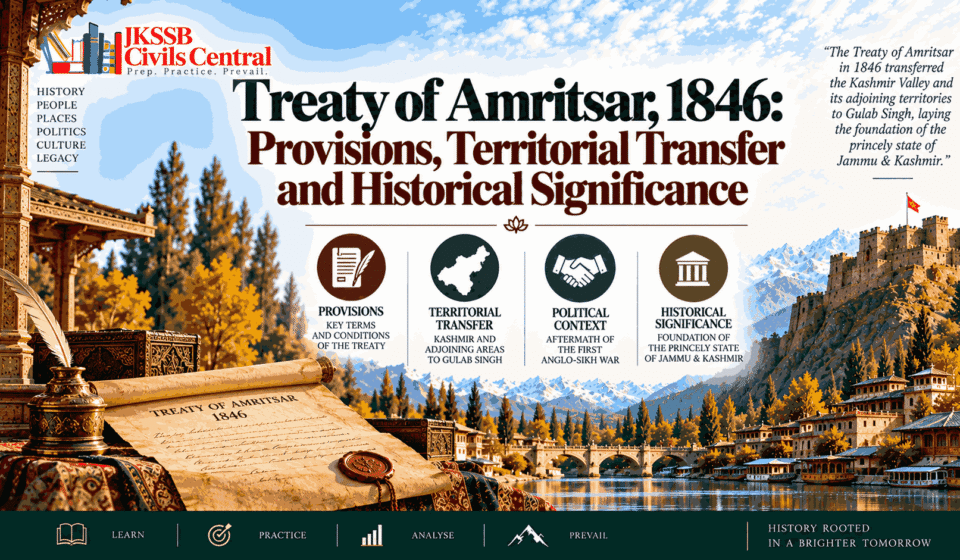
Treaty of Amritsar, 1846: Provisions, Territorial Transfer and Historical Significance

J&K History Series Navigation
| Previous Article | Current Article | Next Article |
|---|---|---|
| Article 34 — First Anglo-Sikh War, Treaty of Lahore and Formation of Jammu & Kashmir in 1846 | Article 35 — Treaty of Amritsar, 1846: Provisions, Territorial Transfer and Historical Significance | Article 36 — Dogra Rule in Jammu & Kashmir: Gulab Singh and the Consolidation of the Princely State |
Learning Dashboard
| Component | Key Information |
|---|---|
| Historical Period | 1846 |
| Historical Phase | Formation of the Dogra princely state |
| Treaty | Treaty of Amritsar |
| Date | 16 March 1846 |
| Principal Parties | British Government and Maharaja Gulab Singh |
| British Governor-General | Sir Henry Hardinge |
| Dogra Ruler | Maharaja Gulab Singh |
| Immediate Background | First Anglo-Sikh War and Treaty of Lahore |
| Core Territorial Issue | Transfer of specified hill and mountainous territories to Gulab Singh |
| Payment | 75 lakh Nanakshahi rupees |
| Key Article | Article I — territorial transfer |
| Other High-Value Articles | II, III, IV, V, VI, VII, VIII, IX, X |
| Political Status | Princely state under British paramountcy |
| Key Historical Result | Formal establishment of the Dogra-ruled State of Jammu and Kashmir |
| JKSSB Importance | Very High |
| Expected Question Types | Treaty provisions, chronology, statement-based, territorial identification, matching, conceptual-factual |
Introduction
The Treaty of Amritsar of 16 March 1846 occupies a foundational position in the modern political history of Jammu and Kashmir. Concluded between the British Government and Maharaja Gulab Singh, the treaty transferred specified hill and mountainous territories to Gulab Singh and provided the legal framework for the emergence of the Dogra-ruled princely State of Jammu and Kashmir. The treaty followed immediately after the First Anglo-Sikh War and the Treaty of Lahore, but it was a separate agreement with a different purpose and different parties.
The distinction between the two 1846 treaties is essential. The Treaty of Lahore of 9 March 1846 ended the First Anglo-Sikh War and required the Lahore State to cede extensive territories to the British, including the hill territories between the Beas and Indus that included Kashmir. Article XII of that treaty provided for recognition of Gulab Singh’s independent sovereignty in territories that might subsequently be transferred to him through a separate agreement. The Treaty of Amritsar, signed seven days later, was that separate agreement.
The treaty therefore represents a critical transition in J&K history: Sikh sovereignty over Kashmir ended through the Lahore settlement, while Dogra sovereignty over the territories transferred to Gulab Singh was established through the Treaty of Amritsar. At the same time, this sovereignty was not equivalent to modern international independence. Article X explicitly placed Gulab Singh within the framework of British supremacy, making the new polity a princely state under British paramountcy.
CivilsCentral Historical Insight
The importance of the Treaty of Amritsar lies in its role as the legal instrument through which British territorial acquisition following the First Anglo-Sikh War was converted into a Dogra-ruled princely state. It therefore connects British imperial expansion, the decline of Lahore and the earlier rise of Gulab Singh into a single political transformation.
Part I — Historical Background to the Treaty
The Rise of Gulab Singh
The Treaty of Amritsar cannot be understood without the preceding rise of Gulab Singh. He had emerged as the principal Dogra ruler of Jammu within the political structure of the Sikh Empire under Maharaja Ranjit Singh. His position was strengthened during the 1820s, while the expansion of Dogra power under Zorawar Singh extended the territorial reach of the Jammu-based power into Ladakh and subsequently Baltistan.
Thus, by the time of the First Anglo-Sikh War, Gulab Singh was not merely a local Jammu chief. He possessed a significant political and territorial base and had acquired strategic importance in the western Himalayas. The preceding articles in this series have examined this development in greater detail; for the present treaty, the key point is that the 1846 settlement formalized and enlarged an already developing Dogra political power.
The First Anglo-Sikh War
The First Anglo-Sikh War of 1845–46 transformed the political balance of northern India. Following the British victories, particularly at Sobraon on 10 February 1846, British forces occupied Lahore and imposed the Treaty of Lahore on the Lahore State.
The Treaty of Lahore, signed on 9 March 1846, required the Lahore Government to cede territory and pay a substantial war indemnity. The Lahore State’s inability to meet the entire indemnity led to the cession of the hill territories between the Beas and Indus, including Kashmir and Hazara, to the British.
Article XII of the Lahore settlement then provided the diplomatic opening for a separate agreement with Gulab Singh. The Treaty of Amritsar followed on 16 March 1846.
CivilsCentral Historical Insight
The Treaty of Amritsar was not an isolated agreement. It was the second stage of the post-war restructuring of 1846: Lahore first transferred territory to the British, and the British then transferred specified territory to Gulab Singh.
Part II — Why a Separate Treaty with Gulab Singh Was Concluded
The British victory over the Lahore State created a new territorial problem. The British had acquired extensive hill territories through the Treaty of Lahore, but the political and administrative arrangements for those territories still had to be determined.
Gulab Singh offered a politically useful alternative to direct British administration. He already possessed Jammu, had expanded Dogra power into the western Himalayas, and was an established regional ruler. The British therefore negotiated a separate agreement through which specified territories were transferred to him.
The arrangement also served broader British strategic interests. A Dogra-ruled state occupying the Himalayan region could function as a political intermediary between British India and the northern frontier. The settlement simultaneously reduced the territorial reach of the defeated Lahore State and created a new political authority in the mountains.
This should not be interpreted as evidence that the British acted for only one reason. Financial considerations, post-war territorial reorganization, strategic interests, relations with Gulab Singh and the practical question of governing mountain territories all formed part of the wider context.
Part III — The Treaty of Amritsar: Date, Parties and Character
The treaty was concluded at Amritsar on 16 March 1846.
It was settled on behalf of the British Government by Frederic Currie and Brevet-Major Henry Montgomery Lawrence, acting under the direction of Sir Henry Hardinge, Governor-General of India. Gulab Singh signed the treaty personally, and it was ratified by Hardinge. The document consisted of ten articles.
The treaty’s formal character is important. It was not a peace treaty ending the Anglo-Sikh War—that was the function of the Treaty of Lahore. Nor was it simply an internal appointment by the British. It was a bilateral agreement between the British Government and Gulab Singh that transferred specified territories to him and established the political obligations governing his relationship with the British.
The treaty therefore combined three dimensions:
Territorial transfer
→ financial consideration
→ political subordination within British paramountcy
Part IV — Article I: Territorial Transfer
The Core Provision
Article I is the most important provision of the Treaty of Amritsar for J&K history.
The British Government transferred and made over, in perpetuity and in independent possession, to Maharaja Gulab Singh and the male heirs of his body, the hilly or mountainous country and its dependencies situated east of the Indus and west of the Ravi, including Chamba and excluding Lahul, insofar as these territories formed part of the territories ceded to the British Government by the Lahore Darbar under Article IV of the Treaty of Lahore.
This wording establishes several important facts.
First, the territory was not being transferred from the Lahore State directly to Gulab Singh. The British had first acquired it through the Treaty of Lahore.
Second, the treaty described the transfer as being made in independent possession, which gave Gulab Singh substantial authority over the transferred territory.
Third, the territorial description was geographically broad and was not simply a reference to the Kashmir Valley.
Fourth, the treaty specifically mentioned Chamba while excluding Lahul.
Part V — Understanding the Territorial Scope
Kashmir Was the Central Component
The territorial transfer included Kashmir, which had been ceded by the Lahore State to the British under the earlier Treaty of Lahore. This was the principal development that brought the Kashmir Valley under Dogra rule.
However, the geographical language of Article I is important because it prevents the treaty from being reduced to the simplistic statement:
“The British sold Kashmir to Gulab Singh.”
The treaty transferred a specified complex of hilly and mountainous territories, not merely an isolated valley.
Jammu
Gulab Singh already ruled Jammu before the Treaty of Amritsar. Therefore, the treaty should not be described as creating his authority over Jammu from nothing. Instead, it added the territories transferred under the treaty to the political domain already controlled by him.
Ladakh and Baltistan
The Dogras had already established their authority over Ladakh and Baltistan through the campaigns associated with Zorawar Singh before 1846. Consequently, the Treaty of Amritsar should not be described as if it were the original Dogra conquest of Ladakh and Baltistan.
Their earlier incorporation into Gulab Singh’s political sphere formed part of the background against which the 1846 state took shape.
Hazara
A particularly important examination distinction is that Hazara had been ceded to the British under the Treaty of Lahore but was not included in the territorial transfer to Gulab Singh under Article I of the Treaty of Amritsar. The geographical wording of Article I—east of the Indus and west of the Ravi—does not encompass Hazara west of the Indus.
This is an excellent example of why students should read treaty provisions rather than relying on simplified descriptions of the settlement.
CivilsCentral Historical Insight
The territorial history of 1846 is more precise than the popular phrase “sale of Kashmir” suggests. The Treaty of Lahore transferred a wider set of territories to the British, while the Treaty of Amritsar transferred a defined portion of the acquired hill territories to Gulab Singh. The distinction is crucial for reconstructing the actual territorial formation of the princely state.
Part VI — Article II: Delimitation of the Eastern Boundary
Article II provided that the eastern boundary of the territory transferred to Gulab Singh would be determined by commissioners appointed separately by the British Government and Gulab Singh.
The boundary was therefore not treated as completely settled by the broad geographical description in Article I. A survey and subsequent agreement were required to define the eastern limit.
This provision is historically important because it demonstrates that territorial sovereignty and boundary demarcation were not always identical processes. The treaty established the broad legal transfer, while subsequent surveying and boundary work were necessary to translate that arrangement into a more precisely defined territorial frontier.
This becomes particularly significant for the later history of Ladakh and the northern Himalayan frontier, where questions of surveying, boundaries and competing territorial understandings became increasingly important.
Part VII — Article III: The Payment of 75 Lakh Rupees
Article III specified the financial consideration for the territorial transfer.
Gulab Singh agreed to pay the British Government:
75 lakh rupees (Nanakshahi)
The treaty specified:
- 50 lakh rupees on ratification of the treaty
- 25 lakh rupees on or before 1 October 1846
Thus:
50 lakh + 25 lakh = 75 lakh rupees
The amount is one of the most frequently tested facts relating to the Treaty of Amritsar.
Was the Entire Amount Paid Immediately?
The treaty specified the payment schedule, but the actual settlement of the full amount extended beyond the original schedule according to later documentary evidence. Scholarship drawing upon British records indicates that the final payment was made later, with evidence pointing to March 1850 for the last installment.
Therefore, students should distinguish:
Treaty obligation: 75 lakh rupees
from
actual completion of payment: later than the original 1 October 1846 deadline.
This distinction is useful because historical treaties specify obligations, while implementation can occur over a different period.
CivilsCentral Historical Insight
Article III illustrates the difference between the treaty’s legal terms and its later implementation. The treaty established a 75-lakh financial obligation, but the historical record indicates that completion of payment took longer than the schedule initially specified.
Part VIII — Was Kashmir “Sold”?
The phrase “sale of Kashmir” has become deeply embedded in later political and historical discourse. It derives from the fact that Article III linked the territorial transfer with a substantial monetary payment.
However, as a historical resource, the phrase requires qualification.
The treaty itself describes the arrangement as a transfer of territory to Gulab Singh in consideration of payment. Modern scholarship has also cautioned against treating the popular “sale” formulation as a complete description of the legal and political process. A major Cambridge study on Gulab Singh and the creation of the Dogra state explicitly notes the controversy over whether Kashmir and Ladakh should be described as having been “sold” or “transferred,” and concludes that the documentary structure is better understood as a transfer, with the pecuniary settlement being specified in the subsequent Treaty of Amritsar.
At the same time, the language of “sale” became historically powerful because the treaty involved a direct monetary payment and because later Kashmiri political memory interpreted the settlement as the transfer of a territory and its population without their participation in the agreement.
Therefore, a balanced formulation is:
The Treaty of Amritsar transferred specified territories to Gulab Singh in return for a payment of 75 lakh Nanakshahi rupees; the later description of this as the “sale of Kashmir” reflects a powerful political and historiographical interpretation of that arrangement.
This preserves both the documentary fact and the later historical memory.
Part IX — Article IV: Limits of the Territory
Article IV provided that the limits of Gulab Singh’s territories could not subsequently be changed without the concurrence of the British Government.
This provision demonstrates that the treaty did not establish an unrestricted external sovereignty for Gulab Singh. Territorial questions involving the new state remained connected to British authority.
The provision also illustrates the unequal nature of the political relationship. Gulab Singh received extensive territorial possession, but the British retained a decisive role in questions affecting the state’s territorial boundaries.
Part X — Article V: British Arbitration
Article V required Gulab Singh to refer disputes or questions arising between himself and the Government of Lahore or another neighbouring state to the arbitration of the British Government and to abide by its decision.
This clause placed the British in the position of a superior political arbiter.
It was particularly significant in a region where territorial boundaries and relations with neighbouring states could generate disputes. Instead of leaving Gulab Singh to conduct these matters entirely through independent diplomacy, the treaty incorporated British arbitration into the political structure of the new state.
This is one of the clearest indicators that the treaty created princely autonomy under paramountcy rather than complete sovereign independence.
Part XI — Article VI: Military Cooperation
Article VI required Gulab Singh, for himself and his heirs, to join the British forces with his military forces when British troops were employed in the hills or in territories adjoining his possessions.
This provision had strategic importance.
The British acquired a formal military commitment from the new Dogra ruler at a time when the Himalayan and north-western frontier was becoming increasingly important to British strategic thinking.
For Gulab Singh, the arrangement also reflected the reality that his new state existed within a larger imperial security structure.
The clause should therefore be understood as part of the wider political relationship rather than simply as a military alliance between equal sovereign states.
Part XII — Article VII: Restrictions on Foreign Military and Political Personnel
Article VII restricted Gulab Singh from taking or retaining in his service British subjects or subjects of European or American states without British consent.
This provision limited the ruler’s freedom to independently recruit foreign personnel.
Such restrictions were consistent with the broader British objective of controlling foreign political and military influence within princely territories. They also reflected British concerns about European involvement in the Himalayan and north-western frontier during the nineteenth century.
For examination purposes, Article VII is less important than Articles I, III and X, but it helps explain the wider structure of the treaty.
Part XIII — Article VIII: Application of Earlier Lahore Provisions
Article VIII required Gulab Singh to respect, in relation to the transferred territory, specified provisions of the separate engagement concluded between the British Government and the Lahore Darbar on 11 March 1846.
This provision linked the Treaty of Amritsar directly to the broader post-war settlement.
It is another indication that the treaty should not be studied in isolation. The political system created in 1846 was assembled through several connected agreements:
Treaty of Lahore — 9 March 1846
↓
Supplementary engagement — 11 March 1846
↓
Treaty of Amritsar — 16 March 1846
The Treaty of Amritsar incorporated selected obligations from the earlier settlement into Gulab Singh’s relationship with the British.
Part XIV — Article IX: British Protection
Article IX stated that the British Government would assist Gulab Singh in protecting his territories against external enemies.
This provision gave the new ruler an important security guarantee.
At the same time, it reinforced the unequal political relationship. British protection and Gulab Singh’s acknowledgment of British supremacy were complementary elements of the same system.
The new state therefore enjoyed substantial internal political authority while relying upon the wider British imperial framework for external security.
Part XV — Article X: British Supremacy
Article X is one of the most important provisions for understanding the political status of Jammu and Kashmir after 1846.
It stated that Maharaja Gulab Singh acknowledged the supremacy of the British Government.
In symbolic recognition of that supremacy, he was required to present annually:
- one horse;
- twelve perfect shawl goats of approved breed, six male and six female;
- three pairs of Kashmiri shawls.
The annual presentation was therefore not merely an economic arrangement. It symbolized the political relationship between the Maharaja and the British Government.
The clause is particularly important because it prevents an inaccurate characterization of the new state as an entirely independent sovereign country.
The correct political formulation
Gulab Singh possessed internal princely authority but acknowledged British paramountcy.
This relationship continued as a defining feature of the princely state until the end of British paramountcy in 1947.
CivilsCentral Historical Insight
Article X captures the central contradiction of the 1846 settlement: the Dogra ruler gained a large territorial state and substantial internal authority, but that authority existed within a superior British imperial framework. The state was therefore autonomous in many internal matters without being independent in the modern international sense.
Part XVI — The Ten Articles at a Glance
| Article | Principal Subject | Historical Significance |
|---|---|---|
| I | Territorial transfer | Specified hill and mountainous territories transferred to Gulab Singh |
| II | Eastern boundary | Boundary to be determined after survey |
| III | Payment | 75 lakh Nanakshahi rupees |
| IV | Territorial limits | Boundaries could not be changed without British concurrence |
| V | Arbitration | British Government to arbitrate specified disputes |
| VI | Military cooperation | Gulab Singh to support British forces in specified circumstances |
| VII | Foreign subjects | Restrictions on employing British/European/American subjects |
| VIII | Earlier Lahore provisions | Certain 11 March 1846 obligations extended to transferred territory |
| IX | British protection | British aid against external enemies |
| X | British supremacy | Gulab Singh acknowledged British supremacy |
Part XVII — From Treaty to Actual Control of Kashmir
The signing of the Treaty of Amritsar did not mean that Gulab Singh immediately exercised uncontested control over every territory included in the settlement.
This distinction is particularly important for the Kashmir Valley. Sheikh Imam-ud-Din, who had been appointed governor of Kashmir under the Lahore regime, initially refused to hand over the province to Gulab Singh. The resulting resistance required British intervention, and Gulab Singh’s effective control over Kashmir was established later in 1846, with British records indicating that Kashmir came under his official control in November.
Therefore:
16 March 1846 = treaty and formal territorial transfer
but
later 1846 = establishment of effective Dogra control in Kashmir
This is an important chronological distinction.
It also demonstrates a broader principle of historical analysis:
Legal sovereignty and effective administrative control are not always established on exactly the same date.
Part XVIII — Formation of the Princely State of Jammu and Kashmir
The Treaty of Amritsar is widely treated as the foundational document in the formation of the princely State of Jammu and Kashmir. Modern scholarship describes 1846 as the beginning of Kashmir’s modern political history in the sense that the treaty created a new princely polity under Gulab Singh and his successors.
The state, however, was not constructed from a historically uniform territory.
It brought together:
- Jammu, the pre-existing political base of Gulab Singh;
- Kashmir Valley, previously governed under the Sikh regime;
- Ladakh, already brought under Dogra authority through earlier campaigns;
- Baltistan and associated frontier territories, connected with earlier Dogra expansion;
- additional hill territories covered by the 1846 settlement.
These regions differed considerably in geography, political history, economic activity, language, religious composition and patterns of local authority.
The Treaty therefore created a common political framework, but it did not erase regional historical differences.
Part XIX — 1846 as a Turning Point in J&K History
From Jammu Rulership to a Multi-Regional Princely State
Before 1846, Gulab Singh’s political identity was primarily associated with Jammu and Dogra expansion. After the treaty, he became ruler of a much larger territorial formation.
This represented a fundamental change in political scale.
The Dogra ruling house now had to administer territories stretching from the Jammu region into the Kashmir Valley and across high Himalayan frontier zones. The diversity of these territories would subsequently shape the administrative and political history of the state.
From Sikh Paramountcy to British Paramountcy
The treaty also marked a change in the external political framework.
Before 1846, Gulab Singh’s rise had occurred within the Sikh imperial order. After 1846, his princely state existed under British supremacy.
Thus, the political transition can be summarized as:
Sikh paramountcy
↓
British victory over Lahore
↓
Dogra territorial consolidation
↓
British paramountcy over the new princely state
Part XX — Why the Treaty Was Historically Significant
1. Creation of the Dogra Princely State
The most important consequence was the establishment of the political framework of the princely State of Jammu and Kashmir under Gulab Singh.
2. Transfer of Kashmir to Dogra Rule
The treaty brought Kashmir under the rule of the Dogra dynasty.
3. Expansion of Gulab Singh’s Political Authority
Gulab Singh’s authority expanded from Jammu into a much larger Himalayan political formation.
4. British Strategic Advantage
The British obtained a strategically useful princely state on the Himalayan frontier without assuming direct administration of every transferred mountain territory.
5. Beginning of Dogra Dynastic Rule
The treaty established the political framework under which Gulab Singh and his successors ruled the princely state until 1947.
6. Long-Term Administrative Consequences
The new state required the integration of geographically and historically diverse territories into a common administrative system.
7. Long-Term Political Consequences
The political structure created in 1846 became the institutional framework within which later developments—including political awakening, constitutional change and the crisis of 1947—unfolded.
CivilsCentral Historical Insight
The deepest significance of the Treaty of Amritsar lies in its long-term consequences rather than merely in the territorial transaction of 1846. It created the princely-state framework within which the political history of Jammu, Kashmir and the frontier regions developed for the next century.
Part XXI — Historical Interpretation and the “Sale of Kashmir” Debate
The Treaty of Amritsar has generated sharply different interpretations.
One interpretation emphasizes the treaty as a formal instrument of British-Dogra state formation. From this perspective, the agreement transferred territory acquired from the Lahore State to an established regional ruler and created a new princely polity.
A second interpretation emphasizes the colonial and financial character of the settlement. The fact that Gulab Singh paid 75 lakh rupees for the territorial transfer has led later writers to characterize the arrangement as the “sale of Kashmir.” This interpretation became particularly powerful in later Kashmiri political discourse.
A third approach focuses on the agency of Gulab Singh. Rather than treating him simply as a passive recipient of British favour, this interpretation places the treaty within the longer history of Dogra political and military expansion. Gulab Singh had already established a territorial base and negotiated from a position created partly by his earlier political rise.
A fourth approach emphasizes the consequences for the inhabitants of the transferred territories. The treaty was negotiated between rulers and did not provide a mechanism for popular participation or consent. This fact became important in later political memory and in twentieth-century critiques of Dogra rule.
These interpretations are not mutually exclusive. A historically balanced account can recognize simultaneously that:
the treaty was a legal territorial transfer;
it involved a substantial financial payment;
it served British strategic interests;
it strengthened Gulab Singh’s political position;
and
it had major consequences for populations who were not parties to the agreement.
Part XXII — Was the State Completely Independent?
No.
This is one of the most important conceptual distinctions.
The Treaty of Amritsar granted Gulab Singh possession of the transferred territories and established his hereditary position, but Article X explicitly acknowledged British supremacy.
The relationship can therefore be represented as:
Internal princely authority
British paramountcy
=
Princely State
This was the general political framework of British India in which princely rulers exercised substantial internal authority while accepting the superior position of the British Crown.
Therefore, avoid describing Gulab Singh’s state after 1846 as:
- a fully independent modern nation-state;
- a British province;
- a direct British colony.
The most accurate examination term is:
Princely State under British paramountcy.
Part XXIII — Treaty of Amritsar vs Treaty of Lahore
This distinction deserves special emphasis because it is one of the most likely areas for statement-based questions.
| Feature | Treaty of Lahore | Treaty of Amritsar |
|---|---|---|
| Date | 9 March 1846 | 16 March 1846 |
| Main Parties | British Government and Lahore State | British Government and Gulab Singh |
| Purpose | End First Anglo-Sikh War | Transfer specified territories to Gulab Singh |
| Kashmir | Ceded by Lahore to British | Transferred by British to Gulab Singh |
| Article IV | Hill territories including Kashmir and Hazara | — |
| Article XII | Separate settlement with Gulab Singh | — |
| Article I | — | Territorial transfer to Gulab Singh |
| Article III | War indemnity framework | 75 lakh rupees |
| Article X | — | British supremacy acknowledged |
| Historical Result | Sikh sovereignty ended over ceded territories | Dogra princely state formally established |
The examination formula
Lahore Treaty = Lahore → British
Amritsar Treaty = British → Gulab Singh
Part XXIV — Treaty of Amritsar and the Broader Dogra State
The Treaty of Amritsar should not be treated as the entire history of the Dogra state. It was the foundational settlement, but the actual process of state consolidation continued after 1846.
Gulab Singh had to establish effective authority over territories that had previously been governed through different political structures. The new state also required mechanisms for revenue collection, law, military organization, communication and relations between regional authorities.
These developments belong principally to the subsequent history of Dogra rule, which is examined in the next article of the series.
This division is important for maintaining the chronological architecture of the series:
Article 35: Why and how the state was created.
Article 36 onward: How the state was governed and consolidated.
Part XXV — Historical Sources and Evidence Note
The Treaty of Amritsar is supported by unusually strong documentary evidence because the treaty text itself survives and has been reproduced in authoritative collections of treaties and historical works.
The most important primary evidence is the treaty text of 16 March 1846, which establishes the ten articles, territorial transfer, financial obligation and political relationship with the British.
The Treaty of Lahore must be read alongside it because Article I of the Treaty of Amritsar explicitly refers back to the territories ceded by the Lahore Darbar under Article IV of the Lahore treaty.
British political correspondence and later historical scholarship are particularly useful for understanding the implementation of the treaty. Cambridge’s publication of the Hardinge Letters, for example, records that the treaty making Gulab Singh Maharaja of Kashmir and other mountain territories was signed at Amritsar on 16 March 1846 and notes the later difficulty created by Sheikh Imam-ud-Din’s refusal to surrender Kashmir.
Modern scholarship also demonstrates that the interpretation of the treaty is not entirely uniform. The distinction between “sale” and “transfer,” the role of Gulab Singh during the First Anglo-Sikh War, and the political meaning of the treaty have all generated historiographical debate. Such interpretations should be kept separate from the treaty’s undisputed documentary provisions.
Part XXVI — JKSSB Knowledge Matrix
| Question | Answer |
|---|---|
| Treaty name | Treaty of Amritsar |
| Date | 16 March 1846 |
| Place | Amritsar |
| Main parties | British Government and Gulab Singh |
| British Governor-General | Sir Henry Hardinge |
| Dogra ruler | Maharaja Gulab Singh |
| Number of articles | 10 |
| Most important territorial article | Article I |
| Boundary article | Article II |
| Payment article | Article III |
| Payment | 75 lakh Nanakshahi rupees |
| Territorial limitation | Article IV |
| Arbitration | Article V |
| Military cooperation | Article VI |
| Foreign personnel restriction | Article VII |
| Earlier Lahore provisions | Article VIII |
| British protection | Article IX |
| British supremacy | Article X |
| Kashmir’s political transition | Sikh → British → Gulab Singh |
| Status after treaty | Princely state under British paramountcy |
| Key preceding treaty | Treaty of Lahore, 9 March 1846 |
| Key predecessor ruler/system | Lahore Darbar / Sikh rule |
| Key successor phase | Consolidation of Dogra rule |
Part XXVII — Examination Discrimination Points
1. Treaty of Amritsar — 1846 vs Treaty of Amritsar — 1809
There were two important treaties associated with Amritsar in Sikh history.
- 1809: Treaty between Ranjit Singh and the British East India Company
- 1846: Treaty between the British Government and Gulab Singh
Do not confuse them.
2. Treaty of Lahore vs Treaty of Amritsar
Lahore: 9 March 1846
Amritsar: 16 March 1846
3. Article I vs Article III
Article I: Territorial transfer
Article III: 75 lakh rupee payment
4. Article VI vs Article IX
Article VI: Gulab Singh’s military cooperation with British forces
Article IX: British assistance in protecting Gulab Singh’s territories against external enemies
5. Article X
Article X is associated with:
British supremacy
not territorial transfer.
6. Kashmir vs Hazara
Both were included in the territories ceded by Lahore to the British under the Treaty of Lahore.
But the Treaty of Amritsar’s Article I transferred the specified territories east of the Indus and west of the Ravi to Gulab Singh; Hazara was not part of that transfer to Gulab Singh.
7. Formal transfer vs effective control
16 March 1846: Treaty signed.
Later 1846: Gulab Singh established effective control over Kashmir after resistance from Sheikh Imam-ud-Din.
8. 1822 vs 1846
1822: Gulab Singh recognized as Raja of Jammu.
1846: Larger princely State of Jammu and Kashmir established.
Part XXVIII — JKSSB Question Pattern
Direct Fact
The Treaty of Amritsar was signed on:
A. 26 March 1846
B. 16 March 1846
C. 9 March 1846
D. 10 February 1846
Answer: B
Statement-Based
Consider the following statements about the Treaty of Amritsar of 1846:
- It was signed between the British Government and Gulab Singh.
- Article III specified a payment of 75 lakh Nanakshahi rupees.
- Article X acknowledged British supremacy.
- It ended the First Anglo-Sikh War.
Which of the above are correct?
A. 1 and 2 only
B. 1, 2 and 3 only
C. 2, 3 and 4 only
D. 1, 2, 3 and 4
Answer: B
Why? The Treaty of Lahore, not the Treaty of Amritsar, ended the First Anglo-Sikh War.
Chronology
Arrange the following:
- Treaty of Amritsar
- Battle of Sobraon
- Treaty of Lahore
- Gulab Singh’s recognition as Raja of Jammu
A. 4–2–3–1
B. 2–4–3–1
C. 4–3–2–1
D. 2–3–4–1
Answer: A
Match the Following
| Article | Provision |
|---|---|
| A. Article I | 1. British supremacy |
| B. Article III | 2. Territorial transfer |
| C. Article VI | 3. 75 lakh rupees |
| D. Article X | 4. Military cooperation |
Answer: A–2, B–3, C–4, D–1
Identification by Clues
Identify the treaty:
- Signed at Amritsar
- 16 March 1846
- British Government and Gulab Singh
- Ten articles
- 75 lakh rupees
- British supremacy acknowledged
Answer: Treaty of Amritsar, 1846
Correct / Incorrect Pair
Which pair is correctly matched?
A. Article I — 75 lakh rupees
B. Article III — Territorial transfer
C. Article VI — Military cooperation
D. Article X — Eastern boundary
Answer: C
Conceptual-Factual
Which statement best describes the political status created by the Treaty of Amritsar?
A. Gulab Singh became ruler of a fully independent sovereign republic.
B. Jammu and Kashmir became a directly administered British province.
C. Gulab Singh became ruler of a princely state acknowledging British supremacy.
D. Kashmir remained under the Lahore Darbar.
Answer: C
Part XXIX — JKSSB Practice Questions
Question 1
The Treaty of Amritsar of 1846 was signed between:
A. Ranjit Singh and the British
B. Duleep Singh and Gulab Singh
C. British Government and Gulab Singh
D. Gulab Singh and the Afghan ruler
Correct Answer: C
Explanation: The Treaty of Amritsar was concluded between the British Government and Maharaja Gulab Singh on 16 March 1846.
Question 2
Which article of the Treaty of Amritsar dealt primarily with the territorial transfer?
A. Article I
B. Article III
C. Article V
D. Article X
Correct Answer: A
Question 3
The amount specified in Article III of the Treaty of Amritsar was:
A. 25 lakh rupees
B. 50 lakh rupees
C. 75 lakh rupees
D. 1 crore rupees
Correct Answer: C
Question 4
Consider the following statements:
- Article X acknowledged British supremacy.
- Article VI concerned military cooperation.
- Article III concerned the eastern boundary.
- Article II concerned boundary determination.
Which are correct?
A. 1 and 2 only
B. 1, 2 and 4 only
C. 2 and 3 only
D. 1, 2, 3 and 4
Correct Answer: B
Explanation: Article III concerned the 75-lakh payment, not the eastern boundary. Article II dealt with determination of the eastern boundary.
Question 5
Which territory was specifically included in Article I of the Treaty of Amritsar?
A. Chamba
B. Lahul
C. Hazara
D. Kangra
Correct Answer: A
Explanation: Article I expressly included Chamba and excluded Lahul. Hazara had been ceded to the British under the Treaty of Lahore but was not transferred to Gulab Singh under the Treaty of Amritsar.
Question 6
Which of the following best explains why the Treaty of Amritsar did not establish complete sovereign independence for Gulab Singh?
A. He remained subordinate to the Lahore Darbar.
B. Article X acknowledged British supremacy.
C. He had no territorial authority.
D. He was appointed as a British provincial governor.
Correct Answer: B
Question 7
The Treaty of Amritsar followed the Treaty of Lahore by approximately:
A. One day
B. Three days
C. One week
D. One month
Correct Answer: C
Explanation: Treaty of Lahore — 9 March 1846; Treaty of Amritsar — 16 March 1846.
Question 8
Which sequence correctly represents the political transfer of Kashmir in 1846?
A. Lahore → Gulab Singh → British
B. British → Lahore → Gulab Singh
C. Lahore → British → Gulab Singh
D. Gulab Singh → Lahore → British
Correct Answer: C
Part XXX — Rapid Revision Zone
Important Dates
- 1822 — Gulab Singh recognized as Raja of Jammu
- 1834 — Beginning of Dogra conquest of Ladakh
- 1840 — Dogra expansion into Baltistan
- 1845–46 — First Anglo-Sikh War
- 10 February 1846 — Battle of Sobraon
- 9 March 1846 — Treaty of Lahore
- 16 March 1846 — Treaty of Amritsar
- Later 1846 — Gulab Singh established effective control over Kashmir
Treaty of Amritsar — Core Facts
Date: 16 March 1846
Place: Amritsar
Parties: British Government + Gulab Singh
Articles: 10
Payment: 75 lakh Nanakshahi rupees
Main territorial article: Article I
British supremacy: Article X
Important Articles
Article I → Territorial transfer
Article II → Eastern boundary
Article III → 75 lakh rupees
Article IV → Territorial limits
Article V → British arbitration
Article VI → Military cooperation
Article VII → Restriction on foreign subjects in service
Article VIII → Earlier Lahore provisions
Article IX → British protection
Article X → British supremacy
Territorial Formula
East of Indus
West of Ravi
Chamba included
−
Lahul excluded
Political Formula
Gulab Singh’s internal authority
British supremacy
=
Princely State
Part XXXI — Frequently Confused Facts
Treaty of Amritsar, 1809 vs 1846
1809: Ranjit Singh–British treaty
1846: Gulab Singh–British treaty
Treaty of Lahore vs Treaty of Amritsar
9 March 1846: Treaty of Lahore
16 March 1846: Treaty of Amritsar
Kashmir’s Transfer
Lahore State → British: Treaty of Lahore
British → Gulab Singh: Treaty of Amritsar
Payment
Treaty of Amritsar: 75 lakh Nanakshahi rupees
Do not confuse this with the one-crore war indemnity imposed upon the Lahore State under the wider post-war settlement.
Article I vs Article X
Article I: Territory
Article X: British supremacy
Chamba vs Lahul
Chamba: included
Lahul: excluded
Hazara
Hazara was included in the territorial cession from Lahore to the British but was not transferred to Gulab Singh under the Treaty of Amritsar.
Treaty date vs effective control
16 March 1846: treaty signed
Later 1846: effective Dogra control established in Kashmir after resistance.
Part XXXII — What Can JKSSB Ask?
From the Treaty of Amritsar, high-value examination areas include:
- exact date — 16 March 1846
- place — Amritsar
- parties — British Government and Gulab Singh
- number of articles — 10
- Article I — territorial transfer
- Article II — eastern boundary
- Article III — 75 lakh rupees
- Article V — British arbitration
- Article VI — military cooperation
- Article IX — British protection
- Article X — British supremacy
- Chamba included
- Lahul excluded
- Hazara distinction
- Treaty of Lahore vs Treaty of Amritsar
- “sale” vs “transfer” interpretation
- formal treaty vs effective control
- princely state vs fully independent sovereign state
- relationship between Dogra authority and British paramountcy
Highest-Value Statement Trap
“The Treaty of Amritsar directly transferred Kashmir from the Lahore Darbar to Gulab Singh.”
Incorrect.
The sequence was:
Lahore Darbar → British Government → Gulab Singh
Chapter Summary
The Treaty of Amritsar of 16 March 1846 was the principal legal instrument through which the British transferred specified hill and mountainous territories to Maharaja Gulab Singh after the First Anglo-Sikh War. It followed the Treaty of Lahore of 9 March 1846, under which the Lahore State had ceded extensive territories to the British. Article XII of the Lahore settlement provided the framework for a separate agreement with Gulab Singh, resulting in the Treaty of Amritsar.
The most important provision was Article I, which transferred to Gulab Singh and his male heirs in independent possession the specified hilly or mountainous territories east of the Indus and west of the Ravi, including Chamba and excluding Lahul. Article II provided for the subsequent determination of the eastern boundary, while Article III required Gulab Singh to pay 75 lakh Nanakshahi rupees. The remaining articles established territorial limitations, British arbitration, military cooperation, restrictions on foreign personnel, British protection and, most importantly, Gulab Singh’s acknowledgment of British supremacy under Article X.
The treaty therefore did not establish an independent modern nation-state. It established a princely state under British paramountcy, ruled by Gulab Singh and his successors. Its significance extended far beyond the financial and territorial provisions of 1846 because it created the political framework within which Jammu, Kashmir, Ladakh and associated frontier territories were subsequently governed as one princely polity.
The treaty also requires careful chronological interpretation. Its signing on 16 March 1846 established the formal legal settlement, but effective Dogra control over Kashmir followed only after resistance from Sheikh Imam-ud-Din was overcome later in 1846. Thus, the formation of the state involved both legal transfer and subsequent political consolidation.
JKSSB Takeaway
Memorize this chain:
Treaty of Lahore — 9 March 1846
↓
Lahore cedes hill territories to British
↓
Treaty of Amritsar — 16 March 1846
↓
British transfer specified territories to Gulab Singh
↓
Article I — Territory
↓
Article III — 75 lakh rupees
↓
Article X — British supremacy
↓
Dogra princely State of Jammu and Kashmir
Mind Map
TREATY OF AMRITSAR — 1846
First Anglo-Sikh War
↓
British victory
↓
Treaty of Lahore — 9 March 1846
↓
Lahore cedes hill territories to British
↓
Article XII — separate settlement with Gulab Singh
↓
Treaty of Amritsar — 16 March 1846
↓
Article I
Territorial transfer
↓
Article II
Eastern boundary
↓
Article III
75 lakh rupees
↓
Articles IV–VIII
Territorial / arbitration / military / administrative obligations
↓
Article IX
British protection
↓
Article X
British supremacy
↓
Dogra Princely State
↓
Gulab Singh and successors
↓
Dogra consolidation
↓
Later political and constitutional history of J&K
FAQs
1. When was the Treaty of Amritsar signed?
The Treaty of Amritsar was signed on 16 March 1846.
2. Who signed the Treaty of Amritsar?
It was concluded between the British Government and Maharaja Gulab Singh.
3. How many articles did the treaty contain?
The treaty contained ten articles.
4. Which article transferred the territory to Gulab Singh?
Article I dealt with the territorial transfer.
5. How much did Gulab Singh agree to pay?
He agreed to pay 75 lakh Nanakshahi rupees under Article III.
6. Which article acknowledged British supremacy?
Article X.
7. Was Kashmir directly transferred from the Sikh government to Gulab Singh?
No. The Lahore State first ceded the relevant territory to the British under the Treaty of Lahore; the British subsequently transferred the specified territory to Gulab Singh under the Treaty of Amritsar.
8. Did the Treaty of Amritsar include Hazara?
No. Although Hazara was among the territories ceded by Lahore to the British under the Treaty of Lahore, it was not included in the territorial transfer to Gulab Singh under Article I of the Treaty of Amritsar.
9. Was Gulab Singh completely independent after the treaty?
No. He exercised substantial princely authority but explicitly acknowledged British supremacy.
10. Why is the Treaty of Amritsar important in J&K history?
Because it provided the legal foundation for the Dogra-ruled princely State of Jammu and Kashmir, whose political structure continued until the end of British paramountcy in 1947.
About The Author




[…] Article 35 — Treaty of Amritsar, 1846: Provisions, Territorial Transfer and Historical Significanc… […]
[…] Article 35 — Treaty of Amritsar, 1846: Provisions, Territorial Transfer and Historical Significanc… […]