
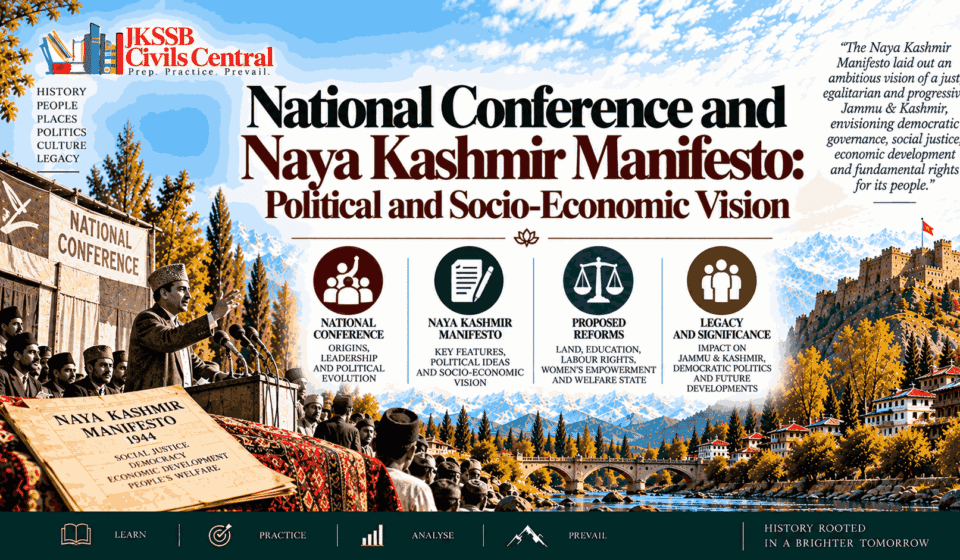
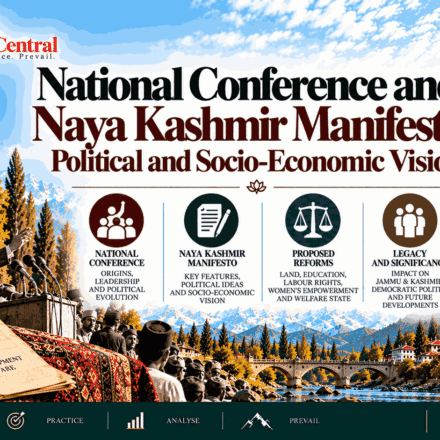
National Conference and Naya Kashmir Manifesto: Political and Socio-Economic Vision

J&K History Series Navigation
| Previous Article | Current Article | Next Article |
|---|---|---|
| Article 42 — Political Awakening in Jammu & Kashmir: Reading Room Party, 1931 and the Muslim Conference | Article 43 — National Conference and Naya Kashmir Manifesto: Political and Socio-Economic Vision | Article 44 — Quit Kashmir Movement, 1946: Causes, Course, Leadership and Political Significance |
Learning Dashboard
| Area | Key Information |
|---|---|
| Historical Period | 1938–1944 |
| Historical Phase | Political Awakening & 20th-Century J&K |
| Core Theme | Transformation from Muslim Conference to National Conference and development of the Naya Kashmir programme |
| Major Organisation | All Jammu & Kashmir National Conference |
| Predecessor | All Jammu & Kashmir Muslim Conference |
| Major Political Turning Point | Renaming of Muslim Conference as National Conference in 1939 |
| Major Programme | Naya Kashmir Manifesto |
| Manifesto Date | September 1944 |
| Important Venue | Sopore |
| Major Personality | Sheikh Mohammad Abdullah |
| Other Important Personalities | Chaudhry Ghulam Abbas, Maulana Mohammad Sayeed Masoodi, B. P. L. Bedi, Freda Bedi, G. M. Sadiq, P. N. Bazaz |
| Political Vision | Responsible government, civil liberties, representative institutions |
| Economic Vision | Planned development, agrarian restructuring, reduction of economic exploitation |
| Social Vision | Education, health, women’s rights, social equality and welfare |
| Important Ideological Influence | Democratic, anti-autocratic and socialist/left-oriented ideas |
| JKSSB Importance | Very High |
| Likely Question Types | Chronology, statement-based, direct fact, matching, conceptual-factual, identification |
Introduction
The political awakening that had developed in Jammu & Kashmir during the late 1920s and early 1930s entered a new phase during the second half of the 1930s. The Muslim Conference, established in 1932, had emerged from the political mobilisation following the events of 1931 and initially articulated the political and socio-economic concerns of the state’s Muslim population. By the late 1930s, however, a section of its leadership increasingly argued that opposition to autocratic rule and the demand for responsible government should be organised on a broader basis rather than primarily through religious identity.
This debate culminated in the transformation of the All Jammu & Kashmir Muslim Conference into the All Jammu & Kashmir National Conference in June 1939. The change was politically significant because it attempted to redefine the movement as one representing the people of the state irrespective of religion. It also brought the organisation more closely into the wider politics of the Indian States Peoples Conference and into contact with leaders of the Indian national movement, particularly Jawaharlal Nehru. However, the transformation was contested, especially among Muslim leaders in Jammu and other regions, and the Muslim Conference was subsequently revived in 1941 under the leadership of Chaudhry Ghulam Abbas.
The second major development was the formulation of the Naya Kashmir Manifesto in 1944. This was not simply an electoral programme. It represented an ambitious political, constitutional, economic and social vision for the future of Jammu & Kashmir. It proposed representative government, civil liberties, equality before the law, expanded rights for women, educational and health institutions, agrarian transformation and a planned economic framework. The document therefore connected the political struggle against autocratic rule with a broader programme for social and economic reconstruction.
Naya Kashmir is particularly important because it reveals how the National Conference leadership had moved beyond the immediate question of political representation towards an attempt to define what a future state should look like. Its programme combined representative government with a strongly socialist economic orientation, while retaining a constitutional role for the Maharaja rather than simply proposing the immediate abolition of the monarchy.
Part I — From Muslim Conference to a Broader Political Movement
The Muslim Conference as the Starting Point
The Muslim Conference had emerged in 1932 from the political awakening discussed in the previous article. Its formation provided an organised political platform for demands concerning representation, education, employment, religious interests and constitutional reform. Its early social base was predominantly Muslim, reflecting the circumstances from which the movement had emerged.
During the following years, however, the political environment changed. The introduction of the Praja Sabha in 1934 created a limited representative institution, but the Maharaja retained substantial authority. Political activists increasingly concluded that limited representation within the existing system was insufficient and that a more comprehensive form of responsible government was necessary.
At the same time, political leaders were debating the relationship between religious identity and political organisation. Sheikh Mohammad Abdullah increasingly argued that the political struggle against autocratic government should unite the different communities of the state. The question was therefore not simply whether Muslims should receive greater representation, but whether the entire political system should become more representative.
This distinction is crucial for understanding the evolution from Muslim Conference to National Conference.
CivilsCentral Historical Insight
The transition from Muslim Conference to National Conference reflected a change in the political definition of the struggle. The central issue increasingly moved from community-specific representation toward the broader question of responsible government for the people of Jammu & Kashmir, although this transformation remained contested and did not produce political unity across the entire state.
Part II — The National Demand and the Politics of 1938
The 1938 Political Turning Point
The move towards a broader political organisation became particularly visible in 1938. The National Conference’s later political direction was preceded by efforts to formulate demands for responsible government that could attract support beyond one religious community.
A document known as the National Demand, published in August 1938, called for the achievement of complete responsible government under the Maharaja. This formulation is important because it demonstrates that the movement’s immediate political objective was not necessarily the abolition of the monarchy but a transformation of its constitutional character.
The demand reflected a developing constitutional imagination: the ruler could remain within a reformed political system, but executive authority would increasingly become responsible to representative institutions. This idea would later reappear in more developed form in the Naya Kashmir programme.
The political developments of 1938 also brought the movement into closer contact with the wider Indian States Peoples movement. Sheikh Abdullah’s political relationship with Jawaharlal Nehru became increasingly important, although the internal politics of Jammu & Kashmir cannot simply be reduced to an extension of Indian National Congress politics.
Responsible Government
The concept of responsible government requires particular attention. In a princely state, the demand meant that the executive should be accountable to representative institutions and, ultimately, to the people rather than functioning solely at the discretion of the hereditary ruler.
Thus, the political progression can be understood as:
Limited representation → demand for responsible government → broader political organisation → constitutional programme.
This progression provides the bridge between the political awakening of 1931–34 and the Naya Kashmir programme of 1944.
CivilsCentral Historical Insight
Responsible government was the constitutional bridge between the protest politics of the early 1930s and the more developed political vision of the 1940s. It shifted the movement from demanding concessions within autocratic government toward demanding a different relationship between the ruler, legislature and people.
Part III — Transformation into the National Conference
The Decision of 1939
The Muslim Conference’s transformation into the National Conference was formally approved at a special session held in Srinagar on 10–11 June 1939. The organisation adopted the name All Jammu & Kashmir National Conference and opened membership to citizens irrespective of religion and race, subject to commitment to responsible government and individual liberties. The National Conference’s own historical account dates the renaming to 11 June 1939.
The decision represented a major ideological shift. The organisation no longer defined its political identity through the word “Muslim” but through the broader political category of the “nation” of Jammu & Kashmir. The new organisational identity sought to bring Muslims, Hindus, Sikhs and other communities into a common political movement.
The change was associated most strongly with Sheikh Mohammad Abdullah, although it was not simply a personal decision. The transformation followed several years of debate within the movement, and figures such as Maulana Mohammad Sayeed Masoodi and others supported the broader political orientation. Academic scholarship also emphasises the influence of secular nationalism, socialism and the wider Indian anti-colonial movement on Abdullah’s evolving political thought.
Chaudhry Ghulam Abbas and the Internal Debate
The transformation was not universally accepted. Chaudhry Ghulam Abbas and other leaders were concerned about the implications of abandoning the Muslim Conference identity. The debate involved questions of political strategy, community representation and relations with the wider Indian political movement.
This disagreement eventually produced a major organisational split. The Muslim Conference was revived in 1941, while the National Conference continued under Sheikh Abdullah’s leadership. The two organisations increasingly represented different political orientations, particularly concerning the relationship between Muslim political identity, Indian nationalism and the future political structure of Jammu & Kashmir.
This development is essential for understanding later politics. The National Conference’s transformation did not eliminate Muslim political mobilisation. Instead, it created two competing political traditions within the state’s politics.
CivilsCentral Historical Insight
The creation of the National Conference broadened the political vocabulary of the movement, but it did not eliminate earlier communal and regional political identities. The revival of the Muslim Conference in 1941 demonstrates that political mobilisation in Jammu & Kashmir remained contested, with different leaders offering different answers to the question of representation and political future.
Part IV — Political Ideology of the National Conference
The National Conference’s political programme developed around several interconnected ideas: responsible government, civil liberties, representative institutions, secular political mobilisation, social equality and economic reform.
The organisation’s emphasis on responsible government reflected dissatisfaction with the concentration of authority in the hands of the Maharaja. Its emphasis on civil liberties reflected the experience of political restrictions during the preceding decade. Its broader membership policy sought to overcome the explicitly Muslim organisational identity of the earlier Muslim Conference.
At the same time, the National Conference’s political ideology was not simply liberal constitutionalism. By the early 1940s, socialist and left-oriented ideas had become increasingly influential within sections of its leadership. The result was a political programme that combined representative government with extensive proposals for economic planning and redistribution.
This combination became most clearly expressed in the Naya Kashmir Manifesto of 1944.
Influence of the Indian States Peoples Movement
The National Conference’s relationship with the All India States Peoples Conference was also significant. The latter provided a wider political framework for movements seeking constitutional and political reform within princely states.
This connection helped situate Jammu & Kashmir’s political struggle within a broader Indian debate over the future of princely states. However, the National Conference retained its own state-specific programme and political objectives.
Influence of Left-Wing Thought
Socialist and communist intellectuals had an important influence on the formulation of the National Conference’s economic programme. B. P. L. Bedi, a Punjabi left-wing intellectual, is widely associated with drafting the Naya Kashmir document, while Freda Bedi and other left-oriented intellectuals were also involved in the political and intellectual environment surrounding the National Conference.
The Soviet constitutional and economic model influenced aspects of the document. This does not mean that Naya Kashmir was simply a copy of Soviet constitutionalism; rather, it selectively incorporated ideas of planned economic development, social equality and state responsibility for welfare into a programme specifically designed for Jammu & Kashmir.
CivilsCentral Historical Insight
The National Conference’s ideology combined several intellectual currents rather than emerging from a single source. Democratic and anti-autocratic politics interacted with Indian nationalist ideas and socialist thought, producing a distinctive programme aimed at both political representation and socio-economic transformation.
Part V — The Naya Kashmir Manifesto of 1944
What Was Naya Kashmir?
Naya Kashmir, literally “New Kashmir”, was a comprehensive political and socio-economic programme adopted by the National Conference in September 1944 at Sopore. It contained a proposed constitutional framework as well as a detailed economic programme for the reconstruction of the state. The document was substantially associated with B. P. L. Bedi, although it emerged from the wider intellectual and political work of the National Conference rather than being treated simply as the personal work of one individual.
The document was divided broadly into two major components:
- The Constitution of the State
- The National Economic Plan
It also contained specific provisions concerning women and the peasantry. Its programme therefore covered political institutions, civil liberties, agriculture, industry, labour, education, health, women’s rights and economic organisation.
The significance of the document lies in its attempt to connect political freedom with social and economic transformation. It did not treat constitutional reform as an end in itself. Political institutions were presented as instruments through which poverty, illiteracy, exploitation and social inequality could be addressed.
Part VI — Constitutional Vision of Naya Kashmir
Responsible and Representative Government
The proposed political structure sought to replace autocratic government with representative institutions. The document envisaged a National Assembly elected through a broad franchise and an executive responsible to the representative system.
The programme therefore represented a substantial departure from the existing constitutional structure of the princely state. The political objective was not simply a larger advisory body but a government whose legitimacy derived from the people.
At the same time, the document did not simply erase the monarchy from its constitutional scheme. The Maharaja was envisaged as a constitutional head with defined functions. This distinction is historically important because it demonstrates that the Naya Kashmir programme combined a radical democratic and socio-economic agenda with a constitutional role for the ruler.
Civil Liberties
The proposed constitution placed considerable emphasis on individual rights. These included freedoms relating to:
- equality;
- religion and conscience;
- speech;
- press;
- assembly and association;
- education;
- employment;
- protection from discrimination.
The emphasis on civil liberties reflected the political experience of the preceding decade. The movement had developed in an environment in which public meetings, political organisation and expression had been restricted. Naya Kashmir therefore attempted to establish civil liberties as constitutional principles rather than discretionary privileges.
Equality
The document proposed equality of citizens irrespective of religion, caste or other social distinctions. This was central to the National Conference’s claim to represent the entire population of Jammu & Kashmir.
The principle was politically significant because the National Conference had deliberately sought to move beyond the communal identity of the Muslim Conference. However, the existence of a formal commitment to equality should not be confused with proof that social equality had already been achieved. The manifesto was fundamentally a programme for a future political and social order.
CivilsCentral Historical Insight
Naya Kashmir’s constitutional significance lies in its attempt to transform rights from political demands into principles of state organisation. Its language reveals a movement that increasingly viewed responsible government, equality and civil liberties as interconnected rather than as separate reforms.
Part VII — Socio-Economic Vision
The National Economic Plan
The economic section of Naya Kashmir was particularly ambitious. It proposed a planned approach to economic development in which the state would play a major role in reorganising production, distribution and economic institutions.
The programme addressed:
- agriculture;
- industry;
- transport;
- distribution;
- public utilities;
- finance;
- labour;
- education;
- health.
Its underlying concern was the reduction of economic exploitation and the improvement of living standards. The manifesto therefore represented a strong departure from a purely laissez-faire economic model.
The influence of socialist thought was particularly visible here. Scholarship has described Naya Kashmir as a socialist or strongly left-oriented programme, while also noting its relationship with Soviet constitutional and economic ideas.
Agriculture and the Peasantry
Agrarian reform occupied an important place in the manifesto because agriculture formed the economic foundation of much of the state’s rural society. The document’s Peasant’s Charter expressed the principle that cultivators should receive greater security and protection from exploitation.
The programme sought to alter existing property and tenancy relationships and place the interests of cultivators at the centre of agrarian policy. This later became particularly significant in post-1947 land reform, although the later legislation should not simply be described as a direct mechanical implementation of every provision of the 1944 document.
The distinction is important: Naya Kashmir = political programme and ideological framework, whereas, post-1947 agrarian legislation = subsequent state policy shaped by changing political and administrative circumstances.
Workers and Labour
The manifesto also addressed the position of industrial and other workers. It emphasised protection from exploitation, fair working conditions and social security.
The right to work and the right to rest formed part of its broader conception of social welfare. These provisions reflected the socialist understanding that political freedom would have limited value if large sections of the population remained economically insecure.
Planned Development
The National Economic Plan envisaged a state-directed approach to development. Rather than leaving economic transformation entirely to private initiative, the state would play a central role in organising production, infrastructure and public services.
This approach was particularly significant in a largely agrarian and economically underdeveloped princely state. The programme attempted to connect economic planning with the removal of poverty, illiteracy and social inequality.
CivilsCentral Historical Insight
The economic vision of Naya Kashmir reveals that the National Conference understood political freedom and economic justice as mutually dependent. The document’s central question was not merely who would govern Jammu & Kashmir, but what economic relationship between the state, cultivator, worker and productive resources should exist under the new political order.
Part VIII — Women’s Rights in Naya Kashmir
One of the most distinctive features of the manifesto was its detailed treatment of women’s rights.
The proposed framework supported equality between women and men in political, economic and public life. It envisaged women’s participation in elected institutions and state employment, as well as equal remuneration for similar work.
The document also addressed women’s welfare in the workplace and during motherhood. Provisions concerning maternity protection, healthcare and social security reflected an understanding of women’s rights that went considerably beyond merely granting formal political equality.
The Women’s Charter dealt with questions concerning:
- political participation;
- employment;
- equal pay;
- education;
- maternity;
- healthcare;
- social protection;
- protection against economic exploitation.
Academic research has particularly highlighted the unusually extensive treatment of women’s rights in the 1944 document and its relationship with contemporary socialist constitutional ideas.
The importance of these provisions should nevertheless be understood historically. They represented a programme and political commitment, not evidence that all the proposed rights had already been implemented in 1944.
CivilsCentral Historical Insight
The Women’s Charter demonstrates how the National Conference’s political vision had expanded beyond constitutional representation to social citizenship. Women were conceived not merely as beneficiaries of reform but as political and economic participants in the proposed new state.
Part IX — Education, Health and Social Welfare
Naya Kashmir placed education at the centre of social reconstruction. The programme envisaged wider access to education and the development of institutions capable of overcoming widespread illiteracy.
Education was not treated solely as an individual benefit. It was viewed as an essential instrument of social and economic development. A population capable of participating in representative institutions, modern economic activity and public administration required expanded educational opportunities.
Health was similarly incorporated into the programme of state responsibility. The document envisaged institutional arrangements for improving healthcare and public welfare.
The proposed framework also recognised the needs of socially and economically disadvantaged sections of the population. Its broader welfare orientation therefore linked education, health, employment and economic security.
These proposals were particularly important because they reflected an emerging concept of the state as an active provider of social services rather than merely an authority responsible for law and order.
Part X — Naya Kashmir and Cultural Reconstruction
Political and economic reconstruction was accompanied by a cultural vision. The manifesto envisaged institutions concerned with cultural development, education and communication, reflecting the National Conference’s understanding that political transformation required changes in public knowledge and cultural life as well.
This was particularly significant in a geographically diverse princely state containing Jammu, Kashmir, Ladakh, Gilgit, Baltistan, Poonch and other regions with different linguistic, cultural and social traditions.
The National Conference’s political language increasingly sought to construct a broader political community that was not dependent solely upon religious identity. The idea of a common political future therefore had to accommodate substantial regional and cultural diversity.
However, the existence of this vision did not eliminate regional political differences. The later history of Jammu & Kashmir would demonstrate the difficulty of translating a broad territorial political identity into equal political participation across all regions.
CivilsCentral Historical Insight
Naya Kashmir attempted to construct a political community across religious and regional differences, but the programme’s territorial vision remained an aspiration whose implementation faced the state’s considerable regional diversity. This distinction is essential when assessing the manifesto as both a political document and a historical programme.
Part XI — The Political Context of 1944
The adoption of Naya Kashmir must be understood against the backdrop of the Second World War and the wider political crisis of British India.
By 1944, the question of India’s political future was becoming increasingly urgent. The Quit India movement had already demonstrated the depth of the anti-colonial crisis, while debates concerning constitutional arrangements, communal representation and the future of princely states were intensifying.
Within Jammu & Kashmir, the National Conference was attempting to define a political future in which the people of the state would possess greater control over government. The Naya Kashmir programme therefore represented an effort to formulate a concrete political alternative before the final crisis of British paramountcy and princely-state politics.
The manifesto also reflected the National Conference’s ideological distance from the Muslim League’s political programme. The National Conference sought to construct a territorial and civic political identity rather than defining the future exclusively through Muslim political identity.
However, this ideological difference had political consequences. The revival of the Muslim Conference in 1941 meant that Jammu & Kashmir’s Muslim political leadership was divided between competing organisations. This division would become increasingly important as the constitutional crisis of 1947 approached.
Part XII — National Conference and the Idea of the State
One of the most important features of the National Conference’s political thought was its attempt to define Jammu & Kashmir as a political community that could contain multiple religious and regional identities.
This idea differed fundamentally from a political system based solely upon communal representation. The National Conference argued that the state should belong politically to all its citizens, while also acknowledging the socio-economic inequalities affecting particular communities and classes.
Naya Kashmir therefore combined two principles that could sometimes pull in different directions: universal citizenship and targeted socio-economic reform.
The first emphasised equality before the political system. The second recognised that formal equality alone could not remove existing economic inequalities.
This combination helps explain why the manifesto placed such emphasis on peasants, workers, women and economically disadvantaged groups.
Part XIII — What Naya Kashmir Did Not Mean
Because Naya Kashmir later became associated with the political and economic reforms of post-1947 Jammu & Kashmir, several misconceptions can arise.
It was not the Constitution of 1944
Naya Kashmir was a political manifesto and proposed constitutional programme, not an enacted constitution of the princely state.
It did not immediately abolish the monarchy
The proposed constitutional structure retained a role for the Maharaja, although in a substantially altered constitutional capacity.
It did not immediately implement land redistribution
The manifesto proposed agrarian restructuring, but actual post-1947 land reforms emerged through subsequent legislation and administrative measures.
It was not simply a communist document
The programme had strong socialist and left-oriented influences, including Soviet constitutional influence, but it also incorporated representative government, civil liberties and a constitutional framework specific to Jammu & Kashmir.
It did not represent unanimous political opinion in the state
The National Conference was an important political organisation, but the Muslim Conference and other political currents continued to exist. Regional and ideological differences remained substantial.
These distinctions are particularly important for JKSSB because statement-based questions can easily confuse a proposal with an implemented policy.
Part XIV — Historical Significance
1. From Protest to Political Programme
The political movement of the early 1930s had been dominated by grievances and demands for representation. By 1944, the National Conference had developed a much broader programme specifying how government, economy and society should be reorganised.
2. Development of Representative Politics
The National Conference strengthened the demand for responsible government and representative institutions. It provided a more systematic constitutional alternative to the existing monarchical system.
3. Expansion of the Political Constituency
The transformation from Muslim Conference to National Conference attempted to create a political organisation open to citizens irrespective of religion. This was an important ideological departure, although it did not eliminate competing communal and regional political movements.
4. Socialist Economic Orientation
The National Economic Plan made economic planning and redistribution central to political reconstruction. This represented a major ideological development in the political history of Jammu & Kashmir.
5. Agrarian Reform
The emphasis on the peasantry helped establish land and tenancy relations as major political questions. These ideas became particularly important in the agrarian reforms introduced after 1947.
6. Women’s Political and Economic Rights
The Women’s Charter gave women an explicit place within the political, economic and social programme of the proposed state.
7. Education and Welfare
The manifesto envisioned education, healthcare and cultural development as responsibilities of the state, thereby moving beyond a narrow conception of government.
CivilsCentral Historical Insight
The historical significance of Naya Kashmir lies in the breadth of its political imagination. It connected constitutional democracy with agrarian reform, economic planning, women’s rights, education and social welfare, making the question of political freedom inseparable from the question of how ordinary people would live within the proposed new state.
Part XV — Historical Interpretation and Evidence Note
The Naya Kashmir Manifesto has attracted considerable historiographical attention because it combined several ideological traditions. Scholars have identified strong socialist and Soviet influences, particularly in its constitutional and economic provisions. At the same time, its programme was rooted in the specific political conditions of a princely state and sought representative government and civil liberties rather than simply reproducing an external ideological model.
The authorship of the document should also be expressed carefully. B. P. L. Bedi is widely identified as its principal drafter or author, and left-wing intellectuals around the National Conference contributed to its formulation. However, it is better to describe it as a National Conference political programme associated strongly with B. P. L. Bedi rather than presenting it as the work of one individual alone.
Similarly, claims that Naya Kashmir was simply copied from the Soviet Constitution are too simplistic. There were clear intellectual parallels, and scholars have identified Soviet influence, but the document was adapted to the political and social conditions of Jammu & Kashmir.
The manifesto’s later relationship with post-1947 policy also requires caution. Some of its themes clearly anticipated later policies, particularly agrarian reform, education and social welfare. Yet historical causation should not be reduced to a simple equation in which every later reform was directly implemented from Naya Kashmir.
The most accurate interpretation is that the manifesto provided an ideological and political framework that influenced later policy debates and reforms.
Part XVI — JKSSB Knowledge Matrix
| Question Area | High-Value Knowledge |
|---|---|
| Predecessor organisation | Muslim Conference |
| New organisation | National Conference |
| Transformation | June 1939 |
| Key leader | Sheikh Mohammad Abdullah |
| Major opposing leader | Chaudhry Ghulam Abbas |
| Political objective | Responsible government |
| Membership principle | Opened to citizens irrespective of religion/race |
| Later Muslim Conference revival | 1941 |
| Naya Kashmir year | 1944 |
| Naya Kashmir venue | Sopore |
| Main document character | Political, constitutional, economic and social programme |
| Major drafter associated with document | B. P. L. Bedi |
| Major economic orientation | Socialist/planned economy |
| Agrarian component | Peasant’s Charter |
| Gender component | Women’s Charter |
| Political component | Representative/responsible government |
| Civil-liberty component | Equality, freedom of conscience, speech and press |
| Social sectors | Education, health and welfare |
| Historical importance | Comprehensive vision of political and socio-economic reconstruction |
Part XVII — Examination Discrimination Points
Muslim Conference vs National Conference
Muslim Conference: established in 1932.
National Conference: formed through the transformation of the Muslim Conference in 1939.
1938 vs 1939
1938: National Demand and growing campaign for responsible government.
1939: formal transformation into National Conference.
National Conference vs Naya Kashmir
National Conference: political organisation.
Naya Kashmir: political, constitutional and socio-economic programme adopted by the National Conference in 1944.
1939 vs 1944
1939: organisation renamed National Conference.
1944: Naya Kashmir Manifesto adopted.
B. P. L. Bedi vs Sheikh Abdullah
B. P. L. Bedi: strongly associated with drafting the Naya Kashmir document.
Sheikh Abdullah: principal political leader of the National Conference and the leading political figure presenting and advocating the programme.
Manifesto vs Implementation
Naya Kashmir was a programme/proposed political framework. Later land, education and welfare reforms were implemented through subsequent governments and legislation.
Responsible Government vs End of Monarchy
The National Conference’s constitutional programme sought responsible government; it did not simply equate responsible government with immediate abolition of the monarchy.
Part XVIII — JKSSB Question Pattern
Direct Fact
Question
The Muslim Conference was transformed into the National Conference in:
A. 1931
B. 1934
C. 1939
D. 1944
Answer: C. 1939
Chronology
Arrange the following:
- Formation of Muslim Conference
- National Demand
- Formation of National Conference
- Naya Kashmir Manifesto
Correct sequence:
1 → 2 → 3 → 4
1932 → 1938 → 1939 → 1944
Statement-Based
Consider the following statements:
- The National Conference emerged from the Muslim Conference.
- The transformation took place in 1939.
- Naya Kashmir was adopted in 1944.
- Naya Kashmir was the constitution actually enacted in 1944.
Correct answer: 1, 2 and 3 only.
Identification by Clues
Identify the document:
- Adopted in 1944.
- Associated with the National Conference.
- Contained a proposed constitutional framework.
- Included an economic plan.
- Contained separate provisions concerning peasants and women.
- Had a strong socialist orientation.
Answer: Naya Kashmir Manifesto.
Match the Following
| Column A | Column B |
|---|---|
| Muslim Conference | 1932 |
| National Conference | 1939 |
| Naya Kashmir | 1944 |
| B. P. L. Bedi | Drafting of Naya Kashmir |
Part XIX — JKSSB Practice Questions
Q1. The All Jammu & Kashmir National Conference emerged from the:
A. Young Men’s Muslim Association
B. Muslim Conference
C. Praja Sabha
D. State Subject Committee
Correct Answer: B
Explanation: The National Conference was formed through the transformation of the All Jammu & Kashmir Muslim Conference in 1939.
Q2. The Muslim Conference was renamed the National Conference in:
A. 1934
B. 1937
C. 1939
D. 1944
Correct Answer: C
Q3. Consider the following statements regarding the National Conference:
- It sought to broaden political mobilisation beyond a specifically Muslim organisational identity.
- It advocated responsible government.
- Its transformation ended all Muslim political mobilisation in Jammu & Kashmir.
Which of the above is/are correct?
A. 1 only
B. 1 and 2 only
C. 2 and 3 only
D. 1, 2 and 3
Correct Answer: B
Explanation: The transformation sought broader political mobilisation and responsible government. Muslim political mobilisation did not disappear; the Muslim Conference was revived in 1941.
Q4. Naya Kashmir was adopted by the National Conference in:
A. 1939
B. 1941
C. 1942
D. 1944
Correct Answer: D
Q5. Naya Kashmir was adopted at the National Conference session associated with:
A. Jammu
B. Srinagar
C. Sopore
D. Poonch
Correct Answer: C
Q6. Which of the following best describes the Naya Kashmir Manifesto?
A. A military treaty
B. A Dogra revenue settlement
C. A political, constitutional and socio-economic programme
D. A Mughal administrative manual
Correct Answer: C
Q7. B. P. L. Bedi is primarily associated with:
A. Treaty of Amritsar
B. Naya Kashmir Manifesto
C. Praja Sabha
D. State Subject Notification
Correct Answer: B
Q8. Which of the following was a major feature of Naya Kashmir?
A. Restoration of unrestricted autocratic rule
B. Complete rejection of representative government
C. Planned economic development and social reform
D. Abolition of all state institutions
Correct Answer: C
Q9. Consider the following pairs:
- Muslim Conference — 1932
- National Conference — 1939
- Naya Kashmir — 1944
- Praja Sabha — 1950
Which pairs are correctly matched?
A. 1 and 2 only
B. 1, 2 and 3 only
C. 2, 3 and 4 only
D. 1, 2, 3 and 4
Correct Answer: B
Q10. Which component of Naya Kashmir specifically addressed women’s political and economic rights?
A. Peasant’s Charter
B. Women’s Charter
C. National Economic Plan only
D. Franchise Committee
Correct Answer: B
Q11. Which statement most accurately describes the economic orientation of Naya Kashmir?
A. Pure laissez-faire capitalism
B. Feudal restoration
C. Socialist and planned economic development
D. Complete withdrawal of the state from economic activity
Correct Answer: C
Q12. Which of the following is the correct sequence?
A. Naya Kashmir → Muslim Conference → National Conference
B. Muslim Conference → National Conference → Naya Kashmir
C. National Conference → Muslim Conference → Naya Kashmir
D. Praja Sabha → Naya Kashmir → Muslim Conference
Correct Answer: B
Q13. Which statement about Naya Kashmir is most accurate?
A. It was the enacted constitution of J&K in 1944.
B. It was a political manifesto containing constitutional and economic proposals.
C. It was a treaty between the Maharaja and the National Conference.
D. It was a report of the Glancy Commission.
Correct Answer: B
Q14. The transformation of Muslim Conference into National Conference primarily reflected:
A. A shift toward broader political mobilisation and responsible government
B. A return to purely religious politics
C. The abolition of the Praja Sabha
D. The end of the Dogra monarchy
Correct Answer: A
Q15. Which one of the following was not a principal component of the Naya Kashmir programme?
A. Women’s rights
B. Agrarian reform
C. Planned economic development
D. Restoration of unrestricted autocratic government
Correct Answer: D
Part XX — Rapid Revision Zone
Important Years
| Year | Development |
|---|---|
| 1932 | Muslim Conference established |
| 1934 | Praja Sabha established |
| 1938 | National Demand / responsible-government politics intensifies |
| 1939 | Muslim Conference transformed into National Conference |
| 1941 | Muslim Conference revived by the opposing faction |
| 1944 | Naya Kashmir Manifesto adopted |
Important Personalities
- Sheikh Mohammad Abdullah — principal National Conference leader
- Chaudhry Ghulam Abbas — major Muslim Conference leader and opponent of the 1939 transformation
- B. P. L. Bedi — strongly associated with drafting Naya Kashmir
- Freda Bedi — part of the left-oriented intellectual environment around the movement
- Maulana Mohammad Sayeed Masoodi — important National Conference leader
- G. M. Sadiq — associated with the left-oriented political current
Important Organisations
Muslim Conference
↓
National Conference — 1939
Muslim Conference revived — 1941
Important Document
Naya Kashmir — 1944
Two Major Components
1. Constitution of the State
2. National Economic Plan
Important Associated Charters
- Peasant’s Charter
- Women’s Charter
Core Political Ideas
- Responsible government
- Representative institutions
- Civil liberties
- Equality
- Broad political citizenship
Core Economic Ideas
- Planned economy
- Agrarian restructuring
- Protection of peasants
- Labour welfare
- Reduction of economic exploitation
- State responsibility for development
Core Social Ideas
- Women’s rights
- Education
- Healthcare
- Social welfare
- Cultural development
Part XXI — Frequently Confused Facts
| Confusion | Correct Distinction |
|---|---|
| Muslim Conference vs National Conference | Muslim Conference = 1932; National Conference = 1939 |
| National Conference vs Naya Kashmir | NC = organisation; Naya Kashmir = 1944 political programme |
| 1938 vs 1939 | National Demand = 1938; formal renaming = 1939 |
| 1939 vs 1944 | National Conference formation = 1939; Naya Kashmir = 1944 |
| Sheikh Abdullah vs B. P. L. Bedi | Abdullah = political leader; Bedi = strongly associated with drafting the manifesto |
| Naya Kashmir vs J&K Constitution | Naya Kashmir = proposed political programme; J&K Constitution = later enacted constitutional framework |
| Manifesto vs Land Reform | Manifesto proposed agrarian transformation; later legislation implemented reforms |
| National Conference vs Muslim League | Different political organisations with different approaches to the political future of J&K |
| Responsible government vs immediate abolition of monarchy | The former was the constitutional objective; the manifesto still envisaged a constitutional role for the ruler |
Part XXII — What Can JKSSB Ask?
From this topic, high-value question areas include:
- Muslim Conference → National Conference transition;
- year of transformation;
- role of Sheikh Abdullah;
- role of Chaudhry Ghulam Abbas;
- 1938 National Demand;
- meaning of responsible government;
- revival of Muslim Conference in 1941;
- Naya Kashmir year;
- Sopore session;
- B. P. L. Bedi;
- constitutional section of Naya Kashmir;
- National Economic Plan;
- Peasant’s Charter;
- Women’s Charter;
- socialist orientation;
- civil liberties;
- equality;
- planned economic development;
- distinction between manifesto and implemented legislation;
- chronology from 1932 to 1944.
High-Value Chronology
1932
Muslim Conference
↓
1934
Praja Sabha
↓
1938
National Demand
↓
1939
National Conference
↓
1941
Muslim Conference revived
↓
1944
Naya Kashmir
Chapter Summary
The political history of Jammu & Kashmir entered a new phase in the late 1930s when the leadership of the Muslim Conference increasingly debated whether the movement should remain organised around Muslim political identity or develop into a broader movement for responsible government. The publication of the National Demand in 1938 and the subsequent transformation of the Muslim Conference into the National Conference in June 1939 marked the culmination of this political shift.
The transformation sought to create a political organisation open to citizens irrespective of religion and to place the demand for responsible government at the centre of the movement. However, the change was contested. Chaudhry Ghulam Abbas and other leaders opposed the direction taken by Sheikh Abdullah, and the Muslim Conference was revived in 1941. Thus, the National Conference did not produce political unanimity; instead, it created a new ideological and organisational division within J&K politics.
The second major development was the Naya Kashmir Manifesto of 1944, adopted at Sopore. It went far beyond a conventional political demand by presenting a proposed constitutional framework alongside a National Economic Plan. Its programme included representative government, civil liberties, equality, agrarian restructuring, labour rights, women’s rights, education, healthcare and planned economic development.
The manifesto’s significance lies in its attempt to combine political democracy with socio-economic transformation. It represented a mature stage of the political movement that had begun with the Reading Room activities and the 1931 agitation. It also provided an ideological bridge between the pre-1947 political movement and several major reform programmes that emerged after 1947, although later policies should not be treated as automatic or complete implementations of the manifesto.
JKSSB Takeaway
Remember the sequence:
Muslim Conference (1932)
→ National Demand (1938)
→ National Conference (1939)
→ Muslim Conference revived (1941)
→ Naya Kashmir Manifesto (1944)
And remember the core distinction:
National Conference = political organisation
Naya Kashmir = political + constitutional + socio-economic programme
Mind Map
POLITICAL EVOLUTION, 1938–1944
│
├── MUSLIM CONFERENCE
│   └── 1932
│       ├── Muslim political mobilisation
│       ├── Representation
│       └── Constitutional reform
│
├── 1938
│   └── NATIONAL DEMAND
│       └── Responsible Government
│
├── 1939
│   └── NATIONAL CONFERENCE
│       ├── Broader political membership
│       ├── Responsible Government
│       ├── Civil Liberties
│       └── Secular / civic political orientation
│
├── INTERNAL DIVISION
│   └── Muslim Conference revived — 1941
│
└── 1944
    └── NAYA KASHMIR
        │
        ├── CONSTITUTIONAL VISION
        │   ├── Representative Government
        │   ├── National Assembly
        │   ├── Civil Liberties
        │   └── Equality
        │
        ├── ECONOMIC VISION
        │   ├── Planned Economy
        │   ├── Agrarian Reform
        │   ├── Peasant's Charter
        │   └── Labour Welfare
        │
        ├── SOCIAL VISION
        │   ├── Women's Rights
        │   ├── Education
        │   ├── Healthcare
        │   └── Social Welfare
        │
        └── HISTORICAL SIGNIFICANCE
            ├── Political Democracy
            ├── Economic Reconstruction
            └── Welfare-State Vision
FAQs
1. When was the National Conference formed in Jammu & Kashmir?
The All Jammu & Kashmir National Conference emerged from the Muslim Conference in June 1939, with the formal transformation taking place at the special session of 10–11 June 1939.
2. Who led the National Conference?
Sheikh Mohammad Abdullah became its principal political leader.
3. Why was the Muslim Conference renamed the National Conference?
The transformation reflected an attempt to broaden the political movement beyond its specifically Muslim organisational identity and build a movement representing the people of Jammu & Kashmir irrespective of religion.
4. Did everyone support the transformation?
No. Chaudhry Ghulam Abbas and other leaders opposed important aspects of the change, and the Muslim Conference was subsequently revived in 1941.
5. What was the Naya Kashmir Manifesto?
It was a comprehensive political, constitutional, economic and social programme adopted by the National Conference in 1944.
6. Where was Naya Kashmir adopted?
It was adopted at the National Conference’s Sopore session in September 1944.
7. Who drafted Naya Kashmir?
B. P. L. Bedi is widely associated with drafting the document, although it emerged from the wider intellectual and political work of the National Conference.
8. What were the two major parts of Naya Kashmir?
The document broadly consisted of:
- The Constitution of the State
- The National Economic Plan
9. What was the economic ideology of Naya Kashmir?
It had a strong socialist and planned-economic orientation, emphasising agrarian restructuring, labour welfare, economic planning and reduction of exploitation.
10. Did Naya Kashmir immediately become the Constitution of Jammu & Kashmir?
No. It was a political manifesto and proposed constitutional programme, not an enacted constitution of the state in 1944.
About The Author




[…] Article 43 — National Conference and Naya Kashmir Manifesto: Political and Socio-Economic Vision […]
[…] Article 43 — National Conference and Naya Kashmir Manifesto: Political and Socio-Economic Vision […]