
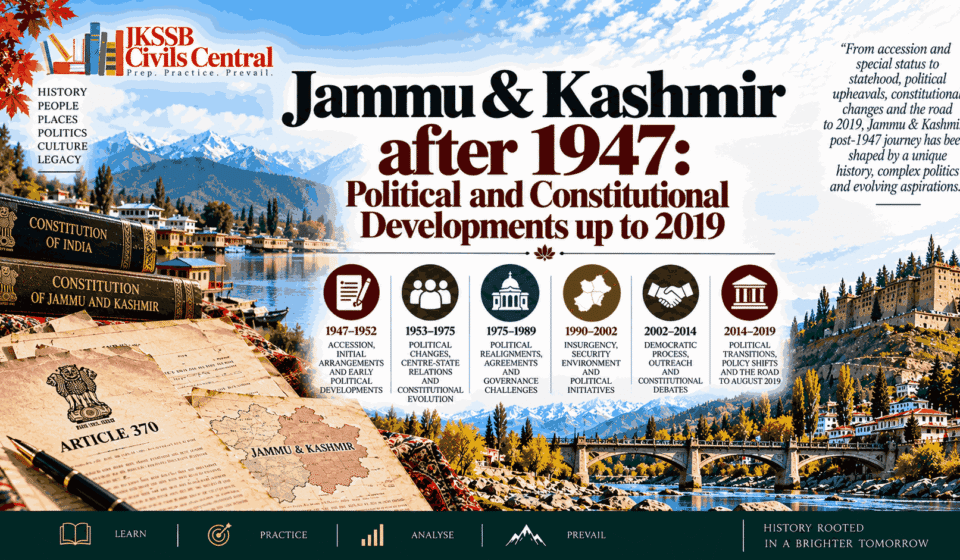
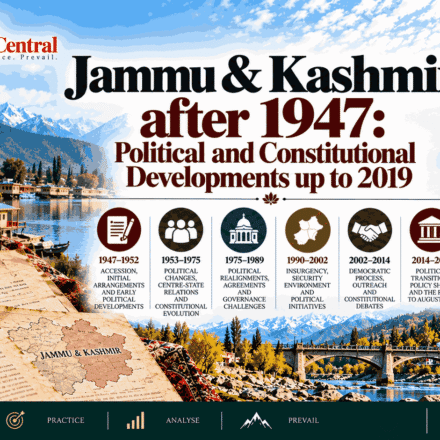
Jammu & Kashmir after 1947: Political and Constitutional Developments up to 2019

J&K History Series Navigation
| Previous Article | Current Article | Next Article |
|---|---|---|
| ← Article 48: Constitutional Development of Jammu & Kashmir: Article 370, Article 35A and the J&K Constitution | Article 49: Jammu & Kashmir after 1947: Political and Constitutional Developments up to 2019 | Article 50: Jammu & Kashmir after 2019: Reorganisation, Union Territory Status and the Post-2019 Constitutional Framework → |
Learning Dashboard
| Category | Key Information |
|---|---|
| Historical Period | 1947–2019 |
| Historical Phase | Post-Accession Political & Constitutional Development |
| Geographical Area | Former State of Jammu and Kashmir |
| Core Theme | Evolution of political institutions, governments, elections, Centre–State relations and political conflict |
| Major Early Leader | Sheikh Abdullah |
| Major Political Organisations | National Conference, Congress, Praja Parishad, Plebiscite Front, PDP, BJP |
| Major Turning Points | 1953, 1965, 1975, 1977, 1984, 1986–87, 1990, 1996, 2002, 2008, 2014, 2018, 2019 |
| Major Political Crisis | 1987 election controversy followed by insurgency from 1989 |
| Major Democratic Recovery | Assembly elections of 1996 and subsequent electoral cycles |
| Major Constitutional Transformation | 2019 |
| JKSSB Importance | Extremely High |
| Expected Question Types | Chronology, statement-based, matching, political personality, election sequence, conceptual-factual, cause and consequence |
Introduction
The political history of Jammu and Kashmir after 1947 is a history of constitutional negotiation, political centralisation, regional aspirations, electoral competition, periods of democratic disruption, armed conflict and attempts at political reconstruction. The accession of 1947 created the constitutional basis for the state’s relationship with India, but it did not settle all questions concerning internal political authority, the extent of autonomy, Centre–State relations or the representation of the state’s diverse regions. Those questions continued to shape J&K politics for more than seven decades.
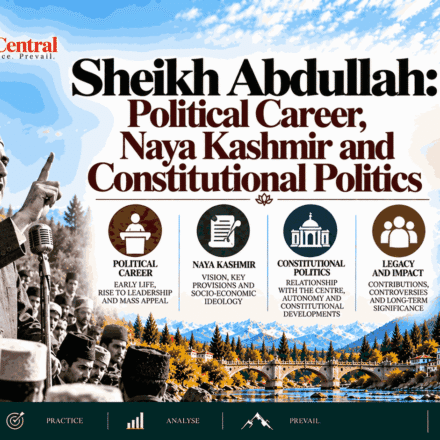
The early post-accession period was dominated by Sheikh Abdullah and the National Conference, whose political movement had emerged from the struggle against Dogra rule. Abdullah became the central figure in the state’s first popular government, but disagreements concerning the future political and constitutional relationship between J&K and India intensified after accession. His dismissal and arrest in August 1953 became a decisive turning point and profoundly influenced later political perceptions of the relationship between the state and the Union.
Between 1953 and the early 1970s, the political system underwent substantial institutional and constitutional change, accompanied by growing Union influence over state politics. The Indira–Sheikh Accord of 1975 brought Abdullah back to power and marked a new phase of political accommodation. The 1977 Assembly election, generally regarded as a substantially more credible electoral exercise than many earlier elections, strengthened the importance of electoral politics in the state.
The political trajectory changed again during the 1980s. The dismissal of Farooq Abdullah’s government in 1984, the subsequent political realignment between the National Conference and Congress, and the controversy surrounding the 1987 Assembly election contributed to a deep crisis of democratic legitimacy. By 1989, an armed insurgency had emerged, producing prolonged violence, displacement, extensive security operations and the longest period of direct central rule in the state’s history.
Electoral politics resumed with the 1996 Assembly election and subsequently became increasingly competitive. The emergence of the People’s Democratic Party (PDP) in the late 1990s created a new political force, while the 2002, 2008 and 2014 elections produced different coalition arrangements and demonstrated the changing political geography of Jammu and Kashmir. The collapse of the PDP–BJP coalition in 2018, followed by prolonged central rule, formed the immediate political background to the constitutional transformation of 2019.
This article therefore traces the political development of J&K as a connected historical process, rather than as a list of governments and elections.
CivilsCentral Historical Insight
The post-1947 political history of J&K cannot be explained either as a simple story of constitutional integration or as a simple story of political alienation. Both processes existed simultaneously: constitutional institutions expanded and elections continued, while disputes over autonomy, Centre–State relations, representation and political legitimacy repeatedly produced crises.
Part I — The Political Order after Accession
From Princely Rule to Popular Government
The accession of Jammu and Kashmir to India in October 1947 did not immediately transform the state’s internal political system into a fully representative democracy. The Maharaja remained the formal ruler, while Sheikh Abdullah and the National Conference became increasingly central to the administration and political mobilisation of the state.
The Emergency Administration headed by Sheikh Abdullah in the immediate crisis of 1947 was followed by an Interim Government in 1948. The political direction of the state consequently began shifting away from exclusive monarchical authority toward a system in which the National Conference exercised major political influence.
The process was gradual. The political legitimacy of the National Conference rested partly on its earlier mass movement against Dogra rule and partly on its role in defending the state during the 1947 crisis. Yet the constitutional settlement between the state and India remained incomplete, and the political question of autonomy remained central.
The J&K Constituent Assembly
The election of the Jammu and Kashmir Constituent Assembly in 1951 represented an important stage in the development of representative institutions.
The Assembly was given the task of framing the Constitution of Jammu and Kashmir and determining important constitutional questions concerning the state. Its work eventually produced the Constitution of Jammu and Kashmir, adopted in 1956 and brought into force in 1957.
The political significance of the Constituent Assembly extended beyond constitutional drafting. Its proceedings became part of the larger process through which the state attempted to define its relationship with India while establishing its own institutions of government.
CivilsCentral Historical Insight
The post-1947 transition was not an immediate movement from monarchy to fully developed parliamentary democracy. It was a gradual institutional transition involving the Maharaja, popular ministers, the National Conference, the J&K Constituent Assembly and the Union government.
Part II — Sheikh Abdullah and the Crisis of 1953
From Popular Leadership to Political Conflict
Sheikh Abdullah entered the post-accession period as the dominant political figure in J&K. His political position combined support for accession to India with a strong emphasis on the state’s distinctive political status and internal autonomy.
The relationship between Abdullah and the Government of India became increasingly strained during the early 1950s. Several issues contributed to the tension, including the extent of constitutional integration, the future political status of the state and competing pressures from within Jammu, Kashmir and the Union political system.
The Praja Parishad movement in Jammu also became an important factor in the political environment. Its demand for fuller constitutional integration with India contrasted with the National Conference’s emphasis on the state’s distinctive constitutional position.
The result was a widening political divide not simply between Srinagar and New Delhi but also among the different regions and political constituencies within J&K.
Dismissal and Arrest — 1953
On 9 August 1953, Sheikh Abdullah was dismissed as Prime Minister by Sadar-i-Riyasat Karan Singh and arrested. Bakshi Ghulam Mohammad was appointed to head the new government.
The precise historical interpretation of the dismissal remains politically contested. Contemporary and later accounts differ over the relative importance of cabinet divisions, allegations concerning Abdullah’s political intentions, Centre–State tensions, Jammu opposition and concerns in New Delhi regarding the future constitutional direction of J&K.
What is not disputed is the historical consequence: 1953 became a watershed in the political relationship between J&K and the Union.
Abdullah’s removal weakened the political autonomy of the state’s government and inaugurated a long period in which the Centre exercised much greater influence over the state’s political leadership.
CivilsCentral Historical Insight
The significance of 1953 lies not only in the removal of one leader. It altered the political trajectory of J&K by creating a lasting debate over political legitimacy, Centre–State intervention and the meaning of autonomy within the Indian Union.
Part III — The Bakshi Period and Political Centralisation
Bakshi Ghulam Mohammad
Bakshi Ghulam Mohammad became Prime Minister of J&K in August 1953 and remained the dominant political figure until 1963.
His government emphasised administrative stability, economic development, infrastructure and social programmes. During this period, the state witnessed substantial development activity, including expansion of roads, education, tourism and other public services.
At the same time, the political system became increasingly dependent upon the support of the Union government. The truncated National Conference that remained after Abdullah’s removal operated within a political environment substantially different from the mass movement associated with the earlier period.
The central issue was therefore not whether the state developed institutionally—it did—but whether political development was accompanied by sufficient democratic autonomy and legitimacy. This distinction became increasingly important in later assessments of the period.
Constitutional Integration
The 1950s and early 1960s also witnessed the continued extension of provisions of the Constitution of India to J&K through the constitutional mechanisms discussed in Article 48.
Thus, political centralisation and constitutional integration proceeded alongside economic and administrative development.
The process created an enduring tension: the state possessed a distinctive constitutional framework, but the actual political relationship with New Delhi was becoming increasingly integrated.
Part IV — The 1965 Constitutional and Political Transition
The constitutional changes of 1965 represented an important stage in the gradual transformation of J&K’s political institutions.
The title of the head of government changed from Prime Minister to Chief Minister, while the office of Sadar-i-Riyasat was replaced by the Governor.
Ghulam Mohammed Sadiq became the first Chief Minister of Jammu and Kashmir under the new arrangement.
These changes were more than alterations of terminology. They symbolised the increasing alignment of the state’s constitutional institutions with the wider Indian constitutional structure.
The period also witnessed greater influence of the Congress in state politics. The earlier separate political identity of the National Conference had already been weakened after 1953, and the party’s organisational history became closely intertwined with Congress politics for a period.
CivilsCentral Historical Insight
The 1965 changes illustrate an important pattern in J&K history: constitutional integration occurred incrementally, through successive institutional changes rather than through one single constitutional event.
Part V — Sheikh Abdullah, Plebiscite Politics and the 1975 Accord
The Plebiscite Front
After his dismissal, Sheikh Abdullah remained outside the formal political system for extended periods. His supporters organised the Plebiscite Front in 1955, demanding a political settlement based on the question of the state’s future status.
Abdullah’s political position gradually evolved over time. His relationship with the Government of India remained deeply adversarial for years, but by the early 1970s regional and international developments contributed to a change in political strategy.
The 1971 Indo-Pakistan War and the creation of Bangladesh altered the regional political environment. Abdullah increasingly accepted that a political settlement within the Indian Union was more realistic than pursuing his earlier plebiscite position.
Indira–Sheikh Accord, 1975
The negotiations between Sheikh Abdullah’s representatives and the Government of India culminated in the Indira–Sheikh Accord of 1975.
The Accord accepted Jammu and Kashmir as a constituent unit of the Union of India while retaining Article 370 as the constitutional basis of its relationship with the Union. It also recognised the continuation of the state’s residuary legislative powers, subject to specified exceptions, and provided mechanisms through which the state could review certain laws applied after 1953.
The agreement represented a compromise rather than a complete victory for either side. Abdullah did not secure a return to the exact constitutional position he had demanded before 1953, while the Government of India accepted the return of a leader who had spent much of the previous two decades in opposition or detention.
Sheikh Abdullah became Chief Minister on 25 February 1975, returning to formal power after more than two decades.
CivilsCentral Historical Insight
The 1975 Accord is best understood as a political compromise designed to restore constitutional politics, not as either complete restoration of pre-1953 autonomy or complete abandonment of J&K’s distinctive constitutional position.
Part VI — The 1977 Election and a New Phase of Electoral Politics
The Congress withdrawal of support from Sheikh Abdullah’s government in 1977 led to the imposition of Governor’s Rule and then fresh Assembly elections.
The 1977 Assembly election is particularly important in the political history of J&K because it is generally regarded as one of the state’s more credible electoral exercises of the pre-insurgency period. The National Conference won a clear majority, and Sheikh Abdullah returned as Chief Minister.
The election strengthened the argument that competitive electoral politics could provide political legitimacy when voters had meaningful opportunities to choose between political alternatives.
For this reason, 1977 occupies a special place in the chronology of J&K elections.
Part VII — Farooq Abdullah and the Political Crisis of the 1980s
Succession after Sheikh Abdullah
Sheikh Abdullah died on 8 September 1982. His son Farooq Abdullah succeeded him as Chief Minister.
The succession marked a generational transition within the National Conference. Farooq Abdullah sought to maintain the party’s political identity while operating within the constitutional framework that had developed since the 1975 Accord.
The political environment, however, became increasingly unstable.
Dismissal of Farooq Abdullah — 1984
In 1984, Farooq Abdullah’s government was dismissed after a split within the National Conference. G. M. Shah, who led the breakaway faction, became Chief Minister.
The dismissal became another major source of political controversy because it was widely interpreted in Kashmir as evidence of direct political intervention by the Centre in state politics.
The episode weakened confidence in the political autonomy of elected institutions and became part of the accumulated political memory that influenced later developments.
Return of Farooq Abdullah
Farooq Abdullah returned to office in 1986 following a political realignment involving the National Conference and Congress.
The subsequent decision of the two parties to contest the 1987 Assembly election in alliance became a decisive factor in the next phase of J&K’s political history.
CivilsCentral Historical Insight
The significance of the 1980s lies in the cumulative effect of political interventions. The dismissal of elected governments and changing alliances weakened confidence in the electoral system at precisely the time when political competition needed stronger institutional credibility.
Part VIII — The 1987 Election and the Crisis of Democratic Legitimacy
Background
The political environment before the 1987 election was already difficult. Discontent had accumulated over governance, unemployment, political centralisation and the perception that electoral politics did not provide a reliable avenue for expressing opposition.
The National Conference and Congress formed an electoral alliance. Opponents of the alliance included groups that came together around the Muslim United Front (MUF).
The election produced a large victory for the National Conference–Congress alliance.
Controversy over the Election
The official results were accepted constitutionally, but the election became widely associated with allegations of rigging and electoral manipulation.
The controversy became historically important because many young political activists who had attempted to use electoral politics concluded that the electoral process was incapable of accommodating opposition.
It would be an oversimplification to claim that the 1987 election alone caused the insurgency. Political alienation, earlier constitutional conflicts, regional tensions, international factors and developments in Pakistan all contributed to the subsequent crisis.
Nevertheless, the election became an important trigger and symbol of democratic disillusionment.
CivilsCentral Historical Insight
The importance of 1987 lies less in the numerical election result than in its effect on political legitimacy. When electoral institutions lose credibility, political opposition can shift from institutional competition to extra-institutional mobilisation.
Part IX — Emergence of Insurgency, 1989–1990
From Political Crisis to Armed Conflict
By 1989, Jammu and Kashmir had entered a new phase of armed insurgency.
The insurgency developed through multiple organisations and political currents and was influenced by support from Pakistan, including training, arms and organisational assistance to militant groups. At the same time, the movement drew upon local political grievances and accumulated dissatisfaction with the functioning of democratic institutions.
The insurgency therefore cannot be explained by a single cause.
Its development reflected the interaction of:
- political alienation;
- the controversy surrounding the 1987 election;
- Centre–State tensions;
- regional and social grievances;
- developments in Pakistan and Afghanistan;
- militant organisation and external support;
- security responses by the state.
Collapse of the Elected Government
Farooq Abdullah resigned as Chief Minister in January 1990 amid the deteriorating security situation and disagreement over the appointment of Governor Jagmohan.
Governor’s Rule was followed by President’s Rule, and the state entered its longest period of direct central rule.
The ordinary functioning of democratic institutions was severely disrupted.
Human Consequences
The insurgency produced extensive violence affecting civilians, security personnel, political workers and militant groups.
It also contributed to the large-scale displacement of Kashmiri Pandits from the Kashmir Valley during 1989–90, alongside displacement and insecurity affecting other communities and sections of the population.
The period therefore represents not merely a constitutional crisis but a profound social and humanitarian rupture.
CivilsCentral Historical Insight
The 1990 crisis transformed J&K from a primarily constitutional and electoral dispute into a prolonged security and political conflict. The consequences extended far beyond government formation, affecting civilian life, inter-community relations, migration, administration and the functioning of democratic institutions.
Part X — Direct Central Rule and the Suspension of Electoral Politics
During the period of armed conflict, normal electoral politics was severely disrupted.
The Legislative Assembly was not restored through elections immediately after the onset of insurgency. The state remained under direct central administration for several years, while security forces operated extensively across the conflict-affected areas.
The interruption of electoral politics created another major political problem. Even where constitutional institutions formally continued to exist, their democratic legitimacy was weakened when citizens could not regularly participate in competitive elections.
The restoration of electoral politics therefore became an important component of the broader political stabilisation process of the 1990s.
Part XI — The 1996 Election and Return of an Elected Government
Assembly Elections of 1996
Assembly elections were held in 1996, the first such election in the state since the onset of the insurgency.
The National Conference led by Farooq Abdullah won a majority and formed the government.
The election was historically significant because it restored an elected state government after several years of direct central rule.
The political environment remained deeply disturbed, however. Armed insurgency continued, and the electoral process itself took place under substantial security constraints.
Regional Autonomy
The National Conference government also raised the issue of greater regional autonomy, reflecting the continuing debate over the distribution of power between the Union and the state.
The political challenge after 1996 was therefore twofold:
Restore democratic institutions
while simultaneously
addressing the political grievances that had contributed to the conflict.
CivilsCentral Historical Insight
The 1996 election represented a return to electoral government, but elections alone could not resolve the deeper political conflict. Institutional restoration and political reconciliation were related but distinct tasks.
Part XII — Emergence of the People’s Democratic Party
The political landscape changed significantly with the formation of the Jammu and Kashmir People’s Democratic Party (PDP) in 1999, associated with Mufti Mohammad Sayeed and other political figures.
The PDP emerged as a significant competitor to the National Conference, particularly in the Kashmir Valley.
Its political discourse emphasised what it described as a “healing touch,” dialogue and engagement with different sections of society.
The emergence of the PDP was important because it weakened the earlier dominance of the National Conference and created a more competitive two-party structure in much of the Valley.
This development also contributed to a broader shift from a political system dominated by one major regional party toward coalition-based electoral politics.
Part XIII — The 2002 Election and Coalition Politics
The 2002 Assembly election marked a major political transition.
The National Conference failed to secure a majority. The PDP emerged as a major political force, while the Congress became essential to government formation.
Mufti Mohammad Sayeed became Chief Minister under the PDP–Congress coalition arrangement.
The coalition agreement envisaged a transfer of the Chief Ministership after three years, and in 2005 Ghulam Nabi Azad of the Congress became Chief Minister.
This was a significant development in the political history of J&K because power was now changing through competitive elections and coalition negotiations rather than through the dominance of a single regional party.
CivilsCentral Historical Insight
The 2002 election marked a transition from one-party dominance toward competitive coalition politics. This was politically significant even though the wider security conflict and constitutional disputes remained unresolved.
Part XIV — The 2008 Election and Amarnath Land Controversy
Coalition Government
The PDP–Congress government ended in 2008 after the PDP withdrew support amid the controversy surrounding the transfer of land to the Shri Amarnathji Shrine Board.
The dispute generated intense political mobilisation in both the Kashmir Valley and Jammu region and exposed the depth of regional differences within the state.
The controversy demonstrated that J&K politics could not be understood solely through the Kashmir Valley. Political mobilisation in Jammu and Kashmir often followed different regional patterns, and questions involving land, identity, religion and administration could produce sharply different responses in the two regions.
2008 Assembly Election
Assembly elections were held in November–December 2008.
The National Conference emerged as the single largest party with 28 seats, while the Congress won 17 and the PDP 21 in the 87-member Assembly.
The National Conference and Congress formed a coalition government.
Omar Abdullah became Chief Minister in January 2009.
The 2008 election therefore reinforced the movement toward competitive coalition politics that had become visible in 2002.
Part XV — Omar Abdullah Government and the Political Environment, 2009–2014
The Omar Abdullah government operated in an environment marked by continuing militancy, separatist politics, security concerns and periodic mass protests.
The 2010 unrest became a major political crisis, with prolonged protests and significant civilian casualties. The episode demonstrated that a decline in conventional militancy did not necessarily mean the disappearance of political alienation or public mobilisation.
The government also faced demands concerning accountability, human rights, governance and the political status of the state.
The period nevertheless witnessed continued operation of elected institutions and the functioning of coalition government.
This combination of institutional continuity and recurring political unrest became characteristic of the final decade of the pre-2019 state.
CivilsCentral Historical Insight
The post-2008 period demonstrates the difference between electoral normalisation and political resolution. Regular elections can restore representative institutions without automatically resolving questions of identity, autonomy, security or Centre–State relations.
Part XVI — The 2014 Election and a New Political Geography
The 2014 Assembly election produced one of the most important electoral outcomes in the history of the state.
The PDP won 28 seats, the BJP won 25, the National Conference won 15 and the Congress won 12 in the 87-member Assembly.
The results revealed a strong regional pattern:
- the PDP emerged as the dominant force in much of the Kashmir Valley;
- the BJP achieved a major breakthrough in Jammu;
- the National Conference and Congress lost ground.
No party obtained a majority.
The fractured mandate reflected the growing importance of regional political geography in J&K.
PDP–BJP Coalition
After negotiations, the PDP and BJP formed a coalition government in March 2015, with Mufti Mohammad Sayeed as Chief Minister.
This coalition was politically significant because the two parties represented markedly different political constituencies and ideological positions.
The coalition’s Agenda of Alliance attempted to provide a common political framework, including a commitment to development and an agreed approach to contentious constitutional and security questions.
The government therefore represented an unusual form of cross-regional coalition politics.
Part XVII — Leadership Change in 2016
Mufti Mohammad Sayeed died in January 2016.
After a period of Governor’s Rule, Mehbooba Mufti became Chief Minister in April 2016.
She became the first woman to serve as Chief Minister of Jammu and Kashmir.
Her government continued the PDP–BJP coalition but operated in an increasingly difficult security and political environment.
The killing of militant commander Burhan Wani in July 2016 triggered widespread unrest in the Kashmir Valley and produced a prolonged period of protests, curfews and security operations.
The political space for the coalition narrowed further as disagreements over security policy, governance and political priorities intensified.
Part XVIII — Collapse of the PDP–BJP Coalition, 2018
In June 2018, the BJP withdrew support from the PDP government.
Mehbooba Mufti resigned as Chief Minister, and Governor’s Rule was imposed.
The collapse of the coalition demonstrated once again the difficulty of sustaining governments built around sharply different regional and ideological constituencies.
The Assembly was subsequently dissolved in November 2018, after which the state remained under central administration.
President’s Rule followed in December 2018.
The political system therefore entered 2019 without an elected state government.
CivilsCentral Historical Insight
The period from 2002 to 2018 established coalition politics as a central feature of J&K government formation, but it also demonstrated its vulnerability. Coalition governments could broaden representation, yet profound differences over regional interests, security and constitutional questions repeatedly limited their stability.
Part XIX — Regional Dimensions of Post-1947 Politics
Jammu
Jammu’s political concerns historically included greater integration with the Indian Union, regional representation, equitable distribution of resources and political concerns about perceived Valley-centric governance.
The Praja Parishad movement represented an important early expression of these concerns. Later, the BJP’s rise in Jammu transformed the region’s electoral politics.
Kashmir Valley
The Kashmir Valley remained the principal centre of National Conference politics and later witnessed the rise of the PDP.
Its political discourse was strongly influenced by questions of autonomy, Centre–State relations, political identity, security, insurgency and separatist mobilisation.
Ladakh
Ladakh developed its own political demands, often focused on regional representation, administrative autonomy and protection of local cultural and geographical interests.
These demands became especially significant in debates over the internal constitutional structure of the state.
The three regions therefore did not possess identical political priorities.
CivilsCentral Historical Insight
One of the most important analytical lessons of J&K history is that “Jammu and Kashmir politics” was never politically uniform. Jammu, Kashmir and Ladakh developed distinct political concerns, and the balance among these regional aspirations repeatedly shaped constitutional and electoral debates.
Part XX — Political Institutions and Constitutional Change
Political developments after 1947 cannot be separated from constitutional transformation.
Several institutional changes progressively altered the structure of governance:
1947–48
→ transition from princely authority toward popular government.
1951
→ J&K Constituent Assembly.
1953
→ dismissal of Sheikh Abdullah.
1956–57
→ J&K Constitution.
1965
→ Prime Minister → Chief Minister
→ Sadar-i-Riyasat → Governor.
1975
→ Indira–Sheikh political settlement.
1987
→ disputed election and democratic legitimacy crisis.
1990
→ breakdown of elected government and prolonged direct rule.
1996
→ return of elected government.
2002 onward
→ competitive coalition politics.
2018
→ collapse of elected government.
2019
→ fundamental constitutional and territorial transformation.
The political and constitutional histories therefore developed together.
Part XXI — Elections as a Measure of Political Change
Elections provide an important chronological framework for understanding post-1947 J&K politics.
| Election | Broad Political Significance |
|---|---|
| 1951 | Constituent Assembly election |
| 1957 | First Assembly election after adoption of state Constitution |
| 1962 | Continued institutional electoral politics |
| 1967 | Congress influence became significant |
| 1972 | Pre-Accord political environment |
| 1977 | Widely regarded as comparatively credible; NC victory |
| 1983 | Farooq Abdullah and NC victory |
| 1987 | NC–Congress victory amid major rigging allegations |
| 1996 | Return of Assembly elections after prolonged central rule |
| 2002 | PDP–Congress coalition and competitive politics |
| 2008 | NC–Congress coalition |
| 2014 | PDP–BJP emerged as largest parties; hung Assembly |
The Election Commission of India maintains the historical record of J&K Assembly elections, including elections from 1962 onward and subsequent electoral cycles.
Part XXII — Centre–State Relations: The Central Political Theme
The relationship between the Government of India and the government of Jammu and Kashmir remained one of the defining themes of the state’s post-1947 political history.
Three broad phases can be identified.
Phase I — Negotiated Constitutional Relationship
The early years were characterised by negotiations concerning accession, Article 370, the J&K Constitution and the division of powers.
Phase II — Greater Central Influence
After 1953, the Union exercised substantially greater influence over state politics. The dismissal of governments, political interventions and constitutional changes contributed to a widespread debate over the erosion or transformation of autonomy.
Phase III — Competitive Political Accommodation
From 1975 onward, successive political arrangements attempted to reconcile J&K’s distinctive political demands with its position within the Indian Union.
The 1996, 2002, 2008 and 2014 elections demonstrated the continuing importance of electoral politics, but the persistence of insurgency and constitutional disputes meant that the question of political legitimacy remained unresolved.
CivilsCentral Historical Insight
The central political question after 1947 was not simply “India or not India”. It also concerned how Jammu and Kashmir would function within India, how much political autonomy its institutions would exercise, and how its diverse regional aspirations would be represented.
Part XXIII — Insurgency, Security and Democratic Politics
The insurgency fundamentally altered the functioning of government.
Security considerations increasingly shaped:
- administration;
- elections;
- movement;
- political campaigning;
- public order;
- Centre–State relations.
The state responded through police and security institutions, while Parliament and the Union government adopted legal and constitutional measures applicable to the conflict environment.
The armed conflict also produced political consequences. It weakened conventional party politics in parts of the Valley, strengthened separatist organisations, increased central involvement and produced long periods of direct administration.
At the same time, electoral politics did not disappear permanently. The elections of 1996, 2002, 2008 and 2014 demonstrated that substantial sections of the population continued to participate in representative institutions despite the conflict.
This coexistence of insurgency and electoral participation is one of the most distinctive features of late-20th- and early-21st-century J&K politics.
Part XXIV — Autonomy and Self-Government
The question of autonomy remained politically important throughout the post-1947 period.
Different political groups proposed different meanings of autonomy.
For the National Conference, autonomy often referred to strengthening the state’s constitutional position within India.
For some separatist organisations, the objective was substantially different and could involve independence or accession to Pakistan.
In Jammu and Ladakh, some political movements viewed greater autonomy for the Valley with concern and instead emphasised regional autonomy, equal representation or closer constitutional integration.
The State Autonomy Committee established during the Farooq Abdullah government produced a report in 2000 recommending restoration of a larger measure of the state’s earlier constitutional autonomy.
The Union government did not accept the report as the basis for constitutional restoration.
This episode illustrates the difficulty of finding a single definition of “autonomy” acceptable across the state’s regions and political constituencies.
Part XXV — Political Parties and the Transformation of Electoral Competition
The political party system changed substantially over time.
National Conference
The principal regional political force for much of the post-1947 period, rooted in Sheikh Abdullah’s mass movement.
Congress
Played a major role in state politics, particularly during the period after 1953 and through various coalition arrangements.
PDP
Established in 1999 and became a major competitor to the National Conference, particularly in the Valley.
BJP
Gradually expanded its political presence, especially in Jammu, and became a major force in the 2014 Assembly election.
Smaller and Alternative Forces
The electoral history also included the Praja Parishad, Janata Party, Jammu and Kashmir National Panthers Party, Muslim United Front and various independent candidates and regional groups.
The changing party system demonstrates the transformation from National Conference dominance → Congress influence → competitive regional politics → coalition politics → stronger regional polarisation.
Part XXVI — Political Developments and Constitutional Development: The Connection
The constitutional framework cannot be studied separately from political events.
For example:
1953 political crisis
→ influenced the subsequent trajectory of constitutional integration.
1965 constitutional changes
→ reflected greater institutional alignment with the Union.
1975 Accord
→ attempted to restore political participation within the constitutional framework.
1987 election controversy
→ damaged democratic legitimacy.
1990 insurgency
→ disrupted constitutional government.
1996 election
→ restored representative institutions.
2002–2014 coalition governments
→ reflected competitive regional politics.
2018 collapse
→ created the immediate political setting preceding the 2019 transformation.
This relationship between political events and constitutional change is central to understanding the period.
Part XXVII — 2019: The End of the Pre-2019 Political Order
By 2018, Jammu and Kashmir had entered another phase of direct central administration.
The state had no functioning elected government when the constitutional changes of August 2019 were introduced.
On 5 August 2019, the Government of India initiated the constitutional measures that fundamentally altered the previous Article 370 framework. On 6 August, a further Presidential declaration rendered the earlier operative provisions of Article 370 inoperative in the manner discussed in Article 48.
Parliament also enacted the Jammu and Kashmir Reorganisation Act, 2019.
The Act provided for the reorganisation of the existing State of Jammu and Kashmir into two Union Territories:
Union Territory of Jammu and Kashmir
→ with a Legislative Assembly.
Union Territory of Ladakh
→ without a Legislative Assembly.
The appointed day was 31 October 2019. The official India Code text identifies the Act as Act No. 34 of 2019 and records 31 October 2019 as the appointed day.
The Supreme Court’s December 2023 judgment subsequently upheld the constitutional validity of the 2019 measures.
Article 50 will examine the post-2019 Union Territory framework separately. This article therefore treats 2019 as the endpoint of the political order that developed after accession.
CivilsCentral Historical Insight
The significance of 2019 is that it did not merely change one constitutional provision. It marked the transition from the post-1947 State of Jammu and Kashmir’s distinctive constitutional-political structure to a new Union Territory framework.
Part XXVIII — Historical Interpretation and Evidence Note
The post-1947 history of J&K is one of the most politically contested areas of modern Indian history. Several interpretations coexist, and they should not be treated as identical to established documentary facts.
Established Historical Sequence
The following developments are firmly documented:
- accession in 1947;
- formation of popular government;
- J&K Constituent Assembly;
- dismissal of Sheikh Abdullah in 1953;
- constitutional changes of 1965;
- 1975 political accord;
- 1977 election;
- Farooq Abdullah’s dismissal in 1984;
- 1987 election controversy;
- insurgency from 1989;
- direct central rule;
- 1996 Assembly election;
- 2002 PDP–Congress coalition;
- 2008 NC–Congress coalition;
- 2014 PDP–BJP electoral emergence;
- 2018 coalition collapse;
- 2019 constitutional transformation.
Areas of Interpretation
Historians and political scholars differ over:
- the precise causes of Sheikh Abdullah’s dismissal;
- the degree of autonomy that existed at different points;
- the extent and consequences of electoral manipulation;
- the relative weight of local grievances and external intervention in the insurgency;
- the political significance of the 1975 Accord;
- the relationship between constitutional integration and political alienation.
These debates should not be erased, but they should also not obscure the documented chronology.
A Crucial Methodological Distinction
Historical fact
→ “Sheikh Abdullah was dismissed in August 1953.”
Historical interpretation
→ “The dismissal represented a major erosion of democratic autonomy.”
Political argument
→ “The dismissal was either necessary for constitutional stability or an unjustified intervention.”
These are not equivalent statements.
CivilsCentral Historical Insight
A strong understanding of modern J&K history requires separating what happened from why different political traditions believe it happened. This distinction is particularly important because many examination errors arise when political interpretations are memorised as though they were uncontested historical facts.
Part XXIX — JKSSB Knowledge Matrix
| Question Component | High-Value Knowledge |
|---|---|
| Who was dismissed in 1953? | Sheikh Abdullah |
| Who dismissed him? | Sadar-i-Riyasat Karan Singh |
| Who succeeded him? | Bakshi Ghulam Mohammad |
| Major constitutional change of 1965? | Prime Minister → Chief Minister; Sadar-i-Riyasat → Governor |
| First Chief Minister? | Ghulam Mohammed Sadiq |
| 1975 Accord? | Indira Gandhi–Sheikh Abdullah political settlement |
| Sheikh returned to power? | 1975 |
| Important election of 1977? | NC won a clear majority |
| Sheikh Abdullah died? | 8 September 1982 |
| Who succeeded him? | Farooq Abdullah |
| Farooq Abdullah dismissed? | 1984 |
| Major political controversy? | 1987 Assembly election |
| Insurgency became prominent? | From 1989 |
| Assembly elections after prolonged central rule? | 1996 |
| Major new regional party? | PDP, formed 1999 |
| 2002 coalition? | PDP–Congress |
| 2008 coalition? | NC–Congress |
| 2014 largest parties? | PDP 28; BJP 25 |
| 2015 coalition? | PDP–BJP |
| First woman CM? | Mehbooba Mufti |
| PDP–BJP coalition collapsed? | 2018 |
| Reorganisation? | 2019 |
Part XXX — Examination Discrimination Points
1. Sheikh Abdullah vs Farooq Abdullah
Sheikh Abdullah
→ major pre-1947 movement leader
→ Prime Minister after accession
→ dismissed in 1953
→ returned as Chief Minister in 1975.
Farooq Abdullah
→ became Chief Minister after Sheikh Abdullah’s death
→ dismissed in 1984
→ returned after the 1986 political realignment
→ Chief Minister after 1996 election.
2. 1953 vs 1975
1953
→ Sheikh Abdullah dismissed and arrested.
1975
→ Indira–Sheikh Accord
→ Sheikh returned to office.
3. 1977 vs 1987
1977
→ generally regarded as a comparatively credible election.
1987
→ major allegations of rigging
→ serious crisis of democratic legitimacy.
4. 1989 vs 1990
1989
→ insurgency became prominent.
1990
→ elected government collapsed
→ prolonged central rule followed.
5. 1996 vs 2002
1996
→ NC returned to power under Farooq Abdullah.
2002
→ NC lost majority
→ PDP–Congress coalition.
6. 2008 vs 2014
2008
→ NC–Congress coalition.
2014
→ PDP 28 + BJP 25
→ later PDP–BJP coalition.
7. Governor’s Rule vs President’s Rule
These terms should not be treated as interchangeable. The distinctive J&K constitutional arrangement historically allowed Governor’s Rule under the J&K Constitution before President’s Rule followed under the applicable constitutional framework.
The distinction is particularly important for questions concerning the periods of direct administration.
Part XXXI — JKSSB Question-Type Mapping
Direct Fact
- Who dismissed Sheikh Abdullah in 1953?
- Who became the first Chief Minister after the 1965 constitutional change?
- In which year was the Indira–Sheikh Accord concluded?
- In which year was the first Assembly election held after the insurgency began?
Statement-Based
Candidates can be tested on combinations involving:
- 1953;
- 1965;
- 1975;
- 1977;
- 1987;
- 1990;
- 1996;
- 2002;
- 2014;
Chronology
A particularly high-value sequence is:
1953 → 1965 → 1975 → 1977 → 1984 → 1987 → 1990 → 1996 → 2002 → 2008 → 2014 → 2018 → 2019
Match the Following
| Event | Year |
|---|---|
| Sheikh Abdullah’s dismissal | 1953 |
| Prime Minister → Chief Minister | 1965 |
| Indira–Sheikh Accord | 1975 |
| Major election controversy | 1987 |
| Return of Assembly elections | 1996 |
| PDP–Congress coalition | 2002 |
| PDP–BJP electoral emergence | 2014 |
| Constitutional transformation | 2019 |
Identification by Clues
Identify the political development:
- followed the dismissal of Sheikh Abdullah;
- involved prolonged direct central influence;
- eventually led to restoration of competitive politics under Farooq Abdullah.
→ Post-1953 political phase
Part XXXII — JKSSB Practice Questions
Q1. Sheikh Abdullah was dismissed as Prime Minister of Jammu and Kashmir in:
A. 1948
B. 1951
C. 1953
D. 1956
Correct Answer: C
Explanation: Sheikh Abdullah was dismissed on 9 August 1953 by Sadar-i-Riyasat Karan Singh.
Q2. Who succeeded Sheikh Abdullah as head of government in 1953?
A. Ghulam Mohammed Sadiq
B. Bakshi Ghulam Mohammad
C. Mirza Afzal Beg
D. Farooq Abdullah
Correct Answer: B
Explanation: Bakshi Ghulam Mohammad was appointed Prime Minister after Abdullah’s dismissal.
Q3. Which of the following correctly describes the 1965 constitutional changes in J&K?
A. Governor was replaced by Sadar-i-Riyasat
B. Prime Minister was replaced by Chief Minister
C. Chief Minister was replaced by Prime Minister
D. Legislative Assembly was abolished
Correct Answer: B
Explanation: The 1965 changes replaced the title Prime Minister with Chief Minister and Sadar-i-Riyasat with Governor.
Q4. The Indira–Sheikh Accord is associated with:
A. 1953
B. 1965
C. 1975
D. 1987
Correct Answer: C
Explanation: The political agreement between the Government of India and Sheikh Abdullah’s leadership was concluded in 1975.
Q5. Which election is particularly associated with allegations of large-scale electoral manipulation and subsequent political alienation?
A. 1977
B. 1983
C. 1987
D. 1996
Correct Answer: C
Explanation: The 1987 Assembly election became widely associated with allegations of rigging and is considered an important factor in the subsequent crisis of democratic legitimacy.
Q6. Arrange the following in chronological order:
- Indira–Sheikh Accord
- Dismissal of Sheikh Abdullah
- 1987 Assembly election
- 1996 Assembly election
A. 2–1–3–4
B. 1–2–3–4
C. 2–3–1–4
D. 1–3–2–4
Correct Answer: A
Explanation: 1953 → 1975 → 1987 → 1996.
Q7. The Assembly elections of 1996 were significant because:
A. They were the first elections in J&K.
B. They restored an elected state government after a prolonged period of central rule.
C. They created the PDP.
D. They abolished the Legislative Assembly.
Correct Answer: B
Explanation: The 1996 election marked the return of an elected government after years of direct central administration amid insurgency.
Q8. The People’s Democratic Party was founded in:
A. 1987
B. 1990
C. 1996
D. 1999
Correct Answer: D
Explanation: The PDP was established in 1999 and subsequently became a major political force in J&K.
Q9. Which coalition followed the 2002 Assembly election?
A. NC–BJP
B. PDP–Congress
C. Congress–BJP
D. NC–PDP
Correct Answer: B
Explanation: The PDP and Congress formed the government, with Mufti Mohammad Sayeed becoming Chief Minister.
Q10. Consider the following statements:
- The 2008 Assembly election produced an NC–Congress coalition.
- Omar Abdullah became Chief Minister in 2009.
- The 2014 Assembly election produced a clear single-party majority.
- The PDP won 28 seats in the 2014 election.
Which are correct?
A. 1, 2 and 4 only
B. 1 and 3 only
C. 2 and 3 only
D. All four
Correct Answer: A
Explanation: Statements 1, 2 and 4 are correct. The 2014 election produced a hung Assembly.
Q11. Which pair is correctly matched?
A. 1977 — Major electoral controversy and allegations of rigging
B. 1987 — Widely regarded as a comparatively credible election
C. 1996 — Return of Assembly elections after prolonged central rule
D. 2002 — PDP–BJP government
Correct Answer: C
Explanation: The 1996 election restored elected government after prolonged central administration.
Q12. Which political development immediately preceded the 2019 constitutional transformation?
A. 2002 PDP–Congress coalition
B. 2008 NC–Congress coalition
C. 2014 PDP–BJP coalition
D. Collapse of the PDP–BJP government and prolonged central rule
Correct Answer: D
Explanation: The PDP–BJP coalition collapsed in June 2018, followed by central rule before the 2019 constitutional changes.
Part XXXIII — Rapid Revision Zone
Important Dates
| Year | Development |
|---|---|
| 1947 | Accession; transition toward popular government |
| 1951 | J&K Constituent Assembly election |
| 1953 | Sheikh Abdullah dismissed and arrested |
| 1965 | Prime Minister → Chief Minister; Sadar-i-Riyasat → Governor |
| 1975 | Indira–Sheikh Accord; Sheikh Abdullah returns as Chief Minister |
| 1977 | National Conference wins Assembly election |
| 1982 | Sheikh Abdullah dies; Farooq Abdullah succeeds him |
| 1984 | Farooq Abdullah government dismissed |
| 1986 | Farooq Abdullah returns through political realignment |
| 1987 | Controversial Assembly election |
| 1989 | Insurgency becomes prominent |
| 1990 | Elected government collapses; prolonged central rule |
| 1996 | Assembly elections resume |
| 1999 | PDP formed |
| 2002 | PDP–Congress coalition |
| 2005 | Ghulam Nabi Azad becomes Chief Minister |
| 2008 | Amarnath land controversy; Assembly election |
| 2009 | Omar Abdullah becomes Chief Minister |
| 2010 | Major Valley unrest |
| 2014 | PDP 28, BJP 25; hung Assembly |
| 2015 | PDP–BJP government formed |
| 2016 | Mehbooba Mufti becomes Chief Minister |
| 2018 | PDP–BJP coalition collapses |
| 2019 | Constitutional transformation and reorganisation |
Important Personalities
Sheikh Abdullah
→ National Conference
→ Prime Minister
→ dismissed 1953
→ Accord 1975
→ Chief Minister 1975–1982.
Bakshi Ghulam Mohammad
→ succeeded Abdullah in 1953
→ development-oriented administration
→ major political figure of 1953–63.
Ghulam Mohammed Sadiq
→ first Chief Minister after 1965 constitutional change.
Farooq Abdullah
→ succeeded Sheikh Abdullah
→ dismissed 1984
→ returned to office
→ Chief Minister after 1996 election.
Mufti Mohammad Sayeed
→ PDP
→ Chief Minister after 2002 election
→ Chief Minister again in 2015.
Omar Abdullah
→ Chief Minister from 2009.
Mehbooba Mufti
→ first woman Chief Minister
→ Chief Minister from 2016 to 2018.
Part XXXIV — Important Political Associations
| Political Development | Association |
|---|---|
| National Conference | Sheikh Abdullah |
| Plebiscite Front | Post-1953 Abdullah politics |
| 1975 Accord | Indira Gandhi + Sheikh Abdullah |
| 1977 election | National Conference victory |
| 1987 election | NC–Congress alliance |
| Muslim United Front | 1987 opposition coalition |
| PDP | Mufti Mohammad Sayeed |
| 2002 coalition | PDP–Congress |
| 2008 coalition | NC–Congress |
| 2014 coalition | PDP–BJP |
| 2018 collapse | PDP–BJP government |
| 2019 transformation | Union Government + Parliament |
Part XXXV — One-Line Revision Facts
- 1953 — Sheikh Abdullah dismissed.
- Bakshi Ghulam Mohammad — succeeded Abdullah.
- 1965 — Prime Minister became Chief Minister.
- 1965 — Sadar-i-Riyasat replaced by Governor.
- 1975 — Indira–Sheikh Accord.
- 1977 — NC won a clear Assembly majority.
- 1982 — Sheikh Abdullah died.
- 1984 — Farooq Abdullah dismissed.
- 1987 — major election controversy.
- 1989 — insurgency became prominent.
- 1990 — prolonged central rule began.
- 1996 — Assembly elections returned.
- 1999 — PDP formed.
- 2002 — PDP–Congress government.
- 2008 — NC–Congress government after Assembly election.
- 2014 — PDP and BJP emerged as largest parties.
- 2015 — PDP–BJP coalition.
- 2016 — Mehbooba Mufti became Chief Minister.
- 2018 — PDP–BJP coalition collapsed.
- 2019 — pre-2019 political-constitutional order ended.
Part XXXVI — Frequently Confused Facts
| Common Confusion | Correct Understanding |
|---|---|
| Sheikh Abdullah was dismissed in 1965 | 1953 |
| Bakshi succeeded Sheikh in 1975 | Bakshi succeeded him in 1953 |
| Sheikh returned as Chief Minister in 1977 | He returned in 1975; 1977 was a fresh election |
| Farooq Abdullah succeeded Sheikh immediately in 1975 | Farooq succeeded him after Sheikh’s death in 1982 |
| 1977 election was the disputed election | 1987 was the major disputed election |
| Insurgency began in 1987 | 1987 was an important political trigger; armed insurgency became prominent from 1989 |
| 1990 was the first Assembly election after insurgency | 1996 |
| PDP was formed in 2002 | 1999 |
| PDP–BJP government followed 2002 election | PDP–Congress followed 2002 |
| NC–Congress coalition followed 2014 | PDP–BJP followed 2014 |
| Mehbooba Mufti became CM in 2015 | Mufti Mohammad Sayeed became CM in 2015; Mehbooba succeeded him in 2016 |
| 2018 was an Assembly election year | No; the PDP–BJP coalition collapsed in 2018 |
| 2019 was simply another change of government | No; it was a fundamental constitutional and territorial transformation |
Part XXXVII — What Can JKSSB Ask?
High-Value Chronology
1953 → 1965 → 1975 → 1977 → 1984 → 1987 → 1989 → 1990 → 1996 → 1999 → 2002 → 2008 → 2014 → 2018 → 2019
High-Value Personalities
- Sheikh Abdullah
- Bakshi Ghulam Mohammad
- Karan Singh
- Ghulam Mohammed Sadiq
- Farooq Abdullah
- Mufti Mohammad Sayeed
- Omar Abdullah
- Mehbooba Mufti
High-Value Political Associations
- Sheikh Abdullah → 1953 dismissal / 1975 Accord
- Bakshi → post-1953 government
- Farooq → 1984 dismissal / 1996 government
- PDP → Mufti Mohammad Sayeed
- 2002 → PDP–Congress
- 2008 → NC–Congress
- 2014 → PDP–BJP
- 2018 → coalition collapse
- 2019 → constitutional transformation
High-Value Conceptual Areas
- Centre–State relations
- autonomy
- electoral legitimacy
- regional aspirations
- insurgency
- direct central rule
- coalition politics
- constitutional change.
Chapter Summary
The post-1947 political history of Jammu and Kashmir began with the transition from princely rule toward popular government under the National Conference and Sheikh Abdullah. The creation of the J&K Constituent Assembly and the development of the state’s own constitutional framework represented major steps in institutional transformation.
The 1953 dismissal of Sheikh Abdullah was the first major rupture in this political trajectory. Bakshi Ghulam Mohammad’s subsequent government operated in an environment of greater Union influence, while constitutional integration proceeded through successive measures. The 1965 changes, including the replacement of Prime Minister by Chief Minister and Sadar-i-Riyasat by Governor, symbolised a further transformation.
The 1975 Indira–Sheikh Accord brought Abdullah back into formal political life and created a new phase of accommodation. The relatively credible 1977 election strengthened the role of electoral politics, but the dismissal of Farooq Abdullah in 1984 and the subsequent political instability weakened democratic confidence.
The 1987 Assembly election became a decisive political turning point. Allegations of rigging damaged the credibility of electoral institutions and contributed to a wider political crisis. By 1989, armed insurgency had emerged, and in 1990 the elected government collapsed. Prolonged central rule, violence, displacement and security operations transformed the political environment of the state.
The 1996 election restored an elected government. The emergence of the PDP in 1999 and the 2002 election introduced a more competitive party system and coalition politics. The 2008 and 2014 elections further demonstrated the importance of regional political divisions, with the 2014 result producing the PDP–BJP coalition.
The coalition collapsed in 2018, leaving J&K under central administration when the constitutional transformation of 2019 occurred.
The major historical lesson is therefore not simply a list of governments. It is the interaction between constitutional structure, political legitimacy, Centre–State relations, regional aspirations, electoral competition and armed conflict.
JKSSB Takeaway
Remember the political spine:
Sheikh Abdullah → 1953 dismissal → Bakshi period → 1965 constitutional changes → 1975 Accord → 1977 election → Farooq Abdullah → 1984 dismissal → 1987 election controversy → 1989 insurgency → 1990 central rule → 1996 elections → PDP emergence → 2002 PDP–Congress → 2008 NC–Congress → 2014 PDP–BJP → 2018 coalition collapse → 2019 constitutional transformation
Mind Map
1947 ACCESSION
↓
POPULAR GOVERNMENT
↓
SHEIKH ABDULLAH
↓
1953 DISMISSAL
↓
BAKSHI PERIOD + GREATER CENTRAL INFLUENCE
↓
1965 CONSTITUTIONAL CHANGES
↓
1975 INDIRA–SHEIKH ACCORD
↓
1977 ELECTION
↓
FAROOQ ABDULLAH
↓
1984 DISMISSAL
↓
1987 ELECTION CONTROVERSY
↓
1989 INSURGENCY
↓
1990 CENTRAL RULE
↓
1996 ELECTORAL RETURN
↓
PDP EMERGENCE — 1999
↓
2002 PDP–CONGRESS
↓
2008 NC–CONGRESS
↓
2014 PDP–BJP
↓
2018 COALITION COLLAPSE
↓
2019 CONSTITUTIONAL TRANSFORMATION
↓
POST-2019 UNION TERRITORY FRAMEWORK
FAQs
1. Who was the first major popular political leader of J&K after accession?
Sheikh Abdullah was the dominant political leader of the early post-accession period and headed the popular government established after the 1947 crisis.
2. Why is 1953 important in J&K history?
Sheikh Abdullah was dismissed and arrested in August 1953. The event marked a major turning point in Centre–State relations and influenced subsequent debates over political autonomy and legitimacy.
3. Who succeeded Sheikh Abdullah in 1953?
Bakshi Ghulam Mohammad became Prime Minister of J&K.
4. What happened to the title of Prime Minister in 1965?
The title was changed to Chief Minister, and Ghulam Mohammed Sadiq became the first Chief Minister under the new arrangement.
5. What was the significance of the 1975 Accord?
The Indira–Sheikh Accord created a political settlement through which Sheikh Abdullah returned to power while accepting J&K’s position as a constituent unit of India and retaining Article 370 as the constitutional basis of the relationship.
6. Why is the 1977 election important?
It is generally regarded as one of the more credible elections in the pre-insurgency political history of J&K and produced a clear National Conference victory.
7. Why is the 1987 election important?
The election became widely associated with allegations of rigging and contributed to a severe crisis of confidence in democratic politics, forming part of the background to the subsequent insurgency.
8. When did the armed insurgency become prominent?
Armed insurgency became prominent from 1989, following a period of growing political discontent and the controversial 1987 election.
9. When did Assembly elections return after the onset of insurgency?
Assembly elections were held again in 1996, restoring an elected state government.
10. Which party emerged as a major competitor to the National Conference in the late 1990s?
The People’s Democratic Party (PDP), founded in 1999, became a major political force.
11. Which coalition followed the 2002 election?
The PDP–Congress coalition, initially headed by Mufti Mohammad Sayeed.
12. Which parties formed the government after the 2008 election?
The National Conference and Congress formed a coalition, with Omar Abdullah becoming Chief Minister in 2009.
13. What was the outcome of the 2014 Assembly election?
The PDP won 28 seats and BJP 25 in the 87-member Assembly, producing a hung Assembly and eventually a PDP–BJP coalition.
14. What happened to the PDP–BJP government in 2018?
The BJP withdrew support in June 2018, Mehbooba Mufti resigned, and the state returned to central administration.
About The Author




[…] ← Article 49: Jammu & Kashmir after 1947: Political and Constitutional Developments up to 2019 […]