
Jammu & Kashmir after 2019: Reorganisation, Union Territory Status and the Post-2019 Constitutional Framework

Understand J&K after 2019: Article 370 changes, Reorganisation Act, UT status, J&K Assembly, Ladakh, LG framework and constitutional developments.
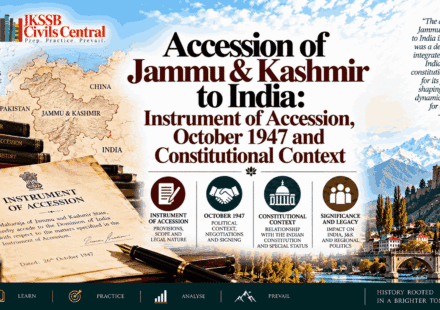
Accession of Jammu & Kashmir to India: Instrument of Accession, October 1947 and Constitutional Context
The accession of Jammu and Kashmir to India in October 1947 was established through the Instrument of Accession executed by Maharaja Hari Singh. This article explains its provisions, the roles of Hari Singh and Mountbatten, the subjects covered and its…
Jammu & Kashmir in 1947: Partition, Conflict, Standstill Agreement and the Crisis of Accession

The 1947 crisis transformed Jammu and Kashmir from a princely state facing an unresolved accession decision into the centre of an armed India–Pakistan conflict. This article explains the Standstill Agreement, internal unrest, October invasion and the…
Sheikh Abdullah: Political Career, Naya Kashmir and Constitutional Politics
Sheikh Abdullah shaped modern Jammu and Kashmir politics from the rise of the National Conference and Naya Kashmir to the 1947 accession crisis, constitutional negotiations, 1953 dismissal and 1975 return to power. This article traces his political…
Land Reforms in Jammu & Kashmir: Lawrence Settlement, Glancy Commission and Agrarian Reforms
Land reforms in Jammu and Kashmir evolved through a series of settlements, tenancy laws and political reforms. This article explains the Lawrence Settlement, occupancy rights, Tenancy Act of 1923, Glancy Commission, proprietary rights and the post-1947…
Socio-Economic Conditions under Dogra Rule: Land, Taxation, Begar, Agriculture and Crafts
The socio-economic history of Dogra Jammu and Kashmir was shaped by agriculture, land revenue, taxation, begar, crafts and trade. This article examines agrarian relations, the shawl economy, famine, rural society and the reforms that gradually…
Treaty of Amritsar, 1846: Provisions, Territorial Transfer and Historical Significance
The Treaty of Amritsar, signed on 16 March 1846 between the British Government and Gulab Singh, established the legal foundation of the Dogra princely State of Jammu and Kashmir. Learn its territorial, financial and political provisions and understand…
First Anglo-Sikh War, Treaty of Lahore and Formation of Jammu & Kashmir in 1846
The First Anglo-Sikh War of 1845–46 transformed the political map of the north-western Himalayas. This article explains the battles, Treaty of Lahore, Gulab Singh's role and the 1846 settlement that led to the formation of the princely State of Jammu and…
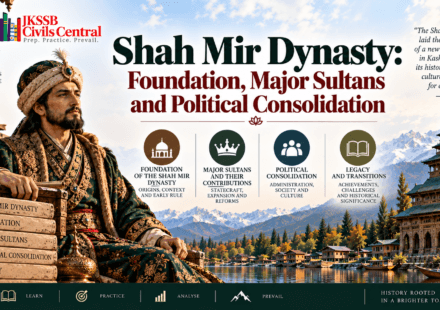
Shah Mir Dynasty: Foundation, Major Sultans and Political Consolidation
The Shah Mir dynasty transformed the political history of Kashmir after 1339. Explore its major sultans, regional expansion, succession struggles, Persianate culture and the influential reign of Zain-ul-Abidin.
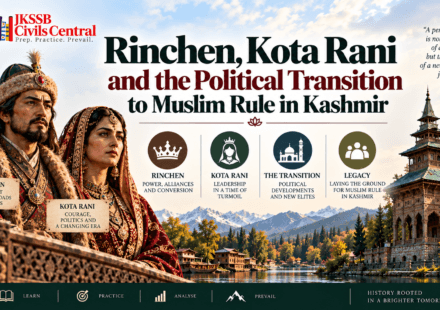
Rinchen, Kota Rani and the Political Transition to Muslim Rule in Kashmir
The transition to Muslim rule in Kashmir was a gradual political process rather than a single event. This article examines Rinchana's rise and conversion, Kota Rani's final rule and Shah Mir's establishment of sustained Muslim dynastic rule in 1339.