
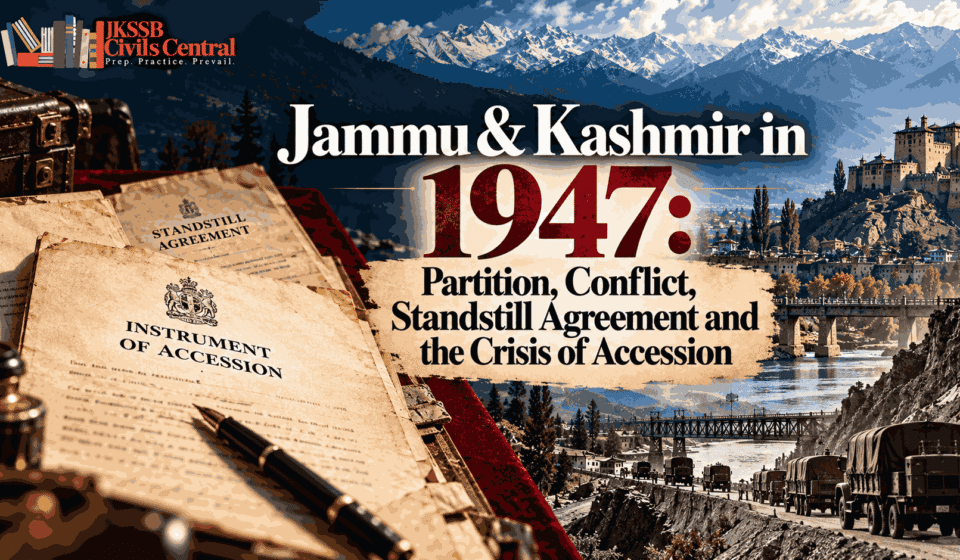
Jammu & Kashmir in 1947: Partition, Conflict, Standstill Agreement and the Crisis of Accession

J&K History Series Navigation
| Previous Article | Current Article | Next Article |
|---|---|---|
| ← Article 45: Sheikh Abdullah: Political Career, Naya Kashmir and Constitutional Politics | Article 46: Jammu & Kashmir in 1947: Partition, Conflict, Standstill Agreement and the Crisis of Accession | Article 47: Accession of Jammu & Kashmir to India: Instrument of Accession, October 1947 and Constitutional Context → |
Learning Dashboard
| Category | Key Information |
|---|---|
| Historical Period | 1947 |
| Historical Phase | Partition, Accession & Constitutional Transition |
| Principal Topic | Jammu & Kashmir during the 1947 crisis |
| Geographical Area | Jammu, Kashmir Valley, Poonch, Mirpur, Muzaffarabad, Gilgit and adjoining frontier regions |
| Core Theme | End of British paramountcy, political uncertainty, conflict and accession |
| Key Events | Partition; Standstill proposal; Poonch unrest; communal violence; tribal invasion; Maharaja’s flight to Jammu; request for Indian assistance; accession crisis |
| Key Personalities | Maharaja Hari Singh, Ram Chandra Kak, Janak Singh, Mehr Chand Mahajan, Sheikh Abdullah, Jawaharlal Nehru, Lord Mountbatten, V. P. Menon |
| Key Places | Srinagar, Jammu, Poonch, Muzaffarabad, Domel, Uri, Baramulla |
| Key Documents | Indian Independence Act, Standstill telegrams, Instrument of Accession, Maharaja’s letter, Mountbatten’s acceptance |
| JKSSB Importance | Extremely High |
| Expected Question Types | Chronology, statement-based, direct fact, document identification, cause-and-consequence, comparative and conceptual-factual |
Introduction
The year 1947 was the decisive turning point in the modern political history of Jammu and Kashmir. The end of British paramountcy transformed the constitutional position of the princely state, while the Partition of British India created an immediate geopolitical crisis. Jammu and Kashmir was contiguous to both India and Pakistan and therefore faced a choice that could not be separated from its internal political divisions, geographical position, communal tensions, economic links and the weakening authority of the Dogra state.
The Maharaja, Hari Singh, initially sought to avoid immediate accession to either Dominion. This policy was connected with the possibility of maintaining the state’s separate position while negotiating arrangements with both India and Pakistan. The attempt to preserve the status quo was expressed most clearly through the proposed Standstill Agreements of August 1947. However, the situation deteriorated rapidly as political unrest, communal violence, disturbances in Poonch, pressure from Pakistan, and eventually the armed tribal invasion transformed the question from a diplomatic problem into an emergency of state survival.
The crisis culminated in October 1947. Armed tribal forces entered the state from the direction of Pakistan, rapidly advancing through the western areas towards Srinagar. The Maharaja’s government requested military assistance from India, while the Government of India made assistance conditional upon accession. The Maharaja signed the Instrument of Accession in October 1947, and India accepted it; Indian troops were then airlifted to Srinagar. The precise legal and constitutional provisions of that accession form the subject of the next article, while this article explains why the accession crisis arose and how the events of 1947 led to it.
CivilsCentral Historical Insight
The 1947 crisis was not caused by a single event. It developed through the interaction of the end of British paramountcy, the Maharaja’s initial policy of delaying accession, competing political movements, regional and communal conflict, the state’s economic dependence on its western connections, and the October armed invasion. Accession therefore emerged from a rapidly changing security and political environment rather than from an isolated constitutional decision.
Part I — Jammu & Kashmir on the Eve of Partition
The Princely State and the End of British Paramountcy
Before August 1947, Jammu and Kashmir was a princely state under British paramountcy. The Maharaja exercised internal authority, while the British Crown’s paramountcy regulated the state’s external relationship and certain aspects of its political position. The Indian Independence Act of 1947 created the two Dominions of India and Pakistan and brought British paramountcy over the princely states to an end.
This constitutional transition was fundamental. Jammu and Kashmir did not automatically become part of either India or Pakistan merely because British India was partitioned. Its future therefore had to be determined through the political and constitutional choices available to the princely state. The geographical position of Jammu and Kashmir made the issue particularly complicated because the state shared boundaries and extensive economic and communications links with Pakistan while also maintaining important connections with India.
The end of paramountcy consequently created a period of uncertainty. The Maharaja remained the ruler of the state, but the previous imperial framework within which his authority had operated had disappeared. The question was no longer simply how Jammu and Kashmir would be administered under British paramountcy; it was what political and constitutional relationship the state would establish with the two new Dominions.
Why Jammu and Kashmir Was Strategically Important
The geography of Jammu and Kashmir made its future significant to both India and Pakistan. The state occupied a strategically important Himalayan position and contained routes linking it with the Punjab plains, the North-West Frontier region, Ladakh and the wider western Himalayan zone.
Its economic connections were also important. Roads, postal arrangements, trade routes and supply systems connected substantial parts of the state with areas that became part of Pakistan after Partition. At the same time, political connections with India had strengthened through the National Conference’s relationship with the Indian National Congress and through Sheikh Abdullah’s political association with Nehru.
The result was a state whose geographical, economic and political connections did not point in a single direction. This is essential for understanding why the Maharaja initially attempted to postpone the accession decision.
CivilsCentral Historical Insight
The constitutional uncertainty of 1947 cannot be understood without geography. Jammu and Kashmir’s links to both new Dominions meant that accession was simultaneously a political, economic, military and strategic question.
Part II — Political Situation Before Independence
Maharaja Hari Singh and the Question of Accession
Hari Singh’s government faced competing political pressures in 1947. The National Conference under Sheikh Abdullah had become the most important mass political organisation in the Kashmir Valley, while the Muslim Conference retained significant influence in parts of Jammu Province, particularly in western areas. Hindu political opinion in Jammu also contained strong support for the Maharaja and concern about the future of the Dogra state.
The political situation was therefore regionally differentiated. The National Conference’s political programme emphasised popular government and had developed close relations with the Indian National Congress, whereas the Muslim Conference increasingly leaned towards Pakistan. These political differences overlapped with regional, communal and socio-economic divisions.
At the same time, the Maharaja was reluctant to surrender his authority by immediately acceding to either Dominion. His government therefore sought to preserve the state’s freedom of action for as long as possible.
Change of Prime Minister in August 1947
The political uncertainty was reflected in changes within the state government. Ram Chandra Kak, who had served as Prime Minister since 1945, was removed from office in August 1947. Major General Janak Singh succeeded him temporarily, and Mehr Chand Mahajan subsequently became Prime Minister in October.
The change was politically significant because it occurred at the moment when the state was attempting to determine its future. However, it should not be presented simplistically as proof that the Maharaja had already made a final decision for India. The evidence indicates that the political situation was fluid and that the state’s leadership was responding to rapidly changing circumstances.
Mahajan’s arrival in October coincided with the final phase of the accession crisis. He became one of the principal figures through whom the Maharaja’s government communicated the deteriorating security situation to Indian leaders.
CivilsCentral Historical Insight
The change in the state government during August–October 1947 illustrates the instability of the political environment. Personnel changes mattered, but they should not be treated as automatic proof of a predetermined accession decision.
Part III — The Standstill Agreement Question
What Was a Standstill Agreement?
With British paramountcy ending, the princely states faced the practical problem of maintaining existing administrative and economic arrangements. A Standstill Agreement was intended to preserve existing arrangements temporarily while a more permanent constitutional relationship was worked out.
For Jammu and Kashmir, these arrangements were especially important because the state depended on established networks for communications, trade, supplies, posts and telegraphs. An abrupt breakdown could have had serious consequences for the functioning of government and the supply of essential goods.
The Standstill proposal therefore represented an attempt to freeze the existing practical arrangements without immediately deciding the ultimate question of accession.
The August 1947 Proposal
On 12 August 1947, the Government of Jammu and Kashmir sent parallel telegrams proposing Standstill Agreements to both India and Pakistan. The state proposed that existing arrangements with the outgoing British Indian government should continue until new agreements could be formally negotiated.
Pakistan accepted the proposal by telegram on 15 August 1947. India did not enter into an equivalent Standstill Agreement at that stage; instead, the Government of India requested that an authorised representative of the state come to Delhi to negotiate the proposed arrangement.
This distinction is extremely important for examination purposes:
J&K proposed Standstill arrangements to both Dominions.
Pakistan accepted the proposal by telegram.
India did not conclude a Standstill Agreement with J&K in August 1947; it sought negotiations.
The available documentary evidence also indicates that the Standstill arrangement concerned the continuation of existing practical arrangements and did not itself constitute accession to Pakistan. Contemporary UN documentation later described the matters involved as including communications, posts and telegraphs, supplies and related arrangements rather than the transfer of sovereignty or the state’s defence and foreign relations.
CivilsCentral Historical Insight
The Standstill Agreement was a mechanism for maintaining continuity, not a substitute for accession. Confusing the two leads to one of the most common errors in understanding the 1947 Kashmir crisis.
Part IV — Why the Standstill Arrangement Failed to Stabilise the State
Economic and Administrative Pressure
The Standstill arrangement did not remove the underlying political conflict. Jammu and Kashmir remained economically dependent upon routes and services running through areas that were now part of Pakistan. Disruption of supplies and communications therefore had immediate political consequences.
The state’s western districts were also experiencing increasing unrest. Poonch, in particular, became an important centre of armed opposition to Dogra authority. The roots of the unrest included local grievances, taxation, political mobilisation and the broader instability created by Partition.
The disturbances cannot be reduced to a single explanation. The Poonch crisis had an internal socio-political dimension, while the wider conflict increasingly acquired an inter-Dominion character. The overlap between local rebellion, communal mobilisation and external intervention makes the period particularly difficult to interpret.
Poonch and Western Jammu
Poonch was strategically important because of its location near the western frontier and its connections with Rawalpindi and the areas that became part of Pakistan. Armed resistance developed in the region during 1947, weakening the Maharaja’s authority.
The crisis in Poonch occurred against the background of the larger political division between the National Conference and Muslim Conference. The National Conference was strongest in the Kashmir Valley, while the Muslim Conference had significant support in western Jammu districts. These organisational differences became increasingly important as the accession question approached.
The Poonch disturbances therefore formed part of the wider breakdown of political order in the state. They also reduced the Maharaja government’s ability to maintain effective control over its western frontier.
CivilsCentral Historical Insight
Poonch should not be studied merely as a military episode. It demonstrates how local grievances, political mobilisation, Partition-era instability and external involvement could combine to weaken the authority of the princely state before the October invasion.
Part V — Communal Violence and the Breakdown of Political Order
Jammu and the Partition Crisis
Partition generated severe communal violence across northern India and Punjab, and Jammu and Kashmir was not isolated from these developments. Violence and displacement affected parts of Jammu Province, while large numbers of refugees moved across the newly created international boundary.
Communal violence further undermined confidence in the state’s administration. Political perceptions increasingly became linked with religious identity, and the ability of the Maharaja’s government to act as a neutral authority came under severe strain.
The situation was particularly dangerous because Jammu and Kashmir was politically heterogeneous. The Kashmir Valley had a Muslim majority and a strong National Conference organisation, while Jammu contained substantial Hindu, Muslim and Sikh populations with different political preferences. The western districts had their own political and military dynamics, while Ladakh and the northern frontier possessed distinct geographical and political characteristics.
The crisis therefore had a regional dimension as well as an India–Pakistan dimension.
The Political Importance of Sheikh Abdullah
Sheikh Abdullah’s role became increasingly important after his release on 29 September 1947. The National Conference leadership supported resistance to the emerging armed threat and organised political mobilisation in the Valley.
Abdullah’s position was significant because he represented a major popular political organisation whose support could influence the legitimacy of the Maharaja’s government and any future relationship with India. His political relationship with Nehru also provided an important channel between the National Conference and the Indian leadership.
The role of the National Conference does not mean that all people of Jammu and Kashmir held the same political position. Rather, it demonstrates that accession was being considered in an environment of competing political constituencies.
CivilsCentral Historical Insight
The 1947 crisis cannot be understood through the ruler alone. The emergence of mass politics meant that the political position of organisations such as the National Conference had become an important factor in determining the legitimacy and viability of the state’s future.
Part VI — The October 1947 Armed Invasion
The Invasion Begins
By October 1947, the political crisis had become a military emergency. Armed tribal forces entered Jammu and Kashmir from the direction of the North-West Frontier region. The commonly used historical chronology places the beginning of the major tribal invasion on 22 October 1947, although some official Indian military publications use an earlier date in describing the opening of the operations.
The invading forces advanced through the western approaches toward Muzaffarabad, Domel, Uri and Baramulla, creating a direct threat to Srinagar. Their rapid advance exposed the weakness of the state’s military position and the inability of the State Forces to contain the offensive.
The nature and extent of Pakistani state involvement in the invasion remain a major subject of historical and political debate. Indian contemporary records described the attackers as invaders supported from Pakistan, while Pakistan disputed responsibility for directing the invasion and presented the conflict differently. For a historically balanced account, the distinction between tribal participation, local rebellion and Pakistani state involvement should be maintained rather than collapsing all three into a single category.
The Fall of Muzaffarabad and Advance Toward Srinagar
The western frontier deteriorated rapidly. The capture of Muzaffarabad and the advance through the Jhelum Valley corridor opened the route toward Srinagar. Baramulla became an important point in the advance, and reports of violence, looting and disorder generated panic in the Valley.
The military significance was immediate. Srinagar, the political capital, was threatened, while the Maharaja’s administration faced a rapidly deteriorating security situation. The state forces were not sufficient to contain the advancing forces on their own.
The crisis was therefore transformed from a question of political preference into a question of immediate territorial defence and survival of the state government.
CivilsCentral Historical Insight
The October invasion transformed the accession question. Before the invasion, the Maharaja could attempt to postpone the decision; once the capital itself was threatened, delay became increasingly difficult to sustain.
Part VII — The Maharaja’s Move to Jammu and the Emergency
The Crisis in Srinagar
As the invading forces advanced, the Maharaja’s government faced a breakdown of effective authority in parts of the state. Srinagar was increasingly vulnerable, and the security situation became critical.
The Maharaja subsequently moved from Srinagar to Jammu. This was not simply an administrative relocation; it reflected the gravity of the military crisis. The state government required external military assistance if Srinagar was to be defended.
On 26 October 1947, the Government of India was considering the request for assistance. A contemporary note records that the Defence Committee of the Cabinet considered both the request for help against the raiders and the question of accession. The decision was to send troops to Srinagar while accepting accession, subject to the policy that the people’s wishes would ultimately be considered after restoration of law and order.
Request for Indian Military Assistance
The Maharaja’s government formally requested Indian assistance. The Government of India was unwilling to send troops to the state without a constitutional basis for intervention.
This created the decisive connection between military assistance and accession. The Maharaja’s government sought urgent military help, while India required accession before assuming responsibility for the state’s defence.
At the same time, the Indian leadership considered the political position of the National Conference. The contemporary record indicates that Sheikh Abdullah and the National Conference also supported assistance from India during the invasion.
This produced a convergence, although for different reasons, between the Maharaja’s immediate need for military assistance and the National Conference’s political alignment with India.
CivilsCentral Historical Insight
The accession crisis developed at the intersection of two forms of legitimacy: the Maharaja’s constitutional authority as ruler and the National Conference’s claim to popular political legitimacy. The Indian response was shaped by both the ruler’s request and the support of the major popular organisation.
Part VIII — The Crisis of Accession
From Delay to Decision
The Maharaja had attempted to postpone accession during the first months of independence. The Standstill proposal represented this policy most clearly: maintain existing arrangements while preserving freedom to decide later.
The October invasion fundamentally altered the circumstances. The state’s military position had deteriorated, Srinagar was threatened, and the Maharaja required immediate assistance. Under these conditions, the question of accession could no longer be postponed indefinitely.
On 26 October 1947, the Maharaja signed the Instrument of Accession to India. The Government of India accepted the accession on 27 October 1947, and Indian troops were airlifted into Srinagar that day.
This distinction is essential:
26 October 1947 — signing of the Instrument by Maharaja Hari Singh.
27 October 1947 — acceptance by Governor-General Lord Mountbatten and commencement of the Indian military airlift.
The detailed provisions of the Instrument, including the subjects transferred to India and the constitutional implications, belong to Article 47.
The Governor-General’s Acceptance
Lord Mountbatten accepted the accession on behalf of India on 27 October. His accompanying letter referred to the Government of India’s stated policy that, once law and order had been restored and the territory cleared of the invader, the question of accession could be settled by reference to the wishes of the people.
This political assurance became extremely important in subsequent constitutional and international debates. It should, however, be distinguished from the legal text of the Instrument of Accession itself. The Instrument and Mountbatten’s accompanying letter were related documents but performed different functions.
Jawaharlal Nehru also repeatedly stated in contemporary correspondence that India regarded the accession as subject to the eventual ascertainment of the people’s wishes once normal conditions had been restored. These statements became part of the later political history of the Kashmir question.
CivilsCentral Historical Insight
The accession crisis produced a layered constitutional arrangement: the Maharaja exercised the authority to accede, India accepted the accession, and the Indian leadership simultaneously articulated a political commitment to eventual consideration of the people’s wishes once the extraordinary circumstances had ended. Understanding these layers is essential before studying the later constitutional history of Article 370 and the J&K Constitution.
Part IX — Why the 1947 Crisis Became an India–Pakistan Conflict
From Princely-State Crisis to Inter-Dominion Conflict
The October events rapidly transformed the crisis from an internal struggle over the future of a princely state into a conflict involving India and Pakistan.
Pakistan disputed India’s interpretation of the accession and questioned the circumstances in which it had occurred. India maintained that the Maharaja had legally acceded to India and that Indian military intervention followed that accession. Both governments subsequently presented competing accounts of the events leading to accession.
The conflict also expanded geographically. Fighting was not confined to the Kashmir Valley. Jammu, Poonch, the western districts and the northern areas became part of the broader military confrontation.
The political dispute consequently acquired an international dimension. India approached the United Nations Security Council on 1 January 1948, complaining of assistance being provided to the forces operating against Jammu and Kashmir. Pakistan rejected India’s allegations and presented its own account of the conflict.
The United Nations became involved in the dispute in January 1948, but that development belongs to the subsequent military and international phase of the conflict rather than to the immediate constitutional decision of October 1947.
CivilsCentral Historical Insight
The significance of October 1947 lies in the transition from a princely state’s unresolved accession question to an interstate conflict. The constitutional decision and the subsequent international dispute are connected, but they should not be treated as the same historical event.
Part X — The 1947 Crisis: Multiple Dimensions
The crisis becomes clearer when its different dimensions are studied together.
Constitutional Dimension
The end of British paramountcy created the need for each princely state to determine its future relationship with the new Dominions. Jammu and Kashmir initially attempted to postpone the decision.
Political Dimension
The Maharaja, National Conference and Muslim Conference represented different political constituencies and visions of the state’s future. Political authority was therefore contested from within.
Regional Dimension
Jammu, Kashmir Valley, Poonch, Mirpur, Muzaffarabad, Gilgit and Ladakh did not experience the crisis in identical ways. Regional political and social conditions mattered.
Communal Dimension
Partition-related communal violence intensified mistrust and political polarisation. However, the conflict cannot be explained by communal identity alone because political, economic and territorial factors were also central.
Economic Dimension
The state’s dependence on western supply and communication networks made the preservation or disruption of existing arrangements particularly important.
Military Dimension
The weakness of the State Forces in the face of the October invasion made external military assistance decisive.
International Dimension
Once India and Pakistan became directly involved, the Kashmir issue moved beyond the framework of princely-state accession and became an international dispute.
CivilsCentral Historical Insight
The 1947 crisis was simultaneously constitutional, political, regional, economic, communal and military. Reducing it to a single question—”India or Pakistan?”—obscures the sequence of developments that actually produced the accession crisis.
Part XI — Historical Interpretation and Evidence Note
Was Independence the Maharaja’s Initial Position?
The Maharaja’s attempt to conclude Standstill arrangements with both Dominions demonstrates that he sought to preserve existing relations while postponing the accession decision. It is therefore reasonable to describe non-accession and preservation of autonomy as the initial policy direction.
However, the exact moment at which Hari Singh made a final internal decision regarding accession remains debated in historical literature. Claims that he had definitively chosen India months before October should therefore be treated cautiously unless supported by specific documentary evidence.
For examination purposes, the safest formulation is:
Initial policy — delay accession and preserve autonomy/status quo.
October invasion — transformed the situation.
26 October — Instrument of Accession signed.
27 October — accession accepted and Indian troops airlifted to Srinagar.
Was the Standstill Agreement with Pakistan an Accession to Pakistan?
No. The August arrangement was intended to maintain existing practical arrangements while the final constitutional relationship remained unresolved. Pakistan’s acceptance of the Standstill proposal did not itself constitute accession of Jammu and Kashmir to Pakistan.
This distinction is supported by the contemporary documentary record and is particularly important because the two concepts are frequently confused.
Was the Instrument of Accession Signed on 26 or 27 October?
The chronology must be stated carefully. The Maharaja signed the Instrument on 26 October 1947. The Governor-General accepted the accession on 27 October, and Indian troops began arriving in Srinagar that day.
Some later narratives compress these events into “accession on 27 October.” For examination purposes, the more precise distinction is preferable.
Did the Accession End the Conflict?
No. Accession created the constitutional basis on which India accepted responsibility for the state’s defence, but fighting continued. Pakistan disputed the accession, armed conflict continued, and the issue subsequently reached the United Nations.
Therefore: Accession ≠ end of the 1947–48 war.
Part XII — JKSSB Knowledge Matrix
| Question | High-Value Answer |
|---|---|
| What changed in 1947? | British paramountcy ended and the princely state’s future relationship with India/Pakistan had to be determined |
| Who ruled J&K in 1947? | Maharaja Hari Singh |
| Initial policy | Delay accession and preserve freedom of choice/status quo |
| Prime Minister during August 1947 | Janak Singh |
| Prime Minister from October 1947 | Mehr Chand Mahajan |
| Standstill proposal | 12 August 1947 |
| Pakistan’s acceptance | 15 August 1947 |
| India–J&K Standstill Agreement | Not concluded in August 1947 |
| Major internal unrest | Poonch and wider communal/political disturbances |
| Major invasion | Tribal invasion from the western direction in October 1947 |
| Commonly used invasion date | 22 October 1947 |
| Major threatened city | Srinagar |
| Maharaja moved to | Jammu |
| Instrument signed | 26 October 1947 |
| Accession accepted | 27 October 1947 |
| Indian troops landed in Srinagar | 27 October 1947 |
| Governor-General who accepted accession | Lord Mountbatten |
| Major popular organisation supporting accession in the crisis | National Conference |
| Next historical subject | Instrument of Accession and constitutional context |
Part XIII — Examination Discrimination Points
1. Standstill Agreement vs Instrument of Accession
Standstill Agreement
- August 1947
- temporary continuity of existing arrangements
- not accession
Instrument of Accession
- October 1947
- constitutional instrument of accession to India
- signed by Maharaja Hari Singh
2. 26 October vs 27 October
26 October 1947
→ Maharaja signed Instrument of Accession.
27 October 1947
→ Mountbatten accepted accession.
→ Indian troops were airlifted to Srinagar.
3. Pakistan vs India on Standstill
Pakistan: accepted the proposed Standstill arrangement by telegram.
India: sought negotiations through an authorised representative rather than concluding the proposed arrangement immediately.
4. Maharaja vs National Conference
Maharaja Hari Singh
→ constitutional ruler.
National Conference
→ major popular political organisation led by Sheikh Abdullah.
Both became important in the 1947 accession crisis, but they represented different sources of political authority.
5. Poonch vs Tribal Invasion
Poonch unrest
→ internal regional rebellion and political conflict with roots predating the October invasion.
Tribal invasion
→ armed incursion from the western direction beginning in October 1947.
They were connected within the wider crisis but were not identical events.
6. Accession vs United Nations
Accession
→ October 1947.
India approached the UN Security Council
→ 1 January 1948.
Thus, the UN involvement came after the accession crisis and the beginning of the armed conflict.
Part XIV — JKSSB Question Pattern
Direct Fact
Who was the Maharaja of Jammu and Kashmir at the time of accession in 1947?
Answer: Hari Singh
Statement-Based
Consider the following statements:
- Jammu and Kashmir proposed Standstill arrangements to both India and Pakistan.
- Pakistan accepted the proposal in August 1947.
- India concluded an identical Standstill Agreement with J&K in August 1947.
- The Standstill arrangement itself constituted accession to Pakistan.
Which statements are correct?
Answer: 1 and 2 only
Statements 3 and 4 are incorrect.
Chronology
Arrange the following:
- Pakistan accepts Standstill proposal
- Tribal invasion
- Instrument of Accession signed
- Indian troops arrive in Srinagar
- India approaches the UN Security Council
Correct sequence: 15 August 1947 → 22 October 1947 → 26 October 1947 → 27 October 1947 → 1 January 1948
Identification by Clues
Identify the 1947 document/arrangement intended to maintain existing administrative and economic arrangements pending the conclusion of new agreements.
Answer: Standstill Agreement
Comparative
Which pair is correctly matched?
A. Standstill Agreement — accession to India
B. Instrument of Accession — temporary continuation of postal arrangements
C. Standstill Agreement — maintenance of existing arrangements
D. UN Security Council complaint — August 1947
Correct Answer: C
Part XV — JKSSB Practice Questions
Q1. Who was the ruler of Jammu and Kashmir when the Instrument of Accession was signed in October 1947?
A. Pratap Singh
B. Hari Singh
C. Karan Singh
D. Gulab Singh
Correct Answer: B
Explanation: Maharaja Hari Singh was the ruler of Jammu and Kashmir in 1947 and signed the Instrument of Accession.
Q2. Jammu and Kashmir proposed Standstill arrangements to:
A. India only
B. Pakistan only
C. Both India and Pakistan
D. The United Nations
Correct Answer: C
Explanation: The J&K Government sent parallel proposals to both Dominions on 12 August 1947.
Q3. Which of the following correctly describes the August 1947 Standstill arrangement?
A. It transferred J&K’s sovereignty to Pakistan.
B. It transferred J&K’s defence to India.
C. It sought continuation of existing arrangements pending new agreements.
D. It created the Instrument of Accession.
Correct Answer: C
Explanation: The Standstill proposal sought continuity of existing arrangements while the future constitutional relationship remained unresolved.
Q4. Arrange the following events chronologically:
- India approaches the UN Security Council
- Pakistan accepts the Standstill proposal
- Instrument of Accession is signed
- Tribal invasion begins
A. 2–4–3–1
B. 4–2–3–1
C. 2–3–4–1
D. 3–2–4–1
Correct Answer: A
Explanation:
15 August 1947 → 22 October 1947 → 26 October 1947 → 1 January 1948.
Q5. The Instrument of Accession of Jammu and Kashmir was signed by:
A. Sheikh Abdullah
B. Lord Mountbatten
C. Maharaja Hari Singh
D. Jawaharlal Nehru
Correct Answer: C
Explanation: Hari Singh, as ruler of the princely state, signed the Instrument of Accession.
Q6. Lord Mountbatten accepted the accession of Jammu and Kashmir on:
A. 15 August 1947
B. 22 October 1947
C. 26 October 1947
D. 27 October 1947
Correct Answer: D
Explanation: The Maharaja signed the Instrument on 26 October; Governor-General Lord Mountbatten accepted the accession on 27 October 1947.
Q7. Consider the following statements:
- The Standstill Agreement and Instrument of Accession were different instruments.
- Pakistan accepted the proposed Standstill arrangement in August 1947.
- India and J&K concluded an identical Standstill Agreement before the tribal invasion.
- The Instrument of Accession was signed after the October invasion had begun.
Which is correct?
A. 1 and 2 only
B. 1, 2 and 4 only
C. 2, 3 and 4 only
D. 1, 2, 3 and 4
Correct Answer: B
Explanation: Statements 1, 2 and 4 are correct. Statement 3 is incorrect because India did not conclude the proposed Standstill Agreement with J&K in August 1947.
Q8. Which event most directly transformed the accession question into an immediate military crisis?
A. Formation of the National Conference
B. End of British paramountcy
C. Tribal invasion in October 1947
D. Formation of the United Nations
Correct Answer: C
Explanation: The October armed invasion threatened Srinagar and forced the Maharaja’s government to seek immediate military assistance.
Q9. The Government of India approached the UN Security Council regarding the Kashmir conflict on:
A. 27 October 1947
B. 15 November 1947
C. 1 January 1948
D. 17 January 1948
Correct Answer: C
Explanation: India approached the Security Council on 1 January 1948, after the accession and the outbreak of armed conflict.
Q10. Which sequence is most accurate?
A. Accession → Standstill Agreement → Tribal invasion → UN complaint
B. Standstill proposal → Tribal invasion → Accession → UN complaint
C. Tribal invasion → Standstill proposal → Accession → UN complaint
D. Standstill proposal → Accession → Tribal invasion → UN complaint
Correct Answer: B
Explanation: The sequence is broadly: August Standstill proposal → October invasion → October accession → January 1948 UN complaint.
Part XVI — Rapid Revision Zone
Important Dates
| Date | Event |
|---|---|
| 15 August 1947 | Independence of India and Pakistan; British paramountcy ended |
| 12 August 1947 | J&K proposed Standstill arrangements to both Dominions |
| 15 August 1947 | Pakistan accepted the Standstill proposal |
| August–September 1947 | Political and regional unrest intensified |
| October 1947 | Mehr Chand Mahajan became Prime Minister |
| 22 October 1947 | Commonly used date for beginning of major tribal invasion |
| 26 October 1947 | Maharaja Hari Singh signed Instrument of Accession |
| 27 October 1947 | Mountbatten accepted accession; Indian troops airlifted to Srinagar |
| 1 January 1948 | India approached UN Security Council |
Important Personalities
Hari Singh
→ Maharaja of J&K in 1947
→ signed Instrument of Accession
Ram Chandra Kak
→ Prime Minister until August 1947
Janak Singh
→ Prime Minister during August–October 1947
Mehr Chand Mahajan
→ Prime Minister during the final accession crisis
Sheikh Abdullah
→ National Conference leader
→ released in September 1947
→ major popular political figure during crisis
Jawaharlal Nehru
→ Indian Prime Minister
→ closely involved in Kashmir policy
Lord Mountbatten
→ Governor-General of India
→ accepted accession on 27 October 1947
V. P. Menon
→ Indian constitutional/States Department official involved in the accession process
Important Documents
Indian Independence Act, 1947
→ constitutional framework for the creation of India and Pakistan and the end of British paramountcy.
Standstill Telegrams
→ August 1947
→ continuity of existing arrangements.
Instrument of Accession
→ October 1947
→ accession of J&K to India.
Maharaja’s Letter
→ accompanied the Instrument of Accession.
Mountbatten’s Letter of Acceptance
→ 27 October 1947.
Key Chronological Chain
End of British Paramountcy
↓
Maharaja seeks to delay accession
↓
Standstill proposal — 12 August 1947
↓
Pakistan accepts — 15 August
↓
Poonch and wider political/communal unrest
↓
Tribal invasion — October
↓
Advance toward Srinagar
↓
Maharaja moves to Jammu
↓
Request for Indian military assistance
↓
Instrument of Accession signed — 26 October
↓
Accession accepted — 27 October
↓
Indian troops airlifted to Srinagar
↓
India–Pakistan conflict expands
↓
India approaches UN — 1 January 1948
Part XVII — Frequently Confused Facts
| Confusion | Correct Fact |
|---|---|
| Standstill Agreement = accession | Incorrect |
| J&K proposed Standstill only to Pakistan | Incorrect — both India and Pakistan |
| Pakistan rejected the Standstill proposal | Incorrect — Pakistan accepted it |
| India concluded a Standstill Agreement with J&K in August 1947 | Incorrect |
| Standstill Agreement transferred sovereignty | Incorrect |
| Hari Singh was ruler in 1947 | Correct |
| Instrument signed on 27 October | For precision: signed 26 October; accepted 27 October |
| Mountbatten signed the Instrument | Incorrect — Hari Singh signed; Mountbatten accepted |
| Indian troops arrived before accession | Incorrect in the formal chronology |
| UN involvement preceded accession | Incorrect |
| UN Security Council approached on 1 January 1948 | Correct |
| Poonch unrest and tribal invasion were identical | Incorrect |
Part XVIII — What Can JKSSB Ask?
High-Value Areas
JKSSB can test:
- Maharaja Hari Singh’s identity
- end of British paramountcy
- August 1947 Standstill proposal
- Pakistan’s acceptance
- India’s response
- Poonch unrest
- political role of Sheikh Abdullah
- October tribal invasion
- Muzaffarabad–Uri–Baramulla route
- threat to Srinagar
- Maharaja’s move to Jammu
- request for Indian assistance
- signing versus acceptance of accession
- role of Lord Mountbatten
- arrival of Indian troops
- date of India’s UN complaint
- difference between Standstill Agreement and Instrument of Accession
- constitutional versus military dimensions of accession
Particularly Important Statement Traps
Statement 1: J&K offered Standstill arrangements to both India and Pakistan.
→ Correct
Statement 2: Pakistan accepted the proposal.
→ Correct
Statement 3: India signed an identical Standstill Agreement with J&K in August 1947.
→ Incorrect
Statement 4: The Standstill Agreement amounted to accession to Pakistan.
→ Incorrect
Statement 5: Hari Singh signed the Instrument of Accession.
→ Correct
Statement 6: Mountbatten accepted the accession on 27 October 1947.
→ Correct
Statement 7: India approached the UN before the accession.
→ Incorrect
Chapter Summary
The 1947 crisis in Jammu and Kashmir began with the end of British paramountcy and the disappearance of the political framework that had previously governed the princely state. Maharaja Hari Singh initially attempted to preserve the state’s freedom of action rather than immediately accede to India or Pakistan. The proposal for Standstill arrangements with both Dominions represented an effort to maintain existing administrative and economic relations while postponing the final constitutional decision.
The political situation deteriorated rapidly. Poonch unrest, communal violence, refugee movements, regional political divisions and the weakening authority of the state administration created an increasingly unstable environment. The release of Sheikh Abdullah and the mobilisation of the National Conference added another important political dimension because the question of the state’s future now involved not only the Maharaja but also competing claims of popular political legitimacy.
The decisive transformation occurred in October 1947 when armed tribal forces entered the state and advanced rapidly through the western areas toward Srinagar. The invasion created an immediate military emergency, forcing the Maharaja’s government to seek external assistance. With Srinagar threatened and the State Forces unable to contain the offensive, the question of accession could no longer be postponed.
Hari Singh signed the Instrument of Accession on 26 October 1947. Governor-General Lord Mountbatten accepted the accession on 27 October, and Indian troops were airlifted to Srinagar. These events created the constitutional and military basis for India’s intervention, but they did not end the conflict. Pakistan disputed the accession, fighting continued, and the issue subsequently acquired an international dimension through the United Nations.
The central historical lesson is therefore:
1947 was a process, not a single event.
End of paramountcy → uncertainty → Standstill arrangements → internal conflict → October invasion → request for assistance → accession → military conflict → internationalisation.
JKSSB Takeaway
The highest-value facts are:
12 Aug 1947 → J&K proposes Standstill arrangements to both Dominions
15 Aug 1947 → Pakistan accepts
22 Oct 1947 → commonly used date for major tribal invasion
26 Oct 1947 → Hari Singh signs Instrument of Accession
27 Oct 1947 → Mountbatten accepts; Indian troops arrive
1 Jan 1948 → India approaches UN Security Council
The most important conceptual distinction is:
Standstill Agreement = continuation of existing arrangements.
Instrument of Accession = constitutional accession to India.
Mind Map
JAMMU & KASHMIR — 1947
↓
End of British Paramountcy
↓
Maharaja Hari Singh
↓
Initial Policy: Delay Accession / Preserve Autonomy
↓
Standstill Proposal — 12 Aug 1947
↙︎ ↘︎
Pakistan accepts India seeks negotiations
↓
Political + Regional + Communal Unrest
↓
Poonch Crisis
↓
October Tribal Invasion
↓
Muzaffarabad → Uri → Baramulla → Threat to Srinagar
↓
Maharaja Moves to Jammu
↓
Request for Indian Military Assistance
↓
Instrument of Accession — 26 Oct
↓
Acceptance — 27 Oct
↓
Indian Troops Arrive
↓
India–Pakistan Conflict
↓
UN Involvement — Jan 1948
↓
Constitutional & Political Developments
FAQs
1. What happened to Jammu and Kashmir when British paramountcy ended?
Jammu and Kashmir ceased to be under British paramountcy and had to determine its future relationship with the new Dominions of India and Pakistan.
2. Did Maharaja Hari Singh initially accede to India or Pakistan?
He initially attempted to postpone accession and preserve the state’s freedom of action while maintaining existing arrangements with both Dominions.
3. What was the Standstill Agreement?
It was an arrangement intended to maintain existing administrative and economic relations pending the conclusion of new agreements.
4. Did J&K propose a Standstill arrangement to both India and Pakistan?
Yes. Parallel proposals were sent to both Dominions on 12 August 1947.
5. Did Pakistan accept the Standstill proposal?
Yes. Pakistan accepted it by telegram in August 1947.
6. Did India sign a Standstill Agreement with J&K?
No. India sought further negotiations and asked the state to send an authorised representative to Delhi.
7. When did the tribal invasion begin?
The commonly used historical date is 22 October 1947, although some official Indian military publications use different dating for the opening of operations.
8. When did Hari Singh sign the Instrument of Accession?
26 October 1947.
9. When was the accession accepted by India?
Governor-General Lord Mountbatten accepted it on 27 October 1947.
10. When did India approach the United Nations over Kashmir?
India approached the UN Security Council on 1 January 1948.
About The Author




[…] ← Article 46: Jammu & Kashmir in 1947: Partition, Conflict, Standstill Agreement and the Crisi… […]