
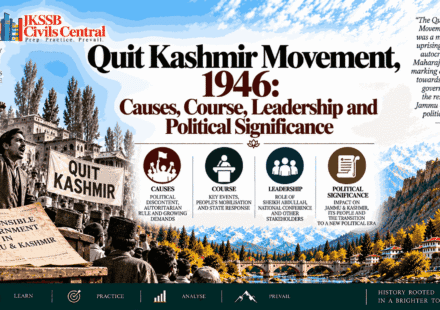
Quit Kashmir Movement, 1946: Causes, Course, Leadership and Political Significance

The Quit Kashmir Movement of 1946 was a major National Conference-led challenge to Dogra rule under Maharaja Hari Singh. Led by Sheikh Abdullah, it raised the question of popular sovereignty, challenged the existing political order and became a crucial…
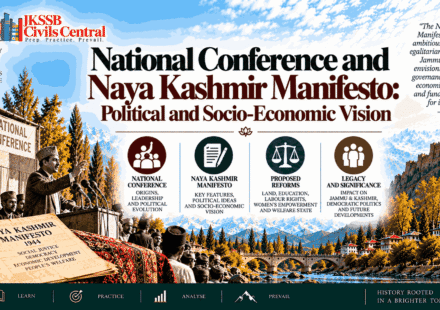
National Conference and Naya Kashmir Manifesto: Political and Socio-Economic Vision
The National Conference emerged from the Muslim Conference in 1939 with a broader political vision centred on responsible government. Its 1944 Naya Kashmir Manifesto proposed constitutional democracy, economic planning, agrarian reform, women's rights…
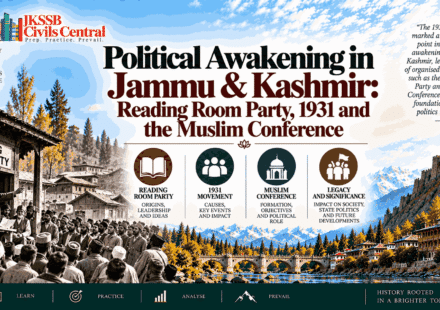
Political Awakening in Jammu & Kashmir: Reading Room Party, 1931 and the Muslim Conference
The political awakening of Jammu & Kashmir in the late 1920s and early 1930s transformed scattered grievances into organised political mobilisation. This article examines the Reading Room Party, the 1931 agitation, Glancy Commission and formation of the…
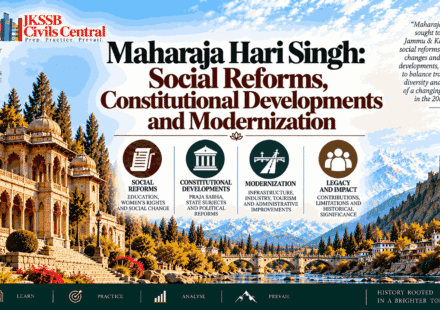
Maharaja Hari Singh: Social Reforms, Constitutional Developments and Modernization
Maharaja Hari Singh's reign from 1925 to 1947 witnessed major social, educational, judicial and constitutional developments in Jammu and Kashmir. This article examines his reforms, the State Subject system, Praja Sabha, the 1939 Constitution and the…
Land Reforms in Jammu & Kashmir: Lawrence Settlement, Glancy Commission and Agrarian Reforms
Land reforms in Jammu and Kashmir evolved through a series of settlements, tenancy laws and political reforms. This article explains the Lawrence Settlement, occupancy rights, Tenancy Act of 1923, Glancy Commission, proprietary rights and the post-1947…
Socio-Economic Conditions under Dogra Rule: Land, Taxation, Begar, Agriculture and Crafts
The socio-economic history of Dogra Jammu and Kashmir was shaped by agriculture, land revenue, taxation, begar, crafts and trade. This article examines agrarian relations, the shawl economy, famine, rural society and the reforms that gradually…
Dogra Administration: Institutions, Law, Revenue and Governance in Jammu & Kashmir
Dogra administration transformed Jammu & Kashmir from a ruler-centred princely state into a progressively institutionalized system of courts, departments, revenue records, written laws and limited representative government. This article traces that…
Dogra Rule in Jammu & Kashmir: Gulab Singh and the Consolidation of the Princely State
Gulab Singh's reign marked the first phase of consolidation of the Jammu & Kashmir princely state created in 1846. This article examines his political rise, establishment of authority in Kashmir, administration, revenue system, frontier challenges, shawl…
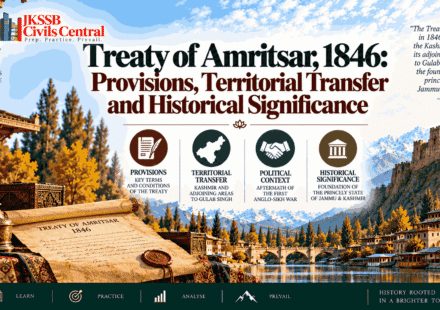
Treaty of Amritsar, 1846: Provisions, Territorial Transfer and Historical Significance
The Treaty of Amritsar, signed on 16 March 1846 between the British Government and Gulab Singh, established the legal foundation of the Dogra princely State of Jammu and Kashmir. Learn its territorial, financial and political provisions and understand…

Quit Kashmir Movement 1946: Causes, Politics & Impact – JKSSB Notes

Quit Kashmir Movement 1946 The historical landscape of Jammu and Kashmir is a tapestry of complex socio-political shifts, but few events resonate with as much intensity in the modern competitive examination syllabus as the Quit Kashmir Movement of 1946.…