
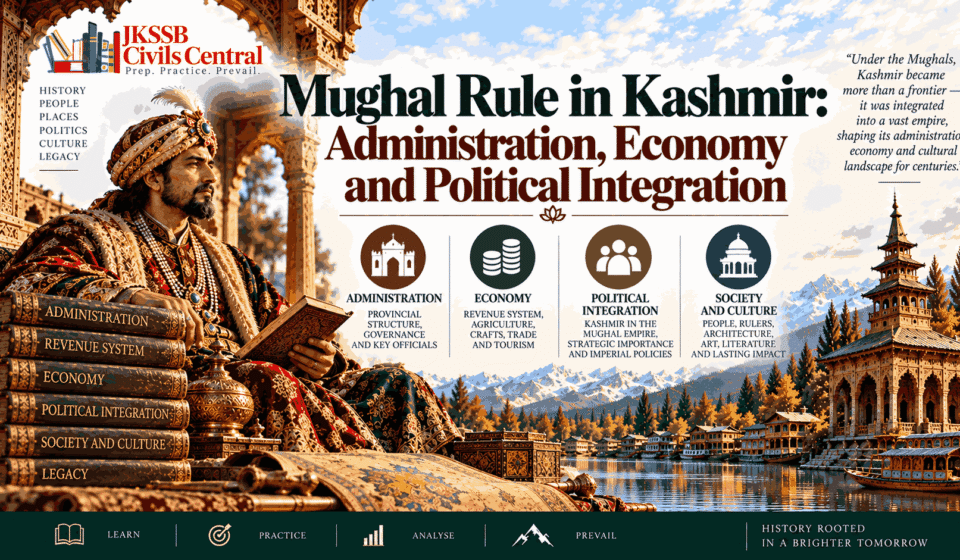
Mughal Rule in Kashmir: Administration, Economy and Political Integration

J&K History Series Navigation
| Previous Article | Current Article | Next Article |
|---|---|---|
| Article 26 — Mughal Annexation of Kashmir: Akbar, Yusuf Shah Chak and the Events of 1586 | Article 27 — Mughal Rule in Kashmir: Administration, Economy and Political Integration | Article 28 — Mughal Kashmir: Jahangir, Shah Jahan, Aurangzeb and the Development of Gardens and Architecture |
Learning Dashboard
| Aspect | Key Information |
|---|---|
| Historical Period | 1586–1752 |
| Historical Phase | Mughal rule in Kashmir |
| Main Imperial Dynasty | Mughal Empire |
| Initial Emperor | Akbar |
| Important Later Emperors | Jahangir, Shah Jahan, Aurangzeb |
| Administrative Centre | Srinagar |
| Initial Imperial Arrangement | Kashmir incorporated into the Mughal administrative system after 1586; its exact provincial relationship with Kabul evolved over time |
| Major Administrative Theme | Provincial integration and revenue reorganization |
| Major Economic Theme | Agriculture + land revenue + crafts + long-distance trade |
| Important Revenue Theme | Adaptation of imperial assessment to Kashmir’s agrarian conditions |
| Important Language | Persian in court and state administration |
| Important Local Groups | Kashmiri landed elites, officials, merchants, artisans, Kashmiri Pandits |
| Major Economic Products | Rice, saffron, shawls, woollen goods, fruits, paper and other crafts |
| Major Political Development | Integration of regional elites into the Mughal administrative order |
| End of Mughal Rule | 1752, with Afghan conquest |
| JKSSB Importance | Very High |
| Likely Question Types | Statement-based, chronology, administration, revenue, economic associations, source-based and comparative |
Introduction
The Mughal annexation of Kashmir in 1586 created a political problem that was more difficult than simply defeating the Chak dynasty. Military conquest established imperial sovereignty, but durable rule required the Mughals to reorganize administration, regulate revenue, work with local elites, secure communications, connect Kashmir’s economy with wider imperial markets and establish institutions through which the imperial centre could exercise authority over a geographically difficult region. The history of Mughal Kashmir is therefore best understood not merely as a period of imperial occupation but as a prolonged process of political, fiscal, administrative and economic integration.
This process began under Akbar and developed under his successors. The first years were particularly important because the Mughal state had to stabilize a recently conquered territory in which political factions remained active and the existing revenue structure was poorly suited to the demands of a new imperial administration. Akbar’s government consequently investigated land, production and revenue, reorganized officials and revised assessments more than once. The evidence also shows that imperial policy was not static: revenue arrangements changed as Mughal officials acquired more information about Kashmir’s land, crops, prices and ecological constraints.
Mughal rule also altered Kashmir’s relationship with the wider economy of northern India. Kashmir’s shawls, saffron, fruits, paper, woollen goods and other products circulated more extensively through imperial markets, while merchants, raw materials and manufactured goods moved into the Valley from other parts of the Mughal world. Persian became increasingly important in administration and elite culture, while Kashmiri officials and intellectuals—including substantial numbers of Kashmiri Pandits—participated in the new political and economic order. The result was not the disappearance of local society but its repositioning within an imperial structure.
CivilsCentral Historical Insight
The central significance of Mughal rule in Kashmir lay in the transformation of sovereignty into administration. The conquest of 1586 established Mughal authority, but revenue surveys, provincial offices, elite incorporation, market expansion and Persian administrative culture gradually converted that military victory into a more durable imperial relationship.
Clear Chronological Framework: Mughal Rule in Kashmir
Before studying individual institutions, it is important to establish the broad chronology.
| Period | Development |
|---|---|
| 1586 | Mughal conquest and effective annexation of Kashmir |
| 1586–1587 | Initial military consolidation under the first Mughal administration |
| 1587 onward | More systematic provincial administration develops |
| 1589 | Akbar’s visit; major effort toward revenue and administrative reorganization |
| 1591 | Further investigation into revenue assessment and administrative irregularities |
| 1594–1597 | Reassessment and refinement of land-revenue arrangements |
| 1605 | Jahangir succeeds Akbar |
| Early 17th century | Mughal political and economic integration deepens |
| 1628 | Shah Jahan succeeds Jahangir |
| Mid-17th century | Kashmir’s position within the Mughal provincial system develops further |
| 1658 | Aurangzeb succeeds Shah Jahan |
| Late 17th century | Mughal political control continues, while imperial pressures and local administrative issues evolve |
| 18th century | Mughal power in Kashmir gradually weakens alongside wider imperial decline |
| 1752 | Mughal rule in Kashmir ends with Afghan conquest |
The precise administrative classification of Kashmir changed over time and has been described differently in historical scholarship. It is therefore safer to emphasize the process of provincial integration rather than impose one rigid administrative formula on the entire period from 1586 to 1752.
Part I — From Conquest to Provincial Integration
The Problem of Governing a Newly Conquered Region
The Mughal conquest did not automatically produce a functioning Mughal administration. Kashmir had its own political elites, revenue practices, geographical constraints and established social institutions. The early Mughal authorities therefore had to combine imperial institutions with local knowledge.
The first priority was political stabilization. The Chak ruling structure had collapsed, but its supporters had not necessarily disappeared, and local elites had their own interests in the new order. Some resisted Mughal authority, while others saw imperial service as an opportunity to recover or enhance their political position. This created a situation in which Mughal rule depended not only on force but also on selective incorporation of local political groups.
Rattan Lal Hangloo’s analysis emphasizes this dual process: Mughal incorporation involved the creation of imperial-dependent officials while also drawing sections of the Kashmiri nobility and educated groups into the new political structure. This was not simply replacement of one elite by another; it was a restructuring of political relationships around Mughal authority.
The First Mughal Governors
The earliest governors operated in a difficult environment. Qasim Khan was among the first Mughal officials responsible for consolidating the conquest, while Mirza Yusuf Khan Rizvi became particularly important in the subsequent organization of Mughal administration.
The early years should not be imagined as a fully developed provincial bureaucracy functioning smoothly from the moment of annexation. The evidence instead points to experimentation, conflict with existing officials and repeated reassessment of revenue and administrative practices.
This distinction is important because the Mughal Empire possessed a sophisticated imperial administrative system, but the actual implementation in Kashmir developed gradually.
CivilsCentral Historical Insight
Imperial integration was a process rather than an event. The Mughals brought Kashmir under the authority of the emperor in 1586, but effective administration required the gradual construction of a working relationship between imperial officials, local elites, cultivators and commercial groups.
Part II — The Administrative Structure of Mughal Kashmir
The Subah and the Provincial Government
Mughal political organization was based on a hierarchy connecting the emperor to provincial and local authorities. Kashmir was incorporated into this structure after the conquest, with a Subahdar or provincial governor serving as the principal representative of imperial authority.
The governor’s responsibilities included maintaining political order, supervising administration and representing the emperor’s interests. Yet the governor did not possess unrestricted autonomy. Mughal governance deliberately distributed responsibilities among different officials so that no single provincial officer could easily transform the province into an independent political base.
The structure therefore combined central authority with provincial delegation.
Sarkars, Parganas and Mahals
The territory was further organized into smaller administrative units. Sources for Mughal Kashmir refer to sarkars, parganas and mahals, through which revenue and local administration could be organized.
The exact number and territorial boundaries of these units changed over time, so numerical lists should not be treated as permanent divisions for the entire Mughal period. A later reorganization is particularly associated with Qazi Ali, who divided the Subah into a large number of parganas during the process of revenue reassessment.
The significance of these divisions was practical. Imperial government needed identifiable territorial units through which land could be assessed, revenue could be collected, disputes could be handled and local officials could be supervised.
The Provincial–Fiscal Relationship
One of the most important principles of Mughal administration was the separation of political and fiscal responsibilities. The provincial governor was not supposed to control the entire revenue machinery independently.
This was part of a wider Mughal system in which the emperor maintained checks among provincial officials. However, the exact working of these arrangements in Kashmir varied with local circumstances and the strength of individual governors.
It is therefore safer to distinguish the imperial administrative model from the actual functioning of Mughal institutions in Kashmir.
Part III — Persian and the Administrative Culture of Mughal Kashmir
Persian before the Mughals
Persian did not arrive in Kashmir with Akbar. The language had already been introduced under the Shahmiri Sultans and had become increasingly important under rulers such as Zain-ul-Abidin. By the Mughal period, Persian was already deeply connected with court culture, administration and elite intellectual life.
The Mughal conquest therefore accelerated and institutionalized an existing Persianate administrative tradition rather than creating it from nothing.
Persian as a Language of Government
Under Mughal rule, Persian became firmly embedded in state administration and record keeping. This was part of the wider Mughal administrative culture, but its significance in Kashmir was particularly strong because it provided a common language linking local officials with the imperial government.
This linguistic integration also created opportunities for educated Kashmiris. Kashmiri Pandits, in particular, possessed longstanding traditions of literacy and administrative service and became increasingly involved in Persian-based state administration. Evidence discussed by modern scholarship shows Kashmiri officials serving as peshkars, qanungos, diwans, qazis and other functionaries in the Mughal system.
Persianization Was Not the Same as Cultural Replacement
The spread of Persian administration did not mean that Kashmiri language and local culture disappeared.
Rather, a layered cultural environment developed:
Persian → administration and elite culture
Kashmiri → everyday regional society and vernacular culture
Sanskrit → continued intellectual and religious traditions among learned communities
This is an important distinction for understanding cultural change in Mughal Kashmir.
CivilsCentral Historical Insight
Persianization under the Mughals should not be understood as a complete replacement of Kashmiri culture. The Mughal state operated through Persian, but local communities—including Kashmiri Pandits and other regional groups—adapted to and participated in that administrative culture.
Part IV — Land Revenue: The Core of Mughal Governance
Why Revenue Was Central
The Mughal state depended heavily on agrarian revenue. In Kashmir, this was especially important because agriculture formed a major component of the Valley’s economic base even though ecological conditions differed from those of the Mughal heartlands.
Akbar’s empire had developed increasingly systematic methods of land assessment by the late sixteenth century. The famous Dahsala system was based on long-term calculations of crops, prices and yields in areas where it was fully applicable. But the existence of this imperial model does not mean that Kashmir automatically adopted an identical system.
Kashmir required adaptation because of its mountainous terrain, limited cultivable land, climatic conditions and distinctive crop pattern.
The Kashmir Revenue Problem
The early Mughal authorities inherited a revenue system that had developed under the Sultanate. Its assessment practices did not always correspond to actual agricultural production. The Mughal government therefore undertook investigations into land, crops, production and existing revenue records. This was not a single settlement completed immediately after annexation. Instead, assessment was repeatedly reviewed during Akbar’s reign.
The process is particularly important because it demonstrates how imperial administration depended on measurement and information.
The 1589 Revenue Investigation
During Akbar’s visit and the subsequent reorganization of Kashmir, a team of officials was assigned to examine the revenue system. The sources identify figures including Shaikh Faizi, Mir Sharif Amuli, Khwaja Muhammad Husain, Khwaja Shamsuddin Khafi and Kanwar Man Singh in this process.
The investigation examined land classification, production and the existing revenue demand. The purpose was not merely to increase taxation but to make the revenue system more legible and controllable to the imperial state.
Yusuf Khan Rizvi and Administrative Irregularities
The early Mughal revenue arrangements were not free from corruption or local resistance. The records indicate serious discrepancies in assessments associated with the administration of Yusuf Khan Rizvi, one of the early Mughal governors. Local officials had incentives to resist reforms because closer imperial scrutiny could reduce opportunities for private extraction from cultivators.
A complaint by Tota Ram, a Kashmiri peshkar associated with Yusuf Khan Rizvi, brought some of these problems to Akbar’s attention. The emperor subsequently ordered further investigation.
This episode is important because it demonstrates that Mughal administration was not simply an impersonal bureaucracy imposed from above. Local officials could manipulate the system, and the imperial government had to respond to complaints, audits and administrative information.
Part V — Revenue Assessment and the Adaptation to Kashmir
Nasq and Crop Sharing
Kashmir’s revenue system involved methods associated with nasq and ghalla-bakhshi, in which revenue was connected to the agricultural produce rather than relying exclusively on the standardized cash assessment used in some core Mughal territories. This arrangement had an important advantage in an environmentally variable region: when harvests changed, the revenue burden could adjust with production.
The system nevertheless required a substantial administrative apparatus because officials had to observe, record and assess agricultural production.
From One Assessment to Another
Akbar’s government revised the revenue demand more than once. The evidence cited by Hangloo indicates that an assessment associated with the late sixteenth-century reforms placed the state’s share at half the produce, while a later reassessment under Akbar reduced the standard state share to one-third, with the assessment also being made more responsive to variations in cultivation and harvest.
This sequence is extremely important for examination purposes.
It means that the statement: “The Mughal land revenue in Kashmir was always fixed at one-half of the produce”
would be misleading.
Likewise, simply applying the standard textbook description of Akbar’s empire-wide revenue system to Kashmir without qualification would be inaccurate.
Abolition or Reduction of Certain Cesses
Akbar’s reforms also addressed several additional imposts recorded in the Kashmir revenue system. Sources associate his administration with the abolition of various cesses, including Baj and Tamgah, among others.
These measures reduced some of the additional burdens imposed beyond the principal land-revenue demand. The changes therefore had both administrative and political significance: reducing irregular or unpopular demands could strengthen the legitimacy of imperial government among cultivators.
The Limits of the Reform
Revenue reform should not be romanticized as a simple policy of peasant welfare. The fundamental purpose remained the extraction of a predictable agrarian surplus for the state. Better assessment could reduce arbitrary extraction while simultaneously increasing the ability of the state to collect revenue efficiently.
Thus: Administrative rationalization ≠ absence of taxation and revenue regularization ≠ complete peasant freedom from exploitation.
CivilsCentral Historical Insight
The Mughal revenue system in Kashmir illustrates the dual character of imperial reform. Better assessment could protect cultivators from some forms of arbitrary extraction, but it also made the agrarian surplus more visible and therefore more accessible to the state. The same administrative machinery could produce both greater regularity and greater fiscal penetration.
Part VI — Agriculture and the Kashmir Economy
Agriculture as the Agrarian Base
Agriculture remained fundamental to Kashmir’s economy under Mughal rule. Rice was particularly important, while saffron, fruits and other crops contributed to the region’s commercial economy.
The geography of the Valley, however, meant that agriculture could not simply be treated like cultivation in the plains of northern India. Seasonal conditions, limited arable land and the short agricultural cycle shaped the organization of production.
This ecological context helps explain why the Mughal administration paid particular attention to the actual productivity of land.
Rice and the Revenue System
Rice was particularly important because it served both as a staple food and as a measure within revenue calculations.
The Ain-i-Akbari and Kashmir-focused scholarship preserve information about revenue assessments expressed through quantities of grain and their cash equivalents. This shows that the Kashmir economy was not simply a cash economy imposed from outside; payment in kind remained significant.
Saffron
Saffron was among Kashmir’s important commercial products. Its value extended beyond local consumption, and Mughal interest in the commodity reflected its importance within interregional trade.
The earlier Chak-Mughal settlement had already identified saffron as an economically significant resource. Under established Mughal rule, its circulation through wider markets became part of Kashmir’s growing economic integration.
Horticulture and Fruit
Kashmir’s horticultural production also acquired importance in the imperial economy. Fruits and other agricultural products moved toward major centres such as Lahore and Agra.
This illustrates a broader change: the Mughal state did not simply extract agricultural revenue from Kashmir; it also connected Kashmiri production to markets outside the Valley.
Part VII — Crafts and the Shawl Economy
Why Crafts Mattered
Kashmir’s economy cannot be understood through agriculture alone. Because the Valley had a limited agricultural season, craft production had long supplemented rural livelihoods. Under Mughal rule, the expansion of imperial markets created stronger demand for Kashmiri manufactures.
This was one of the most significant economic consequences of Mughal integration.
Shawl Production
The shawl industry became particularly important. Akbar took an interest in Kashmiri shawl manufacture, and the Ain-i-Akbari records imperial attention to the quality, design, colouring and dimensions of shawl products. This indicates that Mughal interest extended beyond taxation to the organization and improvement of commercially valuable production.
The shawl industry was not created by the Mughals. Its roots predated Mughal rule. What changed was the scale and reach of its market.
The Mughal nobility represented a major market for luxury textiles, while merchants carried Kashmiri products into other parts of the empire.
Other Crafts
Mughal Kashmir was also associated with the production and circulation of:
- woollen textiles
- carpets
- paper
- papier-mâché articles
- wood products
- embroidered goods
- metal and other craft products.
These activities supported both rural and urban populations. The expansion of craft production also increased occupational specialization. Artisans became more closely connected to merchant networks and distant consumers.
CivilsCentral Historical Insight
The Mughal impact on Kashmiri crafts was less a matter of inventing traditional industries than of expanding markets, reorganizing production and connecting artisans to imperial demand. This distinction is essential: many Kashmiri crafts predated the Mughals, but Mughal political integration altered their commercial scale.
Part VIII — Trade and Commercial Integration
From Regional Economy to Imperial Market
The Mughal period strengthened Kashmir’s commercial connections with the plains and with transregional markets. Merchants moved between Kashmir and major Mughal centres, while merchants from outside Kashmir established commercial connections in the Valley. This created a more integrated market structure.
Kashmir increasingly functioned as both: a producer of specialized goods and a consumer of imported commodities.
Exports from Kashmir
Among the products associated with Kashmir’s external trade were:
- shawls
- saffron
- fruits
- paper
- woollen products
- forest products
- honey
- craft goods
- certain agricultural commodities.
The exact volume of exports varied and should not be converted into unsupported modern statistics.
Imports
Kashmir also imported commodities that were less readily available locally, including salt, cotton, yarn, sugar and other goods. This exchange reduced the economic isolation of the Valley.
Kashmir and Long-Distance Networks
Mughal Kashmir remained connected to wider commercial networks extending toward:
- Punjab
- northern India
- Central Asia
- Tibet
- Persia
- other regional markets.
The importance of these connections should not be exaggerated into the claim that Kashmir was simply a major international trade centre comparable to the principal ports of the Mughal Empire. Its significance lay in its specialized position within mountain and overland trade networks.
Roads and Inns
The Mughals also invested in maintaining routes and facilities used by travellers and merchants. Under Jahangir, the famous Mughal road network connecting Kashmir with the plains became particularly important. Routes, bridges and inns reduced some of the logistical barriers created by Kashmir’s geography.
The significance of this infrastructure was therefore economic as well as administrative.
CivilsCentral Historical Insight
Political integration became economically meaningful when roads, merchants, crafts and agricultural products linked Kashmir more closely to the wider Mughal market. Imperial sovereignty was therefore reinforced not only through officials and revenue but also through the movement of goods and people.
Part IX — Urban Growth and Srinagar
Srinagar as the Administrative Centre
Srinagar remained the principal political and urban centre of Kashmir. Under Mughal rule, its importance increased because the city became the focal point of provincial administration, commerce, elite residence and imperial activity.
The concentration of officials and merchants encouraged urban development.
Markets and Commercial Spaces
The expansion of trade contributed to the growth of markets and specialized commercial areas. Merchants dealt in textiles, agricultural goods, craft products and imported commodities. The city therefore became increasingly connected to markets beyond Kashmir.
Urban–Rural Relationship
The growth of Srinagar did not mean that Kashmir’s economy became primarily urban.
Instead, the city depended heavily on the countryside for:
- food
- raw materials
- agricultural revenue
- labour
- craft inputs.
The Mughal administrative system therefore linked urban political authority with rural production.
Part X — Mughal Integration of the Local Elite
Why the Mughals Needed Local Elites
An empire could not effectively govern Kashmir through outsiders alone.
Local elites possessed:
- knowledge of the region
- established social connections
- influence over villages
- administrative experience
- linguistic skills
- access to commercial networks.
The Mughals therefore incorporated sections of the local elite into the imperial system.
From Local Nobility to Imperial Service
Some Kashmiri elites entered positions such as:
- peshkar
- qanungo
- chaudhri
- diwan
- qazi
- jagirdar
- mansabdar
- muqaddam.
The exact functions and status of these offices varied, and they should not be treated as interchangeable. The broader pattern, however, is clear: political authority was redistributed through imperial appointments and patronage.
Hangloo’s evidence includes several Kashmiri officials and elites who occupied positions within the Mughal system. This indicates that incorporation did not mean the disappearance of Kashmiri political participation; instead, local political agency increasingly operated through imperial institutions.
Kashmiri Pandits in Administration
Kashmiri Pandits played an important role in the administrative culture of Mughal Kashmir.
Their literacy and familiarity with Persian made them useful to the state. Their participation should not be interpreted as evidence that the Mughal state was exclusively dependent upon one community, but it demonstrates the importance of educated local groups in maintaining imperial administration.
This pattern continued into later periods and became an important feature of Kashmir’s administrative history.
Part XI — Jagirs, Mansabs and Imperial Patronage
The Mansabdari Connection
The Mughal mansabdari system provided a framework through which military and civil elites were ranked and rewarded. Kashmiri elites could enter this wider imperial hierarchy, allowing political status to become connected to imperial service.
The system also helped the emperor prevent regional elites from becoming entirely independent.
Jagirs
A jagir was a revenue assignment granted in lieu of or as part of remuneration and political service. It did not necessarily mean private ownership of land in the modern sense.
This distinction is important for examination purposes. A jagirdar’s relationship with land was fundamentally connected to the right to collect specified revenue, subject to imperial authority.
Political Consequences
The incorporation of local elites into mansab and jagir networks weakened the institutional basis for independent regional sovereignty. A noble who depended upon imperial appointment, revenue assignment or court patronage had a direct interest in maintaining the Mughal order.
This was one of the principal mechanisms through which political integration worked.
CivilsCentral Historical Insight
Mughal integration was not achieved only by replacing Kashmiri elites. It worked partly by reclassifying regional political power within the imperial system. Local influence could survive, but its legitimacy and resources increasingly depended on recognition by the Mughal state.
Part XII — Justice, Police and Local Administration
The Need for Local Order
A revenue system could not function without mechanisms for maintaining order. Provincial officials therefore dealt with disputes, policing, collection of revenue and enforcement of imperial authority. At the local level, officials associated with revenue records, collection and judicial functions became important.
Qazis
The Qazi represented an important judicial institution within the Islamic legal framework of the Mughal state. However, the existence of the qazi should not be interpreted as meaning that all aspects of Kashmiri society were governed exclusively through Islamic law. Local customs, village practices and other institutions continued to influence everyday life.
Qanungos and Revenue Records
The qanungo was associated with the maintenance of revenue information and local fiscal records. Such record-keeping was essential because the Mughal state increasingly depended upon information about land, cultivation, assessment and collection.
The expansion of written administration was therefore one of the most important long-term changes introduced by Mughal rule.
The Limits of Centralization
The Mughals did not create complete uniformity. Mountain geography, local power structures and distance from the imperial centre meant that implementation could vary considerably.
The Mughal state was therefore centralized in sovereignty but negotiated in practice.
Part XIII — Political Integration Beyond Administration
Matrimonial Alliances
Political integration also involved relationships between the Mughal ruling family and Kashmiri elites.
Matrimonial alliances created personal connections between regional elites and the imperial household.
Such alliances were not simply social events. In a pre-modern political system, marriage could serve as an instrument for securing loyalty, recognition and access to imperial patronage.
Evidence discussed by Hangloo records several matrimonial relationships involving Kashmiri elites and members of the Mughal ruling family. These should nevertheless be treated as individual political relationships rather than as evidence of a universal policy of intermarriage.
Visits of the Emperors
The Mughal emperors’ personal visits to Kashmir were another form of political integration. Akbar visited Kashmir in 1589, while Jahangir became particularly associated with repeated imperial visits to the Valley.
These visits served several purposes:
- political supervision
- imperial display
- communication with local elites
- inspection of administration
- personal engagement with the landscape
- cultural patronage.
The imperial presence therefore had a symbolic dimension as well as a practical one.
Part XIV — Jahangir and the Consolidation of Mughal Kashmir
A New Phase after Akbar
Akbar established the administrative foundations of Mughal rule. Under Jahangir (1605–1627), Kashmir became increasingly integrated into the imperial political and cultural world. Jahangir’s personal interest in Kashmir was unusually strong. His repeated visits reinforced the symbolic connection between the emperor and the Valley.
His reign also witnessed further development of roads, communication and commercial infrastructure.
Administration Continued
Jahangir did not need to construct an entirely new state structure.
The basic administrative principles established under Akbar continued:
provincial governor
→ territorial subdivisions
→ revenue administration
→ local officials
→ imperial oversight.
The continuation of administrative formulas demonstrates that Akbar’s reforms created institutional structures that could survive a change of emperor.
Economic Integration
The relationship between Kashmir and the wider Mughal economy also deepened. Kashmiri shawls, fruits, saffron and other products circulated more widely, while imperial demand stimulated specialized production.
This economic integration became one of the most durable legacies of Mughal rule.
Part XV — Shah Jahan and the Provincial Development of Kashmir
From Akbar’s Integration to Greater Provincial Definition
Under Shah Jahan (1628–1658), Mughal administration in Kashmir developed further.
Historical works differ in how they describe the precise evolution of Kashmir’s administrative status, particularly concerning its relationship with Kabul and the later formation of a distinct provincial structure. This is an area where the article should avoid presenting one simplified administrative formula as though it applied unchanged from 1586 to 1752.
What is clear is that Kashmir had become firmly embedded within the Mughal provincial system by Shah Jahan’s reign.
Greater Administrative Institutionalization
The development of a more established provincial administration strengthened:
- revenue collection
- official appointments
- judicial administration
- military organization
- communication with the imperial centre.
The governor remained dependent upon imperial appointment and could be transferred or replaced.
This prevented the provincial government from becoming an independent hereditary state.
Imperial Presence
Shah Jahan’s reign also intensified the cultural and architectural association of the Mughals with Kashmir. Detailed treatment of gardens, architecture and imperial building activity belongs to Article 28.
For Article 27, the key point is that cultural patronage accompanied and reinforced political integration.
Part XVI — Aurangzeb and the Later Mughal Period
Continuity and Change
Under Aurangzeb (1658–1707), Kashmir remained part of the Mughal Empire. The administrative system continued to operate through governors and officials appointed within the imperial framework. Local elites continued to participate in government, while the fiscal relationship between agriculture and the state remained important.
However, the broader Mughal Empire was undergoing significant political and fiscal pressures.
Kashmir and Imperial Strain
As the Mughal Empire expanded elsewhere, the emperor’s attention was increasingly divided among multiple fronts. Kashmir’s distance from the imperial heartland created difficulties in supervision. Provincial officials therefore became increasingly important in the day-to-day functioning of the state.
The later Mughal period consequently demonstrates an important structural tension:
central imperial sovereignty versus provincial dependence on local political networks.
This tension became more serious as Mughal power weakened during the eighteenth century.
Part XVII — Social Effects of Mughal Integration
A More Connected Elite
Mughal rule created a political class whose interests were increasingly connected with the imperial system.
Officials, merchants and aristocratic families benefited from access to:
- imperial appointments
- revenue assignments
- commercial networks
- court patronage
- wider markets.
This produced new opportunities but also created inequalities.
Rural Society
For cultivators, the effects were more complex. Revenue reassessment could reduce arbitrary exactions and make demands more predictable. At the same time, a more systematic bureaucracy could penetrate rural society more deeply and ensure that the state captured a larger share of agricultural surplus.
The impact therefore varied by social position.
Artisans
Artisans could benefit from expanding demand, particularly in textile and luxury-goods production. Yet greater market integration also meant increased dependence on merchants, imperial consumers and commercial intermediaries.
Economic integration therefore produced both: opportunity and dependency.
CivilsCentral Historical Insight
Mughal integration changed different sections of Kashmiri society in different ways. Merchants and skilled artisans could gain from wider markets, elites could gain from imperial service, while cultivators remained subject to the demands of a more systematic revenue state. Political integration therefore cannot be equated with uniform social improvement.
Part XVIII — Was Mughal Rule “Beneficial” or “Exploitative”?
This question requires historical balance. Some aspects of Mughal rule clearly represented administrative improvement compared with unstable political conditions: revenue records became more systematic, certain irregular cesses were removed, communication improved and commercial markets expanded.
At the same time, the fundamental purpose of the Mughal state remained imperial extraction and political control. Land revenue continued to be a major source of state income, and the expansion of bureaucracy increased the state’s capacity to appropriate agricultural surplus.
The correct historical interpretation therefore avoids two extremes. It is inaccurate to portray Mughal rule simply as a period of prosperity and good government. It is equally simplistic to describe it only as exploitation.
The more defensible conclusion is that Mughal rule produced greater administrative regularity and economic integration while simultaneously extending imperial fiscal and political control.
Part XIX — The Economy of Mughal Kashmir: A Connected Model
The Mughal economic system can be understood as a chain:
Agriculture
↓
Land Revenue
↓
State Treasury
↓
Imperial Administration
↓
Roads + Political Stability + Market Networks
↓
Trade
↓
Craft Production
↓
Shawls, Woollens, Paper, Carpets, Saffron, Fruits and Other Goods
↓
Wider Mughal Markets
↓
Greater Economic Integration of Kashmir
This system was mutually reinforcing.
Agriculture generated revenue.
Revenue financed government.
Government secured political order.
Political order facilitated trade.
Trade created demand for crafts.
Crafts generated commercial income.
Commercial networks connected Kashmir more closely to the Mughal Empire.
Part XX — Kashmir and the Wider Mughal World
Mughal integration gradually weakened the economic isolation of the Valley. Kashmiri merchants travelled beyond the region, while merchants from the plains entered Kashmir. Persian and Central Asian connections also continued.
The result was not the disappearance of Kashmir’s distinct economic character but its insertion into a wider system.
This is particularly important because Kashmir’s economy was structurally different from the predominantly agrarian plains. Craft production, horticulture, animal products and specialized goods played an unusually important role.
Mughal rule therefore connected two different economic environments: Kashmir’s mountain economy and the agrarian-commercial economy of the Mughal plains.
Part XXI — Mughal Rule and the Transformation of Political Sovereignty
Before 1586:
Regional Sovereignty
The Chak ruler possessed independent political authority.
After 1586:
Imperial Sovereignty
The Mughal emperor became the ultimate source of political authority.
But the transition was more complex than replacing one ruler with another.
Under the Chak state, local elites competed for access to the ruler.
Under Mughal rule, local elites increasingly competed for access to:
the emperor
↓
provincial governor
↓
imperial offices
↓
jagirs and mansabs
↓
revenue and commercial opportunities.
This changed the political geography of power.
Political ambition was increasingly directed toward the imperial system rather than solely toward an independent Kashmiri court.
CivilsCentral Historical Insight
The deepest political consequence of Mughal rule was the transformation of the source of legitimacy and political opportunity. Kashmir’s elites did not disappear; instead, their advancement increasingly depended upon participation in an imperial hierarchy whose centre lay outside the Valley.
Part XXII — Historical Sources for Mughal Administration and Economy
Ain-i-Akbari
The Ain-i-Akbari of Abu’l Fazl is one of the most important sources for understanding Mughal administration, revenue, geography and economic life. It contains administrative regulations, descriptions of provincial organization and information about agriculture and crafts.
However, the Ain primarily describes the imperial administrative system from the perspective of the Mughal state. It should therefore not automatically be treated as proof that every regulation worked exactly as described on the ground.
This distinction is particularly important for Kashmir.
Akbarnama
The Akbarnama provides the narrative history of Akbar’s reign and is valuable for understanding the conquest, imperial policy and major administrative developments. Its courtly perspective requires source criticism.
Kashmir-Centred Persian Chronicles
Works produced within Kashmir provide perspectives that differ from the Mughal court narrative.
These sources are particularly valuable for understanding:
- local political elites
- provincial officials
- administrative conflicts
- revenue problems
- social conditions.
Modern Scholarship
Modern studies such as A. Majid Mattoo’s Kashmir Under the Mughals, 1586–1752 organize the period around administration, revenue, social conditions, religion, learning, architecture and economic development. Hangloo’s study emphasizes the process through which the Kashmiri Sultanate was incorporated into the Mughal state and how administration, agrarian restructuring, crafts and political patronage interacted.
Part XXIII — Evidence and Historiographical Cautions
Do Not Project the Entire Imperial System onto Kashmir
One of the most common mistakes in studying Mughal Kashmir is to assume that every institution of the Mughal heartland functioned identically in the Valley.
Akbar’s empire had a highly developed revenue structure, but Kashmir’s geography and agricultural economy required adaptation.
Therefore: Mughal administrative model ≠ identical Kashmir implementation.
Do Not Treat Revenue Rates as Permanently Fixed
The revenue share changed during Akbar’s reforms.
A statement that “Mughal revenue in Kashmir was one-half throughout the period” is incorrect.
Likewise, a statement that the state always took exactly one-third would also be misleading.
The evidence points to successive assessments and revisions.
Do Not Claim Complete Abolition of Begar
An inscription associated with the construction of Nagar Nagar records that workers were not compelled to perform begar for that particular project. That does not prove the complete abolition of forced labour throughout Kashmir.
This distinction is especially important because older historical interpretations sometimes generalized the inscription beyond what the evidence establishes.
Do Not Say the Mughals Invented the Shawl Industry
Shawl production existed before Mughal rule. The Mughal contribution lay primarily in patronage, market expansion, production organization and integration into imperial demand.
Do Not Say Persian Began in Kashmir with Akbar
Persian already had an established administrative and literary presence under the Shahmiri Sultans.
The Mughals strengthened its administrative institutionalization.
Part XXIV — Historical Significance
1. Administrative Integration
Mughal rule introduced Kashmir into a larger imperial administrative framework.
2. Revenue Reorganization
Land and agricultural production became subject to increasingly systematic imperial assessment.
3. Greater State Penetration
Officials, records and revenue institutions allowed the state to reach more deeply into rural society.
4. Political Incorporation of Local Elites
Kashmiri nobles, administrators and educated groups increasingly participated in imperial institutions.
5. Expansion of Trade
Kashmir became more closely connected to markets across northern India and beyond.
6. Growth of Craft Production
Imperial demand strengthened important industries, especially shawl and other textile production.
7. Persian Administrative Culture
Persian became firmly embedded in the functioning of the state.
8. Urban Development
Srinagar’s political and commercial importance increased.
9. Infrastructure and Communications
Routes, bridges and inns facilitated movement between Kashmir and the plains.
10. Long-Term Political Transformation
Kashmir ceased to function as an independent regional Sultanate and became part of successive larger empires.
Part XXV — Mughal Rule: Strengths and Limitations
| Dimension | Development | Historical Assessment |
|---|---|---|
| Political | Integration into Mughal Empire | Ended independent Chak sovereignty |
| Administration | Provincial bureaucracy expanded | Greater state capacity |
| Revenue | Reassessment and record keeping | More systematic but still extractive |
| Agriculture | Closer fiscal regulation | Greater predictability in some contexts |
| Trade | Wider imperial markets | Increased commercial integration |
| Crafts | Expansion of demand | Strengthened specialized production |
| Language | Persian administrative dominance | Linked Kashmir to wider Persianate bureaucracy |
| Local Elites | Mansabs, jagirs and offices | Preserved local participation within imperial hierarchy |
| Urban Life | Growth of Srinagar and markets | Strengthened commercial-administrative centre |
| Infrastructure | Routes and inns improved | Reduced geographical barriers |
| Social Impact | Differentiated benefits and burdens | No uniform experience |
| Long-Term | Imperial integration | Created conditions for later Mughal political decline and transition |
Part XXVI — JKSSB Knowledge Matrix
| Question | Answer |
|---|---|
| Who established Mughal rule in Kashmir? | Akbar |
| When was Kashmir conquered? | 1586 |
| Who was the first phase of Mughal authority centred on? | Imperial governors and provincial administration |
| What was the principal economic base? | Agriculture |
| What was a major staple crop? | Rice |
| Which crop was commercially important? | Saffron |
| Which major craft received strong Mughal patronage and market expansion? | Shawl production |
| Which language dominated Mughal administration? | Persian |
| Did Persian begin in Kashmir under Akbar? | No |
| Which source is especially important for Mughal administrative details? | Ain-i-Akbari |
| Who wrote the Ain-i-Akbari? | Abu’l Fazl |
| What was a jagir? | A revenue assignment connected with imperial service |
| What was a mansab? | An imperial rank/status within the Mughal service system |
| Which officials maintained revenue records? | Qanungos and other revenue officials |
| What was the importance of Srinagar? | Administrative, political and commercial centre |
| Did Kashmir follow one unchanging revenue rate? | No |
| What happened to some additional cesses under Akbar? | Several were abolished/remitted |
| Was begar completely abolished throughout Kashmir? | Not established by the available inscriptional evidence |
| When did Mughal rule end? | 1752 |
Part XXVII — Examination Discrimination Points
Mughal Conquest vs Mughal Administration
1586 → conquest and annexation
After 1586 → administrative consolidation
Do not treat these as the same event.
Persian vs Mughal
Persian already existed as an administrative and literary language before Mughal rule.
Mughals strengthened and institutionalized its use.
Shawl Industry vs Mughal Patronage
Shawl production predates the Mughals.
Mughal rule expanded imperial demand and market connections.
Revenue Reform vs Revenue Abolition
Akbar reorganized and rationalized revenue.
He did not abolish land revenue.
One-Third vs One-Half
Different stages of Akbar’s Kashmir revenue reforms are associated with different assessments.
Therefore:
One-third ≠ permanent Mughal Kashmir rate
One-half ≠ permanent Mughal Kashmir rate
Begar
A specific inscriptional exemption from forced labour on a particular construction project does not prove universal abolition of begar.
Local Elites
Mughal rule did not eliminate Kashmiri elites.
It integrated selected elites into the imperial political structure.
Part XXVIII — JKSSB Question Pattern Mapping
Direct Fact
Which language became firmly established as the language of Mughal state administration in Kashmir?
Answer: Persian
Statement-Based
Consider the following statements:
- Persian was introduced into Kashmir only after Akbar’s conquest.
- Agriculture remained an important economic base under Mughal rule.
- Shawl production predated Mughal rule.
- Mughal rule expanded Kashmir’s links with wider markets.
Correct answer: Statements 2, 3 and 4 only.
Chronology
Arrange the following:
- Akbar’s conquest of Kashmir
- Revenue investigations and reassessment
- Jahangir’s reign
- Shah Jahan’s reign
Correct sequence:
1 → 2 → 3 → 4
Match the Following
| Person / Institution | Association |
|---|---|
| Abu’l Fazl | Ain-i-Akbari |
| Yusuf Khan Rizvi | Early Mughal administration |
| Qazi Ali | Revenue investigation/reorganization |
| Qanungo | Revenue records |
| Peshkar | Administrative deputy/assistant |
Identification by Clues
Identify the source:
- Written by Abu’l Fazl.
- Contains information on Mughal administration.
- Provides details on revenue, geography and economic activities.
- Closely associated with Akbar’s reign.
Answer: Ain-i-Akbari
Comparative Question
Which best distinguishes Mughal rule from the preceding Chak political order?
A. Complete replacement of Kashmiri elites
B. Integration of Kashmir into an imperial administrative and fiscal structure
C. Introduction of agriculture
D. Introduction of Persian for the first time
Answer: B
Part XXIX — JKSSB Practice Questions
Question 1
Which of the following best describes the principal economic base of Mughal Kashmir?
A. Maritime trade
B. Agriculture and related rural production
C. Mining
D. Overseas commerce
Correct Answer: B
Explanation: Agriculture remained fundamental to the economy, although crafts, trade and specialized products were also important.
Question 2
Consider the following statements:
- Persian was already present in Kashmir before Mughal annexation.
- Mughal rule strengthened Persian’s role in administration.
- Kashmiri Pandits participated in Persian-based administration.
- Kashmiri language disappeared from everyday use under the Mughals.
Which statements are correct?
A. 1 and 2 only
B. 1, 2 and 3 only
C. 2, 3 and 4 only
D. All four
Correct Answer: B
Explanation: Persian had an established pre-Mughal history in Kashmir. Mughal rule strengthened its administrative role, while Kashmiri continued as a regional vernacular.
Question 3
Which source is particularly important for studying Mughal administrative arrangements under Akbar?
A. Rajatarangini
B. Ain-i-Akbari
C. Nilamata Purana
D. Kitab-ul-Hind
Correct Answer: B
Explanation: The Ain-i-Akbari provides detailed information on Akbar’s administration, revenue system, geography and economic organization.
Question 4
Which of the following is the most accurate statement about Mughal revenue administration in Kashmir?
A. A single fixed rate operated unchanged throughout Mughal rule.
B. Kashmir was completely exempt from land revenue.
C. Revenue assessment was revised and adapted to local conditions.
D. Only customs duties were collected.
Correct Answer: C
Explanation: The evidence indicates successive assessments and adjustments during Akbar’s reign.
Question 5
Which commodity was particularly associated with Kashmir’s commercial economy under Mughal rule?
A. Pepper from Malabar
B. Shawls
C. Indigo from Bengal
D. Salt from Gujarat
Correct Answer: B
Explanation: Kashmiri shawls became an important commercial product in wider Mughal markets.
Question 6
Which statement about the shawl industry is correct?
A. It was created by Akbar.
B. It began only after Kashmir became a Mughal province.
C. It predated Mughal rule but expanded under wider imperial markets.
D. It was exclusively a royal industry.
Correct Answer: C
Explanation: Shawl production had earlier roots; Mughal patronage and market expansion strengthened the industry.
Question 7
A jagir in the Mughal administrative context was primarily:
A. A hereditary sovereign kingdom
B. A revenue assignment connected with service
C. A religious tax
D. A village council
Correct Answer: B
Question 8
Which of the following best describes the relationship between Mughal administration and local Kashmiri elites?
A. Complete exclusion
B. Complete independence
C. Selective incorporation into imperial institutions
D. Abolition of all local offices
Correct Answer: C
Explanation: Kashmiri nobles and officials could enter imperial service and occupy positions within the Mughal administrative structure.
Question 9
Consider the following statements:
- Akbar’s revenue reforms in Kashmir were revised more than once.
- Some additional cesses were abolished.
- The state completely abolished all forms of forced labour throughout Kashmir.
- Revenue administration became more systematic.
Which are correct?
A. 1, 2 and 4 only
B. 1 and 3 only
C. 2 and 3 only
D. All four
Correct Answer: A
Explanation: The evidence supports repeated reassessment, abolition/remission of several cesses and increased administrative regularization. Complete abolition of begar throughout Kashmir is not established.
Question 10
Which development most directly strengthened political integration between Kashmir and the Mughal Empire?
A. Decline of agriculture
B. Incorporation of local elites into imperial offices and service networks
C. Abolition of all local customs
D. Isolation of Srinagar from external markets
Correct Answer: B
Part XXX — Rapid Revision Zone
Important Dates
- 1586 — Mughal conquest of Kashmir.
- 1589 — Akbar’s visit and major administrative/revenue reorganization.
- 1591 — Further investigation into revenue problems.
- 1594–1597 — Reassessment and refinement of revenue arrangements.
- 1605 — Jahangir succeeds Akbar.
- 1628 — Shah Jahan succeeds Jahangir.
- 1658 — Aurangzeb succeeds Shah Jahan.
- 1752 — Mughal rule ends in Kashmir with Afghan conquest.
Important Personalities
- Akbar — established Mughal sovereignty and initiated administrative integration.
- Abu’l Fazl — author of Ain-i-Akbari.
- Qasim Khan — early Mughal military/provincial authority.
- Yusuf Khan Rizvi — important early Mughal governor.
- Qazi Ali — associated with revenue investigation and reorganization.
- Jahangir — deepened imperial engagement with Kashmir.
- Shah Jahan — further developed the provincial and imperial framework.
- Aurangzeb — ruled during the later phase of Mughal Kashmir.
Important Administrative Terms
- Subah — imperial province.
- Subahdar — provincial governor.
- Sarkar — territorial administrative division.
- Pargana — lower territorial/revenue unit.
- Mahal — administrative/revenue unit in Mughal usage.
- Jagir — revenue assignment.
- Mansab — imperial rank.
- Qanungo — revenue-record official.
- Peshkar — administrative deputy/assistant.
- Qazi — judicial official.
- Diwan — senior fiscal/financial official.
- Muqaddam — village-level/local head in appropriate contexts.
Important Economic Products
- Rice
- Saffron
- Shawls
- Woollen goods
- Fruits
- Paper
- Carpets
- Forest products
- Papier-mâché and other crafts
Important Sources
- Ain-i-Akbari — Abu’l Fazl
- Akbarnama — Abu’l Fazl
- Kashmir Persian chronicles
- Revenue records
- Inscriptions
- Modern historical scholarship
Core Economic Chain
Agriculture → Revenue → Administration → Trade → Crafts → Imperial Markets
Part XXXI — Frequently Confused Facts
| Confusion | Correct Understanding |
|---|---|
| Persian introduced by Mughals | Persian already had a pre-Mughal administrative history |
| Shawls invented by Mughals | Shawl production predated Mughal rule |
| Revenue always one-third | Revenue assessments changed over time |
| Revenue always one-half | Also incorrect as a permanent rule |
| Jagir = land ownership | Jagir primarily involved revenue assignment |
| Mansab = jagir | Mansab = rank; jagir = revenue assignment |
| Mughal rule removed local elites | Selected local elites were incorporated |
| Mughal rule ended local culture | Local culture continued within a wider imperial framework |
| Begar completely abolished | Not established for all economic activity |
| Conquest = immediate administrative integration | Integration developed over subsequent decades |
| Agriculture = entire economy | Crafts and trade were highly important |
| Mughal gardens = whole Mughal legacy | Administration, revenue and economic integration were equally important |
Part XXXII — What Can JKSSB Ask?
High-value question areas include:
- Mughal administrative structure in Kashmir.
- Akbar’s revenue reforms.
- Revenue reassessment under Akbar.
- One-third vs one-half revenue distinctions.
- Abolition/remission of additional cesses.
- Persian and Mughal administration.
- Ain-i-Akbari and Abu’l Fazl.
- Yusuf Khan Rizvi.
- Qazi Ali.
- Subahdar and provincial government.
- Sarkar, pargana and mahal.
- Jagir and mansab.
- Role of Kashmiri Pandits in administration.
- Shawl industry.
- Saffron.
- Kashmir’s trade with Mughal India.
- Economic integration.
- Srinagar as administrative and commercial centre.
- Local elite incorporation.
- Difference between imperial policy and actual Kashmir implementation.
- Mughal rule ending in 1752.
Chapter Summary
Mughal rule transformed Kashmir from an independent regional Sultanate into an integrated component of a larger imperial system. The conquest of 1586 was therefore only the beginning. The Mughals had to stabilize the Valley, organize provincial government, establish reliable revenue assessment, work with local elites and connect Kashmir’s economy to the wider imperial market.
Akbar’s reign was particularly important because it established the foundations of this process. Revenue investigations were undertaken, land and production were examined, officials were reorganized and several additional cesses were abolished or remitted. Yet the reforms did not follow one fixed formula. Kashmir’s ecological conditions and distinctive agrarian economy required adjustments, and successive assessments changed the state’s revenue demand.
The Mughal state also transformed Kashmir’s economic connections. Agriculture remained the principal rural base, but saffron, shawls, woollen goods, fruits, paper, carpets and other products circulated increasingly through wider markets. The shawl industry in particular benefited from imperial demand and patronage, although it clearly predated Mughal rule.
Political integration was equally important. The Mughals incorporated sections of the Kashmiri nobility and educated classes into imperial service. Kashmiri Pandits became important participants in Persian-based administration, while local political influence increasingly operated through offices, mansabs, jagirs and provincial patronage.
Under Jahangir and Shah Jahan, these foundations were strengthened and Kashmir became increasingly embedded in the political, economic and cultural world of the Mughal Empire. Under Aurangzeb and the later Mughals, the same structures continued but increasingly operated within a wider empire facing political and fiscal pressures.
Thus the historical significance of Mughal Kashmir lies in a combination of imperial sovereignty, administrative rationalization, fiscal integration, elite incorporation, commercial expansion and cultural-linguistic change.
JKSSB Takeaway
Mughal conquest = 1586
Administrative consolidation = mainly Akbar’s post-conquest period
Persian = strengthened by Mughals, but already established before them
Revenue = repeatedly reassessed, not permanently fixed at one rate
Agriculture = principal economic base
Shawl industry = pre-Mughal origin + major Mughal market expansion
Local elites = incorporated, not simply eliminated
Ain-i-Akbari = Abu’l Fazl + key source for Mughal administration
1752 = end of Mughal rule in Kashmir
Mind Map
MUGHAL RULE IN KASHMIR
↓
1586 CONQUEST
↓
POLITICAL CONSOLIDATION
↓
PROVINCIAL ADMINISTRATION
Subahdar
↓
Sarkars
↓
Parganas / Mahals
↓
Local Officials
↓
REVENUE REORGANIZATION
Land Survey
↓
Assessment
↓
Crop-Based Revenue
↓
Repeated Reassessment
↓
Greater Fiscal Control
↓
AGRARIAN ECONOMY
Rice
+
Saffron
+
Horticulture
↓
CRAFT ECONOMY
Shawls
+
Woollens
+
Carpets
+
Paper
+
Other Crafts
↓
TRADE
Kashmir
↕
Punjab
↕
Mughal India
↕
Central Asia / Tibet / Persia
↓
LOCAL ELITES
Nobles
+
Pandits
+
Officials
+
Merchants
↓
IMPERIAL INTEGRATION
Persian Administration
+
Mansabs
+
Jagirs
+
Revenue System
+
Imperial Patronage
↓
POLITICAL CONSEQUENCE
Regional Sovereignty
→
Mughal Imperial Sovereignty
↓
1752
Mughal Rule Ends
→
Afghan Rule Begins
FAQs
1. When did Mughal rule begin in Kashmir?
Mughal rule began with the conquest and annexation of Kashmir in 1586 under Akbar.
2. Who was the first Mughal emperor to rule Kashmir?
Akbar established Mughal sovereignty over Kashmir.
3. What was the main economic base of Mughal Kashmir?
Agriculture remained the principal economic base, particularly rice cultivation, although crafts, trade, horticulture and specialized products were also important.
4. Was Persian introduced into Kashmir by the Mughals?
No. Persian had already become important under the Shahmiri Sultans. Mughal rule strengthened and institutionalized its administrative role.
5. What was the importance of the shawl industry?
Shawl production predated Mughal rule, but Mughal patronage and access to imperial markets significantly expanded its commercial importance.
6. Did Akbar impose one fixed revenue rate throughout Kashmir?
No. Revenue assessments were revised during his reign, reflecting attempts to adapt the system to Kashmir’s agricultural conditions.
7. What was a jagir?
A jagir was primarily a revenue assignment associated with imperial service and remuneration, not simply private ownership of land.
8. Did the Mughals eliminate Kashmiri elites?
No. Selected local elites were incorporated into imperial offices, revenue administration and service networks.
9. What source is particularly important for Mughal administration?
The Ain-i-Akbari, written by Abu’l Fazl, is one of the most important sources.
10. When did Mughal rule in Kashmir end?
Mughal rule ended in 1752, when Kashmir passed to Afghan rule.
About The Author




[…] Article 27 — Mughal Rule in Kashmir: Administration, Economy and Political Integration […]
[…] Article 27 — Mughal Rule in Kashmir: Administration, Economy and Political Integration […]