
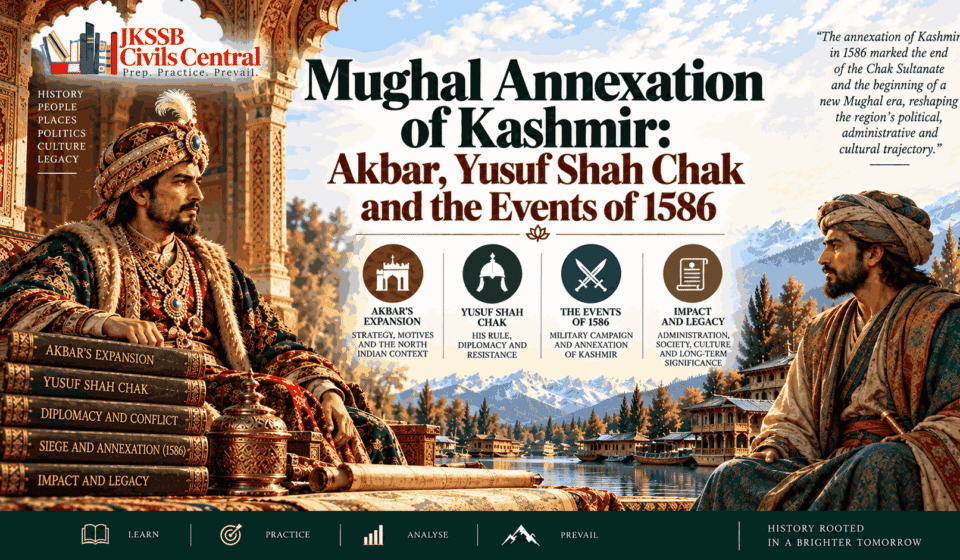
Mughal Annexation of Kashmir: Akbar, Yusuf Shah Chak and the Events of 1586

J&K History Series Navigation
| Previous Article | Current Article | Next Article |
|---|---|---|
| Article 25 — Chak Dynasty in Kashmir: Political Rise, Major Rulers and the End of the Sultanate | Article 26 — Mughal Annexation of Kashmir: Akbar, Yusuf Shah Chak and the Events of 1586 | Article 27 — Mughal Rule in Kashmir: Administration, Economy and Political Integration |
Learning Dashboard
| Aspect | Key Information |
|---|---|
| Historical Period | Late 16th century |
| Historical Phase | Mughal conquest and annexation of Kashmir |
| Main Dynasty | Chak Dynasty → Mughal Empire |
| Mughal Emperor | Akbar |
| Principal Kashmiri Ruler | Yusuf Shah Chak |
| Later Resistance Leader | Yaqub Shah Chak |
| Core Period | 1585–1589 |
| Decisive Conquest Phase | 1586 |
| Important Battle | Battle of Hastivanj, October 1586 |
| Important Mughal Commanders | Raja Bhagwan Das, Qasim Khan |
| Key Places | Pir Panjal, Buliasa/approaches to Kashmir, Attock, Srinagar, Hastivanj |
| Key Political Turning Point | Yusuf Shah’s negotiated submission and subsequent detention |
| Final Resistance | Yaqub Shah’s submission in 1589 |
| Major Sources | Akbarnama, Ain-i-Akbari, Baharistan-i-Shahi and later Kashmir chronicles |
| JKSSB Importance | Very High |
| Likely Question Types | Chronology, statement-based, ruler-event association, battle identification, cause-consequence, source-based |
Introduction
The Mughal annexation of Kashmir was one of the major political turning points of the late medieval history of the Valley. It brought to an end the independent political authority of the Chak dynasty and incorporated Kashmir into the expanding Mughal Empire under Akbar. Yet the transition was not accomplished through a single battle or a simple act of surrender. It developed through Mughal strategic pressure, a difficult first expedition, negotiations with Yusuf Shah Chak, the breakdown of the negotiated settlement, Yusuf Shah’s detention, a renewed Mughal military campaign under Qasim Khan, the decisive fighting of 1586, and continued Chak resistance until the final submission of Yaqub Shah in 1589.
The chronology is particularly important because 1586 and 1589 refer to different stages of the transition. The Mughal conquest and effective annexation of Kashmir are conventionally associated with 1586, while 1589 marks the final submission of Yaqub Shah and the consolidation of Mughal authority after the remaining Chak resistance had been overcome. Some historical works use 1589 more broadly for the completion of the annexation process, so the distinction must be made explicitly rather than treating one date as simply right and the other as wrong.
The conquest also illustrates the interaction between geography and political power. Kashmir’s mountains and passes made military entry difficult, but the Valley’s strategic connection with Punjab meant that the Mughal Empire could not ignore it indefinitely. Akbar’s prolonged residence in Lahore during the 1580s placed the Mughal court much closer to the north-western frontier and allowed the emperor to supervise the Kashmir campaign from a strategically advantageous position.
CivilsCentral Historical Insight
The Mughal annexation of Kashmir was a process in which imperial military power, diplomacy, mountain geography and internal political divisions interacted with one another. The crucial distinction is therefore not simply between “1586” and “1589,” but between conquest in 1586 and completion of the major Chak political resistance by 1589.
Clear Campaign Timeline: 1585–1589
The Mughal annexation of Kashmir unfolded through several stages rather than a single battle. The following chronology should be treated as the core campaign framework for this article.
| Date / Period | Event | Main Actors | Historical Significance |
|---|---|---|---|
| 1585 | Mughal strategic pressure on Kashmir intensifies as Akbar strengthens his position in Lahore and the north-west. | Akbar, Mughal commanders, Yusuf Shah Chak | Kashmir becomes an increasingly important Mughal strategic objective. |
| Late 1585–early 1586 | First major Mughal expedition advances toward Kashmir through difficult mountain approaches. | Raja Bhagwan Das, Mughal forces, Yusuf Shah | Weather, terrain and supply difficulties limit Mughal progress. |
| February 1586 | Negotiations produce a settlement between the Mughal side and Yusuf Shah Chak. | Raja Bhagwan Das, Yusuf Shah Chak | Temporary political compromise replaces continued military confrontation. |
| February 1586 | Yusuf Shah agrees to acknowledge Akbar’s sovereignty while retaining his position under the negotiated arrangement. | Yusuf Shah Chak | Demonstrates that the first phase was not simply a straightforward military surrender. |
| 28 March 1586 | Yusuf Shah is presented before Akbar at Attock and is detained. | Yusuf Shah, Akbar, Raja Bhagwan Das | The negotiated settlement collapses and the political crisis intensifies. |
| Mid-1586 | Akbar authorizes a renewed and larger military campaign under Qasim Khan. | Qasim Khan, Mughal forces, Yaqub Shah | Mughal strategy shifts decisively toward direct conquest. |
| October 1586 | Battle of Hastivanj is fought in the Pir Panjal region. | Qasim Khan, Shams Chak and Kashmiri forces | Major Mughal victory in the decisive military phase of the conquest. |
| October 1586 | Mughal forces enter Srinagar and establish effective control. | Mughal forces | Independent Chak political rule is effectively ended. |
| 1586–1589 | Yaqub Shah and remaining Chak supporters continue resistance. | Yaqub Shah, Mughal authorities | Shows that military conquest did not immediately eliminate all political resistance. |
| June 1589 | Akbar travels from Lahore and reaches Srinagar. | Akbar | Demonstrates the consolidation of Mughal authority in Kashmir. |
| July–August 1589 | Yaqub Shah opens negotiations and formally submits to Akbar. | Yaqub Shah, Akbar | Remaining major Chak resistance comes to an end. |
The detailed chronology of the 1586 campaign is supported by Kashmir-focused scholarship and historical studies, while the exact dating of individual stages can vary between chronicles. The 28 March 1586 presentation of Yusuf Shah at Attock, the Qasim Khan campaign, and the later 1589 submission of Yaqub Shah are particularly important chronological markers.
The Campaign in One Line
Mughal strategic pressure → First expedition → Mountain and weather difficulties → Yusuf Shah’s negotiated submission → Yusuf Shah presented at Attock → Yusuf detained → Qasim Khan’s renewed campaign → Battle of Hastivanj → Mughal control of Srinagar → Yaqub Shah’s continued resistance → Akbar’s 1589 visit → Yaqub Shah’s final submission
The Three Turning Points
1. February 1586 — Yusuf Shah’s Submission
The first Mughal expedition did not produce an immediate military victory. Difficult conditions encouraged Raja Bhagwan Das and Yusuf Shah to negotiate a settlement.
2. March–October 1586 — Breakdown of the Settlement and Military Conquest
Yusuf Shah’s detention at Attock destroyed the negotiated political arrangement. Akbar subsequently sent a renewed force under Qasim Khan, and the military campaign culminated in the Battle of Hastivanj and the Mughal establishment of control over Srinagar.
3. 1589 — Final Submission of Yaqub Shah
Although Mughal control had been established in 1586, Yaqub Shah continued resistance. His formal submission in 1589 completed the major political transition.
1586 vs 1589 — The Essential Distinction
1586 = Mughal conquest and effective annexation of Kashmir
1589 = Final submission of Yaqub Shah and completion of the major Chak resistance
This formulation reconciles the two dates used in historical literature. Encyclopaedia Iranica, for example, uses 1586–87 for Akbar’s conquest in its general chronology, while another Iranica treatment uses 1589 in describing the formal annexation. For examination purposes, the most useful distinction is conquest in 1586 versus final political submission in 1589.
Part I — Kashmir Before the Mughal Conquest
The Chak State in the Late Sixteenth Century
By the 1580s, Kashmir was ruled by the Chak dynasty, which had risen to political prominence during the later phase of the Kashmir Sultanate. The Chaks were a locally rooted military-political elite and had established their authority within the Valley. Their rule, however, was affected by factional struggles, rivalries among nobles and disagreements within the ruling establishment.
Yusuf Shah Chak was the ruler whose reign coincided with the decisive Mughal intervention. His position was complicated by the fact that he had to manage both the internal politics of the Kashmiri nobility and the growing external pressure from Akbar.
The Chak state was not simply a passive political entity waiting to be conquered. Its leaders understood the defensive value of the mountains and passes and attempted to use these geographical advantages against the Mughals. At the same time, internal divisions meant that the Chak political establishment could not maintain a permanently united response to Mughal intervention.
This combination of strong geographical defences but vulnerable political cohesion became one of the central features of the 1585–1586 crisis.
CivilsCentral Historical Insight
The strength of the Chak state lay partly in its ability to exploit Kashmir’s geography, but geography alone could not guarantee political independence. The Mughal conquest became possible when external military pressure interacted with internal divisions within the ruling elite.
Part II — Why Did Akbar Target Kashmir?
The North-Western Strategic Context
Akbar’s Kashmir policy must be understood within the broader consolidation of the Mughal Empire in the north-west. During the 1580s, Lahore became the principal imperial base from which Akbar supervised affairs on the frontier. The emperor spent an unusually long period in Lahore while dealing with the political and military problems of the north-western regions. Cambridge scholarship specifically identifies Akbar’s stay in Punjab as important for supervising the conquest of Kashmir in 1586.
Kashmir’s geographical position added to its strategic importance. The Valley lay beyond the Pir Panjal mountains but remained connected to the Punjab through several routes and passes. Its location also placed it within the wider political environment linking the Mughal frontier with Afghanistan and Central Asia.
The conquest therefore had a strategic dimension beyond the immediate question of who ruled Kashmir. Incorporating the Valley strengthened Mughal control over the north-western Himalayan frontier and brought Kashmir into the political geography of the empire.
Kashmir as a Frontier
The Mughal relationship with Kashmir was shaped by geography. Cambridge scholarship describes Kashmir after its conquest as a northern political frontier of the Mughal Empire, emphasizing both its marginal location and its difficult mountain terrain. Access required movement through high mountains and narrow passes, making the Valley militarily different from the plains of northern India.
This geographical reality helps explain why the Mughal conquest was prolonged. A large imperial army could possess overwhelming resources and still face severe difficulties in moving men, animals, weapons and supplies through the mountain approaches.
Part III — Mughal Pressure Before the Final Campaign
Akbar’s Demand for Submission
Akbar’s attempt to establish Mughal authority over Kashmir preceded the final military campaign. The Mughal court expected Yusuf Shah to acknowledge the emperor’s supremacy and establish a closer relationship with the imperial court.
Yusuf Shah did not immediately comply with Akbar’s expectations. This created increasing tension between the two sides. The Mughal court gradually moved from diplomatic pressure toward the possibility of military intervention.
The situation also demonstrates that Mughal expansion was not always based on an immediate decision to destroy a neighbouring kingdom. Recognition of imperial sovereignty, personal submission and political dependency could initially be pursued through diplomatic means.
When such arrangements failed, military force became the alternative.
Part IV — The First Mughal Expedition, 1585–1586
The Advance toward Kashmir
The first major Mughal expedition advanced toward Kashmir during the winter of 1585–1586. Raja Bhagwan Das was among the principal commanders associated with this phase. The Mughal army encountered precisely the problems that Kashmir’s geography made likely: difficult mountain roads, severe weather and shortages of provisions. The campaign was therefore not a straightforward imperial march into an undefended Valley.
Kashmiri forces could exploit the narrow approaches and the difficult terrain. The resulting military situation created pressure on both sides. The Mughal commanders faced the prospect of continuing a costly campaign under increasingly difficult conditions, while Yusuf Shah had to consider whether Kashmir could withstand the resources of the Mughal Empire if Akbar sent additional forces.
The resulting situation created the conditions for negotiation.
Part V — Yusuf Shah Chak and the Negotiated Settlement
Yusuf Shah’s Decision
Yusuf Shah eventually agreed to negotiate with Raja Bhagwan Das. The settlement is one of the most important episodes in the entire annexation because it demonstrates that the initial Mughal strategy did not immediately produce direct imperial rule.
According to historical accounts, the settlement allowed Yusuf Shah to retain his position while recognizing Akbar’s superior sovereignty. The khutba was to be read in Akbar’s name and coins were to bear the emperor’s name.
The agreement also involved imperial supervision of economically significant activities, including the mint, saffron cultivation and shawl manufacture. These provisions demonstrate that the Mughal conception of sovereignty involved both political symbols and control over strategically important economic resources.
The treaty traditions differ in their presentation of the details, but the central historical point is clear: a negotiated settlement was reached between Yusuf Shah and Raja Bhagwan Das before the final Mughal conquest.
Why Did Yusuf Shah Agree?
Yusuf Shah’s decision should not simply be described as cowardice or unconditional surrender. He was operating under difficult strategic circumstances. The first Mughal expedition had demonstrated the advantages and limitations of Kashmir’s geography. The mountains could slow the imperial army, but they could not guarantee that a larger and better-resourced Mughal force could never penetrate the Valley.
A negotiated arrangement therefore offered Yusuf Shah a possible way to preserve his political position while avoiding a prolonged war. This was a rational political calculation under difficult circumstances.
CivilsCentral Historical Insight
Yusuf Shah’s submission illustrates the difference between recognizing imperial supremacy and accepting direct annexation. The initial settlement contemplated a subordinate Chak political order, whereas Akbar’s later policy moved toward direct incorporation. The breakdown of that distinction was central to the subsequent conflict.
Part VI — Yusuf Shah at Attock
28 March 1586
After the settlement, Yusuf Shah was taken to the imperial court. Historical scholarship based on Kashmir’s Persian chronicles places his presentation before Akbar at Attock on 28 March 1586. He was received with outward respect but was then detained.
This event fundamentally changed the political situation.
Yusuf Shah had entered the arrangement on the understanding that he could retain his political position after acknowledging Akbar’s supremacy. His detention removed him from effective control of Kashmir and made a peaceful settlement increasingly difficult.
The episode also had consequences for Raja Bhagwan Das, who had negotiated the settlement and whose honour and assurances were implicated in the detention. Later narratives emphasize his distress at the emperor’s decision. Such personal details belong primarily to the chronicle tradition and should therefore be treated cautiously.
Why Was Yusuf Shah Detained?
The safest historical interpretation is that Akbar was unwilling to accept the degree of Chak political autonomy contemplated in the field settlement. The emperor’s broader expansionist policy and the strategic importance of Kashmir made direct imperial control preferable to a semi-independent subordinate ruler.
Thus, the detention was not simply a personal disagreement between Akbar and Yusuf Shah. It represented a larger conflict over the political status of Kashmir.
Part VII — The Second Mughal Campaign
Yaqub Shah Takes the Lead
Yusuf Shah’s detention created a leadership crisis. His son Yaqub Shah Chak emerged as the principal figure of continued resistance. Yaqub did not accept the political settlement that had been negotiated by his father. The Chak state therefore entered a new phase in which resistance rather than negotiated accommodation became the central strategy.
At the same time, Kashmiri political divisions became more visible. Some nobles remained committed to resistance, while others were willing to cooperate with or seek assistance from the Mughals.
This division weakened the possibility of a unified defence.
Qasim Khan’s Expedition
Akbar authorized a renewed military campaign under Qasim Khan. This second expedition was more clearly directed toward military conquest rather than negotiated submission.
The campaign also benefited from political support among Kashmiri defectors and opponents of Yaqub Shah. Modern scholarship emphasizes that the Mughal forces were reinforced and accompanied by Kashmiri allies who possessed local knowledge of the terrain and political environment.
The Mughal army therefore entered Kashmir with two forms of advantage:
Imperial military resources and local political assistance.
Part VIII — The Battle of Hastivanj, 1586
The Decisive Military Phase
The most important military engagement of the conquest was the Battle of Hastivanj, fought in October 1586 in the Pir Panjal region. Hastivanj was located on an old route toward Kashmir through the mountain approaches. A scholarly study published through the Journal of the Royal Asiatic Society identifies Hastivanj as a mountain ridge on the old route to Kashmir via Bhimbar and Bahrāmgala.
The battle involved Mughal forces under Qasim Khan and Kashmiri forces associated with Shams Chak and other Chak commanders. The Kashmiri defenders initially benefited from the terrain and were able to inflict serious pressure on the Mughal advance.
The Mughal forces, however, eventually broke the Kashmiri resistance at the pass. The defeat had consequences far beyond the battlefield because the route toward the Valley was now increasingly open to the imperial forces.
Why Hastivanj Matters
The Battle of Hastivanj is important because it connects the abstract idea of “Mughal annexation in 1586” with an actual military turning point. The Mughal conquest was not simply the consequence of Yusuf Shah’s detention. The renewed campaign required military force, and the fighting at Hastivanj played a major role in establishing Mughal control over the Valley.
For examination purposes: Hastivanj → Qasim Khan → Mughal victory → collapse of effective Chak resistance in 1586
The exact naming and dating of the battle should nevertheless be treated with source awareness because the name Hastivanj itself appears more clearly in later Kashmir historical traditions. A Cambridge study of the site notes that the name is particularly associated with later sources rather than being straightforwardly traceable to the earliest records.
CivilsCentral Historical Insight
Hastivanj demonstrates why the Mughal annexation cannot be reduced to diplomacy. The political settlement with Yusuf Shah created one stage of the crisis, but the final establishment of Mughal authority depended upon military control of the mountain approaches and the Valley itself.
Part IX — Fall of Srinagar and Mughal Control
Following the Mughal victory in the mountain approaches, imperial forces moved toward the Valley and Srinagar. The reading of the khutba in Akbar’s name in Srinagar became a powerful symbolic expression of the new political order. The khutba was not merely a religious ritual; in the political culture of the period, the ruler’s name in the Friday sermon could signify recognition of sovereign authority.
Mughal forces subsequently established control over Srinagar. The independent Chak Sultanate had therefore ceased to function as an effective sovereign state. This is the point at which 1586 can most clearly be understood as the year of Mughal conquest and annexation.
The conquest was therefore a combination of: Yusuf Shah’s failed negotiated settlement, his detention, Yaqub Shah’s resistance, Qasim Khan’s military campaign, the defeat of Chak forces, Mughal occupation and political control of Srinagar.
Part X — Why Did the Mughals Succeed?
The Mughal victory cannot be explained simply by saying that Akbar possessed a larger army. Several factors interacted.
1. Greater Imperial Resources
The Mughal Empire possessed a much larger military and fiscal base than the Chak state. Akbar could send reinforcements when an initial expedition failed to achieve its objective.
2. Strategic Position of Lahore
Akbar’s prolonged stay in Lahore during the 1580s enabled him to supervise the north-western frontier directly. Kashmir was therefore being approached from a strong imperial base rather than from a distant capital.
3. Kashmiri Political Divisions
The Chak ruling establishment was not politically united. Rivalries among nobles created opportunities for Mughal intervention.
4. Local Allies and Defectors
Some Kashmiri nobles who opposed Yaqub Shah cooperated with the Mughals. Their knowledge of local routes and political conditions was valuable.
5. Breakdown of the Yusuf Shah Settlement
The initial agreement had temporarily prevented direct conquest. Once Yusuf Shah was detained, the political framework of that settlement collapsed.
6. Control of Mountain Routes
The conquest depended on gaining access through the Pir Panjal approaches. Once key routes were secured, the strategic position of the Chak forces deteriorated.
7. Persistence of Imperial Pressure
The Mughals were able to sustain military pressure even after facing severe difficulties during the first expedition.
Part XI — Why Was Kashmir Difficult to Conquer?
The Mughal victory should not conceal the difficulties faced by the imperial army.
Mountain Terrain
The Pir Panjal ranges created narrow and defensible approaches.
Weather
Snow, rain and severe cold affected troops and animals and disrupted movement.
Supply Problems
The Mughal army had difficulty maintaining adequate supplies in the mountain environment.
Local Knowledge
Kashmiri forces knew the passes and defensive positions better than the invading army.
Political Resistance
Even after Yusuf Shah’s detention, Yaqub Shah and his supporters continued the struggle.
Cambridge scholarship specifically emphasizes the difficult roads, narrow passes and high mountains that separated Kashmir from the Mughal heartland. The campaign therefore demonstrates that imperial military superiority did not eliminate geographical constraints.
Part XII — Yaqub Shah and the Continuing Resistance
Why Did Resistance Continue after 1586?
The Mughal victory did not immediately erase every Chak political network. Yaqub Shah remained an important symbol and political actor for the resistance. This is why the phrase “Kashmir was conquered in 1586” should not be misunderstood as meaning that all political opposition disappeared on the same day.
Mughal authority had been established, but consolidation remained necessary.
The continued resistance also reveals the difference between: territorial occupation and complete political submission.
The Mughals possessed the Valley, but the political legitimacy and loyalty of all local elites could not be assumed automatically.
Part XIII — Akbar’s Visit to Kashmir, 1589
The Imperial Visit
By 1589, the Mughal position had become sufficiently secure for Akbar to travel personally to Kashmir. Historical scholarship records Akbar’s departure from Lahore in May 1589 and his arrival in Srinagar in June. The visit provided the emperor with an opportunity to supervise the newly incorporated territory directly.
The visit is therefore significant not simply because Akbar entered Kashmir, but because it occurred at the transition from military conquest to imperial consolidation.
Yaqub Shah’s Final Submission
During Akbar’s stay, Yaqub Shah opened negotiations for surrender. His formal submission in August 1589 brought the remaining major Chak resistance to an end. This is the reason 1589 remains an important date in the history of the annexation.
It is therefore historically safer to state:
The Mughal conquest of Kashmir was achieved in 1586, while the remaining major Chak resistance was brought to an end in 1589.
This formulation accommodates the different chronological emphases found in historical literature.
Part XIV — The Fate of Yusuf Shah Chak
Yusuf Shah’s political career did not end with his detention. He remained under Mughal custody for a period and was eventually incorporated into the imperial political system rather than restored as an independent ruler of Kashmir. Later accounts associate him with service under the Mughal state.
This outcome illustrates an important feature of Mughal imperial policy: defeated rulers and nobles could sometimes be incorporated into the imperial elite after their political independence had been removed.
The Mughal system therefore did not necessarily require the physical destruction of a defeated ruling family. It could transform a regional ruler into an imperial subordinate.
The political status of Yusuf Shah after his detention should consequently be distinguished from the fate of the Chak dynasty as an independent ruling house.
Part XV — Political Consequences of the Annexation
End of Independent Chak Sovereignty
The most immediate consequence was the end of independent Chak rule. The Chak dynasty had been the final locally rooted ruling house of the medieval Kashmir Sultanate. Its defeat transferred ultimate sovereignty to the Mughal emperor.
Kashmir Enters the Mughal Imperial System
Kashmir was incorporated into the Mughal Empire and administratively associated with the Subah of Kabul during the early phase of Mughal rule. The Ain-i-Akbari later records Kashmir within the Mughal administrative framework. This administrative association is important because it demonstrates that the conquest was followed by institutional incorporation rather than a purely military occupation.
A Change in the Political Centre
Before annexation, the political centre of Kashmir was located within the Valley and sovereignty was exercised by a regional dynasty. After annexation, ultimate political authority came from the Mughal emperor and the imperial administrative structure.
Kashmir therefore moved from:
Regional Sultanate sovereignty to Imperial provincial integration.
Part XVI — Economic Consequences
The economic importance of Kashmir was already visible in the terms associated with the Yusuf Shah settlement. The mint, saffron cultivation and shawl manufacture were specifically mentioned in the treaty traditions. This indicates that these activities were not merely local economic matters but had become significant enough to attract imperial attention.
The Mughal state subsequently developed more systematic arrangements for revenue and administration. However, it is important not to project the later mature Mughal system backward onto the first days after conquest. Political conquest came first; detailed administrative and revenue integration developed over time.
Part XVII — Religious and Social Context
The Chak dynasty had developed a strong association with Shi’i political culture. Encyclopaedia Iranica describes the Chaks as a Twelver dynasty ruling Kashmir from approximately 1561 to 1589 and notes the formal embrace of Shi’ism by Nurbakhshiya circles under Chak rule.
This religious context formed part of the political environment of the Mughal intervention, but the annexation should not be reduced to a simple Sunni–Shi’i war. Akbar’s Mughal policy was driven by broader imperial and strategic objectives. Political sovereignty, frontier security, control over Kashmir and the internal divisions of the Chak state were all important.
A purely sectarian explanation therefore oversimplifies the event.
The annexation should instead be understood as an imperial conquest occurring within a politically and religiously complex regional environment.
Part XVIII — Kashmir after the Conquest
The Mughal annexation created the foundation for a new phase in Kashmir’s history. Under Mughal rule, the Valley became increasingly connected to the imperial political and cultural world of northern India and the north-west. Persianate court culture expanded, Mughal administrative institutions developed, and imperial interest in Kashmir’s landscape, agriculture, crafts and strategic routes increased.
The later Mughal rulers—especially Jahangir and Shah Jahan—would transform Kashmir’s architectural and garden landscape in ways that became major elements of its historical heritage.
Those developments should not, however, be projected backward onto Akbar’s initial conquest.
The historical sequence is:
Akbar’s conquest → administrative consolidation → later Mughal cultural and architectural development.
Part XIX — Historical Sources
Akbarnama
The Akbarnama, written by Abu’l-Fazl, is a principal source for Akbar’s reign and imperial campaigns. It is especially valuable for reconstructing the Mughal perspective on the conquest. Its courtly character also creates a limitation: imperial actions and Akbar’s decisions are presented from within the ideological framework of the Mughal court.
It should therefore be compared with Kashmir-centred sources.
Ain-i-Akbari
The Ain-i-Akbari provides valuable information about Mughal administration, geography and imperial organization. It is especially useful for understanding how Kashmir was incorporated into the administrative structure after conquest.
Baharistan-i-Shahi
The Baharistan-i-Shahi is a major Kashmir-centred Persian chronicle. It is particularly important for reconstructing events from the perspective of Kashmir’s own political history. Its narrative must nevertheless be read critically because it was composed after the events and reflects its own historical and political context.
Later Kashmir Chronicles
Later works preserve additional details about Yusuf Shah, Yaqub Shah, the Mughal campaigns and the Battle of Hastivanj. These sources are important for Kashmir’s historical memory but do not all possess the same evidentiary status.
Source Comparison
A sound historical reconstruction therefore compares:
Mughal court histories
Kashmir-based chronicles
geographical evidence
modern historical scholarship.
This is especially important for details concerning negotiations, personal motives, exact military movements and later interpretations of the treaty.
CivilsCentral Historical Insight
The conquest of Kashmir demonstrates why historical sources must be compared rather than read in isolation. Mughal court histories naturally emphasize imperial authority, while Kashmir-centred chronicles preserve local perspectives and traditions. The strongest reconstruction emerges from identifying where these accounts converge and where their interpretations differ.
Part XX — Historical Interpretation
The Mughal annexation has sometimes been presented as a straightforward story of imperial conquest: Akbar wanted Kashmir, sent an army and defeated the Chak rulers. That interpretation captures the outcome but not the process.
The first Mughal expedition encountered serious geographical and logistical difficulties. Negotiation consequently became necessary. Yusuf Shah accepted a settlement that would have preserved a degree of Chak authority under Mughal supremacy, but his subsequent detention changed the political situation.
The Mughal campaign then entered a second phase. Yaqub Shah continued resistance, Qasim Khan led a renewed imperial offensive, and the Mughal victory in the mountain approaches opened the way toward Srinagar.
Even then, resistance did not disappear entirely. The final submission of Yaqub Shah in 1589 demonstrated that political consolidation extended beyond the battlefield victory of 1586.
The conquest therefore resulted from:
Imperial military resources
strategic pressure
mountain warfare
diplomacy
political divisions
local alliances
continued imperial pressure.
This is a more historically adequate explanation than attributing the result to military superiority alone.
Part XXI — Historical Significance
1. End of Chak Sovereignty
The independent Chak political order came to an end.
2. Beginning of Mughal Rule
Kashmir entered the Mughal imperial system.
3. Strategic Frontier Expansion
The conquest strengthened the Mughal position in the north-western Himalayan frontier.
4. Administrative Transformation
The conquest created the conditions for the development of Mughal provincial administration.
5. Economic Integration
Kashmir’s agricultural and commercial resources became increasingly connected with the imperial economy.
6. Political Reorientation
Ultimate sovereignty shifted from a regional ruling house to the Mughal emperor.
7. Cultural Consequences
The subsequent Mughal period produced major developments in Persianate culture, gardens, architecture and artistic patronage.
8. Long-Term Chronological Importance
The conquest opened the Mughal phase of Kashmir’s history, which continued until the Afghan takeover in the eighteenth century.
Part XXII — Evidence Note
| Claim | Evidence Level | Historical Treatment |
|---|---|---|
| Akbar conquered Kashmir in the 1580s | A/B | Strongly established in imperial and Kashmir historical traditions |
| 1586 is the conventional conquest date | A/B | Standard chronological formulation |
| Yusuf Shah negotiated with Raja Bhagwan Das | B | Strong historical tradition supported by multiple chronicles |
| Yusuf Shah was presented before Akbar at Attock | B | Strong historical tradition; dated to 28 March 1586 in Kashmir-focused scholarship |
| Yusuf Shah was detained | B | Central feature of the conquest narrative |
| Qasim Khan led the renewed campaign | B | Strong historical tradition |
| Battle of Hastivanj occurred in 1586 | B | Well established in later Kashmir historical literature; site/name requires source awareness |
| Mughal forces established control of Srinagar in 1586 | B | Strong historical tradition |
| Yaqub Shah continued resistance | A/B | Strongly established |
| Akbar visited Kashmir in 1589 | B | Strong historical tradition |
| Yaqub Shah submitted in 1589 | B | Strong historical tradition |
| 1589 is sometimes given as the annexation date | D / historiographical variation | Better understood as completion of the annexation process |
| The treaty was “betrayed” by Akbar | Interpretation | Better phrased as rejection/non-implementation of the negotiated settlement |
| Mughal conquest was solely religious | Not supported | Strategic, political and military factors were central |
| Every detail of the treaty is certain | Requires caution | Terms vary in surviving narratives |
Part XXIII — JKSSB Knowledge Matrix
| Question | Answer |
|---|---|
| Who was the Mughal emperor? | Akbar |
| Who was the Chak ruler during the initial Mughal intervention? | Yusuf Shah Chak |
| Who succeeded Yusuf Shah as the main resistance leader? | Yaqub Shah Chak |
| Which Mughal commander negotiated with Yusuf Shah? | Raja Bhagwan Das |
| Where was Yusuf Shah presented before Akbar? | Attock |
| What happened to Yusuf Shah? | He was detained by the Mughal authorities |
| Who led the major renewed Mughal campaign? | Qasim Khan |
| What major battle occurred in October 1586? | Battle of Hastivanj |
| Which city came under Mughal control after the decisive 1586 campaign? | Srinagar |
| What year is conventionally associated with Mughal conquest of Kashmir? | 1586 |
| What year marks Yaqub Shah’s final submission? | 1589 |
| Which imperial symbol was associated with recognition of Akbar? | Khutba |
| What other symbol represented imperial sovereignty? | Coinage |
| Which economic activities featured in the settlement? | Mint, saffron cultivation and shawl manufacture |
| Which Mughal base was strategically important? | Lahore |
| Which mountain system complicated the campaign? | Pir Panjal |
Part XXIV — Examination Discrimination Points
1586 vs 1589
1586: Mughal conquest and effective annexation.
1589: Final major Chak resistance ends with Yaqub Shah’s submission.
Yusuf Shah vs Yaqub Shah
Yusuf Shah: Negotiated with the Mughals and was subsequently detained.
Yaqub Shah: Continued resistance and finally submitted in 1589.
Bhagwan Das vs Qasim Khan
Raja Bhagwan Das: Associated with the first expedition and negotiations.
Qasim Khan: Associated with the renewed military conquest.
Attock vs Srinagar
Attock: Yusuf Shah was presented before Akbar.
Srinagar: Mughal forces established control during the decisive 1586 campaign.
Negotiation vs Conquest
The negotiated settlement did not represent the final political outcome.
The later military campaign established effective Mughal control.
Akbar’s Role
Akbar directed Mughal imperial policy and supervised the conquest from the north-western frontier; he should not be described as personally leading the main 1586 field army.
Hastivanj
Hastivanj → October 1586 → Qasim Khan → Mughal victory
This is a high-value association, but the terminology should be understood through the later Kashmir chronicle tradition.
Part XXV — JKSSB Question Pattern Mapping
Direct Fact
Who was the Chak ruler during the Mughal annexation of Kashmir?
Answer: Yusuf Shah Chak
Statement-Based
Consider the following statements:
- Yusuf Shah Chak negotiated with Raja Bhagwan Das.
- Yusuf Shah was detained after being presented before Akbar.
- Yaqub Shah continued resistance after Yusuf Shah’s detention.
- The remaining Chak resistance ended immediately in 1586.
Which statements are correct?
Answer: 1, 2 and 3 only.
Chronology
Arrange the following:
- Battle of Hastivanj
- Yusuf Shah’s negotiated submission
- Yusuf Shah’s presentation before Akbar
- Yaqub Shah’s final submission
Correct sequence:
2 → 3 → 1 → 4
Match the Following
| Person | Association |
|---|---|
| Akbar | Mughal emperor |
| Yusuf Shah Chak | Negotiated submission |
| Raja Bhagwan Das | Initial campaign and negotiations |
| Qasim Khan | Renewed Mughal campaign |
| Yaqub Shah Chak | Continued resistance and final submission |
Identification by Clues
Identify the battle:
- Fought during the Mughal conquest of Kashmir.
- Located in the Pir Panjal region.
- Associated with Qasim Khan.
- Resulted in a major Mughal victory.
- Preceded the establishment of Mughal control over Srinagar.
Answer: Battle of Hastivanj
Correct / Incorrect Pair
Which pair is incorrectly matched?
A. Yusuf Shah — Chak ruler
B. Qasim Khan — Mughal commander
C. Yaqub Shah — Chak resistance
D. Bhagwan Das — Mughal emperor
Answer: D
Conceptual-Factual
Which development best explains why 1586 and 1589 are both important?
A. Two different Mughal emperors ruled Kashmir
B. Conquest occurred in 1586 while remaining Chak resistance ended in 1589
C. Yusuf Shah ruled twice
D. Akbar conquered Kashmir twice
Answer: B
Part XXVI — JKSSB Practice Questions
Question 1
The Mughal conquest of Kashmir is conventionally dated to:
A. 1526
B. 1556
C. 1586
D. 1605
Correct Answer: C. 1586
Explanation: Akbar’s Mughal forces established control over Kashmir in 1586. The remaining major Chak resistance continued until 1589.
Question 2
Who was the Chak ruler who negotiated with Raja Bhagwan Das?
A. Shams Chak
B. Yusuf Shah Chak
C. Yaqub Shah Chak
D. Husain Shah Chak
Correct Answer: B. Yusuf Shah Chak
Explanation: Yusuf Shah was the ruler during the first phase of the Mughal intervention and negotiated a settlement with Raja Bhagwan Das.
Question 3
Yusuf Shah Chak was presented before Akbar at:
A. Lahore
B. Srinagar
C. Attock
D. Kabul
Correct Answer: C. Attock
Explanation: Kashmir-focused historical scholarship places Yusuf Shah’s presentation before Akbar at Attock on 28 March 1586.
Question 4
Who led the renewed major Mughal campaign against Kashmir after the breakdown of the Yusuf Shah settlement?
A. Todar Mal
B. Qasim Khan
C. Man Singh
D. Birbal
Correct Answer: B. Qasim Khan
Explanation: Qasim Khan was associated with the renewed Mughal military campaign that ultimately established effective Mughal control.
Question 5
The Battle of Hastivanj is associated with:
A. Mughal conquest of Kashmir
B. Sikh conquest of Kashmir
C. Afghan conquest of Kashmir
D. Dogra conquest of Ladakh
Correct Answer: A. Mughal conquest of Kashmir
Explanation: Hastivanj was an important battle in the renewed Mughal campaign of 1586.
Question 6
Consider the following statements:
- Yusuf Shah initially negotiated a settlement with the Mughals.
- Yusuf Shah was subsequently detained.
- Yaqub Shah continued resistance.
- Yaqub Shah’s submission occurred in 1589.
Which of the above are correct?
A. 1 and 2 only
B. 1, 2 and 3 only
C. 1, 2, 3 and 4
D. 2 and 4 only
Correct Answer: C
Explanation: All four statements describe the broad chronology of the Mughal annexation process.
Question 7
Which of the following was associated with the negotiated settlement between Yusuf Shah and the Mughal side?
A. Khutba and coinage in Akbar’s name
B. Transfer of Kashmir to the Sikh Empire
C. Complete abolition of the Chak dynasty immediately
D. Recognition of Afghan sovereignty
Correct Answer: A
Explanation: Recognition of Akbar through khutba and coinage formed part of the reported settlement.
Question 8
Which factor made the initial Mughal campaign particularly difficult?
A. Desert warfare
B. Naval resistance
C. Mountain terrain and severe weather
D. Lack of cavalry in Kashmir
Correct Answer: C
Explanation: The Pir Panjal approaches, winter weather and supply difficulties created major operational problems for the Mughal army.
Question 9
Which sequence is correct?
A. Yaqub Shah’s submission → Yusuf Shah’s detention → Hastivanj → negotiations
B. Yusuf Shah’s negotiated submission → Yusuf Shah’s detention → Qasim Khan’s campaign → Hastivanj
C. Hastivanj → Yusuf Shah’s submission → Yusuf Shah’s detention → Akbar’s arrival
D. Akbar’s visit → Yusuf Shah’s submission → Hastivanj → Yaqub Shah’s resistance
Correct Answer: B
Question 10
Which statement is the most historically precise?
A. Akbar personally led the main Mughal army that conquered Kashmir in 1586.
B. Kashmir was completely politically pacified immediately after Yusuf Shah’s submission.
C. The Mughal conquest was established in 1586, while Yaqub Shah’s final submission came in 1589.
D. Kashmir became Mughal territory only after Akbar’s death.
Correct Answer: C
Part XXVII — Rapid Revision Zone
Important Dates
- 1585 — Mughal strategic pressure intensifies.
- February 1586 — Yusuf Shah reaches a negotiated settlement.
- 28 March 1586 — Yusuf Shah presented before Akbar at Attock and detained.
- 1586 — Renewed Mughal campaign under Qasim Khan.
- October 1586 — Battle of Hastivanj.
- October 1586 — Mughal control established in Srinagar.
- 1586–1589 — Continued Chak resistance.
- June 1589 — Akbar reaches Srinagar.
- August 1589 — Yaqub Shah formally submits.
Important Personalities
- Akbar — Mughal emperor.
- Yusuf Shah Chak — Chak ruler during the first phase.
- Yaqub Shah Chak — principal later resistance leader.
- Raja Bhagwan Das — commander and negotiator.
- Qasim Khan — commander of the renewed Mughal campaign.
Important Places
- Lahore — important Mughal base.
- Pir Panjal — major geographical barrier.
- Attock — Yusuf Shah presented before Akbar.
- Hastivanj — major battle site.
- Srinagar — centre of Mughal control after the decisive campaign.
Important Associations
Yusuf Shah → Bhagwan Das → Negotiated Settlement
Yusuf Shah → Attock → Detention
Qasim Khan → Hastivanj → Mughal Victory
Yaqub Shah → Resistance → 1589 Submission
Akbar → Kashmir → 1589 Visit
Part XXVIII — Frequently Confused Facts
| Confusion | Correct Distinction |
|---|---|
| 1586 vs 1589 | 1586 = conquest; 1589 = final major Chak submission |
| Yusuf Shah vs Yaqub Shah | Yusuf negotiated; Yaqub continued resistance |
| Bhagwan Das vs Qasim Khan | Bhagwan Das = first expedition/negotiations; Qasim Khan = renewed conquest |
| Attock vs Srinagar | Yusuf presented at Attock; Mughal control established at Srinagar |
| Submission vs annexation | Negotiated submission did not prevent later direct conquest |
| Hastivanj vs Pir Panjal | Hastivanj was a specific battle site/route area within the Pir Panjal region |
| Akbar vs Qasim Khan | Akbar was emperor directing imperial policy; Qasim Khan commanded the renewed campaign |
| Conquest vs consolidation | Military victory in 1586 preceded fuller political consolidation by 1589 |
Part XXIX — What Can JKSSB Ask?
High-value areas include:
- Date of Mughal conquest of Kashmir.
- Yusuf Shah Chak’s role.
- Yaqub Shah’s role.
- Raja Bhagwan Das and the initial campaign.
- Qasim Khan and the renewed campaign.
- Battle of Hastivanj.
- Attock and Yusuf Shah.
- Srinagar and Mughal control.
- Khutba and coinage as symbols of sovereignty.
- 1586 versus 1589.
- Reasons for Mughal success.
- Role of Pir Panjal geography.
- Internal divisions within the Chak state.
- Akbar’s 1589 visit.
- Sources for reconstructing the conquest.
- Difference between negotiated submission and direct annexation.
Chapter Summary
The Mughal annexation of Kashmir developed from a combination of imperial expansion and internal political vulnerability within the Chak state. Akbar’s consolidation of the north-west, particularly his prolonged presence at Lahore, brought Kashmir into the immediate strategic environment of the Mughal Empire. The first Mughal expedition encountered difficult mountain terrain, severe weather and supply problems, creating the conditions for negotiations with Yusuf Shah Chak.
The February 1586 settlement offered a temporary political compromise. Yusuf Shah would retain his position while acknowledging Akbar’s sovereignty through arrangements including the khutba and coinage. However, when Yusuf Shah was presented before Akbar at Attock on 28 March 1586, he was detained. The negotiated settlement consequently collapsed.
The conflict then entered a decisive military phase. Akbar sent a renewed force under Qasim Khan, and the Mughal campaign culminated in the Battle of Hastivanj in October 1586. Mughal forces subsequently established control over Srinagar, bringing the independent Chak political order effectively to an end.
Yet the political process was not completely finished. Yaqub Shah continued resistance, and Akbar’s visit to Kashmir in 1589 was followed by Yaqub’s formal submission. Thus, the clearest chronology is:
1586 = Mughal conquest and effective annexation
1589 = final major Chak resistance ends
The conquest transformed Kashmir from an independent regional Sultanate into a territory integrated within the Mughal imperial system. It also created the political and administrative conditions for the next phase of Kashmir’s history: Mughal provincial governance, economic integration and cultural development.
JKSSB Takeaway
Remember the chain:
Akbar → Yusuf Shah Chak → Raja Bhagwan Das → negotiated settlement → Yusuf Shah detained at Attock → Qasim Khan → Battle of Hastivanj → Mughal control of Srinagar → Yaqub Shah’s resistance → Akbar’s 1589 visit → Yaqub’s submission.Most important date distinction:
1586 = Mughal conquest/annexation
1589 = final major Chak resistance ends
Mind Map
MUGHAL ANNEXATION OF KASHMIR
↓
Chak State
Yusuf Shah Chak
↓
Akbar’s North-Western Strategy
Lahore + frontier consolidation
↓
First Mughal Expedition
1585–Early 1586
↓
Mountain + Weather Difficulties
Pir Panjal
↓
Negotiation
Bhagwan Das ↔ Yusuf Shah
↓
February 1586
Yusuf Shah’s Submission
↓
28 March 1586
Yusuf Shah → Attock → Detained
↓
Renewed Mughal Campaign
Qasim Khan
↓
October 1586
Battle of Hastivanj
↓
Srinagar Comes under Mughal Control
↓
1586–1589
Yaqub Shah’s Resistance
↓
1589
Akbar Visits Kashmir
↓
Yaqub Shah Submits
↓
Mughal Consolidation
↓
Upcoming Article
Mughal Administration, Economy and Political Integration
FAQs
1. When did the Mughals conquer Kashmir?
The Mughal conquest and effective annexation of Kashmir are conventionally dated to 1586.
2. Who was the Chak ruler during the Mughal intervention?
Yusuf Shah Chak was the principal Chak ruler during the first phase of the Mughal intervention.
3. Who was Yaqub Shah?
Yaqub Shah was Yusuf Shah Chak’s son and became the principal figure of continued Chak resistance after his father’s detention.
4. What happened to Yusuf Shah at Attock?
Yusuf Shah was presented before Akbar at Attock on 28 March 1586 and was detained rather than being permitted to return to Kashmir under the negotiated settlement.
5. Who led the renewed Mughal campaign?
Qasim Khan was the principal commander associated with the renewed military campaign of 1586.
6. What was the Battle of Hastivanj?
It was a major battle of the 1586 Mughal campaign fought in the Pir Panjal region. Mughal forces under Qasim Khan defeated the Kashmiri resistance, helping open the route toward the Valley.
7. Why is 1589 important?
In 1589, Akbar visited Kashmir and Yaqub Shah formally submitted, ending the remaining major Chak resistance.
8. Was Kashmir fully conquered through one battle?
No. The conquest developed through diplomacy, military campaigns, political divisions and continued resistance.
9. Was the Mughal conquest purely religious?
No. Religious divisions formed part of the political context, but strategic, imperial, military and political factors were fundamental to the annexation.
10. What happened after the annexation?
Kashmir was incorporated into the Mughal imperial system, initially within the administrative framework associated with Kabul. The next phase involved the development of Mughal administration, revenue arrangements and political integration.
About The Author





[…] Article 26 — Mughal Annexation of Kashmir: Akbar, Yusuf Shah Chak and the Events of 1586 […]
[…] Article 26 — Mughal Annexation of Kashmir: Akbar, Yusuf Shah Chak and the Events of 1586 […]