
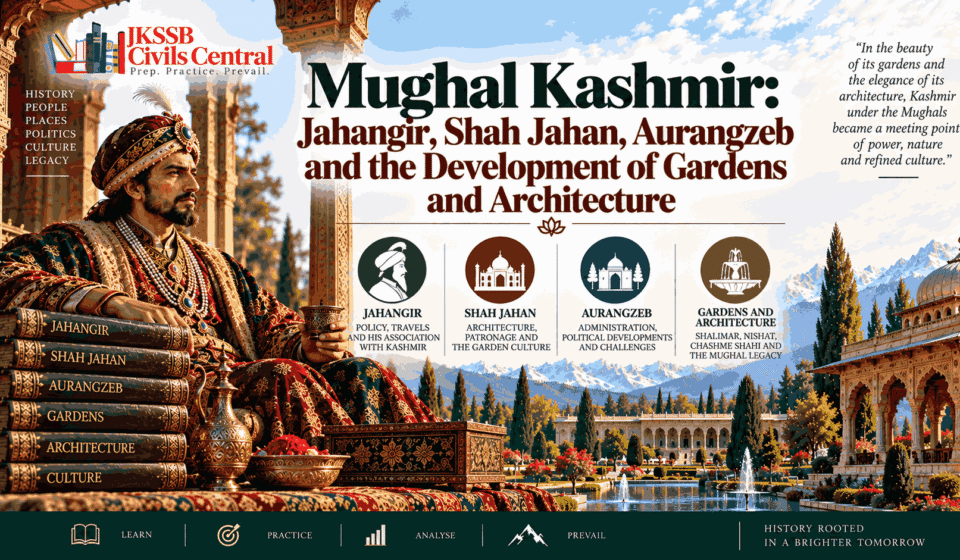
Mughal Kashmir: Jahangir, Shah Jahan, Aurangzeb and the Development of Gardens and Architecture

J&K History Series Navigation
| Previous Article | Current Article | Next Article |
|---|---|---|
| Article 27 — Mughal Rule in Kashmir: Administration, Economy and Political Integration | Article 28 — Mughal Kashmir: Jahangir, Shah Jahan, Aurangzeb and the Development of Gardens and Architecture | Article 29 — Afghan Rule in Kashmir, 1752/53–1819: Administration, Revenue, Society and Economy |
Learning Dashboard
| Aspect | Key Information |
|---|---|
| Historical Period | 1605–1707, with earlier Akbari foundations |
| Historical Phase | Mughal Kashmir |
| Main Rulers | Jahangir, Shah Jahan, Aurangzeb |
| Geographical Core | Kashmir Valley, especially Srinagar and the Dal Lake–Zabarwan landscape |
| Core Theme | Imperial patronage, gardens, architecture, landscape design and Kashmir’s adaptation of Mughal forms |
| Major Garden Tradition | Terraced Mughal gardens with axial water channels |
| Major Gardens | Shalimar, Nishat, Chashme Shahi, Achabal, Verinag, Nasim Bagh, Pari Mahal |
| Major Buildings | Hari Parbat Fort, Pathar Masjid, Akhun Mulla Shah Mosque, Jama Masjid reconstruction |
| Important Architectural Feature | Combination of Mughal/Persian forms with Kashmir’s terrain and local building traditions |
| Important Materials | Stone, brick and timber |
| Important Water Features | Springs, canals, cascades, pools, fountains and channels |
| Key Personality | Jahangir |
| Important Women Patrons | Nur Jahan and other Mughal women of the imperial household |
| Important Nobles | Asif Khan, Ali Mardan Khan |
| Important Prince | Dara Shikoh |
| Major Source | Jahangir’s memoirs, alongside Mughal chronicles and architectural evidence |
| JKSSB Importance | Very High |
| Likely Question Types | Direct fact, statement-based, chronology, matching, identification, comparative |
Introduction
The Mughal conquest of Kashmir in 1586 established imperial sovereignty, but it was during the seventeenth century that Kashmir acquired the architectural and landscape character most strongly associated with the Mughal period. The reigns of Jahangir (1605–1627), Shah Jahan (1628–1658) and Aurangzeb (1658–1707) belong to this later phase of Mughal rule, when Kashmir became an important imperial summer retreat, a setting for royal gardens, a centre of elite residence and a region in which Mughal architectural ideas interacted with an established Kashmiri building tradition.
The Mughal transformation of Kashmir should not, however, be reduced to the creation of attractive gardens. Gardens were connected with imperial politics, royal mobility, water management, architecture, elite patronage and the symbolic representation of power. A Mughal garden in Kashmir was simultaneously a landscape, a residence, a place of courtly recreation and a carefully engineered response to the Valley’s terrain. Its design depended upon water, slope, views, vegetation and architectural structures, making Kashmir particularly suitable for the development of a distinctive form of Mughal landscape architecture.
The architectural story was equally complex. Mughal builders introduced or strengthened stone and masonry construction and used forms associated with Persianate, Timurid and Mughal architecture, but they operated within a region where timber construction, pitched roofs and other Himalayan building practices had deep roots. The result was therefore neither a simple transplantation of imperial architecture nor a complete replacement of local traditions. Instead, Mughal Kashmir produced a layered architectural landscape in which imperial forms were adapted to local geography and interacted with existing Kashmiri techniques.
CivilsCentral Historical Insight
The architectural importance of Mughal Kashmir lies less in the number of monuments than in the interaction between imperial design and local landscape. The Mughals brought a powerful garden and architectural vocabulary, but Kashmir’s mountains, springs, timber traditions and existing urban culture shaped how that vocabulary was actually realized.
A Clear Ruler-Wise Timeline
| Period | Ruler | Major Kashmir Developments |
|---|---|---|
| 1586–1605 | Akbar | Mughal annexation; early administrative consolidation; fortification; imperial garden tradition introduced/expanded |
| 1605–1627 | Jahangir | Kashmir becomes a major imperial summer retreat; Shalimar, Verinag and Achabal receive major development; imperial interest in landscape intensifies |
| 1628–1658 | Shah Jahan | Expansion and refinement of gardens; Nishat, Chashme Shahi, Pari Mahal; additions to Shalimar; important stone architecture |
| 1658–1707 | Aurangzeb | Mughal sovereignty continues; earlier garden and architectural traditions remain in use; no comparable new Kashmir garden-building phase on the scale associated with Jahangir and Shah Jahan |
| 1707–1752 | Later Mughals | Gradual weakening of effective imperial control |
| 1752 | Afghan takeover | Mughal political rule in Kashmir ends |
This chronology is important because not every famous Mughal monument in Kashmir belongs to the same emperor. In particular, Shalimar belongs primarily to Jahangir’s period but was subsequently enlarged under Shah Jahan; Nishat and Chashme Shahi belong to Shah Jahan’s period; and Pari Mahal is associated with Prince Dara Shikoh.
Part I — Kashmir under Jahangir
Jahangir’s Personal Relationship with Kashmir
Jahangir’s reign marks a major change in the relationship between the Mughal court and Kashmir. Although Akbar had already conquered the Valley and visited it in 1589, Jahangir developed a particularly strong personal attachment to Kashmir and repeatedly used the Valley as a summer retreat.
The importance of Kashmir for Jahangir was partly environmental. The Valley offered a combination of mountains, water, springs, lakes, forests, gardens and relatively cool summer conditions that differed sharply from the heat of the imperial plains. Jahangir’s memoirs reveal an unusually detailed interest in the natural landscape, plants, gardens, springs and cultivated fruits of Kashmir.
This imperial fascination had political consequences. The movement of the emperor and his court into Kashmir transformed selected parts of the Valley into spaces of imperial residence and display. Gardens were not merely recreational spaces; they became settings in which the emperor, court, nobility and landscape were brought together.
CivilsCentral Historical Insight
Jahangir’s Kashmir policy demonstrates how environmental attraction could become politically significant. The Valley’s landscape encouraged repeated imperial visits, and those visits stimulated the creation of gardens, residences and infrastructure that permanently altered the visual and cultural geography of Srinagar and other parts of Kashmir.
Part II — Shalimar Bagh and the Jahangiri Garden Tradition
Shalimar: From Earlier Garden to Imperial Landscape
Shalimar Bagh is the most famous garden associated with Mughal Kashmir. The present garden is generally associated with Jahangir’s development of an earlier garden landscape into an imperial garden around 1619–1620.
Jahangir’s memoirs record his admiration for the site and his instructions to his son Prince Khurram, the future Shah Jahan, to develop the water system and garden. The early garden was associated with the name Farah Bakhsh, while later development under Shah Jahan produced further enlargement and the name Faiz Bakhsh in the historical tradition.
This is why a simple statement such as “Shalimar was built by Jahangir” is useful for examination purposes but incomplete historically. Jahangir established the principal imperial garden phase, while Shah Jahan subsequently extended and modified the complex.
The Structure of Shalimar
Shalimar’s design demonstrates how Mughal garden principles were adapted to Kashmir.
The basic idea derived from the Persian chahar-bagh tradition, in which gardens were organized through geometric divisions and controlled water. In Kashmir, however, the terrain encouraged a more strongly terraced arrangement. Water descended through the garden along a central axis, creating pools, cascades, channels and fountains.
The garden therefore combined:
- geometric planning
- axial water movement
- terraces
- pavilions
- ornamental planting
- views toward Dal Lake
- mountain scenery
- controlled transitions between public and more private spaces.
The landscape was not incidental to the architecture. Water, slope, vegetation and views formed the central components of the design.
Farah Bakhsh and Faiz Bakhsh
The historical terminology surrounding Shalimar is important.
The earlier royal garden was associated with Farah Bakhsh, while Shah Jahan’s later extension is associated with Faiz Bakhsh.
Therefore:
Jahangir → Farah Bakhsh / principal imperial garden development
Shah Jahan → later extension / Faiz Bakhsh
This distinction can be tested directly in a statement-based question.
CivilsCentral Historical Insight
Shalimar illustrates an important feature of Mughal architecture in Kashmir: monuments were often developed in phases rather than created by one ruler in a single act. Correct historical identification therefore requires distinguishing original patronage from later enlargement.
Part III — The Mughal Garden as a Kashmiri Landscape
The Persian Garden Idea
The conceptual foundation of Mughal garden design came from the broader Persianate garden tradition. The chahar-bagh was based on controlled geometry, water distribution and the symbolic association of gardens with an ordered paradise landscape. Mughal rulers adapted this tradition across India.
Kashmir, however, presented a very different physical environment from the plains.
The Valley contained:
- steep slopes
- natural springs
- streams
- lakes
- mountain backdrops
- uneven terrain
- abundant vegetation.
As a result, the Kashmir garden often became a terraced water garden rather than a perfectly symmetrical flat quadrilateral.
Water as the Organizing Principle
Water was central to Mughal garden design in Kashmir.
A typical garden could use:
spring
↓
canal
↓
central water channel
↓
terrace
↓
cascade / chadar
↓
pool
↓
fountain
↓
lower terrace
This arrangement turned water into both an engineering system and an aesthetic element. The slope of the land was not simply an obstacle. It became part of the design. The garden’s terraces allowed gravity to move water downward, while the sound and movement of water became part of the sensory experience of the landscape.
The Kashmir Adaptation
This is why it is misleading to describe the gardens simply as Persian gardens transplanted into Kashmir. They were better understood as Mughal-Persian garden principles adapted to Kashmiri terrain.
The rectangular and terraced forms of Kashmir often differed from the idealized square chahar-bagh plan suited to flatter terrain. This adaptation is one of the most important architectural characteristics of the Kashmir garden tradition.
Part IV — Jahangir’s Other Kashmir Gardens
Verinag
Verinag was particularly important because the garden was built around the source of the Jhelum. The natural spring was transformed into an architectural landscape with a large octagonal pool and surrounding structures.
The significance of Verinag lies in the combination of:
natural spring + hydraulic control + architecture + imperial landscape design.
The site demonstrates that Mughal garden design in Kashmir often began with a natural water source rather than imposing an entirely artificial water system. Jahangir was especially interested in the site, and later Mughal rulers continued to develop it.
Achabal
Achabal in south Kashmir also became associated with Jahangiri garden development. The site’s natural spring and sloping terrain made it particularly suitable for the terraced-water garden model.
Later alterations and additions occurred under subsequent Mughal patronage, meaning that its present appearance represents more than a single moment of construction.
Nasim Bagh and Akbar’s Legacy
The garden tradition also has an earlier Akbari foundation. Akbar established a garden in Srinagar associated in the sources with Bagh-i Nurafza, which has sometimes been identified with or connected to the later Nasim Bagh tradition.
The identification should be treated cautiously rather than presented as absolutely established.
The important historical point is that the Mughal garden tradition in Kashmir began under Akbar and reached a much greater development under Jahangir and Shah Jahan.
Part V — Nur Jahan and Female Patronage
Nur Jahan’s Role
The history of Mughal Kashmir’s architecture cannot be understood through emperors alone. Nur Jahan, Jahangir’s influential wife, was a major figure in Mughal architectural and garden patronage. Her position within the imperial household enabled her to participate directly in the creation and patronage of buildings and gardens.
Her influence is particularly relevant to the Pathar Masjid of Srinagar.
Pathar Masjid
The Pathar Masjid, or Stone Mosque, is traditionally dated to 1623 and associated with Nur Jahan’s patronage. It represents a significant departure from Kashmir’s predominantly timber-based mosque tradition because of its substantial masonry construction.
The mosque uses stone construction with a series of arches and a substantial interior structural system. Its importance lies not simply in its association with Nur Jahan but in the broader transition toward a stronger Mughal stone-building presence in Kashmir.
Why Female Patronage Matters
Female patronage should not be treated as an incidental detail. Mughal royal women could control wealth, maintain political influence and sponsor architectural works.
Thus: Nur Jahan → Pathar Masjid, is an important examination association.
At the same time, her role should not be exaggerated into the claim that she personally designed every architectural feature. Patronage, commissioning and architectural execution involved different actors.
CivilsCentral Historical Insight
Mughal architecture was also shaped by the patronage of women within the imperial household. Nur Jahan’s association with Pathar Masjid demonstrates that architectural patronage in Mughal Kashmir cannot be reduced to the actions of emperors alone.
Part VI — Jahangir’s Interest in Nature and Kashmir’s Landscape
Jahangir’s relationship with Kashmir was distinctive because his interest extended beyond architecture to the natural world.
His memoirs contain observations on:
- flowers
- trees
- fruits
- animals
- birds
- springs
- lakes
- mountains
- cultivated landscapes.
This interest was part of a wider Mughal culture of imperial observation and natural-history description, but Kashmir provided an especially rich environment for it. The gardens therefore cannot be understood simply as decorative constructions.
They represented a controlled relationship between: nature and imperial design.
The emperor’s garden transformed a natural landscape into an ordered imperial space without eliminating the landscape’s major visual features.
Part VII — Shah Jahan and the Expansion of Mughal Kashmir
A New Architectural Phase
The accession of Shah Jahan in 1628 began another important phase in the architectural history of Kashmir. Shah Jahan inherited the gardens created or developed during Jahangir’s reign and expanded them. His reign also saw the construction of additional gardens and stone structures.
The architecture of this period generally shows greater emphasis on:
- formal symmetry
- masonry
- stone
- decorative refinement
- pavilions
- monumental terraces
- controlled water systems.
However, Kashmir’s topography continued to shape the final form.
Shah Jahan’s Kashmir Visits
Shah Jahan spent several summers in Kashmir and continued the Mughal practice of treating the Valley as an imperial retreat. His patronage was therefore not limited to individual monuments.
It formed part of a broader imperial landscape consisting of:
- gardens
- roads
- residences
- waterworks
- mosques
- fortifications
- recreational spaces.
This gave Kashmir a particularly dense concentration of Mughal landscape architecture.
Part VIII — Nishat Bagh
Patronage of Asif Khan
Nishat Bagh is associated with Asif Khan, the brother of Nur Jahan and father of Mumtaz Mahal. The garden was laid out around 1633–1634 during Shah Jahan’s reign.
This is an important distinction: Nishat Bagh → Asif Khan
rather than: Nishat Bagh → Shah Jahan personally as builder.
Shah Jahan was the reigning emperor and patron of the broader imperial environment, but the garden is conventionally attributed to Asif Khan. Government of J&K sources likewise identify Asif Khan as the builder of Nishat Bagh in 1633.
Twelve Terraces
Nishat is particularly famous for its twelve terraces. These terraces are traditionally associated with the twelve signs of the zodiac. The central water channel descends through the garden, connecting the terraces.
The garden’s long rectangular form reflects adaptation to the slope and site rather than strict reproduction of the flat-land square chahar-bagh.
Public and Private Spaces
Nishat also demonstrates differentiation between spaces.
The garden could be understood in terms of:
- lower/public areas
- central garden spaces
- upper/private areas.
This relationship between landscape and social hierarchy was a characteristic feature of Mughal garden design.
The Shah Jahan–Asif Khan Story
A well-known tradition states that Shah Jahan admired Nishat so much that he wished to possess it, and that the garden’s water supply was temporarily stopped. This story appears in later historical and popular accounts.
It is useful for understanding the cultural memory surrounding the garden, but it should not be treated as an independently established fact without qualification.
For examination purposes, the stronger facts are: Nishat Bagh → Asif Khan → 1633/34 → Dal Lake → twelve terraces.
Part IX — Chashme Shahi
The Royal Spring
Chashme Shahi, meaning the “Royal Spring,” belongs to Shah Jahan’s reign. The garden was constructed around a natural spring in 1632 and is associated with Ali Mardan Khan, a major Mughal official and engineer associated with Shah Jahan.
Government of J&K sources identify the garden as commissioned by Shah Jahan for his son Dara Shikoh.
Three Main Terraces
Chashme Shahi is smaller than Shalimar and Nishat, but architecturally important because the garden is organized around the spring itself.
Its water passes through terraces and cascades, producing:
- channels
- pools
- fountains
- water ramps
- stepped transitions.
The spring is therefore both the natural and architectural centre of the garden.
Why Chashme Shahi Is Important for JKSSB
The high-value associations are:
Chashme Shahi → 1632 → Shah Jahan → Ali Mardan Khan → Dara Shikoh
This makes it particularly suitable for match-the-following and statement-based questions.
Part X — Pari Mahal and Dara Shikoh
A Prince’s Garden
Pari Mahal, or the “Palace of Fairies,” occupies a hill overlooking Srinagar and Dal Lake. It is associated with Prince Dara Shikoh, the eldest son of Shah Jahan, and is generally dated to 1644.
Unlike a conventional flat garden, Pari Mahal uses a steep hillside. Its architecture therefore consists of a sequence of terraces rising along the slope.
Seven Terraces
The garden is associated with a compact system of stepped terraces.
This creates a visual relationship among:
- architecture
- slope
- city
- Dal Lake
- surrounding mountains.
The site was also associated with Dara Shikoh’s intellectual interests. Traditional accounts connect him with the study of astrology and related intellectual pursuits at the site. Such associations should be used carefully where the precise details derive from later traditions.
Historical Significance
Pari Mahal demonstrates that Mughal garden architecture was not limited to the emperor’s own gardens. Members of the imperial family and elite nobles also created landscapes that reflected their status and personal interests.
CivilsCentral Historical Insight
The gardens of Mughal Kashmir were not a single standardized category. Shalimar functioned as an imperial royal garden; Nishat represented elite noble patronage; Chashme Shahi was associated with an imperial prince; and Pari Mahal combined residence, landscape and intellectual association. The garden therefore became a form of political and social architecture.
Part XI — Mughal Gardens as Hydraulic Architecture
It is tempting to study Mughal gardens only as ornamental landscapes. Historically, this is incomplete. A Kashmir garden required the controlled movement of water.
Its construction could involve:
- identifying a spring
- diverting or collecting water
- constructing channels
- controlling water levels
- building pools
- creating cascades
- maintaining fountains
- distributing water across terraces.
The garden was therefore simultaneously:
landscape architecture
hydraulic engineering
horticulture
residential architecture.
The success of a garden depended upon the reliability of its water supply.
This is particularly visible in gardens such as Chashme Shahi and Verinag, where the natural spring formed the foundation of the design.
Part XII — Why Mughal Gardens in Kashmir Became Terraced
The terrace was not merely an aesthetic preference. It solved several practical problems. Kashmir’s gardens were frequently constructed on slopes, especially along the Zabarwan foothills and other elevated sites.
A terraced arrangement allowed:
- controlled movement of water by gravity;
- stabilization of the slope;
- division of the garden into functional spaces;
- creation of visual depth;
- better views over lakes and valleys;
- placement of pavilions at different elevations.
Thus: Terrain → Terrace → Water Flow → Garden Structure
This is one of the most important conceptual chains for understanding Kashmir’s Mughal gardens. The terracing should therefore not be interpreted simply as a decorative modification of Persian garden design. It was also a rational response to Kashmir’s geography.
Part XIII — Mughal Architecture Beyond Gardens
The architectural legacy of the Mughals in Kashmir extends beyond gardens.
Important examples include:
- Hari Parbat Fort
- Pathar Masjid
- Akhun Mulla Shah Mosque
- additions and rebuilding associated with the Jama Masjid
- structures connected with Mughal gardens
- gateways and retaining walls.
These monuments demonstrate the increasing importance of masonry and stone in a region where timber had long been a major construction material.
Part XIV — Hari Parbat Fort
Akbar’s Foundation
The fortification of Hari Parbat represents an important early Mughal architectural intervention. Its foundation is associated with Akbar, and the surviving Mughal-period gateways and walls reflect the introduction of imperial stone construction into the Kashmir Valley.
The significance of the fort is therefore political as well as architectural.
A fort on an elevated site provided:
- military security
- surveillance
- symbolic imperial presence
- control over the urban landscape.
The surviving structures should not, however, be treated as a perfectly preserved Akbari fortification. Later modifications and rebuilding affected the complex.
Architectural Transition
The Hari Parbat fort is important because it demonstrates the growing Mughal use of masonry and stone. Earlier Kashmiri architecture had made extensive use of timber because it was locally available and suited to the climate and building tradition. Mughal construction introduced a stronger stone and masonry vocabulary.
This did not eliminate timber architecture.
Instead, the Valley developed a coexistence of: Mughal stone architecture and traditional Kashmiri timber architecture.
Part XV — Kashmir’s Timber Architectural Tradition
Why Timber Mattered
Kashmir possessed a distinctive architectural tradition based heavily on timber.
The climate, available forests and inherited building techniques encouraged:
- timber columns
- pitched roofs
- layered wooden structures
- brick-and-timber construction
- large wooden superstructures.
This tradition was already well established before Mughal rule.
Mughal Encounter with Local Architecture
Mughal architecture entered this environment with a different material vocabulary.
The imperial preference for:
- stone
- brick
- arches
- masonry walls
- formal geometric planning
interacted with Kashmir’s existing construction techniques. The resulting architecture should therefore not be described as purely Persian or purely Kashmiri.
It was often hybrid in practice, even where the visual language remained strongly Mughal.
CivilsCentral Historical Insight
Mughal architecture did not simply erase the older Kashmiri building tradition. The continued importance of timber demonstrates that imperial architecture operated within local ecological and technical conditions. This is a useful example of how cultural change usually involves adaptation and coexistence rather than total replacement.
Part XVI — Jama Masjid: An Important Examination Distinction
Not a Mughal Foundation
The Jama Masjid of Srinagar is an important monument, but it should not be classified as a Mughal-built monument. Its foundation belongs to the Sultanate period, traditionally associated with Sultan Sikandar in the late fourteenth century.
The mosque underwent reconstruction and rebuilding during later periods.
Mughal-Period Reconstruction
The mosque was rebuilt during the Mughal period and the reconstruction was completed in 1637, during Shah Jahan’s reign.
This produces an important examination distinction:
Jama Masjid Srinagar → Sultanate foundation
Mughal period → later rebuilding/completion
Therefore, the statement: “Jama Masjid Srinagar was built by Shah Jahan”
is incorrect.
A more accurate statement is: “The Jama Masjid predates Mughal rule but underwent important reconstruction during the Mughal period.”
The monument’s survival also demonstrates the continuity of Kashmiri architectural traditions across political transitions.
Part XVII — Pathar Masjid: Mughal Stone Architecture
The Pathar Masjid is particularly important because its material distinguishes it from the older timber-dominated Kashmiri mosque tradition. Built in stone and associated with Nur Jahan, the mosque contains a series of arches and a substantial masonry structure.
It is therefore a useful example of the Mughal architectural tendency toward stone construction in Kashmir. At the same time, it should not be isolated from the broader development of local architecture.
Its significance lies in the contrast:
Earlier Kashmir → timber-dominated tradition
Mughal intervention → greater stone and masonry construction
This is one of the clearest architectural transitions associated with the Mughal period.
Part XVIII — Akhun Mulla Shah Mosque
The Akhun Mulla Shah Mosque is associated with the Mughal period and is generally dated to the reign of Shah Jahan. Its position near Hari Parbat and its masonry construction make it another important example of the Mughal architectural presence in Kashmir.
Its plan differs from the traditional timber-dominated mosque architecture of the Valley and reflects a more strongly masonry-based Mughal architectural vocabulary.
For examination purposes, it is less important to memorize every architectural detail than to understand the broader association:
Akhun Mulla Shah Mosque → Mughal period → stone/masonry architecture → Kashmir.
Part XIX — Mughal Architecture and Persian Influence
The Mughal architectural vocabulary in Kashmir reflected wider Persianate and Central Asian influences.
These could be seen in:
- arches
- garden geometry
- water channels
- pavilions
- masonry
- decorative planning
- formal symmetry.
However, the transmission was not direct or uniform. Kashmir had its own architectural history. Earlier Kashmir had already experienced Central Asian, Iranian, Indic and Himalayan influences in different periods.
Therefore, Mughal architecture should be understood as part of a longer process of architectural interaction rather than a completely new beginning.
Part XX — Shah Jahan and the Refinement of Garden Architecture
Shah Jahan’s period is particularly important for the formal refinement of Mughal landscape architecture.
The Kashmir gardens of this period demonstrate:
- larger terraces
- stronger axial organization
- carefully controlled water
- greater use of stone
- pavilions and retaining walls
- visual relationships with Dal Lake
- separation of public and private spaces.
The emphasis on formal geometry did not eliminate the importance of landscape. Instead, the architecture was carefully positioned so that the natural scenery became part of the composition.
A garden could therefore be viewed simultaneously from:
- inside the garden
- from the lake
- from an elevated terrace
- from a pavilion
- from surrounding mountains.
This relationship between architecture and landscape is central to the distinctiveness of Mughal Kashmir.
Part XXI — Mughal Gardens and the Dal Lake Landscape
The Dal Lake became one of the principal settings for Mughal garden architecture. The relationship was especially important because the gardens did not merely overlook the lake. They were designed in relation to it.
The lake provided:
- visual depth
- water transport
- a reflective surface
- access by boat
- a connection between gardens.
The Zabarwan foothills provided the vertical background.
The resulting landscape consisted of:
Zabarwan Mountains
↓
Terraced Gardens
↓
Dal Lake
↓
Srinagar
This visual arrangement became one of the defining characteristics of the Mughal landscape of Srinagar. Government planning documents continue to recognize Shalimar, Nishat, Chashme Shahi and Pari Mahal among the major heritage sites of Srinagar.
Part XXII — Horticulture and Imperial Landscape
The Mughal garden was not simply a collection of flowers. Horticulture formed a central component of imperial landscape planning. Jahangir’s observations mention numerous plants and fruits, and the Mughals introduced or cultivated varieties that linked Kashmir to broader horticultural traditions.
Fruit trees were especially important.
The gardens combined:
- ornamental plants
- shade trees
- fruit trees
- flowers
- water
- pavilions.
This combination produced a landscape that was simultaneously productive, recreational and symbolic.
The historical garden should therefore not be confused with the modern ornamental park.
Part XXIII — Aurangzeb and the Later Mughal Phase
Continuity Rather Than a New Garden-Building Peak
The accession of Aurangzeb in 1658 did not end Mughal control of Kashmir. The gardens, roads, residences and administrative institutions developed under his predecessors continued to operate. However, the architectural history of Kashmir under Aurangzeb should be distinguished from the major garden-building phases associated with Jahangir and Shah Jahan.
There is no equally prominent new Kashmir garden complex associated with Aurangzeb on the scale of Shalimar, Nishat or Chashme Shahi. This does not mean that architecture and landscape activity ceased.
Rather, the emphasis shifted toward the continued use, maintenance and adaptation of an already developed imperial landscape.
Why the Distinction Matters
This prevents a common examination error: “All famous Mughal gardens of Kashmir were built under Aurangzeb.”
They were not.
The major surviving gardens belong predominantly to the reigns of Jahangir and Shah Jahan, with earlier foundations under Akbar.
Part XXIV — Aurangzeb and the Political Context
Aurangzeb inherited an empire much larger and more politically demanding than that inherited by Jahangir. His reign was characterized by extensive military commitments and growing pressure on imperial finances. Kashmir remained important as an imperial retreat and frontier region, but it no longer occupied the same distinctive position in Mughal cultural memory that it had under Jahangir.
The political importance of Kashmir continued, but the intense garden-building culture associated with Jahangir and Shah Jahan was not reproduced on the same scale.
This distinction illustrates a wider principle: Political control can continue even when the intensity of cultural patronage changes.
Part XXV — The Architecture of Imperial Power
The Mughal monuments of Kashmir can be understood as instruments of imperial presence.
Forts
Purpose: security, surveillance and political authority.
Example: Hari Parbat Fort.
Gardens
Purpose: imperial residence, recreation, symbolic landscape and elite display.
Examples: Shalimar, Nishat, Chashme Shahi.
Mosques
Purpose: religious and architectural patronage.
Examples: Pathar Masjid, Akhun Mulla Shah Mosque.
Waterworks
Purpose: supply, circulation, cooling and aesthetic effect.
Examples: garden channels, springs, pools and cascades.
This means that architecture was not separate from politics.
The imperial landscape communicated:
Mughal sovereignty
imperial wealth
technical capacity
courtly culture.
Part XXVI — Architecture and the Local Kashmiri Environment
One of the most important features of Mughal Kashmir is the way architecture responded to the environment.
The Valley’s climate and terrain affected:
- roof forms
- materials
- garden orientation
- water systems
- terrace construction
- vegetation
- building location.
The Mughal architects could not simply reproduce the flat-land gardens of Agra or Delhi.
Instead, they had to work with:
mountains
slopes
springs
lakes
snow
heavy seasonal moisture
local construction materials.
The resulting architecture therefore reveals the interaction of an imperial aesthetic with environmental constraints.
Part XXVII — Mughal Gardens as Political Landscapes
The gardens also reflected social hierarchy.
The arrangement of terraces could correspond to differences between:
- public spaces
- private royal spaces
- elite residences
- service areas.
The movement upward through a garden could therefore also represent movement into increasingly private or privileged spaces.
The architecture created a controlled relationship between:
visitor → court → emperor → landscape.
This is why the garden was not simply a recreational park. It was part of the organization of imperial space.
Part XXVIII — The Mughal Garden and the Idea of Paradise
The Mughal garden tradition was deeply connected with the Persianate conception of the garden as an ordered and fertile landscape. Water, shade, flowers, fruit and geometric organization contributed to this symbolic dimension. In Kashmir, however, the natural landscape itself was already exceptionally rich.
The Mughal intervention therefore involved transforming an existing landscape into a deliberately ordered imperial garden.
This produced a distinctive contrast: Natural Kashmir versus Designed Kashmir.
The Mughal garden did not replace the Valley’s landscape. It framed and reorganized it.
Part XXIX — From Persian Chahar-Bagh to Kashmiri Terraced Garden
The development can be summarized as:
Persian garden concept
↓
Mughal adaptation in India
↓
Mughal expansion into Kashmir
↓
Encounter with Himalayan terrain
↓
Terracing
↓
Axial water channel
↓
Cascades and pools
↓
Pavilions and retaining walls
↓
Kashmir’s distinctive Mughal garden landscape
This is one of the most important conceptual chains in the entire article.
Part XXX — Major Mughal Gardens: Comparative Table
| Garden | Approx. Date | Main Association | Location / Setting | Key Feature |
|---|---|---|---|---|
| Shalimar Bagh | 1619–20; later expansion | Jahangir; later Shah Jahan | Dal Lake | Imperial terraced garden |
| Nishat Bagh | 1633–34 | Asif Khan | Eastern Dal Lake | Twelve terraces |
| Chashme Shahi | 1632 | Ali Mardan Khan / Shah Jahan | Zabarwan foothills | Natural spring and three main terraces |
| Achabal | Jahangir period | Jahangir and later patrons | South Kashmir | Spring-fed garden |
| Verinag | Jahangir period | Jahangir | Jhelum source | Large spring/pool |
| Nasim Bagh | Akbari/Jahangiri tradition | Akbar tradition; later development | Dal Lake | Large garden landscape |
| Pari Mahal | 1644 | Dara Shikoh | Hill above Srinagar | Stepped hillside garden/residence |
Dates and attribution of some gardens can vary in secondary literature; the strongest recurring associations are retained here.
Part XXXI — Major Mughal Buildings: Comparative Table
| Monument | Period | Main Association | Architectural Importance |
|---|---|---|---|
| Hari Parbat Fort | Akbar/Jahangir period | Akbar | Mughal fortification and stone construction |
| Pathar Masjid | c.1623 | Nur Jahan | Stone mosque |
| Jama Masjid Srinagar | Sultanate origin; Mughal reconstruction | Sikandar foundation; completed/rebuilt in Mughal period | Kashmiri timber tradition with later Mughal-period rebuilding |
| Akhun Mulla Shah Mosque | Shah Jahan period | Mughal period | Masonry mosque near Hari Parbat |
| Pari Mahal | 1644 | Dara Shikoh | Terraced residence/garden |
| Shalimar structures | Jahangir–Shah Jahan | Imperial court | Garden pavilions and water architecture |
Part XXXII — Historical Sources
Tuzuk-i-Jahangiri
Jahangir’s memoirs are especially important for Mughal Kashmir.
They provide first-person observations on:
- gardens
- natural landscapes
- plants
- fruits
- springs
- architecture
- Kashmir’s shawls
- imperial visits.
The source is particularly valuable because Jahangir himself travelled through the Valley and recorded observations. However, it remains an imperial memoir. It therefore reflects the interests and perspective of the emperor and court.
Shah Jahan’s Court Chronicles
The chronicles of Shah Jahan’s reign provide information on:
- construction
- imperial patronage
- gardens
- court officials
- architecture.
These sources should be combined with physical remains.
Archaeological and Architectural Evidence
Surviving:
- gardens
- terraces
- channels
- pavilions
- mosques
- fortifications
- masonry
provide independent material evidence for architectural development. The combination of textual and material evidence is especially valuable because gardens have often undergone restoration and modification.
Part XXXIII — Evidence and Historical Caution
Shalimar’s Exact Development
The safe conclusion is that Jahangir developed the principal imperial garden at Shalimar around 1619–20, while Shah Jahan later expanded it. Avoid treating the entire existing complex as the product of a single ruler.
Nishat’s Patronage
Nishat is associated with Asif Khan and dated to 1633–34. The popular story about Shah Jahan’s reaction to the garden should be treated as tradition rather than unquestioned documentary fact.
Chashme Shahi
The garden dates to Shah Jahan’s reign and is associated with Ali Mardan Khan. Government of J&K sources explicitly connect its construction in 1632 with Shah Jahan and Dara Shikoh.
Pari Mahal
The garden/residence is generally associated with Dara Shikoh and dated to 1644. The site is secure as a Mughal-period monument, but individual stories about its intellectual activities should be distinguished from the physical evidence.
Garden Restoration
Modern Mughal gardens have undergone restoration. Therefore, the garden seen today should not automatically be treated as an untouched seventeenth-century landscape.
The historical design survives through:
- terraces
- channels
- pools
- pavilions
- retaining walls
- spatial organization.
Planting schemes and some structures have changed over time.
Part XXXIV — Mughal Architecture and Cultural Interaction
The architectural history of Mughal Kashmir demonstrates that cultural interaction was multidirectional.
The Mughals brought:
- Persianate garden principles
- imperial masonry traditions
- formal water architecture
- courtly spatial organization.
Kashmir contributed:
- timber expertise
- adaptation to steep terrain
- local stone
- traditional roof forms
- environmental knowledge
- established urban and religious architecture.
The resulting architectural landscape therefore cannot be understood through a simple “foreign influence versus local tradition” model. It was a process of adaptation.
Part XXXV — Historical Significance
1. Kashmir Became an Imperial Landscape
The repeated presence of Mughal emperors transformed parts of Kashmir into spaces of imperial residence and display.
2. Garden Architecture Reached a Distinctive Form
Persianate chahar-bagh ideas were adapted to Kashmir’s mountainous terrain, producing terraced gardens with controlled water systems.
3. Water Became an Architectural Element
Springs, channels, pools and cascades were incorporated directly into landscape design.
4. Stone Construction Expanded
Mughal rule strengthened the use of stone and masonry in Kashmir.
5. Timber Traditions Continued
Mughal architecture did not eliminate indigenous Kashmiri building practices.
6. Elite Patronage Expanded
Emperors, princes, royal women and nobles all participated in architectural patronage.
7. Srinagar’s Landscape Was Transformed
Dal Lake, Zabarwan foothills and surrounding urban spaces became interconnected with imperial gardens.
8. Mughal Kashmir Acquired a Distinct Visual Identity
The combination of mountains, water, gardens, pavilions and masonry created a recognizable Mughal-era landscape.
9. Architecture Reflected Political Power
Forts, gardens and elite residences communicated imperial authority and status.
10. The Legacy Continued Beyond the Mughals
Later Afghan, Sikh and Dogra regimes inherited and reused elements of the Mughal landscape.
Part XXXVI — Jahangir vs Shah Jahan vs Aurangzeb
| Feature | Jahangir | Shah Jahan | Aurangzeb |
|---|---|---|---|
| Reign | 1605–1627 | 1628–1658 | 1658–1707 |
| Kashmir Association | Strong personal attachment | Continued imperial patronage | Continued imperial control |
| Garden Development | Major phase | Major expansion/refinement | No comparable new Kashmir garden phase |
| Shalimar | Principal imperial development | Later expansion | Continued use |
| Nishat | — | Asif Khan, 1633–34 | — |
| Chashme Shahi | — | 1632 | — |
| Pari Mahal | — | Dara Shikoh, 1644 | — |
| Verinag | Major development | Further improvement | Continued imperial landscape |
| Pathar Masjid | Nur Jahan’s patronage | Earlier structure | Continued existence |
| Overall Architectural Character | Landscape and nature | Formal refinement and masonry | Continuity of established imperial landscape |
Part XXXVII — Examination Discrimination Points
Shalimar vs Nishat
Shalimar → Jahangir
Nishat → Asif Khan
Do not confuse them.
Nishat vs Chashme Shahi
Nishat → 1633/34 → Asif Khan → twelve terraces
Chashme Shahi → 1632 → Ali Mardan Khan → spring
Chashme Shahi vs Pari Mahal
Chashme Shahi → Shah Jahan’s reign → Dara Shikoh connection
Pari Mahal → 1644 → Dara Shikoh
Jahangir vs Shah Jahan
Jahangir → major development of Shalimar, Verinag and Achabal
Shah Jahan → Nishat, Chashme Shahi, Pari Mahal and expansion of earlier gardens
Mughal vs Sultanate Architecture
Jama Masjid Srinagar → Sultanate foundation
Pathar Masjid → Mughal period
Persian Garden vs Kashmiri Garden
Persian chahar-bagh → conceptual foundation
Kashmir → terraced adaptation to mountain terrain
Emperor vs Patron
A ruler may be the reigning emperor without being the person who physically commissioned or built every monument.
Example:
Nishat → Asif Khan
not simply “Shah Jahan’s garden.”
Part XXXVIII — JKSSB Knowledge Matrix
| Question | Answer |
|---|---|
| Which Mughal emperor had a particularly strong personal association with Kashmir? | Jahangir |
| Which emperor developed Shalimar as an imperial garden? | Jahangir |
| Who later enlarged Shalimar? | Shah Jahan |
| Who is associated with Nishat Bagh? | Asif Khan |
| When was Nishat Bagh laid out? | c.1633–34 |
| How many principal terraces are traditionally associated with Nishat? | Twelve |
| When was Chashme Shahi developed? | 1632 |
| Who is associated with Chashme Shahi’s construction? | Ali Mardan Khan under Shah Jahan |
| Which prince is associated with Pari Mahal? | Dara Shikoh |
| When was Pari Mahal built? | 1644 |
| Which Mughal ruler’s period is associated with major Kashmir garden development? | Jahangir and Shah Jahan |
| Which mosque is associated with Nur Jahan? | Pathar Masjid |
| What is special about Pathar Masjid? | Stone/masonry construction |
| Which major Srinagar mosque predates Mughal rule? | Jama Masjid |
| What happened to Jama Masjid during Mughal rule? | It was rebuilt/reconstructed and completed in 1637 |
| What is the main conceptual origin of Mughal gardens? | Persianate chahar-bagh tradition |
| Why are Kashmir gardens heavily terraced? | Adaptation to sloping terrain and water management |
| Which lake is closely associated with Shalimar and Nishat? | Dal Lake |
| Which mountain range forms the backdrop to several Srinagar gardens? | Zabarwan Range |
| When did Aurangzeb rule? | 1658–1707 |
| Did Aurangzeb build the major famous Srinagar Mughal gardens? | No; the major surviving garden-building phase belongs principally to Jahangir and Shah Jahan |
Part XXXIX — JKSSB Question Pattern Mapping
Direct Fact
Nishat Bagh is associated with which Mughal noble?
A. Ali Mardan Khan
B. Asif Khan
C. Qasim Khan
D. Raja Man Singh
Answer: B
Statement-Based
Consider the following:
- Shalimar Bagh was developed under Jahangir.
- Nishat Bagh is associated with Asif Khan.
- Chashme Shahi was developed during Shah Jahan’s reign.
- Pari Mahal is associated with Dara Shikoh.
All four statements are correct.
Chronology
Arrange the following:
- Nishat Bagh
- Shalimar Bagh
- Chashme Shahi
- Pari Mahal
A historically useful sequence is: Shalimar → Chashme Shahi → Nishat → Pari Mahal
with the important caveat that Shalimar itself was subsequently modified and expanded.
Match the Following
| Garden / Monument | Association |
|---|---|
| Shalimar | Jahangir |
| Nishat | Asif Khan |
| Chashme Shahi | Ali Mardan Khan |
| Pari Mahal | Dara Shikoh |
| Pathar Masjid | Nur Jahan |
Identification by Clues
Identify the garden:
- Located on the eastern side of Dal Lake.
- Associated with Asif Khan.
- Developed in 1633–34.
- Characterized by twelve terraces.
Answer: Nishat Bagh
Correct / Incorrect Pair
Which pair is incorrectly matched?
A. Shalimar — Jahangir
B. Nishat — Asif Khan
C. Chashme Shahi — Ali Mardan Khan
D. Pari Mahal — Akbar
Answer: D
Comparative
Which feature most clearly distinguishes Kashmir’s Mughal gardens from a simple reproduction of flat-land Persian chahar-bagh gardens?
A. Absence of water
B. Extensive use of terraces responding to mountain terrain
C. Complete absence of geometry
D. Exclusive use of timber
Answer: B
Part XL — JKSSB Practice Questions
Question 1
Which Mughal emperor is most closely associated with the development of Kashmir as an imperial summer retreat?
A. Babur
B. Akbar
C. Jahangir
D. Aurangzeb
Correct Answer: C
Explanation: Akbar conquered Kashmir and established the Mughal presence, but Jahangir developed an especially strong personal relationship with Kashmir and promoted major garden projects.
Question 2
Nishat Bagh was principally associated with:
A. Dara Shikoh
B. Asif Khan
C. Nur Jahan
D. Ali Mardan Khan
Correct Answer: B
Explanation: Nishat Bagh was laid out by Asif Khan during Shah Jahan’s reign.
Question 3
Which garden is associated with a natural spring and was developed in 1632?
A. Shalimar
B. Nishat
C. Chashme Shahi
D. Pari Mahal
Correct Answer: C
Explanation: Chashme Shahi was developed around a spring during Shah Jahan’s reign.
Question 4
Consider the following statements:
- Shalimar was developed under Jahangir.
- Nishat was associated with Asif Khan.
- Pari Mahal is associated with Dara Shikoh.
- All major Kashmir Mughal gardens were built by Aurangzeb.
Which are correct?
A. 1, 2 and 3 only
B. 1 and 4 only
C. 2 and 4 only
D. All four
Correct Answer: A
Question 5
Which of the following best explains the terraced design of many Mughal gardens in Kashmir?
A. It was intended only for military defence.
B. It was imposed without regard to terrain.
C. It adapted garden design to sloping terrain and facilitated gravity-fed water movement.
D. It eliminated the use of water.
Correct Answer: C
Question 6
Pathar Masjid is associated with:
A. Nur Jahan
B. Gulab Singh
C. Zain-ul-Abidin
D. Akbar
Correct Answer: A
Explanation: The mosque is traditionally dated to 1623 and associated with Nur Jahan’s patronage.
Question 7
Which statement about Jama Masjid Srinagar is correct?
A. It was originally built by Shah Jahan.
B. It was founded during the Kashmir Sultanate and later underwent Mughal-period reconstruction.
C. It was built by Jahangir in 1619.
D. It was founded by Dara Shikoh.
Correct Answer: B
Question 8
Which of the following is correctly matched?
A. Nishat — Dara Shikoh
B. Pari Mahal — Dara Shikoh
C. Shalimar — Asif Khan
D. Pathar Masjid — Akbar
Correct Answer: B
Question 9
The principal architectural principle behind Mughal gardens was derived from:
A. Dravidian temple architecture
B. Persianate chahar-bagh tradition
C. Gothic architecture
D. Buddhist chaitya design
Correct Answer: B
Question 10
Which statement best describes Mughal architecture in Kashmir?
A. It completely replaced traditional Kashmiri architecture.
B. It remained entirely unchanged from the Sultanate period.
C. It introduced stronger stone and masonry traditions while interacting with existing Kashmiri timber architecture.
D. It eliminated the use of local materials.
Correct Answer: C
Part XLI — Rapid Revision Zone
Important Dates
- 1586 — Mughal conquest of Kashmir under Akbar.
- 1589 — Akbar’s visit to Kashmir.
- 1605 — Jahangir becomes emperor.
- 1619–20 — Major development of Shalimar under Jahangir.
- 1623 — Pathar Masjid, traditionally associated with Nur Jahan.
- 1632 — Chashme Shahi.
- 1633–34 — Nishat Bagh.
- 1637 — Mughal-period completion/reconstruction of Jama Masjid.
- 1644 — Pari Mahal associated with Dara Shikoh.
- 1658 — Aurangzeb becomes emperor.
- 1707 — Aurangzeb dies; later Mughal phase begins.
- 1752 — Mughal rule in Kashmir ends.
Important Associations
| Entity | Association |
|---|---|
| Shalimar | Jahangir |
| Nishat | Asif Khan |
| Chashme Shahi | Ali Mardan Khan |
| Pari Mahal | Dara Shikoh |
| Pathar Masjid | Nur Jahan |
| Hari Parbat Fort | Akbar/Mughal period |
| Jama Masjid | Sultanate foundation; Mughal reconstruction |
Important Places
- Dal Lake
- Zabarwan Range
- Srinagar
- Verinag
- Achabal
- Hari Parbat
Important Architectural Concepts
- Chahar-bagh
- Terrace
- Chadar
- Water channel
- Pool
- Fountain
- Pavilion
- Stone masonry
- Timber construction
Important Rulers
Akbar → Jahangir → Shah Jahan → Aurangzeb
Part XLII — Frequently Confused Facts
| Confusion | Correct Understanding |
|---|---|
| Shalimar = Shah Jahan only | Principal imperial development under Jahangir; later enlarged under Shah Jahan |
| Nishat = Shah Jahan personally | Associated with Asif Khan |
| Nishat = Jahangir | No; its principal construction belongs to Shah Jahan’s reign |
| Chashme Shahi = Jahangir | No; associated with Shah Jahan’s reign |
| Pari Mahal = Shah Jahan personally | Associated with his son Dara Shikoh |
| Pathar Masjid = Shah Jahan | Traditionally associated with Nur Jahan |
| Jama Masjid = Mughal foundation | Sultanate foundation; later Mughal reconstruction |
| All Mughal gardens = Persian design copied unchanged | Kashmir gardens adapted Persianate principles to local terrain |
| Aurangzeb built Shalimar | No |
| Mughal architecture replaced timber architecture | Timber traditions continued |
| Garden = decoration only | Gardens also involved water engineering, residence and imperial symbolism |
| Twelve Nishat terraces = twelve emperors | Traditionally associated with twelve zodiac signs |
Part XLIII — What Can JKSSB Ask?
From this topic, high-value examination areas include:
- Jahangir’s association with Kashmir.
- Shalimar Bagh and its chronology.
- Farah Bakhsh and Faiz Bakhsh.
- Nishat Bagh and Asif Khan.
- Twelve terraces of Nishat.
- Chashme Shahi and Ali Mardan Khan.
- Chashme Shahi and Dara Shikoh.
- Pari Mahal and Dara Shikoh.
- Pathar Masjid and Nur Jahan.
- Hari Parbat Fort and Akbar.
- Jama Masjid’s Sultanate origin versus Mughal reconstruction.
- Persian chahar-bagh.
- Terraced adaptation to Kashmiri terrain.
- Water architecture.
- Dal Lake and Zabarwan landscape.
- Mughal stone architecture.
- Survival of Kashmiri timber architecture.
- Jahangir vs Shah Jahan architectural patronage.
- Aurangzeb versus the earlier garden-building phase.
- Monument–patron matching.
- Chronology of major gardens.
Chapter Summary
The Mughal architectural history of Kashmir developed through several connected stages. Akbar established Mughal sovereignty and introduced the imperial presence, but Jahangir transformed Kashmir into a major imperial summer landscape. His repeated visits and fascination with the Valley encouraged the development of gardens such as Shalimar, Verinag and Achabal and made the Kashmir landscape an important component of Mughal court culture.
Shah Jahan continued this process and gave it a more formal architectural expression. Nishat Bagh, Chashme Shahi and Pari Mahal belong to this phase, while earlier gardens such as Shalimar were expanded and refined. Stone and masonry construction also became more prominent, represented by monuments such as Pathar Masjid and other Mughal-period structures.
The gardens themselves were products of adaptation. The Persianate chahar-bagh provided the conceptual foundation, but Kashmir’s mountainous terrain encouraged a distinctive terraced form. Springs, canals, pools, fountains and cascades became integral to garden architecture. The result was a landscape in which water, architecture, vegetation, mountains and lakes were deliberately composed into a single visual system.
The Mughal architectural impact should not, however, be understood as the complete replacement of Kashmiri traditions. Timber architecture remained important, and earlier monuments such as the Jama Masjid continued to embody local architectural traditions even after Mughal-period reconstruction. Mughal stone architecture therefore existed alongside, and interacted with, a much older Kashmiri building culture.
Under Aurangzeb, Mughal sovereignty continued, but the major phase of garden creation associated with Jahangir and Shah Jahan was not repeated on the same scale. The gardens and monuments already created remained important components of the imperial landscape.
The broader historical significance of Mughal Kashmir therefore lies in the creation of a distinctive imperial landscape adapted to the Valley’s environment.
JKSSB Takeaway
Akbar → Mughal foundation and early fortification
Jahangir → major garden development and Kashmir as imperial summer retreat
Shalimar → Jahangir; later expanded under Shah Jahan
Shah Jahan → Nishat, Chashme Shahi, Pari Mahal and further architectural refinement
Nishat → Asif Khan → 1633–34 → twelve terraces
Chashme Shahi → 1632 → Ali Mardan Khan → Shah Jahan
Pari Mahal → 1644 → Dara Shikoh
Pathar Masjid → Nur Jahan → c.1623
Jama Masjid → Sultanate foundation → Mughal-period reconstruction
Mughal garden principle → Persianate chahar-bagh
Kashmir adaptation → terraces + springs + axial water channels
Aurangzeb → continuity of Mughal rule, but no comparable new Kashmir garden-building phase
1752 → end of Mughal rule in Kashmir
Mind Map
MUGHAL KASHMIR
↓
AKBAR
Mughal Conquest
↓
Fortification
↓
Early Imperial Gardens
↓
JAHANGIR
Imperial Summer Retreat
↓
Natural Landscape Interest
↓
Shalimar
↓
Verinag
↓
Achabal
↓
Nur Jahan / Pathar Masjid
↓
SHAH JAHAN
Formal Architectural Refinement
↓
Nishat
↓
Chashme Shahi
↓
Pari Mahal
↓
Shalimar Expansion
↓
Stone & Masonry
↓
MUGHAL GARDEN PRINCIPLE
Persian Chahar-Bagh
↓
Kashmir’s Mountain Terrain
↓
Terraces
↓
Springs
↓
Water Channels
↓
Cascades
↓
Pavilions
↓
ARCHITECTURAL INTERACTION
Mughal Stone
↕
Persianate Forms
↕
Kashmiri Timber Tradition
↓
AURANGZEB
Continuation
↓
Maintenance / Use
↓
No comparable new garden-building phase
↓
HISTORICAL LEGACY
Gardens
+
Water Architecture
+
Stone Monuments
+
Kashmiri Landscape
↓
Distinctive Mughal Heritage of Kashmir
FAQs
1. Which Mughal emperor is most strongly associated with Kashmir’s gardens?
Jahangir is particularly associated with Kashmir’s development as an imperial summer retreat and with major garden projects such as Shalimar, Verinag and Achabal.
2. Who built Nishat Bagh?
Nishat Bagh is associated with Asif Khan, brother of Nur Jahan, and dates to approximately 1633–34.
3. Who built Chashme Shahi?
Chashme Shahi was developed in 1632 under Shah Jahan and is associated with Ali Mardan Khan.
4. Who is associated with Pari Mahal?
Prince Dara Shikoh, son of Shah Jahan, is associated with Pari Mahal, generally dated to 1644.
5. What is the main architectural principle behind Mughal gardens?
The conceptual foundation is the Persianate chahar-bagh, adapted to local conditions in Kashmir.
6. Why are Kashmir’s Mughal gardens heavily terraced?
Terracing responded to the Valley’s sloping terrain and allowed water to flow by gravity through channels, pools and cascades.
7. Was Jama Masjid Srinagar built by the Mughals?
No. Its foundation belongs to the Kashmir Sultanate, although it underwent important reconstruction during the Mughal period.
8. Which Mughal monument is associated with Nur Jahan?
Pathar Masjid in Srinagar is traditionally associated with her patronage.
9. Did Mughal architecture completely replace Kashmiri timber architecture?
No. Timber traditions continued alongside Mughal stone and masonry construction.
10. Did Aurangzeb build the famous Mughal gardens of Srinagar?
No. The major surviving garden-building phase is principally associated with Jahangir and Shah Jahan, building on earlier Akbari foundations.
About The Author









[…] Article 28 — Mughal Kashmir: Jahangir, Shah Jahan, Aurangzeb and the Development of Gardens and Ar… […]
[…] Article 28 — Mughal Kashmir: Jahangir, Shah Jahan, Aurangzeb and the Development of Gardens and Ar… […]