
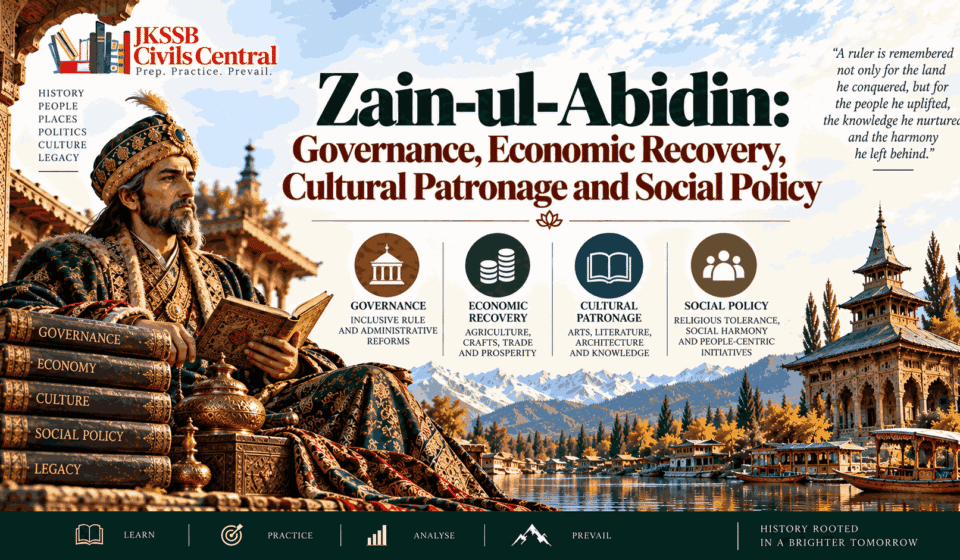
Zain-ul-Abidin: Governance, Economic Recovery, Cultural Patronage and Social Policy

J&K History Series Navigation
| Previous Article | Current Article | Next Article |
|---|---|---|
| Article 22 — Sultanate Administration and Economy in Medieval Kashmir | Article 23 — Zain-ul-Abidin: Governance, Economic Recovery, Cultural Patronage and Social Policy | Article 24 — Medieval Kashmir: Sufism, Rishi Tradition, Persian Culture, Art and Literature |
Learning Dashboard
| Category | Key Information |
|---|---|
| Historical Period | 15th century |
| Historical Phase | Kashmir Sultanate |
| Dynasty | Shah Mir dynasty |
| Ruler | Zain-ul-Abidin |
| Regnal Period | Conventionally 1420–1470 |
| Popular Title | Budshah / Badshah |
| Political Centre | Kashmir Valley, with Srinagar as major royal and urban centre |
| Core Theme | Governance, economic reconstruction, cultural patronage and social policy |
| Major Economic Policies | Irrigation, agricultural recovery, crafts, trade and public works |
| Major Cultural Policies | Persian learning, Sanskrit scholarship, translation and literary patronage |
| Important Social Theme | Reconciliation and restoration after earlier religious and political tensions |
| Important Sources | Jonaraja, Srivara, Persian traditions, material evidence and modern scholarship |
| JKSSB Importance | Very High |
| Expected Question Types | Direct fact, statements, chronology, matching, identification, comparative and conceptual-factual |
Introduction
The reign of Zain-ul-Abidin, conventionally dated to 1420–1470, occupies a distinctive place in the history of the Kashmir Sultanate. He inherited a kingdom that had experienced political conflict, factional struggles and religious tensions, yet he governed for roughly half a century and is associated with efforts to restore political stability, strengthen agriculture, encourage crafts and promote scholarship. His importance therefore lies not in a single reform but in the interaction between political consolidation, economic recovery, cultural patronage and social accommodation.
Zain-ul-Abidin is often remembered in Kashmiri historical tradition as Budshah, meaning the “Great King.” The title is useful as a marker of his later historical reputation, but it should not replace historical analysis. His reign did contain substantial achievements, but it also remained a medieval monarchy dependent upon taxation, political hierarchy and royal authority. A balanced assessment must therefore distinguish the strong historical evidence for particular policies from later idealized portrayals of the ruler.
The central feature of his reign was the attempt to make political authority productive. Irrigation and agricultural improvement strengthened the economic base; support for crafts and trade expanded non-agricultural activity; Persian and Sanskrit scholarship flourished within a multilingual intellectual environment; and policies toward different religious communities helped create a more accommodative political climate than that associated with some preceding phases of the Sultanate. These developments were mutually reinforcing rather than isolated reforms.
CivilsCentral Historical Insight
Zain-ul-Abidin’s historical significance lies in the relationship between political stability and productive state policy. His reign demonstrates that medieval state power could be strengthened not only through military authority and revenue extraction but also through agricultural investment, public works, economic patronage and management of social diversity.
Part I — Historical Background: Kashmir Before Zain-ul-Abidin
The Crisis Before 1420
Zain-ul-Abidin came to power after a turbulent period in the Shah Mir dynasty. His father, Sikandar, had ruled from 1389 to 1413 and was followed by his son Ali Shah, whose reign was marked by political difficulties and growing dependence on powerful factions.
The transition from Ali Shah to Zain-ul-Abidin was therefore more than an ordinary succession. It occurred against a background in which court politics, religious tensions and the influence of powerful nobles had weakened the stability of the state. The new ruler’s first challenge was consequently political: he needed to restore effective authority before economic reconstruction could become sustainable.
Rebuilding Royal Authority
Zain-ul-Abidin’s long reign provided something that Kashmir had lacked during several earlier phases—relative political continuity. A ruler who remained in power for decades could undertake projects whose benefits were not immediate, such as canals, bridges, agricultural expansion, craft development and institutional patronage.
This continuity also allowed the Sultan to develop relationships with local elites and officials rather than repeatedly confronting succession crises. The result was not complete centralization, but a more stable political environment in which the government could pursue longer-term policies.
CivilsCentral Historical Insight
The starting point of Zain-ul-Abidin’s reforms was political stability. Economic and cultural initiatives became possible on a larger scale because the state had sufficient continuity to plan beyond immediate succession and factional struggles.
Part II — Zain-ul-Abidin as a Political Ruler
Consolidation Rather Than Constant Expansion
Zain-ul-Abidin is better understood as a ruler of consolidation and reconstruction than primarily as a conqueror. His reign is associated with maintaining the authority of the Kashmir state and extending its political influence where necessary, but his historical reputation rests much more heavily on governance within the valley.
This distinction matters because medieval rulers are often judged through the language of conquest. In Zain-ul-Abidin’s case, the more important historical question is how the existing state was made more stable and productive.
Relations with Local Elites
The Sultan could not govern Kashmir solely through the royal household. Landed interests, officials, military figures, religious authorities and urban groups all mattered. Managing these groups required negotiation as well as coercion.
A stable ruler could integrate influential groups into the political system while limiting their ability to destabilize the state. Zain-ul-Abidin’s long reign suggests that he was relatively successful in maintaining this equilibrium, although the later political history of the Shah Mir dynasty shows that the underlying problem of elite competition did not disappear.
Administrative Continuity
Zain-ul-Abidin did not create an entirely new administrative state. Instead, his government worked within the developing Sultanate framework while strengthening the role of Persian as a court and administrative language.
Encyclopaedia Iranica notes that Persian had been introduced under the Shah Mir dynasty and flourished under Zain-ul-Abidin, while Hindu Pandits participated alongside Muslim scholars in Persian learning and literary production.
This is important because it demonstrates that administrative transformation and social continuity could coexist.
Part III — Persian and the Administrative-Cultural Transformation
Persian as a Court Language
By Zain-ul-Abidin’s reign, Persian had become an important language of courtly and administrative culture. Its growing importance connected Kashmir to a wider Persianate intellectual and political world extending across Iran, Central Asia and parts of South Asia.
The significance of Persian went beyond official correspondence. It provided a medium for historical writing, poetry, scholarship, diplomacy and administrative communication. Persian-speaking scholars and migrants also contributed to the intellectual environment of the court.
At the same time, Persianization should not be equated with the disappearance of local languages or Sanskrit learning. Kashmiri remained an important spoken and literary language, while Sanskrit intellectual traditions continued. The court could therefore operate within a multilingual cultural environment.
Kashmiri Pandits and Persian Learning
One of the important features of Zain-ul-Abidin’s cultural policy was the participation of Hindu scholars in the Persianate intellectual world. Encyclopaedia Iranica specifically notes that Hindu Pandits and Muslim scholars worked alongside one another in promoting Persian learning, science and literature in Kashmir.
This development had long-term consequences. It created a class of multilingual scholars and scribes capable of moving between different intellectual traditions and helped connect Kashmiri scholarship with the wider Indo-Persian world.
CivilsCentral Historical Insight
Zain-ul-Abidin’s Persian policy was not simply a replacement of one language by another. It contributed to the formation of a multilingual intellectual environment in which Persian, Sanskrit and Kashmiri operated in different but overlapping spheres.
Part IV — Economic Recovery: Agriculture as the Foundation
Why Agriculture Was Central
Agriculture remained the principal economic foundation of medieval Kashmir. The valley’s fertile lands and extensive water resources made cultivation possible on a substantial scale, but agricultural production was vulnerable to flooding, waterlogging, inadequate drainage and the condition of irrigation networks.
For the state, agricultural recovery had two linked advantages. It improved the material condition of cultivators and increased the productive surplus from which revenue could be obtained. Thus agricultural policy was simultaneously an economic, fiscal and political issue.
Zain-ul-Abidin’s government paid particular attention to this relationship.
Irrigation and Canal Construction
Historical accounts associate Zain-ul-Abidin with extensive canal construction and water-management works. A later compilation preserved through the IGNCA records a tradition of numerous canals associated with his reign, including the Kakapur, Karla, Chakdar, Avantipur, Shahkul, Lachham Kul/Zainaganga, Lall Kul/Pohri and Mar Canal systems.
The significance of these works lies not merely in the number of canals. Irrigation could bring more land into cultivation, improve water availability and reduce some of the uncertainty facing agriculture.
The relationship can therefore be represented as:
Canals and water management
↓
Improved irrigation / drainage
↓
Expanded or more reliable cultivation
↓
Greater agricultural production
↓
Higher potential surplus and revenue
This is the economic mechanism behind the traditional image of Zain-ul-Abidin as a restorer of Kashmir’s agricultural prosperity.
Agricultural Policy and the Cultivator
The Sultan’s concern with agriculture also had a social dimension. A state that demanded revenue from cultivators had an interest in ensuring that cultivation remained viable.
However, the evidence does not justify turning this into a modern land-reform narrative. Zain-ul-Abidin remained a medieval monarch operating within a hierarchical agrarian system. The more defensible interpretation is that his government sought to improve productive capacity and reduce some of the pressures that could undermine the rural economy.
CivilsCentral Historical Insight
Zain-ul-Abidin’s agricultural policy reveals the fiscal logic of medieval governance: the state benefited when cultivators could produce a larger and more reliable surplus. Irrigation was therefore both an economic investment and a means of strengthening the political foundations of the Sultanate.
Part V — Public Works and Infrastructure
Bridges and Urban Connectivity
Zain-ul-Abidin is associated with significant public works, particularly in and around Srinagar. Bridges across the Jhelum improved communication between different parts of the city and facilitated movement of people and goods.
The bridge-building tradition associated with his reign includes Zaina Kadal, one of the structures linked to the Sultan’s urban development.Such infrastructure had economic significance because urban markets depended upon the movement of agricultural produce, artisans and merchants. Public works therefore connected the political capital with the wider economic system.
Zain Lank
Another important structure associated with Zain-ul-Abidin is Zain Lank, traditionally connected with the Sultan’s works in Wular Lake.
Its historical importance lies in demonstrating the scale of public construction associated with his reign. At the same time, individual details concerning construction techniques, dates and precise functions should be distinguished from later historical descriptions.
Public Works as Statecraft
Public works also served political purposes. A bridge, canal or urban structure was a visible demonstration of the ruler’s capacity to mobilize labour and resources.
This is an important feature of medieval political legitimacy: rulers demonstrated their authority not only through armies and palaces but also through infrastructure that directly affected everyday economic life.
Part VI — Crafts, Artisans and Technical Exchange
Craft Development
Zain-ul-Abidin’s economic policy extended beyond agriculture. His reign is strongly associated with the development of specialized crafts, including textile production, paper-making, woodwork and other artisanal activities.
The ruler’s role should be described as promotion, organization and technical encouragement, rather than claiming that every craft originated under him. Many Kashmiri crafts had earlier roots, while the fifteenth century saw increased interaction with Central Asian and Persianate techniques.
Skilled Artisans and External Knowledge
Historical traditions associate the Sultan with bringing skilled craftsmen and encouraging the transmission of techniques from outside Kashmir. The broader pattern is credible even where precise traditional details are difficult to independently verify.
The movement of artisans mattered because skills were themselves an economic resource. A skilled weaver, paper-maker or woodworker could introduce techniques that increased the quality and value of local production.
Kashmir consequently became more deeply integrated into regional networks of technical and artistic exchange.
Shawl Weaving
The later fame of Kashmiri shawls has sometimes encouraged an overly simple claim that Zain-ul-Abidin “invented” the shawl industry. That formulation is too strong.
A more defensible interpretation is that his reign was an important phase in the organization, patronage and development of textile production. Earlier weaving traditions existed, while new techniques and skilled labour could be incorporated into Kashmiri production.
This distinction is important for examination purposes because patronage/development is not the same as invention.
Paper and Manuscript Production
The expansion of Persian literary culture also created demand for paper, scribes, bookbinders and manuscript production. Encyclopaedia Iranica notes the availability of locally produced high-quality paper alongside the growth of Persian scholarship in Kashmir.
Economic and intellectual development therefore reinforced one another: scholarship created demand for specialized materials and skills, while royal patronage sustained literary activity.
CivilsCentral Historical Insight
Zain-ul-Abidin’s craft policy illustrates how medieval economic development often occurred through patronage and technical exchange rather than through industrial innovation in the modern sense. The Sultan’s importance lies in creating conditions in which specialized production could expand.
Part VII — Trade and Commercial Activity
Zain-ul-Abidin’s economic policies also benefited from Kashmir’s established geographical connections. The valley’s routes linked it with Punjab, Ladakh, Tibet and Central Asian regions, allowing the movement of goods, people and ideas. Agriculture remained the economic foundation, but trade allowed specialized Kashmiri products to reach wider markets. Textile production and other crafts could therefore benefit from connections beyond the valley.
The state also had an interest in maintaining routes and political relations because commercial exchange generated revenue and strengthened connections with neighbouring regions.
The economic significance of Zain-ul-Abidin’s reign consequently lies partly in the interaction of:
agriculture + crafts + trade + infrastructure
rather than in any one sector alone.
Part VIII — Religious and Social Policy
The Historical Context
Zain-ul-Abidin inherited a society in which relations between religious communities had been affected by the policies and conflicts of earlier rulers. The reign of Sikandar, in particular, occupies a controversial place in historical memory because Persian and later historical traditions associate it with temple destruction, restrictions and religious pressure.
The historical record is complex, and not every later narrative detail can be independently verified. Nevertheless, the contrast between earlier restrictive policies and Zain-ul-Abidin’s later reputation for accommodation is an important feature of the historical tradition.
Restoration and Accommodation
Zain-ul-Abidin is associated with policies that allowed some Hindu families who had left Kashmir to return, restored or permitted religious practices, and reduced certain discriminatory burdens.
His approach did not represent religious equality in the modern constitutional sense. The state remained a medieval Islamic monarchy. The historically significant point is instead that he pursued a more accommodative policy toward sections of the non-Muslim population than the preceding phase associated with Sikandar.
This distinction prevents two opposite errors:
Error 1: describing Zain-ul-Abidin as a modern secular ruler.
Error 2: ignoring the substantial change in religious and social policy associated with his reign.
Jizya
The question of jizya requires careful treatment. Sources differ in how they describe its imposition, reduction and abolition during the transition from Sikandar to Zain-ul-Abidin.
The safest examination formulation is that Zain-ul-Abidin is associated with ending or reducing discriminatory fiscal burdens, including jizya, in the course of his conciliatory policies. The precise chronology and mechanism should not be presented with greater certainty than the sources permit.
Religious Institutions
The reign also witnessed support for religious and cultural institutions belonging to different communities. This is consistent with the broader picture of a ruler attempting to stabilize a socially diverse kingdom.
However, the existence of religious patronage should not be interpreted as evidence that all forms of religious conflict disappeared. Medieval Kashmir remained a hierarchical society in which political and religious identities continued to matter.
CivilsCentral Historical Insight
Zain-ul-Abidin’s social policy is best understood as political accommodation rather than modern secularism. Its historical significance lies in the restoration of social stability and the reduction of some earlier forms of religious exclusion within a medieval political framework.
Part IX — Relations with Hindu Scholars and Sanskrit Learning
One of the most important aspects of Zain-ul-Abidin’s cultural policy was the revival and protection of Sanskrit intellectual activity. The Sultan’s court did not operate exclusively within Persian culture. Hindu scholars continued to produce Sanskrit works, while some intellectuals participated in Persian literary culture as well.
This interaction produced a distinctive intellectual environment in which knowledge could move across linguistic and religious boundaries.
Sanskrit–Persian Translation
Zain-ul-Abidin’s reign is associated with translations of Sanskrit works into Persian. Among the texts connected with this translation movement are the Mahabharata and works of Kashmiri historical and literary tradition.
Encyclopaedia Iranica notes that translations of the Mahabharata and Rajatarangini are associated with Molla Ahmad, a court poet of Zain-ul-Abidin; a later source also preserves the tradition of a Persian translation of Rajatarangini under the Sultan.
The exact textual history of these translations is complicated, and later translations should not be confused with the original fifteenth-century work. Nevertheless, the broader pattern of translation and intellectual exchange is historically significant.
Why Translation Mattered
Translation was not simply literary entertainment. It enabled knowledge to circulate across linguistic communities and connected Kashmiri Sanskrit intellectual traditions with the expanding Persianate world.
It also demonstrates that cultural interaction under the Sultanate was not a one-directional process. Persian culture influenced Kashmir, but Kashmiri intellectual traditions were also translated, transmitted and incorporated into Persian literary culture.
Part X — Patronage of Learning, Literature and Science
Zain-ul-Abidin’s court became an important centre of intellectual activity. Scholars, poets, translators, scribes and religious thinkers benefited from royal patronage.
The Sultan’s patronage extended beyond strictly religious scholarship. Historical traditions associate his court with interests in medicine, astronomy, literature, languages and technical knowledge.
A particularly important aspect was the institutional environment created by patronage. Scholars required manuscripts, paper, scribes, libraries and educational spaces. The court therefore supported an ecosystem rather than merely individual authors.
This helps explain why Zain-ul-Abidin’s reign occupies an important position in the intellectual history of Kashmir.
Part XI — Jonaraja and the Historical Record
Jonaraja
For the political and cultural history of Zain-ul-Abidin’s reign, Jonaraja is an especially important source. He continued the Kashmiri historical tradition associated with Kalhana’s Rajatarangini.
Jonaraja’s account provides information about the ruler, political events, public works, social conditions and cultural life. His proximity to the period makes his work particularly valuable.
However, he was still a court-associated chronicler writing within a literary tradition. His account therefore requires source criticism rather than being treated as a modern administrative record.
Srivara
Srivara continued the chronicle tradition after Jonaraja. His work is especially important for understanding the later years of Zain-ul-Abidin and the political developments that followed.
The sequence: Kalhana → Jonaraja → Srivara
is particularly useful for examination purposes because it represents the continuity of Kashmir’s historical chronicle tradition across different political periods.
CivilsCentral Historical Insight
Zain-ul-Abidin’s reign is unusually important for the study of medieval Kashmir because political history, economic activity and cultural development can be reconstructed through a continuing local chronicle tradition rather than solely through external accounts.
Part XII — Architecture and Material Culture
Zain-ul-Abidin’s cultural environment also influenced Kashmir’s architectural development. The architectural vocabulary of the period combined Islamic religious requirements with established Kashmiri and Himalayan building traditions. Kashmir’s use of timber remained particularly important because of local building traditions and the availability of wood. Pitched roofs, timber construction and local structural techniques continued to influence Islamic buildings.
Encyclopaedia Iranica notes that buildings associated with the period of Zain-ul-Abidin combined Islamic arches and religious functions with traditional Kashmiri/Himalayan forms, including timber pitched roofs. Several buildings associated with his reign were subsequently rebuilt, so present structures cannot always be treated as wholly original fifteenth-century fabric.
This is an important example of cultural adaptation: Islamic architectural requirements were expressed through regional Kashmiri building traditions rather than simply reproducing West Asian architectural forms.
Part XIII — Social Policy and the Idea of Reconciliation
Zain-ul-Abidin’s social policy should be understood within the practical requirements of governing a diverse society. The Sultan needed the cooperation of cultivators, artisans, merchants, scholars, local elites and religious communities. Excessive conflict with any one major group could weaken the political and economic base of the state.
His accommodation of Hindu scholars, encouragement of Sanskrit learning, reduction of some religiously discriminatory burdens and support for cultural exchange can therefore be viewed both as expressions of personal policy and as mechanisms of political stabilization.
This does not mean that every policy was purely motivated by economic calculation. Medieval rulers could simultaneously act from religious, political, intellectual and personal motivations. Historical analysis should therefore avoid reducing the reign to a single explanation.
Part XIV — Zain-ul-Abidin and the Transformation of Kashmir’s Cultural Landscape
The cultural consequences of his reign extended beyond the court. Persian became increasingly influential in literature and administration. Sanskrit scholarship continued. Kashmiri remained an important local language. Persian-speaking scholars and artisans contributed new forms and techniques, while local intellectuals adapted them to Kashmiri conditions.
This produced a cultural environment that was neither simply a continuation of pre-Sultanate Kashmir nor a complete transplantation of Persian culture.
Instead, the period witnessed cultural synthesis and institutional adaptation.
Part XV — Economic Recovery and Political Legitimacy
Zain-ul-Abidin’s economic policy also had a political dimension.
A ruler who improved irrigation, roads, bridges and craft production could strengthen the state’s revenue base while simultaneously improving the material conditions of sections of society. This created a relationship between economic performance and political legitimacy.
The process can be represented as:
Political stability
↓
Public investment and patronage
↓
Agricultural + artisanal expansion
↓
Greater economic activity
↓
Stronger fiscal capacity
↓
Greater ability to maintain the state
This should not be mistaken for a modern economic-development programme. The Sultan’s government remained hierarchical and extractive. What changed was the relative emphasis placed on productive reconstruction and public works.
CivilsCentral Historical Insight
Zain-ul-Abidin’s economic recovery was politically significant because productive prosperity strengthened the state itself. His reign illustrates how medieval rulers could use public works and patronage to convert economic improvement into political stability.
Part XVI — Foreign Relations and the Wider Persianate World
Zain-ul-Abidin’s Kashmir was increasingly connected with neighbouring political and cultural centres. Relations with Central Asian and Persianate regions facilitated the movement of scholars, artisans and ideas. These connections did not make Kashmir politically subordinate to Central Asia. Rather, they expanded the cultural and economic networks within which the Sultanate operated.
Kashmir’s mountain geography still imposed constraints, but it did not prevent sustained exchange. The movement of people and knowledge was particularly important for Persian scholarship, craft technology and court culture.
The wider significance of this development was the increasing integration of Kashmir into a Persianate cultural sphere while retaining strong regional traditions.
Part XVII — The Limits of the “Budshah” Image
Zain-ul-Abidin’s reputation as Budshah is deeply embedded in Kashmiri historical memory. His long reign, economic policies and cultural patronage provide substantial historical reasons for his favourable reputation. Nevertheless, the historian must distinguish reputation from evidence.
The ruler was not a modern constitutional reformer. His state retained monarchy, social hierarchy and taxation. Nor should every later account of prosperity, justice or religious tolerance be treated as a statistical or administrative record.
The strongest historical assessment is therefore comparative: Compared with the instability and religious tensions preceding his reign, Zain-ul-Abidin’s government represented a substantial phase of political stabilization, economic reconstruction and cultural accommodation.
That formulation preserves the significance of his reign without converting historical memory into uncritical celebration.
Part XVIII — What Changed Under Zain-ul-Abidin?
The transformation associated with his reign can be organized into five interconnected areas.
1. Political
Long-term stability strengthened central authority.
2. Economic
Agriculture, irrigation, crafts and trade received greater attention.
3. Administrative
Persian gained greater importance within the court and administrative environment.
4. Cultural
Persian and Sanskrit intellectual traditions interacted through scholarship and translation.
5. Social
Policies toward Hindu communities became more accommodative than under the preceding restrictive phase.
The importance of the reign lies in the combination of these changes rather than in any one isolated reform.
Part XIX — Historical Significance
Zain-ul-Abidin’s reign represents one of the most important phases of the Kashmir Sultanate because it connected political stability with economic and cultural reconstruction.
His agricultural policies demonstrate the importance of irrigation and public works to a valley-based agrarian economy. His craft policies illustrate the role of skilled migration and technical exchange. His patronage of Persian and Sanskrit scholarship shows how Kashmir participated in the expanding Persianate world without simply abandoning older intellectual traditions.
His social policies are equally significant. The contrast between his reign and the preceding period demonstrates that the Sultanate was not ideologically or administratively static. Religious policy could change substantially according to the ruler, political context and social requirements of the state.
Finally, his reign helped shape the cultural environment inherited by the later Sultanate. Persian literary culture, Kashmiri traditions, Sufi networks, Rishi traditions and Sanskrit scholarship interacted in increasingly complex ways. These developments form the background for the cultural history examined in Article 24.
Part XX — Evidence and Historical Interpretation
| Historical Claim | Evidence Level | Caution |
|---|---|---|
| Zain-ul-Abidin was a major Shah Mir ruler | A/B | Strongly established in the historical record |
| Reign conventionally dated 1420–1470 | B | Some chronological traditions differ slightly |
| Associated with title Budshah | B | Historical/reputational title |
| Promoted irrigation and canals | B | Strong literary tradition supported by historical scholarship |
| Encouraged agricultural recovery | B | Strongly associated with his reign |
| Promoted crafts | B | Strong historical tradition; exact individual introductions require caution |
| Persian flourished under his reign | A/B | Strongly supported by scholarly reference works |
| Hindu Pandits participated in Persian learning | A/B | Strong historical evidence |
| Sanskrit scholarship continued | B | Supported by literary and cultural evidence |
| Translation activity occurred at his court | B | Strong tradition; individual translation histories require source criticism |
| He personally invented Kashmiri shawl weaving | D | Too strong; earlier textile traditions existed |
| He created a modern secular state | D | Anachronistic |
| All religious conflict disappeared | D | Unsupported |
| Every later story about his justice is literally factual | D | Courtly and later traditions require source criticism |
| His economic policy was equivalent to a modern development programme | D | Anachronistic |
Part XXI — JKSSB Knowledge Matrix
| Question | Answer |
|---|---|
| Dynasty | Shah Mir |
| Ruler | Zain-ul-Abidin |
| Conventional reign | 1420–1470 |
| Popular title | Budshah |
| Historical phase | Kashmir Sultanate |
| Main political achievement | Long-term political stabilization |
| Main economic emphasis | Agriculture and irrigation |
| Major infrastructure | Canals, bridges and public works |
| Important urban centre | Srinagar |
| Important economic sectors | Agriculture, crafts and trade |
| Important administrative-cultural language | Persian |
| Earlier intellectual language | Sanskrit continued |
| Important court historians | Jonaraja and Srivara |
| Important cultural activity | Translation and multilingual scholarship |
| Important social policy | Reconciliation/accommodation |
| Major craft association | Development and patronage of specialized crafts |
| Key historical distinction | Patronage/development ≠ invention |
| Major legacy | Political stability + economic recovery + cultural patronage |
Part XXII — Examination Discrimination Points
1. Zain-ul-Abidin vs Sikandar
Sikandar: associated in historical traditions with restrictive religious policies and temple destruction.
Zain-ul-Abidin: associated with accommodation, restoration and cultural patronage.
Do not confuse the two rulers.
2. Zain-ul-Abidin vs Shah Mir
Shah Mir: founder of the dynasty and first Sultan.
Zain-ul-Abidin: later Shah Mir ruler associated with economic and cultural reconstruction.
3. Zain-ul-Abidin vs Avantivarman
Both are associated with economic recovery and water management, but they belong to different dynasties and centuries.
Avantivarman → Utpala dynasty
Zain-ul-Abidin → Shah Mir dynasty
This is a particularly useful comparative question.
4. Persian vs Sanskrit
Zain-ul-Abidin’s reign saw the flourishing of Persian learning, but Sanskrit did not disappear.
The correct understanding is interaction and coexistence, not immediate replacement.
5. Patronage vs Invention
Zain-ul-Abidin promoted crafts.
That does not establish that he invented every craft associated with fifteenth-century Kashmir.
6. Budshah vs Later Mughal Rulers
Budshah is associated with Zain-ul-Abidin.
Do not confuse the title with Mughal rulers of Kashmir.
7. Jonaraja vs Kalhana
Kalhana → Rajatarangini, 12th century
Jonaraja → continuation of the Kashmiri chronicle tradition in the 15th century
8. Persianization vs Islamization
Persianization concerns language and cultural transformation.
Islamization concerns religious and social transformation.
The two processes interacted but were not identical.
Part XXIII — JKSSB Question Pattern
Direct Fact
Who is popularly known as Budshah in Kashmir’s medieval history?
Answer: Zain-ul-Abidin.
Statement-Based
Consider:
- Zain-ul-Abidin belonged to the Shah Mir dynasty.
- His reign is conventionally dated to 1420–1470.
- He is associated with irrigation and agricultural development.
- He completely replaced Persian with Sanskrit in administration.
Correct answer:
1, 2 and 3 only.
Chronology
Arrange chronologically:
- Avantivarman
- Zain-ul-Abidin
- Sikandar
- Shah Mir
Correct:
1 → 4 → 3 → 2
Match the Following
| Personality | Association |
|---|---|
| Shah Mir | Founder of Shah Mir dynasty |
| Sikandar | Restrictive religious phase in historical tradition |
| Zain-ul-Abidin | Economic and cultural reconstruction |
| Jonaraja | Later Kashmiri chronicle tradition |
| Srivara | Continuation of chronicle tradition |
Identification by Clues
A fifteenth-century Kashmiri ruler:
- belonged to the Shah Mir dynasty;
- ruled conventionally from 1420 to 1470;
- promoted irrigation;
- supported crafts;
- encouraged Persian and Sanskrit scholarship;
- is popularly remembered as Budshah.
Answer: Zain-ul-Abidin.
Comparative Question
Which pair is correctly matched?
A. Avantivarman — Shah Mir dynasty
B. Zain-ul-Abidin — Shah Mir dynasty
C. Lalitaditya — Utpala dynasty
D. Sikandar — Karkota dynasty
Correct Answer: B
Conceptual-Factual
Why was irrigation important to Zain-ul-Abidin’s government?
Because improved water management could increase agricultural productivity, strengthen the rural economy and ultimately enlarge the economic base available to the state.
Part XXIV — JKSSB Practice Questions
Question 1
Zain-ul-Abidin belonged to which dynasty?
A. Karkota
B. Utpala
C. Shah Mir
D. Lohara
Correct Answer: C
Explanation: Zain-ul-Abidin was a major ruler of the Shah Mir dynasty.
Question 2
Zain-ul-Abidin is conventionally associated with which period?
A. 1003–1028
B. 1200–1230
C. 1420–1470
D. 1586–1605
Correct Answer: C
Explanation: The series uses the conventional regnal chronology of 1420–1470.
Question 3
Which of the following best describes Zain-ul-Abidin’s economic policy?
A. Exclusive dependence on foreign trade
B. Agricultural development combined with irrigation, crafts and public works
C. Abolition of agriculture-based taxation
D. Complete state control over every craft
Correct Answer: B
Explanation: His reign is associated with a broad programme of economic reconstruction rather than a single-sector policy.
Question 4
Consider the following statements:
- Zain-ul-Abidin promoted irrigation.
- He encouraged crafts and technical exchange.
- Persian scholarship flourished during his reign.
- Sanskrit intellectual traditions completely disappeared.
Which are correct?
A. 1, 2 and 3 only
B. 1 and 4 only
C. 2 and 4 only
D. All four
Correct Answer: A
Explanation: Statements 1–3 are supported; Sanskrit intellectual traditions did not disappear.
Question 5
Who continued the Kashmiri chronicle tradition during Zain-ul-Abidin’s period?
A. Kalhana
B. Jonaraja
C. Bilhana
D. Kshemendra
Correct Answer: B
Explanation: Jonaraja continued the historical chronicle tradition after Kalhana.
Question 6
Which of the following is the most appropriate description of Zain-ul-Abidin’s relationship with Kashmiri crafts?
A. He invented all Kashmiri crafts.
B. He played an important role in promoting and developing crafts.
C. He abolished artisanal production.
D. He prohibited foreign technical influence.
Correct Answer: B
Explanation: His reign is strongly associated with craft patronage, technical exchange and specialized production.
Question 7
Which language flourished particularly strongly as a court and literary language under Zain-ul-Abidin?
A. Greek
B. Persian
C. Pali
D. Prakrit
Correct Answer: B
Explanation: Persian had already entered the Shah Mir political environment and flourished under Zain-ul-Abidin.
Question 8
Which of the following represents the most historically appropriate understanding of Zain-ul-Abidin’s social policy?
A. Modern constitutional secularism
B. Complete religious uniformity
C. Political accommodation and reduction of some earlier religious restrictions
D. Elimination of all social hierarchy
Correct Answer: C
Explanation: His policy is associated with greater accommodation of different communities, but it should not be described using modern constitutional categories.
Question 9
Which pair is correctly matched?
A. Zain-ul-Abidin — Karkota dynasty
B. Avantivarman — Shah Mir dynasty
C. Zain-ul-Abidin — Budshah
D. Lalitaditya — Shah Mir dynasty
Correct Answer: C
Explanation: Zain-ul-Abidin is traditionally remembered by the title Budshah.
Question 10
Consider the following sequence:
- Shah Mir
- Sikandar
- Zain-ul-Abidin
- Chak dynasty
Which is the correct chronological order?
A. 1 → 2 → 3 → 4
B. 2 → 1 → 4 → 3
C. 1 → 3 → 2 → 4
D. 3 → 2 → 1 → 4
Correct Answer: A
Explanation: Shah Mir founded the dynasty in the fourteenth century; Sikandar ruled later; Zain-ul-Abidin succeeded him; the Chak dynasty emerged later in the sixteenth century.
Part XXV — Rapid Revision Zone
Important Dates
- 1339 — Establishment of Shah Mir rule.
- 1389–1413 — Sikandar.
- 1413–1420 — Ali Shah.
- 1420–1470 — Zain-ul-Abidin, conventional series chronology.
- 1470 — Death/end of Zain-ul-Abidin’s reign.
- 1561 — Chak ascendancy.
Dynasty
Zain-ul-Abidin → Shah Mir dynasty
Popular Title
Budshah / Badshah
Main Policy Areas
Governance
→ Political stabilization
→ Management of elites
→ Administrative continuity
Economy
→ Irrigation
→ Agriculture
→ Crafts
→ Trade
→ Public works
Culture
→ Persian learning
→ Sanskrit scholarship
→ Translation
→ Literature
→ Manuscript culture
Social Policy
→ Religious accommodation
→ Restoration/reconciliation
→ Support for scholars from different traditions
Important Associations
| Association | Remember |
|---|---|
| Zain-ul-Abidin | Budshah |
| Zain-ul-Abidin | Shah Mir dynasty |
| Zain-ul-Abidin | Irrigation |
| Zain-ul-Abidin | Craft development |
| Zain-ul-Abidin | Persian scholarship |
| Zain-ul-Abidin | Sanskrit–Persian intellectual exchange |
| Jonaraja | Contemporary/later chronicle tradition |
| Srivara | Continuation of chronicle tradition |
| Zaina Kadal | Associated with Zain-ul-Abidin |
| Zain Lank | Associated with Zain-ul-Abidin |
Part XXVI — Frequently Confused Facts
| Confusion | Correct Distinction |
|---|---|
| Zain-ul-Abidin vs Shah Mir | Shah Mir founded dynasty; Zain-ul-Abidin was a later major ruler |
| Zain-ul-Abidin vs Sikandar | Their religious-policy reputations are substantially different in historical tradition |
| Zain-ul-Abidin vs Avantivarman | Both associated with economic/water development but belonged to different dynasties and centuries |
| Persian vs Sanskrit | Persian flourished; Sanskrit continued |
| Craft development vs invention | Patronage/development is safer than absolute invention |
| Budshah vs Shah Mir | Budshah = Zain-ul-Abidin |
| Jonaraja vs Kalhana | Jonaraja belongs to the later continuation of Kashmir’s chronicle tradition |
| Persianization vs Islamization | Related but distinct |
| Historical reputation vs historical evidence | Budshah tradition should be interpreted, not treated as a statistical record |
| Medieval accommodation vs modern secularism | Zain-ul-Abidin’s policy was medieval political accommodation |
Part XXVII — What Can JKSSB Ask?
High-Value Areas
From this topic, JKSSB can test:
- Zain-ul-Abidin’s dynasty
- reign
- title
- predecessor and successor
- economic reforms
- irrigation
- agriculture
- public works
- crafts
- Persian language
- Sanskrit scholarship
- translation activity
- Jonaraja
- Srivara
- social policy
- religious accommodation
- comparison with Sikandar
- comparison with Avantivarman
- distinction between patronage and invention.
High-Value Statement Traps
Be cautious with statements claiming that:
- Zain-ul-Abidin founded the Shah Mir dynasty;
- he introduced Islam to Kashmir;
- he invented Kashmiri shawl weaving;
- Sanskrit disappeared during his reign;
- his rule represented modern secularism;
- every traditional story about his justice is independently verified;
- he completely eliminated religious tensions;
- Persian replaced all other languages.
Chapter Summary
Zain-ul-Abidin inherited Kashmir after a period of political instability and religious tension. His long reign, conventionally dated to 1420–1470, gave the Shah Mir state the continuity required for sustained administrative and economic reconstruction.
His economic policies focused particularly on agriculture and water management. Canals and other public works could improve irrigation, expand cultivation and strengthen the productive base of the state. At the same time, his support for crafts, artisans and technical exchange encouraged the diversification of the economy beyond agriculture.
His cultural policy was equally important. Persian flourished as a court and administrative language, but Sanskrit scholarship continued, and Hindu scholars participated in the developing Persianate intellectual environment. Translation activity created channels between Sanskrit and Persian traditions, while court patronage encouraged literature, scholarship and manuscript production.
Zain-ul-Abidin’s social policy marked an important contrast with the restrictive phase associated in historical traditions with Sikandar. His government is associated with greater accommodation of Hindu communities, restoration and reduction of certain discriminatory burdens. This should be understood as medieval political accommodation rather than modern secularism.
The larger historical significance of the reign lies in the interaction of these policies. Political stability enabled economic recovery; economic recovery strengthened state capacity; cultural patronage deepened Kashmir’s connections with the Persianate world; and social accommodation helped stabilize a diverse society.
JKSSB Takeaway
Zain-ul-Abidin = Shah Mir dynasty
Reign = conventionally 1420–1470
Title = Budshah
Core achievement = political stabilization + economic recovery + cultural patronage + social accommodation
Economy = agriculture + irrigation + crafts + trade
Culture = Persian flourishing + Sanskrit continuity + translation
Sources = Jonaraja + Srivara + Persian traditions + material evidence
Important comparison = Zain-ul-Abidin vs Sikandar
Important dynasty comparison = Zain-ul-Abidin/ Shah Mir vs Avantivarman/Utpala
Critical distinction = historical accommodation ≠ modern secularism
Mind Map
SHAH MIR SULTANATE
↓
POLITICAL INSTABILITY BEFORE 1420
↓
ZAIN-UL-ABIDIN
↓
POLITICAL CONSOLIDATION
↓
ECONOMIC RECOVERY
→ Irrigation
→ Agriculture
→ Public works
→ Crafts
→ Trade
↓
ADMINISTRATIVE-CULTURAL CHANGE
→ Persian
→ Scribes
→ Scholars
→ Translation
↓
INTELLECTUAL DEVELOPMENT
→ Sanskrit scholarship
→ Persian scholarship
→ Manuscripts
→ Literature
↓
SOCIAL ACCOMMODATION
→ Restoration
→ Reduced restrictions
→ Religious-cultural interaction
↓
LONG-TERM LEGACY
→ Stronger Sultanate
→ Persianate cultural influence
→ Economic development
→ Multilingual intellectual culture
FAQs
1. Who was Zain-ul-Abidin?
Zain-ul-Abidin was one of the major rulers of the Shah Mir dynasty of Kashmir and conventionally ruled from 1420 to 1470.
2. Why is Zain-ul-Abidin called Budshah?
Budshah, meaning “Great King,” is a historical title associated with his favourable reputation in Kashmiri historical memory.
3. What were the major economic reforms of Zain-ul-Abidin?
His reign is associated particularly with irrigation and agricultural improvement, public works, craft development, technical exchange and support for commercial activity.
4. Which language flourished under Zain-ul-Abidin?
Persian flourished as a court and administrative language, while Sanskrit and Kashmiri continued in their respective intellectual and social contexts.
5. Did Zain-ul-Abidin abolish Sanskrit?
No. Sanskrit scholarship continued, and his court is associated with interaction between Sanskrit and Persian intellectual traditions.
6. Did Zain-ul-Abidin invent Kashmiri shawl-making?
That claim is too strong. His reign was an important phase in the development and patronage of textile production, but earlier weaving traditions existed.
7. What was Zain-ul-Abidin’s religious policy?
He is associated with a more accommodative policy toward Hindu communities than the preceding restrictive phase, including restoration and reduction of some discriminatory burdens.
8. Was Zain-ul-Abidin a modern secular ruler?
No. That would be anachronistic. He was a medieval Muslim monarch whose policies included substantial political and religious accommodation.
9. Who was Jonaraja?
Jonaraja was a Kashmiri chronicler who continued the historical chronicle tradition after Kalhana and is an important source for the period of Zain-ul-Abidin.
10. Why is irrigation so important in understanding his reign?
Because irrigation connected economic policy with political power: better water management could improve cultivation, agricultural surplus and the state’s fiscal foundation.
About The Author




[…] Article 23 — Zain-ul-Abidin: Governance, Economic Recovery, Cultural Patronage and Social Policy […]
[…] Article 23 — Zain-ul-Abidin: Governance, Economic Recovery, Cultural Patronage and Social Policy […]