
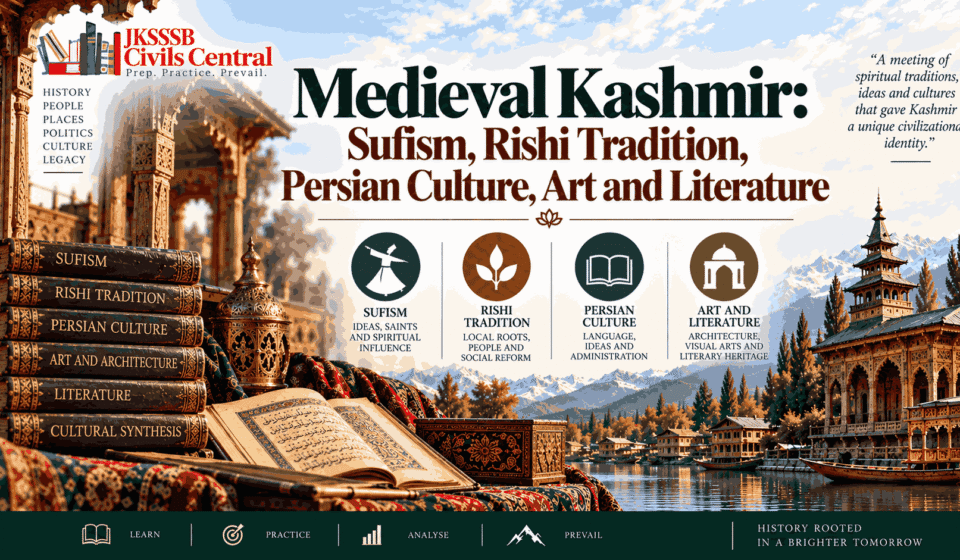
Medieval Kashmir: Sufism, Rishi Tradition, Persian Culture, Art and Literature

J&K History Series Navigation
| Previous Article | Current Article | Next Article |
|---|---|---|
| Article 23 — Zain-ul-Abidin: Governance, Economic Recovery, Cultural Patronage and Social Policy | Article 24 — Medieval Kashmir: Sufism, Rishi Tradition, Persian Culture, Art and Literature | Article 25 — Chak Dynasty in Kashmir: Political Rise, Major Rulers and the End of the Sultanate |
Learning Dashboard
| Category | Key Information |
|---|---|
| Historical Period | Mainly 14th–16th centuries |
| Historical Phase | Medieval Kashmir / Kashmir Sultanate |
| Political Context | Shah Mir and early Chak periods |
| Core Theme | Sufism, Rishi tradition, Persianization, literature, art and cultural interaction |
| Geographical Area | Kashmir Valley, especially Srinagar and major shrine/learning centres |
| Key Personalities | Lal Ded, Sayyid Ali Hamadani, Mir Muhammad Hamadani, Nund Rishi, Jonaraja, Srivara and later Persian scholars |
| Key Traditions | Kubrawi Sufism, Rishi tradition, Kashmiri vernacular poetry, Persian literary culture |
| Key Languages | Kashmiri, Persian, Sanskrit and Arabic in different intellectual/religious contexts |
| Key Literary Forms | Vakh, Shruk, Persian poetry, chronicles, translations |
| Key Architectural Features | Timber construction, pitched roofs, Islamic arches, regional Kashmiri forms, Persianate influences |
| Important Places | Srinagar, Chrar-e-Sharif, Khanqah-e-Moula/Zadibal traditions and other Sufi/Rishi centres |
| Important Sources | Literary works, chronicles, hagiographical traditions, architectural remains and modern scholarship |
| JKSSB Importance | Very High |
| Expected Question Types | Direct fact, statement-based, matching, identification, comparison and conceptual-factual |
Introduction
The medieval cultural history of Kashmir cannot be understood simply as a story of political change from Hindu rule to Muslim rule. From the fourteenth century onward, Kashmir witnessed the interaction of Sufi religious networks, indigenous ascetic traditions, Persian language and literature, Kashmiri vernacular expression, Sanskrit scholarship and regional architectural practices. These developments unfolded over generations rather than appearing simultaneously, and they produced a cultural landscape that was neither a simple continuation of the pre-Sultanate past nor a complete cultural transplantation from Persia and Central Asia.
The establishment of Muslim political rule in the fourteenth century created new institutional and cultural connections, but Islamization itself had already begun through contacts involving migrants, merchants, religious figures and local converts. Among the most important figures associated with the religious transformation of Kashmir was Sayyid Ali Hamadani, a Kubrawi Sufi who visited Kashmir in the fourteenth century. Yet Hamadani should not be treated as the sole cause of Kashmir’s Islamization; modern scholarship emphasizes a much more complex interaction of migration, political authority, local social conditions, religious networks and indigenous traditions.
Alongside the Persianate Sufi tradition emerged the Rishi tradition, most famously associated with Sheikh Noor-ud-Din Noorani, or Nund Rishi. The Rishis used Kashmiri as an important medium of religious expression and developed an ascetic tradition that interacted with the intellectual and spiritual environment of medieval Kashmir. The relationship between Rishi thought and earlier Kashmiri traditions is historically important, but the modern description of the entire medieval culture as simply “syncretic” can obscure more than it explains.
Persian meanwhile became increasingly important as the language of the court, administration and elite literary culture. The result was a multilingual intellectual environment in which Persian, Sanskrit and Kashmiri continued to perform different functions. Art and architecture followed a similar pattern: Islamic religious forms interacted with established Kashmiri timber traditions, producing a regional architectural vocabulary rather than simply reproducing foreign models.
CivilsCentral Historical Insight
The cultural history of medieval Kashmir is best understood as a process of interaction rather than replacement. Islam, Sufi institutions, Persian language and literature entered an already developed cultural environment and were adapted through local languages, institutions, artistic traditions and forms of religious expression.
Part I — Kashmir Before the Formation of the Medieval Cultural Order
The cultural environment inherited by the Sultanate was already diverse. Kashmir possessed a long history of Sanskrit learning, Shaiva traditions, Buddhist intellectual activity, temple architecture and vernacular cultural practices. The transition to Muslim political rule therefore occurred within an established society rather than in an empty cultural space.
The political transformation beginning in the early fourteenth century changed the institutions through which culture was patronized and transmitted. New Muslim elites, religious scholars and migrants entered Kashmir, while older intellectual and landed groups did not simply disappear. Sanskrit scholarship continued, local communities retained their social identities and new religious institutions developed alongside older cultural practices.
This historical continuity is important because it prevents the common misconception that the arrival of Muslim political rule automatically produced an immediate and complete cultural transformation. The process was gradual and regionally differentiated.
CivilsCentral Historical Insight
Political transition and cultural transformation did not occur at the same speed. Medieval Kashmir retained substantial institutional and cultural continuities even as new religious, linguistic and political networks became increasingly influential.
Part II — The Arrival and Expansion of Sufi Networks
Sufism and the Kashmir Context
Sufism became one of the major vehicles through which Islamic religious ideas developed social roots in Kashmir. Sufi teachers could operate through personal discipleship, preaching, hospices, networks of students and relationships with rulers and local communities.
The importance of Sufism should not, however, be reduced to a single missionary model. Different Sufis belonged to different intellectual traditions, and their relationships with political authorities and local society varied. Some were closely connected to courts; others emphasized asceticism, teaching and spiritual discipline.
The growth of Sufi networks therefore contributed to the formation of new religious institutions as well as to changes in the social and intellectual life of Kashmir.
Part III — Sayyid Ali Hamadani and the Kubrawi Connection
Background
Sayyid Ali Hamadani was a major fourteenth-century Sufi scholar belonging to the Kubrawi tradition. Encyclopaedia Iranica dates his death to 1384 and identifies his connection with the Kubrawiya. He visited Kashmir more than once, with visits conventionally associated with the 1370s and early 1380s.
His importance in Kashmir lies not simply in the number of followers attributed to him in later tradition but in the wider intellectual and institutional connections associated with his presence. Persianate religious scholarship, Sufi networks and the movement of scholars from Iran and Central Asia contributed to the transformation of Kashmir’s religious and intellectual environment.
Khanqah and Sufi Institutional Culture
Sufi institutions such as khanqahs provided spaces for religious instruction, spiritual practice, hospitality and community interaction. In Kashmir, these institutions became important nodes connecting local society with wider Persianate Islamic networks.
The Khanqah-e-Moula in Srinagar is traditionally associated with the memory of Sayyid Ali Hamadani, although the present structure represents later rebuilding and development rather than an untouched fourteenth-century building.
This distinction is important in historical analysis: a shrine or khanqah can preserve a centuries-old religious association even when its present architectural fabric is substantially later.
Hamadani’s Historical Role
Hamadani’s importance should therefore be expressed carefully.
He was:
- a major Kubrawi Sufi;
- an important link between Kashmir and Persianate Islamic intellectual networks;
- associated with the expansion of Sufi institutions and religious scholarship;
- influential in the development of Persianate culture in Kashmir.
He was not, however, the sole “introducer” of Islam into Kashmir. Islamic presence and settlement predated his visits, and the subsequent Islamization of Kashmir involved multiple actors and social processes.
CivilsCentral Historical Insight
Hamadani’s significance lies in strengthening an existing process rather than beginning it from nothing. His career illustrates how religious transformation in medieval Kashmir was connected to transregional intellectual networks extending across Iran, Central Asia and the western Himalaya.
Part IV — Mir Muhammad Hamadani and the Continuation of the Kubrawi Tradition
After Sayyid Ali Hamadani, the Kubrawi tradition continued to influence Kashmir through his followers and successors. Mir Muhammad Hamadani, his son, became particularly important in the early fifteenth century.
His activities coincided with the period of Zain-ul-Abidin, when Kashmir was experiencing political stabilization and increased cultural activity. The interaction between Sufi networks and the court was therefore not simply religious; it formed part of a larger Persianate intellectual environment.
This period also demonstrates why it is misleading to isolate “Sufism” from the broader history of Persian culture. Religious scholars, poets, administrators and migrants could participate in overlapping intellectual networks.
Part V — The Rishi Tradition
What Was the Rishi Tradition?
The Rishi tradition was a distinctive form of Kashmiri Islamic asceticism associated most strongly with Nund Rishi, also known as Sheikh Noor-ud-Din Noorani.
Modern scholarship describes the Rishi Order as an important local Sufi tradition of fifteenth-century Kashmir. Cambridge scholarship on Nund Rishi emphasizes both his place within Kashmiri Sufi history and the importance of his vernacular poetry in the religious culture of the period.
The Rishi tradition emphasized ascetic discipline, remembrance of God, moral conduct, simplicity and spiritual withdrawal. It developed in the local cultural environment of Kashmir rather than simply reproducing the institutional forms of Persian or Central Asian Sufi orders.
Nund Rishi
Nund Rishi, generally dated to 1378–1440, became one of the most important saint-poets of medieval Kashmir. Cambridge’s recent study describes him as one of Kashmir’s most important Sufi poets and identifies him with the foundation of a fifteenth-century Kashmiri Sufi order called the Rishi Order.
His importance rests particularly on his use of Kashmiri as a literary and spiritual language. His shruks expressed religious and ethical ideas through imagery accessible to the local population.
This was significant because Persian was becoming increasingly important among educated and administrative elites. The Rishi tradition therefore demonstrates that the expansion of Persian did not eliminate vernacular religious expression.
Part VI — Lal Ded and Nund Rishi: Tradition, Influence and Historical Caution
Lal Ded
Lal Ded, also known as Lalleshwari, was a fourteenth-century Kashmiri mystic poet associated with the Shaiva spiritual tradition. Her vaakhs became one of the foundational bodies of Kashmiri vernacular mystical poetry.
Her historical importance extends beyond religious affiliation. She demonstrated that Kashmiri itself could serve as a sophisticated medium of philosophical and spiritual expression.
Lal Ded and Nund Rishi
Kashmiri tradition strongly associates Lal Ded and Nund Rishi. Later narratives describe Lal Ded as a spiritual predecessor or mentor of Nund Rishi.
The relationship is deeply embedded in Kashmiri cultural memory, but the historian must distinguish documented historical evidence from later hagiographical tradition. Cambridge scholarship notes that the earliest known written account of Lal Ded’s encounter with Nund Rishi appears much later than the lifetimes of the two figures, in a seventeenth-century text by Muhammad Ali Raina.
Therefore, the safest historical formulation is: Lal Ded and Nund Rishi became closely connected in Kashmiri religious memory and literary tradition, while the exact historical details of their personal relationship remain difficult to establish independently.
Why the Relationship Matters
Even if the precise biographical details cannot be independently verified, the enduring association itself is historically significant. It reveals how Kashmir’s later cultural memory connected Shaiva and Islamic mystical traditions through vernacular poetry and saintly narratives.
This is an example of why cultural history must distinguish between: historical event and historical memory of an event.
CivilsCentral Historical Insight
The Lal Ded–Nund Rishi tradition is important not because every detail of the later narrative can be verified, but because the tradition itself demonstrates how Kashmiris remembered religious interaction through shared vernacular spiritual culture.
Part VII — Rishi Tradition and the Question of “Syncretism”
The word syncretism is frequently used to describe medieval Kashmiri religious culture. It can be useful when referring to interaction between traditions, but it becomes misleading if it suggests that Hinduism and Islam simply merged into a single religion.
The Rishi tradition remained Islamic in its religious framework. Nund Rishi’s poetry draws on Islamic concepts and Qur’anic imagery while also employing the cultural memory and ascetic vocabulary of Kashmir. Cambridge scholarship specifically emphasizes this combination rather than treating the Rishi tradition as a simple fusion of two religions.
The more historically precise formulation is therefore religious interaction, adaptation and vernacularization.
This approach recognizes both sides of the historical process:
- Islamic religious ideas were localized within Kashmir.
- Indigenous cultural forms continued to influence religious expression.
- Persianate networks interacted with local traditions.
- Kashmiri became a vehicle for Islamic as well as non-Islamic mystical expression.
This is more useful historically than describing the entire period as a seamless “syncretic culture.”
Part VIII — Persian Culture and the Transformation of the Intellectual World
Persian Before and During the Shah Mir Period
Persian had long been connected to wider Central Asian and Iranian cultural networks, but its institutional importance increased substantially under the Shah Mir dynasty. Encyclopaedia Iranica notes that New Persian spread in Kashmir under the Shah Mir rulers and that interest initiated in the fourteenth century flourished under Zain-ul-Abidin (1420–1470).
The growth of Persian was facilitated by:
- migration of scholars;
- court patronage;
- administrative use;
- religious scholarship;
- literary production;
- trade and cultural contacts with Persian-speaking regions.
Persian as Court Language
Persian became an important court language and eventually the principal language of high literary and administrative culture. However, the historical evidence does not support the idea that Persian instantly displaced all local languages. Kashmiri remained widely spoken and became an important medium of vernacular mystical poetry, while Sanskrit continued in learned circles.
The linguistic history of medieval Kashmir is therefore better described as multilingual hierarchy and interaction rather than simple replacement.
Part IX — Persian and Kashmiri: Interaction Rather Than Disappearance
Persian profoundly influenced Kashmiri vocabulary and literary style. Encyclopaedia Iranica identifies extensive Persian influence on Kashmiri language and literature and notes that Persian forms entered religious, legal and commercial registers.
The influence worked in several directions.
Vocabulary
Large numbers of Persian and Arabic-derived terms entered Kashmiri.
Literary Forms
Persian poetic structures, metaphors and genres influenced later Kashmiri writing.
Intellectual Concepts
Persian became an important vehicle for concepts relating to administration, religion, ethics, history and philosophy.
Translation
Persian translations of Sanskrit works allowed some Kashmiri intellectual traditions to enter the Persianate literary world.
Yet Kashmiri did not disappear. Its survival as the language of vernacular poetry was particularly important because it allowed mystical ideas to reach audiences outside elite Persian literacy.
Part X — Sanskrit Scholarship and the Multilingual Court
Zain-ul-Abidin’s reign is especially important for demonstrating that Persianization did not mean the end of Sanskrit scholarship.
Hindu scholars participated in Persian literary culture, while Sanskrit intellectual activity continued. Encyclopaedia Iranica notes that Hindu Pandits stood alongside Muslim scholars in promoting Persian learning, science and literature, and associates early Persian translations of the Mahabharata and Rajatarangini with Molla Ahmad, a court poet of Zain-ul-Abidin.
This development had two consequences.
First, it created a class of intellectuals capable of functioning across linguistic and religious boundaries.
Second, it allowed Kashmiri knowledge traditions to become part of a broader Indo-Persian intellectual world.
The important examination distinction is: ersianization ≠ destruction of Sanskrit learning.
Part XI — Literature in Medieval Kashmir
The Vakh Tradition
The vakh became an important form of Kashmiri mystical and philosophical poetry. Lal Ded is especially associated with this tradition. The vakh demonstrated the capacity of the Kashmiri language to express abstract philosophical ideas through concise poetic forms.
Its importance extends beyond literature because it shows the development of a vernacular intellectual culture.
The Shruk
Nund Rishi is particularly associated with shruk, a form of Kashmiri mystical verse. His poetry used Kashmiri imagery and language to express Islamic religious ideas. Cambridge scholarship emphasizes the importance of the vernacular and local cultural memory in Nund Rishi’s poetry.
The relationship between vakh and shruk is therefore highly useful for examination:
Lal Ded → Vakh
Nund Rishi → Shruk
Both demonstrate the importance of Kashmiri as a medium of mystical expression.
Persian Poetry
Persian poetry developed alongside these vernacular traditions. Encyclopaedia Iranica identifies Sayyid Ali Hamadani and Zain-ul-Abidin among the early figures associated with Persian poetry in Kashmir and notes the subsequent development of distinct phases of Kashmiri Persian poetry.
Thus medieval Kashmir developed two overlapping literary worlds: Persianate elite literature and Kashmiri vernacular mystical literature.
They interacted rather than existing in complete isolation.
CivilsCentral Historical Insight
Language is one of the clearest indicators of medieval Kashmir’s cultural complexity. Persian expanded as the language of elite literary and administrative culture, while Kashmiri retained an important role in vernacular spiritual poetry and Sanskrit continued in learned traditions.
Part XII — Historical Writing and the Continuation of the Chronicle Tradition
The development of Persian literary culture did not end Kashmir’s indigenous historical writing. The chronicle tradition associated with Kalhana continued through later writers such as Jonaraja and Srivara. This continuity is important because it demonstrates that historical memory crossed the political and religious transition.
At the same time, Persian historiography gradually became increasingly important. Works such as Molla Ahmad’s Bahr al-Asmar belong to the emerging Persian historical tradition of Kashmir. Encyclopaedia Iranica identifies Bahr al-Asmar as probably the earliest Persian historical work written in Kashmir.
The result was a plural historical culture in which Sanskrit and Persian historiographical traditions existed in succession and interaction.
Part XIII — Art and Architecture: Regional Adaptation
The Basic Architectural Pattern
Islamic architecture in Kashmir developed within a strong local building environment. Kashmir’s abundant timber, climatic conditions and established Himalayan construction practices encouraged the continued use of wooden architecture. At the same time, Islamic buildings introduced features such as arches, mosque layouts and new religious functions.
The result was not simply “Persian architecture in Kashmir.”
Instead, Persianate and Islamic forms were adapted to a distinctly Kashmiri architectural environment.
Part XIV — The Kashmiri Mosque Form
The medieval Kashmiri mosque developed distinctive characteristics.
These included:
- extensive timber construction;
- pitched or pyramidal roofs;
- multiple roof tiers in some structures;
- Islamic arches;
- regional decorative forms;
- adaptation to local climatic and material conditions.
The architectural result was therefore a regional Islamic style rather than a simple imitation of mosque architecture from the plains or West Asia. The development is especially important for understanding why Kashmir’s religious architecture looks visually different from many contemporary buildings elsewhere in the Indian subcontinent.
Part XV — Jamia Masjid and Medieval Srinagar
The Jamia Masjid of Srinagar is one of the most important monuments for understanding medieval Kashmiri mosque architecture. Its foundation is traditionally associated with Sikandar, while major enlargement is associated with Zain-ul-Abidin. Later fires and reconstructions altered the building substantially, meaning that the present structure cannot simply be treated as an untouched fifteenth-century monument.
The mosque nevertheless preserves the architectural principle of large-scale timber construction combined with Islamic religious planning and local Kashmiri building traditions.
For examination purposes:
Jamia Masjid, Srinagar → medieval Sultanate architectural tradition
Sikandar → original foundation
Zain-ul-Abidin → enlargement
Later rebuilding should not be confused with original construction.
Part XVI — Tomb of Zain-ul-Abidin’s Mother
Another important monument is the tomb traditionally associated with Zain-ul-Abidin’s mother in Srinagar. The building demonstrates a different architectural vocabulary, including masonry construction and a domed form. Scholars have noted the interaction of Islamic architectural elements with pre-existing Kashmiri structural traditions.
This monument is especially useful for understanding that medieval Kashmiri architecture was not uniform. Timber mosque architecture, masonry tombs and other structures could employ different combinations of regional and Islamic elements.
Part XVII — Sufi Shrines and Sacred Geography
Sufi and Rishi traditions created a new sacred geography in Kashmir.
Shrines became centres of:
- pilgrimage;
- devotional practice;
- teaching;
- charity;
- community interaction;
- transmission of saintly memory.
Places associated with saints could therefore become important social institutions as well as religious sites. Chrar-e-Sharif, associated with Nund Rishi, became one of the most important centres of Rishi memory. The shrine’s later history extends far beyond the medieval period, but its medieval association derives from the saint’s life and tradition.
Similarly, Srinagar’s shrines associated with Sayyid Ali Hamadani and other Sufi figures became important nodes in the religious geography of Kashmir. The historical significance of these spaces lies not only in architecture but also in the communities and memories that developed around them.
Part XVIII — Persian Influence on Kashmiri Art
Persian influence extended beyond language and literature. Iranian and Persianate artistic forms interacted with local Kashmiri techniques in architecture, manuscript culture, decorative arts and later craft traditions.
However, the influence was neither uniform nor purely one-directional. Kashmir already possessed its own artistic vocabulary, and foreign forms were adapted to local materials and aesthetic practices.
This is particularly visible in architecture, where Persianate or Islamic elements could coexist with Himalayan timber construction.
The historical pattern can therefore be summarized as: External influence + local materials + local craftsmanship + regional adaptation = Kashmiri medieval artistic forms
Part XIX — Calligraphy, Manuscripts and the Culture of the Book
The growth of Persian literature increased the importance of manuscript production and calligraphy. Persian required skilled scribes, paper-makers, illuminators and bookbinders. Kashmir’s production of high-quality paper and the presence of scholarly communities supported this literary culture.
The manuscript therefore became more than a written object. It connected:
language → scholarship → court → religion → craft → trade
This illustrates how cultural history and economic history intersected in medieval Kashmir.
Part XX — Sufism, Rishi Tradition and Social Interaction
Sufi and Rishi institutions provided more than theological instruction. They could become spaces where people encountered teachers, disciples, travellers, artisans, merchants and members of different social groups. Their social influence therefore extended beyond formal religious doctrine.
The Rishi tradition in particular used vernacular expression and ascetic practice to establish a strong local identity. Modern scholarship emphasizes its importance in the history of Kashmiri Islam while also warning against reducing it to a simplistic “syncretic” model.
This distinction matters because medieval religious interaction could involve both shared cultural forms and real differences in religious belief.
Part XXI — Women in Medieval Kashmiri Mystical Culture
The cultural history of medieval Kashmir should not be reduced to male religious figures. Lal Ded is particularly important because her poetry became central to Kashmir’s vernacular mystical tradition. Later traditions also preserve memories of women associated with Sufi and Rishi networks.
However, evidence for individual female disciples and saintly biographies varies considerably in quality. Many detailed accounts survive through oral or hagiographical traditions and should therefore be presented as traditions rather than independently established biographies.
The larger historical point remains significant: women participated in the spiritual and literary culture of Kashmir, even though the surviving documentary record is uneven.
Part XXII — Cultural Interaction Without Cultural Erasure
One of the most important conclusions from medieval Kashmir’s cultural history is that new influences did not simply erase older ones.
Instead:
Islamic religious traditions
interacted with
local cultural practices
Persian literary culture
interacted with
Kashmiri vernacular expression
Islamic architecture
interacted with
Kashmiri timber traditions
Persian scholarship
interacted with
Sanskrit intellectual traditions
The resulting cultural environment was therefore layered.
This is why the medieval history of Kashmir should not be described through a simple binary of “indigenous versus foreign.” Many cultural forms that later became identified as distinctly Kashmiri emerged precisely through interaction.
CivilsCentral Historical Insight
Cultural change in medieval Kashmir was cumulative. Persian, Central Asian and Islamic influences became embedded within an existing Kashmiri cultural environment, producing new forms without eliminating every earlier tradition.
Part XXIII — The Historical Meaning of “Kashmiriyat”
The modern concept of Kashmiriyat is frequently projected backward into medieval history. This requires caution.
Medieval Kashmir certainly experienced religious interaction, shared cultural spaces, vernacular literary traditions and saintly networks that crossed some social boundaries. But these historical processes should not automatically be equated with the modern political or cultural concept of Kashmiriyat.
The more defensible historical language is:
- cultural interaction;
- shared regional identity;
- vernacular religious expression;
- saint traditions;
- social coexistence;
- adaptation of external cultural forms.
These processes contributed to later Kashmiri identity, but they should not be treated as evidence that a fully formed modern ideology already existed in medieval Kashmir.
Part XXIV — Historical Sources and Their Limitations
The cultural history of medieval Kashmir must be reconstructed from different kinds of evidence.
Literary Sources
Persian and Sanskrit texts provide information about rulers, saints, scholars and cultural practices.
Vernacular Poetry
The vaakhs of Lal Ded and shruks associated with Nund Rishi preserve religious and cultural ideas in Kashmiri.
Chronicles
Kalhana’s tradition continued through Jonaraja, Srivara and later writers.
Hagiographies
Sufi and Rishi biographies preserve memories of saints, but they often combine historical information with devotional narrative.
Architecture
Mosques, shrines, tombs and other buildings provide material evidence for cultural transformation.
Linguistic Evidence
Persian loanwords and changes in Kashmiri literary forms demonstrate long-term cultural contact.
The historian must therefore use source triangulation. A saint’s biography should not automatically be treated as equivalent to an inscription, while a surviving building should not automatically confirm every story attached to it.
Part XXV — Historiographical Interpretation
Three broad approaches have often shaped interpretations of medieval Kashmiri culture.
1. Religious-Centred Interpretation
This approach emphasizes the role of Sufis, religious teachers and Islamic institutions in the spread of Islam.
Its strength is that it recognizes the importance of religious networks.
Its limitation is that it can understate economic, political, demographic and local social processes.
2. Syncretic Interpretation
This approach emphasizes interaction between Islamic and pre-Islamic Kashmiri traditions, especially through the Rishi tradition and vernacular poetry.
Its strength is that it captures cultural adaptation.
Its limitation is that “syncretism” can become too broad and may blur genuine differences between religious traditions.
3. Interactional / Social-Historical Interpretation
A more cautious approach examines:
migration + political change + Sufi networks + local traditions + language + social institutions + economic relationships
This framework avoids reducing the transformation to either a single religious mission or a simplistic cultural fusion.
For a premium historical resource, this third approach is the most useful because it allows the evidence to remain differentiated.
Part XXVI — Historical Significance
Medieval Kashmir’s cultural development was significant for several interconnected reasons.
First, Sufi networks established durable religious and institutional connections between Kashmir and the wider Persianate Islamic world.
Second, the Rishi tradition developed a strongly local expression of Islamic spirituality through Kashmiri language and ascetic practice.
Third, Persian became a major language of administration, scholarship and literature, linking Kashmir to a much wider intellectual world.
Fourth, Kashmiri vernacular poetry continued to develop, ensuring that religious and philosophical expression was not confined to Persian-speaking elites.
Fifth, Sanskrit scholarship continued to coexist with Persian learning, particularly under the cultural patronage associated with Zain-ul-Abidin.
Sixth, architecture adapted Islamic functions to Kashmiri materials and building traditions, producing a recognizable regional architectural vocabulary.
The larger result was a layered cultural formation that influenced the later Chak, Mughal, Afghan, Sikh and Dogra periods.
Part XXVII — Evidence and Historical Interpretation Table
| Topic | Evidence Level | Historical Caution |
|---|---|---|
| Growth of Sufi networks in medieval Kashmir | A/B | Supported by literary and institutional evidence |
| Sayyid Ali Hamadani’s Kubrawi affiliation | A/B | Strongly established |
| Hamadani’s visits to Kashmir | B | Dates and details vary among traditions |
| Hamadani as sole introducer of Islam | D | Islam predated his visits |
| Rishi tradition | B | Strong historical/literary tradition |
| Nund Rishi as major Kashmiri Sufi poet | A/B | Strongly supported |
| Nund Rishi’s use of Kashmiri | A/B | Strong literary evidence |
| Lal Ded’s association with Nund Rishi | B/C | Strong cultural tradition; precise encounter details later documented |
| Lal Ded as Nund Rishi’s literal teacher | C/D | Should not be presented as independently established |
| Persian expansion under Shah Mir rulers | A/B | Strongly supported |
| Persian flourishing under Zain-ul-Abidin | A/B | Strong evidence |
| Hindu participation in Persian scholarship | A/B | Supported by scholarly sources |
| Persian influence on Kashmiri vocabulary | A | Linguistic evidence |
| Rishi culture as simple “syncretism” | D | Too broad without qualification |
| Medieval Kashmiri architecture combining local and Islamic forms | A/B | Material evidence supports regional adaptation |
| Exact attribution of every present shrine structure to medieval founders | D | Many buildings were rebuilt |
| Modern Kashmiriyat as a medieval ideology | D | Anachronistic |
Part XXVIII — JKSSB Knowledge Matrix
| Question | High-Value Answer |
|---|---|
| Major Kubrawi Sufi associated with Kashmir | Sayyid Ali Hamadani |
| Major local Rishi figure | Nund Rishi |
| Nund Rishi’s other name | Sheikh Noor-ud-Din Noorani |
| Major Kashmiri woman mystic poet | Lal Ded / Lalleshwari |
| Lal Ded’s poetic form | Vakh |
| Nund Rishi’s poetic form | Shruk |
| Major language of elite Sultanate culture | Persian |
| Important local literary language | Kashmiri |
| Learned pre-existing language | Sanskrit |
| Major Persianate ruler associated with cultural patronage | Zain-ul-Abidin |
| Major Sufi order associated with Hamadani | Kubrawiya |
| Major Rishi centre | Chrar-e-Sharif |
| Major urban cultural centre | Srinagar |
| Key cultural process | Persianization + vernacularization + religious interaction |
| Major historical caution | Syncretism should not erase religious distinctions |
| Major architectural feature | Islamic forms adapted to Kashmiri timber traditions |
Part XXIX — Examination Discrimination Points
1. Hamadani vs Nund Rishi
Sayyid Ali Hamadani
→ Persian/Central Asian connection
→ Kubrawi Sufi
→ Fourteenth century
→ Major transregional religious influence
Nund Rishi
→ Indigenous Kashmiri Rishi tradition
→ Fifteenth century
→ Kashmiri vernacular poetry
→ Rishi Order
2. Lal Ded vs Nund Rishi
Lal Ded → Vakh
Nund Rishi → Shruk
Both belong to the broader history of Kashmiri mystical literature, but they are not the same personality or tradition.
3. Persian vs Kashmiri
Persian
→ Court
→ Administration
→ Elite literature
→ Wider Persianate intellectual world
Kashmiri
→ Vernacular expression
→ Vakh
→ Shruk
→ Local literary culture
4. Sanskrit vs Persian
The rise of Persian did not mean the disappearance of Sanskrit scholarship.
5. Hamadani vs Shah Mir
Hamadani was a Sufi religious figure.
Shah Mir was a political ruler and founder of the Shah Mir dynasty.
6. Rishi Tradition vs Generic Sufism
The Rishi tradition was a distinctive local Kashmiri Islamic ascetic tradition. It should not simply be treated as synonymous with every Sufi order operating in Kashmir.
7. Historical Shrine vs Present Structure
A shrine may preserve a medieval religious association even when the present building is the result of later reconstruction.
Part XXX — JKSSB Question-Type Mapping
Direct Fact
Who is associated with the Rishi tradition of Kashmir?
→ Nund Rishi.
Statement-Based
Consider:
- Sayyid Ali Hamadani belonged to the Kubrawi tradition.
- Nund Rishi was associated with the Rishi Order.
- Lal Ded is associated with Kashmiri vaakhs.
- Persian completely replaced Kashmiri as a spoken language.
Correct:
1, 2 and 3 only.
Match the Following
| Personality | Association |
|---|---|
| Lal Ded | Vakh |
| Nund Rishi | Shruk |
| Sayyid Ali Hamadani | Kubrawi Sufi tradition |
| Zain-ul-Abidin | Persian cultural patronage |
| Jonaraja | Kashmiri chronicle tradition |
Identification by Clues
A fourteenth-century mystic poet of Kashmir associated with vaakhs and the Shaiva spiritual tradition:
Lal Ded.
A fifteenth-century Kashmiri Sufi associated with the Rishi Order and shruks:
Nund Rishi.
Comparative
Which statement best distinguishes Hamadani from Nund Rishi?
Hamadani was a transregional Kubrawi Sufi associated with Persianate networks, whereas Nund Rishi represented a strongly localized Kashmiri Rishi tradition.
Part XXXI — JKSSB Practice Questions
Question 1
Sayyid Ali Hamadani was associated with which Sufi tradition?
A. Chishti
B. Kubrawi
C. Naqshbandi
D. Suhrawardi
Correct Answer: B
Explanation: Hamadani was a major figure of the Kubrawi tradition.
Question 2
Nund Rishi is primarily associated with:
A. Karkota administration
B. Rishi tradition of Kashmir
C. Mughal garden architecture
D. Sikh military expansion
Correct Answer: B
Explanation: Nund Rishi is the principal historical figure associated with Kashmir’s Rishi tradition.
Question 3
Which literary form is most closely associated with Lal Ded?
A. Shruk
B. Vakh
C. Masnavi
D. Farman
Correct Answer: B
Explanation: Lal Ded is particularly associated with Kashmiri vaakhs.
Question 4
Which literary form is associated with Nund Rishi?
A. Shruk
B. Vakh
C. Rajatarangini
D. Tarikh
Correct Answer: A
Explanation: Nund Rishi’s mystical poetry is associated with the Kashmiri shruk.
Question 5
Consider the following statements:
- Persian became increasingly important under the Shah Mir rulers.
- Persian flourished particularly under Zain-ul-Abidin.
- Sanskrit scholarship disappeared immediately after the establishment of Muslim rule.
- Hindu scholars also participated in Persian learning.
Which are correct?
A. 1, 2 and 4 only
B. 1 and 3 only
C. 2 and 3 only
D. All four
Correct Answer: A
Explanation: Statements 1, 2 and 4 are supported; Sanskrit scholarship did not simply disappear.
Question 6
Which pair is correctly matched?
A. Lal Ded — Shruk
B. Nund Rishi — Vakh
C. Sayyid Ali Hamadani — Kubrawi tradition
D. Zain-ul-Abidin — Chak dynasty
Correct Answer: C
Explanation: Hamadani belonged to the Kubrawi tradition. Lal Ded is associated with the vakh and Nund Rishi with the shruk.
Question 7
Which of the following best describes medieval Kashmiri architecture?
A. Complete rejection of local building traditions
B. Direct copying of Persian architecture
C. Interaction of Islamic forms with established Kashmiri building traditions
D. Exclusive use of stone construction
Correct Answer: C
Explanation: Timber, pitched roofs and regional structural forms continued alongside Islamic architectural elements.
Question 8
Why should the Lal Ded–Nund Rishi relationship be treated cautiously by historians?
A. Neither figure is associated with Kashmir.
B. All information about them comes from inscriptions.
C. Important details of their personal relationship are preserved mainly in later tradition.
D. They belonged to the same royal dynasty.
Correct Answer: C
Explanation: Their association is deeply rooted in Kashmiri tradition, but the detailed personal narrative is not contemporaneously documented.
Question 9
Which of the following best describes the relationship between Persian and Kashmiri in medieval Kashmir?
A. Persian immediately eliminated Kashmiri.
B. Kashmiri eliminated Persian.
C. Persian became dominant in elite literary/administrative spheres while Kashmiri continued as an important vernacular medium.
D. Both languages disappeared.
Correct Answer: C
Explanation: Medieval Kashmir developed a multilingual cultural environment.
Question 10
Which sequence is chronologically most appropriate?
A. Nund Rishi → Lal Ded → Sayyid Ali Hamadani
B. Lal Ded → Sayyid Ali Hamadani → Nund Rishi
C. Zain-ul-Abidin → Lal Ded → Hamadani
D. Hamadani → Lal Ded → Zain-ul-Abidin
Correct Answer: B
Explanation: Lal Ded belongs broadly to the fourteenth century; Hamadani was active in Kashmir in the later fourteenth century; Nund Rishi belongs to the late fourteenth/early fifteenth-century transition and died in 1440.
Part XXXII — Rapid Revision Zone
Important Personalities
- Lal Ded / Lalleshwari → Kashmiri mystic poet
- Sayyid Ali Hamadani → Kubrawi Sufi
- Mir Muhammad Hamadani → continuation of Hamadani/Kubrawi influence
- Nund Rishi / Sheikh Noor-ud-Din Noorani → Rishi tradition
- Zain-ul-Abidin → Persian cultural patronage
- Jonaraja → later Kashmiri chronicle tradition
- Srivara → continuation of chronicle tradition
Important Literary Associations
| Personality | Literary Association |
|---|---|
| Lal Ded | Vakh |
| Nund Rishi | Shruk |
| Zain-ul-Abidin | Persian literary patronage |
| Molla Ahmad | Persian translations/tradition |
| Kalhana | Rajatarangini |
| Jonaraja | Later Rajatarangini tradition |
| Srivara | Later chronicle tradition |
Important Religious Associations
| Figure | Association |
|---|---|
| Sayyid Ali Hamadani | Kubrawi Sufism |
| Mir Muhammad Hamadani | Kubrawi continuation |
| Nund Rishi | Rishi Order |
| Lal Ded | Shaiva mystical tradition |
| Chrar-e-Sharif | Nund Rishi |
| Srinagar | Major Sufi and literary centre |
Language
Persian → court / administration / elite literary culture
Kashmiri → vernacular / mystical poetry
Sanskrit → learned intellectual tradition
Arabic → Islamic religious scholarship
Part XXXIII — Chronological Sequence
Lal Ded
↓
Early Muslim/Sufi networks
↓
Sayyid Ali Hamadani — 14th century
↓
Mir Muhammad Hamadani
↓
Nund Rishi — c.1378–1440
↓
Zain-ul-Abidin — 1420–1470
↓
Growth of Persianate and vernacular literary culture
↓
Later Shah Mir cultural development
↓
Chak period
Part XXXIV — One-Line Revision Facts
- Sayyid Ali Hamadani was a major Kubrawi Sufi associated with medieval Kashmir.
- Islam in Kashmir predated Hamadani.
- Hamadani strengthened transregional Persianate religious and intellectual connections.
- Nund Rishi is the principal figure associated with the Rishi tradition.
- Nund Rishi’s poetry is associated with shruks.
- Lal Ded is associated with vaakhs.
- Persian flourished under Zain-ul-Abidin.
- Persian became important in court, administration and elite literary culture.
- Kashmiri continued as an important vernacular language.
- Sanskrit scholarship did not disappear after Muslim political rule.
- Hindu scholars participated in Persian learning.
- Persian and Kashmiri influenced one another.
- Medieval Kashmiri architecture adapted Islamic forms to local timber traditions.
- Jamia Masjid, Srinagar represents an important Sultanate architectural tradition.
- The present form of many medieval shrines reflects later rebuilding.
- Rishi tradition should not simply be equated with all Sufi traditions.
- “Syncretism” is useful only when carefully defined.
- Modern Kashmiriyat should not be projected backward as a fully formed medieval ideology.
- Cultural interaction did not mean complete cultural replacement.
- Medieval Kashmir developed a layered Persianate, Sanskritic and vernacular cultural environment.
Part XXXV — Frequently Confused Facts
| Confusion | Correct Distinction |
|---|---|
| Hamadani vs Nund Rishi | Hamadani = Kubrawi/transregional; Nund Rishi = local Rishi tradition |
| Lal Ded vs Nund Rishi | Lal Ded = Vakh; Nund Rishi = Shruk |
| Persian vs Kashmiri | Persian = elite/court; Kashmiri = major vernacular medium |
| Persianization vs Islamization | Related processes, but not identical |
| Rishi tradition vs all Sufism | Rishi tradition was a distinctive local Islamic ascetic tradition |
| Hamadani vs Shah Mir | Sufi scholar vs political ruler |
| Lal Ded’s historical life vs later traditions | Core historical figure is established; detailed biographical narratives vary |
| Shrine foundation vs present building | Religious association may be medieval while present structure is later |
| Syncretism vs interaction | Interaction is safer; “syncretism” requires careful definition |
| Medieval cultural interaction vs modern Kashmiriyat | Do not project modern ideology backward |
Part XXXVI — What Can JKSSB Ask?
High-Value Areas
JKSSB can test:
- Sayyid Ali Hamadani’s Sufi order
- Nund Rishi’s identity
- Rishi tradition
- Lal Ded
- Vakh and Shruk
- Persian language
- Sanskrit scholarship
- Zain-ul-Abidin’s cultural patronage
- Persian–Kashmiri interaction
- Persian–Sanskrit translation
- Jamia Masjid
- Kashmiri mosque architecture
- Sufi shrine locations
- Chrar-e-Sharif
- chronicle tradition
- source criticism
- syncretism vs cultural interaction
- chronology of major medieval personalities.
Particularly Useful Statement Traps
A question may distinguish between statements such as:
- Hamadani introduced Islam to Kashmir — too absolute
- Hamadani strengthened existing Sufi/Persianate networks — defensible
- Nund Rishi belonged to the Rishi tradition — correct
- Lal Ded composed shruks — incorrect
- Nund Rishi composed vaakhs — incorrect
- Persian replaced Kashmiri completely — incorrect
- Persian flourished under Zain-ul-Abidin — correct
- Sanskrit scholarship disappeared — incorrect
- Rishi tradition was identical to every Persian Sufi order — incorrect
- modern Kashmiriyat can simply be projected onto the medieval period — incorrect
Chapter Summary
Medieval Kashmir witnessed a complex cultural transformation following the establishment of Muslim political rule. Sufi networks linked Kashmir with wider Persianate Islamic intellectual traditions, while local religious and literary traditions continued to shape the emerging cultural environment.
Sayyid Ali Hamadani was an important Kubrawi Sufi whose visits strengthened Kashmir’s connections with Persianate religious and intellectual networks. His role was substantial, but he did not single-handedly introduce Islam to Kashmir. The subsequent development of Islamic society involved political change, migration, settlement, local conversion and multiple religious networks.
The Rishi tradition represented a distinctive local form of Islamic asceticism. Nund Rishi became its most important figure, while Lal Ded remained one of the foundational figures of Kashmiri vernacular mystical poetry. Their association is central to Kashmiri cultural memory, but the detailed stories connecting them must be distinguished from securely documented contemporary evidence.
Persian became increasingly dominant in courtly, administrative and elite literary spheres, particularly under Zain-ul-Abidin. Yet Kashmiri remained an important vernacular language, while Sanskrit scholarship continued. Translation and intellectual exchange created connections between these traditions rather than producing an immediate linguistic or cultural replacement.
Art and architecture followed the same pattern. Islamic religious forms were adapted to Kashmiri materials and established Himalayan construction practices, particularly the extensive use of timber and pitched roofs. Sufi shrines, mosques, manuscripts, poetry and centres of learning gradually created a new cultural geography.
The result was a layered medieval Kashmiri culture shaped by religious change, Persianate influence, indigenous traditions and vernacular creativity.
JKSSB Takeaway
Hamadani → Kubrawi Sufi tradition
Nund Rishi → Rishi tradition
Lal Ded → Vakh
Nund Rishi → Shruk
Zain-ul-Abidin → Persian cultural patronage
Persian → court/administrative/elite literary culture
Kashmiri → vernacular mystical expression
Sanskrit → continuing learned tradition
Chrar-e-Sharif → Nund Rishi
Major analytical point → cultural interaction ≠ complete cultural replacement
Mind Map
MEDIEVAL KASHMIR
↓
MUSLIM POLITICAL RULE
↓
NEW RELIGIOUS + CULTURAL NETWORKS
↓
SUFISM
→ Sayyid Ali Hamadani
→ Kubrawiya
→ Khanqahs
→ Mir Muhammad Hamadani
↓
LOCAL RISHI TRADITION
→ Nund Rishi
→ Shruk
→ Kashmiri vernacular
↓
EARLIER / INDIGENOUS MYSTICAL TRADITIONS
→ Lal Ded
→ Vakh
→ Shaiva intellectual background
↓
PERSIAN CULTURAL EXPANSION
→ Court
→ Administration
→ Literature
→ Scholarship
→ Translation
↓
MULTILINGUAL CULTURE
→ Persian
→ Kashmiri
→ Sanskrit
→ Arabic
↓
ART + ARCHITECTURE
→ Timber
→ Pitched roofs
→ Islamic arches
→ Regional mosque forms
→ Shrines
→ Manuscript culture
↓
HISTORICAL CONSEQUENCE
→ Layered Kashmiri cultural formation
↓
JKSSB CONNECTION
→ Personality
→ Order
→ Literary form
→ Language
→ Monument
→ Chronology
→ Source criticism
FAQs
1. Who introduced Sufism to Kashmir?
It is too simplistic to identify one individual as the sole introducer of Sufism. Sayyid Ali Hamadani was one of the most influential Sufis associated with the expansion of Persianate/Kubrawi Sufi networks in Kashmir.
2. Which Sufi order was associated with Sayyid Ali Hamadani?
He belonged to the Kubrawi/Kubrawiya tradition.
3. Who was Nund Rishi?
Nund Rishi, or Sheikh Noor-ud-Din Noorani, was a major Kashmiri Sufi saint and the central figure of the indigenous Rishi tradition.
4. What is the difference between Vakh and Shruk?
Vakh is especially associated with Lal Ded, while shruk is associated with Nund Rishi.
5. Did Persian replace Kashmiri?
No. Persian became highly influential in administration, court culture and elite literature, but Kashmiri remained an important vernacular language.
6. Did Persianization mean the disappearance of Sanskrit?
No. Sanskrit scholarship continued, particularly in learned communities, while Persian became increasingly important.
7. Was medieval Kashmir completely syncretic?
That formulation is too broad. Medieval Kashmir witnessed substantial religious and cultural interaction, but distinct Islamic, Hindu and other traditions continued to exist.
8. Was Lal Ded definitely the teacher of Nund Rishi?
The association is deeply rooted in Kashmiri tradition, but the detailed teacher-disciple narrative should be treated cautiously because important written accounts of their relationship are later.
9. What architectural feature distinguishes medieval Kashmiri Islamic architecture?
The adaptation of Islamic architectural requirements to local Kashmiri traditions, especially extensive timber construction and pitched or tiered roofs.
10. Why is this topic important for JKSSB?
Because it connects several frequently tested areas: medieval personalities, Sufi orders, Rishi tradition, literary forms, languages, architecture, cultural history and chronology.
About The Author




[…] Article 24 — Medieval Kashmir: Sufism, Rishi Tradition, Persian Culture, Art and Literature […]