
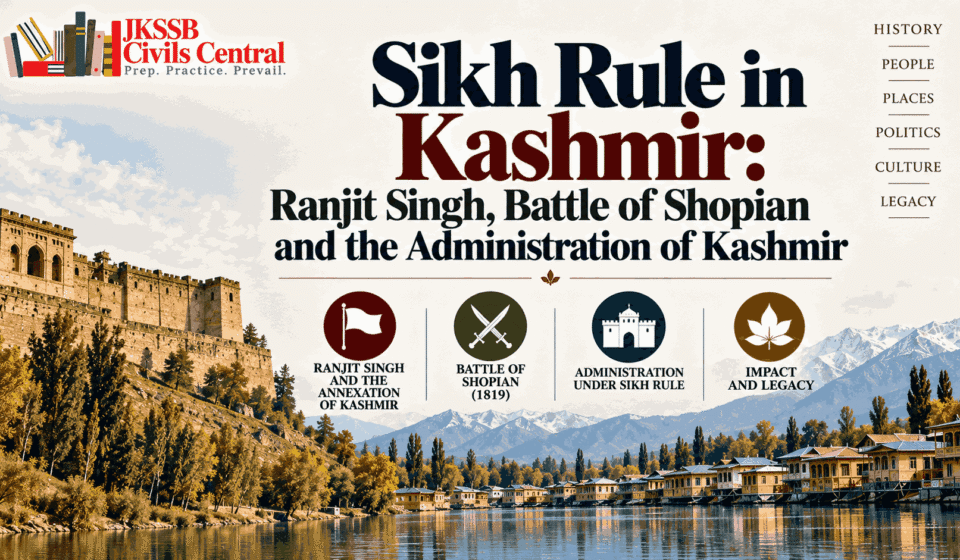
Sikh Rule in Kashmir: Ranjit Singh, Battle of Shopian and the Administration of Kashmir

J&K History Series Navigation
| Previous Article | Current Article | Next Article |
|---|---|---|
| Article 30 — Afghan and Sikh Rule in Kashmir: Comparative Socio-Economic Conditions, Taxation and Crafts | Article 31 — Sikh Rule in Kashmir: Ranjit Singh, Battle of Shopian and the Administration of Kashmir | Article 32 — Gulab Singh and the Rise of Dogra Power: From Jammu Chiefdom to Regional Power |
Learning Dashboard
| Category | Key Information |
|---|---|
| Historical Period | 1819–1846 CE |
| Historical Phase | Sikh Rule in Kashmir |
| Main Political Power | Sikh Empire / Lahore Darbar |
| Principal Ruler | Maharaja Ranjit Singh |
| Core Theme | Conquest, political integration and provincial administration |
| Turning Point | Battle of Shopian, 1819 |
| Afghan Governor | Jabbar Khan |
| Important Sikh Commanders | Misr Diwan Chand, Hari Singh Nalwa, Kharak Singh and others |
| First Sikh Governor | Diwan Moti Ram |
| Important Later Governors | Hari Singh Nalwa, Diwan Kirpa Ram, Prince Sher Singh, Mian Singh, Sheikh Ghulam Muhy-ud-Din, Sheikh Imam-ud-Din |
| Important Places | Shopian, Srinagar, Pir Panjal, Rajouri, Bhimber, Lahore |
| Important Source Types | Persian chronicles, Sikh court records, European travel accounts and later historical scholarship |
| Duration | Approximately 27 years |
| JKSSB Importance | Very High |
| High-Value Question Areas | 1819 conquest, Battle of Shopian, Jabbar Khan, Ranjit Singh, governors, administrative structure, chronology, transition to Dogra rule |
Introduction
The year 1819 marked a major political transition in the history of Kashmir. After more than six decades of Afghan rule, the Kashmir Valley came under the control of the Sikh Empire of Maharaja Ranjit Singh following the Sikh victory over the Afghan forces at the Battle of Shopian. The conquest was not an isolated military episode: it formed part of Ranjit Singh’s wider expansion across the north-western region and was connected with the strategic importance of the routes through the Jammu hills and the Pir Panjal.
The Sikh conquest also transformed the political relationship between Kashmir and the power centres outside the Valley. Kashmir was incorporated into the Lahore Darbar’s expanding state and administered through governors appointed from the centre. This arrangement allowed the Sikh state to maintain political and military control over a distant province, but it also created a persistent problem: the greater the distance between Lahore and Kashmir, the more dependent the central government became on the conduct of individual governors and revenue officials.
Sikh rule therefore needs to be studied in two connected ways. First, it was a phase of territorial and political integration, in which Kashmir became part of the Sikh Empire and was strategically linked with the wider Punjab-based state. Second, it was a period of considerable administrative and socio-economic pressure, particularly because provincial authorities were expected to generate revenue for the Lahore treasury. The history of the period cannot therefore be reduced either to a simple narrative of liberation from Afghan rule or to a single uniform description of oppression; the actual experience varied across governors, institutions, communities and phases.
CivilsCentral Historical Insight
The importance of the Sikh conquest lies not merely in the replacement of one ruling power by another. It brought Kashmir more firmly into the political orbit of Lahore and created an administrative relationship in which military conquest, provincial government and revenue extraction became closely interconnected. This structure would also shape the political circumstances in which Gulab Singh and the Dogra power subsequently expanded their position.
Part I — Historical Background: Kashmir Before the Sikh Conquest
The Afghan Political Order and Its Weakening
The Sikh conquest of Kashmir came after a prolonged period of Afghan rule that had begun in the mid-eighteenth century. By the early nineteenth century, however, the Durrani political structure in the north-west was facing serious internal difficulties. Afghanistan itself was experiencing struggles among competing political factions, while control over distant provinces depended heavily upon individual governors and military commanders.
Kashmir was particularly vulnerable to changes in the wider Afghan political environment because of its geographical separation from the Afghan and Punjabi centres of power. The Pir Panjal range presented a formidable barrier to armies and supplies, while the political authority of governors in Kashmir could fluctuate according to developments in Kabul, Peshawar and the Punjab. The departure of Azim Khan from Kashmir in 1819 to take up a position in Kabul left his brother Jabbar Khan in charge of the Valley at precisely the moment when the Sikh state was preparing another major expedition.
The Sikh advance therefore took place in a context of Afghan political weakness, regional competition and the strategic importance of the mountain routes leading into Kashmir.
Ranjit Singh’s Expansion
Maharaja Ranjit Singh had been steadily consolidating the Sikh Empire in the Punjab and adjoining regions. Kashmir was strategically attractive because of its position beyond the Pir Panjal, its agricultural and commercial resources, its shawl industry, and its connections with routes towards Ladakh, Tibet and the north-western highlands.
The conquest of Kashmir was not the first attempt by the Sikh state to penetrate the region. A Sikh expedition in 1814 had failed to establish lasting control, demonstrating the logistical difficulties involved in crossing the mountains and maintaining an army in Kashmir. The experience of this failure contributed to the preparation and organization of the successful expedition of 1819.
The intervening years were important because Sikh power had expanded in the surrounding territories, while control over the hill states and routes south of the Pir Panjal strengthened the strategic position from which a later invasion could be undertaken.
CivilsCentral Historical Insight
The 1819 conquest should not be understood as a sudden event. It was the culmination of a longer process of Sikh expansion in the north-west and repeated attempts to secure the approaches to Kashmir. Geography mattered greatly: controlling the routes through the Jammu hills and Pir Panjal was almost as important as defeating the Afghan army inside the Valley.
Part II — The 1819 Kashmir Expedition
Preparations for the Campaign
Ranjit Singh organized the 1819 expedition on a substantially larger and better-prepared basis than the failed attempt of 1814. Sikh forces advanced through the Jammu and Pir Panjal approaches, with different commanders responsible for different components of the expedition.
Among the leading military figures was Misr Diwan Chand, an experienced commander who had already played an important role in the Sikh conquest of Multan. Hari Singh Nalwa and Prince Kharak Singh were also associated with the campaign. Ranjit Singh himself remained connected with the expedition and its supply arrangements rather than personally leading the decisive engagement in the Valley.
The advance involved the occupation or submission of strategic points along the route. Rajouri became important because of its position on the approach towards the Pir Panjal. Sikh forces also had to overcome resistance and secure passes before entering the Kashmir Valley.
The Pir Panjal and the Route into Kashmir
The geographical problem facing the Sikh army was considerable. An army crossing the Pir Panjal had to maintain communications and supplies while operating in difficult terrain. The campaign therefore involved not simply battlefield strength but also control over passes, local routes and supporting territories.
The Sikh advance through the mountain routes gradually weakened the Afghan defensive position. By the time the Sikh army approached Shopian, the decisive confrontation with Jabbar Khan’s forces was approaching.
Part III — Battle of Shopian, 1819
Background to the Battle
The Battle of Shopian was the decisive military engagement of the 1819 Kashmir expedition. The Afghan side was commanded by Jabbar Khan, who was responsible for defending Kashmir after the departure of Azim Khan.
The Sikh forces were commanded principally by Misr Diwan Chand, with other senior commanders associated with different divisions of the army. The exact composition and numerical strength of the armies varies across historical accounts, and exaggerated figures found in later narratives should not be treated as precise military statistics without qualification.
The battle was fought in the Shopian area, where the Afghan forces attempted to prevent the Sikh army from advancing towards Srinagar.
Course of the Battle
The Afghan forces made use of defensive positions and artillery, while the Sikh army employed artillery, infantry and cavalry in a coordinated assault. The engagement was contested rather than being a completely bloodless or effortless Sikh advance. The Sikh army eventually succeeded in breaking the Afghan position, while Jabbar Khan was forced to retreat.
The Sikh victory opened the route towards Srinagar. Jabbar Khan withdrew from the Valley, and the remaining Afghan political and military resistance could no longer prevent the Sikh takeover of Kashmir.
The battle is generally dated to 3 July 1819, while the Sikh army subsequently entered Srinagar in July, conventionally dated to 15 July 1819 in many accounts. These two dates should not be confused: the Battle of Shopian and the subsequent entry into Srinagar were separate stages of the campaign.
Why Shopian Matters
The significance of Shopian lies in its political consequences rather than simply its battlefield result. The defeat of Jabbar Khan effectively ended Afghan political control over the Kashmir Valley and enabled Ranjit Singh’s government to establish a new provincial administration.
The conquest also brought Kashmir into the political system of the Sikh Empire. From this point onwards, the history of Kashmir was closely connected with developments at the Lahore Darbar, including the succession of Sikh rulers, court politics and the appointment or removal of provincial governors.
CivilsCentral Historical Insight
Shopian was the military turning point of 1819, but the more important historical transformation came afterward. A battlefield victory had to be converted into durable political control, and this required governors, military posts, revenue administration and communication with Lahore. The history of Sikh Kashmir is therefore fundamentally the history of converting conquest into provincial government.
Part IV — From Conquest to Provincial Administration
Kashmir and the Lahore Darbar
After the conquest, Kashmir was not governed as an independent kingdom under a separate Sikh monarch. It was incorporated into the expanding Sikh Empire, with authority ultimately resting with the Maharaja and the Lahore Darbar.
The distance between Lahore and Kashmir made direct day-to-day administration impractical. Consequently, the Sikh government relied upon governors, commonly described in the sources as Nazims, governors or Diwans, depending on the particular period and source. These officials exercised considerable practical authority within the province while remaining accountable to the central government.
This arrangement had an important structural consequence. A governor who maintained order and revenue collection could strengthen Sikh control, whereas an inefficient or excessively extractive governor could create unrest and reduce the province’s long-term fiscal productivity. The frequent changes in governors during the Sikh period demonstrate the Lahore Darbar’s continuing attempt to control this problem.
Military and Administrative Integration
The early Sikh administration had to perform two immediate tasks: consolidate the conquest and establish regular revenue collection. Military posts were maintained at strategic locations, while provincial officials worked to bring the Valley’s agrarian and commercial resources under the authority of the new state.
The administration also inherited institutions and practices from earlier regimes. Sikh rule did not begin with a completely new administrative system created from scratch. Rather, older mechanisms of land assessment, revenue collection and local administration were adapted to the requirements of the Lahore Darbar.
This continuity is important. Political sovereignty changed in 1819, but administrative transformation was gradual. Local officials, revenue intermediaries and established agrarian practices continued to play important roles even after the change of ruling power.
Part V — The Sikh Governors of Kashmir
The Sikh government administered Kashmir through a succession of governors. Historical sources differ somewhat in the exact dating of individual tenures and in whether acting administrators are counted separately, so the safest examination approach is to learn the broad sequence while avoiding false precision regarding every short transition.
Commonly cited sequence
| Governor / Administrator | Approximate Phase | Historical Association |
|---|---|---|
| Diwan Moti Ram | 1819–1820 | First major Sikh governor after conquest |
| Hari Singh Nalwa | 1820–1821 | Military commander and governor |
| Diwan Moti Ram — second tenure | c.1821–1825 | Return to provincial administration |
| Diwan Chuni Lal / associated acting officials | mid-1820s | Administrative transition |
| Diwan Kirpa Ram | late 1820s–1830/31 | Revenue and provincial administration |
| Bhima/Bamma Singh Ardali | c.1830–1831/32 | Transitional administration |
| Prince Sher Singh | early 1830s | Royal involvement in provincial government |
| Mian Singh | 1834–1841 | Long and important governorship |
| Sheikh Ghulam Muhy-ud-Din | 1841–1845 | Later Sikh administration |
| Sheikh Imam-ud-Din | 1845–1846 | Last major Sikh governor; transition to 1846 |
The exact list can appear differently in historical works because some authors count acting governors and temporary arrangements separately. For examination purposes, the most important distinction is between the first governor, major governors, and final governor, rather than memorizing disputed day-to-day changes in office.
Diwan Moti Ram
Diwan Moti Ram was the first major Sikh governor appointed after the conquest. His early administration focused on consolidating Sikh authority, maintaining order and establishing the machinery through which the newly conquered province could be governed.
Moti Ram’s tenure is important because it demonstrates that the Sikh government initially relied on a combination of military consolidation and administrative continuity. He was associated with efforts to stabilize the province after conquest and worked with local revenue officials.
His career also illustrates the complex relationship between provincial governors and the Lahore Darbar. Governors were powerful within Kashmir but remained dependent upon the Maharaja’s confidence and could be recalled when their performance was judged unsatisfactory.
Hari Singh Nalwa
Hari Singh Nalwa succeeded Moti Ram during the early phase of Sikh rule. He was one of the most prominent military commanders of Ranjit Singh and had already played an important role in Sikh expansion.
His appointment demonstrates the importance attached to military authority in the newly conquered province. Nalwa’s administration has been interpreted differently in historical writings, particularly regarding taxation, policing and relations with the population. His brief tenure should therefore not be reduced to either an entirely administrative success or a simple narrative of repression.
The coinage associated with his governorship is also historically important. The Hari Singhi coin is associated with the monetary history of Sikh Kashmir and is a useful examination association between Hari Singh Nalwa and Sikh-period coinage.
Diwan Kirpa Ram
Diwan Kirpa Ram, son of Moti Ram, later served as governor and represents the importance of hereditary administrative networks within the Sikh establishment. He was also a military and administrative figure in the wider Sikh state.
Kirpa Ram is particularly important for the later history of Jammu and Kashmir because he was associated with the composition of the Gulabnama, a historical work concerning Gulab Singh and the Dogra ruling house. This makes him significant not only as a Sikh administrator but also as a source-related personality for the subsequent Dogra period.
Mian Singh
Among the later governors, Mian Singh held office for a comparatively long period, from approximately 1834 to 1841. His governorship is important because it represents a phase in which the Sikh administration attempted to strengthen provincial management after repeated changes of governors.
Mian Singh is frequently described in historical literature as one of the more capable Sikh governors of Kashmir. His administration is associated with efforts to regularize revenue collection and improve administrative control, although the broader fiscal pressures of Sikh rule continued.
Sheikh Ghulam Muhy-ud-Din and the Later Phase
The appointment of Sheikh Ghulam Muhy-ud-Din marked another important phase. His administration is particularly remembered in historical accounts for modifying some earlier restrictions affecting Muslim religious life, including the reopening of the Jamia Masjid in Srinagar for congregational worship and allowing the public call to prayer.
These developments should be understood as changes in provincial policy rather than evidence of a single, unchanging religious policy throughout the entire Sikh period.
His successor, Sheikh Imam-ud-Din, became the final major Sikh governor of Kashmir. His position became especially important during the political crisis of 1846, when the Sikh Empire was defeated in the First Anglo-Sikh War and the political status of Kashmir was transformed.
CivilsCentral Historical Insight
The succession of governors reveals a central weakness of Sikh provincial administration: the system depended heavily on the personal ability, loyalty and conduct of individual officials. Lahore attempted to maintain control by repeatedly replacing governors, but frequent turnover could itself produce administrative instability. The history of the governors therefore provides a useful window into the relationship between central authority and provincial government.
Part VI — Administrative Structure of Sikh Kashmir
Central Authority
The ultimate authority remained with the Maharaja and the Lahore Darbar. Kashmir was a province of the Sikh Empire rather than an autonomous political unit. The governor represented the central state and was responsible for maintaining political order, military security and revenue flows.
Because the Valley was geographically distant from Lahore, the governor enjoyed substantial practical authority. However, this did not mean complete independence. The central court monitored revenue commitments and responded to complaints, reports and political disturbances.
Revenue Administration
Revenue was the most important foundation of provincial government. Agriculture remained the principal economic base of Kashmir, and the state sought to extract a substantial share of agricultural production and other forms of revenue.
The Sikh authorities inherited an agrarian system shaped by earlier Mughal and Afghan practices, but they adjusted it to meet the fiscal requirements of the Lahore Darbar. Revenue was collected through provincial officials and intermediaries, while assessment and collection practices varied over time and between localities.
The important point for examination purposes is that Sikh revenue administration was not a completely new system. It represented a combination of inherited practices and modifications introduced under Sikh political control.
Kardars and Local Officials
The Sikh state depended upon subordinate officials to make provincial administration work at the local level. The kardar is particularly important in the revenue and administrative vocabulary of the period.
Such officials were involved in revenue collection and local administration, connecting the provincial government with villages and agrarian communities. Their conduct could therefore have a direct impact on the experience of peasants.
The distance between Lahore and Kashmir made effective supervision difficult. Consequently, the quality of administration could vary considerably according to the governor and subordinate officials in office.
Military Administration
Military force remained an essential component of Sikh rule. The conquest had been achieved through military power, and strategic positions required continuing protection.
The Sikh administration maintained troops and military posts in the Valley and along important routes. This was especially important because Kashmir’s geographical position made it both a frontier region and a strategically valuable territory.
Military and fiscal administration were consequently interconnected: troops required resources, while revenue collection required political and military authority.
Part VII — Economy and Revenue under Sikh Rule
Agriculture
Agriculture remained the foundation of Kashmir’s economy. Rice cultivation was particularly important in the Valley, while horticulture and other forms of cultivation supplemented the agrarian economy.
The Sikh state depended heavily on agricultural revenue. This meant that changes in harvests, agricultural productivity and the condition of cultivators directly affected the provincial treasury.
The agricultural system, however, should not be viewed in isolation. Revenue demands interacted with local intermediaries, irrigation conditions, prices, labour obligations and periodic environmental crises.
Revenue Pressure
A major theme in the historical literature on Sikh Kashmir is the burden created by revenue demands and additional exactions. Later scholarship has emphasized that the fiscal needs of the Lahore Darbar, combined with the practices of provincial officials, placed considerable pressure on cultivators.
At the same time, historical assessment should avoid treating every year of Sikh rule as economically identical. The intensity of extraction varied according to governor, locality, agricultural conditions and the wider political situation.
This distinction is important because the Sikh state did not merely seek revenue for its own sake. It required revenue to maintain its military and political structure. The problem arose when excessive extraction undermined the productive base on which future revenue depended.
Begar and Labour Obligations
Begar, or compulsory labour, must also be placed in historical continuity. It did not originate with Sikh rule. Forms of compulsory labour existed before the Sikh period and continued under later regimes.
The Sikh state nevertheless made use of labour obligations in ways connected with military, transport and administrative requirements. Consequently, begar became part of the wider burden experienced by sections of the population.
For examination purposes:
Begar ≠ an invention of Sikh rule.
Its historical significance lies in its continuation and changing forms across successive regimes.
Part VIII — Trade, Crafts and the Shawl Industry
Kashmir’s economy was not exclusively agrarian. Srinagar was an important centre of trade and craft production, and the Valley maintained connections with Punjab, Ladakh and other Himalayan and trans-regional markets.
The shawl industry was particularly important. It had developed before Sikh rule, and the Sikh state inherited an already established craft economy. Government regulation and taxation affected production and trade, while the industry continued to provide employment and revenue.
This is an important distinction:
The Sikh state did not create Kashmir’s shawl industry.
Instead, it inherited, regulated and taxed an established craft sector. The industry’s importance also helps explain why Srinagar was economically valuable to the Lahore Darbar.
Trade was similarly affected by the condition of roads, security, taxation and political stability. The existence of commercial connections does not automatically mean that trade was consistently prosperous. Historical evidence indicates periods of difficulty, particularly when taxation and political insecurity increased transaction costs.
CivilsCentral Historical Insight
The economic history of Sikh Kashmir illustrates a recurring pattern in pre-modern state formation: a strong central state could increase the capacity to collect revenue, but excessive extraction could damage agriculture, crafts and trade—the very sectors from which revenue was obtained. The relationship between state capacity and economic pressure is therefore more historically useful than simply labelling the period “prosperous” or “oppressive.”
Part IX — Religious and Social Policies
A Complex Religious Policy
Religious policy during Sikh rule should be studied carefully because it changed over time and differed according to individual governors.
Some early policies affected Muslim religious institutions and public practices. Historical accounts associate the early Sikh administration, particularly the governorship of Diwan Moti Ram, with restrictions on public Muslim worship and the closure of the Jamia Masjid in Srinagar.
These measures became an important part of the historical memory of Sikh rule. However, they should not be converted into the claim that the entire Sikh administration operated according to one uniform religious policy throughout its 27-year duration.
Later Changes
The later administration under Sheikh Ghulam Muhy-ud-Din is associated with the reopening of Jamia Masjid and the restoration of public Muslim religious practices that had been restricted earlier.
This change is historically significant because it demonstrates that provincial policy was capable of modification. It also warns against treating the Sikh period as a single, unchanging administrative experience.
The religious history of Sikh Kashmir therefore requires a distinction between:
- early and later phases;
- individual governors;
- formal state policy and local administrative practice;
- religious restrictions and wider political administration.
Social Composition of Administration
The Sikh state was not administered exclusively by Sikhs. Hindu and Muslim officials participated in the administrative and revenue machinery, continuing a broader pattern in which the Sikh Empire employed personnel from different religious and social backgrounds.
This is important because the political identity of the ruling power should not be confused with the religious identity of every official working within its administration.
Part X — Ranjit Singh and the Problem of Distant Governance
Ranjit Singh’s Relationship with Kashmir
Ranjit Singh never developed a permanent personal administrative presence in Kashmir comparable to his direct presence in Lahore. The province therefore depended heavily on appointed governors.
This distance produced an important political problem. The Maharaja expected the province to provide revenue and remain politically stable, while governors possessed considerable discretion in how those objectives were pursued.
Historical accounts indicate that Ranjit Singh was aware of complaints concerning the administration of Kashmir and sometimes replaced governors whose performance was considered unsatisfactory.
This pattern illustrates the difference between central authority and effective local control. Lahore possessed sovereignty over Kashmir, but the actual quality of governance depended substantially on provincial institutions.
Why Governors Were Frequently Changed
Frequent changes resulted from several factors:
- administrative complaints;
- failure to meet revenue expectations;
- local disturbances;
- rivalry within the Lahore Darbar;
- changing military requirements;
- the personal suitability of governors.
The rapid succession should therefore not be interpreted simply as evidence that the Sikh state lacked any administrative structure. Rather, it demonstrates the difficulty of managing a distant and strategically important province through appointed officials.
Part XI — The Wider Sikh Political Context
Ranjit Singh, Jammu and the Rise of Gulab Singh
The history of Sikh Kashmir cannot be separated from the rise of the Dogra chiefs of Jammu.
By the early nineteenth century, Jammu had become increasingly connected with Ranjit Singh’s political system. Gulab Singh, along with his brothers Dhian Singh and Suchet Singh, rose within the Sikh political order and acquired substantial influence.
This development is crucial because Sikh rule in Kashmir created the political environment within which Gulab Singh could later expand his authority. His rise was not independent of the Sikh Empire; it occurred within the framework of Ranjit Singh’s state.
The relationship was nevertheless complex. Gulab Singh became an important Sikh subordinate while simultaneously building his own territorial and political base in Jammu and the surrounding hill regions.
Ladakh and the Trans-Himalayan Expansion
The Sikh period also overlaps with the expansion of Dogra power under Gulab Singh’s general Zorawar Singh. Beginning in the 1830s, Dogra forces expanded into Ladakh, followed by further campaigns towards Baltistan.
These campaigns were undertaken by the Dogra power within the broader political framework of the Sikh Empire rather than being direct operations of the Lahore Darbar’s Kashmir governor.
This distinction is extremely important: Sikh rule in Kashmir and Dogra expansion into Ladakh and Baltistan were related through the political structure of the Sikh Empire, but they were not identical processes.
CivilsCentral Historical Insight
The Sikh period unintentionally created the political setting in which the Dogra state expanded. Ranjit Singh’s empire brought Jammu’s Dogra chiefs into a powerful military-political network, while Sikh control of Kashmir altered the regional balance. By the 1830s and 1840s, Gulab Singh had become a major political actor whose importance would extend beyond the Sikh administrative system.
Part XII — The Final Phase of Sikh Rule
Ranjit Singh’s Death and Political Instability
The death of Maharaja Ranjit Singh in 1839 weakened the political cohesion of the Sikh Empire. The succession struggles and factional conflicts that followed increasingly affected the functioning of the Lahore Darbar and its provinces.
Kashmir was not isolated from these developments. The authority of governors depended ultimately upon the stability of the central political system. As Lahore became increasingly divided by court politics and military tensions, the ability of the centre to exercise consistent control over distant territories weakened.
The First Anglo-Sikh War
The decisive crisis came with the First Anglo-Sikh War of 1845–46. The Sikh defeat transformed the political structure of the Punjab and opened the way for British intervention in territories previously controlled by the Lahore Darbar.
The Treaty of Lahore, concluded in March 1846, required the Sikh state to make major territorial and financial concessions. Kashmir became part of the territorial settlement arising from the defeat.
This is the bridge between Sikh rule and the formation of the Dogra princely state.
Sheikh Imam-ud-Din and the End of Sikh Political Control
Sheikh Imam-ud-Din, the last Sikh governor of Kashmir, remained involved in the political transition of 1846. His resistance to the immediate transfer of Kashmir to Gulab Singh demonstrated that the transfer of sovereignty was not simply an automatic administrative handover.
The resulting conflict and British intervention eventually cleared the way for the establishment of Gulab Singh’s rule over Kashmir.
The Sikh period therefore ended not through another battle comparable to Shopian, but through the much larger political crisis created by the First Anglo-Sikh War and the subsequent treaties of 1846.
CivilsCentral Historical Insight
The end of Sikh rule demonstrates how regional sovereignty could change through a combination of war, treaty and political bargaining. The same Sikh state that had conquered Kashmir militarily in 1819 lost control of it less than three decades later because its own defeat in the Anglo-Sikh War transformed the political balance of North India.
Part XIII — Historical Significance of Sikh Rule in Kashmir
The Sikh period was significant for several interconnected reasons.
First, it ended Afghan political control over the Kashmir Valley and incorporated Kashmir into the expanding Sikh Empire. The Battle of Shopian therefore represents a major turning point in the political history of nineteenth-century Kashmir.
Second, Sikh rule strengthened the political connection between Kashmir and the Lahore Darbar. Kashmir became a province governed through centrally appointed officials, with military and fiscal institutions linking the Valley to the wider Sikh state.
Third, the period illustrates the tension between provincial autonomy and central extraction. Governors exercised substantial authority because of Kashmir’s geographical distance, but the Lahore government expected them to maintain order and generate revenue. This tension contributed to frequent changes of governors and periodic administrative difficulties.
Fourth, Sikh rule formed an important link between the Afghan and Dogra periods. The political order created by Ranjit Singh’s expansion enabled the Dogra chiefs of Jammu, particularly Gulab Singh, to rise within the Sikh system. The eventual transfer of Kashmir in 1846 cannot therefore be understood without studying the Sikh period.
Finally, Sikh rule provides an important example of the difference between military conquest and durable governance. The conquest of 1819 was achieved through military force, but maintaining control required a complex system of governors, officials, revenue mechanisms, military posts and political relationships.
Part XIV — Historical Interpretation and Evidence Note
The Sikh period is documented through a mixture of Sikh court chronicles, Persian and vernacular historical works, administrative material, European travel accounts and later historical scholarship. These sources do not always provide identical interpretations.
The broad chronology of Sikh conquest in 1819 and the end of Sikh rule in 1846 is firmly established. The Battle of Shopian and the incorporation of Kashmir into Ranjit Singh’s empire are also central, well-established features of the period.
Greater caution is required when assessing exact revenue rates, the numerical strength of armies, the personal conduct of individual governors, and the extent to which particular policies were consistently applied across the entire Valley. Such claims often depend on sources written from different political or social perspectives.
The frequent use of terms such as “oppressive” in descriptions of Sikh rule should therefore be understood as part of a broader historical interpretation grounded in evidence concerning taxation, labour obligations, religious restrictions and administrative conduct. At the same time, the administration should not be reduced to a single characterization: it also maintained political order, military integration, revenue institutions, trade connections and administrative continuity.
The most defensible historical approach is therefore to recognize both state consolidation and social-economic pressure as dimensions of the same period.
Part XV — JKSSB Knowledge Matrix
| Question | High-Value Answer |
|---|---|
| Who conquered Kashmir in 1819? | Maharaja Ranjit Singh’s Sikh Empire |
| Which battle was decisive? | Battle of Shopian |
| Who commanded the Afghan forces? | Jabbar Khan |
| Which Sikh commander led the principal expeditionary force? | Misr Diwan Chand |
| When did the Battle of Shopian take place? | Generally dated to 3 July 1819 |
| When did Sikh forces enter Srinagar? | July 1819; commonly given as 15 July |
| Who was the first major Sikh governor of Kashmir? | Diwan Moti Ram |
| Who succeeded Moti Ram in the early phase? | Hari Singh Nalwa |
| Which ruler established Sikh imperial control over Kashmir? | Maharaja Ranjit Singh |
| Where was the Sikh imperial centre? | Lahore |
| What was the main economic base? | Agriculture |
| Which major craft was inherited by Sikh rule? | Shawl industry |
| Did Sikh rule create the shawl industry? | No |
| Was begar invented by the Sikhs? | No |
| Which later governor is associated with reopening Jamia Masjid? | Sheikh Ghulam Muhy-ud-Din |
| Which governor is associated with the final phase before 1846? | Sheikh Imam-ud-Din |
| What ended Sikh rule in Kashmir? | The political settlement following the First Anglo-Sikh War of 1845–46 |
| What followed Sikh rule? | The establishment of Gulab Singh’s rule in 1846 |
Part XVI — Examination Discrimination Points
1. Battle of Shopian vs Entry into Srinagar
- Battle of Shopian → decisive military engagement of 1819.
- Entry into Srinagar → occurred subsequently.
- Do not treat the two dates as the same event.
2. 1814 vs 1819
- 1814 → earlier unsuccessful Sikh attempt.
- 1819 → successful conquest of Kashmir.
3. Jabbar Khan vs Azim Khan
- Azim Khan → Afghan governor who left Kashmir for Kabul in the context of the 1819 crisis.
- Jabbar Khan → commanded the Afghan defence against the Sikh expedition.
4. Ranjit Singh vs Misr Diwan Chand
- Ranjit Singh → ruler and political authority behind the conquest.
- Misr Diwan Chand → principal military commander associated with the successful expedition.
5. Sikh Rule vs Dogra Rule
- 1819–1846 → Sikh political control of Kashmir.
- 1846 onward → Gulab Singh’s Dogra state.
6. Kashmir vs Ladakh Expansion
- Sikh conquest of the Kashmir Valley occurred in 1819.
- Dogra expansion into Ladakh occurred later, particularly under Zorawar Singh during the 1830s.
7. Ranjit Singh vs Gulab Singh
- Ranjit Singh → Maharaja of the Sikh Empire.
- Gulab Singh → Dogra chief of Jammu who rose within the Sikh political system before becoming Maharaja of Jammu and Kashmir in 1846.
Part XVII — JKSSB Question Pattern
Direct Fact
High-value direct questions can test:
- Battle of Shopian
- Jabbar Khan
- Misr Diwan Chand
- Ranjit Singh
- Diwan Moti Ram
- Hari Singh Nalwa
- Mian Singh
- Sheikh Imam-ud-Din.
Statement-Based
Candidates can be asked to distinguish:
- the unsuccessful 1814 expedition from the successful 1819 conquest;
- the Battle of Shopian from the entry into Srinagar;
- Sikh rule from subsequent Dogra rule;
- Sikh conquest of Kashmir from Dogra conquest of Ladakh.
Chronology
A likely chronology framework is: Afghan Rule → 1814 Sikh Attempt → 1819 Battle of Shopian → Sikh Rule → Ranjit Singh’s death, 1839 → First Anglo-Sikh War, 1845–46 → Treaties of 1846 → Dogra Rule
Match the Following
| Person | Association |
|---|---|
| Ranjit Singh | Sikh Empire |
| Jabbar Khan | Afghan defence of Kashmir in 1819 |
| Misr Diwan Chand | Sikh conquest of Kashmir |
| Diwan Moti Ram | Early Sikh governor |
| Hari Singh Nalwa | Early Sikh governor |
| Mian Singh | Long later governorship |
| Sheikh Imam-ud-Din | Final Sikh governor / 1846 transition |
Identification by Clues
Clue: Decisive battle through which Sikh forces broke Afghan control of Kashmir in 1819.
Answer: Battle of Shopian.
Clue: Afghan commander who opposed the Sikh expedition.
Answer: Jabbar Khan.
Clue: First major Sikh governor appointed after the conquest.
Answer: Diwan Moti Ram.
Part XVIII — JKSSB Practice Questions
Question 1
The Battle of Shopian is associated with which of the following historical developments?
A. Afghan conquest of Kashmir
B. Sikh conquest of Kashmir
C. Dogra conquest of Ladakh
D. Mughal annexation of Kashmir
Correct Answer: B
Explanation: The Battle of Shopian was the decisive engagement of the Sikh expedition that resulted in the establishment of Sikh control over Kashmir in 1819.
Question 2
Consider the following statements:
- Ranjit Singh’s first attempt to conquer Kashmir was successful in 1814.
- The Battle of Shopian was fought during the successful Sikh expedition of 1819.
- Jabbar Khan was associated with the Afghan defence of Kashmir.
Which of the statements given above is/are correct?
A. 1 only
B. 2 and 3 only
C. 1 and 3 only
D. 1, 2 and 3
Correct Answer: B
Explanation: The 1814 expedition was unsuccessful. The decisive campaign occurred in 1819, when Jabbar Khan commanded the Afghan defence.
Question 3
Who was associated with the principal Sikh military command during the 1819 Kashmir expedition?
A. Zorawar Singh
B. Misr Diwan Chand
C. Gulab Singh
D. Dhian Singh
Correct Answer: B
Explanation: Misr Diwan Chand was a leading Sikh commander in the successful 1819 expedition.
Question 4
Arrange the following in chronological order:
- First Anglo-Sikh War
- Battle of Shopian
- Death of Ranjit Singh
- Establishment of Dogra rule in Kashmir
A. 2–3–1–4
B. 3–2–1–4
C. 2–1–3–4
D. 1–2–3–4
Correct Answer: A
Explanation: Shopian was fought in 1819, Ranjit Singh died in 1839, the First Anglo-Sikh War occurred in 1845–46, and Dogra rule was established in 1846.
Question 5
Which one of the following was the principal economic foundation of Sikh-period Kashmir?
A. Maritime commerce
B. Plantation agriculture
C. Agriculture
D. Mining
Correct Answer: C
Explanation: Agriculture remained the principal economic base, although crafts, trade and the shawl industry were also important.
Question 6
Consider the following pairs:
| Governor | Association |
|---|---|
| 1. Diwan Moti Ram | Early Sikh administration |
| 2. Hari Singh Nalwa | Early Sikh governorship |
| 3. Mian Singh | Later Sikh administration |
| 4. Sheikh Imam-ud-Din | Final phase of Sikh rule |
Which of the pairs given above are correctly matched?
A. 1 and 2 only
B. 2 and 3 only
C. 1, 2, 3 and 4
D. 1, 3 and 4 only
Correct Answer: C
Question 7
Which distinction is historically correct?
A. Sikh rule began in 1814 and ended in 1839
B. Sikh rule began after the Battle of Shopian in 1819 and ended during the political settlement of 1846
C. Sikh rule began after the Treaty of Amritsar in 1846
D. Sikh rule began after Dogra conquest of Kashmir
Correct Answer: B
Question 8
Which of the following statements about begar is most accurate?
A. It was introduced for the first time by the Sikhs
B. It originated under Dogra rule
C. It had older roots and continued under successive regimes, including Sikh rule
D. It existed only during Afghan rule
Correct Answer: C
Question 9
The historical importance of Mian Singh’s governorship is primarily associated with:
A. the conquest of Kashmir from the Afghans
B. the final transfer of Kashmir to Gulab Singh
C. a relatively long later phase of Sikh provincial administration
D. the foundation of the Sikh Empire
Correct Answer: C
Question 10
Which sequence is correct?
A. Battle of Shopian → Afghan rule → Sikh rule → Dogra rule
B. Afghan rule → Battle of Shopian → Sikh rule → Dogra rule
C. Sikh rule → Battle of Shopian → Afghan rule → Dogra rule
D. Afghan rule → Dogra rule → Battle of Shopian → Sikh rule
Correct Answer: B
Part XIX — Rapid Revision Zone
Important Dates
- 1814 — Earlier unsuccessful Sikh attempt to penetrate Kashmir.
- 1819 — Successful Sikh conquest of Kashmir.
- 3 July 1819 — Commonly cited date for the Battle of Shopian.
- July 1819 — Sikh entry into Srinagar; commonly dated to 15 July.
- 1839 — Death of Maharaja Ranjit Singh.
- 1845–46 — First Anglo-Sikh War.
- 1846 — End of Sikh political control and establishment of Gulab Singh’s rule.
Important Personalities
- Maharaja Ranjit Singh — ruler of Sikh Empire.
- Misr Diwan Chand — leading Sikh commander in 1819 conquest.
- Jabbar Khan — Afghan commander in Battle of Shopian.
- Diwan Moti Ram — first major Sikh governor.
- Hari Singh Nalwa — early Sikh governor and major military commander.
- Diwan Kirpa Ram — Sikh administrator and author associated with Gulabnama.
- Mian Singh — important later governor.
- Sheikh Ghulam Muhy-ud-Din — later governor associated with religious-policy changes.
- Sheikh Imam-ud-Din — final Sikh governor during the 1846 transition.
- Gulab Singh — Dogra ruler who succeeded Sikh rule in Kashmir.
Important Places
- Shopian — decisive 1819 battle.
- Srinagar — political and commercial centre of Kashmir.
- Pir Panjal — strategic mountain barrier and route into Kashmir.
- Rajouri — important approach to the Valley.
- Lahore — centre of the Sikh Empire.
Important Associations
Ranjit Singh → Sikh conquest of Kashmir
Misr Diwan Chand → Battle of Shopian
Jabbar Khan → Afghan defence
Moti Ram → First major Sikh governor
Hari Singh Nalwa → Early Sikh governorship
Mian Singh → Later Sikh administration
Imam-ud-Din → Final Sikh governor
1846 → End of Sikh rule / beginning of Dogra rule
Part XX — Frequently Confused Facts
| Confusion | Correct Distinction |
|---|---|
| 1814 vs 1819 | 1814 = unsuccessful attempt; 1819 = successful conquest |
| Shopian vs Srinagar | Shopian = decisive battle; Srinagar = subsequently occupied |
| Jabbar Khan vs Azim Khan | Jabbar defended Kashmir in 1819; Azim Khan had left for Kabul |
| Ranjit Singh vs Misr Diwan Chand | Ranjit Singh = ruler; Misr Diwan Chand = leading commander |
| Sikh vs Dogra conquest | Sikh conquest of Kashmir = 1819; Dogra rule = 1846 |
| Shawl industry and Sikhs | Shawl industry predated Sikh rule |
| Begar and Sikhs | Begar had older roots and was not invented by Sikhs |
| Sikh rule and Ladakh expansion | Dogra forces under Zorawar Singh drove the major Ladakh expansion |
| Moti Ram vs Mian Singh | Moti Ram = early governor; Mian Singh = later governor |
| Afghan vs Sikh rule | Afghan rule ended with the Sikh victory of 1819 |
Part XXI — What Can JKSSB Ask?
From this topic, high-value question areas include:
- the year of Sikh conquest of Kashmir;
- Battle of Shopian;
- Jabbar Khan;
- Misr Diwan Chand;
- distinction between 1814 and 1819;
- entry of Sikh forces into Srinagar;
- first Sikh governor;
- sequence of Sikh governors;
- Hari Singh Nalwa’s governorship;
- Mian Singh’s administration;
- Sheikh Ghulam Muhy-ud-Din and Jamia Masjid;
- Sheikh Imam-ud-Din and the 1846 transition;
- revenue administration;
- begar;
- shawl industry;
- relationship between Sikh rule and Dogra expansion;
- chronology from Afghan rule to Dogra rule.
The most useful preparation strategy is not simply memorizing “1819 = Sikh rule.” Candidates should connect:
1814 → failed attempt → 1819 expedition → Shopian → Jabbar Khan defeated → Srinagar occupied → Sikh provincial administration → succession of governors → Ranjit Singh dies in 1839 → First Anglo-Sikh War → 1846 transition to Gulab Singh.
Chapter Summary
The Sikh conquest of Kashmir in 1819 represented the culmination of Ranjit Singh’s expansion towards the north-west and followed an earlier unsuccessful attempt in 1814. The decisive military encounter was the Battle of Shopian, where Sikh forces under the leadership of Misr Diwan Chand defeated the Afghan forces associated with Jabbar Khan. The victory opened the way to Srinagar and ended Afghan political control of the Kashmir Valley.
After conquest, Kashmir was incorporated into the Sikh Empire and governed through officials appointed by the Lahore Darbar. The provincial administration relied upon governors, revenue officials and military posts, while retaining and modifying several practices inherited from earlier regimes. The distance between Lahore and Kashmir made provincial governance heavily dependent on individual governors, resulting in repeated administrative changes.
The economic foundation of the province remained agricultural, while trade, horticulture and crafts—particularly the established shawl industry—also remained important. Revenue demands and other obligations placed considerable pressure on sections of the population, while religious policies varied over the course of the period. Later governors such as Sheikh Ghulam Muhy-ud-Din modified some earlier restrictions, demonstrating that Sikh rule was not administratively or religiously uniform throughout its 27-year duration.
The political decline of the Sikh Empire after Ranjit Singh’s death in 1839 eventually culminated in the First Anglo-Sikh War. The resulting political settlement of 1846 brought Sikh rule in Kashmir to an end and opened the way for Gulab Singh’s Dogra rule. Thus, the Sikh period forms the essential bridge between the Afghan and Dogra phases of modern Kashmir history.
JKSSB Takeaway
1819 — Battle of Shopian — Jabbar Khan defeated — Sikh conquest under Ranjit Singh — Moti Ram — Hari Singh Nalwa — succession of Sikh governors — agricultural revenue and provincial administration — Ranjit Singh’s death in 1839 — First Anglo-Sikh War — 1846 — Dogra rule.
Mind Map
AFGHAN RULE
↓
Sikh Expansion under Ranjit Singh
↓
1814 Unsuccessful Attempt
↓
1819 Kashmir Expedition
↓
Pir Panjal / Strategic Routes
↓
Battle of Shopian
Jabbar Khan × Misr Diwan Chand
↓
Sikh Victory
↓
Srinagar Occupied
↓
Kashmir Integrated into Sikh Empire
↓
Provincial Administration
→ Governors
→ Military Posts
→ Revenue Officials
→ Lahore Darbar
↓
Economic Structure
→ Agriculture
→ Revenue
→ Shawls
→ Trade
→ Begar
↓
Successive Governors
→ Moti Ram
→ Hari Singh Nalwa
→ Kirpa Ram
→ Sher Singh
→ Mian Singh
→ Ghulam Muhy-ud-Din
→ Imam-ud-Din
↓
Ranjit Singh Dies — 1839
↓
Sikh Political Crisis
↓
First Anglo-Sikh War — 1845–46
↓
End of Sikh Rule
↓
Gulab Singh and Dogra State — 1846
FAQs
1. When did Sikh rule begin in Kashmir?
Sikh rule began in 1819, following the successful military expedition of Maharaja Ranjit Singh against the Afghan-controlled Kashmir Valley.
2. Which battle ended Afghan political control of Kashmir?
The Battle of Shopian in 1819 was the decisive military engagement that enabled the Sikh conquest of Kashmir.
3. Who was Jabbar Khan?
Jabbar Khan was the Afghan commander responsible for defending Kashmir against the Sikh expedition in 1819.
4. Who led the Sikh forces in the Battle of Shopian?
Misr Diwan Chand was the principal Sikh commander associated with the successful expedition, while several other senior Sikh commanders participated in the campaign.
5. Who was the first Sikh governor of Kashmir?
Diwan Moti Ram is commonly identified as the first major Sikh governor of Kashmir following the conquest.
6. How long did Sikh rule in Kashmir last?
Sikh rule lasted approximately 27 years, from 1819 to 1846.
7. Was the shawl industry introduced by the Sikhs?
No. The shawl industry predated Sikh rule. The Sikh administration inherited and regulated an already established craft industry.
8. Did begar originate under Sikh rule?
No. Begar had older historical roots and continued across several successive regimes, including the Sikh period.
9. Who was Mian Singh?
Mian Singh was an important later Sikh governor of Kashmir, serving approximately from 1834 to 1841.
10. How did Sikh rule in Kashmir end?
Sikh rule ended as a consequence of the political and territorial settlement following the First Anglo-Sikh War of 1845–46, after which Kashmir passed into the political sphere of Gulab Singh.
About The Author






[…] Article 31 — Sikh Rule in Kashmir: Ranjit Singh, Battle of Shopian and the Administration of Kashm… […]
[…] Article 31 — Sikh Rule in Kashmir: Ranjit Singh, Battle of Shopian and the Administration of Kashm… […]