
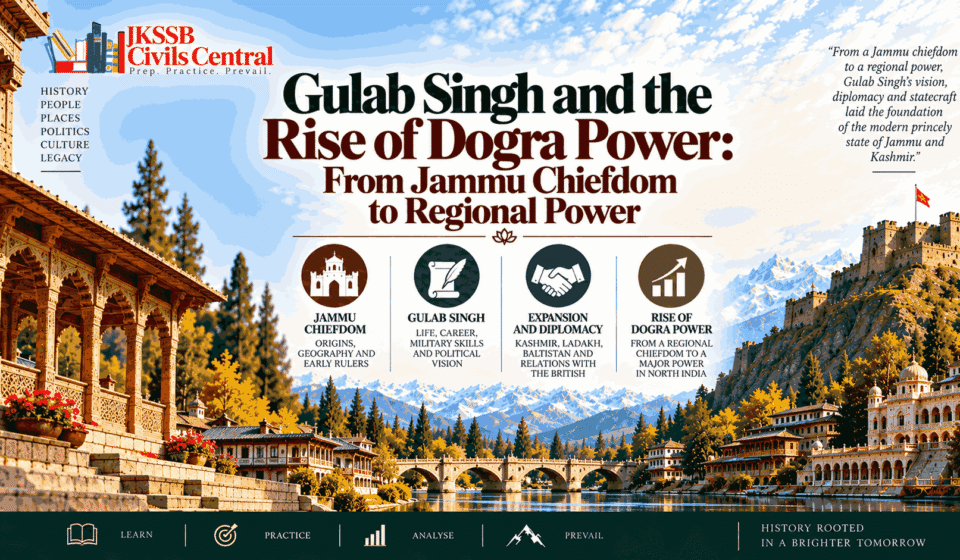
Gulab Singh and the Rise of Dogra Power: From Jammu Chiefdom to Regional Power

J&K History Series Navigation
| Previous Article | Current Article | Next Article |
|---|---|---|
| Article 31 — Sikh Rule in Kashmir: Ranjit Singh, Battle of Shopian and the Administration of Kashmir | Article 32 — Gulab Singh and the Rise of Dogra Power: From Jammu Chiefdom to Regional Power | Article 33 — Dogra Expansion under Zorawar Singh: Ladakh, Baltistan and Western Himalayan Campaigns |
Learning Dashboard
| Category | Key Information |
|---|---|
| Historical Period | Early 19th century to 1846 |
| Historical Phase | Rise of Dogra Power |
| Main Personality | Gulab Singh |
| Political Framework | Sikh Empire under Maharaja Ranjit Singh |
| Core Theme | Transformation of the Jammu Dogra chiefs into a major regional power |
| Important Development | Gulab Singh’s appointment/recognition as Raja of Jammu |
| Key Date | 1822 — Raj Tilak of Gulab Singh |
| Major Early Conquests | Dido’s rebellion, Rajouri, Kishtwar and adjoining hill territories |
| Important Family Members | Dhian Singh, Suchet Singh, Kishore Singh |
| Important Military Commander | Zorawar Singh |
| Key Political Centre | Jammu |
| Important Sikh Centre | Lahore Darbar |
| Important Places | Jammu, Akhnoor, Kishtwar, Rajouri, Bhimber, Reasi, Poonch, Chenani, Samba |
| Key Sources | Gulabnama, Sikh court chronicles, Persian records, European accounts, later scholarship |
| JKSSB Importance | Very High |
| Expected Question Types | Direct fact, chronology, statement-based, matching, identification, comparative |
Introduction
The rise of Gulab Singh is one of the most important political developments in nineteenth-century Jammu and Kashmir history. It explains how a member of the Dogra ruling lineage, initially operating within the expanding Sikh political order of Maharaja Ranjit Singh, transformed his family’s position in Jammu into a substantial regional power. This transformation was neither instantaneous nor independent of the Sikh Empire: it developed through military service, political loyalty, territorial expansion, family alliances and the gradual accumulation of an autonomous power base.
The historical setting was particularly favourable to such a transformation. The old political order of Jammu had weakened after the death of Raja Ranjit Dev in the late eighteenth century, while the rise of Sikh power in Punjab brought the Jammu hill principalities increasingly within the influence of the Lahore Darbar. Gulab Singh and his brothers Dhian Singh and Suchet Singh entered Ranjit Singh’s service and rose rapidly within the Sikh political system. Their advancement gave the Dogra family access to military resources, political patronage and territorial opportunities that had previously been unavailable to them.
Gulab Singh’s achievement was therefore not simply the acquisition of Jammu. His more important accomplishment was the construction of a coherent Dogra territorial base from which the family could expand into neighbouring hill regions and eventually play a decisive role in the formation of the princely state of Jammu and Kashmir in 1846. The process involved both cooperation with the Sikh Empire and the gradual development of interests that increasingly centred on Jammu itself.
CivilsCentral Historical Insight
Gulab Singh’s rise demonstrates how regional powers could emerge from within a larger empire rather than only in opposition to it. The Sikh Empire provided the political and military framework within which the Dogra family first rose, but Gulab Singh progressively converted imperial service into territorial power centred on Jammu. This distinction is essential for understanding why the later Dogra state cannot simply be treated as an extension of the Sikh administration.
Part I — Jammu Before Gulab Singh
The Earlier Dogra Political Tradition
The rise of Gulab Singh must be placed against the background of an older political tradition in Jammu. The region was not historically a single uniformly administered territory but consisted of a number of hill principalities, chiefships and local ruling houses whose political influence changed over time.
Among the prominent earlier rulers was Raja Ranjit Dev, who ruled Jammu during the eighteenth century and is generally associated with a period in which Jammu enjoyed considerable political importance. His death, conventionally placed around 1780, was followed by disputes over succession and increasing intervention by neighbouring powers.
The resulting political fragmentation weakened the ability of the Jammu ruling house to exercise authority over the wider hill region. At the same time, the expansion of Sikh power under Ranjit Singh created a new political environment in which the hill states increasingly became subordinate to Lahore.
From Independent Chiefships to Sikh Influence
The transformation of Jammu did not occur in a single military conquest. Sikh influence expanded through a combination of military campaigns, political arrangements, tribute relationships and intervention in local disputes.
By the early nineteenth century, Jammu had become increasingly dependent upon the Sikh power centred at Lahore. This created an important contradiction: the old Dogra ruling lineage had not disappeared, but its political autonomy had been reduced.
It was within this environment that the family of Kishore Singh and his sons—Gulab Singh, Dhian Singh and Suchet Singh—entered the service of Maharaja Ranjit Singh.
CivilsCentral Historical Insight
Gulab Singh’s rise cannot be understood as the sudden restoration of an old Jammu kingdom. The eighteenth-century Dogra political order had already been weakened. His achievement was to rebuild Dogra territorial power under the new political conditions created by Sikh expansion.
Part II — Gulab Singh’s Entry into the Sikh Political System
Background of Gulab Singh
Gulab Singh was born in 1792 into a Dogra Rajput family connected with the earlier Jammu ruling house. His father, Kishore Singh, belonged to the broader lineage associated with the Jammu chiefs.
Like many regional military elites of the period, Gulab Singh’s early career was shaped by military service. He entered the service of Maharaja Ranjit Singh and gradually distinguished himself in the military and political affairs of the Sikh Empire.
The exact chronology of his earliest service varies somewhat among historical accounts, but by the second decade of the nineteenth century he had established himself as a capable subordinate of the Lahore Darbar.
The Three Dogra Brothers
Gulab Singh’s rise cannot be separated from the careers of his two brothers.
Dhian Singh
Dhian Singh became an important figure at the Lahore court and eventually rose to the position of Prime Minister/Vazir under Ranjit Singh. His proximity to the Maharaja gave the Dogra family exceptional influence at the imperial centre.
Suchet Singh
Suchet Singh also became an important military and political figure and received territorial assignments in the Jammu hills.
Gulab Singh
Gulab Singh’s role developed somewhat differently. Rather than concentrating primarily on the Lahore court, he increasingly built his power base in Jammu and the surrounding hill territories.
This division of roles proved extremely important. Dhian Singh’s influence at Lahore strengthened the family’s position within the Sikh political system, while Gulab Singh’s territorial activity strengthened the family’s independent material base.
CivilsCentral Historical Insight
The power of the Dogra family rested on a combination of court influence and territorial control. Dhian Singh’s position at Lahore and Gulab Singh’s growing authority in Jammu were complementary sources of power. This family-wide political strategy helped the Dogras survive the later instability of the Sikh Empire.
Part III — The Dido Rebellion and the Opportunity in Jammu
Mian Dido and Resistance in Jammu
One of the immediate problems facing the Sikh authorities in Jammu was the resistance associated with Mian Dido. Dido, a member of a local Rajput lineage, became associated with armed resistance to Sikh authority and was able to exploit the difficult terrain and local networks of the Jammu hills.
The rebellion was significant because it demonstrated the difficulty of administering the Jammu region through distant authority. The routes connecting Punjab with Kashmir also passed through the Jammu hills, making political instability there strategically important for the Sikh Empire.
The Lahore Darbar therefore required a local power-holder capable of suppressing the rebellion while maintaining the security of the routes.
Gulab Singh’s Role
Gulab Singh successfully presented himself as a suitable candidate for this task. Historical accounts describe Ranjit Singh granting the Dogra family a territorial assignment in Jammu and adjoining areas with responsibilities that included maintaining troops, securing communications and suppressing Dido’s rebellion.
Gulab Singh used a combination of military action, intelligence and political pressure to isolate Dido’s support network. Dido was eventually killed, and the immediate phase of organized resistance was suppressed.
The significance of this episode extended beyond the defeat of a rebel leader. Gulab Singh had demonstrated to Ranjit Singh that he could exercise effective control over a difficult hill territory.
From Imperial Service to Territorial Authority
The settlement gave Gulab Singh and his family a stronger territorial base in Jammu. This did not make Gulab Singh an independent sovereign. He remained subordinate to Ranjit Singh, and the family’s authority existed within the political framework of the Sikh Empire.
Nevertheless, the arrangement provided the foundation from which Gulab Singh could subsequently expand.
This is a critical distinction:
1820s Dogra Jammu ≠ an independent Jammu and Kashmir state.
It was a Dogra-controlled territorial base under Sikh paramountcy.
CivilsCentral Historical Insight
Dido’s rebellion was important not simply because it was suppressed. It created an opportunity for Gulab Singh to demonstrate the value of locally rooted military authority to the Lahore Darbar. In the process, a Sikh administrative problem became a foundation for the territorial consolidation of Dogra power.
Part IV — Gulab Singh’s Consolidation of Jammu
The Jammu Grant
In the early 1820s, the Sikh government placed increasing territory in the Jammu family sphere of authority. The arrangement included Jammu and several adjoining areas and was linked to obligations concerning military service and the maintenance of order.
The grant was therefore both reward and responsibility. Gulab Singh obtained resources with which he could strengthen his position, but he remained expected to serve the interests of the Lahore Darbar.
The distinction between a jagir or territorial grant and independent sovereignty is particularly important. Gulab Singh’s authority was substantial, but it was not yet the authority of a fully independent Maharaja.
Suppression of Rival Powers
Gulab Singh subsequently worked to consolidate his position over the surrounding hill principalities. Some territories were acquired through military action, while in other cases political negotiation, internal disputes and strategic alliances played a major role.
This combination of force and political manoeuvring became a characteristic feature of Gulab Singh’s expansion. Mountainous political landscapes rarely permitted simple conquest of every territory; local chiefs, rival factions and difficult terrain had to be incorporated into a broader political strategy.
Part V — Kishtwar and the Expansion of Dogra Power
The Conquest of Kishtwar
One of the most important steps in Gulab Singh’s early expansion was the acquisition of Kishtwar in 1821. Kishtwar was strategically important because of its position east of Jammu and its access towards the high mountain regions beyond the Chenab basin. Control of Kishtwar therefore offered both territorial expansion and a base for later Dogra activity towards the Trans-Himalayan region.
The conquest is commonly described as having been achieved more through political strategy than through a large-scale conventional battle. Internal tensions within the Kishtwar ruling establishment were exploited, enabling Gulab Singh to establish control.
After the conquest, Zorawar Singh emerged as an important administrator and military commander in the region.
Why Kishtwar Was a Turning Point
Kishtwar transformed the geographical possibilities available to Gulab Singh. Jammu was no longer simply a territorial base south of the Pir Panjal. It now had a strategic connection with the high mountain regions leading towards Ladakh.
This development is crucial for understanding Article 33 of the series. The later Dogra campaigns under Zorawar Singh into Ladakh were made possible in large part by the territorial and administrative base created through the consolidation of Kishtwar.
CivilsCentral Historical Insight
Kishtwar was more than another territorial acquisition. It changed the strategic geography of Dogra power by connecting Jammu with the routes towards the high Himalayan regions. The subsequent expansion into Ladakh should therefore be seen as a continuation of the territorial strategy that began with the consolidation of Jammu and Kishtwar.
Part VI — Rajouri and the Growth of Dogra Influence
Rajouri
Rajouri was another strategically important territory in the Jammu hills. Its location on routes connecting the Punjab plains, Jammu and the Kashmir region made it politically valuable.
The Sikh authorities had their own reasons for seeking control over Rajouri, particularly because its ruler had been associated with difficulties during earlier Sikh campaigns towards Kashmir.
Gulab Singh was entrusted with dealing with the Rajouri ruler and succeeded in bringing the territory under his control.
The acquisition strengthened his position on the western side of the Jammu region and contributed to the consolidation of a larger Dogra territorial zone.
Bhimber and Other Hill Territories
The wider expansion of the Dogra brothers involved several territories including Bhimber, Poonch, Ramnagar, Samba, Chenani and adjoining areas. Not all of these territories were incorporated through exactly the same mechanism, and the respective positions of Gulab Singh, Dhian Singh and Suchet Singh changed over time.
The important historical point is that the three brothers collectively became major territorial figures under the Sikh Empire.
Gulab Singh, however, increasingly emerged as the principal Dogra power-holder in Jammu itself.
Part VII — The Raj Tilak of Gulab Singh, 1822
The 1822 Settlement
The decisive step in Gulab Singh’s political rise came after the death of his father Kishore Singh.
In 1822, Maharaja Ranjit Singh formally recognized Gulab Singh as Raja of Jammu. The installation ceremony took place at Akhnoor, traditionally associated with the Jia Pota site on the Chenab.
The date is given differently in some historical and modern accounts, with 17 June 1822 commonly cited and other accounts giving January or June formulations depending on whether they distinguish earlier arrangements from the formal installation. For examination purposes, 1822 is the essential date.
The ceremony was politically significant because it gave hereditary recognition to Gulab Singh’s position in Jammu within the Sikh imperial framework.
Was Gulab Singh Independent in 1822?
No. This is one of the most important examination distinctions. The recognition of Gulab Singh as Raja of Jammu did not mean that an independent Jammu and Kashmir state had been established in 1822.
Gulab Singh remained subordinate to Maharaja Ranjit Singh and operated within the political structure of the Sikh Empire. His authority in Jammu was nevertheless substantially greater than that of an ordinary local official because it was hereditary and supported by his own military and territorial resources.
Thus: 1822 = formal rise of Gulab Singh as hereditary Raja of Jammu, but:
1822 ≠ establishment of the independent princely state of Jammu and Kashmir.
CivilsCentral Historical Insight
The Raj Tilak of 1822 represents the transition from Dogra service to Dogra territorial authority. Gulab Singh remained under Sikh paramountcy, but hereditary recognition gave his family a durable political base. This distinction explains how a subordinate chief could eventually become the ruler of a much larger state.
Part VIII — The Dogra Brothers and a Regional Power Network
Gulab Singh’s rise must be understood within the broader distribution of territories among the Dogra brothers. Dhian Singh became one of the most influential nobles at Lahore and was associated with territories including Poonch and Bhimber. Suchet Singh received territories in the Jammu hills, including areas associated with Ramnagar and Samba.
This arrangement created something more significant than a single territorial principality. It produced a Dogra family network extending across different parts of the hill region and into the political centre at Lahore.
The network was useful because the brothers could support one another politically while occupying different strategic positions. Dhian Singh’s influence at Lahore provided access to the imperial court, while Gulab Singh’s position in Jammu gave the family a strong territorial base.
The arrangement also contained potential tensions. The brothers were individual political actors with their own interests, and their territories were not simply departments of one unified Dogra administration. Nevertheless, the collective rise of the family significantly changed the political balance of the western Himalayan region.
Part IX — Gulab Singh’s Methods of Expansion
Military Force
Gulab Singh did not hesitate to use military force when necessary. The difficult terrain of the Jammu hills required mobile forces familiar with mountain warfare, and his growing military establishment enabled him to confront rival chiefs and rebellious groups.
Military capacity also increased his bargaining power with the Lahore Darbar. A ruler who could maintain order and contribute troops was valuable to Ranjit Singh’s empire.
Political Strategy
Military action was only one component of Gulab Singh’s expansion. He frequently benefited from rivalries among local chiefs and from divisions within ruling families.
The Kishtwar episode is a useful example of how political strategy could reduce the need for prolonged warfare. By exploiting internal disagreements, Gulab Singh could acquire territory at comparatively lower military cost.
Revenue and Territorial Resources
Territorial expansion also provided revenue. The ability to control agricultural land, routes and local markets increased the resources available to the Dogra administration.
The relationship between territorial expansion and revenue was therefore circular:
Territory → Revenue → Military Capacity → Further Expansion
This does not mean every acquisition was motivated solely by revenue. Strategic geography and political security were equally important, particularly in mountainous frontier regions.
CivilsCentral Historical Insight
Gulab Singh’s expansion was based on a combination of force, diplomacy, exploitation of local rivalries and strategic geography. His success lay not in battlefield victories alone but in converting each territorial gain into a stronger political and military base for the next stage of expansion.
Part X — Zorawar Singh and the Transformation of Dogra Power
The Rise of Zorawar Singh
The consolidation of Kishtwar brought Zorawar Singh into a position of exceptional importance. He became one of Gulab Singh’s principal military commanders and administrators. Zorawar Singh’s importance was not merely military. He helped transform the eastern frontier of Gulab Singh’s territories into a launching point for much larger Himalayan campaigns.
His subsequent campaigns in Ladakh, Baltistan and western Tibet represent a distinct phase of Dogra expansion and are therefore examined in detail in Article 33.
Why Zorawar Belongs in the Story of Gulab Singh
Gulab Singh provided political authority, territorial resources and strategic direction, while Zorawar Singh translated these resources into military expansion. Their relationship illustrates the way in which a regional state could extend its power through delegated military leadership.
It is therefore inaccurate to treat the later Dogra conquests as completely separate from Gulab Singh’s state-building process.
CivilsCentral Historical Insight
Zorawar Singh’s campaigns were the military extension of a political structure that Gulab Singh had already built. The commander expanded the frontier, but the capacity to undertake those campaigns came from the consolidation of Jammu and Kishtwar under Gulab Singh.
Part XI — Gulab Singh and the Sikh Empire After 1822
Loyalty and Autonomy
After becoming Raja of Jammu, Gulab Singh did not immediately break from Ranjit Singh. On the contrary, he continued to recognize Sikh supremacy and participate in the military and political affairs of the Sikh Empire.
This relationship was mutually beneficial. Ranjit Singh could rely on Gulab Singh as a powerful hill chief, while Gulab Singh benefited from the protection and legitimacy provided by the Sikh Empire.
At the same time, Gulab Singh increasingly developed interests that were specific to Jammu. His political attention shifted towards strengthening his own territorial base rather than remaining dependent entirely upon court influence at Lahore.
This gradual process of autonomy within subordination is central to understanding his rise.
Military Service to Ranjit Singh
Gulab Singh continued to provide military assistance to the Sikh state. His troops participated in campaigns and his territorial position helped protect communications through the Jammu hills.
His usefulness to Ranjit Singh therefore remained an important source of political legitimacy.
The relationship should not be described simply as one of passive obedience. Gulab Singh was simultaneously a subordinate of the Sikh ruler and an increasingly powerful regional actor whose own interests were becoming more substantial.
Part XII — The 1830s: From Jammu Chief to Regional Power
By the 1830s, Gulab Singh’s position had changed substantially from that of a local Dogra chief. He controlled Jammu and a widening network of hill territories, possessed military forces of his own, and exercised influence through Zorawar Singh’s campaigns beyond the immediate Jammu region. His family also retained significant influence at the Lahore court through Dhian Singh.
This combination made Gulab Singh one of the most important non-royal political figures within the Sikh Empire.
The expansion into Ladakh from 1834 represented a major turning point. Although the detailed military story belongs to the next article, the political significance is already clear: Dogra power was moving beyond the Jammu hills into the trans-Himalayan region.
The resulting territorial network increasingly connected:
Jammu → Kishtwar → Ladakh → Baltistan
This was the foundation for the much larger territorial formation that would emerge in 1846.
Part XIII — The Death of Ranjit Singh and the Political Opportunity
1839: A Turning Point
The death of Maharaja Ranjit Singh in 1839 transformed the political environment. During his lifetime, Ranjit Singh had maintained a strong personal authority over the Sikh Empire. His death exposed tensions that had previously been contained by his political leadership.
Succession disputes, court rivalries and conflicts among major factions weakened the Lahore Darbar. The Dogras themselves became deeply involved in this political struggle, particularly through Dhian Singh’s position at the court.
Gulab Singh’s Strategic Position
Gulab Singh’s strength in this period came from the fact that he was not entirely dependent upon Lahore. His territorial base in Jammu allowed him to maintain a degree of political distance from the increasingly unstable court.
This was a major advantage. While political factions competed for power in Lahore, Gulab Singh could consolidate his position in the hills. His ability to combine territorial security with political negotiation made him an increasingly autonomous actor.
However, later narratives sometimes portray Gulab Singh’s conduct during the collapse of the Sikh Empire in overly simplified terms. The political environment was extraordinarily complex, and interpretations of his role in the events preceding the First Anglo-Sikh War vary.
The important structural fact is that the weakening of central Sikh authority created an opportunity for powerful regional figures such as Gulab Singh to strengthen their autonomy.
CivilsCentral Historical Insight
Ranjit Singh’s death did not create Gulab Singh’s power; it revealed how much power Gulab Singh had already accumulated. The collapse of strong central authority at Lahore allowed his territorial base, military resources and political networks to become more consequential.
Part XIV — From Regional Power to the Threshold of State Formation
By the mid-1840s, Gulab Singh had developed characteristics associated with a regional state rather than an ordinary jagirdar. He possessed a hereditary political title, a substantial territorial base, military forces, administrative institutions and a network of subordinate territories. Dogra campaigns had also extended his influence far beyond the original Jammu core.
Yet one important limitation remained: Gulab Singh was not formally the sovereign of Kashmir.
Kashmir remained under the Sikh Empire and was administered through the Lahore Darbar’s provincial structure. The Dogra state and Sikh Kashmir therefore remained distinct political entities until the political upheavals of 1845–46.
The First Anglo-Sikh War changed this situation fundamentally. The defeat of the Sikh Empire and the subsequent treaties created the political conditions under which Gulab Singh acquired sovereignty over the territories specified in the Treaty of Amritsar of 1846.
The details of that transition belong to the next stage of the series, particularly Articles 34 and 35.
Part XV — Historical Significance of Gulab Singh’s Rise
Gulab Singh’s rise is historically significant for several reasons.
1. Transformation of Jammu Politics
He transformed Jammu from a politically fragmented hill region under growing Sikh influence into the core of a powerful Dogra territorial state.
2. Rise within the Sikh Empire
His political career demonstrates that regional power could emerge inside an imperial structure. He did not initially rise by overthrowing Ranjit Singh; he rose through service to him.
3. Territorial Consolidation
The acquisition of Jammu, Rajouri, Kishtwar and other adjoining territories gave the Dogra family a substantial geographical base.
4. Military Expansion
Through commanders such as Zorawar Singh, the Dogra state extended its reach into regions beyond Jammu. This expansion dramatically changed the political geography of the western Himalayas.
5. Family Political Network
Dhian Singh’s influence at Lahore and the territorial positions of Suchet Singh and other members of the family gave the Dogras unusual political reach.
6. Preparation for 1846
By the time the Sikh Empire entered its final crisis, Gulab Singh possessed the territorial, military and political resources necessary to emerge as a principal beneficiary of the transformation of power.
CivilsCentral Historical Insight
Gulab Singh’s greatest historical significance lies in the creation of a durable political base before 1846. The Treaty of Amritsar did not create Dogra power from nothing; it formalized a territorial and political strength that had been built over the preceding decades through Jammu consolidation, military expansion and strategic engagement with the Sikh Empire.
Part XVI — Historical Interpretation and Evidence Note
The history of Gulab Singh is preserved through several types of sources, including Sikh court chronicles, Persian historical works, Dogra traditions, the Gulabnama of Diwan Kirpa Ram, European accounts and later academic scholarship.
The Gulabnama is especially important for the history of Gulab Singh and the Dogra family, but it should not be treated as an entirely neutral modern biography. It was produced within a political and historical environment shaped by the later Dogra state and therefore needs to be read alongside other sources.
Similarly, later Dogra historical traditions sometimes present Gulab Singh’s rise as a straightforward restoration of an ancient Jammu kingdom. The historical process was more complicated. The Dogra family certainly possessed an established connection with the Jammu ruling tradition, but Gulab Singh’s power was rebuilt within the political framework of the Sikh Empire.
The chronology of some early grants and the precise dates of individual political arrangements also varies among historical works. The safest reconstruction is therefore to distinguish the broad sequence, which is firmly established, from disputed details concerning the exact date or legal character of individual grants.
The evidence strongly supports the following sequence:
Sikh expansion in Jammu → Dogra brothers enter Sikh service → suppression of Dido’s rebellion → territorial grant to the Jammu family → Kishtwar and Rajouri expansion → Gulab Singh recognized as Raja of Jammu in 1822 → further territorial consolidation → Zorawar Singh’s Himalayan campaigns → weakening of Sikh central authority after 1839 → Gulab Singh’s emergence as a major regional power → 1846 political settlement.
Part XVII — JKSSB Knowledge Matrix
| Question | High-Value Answer |
|---|---|
| Who was Gulab Singh? | Dogra ruler who rose within the Sikh political system and became Raja of Jammu |
| When was Gulab Singh born? | 1792 |
| Who was his father? | Kishore Singh |
| Which ruler patronized Gulab Singh’s early career? | Maharaja Ranjit Singh |
| Who were Gulab Singh’s brothers? | Dhian Singh and Suchet Singh |
| What was Dhian Singh’s major role? | Powerful Lahore court noble and wazir |
| What was Suchet Singh associated with? | Dogra territorial power in the Jammu hills |
| Which rebellion helped Gulab Singh establish himself in Jammu? | Mian Dido’s rebellion |
| Which territory did Gulab Singh acquire in 1821? | Kishtwar |
| Which territory did he help subjugate for the Lahore Darbar? | Rajouri |
| When was Gulab Singh recognized as Raja of Jammu? | 1822 |
| Where was his Raj Tilak held? | Akhnoor |
| Under whose authority did he initially rule? | Maharaja Ranjit Singh / Sikh Empire |
| Was Jammu an independent state in 1822? | No |
| Who was Gulab Singh’s principal military commander in later expansion? | Zorawar Singh |
| Which region became the base for later eastern expansion? | Kishtwar |
| When did Dogra expansion into Ladakh begin? | 1834 |
| What major event weakened the Sikh political system? | Death of Ranjit Singh in 1839 |
| What happened in 1846? | Gulab Singh’s political position was transformed through the settlement following the First Anglo-Sikh War |
Part XVIII — Examination Discrimination Points
Gulab Singh vs Ranjit Singh
Ranjit Singh → Maharaja of the Sikh Empire.
Gulab Singh → Dogra chief who rose within Ranjit Singh’s political system and later became Maharaja of Jammu and Kashmir.
1822 vs 1846
1822 → Gulab Singh formally recognized/installed as Raja of Jammu.
1846 → Treaty of Amritsar established his sovereignty over the territories transferred to him by the British.
Do not treat 1822 as the date of formation of the princely state of Jammu and Kashmir.
Jammu vs Jammu and Kashmir
Jammu → Gulab Singh’s initial territorial base.
Jammu and Kashmir → larger princely state created through the political settlement of 1846.
Gulab Singh vs Zorawar Singh
Gulab Singh → ruler and political architect of Dogra expansion.
Zorawar Singh → leading military commander responsible for major Himalayan campaigns.
Dhian Singh vs Gulab Singh
Dhian Singh → major political figure at the Lahore court.
Gulab Singh → principal Dogra territorial power-holder in Jammu.
Kishtwar vs Ladakh
Kishtwar → consolidated by Gulab Singh in 1821.
Ladakh → conquered by Dogra forces under Zorawar Singh beginning in 1834.
Sikh Rule vs Dogra Rule
1819–1846 → Sikh political control of Kashmir.
1846 onward → Gulab Singh’s Dogra rule over the territories constituting the princely state.
Part XIX — JKSSB Question Pattern
Direct Fact
High-value questions can test:
- birth year of Gulab Singh;
- name of his father;
- names of his brothers;
- 1821 conquest of Kishtwar;
- 1822 Raj Tilak;
- Akhnoor;
- Mian Dido;
- Dhian Singh;
- Suchet Singh;
- Zorawar Singh.
Statement-Based
A question may provide statements such as:
- Gulab Singh initially rose within the Sikh political system.
- He became Raja of Jammu in 1822.
- Jammu became an independent Jammu and Kashmir state in 1822.
- Zorawar Singh later led Dogra expansion into Ladakh.
The correct combination requires distinguishing 1822 political recognition from 1846 state formation.
Chronology
The most important sequence is:
Ranjit Dev’s decline → Sikh expansion → Dogra brothers enter Sikh service → Dido’s rebellion → Jammu grant → Kishtwar, 1821 → Gulab Singh’s Raj Tilak, 1822 → further Dogra consolidation → Ladakh campaign, 1834 → Ranjit Singh’s death, 1839 → First Anglo-Sikh War, 1845–46 → Treaty of Amritsar, 1846
Match the Following
| Personality | Association |
|---|---|
| Gulab Singh | Raja of Jammu |
| Dhian Singh | Lahore court |
| Suchet Singh | Dogra territorial power |
| Mian Dido | Resistance in Jammu |
| Zorawar Singh | Dogra Himalayan campaigns |
| Kishore Singh | Father of Gulab Singh |
Identification by Clues
Clue: Dogra ruler who was formally installed as Raja of Jammu in 1822 at Akhnoor.
Answer: Gulab Singh.
Clue: Dogra military commander who later led the expansion into Ladakh.
Answer: Zorawar Singh.
Clue: Rebel whose suppression strengthened Gulab Singh’s position in Jammu.
Answer: Mian Dido.
Part XX — JKSSB Practice Questions
Question 1
Gulab Singh’s rise to political prominence was most closely associated with the service of which ruler?
A. Maharaja Ranjit Singh
B. Maharaja Kharak Singh
C. Maharaja Sher Singh
D. Maharaja Duleep Singh
Correct Answer: A
Explanation: Gulab Singh and his brothers rose within the political and military system established by Maharaja Ranjit Singh.
Question 2
Consider the following statements:
- Gulab Singh initially rose within the Sikh Empire.
- He was recognized as Raja of Jammu in 1822.
- The princely state of Jammu and Kashmir was formally established in 1822.
Which of the statements is/are correct?
A. 1 only
B. 1 and 2 only
C. 2 and 3 only
D. 1, 2 and 3
Correct Answer: B
Explanation: Gulab Singh’s recognition as Raja of Jammu occurred in 1822, but the larger princely state of Jammu and Kashmir emerged through the political settlement of 1846.
Question 3
Which of the following territories was associated with Gulab Singh’s expansion in 1821?
A. Ladakh
B. Kishtwar
C. Baltistan
D. Gilgit
Correct Answer: B
Explanation: Kishtwar was brought under Gulab Singh’s control in 1821. The major Dogra campaign in Ladakh began later, in 1834.
Question 4
Match List I with List II:
| List I | List II |
|---|---|
| 1. Gulab Singh | A. Lahore court |
| 2. Dhian Singh | B. Raja of Jammu |
| 3. Zorawar Singh | C. Himalayan military expansion |
| 4. Mian Dido | D. Resistance in Jammu |
Choose the correct answer:
A. 1-B, 2-A, 3-C, 4-D
B. 1-A, 2-B, 3-D, 4-C
C. 1-C, 2-D, 3-A, 4-B
D. 1-D, 2-C, 3-B, 4-A
Correct Answer: A
Question 5
The Raj Tilak of Gulab Singh is associated with:
A. Lahore
B. Srinagar
C. Akhnoor
D. Kishtwar
Correct Answer: C
Explanation: Gulab Singh’s installation as Raja of Jammu in 1822 is associated with Akhnoor on the Chenab.
Question 6
Which sequence is chronologically correct?
A. Ladakh conquest → Kishtwar → Raj Tilak → Dido’s rebellion
B. Dido’s rebellion → Kishtwar → Raj Tilak → Ladakh campaign
C. Raj Tilak → Dido’s rebellion → Ladakh campaign → Kishtwar
D. Kishtwar → Ladakh campaign → Dido’s rebellion → Raj Tilak
Correct Answer: B
Explanation: Dido’s rebellion was suppressed before Gulab Singh’s consolidation of Kishtwar in 1821; the Raj Tilak followed in 1822, while the major Dogra campaign into Ladakh began in 1834.
Question 7
Which of the following best describes Gulab Singh’s political position immediately after his recognition as Raja of Jammu?
A. Independent emperor of Jammu and Kashmir
B. Governor directly appointed by the British
C. Hereditary Dogra ruler of Jammu operating under Sikh paramountcy
D. Governor of Kashmir under the Afghan Empire
Correct Answer: C
Question 8
Why was Kishtwar particularly important in the rise of Dogra power?
A. It became the Mughal capital of Kashmir
B. It provided a strategic base for expansion towards the high Himalayan regions
C. It was the site of the Treaty of Amritsar
D. It was the centre of Afghan administration in Kashmir
Correct Answer: B
Question 9
Which pair is incorrectly matched?
A. Gulab Singh — Jammu
B. Dhian Singh — Lahore court
C. Zorawar Singh — Ladakh campaigns
D. Mian Dido — Sikh governor of Kashmir
Correct Answer: D
Explanation: Mian Dido was associated with resistance in Jammu, not with the governorship of Kashmir.
Question 10
The death of Maharaja Ranjit Singh in 1839 was significant for Gulab Singh because it:
A. immediately made him Maharaja of Jammu and Kashmir
B. strengthened central Sikh authority
C. created a period of political instability in which regional powers could increase their autonomy
D. ended Dogra control of Jammu
Correct Answer: C
Part XXI — Rapid Revision Zone
Important Dates
- 1792 — Birth of Gulab Singh.
- Early 19th century — Gulab Singh enters the service of Ranjit Singh.
- c. 1820 — Dogra family receives important territorial authority in Jammu under Sikh paramountcy.
- 1821 — Gulab Singh consolidates Kishtwar.
- 1822 — Gulab Singh formally recognized/installed as Raja of Jammu.
- 1834 — Major Dogra expansion into Ladakh begins under Zorawar Singh.
- 1839 — Death of Ranjit Singh.
- 1845–46 — First Anglo-Sikh War.
- 1846 — Political settlement creates the conditions for Gulab Singh’s sovereignty over the new princely state.
Important Personalities
- Gulab Singh — Raja of Jammu; later Maharaja.
- Kishore Singh — father of Gulab Singh.
- Dhian Singh — influential Dogra noble at Lahore.
- Suchet Singh — Dogra military and territorial figure.
- Mian Dido — Jammu rebel/resistance leader.
- Zorawar Singh — Gulab Singh’s principal military commander in Himalayan expansion.
- Ranjit Singh — Sikh ruler under whose political framework Gulab Singh first rose.
Important Places
- Jammu — core of Gulab Singh’s political power.
- Akhnoor — associated with Gulab Singh’s Raj Tilak.
- Kishtwar — consolidated by Gulab Singh in 1821.
- Rajouri — strategically important hill territory brought under Dogra influence.
- Bhimber — associated with Dhian Singh’s territorial sphere.
- Poonch — associated with the Dogra family network.
- Ladakh — later expanded into by Zorawar Singh.
Important Associations
Gulab Singh → Jammu
1822 → Raj Tilak
Akhnoor → Raj Tilak
Mian Dido → Jammu resistance
Kishtwar → 1821
Dhian Singh → Lahore court
Zorawar Singh → Ladakh
1839 → Death of Ranjit Singh
1846 → Dogra state formation
Part XXII — Frequently Confused Facts
| Confusion | Correct Distinction |
|---|---|
| Gulab Singh vs Ranjit Singh | Gulab Singh = Dogra ruler; Ranjit Singh = Sikh Maharaja |
| 1822 vs 1846 | 1822 = Raja of Jammu; 1846 = establishment of larger Dogra state |
| Jammu vs Jammu & Kashmir | Jammu was Gulab Singh’s initial base; larger state emerged in 1846 |
| Gulab Singh vs Zorawar Singh | Gulab Singh = ruler; Zorawar = principal military commander |
| Dhian Singh vs Gulab Singh | Dhian Singh = Lahore court power; Gulab Singh = Jammu territorial power |
| Kishtwar vs Ladakh | Kishtwar = 1821; Ladakh campaign = 1834 onward |
| Mian Dido vs Zorawar Singh | Dido = rebel in Jammu; Zorawar = Dogra commander |
| Sikh rule vs Dogra rule | Sikh political control of Kashmir = 1819–1846; Dogra rule = from 1846 |
| 1822 Raj Tilak vs Treaty of Amritsar | Raj Tilak established Gulab Singh’s position in Jammu; Treaty of Amritsar transferred wider territory in 1846 |
| Dogra expansion vs Sikh expansion | Dogra expansion occurred within the broader Sikh political framework before 1846 |
Part XXIII — One-Line Revision Facts
- Gulab Singh was born in 1792.
- He belonged to the Dogra Rajput ruling lineage of Jammu.
- He rose through the service of Maharaja Ranjit Singh.
- His brothers were Dhian Singh and Suchet Singh.
- Dhian Singh became a major political figure at the Lahore court.
- Mian Dido’s rebellion created an important opportunity for Gulab Singh to establish his authority in Jammu.
- Kishtwar was consolidated by Gulab Singh in 1821.
- Gulab Singh was recognized as Raja of Jammu in 1822.
- His Raj Tilak is associated with Akhnoor.
- Gulab Singh remained under Sikh paramountcy after 1822.
- Zorawar Singh became his principal military commander in later Himalayan expansion.
- Dogra expansion into Ladakh began in 1834.
- The death of Ranjit Singh in 1839 weakened the Sikh political system.
- The First Anglo-Sikh War occurred in 1845–46.
- The political settlement of 1846 transformed Gulab Singh from Raja of Jammu into Maharaja of the larger Dogra state.
Part XXIV — What Can JKSSB Ask?
From this topic, high-value examination areas include:
- Gulab Singh’s family background;
- Ranjit Singh’s role in his rise;
- Mian Dido and Jammu resistance;
- the Jammu grant;
- Kishtwar, 1821;
- Raj Tilak, 1822;
- Akhnoor;
- distinction between Raja of Jammu and Maharaja of Jammu and Kashmir;
- Dhian Singh’s role at Lahore;
- Suchet Singh’s territorial position;
- Zorawar Singh’s role;
- beginning of Dogra expansion into Ladakh;
- death of Ranjit Singh in 1839;
- relationship between Sikh paramountcy and Dogra autonomy;
- chronology leading to 1846.
The most important conceptual distinction
Gulab Singh did not suddenly become ruler of Jammu and Kashmir in 1822.
The process was:
Dogra lineage
→ Service under Ranjit Singh
→ Suppression of Dido
→ Territorial base in Jammu
→ Kishtwar, 1821
→ Raj Tilak as Raja of Jammu, 1822
→ Further territorial expansion
→ Zorawar Singh’s Himalayan campaigns
→ Weakening of Sikh central authority after 1839
→ 1846 political settlement
→ Maharaja Gulab Singh and the Dogra State
Chapter Summary
Gulab Singh’s rise began within the political framework of the Sikh Empire rather than outside it. Born into a Dogra Rajput family connected with the earlier Jammu ruling tradition, he and his brothers entered the service of Maharaja Ranjit Singh. Their military and political abilities allowed the family to rise rapidly, with Dhian Singh becoming an important figure at Lahore and Gulab Singh gradually building a territorial power base in Jammu.
The suppression of Mian Dido’s rebellion was an important early step because it demonstrated Gulab Singh’s ability to restore order in the Jammu hills. The subsequent consolidation of Kishtwar in 1821 and recognition of Gulab Singh as Raja of Jammu in 1822 transformed him from a Sikh subordinate of growing importance into the hereditary head of a substantial Dogra territory.
Gulab Singh then expanded his influence over neighbouring hill regions while continuing to operate under Sikh paramountcy. The appointment of Zorawar Singh and the later expansion into Ladakh extended Dogra power beyond the original Jammu core. This process created a regional political structure whose importance increased dramatically after the death of Ranjit Singh in 1839 weakened the central authority of the Sikh Empire.
The significance of Gulab Singh’s career therefore lies in the gradual accumulation of territory, military capacity, administrative authority and political autonomy. The Dogra state of 1846 was not created from nothing by a treaty; its foundations had been laid during the preceding decades of political and military consolidation.
JKSSB Takeaway
Gulab Singh → Ranjit Singh’s service → Dido’s suppression → Jammu territorial base → Kishtwar (1821) → Raj Tilak at Akhnoor (1822) → Dogra expansion → Zorawar Singh → Ladakh (1834 onward) → Ranjit Singh’s death (1839) → First Anglo-Sikh War → 1846 Dogra state.
Mind Map
18th-CENTURY JAMMU
↓
Decline of Earlier Dogra Political Power
↓
Expansion of Sikh Empire
↓
Gulab Singh + Dhian Singh + Suchet Singh
↓
Service under Ranjit Singh
↓
Mian Dido’s Rebellion
↓
Dogra Territorial Grant
↓
Kishtwar — 1821
↓
Raj Tilak of Gulab Singh — 1822
↓
RAJA OF JAMMU
↓
Territorial Consolidation
→ Rajouri
→ Reasi
→ Bhimber/Poonch network
→ adjoining hill territories
↓
Zorawar Singh
↓
Ladakh Expansion — 1834 onward
↓
Regional Dogra Power
↓
Death of Ranjit Singh — 1839
↓
Weakening Sikh Central Authority
↓
First Anglo-Sikh War — 1845–46
↓
Treaties of 1846
↓
MAHARAJA GULAB SINGH
↓
DOGRA STATE OF JAMMU & KASHMIR
FAQs
1. Who was Gulab Singh?
Gulab Singh was a Dogra Rajput ruler who rose through service to Maharaja Ranjit Singh and gradually built a powerful territorial base in Jammu. He became Raja of Jammu in 1822 and Maharaja of the larger Dogra state in 1846.
2. When was Gulab Singh made Raja of Jammu?
He was formally recognized and installed as Raja of Jammu in 1822. The Raj Tilak is associated with Akhnoor.
3. Was Gulab Singh independent in 1822?
No. He remained under the political supremacy of Maharaja Ranjit Singh and the Sikh Empire, although his authority in Jammu was hereditary and increasingly substantial.
4. What was Mian Dido’s significance in Gulab Singh’s rise?
The suppression of Dido’s rebellion demonstrated Gulab Singh’s ability to establish political and military control in Jammu and strengthened his position with the Lahore Darbar.
5. Why was Kishtwar important to Gulab Singh?
Kishtwar strengthened the eastern strategic depth of Dogra power and provided an important base for later expansion towards the high Himalayan regions.
6. Who was Zorawar Singh?
Zorawar Singh was one of Gulab Singh’s principal military commanders and administrators. He later led major Dogra campaigns into Ladakh and other Himalayan regions.
7. What was the role of Dhian Singh?
Dhian Singh became a highly influential noble and wazir at the Lahore court. His political position strengthened the wider Dogra family’s influence within the Sikh Empire.
8. Did Gulab Singh create the princely state of Jammu and Kashmir in 1822?
No. 1822 marked his recognition as Raja of Jammu. The larger Dogra princely state emerged through the political settlement of 1846.
9. Why is 1839 important in Gulab Singh’s rise?
The death of Ranjit Singh weakened the central authority of the Sikh Empire and created greater political space for powerful regional figures such as Gulab Singh.
About The Author






[…] Article 32 — Gulab Singh and the Rise of Dogra Power: From Jammu Chiefdom to Regional Power […]
[…] Article 32 — Gulab Singh and the Rise of Dogra Power: From Jammu Chiefdom to Regional Power […]