
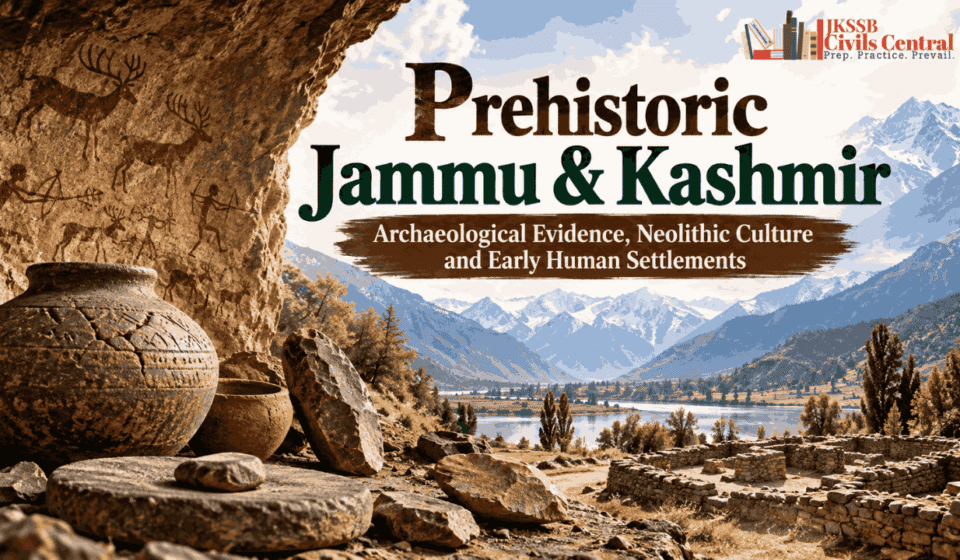
Prehistoric Jammu and Kashmir: Archaeological Evidence, Neolithic Culture and Early Human Settlements

J&K History Series Navigation
| Previous Article | Current Article | Next Article |
|---|---|---|
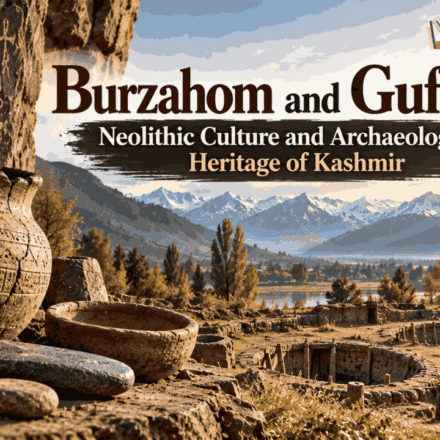
| Series Start | Article 01 — Prehistoric Jammu & Kashmir | Article 02 — Burzahom and Gufkral: Neolithic Culture and Archaeological Heritage of Kashmir |
Learning Dashboard
| Category | Key Information |
|---|---|
| Article Number | 01 |
| Module | Module I — Prehistoric & Early J&K |
| Historical Phase | Prehistoric / Protohistoric J&K |
| Core Region | Kashmir Valley and Jammu region |
| Core Theme | Archaeological evidence of early human presence and the emergence of settled Neolithic communities |
| Major Sites | Pahalgam/Lidder Valley, Balapura, Manasbal, Bomai, Sombur, Burzahom, Gufkral, Kanispur, Malpur |
| Major Evidence | Stone tools, bone and antler tools, dwelling pits, pottery, agricultural remains, animal remains, burials and megalithic remains |
| Key Concept | Transition from earlier Stone Age communities to Neolithic food production and settled life |
| Important Sources | Archaeological excavations, ASI reports, palaeobotanical evidence, palaeoclimatic studies and comparative archaeological research |
| JKSSB Importance | Very High |
| Likely Question Types | Statements, identification by clues, chronology, site-feature matching, correct/incorrect associations |
Introduction
The history of Jammu and Kashmir does not begin with the dynasties recorded in later literary traditions. Long before the emergence of identifiable kingdoms, political institutions and written chronicles, the region was inhabited by communities whose lives can be reconstructed through archaeology. Stone tools, habitation remains, animal bones, plant remains, pottery, burials and later megalithic structures provide the principal evidence for understanding these early populations. Because written records are absent for this period, the archaeology of the region is not simply supplementary to history; it is the primary means through which its earliest human past can be studied.
The prehistoric record of present-day Jammu and Kashmir is also geographically diverse. In the Kashmir Valley, the Palaeolithic record includes stone-tool discoveries from areas such as the Lidder Valley, while the later Neolithic horizon is particularly well represented by sites such as Burzahom, Gufkral and Kanispur. The Jammu region, meanwhile, has yielded its own lithic evidence, including pebble-tool assemblages in the Ravi and Tawi river systems and Neolithic material at sites such as Malpur. This evidence cautions against treating prehistoric J&K as a single uniform cultural zone.
The most important transformation came with the emergence of Neolithic communities. In Kashmir, this involved not simply better stone tools but broader changes in subsistence, settlement and material culture: agriculture and animal domestication became important, pottery appeared in later phases, and communities constructed distinctive dwelling spaces, including the famous subterranean or pit structures found at several sites. The archaeological sequence therefore allows us to study a long transition from mobile or semi-mobile Stone Age communities toward increasingly settled societies with agriculture, craft production, burial practices and more complex material traditions.
CivilsCentral Historical Insight
The significance of prehistoric J&K lies less in identifying a single “first civilization” than in understanding a long process of adaptation to a distinctive Himalayan environment. The archaeological record shows that communities repeatedly adjusted their settlement patterns, technology and subsistence strategies to changing ecological conditions, eventually producing a distinctive Neolithic cultural tradition in the Kashmir Valley.
Part I — The Geographical and Environmental Setting
Kashmir’s Karewas and the Prehistoric Landscape
The physical environment of the Kashmir Valley is fundamental to understanding its prehistoric archaeology. The valley contains extensive Karewa deposits, formed from ancient lacustrine and related sediments. These deposits preserve a long record of environmental and geological change and later became important locations for prehistoric settlement. Archaeological research has therefore developed alongside geological and palaeoclimatic investigation, since understanding the landscape in which early communities lived is essential for interpreting their settlements.
The Karewas were not merely geological formations. Their elevated terraces, soils and relationship to watercourses created landscapes that could support human occupation and later agricultural activity. Archaeological sites such as Burzahom and Gufkral were established on Karewa formations, demonstrating the close relationship between prehistoric settlement and the distinctive geomorphology of the Kashmir Valley.
This environmental setting also helps explain why prehistoric Kashmir cannot be studied solely through the conventional sequence of “Stone Age → agriculture → civilization.” The region’s altitude, winter climate, river systems, lake environments and mountain passes influenced where communities could settle, how they obtained food and raw materials, and how they interacted with neighbouring regions.
Part II — The Earliest Evidence of Human Presence
Palaeolithic Kashmir
The earliest archaeological evidence currently available for human activity in Kashmir comes principally from stone tools, rather than human skeletal remains. This distinction is important. Archaeologists have rarely recovered direct human fossils from the prehistoric Kashmir sequence, so the presence and activities of early populations are reconstructed largely through lithic technology and the geological contexts in which tools were found.
A major development in the study of Palaeolithic Kashmir came from investigations in the Lidder Valley around Pahalgam. In 1969, an Archaeological Survey of India team headed by H. D. Sankalia investigated the area and recovered a massive flake and a crude handaxe from stratified deposits. Subsequent investigations by R. V. Joshi and colleagues produced additional tools. Later geological work assigned the relevant deposits to the Middle Pleistocene, illustrating why the dating of early Palaeolithic material must be handled carefully rather than relying on the earliest proposed chronology.
The archaeological record subsequently expanded beyond Pahalgam. Palaeolithic tools have been reported from areas including Balapura in the Rembiara valley, Manasbal, Bomai, and Sombur. These assemblages include tool types such as choppers, scrapers, handaxes, cleavers, points, borers and other flake-based implements. The distribution suggests that early populations occupied different ecological settings rather than remaining confined to a single valley.
Important Palaeolithic Sites
| Site / Area | Region | Important Evidence |
|---|---|---|
| Pahalgam / Lidder Valley | South Kashmir | Early Palaeolithic stone tools |
| Balapura | Shopian | Chopper-chopping tools, discoids and scrapers |
| Manasbal | North Kashmir | Handaxes, cleavers, points and scrapers |
| Bomai | Sopore | Handaxe and prehistoric rock engraving |
| Sombur | Pulwama | Upper Palaeolithic tools including burins, points and borers |
These discoveries transformed the earlier understanding of prehistoric Kashmir. Early investigators such as H. de Terra and T. T. Paterson had not recovered convincing Palaeolithic tools during their 1930s investigations, and climatic explanations were proposed for the apparent absence of early humans. Later discoveries demonstrated that the earlier absence of evidence could not be treated as proof of absence of human occupation.
An Important Examination Distinction
The Palaeolithic evidence of Kashmir is not the same thing as the Neolithic culture of Burzahom and Gufkral.
The Palaeolithic record primarily concerns: early stone-tool industries and human presence
whereas the Neolithic record provides evidence for: settlement, agriculture, animal domestication, pottery, specialized tools and changing social practices.
This distinction is extremely important for statement-based questions.
CivilsCentral Historical Insight
The Palaeolithic record demonstrates why archaeological history must be read as an accumulation of evidence rather than a fixed narrative. The absence of early discoveries initially encouraged theories about the inability of humans to inhabit Kashmir during severe climatic phases, but subsequent fieldwork changed that interpretation. Historical knowledge therefore develops not only through new events but also through new archaeological evidence and improved interpretation of older evidence.
Part III — The Emergence of the Neolithic in Kashmir
From Stone Tools to Settled Communities
The Neolithic represents a major transformation in the prehistoric history of Kashmir. Earlier Stone Age communities were primarily known through lithic technology, but the Neolithic archaeological record provides evidence of a broader economic and social transformation. Agriculture, animal domestication, pottery, more specialized tools and increasingly stable settlement patterns became important components of the archaeological record.
This transformation should not be interpreted as an abrupt revolution occurring at one precise date. Archaeological research indicates a sequence containing aceramic and ceramic phases, with regional differences in the timing and character of developments. Recent research also emphasizes that the chronology and internal variation of the so-called Northern Neolithic of Kashmir remain subjects of archaeological investigation.
The term Aceramic Neolithic refers to an early Neolithic phase in which characteristic Neolithic settlement and tool traditions occur without pottery. The subsequent Ceramic Neolithic is marked by the appearance and development of pottery. This distinction is particularly important in Kashmir because both phases are represented archaeologically.
The Major Neolithic Evidence
The Kashmir Neolithic record includes:
- polished and ground stone tools
- axes and adzes
- chisels
- harvesters
- grinding stones and querns
- bone points
- needles
- awls
- harpoons
- antler tools
- dwelling pits
- storage pits
- pottery in later phases
- agricultural remains
- animal remains
- burials
- megalithic structures in subsequent phases.
These materials collectively provide evidence for changes in technology, subsistence and settlement rather than merely representing an improved collection of stone implements.
Part IV — Burzahom and the Distinctive Kashmir Neolithic
Burzahom as an Archaeological Window
Burzahom, located northeast of Srinagar, is the best-known prehistoric archaeological site of Kashmir and one of the most important sources for understanding the region’s Neolithic sequence. The site was first investigated in the 1930s and later subjected to systematic excavations by the Archaeological Survey of India between 1960 and 1971. The excavations established a sequence extending from the Neolithic through the Megalithic phase and into the Early Historic period.
The archaeological sequence at Burzahom is generally divided into four broad periods:
- Neolithic Period I
- Neolithic Period II
- Megalithic Period
- Early Historic Period
The earliest phase is particularly famous for its subterranean or pit dwellings. These pits were cut into the Karewa soil, and excavations revealed features such as post-holes, steps, hearths and storage arrangements. Evidence for roof structures suggests that at least some of the pits were covered by perishable materials.
The interpretation of these pits deserves caution. They are commonly described as pit dwellings, and the majority interpretation treats them as habitation structures. However, archaeological interpretations have also questioned whether every pit served exclusively as a permanent dwelling. This is an excellent example of how archaeological evidence can support a strong interpretation without eliminating scholarly debate.
The later Neolithic phase at Burzahom shows an important change: communities increasingly constructed above-ground mud and mud-brick structures, while earlier pits were sometimes filled and incorporated into the settlement. This change demonstrates that the Neolithic sequence was not static; settlement architecture itself evolved over time.
Burzahom also produced a wide range of stone, bone and antler tools. Agricultural activity is indicated by implements such as harvesters and grinding equipment as well as palaeobotanical evidence for crops including wheat, barley and lentils. At the same time, animal remains and hunting equipment demonstrate that agriculture did not completely replace hunting and other subsistence activities. The economy was therefore mixed rather than based on a single food source.
The site is also notable for its burials. Human remains occur in association with settlement structures, while some burials include animal remains. Such evidence is particularly valuable because it provides clues not merely about subsistence but also about the symbolic and social practices of the community.
Burzahom’s archaeological significance extends beyond Kashmir itself. The combination of pit structures, distinctive tools, burial practices, pottery and other material remains has generated comparisons with prehistoric traditions in neighbouring regions. These comparisons are useful, but they should not be transformed into a simplistic claim that the Burzahom culture was simply “imported” from another region. Current scholarship emphasizes both local development and wider interaction.
Part V — Gufkral and the Wider Neolithic Landscape
Although Burzahom is the best-known site, the prehistoric history of Kashmir cannot be reduced to a single archaeological settlement.
Gufkral, in the Tral area of south Kashmir, is another major Neolithic-Megalithic site. Excavations by the Archaeological Survey of India revealed a sequence extending from the Aceramic Neolithic through later Neolithic and Megalithic phases and into the historical period. The site is particularly important because it provides evidence for internal development within the Kashmir Neolithic rather than a single uniform cultural phase.
Gufkral’s early phase contains pit structures and stone and bone tools, while subsequent phases show the appearance of pottery and changes in settlement and subsistence. Evidence for wheat, barley and lentils, together with remains of domesticated and wild animals, demonstrates the mixed economic basis of the community.
The relationship between Burzahom and Gufkral is therefore especially important for understanding the Kashmir Neolithic. They share broad cultural features, including pit structures and related tool traditions, but their sequences are not identical. Archaeologists use both sites to reconstruct the development and regional variability of Neolithic Kashmir.
CivilsCentral Historical Insight
Burzahom and Gufkral should not be remembered simply as two names associated with “pit dwellings.” Their real historical importance lies in showing that Neolithic Kashmir was a developing cultural system with changing settlement patterns, subsistence strategies, technologies and material traditions. Together, they demonstrate both cultural continuity and internal variation.
Part VI — Beyond Burzahom and Gufkral
The archaeological landscape of prehistoric Kashmir is considerably broader than the two most famous sites.
Kanispur, near Baramulla, contains archaeological remains extending from the Neolithic into later historical periods. Its sequence is especially valuable because it demonstrates that prehistoric occupation was not confined to the Srinagar–south Kashmir zone. Other sites have also produced Neolithic or aceramic material, indicating a wider distribution of early farming communities across the valley.
Archaeological investigations have identified Neolithic material at numerous locations, including Kuladur, Khan Sahab, Pyathpathur, Huin, Batachar and Nilnag, although the intensity of excavation and quality of documentation vary substantially from site to site. This distinction matters: a reported archaeological site is not necessarily equivalent to a fully excavated and chronologically well-established settlement.
Recent research continues to expand this picture. Pethpuran, in the Ganderbal area, has produced palaeobotanical evidence that has attracted attention for the history of early cultivation and long-distance interaction. Other recently studied sites are also helping archaeologists refine the chronology of the Kashmir Neolithic.
A 2026 study using AMS radiocarbon dating examined exposed deposits from Gufkral Extension, Hariparigam and Qasim Bagh. The results produced dates ranging from approximately 2890 to 516 BCE for the sampled material and suggested that substantial portions of the Neolithic occupation represented in these samples fall around 2500–2200 BCE. The study is important because it demonstrates that the chronology of Kashmir’s Neolithic continues to be refined through new scientific dating methods.
This is precisely why a premium history resource should avoid presenting one rigid date range for the entire “Kashmir Neolithic.” Different sites, cultural phases and dating methods produce different chronological ranges.
Part VII — Prehistoric Jammu
The prehistoric history of the present-day Union Territory is not confined to the Kashmir Valley.
The Jammu region has produced evidence of prehistoric lithic activity along river systems including the Ravi, Ujh, Tarnah, Basantar and Tawi. Archaeological exploration reported pebble-tool assemblages associated with what researchers described as Early Soan traditions, as well as small flake-tool industries. Sites were identified at locations including Nagrota, Kuta, Dri, Dyalachak, Jindore and Rajbagh.
The evidence from Jammu is important because it demonstrates a different prehistoric archaeological landscape from the better-known Neolithic settlements of the Kashmir Valley. River terraces and the lower Himalayan foothill environment provided different ecological and technological settings for early human activity.
Later Neolithic evidence is also present. Malpur, near Jammu, was investigated by the Archaeological Survey of India, and archaeological material included stone tools and pottery. The available evidence indicates that the Neolithic cultural pattern of Jammu should not simply be assumed to be identical to the distinctive “Northern Neolithic” complex of Kashmir. Comparative research has emphasized that Malpur’s material culture differs in significant respects from the classic Kashmir Valley assemblages.
This distinction is particularly useful for examination purposes:
Jammu prehistoric archaeology and Kashmir Neolithic archaeology are related parts of the broader prehistoric history of J&K, but they should not automatically be treated as one identical cultural tradition.
Part VIII — Agriculture, Animal Domestication and the Neolithic Economy
From Foraging to Food Production
One of the most important developments in the Neolithic period was the increasing importance of food production. Archaeological evidence from Kashmir indicates cultivation of crops including:
- wheat
- barley
- lentils
while animal remains indicate the management and domestication of animals alongside continued hunting. Gufkral, for example, contains evidence for both wild and domesticated animals, while agricultural remains demonstrate the importance of cultivated crops.
This should not be described as a complete replacement of hunting by agriculture. The archaeological evidence instead suggests a mixed subsistence economy in which cultivation, animal husbandry, hunting, fishing and gathering could coexist.
This is an important historical distinction because the term “Neolithic” refers to a broader technological and economic transformation rather than simply the moment when people began farming.
Agricultural Diversity and External Connections
Recent archaeobotanical research has drawn attention to the presence of different crop traditions in the Kashmir Valley. Evidence for wheat, barley and lentils, together with findings associated with broomcorn millet, has contributed to discussion about contacts between Kashmir and wider Central and South Asian networks.
However, such evidence should not automatically be interpreted as proof of direct migration by a particular population. Archaeological similarities and crop distributions can result from several processes, including exchange, movement of communities, diffusion of techniques or repeated interaction through wider networks.
The safest historical conclusion is therefore: Neolithic Kashmir participated in wider interaction networks while also developing a distinctive local archaeological tradition.
CivilsCentral Historical Insight
The Neolithic transformation in Kashmir was not simply an economic shift from hunting to farming. It involved changes in settlement, technology, food production, animal management, craft practices and social organization. The coexistence of local development with evidence of wider interaction makes the Kashmir Neolithic particularly important for understanding prehistoric cultural exchange in the western Himalayas.
Part IX — Tools, Technology and Material Culture
The tools recovered from prehistoric Kashmir provide a direct window into everyday activities. Stone implements included:
- axes
- adzes
- chisels
- harvesters
- picks
- grinding stones
- querns
- scrapers
- points
- mace heads.
Bone and antler were also important raw materials. Archaeologists have recovered:
- needles
- awls
- harpoons
- points
- spearheads
- other worked bone implements.
The combination of stone, bone and antler technology demonstrates that Neolithic communities possessed a diversified technological repertoire rather than relying on one material alone.
Pottery became increasingly important during the ceramic phases. At Burzahom, pottery includes handmade wares and later ceramic forms, while Gufkral also produced several pottery traditions. The appearance of pottery is important because it indicates changes in food preparation, storage and household technology. The archaeological record also provides evidence for grinding and processing plants. Querns, grinding stones and related implements point toward the processing of cultivated cereals and other food resources.
Thus, the Neolithic technological transformation should be understood as an interconnected system:
STONE TECHNOLOGY
↓
FOOD PROCESSING
↓
AGRICULTURE
↓
ANIMAL MANAGEMENT
↓
SETTLEMENT
↓
POTTERY AND STORAGE
↓
CHANGING SOCIAL PRACTICES
Part X — Burials, Ritual Practices and Early Symbolic Behaviour
Prehistoric archaeology becomes especially valuable when it reveals practices that cannot be understood merely as economic activities.
At Burzahom, burials were found in association with habitation areas, particularly in later Neolithic phases. Some human burials were associated with animal remains, including dogs and other animals. These discoveries have generated discussion about the symbolic significance of animals within the community.
Another notable discovery at Burzahom is an engraved stone slab depicting a hunting scene. The engraving includes human figures, a deer or stag and a dog, along with other symbols. The scene is important because it provides rare visual evidence for the symbolic or representational behaviour of Neolithic inhabitants.
However, interpretations of prehistoric art should remain cautious. The existence of a hunting scene is evidence of representation; it does not automatically reveal the complete religious beliefs or social structure of the people who created it. Similarly, burial practices can reveal aspects of social and ritual life, but they should not be used to construct elaborate belief systems without supporting evidence.
Part XI — From Neolithic to Megalithic
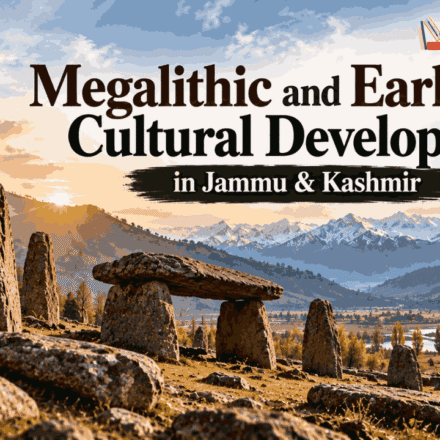
The prehistoric sequence of Kashmir did not end with the Neolithic. At Burzahom and Gufkral, archaeological evidence indicates a subsequent Megalithic phase, associated with the use or erection of large stones, including menhirs. This represents another stage in the changing material and social landscape of prehistoric Kashmir.
The transition from Neolithic to Megalithic should not be described as a sudden replacement of one population by another unless evidence specifically establishes such a movement. Archaeological cultures can change through a combination of internal development, interaction, migration and technological transformation.
At Burzahom, the sequence eventually continues into an Early Historic phase, demonstrating that the site was not abandoned immediately after the prehistoric period. The settlement therefore provides a long archaeological sequence through which changes in technology, settlement and material culture can be studied over several millennia.
CivilsCentral Historical Insight
The archaeological sequence from Neolithic to Megalithic and then Early Historic demonstrates that “prehistory” was not a single static age. Communities changed their technologies, settlement patterns, economic practices and symbolic traditions over time. The importance of sites such as Burzahom lies precisely in their ability to preserve these transitions within a stratified archaeological sequence.
Part XII — What Makes the Kashmir Neolithic Distinctive?
The Kashmir Neolithic is significant because several features occur together within a relatively distinctive regional archaeological tradition.
1. Pit Structures
Subterranean or semi-subterranean pits are among the most recognizable features of sites such as Burzahom and Gufkral.
2. Aceramic and Ceramic Phases
The archaeological record contains both phases without pottery and later phases with pottery.
3. Stone, Bone and Antler Technology
The extensive use of multiple raw materials produced a diversified tool tradition.
4. Mixed Economy
Agriculture existed alongside hunting, fishing, gathering and animal husbandry.
5. Distinctive Burial Practices
Human burials and animal associations provide evidence for complex social and symbolic practices.
6. Megalithic Development
The later archaeological sequence includes menhirs and other megalithic features.
7. Wider Cultural Connections
Material similarities and archaeobotanical evidence indicate interaction with neighbouring regions, although the precise mechanisms of interaction remain subjects of archaeological research.
Part XIII — Archaeology and the Problem of Interpretation
Prehistoric history must be treated differently from periods for which written records are available.
There is no contemporary prehistoric chronicle explaining why people constructed pit structures, how they organized their communities or what their burial rituals meant. Archaeologists therefore work from material evidence and construct interpretations from the relationship among artefacts, structures, stratigraphy, environmental data and comparative evidence.
This creates several important distinctions.
Evidence vs Interpretation
A pit structure is archaeological evidence. The interpretation that it was used as a dwelling is an archaeological inference supported by associated evidence. Similarly, the presence of animal remains in a burial is evidence. The precise religious meaning of that practice remains an interpretation. This distinction is not merely academic. It is essential for a premium JKSSB resource because statement-based questions can exploit precisely these differences.
Part XIV — What Archaeology Tells Us About Early J&K
The prehistoric archaeological record allows several broad conclusions.
First, human occupation in the region extends far beyond the historical periods preserved in literary sources. The Palaeolithic evidence demonstrates the presence of early stone-tool traditions, while the Neolithic record reveals increasingly settled communities.
Second, prehistoric communities adapted closely to the physical environment. River terraces, Karewa formations, lake margins and mountain valleys all played roles in the distribution of archaeological evidence.
Third, the Neolithic transformation was multidimensional. Agriculture and animal domestication were accompanied by changes in architecture, technology, pottery, burial practices and settlement organization.
Fourth, the prehistoric culture of J&K was not isolated. Archaeological similarities and botanical evidence indicate interaction with wider regions, but the evidence also points toward strong local development. Current research increasingly emphasizes interaction rather than simplistic one-way diffusion.
Finally, the archaeological record remains incomplete. Many sites have been identified but only a fraction have received systematic excavation. New dating techniques and archaeogenetic research are continuing to modify our understanding of prehistoric Kashmir.
Part XV — Historical Significance
The prehistoric history of Jammu and Kashmir is important for three interconnected reasons.
Environmental Adaptation
Early communities lived within a demanding Himalayan environment and developed settlement and subsistence strategies suited to local ecological conditions.
Cultural Transformation
The movement from earlier stone-tool traditions toward Neolithic agriculture, animal management, pottery and settled life represents a major transformation in the region’s human history.
Regional Interaction
The archaeological record indicates that Kashmir was connected to wider networks extending beyond the valley, while retaining distinctive local characteristics. This makes prehistoric J&K important not only for regional history but also for understanding cultural interaction across the western Himalayas.
CivilsCentral Historical Insight
The deepest significance of prehistoric J&K is that it reveals a history of adaptation, experimentation and interaction long before political states emerged. Kashmir’s prehistoric communities were neither isolated nor simply passive recipients of external influences; the archaeological record points toward local development occurring within wider networks of contact.
Part XVI — Evidence and Historical Interpretation Note
A premium understanding of prehistoric J&K requires distinguishing four levels of knowledge.
| Type | Example | How to Treat It |
|---|---|---|
| Archaeological Evidence | Stone tools, pits, pottery, burials | Direct material evidence |
| Scientific Evidence | Radiocarbon dating, palaeobotany, environmental studies | Helps establish chronology and environment |
| Archaeological Interpretation | Pit structures interpreted as dwellings | Strong interpretation, but open to debate |
| Comparative Interpretation | Similarities with Central Asia or neighbouring regions | Useful for understanding interaction, but not proof of migration |
Recent research is particularly important here. A 2026 AMS radiocarbon study demonstrates that scientific dating of previously under-studied sites can refine the chronology of Kashmir’s Neolithic. Similarly, archaeogenetic research at Burzahom is beginning to contribute a new dimension to the study of population history and interaction. These developments should be treated as ongoing research, not as final answers to long-standing historical questions.
Part XVII — JKSSB Knowledge Matrix
| Dimension | High-Value Knowledge |
|---|---|
| Earliest Evidence | Palaeolithic stone tools provide evidence of early human activity |
| Important Palaeolithic Area | Pahalgam / Lidder Valley |
| Important Palaeolithic Sites | Pahalgam, Balapura, Manasbal, Bomai, Sombur |
| Major Neolithic Sites | Burzahom, Gufkral, Kanispur |
| Famous Feature | Pit dwellings |
| Major Geological Context | Karewa deposits |
| Aceramic | Early Neolithic phase without pottery |
| Ceramic | Later Neolithic phase with pottery |
| Important Crops | Wheat, barley, lentils; other crops are also attested in the broader archaeological record |
| Important Tools | Stone axes, adzes, harvesters, grinding tools, bone points, needles, harpoons |
| Burial Evidence | Human burials, sometimes associated with animal remains |
| Megalithic Evidence | Menhirs and other large-stone features |
| Important Jammu Evidence | Lithic industries along Ravi/Tawi systems; Malpur Neolithic evidence |
| Major Archaeological Institution | Archaeological Survey of India |
| Major Archaeological Problem | Chronology and interpretation continue to be refined |
| Key Distinction | Palaeolithic evidence ≠ Neolithic culture |
Part XVIII — Examination Discrimination Points
Burzahom vs Gufkral
Both are major Neolithic sites of Kashmir and both are associated with pit structures, but they are distinct archaeological sites with their own sequences.
Palaeolithic vs Neolithic
Palaeolithic evidence is primarily associated with early stone-tool industries, whereas Neolithic archaeology provides evidence of settled life, agriculture, animal domestication and associated technological changes.
Aceramic vs Ceramic Neolithic
Aceramic = without pottery
Ceramic = pottery present
Kashmir Neolithic vs Jammu Neolithic Evidence
Do not automatically treat all prehistoric cultures of present-day J&K as identical. The archaeological traditions of the Kashmir Valley and Jammu region show significant differences.
Archaeological Evidence vs Interpretation
A pit is evidence. Calling it a dwelling is an interpretation supported by archaeological context.
Tradition vs Archaeology
Later literary traditions about the origins of Kashmir belong to a different evidentiary category from prehistoric archaeological evidence and should not be used to establish prehistoric chronology.
Part XIX — JKSSB Question Pattern
Direct Fact
Which archaeological site of Kashmir is particularly famous for its subterranean pit dwellings?
A. Kanispur
B. Burzahom
C. Manda
D. Ambaran
Answer: B. Burzahom
Statement-Based
Consider the following statements:
- Burzahom provides evidence of pit structures.
- Kashmir Neolithic communities depended exclusively on agriculture.
- Gufkral provides evidence of Neolithic occupation.
Which of the statements given above is/are correct?
A. 1 only
B. 1 and 3 only
C. 2 and 3 only
D. 1, 2 and 3
Answer: B. 1 and 3 only
Explanation: Burzahom is associated with pit structures, and Gufkral is an important Neolithic site. The economy was mixed, with evidence of agriculture alongside hunting, gathering and animal management.
Identification by Clues
A prehistoric archaeological site in Kashmir is especially associated with subterranean habitation pits, stone and bone tools, later megalithic remains and a long sequence continuing into the Early Historic period. Identify it.
A. Burzahom
B. Manda
C. Kanispur
D. Pahalgam
Answer: A. Burzahom
Match the Following
| Site | Association |
|---|---|
| 1. Pahalgam | A. Neolithic-Megalithic site |
| 2. Burzahom | B. Palaeolithic evidence |
| 3. Gufkral | C. Neolithic pit structures |
| 4. Malpur | D. Neolithic evidence in Jammu |
Correct matching:
1-B, 2-C, 3-A, 4-D
Correct / Incorrect Pair
Which of the following is incorrectly matched?
A. Burzahom — Pit structures
B. Pahalgam — Palaeolithic tools
C. Gufkral — Neolithic-Megalithic sequence
D. Manda — Famous Kashmir Neolithic pit settlement
Answer: D
Manda is in the Jammu region and is primarily important for its later prehistoric/protohistoric and Harappan archaeological significance, not as the classic Kashmir pit-dwelling site.
Part XX — What Can JKSSB Ask?
From this topic, JKSSB can test:
- Palaeolithic sites
- Neolithic sites
- Burzahom’s distinctive features
- Gufkral’s significance
- Kanispur’s location
- Malpur and Jammu archaeology
- Karewa association
- pit structures
- aceramic vs ceramic Neolithic
- agriculture and animal domestication
- stone, bone and antler tools
- megalithic features
- site-feature matching
- chronology
- correct/incorrect statements
- archaeological evidence vs interpretation.
Part XXI — Rapid Revision Zone
Important Sites
| Site | Key Association |
|---|---|
| Pahalgam | Palaeolithic evidence |
| Balapura | Palaeolithic tools |
| Manasbal | Palaeolithic tools |
| Bomai | Handaxe and prehistoric rock engraving |
| Sombur | Upper Palaeolithic evidence |
| Burzahom | Neolithic pit structures; Megalithic and Early Historic sequence |
| Gufkral | Aceramic/Ceramic Neolithic; Megalithic sequence |
| Kanispur | Neolithic and later cultural sequence |
| Malpur | Neolithic evidence in Jammu |
Important Terms
Palaeolithic — Old Stone Age
Neolithic — New Stone Age; associated with major changes in settlement, technology and food production
Aceramic Neolithic — Neolithic phase without pottery
Ceramic Neolithic — Neolithic phase with pottery
Megalithic — archaeological traditions involving large stones, including menhirs
Karewa — ancient lacustrine/related sedimentary formations important to Kashmir’s geological and archaeological record
High-Value Associations
Burzahom → Pit structures
Gufkral → Neolithic-Megalithic sequence
Pahalgam → Palaeolithic evidence
Balapura → Palaeolithic tools
Malpur → Jammu Neolithic evidence
Karewas → Kashmir prehistoric landscape
Wheat + Barley + Lentils → Neolithic agricultural evidence
Part XXII — Frequently Confused Facts
| Do Not Confuse | Correct Distinction |
|---|---|
| Burzahom vs Gufkral | Both are major Kashmir Neolithic sites, but they are different sites |
| Pahalgam vs Burzahom | Pahalgam is important for Palaeolithic evidence; Burzahom for Neolithic and later sequence |
| Aceramic vs Ceramic | Absence vs presence of pottery |
| Palaeolithic vs Neolithic | Earlier stone-tool traditions vs later settled/food-producing developments |
| Burzahom vs Manda | Burzahom = Kashmir Neolithic; Manda = Jammu archaeological site with later protohistoric/Harappan significance |
| Archaeological evidence vs tradition | Material evidence must be distinguished from later literary narratives |
| Neolithic vs Megalithic | Distinct archaeological phases, although they occur sequentially at some sites |
Part XXIII — Chronological Framework
A simplified framework for examination purposes is:
Palaeolithic evidence
↓
Neolithic — Aceramic phase
↓
Neolithic — Ceramic phase
↓
Megalithic phase
↓
Early Historic developments
This is a broad analytical sequence. Exact dates vary by site and archaeological phase, and current research continues to refine the chronology.
Chapter Summary
The prehistoric history of Jammu and Kashmir is reconstructed primarily through archaeology rather than written records. Evidence from Pahalgam and other parts of Kashmir demonstrates early Palaeolithic activity, while later archaeological sites reveal the emergence of Neolithic communities whose lives involved agriculture, animal management, hunting, specialized stone and bone technology, pottery and increasingly settled habitation.
The Kashmir Neolithic is especially important because of its distinctive archaeological features, including subterranean pit structures, aceramic and ceramic phases, diverse tool traditions, agricultural evidence and later megalithic developments. Burzahom and Gufkral are central to this understanding, but they belong to a much wider archaeological landscape that includes Kanispur and numerous less extensively excavated sites.
The prehistoric archaeology of Jammu provides a complementary but not identical record, with lithic industries associated with the Ravi, Ujh, Basantar and Tawi systems and Neolithic evidence at Malpur. Together, these discoveries demonstrate that prehistoric J&K contained diverse regional archaeological traditions rather than a single uniform culture.
JKSSB Takeaway
Remember the core chain:
Palaeolithic → Early human presence and stone tools
Neolithic → Agriculture + domestication + settlement + new technology
Burzahom → Pit structures + Neolithic/Megalithic/Early Historic sequence
Gufkral → Neolithic-Megalithic sequence
Pahalgam → Palaeolithic evidence
Karewas → Important geological and archaeological landscape
Malpur → Important prehistoric evidence in Jammu
Mind Map
PREHISTORIC J&K
        │
        ├── ENVIRONMENT
        │      ├── Kashmir Valley
        │      ├── Karewas
        │      ├── Rivers
        │      └── Himalayan setting
        │
        ├── PALAEOLITHIC
        │      ├── Pahalgam
        │      ├── Balapura
        │      ├── Manasbal
        │      ├── Bomai
        │      └── Sombur
        │
        ├── NEOLITHIC
        │      ├── Aceramic
        │      ├── Ceramic
        │      ├── Agriculture
        │      ├── Animal domestication
        │      ├── Pottery
        │      └── Settled life
        │
        ├── MAJOR SITES
        │      ├── Burzahom
        │      ├── Gufkral
        │      ├── Kanispur
        │      └── Malpur
        │
        ├── MATERIAL CULTURE
        │      ├── Stone tools
        │      ├── Bone tools
        │      ├── Antler tools
        │      ├── Pottery
        │      └── Grinding equipment
        │
        ├── SOCIAL / RITUAL
        │      ├── Burials
        │      ├── Animal associations
        │      └── Engraved hunting scene
        │
        ├── MEGALITHIC
        │      └── Menhirs
        │
        └── JKSSB
               ├── Statements
               ├── Chronology
               ├── Matching
               ├── Identification
               └── Confused facts
FAQs
1. What is the main source for studying prehistoric Jammu and Kashmir?
Archaeological evidence is the principal source because written historical records do not exist for the prehistoric period. Stone tools, structures, pottery, plant remains, animal bones and burials are especially important.
2. Which archaeological site is most famous for pit structures in Kashmir?
Burzahom is particularly famous for its subterranean or pit structures.
3. What are the major Neolithic sites of Kashmir?
Burzahom, Gufkral and Kanispur are among the most important excavated Neolithic sites.
4. What is the difference between Aceramic and Ceramic Neolithic?
The Aceramic Neolithic refers to an early phase without pottery, while the Ceramic Neolithic contains pottery.
5. Was the Neolithic economy based entirely on agriculture?
No. Evidence indicates a mixed economy involving agriculture, animal domestication, hunting, fishing and gathering.
6. Why are Karewas important in J&K history?
Karewa formations are important geological features of the Kashmir Valley and contain deposits associated with the environmental and archaeological history of prehistoric Kashmir.
7. Is Jammu’s prehistoric archaeology identical to Kashmir’s Neolithic culture?
No. The Jammu region has its own prehistoric archaeological record, including lithic industries and Neolithic evidence at sites such as Malpur, but its material culture should not automatically be equated with the distinctive Northern Neolithic of the Kashmir Valley.
8. Why is Burzahom historically important?
It preserves a long archaeological sequence including Neolithic, Megalithic and Early Historic phases and provides important evidence for settlement architecture, technology, subsistence and burial practices.
9. Is the chronology of the Kashmir Neolithic completely settled?
No. Archaeological dating continues to be refined through new excavations, radiocarbon dating and scientific analysis.
10. Why should prehistoric history be treated differently from later J&K history?
Because prehistoric J&K lacks contemporary written chronicles. Its history must therefore be reconstructed primarily from material and scientific evidence, making source criticism and interpretation especially important.
About The Author







[…] Article 01 — Prehistoric Jammu & Kashmir: Archaeological Evidence, Neolithic Culture and Early… […]