Energy: Concept, Classification & India’s Energy Landscape | Sources, Types & Energy Transition

Learning Dashboard
| Chapter Information | Details |
|---|---|
| Subject | General Science – Physics |
| Series | Sources of Energy |
| Lesson Number | Lesson 1 |
| Current Lesson | Energy: Concept, Classification & India’s Energy Landscape |
| Next Lesson | Conventional Sources of Energy: Coal, Petroleum, Natural Gas & Hydropower |
| Core Theme | Energy is the foundation of modern civilization. Understanding what energy is, how energy sources are classified, how energy is transformed and why countries need secure and sustainable energy systems provides the conceptual foundation for studying conventional and renewable sources of energy. |
| Major Topics Covered | Concept of energy, energy and power, forms of energy, energy transformation, conservation of energy, renewable and non-renewable sources, conventional and non-conventional sources, primary and secondary energy, commercial and non-commercial energy, energy efficiency, energy conservation, energy security, energy transition and India’s changing energy landscape |
| Important Energy Sources Studied | Coal, petroleum, natural gas, hydropower, biomass, solar energy, wind energy, tidal energy and emerging energy technologies |
| Key Concepts | Energy, Power, Primary Energy, Secondary Energy, Renewable Energy, Non-Renewable Energy, Conventional Energy, Non-Conventional Energy, Energy Efficiency, Energy Conservation, Energy Security and Energy Transition |
| Real-Life Applications | Electricity generation, transportation, agriculture, industries, household energy use, renewable power systems, rural electrification, energy storage and sustainable development |
| Exam Focus | Frequently Asked in JKSSB, JKPSC, JKAS, SSC, CDS, UPSC & State PSC Examinations; important for conceptual questions, classification-based questions, current affairs and analytical questions on India’s energy transition |
Introduction: Why Energy Is More Than a Physics Concept
Almost every feature of modern life depends on energy. A farmer needs energy to operate irrigation pumps and agricultural machinery. A factory needs it to run machines and furnaces. A hospital needs reliable electricity for diagnostic equipment, intensive-care systems and refrigeration. Transport systems require fuels or electricity, while communication networks, data centres and digital infrastructure depend on continuous power supply.
This makes energy fundamentally different from an ordinary commodity. It is an enabling resource: the availability, reliability and affordability of energy determine how effectively other economic resources can be used.
Human civilization has therefore progressed alongside changes in the way energy is obtained and used. Early societies depended heavily on human and animal labour, firewood and other forms of biomass. The Industrial Revolution dramatically increased the use of coal. Petroleum and natural gas later transformed transportation, industry and urbanization. Electricity became the most versatile energy carrier of the modern economy, allowing energy produced in one location to be transmitted and used elsewhere.
The present stage of this story is different. The world is attempting to meet rising energy demand while reducing the environmental and strategic costs associated with fossil fuels. Solar and wind power are expanding rapidly, battery storage is becoming increasingly important, electric mobility is developing, and countries are investing in hydrogen, nuclear energy, grid modernization and energy efficiency.
India is at the centre of this transition. Its energy demand continues to rise because of economic growth, urbanization, industrialization and improving living standards, yet the country is simultaneously expanding its non-fossil energy capacity. By the end of 2025, India’s installed electricity capacity had reached about 513.73 GW, with 51.93% coming from non-fossil sources. India had crossed the 50% non-fossil installed-capacity milestone in June 2025.
The central question of this chapter, therefore, is not simply “What are the sources of energy?”
It is: How does an energy system support development, and how can that system become more secure, efficient and sustainable?
Understanding Energy from First Principles
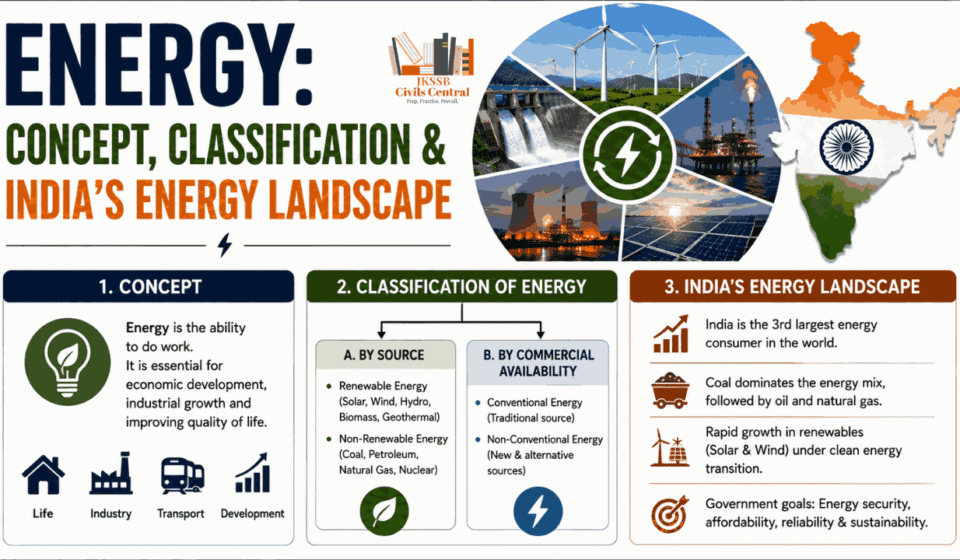
In physics, energy is the capacity to do work or bring about a change. The SI unit of energy is the joule (J).
The definition is simple, but its significance becomes clearer when we observe the world around us. A moving car can change its position because it possesses kinetic energy. Water stored behind a dam can drive turbines because it possesses gravitational potential energy. Food allows the human body to perform physical work because it contains chemical energy. Sunlight can heat a surface or generate electricity because it carries radiant energy.
Energy therefore exists in different forms, but these forms are not isolated from one another. A coal-fired power plant provides a useful example. Coal contains chemical energy. When it burns, this becomes thermal energy. The heat produces steam, the steam drives a turbine, and the turbine drives a generator. The final product is electrical energy.
The sequence can be represented as:
Chemical Energy
       ↓
Thermal Energy
       ↓
Mechanical Energy
       ↓
Electrical Energy
A hydroelectric power plant follows a different pathway:
Potential Energy of Stored Water
              ↓
       Kinetic Energy
              ↓
       Mechanical Energy
              ↓
       Electrical Energy
A wind turbine similarly converts:
Kinetic Energy of Wind
          ↓
   Mechanical Energy
          ↓
   Electrical Energy
This leads to one of the most fundamental principles of physics: energy is neither created nor destroyed; it is transformed from one form into another. The practical energy system of a country is essentially a huge network of such transformations.
Energy and Power Are Not the Same
One of the most common conceptual mistakes is to use energy and power interchangeably. Energy refers to the amount of work that can be performed or the amount of energy transferred. Power is the rate at which work is done or energy is transferred. Energy is measured in joules, while power is measured in watts. This distinction becomes particularly important when discussing electricity.
A power plant may have an installed capacity of 1,000 MW. That tells us the maximum rate at which it can generate electricity under specified conditions; it does not mean that it produces 1,000 MW continuously under all circumstances.
A solar plant cannot generate at its rated capacity throughout the night. A wind farm’s output changes with wind conditions. A thermal plant may be unavailable during maintenance. Hydropower output can vary with water availability.
Installed capacity tells us what a system can potentially produce; generation tells us what it actually produces over a period of time.
Why Does Civilization Need Different Sources of Energy?
If energy is fundamentally just energy, why do we need coal, petroleum, natural gas, hydro, solar, wind, biomass and other sources?
The answer lies in the different characteristics of energy sources.
An energy source is valuable not merely because it contains energy, but because of how easily that energy can be accessed, converted, transported, stored and used. Coal has high energy density and can be transported and stored relatively easily. Petroleum is particularly valuable for transportation because liquid fuels can store large amounts of energy in compact form. Natural gas can provide flexible electricity generation and industrial heat.
Solar radiation is abundant and widely distributed, but its availability varies with time and weather. Wind energy is renewable and increasingly economical, but its output also varies. Hydropower can provide electricity and, in some cases, valuable flexibility to the electricity system, but suitable sites are geographically constrained.
Biomass can provide energy while also utilizing agricultural and organic residues, but its sustainability depends on how the resource is produced and collected.
Thus, there is no universally perfect energy source.
Every source involves a combination of: Availability + Reliability + Cost + Energy Density + Infrastructure + Environmental Impact + Technological Requirements
The Different Forms of Energy
Energy can appear in many forms.
Kinetic energy is associated with motion. Flowing water and moving air are important examples exploited for power generation.
Potential energy is stored because of position or configuration. Water stored behind a dam is a classic example.
Chemical energy is stored in chemical bonds. Coal, petroleum, natural gas, biomass and food contain chemical energy.
Thermal energy is associated with the internal motion of particles and is central to heating and thermal power generation.
Electrical energy is associated with electric charges and is particularly useful because it can be transmitted and converted into many other forms.
Radiant energy is carried by electromagnetic radiation. Solar radiation is the most important natural source in this category.
Nuclear energy originates from changes in atomic nuclei and is fundamentally different from chemical energy.
The important point is not to memorize these as disconnected definitions. Instead, understand that energy systems continuously transform one form into another.
How Should Energy Sources Be Classified?
There is no single classification that answers every question about an energy source. A source can be classified according to whether it is naturally replenished, how long it has been used, whether it occurs directly in nature, whether it enters a commercial market, or whether it can be exhausted.
This is why the same energy source may appear in different categories. Understanding the basis of classification is more important than memorizing the categories themselves.
Renewable and Non-Renewable Energy
The most important modern classification is based on replenishment.
Renewable Energy
Renewable energy sources are naturally replenished on a timescale relevant to human use. Examples include:
- Solar energy
- Wind energy
- Hydropower
- Biomass
- Tidal energy
- Geothermal energy
However, the term renewable does not mean unlimited or impact-free.
A river can be renewable, but a hydroelectric project can alter river ecosystems. Solar energy is renewable, but solar installations require land, materials and manufacturing infrastructure. Wind is renewable, but wind farms can create local ecological and land-use concerns. Biomass is renewable only when its rate of use does not exceed sustainable regeneration.
Renewable describes the replenishment of the resource, not the absence of environmental impact.
Non-Renewable Energy
Non-renewable resources exist in finite quantities and are not replenished on a human timescale. Coal, petroleum and natural gas are the principal fossil fuels. Uranium used for nuclear power is also a finite mineral resource. This gives us an important examination distinction:
Nuclear energy is non-renewable but non-fossil.
The terms renewable and fossil/non-fossil describe different characteristics and should not be treated as interchangeable.
Conventional and Non-Conventional Energy
Another classification commonly used in Indian textbooks and competitive examinations is conventional versus non-conventional energy. Conventional sources are those that have traditionally played a major role in established commercial energy systems. Coal, petroleum, natural gas and large hydropower are commonly placed in this category.
Non-conventional sources generally refer to newer or less traditionally exploited sources, particularly solar, wind, tidal, geothermal and several modern renewable technologies. But there is an important conceptual qualification. This is not a universal scientific classification. It is largely historical and contextual.
Solar energy may once have been considered highly unconventional, but its rapid commercialization is changing that distinction. Therefore, for examination purposes, remember the conventional classification while understanding that the boundary can change with technology and historical usage.
Primary and Secondary Energy
A completely different question is whether energy is available directly from nature or has already been converted into another usable form. This produces the distinction between primary and secondary energy.
Primary Energy
Primary energy is obtained directly from natural sources before human conversion. Examples include:
- Coal
- Crude petroleum
- Natural gas
- Sunlight
- Wind
- Flowing water
- Biomass
- Uranium
These are the starting points of the energy system.
Secondary Energy
Secondary energy is produced by converting primary energy into a more convenient form. Electricity is the most important example.
Coal can be converted into electricity in a thermal power plant. Wind can be converted into electricity through a turbine-generator system. Solar radiation can be converted into electricity through photovoltaic cells. Electricity is therefore best understood as an energy carrier, rather than a naturally occurring primary energy source.
This distinction becomes increasingly important in a world where transport, heating and industry are becoming more electrified.
Commercial and Non-Commercial Energy
Energy can also be classified according to whether it is traded in formal markets.
Commercial energy is purchased and sold, such as electricity, coal, petroleum products and natural gas.
Non-commercial energy traditionally refers to energy resources that households or communities collect and use directly, particularly firewood, agricultural residues and animal dung.
The distinction is not permanent. When biomass is collected traditionally and burned directly, it may function as non-commercial energy. When the same resource is processed into pellets, biogas or other marketable fuels, it enters a commercial energy system.
Energy classifications often depend on how a resource is used, not merely on what the resource physically is.
Exhaustible and Inexhaustible Sources
Another classification considers whether the available resource can eventually be exhausted. Coal, petroleum, natural gas and uranium are exhaustible because their geological stocks are finite.
Solar radiation and tidal processes are often described as inexhaustible from the human perspective because their natural flows continue independently of human consumption.
Yet even an inexhaustible energy flow cannot automatically provide unlimited usable energy. Technology, geographical conditions, conversion efficiency, transmission and storage determine how much of that natural flow can actually be harnessed.
Energy Conservation and Energy Efficiency
The energy challenge is not solved only by producing more energy. A country can also reduce pressure on its energy system by using energy more intelligently. Energy conservation broadly involves avoiding unnecessary energy use. Turning off unused equipment, reducing unnecessary travel or improving building design can contribute to conservation.
Energy efficiency, on the other hand, means achieving the same useful outcome with less energy input. An LED bulb illustrates the idea. If it provides the required illumination while consuming less electricity than an older technology, it is more energy-efficient.
This distinction matters because efficiency improvements can reduce:
Energy demand → Fuel consumption → Costs → Infrastructure pressure → Emissions
Energy efficiency is therefore often described as one of the most cost-effective components of an energy strategy.
From Energy to Energy Security
Once energy becomes essential to every major economic activity, its availability becomes a matter of national security. This is the foundation of energy security. Energy security means ensuring that adequate energy is available reliably, affordably and sustainably, while reducing vulnerability to disruptions.
For a country such as India, this question is particularly important because energy demand is large and growing, while several important fuels have historically involved substantial imports. Energy security therefore involves much more than possessing domestic coal or renewable resources.
It includes:
- Availability of resources
- Reliability of supply
- Affordability
- Import dependence
- Strategic reserves
- Diversification of sources
- Transmission infrastructure
- Storage
- Technological capability
- Resilience against geopolitical and climatic disruptions
This is why renewable energy has importance beyond climate policy. Domestic solar and wind resources can contribute to diversification of India’s energy supply, while domestic manufacturing and energy-storage capabilities can reduce vulnerabilities elsewhere in the energy chain.
India’s Energy Landscape: A System in Transition
India’s energy story is shaped by a fundamental tension. On one side, India needs more energy to support economic development, industrialization, urbanization, digitalization and improving living standards. On the other side, it needs to reduce the environmental and strategic costs associated with conventional energy. This does not mean that one source will suddenly replace all others.
Instead, India’s energy system is becoming more diversified. At the end of 2025, India’s total installed electricity capacity stood at approximately 513.73 GW. Fossil-fuel sources accounted for about 48.07%, while non-fossil sources accounted for 51.93%. Non-fossil capacity included renewable energy as well as nuclear power.
This is an important milestone, but it must be interpreted correctly. More than half of installed capacity being non-fossil does not mean that more than half of India’s electricity generation comes from non-fossil sources.
The two measurements answer different questions. Capacity measures the power-generation infrastructure that exists. Generation measures the electricity actually produced. This distinction is one of the most important conceptual traps in the entire energy topic.
India’s Renewable-Energy Expansion
The scale of India’s renewable expansion has been substantial. According to the Ministry of New and Renewable Energy, by 30 June 2026, India had approximately:
- 162.15 GW of solar capacity
- 57.44 GW of wind capacity
- 5.18 GW of small hydropower
- 10.87 GW of bio-power
- 0.88 GW of waste-to-energy
- 52.06 GW of large hydropower
The total renewable-energy capacity, including large hydropower, was approximately 288.59 GW.
Solar illustrates the speed of this transformation particularly clearly. India’s installed solar capacity increased from about 2.82 GW in 2014 to 162.15 GW by June 2026. Wind capacity increased from about 21 GW to 57.44 GW over the same broad period. But capacity growth alone does not eliminate the challenges of the energy transition. Solar generation varies with sunlight. Wind generation varies with wind conditions. Electricity demand does not necessarily follow these patterns.
This creates the need for: Storage + Transmission + Flexible Generation + Forecasting + Grid Management
That is why the next lessons on individual energy sources will eventually lead us to questions of batteries, pumped storage, grid integration and energy security.
Why Coal Still Matters
The rapid growth of renewable energy does not mean that coal has immediately disappeared from India’s energy system. Coal continues to be important because it provides large-scale electricity generation and supports energy-intensive industries such as steel and cement.
The International Energy Agency notes that coal remained the dominant source of electricity generation in India in 2025, even as renewable generation expanded. The IEA also projects that India’s electricity demand will continue to grow strongly through 2030, with solar PV expected to provide around half of additional demand growth and coal around one-quarter, with the remainder supplied by wind, nuclear, hydropower and gas.
Energy transition does not necessarily mean immediate fossil-fuel elimination.
For a rapidly developing economy, the transition is a process of changing the composition, efficiency and environmental performance of the energy system while continuing to meet rising demand.
The Four-Way Energy Challenge
India’s energy challenge cannot be reduced to a simple choice between fossil fuels and renewable energy. A national energy system has to satisfy several objectives simultaneously. Energy must be available in sufficient quantities, affordable to consumers, reliable when required, and increasingly sustainable from an environmental perspective.
These objectives are closely connected, but they do not always move in the same direction. A policy that improves one dimension can sometimes create pressure on another. Understanding these trade-offs is essential for understanding India’s energy transition.
1. Energy Security: Is Enough Energy Available When We Need It?
Energy security refers to the ability of a country to ensure adequate and dependable access to energy while protecting itself from major disruptions in supply. For India, this is particularly important because energy demand is large and continues to grow with industrialization, urbanization, rising incomes and increasing electrification.
Energy security has several dimensions. A country needs sufficient domestic resources, dependable imports, adequate generation capacity, fuel reserves, transmission infrastructure and increasingly, energy-storage capacity.
Consider petroleum. India has substantial petroleum demand but depends significantly on imported crude oil. A major geopolitical conflict, disruption of shipping routes or sharp increase in international oil prices can therefore affect India’s import bill, inflation and economic stability. Renewable energy can strengthen energy security because sunlight and wind are domestic resources. However, renewable energy also introduces new dependencies. Solar panels, batteries, wind turbines and their components require manufacturing capacity and access to minerals and supply chains.
Energy security is not simply about producing energy domestically; it is about building a resilient energy system that can withstand disruptions.
2. Affordability: Can People and Industries Actually Pay for Energy?
Energy may be available, but if it is too expensive, it cannot effectively support development. Energy affordability means that households, farmers, businesses and industries can obtain the energy they require without an excessive financial burden.
This is particularly important in a developing economy such as India. For a household, high electricity prices can increase the cost of living. For agriculture, expensive electricity or diesel can raise irrigation costs. For industries, expensive electricity and fuel increase production costs and can reduce international competitiveness.
Affordability also has a broader development dimension. Poor households may depend more heavily on traditional fuels if modern energy services are unavailable or unaffordable. Therefore, improving energy access is not merely about connecting a household to an electricity network; it is also about ensuring that the household can actually afford useful energy services.
Why does affordability create a trade-off?
Different energy sources have different cost structures. A fossil-fuel power plant may require continuous expenditure on fuel. A solar plant has no fuel cost after installation, but requires significant upfront investment and additional infrastructure for transmission and, where necessary, storage.
Similarly, upgrading transmission networks, installing batteries or developing pumped-storage systems can increase initial investment even though they may improve long-term system reliability.
Therefore, energy policy must consider both: Cost of producing energy and Cost of building and maintaining the entire system required to deliver it reliably.
3. Reliability: Is Energy Available at the Exact Moment It Is Needed?
Reliability is different from simply having sufficient installed capacity. An electricity system must be capable of supplying consumers when demand occurs, including during periods of unusually high demand. This becomes particularly important when a growing share of electricity comes from variable renewable sources.
Solar power is an excellent example. A solar plant can produce substantial electricity during daylight hours, but its output falls sharply after sunset. Yet electricity demand does not disappear when the Sun sets. Similarly, wind turbines generate electricity when suitable wind conditions exist, but wind speed is not constant.
The timing of renewable-energy generation does not always match the timing of electricity demand.
The electricity system therefore needs mechanisms to bridge this gap. These include:
- Battery energy storage
- Pumped-storage hydropower
- Flexible thermal generation
- Hydropower
- Demand-side management
- Stronger transmission networks
- Better weather and renewable-energy forecasting
- Regional power exchanges
This is why simply comparing the installed capacity of a solar plant with that of a coal plant can be misleading. A 1 GW solar installation and a 1 GW thermal plant have the same rated capacity, but they do not necessarily provide the same amount of electricity at every hour of the day.
4. Sustainability: Can We Meet Energy Demand Without Creating Unsustainable Environmental Costs?
The fourth dimension is sustainability. Energy production and consumption affect the environment in multiple ways. The combustion of coal, petroleum and natural gas produces greenhouse gases and air pollutants. Mining can alter landscapes and ecosystems. Large infrastructure projects can affect land and water systems.
Renewable energy can significantly reduce operational emissions compared with fossil-fuel generation, but renewable technologies are not completely impact-free. Solar and wind projects require land and infrastructure. Hydropower can alter river ecosystems. Biomass requires sustainable feedstock management. Manufacturing renewable-energy equipment requires minerals, materials and industrial processes.
Therefore, sustainability does not mean: “Use renewable energy and every environmental problem disappears.”
Rather, it means: Meet human energy needs while minimizing environmental damage and ensuring that resources and ecosystems remain viable over the long term.
This requires consideration of the entire life cycle of an energy technology—from extraction of raw materials and manufacturing to operation, disposal and recycling.
The Energy Transition Is Also a Technology Transition
The movement towards renewable energy is often described as a shift from fossil fuels to solar and wind. That is only part of the story. A modern energy transition also involves changing the technologies used to generate, transmit, store and consume energy.
The system increasingly includes: Solar PV, Wind turbines, Battery storage, Pumped-storage hydropower, Smart grids, Electric vehicles, Green hydrogen, Advanced nuclear technologies, Energy-efficient appliances, Digital energy-management systems
This means the energy transition is simultaneously an industrial, technological and infrastructure transition. Countries that develop capabilities in these areas can gain not only environmental benefits but also manufacturing, investment and employment opportunities.
Current Affairs: The Direction of India’s Energy Transition
India’s recent developments demonstrate this transition clearly. India achieved the milestone of 50% of installed electricity capacity from non-fossil sources in June 2025, ahead of the timeline associated with its Paris Agreement commitment. By 31 December 2025, the share had risen to 51.93%.
During 2025 alone, India added 48.44 GW of renewable-energy capacity, including about 37.95 GW of solar and 6.35 GW of wind. The policy focus is also moving beyond simply adding generation capacity. India is increasingly concerned with renewable-energy manufacturing, grid integration, storage, research and technological development.
In 2026, the Ministry of New and Renewable Energy continued its Renewable Energy Research and Technology Development Programme for the 2026–27 to 2030–31 period, demonstrating the increasing importance of indigenous technological capability in the renewable-energy sector.
At the global level, the transition is also accelerating. The IEA estimates that renewables accounted for 34% of global electricity generation in 2025, while solar PV and wind together accounted for 17%. At the same time, coal remained the largest individual source of global electricity generation.
This is an important reminder that the global energy transition is not a simple story of one source replacing another. Different energy systems are evolving at different speeds according to their resources, economic conditions, technologies and policy priorities.
The Central Challenge: From Capacity to a Complete Energy System
Adding renewable capacity is necessary, but it is not sufficient. Suppose a country installs enormous quantities of solar power. The electricity generated during sunny hours may exceed immediate demand, while electricity demand continues after sunset.
The system therefore needs ways to: Generate → Transmit → Store → Dispatch → Consume
The same principle applies to wind power. A windy location may be hundreds of kilometres away from a major electricity-demand centre. This creates the need for transmission infrastructure.
Thus, the future energy system cannot be judged simply by asking: “How much renewable capacity has been installed?”
It must also ask: “Can that energy be delivered reliably and affordably when consumers need it?”
That is the deeper meaning of energy-system transformation.
Energy and Sustainable Development
Energy lies at the intersection of development and environmental sustainability. Without sufficient energy, industrialization and infrastructure development become difficult. But uncontrolled dependence on carbon-intensive fuels can contribute to air pollution, greenhouse-gas emissions and climate risks.
The objective is therefore not to minimize energy use at any cost. It is to ensure that development becomes progressively more energy-efficient, secure and sustainable. This is why the energy transition must be linked with:
- Sustainable transportation
- Efficient buildings
- Clean industrial technologies
- Renewable electricity
- Energy storage
- Electrification
- Circular economy
- Sustainable biomass
- Cleaner fuels
- Technological innovation
Energy policy is therefore not an isolated environmental subject. It connects Physics, Geography, Economics, Environment, Science & Technology, International Relations and Governance.
CivilsCentral Insight
1. Renewable ≠ Impact-Free
Renewable sources are replenished naturally, but their infrastructure can still have environmental and social impacts.
2. Non-Fossil ≠ Renewable
Nuclear energy is the classic example. It is non-fossil but non-renewable.
3. Installed Capacity ≠ Electricity Generation
Capacity represents potential generation capability; generation represents actual electricity produced.
4. Electricity ≠ Primary Energy
Electricity is generally a secondary energy form or energy carrier produced from primary energy sources.
5. Energy Transition ≠ Immediate Fossil-Fuel Elimination
A transition involves gradually changing the structure of the energy system while continuing to meet development needs.
6. Energy Security ≠ Energy Self-Sufficiency
A country can strengthen energy security through diversification, strategic reserves, resilient supply chains, domestic production, international partnerships and efficient energy use. Complete self-sufficiency is not the only route to security.
Challenges Ahead
India’s energy transition will take place against the background of rising demand.
The first challenge is scale. A large population and expanding economy require enormous quantities of reliable energy.
The second is variability. Solar and wind output fluctuates, creating the need for storage and flexible electricity systems.
The third is transmission. Renewable resources and major demand centres are not always geographically aligned.
The fourth is finance. New generation, transmission, storage and manufacturing infrastructure require substantial investment.
The fifth is technology and manufacturing. Energy security increasingly depends not only on access to fuels but also on access to technologies, components and critical minerals.
The sixth is the just transition. Regions and workers dependent on coal and other fossil-fuel industries cannot simply be left behind.
The seventh is sustainable consumption. Increasing supply alone cannot indefinitely compensate for inefficient energy use.
Way Forward
India’s energy future will require diversification rather than dependence on a single source. Solar and wind can provide large quantities of low-carbon electricity. Hydropower can provide renewable generation and, where appropriately developed, system flexibility. Biomass can convert agricultural and organic residues into useful energy. Nuclear power can contribute firm low-carbon electricity. Storage technologies can help balance variable renewable generation.
At the same time, energy efficiency must become a central component of energy policy. Improving the efficiency of buildings, industries, appliances, transport systems and agricultural equipment can reduce the amount of energy required to achieve the same level of economic output.
India will also need stronger transmission networks, domestic manufacturing capabilities, resilient supply chains, research and development, sustainable critical-mineral strategies and mechanisms for supporting regions affected by the decline of fossil-fuel-intensive activities.
Conclusion
Energy is the foundation of modern civilization because almost every economic and social activity ultimately depends on the ability to obtain and transform energy into useful forms.
Understanding the energy sector therefore begins with Physics but cannot end there. The distinction between renewable and non-renewable sources explains the question of resource availability. The distinction between conventional and non-conventional sources reflects historical development. Primary and secondary energy explain how natural resources are converted into usable energy carriers. Energy efficiency and conservation address the demand side, while energy security connects energy with national economic and strategic interests.
India’s energy landscape demonstrates why these concepts matter. The country is simultaneously expanding renewable capacity, continuing to rely on conventional sources, investing in nuclear power and storage, strengthening transmission infrastructure and developing domestic technological capabilities. India’s achievement of more than 50% non-fossil installed electricity capacity in 2025 was a significant milestone, but it is only one part of a much larger transformation. (Power Ministry of India)
The real energy transition is therefore not simply about changing what fuels are used. It is about changing how energy is generated, converted, transported, stored and consumed. That broader understanding will provide the conceptual foundation for the remaining lessons in this series, beginning with the conventional sources that powered India’s industrial development and continue to play a major role today.
Revision Framework
                         ENERGY
                            │
          ┌─────────────────┼─────────────────┐
          │                 │                 │
       FORMS            SOURCES          ENERGY SYSTEM
          │                 │                 │
  Kinetic              Renewable        Primary Energy
  Potential            Non-renewable    ↓
  Chemical             Conventional     Conversion
  Thermal              Non-conventional ↓
  Electrical                           Secondary Energy
  Radiant
  Nuclear
                            │
                            ▼
                    ENERGY SECURITY
                            │
          ┌─────────────────┼─────────────────┐
          │                 │                 │
      Availability      Affordability      Reliability
                            │
                            ▼
                      Sustainability
                            │
                            ▼
                    ENERGY TRANSITION
                            │
       ┌────────────────────┼────────────────────┐
       │                    │                    │
    Renewable            Efficiency          Storage
    Expansion                                & Grid
       │                    │                    │
       └────────────────────┼────────────────────┘
                            ▼
                 SUSTAINABLE ENERGY SYSTEM
Frequently Asked Questions
1. What is energy?
Energy is the capacity to do work or bring about a change. Its SI unit is the joule.
2. What is the difference between energy and power?
Energy represents the amount of work or energy transferred, while power represents the rate at which work is done or energy is transferred. Energy is measured in joules and power in watts.
3. What are the major forms of energy?
The major forms include kinetic, potential, chemical, thermal, electrical, radiant and nuclear energy.
4. What is renewable energy?
Renewable energy comes from sources that are naturally replenished on a human timescale, such as sunlight, wind, flowing water, biomass and tides.
5. Is renewable energy completely pollution-free?
No. Renewable sources generally have lower operational emissions than fossil fuels, but their infrastructure can involve land use, mineral extraction, manufacturing, ecological impacts and waste management.
6. Is nuclear energy renewable?
No. Nuclear energy is generally classified as non-renewable but non-fossil, because fuels such as uranium are finite but are not fossil fuels.
7. What is the difference between conventional and non-conventional energy?
Conventional energy sources are those traditionally used on a large scale, while non-conventional sources generally refer to newer or less traditionally exploited sources. The classification is historical and contextual rather than a strict physical classification.
8. Is hydropower renewable?
Yes. Hydropower is renewable because it depends on the naturally replenished water cycle. However, it has traditionally been classified as a conventional source in Indian examination literature.
9. What is primary energy?
Primary energy is energy available directly from natural resources before human conversion, such as coal, crude oil, sunlight, wind and natural gas.
10. Why is electricity considered a secondary energy form?
Because electricity is generally produced by converting primary energy sources such as coal, natural gas, nuclear energy, sunlight, wind or flowing water into electrical energy.
11. What is energy efficiency?
Energy efficiency means obtaining the required useful output using less energy input.
12. What is energy conservation?
Energy conservation involves reducing unnecessary energy consumption and using energy resources judiciously.
13. What is energy security?
Energy security means ensuring adequate, affordable, reliable and sustainable access to energy, while reducing vulnerability to disruptions.
14. Why is energy security important for India?
India’s economic growth depends on reliable energy, while dependence on particular fuels or supply chains can create economic and strategic vulnerabilities. Diversification of energy sources therefore strengthens resilience.
15. What is energy transition?
Energy transition is the long-term transformation of the energy system towards different sources, technologies, infrastructure and patterns of consumption, generally with increasing emphasis on efficiency and lower-emission energy.
16. Does India’s energy transition mean that coal will immediately disappear?
No. Coal continues to play a major role in India’s electricity and industrial systems. The transition involves expanding non-fossil sources while progressively changing the composition and efficiency of the overall energy system.
17. What is the difference between installed capacity and electricity generation?
Installed capacity represents the generation capacity available in the system, while electricity generation represents the actual amount of electricity produced over a period.
18. What percentage of India’s installed electricity capacity was non-fossil at the end of 2025?
As of 31 December 2025, 51.93% of India’s installed electricity capacity was from non-fossil sources. (Power Ministry of India)
19. When did India cross the 50% non-fossil installed-capacity milestone?
India reached 50% of installed electricity capacity from non-fossil sources in June 2025, according to the Ministry of Power.
20. What was India’s renewable-energy capacity as of 30 June 2026?
India had approximately 288.59 GW of installed renewable-energy capacity, including large hydropower, as of 30 June 2026.
21. What were India’s solar and wind capacities as of 30 June 2026?
Solar capacity stood at approximately 162.15 GW, while wind capacity stood at approximately 57.44 GW.
22. What is the most important conceptual distinction in this lesson?
The most important lesson is that energy sources cannot be understood through a single classification.
For example, hydropower is: Renewable + conventionally classified + primary energy source
Nuclear energy is: Non-renewable + non-fossil + primary energy source
Electricity is: Secondary energy / energy carrier
Understanding why these classifications differ is more valuable than memorizing them mechanically.
23. What are the four major dimensions of India’s energy challenge?
They can be remembered as: Security + Affordability + Reliability + Sustainability
India must expand energy availability while ensuring that the resulting system remains economically viable, technically reliable and environmentally sustainable.
24. Why is energy storage becoming important?
Solar and wind generation varies according to sunlight and wind availability, while electricity demand continues throughout the day. Storage allows electricity generated at one time to be used later and can therefore improve grid flexibility and renewable integration.
25. What should an aspirant ultimately understand from this lesson?
The central idea is that energy is not merely a list of sources. It is a complete system involving resources, conversion technologies, electricity generation, transportation, storage, consumption, economics, environment and national security.
About The Author