
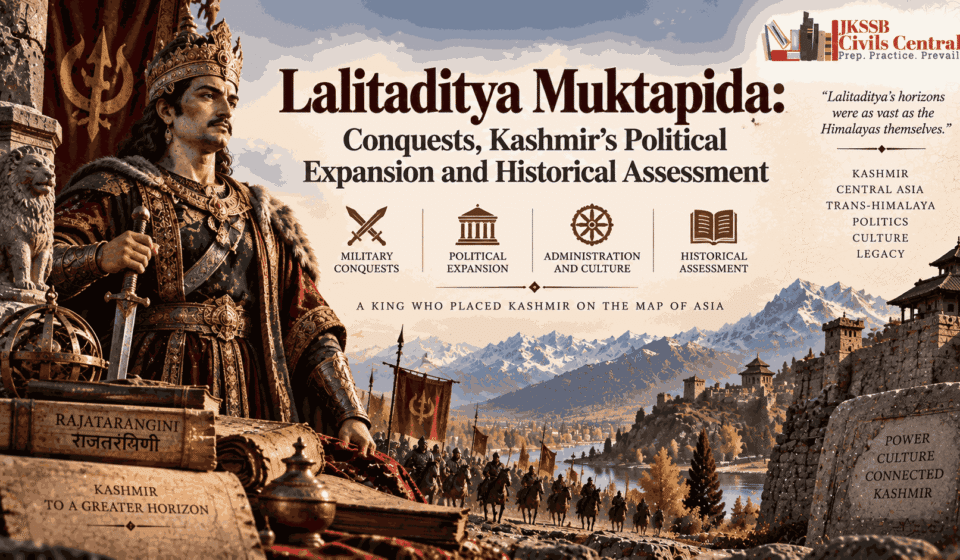
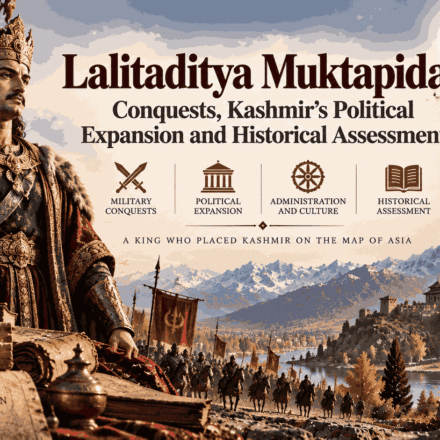
Lalitaditya Muktapida: Conquests, Kashmir’s Political Expansion and Historical Assessment

J&K History Series Navigation
| Previous Article | Current Article | Next Article |
|---|---|---|
| Article 11 — Karkota Dynasty in Kashmir: Rise, Political Consolidation and Major Rulers | Article 12 — Lalitaditya Muktapida: Conquests, Kashmir’s Political Expansion and Historical Assessment | Article 13 — Karkota Architecture and Cultural Development: Martand, Parihaspura and Early Medieval Kashmir |
Learning Dashboard
| Category | Key Information |
|---|---|
| Historical Period | 8th century CE |
| Historical Phase | Karkota / Early Medieval Kashmir |
| Ruler | Lalitaditya Muktapida |
| Dynasty | Karkota |
| Approximate Reign | c. 724–760/761 CE; exact chronology is debated |
| Political Centre | Kashmir Valley |
| Major Political Development | Expansion of Karkota influence beyond Kashmir |
| Most Secure External Conflict | Conflict with Yashovarman of Kanauj |
| Major Diplomatic Connection | Tang China; anti-Tibetan strategic cooperation |
| Important Regions in Literary Conquest Narrative | Kanauj, northern India, eastern India, western India, Himalayan/north-western regions |
| Major Monuments Associated | Martand Sun Temple, Parihaspura foundations |
| Principal Literary Source | Kalhana’s Rajatarangini |
| External Evidence | Tang Chinese records and other comparative evidence |
| Core Historical Problem | Distinguishing historical military expansion from literary exaggeration |
| JKSSB Importance | Very High |
| Expected Questions | Direct fact, statements, chronology, source criticism, ruler–monument association, comparative and conceptual-factual |
Introduction
Lalitaditya Muktapida is the most prominent ruler of the Karkota dynasty and one of the most debated figures in the early medieval history of Kashmir. His reign, conventionally placed in the eighth century CE, is remembered for military campaigns, diplomatic engagement with the wider Asian political world and major architectural foundations. Kalhana’s Rajatarangini, written several centuries later, presents him as an extraordinarily successful conqueror whose campaigns extended far beyond the Kashmir Valley. Modern historical scholarship, however, has had to distinguish between the core of this narrative that can be independently supported and the much larger geographical claims that may reflect literary expansion, political memory or later idealisation.
The importance of Lalitaditya therefore lies in two interconnected but distinct historical questions. The first is how far Karkota political power actually extended during his reign; the second is how Lalitaditya’s reign transformed Kashmir itself through royal construction, political organisation, diplomacy and cultural patronage. The evidence is stronger for some aspects than others. His association with major architectural projects and with diplomatic relations involving Tang China has substantial support, while the claim that he established a permanently administered empire stretching across much of the subcontinent and into Central Asia remains contested.
A historically responsible assessment must therefore avoid two opposite extremes. It should neither accept every conquest described by Kalhana literally nor dismiss Lalitaditya’s military and political achievements altogether. The most useful approach is to reconstruct the ruler through literary evidence, external records, archaeology, political geography and historiographical criticism.
CivilsCentral Historical Insight: Lalitaditya’s historical importance does not depend on accepting every territorial claim made by Rajatarangini. Even after separating probable history from literary expansion, his reign represents a significant phase in which Kashmir projected political power beyond the valley, engaged with Tang China and Tibet-related geopolitics, and invested heavily in monumental architecture.
Part I — Lalitaditya’s Rise to Power
From Tarapida to Lalitaditya
Lalitaditya succeeded his brother Tarapida, continuing the Karkota succession established under their father, Durlabhaka. The conventional chronology places his accession around 724 CE, although historians have differed over the exact dating of the Karkota rulers. The reign is commonly given as lasting approximately three to four decades, with dates around 724–760/761 CE frequently used in modern historical writing.
His accession was important because it followed a period of relatively rapid succession. The political challenge facing a new Karkota ruler was therefore not simply external expansion but also the consolidation of authority within Kashmir. A ruler who wished to conduct campaigns beyond the valley first required a sufficiently secure political and economic base at home.
Lalitaditya inherited such a base from the earlier Karkota rulers. Durlabhavardhana had established the dynasty, Durlabhaka provided continuity, and Chandrapida had already demonstrated Kashmir’s involvement in wider diplomatic politics. Lalitaditya’s reign built upon this foundation rather than creating Kashmir’s regional significance from nothing.
The sequence is therefore important:
Durlabhavardhana → Durlabhaka → Chandrapida → Tarapida → Lalitaditya
Lalitaditya represented the point at which Karkota political ambitions became most visibly expansive.
Part II — The Geopolitical Setting of Lalitaditya’s Reign
Kashmir Between Several Political Worlds
Lalitaditya ruled during a period of major geopolitical change across northern South Asia and Inner Asia. Arab expansion had established a new political presence in Sindh and the north-west, while the Tibetan Empire was an important military power across the Himalayan and Central Asian frontier. At the same time, the Tang dynasty of China remained a major power in Central and East Asia.
Kashmir’s geography gave these developments particular importance. The valley was protected by mountain barriers but was not isolated from the surrounding political world. Routes connected Kashmir with the Punjab and north-west, while northern and eastern mountain corridors linked the region to areas associated with Tibet and Central Asia. Control of these routes had political and economic implications beyond the immediate territory of the valley.
The Karkota state therefore operated within a geopolitical environment in which military strength, diplomacy and control of communication corridors were closely connected. Lalitaditya’s campaigns should be understood within this setting rather than as isolated attempts at territorial conquest.
Arab Expansion and the North-Western Frontier
The Arab conquest of Sindh in the early eighth century changed the political balance in the north-western subcontinent. This did not mean that Arab armies directly conquered the Kashmir Valley. Rather, the expansion of Arab power altered the strategic environment of the regions through which Kashmir interacted with the plains and north-western frontier.
The evidence concerning Lalitaditya’s response is intertwined with the broader question of his relations with Tang China and Tibet. Later interpretations have sometimes portrayed these developments as part of a simple defence of Kashmir against Arab invasion. A more cautious reconstruction recognises that the political situation involved several competing powers and that alliances could be shaped by changing strategic interests.
Part III — Kashmir and Tang China
The Diplomatic Dimension of Lalitaditya’s Rule
One of the strongest pieces of external evidence for Lalitaditya’s reign comes from Tang Chinese records. Chinese annals refer to a ruler of Kashmir named Mu-to-pi, generally identified with Muktapida/Lalitaditya of the Rajatarangini tradition. The records indicate diplomatic contact between Kashmir and the Tang court.
This evidence is particularly valuable because it does not originate in Kalhana’s twelfth-century chronicle. It therefore provides an independent chronological and political framework for evaluating Lalitaditya’s reign. The Chinese material confirms that Kashmir possessed sufficient diplomatic importance to participate in the international politics of the Tang world.
The precise interpretation of this relationship has been debated. Older narratives sometimes describe China as a straightforward ally protecting Kashmir, while more recent scholarship has emphasised the strategic interests of both sides, particularly the pressure created by Tibetan expansion and the wider Central Asian contest. A 2026 peer-reviewed reassessment, for example, interprets the relationship as a strategic interaction shaped by Arab incursions, Tibetan influence and mutual geopolitical concerns rather than as a simple client–patron relationship.
Tibet as a Strategic Factor
The Tibetan Empire was one of the most important powers affecting the Himalayan and Central Asian political environment during Lalitaditya’s reign. Kashmir’s interests and Tang China’s interests could therefore overlap where Tibetan expansion threatened their strategic positions.
The existence of Kashmir–Tang diplomacy should not, however, be transformed into a claim that China exercised political control over Kashmir. Nor should every later tradition concerning military assistance be accepted literally. The historically safer conclusion is that Lalitaditya’s Kashmir participated in a wider diplomatic and strategic system involving Tang China and the Tibetan sphere.
CivilsCentral Historical Insight: Lalitaditya’s diplomacy demonstrates that eighth-century Kashmir was not merely a local Himalayan kingdom. Its rulers participated in wider international politics, and Kashmir’s strategic position gave it a role in the triangular geopolitical environment involving Tibet and Tang China.
Part IV — Lalitaditya’s Conquests: The Core Historical Problem
What Does Kalhana Actually Claim?
The principal narrative of Lalitaditya’s conquests comes from Book IV of Kalhana’s Rajatarangini. Kalhana presents Lalitaditya as a ruler whose military campaigns took him far beyond Kashmir. The narrative includes campaigns against neighbouring powers and then describes a much wider sequence of victories across northern, eastern, southern and western India.
The scale of these campaigns has made Lalitaditya one of the most famous rulers in Kashmiri historical tradition. But the geographical breadth of Kalhana’s account also creates a major source-critical problem. The Rajatarangini was composed in the twelfth century, several centuries after Lalitaditya, and Kalhana’s narrative combines historical memory, earlier traditions, literary conventions and moral interpretation.
Modern reference scholarship therefore treats Lalitaditya’s extensive conquest narrative with caution. The Encyclopedia of the History of Science and Technology reference entry on the Karkota dynasty notes that Lalitaditya was its most prominent king and that he undertook extensive campaigns, while also stressing that much of Kalhana’s account is unreliable, even though there are reasons to accept some victories, particularly in northern and eastern India.
This distinction is fundamental: Kalhana’s geographical list of conquests ≠ automatically a map of a permanently administered Karkota Empire.
Part V — Conflict with Yashovarman of Kanauj
The Most Important Campaign
Among Lalitaditya’s campaigns, his conflict with Yashovarman of Kanauj is generally regarded as one of the strongest historical elements of the conquest narrative.
Yashovarman was a major ruler in northern India and controlled Kanauj, one of the most important political centres of the Ganga-Yamuna region during the period. A confrontation between the Karkota ruler and Yashovarman would therefore represent a significant extension of Kashmiri military activity into the northern Indian plains.
Kalhana presents the conflict as a major victory for Lalitaditya and describes the defeat and submission of Yashovarman. The basic historical plausibility of a Lalitaditya–Yashovarman conflict is strengthened by the broader political evidence for the prominence of both rulers. Modern scholarship generally treats Lalitaditya’s victory over Yashovarman as considerably more credible than some of the later, more geographically extravagant conquest claims.
What Did Victory Mean?
The meaning of Yashovarman’s defeat requires careful qualification. A military victory over a major north Indian ruler could establish political prestige, tribute or temporary dominance without creating permanent Karkota administrative control over Kanauj.
This distinction is particularly important because early medieval political systems often operated through changing forms of overlordship, alliances and tribute. A defeated ruler could retain local authority while acknowledging the temporary superiority of another king.
Therefore, the safest historical formulation is: Lalitaditya defeated or subordinated Yashovarman of Kanauj according to a widely accepted reconstruction of the campaign; the extent and duration of direct Karkota control over Kanauj remain more difficult to establish.
Part VI — The Eastern Campaigns
Gauda and Eastern India
Kalhana’s narrative next expands the geographical scope of Lalitaditya’s campaigns toward eastern India. The account includes Gauda and other eastern territories, followed by a movement through regions associated with the eastern and southern parts of the subcontinent.
These descriptions are among the areas where the distinction between historical core and literary expansion becomes especially important. The existence of military activity outside Kashmir is plausible and supported in broad terms by the prominence of Lalitaditya’s reign, but the precise sequence, duration and administrative consequences of every campaign cannot be established independently.
The geographical order of the narrative has also attracted historiographical attention. Some historians have argued that the sequence reflects the literary construction of an ideal universal conqueror rather than a straightforward campaign diary. The absence of contemporary inscriptions documenting each supposed conquest makes it impossible to treat the entire sequence as equally secure.
Why Eastern Campaigns Matter
Even when the exact territorial claims remain uncertain, the eastern campaign tradition is historically important because it reflects the scale of political ambition associated with Lalitaditya. It indicates that Kashmir’s ruling elite conceptualised their political world in terms extending well beyond the mountain valley.
It also demonstrates why Rajatarangini must be read both as a historical source and as a literary-political narrative. Its description of Lalitaditya tells us not only what later Kashmiri tradition remembered about the ruler but also what an idealised image of powerful kingship looked like in Kalhana’s historical imagination.
Part VII — Western and Southern Campaigns
The Wider Conquest Narrative
Kalhana’s account attributes further campaigns to Lalitaditya in regions corresponding broadly to western and southern India. Territories and peoples associated with Malwa, Gujarat, Rajasthan/Maru and other parts of the subcontinent appear within the narrative.
The difficulty is not that military expeditions from Kashmir into the plains are geographically impossible. Kashmir was connected with the north Indian political world through the Punjab and north-west. The difficulty is establishing whether the later literary account describes direct conquest, temporary raids, political submission, tribute relationships or an idealised sequence of universal victories.
For this reason, modern historical assessments vary significantly. Some scholars have accepted a substantial core of Lalitaditya’s northern and eastern campaigns while rejecting the most expansive claims. Others have interpreted the campaigns as large-scale raids or military expeditions rather than the creation of a stable empire. The debate itself is evidence of the limitations of the surviving source material.
The Problem of the “Empire”
Calling Lalitaditya’s realm an empire stretching across much of India and Central Asia without qualification is therefore historically unsafe. There is insufficient independent evidence to draw a precise political map of permanent Karkota administration corresponding to the maximum territorial claims in Rajatarangini.
A better formulation is that Lalitaditya expanded Kashmir’s political influence and military reach substantially, while the exact territorial extent, duration and administrative character of that expansion remain debated.
This distinction is one of the most important examination-level concepts in the entire article.
CivilsCentral Historical Insight: The historical question is not simply “Did Lalitaditya conquer India?” It is “What kind of political control did his campaigns create, for how long, and what evidence demonstrates it?” This shift from a binary conqueror/non-conqueror question to a question of political mechanisms produces a much more reliable historical reconstruction.
Part VIII — Northern Campaigns and the Himalayan Frontier
Dards and the Northern Regions
The northern frontier was particularly important for Kashmir because mountain routes connected the valley with areas inhabited by Dardic-speaking populations and with routes leading toward the north-west and Central Asian world. Kalhana associates Lalitaditya with campaigns in the northern regions and with the subjugation of neighbouring peoples. Some of these claims are geographically plausible because the Kashmir state had strong strategic interests in securing its northern approaches.
However, the exact extent of permanent Karkota authority in these regions remains uncertain. Mountain territories could be difficult to administer directly, and political relationships could take the form of tribute, alliance or temporary military submission rather than continuous bureaucratic control.
Kashmir, Tibet and the Northern Frontier
The Tibetan factor gives the northern campaigns greater strategic significance. Tibet was a major military power during this period, and its expansion into the Himalayan and Central Asian zones created pressure on states that controlled routes toward the north.
Lalitaditya’s relations with Tang China therefore cannot be separated from his northern strategy. The combination of military activity and diplomacy suggests that Kashmir was attempting to protect its strategic environment while also increasing its influence.
Part IX — Lalitaditya’s Military Strategy
Expansion Was Not an End in Itself
The traditional image of Lalitaditya is that of a ruler driven by unlimited conquest. A more analytical interpretation asks why a Kashmir-based ruler would undertake campaigns so far beyond the valley.
Several strategic objectives can be considered:
1. Security of Kashmir
Controlling or intimidating neighbouring powers could reduce the possibility of threats reaching the valley.
2. Control of Strategic Corridors
The Kashmir Valley was connected with important routes toward the plains and mountain regions. Military power could strengthen Kashmir’s position along these routes.
3. Political Prestige
Victory over major rulers increased royal legitimacy. In early medieval political culture, military success was closely associated with the status of the king.
4. Access to Resources
Military campaigns could generate wealth through tribute, booty and access to resources. A recent scholarly reassessment specifically emphasises the role of material wealth and geopolitical calculation in interpreting Lalitaditya’s campaigns.
5. Regional Balance of Power
Kashmir’s relations with Tibet, Tang China and the north-western powers created incentives to project military strength beyond the valley.
These objectives are not mutually exclusive. Lalitaditya’s campaigns may have combined security, political prestige, strategic control and resource acquisition.
Part X — Military Expansion and the Kashmir State
Did Conquest Create a Permanent Empire?
The answer requires qualification. There is good reason to believe that Lalitaditya’s Kashmir possessed significant military capabilities and was capable of projecting force beyond the valley. His conflict with Yashovarman and his participation in wider Himalayan geopolitics support this conclusion.
But military reach is not equivalent to permanent territorial administration. An army can defeat a distant ruler without incorporating his kingdom into a centralised state. It can extract tribute, impose a political settlement or temporarily install a subordinate ruler and then withdraw.
This distinction is especially important in early medieval South Asian history, where political authority frequently operated through layered relationships rather than through modern-style territorial administration.
Accordingly, the most defensible interpretation is that Lalitaditya created or exercised a wide sphere of political and military influence, while the exact boundaries of direct Karkota administration remain uncertain.
Part XI — Lalitaditya and the Economy of Power
Resources Behind Expansion
Large military campaigns require resources. The Kashmir Valley’s agricultural production provided an important economic foundation for the royal state, while military expansion could generate additional wealth through tribute and the acquisition of resources.
The relationship between conquest and monumental construction is particularly significant. Lalitaditya is associated with major architectural projects at a time when his political influence had expanded considerably. It is reasonable to consider the possibility that military success increased the resources available to the royal court, although the precise financial mechanism cannot be reconstructed in detail.
A recent study of Kashmir–Tang relations under Lalitaditya has explicitly argued that material wealth acquired through military campaigns may have contributed to the financing of his architectural establishments. This is an interpretation rather than a directly documented financial account and should therefore be treated as such.
Political Economy and Royal Patronage
Monumental construction also served a political purpose. Temples, monasteries and royal foundations displayed the capacity of the king to mobilise labour, land and resources. They transformed political power into visible institutions and sacred landscapes. Thus, Lalitaditya’s architectural patronage should not be separated completely from his political expansion. Both formed part of the wider expression of royal authority.
Part XII — Parihaspura and the Material Expression of Power
The Royal Foundation
Parihaspura is one of the most important sites associated with Lalitaditya. Archaeological documentation identifies modern Paraspora with ancient Parihasapura and associates the site with Lalitaditya’s royal foundation. The site contains substantial remains of Buddhist and other religious structures.
The scale of the remains demonstrates the ability of the Karkota state to undertake large architectural projects. The site included a substantial stupa base and a monastery traditionally identified with the Raja-vihara associated with Lalitaditya. Parihaspura is therefore more than a monument associated with a famous king. It provides archaeological evidence for the political and cultural resources available to the Karkota court.
Buddhist Patronage
Lalitaditya’s association with Buddhist establishments is especially important because it complicates simplistic descriptions of the ruler’s religious identity. Archaeological and literary evidence associates him with Buddhist monasteries and viharas as well as Brahmanical temples.
This should not automatically be converted into a modern concept of “religious tolerance” without qualification. Royal patronage of multiple religious institutions was part of the political and social environment of the period. It could simultaneously express personal religious interests, political legitimacy, institutional patronage and the practical integration of different elite groups.
Part XIII — Martand Sun Temple and Royal Monumentality
Martand
The Martand Sun Temple is the most famous architectural monument associated with Lalitaditya. The eighth-century temple complex stands in the Kashmir Valley near present-day Anantnag and represents a major example of the monumental stone architecture associated with the Karkota period.
The temple’s architectural scale is significant because it demonstrates the ability of the royal court to mobilise substantial resources for a religious foundation. Its setting, courtyard and monumental stone construction also illustrate the development of a distinctive Kashmir architectural tradition.
The attribution of Martand to Lalitaditya is widely accepted in the historical and archaeological literature, although popular accounts sometimes add unsupported claims concerning the temple’s absolute age, size or supposed direct architectural ancestry. Such claims should not be repeated without specific evidence.
Architecture as Political Language
Martand can also be interpreted as political architecture. A monumental royal temple did more than provide a place of worship. It projected the king’s authority into the landscape, linked the ruler to sacred legitimacy and created a durable representation of political power.
This becomes especially significant when considered alongside Lalitaditya’s military expansion. The ruler’s political authority was expressed through two complementary forms:
Military power → external projection
Monumental construction → internal and symbolic projection
CivilsCentral Historical Insight: Martand and Parihaspura demonstrate that Lalitaditya’s historical legacy cannot be reduced to conquest. Monumental architecture converted political resources into durable institutions and landscapes, making royal authority visible long after individual campaigns had ended.
Part XIV — Sanskrit Culture and the Court
Lalitaditya’s reign belongs to a period in which Sanskrit literary culture was an important component of elite political life in Kashmir and northern India. His military interactions with the plains also brought Kashmir into closer contact with other centres of Sanskrit intellectual activity.
The later tradition connects Kashmir with scholars and literary figures associated with courts outside the valley. Some popular accounts state that Lalitaditya brought the famous poets Vakpati and Bhavabhuti to Kashmir after defeating Yashovarman. The broader connection between these literary figures and the political world of Yashovarman is well known, but the exact circumstances of their movement and court affiliation should not be stated more confidently than the evidence permits.
The important historical point is that Lalitaditya’s reign belongs to an interconnected Sanskritic intellectual world in which political centres competed not only through armies but also through patronage, literary culture and religious institutions.
Part XV — The Historical Problem of Lalitaditya’s “World Conquest”
Why the Traditional Image Became So Powerful
Kalhana’s portrait of Lalitaditya is one of the most memorable ruler narratives in Rajatarangini. His campaigns span an enormous geographical space, and the king appears as an almost universal conqueror. Such a narrative fits the literary model of the cakravartin, the universal sovereign. The image of the ruler who conquers in every direction serves a political and moral purpose within a royal chronicle.
This does not mean that Kalhana invented Lalitaditya or that all of his military achievements are fictitious. Rather, the narrative may combine historical events with literary amplification.
Evidence Hierarchy
The evidence can be divided into broad levels.
Stronger Historical Core
- Lalitaditya was a Karkota ruler of major political importance.
- His reign belongs to the eighth century.
- Kashmir participated in diplomatic relations with Tang China.
- He was involved in military activity beyond the immediate Kashmir Valley.
- Conflict with Yashovarman of Kanauj is widely treated as historically plausible.
- Major architectural foundations are associated with his reign.
Probable but Less Secure
- Military activity against neighbouring Himalayan and north-western powers.
- Significant political influence in parts of northern India.
- Strategic engagement with the Tibetan frontier.
More Contested
- Permanent Karkota control over extensive areas of eastern, western and southern India.
- Direct rule across large portions of Central Asia.
- A single continuous empire matching the maximum geographical extent described by Kalhana.
Literary / Highly Uncertain Elements
- The complete sequence of universal conquests exactly as presented by Kalhana.
- Claims that Lalitaditya permanently subdued almost the whole subcontinent.
- A precise imperial map derived solely from Rajatarangini.
Part XVI — Historiographical Assessment
M. A. Stein and the Traditional Critical Approach
Modern scholarship on Lalitaditya has long been shaped by the critical reading of Kalhana. M. A. Stein, whose translation and annotation of Rajatarangini became foundational for modern study, accepted the historical importance of Lalitaditya but treated many of the more extensive conquest claims with scepticism.
This approach established an important principle: the fact that a campaign appears in Rajatarangini does not automatically make every geographical detail historically reliable.
Later Interpretations
Later historians have offered different explanations. Some have accepted a substantial historical core in the campaigns against Yashovarman and in northern and eastern India. Others have argued that Lalitaditya’s campaigns were more likely to have been large-scale raids or temporary expeditions than the establishment of a permanent empire.
Another interpretation emphasises Lalitaditya’s role in the geopolitical contest involving Tang China and Tibet. On this reading, some of his northern military activity should be understood as strategic intervention rather than purely territorial conquest.
The diversity of interpretations is itself significant. It demonstrates that Lalitaditya’s history cannot be reconstructed by simply copying Rajatarangini. The historian must compare literary narrative with external records, geography, archaeology and political context.
CivilsCentral Historical Insight: The disagreement over Lalitaditya is not merely a dispute about how many places he conquered. It is a methodological debate about how historians reconstruct early medieval political power when the principal narrative source is later than the events it describes.
Part XVII — What Can Be Said with Confidence?
A balanced historical assessment can make several relatively secure observations.
First, Lalitaditya was a major Karkota ruler whose reign marked a significant phase of Kashmir’s political expansion. Second, Kashmir under his rule was connected to the wider international politics of Tang China and the Tibetan world. Third, the ruler’s military activity extended beyond Kashmir, with the conflict involving Yashovarman of Kanauj forming one of the strongest components of the wider conquest tradition. Fourth, Lalitaditya’s reign is associated with major royal construction, including Martand and Parihaspura.
What cannot be stated with the same confidence is the exact territorial extent of his kingdom at its maximum. There is insufficient independent evidence to draw a precise map showing permanent Karkota administration over every region named in Kalhana’s narrative.
This distinction produces the most historically defensible conclusion:
Lalitaditya was a powerful regional ruler who substantially expanded Kashmir’s political and military reach, but the maximum imperial geography described in Rajatarangini should not be treated as an uncontested map of permanent Karkota rule.
Part XVIII — Lalitaditya’s Historical Significance
1. Expansion of Kashmir’s Political Horizon
Before Lalitaditya, Karkota rulers had already established Kashmir as a significant regional kingdom. Lalitaditya expanded the scale at which Kashmir operated politically. His reign demonstrated that a Kashmir-based state could intervene in the politics of the northern plains and the Himalayan frontier.
2. Integration into Wider Asian Diplomacy
The Tang connection shows that Kashmir participated in diplomatic networks extending beyond the immediate Indian subcontinent. This makes Lalitaditya’s reign important for the study of Kashmir’s relationship with Central and East Asian political systems.
3. Development of Royal Monumentality
Martand and Parihaspura demonstrate the material resources and ideological ambitions of the Karkota court. Monumental construction became a visible expression of political authority.
4. Religious and Institutional Patronage
The coexistence of Buddhist and Brahmanical establishments illustrates the complexity of Kashmir’s early medieval religious landscape. Lalitaditya’s patronage cannot be reduced to a single institutional or religious category.
5. Historical Memory
Few Kashmir rulers acquired such a powerful place in later historical memory. Lalitaditya became a symbol of Karkota political power, but the very strength of this memory makes source criticism particularly necessary.
Part XIX — Lalitaditya and the Later History of Kashmir
Lalitaditya’s reign represented the high point of Karkota political power, but political expansion did not guarantee permanent dynastic stability. Later Karkota rulers inherited a political system that increasingly experienced succession disputes and internal competition.
This broader historical pattern is important. Military success can increase royal prestige and resources, but it can also intensify competition over the distribution of those resources. The later history of the Karkota dynasty demonstrates that political power required stable succession and institutional continuity in addition to military strength.
The eventual decline of the Karkotas and emergence of the Utpala dynasty under Avantivarman show that Lalitaditya’s achievements should not be interpreted as creating an irreversible Kashmir empire. The transition from Karkota to Utpala is therefore a useful reminder that the zenith of a dynasty and its long-term durability are not the same thing.
Part XX — Evidence Note: Source by Source
| Source / Evidence | What It Helps Establish | Main Limitation |
|---|---|---|
| Kalhana’s Rajatarangini | Succession, campaigns, royal projects, political narrative | Written centuries later; literary and moralising elements |
| Tang Chinese records | Kashmir’s diplomatic relations and Lalitaditya’s international context | External perspective; requires identification and contextual interpretation |
| Archaeology at Parihaspura | Monumental construction and religious institutions | Cannot by itself reconstruct political boundaries |
| Martand remains | Monumental architecture associated with Lalitaditya | Architectural evidence does not prove the complete conquest narrative |
| Coins / numismatic evidence | Monetary circulation and chronology | Circulation does not automatically prove territorial administration |
| Geographical analysis | Plausibility of routes and campaigns | Plausibility is not proof of conquest |
| Later literary traditions | Historical memory and political interpretation | Often chronologically distant from Lalitaditya |
The source hierarchy is crucial. Archaeology can demonstrate that a monumental centre existed; it cannot by itself demonstrate that Lalitaditya permanently ruled every territory named by Kalhana. Likewise, a literary account can preserve a historical memory while still exaggerating the geographical extent of a king’s power.
Part XXI — JKSSB Knowledge Matrix
| Question | High-Value Answer |
|---|---|
| Who was Lalitaditya? | Major Karkota ruler of eighth-century Kashmir |
| Dynasty? | Karkota |
| Predecessor? | Tarapida |
| Approximate reign? | c. 724–760/761 CE, depending on chronology |
| Major northern Indian opponent? | Yashovarman of Kanauj |
| Major external diplomatic connection? | Tang China |
| Major geopolitical factor? | Tibetan power and Central Asian/Himalayan competition |
| Principal literary source? | Kalhana’s Rajatarangini |
| Major monument? | Martand Sun Temple |
| Major royal foundation? | Parihaspura |
| Was his entire conquest narrative independently verified? | No |
| What is the safest interpretation? | Major expansion of Kashmir’s political/military reach, with the maximum territorial extent debated |
| Major historical problem? | Separating historical conquest from literary exaggeration |
| Successor political development? | Later Karkota instability and eventual Utpala rise |
Part XXII — Examination Discrimination Points
Lalitaditya vs Durlabhavardhana
Durlabhavardhana → founder of the Karkota dynasty
Lalitaditya → most prominent expansionist ruler
Lalitaditya vs Jayapida
Lalitaditya → eighth-century political expansion and monumental patronage
Jayapida → later Karkota ruler associated with a significant literary and political environment
Lalitaditya vs Avantivarman
Lalitaditya → Karkota dynasty
Avantivarman → Utpala dynasty
Martand vs Parihaspura
Martand → major Sun temple associated with Lalitaditya
Parihaspura → royal foundation associated with Lalitaditya containing substantial religious remains
Kalhana vs Tang Records
Kalhana → later Kashmiri literary chronicle
Tang records → external evidence for Kashmir’s diplomatic relations
Conquest vs Administration
Conquest / military victory does not automatically equal permanent territorial administration.
This is one of the most important conceptual traps concerning Lalitaditya.
Part XXIII — JKSSB Question Pattern
Direct Fact
Lalitaditya Muktapida belonged to which dynasty?
A. Utpala
B. Karkota
C. Lohara
D. Shah Mir
Answer: B. Karkota
Statement-Based
Consider the following statements:
- Lalitaditya was a Karkota ruler.
- He succeeded Tarapida.
- Martand is associated with his reign.
- His entire conquest narrative in Rajatarangini is independently established by contemporary inscriptions.
Which statements are correct?
A. 1, 2 and 3 only
B. 1 and 4 only
C. 2 and 4 only
D. All four
Answer: A
Explanation: Statements 1–3 are correct. The fourth is incorrect because the full geographical extent of Kalhana’s conquest narrative cannot be independently established.
Chronology
Arrange the following in chronological order:
- Lalitaditya Muktapida
- Durlabhavardhana
- Tarapida
- Durlabhaka
A. 2–4–3–1
B. 4–2–3–1
C. 2–3–4–1
D. 3–2–4–1
Answer: A
Match the Following
| Ruler | Association |
|---|---|
| A. Durlabhavardhana | 1. Founder of Karkota dynasty |
| B. Lalitaditya | 2. Martand |
| C. Avantivarman | 3. Utpala dynasty |
| D. Jayapida | 4. Later Karkota phase |
Correct: A–1, B–2, C–3, D–4
Identification by Clues
Identify the ruler:
- Karkota dynasty
- Eighth century CE
- Defeated/subordinated Yashovarman according to the historical reconstruction
- Associated with Martand
- Diplomatic relations with Tang China
- Extensive conquests described by Kalhana
A. Lalitaditya Muktapida
B. Avantivarman
C. Shankaravarman
D. Durlabhavardhana
Answer: A
Conceptual-Factual
Which statement best explains the caution required when describing Lalitaditya’s empire?
A. Lalitaditya never conducted campaigns outside Kashmir.
B. Rajatarangini contains no information about his reign.
C. Literary accounts of conquest do not necessarily demonstrate permanent administrative control over every region named.
D. Tang records prove that Kashmir was a Chinese province.
Answer: C
Part XXIV — JKSSB Practice Questions
Q1. Lalitaditya Muktapida was a ruler of which dynasty?
A. Utpala
B. Karkota
C. Lohara
D. Gonanda
Answer: B
Explanation: Lalitaditya was the most prominent ruler of the Karkota dynasty.
Q2. Lalitaditya succeeded:
A. Durlabhavardhana
B. Durlabhaka
C. Chandrapida
D. Tarapida
Answer: D
Q3. Which ruler of Kanauj is associated with Lalitaditya’s major northern Indian campaign?
A. Harshavardhana
B. Yashovarman
C. Mihirabhoja
D. Rajyavardhana
Answer: B
Explanation: Lalitaditya’s conflict with Yashovarman is one of the stronger elements of the conquest tradition.
Q4. Which of the following is most closely associated with Lalitaditya?
A. Martand Sun Temple
B. Avantipur town founded by Avantivarman
C. Treaty of Amritsar
D. Shah Mir dynasty
Answer: A
Q5. Which external source is particularly important for Lalitaditya’s diplomatic context?
A. Mughal chronicles
B. Tang Chinese records
C. Ain-i-Akbari
D. Persian chronicles of the Sultanate
Answer: B
Tang records identify a Kashmir ruler generally associated with Muktapida/Lalitaditya.
Q6. Consider the following statements:
- Lalitaditya’s reign occurred during the rise of Tibetan power in the wider Himalayan and Central Asian region.
- Kashmir maintained diplomatic contacts with Tang China.
- Every conquest described by Kalhana is independently confirmed by contemporary inscriptions.
- Lalitaditya is associated with major architectural projects.
Which are correct?
A. 1, 2 and 4 only
B. 1 and 3 only
C. 2 and 3 only
D. All four
Answer: A
Q7. Why is the Lalitaditya conquest narrative treated cautiously?
A. It comes exclusively from archaeological inscriptions.
B. The principal narrative source was written centuries after his reign and contains literary elements.
C. Lalitaditya ruled only for a few months.
D. No source mentions him.
Answer: B
Q8. Which distinction is historically most important when discussing Lalitaditya?
A. Temple vs monastery
B. Kashmir vs Jammu
C. Military conquest vs permanent territorial administration
D. Buddhism vs Islam
Answer: C
Q9. Parihaspura is important in the history of Lalitaditya because it:
A. was a Mughal capital
B. was a royal foundation associated with Lalitaditya and contains major religious remains
C. was founded by Avantivarman
D. was the site of the Treaty of Amritsar
Answer: B
Q10. Which is the most balanced historical assessment of Lalitaditya?
A. He was merely a legendary ruler with no historical basis.
B. He definitely ruled a permanent empire covering almost all of India.
C. He was a major Karkota ruler who expanded Kashmir’s political reach, while the maximum extent of his conquests remains debated.
D. He was primarily a religious reformer with no military significance.
Answer: C
Part XXV — Rapid Revision Zone
Important Dates
- c. 724 CE → conventional beginning of Lalitaditya’s reign
- 8th century CE → principal period of his political activity
- c. 760/761 CE → conventional approximate end of his reign; chronology debated
Dynastic Sequence
Durlabhavardhana
↓
Durlabhaka / Pratapaditya
↓
Chandrapida
↓
Tarapida
↓
Lalitaditya Muktapida
Major Associations
Lalitaditya → Karkota dynasty
Lalitaditya → Yashovarman of Kanauj
Lalitaditya → Tang China
Lalitaditya → Tibet-related geopolitics
Lalitaditya → Martand
Lalitaditya → Parihaspura
Lalitaditya → extensive conquest narrative in Rajatarangini
Important Sources
- Kalhana — Rajatarangini
- Tang Chinese records
- Archaeological evidence
- Coins / numismatic evidence
- Later historical scholarship
Part XXVI — Frequently Confused Facts
| Common Confusion | Correct Distinction |
|---|---|
| Lalitaditya = founder of Karkota | Incorrect — Durlabhavardhana is conventionally regarded as founder |
| Lalitaditya = Utpala ruler | Incorrect — he was Karkota |
| Lalitaditya = Avantivarman | Incorrect — Avantivarman founded the Utpala dynasty |
| Martand = Parihaspura | Incorrect — Martand is the Sun temple; Parihaspura is the royal foundation |
| Yashovarman = Lalitaditya | Incorrect — Yashovarman was the Kanauj ruler involved in conflict with Lalitaditya |
| Military victory = permanent annexation | Incorrect — political control could take several forms |
| Kalhana’s account = contemporary inscription | Incorrect — Rajatarangini was written centuries later |
| Tang China = ruler of Kashmir | Incorrect — Tang China was an external diplomatic power |
| Every conquest = historically proven | Incorrect — the geographical extent is debated |
| Lalitaditya = “Alexander of Kashmir” | Not a historical title — a later comparison/epithet and should not be used as an official title |
Part XXVII — What Can JKSSB Ask?
High-value areas include:
- Lalitaditya’s dynasty
- predecessor and succession
- approximate chronology
- Yashovarman of Kanauj
- Tang Chinese diplomatic connection
- Tibetan geopolitical context
- Martand Sun Temple
- Parihaspura
- Rajatarangini as the principal literary source
- distinction between literary narrative and independently verified evidence
- conquest vs administration
- Karkota vs Utpala chronology
- ruler–monument associations
- source-based statements
- chronology questions
- historical interpretation questions
- correct/incorrect statements concerning the extent of Lalitaditya’s empire
Particularly valuable statement-question trap
“Lalitaditya conquered every region mentioned by Kalhana and permanently incorporated them into the Karkota state.”
This should be treated as incorrect/overstated. The geographical extent of his campaigns and the nature of control over distant regions remain debated.
Chapter Summary
Lalitaditya Muktapida inherited the Karkota throne after Tarapida during the eighth century and presided over the dynasty’s most powerful phase. His rise was built upon earlier Karkota consolidation, but his reign expanded Kashmir’s political horizon through military campaigns, diplomacy and monumental construction.
The conflict with Yashovarman of Kanauj represents one of the stronger elements of the military narrative. Beyond this, Rajatarangini describes an extraordinary sequence of victories across northern, eastern, western and southern India and into regions farther north. Modern historians have not accepted all these claims at face value because the principal narrative was written centuries later and because independent contemporary evidence is uneven.
At the same time, Lalitaditya’s wider geopolitical role is supported by Tang Chinese evidence, which places Kashmir within the international politics of the period. His relationship with Tang China must be understood in the context of Tibetan expansion and the strategic competition of eighth-century Central Asia and the Himalayas.
His architectural legacy is more materially visible. Martand and Parihaspura demonstrate the resources and political ambition of the Karkota court, while Buddhist and Brahmanical establishments show the complexity of the religious landscape during his reign.
The most balanced historical assessment is therefore neither to treat Lalitaditya as a purely legendary figure nor to reproduce the maximum conquest narrative as unquestioned fact. He was a powerful early medieval ruler who substantially expanded Kashmir’s political and military reach, strengthened its position within a wider Himalayan and Asian geopolitical system, and left a major architectural legacy. The precise territorial extent and administrative nature of his conquests remain subjects of historical debate.
JKSSB Takeaway
Remember the five essential connections:
Lalitaditya → Karkota
Lalitaditya → Yashovarman of Kanauj
Lalitaditya → Tang China / Tibetan geopolitical context
Lalitaditya → Martand + Parihaspura
Lalitaditya → Extensive conquest narrative, but debated territorial extent
The key conceptual distinction is: A campaign or victory does not automatically prove permanent territorial administration.
Mind Map
KARKOTA DYNASTY
↓
TARAPIDA
↓
LALITADITYA MUKTAPIDA
↓
INTERNAL BASE
→ Earlier Karkota consolidation
→ Kashmir Valley resources
→ Royal authority
↓
EXTERNAL ENVIRONMENT
→ Arab expansion in Sindh/north-west
→ Tibetan power
→ Tang China
→ Himalayan routes
↓
MILITARY EXPANSION
→ Yashovarman / Kanauj
→ Northern regions
→ Eastern campaigns
→ Western/southern campaigns in Kalhana’s narrative
↓
DIPLOMACY
→ Tang China
→ Tibet-related strategic competition
↓
ROYAL PATRONAGE
→ Martand
→ Parihaspura
→ Buddhist institutions
→ Brahmanical institutions
↓
HISTORICAL PROBLEM
→ Kalhana written centuries later
→ Literary amplification possible
→ Independent evidence uneven
↓
HISTORICAL ASSESSMENT
→ Major regional expansion
→ Wider geopolitical role
→ Monumental state-building
→ Exact territorial extent debated
↓
SUCCESSOR PHASE
→ Later Karkota instability
→ Utpala emergence
FAQs
1. Who was Lalitaditya Muktapida?
Lalitaditya Muktapida was the most prominent ruler of the Karkota dynasty of Kashmir, conventionally dated to the eighth century CE.
2. When did Lalitaditya rule?
His reign is commonly placed around c. 724–760/761 CE, although the exact chronology of the Karkota dynasty remains debated.
3. Who was Lalitaditya’s most important north Indian opponent?
Yashovarman of Kanauj is the principal ruler associated with Lalitaditya’s major north Indian campaign.
4. Which monument is associated with Lalitaditya?
The Martand Sun Temple near present-day Anantnag is strongly associated with his reign.
5. What is Parihaspura?
Parihaspura was a major royal foundation associated with Lalitaditya. Archaeological remains at the site include substantial Buddhist and other religious structures.
6. Did Lalitaditya really conquer all of India?
That statement is too strong. Rajatarangini describes extremely extensive conquests, but the complete geographical extent of those campaigns and whether they created permanent territorial control remain debated.
7. Was Lalitaditya’s conflict with Yashovarman historically real?
The conflict is generally regarded as one of the more historically plausible elements of the conquest narrative, although the precise nature and duration of Lalitaditya’s control over Kanauj remain less certain.
8. Why are Tang Chinese records important?
They provide an external source for Kashmir’s diplomatic relations during Lalitaditya’s period and help place his reign within the wider politics of eighth-century Asia.
9. Was Lalitaditya only a military ruler?
No. His reign is also associated with substantial architectural and religious patronage, including Martand and Parihaspura.
10. Why is Lalitaditya historically controversial?
The controversy arises mainly because the principal narrative of his conquests comes from Kalhana’s later Rajatarangini, whose account contains a mixture of historical memory and literary construction. Independent evidence supports an important core of his political activity but does not securely establish every conquest described by Kalhana.
About The Author




[…] Article 12 — Lalitaditya Muktapida: Conquests, Kashmir’s Political Expansion and Historical Asse… […]
[…] Article 12 — Lalitaditya Muktapida: Conquests, Kashmir’s Political Expansion and Historical Asse… […]