
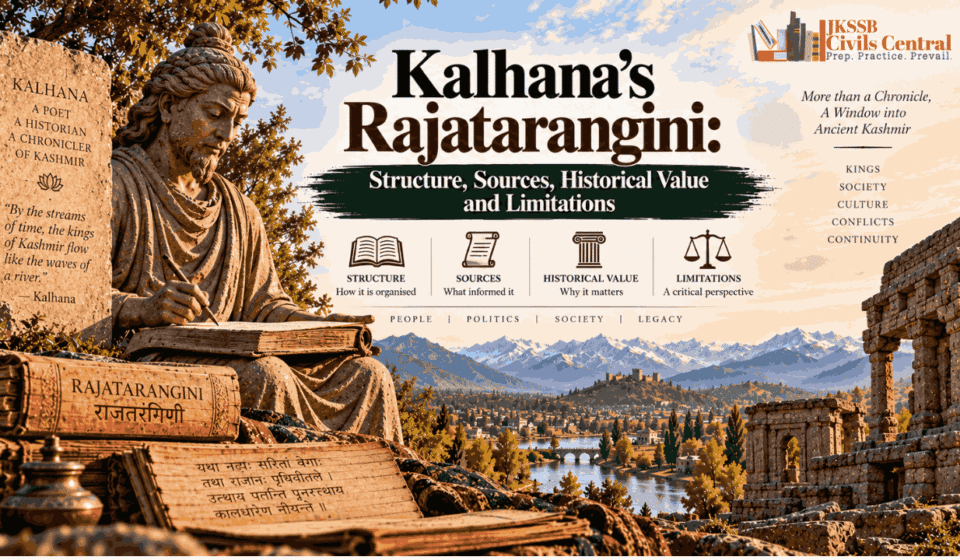
Kalhana’s Rajatarangini: Structure, Sources, Historical Value and Limitations

J&K History Series Navigation
| Previous Article | Current Article | Next Article |
|---|---|---|
| Article 09 — Ancient Kashmir Through Historical Sources: Rajatarangini, Archaeology, Inscriptions and Travel Accounts | Article 10 — Kalhana’s Rajatarangini: Structure, Sources, Historical Value and Limitations | Article 11 — Karkota Dynasty in Kashmir: Rise, Political Consolidation and Major Rulers |
Learning Dashboard
| Category | Key Information |
|---|---|
| Historical Period | Early Medieval Kashmir / 12th century |
| Historical Phase | Kashmir’s historical traditions and Kalhana’s chronicle |
| Main Personality | Kalhana |
| Work | Rajatarangini |
| Language | Sanskrit |
| Form | Historical chronicle in verse / Sanskrit Kavya |
| Date | Mid-12th century, generally around c. 1148–1150 CE |
| Structure | 8 Tarangas (books/cantos) |
| Verses | 7,826 verses in the commonly cited textual count |
| Geographical Focus | Kashmir |
| Major Sources Used | Earlier chronicles, Nilamata Purana, inscriptions, grants, coins, traditions and other records |
| Major Strength | Provides a continuous regional historical narrative, especially valuable for Kashmir’s political history |
| Major Limitation | Earlier portions combine historical traditions, legends, literary conventions and problematic chronology |
| JKSSB Importance | Very High |
| High-Value Question Areas | Author, work, language, structure, sources, chronology, historical value, limitations, contemporary ruler, source criticism |
Introduction
Few texts are as important to the reconstruction of Jammu and Kashmir’s pre-modern history as Kalhana’s Rajatarangini. Composed in Sanskrit in the 12th century, the work presents a long narrative of the kings of Kashmir, beginning with legendary and traditional accounts of the earliest past and extending to the political world in which Kalhana himself lived. Its importance does not arise simply because it contains a long list of rulers. It lies in the fact that Kalhana attempted to organise the past chronologically, compare earlier traditions, consult different kinds of records and comment critically on the material available to him.
At the same time, Rajatarangini should not be treated as though it were a modern archival history. Its opening books contain legendary genealogies, epic associations and chronological problems, while even its stronger historical sections remain embedded in Sanskrit literary conventions. The work therefore occupies an important middle ground: it is both a literary composition and a serious historical source, and its value becomes greatest when it is read critically alongside archaeology, inscriptions, coins and other contemporary or near-contemporary evidence.
For the study of Kashmir, this distinction is fundamental. The Rajatarangini preserves information that would otherwise be difficult or impossible to recover, but it does not automatically make every statement in the text historically established. The historian must therefore ask not only what Kalhana says, but also when he wrote it, what sources he used, how close those sources were to the events, what literary conventions shaped his narrative, and whether independent evidence supports his account.
CivilsCentral Historical Insight: The importance of Rajatarangini lies not in treating every verse as unquestionable fact, but in understanding how a 12th-century Kashmiri author attempted to reconstruct the political past of his region from inherited traditions and surviving records. Its real historical value emerges through critical comparison with other evidence.
Part I — Kalhana and the Historical Context of Rajatarangini
Kalhana: The Author
Kalhana was a Kashmiri Sanskrit author who composed the Rajatarangini during the 12th century. His work belongs to a sophisticated literary culture in which Sanskrit remained an important language of intellectual and historical writing in Kashmir. He wrote during the reign of King Jayasimha of the Lohara dynasty, whose reign extended from approximately 1128 to 1155 CE.
The precise biography of Kalhana is not known in the detail available for some later historical figures. What is clear from the Rajatarangini itself is that he possessed substantial knowledge of Sanskrit literature, political traditions and the historical traditions of Kashmir. His father, Champaka, appears in the text in a political context connected with the court, giving Kalhana an important vantage point from which to understand contemporary politics, although it would be unsafe to reconstruct his entire biography from this alone.
Kalhana’s position is particularly significant because he was not merely composing a royal eulogy. He repeatedly expressed concern with the quality of earlier accounts and attempted to distinguish more credible material from unreliable or poorly arranged traditions. This critical attitude is one of the reasons the work occupies such an important place in the history of historical writing.
Kashmir Before Kalhana
By the time Kalhana wrote, Kashmir already possessed a substantial historical and literary tradition. Earlier works, genealogical lists, royal stories, religious texts, inscriptions, grants, temple records and oral traditions had accumulated over centuries. Much of this material has not survived independently, which makes Kalhana’s references to earlier authors exceptionally important.
This also explains one of the central difficulties of using Rajatarangini. Kalhana was not writing from a modern archive containing a continuous series of contemporary documents. He was reconstructing an inherited past from materials of different ages and different degrees of reliability. His work therefore preserves both historical information and the historical memory through which earlier Kashmiris understood their past.
Part II — Meaning and Purpose of Rajatarangini
What Does Rajatarangini Mean?
The Sanskrit title Rajatarangini is generally translated as “River of Kings” or “River of the Kings.” The metaphor is significant because Kalhana presents the succession of rulers as a continuous stream or sequence.
The title also reflects the structure of the work. Individual rulers appear as successive elements in a larger historical flow, while political change is presented through succession, conflict, dynastic transformation and the rise and fall of kings.
The title should therefore not be understood merely as a list of monarchs. Kalhana attempts to construct a connected narrative in which rulers, political events, social conditions, geography, religious institutions and the consequences of royal actions interact with one another.
History and Poetry Together
Rajatarangini is written in verse and belongs to the Sanskrit literary tradition. This creates an important methodological point. A work can contain historical information without being written according to the conventions of modern historical scholarship.
Kalhana uses literary devices, moral reflections, comparisons, descriptions and poetic language. He is interested not only in recording events but also in explaining the character and consequences of political action. Kings can be praised or criticised; political success can be linked to competence, fortune, morality or circumstance.
Consequently, Rajatarangini must be read simultaneously as a historical narrative and a literary work. Its poetic form does not make it historically useless, but neither should its historical importance lead us to ignore its literary character.
CivilsCentral Historical Insight: Rajatarangini demonstrates that the distinction between “history” and “literature” in pre-modern societies cannot always be drawn using modern categories. Its historical value depends on critical reading rather than on assuming that a poetic text must either be completely factual or completely fictional.
Part III — Structure of the Rajatarangini
Eight Tarangas
The Rajatarangini is divided into eight Tarangas, literally “waves.” The commonly cited textual count is 7,826 verses.
The eight-book structure is one of the most important direct facts for examination purposes, but students should also understand that the historical reliability of the different sections is not uniform.
| Taranga | Broad Historical Character |
|---|---|
| I | Legendary and early dynastic traditions; Gonanda and the earliest Kashmir narrative |
| II | Early dynastic succession and traditional chronology |
| III | Further early history, including rulers preceding the more securely recoverable historical period |
| IV | Transition toward better historically recoverable material |
| V | Early medieval Kashmir and major dynastic developments |
| VI | Later early-medieval political history |
| VII | Events leading toward Kalhana’s contemporary political world |
| VIII | Detailed narrative of later Lohara-period politics, including events close to Kalhana’s own time |
This broad division is more useful than mechanically assigning every Taranga a single dynasty. The historical character of the text changes gradually, and the later books provide much stronger opportunities for corroboration than the earliest sections.
The First Three Tarangas and Early Kashmir
The opening part of Rajatarangini takes Kashmir’s history back into a very remote and partly legendary past. It includes Gonanda and other early rulers whose synchronisms with figures from the Mahabharata tradition form part of the narrative framework.
These accounts are historically important as evidence of Kashmir’s historical memory, but they cannot simply be treated as securely dated political history. The chronology constructed for the earliest rulers contains very long periods and synchronisms that modern historians do not accept without qualification.
This distinction is especially important for examination preparation. A question asking “According to Kalhana, who appears at the beginning of Kashmir’s dynastic narrative?” is different from a question asking “Which rulers are historically securely established?” The first concerns the contents of the chronicle; the second concerns historical evidence.
The Later Tarangas
As the narrative approaches periods closer to Kalhana’s own time, the text becomes substantially more useful for political reconstruction. The later books contain detailed accounts of rulers, political struggles, court factions, administrative actions, military events, economic pressures and social conditions.
The account of King Harsha of Kashmir, who ruled from approximately 1089 to 1101 CE, is particularly important. Kalhana describes Harsha’s financial crisis, political difficulties and the plundering of temples. Modern scholarship has treated this section as valuable evidence for understanding the political economy and religious institutions of the period, while still requiring critical reading of Kalhana’s presentation.
The final Taranga deals extensively with the rulers and political struggles of the Lohara period and reaches the political world of Kalhana’s own generation. The closer the narrative comes to events within or near Kalhana’s lifetime, the more significant contemporary knowledge, personal observation and recent traditions become.
CivilsCentral Historical Insight: The eight Tarangas should not be treated as eight equally reliable chronological blocks. One of the most important skills in using Rajatarangini is to recognise that its evidentiary strength generally increases as the narrative approaches periods for which contemporary or near-contemporary information becomes available.
Part IV — Sources Used by Kalhana
Kalhana’s most important methodological contribution lies in the range of material he attempted to use.
Earlier Historical Chronicles
Kalhana explicitly refers to earlier writers and historical works concerning Kashmir. Among the names associated with his source tradition are Suvrata, Kshemendra, Helaraja, Padmamihira and Chavillakara, along with other earlier works that have not survived.
These works are crucial because much of their original content is now lost. Kalhana therefore acts, in part, as a transmitter of earlier Kashmiri historical traditions.
However, this creates a double problem. We often cannot independently examine the original sources that Kalhana used, and we cannot always determine precisely how he selected, reconciled or transformed their material. His references nevertheless demonstrate that Kashmir possessed a pre-existing tradition of recording royal and regional history before the Rajatarangini.
Nilamata Purana
The Nilamata Purana occupies a particularly important place in the source tradition of Rajatarangini. It contains extensive material on Kashmir’s sacred geography, religious practices, legends, places and cultural life.
The relationship between the two works is important but should not be misunderstood. The Nilamata Purana and Rajatarangini are not simply two versions of the same historical chronicle. Their purposes and narrative orientations differ. The Nilamata is especially valuable for religious and cultural geography, while Rajatarangini places much greater emphasis on kingship and political history.
The Nilamata Purana is also important for understanding why legendary geography and historical geography became intertwined in Kashmir’s textual traditions.
Inscriptions
Kalhana refers to inscriptions and other written records. Epigraphic evidence is particularly valuable to historians because inscriptions can preserve names, titles, grants, religious foundations, dates and political claims close to the period in which they were produced.
However, the existence of an inscription mentioned or consulted by Kalhana does not mean that every detail in his narrative is independently confirmed. The inscription itself must be studied as a historical document with its own context and purpose.
Land Grants and Records
Kalhana also refers to grants and records associated with temples, monasteries and other institutions. Such material can provide information about landholding, patronage, institutions and political authority.
This is particularly important because it expands the source base beyond royal narratives. A political chronicle tends to focus heavily on kings and courts, whereas grants and institutional records can illuminate relationships between rulers, religious establishments and landed resources.
Coins
Coins form another important category of evidence associated with the historical reconstruction of Kashmir. Numismatic material can help establish rulers, circulation patterns, economic connections and political chronology.
But coins must be interpreted carefully. The presence of a coin at a particular archaeological site does not automatically demonstrate direct political administration by the ruler whose name appears on it. Coins can move through trade, taxation, military activity and other forms of circulation.
Oral and Local Traditions
Kalhana also worked with traditions preserved through memory and storytelling. Such traditions are valuable because they preserve information not necessarily contained in formal records.
At the same time, oral tradition changes through transmission. A historian must therefore distinguish between the value of a tradition as evidence of historical memory and its value as evidence of the exact historical event it describes.
Contemporary or Near-Contemporary Knowledge
For events closer to his own lifetime, Kalhana had access to a much stronger evidentiary environment. Recent political events could survive through personal memory, court knowledge, eyewitness information and written records.
This helps explain why the later portion of the chronicle generally has greater historical value than the earliest legendary sections.
Part V — Kalhana’s Historical Method
Kalhana Was Not Simply Copying Earlier Writers
One of the most important features of Rajatarangini is Kalhana’s attempt to evaluate earlier material. He did not treat every predecessor as equally reliable. He criticised errors and inconsistencies and attempted to create a more coherent historical narrative.
This is one reason modern scholarship has paid considerable attention to his method. Kalhana understood that the historian faced a problem of conflicting evidence and inherited mistakes. His attempt to correct or reorganise earlier traditions represents an important feature of his historical thinking.
Chronological Organisation
Kalhana’s narrative is organised around the succession of rulers and the sequence of political events. This gives the work a strong chronological framework. However, chronology does not automatically equal historical accuracy. In the early sections, Kalhana’s dating system depends partly on traditional synchronisms and long dynastic calculations that modern scholarship cannot accept at face value.
The correct approach is therefore:
Kalhana’s chronology → examine the evidence → compare with independent chronology → retain or qualify accordingly.
Cause and Consequence
Kalhana does more than list kings. He often attempts to explain why rulers succeeded or failed, why political disorder emerged and how the behaviour of rulers affected their kingdoms. This gives Rajatarangini an analytical dimension. Kings are not presented merely as names in a succession list; their decisions are linked to political consequences.
For example, Kalhana’s account of later rulers can connect fiscal pressure, court factionalism, military conflict and political instability. These explanations should not automatically be accepted as modern causal analysis, but they provide valuable evidence for how a 12th-century Kashmiri intellectual interpreted political power.
Moral and Political Judgement
Kalhana frequently evaluates rulers. He praises desirable qualities and criticises greed, incompetence, cruelty, corruption and destructive political behaviour.
This moral dimension is part of the literary and intellectual framework of the work. It also means that historians must distinguish between:
- the event being described,
- Kalhana’s interpretation of the event, and
- the moral judgement he places upon the ruler.
These are not necessarily identical.
CivilsCentral Historical Insight: Kalhana’s historical method is strongest when he combines multiple sources and attempts to resolve inconsistencies. Yet his narrative remains shaped by the intellectual conventions of his own period. Therefore, the historian must separate evidence, interpretation and moral judgement rather than treating the entire narrative as a neutral record.
Part VI — Historical Value of Rajatarangini
1. A Major Source for Kashmir’s Political History
The greatest value of Rajatarangini is its detailed narrative of Kashmir’s political history. It provides names of rulers, dynastic sequences, political conflicts, court factions and accounts of succession. For several periods, particularly before the widespread survival of later Persian and administrative records, it is indispensable to the reconstruction of Kashmir’s political past.
Without Kalhana’s work, much of the historical memory surrounding early and medieval Kashmir would be significantly more fragmented.
2. Preservation of Earlier Lost Traditions
Kalhana’s references to earlier chroniclers are valuable even when their original works have disappeared. The historian can therefore use Rajatarangini not only as evidence for the events it describes but also as evidence for the existence of earlier historical traditions in Kashmir.
This is a major reason why the work cannot be reduced to a simple “king list.”
3. Information on Political Institutions
The chronicle contains information about kings, ministers, military figures, court officials, political factions and relationships between rulers and powerful groups. Although these references must be interpreted within their historical context, they provide important material for studying the functioning of political authority in medieval Kashmir.
4. Economic and Fiscal Conditions
Kalhana’s account sometimes provides evidence about taxation, financial pressure, state resources, land and the economic consequences of political instability. His description of King Harsha is particularly important in this respect. The account connects fiscal crisis with political behaviour and the exploitation of religious wealth.
This demonstrates that Rajatarangini can be used for more than dynastic chronology.
5. Social History
Although primarily a political chronicle, Rajatarangini occasionally reveals aspects of social life, relationships between different groups, religious institutions, political violence and the consequences of warfare.
The information is uneven and cannot substitute for sources specifically devoted to social history. Nevertheless, it provides valuable glimpses into the society within which Kashmir’s political institutions operated.
6. Religious and Cultural History
Temples, monasteries, religious figures and acts of patronage occur frequently in the narrative. The text therefore contributes to the reconstruction of Kashmir’s religious landscape and the relationship between political authority and religious institutions.
Its value is especially strong when its descriptions can be compared with archaeological remains.
7. Historical Geography
One of the most useful features of Rajatarangini is its large geographical vocabulary. It refers to settlements, rivers, temples, monasteries, towns and other locations. Modern archaeological research has used some of these references to investigate the historical landscape of Kashmir. This is an important example of how literary evidence and archaeology can complement one another.
8. Archaeological Corroboration
Archaeology has demonstrated the historical importance of several places mentioned in Rajatarangini. Sites associated with Kashmir’s ancient and early medieval political and religious landscape can sometimes be examined against Kalhana’s descriptions.
However, corroboration should be understood carefully. Archaeology may confirm the existence or antiquity of a site without confirming every detail of Kalhana’s narrative concerning that site.
For example:
Archaeology confirms a historical settlement → this strengthens the geographical or cultural context → but it does not automatically prove every literary claim associated with that settlement.
9. Evidence for Political Conflict
The chronicle contains detailed accounts of succession disputes, rival claimants, court factions and military struggles. Such material helps historians move beyond a simplistic ruler-by-ruler chronology and examine the political mechanisms through which power was contested.
10. A Window into Historical Memory
Finally, Rajatarangini is itself a historical artefact. It tells us how a highly literate 12th-century Kashmiri intellectual understood the past. This means that the text has two historical values:
Primary value: information it preserves about earlier events.
Secondary value: evidence of how medieval Kashmir remembered, organised and interpreted its own past.
Part VII — Limitations of Rajatarangini
The importance of Rajatarangini should never lead to uncritical acceptance. Its limitations are essential for both historical research and examination preparation.
1. Legendary Material in the Early Books
The earliest part of the chronicle contains legends associated with Gonanda, the Mahabharata and the ancient origins of Kashmir. These narratives are important as literary and cultural traditions, but they cannot automatically be treated as verified political history. For example, the synchronisation of early Kashmiri rulers with epic figures belongs to the traditional framework of the narrative rather than to a securely established chronological system.
2. Problems of Early Chronology
The chronology of the earliest rulers is one of the major weaknesses of the work. Kalhana attempted to calculate long periods of Kashmir’s history using inherited chronological traditions. Modern historians have found that these calculations cannot simply be reconciled with securely dated archaeological, epigraphic and external evidence.
Therefore:
Kalhana’s chronology ≠ automatically accepted modern chronology.
This is one of the most important examination distinctions.
3. Loss of Earlier Sources
Many of the sources Kalhana consulted are no longer independently available. This creates a methodological difficulty. We know that he used earlier material, but we cannot always check how accurately he transmitted it. As a result, some sections of the chronicle remain difficult to independently verify.
4. Literary Conventions
Rajatarangini is a Sanskrit poetic composition. Literary conventions influence its presentation of events, descriptions of rulers and moral evaluations. The work therefore cannot be read as though it were a modern bureaucratic register.
Poetic form does not destroy historical value, but it requires source criticism.
5. Moral Judgement
Kalhana often explains political events through the virtues or failures of rulers. Such judgements are historically interesting but should not automatically be accepted as objective explanations. A king described as weak, greedy or unjust may indeed have faced serious political problems, but the historian should still investigate the structural causes behind those developments.
6. Uneven Reliability
The reliability of Rajatarangini is not uniform across the entire work.
A useful broad distinction is:
| Section | General Historical Character |
|---|---|
| Earliest narrative | Strong traditional and legendary component |
| Early dynastic sections | Mixed evidence; chronology requires caution |
| Historically recoverable early-medieval period | Increasingly useful |
| Later medieval sections | Stronger narrative detail |
| Events near Kalhana’s lifetime | Particularly valuable for political reconstruction |
This does not mean that a particular verse is automatically reliable or unreliable simply because of its Taranga. It means that chronological proximity and source availability generally improve the evidentiary situation.
7. Regional Perspective
Rajatarangini is fundamentally a history of Kashmir. It therefore gives much greater attention to Kashmir’s political world than to neighbouring regions. External powers appear when they interact with Kashmir, but the work should not be expected to provide a balanced history of the wider subcontinent.
8. Manuscript Transmission
The modern text of Rajatarangini depends upon manuscript traditions that survived through copying and transmission. This introduces another layer of textual criticism. A manuscript available today is not necessarily the original manuscript written in Kalhana’s time.
Modern editions and translations therefore involve textual comparison and editorial decisions.
9. Later Interpretation
The historical reputation of Rajatarangini was also shaped by later scholars, especially during the colonial period when European Orientalist scholarship translated and interpreted the work. This is important because the way modern readers understand Kalhana has itself been historically constructed.
The work should therefore be studied not only as an ancient or medieval text but also as a text that acquired new meanings through later scholarship and translation.
CivilsCentral Historical Insight: The limitations of Rajatarangini do not reduce its importance; they define how it should be used. The correct historical method is neither to reject the chronicle because it contains legends nor to accept it uncritically because it is called a “history.” Its evidence must be graded, contextualised and corroborated.
Part VIII — Rajatarangini and Other Historical Sources
The strongest reconstruction of Kashmir’s past emerges when Rajatarangini is combined with other evidence.
| Source | What It Helps Explain | Major Limitation |
|---|---|---|
| Rajatarangini | Kings, political events, dynasties, places, political conflicts | Literary form, legends, chronology problems |
| Nilamata Purana | Sacred geography, religious practices, cultural life | Mythological and religious framework; complex dating |
| Inscriptions | Names, titles, grants, institutions, dates | Surviving inscriptions are uneven in distribution |
| Coins | Rulers, economy, circulation, chronology | Circulation does not automatically equal political control |
| Archaeology | Settlements, architecture, material culture | Material remains do not always reveal names or motives |
| Travel Accounts | Contemporary observations, institutions, geography | Limited coverage and external perspective |
| Later Persian Sources | Medieval and early modern Kashmir | Written considerably later for earlier periods |
| Modern Scholarship | Comparative reconstruction and interpretation | Interpretations can differ |
This source-combination approach is particularly important for the early history of Kashmir. A literary text may preserve a name; an inscription may provide a date; archaeology may establish the existence of a settlement; coins may demonstrate economic connections; and a travel account may provide an external observation.
No single source type answers every historical question.
Part IX — Rajatarangini and Archaeology: A Case Study in Source Criticism
The relationship between Kalhana’s narrative and archaeology provides an excellent example of how historical evidence should be used. Kalhana describes numerous settlements, religious establishments and royal foundations. Archaeologists have subsequently investigated several sites associated with the historical landscape described in the chronicle.
Where archaeological evidence confirms that a settlement existed during the relevant period, confidence in the geographical component of Kalhana’s narrative increases. However, archaeology may simultaneously modify the literary narrative by revealing a different chronology, a more complex occupational sequence or evidence that Kalhana did not preserve.
This is why historians do not use archaeology simply to “prove” literary texts. The relationship is interactive:
Text → archaeological question → excavation/survey → material evidence → comparison → revised historical interpretation.
The same principle applies to inscriptions and coins.
CivilsCentral Historical Insight: Historical sources should not be arranged in a simple hierarchy in which one source “proves” another. The stronger method is corroboration and comparison. Archaeology can confirm, refine or contradict literary narratives, while literary texts can help archaeologists identify places and historical questions that material evidence alone cannot easily reveal.
Part X — Major Historical Questions Answered Through Rajatarangini
What Was Kalhana Trying to Do?
Kalhana attempted to create a connected account of the kings of Kashmir by drawing upon earlier writings, traditions and records. His aim was not simply to praise a reigning monarch but to construct a broader narrative of political succession and change.
Was Rajatarangini Written by a Contemporary of All the Events It Describes?
No. Kalhana lived in the 12th century, while the chronicle begins with a much earlier and partly legendary past. Therefore, most of the early history was reconstructed from inherited sources and traditions.
Does Rajatarangini Contain Only Facts?
No. It contains a mixture of:
- historical information,
- earlier records,
- oral traditions,
- religious traditions,
- legendary narratives,
- political interpretation,
- moral judgement,
- literary presentation.
Is Every Date in Rajatarangini Historically Accepted?
No. The chronology of the earliest portions is particularly problematic. Dates and dynastic sequences must be compared with independent evidence.
Is Rajatarangini Still Historically Valuable Despite These Problems?
Yes. Its value is especially strong for Kashmir’s political history and for periods closer to Kalhana’s own time. It also preserves information about earlier sources that have since been lost.
Part XI — Evidence Classification for Rajatarangini
A useful CivilsCentral approach is to classify important claims according to their evidentiary strength.
Level A — Strongly Established
Examples include basic facts about the existence, authorship, language and structure of the text, where supported by the surviving textual tradition and scholarship.
Level B — Strong Historical Tradition
Accounts preserved by Kalhana that are widely used in historical reconstruction but require corroboration or contextual qualification.
Level C — Traditional / Literary Account
Legends, sacred narratives and epic synchronisms whose primary historical value may lie in cultural memory rather than independently established chronology.
Level D — Contested Interpretation
Questions concerning exact identification, chronology, authorship of lost sources, textual transmission or the interpretation of specific events where scholarship remains divided.
This framework prevents a common error:
A statement appearing in Rajatarangini does not automatically become Level A historical fact.
Part XII — Historiographical Interpretation
Is Rajatarangini “History” or “Poetry”?
This question is too simplistic if presented as an either/or choice. The work is poetry in form and historical in intention and content. Its literary character does not eliminate its historical value. At the same time, its historical intention does not make it equivalent to a modern professional history.
Modern scholarship has therefore increasingly emphasised the need to understand the text within its own intellectual environment rather than judging it solely by modern standards.
Kalhana as a Critical Historical Writer
Kalhana’s importance lies partly in his effort to work critically with inherited material. He was aware that earlier accounts contained mistakes and that historical reconstruction required judgement.
This does not make him a modern historian in the contemporary disciplinary sense. It does, however, distinguish his approach from a purely celebratory royal eulogy.
Colonial Reception
The modern image of Rajatarangini was significantly shaped by its discovery, editing and translation within colonial scholarship.
Aurel Stein’s influential edition and translation played a major role in making the work accessible to modern historians. Later scholarship, however, has questioned some older assumptions about Indian historical writing and has encouraged a more nuanced reading of Kalhana’s work.
The important point is that Rajatarangini should be studied both as a medieval Kashmiri text and as an object of modern historiography.
Part XIII — Why Rajatarangini Matters for J&K History
The significance of Rajatarangini extends beyond its list of rulers.
First, it provides a long regional historical framework through which political developments in Kashmir can be connected across centuries. Second, it preserves references to earlier historical writings that have largely disappeared. Third, it contains geographical and institutional information that can be compared with archaeology and epigraphy. Fourth, it provides insight into the political thought of a literate Kashmiri intellectual in the 12th century.
Most importantly, Rajatarangini allows the history of Kashmir to be studied as a connected regional historical tradition rather than as a collection of isolated dynasties.
This becomes particularly important for the subsequent articles in the Premium J&K History Series. The Karkota, Utpala and Lohara periods cannot be properly understood without knowing how the principal narrative source for their political history was constructed and what its limitations are.
Part XIV — JKSSB Knowledge Matrix
| Question Area | High-Value Knowledge |
|---|---|
| Who wrote Rajatarangini? | Kalhana |
| When? | 12th century, generally around the mid-12th century |
| Language? | Sanskrit |
| Form? | Historical chronicle in verse / Sanskrit Kavya |
| Meaning? | River/stream of kings |
| Number of Tarangas? | 8 |
| Number of verses? | Commonly cited as 7,826 |
| Main subject? | History of the kings of Kashmir |
| Contemporary ruler? | Jayasimha of the Lohara dynasty |
| Important source tradition? | Earlier Kashmiri chronicles and the Nilamata Purana |
| Other evidence mentioned/used? | Inscriptions, grants, coins, traditions and records |
| Greatest value? | Political history of Kashmir |
| Major limitation? | Uneven reliability, especially early chronology and legendary material |
| Early narrative? | Contains legendary/epic traditions |
| Later narrative? | More historically recoverable and detailed |
| Important methodological point | Text must be corroborated with independent evidence |
Part XV — Examination Discrimination Points
1. Kalhana vs Kalhana’s Rajatarangini
Kalhana = author
Rajatarangini = work
2. Rajatarangini vs Nilamata Purana
Rajatarangini → stronger emphasis on kings and political history
Nilamata Purana → major source for sacred geography, religious practices and cultural life
3. Eight Tarangas vs Number of Dynasties
Rajatarangini has eight Tarangas. These are books/cantos, not eight dynasties.
4. Sanskrit vs Persian
Kalhana’s Rajatarangini was written in Sanskrit, not Persian.
5. Literary Form vs Historical Value
The work is poetic in form but historically valuable.
Poetry does not mean “fiction.”
6. Kalhana’s Time vs Period Covered
Kalhana lived in the 12th century, but the chronicle covers a much earlier period as well.
7. Tradition vs Established Fact
A claim appearing in Rajatarangini must still be evaluated according to its evidence.
8. Contemporary Evidence vs Later Chronicle
Kalhana is later than many of the events he describes. For earlier periods, independent contemporary evidence is therefore especially important.
9. Historical Value vs Historical Perfection
Rajatarangini is an indispensable source, but it is not an infallible source.
Part XVI — JKSSB Question Pattern
Direct Fact
Q. Who was the author of Rajatarangini?
A. Bilhana
B. Kalhana
C. Jonaraja
D. Kshemendra
Answer: B. Kalhana
Statement-Based
Consider the following statements:
- Rajatarangini was composed in Sanskrit.
- It is divided into eight Tarangas.
- It was written during the Mauryan period.
- It contains material relating to the kings of Kashmir.
Which of the statements given above are correct?
A. 1 and 2 only
B. 1, 2 and 4 only
C. 2 and 3 only
D. 1, 3 and 4 only
Correct Answer: B
Explanation: Statements 1, 2 and 4 are correct. Kalhana composed Rajatarangini in the 12th century, not during the Mauryan period.
Correct / Incorrect Pair
Which of the following pairs is correctly matched?
A. Kalhana — Rajatarangini
B. Kalhana — Rajatarangini in Persian
C. Kalhana — Nilamata Purana
D. Kalhana — Vikramankadevacharita
Correct Answer: A
Identification by Clues
Identify the work:
- Written in Sanskrit
- Composed in the 12th century
- Divided into eight Tarangas
- Contains a long narrative of Kashmir’s rulers
- Uses earlier chronicles and traditions
A. Rajatarangini
B. Nilamata Purana
C. Rajatarangini of Jonaraja
D. Harshacharita
Correct Answer: A. Rajatarangini
Conceptual-Factual
Why should the earliest sections of Rajatarangini be used with greater caution than the later sections?
A. They were written in Persian
B. They contain no rulers
C. They depend more heavily on legendary traditions and problematic chronology
D. They were written by a different author
Correct Answer: C
Match the Following
| Column I | Column II |
|---|---|
| A. Kalhana | 1. Rajatarangini |
| B. Language | 2. Sanskrit |
| C. Structure | 3. Eight Tarangas |
| D. Historical focus | 4. Kashmir’s kings |
Correct combination:
A–1, B–2, C–3, D–4
Chronology Question
Arrange the following in chronological order:
- Kalhana’s Rajatarangini
- Mauryan period in Kashmir
- Karkota period
- Lohara period
Correct sequence:
Mauryan period → Karkota period → Lohara period → Kalhana’s Rajatarangini
The important point is that Kalhana’s work was composed during the later Lohara period and describes many earlier political developments.
Part XVII — JKSSB Practice Questions
Q1. Rajatarangini was composed by:
A. Bilhana
B. Kalhana
C. Kshemendra
D. Jonaraja
Answer: B. Kalhana
Explanation: Kalhana was the 12th-century Kashmiri author of Rajatarangini.
Q2. The Rajatarangini is divided into:
A. Six Tarangas
B. Seven Tarangas
C. Eight Tarangas
D. Ten Tarangas
Answer: C. Eight Tarangas
Q3. Which language was used by Kalhana for Rajatarangini?
A. Persian
B. Sanskrit
C. Prakrit
D. Arabic
Answer: B. Sanskrit
Q4. Consider the following statements about Rajatarangini:
- It is written in verse.
- It deals principally with the kings of Kashmir.
- Its earliest sections contain legendary material.
- Every date in its chronology is accepted by modern historians.
Which statements are correct?
A. 1, 2 and 3 only
B. 1 and 4 only
C. 2, 3 and 4 only
D. All four
Answer: A
Explanation: Statements 1, 2 and 3 are correct. The chronology of the earliest portions requires substantial caution and is not accepted uncritically.
Q5. Which of the following is most closely associated with Kalhana’s Rajatarangini?
A. Eight Tarangas
B. Four Vedas
C. Twelve Mandalas
D. Eighteen Puranas
Answer: A
Q6. Which source is particularly important for the sacred geography and cultural-religious traditions of Kashmir and also forms part of the source background of Kalhana?
A. Nilamata Purana
B. Arthashastra
C. Indica
D. Ain-i-Akbari
Answer: A. Nilamata Purana
Q7. Which statement best describes the historical value of Rajatarangini?
A. It is useful only for mythology.
B. It is a modern archival history.
C. It is an important historical source that must be critically corroborated.
D. It contains no political information.
Answer: C
Q8. Why is Kalhana’s account of later Kashmir generally more useful for historical reconstruction than some of his earliest material?
A. Kalhana personally witnessed all early events.
B. Later events were closer to his own time and had a stronger documentary and memory base.
C. The early sections were written in Persian.
D. Later sections contain no literary elements.
Answer: B
Q9. Which of the following is NOT an appropriate method for using Rajatarangini?
A. Comparing it with archaeology
B. Comparing it with inscriptions
C. Treating every legendary account as established fact
D. Examining its chronology critically
Answer: C
Q10. The central methodological lesson of Rajatarangini is that:
A. literary sources are always unreliable
B. only archaeological sources matter
C. historical texts must be evaluated according to context, evidence and corroboration
D. every traditional narrative should be accepted literally
Answer: C
Part XVIII — Rapid Revision Zone
Important Facts
- Author: Kalhana
- Work: Rajatarangini
- Meaning: River/stream of kings
- Language: Sanskrit
- Period: 12th century
- Date: Generally mid-12th century, around c. 1148–1150 CE
- Structure: 8 Tarangas
- Verses: Commonly cited as 7,826
- Contemporary ruler: Jayasimha
- Historical focus: Kashmir and its rulers
Major Source Categories
Earlier chronicles
↓
Nilamata Purana
↓
Inscriptions and grants
↓
Coins
↓
Traditions and records
↓
Kalhana’s own contemporary/near-contemporary knowledge
Historical Value
- Major source for Kashmir’s political history
- Preserves earlier lost traditions
- Provides dynastic information
- Contains political and economic observations
- Provides geographical information
- Records religious institutions and patronage
- Useful for comparison with archaeology
- Important evidence for medieval Kashmiri historical consciousness
Major Limitations
- Legendary early material
- Problems in early chronology
- Lost source material cannot always be independently checked
- Sanskrit literary conventions
- Moral and political judgements
- Uneven evidentiary strength
- Later manuscript transmission
- Regional perspective
Part XIX — Chronological Framework
Broad Historical Sequence Relevant to the Study of Rajatarangini
Early/Legendary Kashmir traditions
↓
Mauryan period
↓
Kushan period
↓
Post-Kushan developments
↓
Karkota dynasty
↓
Utpala dynasty
↓
Lohara dynasty
↓
Jayasimha’s reign
↓
Kalhana’s composition of Rajatarangini
↓
Later continuation of Kashmir’s historical chronicle tradition
Key Examination Distinction
Kalhana did not write during the ancient periods he describes. He was a 12th-century author reconstructing a much longer past.
Part XX — Frequently Confused Facts
| Confusion | Correct Distinction |
|---|---|
| Kalhana / Rajatarangini | Kalhana = author; Rajatarangini = work |
| Rajatarangini / Nilamata Purana | Rajatarangini focuses strongly on kings and political history; Nilamata is especially important for sacred geography and cultural-religious life |
| 8 Tarangas / 8 dynasties | Tarangas are books/cantos, not dynasties |
| Sanskrit / Persian | Kalhana’s Rajatarangini is in Sanskrit |
| Historical / infallible | Historical source does not mean every statement is established fact |
| Legend / archaeology | Literary tradition requires independent corroboration |
| Kalhana / contemporary observer of all events | He lived in the 12th century and relied on earlier sources for older periods |
| Text / original manuscript | Surviving manuscripts are products of transmission and copying |
| Historical chronology / Kalhana’s chronology | His early chronology requires critical examination |
Part XXI — What Can JKSSB Ask?
From this topic, high-value questions can test:
- Who wrote Rajatarangini?
- In which language was it written?
- What does the title mean?
- How many Tarangas does it contain?
- How many verses are commonly attributed to the text?
- Who was the contemporary ruler of Kalhana?
- Which historical period did Kalhana belong to?
- What was the main geographical focus of the chronicle?
- Which earlier sources did Kalhana use?
- What is the relationship between Rajatarangini and Nilamata Purana?
- What types of evidence did Kalhana consult?
- Why are the earliest portions treated cautiously?
- Why is the later portion historically stronger?
- What is the distinction between literary tradition and established evidence?
- How can archaeology be used to assess Kalhana’s narrative?
- What are the major limitations of the chronicle?
- Why is Rajatarangini important for Kashmir’s political history?
- How can the text be used in conjunction with inscriptions and coins?
- What is the difference between a historical source and an infallible source?
Part XXII — Mind Map
KALHANA
↓
12th-Century Kashmir
↓
RAJATARANGINI
↓
Sanskrit Historical Chronicle
↓
8 Tarangas / 7,826 verses
↓
Sources
→ Earlier chronicles
→ Nilamata Purana
→ Inscriptions
→ Grants
→ Coins
→ Traditions
→ Contemporary knowledge
↓
Narrative
→ Early legendary traditions
→ Dynastic succession
→ Political conflicts
→ Early Medieval Kashmir
→ Later Lohara politics
↓
Historical Value
→ Political history
→ Dynasties
→ Geography
→ Institutions
→ Economy
→ Religious landscape
→ Historical memory
↓
Limitations
→ Legendary material
→ Chronological problems
→ Literary conventions
→ Lost sources
→ Moral judgements
→ Uneven evidence
↓
Historical Method
Text + Archaeology + Epigraphy + Numismatics + Travel Accounts
↓
Critical Reconstruction of J&K History
↓
JKSSB
→ Author
→ Language
→ 8 Tarangas
→ Sources
→ Contemporary ruler
→ Value vs limitations
Chapter Summary
Kalhana’s Rajatarangini is a 12th-century Sanskrit chronicle devoted principally to the history of the kings of Kashmir. Its eight Tarangas and commonly cited 7,826 verses create an unusually extensive regional historical narrative, extending from legendary early traditions to the political world of Kalhana’s own time.
The work was based on a wide range of material, including earlier Kashmiri chronicles, the Nilamata Purana, inscriptions, grants, coins, traditions and other records. Kalhana did not simply reproduce this material mechanically; he attempted to evaluate earlier accounts, correct inconsistencies and organise the past into a coherent political narrative.
Its historical value is particularly strong for Kashmir’s political history and for periods closer to Kalhana’s own time. It also preserves information about earlier sources that have otherwise been lost and provides geographical, institutional, economic, religious and social information that can be compared with archaeological and epigraphic evidence.
Its limitations are equally important. The earliest portions contain legendary traditions and problematic chronology, while the entire work is shaped by Sanskrit literary conventions and Kalhana’s own moral and political interpretations. It should therefore never be treated as an infallible record.
FAQs
1. Who wrote Rajatarangini?
Rajatarangini was written by Kalhana, a 12th-century Sanskrit author from Kashmir.
2. What is the meaning of Rajatarangini?
The title is generally translated as “River of Kings” or “River/Stream of Kings.”
3. How many Tarangas are there in Rajatarangini?
There are eight Tarangas, or books/cantos.
4. How many verses does Rajatarangini contain?
The commonly cited textual count is 7,826 verses.
5. In which language was Rajatarangini written?
It was composed in Sanskrit, in verse and within the Sanskrit literary tradition.
6. Is Rajatarangini completely historically accurate?
No. It is an exceptionally important historical source, but its reliability is uneven. The earliest sections contain considerable legendary material and problematic chronology, while later sections are generally more historically recoverable.
7. What sources did Kalhana use?
Kalhana drew upon earlier chronicles and royal traditions, the Nilamata Purana, inscriptions, grants and other records, coins, oral traditions and information concerning more recent events.
8. Why is Rajatarangini important for J&K history?
It provides a long and interconnected narrative of Kashmir’s rulers and political history while also preserving information about geography, institutions, religious establishments, economic conditions and earlier historical traditions.
9. Why should Kalhana’s early chronology be treated cautiously?
The earliest chronology relies heavily on inherited traditions, legendary synchronisms and calculations that cannot always be reconciled with independently established historical evidence.
10. Should Rajatarangini be considered literature or history?
It is both a literary work and an important historical source. Its poetic form and literary conventions must be recognised while its historical information is evaluated critically.
About The Author




[…] Article 10 — Kalhana’s Rajatarangini: Structure, Sources, Historical Value and Limitations […]