
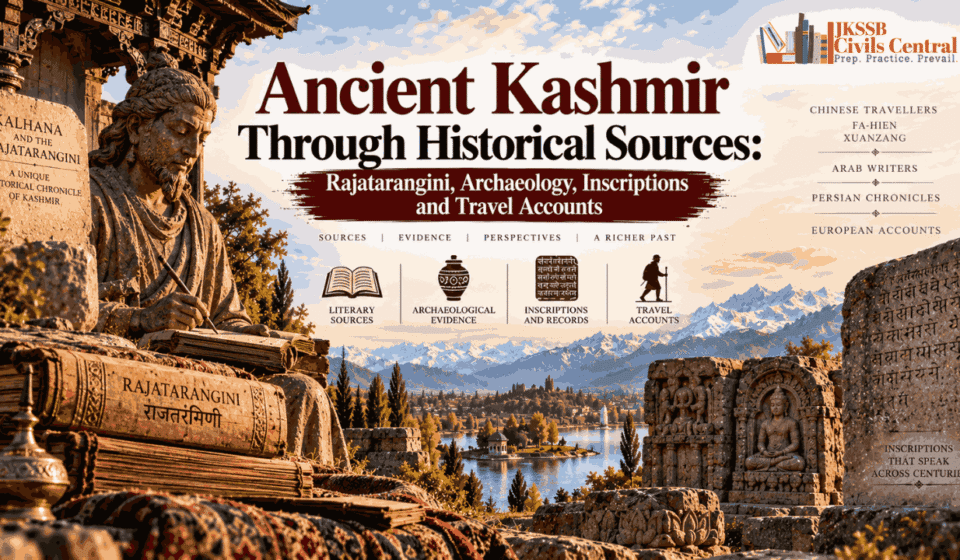
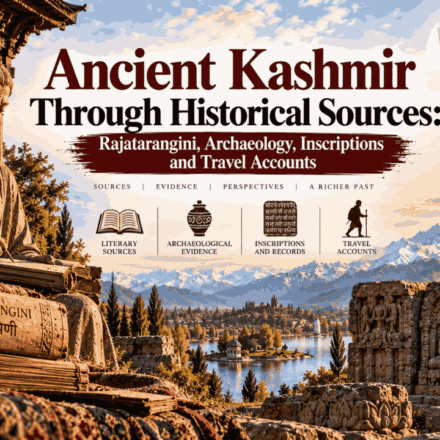
Ancient Kashmir Through Historical Sources: Rajatarangini, Archaeology, Inscriptions and Travel Accounts

J&K History Series Navigation
| Previous Article | Current Article | Next Article |
|---|---|---|
| Article 08 — Buddhism in Jammu & Kashmir: Origins, Expansion, Buddhist Learning and Archaeological Evidence | Article 09 — Ancient Kashmir Through Historical Sources: Rajatarangini, Archaeology, Inscriptions and Travel Accounts | Article 10 — Kalhana’s Rajatarangini: Structure, Sources, Historical Value and Limitations |

Learning Dashboard
| Category | Key Information |
|---|---|
| Historical Period | Ancient to Early Medieval Kashmir |
| Historical Phase | Historical reconstruction and source traditions |
| Core Theme | How the history of Kashmir is reconstructed from different types of evidence |
| Geographical Area | Primarily Kashmir Valley, with wider north-western connections |
| Central Source | Kalhana’s Rajatarangini |
| Material Evidence | Archaeological sites, architecture, coins, pottery, sculptures and inscriptions |
| Literary Sources | Rajatarangini, Nilamata Purana, Buddhist traditions and Sanskrit literature |
| Travel Accounts | Chinese Buddhist pilgrims, especially Xuanzang (Hiuen Tsang) and O-kong |
| Important Scripts | Brahmi, Kharoshthi and later Sharada |
| Major Archaeological Contexts | Semthan, Harwan, Ushkur, Parihaspora, Pandrethan and other sites |
| JKSSB Importance | Very High |
| Expected Question Types | Sources, chronology, source-author matching, evidence classification, statement-based questions |
Introduction
The history of ancient Kashmir cannot be reconstructed from a single continuous contemporary historical record. Unlike a modern state archive, the surviving evidence is scattered across literary works, archaeological remains, inscriptions, coins, manuscripts, religious traditions and the observations of travellers who visited the region at different times. Each source illuminates a different part of the past, but each also has limitations. The historian’s task is therefore not simply to collect facts from every source, but to compare different kinds of evidence and determine what each source can legitimately establish.
This makes Kashmir particularly important for the study of historical methodology. Kalhana’s Rajatarangini, composed in the 12th century, provides an extensive narrative of Kashmir’s rulers, places and political traditions, while archaeology supplies material evidence that can confirm, modify or sometimes complicate literary accounts. Inscriptions can provide direct evidence for names, titles, religious patronage, institutions and chronology; coins can illuminate political authority, economic circulation and cultural connections; and travel accounts provide external observations of Kashmir at particular moments.
The central principle of this article is therefore: Ancient Kashmir must be reconstructed by connecting sources, not by treating one source as universally authoritative.
This distinction is especially important for competitive examinations. A question may ask not merely what happened, but which source tells us about it, how reliable that source is, whether the evidence is contemporary, and whether a statement represents established evidence or later tradition.
CivilsCentral Historical Insight
The history of ancient Kashmir is best understood as an exercise in source comparison. Rajatarangini gives Kashmir an unusually rich historical narrative, but archaeology, inscriptions, coins and travel accounts provide independent or complementary evidence that allows historians to test, refine and contextualise that narrative.

Part I — Why Sources Matter in Ancient Kashmir
1. The Problem of Reconstructing the Ancient Past
Historical reconstruction depends on surviving evidence, and survival is uneven. Buildings may have disappeared, inscriptions may have been damaged, manuscripts may survive only in later copies, and oral traditions may have changed over generations. Kashmir’s geography has also shaped the archaeological record: settlements have been repeatedly occupied, structures reused, altered or destroyed, while political centres shifted over time.
The result is an uneven historical record. Some periods have comparatively strong archaeological evidence, while others depend more heavily on literary traditions. The Kushan period, for example, can be studied through archaeological sites, coins and literary references, whereas much earlier political traditions recorded by Kalhana require greater caution because the chronicle was composed many centuries later.
The historian must therefore distinguish between: Evidence that directly survives from a period and a later source describing that earlier period.
That distinction is fundamental to the entire study of Kashmir’s ancient history.
2. Different Sources Answer Different Questions
No single source type is capable of answering every historical question.
| Source Type | What It Can Tell Us |
|---|---|
| Archaeology | Settlements, structures, material culture, technology, chronology |
| Inscriptions | Names, titles, religious patronage, donations, dates, institutions |
| Coins | Rulers, political authority, economy, circulation, iconography |
| Literary texts | Political traditions, religious ideas, social practices, cultural memory |
| Travel accounts | External observations, institutions, routes, monasteries, cities |
| Manuscripts | Textual transmission, language, intellectual traditions |
| Oral/traditional narratives | Historical memory, sacred geography, cultural traditions |
The same event may therefore appear differently in different sources. A ruler’s literary biography may emphasise his religious patronage, while archaeology may reveal the actual distribution of monuments attributed to his period. A travel account may record the number of monasteries in a particular century, but it cannot automatically tell us how many existed two centuries earlier.

Part II — Literary Sources of Ancient Kashmir
3. Nilamata Purana: Sacred Geography and Cultural Memory
The Nilamata Purana is an important Sanskrit text for understanding the cultural and sacred geography of Kashmir. It contains descriptions of the Valley’s landscape, sacred places, festivals, rituals, rivers, lakes and religious practices.
Its significance is different from that of Rajatarangini. The Nilamata Purana is not a dynastic chronicle arranged around a continuous sequence of kings. Instead, it provides a cultural and religious representation of Kashmir and helps historians understand how the Valley’s landscape was conceptualised within Sanskritic traditions.
Modern scholarship commonly places the text broadly in the early medieval period, although questions of dating and textual development remain. Cambridge scholarship notes that the Nilamata Purana belongs to the seventh-century textual tradition, while Rajatarangini belongs to the twelfth century.
Historical Value
The Nilamata Purana is particularly useful for:
- sacred geography
- religious practices
- festivals
- local traditions
- rivers and sacred sites
- cultural conceptions of Kashmir.
Limitation
It should not be treated as a contemporary political chronicle of the earliest history of Kashmir.
4. Buddhist Literary Traditions

Buddhist texts and traditions preserve important information concerning the early history of Buddhism in Kashmir. These include traditions associated with Ashoka, Madhyantika, Kanishka and the Sarvāstivāda school.
Their importance is particularly clear when combined with archaeology. Harwan, Ushkur and other Buddhist sites provide material evidence for Buddhist institutional life, while Buddhist literary traditions provide explanations of how Buddhist communities understood their own history.
However, Buddhist traditions often contain religious narratives and retrospective accounts. They should therefore be classified according to their evidentiary strength rather than treated automatically as contemporary historical documentation.
Part III — Kalhana’s Rajatarangini
5. What Is the Rajatarangini?
Kalhana’s Rajatarangini, literally the “River of Kings,” is the most important indigenous historical chronicle of Kashmir.
It was composed in Sanskrit in the 12th century, generally dated to around 1148–1150 CE. The work is written in verse and is divided into eight tarangas or cantos, containing thousands of verses. University of Kashmir scholarship describes it as the earliest extant historical chronicle of Kashmir and notes that it narrates the history of Kashmir from its legendary beginnings to Kalhana’s own time.
Its importance is enormous, but its nature must be understood correctly. Rajatarangini is a historical chronicle, not a modern archival history.
Kalhana combines political narrative, genealogy, literary description, moral interpretation, geographical information and traditions from earlier sources. The work therefore has to be critically analysed rather than read as though every statement has the same evidentiary status.
6. Why Rajatarangini Is So Important
The importance of Rajatarangini lies partly in its chronological ambition. Kalhana attempted to narrate Kashmir’s political history across a very long period. He was interested in rulers, succession, political conflict, cities, temples, land, taxation, administrative practices and the consequences of royal behaviour.
The chronicle is particularly valuable for the history of medieval Kashmir because the narrative becomes progressively richer as it approaches Kalhana’s own period. It provides detailed information about political events, rulers and social conditions that cannot be reconstructed from archaeology alone.
Modern scholarship also emphasises that Kalhana drew upon earlier chronicles and other materials rather than creating his narrative entirely from imagination. University of Kashmir research identifies earlier chronicles associated with figures such as Suvrata, Padmamihira and Chavillakara among the materials connected with Kalhana’s historical reconstruction.
7. Kalhana’s Historical Method
One reason Rajatarangini is historically valuable is that Kalhana displays an interest in evidence and chronology. He did not simply present kings as isolated figures. He attempted to connect rulers, dynasties, political changes and consequences. His narrative also includes references to earlier historical traditions, inscriptions, monuments, genealogical material and other sources.
However, Kalhana’s method was not identical to modern historical criticism. He wrote in a Sanskrit poetic tradition, incorporated legends and religious traditions, and sometimes assigned great antiquity to events for which independent evidence is unavailable.
Therefore, the correct approach is: Use Kalhana seriously — but critically.
CivilsCentral Historical Insight
Kalhana’s importance does not come from the assumption that everything in Rajatarangini is literally correct. It comes from the extraordinary historical information contained in the chronicle and from the possibility of testing portions of its narrative against archaeology, inscriptions, coins and other sources.
Part IV — The Eight Tarangas and the Changing Reliability of the Narrative
8. The Broad Structure
The eight tarangas create a continuous narrative of Kashmir’s kings. The early portions contain extensive legendary and traditional material, while the later sections provide increasingly detailed political information. This does not mean that the early books are historically worthless. Rather, their information must be treated differently because independent contemporary evidence is much thinner.
A useful examination-oriented distinction is:
Early Rajatarangini → greater dependence on tradition
Later Rajatarangini → progressively richer historical detail
This is a matter of evidentiary density, not a claim that one section is simply “true” and another “false.”
9. Legendary Beginnings and Historical Caution
Kalhana begins Kashmir’s history with traditions concerning the ancient landscape and early rulers. These include the famous narrative of Kashmir having once been a lake and the role of Kashyapa in making the land habitable. The story is historically important as a cultural tradition and as part of Kashmir’s sacred geography. It should not, however, be used as literal geological evidence.
Modern geology can independently establish the Valley’s history as a former lake basin in broad geological terms, but that does not prove the historical truth of the specific Kashyapa narrative.
This distinction illustrates a recurring principle in J&K history: A traditional narrative may preserve a cultural memory without being a literal historical record.
Part V — Archaeology: The Material Record of Kashmir
10. What Archaeology Adds
Archaeology provides evidence that does not depend on the narrative of a particular historian.
Excavations and surveys can reveal:
- settlement patterns
- houses
- fortifications
- religious buildings
- monasteries
- stupas
- pottery
- tools
- sculptures
- terracotta objects
- coins
- industrial activity
- trade connections.
11. Semthan: Archaeology and the Early Historic Transition
Semthan is one of the most important early historic archaeological sites in Kashmir.
Excavations have yielded evidence associated with Northern Black Polished Ware, Indo-Greek material and Kushan remains, demonstrating that the site participated in the changing political and economic landscape of early historic Kashmir. University of Kashmir research describes Semthan as an important early historic urban centre and examines its links with Central Asian regions.
The significance of Semthan is methodological as well as archaeological. It allows historians to reconstruct periods in which literary narratives may be incomplete. Material evidence can establish that communities, technologies and political connections existed even where a textual chronicle provides limited information.
12. Harwan
Harwan is particularly important for the study of Buddhist Kashmir. Its archaeological remains include a substantial Buddhist complex and distinctive decorated terracotta tiles. The site demonstrates the existence of Buddhist institutional life and connections with wider north-western artistic traditions.
Harwan is therefore an excellent example of how archaeology can independently illuminate religious history. At the same time, the site illustrates the importance of chronological caution. Its archaeological phases should not automatically be equated with every literary event traditionally associated with the area.
13. Ushkur
Ushkur, near Baramulla, provides another important archaeological window into ancient Kashmir.
The site is traditionally associated with Hushkapura, linked with the Kushan ruler Huvishka. Archaeological evidence and literary tradition together make the site important for understanding Kushan-period Kashmir and the western gateway of the Valley.
The Baramulla region itself was strategically significant because the Jhelum provided an important route linking the Valley with areas to the west. University of Kashmir research emphasises the dense concentration of archaeological remains around the Jhelum basin and the region’s role in connecting Kashmir with the outside world.
14. Parihaspora
Parihaspora is associated with the Karkota ruler Lalitaditya Muktapida and represents another important example of archaeology and literary history intersecting.
Kalhana provides a detailed account of royal foundations and monumental construction associated with the Karkota period. Archaeological remains at Parihaspora allow historians to investigate the physical landscape behind this literary narrative.
The significance of the site therefore lies not simply in its monuments but in the opportunity to compare what Kalhana says with what the archaeological landscape reveals.
CivilsCentral Historical Insight
Archaeology does not merely “confirm” literary history. It can also modify it. When a settlement mentioned by Kalhana is excavated, historians can compare literary claims concerning its location, scale and function with the physical evidence actually preserved beneath and around the site.
Part VI — Inscriptions: Direct Historical Evidence
15. What Is an Inscription?
An inscription is a written record preserved on a durable surface such as:
- stone
- metal
- terracotta
- seals
- architectural elements
- other objects.
Epigraphy—the study of inscriptions—is especially valuable because inscriptions can provide contemporary or near-contemporary evidence.
They may contain:
- ruler’s name
- royal title
- date
- genealogy
- religious affiliation
- land grant
- donation
- construction activity
- administrative information
- names of places or individuals.
For ancient history, such evidence can be more direct than a much later literary narrative.
16. Brahmi and Kharoshthi
Two major ancient scripts are particularly important in the broader north-western historical context:
Brahmi and Kharoshthi.
Brahmi was generally written from left to right, while Kharoshthi was written from right to left and was particularly associated with the north-west. Archaeological and epigraphic scholarship identifies both among the earliest decipherable writing systems of ancient India.
Kharoshthi is especially relevant to the study of ancient Kashmir because the Valley’s western and north-western connections brought it into contact with Gandharan and Central Asian cultural zones. Kharoshthi numerals and inscriptions found in Buddhist archaeological contexts such as Harwan are consequently significant evidence of these wider connections.
17. Sharada and the Later Epigraphic Landscape
The Sharada script became particularly associated with Kashmir and the north-western Himalayan region in the later historical period.
The Indira Gandhi National Centre for the Arts notes that Sharada was widely used across Kashmir and adjoining regions including parts of Afghanistan/Gandhara, Gilgit, Chilas, Chitral, Ladakh, Jammu, Himachal Pradesh and Delhi. Epigraphic and literary records in Sharada therefore provide important evidence for the history and culture of Kashmir and the wider north-west.
For examination purposes, however, an important chronological distinction should be maintained: Kharoshthi/Brahmi → ancient north-western epigraphic context
Sharada → later Kashmir-associated script tradition. They should not be treated as interchangeable.
18. What Inscriptions Can and Cannot Do
Inscriptions are extremely valuable, but they do not automatically provide a complete political narrative. A royal inscription may tell us that a ruler constructed or donated something. It may provide a date or title. It may identify a religious institution. But it may not explain the broader political circumstances surrounding the event.
Similarly, the absence of an inscription does not prove that an event did not happen. This is particularly important in the study of ancient Kashmir, where the surviving epigraphic record is uneven.
Therefore: Inscription = direct evidence for what it records, not
Inscription = complete history of the period.
Part VII — Coins as Historical Sources
19. Why Coins Matter
Coins are another major form of material evidence. They can provide information about:
- rulers
- royal titles
- political symbols
- religious imagery
- economic circulation
- trade
- chronology
- cultural interaction.
Coins are particularly valuable in periods where written political records are limited.
20. Kushan Coins and Kashmir
Kushan coins are especially important for reconstructing the Kushan presence in Kashmir. Archaeological research has documented numerous Kushan-period sites and coin finds in the Valley, providing material evidence that complements literary references to Kanishka, Huvishka and other Kushan rulers.
Coins also help illuminate the religious and cultural environment of the Kushan world. Their imagery includes a variety of deities, demonstrating that the political environment was religiously plural rather than reducible to a single religious identity.
This makes numismatics particularly useful when testing literary descriptions of royal religious policy.
21. Coins and Chronology
Coins can sometimes help establish the chronological presence of a ruler or political authority at a particular location. However, a coin found at a site does not necessarily prove that the ruler personally visited or administered the site. Coins can move through trade, taxation, military activity or exchange.
Therefore:
Coin found at a site → evidence of circulation or presence
does not automatically mean:
Coin found at a site → direct proof of political administration.
This distinction is a useful example of evidence-based reasoning for JKSSB.
Part VIII — Travel Accounts: Kashmir Seen by Outsiders
22. Why Travel Accounts Are Valuable
Travel accounts provide an external perspective on Kashmir. Unlike a royal inscription or local chronicle, a traveller may describe what he personally observed:
- cities
- monasteries
- temples
- routes
- rulers
- religious communities
- customs
- geography
- educational institutions.
But travellers also had purposes and limitations. Buddhist pilgrims naturally paid particular attention to monasteries and religious teachers, while their numerical estimates may not meet modern standards of demographic measurement.
Part IX — Xuanzang
23. Xuanzang’s Visit to Kashmir
The Chinese Buddhist monk Xuanzang visited Kashmir in the 7th century CE and spent an extended period studying there.
His account is particularly important because it describes Kashmir as a significant centre of Buddhist learning. He studied Buddhist doctrine and Sanskrit with learned teachers, demonstrating that the Valley was not simply a pilgrimage destination but also an intellectual centre.
His account is therefore valuable for the history of:
- Buddhist monasteries
- Buddhist teachers
- Sanskrit learning
- routes
- political geography
- religious institutions.
24. Xuanzang’s Numerical Information
Xuanzang’s account is often used for estimates of the number of monasteries and monks in Kashmir. Such figures are important historical evidence, but they should be presented as reported observations or estimates, not as modern census data.
This distinction matters because travellers could count institutions differently, could rely on local informants, and could focus on particular religious networks. The value of the figures therefore lies primarily in demonstrating the scale and visibility of Buddhist institutional life, rather than in providing a statistically precise population count.
CivilsCentral Historical Insight
Xuanzang is valuable not because every numerical detail in his account can be treated as statistically exact, but because his prolonged stay provides external evidence that Kashmir possessed a substantial Buddhist intellectual and institutional environment in the 7th century.
Part X — O-kong and the 8th-Century Record
25. O-kong / Wukong
The Chinese Buddhist pilgrim O-kong, also known as Wukong, provides another important external perspective on Kashmir.
He reached Kashmir in the 8th century CE and studied Buddhist texts and Sanskrit. His account is particularly useful because it extends the documentary evidence for Buddhist learning beyond Xuanzang’s time.
His presence demonstrates that Kashmir’s reputation as a Buddhist intellectual centre did not disappear immediately after the 7th century.
26. Why Multiple Travel Accounts Matter
When two travellers separated by roughly a century describe Kashmir as a place of Buddhist learning, the evidence becomes stronger for the continuity of Buddhist institutions across that period.
Nevertheless, their accounts must still be interpreted in context. They were Buddhist pilgrims, so their interests naturally concentrated on Buddhist institutions. Their accounts therefore should not be used to infer that Kashmir’s entire population was Buddhist.
This distinction is essential: Evidence of Buddhist institutional strength ≠ evidence of complete religious uniformity.
Part XI — Other External and Regional Sources
27. Classical and North-Western Connections
Kashmir’s history was closely connected with the wider north-western region. Greek, Roman and later Central Asian geographical traditions sometimes preserve information about peoples and regions surrounding Kashmir. Such evidence is useful for reconstructing Kashmir’s external connections, but geographic identifications must be made cautiously.
Ancient geographical names do not always correspond exactly to modern political boundaries. Terms such as Gandhara, Darada, Kamboja and other regional names changed in meaning and geographical scope across time.
Therefore, ancient geographical references should not be mechanically mapped onto modern J&K districts.
28. Persian Sources
Persian historical writing becomes increasingly important for Kashmir’s later medieval history. However, it should not be projected backward into periods for which it does not provide contemporary evidence. For the ancient period, Sanskrit literary sources, archaeology, inscriptions, coins and Chinese accounts are generally more central.
This distinction becomes increasingly important in later articles dealing with the Sultanate, Mughal, Afghan and Sikh periods.
Part XII — Archaeology and Literary History: Testing the Narrative
29. When Archaeology Supports Literary Tradition
A particularly valuable situation occurs when a site described in literary sources can be independently identified archaeologically.
For example, literary traditions concerning Kushan settlements can be examined alongside archaeological remains and coins. University of Kashmir research notes that literary references to Kushan rulers and settlements in Kashmir have been complemented by archaeological and numismatic evidence.
This does not mean that every literary detail has been proven. Rather, the convergence of different evidence types increases confidence in the broader historical interpretation.
30. When Archaeology Complicates Literary Tradition
Archaeology can also challenge overly simple readings of texts. A literary source may attribute the foundation of a settlement to a particular ruler, while archaeology may reveal that occupation began earlier and continued long afterward. In such a case, the ruler may have expanded, renamed, rebuilt or patronised an existing settlement rather than created it entirely from nothing.
This is why archaeological chronology is essential when interpreting foundation traditions.
The historian should therefore ask: Was the ruler the first occupant?
or
Did the ruler transform an already existing settlement?
The two claims are not equivalent.
Part XIII — The Archaeological Landscape and Rajatarangini
31. Kalhana’s Places on the Ground
One of the most productive areas of current Kashmir historical research is the comparison between places mentioned in Rajatarangini and archaeological remains.
University of Kashmir research specifically examines settlements and religious structures mentioned by Kalhana and compares their literary descriptions with the archaeological landscape of Kashmir. Many such settlements survive today primarily as ruins or archaeological traces.
This approach transforms Rajatarangini from a text that is simply read into a source that can be tested spatially and materially.
32. The Jhelum Basin as a Historical Landscape
The Jhelum basin is especially important because the river connected settlements within Kashmir and linked the Valley toward the west. Research on the Baramulla archaeological landscape shows that numerous settlements and structures were concentrated around the Jhelum basin and that routes through this region connected Kashmir with the outside world.
This geographical evidence helps explain why so many historical sites emerged along river corridors. The historical map of Kashmir was therefore shaped not merely by political boundaries but also by:
rivers + passes + settlement zones + trade routes + religious centres.
Part XIV — Manuscripts and Palaeography
33. Manuscripts as Historical Sources
Manuscripts preserve texts, but they must be distinguished from the original date of composition. A manuscript copy may be centuries later than the work it contains. Therefore:
date of manuscript ≠ date of text.
This is especially important in Kashmir, where many Sanskrit works survive through manuscript traditions that were copied and recopied over long periods.
The study of manuscripts therefore requires:
- palaeography
- textual criticism
- comparison of manuscripts
- linguistic analysis
- identification of interpolations and later additions.
34. Birch Bark and Kashmir’s Manuscript Tradition
Kashmir’s natural and cultural environment supported the historical use of birch bark as a writing material.
The broader Indian manuscript tradition included birch bark, palm leaf and later paper. IGNCA notes that manuscripts were historically written on materials including birch bark and that palaeography is essential for studying the development of scripts and manuscripts.
The survival of manuscripts provides evidence not only for political history but also for:
- philosophy
- grammar
- medicine
- astronomy
- literature
- mathematics
- religious thought.
Thus manuscript history broadens our understanding of Kashmir beyond dynasties and battles.
Part XV — Sharada and the Intellectual History of Kashmir
35. Sharada as a Historical Source
The development and use of the Sharada script are important for understanding Kashmir’s later intellectual and cultural history.
Sharada became strongly associated with Kashmir and was used across a much wider north-western region. The script appears in inscriptions and manuscripts and therefore connects palaeography with the history of language, literature and education.
Its geographical spread also reminds us that ancient and medieval Kashmir should not be studied as an isolated valley. Written culture connected Kashmir with Jammu, Ladakh and north-western regions.
Part XVI — Source Criticism: How Historians Read the Evidence
36. Source A — Contemporary vs Later
The first question is: How close is the source to the event?
A contemporary inscription generally has a different evidentiary position from a 12th-century text describing an event supposedly occurring many centuries earlier. But chronological proximity alone does not guarantee truth. Contemporary royal inscriptions can exaggerate victories or glorify rulers.
Therefore: Contemporary ≠ automatically unbiased.
37. Source B — Purpose
Every source has a purpose. A royal inscription may legitimise a ruler. A Buddhist pilgrim may focus on monasteries. A religious text may preserve sacred traditions. A chronicle may interpret political events through moral categories. A coin may serve economic and political purposes.
Understanding the purpose of a source helps historians identify what it is most useful for.
38. Source C — Corroboration
The strongest historical reconstruction often emerges when independent sources converge.
For example:
Literary reference
archaeological remains
coins
inscriptions
can produce a much stronger reconstruction than any one source alone.
This is the principle of corroboration.
39. Source D — Contradiction
Contradictions between sources should not simply be erased. If a literary source gives one date and archaeological evidence suggests another, the disagreement becomes part of the historical problem.
The correct approach is:
- identify the disagreement;
- assess the evidence;
- explain the stronger interpretation;
- retain uncertainty where it remains.
This is especially important for disputed chronologies and identifications in ancient Kashmir.
CivilsCentral Historical Insight
Historical evidence becomes powerful through comparison. The historian does not ask only, “What does this source say?” but also, “When was it produced, why was it produced, what could its author have known, and does another independent source support it?”
Part XVII — Evidence Hierarchy for Ancient Kashmir
40. Level A — Strongly Established Evidence
Examples include:
- archaeological remains physically excavated or documented;
- coins recovered from archaeological contexts;
- inscriptions whose text and provenance are established;
- documented visits by historical travellers;
- securely dated material evidence.
These sources can support strong historical statements, although their interpretation still requires care.
41. Level B — Strong Historical Tradition
This category includes historical traditions that are widely used in reconstructing Kashmir’s past but are not supported equally by contemporary evidence.
Examples may include:
- traditional associations between particular rulers and settlements;
- literary traditions concerning certain political developments;
- established historical interpretations based on several sources.
42. Level C — Traditional or Literary Account
This includes narratives primarily preserved through literary or religious traditions.
Examples include:
- certain early dynastic traditions;
- sacred narratives concerning Kashmir’s creation;
- missionary legends;
- some accounts of ancient rulers.
These are historically valuable as traditions but should not automatically be converted into established fact.
43. Level D — Contested Interpretation
This category includes questions where scholars continue to disagree about:
- exact chronology
- identification of places
- political control
- foundation traditions
- interpretation of archaeological layers
- historical details of literary narratives.
A premium historical article should explicitly identify such uncertainty rather than conceal it.
Part XVIII — The Source Matrix
| Source | Approximate Period | Main Value | Major Limitation |
|---|---|---|---|
| Archaeology | Various periods | Material culture, settlements, structures | Incomplete survival and interpretation |
| Inscriptions | Ancient–medieval | Names, dates, titles, donations | Fragmentary and uneven distribution |
| Coins | Ancient–medieval | Rulers, circulation, political/economic connections | Circulation does not equal direct administration |
| Nilamata Purana | Early medieval textual tradition | Sacred geography and religious culture | Not a continuous political chronicle |
| Rajatarangini | 12th c. CE | Political narrative and historical traditions | Later composition; poetic and traditional elements |
| Xuanzang | 7th c. CE | Monasteries, teachers, geography | Buddhist pilgrim perspective |
| O-kong | 8th c. CE | Buddhist learning and institutions | Religious/scholarly focus |
| Manuscripts | Various | Intellectual and literary history | Surviving copy may be much later than original |
| Sharada records | Mainly later historical period | Language, literature, regional culture | Chronological interpretation required |
Part XIX — What Each Major Source Is Best Used For
Rajatarangini
Best for: Kashmir’s political narrative, rulers, dynasties, places and medieval historical memory.
Archaeology
Best for: settlements, architecture, material culture, chronology and physical evidence.
Inscriptions
Best for: names, titles, dates, donations, construction and institutional information.
Coins
Best for: rulers, political symbols, circulation, economic networks and cultural imagery.
Nilamata Purana
Best for: sacred geography, religious practices and cultural traditions.
Xuanzang
Best for: 7th-century Buddhist institutions, learning, routes and external observation.
O-kong
Best for: 8th-century Buddhist learning and institutional continuity.
Manuscripts
Best for: intellectual, literary, scientific and religious history.
Part XX — Historical Significance
44. Why Kashmir Has an Unusually Rich Historical Tradition
Kashmir’s historical tradition is distinctive because several different source traditions overlap. There is a strong Sanskrit literary tradition, an extensive archaeological landscape, a record of Buddhist connections, manuscript traditions and accounts from foreign travellers. The interaction between these sources allows historians to reconstruct aspects of Kashmir’s past that would otherwise remain obscure.
This does not mean that Kashmir possesses a complete historical record. Rather, it means that the potential for source comparison is unusually rich.
45. The Importance of Rajatarangini Without Romanticising It
Rajatarangini should neither be dismissed as mythology nor treated as a modern history book.
Its importance lies between these extremes. It preserves historical traditions, political information, geographical descriptions and narratives of rulers that are indispensable to the study of Kashmir. At the same time, it incorporates poetic conventions, legends and information from periods far removed from Kalhana’s own lifetime.
The mature historical approach is therefore:
Respect the source → interrogate the source → compare the source → contextualise the source.
46. Archaeology as an Independent Check
Archaeology provides a particularly important check because material remains were not created to satisfy later historians. A ruined settlement, coin, stupa, inscription or pottery assemblage can reveal aspects of the past that a literary source omitted or interpreted differently.
This makes archaeological research essential for testing claims about:
- settlement chronology
- urban development
- religious institutions
- trade
- political connectivity
- cultural interaction.
47. Travel Accounts as External Evidence
Travel accounts are valuable because they provide an outsider’s perspective. Xuanzang and O-kong demonstrate that Kashmir was connected to wider Buddhist intellectual networks. Their accounts help historians understand how Kashmir appeared to visitors at particular moments.
But external observation also has limitations. A traveller’s Kashmir is partly shaped by the purpose of the journey and the interests of the traveller. Therefore, travel accounts are strongest when combined with local and archaeological evidence.
Part XXI — JKSSB Knowledge Matrix
| Question | High-Value Answer |
|---|---|
| Who wrote Rajatarangini? | Kalhana |
| In which language? | Sanskrit |
| Approximate date? | c. 1148–1150 CE |
| How many tarangas? | Eight |
| What does Rajatarangini primarily narrate? | History of Kashmir’s rulers and political developments |
| Is it contemporary with the Mauryan period? | No |
| What is archaeology used for? | Material evidence of settlements, structures and culture |
| What does epigraphy study? | Inscriptions |
| What is numismatics? | Study of coins |
| Which ancient scripts are important in the north-west? | Brahmi and Kharoshthi |
| Which script became strongly associated with Kashmir later? | Sharada |
| Which site is important for early historic archaeology? | Semthan |
| Which site is famous for Buddhist terracotta tiles? | Harwan |
| Which site is associated with Hushkapura tradition? | Ushkur |
| Which Chinese pilgrim studied in Kashmir in the 7th century? | Xuanzang |
| Which Chinese visitor provides 8th-century evidence? | O-kong/Wukong |
| What is the Nilamata Purana particularly useful for? | Sacred geography and religious-cultural traditions |
| Does an archaeological coin prove direct administration? | Not necessarily |
| Does a later literary source automatically prove an ancient event? | No |
| What is the strongest approach? | Corroboration across independent evidence |
Part XXII — Examination Discrimination Points
1. Rajatarangini vs Nilamata Purana
Rajatarangini → Kalhana → 12th century → historical chronicle.
Nilamata Purana → earlier Sanskrit cultural/religious tradition → sacred geography and ritual culture.
2. Archaeology vs Epigraphy
Archaeology studies the material remains of past societies.
Epigraphy specifically studies inscriptions.
An inscription may itself be an archaeological object, but the disciplines are not identical.
3. Epigraphy vs Numismatics
Epigraphy → inscriptions
Numismatics → coins
4. Brahmi vs Kharoshthi
Brahmi → generally left to right
Kharoshthi → right to left; strong north-western association
5. Kharoshthi vs Sharada
Kharoshthi → ancient north-western script tradition
Sharada → later Kashmir-associated script tradition
6. Kalhana vs Xuanzang
Kalhana → local Sanskrit chronicler, 12th century
Xuanzang → Chinese Buddhist pilgrim, 7th century
7. Xuanzang vs O-kong
Xuanzang → 7th century
O-kong → 8th century
8. Literary Evidence vs Archaeological Evidence
A literary text may describe an event. Archaeology can demonstrate physical remains. The strongest reconstruction often comes when both converge.
Part XXIII — JKSSB Question Pattern
Direct Fact
Who wrote Rajatarangini?
Answer: Kalhana
Statement-Based
Consider the following statements:
- Rajatarangini was composed in Sanskrit.
- It is divided into eight tarangas.
- It was written during the Mauryan period.
Correct: 1 and 2 only.
Match the Following
| Source | Association |
|---|---|
| Kalhana | Rajatarangini |
| Xuanzang | 7th-century travel account |
| O-kong | 8th-century Buddhist account |
| Archaeology | Material evidence |
Identification by Clues
Identify the source:
- Sanskrit
- 12th century
- Kashmir
- eight tarangas
- kings of Kashmir
Answer: Rajatarangini
Conceptual-Factual
Which source is most directly useful for studying physical settlement remains?
A. Archaeology
B. Royal genealogy
C. Religious legend
D. Oral tradition
Answer: A. Archaeology
Part XXIV — JKSSB Practice Questions
Question 1
Who composed Rajatarangini?
A. Bilhana
B. Kalhana
C. Somadeva
D. Kshemendra
Correct Answer: B. Kalhana
Explanation: Kalhana composed the Sanskrit chronicle Rajatarangini in the 12th century.
Question 2
Consider the following statements about Rajatarangini:
- It is written in Sanskrit.
- It is divided into eight tarangas.
- It was composed during the reign of Kanishka.
Which is correct?
A. 1 only
B. 1 and 2 only
C. 2 and 3 only
D. 1, 2 and 3
Correct Answer: B. 1 and 2 only
Explanation: Rajatarangini is a 12th-century Sanskrit chronicle, centuries later than Kanishka.
Question 3
Which of the following is correctly matched?
A. Epigraphy — Study of coins
B. Numismatics — Study of inscriptions
C. Epigraphy — Study of inscriptions
D. Archaeology — Study of only written records
Correct Answer: C. Epigraphy — Study of inscriptions
Question 4
Which script was written from right to left and had a strong association with the ancient north-west?
A. Brahmi
B. Kharoshthi
C. Sharada
D. Devanagari
Correct Answer: B. Kharoshthi
Question 5
Which of the following provides the strongest direct material evidence for the existence of an ancient settlement?
A. A later legend
B. Archaeological remains
C. A modern historical interpretation
D. A modern textbook
Correct Answer: B. Archaeological remains
Question 6
Which Chinese traveller is associated with an extended period of study in Kashmir during the 7th century CE?
A. O-kong
B. Xuanzang
C. Megasthenes
D. Al-Biruni
Correct Answer: B. Xuanzang
Question 7
Arrange the following broadly in chronological order:
- Xuanzang’s visit to Kashmir
- Kalhana’s Rajatarangini
- O-kong’s visit to Kashmir
A. 1–3–2
B. 3–1–2
C. 2–1–3
D. 1–2–3
Correct Answer: A. 1–3–2
Explanation: Xuanzang belongs to the 7th century, O-kong to the 8th century, while Kalhana’s chronicle dates to the 12th century.
Question 8
Which source is particularly useful for understanding the sacred geography and religious-cultural traditions of Kashmir?
A. Nilamata Purana
B. Treaty of Amritsar
C. Ain-i-Akbari
D. Akbarnama
Correct Answer: A. Nilamata Purana
Question 9
A Kushan coin discovered in Kashmir most securely establishes which of the following?
A. The Kushan ruler personally visited the site
B. The site was certainly the Kushan capital
C. Kushan coinage circulated or was present at the site
D. Every inhabitant of the site was Kushan
Correct Answer: C. Kushan coinage circulated or was present at the site
Explanation: Coins are powerful evidence, but their presence does not automatically establish direct personal presence or complete political administration.
Question 10
Which approach is most appropriate for reconstructing ancient Kashmir?
A. Accept Rajatarangini literally in every detail
B. Ignore literary sources and rely only on archaeology
C. Use literary, archaeological, epigraphic, numismatic and travel evidence comparatively
D. Use only modern historical textbooks
Correct Answer: C
Explanation: Historical reconstruction is strongest when different forms of evidence are critically compared.
Part XXV — Rapid Revision Zone
Important Sources
Kalhana → Rajatarangini
Nilamata tradition → Sacred geography and religious culture
Xuanzang → 7th-century Kashmir
O-kong → 8th-century Kashmir
Archaeology → Material remains
Epigraphy → Inscriptions
Numismatics → Coins
Important Dates
| Approximate Date | Event / Source |
|---|---|
| 7th century CE | Nilamata Purana textual tradition broadly associated with early medieval Kashmir |
| 7th century CE | Xuanzang’s visit to Kashmir |
| 8th century CE | O-kong’s visit |
| c. 1148–1150 CE | Composition of Kalhana’s Rajatarangini |
Note: textual dating, especially for the Nilamata Purana, should be treated as approximate rather than mechanically precise.
Important Places
- Semthan → Early historic archaeology
- Harwan → Buddhist archaeology, terracotta tiles
- Ushkur → Hushkapura tradition
- Parihaspora → Karkota archaeological landscape
- Pandrethan → Ancient settlement and architectural history
- Baramulla/Jhelum basin → Major communication and archaeological landscape
Important Scripts
| Script | Key Association |
|---|---|
| Brahmi | Ancient Indian epigraphic tradition |
| Kharoshthi | Ancient north-west; right-to-left |
| Sharada | Kashmir and wider north-western manuscript/epigraphic tradition |
Important Disciplines
Archaeology → Material remains
Epigraphy → Inscriptions
Numismatics → Coins
Palaeography → Development and study of scripts
Manuscriptology → Study and preservation of manuscripts
One-Line Revision Facts
- Rajatarangini was written by Kalhana.
- It was composed in Sanskrit.
- It contains eight tarangas.
- It dates to the 12th century CE.
- It is a historical chronicle, not a modern archival history.
- Nilamata Purana is particularly valuable for Kashmir’s sacred geography and religious-cultural traditions.
- Archaeology provides material evidence.
- Epigraphy studies inscriptions.
- Numismatics studies coins.
- Kharoshthi was written right to left.
- Sharada became strongly associated with Kashmir in the later historical period.
- Xuanzang visited Kashmir in the 7th century.
- O-kong visited Kashmir in the 8th century.
- Semthan is important for Kashmir’s early historic archaeology.
- Harwan is important for Buddhist archaeology.
- Literary evidence and archaeological evidence should be corroborated, not conflated.
Part XXVI — Frequently Confused Facts
Is Rajatarangini an ancient-period text?
No. It is a 12th-century chronicle that describes earlier history as well as Kalhana’s own period.
Is Kalhana a contemporary source for Ashoka?
No. Kalhana lived many centuries after Ashoka. His account is a later literary source for the Mauryan past.
Is Rajatarangini unreliable?
That is too simplistic. It is an extremely important source, but different portions require different levels of critical scrutiny.
Is Nilamata Purana a political chronicle?
No. It is particularly valuable for Kashmir’s sacred geography, religious practices and cultural traditions.
What is the difference between archaeology and epigraphy?
Archaeology studies material remains broadly; epigraphy specifically studies inscriptions.
What is the difference between epigraphy and numismatics?
Epigraphy → inscriptions.
Numismatics → coins.
Does a coin prove political control?
Not automatically. It demonstrates the presence or circulation of the coin and must be interpreted in context.
Does a later manuscript mean the text itself is later?
No. A manuscript may be a later copy of an older work.
Is Sharada the same as Kharoshthi?
No. They belong to different historical script traditions.
Are Xuanzang’s numerical estimates modern census figures?
No. They are observations or estimates recorded by a historical traveller and should be interpreted accordingly.
Part XXVII — What Can JKSSB Ask?
This article contains several high-value examination areas:
Source–Author Association
- Kalhana → Rajatarangini
- Xuanzang → 7th-century travel account
- O-kong → 8th-century account
Source–Subject Association
- Nilamata Purana → sacred geography/religious culture
- Rajatarangini → Kashmir’s dynastic and political narrative
- Archaeology → material remains
- Epigraphy → inscriptions
- Numismatics → coins
Chronology
Xuanzang → O-kong → Kalhana
Evidence Classification
Candidates may be asked to distinguish:
- contemporary evidence
- later literary tradition
- archaeological evidence
- historical interpretation.
Script Identification
- Brahmi
- Kharoshthi
- Sharada
Archaeological Identification
- Semthan
- Harwan
- Ushkur
- Parihaspora
Conceptual Questions
A particularly important question type is:
Which source can establish what?
This tests understanding rather than simple memorisation.
Chapter Summary
Ancient Kashmir’s history cannot be reconstructed from a single source. The region’s past emerges through the interaction of literary traditions, archaeology, inscriptions, coins, manuscripts and travel accounts. Each source type has a different evidentiary value and answers different historical questions.
Rajatarangini occupies a central position because Kalhana attempted to construct a long historical narrative of Kashmir and drew upon earlier traditions and sources. Yet its 12th-century date means that its accounts of much earlier periods cannot automatically be treated as contemporary evidence. Its greatest value is realised when its narratives are compared with archaeology, inscriptions, coins and other independent evidence.
Archaeology provides the material foundation for much of ancient Kashmir’s history. Sites such as Semthan, Harwan, Ushkur and Parihaspora demonstrate the physical existence of settlements, religious institutions and cultural connections that can be compared with literary descriptions. Inscriptions and coins provide more specific evidence concerning names, rulers, dates, religious patronage, political authority and economic circulation, although each has its own limitations.
Travel accounts add another dimension. Xuanzang’s 7th-century visit and O-kong’s 8th-century account provide external evidence for Buddhist learning and institutional life in Kashmir. Their testimony is particularly valuable because it demonstrates that Kashmir remained connected with the wider Buddhist intellectual world, while also reminding historians that travellers observed the region through their own religious and scholarly interests.
The central lesson is therefore methodological:
Ancient Kashmir is not reconstructed by choosing one “best” source. It is reconstructed by comparing different kinds of evidence and identifying where they converge, where they diverge and where uncertainty remains.
JKSSB Takeaway
Remember the core source chain:
KALHANA → RAJATARANGINI → 12th CENTURY → 8 TARANGAS
NILAMATA PURANA → SACRED GEOGRAPHY & RELIGIOUS CULTURE
ARCHAEOLOGY → MATERIAL REMAINS
EPIGRAPHY → INSCRIPTIONS
NUMISMATICS → COINS
XUANZANG → 7th CENTURY
O-KONG → 8th CENTURY
SEMTHAN → EARLY HISTORIC ARCHAEOLOGY
HARWAN → BUDDHIST ARCHAEOLOGY
USHKUR → HUSHKAPURA TRADITION
SHARADA → LATER KASHMIR-ASSOCIATED SCRIPT
And the most important conceptual rule:
A later literary tradition, an archaeological discovery and a contemporary inscription do not carry the same evidentiary weight.
Mind Map
                 ANCIENT KASHMIR
                       │
                       ↓
              HISTORICAL SOURCES
                       │
       ┌───────────────┼────────────────┐
       ↓               ↓                ↓
   LITERARY         MATERIAL         EXTERNAL
    SOURCES          SOURCES          ACCOUNTS
       │               │                │
       │               │                │
 Nilamata          Archaeology       Xuanzang
 Rajatarangini     Inscriptions      O-kong
 Buddhist texts   Coins
       │               │                │
       └───────────────┼────────────────┘
                       ↓
               SOURCE CRITICISM
                       │
        ┌──────────────┼──────────────┐
        ↓              ↓              ↓
   Date/Context      Purpose       Corroboration
        │              │              │
        └──────────────┼──────────────┘
                       ↓
             HISTORICAL RECONSTRUCTION
                       │
          ┌────────────┼────────────┐
          ↓            ↓            ↓
      Political     Religious     Economic
       History       History       History
          │            │            │
          └────────────┼────────────┘
                       ↓
             ARCHAEOLOGICAL LANDSCAPE
                       │
       Semthan — Harwan — Ushkur
                       │
                 Parihaspora
                       │
                       ↓
              JKSSB APPLICATION
                       │
       Source → Author → Period → Evidence
FAQs
1. Why is Rajatarangini important for Kashmir history?
It provides an extensive Sanskrit narrative of Kashmir’s rulers, political developments, places and historical traditions from legendary beginnings to Kalhana’s own period.
2. Who wrote Rajatarangini?
Kalhana, in the 12th century CE.
3. How many books or tarangas are in Rajatarangini?
It is divided into eight tarangas.
4. Is Rajatarangini the only source for ancient Kashmir?
No. Archaeology, inscriptions, coins, manuscripts, Buddhist literature and travel accounts are also important.
5. What is the importance of archaeology?
It provides physical evidence of settlements, buildings, religious institutions, technology and material culture.
6. What is epigraphy?
Epigraphy is the study of inscriptions.
7. What is numismatics?
Numismatics is the study of coins and coinage.
8. Which Chinese traveller is particularly important for 7th-century Kashmir?
Xuanzang (Huien Tsang)
9. Which source is especially useful for Kashmir’s sacred geography?
The Nilamata Purana.
10. What is the most important methodological lesson?
No single source should automatically be treated as completely authoritative. Historical reconstruction is strongest when literary, archaeological, epigraphic, numismatic and travel evidence are critically compared.
About The Author




[…] Article 09 — Ancient Kashmir Through Historical Sources: Rajatarangini, Archaeology, Inscriptions … […]
[…] Article 09 — Ancient Kashmir Through Historical Sources: Rajatarangini, Archaeology, Inscriptions … […]