
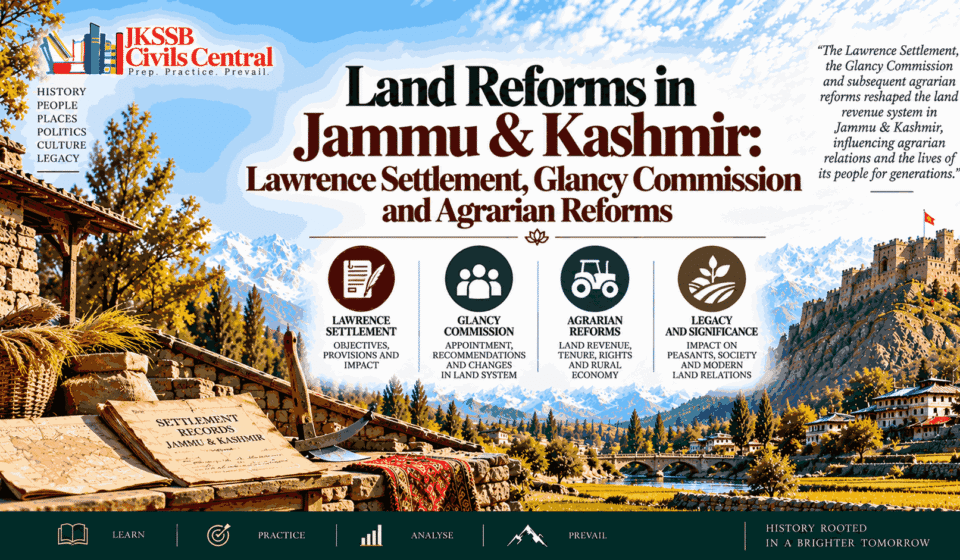
Land Reforms in Jammu & Kashmir: Lawrence Settlement, Glancy Commission and Agrarian Reforms

J&K History Series Navigation
| Previous Article | Current Article | Next Article |
|---|---|---|
| Article 39 — Socio-Economic Conditions under Dogra Rule: Land, Taxation, Begar, Agriculture and Crafts | Article 40 — Land Reforms in Jammu & Kashmir: Lawrence Settlement, Glancy Commission and Agrarian Reforms | Article 41 — Maharaja Hari Singh: Social Reforms, Constitutional Developments and Modernization |
Learning Dashboard
| Component | Key Information |
|---|---|
| Historical Period | Late 19th century–1950, with roots in the Dogra period |
| Historical Phase | Dogra State & Transition to Post-1947 J&K |
| Main Theme | Evolution of land tenure, occupancy and proprietary rights |
| Geographical Focus | Kashmir, Jammu and other parts of the princely state |
| Major Turning Points | Lawrence Settlement; Tenancy Act 1923; Glancy Commission 1931–32; proprietary-rights measures of 1933; Land Revenue Act 1939; Big Landed Estates Abolition Act 1950 |
| Key Personalities | Walter Lawrence, B. J. Glancy, Maharaja Pratap Singh, Maharaja Hari Singh |
| Key Concepts | Settlement, occupancy rights, assami, tenancy, proprietary rights, khalsa/state land, jagir, revenue settlement |
| Key Sources | Settlement records, Lawrence’s The Valley of Kashmir, J&K legislation, administrative records and modern scholarship |
| JKSSB Importance | Very High |
| Likely Question Types | Chronology, statement-based, matching, direct fact, conceptual-factual, comparative |
Introduction
Land was at the centre of the economic and social structure of Jammu and Kashmir under Dogra rule. Agriculture provided the principal livelihood for a large part of the population, while land revenue formed an important component of state finance. Consequently, the question of who cultivated land, who possessed rights over it, who collected revenue from it and who could transfer or inherit those rights became one of the most important socio-economic questions of the princely state.
The agrarian system did not change through one single reform. Instead, it evolved through a sequence of settlements, regulations, tenancy legislation and political concessions. The late nineteenth-century settlement associated with Sir Walter Lawrence attempted to bring greater order to land records and revenue assessment and helped establish categories of occupancy rights. The Jammu and Kashmir Tenancy Act, 1923 subsequently provided a more systematic legal framework for tenancy, while the political crisis of 1931 contributed to the appointment of the Glancy Commission, whose recommendations helped move sections of the peasantry from occupancy toward proprietary rights in state-owned land.
The process remained incomplete. Important distinctions between state land, private land, jagirs and other tenures continued, and the reforms of the Dogra period did not abolish the broader structure of landlordism and intermediary rights. The decisive transformation came only after 1947 with the Jammu and Kashmir Big Landed Estates Abolition Act, 1950, which sought to abolish big landed estates and transfer land to actual tillers. Thus, the history of land reform in J&K is best understood as a long transition from state-centred revenue control and layered tenancy toward stronger cultivator rights and, eventually, land-to-the-tiller legislation.
CivilsCentral Historical Insight
Land reform in Jammu and Kashmir was not a single event but a cumulative process. The Lawrence Settlement, tenancy legislation and Glancy-era reforms progressively altered the legal position of cultivators, while the 1950 legislation represented a much more radical break with the old landed structure.
Part I — Agrarian Conditions before Systematic Settlement
1. Why Land Settlement Became Necessary
Before the major settlement operations of the late nineteenth century, the relationship between the state, landholders and cultivators was not governed by a single uniform system of clearly recorded proprietary rights. Revenue demands, customary claims, occupancy arrangements and intermediary interests existed in different forms, and the state possessed a strong fiscal interest in agricultural production.
The problem was therefore both administrative and social. For the state, inadequate records and irregular assessment made revenue collection less predictable. For cultivators, uncertainty over their rights could make their position vulnerable to revenue demands, changes in assessment and interference by superior landholders or officials.
A systematic settlement promised to address both problems by measuring land, recording cultivation, classifying rights and fixing revenue obligations. It was consequently not merely a technical exercise in revenue administration; it also had important consequences for the social structure of the countryside.
2. State Ownership and the Cultivator
One of the important features of the pre-reform agrarian structure was the strong position of the state in relation to land. In many areas, the state was treated as the proprietor while individuals exercised different forms of cultivation or occupancy rights.
This distinction is crucial. Cultivation of land did not automatically mean ownership of land. A person could cultivate a field for generations and still possess a legally weaker status than a proprietary landholder or the state.
The later settlement process attempted to translate these complex relationships into legally recognizable categories. This was one of the reasons why terms such as occupancy tenant, assami and proprietary right became increasingly important in J&K’s agrarian history.
CivilsCentral Historical Insight
The central transformation was not simply a reduction in revenue. It was a change in the legal relationship between the cultivator and the land. The gradual movement from cultivation without secure ownership toward recorded occupancy and, later, proprietary rights altered the foundations of rural society.
Part II — The Lawrence Settlement
3. Walter Lawrence and the Settlement
The most important late-nineteenth-century development in the history of land settlement was associated with Sir Walter Roper Lawrence, who served as Settlement Commissioner in Kashmir under Maharaja Pratap Singh.
The systematic settlement of land records in Kashmir is officially associated with Lawrence’s work in 1889. His settlement operations examined agricultural land, cultivation, revenue assessment and existing rights, seeking to create a more regular and documented agrarian system. The Government of J&K’s Registration Department identifies the systematic settlement of land records under Lawrence in 1889 as an important landmark in the state’s land-record history.
Lawrence subsequently described the agricultural and administrative structure of Kashmir in his 1895 work, The Valley of Kashmir. The book contains separate sections on agriculture and cultivation, industries, trade, the old administration and the new settlement, making it an important contemporary source for understanding the economic and agrarian conditions of the period.
4. Objectives of the Settlement
The settlement had several interconnected objectives. It sought to survey and classify land, establish records of cultivation, assess land revenue more systematically and clarify the rights associated with different categories of landholding.
For the state, regular settlement increased administrative predictability. For cultivators, recorded rights could provide greater security than reliance upon customary practice alone.
This distinction between administrative regularization and social emancipation must be maintained. The Lawrence Settlement did not abolish all inequality in rural society, nor did it create universal peasant ownership.
5. Occupancy Rights
One of the most important consequences of settlement was the recognition of occupancy rights for certain cultivators.
An occupancy right was stronger than mere temporary cultivation. It gave the cultivator a recognized and more secure legal interest in the land, although it was not initially equivalent to unrestricted proprietary ownership.
Historical accounts indicate that cultivators who accepted the first assessment could acquire hereditary occupancy rights subject to the conditions established by the settlement system. These rights were therefore an important intermediate stage between insecure cultivation and full ownership.
6. The Assami
The term assami became particularly important in the agrarian vocabulary of the period. In the settlement framework, it referred to a recognized cultivator possessing hereditary occupancy rights in specified circumstances.
The emergence of the assami category demonstrates how the settlement converted older customary relationships into more formally recorded legal statuses. The cultivator was no longer merely an undifferentiated producer from the state’s perspective; the administration increasingly distinguished between different grades of landholding and tenancy.
This classification later became important when the state considered the transition from occupancy rights to proprietary rights.
7. Revenue Settlement and Greater Regularity
The settlement also sought to establish more predictable revenue assessment. This was important because uncertainty over revenue demands could make agricultural planning difficult and increase the risk of arrears.
The settlement therefore represented an important transition from a less systematically recorded fiscal order toward one based more heavily on surveys, records and defined assessments.
However, “regularization” should not be confused with low taxation. A more systematic revenue system could still impose substantial obligations upon cultivators. The significance of the settlement lay primarily in predictability, record-making and legal classification, rather than in the disappearance of fiscal pressure.
CivilsCentral Historical Insight
The Lawrence Settlement created an important institutional foundation for later land reform because it generated something the earlier system lacked to the same degree: a more systematic documentary record of land, cultivation and rights. Later agrarian legislation could build upon these categories precisely because settlement had made them administratively visible.
Part III — The Limits and Contradictions of the Lawrence Settlement
8. Occupancy Was Not Full Ownership
The most important examination distinction is: Occupancy right ≠ proprietary right.
A cultivator could possess a hereditary or protected right to cultivate without possessing the full legal rights of an owner. Proprietary ownership generally carried stronger rights of transfer, mortgage and control.
The later demand for proprietary rights therefore did not represent a completely new demand for recognition. It grew partly out of an existing system in which cultivators already possessed varying degrees of recognized occupancy.
9. Emergence of Intermediary Interests
The development of legally recognized landholding categories also contributed to the growth or consolidation of intermediary interests in some areas. Jagirdars, muafidars and other holders of grants could possess important fiscal or proprietary interests.
This produced a more differentiated agrarian structure in which the state, landlords, occupancy tenants and tenants-at-will could occupy different positions. The exact structure varied geographically and by category of land.
Therefore, it is misleading to describe the entire rural population as belonging to one homogeneous “peasant class” with identical rights.
10. Regional Variation
The settlement system did not operate identically across every part of the princely state. Jammu, Kashmir and frontier areas had different historical landholding arrangements, ecological conditions and legal categories.
The later Tenancy Act itself demonstrates this complexity by specifying different categories and qualifications for different regions, including the Kashmir Province, Jammu Province and areas such as Ladakh and Gilgit.
This regional variation is a major examination safeguard. A statement about an agrarian arrangement in Kashmir Province should not automatically be extended to every part of the princely state.
CivilsCentral Historical Insight
Land reform in J&K was geographically differentiated because the princely state itself contained different agrarian systems. The legal evolution of land rights must therefore be read through both chronology and region.
Part IV — The Jammu and Kashmir Tenancy Act, 1923
11. Why Tenancy Legislation Became Necessary
The settlement process had created clearer categories of occupancy, but agrarian relations remained unequal. The distinction between landholder and tenant continued to generate disputes concerning rent, eviction, cultivation and security of tenure.
The need for a clearer legal framework became increasingly evident. This culminated in the Jammu and Kashmir Tenancy Act, 1923, which the J&K Financial Commissioner Revenue Department describes as the state’s first major agrarian reform legislation. The Act consolidated and amended the law relating to tenancy and defined the rights, liabilities and interests of tenants.
12. Protection of Tenants
The Tenancy Act sought to provide greater legal security to tenants. Rather than leaving tenancy relationships entirely dependent upon custom or the discretion of landholders, it defined categories of tenants and established their rights and liabilities.
The legislation is therefore significant because it moved the agrarian system further toward rule-based tenancy relations. A tenant’s status increasingly became a matter of law and record rather than solely a matter of private arrangement.
The Act did not, however, abolish landlordism or transform every tenant into an owner. Its importance lies in strengthening the legal position of tenants within the existing structure.
13. Occupancy Tenants and Tenants-at-Will
The agrarian system distinguished between different classes of cultivators. Occupancy tenants possessed stronger and more secure rights, while tenants-at-will were more dependent upon the landholder.
This distinction is central to understanding the subsequent demand for reform. The movement toward proprietary rights did not begin with a completely rightless peasantry; rather, it developed through a hierarchy of rights in which some cultivators possessed occupancy protection while others remained more vulnerable.
The Tenancy Act attempted to regulate this hierarchy and define the circumstances under which tenants could be protected or removed.
14. Significance of the 1923 Act
The significance of the Tenancy Act lies in its contribution to the legalization of agrarian relations. It did not provide universal landownership, but it strengthened the position of tenants and made tenancy a matter of statutory regulation.
The J&K Government’s Financial Commissioner Revenue Department specifically identifies the Act as a major agrarian reform and notes that it raised the economic, social and personal status of tillers.
CivilsCentral Historical Insight
The Tenancy Act represents a shift from settlement-based recognition of cultivation rights toward a more developed legal regime governing the relationship between landlord and tenant. It was therefore an important bridge between the nineteenth-century settlement system and the later demand for proprietary rights.
Part V — The Agrarian Question and the Political Crisis of 1931
15. Land Becomes a Political Question
By the early twentieth century, agrarian grievances increasingly overlapped with wider political demands. Land rights, taxation, employment and access to state institutions became interconnected questions rather than isolated administrative issues.
The political upheaval of 1931 brought these grievances to the forefront. The Maharaja subsequently appointed a commission under B. J. Glancy to examine complaints and recommend reforms.
The resulting Glancy Commission therefore needs to be understood in the broader context of political mobilization rather than as an isolated technical land commission.
16. Appointment of the Glancy Commission
The commission was constituted in November 1931, with B. J. Glancy, an officer associated with the Political Department of the Government of India, as chairman.
Its remit extended beyond land alone. It considered questions involving administration, representation, employment and socio-economic grievances. Agrarian questions nevertheless occupied an important place in its recommendations.
The commission’s work represented a significant stage in the transformation of economic grievances into demands for legally recognized rights.
CivilsCentral Historical Insight
The Glancy Commission illustrates how socio-economic reform and political reform became intertwined. By 1931, land was no longer merely a revenue-administration issue; the status of the cultivator had become part of the broader question of political legitimacy.
Part VI — Glancy Commission and Proprietary Rights
17. The Major Agrarian Recommendation
One of the most important recommendations of the Glancy Commission concerned cultivators occupying land whose ownership remained with the state.
The commission recommended the granting of proprietary rights to cultivators in specified state-owned lands where private persons possessed occupancy rights. Modern scholarship and contemporary legal-historical studies identify this recommendation as a significant step toward recognizing the cultivator as owner in these categories of land.
This was a major conceptual change because proprietary ownership carried stronger rights than occupancy alone.
18. From Occupancy to Proprietary Rights
The distinction can be represented as:
Cultivator
↓
Occupancy right
↓
Hereditary/protected cultivation
↓
Proprietary right in specified state land
The transition was not universal and did not apply to every category of land. In particular, land held under different forms of private ownership, jagirs or other arrangements was not automatically transformed by the recommendation.
This is one of the most important places where oversimplified accounts of “Glancy land reform” become misleading.
19. The Question of Transfer and Mortgage
Proprietary rights were important not merely because they changed the title to land but because ownership could include stronger powers concerning transfer and mortgage.
The Glancy recommendations and subsequent measures therefore had economic implications beyond cultivation. A cultivator with stronger proprietary rights possessed a more secure asset and a different legal relationship with the state and other landholders.
However, restrictions could still be imposed to prevent rapid alienation of land and preserve the intended social purpose of the reform.
20. Implementation and the 1933 Measures
The recommendations concerning proprietary rights were subsequently implemented through state measures, with 1933 becoming an important date in the history of cultivator rights.
Historical accounts indicate that the state granted proprietary rights to specified categories of cultivators in Kashmir and other relevant areas, while provisions concerning alienation were used to prevent unrestricted disposal of newly acquired holdings.
This is an important chronological distinction:
1931 → Glancy Commission appointed
1932 → Commission’s recommendations and reform process
1933 → implementation of important proprietary-rights measures
The exact legal implementation varied across categories and regions, so it is safer to describe the period as a progressive implementation of Glancy-related agrarian recommendations rather than attributing every land-right change to a single statute in a single year.
CivilsCentral Historical Insight
The Glancy-era reforms marked a crucial conceptual transition: the cultivator was increasingly recognized not merely as a revenue-paying occupant but as a rights-bearing stakeholder in land. Yet the reform remained selective, which explains why the larger agrarian question continued into the post-1947 period.
Part VII — Limits of the Glancy Agrarian Reforms
21. No Complete Abolition of Landlordism
The Glancy reforms did not abolish all landlords, jagirdars or intermediary interests. Their major agrarian intervention concerned land in which the state retained ownership and private cultivators possessed specified occupancy rights. Consequently, private estates and jagir holdings remained outside the full scope of this transformation.
This distinction is crucial because later post-1947 land reforms went much further by directly targeting large landed estates and intermediaries.
22. Restrictions on Alienation
The state was also concerned that newly acquired proprietary rights should not simply lead to rapid concentration or alienation of land. Accordingly, restrictions were imposed on the transfer of land in certain circumstances. Historical studies describe restrictions on alienation during the period following the grant of proprietary rights.
The logic was straightforward: if proprietary rights were granted to improve the economic position of cultivators, unrestricted sale or mortgage could undermine the reform by transferring land away from the cultivating population.
23. Frontier and Regional Differences
The application of the reforms was also regionally differentiated. Historical material indicates that occupancy-tenancy arrangements continued in some frontier areas even after significant changes had taken place in Kashmir and Jammu provinces.
This again demonstrates why J&K agrarian history cannot be reduced to a single Valley-centred model.
The state contained multiple landholding systems, and reform proceeded at different speeds and through different legal categories.
Part VIII — The Jammu and Kashmir Land Revenue Act, 1939
24. Consolidating the Revenue Framework
The next important stage in the legal development of land administration was the Jammu and Kashmir Land Revenue Act, 1939.
The Act consolidated and amended the law relating to the preparation and maintenance of Records of Rights, assessment and collection of land revenue and related liabilities. The J&K Financial Commissioner Revenue Department describes it as the basic revenue law dealing with revenue administration.
Its significance lies in institutional consolidation. Earlier settlement operations had generated records and categories; the 1939 Act provided a broader statutory framework governing revenue records and procedures.
25. Records of Rights
The importance of a Record of Rights should not be underestimated. A land-right system depends upon the ability of the state to determine who possesses what rights over a particular piece of land.
Records could identify landholders, tenants, revenue obligations and other legally relevant interests. Such documentation became increasingly important for resolving disputes and administering later land reforms.
Thus:
Settlement → creates and records categories
Tenancy legislation → defines relationships and protections
Revenue legislation → institutionalizes records and procedures
This sequence is central to understanding the evolution of J&K’s agrarian legal system.
CivilsCentral Historical Insight
Land reform depends upon more than changing ownership. It requires records, legal categories and administrative institutions capable of identifying rights. The 1939 Land Revenue Act therefore represents the institutional consolidation of a process that had begun with nineteenth-century settlement operations.
Part IX — Land Reform and the End of Dogra Rule
26. The Agrarian Question by the 1940s
By the 1940s, land relations remained an important component of political debate. The earlier reforms had strengthened some cultivators, but they had not eliminated disparities in landholding or the existence of intermediary interests.
The political programme of the National Conference, particularly the Naya Kashmir Manifesto of 1944, placed broader socio-economic transformation at the centre of its political vision. Agrarian restructuring increasingly became linked to the idea of social justice and representative government.
This development is important for the chronology of land reform because it shows that the demand for agrarian change had moved beyond administrative reform into a broader political programme.
27. From Reform of Tenancy to Reform of Ownership
The trajectory can now be clearly seen:
Pre-settlement system
→ strong state role + insecure/varied cultivation rights
Lawrence Settlement
→ systematic records + occupancy rights
Tenancy Act, 1923
→ statutory protection and regulation of tenancy
Glancy reforms, 1931–33
→ proprietary rights for specified cultivators on certain state lands
1939 Land Revenue Act
→ consolidation of revenue records and legal procedure
Post-1947 land reform
→ abolition of large landed estates and transfer toward actual tillers
This is one of the most important chronological sequences in the agrarian history of Jammu and Kashmir.
CivilsCentral Historical Insight
The history of land reform shows a gradual widening of the meaning of “rights in land”: from the right to cultivate, to protected occupancy, to proprietary rights, and ultimately to a broader post-1947 programme of land redistribution.
Part X — The Big Landed Estates Abolition Act, 1950: The Major Post-Dogra Break
28. Why 1950 Must Be Distinguished from Dogra Reforms
The Jammu and Kashmir Big Landed Estates Abolition Act, 2007 Samvat (1950 A.D.) belongs to the post-1947 period and therefore should not be described as a Dogra-era reform. It is nevertheless essential to the story of J&K land reform because it represented a much more radical transformation than the earlier settlement and tenancy measures. The Act explicitly sought to abolish big landed estates and transfer land to the actual tillers.
The Act’s stated objective was to remove intermediaries between the tiller and the state and improve agricultural production and efficiency.
29. Land to the Tiller
The central principle of the 1950 reform was therefore substantially different from the earlier reforms.
Earlier: Cultivator receives stronger rights within an existing structure.
1950: Large landed estates themselves are abolished and land is transferred toward actual cultivators.
This distinction is essential. The 1950 Act represented the transition from agrarian regulation to agrarian restructuring.
30. Landholding Ceiling and Redistribution
The legislation imposed limits upon large holdings and provided for the vesting and redistribution of surplus land. The basic objective was to reduce the concentration of land and strengthen the position of actual tillers.
The official text of the Act identifies the abolition of big landed estates and transfer of land to actual tillers as its central purpose.
This was therefore a fundamental break with the landed structure inherited from the earlier period.
31. Why 1950 Is a Separate Historical Stage
The 1950 reform should not be merged with the Lawrence Settlement or Glancy Commission.
A useful distinction is:
| Reform | Historical Character |
|---|---|
| Lawrence Settlement | Settlement, assessment and recognition of occupancy rights |
| Tenancy Act, 1923 | Regulation and protection of tenancy |
| Glancy reforms, 1931–33 | Extension of proprietary rights in specified state-owned lands |
| Land Revenue Act, 1939 | Consolidation of revenue records and procedures |
| Big Landed Estates Abolition Act, 1950 | Abolition of big estates and transfer toward actual tillers |
This sequence prevents one of the most common errors in J&K history: treating all land reforms as though they occurred at the same time.
CivilsCentral Historical Insight
The decisive distinction is between reform within the existing agrarian order and restructuring of the agrarian order itself. Most Dogra-era measures belonged to the first category; the 1950 Big Landed Estates Abolition Act marked the beginning of the second.
Part XI — Historical Significance of the Agrarian Reform Process
The history of land reform in Jammu and Kashmir is significant because it reveals how economic administration gradually became a question of legal rights and political legitimacy. The Lawrence Settlement made cultivators and land relations more visible through systematic records; the Tenancy Act converted important aspects of agrarian relationships into statutory law; and the Glancy reforms strengthened proprietary rights for specified cultivators.
Yet these reforms were incomplete. They did not abolish all forms of landlordism, jagirdari or intermediary control, and their geographical application varied. Consequently, agrarian inequality remained an important political issue in the 1930s and 1940s.
The post-1947 transformation therefore did not emerge from an entirely blank slate. It built upon decades of settlement records, tenancy categories, political demands and earlier experiments in granting cultivators stronger rights. The 1950 legislation was more radical precisely because the legal and political foundations for thinking about land in terms of cultivator rights had already developed.
Land reform thus forms a bridge between the socio-economic history of Dogra rule and the political and constitutional history of post-1947 Jammu and Kashmir.
Part XII — Historical Interpretation and Evidence Note
The history of J&K land reform must be reconstructed from several types of evidence. Settlement records and revenue legislation are particularly important because they reveal how the state legally classified land and cultivation. Walter Lawrence’s The Valley of Kashmir provides a valuable contemporary description of agriculture, land revenue and the settlement process, although it must be read as an official/administrative account shaped by its author’s position.
Later legal texts provide stronger evidence for the precise wording and scope of statutory rights. The 1923 Tenancy Act, for example, contains detailed provisions identifying categories of tenants and the circumstances in which occupancy rights existed.
Modern scholarship also differs in its interpretation of the consequences of settlement. Some accounts emphasize the increased security created by recognized occupancy rights, while others stress the emergence or consolidation of intermediary interests and the limitations placed upon cultivators. These interpretations should not be collapsed into a single simplistic conclusion.
The safest historical formulation is therefore:
The settlement system created greater legal and administrative definition of agrarian rights, but it did not eliminate inequality; subsequent reforms progressively strengthened cultivator rights without fully resolving the agrarian question before 1947.
Part XIII — JKSSB Knowledge Matrix
| Question | High-Value Answer |
|---|---|
| Why were land settlements undertaken? | To systematize land records, assessment and rights |
| Who is most closely associated with the major late-19th-century Kashmir settlement? | Sir Walter Lawrence |
| What year is officially associated with the systematic settlement of land records? | 1889 |
| What was an occupancy right? | A legally recognized and relatively secure right to cultivate, stronger than temporary tenancy but not equivalent to unrestricted ownership |
| What is an assami? | A recognized cultivator associated with hereditary occupancy rights under the settlement framework |
| Did occupancy equal ownership? | No |
| Which major tenancy legislation was enacted in 1923? | Jammu and Kashmir Tenancy Act |
| What did the Tenancy Act do? | Defined and regulated tenancy rights, liabilities and interests |
| Who chaired the Glancy Commission? | B. J. Glancy |
| When was the Glancy Commission appointed? | 1931 |
| What was a major agrarian recommendation? | Grant of proprietary rights to specified occupants of state-owned land |
| What year is associated with implementation of important proprietary-rights measures? | 1933 |
| Did Glancy abolish all landlordism? | No |
| What did the 1939 Land Revenue Act consolidate? | Record of Rights, land revenue assessment/collection and related revenue procedures |
| What was the major post-1947 land reform? | Big Landed Estates Abolition Act, 1950 |
| What was its central principle? | Abolition of big landed estates and transfer toward actual tillers |
Part XIV — Examination Discrimination Points
1. 1889 vs 1895
1889 is the key year officially associated with Lawrence’s systematic settlement of land records.
1895 is the publication year of Lawrence’s The Valley of Kashmir and is also associated in historical accounts with the later phase/implementation of settlement-related measures.
Do not automatically treat every settlement activity as occurring in one single year.
2. Occupancy Right vs Proprietary Right
Occupancy right: secure/legal right to cultivate.
Proprietary right: stronger ownership interest with broader legal powers.
This distinction is one of the highest-value examination areas.
3. Lawrence vs Glancy
Walter Lawrence → settlement and land records, late nineteenth century.
B. J. Glancy → commission appointed in 1931 amid political and socio-economic grievances.
4. 1923 vs 1931 vs 1933
1923 → Tenancy Act.
1931 → Glancy Commission.
1933 → important implementation of proprietary-rights measures.
5. Glancy vs Big Landed Estates Abolition
Glancy reforms: strengthened rights of specified cultivators on certain state-owned lands.
1950 Act: abolished big landed estates and transferred land toward actual tillers.
6. Dogra-era reform vs post-1947 reform
Lawrence Settlement, Tenancy Act and Glancy reforms belong to the evolution of the agrarian system under Dogra rule.
The Big Landed Estates Abolition Act, 1950 belongs to the post-1947 period.
Part XV — JKSSB Question Pattern
Direct Fact
Question: The systematic settlement of land records in Jammu and Kashmir is officially associated with which of the following?
A. B. J. Glancy
B. Walter Lawrence
C. Sheikh Abdullah
D. Hari Singh
Correct Answer: B. Walter Lawrence
Explanation: The J&K Registration Department identifies the systematic settlement of land records with Sir Walter Lawrence in 1889.
Statement-Based
Consider the following statements:
- The Lawrence Settlement was associated with systematic land records and revenue assessment.
- Occupancy rights were identical to unrestricted proprietary ownership.
- The Tenancy Act of 1923 regulated tenancy rights.
- The Glancy Commission was appointed in 1931.
Which of the statements are correct?
A. 1, 2 and 3 only
B. 1, 3 and 4 only
C. 2 and 4 only
D. 1, 2, 3 and 4
Correct Answer: B. 1, 3 and 4 only
Explanation: Occupancy rights were not equivalent to unrestricted proprietary ownership.
Chronology
Arrange the following in chronological order:
- Glancy Commission
- Lawrence Settlement
- Jammu and Kashmir Tenancy Act
- Big Landed Estates Abolition Act
A. 2–3–1–4
B. 3–2–1–4
C. 2–1–3–4
D. 3–1–2–4
Correct Answer: A. 2–3–1–4
Explanation:
Lawrence Settlement — 1889
Tenancy Act — 1923
Glancy Commission — 1931
Big Landed Estates Abolition Act — 1950
Match the Following
| Column I | Column II |
|---|---|
| A. Walter Lawrence | 1. 1931 Commission |
| B. Tenancy Act | 2. Land settlement |
| C. B. J. Glancy | 3. 1923 |
| D. Big Landed Estates Abolition Act | 4. 1950 |
Correct Matching: A–2, B–3, C–1, D–4
Conceptual-Factual
Which development most clearly represents the transition from occupancy rights toward proprietary rights?
A. Treaty of Amritsar
B. Glancy-era agrarian reforms
C. Establishment of the State Council
D. Creation of Praja Sabha
Correct Answer: B. Glancy-era agrarian reforms
Comparative
Which statement best distinguishes the Lawrence Settlement from the Big Landed Estates Abolition Act?
A. Lawrence concerned land settlement and rights classification, whereas the 1950 Act sought to abolish big landed estates.
B. Both abolished landlordism.
C. Lawrence was a post-1947 reform, while the 1950 Act was introduced by Maharaja Pratap Singh.
D. Both were primarily constitutional reforms.
Correct Answer: A
Part XVI — Rapid Revision Zone
Important Chronology
1846
↓
Dogra State established
1889
↓
Systematic settlement of land records associated with Walter Lawrence
1890s
↓
Settlement-related implementation and recognition of occupancy arrangements
1923
↓
J&K Tenancy Act
1931
↓
Glancy Commission
1932
↓
Glancy recommendations and reform process
1933
↓
Important proprietary-rights measures for specified cultivators
1939
↓
J&K Land Revenue Act
1944
↓
Naya Kashmir programme gives agrarian reform a broader political context
1950
↓
Big Landed Estates Abolition Act
Important Personalities
| Personality | Association |
|---|---|
| Maharaja Pratap Singh | Dogra ruler during Lawrence Settlement |
| Walter Lawrence | Late-19th-century land settlement |
| B. J. Glancy | Chairman of Glancy Commission |
| Maharaja Hari Singh | Major reforms and legislation in the late Dogra period |
Important Laws / Measures
| Year | Measure | Core Significance |
|---|---|---|
| Late 19th century | Lawrence Settlement | Land records, assessment, occupancy rights |
| 1923 | J&K Tenancy Act | Regulation and protection of tenancy |
| 1931–33 | Glancy-related reforms | Proprietary rights in specified state land |
| 1939 | Land Revenue Act | Revenue records and legal framework |
| 1950 | Big Landed Estates Abolition Act | Abolition of big landed estates; land to actual tillers |
Important Terminology
Settlement → systematic survey, classification, recording and assessment of land.
Occupancy Right → recognized right to cultivate land with greater security.
Assami → recognized cultivator associated with hereditary occupancy rights.
Proprietary Right → stronger ownership interest in land.
Khalsa / State Land → land in which the state retained ownership.
Jagir → land/revenue grant held under a specific grant arrangement.
Tenant-at-Will → cultivator whose tenure was comparatively insecure and dependent upon the landholder, subject to the applicable law.
Record of Rights → official record identifying legally relevant interests in land.
Part XVII — Frequently Confused Facts
| Pair | Correct Distinction |
|---|---|
| Lawrence / Glancy | Lawrence = settlement; Glancy = 1931 commission |
| 1889 / 1923 | 1889 = systematic settlement; 1923 = Tenancy Act |
| 1931 / 1933 | 1931 = Commission; 1933 = important proprietary-right implementation |
| Occupancy / Proprietary | Cultivation right/security vs ownership |
| Settlement / Land Reform | Settlement records and regulates land; land reform changes rights/ownership more fundamentally |
| Glancy / 1950 Act | Selective proprietary rights vs abolition of big landed estates |
| 1939 / 1950 | Land Revenue Act vs Big Landed Estates Abolition Act |
| Dogra / Post-1947 | Lawrence, Tenancy and Glancy reforms belong to the pre-1947 trajectory; 1950 belongs to post-1947 J&K |
Part XVIII — What Can JKSSB Ask?
High-value areas include:
- Walter Lawrence and 1889 settlement
- Meaning of settlement
- Occupancy rights
- Meaning of assami
- Difference between occupancy and proprietary rights
- Jammu and Kashmir Tenancy Act, 1923
- B. J. Glancy and 1931 Commission
- Glancy recommendation regarding state-owned land
- 1933 proprietary-rights measures
- Jammu and Kashmir Land Revenue Act, 1939
- Record of Rights
- Difference between Lawrence Settlement and Glancy reforms
- Difference between Glancy reforms and 1950 land reform
- Chronology of J&K agrarian reforms
- Regional variation in land-tenure arrangements
- Relationship between agrarian grievances and political mobilization
Chapter Summary
The history of land reform in Jammu and Kashmir began with the need to bring a complex agrarian system under more systematic administrative and legal control. The Lawrence Settlement, associated with the systematic settlement of land records from 1889, established clearer categories of land, cultivation, assessment and occupancy. It was an important foundation, but it did not create universal peasant ownership.
The Jammu and Kashmir Tenancy Act, 1923 represented the next major stage. It transformed tenancy from a largely customary relationship into one governed by statutory categories, rights and liabilities. It strengthened the legal position of cultivators but did not abolish the underlying distinction between landlords, occupancy tenants and more insecure tenants.
The political crisis of 1931 brought agrarian grievances into the centre of state reform. The Glancy Commission, chaired by B. J. Glancy, recommended proprietary rights for specified cultivators occupying state-owned land. The subsequent reforms, particularly those implemented in the early 1930s, represented an important movement from occupancy toward ownership, although they remained selective and did not abolish all forms of landlordism or intermediary tenure.
The Jammu and Kashmir Land Revenue Act, 1939 further consolidated the legal and administrative machinery of land records and revenue administration. By this stage, the state possessed a considerably more developed legal framework for recording and regulating land rights than it had possessed in the nineteenth century.
The final major break came after 1947. The Big Landed Estates Abolition Act, 1950 moved beyond regulation of tenancy and specified grants of proprietary rights to the abolition of big landed estates and transfer of land toward actual tillers. It therefore represented the transition from incremental agrarian reform under the princely state to structural agrarian transformation after its end.
JKSSB Takeaway
Memorize the core sequence:
Lawrence Settlement
→ Occupancy Rights
Tenancy Act, 1923
→ Legal Protection of Tenants
Glancy Commission, 1931
→ Recommendation for Proprietary Rights
1933 Measures
→ Proprietary Rights for Specified Cultivators
Land Revenue Act, 1939
→ Revenue Records and Legal Consolidation
Big Landed Estates Abolition Act, 1950
→ Abolition of Big Estates + Land to Actual Tillers
Mind Map
J&K AGRARIAN HISTORY
Pre-Settlement System
↓
State-centred land relations
+
Variable cultivation rights
+
Revenue demands
↓
LAWRENCE SETTLEMENT
↓
Survey
→ Land records
→ Revenue assessment
→ Occupancy rights
→ Assami
↓
PROBLEM
↓
Occupancy ≠ Ownership
↓
Landlord / Tenant differentiation
↓
TENANCY ACT 1923
↓
Tenant categories
→ Rights
→ Liabilities
→ Protection from arbitrary eviction
↓
POLITICAL AWAKENING
↓
1931 disturbances
↓
GLANCY COMMISSION
↓
1931–33 REFORMS
↓
Specified state land
→ Occupancy cultivators
→ Proprietary rights
↓
1939 LAND REVENUE ACT
↓
Record of Rights
→ Revenue assessment
→ Revenue procedures
↓
POST-1947 TRANSFORMATION
↓
BIG LANDED ESTATES ABOLITION ACT, 1950
↓
Abolition of big estates
→ Transfer toward actual tillers
↓
HISTORICAL SIGNIFICANCE
Cultivation rights → Occupancy rights → Proprietary rights → Land-to-the-tiller
FAQs
1. Who is associated with the major late-nineteenth-century land settlement in Kashmir?
Sir Walter Lawrence is the principal official associated with the systematic settlement of land records in Kashmir in the late nineteenth century.
2. What is the importance of the year 1889?
The J&K Government’s Registration Department identifies 1889 with the first systematic settlement of land records under Walter Lawrence and Maharaja Pratap Singh.
3. Were occupancy rights the same as ownership?
No. Occupancy rights provided recognized security of cultivation but were not equivalent to unrestricted proprietary ownership.
4. What was the J&K Tenancy Act of 1923?
It was a major agrarian law that consolidated and regulated tenancy relations and defined the rights and liabilities of tenants.
5. Who chaired the Glancy Commission?
B. J. Glancy chaired the commission appointed in 1931.
6. What was the most important agrarian recommendation of the Glancy Commission?
It recommended proprietary rights for specified cultivators occupying state-owned land where the state retained ownership.
7. Did the Glancy reforms abolish all landlordism?
No. Their scope was more limited, particularly in relation to state-owned land and specified categories of cultivators.
8. What was the significance of the 1939 Land Revenue Act?
It consolidated the legal framework for land records, assessment and collection of land revenue and related revenue administration.
9. What was the Big Landed Estates Abolition Act, 1950?
It was a post-1947 law that sought to abolish big landed estates and transfer land toward actual tillers.
10. Which is the correct broad sequence of J&K land reform?
Lawrence Settlement → Tenancy Act → Glancy Commission → proprietary-rights measures → Land Revenue Act → Big Landed Estates Abolition Act.
About The Author





[…] Article 40 — Land Reforms in Jammu & Kashmir: Lawrence Settlement, Glancy Commission and Agrar… […]