
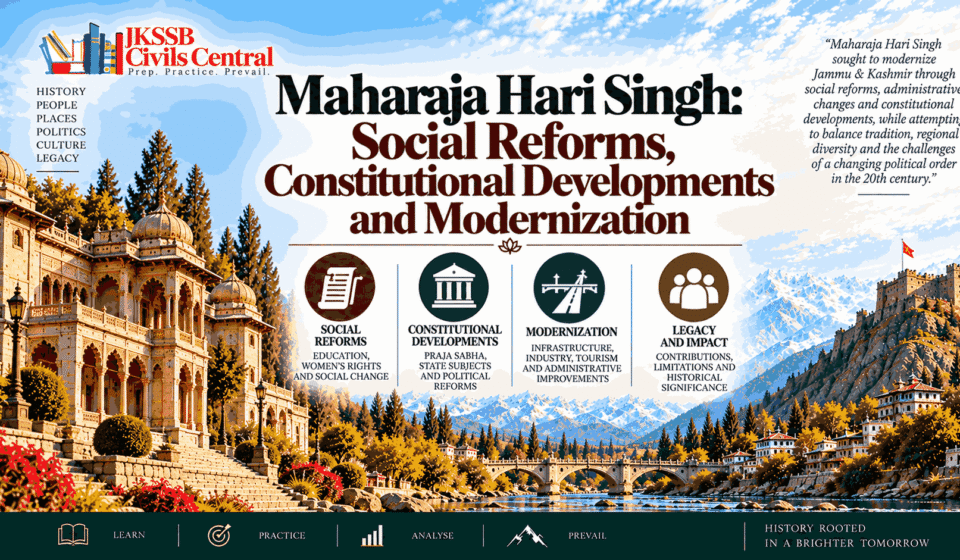
Maharaja Hari Singh: Social Reforms, Constitutional Developments and Modernization

J&K History Series Navigation
| Previous Article | Current Article | Next Article |
|---|---|---|
| Article 40 — Land Reforms in Jammu & Kashmir: Lawrence Settlement, Glancy Commission and Agrarian Reforms | Article 41 — Maharaja Hari Singh: Social Reforms, Constitutional Developments and Modernization | Article 42 — Political Awakening in Jammu & Kashmir: Reading Room Party, 1931 and the Muslim Conference |
Learning Dashboard
| Component | Key Information |
|---|---|
| Historical Period | 1925–1947 |
| Historical Phase | Late Dogra Rule / Political Awakening |
| Ruler | Maharaja Hari Singh |
| Dynasty | Dogra |
| Capital | Jammu / Srinagar as seasonal capitals |
| Core Theme | Social reform, education, institutional modernization and constitutional development |
| Major Developments | Accession to the throne; social legislation; compulsory primary education; reforms concerning depressed classes; State Subject definition; High Court; Praja Sabha; Constitution Act 1939 |
| Key Dates | 1925, 1927, 1928, 1930, 1931–32, 1934, 1939, 1946, 1947 |
| Key Institutions | High Court, Praja Sabha, Council of Ministers, State Subject system |
| Key Sources | State legislation, constitutional documents, High Court records, administrative reports, contemporary political records |
| JKSSB Importance | Very High |
| Likely Question Types | Direct fact, chronology, statement-based, matching, comparative, conceptual-factual |
Introduction
The accession of Maharaja Hari Singh to the throne in 1925 marked the beginning of the final phase of Dogra rule in Jammu and Kashmir. His reign coincided with a period of rapid political change across British India and within the princely state itself. The growth of an educated public sphere, demands for representative government, socio-economic grievances and the political mobilization of different communities increasingly challenged the older model of personal monarchy.
Hari Singh’s reign therefore cannot be understood through either of two simplistic interpretations. It would be inaccurate to portray the period merely as a story of repression and political conflict, because substantial reforms were undertaken in education, social legislation, judicial organization, constitutional administration and public institutions. At the same time, it would be equally misleading to describe the state as having become democratic, because the Maharaja retained decisive authority and the representative institutions created during his reign possessed limited powers.
The central historical significance of Hari Singh’s reign lies in this contradiction between modernization and political control. The state developed more formal institutions of law, education and representation, while the political demand for responsible government moved faster than the constitutional concessions made by the monarchy. This tension became one of the defining features of Jammu and Kashmir’s history in the decades immediately preceding 1947.
CivilsCentral Historical Insight
Hari Singh’s reign represented a transition from traditional princely administration toward a more institutionalized modern state, but not a transition to full responsible government. The reforms expanded education, legal regulation and public institutions while political authority remained concentrated in the Maharaja.
Part I — Accession of Maharaja Hari Singh and the Historical Context
1. From Pratap Singh to Hari Singh
Maharaja Hari Singh succeeded his uncle, Maharaja Pratap Singh, in 1925. He inherited a state that had already experienced substantial administrative change during the late nineteenth and early twentieth centuries, including judicial reforms, the establishment of the High Court in 1928 and the development of more systematic revenue and administrative institutions.
But he also inherited unresolved political and social problems. Access to education and government employment was uneven, agrarian grievances remained significant, and sections of the population demanded greater political participation. The political environment was becoming increasingly influenced by developments elsewhere in India, including constitutional reform, mass politics and debates over communal representation.
Hari Singh’s reign therefore began at a moment when administrative modernization alone was no longer sufficient to satisfy demands for political participation.
2. The Meaning of Modernization under Hari Singh
Modernization during Hari Singh’s reign involved several different processes. Education expanded; social practices became increasingly subject to legislation; courts and administrative departments became more institutionalized; communications and public infrastructure developed; and limited representative institutions were introduced.
Yet modernization did not mean that the state abandoned monarchy. The Maharaja remained the central constitutional authority, and reforms were generally introduced from above rather than through a fully representative democratic process.
This distinction is important because “modernization” and “democratization” were not synonymous in princely India.
CivilsCentral Historical Insight
Hari Singh’s state was becoming more modern in its institutions without becoming fully democratic in its political structure. This distinction explains why the period witnessed both substantial reform and growing political agitation.
Part II — Social Reform under Maharaja Hari Singh
3. Reforming Social Practices
One of the most visible dimensions of Hari Singh’s rule was the use of legislation and executive action to address social practices considered harmful or discriminatory. The reform agenda included measures concerning child marriage, the position of women, education, trafficking and the disabilities faced by historically disadvantaged communities.
The significance of these measures lies not simply in their existence but in the increasing willingness of the state to use law as an instrument of social change. Earlier customary practices were increasingly subjected to statutory regulation.
This development formed part of a wider pattern visible across twentieth-century India, but the J&K state developed its own legislative measures within the framework of princely rule.
4. Infant Marriage Prevention Regulation, 1928
One of the clearest examples was the Infant Marriage Prevention Regulation of 1928. The regulation was formally promulgated in June 1928 and was explicitly intended to prevent infant marriage within the Maharaja’s dominions.
The importance of the measure lies in the state’s intervention in a practice that had been deeply embedded in social custom. Child or very early marriage could contribute to interrupted education, early widowhood and severe social disadvantages for women.
The legislation should therefore be understood as part of a broader attempt to use state law to alter social practices rather than merely as an isolated prohibition.
5. Reform and the Position of Women
The question of women’s status became an important component of the reform agenda. The state expanded female education, introduced measures against child marriage and addressed practices involving exploitation and trafficking.
The reform programme also interacted with the problem of early marriage itself. If girls were to receive education, the state needed to create institutions that could accommodate female students and overcome social resistance to their schooling.
The resulting reform process was therefore interconnected:
Social legislation
→ delayed harmful practices
→ greater educational opportunity
→ improved access to public institutions
→ gradual change in women’s social position.
However, reform should not be equated with immediate transformation. Social customs, poverty, limited female literacy and conservative attitudes continued to restrict the practical reach of legislation.
6. Suppression of Immoral Traffic
The state also addressed prostitution and trafficking. A Suppression of Immoral Traffic Regulation was enacted in 1934, reflecting the government’s attempt to regulate and suppress organized exploitation of women. Contemporary accounts of the period associate the legislation with efforts to close establishments involved in prostitution and to provide alternative livelihoods through training in handicrafts.
This reform is important because it demonstrates that Hari Singh’s social legislation extended beyond education and marriage into questions of public morality, exploitation and women’s economic vulnerability.
The reform also illustrates the limitations of legislation by itself: social rehabilitation required education, employment and institutional support in addition to prohibition.
Part III — Measures Concerning Historically Disadvantaged Communities
7. The Question of Social Disability
Caste-based exclusion and social discrimination were significant issues in parts of the state. Members of historically disadvantaged communities faced restrictions concerning access to educational institutions, public wells and places of worship.
The state increasingly attempted to remove these institutional disabilities during Hari Singh’s reign. Contemporary historical accounts record measures opening public educational institutions and water sources to members of the depressed classes and directing officials to avoid caste-based discrimination in public employment.
These measures should be understood within the wider anti-untouchability movement developing across India during the same period, while also recognizing that the J&K state pursued its own administrative and legal measures.
8. Opening of State Temples
A particularly significant development occurred in 1932, when the Maharaja issued a proclamation opening state temples to members of the depressed classes for darshan and prayer. Contemporary accounts record resistance from sections of the priestly establishment, including opposition associated with the head priest of the Raghunath Temple in Jammu.
The episode is historically significant because it demonstrates that social reform could directly challenge established institutional practices. It also shows the limits of assuming that legislation automatically produced social acceptance: reform could encounter resistance from sections of the society whose customary authority was affected.
The measure should therefore be described as a significant state intervention against religious-social exclusion, rather than as evidence that caste discrimination disappeared from society.
9. Equal Access to Education
The state also instructed educational institutions to provide access to children from historically disadvantaged communities. Special scholarships were provided for students belonging to these communities, indicating an attempt to combine formal equality with targeted educational support.
This was important because formal permission to enter schools was insufficient where poverty and social discrimination still prevented attendance. Scholarships and educational assistance therefore formed part of a broader attempt to make reform practically accessible.
The reform agenda consequently involved both: Removal of formal barriers and Creation of educational opportunities.
CivilsCentral Historical Insight
Hari Singh’s social reforms demonstrate an important feature of modern state-building: the state increasingly intervened in social relations through legislation, education and administrative orders. Yet the persistence of social attitudes reminds us that legal reform and social transformation occur at different speeds.
Part IV — Education and the Expansion of Modern Schooling
10. Education as an Instrument of State Modernization
Education became one of the most important areas of reform during Hari Singh’s reign. The objective was not merely to increase literacy but to create a more educated population capable of participating in a changing administrative and economic system.
A 2024 study of education under Hari Singh identifies expansion of primary, female, higher and technical education as major features of the period. It also emphasizes the use of scholarships and financial assistance to widen educational access.
The reform therefore connected social policy with state modernization.
11. Compulsory Primary Education
The Compulsory Primary Education Regulation of 1930 was a major milestone. Contemporary and later studies describe its initial implementation in Jammu, Srinagar, Sopore, Mirpur and Udhampur, with provisions requiring children of specified ages to attend school.
The regulation was important because it shifted education from being primarily a matter of individual household choice toward a responsibility enforced through public policy.
The government also created mechanisms for implementation, including educational administration and attendance arrangements. The reform was ambitious because the state had to expand schools and teachers while confronting poverty, rural distance, parental resistance and social restrictions on girls’ education.
12. Expansion of Schools
The expansion of schooling was substantial. A contemporary-oriented historical study records the number of schools as approximately 706 in 1925, rising to 20,728 by 1945; the figure should be used carefully because historical educational statistics may reflect different definitions of “school” and institutional category.
The important historical point is not the numerical claim alone but the direction of institutional change: education expanded significantly during the reign.
The state also sought to improve access to female education. In 1939, for example, government measures permitted girls below a specified age to attend boys’ schools in localities where separate girls’ schools were unavailable, provided parents or guardians agreed.
13. Female Education
Female education faced particular obstacles. These included social conservatism, early marriage, the purdah system in some communities, shortage of female teachers and limited access to schools in rural areas.
The government therefore attempted to expand girls’ primary education and address institutional barriers. This included opening girls’ schools and providing educational opportunities in places where separate institutions were difficult to establish.
The reform was significant but incomplete. Educational expansion did not immediately eliminate gender disparities, and access varied considerably between urban and rural areas and among different communities.
14. Higher and Technical Education
Hari Singh’s educational policy also extended beyond elementary schooling. The state supported higher and technical education, reflecting the growing need for trained personnel in administration and the modern economy.
Technical education had already begun developing under the earlier Dogra administration, and Hari Singh’s reign continued this institutional expansion rather than creating modern education from nothing. This distinction is important when assessing his contribution.
The broader trajectory was:
Traditional schooling
→ expanded primary education
→ compulsory education
→ female education
→ higher and technical education.
CivilsCentral Historical Insight
Education was one of the strongest links between Hari Singh’s social reforms and his modernization programme. The objective was simultaneously social and administrative: a modernizing state required a larger educated population, while education itself could weaken some of the social barriers inherited from earlier society.
Part V — Administrative and Judicial Modernization
15. The High Court of 1928
A major institutional development associated with Hari Singh was the establishment of the High Court of Judicature of Jammu and Kashmir in 1928.
The J&K High Court’s official historical account records that Order No. 1 dated 26 March 1928 established a High Court consisting initially of a Chief Justice and two judges. Maharaja Hari Singh appointed Lala Kanwar Sein as the first Chief Justice, with Lala Bodh Raj Sawhney and Khan Sahib Aga Syed Hussain as puisne judges.
This represented a significant institutional development because judicial authority was being placed within a more formal court structure rather than remaining centred primarily on the ruler.
16. The 1939 Constitutional Position of the Judiciary
The Jammu and Kashmir Constitution Act, 1939 further developed the constitutional position of the High Court. According to the High Court’s official history, the Act incorporated provisions relating to the High Court and gave it a substantial measure of independence, including powers of superintendence and control over subordinate courts. It also provided for a Board of Judicial Advisers to advise the ruler in civil and criminal appeals from the High Court.
The institutional sequence is therefore:
1928
→ High Court established
1939
→ High Court’s position further incorporated into the constitutional framework
This should not be confused with the establishment of the High Court in 1939; 1928 is the key establishment date.
Part VI — State Subject Policy and Protection of Local Interests
17. The State Subject Definition of 1927
One of the most important constitutional-administrative measures of Hari Singh’s reign was the State Subject Notification of 20 April 1927.
The notification formally defined who qualified as a “State Subject” and classified state subjects into categories. The system became closely associated with eligibility concerning land ownership and public employment within the princely state. The 1927 notification was later amended, including in 1932 and 1939.
The measure emerged from concerns about the position of permanent residents and the impact of outsiders on land and government employment. It therefore combined elements of demographic protection, economic regulation and political identity.
18. Why the State Subject System Matters
The State Subject system is historically important far beyond Hari Singh’s reign because its legal legacy continued into the constitutional history of Jammu and Kashmir after 1947.
The Supreme Court’s 2023 judgment reviewing the constitutional history of Article 370 noted that the Maharaja’s 20 April 1927 notification defined “State Subject” and classified state subjects into categories; the judgment also noted the later relationship between these categories and the concept of permanent residents under the constitutional framework of J&K.
For examination purposes, however, one distinction must remain clear:
1927 State Subject Notification ≠ Article 35A.
The former was a princely-state measure issued by Maharaja Hari Singh; Article 35A was a constitutional provision introduced into the Constitution of India in 1954.
Part VII — Constitutional Development: From Monarchy to Limited Representation
19. Political Pressure for Constitutional Reform
By the early 1930s, political mobilization had become a major force in the state. The disturbances of 1931, the formation of political organizations and demands for responsible government placed increasing pressure on the monarchy.
Hari Singh responded partly through constitutional reform. This did not amount to the surrender of sovereign authority, but it did create institutions through which a limited representative element could participate in legislation and public debate.
The most important development was the creation of the Praja Sabha.
20. Praja Sabha, 1934
On 22 April 1934, Hari Singh promulgated a constitutional measure establishing a legislative assembly known as the Praja Sabha. The Supreme Court’s constitutional history records that the Maharaja established the assembly while retaining supremacy over legislative, executive and judicial matters.
The first session of the assembly was convened in October 1934. Contemporary documentary records identify 17 October 1934 as the date fixed for the first session.
The Praja Sabha was therefore a major institutional development, but it should not be described as a fully sovereign legislature or a responsible democratic government.
21. Composition of the Praja Sabha
The Praja Sabha was designed as a 75-member body. Of these, 33 members were elected, while the remainder consisted of nominated and official members. The elected seats were distributed through communal representation, including 21 Muslim, 10 Hindu and 2 Sikh seats.
The elected members were therefore a minority within the entire assembly. This structural feature limited the extent to which the Praja Sabha could function as a modern representative legislature.
This is a particularly important examination point: Praja Sabha = representative element, but
Praja Sabha ≠ full responsible government.
22. Powers and Limitations
The Praja Sabha could debate legislation and financial matters within the constitutional framework, but the Maharaja retained overriding authority. The constitutional arrangement therefore associated subjects with government without transferring ultimate sovereignty away from the ruler.
This arrangement reflected a wider pattern in princely India: rulers introduced representative institutions while attempting to preserve dynastic authority.
The development nevertheless mattered. Legislative debate, elections, public speeches and political organization created a new political culture. Even a limited legislature could provide a platform through which political actors learned parliamentary procedures and articulated demands.
CivilsCentral Historical Insight
The Praja Sabha was important less because it created full democracy than because it created an institutional space in which representative politics could develop. Its limitations simultaneously encouraged political actors to demand a deeper form of responsible government.
Part VIII — The Constitution Act of 1939
23. The 1939 Constitution Act
The next major constitutional development was the Jammu and Kashmir Constitution Act, 1939, promulgated on 7 September 1939.
The Act sought to consolidate and define the constitutional organization of the state. It provided a more systematic framework for legislative, executive and judicial institutions while retaining the Maharaja’s sovereignty.
The Supreme Court’s constitutional history records that although the Act empowered the Praja Sabha to make laws subject to constitutional conditions, Hari Singh retained supremacy over legislative, executive and judicial functions. Executive authority was exercised through a Council consisting of a Prime Minister and other ministers appointed by the ruler.
24. Constitutional Significance
The 1939 Act was therefore more than a routine administrative regulation. It represented an attempt to place the institutions of the state within a defined constitutional framework.
Its significance can be understood through four developments:
Legislature
→ Praja Sabha
Executive
→ Council of Ministers
Judiciary
→ High Court and constitutional judicial arrangements
Monarchy
→ retained ultimate authority.
The constitutional system had therefore become more institutionalized without becoming fully responsible government.
25. Why 1939 Is Important for JKSSB
The 1939 Constitution Act is particularly important because it is easily confused with later constitutional developments.
It should not be confused with:
- the 1927 State Subject Notification;
- the 1928 establishment of the High Court;
- the 1934 establishment of the Praja Sabha;
- the 1956 Constitution of Jammu and Kashmir;
- Article 370, introduced into the Constitution of India in 1950;
- Article 35A, inserted in 1954.
These belong to different constitutional stages.
CivilsCentral Historical Insight
The constitutional development of Hari Singh’s reign created institutions that were more formal and representative than those of the nineteenth-century princely state, but sovereignty remained concentrated in the Maharaja. The central historical tension was therefore not monarchy versus no institutions, but monarchy versus increasingly organized demands for responsible government.
Part IX — Economic and Infrastructural Modernization
26. Communications and Public Infrastructure
Hari Singh’s reign also witnessed continued development of roads, communications and public infrastructure. Such modernization was important because the geographical structure of Jammu and Kashmir made communications particularly difficult.
Improved roads and communications strengthened administrative integration and facilitated trade, travel and the movement of officials and goods.
The significance of infrastructure should therefore be viewed in both economic and political terms: better communications could improve economic exchange while simultaneously strengthening the state’s administrative reach.
27. Industry, Crafts and Economic Institutions
The state continued to support traditional crafts while also encouraging modern forms of enterprise. Kashmir’s handicrafts, especially the shawl and related craft sectors, remained economically important, while modernization created new forms of commercial and institutional activity.
The establishment of the Jammu and Kashmir Bank in 1938 was another important development in the state’s financial history. It represented an institutional attempt to develop organized banking within the princely state.
The broader pattern was:
Traditional crafts + commercial development + modern financial institutions + improved communications
→ a more diversified economic environment.
However, economic modernization did not eliminate regional or class inequalities.
Part X — Health, Welfare and Public Services
28. Expansion of Medical Services
Public health also received attention during Hari Singh’s reign. The number of hospitals, dispensaries and trained medical personnel expanded, forming part of the broader modernization of public services. Contemporary assessments of his reign identify increased medical infrastructure as one of the components of state development.
The expansion of health services should nevertheless be understood in relation to the geographical challenges of the state. Access was uneven, especially between urban centres and remote rural and frontier areas.
29. Welfare as State Policy
The growing involvement of the state in education, health, social legislation and economic regulation reflected a broader transformation in the conception of princely governance.
The ruler was increasingly expected to act not merely as a political sovereign but also as an administrator responsible for public welfare. This did not make the system democratic, but it changed the relationship between state authority and society.
The emergence of welfare-oriented policies therefore formed an important part of the modernization of princely governance.
CivilsCentral Historical Insight
Modernization under Hari Singh involved a widening of the state’s responsibilities. Education, health, social regulation and economic institutions increasingly became matters of public administration, even though political accountability remained limited.
Part XI — The Limits and Contradictions of Hari Singh’s Reforms
30. Reform without Full Democracy
The most important limitation of Hari Singh’s modernization programme was the persistence of monarchical supremacy. The Praja Sabha introduced representation, but elected members were a minority. The 1939 constitutional framework established institutions, but the Maharaja retained ultimate authority. Consequently, political demands for responsible government continued even after constitutional reforms had been introduced.
This contradiction became increasingly difficult to sustain as political consciousness expanded.
31. Political Mobilization Continued
The reforms did not end political conflict. The Reading Room movement, the events of 1931, the Muslim Conference, the transformation of the Muslim Conference into the National Conference and later the Quit Kashmir Movement of 1946 all emerged within the increasingly politicized environment of the state.
These developments belong to the next phase of the series and should not be reproduced in detail here. Their relevance to this article is that they demonstrate the limits of administrative reform as a substitute for representative government.
A state could build schools, courts and legislative institutions while still facing demands for deeper political participation.
32. Agrarian Reform and Its Limits
The same pattern can be seen in the countryside. The agrarian reforms discussed in Articles 39 and 40 strengthened certain cultivator rights and introduced more systematic regulation, but they did not completely eliminate the underlying inequalities of the agrarian structure.
Thus, the modernization programme was substantial but incomplete.
It produced: more institutions
without necessarily producing: equal political power or complete socio-economic equality.
This distinction is essential for understanding the political crisis of the late 1930s and 1940s.
Part XII — Hari Singh and the Approach to 1947
33. The Political Environment by the 1940s
By the 1940s, Jammu and Kashmir had a more developed educational system, a formal High Court, a legislative assembly, defined state-subject rules and a constitutional framework. Yet political mobilization had also become considerably stronger.
The state was therefore simultaneously experiencing institutional modernization and political polarization.
The Second World War, the growth of the National Conference, the demand for responsible government, the Quit Kashmir movement and the constitutional crisis of the late 1940s transformed the political environment in which Hari Singh ruled.
34. 1946 and the Quit Kashmir Movement
The Quit Kashmir Movement of 1946 directly challenged the political authority of the Maharaja. Its emergence demonstrated that the issue was no longer merely whether the ruler would introduce additional administrative reforms; the fundamental question had become the political relationship between the ruler and the people.
The movement forms the subject of a later dedicated article in the series and is therefore treated here only as the culmination of the political tensions that had developed during Hari Singh’s reign.
35. Hari Singh in 1947
In 1947, Hari Singh remained the ruler of the princely state when British paramountcy ended and the subcontinent was partitioned.
The political and constitutional questions surrounding accession, the Standstill Agreement, the tribal invasion, the Instrument of Accession and the subsequent transformation of the state belong to Articles 46–50 of the series.
For this article, the key point is that Hari Singh entered the 1947 crisis as the head of a state whose institutions had undergone substantial modernization but whose political system remained fundamentally monarchical.
CivilsCentral Historical Insight
The irony of the late Dogra period was that modernization helped create the very social and political forces that increasingly challenged autocratic rule. Education, public debate, representative institutions and legal consciousness expanded expectations of political participation beyond what the existing constitutional structure was prepared to provide.
Part XIII — Historical Significance of Hari Singh’s Reign
Hari Singh’s reign occupies a critical position in the modern history of Jammu and Kashmir because it connects the nineteenth-century Dogra state with the political transformation of the twentieth century.
His social reforms addressed practices including infant marriage, caste-based disabilities and women’s educational disadvantage. His educational policies expanded primary schooling and supported female, higher and technical education. His administration also strengthened judicial institutions through the High Court and developed a more formal constitutional framework through the Praja Sabha and the Constitution Act of 1939.
At the same time, these developments should not be interpreted as the establishment of modern democracy. The Maharaja retained decisive constitutional authority, the elected component of the Praja Sabha was limited, and demands for responsible government continued to grow.
Hari Singh’s historical importance therefore lies in the transition he presided over:
personal monarchy
→ institutionalized princely administration
→ limited representation
→ constitutional government in a restricted sense
→ mass political mobilization
→ crisis of princely rule in 1946–47.
His reign cannot be reduced either to a purely reformist narrative or to a purely authoritarian narrative. Both institutional reform and political conflict were integral parts of the same historical process.
Part XIV — Historical Interpretation and Evidence Note
The assessment of Maharaja Hari Singh remains historiographically contested. Some accounts emphasize his social reforms, expansion of education, institutional modernization and attempts to create a more regulated administrative system. Other interpretations focus more strongly on the limitations of political representation, the persistence of autocratic authority and the state’s response to political mobilization.
Both dimensions should be retained.
There is strong documentary evidence for several institutional developments: the 1927 State Subject notification, 1928 High Court establishment, 1934 Praja Sabha, and 1939 Constitution Act. The J&K High Court’s own historical record confirms the 1928 establishment and the later constitutional strengthening of the judiciary. The Supreme Court’s 2023 constitutional-history judgment likewise records the 1927 State Subject definition, 1934 Praja Sabha and 1939 constitutional arrangement.
Social reform claims should be handled with similar precision. There is documentary and historical evidence for the Infant Marriage Prevention Regulation, educational expansion and measures concerning depressed classes, while claims about the total eradication of social discrimination should be avoided. The persistence of social resistance and uneven implementation means that legislative reform should not be equated with complete social transformation.
The most defensible interpretation is therefore that Hari Singh’s reign witnessed substantial state-led modernization and social legislation within a still-monarchical political order.
Part XV — JKSSB Knowledge Matrix
| Question | High-Value Answer |
|---|---|
| Who was the last Dogra ruler of J&K? | Maharaja Hari Singh |
| When did Hari Singh succeed Pratap Singh? | 1925 |
| What major social legislation was enacted in 1928? | Infant Marriage Prevention Regulation |
| When was compulsory primary education introduced? | 1930 |
| When was the State Subject definition issued? | 20 April 1927 |
| What did State Subject rules regulate? | Status and associated rights concerning land and public employment |
| When was the J&K High Court established? | 1928 |
| Who was its first Chief Justice? | Lala Kanwar Sein |
| When was the Praja Sabha established? | 1934 |
| How many members did the Praja Sabha have? | 75 |
| How many were elected? | 33 |
| When did the first session of Praja Sabha take place? | October 1934; 17 October is the documented date fixed for the first session |
| What major constitutional Act was promulgated in 1939? | J&K Constitution Act |
| Did the 1939 Act abolish Maharaja’s sovereignty? | No |
| What was the major constitutional contradiction? | Institutional representation expanded while ultimate authority remained with the Maharaja |
| What major banking institution was established in 1938? | Jammu and Kashmir Bank |
| What movement challenged Maharaja’s authority in 1946? | Quit Kashmir Movement |
| What happened to the state in 1947? | It entered the crisis of partition, accession and armed conflict |
Part XVI — Examination Discrimination Points
1. Hari Singh vs Pratap Singh
Pratap Singh → ruler before Hari Singh; major administrative reforms and the Lawrence Settlement period.
Hari Singh → succeeded in 1925; social legislation, compulsory education, State Subject rules, High Court, Praja Sabha and 1939 Constitution Act.
2. 1927 vs 1928
1927 → State Subject definition.
1928 → High Court established and Infant Marriage Prevention Regulation promulgated.
These are distinct developments.
3. 1930 vs 1934
1930 → Compulsory Primary Education.
1934 → Praja Sabha.
4. 1934 vs 1939
1934 → Praja Sabha / limited representative legislature.
1939 → Constitution Act / more comprehensive constitutional framework.
5. State Subject vs Article 35A
1927 → State Subject Notification issued by Maharaja Hari Singh.
1954 → Article 35A inserted into the Constitution of India.
The two are historically connected but legally distinct.
6. High Court vs Constitution Act
1928 → High Court established.
1939 → Constitutional framework further incorporated provisions concerning the High Court and strengthened its institutional position.
7. Modernization vs Democracy
Hari Singh’s reign witnessed substantial modernization.
It did not establish full responsible democratic government.
This distinction is one of the most important conceptual traps.
Part XVII — JKSSB Question Pattern
Direct Fact
Question: The State Subject Notification of Jammu and Kashmir was issued on:
A. 1925
B. 1927
C. 1934
D. 1939
Correct Answer: B. 1927
Explanation: The State Subject definition was promulgated on 20 April 1927.
Statement-Based
Consider the following statements:
- The J&K High Court was established in 1928.
- The Praja Sabha was established in 1934.
- The Constitution Act was promulgated in 1939.
- The State Subject Notification was issued in 1939.
Which statements are correct?
A. 1, 2 and 3 only
B. 1 and 4 only
C. 2, 3 and 4 only
D. All four
Correct Answer: A. 1, 2 and 3 only
Explanation: The State Subject Notification dates to 20 April 1927, not 1939.
Chronology
Arrange the following in chronological order:
- Praja Sabha
- State Subject Notification
- High Court
- Constitution Act
A. 2–3–1–4
B. 3–2–1–4
C. 2–1–3–4
D. 3–1–2–4
Correct Answer: A. 2–3–1–4
Explanation:
1927 → State Subject
1928 → High Court
1934 → Praja Sabha
1939 → Constitution Act
Match the Following
| Column I | Column II |
|---|---|
| A. State Subject Notification | 1. 1934 |
| B. High Court | 2. 1927 |
| C. Praja Sabha | 3. 1939 |
| D. Constitution Act | 4. 1928 |
Correct Answer: A–2, B–4, C–1, D–3
Identification by Clues
Which institution was established under Hari Singh and initially consisted of a Chief Justice and two judges?
A. Praja Sabha
B. State Council
C. High Court of Judicature
D. Board of Judicial Advisers
Correct Answer: C. High Court of Judicature
Conceptual-Factual
Which statement best describes constitutional development under Maharaja Hari Singh?
A. Representative government completely replaced monarchy in 1934.
B. Constitutional institutions expanded, but the Maharaja retained ultimate authority.
C. The Praja Sabha was an independent sovereign parliament.
D. The Maharaja’s office became purely ceremonial after 1939.
Correct Answer: B
Comparative
Which pairing is correctly matched?
A. 1927 — Praja Sabha
B. 1928 — High Court
C. 1934 — State Subject Notification
D. 1939 — Infant Marriage Prevention Regulation
Correct Answer: B. 1928 — High Court
Part XVIII — Rapid Revision Zone
Important Dates
| Year | Event |
|---|---|
| 1925 | Hari Singh succeeds Pratap Singh |
| 20 April 1927 | State Subject Notification |
| 1928 | High Court established |
| 1928 | Infant Marriage Prevention Regulation |
| 1930 | Compulsory Primary Education Regulation |
| 1931 | Political crisis and reforms intensify |
| 1932 | Measures concerning depressed classes / temple entry |
| 1934 | Praja Sabha established |
| 1934 | Suppression of Immoral Traffic Regulation |
| 1938 | Jammu and Kashmir Bank established |
| 7 September 1939 | Constitution Act promulgated |
| 1946 | Quit Kashmir Movement |
| 1947 | End of British paramountcy; accession crisis |
Important Personalities
Maharaja Hari Singh
→ Last Dogra ruler
Lala Kanwar Sein
→ First Chief Justice of J&K High Court
B. J. Glancy
→ Commission associated with reforms following 1931 political crisis
Sir Barjor Dalal
→ Associated with the Franchise Committee and constitutional reform process
Important Institutions
| Institution | Significance |
|---|---|
| High Court | Established 1928 |
| Praja Sabha | Legislative institution established 1934 |
| Council of Ministers | Executive component under 1939 constitutional framework |
| Board of Judicial Advisers | Constitutional judicial advisory body under 1939 framework |
| J&K Bank | Established 1938 |
Important Constitutional Developments
1927
→ State Subject
1928
→ High Court
1934
→ Praja Sabha
1939
→ Constitution Act
Social Reform Associations
1928
→ Infant Marriage Prevention Regulation
1930
→ Compulsory Primary Education
1932
→ State temples opened to depressed classes
1934
→ Suppression of Immoral Traffic Regulation
Part XIX — Frequently Confused Facts
| Confusion | Correct Distinction |
|---|---|
| Pratap Singh / Hari Singh | Pratap ruled before 1925; Hari Singh ruled 1925–1947 |
| 1927 / 1934 | State Subject / Praja Sabha |
| 1928 / 1939 | High Court establishment / Constitution Act |
| Praja Sabha / responsible government | Representative institution / broader democratic principle |
| 33 / 75 | 33 elected members / total Praja Sabha membership |
| State Subject / Article 35A | 1927 princely notification / 1954 constitutional provision |
| Compulsory education / universal modern education | 1930 regulation / broader long-term educational development |
| Social reform / social transformation | Legal intervention / actual change in society |
| Modernization / democratization | Institutional development / transfer of political power |
Part XX — What Can JKSSB Ask?
From this topic, high-value questions can test:
- Hari Singh’s succession
- State Subject Notification
- date of High Court establishment
- first Chief Justice
- Infant Marriage Prevention Regulation
- Compulsory Primary Education
- Praja Sabha
- number of elected and total members
- communal distribution of elected seats
- Constitution Act of 1939
- Council of Ministers
- Board of Judicial Advisers
- social reforms concerning depressed classes
- temple-entry measures
- women’s education
- J&K Bank
- chronology of constitutional developments
- difference between modernization and democratization
- difference between State Subject and Article 35A
- relationship between constitutional reform and political mobilization.
Chapter Summary
Maharaja Hari Singh’s reign began in 1925 at a time when Jammu and Kashmir was moving from nineteenth-century princely administration toward a more institutionalized modern state. His government expanded education, introduced social legislation and addressed discriminatory practices affecting women and historically disadvantaged communities.
The Infant Marriage Prevention Regulation of 1928 and the Compulsory Primary Education Regulation of 1930 demonstrate the increasing use of state legislation to reshape society. Measures opening educational institutions, public water sources and state temples to historically disadvantaged communities further reflected the reform agenda.
Institutionally, the establishment of the High Court in 1928 marked an important step toward a more formal judicial system. The State Subject Notification of 1927 established a legal category that became highly significant in the later constitutional history of J&K.
The creation of the Praja Sabha in 1934 introduced a limited representative element into state government. However, elected representatives remained a minority and the Maharaja retained ultimate authority. The Constitution Act of 1939 provided a more systematic constitutional framework but did not establish responsible government.
The central historical pattern is therefore:
Social reform + Educational expansion + Judicial institutionalization + Limited representative government + Continued monarchical supremacy
→ Modernizing but politically contested princely state
By the 1940s, political mobilization had moved beyond demands for individual administrative reforms toward demands concerning the basic structure of political authority. The resulting tensions contributed to the political struggles of 1946 and ultimately formed part of the background to the crisis of 1947.
JKSSB Takeaway
Remember the constitutional sequence:
1927 → State Subject
1928 → High Court
1930 → Compulsory Primary Education
1934 → Praja Sabha
1939 → Constitution Act
And the conceptual conclusion:
Hari Singh’s reign = significant modernization, but not full responsible government.
Mind Map
MAHARAJA HARI SINGH — 1925–1947
↓
SOCIAL REFORM
→ Infant Marriage Prevention
→ Women’s education
→ Measures against trafficking
→ Depressed-class reforms
→ Temple-entry measures
↓
EDUCATION
→ Compulsory primary education
→ Expansion of schools
→ Female education
→ Higher education
→ Technical education
↓
INSTITUTIONAL MODERNIZATION
→ High Court — 1928
→ Administrative departments
→ Public services
→ Banking — J&K Bank, 1938
↓
CONSTITUTIONAL DEVELOPMENT
→ State Subject — 1927
→ Praja Sabha — 1934
→ Council of Ministers
→ Constitution Act — 1939
↓
LIMITATIONS
→ Maharaja retained supremacy
→ Elected representation limited
→ Political demands continued
↓
POLITICAL AWAKENING
→ 1931 crisis
→ Political organizations
→ Responsible-government demands
→ Quit Kashmir — 1946
↓
1947
→ Partition
→ Accession crisis
→ End of Dogra political order
FAQs
1. Who was Maharaja Hari Singh?
Maharaja Hari Singh was the last ruling Dogra Maharaja of Jammu and Kashmir, ruling from 1925 until the end of the princely-state order in 1947.
2. What was the State Subject Notification of 1927?
It was a notification issued on 20 April 1927 defining the categories of persons recognized as State Subjects of Jammu and Kashmir and forming an important basis for rules concerning land and public employment.
3. When was the High Court of Jammu and Kashmir established?
The full-fledged High Court of Judicature was established in 1928, by Order No. 1 dated 26 March 1928.
4. When was the Praja Sabha established?
The Praja Sabha was established through a constitutional measure in 1934 and its first session was convened in October 1934.
5. How many members did the Praja Sabha have?
It had 75 members, of whom 33 were elected. The remainder consisted of nominated and official members.
6. Did the Praja Sabha establish full democracy?
No. It introduced a representative element, but the elected members were a minority and the Maharaja retained ultimate constitutional authority.
7. What was the importance of the 1939 Constitution Act?
It provided a more systematic constitutional framework for the legislature, executive and judiciary while retaining the Maharaja’s sovereignty.
8. What was the significance of compulsory education under Hari Singh?
The 1930 regulation represented a major shift toward treating primary education as a state responsibility and contributed to the expansion of schooling.
9. Did Hari Singh’s social reforms completely eliminate discrimination?
No. They created significant legal and institutional changes, but social practices and inequalities persisted. Legal reform should not be equated with immediate social transformation.
10. Why is Hari Singh important in modern J&K history?
His reign connected the Dogra state’s administrative modernization with the political awakening that preceded the 1947 crisis. His period saw substantial institutional and social reform alongside growing demands for responsible government.
About The Author




[…] Article 41 — Maharaja Hari Singh: Social Reforms, Constitutional Developments and Modernization […]
[…] Article 41 — Maharaja Hari Singh: Social Reforms, Constitutional Developments and Modernization […]