
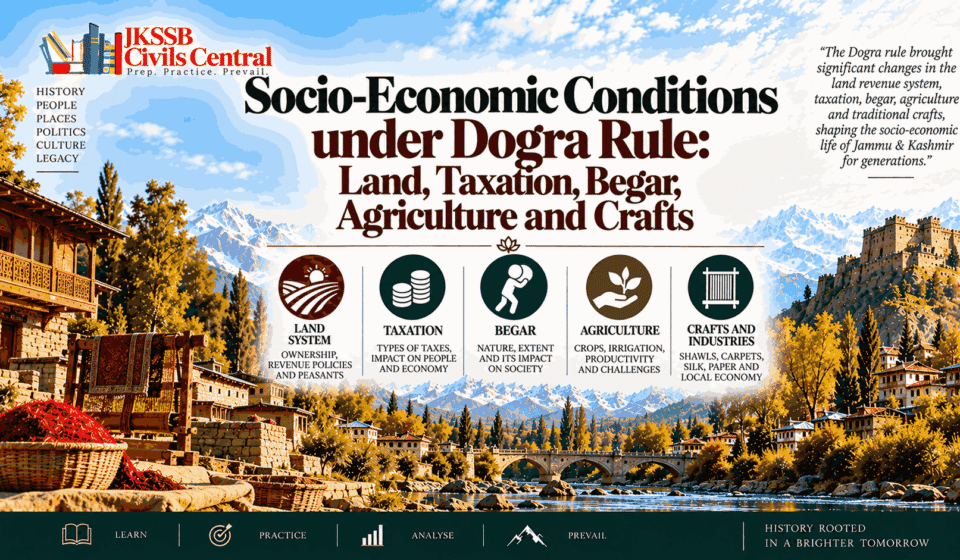
Socio-Economic Conditions under Dogra Rule: Land, Taxation, Begar, Agriculture and Crafts

J&K History Series Navigation
| Previous Article | Current Article | Next Article |
|---|---|---|
| Article 38 — Dogra Administration: Institutions, Law, Revenue and Governance in Jammu & Kashmir | Article 39 — Socio-Economic Conditions under Dogra Rule: Land, Taxation, Begar, Agriculture and Crafts | Article 40 — Land Reforms in Jammu & Kashmir: Lawrence Settlement, Glancy Commission and Agrarian Reforms |
Learning Dashboard
| Component | Key Information |
|---|---|
| Historical Period | 1846–1947 |
| Historical Phase | Dogra State & Princely J&K |
| Main Topic | Socio-economic conditions under Dogra rule |
| Geographical Focus | Jammu, Kashmir Valley, Ladakh and frontier regions, with emphasis on agrarian Kashmir |
| Core Themes | Land, taxation, agriculture, begar, crafts, shawl industry, trade and rural society |
| Major Turning Points | 1846 Dogra rule; late-19th-century agrarian distress; 1877–79 famine; Lawrence Settlement; 1931–32 Glancy reforms |
| Key Personalities | Gulab Singh, Ranbir Singh, Pratap Singh, Walter Lawrence, B. J. Glancy |
| Key Places | Kashmir Valley, Jammu, Srinagar, Ladakh and frontier regions |
| Important Sources | Walter Lawrence’s The Valley of Kashmir, settlement records, administrative reports and later historical scholarship |
| JKSSB Importance | Very High |
| Likely Question Types | Statement-based, chronology, cause–consequence, matching, comparative and identification |
Introduction
The socio-economic history of Jammu and Kashmir under Dogra rule cannot be understood simply through the formal institutions of the state. Behind the administrative structures described in the previous article lay an agrarian society in which land revenue, customary exactions, forced labour, access to land, craft production and trade profoundly shaped the lives of ordinary people. Agriculture remained the principal economic foundation of the state, particularly in the Kashmir Valley, while important non-agricultural sectors such as shawl weaving, silk, handicrafts, transport and trade connected the region to wider Himalayan, Punjabi and international markets.
The economic experience of Dogra rule also changed over time. The early decades after 1846 were marked by the continuation and adaptation of revenue practices inherited from the preceding Sikh period, while later decades witnessed attempts to regularize assessment, establish more systematic land records and modify some of the burdens on cultivators. The Lawrence Settlement of the late 1880s and early 1890s and the reforms associated with the Glancy Commission in the early 1930s were therefore important turning points, but they should not be treated as instantaneous transformations of the rural economy.
The most important historical point is that Dogra socio-economic history contained both extraction and reform. Heavy fiscal demands, begar and insecure agrarian relations generated serious hardship, while later settlements and reforms attempted to regularize revenue and improve the legal position of cultivators. At the same time, Kashmir’s famous crafts, particularly the shawl industry, generated substantial commercial value without necessarily translating that value into improved living conditions for the artisans who produced it.
CivilsCentral Historical Insight
The central contradiction of the Dogra economy was that the state possessed significant revenue-producing resources, yet the benefits of economic activity were distributed unevenly. Agricultural production and crafts could generate substantial surplus while cultivators and artisans remained vulnerable to taxation, insecure tenure, low wages and official exactions.
Part I — Historical Background: The Economic Structure of the Dogra State
1. A Predominantly Agrarian Society
When Gulab Singh acquired the territories that constituted the core of the princely state in 1846, the economy was overwhelmingly dependent upon agriculture. The Kashmir Valley in particular was fundamentally a rural society in which rice cultivation occupied a central position, although maize, wheat, barley and various horticultural and cash crops were also important.
Agriculture was not merely an economic activity; it was the principal source from which the state obtained revenue. Consequently, the condition of cultivation, the assessment of land and the mechanisms used to collect revenue were central to the relationship between the state and the rural population. This helps explain why agrarian grievances later became an important component of political mobilization in twentieth-century Kashmir.
The geographical diversity of the princely state must nevertheless be kept in mind. Jammu, Kashmir Valley, Ladakh and the frontier regions possessed different ecological conditions, crops, occupations and patterns of landholding. Therefore, statements about “the economy of Jammu and Kashmir” should not automatically be understood as describing every region in the same way.
2. Continuity from the Sikh Period
The establishment of Dogra rule did not produce an entirely new economic system overnight. In Kashmir, Gulab Singh initially retained significant elements of the existing revenue arrangement, while attempting to bring the newly acquired territory under more effective political control.
This continuity is important because the socio-economic difficulties of the early Dogra period cannot simply be attributed to institutions invented after 1846. Many practices had deeper roots, while Dogra rule modified, intensified, regulated or sometimes attempted to reform them according to the requirements of the new state.
The result was a system in which the state sought to maximize and regularize revenue while rural producers faced a combination of formal assessment and informal exactions.
CivilsCentral Historical Insight
A useful way to understand the early Dogra economy is through continuity plus transformation. Dogra rule inherited important fiscal practices but placed them within a new political structure whose revenue requirements and administrative mechanisms shaped their subsequent development.
Part II — Land, Tenure and the Rural Economy
3. Land as the Central Economic Resource
Land was the principal productive resource of the agrarian economy. The relationship between the cultivator and the state was therefore crucial: whoever controlled assessment, tenure and the transfer of land possessed considerable influence over rural society.
During the earlier part of Dogra rule, cultivators in Kashmir did not enjoy the secure proprietary rights associated with modern peasant ownership. Different forms of occupancy, state land, jagirs and other tenurial arrangements existed, and the position of the actual cultivator could vary according to the category of land involved.
The practical consequence was that the peasant’s relationship with land was frequently mediated by the state, revenue officials and superior landholders. This insecurity reduced the cultivator’s ability to treat agricultural production simply as a private economic enterprise.
4. Khalsa Land, Jagirs and Other Tenures
A useful distinction in understanding the later agrarian structure is between state-managed or Khalsa land and lands held under other arrangements, including jagirs and various forms of grants or tenure.
Jagirdars and other privileged landholders could exercise authority over land and revenue, while cultivators worked the soil. Such arrangements contributed to differentiation within rural society and could create a gap between those who possessed legal or fiscal rights over land and those who actually cultivated it.
The precise rights attached to different categories changed over time, particularly as settlement operations and later reforms altered the legal position of cultivators. Therefore, the agrarian system should not be described as static throughout the entire period from 1846 to 1947.
5. The Peasant and the Burden of Multiple Exactions
The cultivator’s burden was not necessarily limited to the formally assessed land revenue. Historical accounts also describe a range of customary demands and official or semi-official exactions commonly associated with terms such as rasum and other local dues.
These could take the form of demands upon agricultural produce, livestock, forest products, fruit and other resources. The significance of such exactions lay not simply in their individual value but in their cumulative effect. Even when an individual levy appeared relatively small, numerous demands could substantially reduce the portion of production available to the cultivator.
This distinction between formal revenue assessment and additional exactions is particularly important when evaluating the economic condition of the rural population.
Part III — Land Revenue and Taxation
6. Revenue as the Foundation of State Finance
The Dogra state depended heavily upon land revenue and other fiscal sources. In the Kashmir Valley, where rice cultivation was particularly important, the assessment of agricultural produce became one of the most consequential aspects of rural administration.
During the earlier period, revenue could be collected partly in kind. The state’s claim upon agricultural production was therefore directly connected to the physical harvest. This could become especially burdensome when harvests were poor because the cultivator still faced obligations even when the productive capacity of the land had been reduced.
The historical record also shows that the form and rate of assessment changed over time. The late nineteenth-century settlement reforms attempted to make assessment more systematic and predictable, and cash assessment became increasingly important in the reformed system.
7. Multiple Taxes and Cesses
The economic burden on cultivators arose from a combination of land revenue and other taxes or cesses. Historical descriptions refer to demands connected with agricultural produce, livestock, orchards, forests and other resources, although the precise nature and incidence of these demands varied by period and locality.
This is why simplistic lists claiming that “everything was taxed” should be avoided as historical description. Such expressions may capture the perception of severe fiscal pressure but are not a substitute for identifying the actual categories of revenue and exaction.
For examination purposes, the important distinction is between:
land revenue
→ assessment on agricultural land/produce
and
additional cesses and customary exactions
→ other demands imposed upon particular resources, occupations or services.
8. The Economic Effect of Heavy Fiscal Demands
Heavy fiscal pressure could affect agriculture in several interconnected ways. A cultivator who surrendered a large proportion of the harvest had fewer resources available for food, seed, livestock, investment and improvement of land. The problem became particularly severe when harvest failure coincided with rigid collection practices or shortages of food.
Fiscal extraction could therefore become economically damaging not simply because it reduced disposable income but because it weakened the productive capacity and resilience of the rural household.
This helps explain why later settlement reforms emphasized clearer assessment, more predictable revenue demands and improved recognition of cultivators’ rights.
CivilsCentral Historical Insight
The significance of taxation in Dogra Kashmir lies beyond the amount collected. Fiscal policy influenced food security, investment in agriculture, rural indebtedness, relations between cultivators and officials, and ultimately the political relationship between the state and the peasantry.
Part IV — Agriculture and Rural Production
9. Rice and the Agrarian Economy of Kashmir
Rice was the principal staple crop of the Kashmir Valley and occupied a central position in both agriculture and the revenue system. The ecology of the Valley, including its wetlands and irrigated agricultural areas, supported extensive paddy cultivation.
The importance of rice also made the economy vulnerable to fluctuations in the paddy harvest. A poor rice crop could simultaneously affect food supply, state revenue and rural livelihoods. Consequently, agricultural crises could rapidly become wider social crises.
Other crops such as maize, wheat and barley were also cultivated. Their importance varied according to altitude, soil, water availability and local consumption patterns.
10. Maize, Wheat and Barley
Maize was particularly useful in areas where conditions were less favourable for intensive rice cultivation. It could be grown on higher or less-watered land and therefore formed an important part of the agricultural economy outside the principal rice-growing areas.
Wheat and barley also contributed to dietary and agricultural diversity. Their presence demonstrates that the Valley’s economy should not be reduced entirely to rice cultivation, even though rice remained the dominant staple in many areas.
The broader agricultural pattern was therefore determined by ecology. The agricultural economy of Jammu and Kashmir cannot be understood through a single crop model because the state contained sharply differentiated geographical zones.
11. Horticulture and Cash Crops
Fruit cultivation was another important component of the Kashmir economy. Orchards and products such as walnuts occupied an important place in rural production and trade. Saffron cultivation in particular represented a valuable specialized agricultural activity.
The existence of cash and commercial crops was significant because they connected rural producers to markets beyond subsistence agriculture. At the same time, the taxation of such products could turn commercial specialization into another source of fiscal pressure.
Agriculture under Dogra rule therefore combined subsistence needs, food production for local consumption, and production of commodities capable of generating revenue and trade.
12. Irrigation and Agricultural Constraints
Agricultural productivity depended heavily upon water management, climatic conditions and the availability of labour. Kashmir’s agricultural landscape included irrigated fields, wetlands and areas dependent more heavily upon rainfall.
Yet the agricultural economy remained technologically constrained compared with later periods. Limited mechanization, low levels of agricultural investment and dependence on climatic conditions restricted productivity. Poor harvests could have consequences extending beyond individual villages because the state itself relied heavily upon agricultural revenue.
The major agrarian problem was consequently not simply “lack of land” but the interaction of tenure, taxation, productivity, climate, technology and state extraction.
CivilsCentral Historical Insight
Agriculture was simultaneously the foundation of livelihood and the foundation of state finance. This dual role created a structural tension: the state needed a productive peasantry to generate revenue, but excessive extraction could weaken the very agricultural economy upon which state revenue depended.
Part V — Famine, Food Security and Rural Vulnerability
13. The Famine of 1877–79
The famine of 1877–79 is one of the most important episodes for understanding socio-economic conditions under Dogra rule. Severe weather damaged crops, particularly rice and maize, while the existing fiscal and administrative structure affected the distribution of available food.
The famine was therefore not simply a natural disaster. Environmental conditions were a major trigger, but the scale of suffering was shaped by food distribution, state procurement, transportation difficulties, market conditions and the existing vulnerability of the rural population.
The crisis produced mortality, migration and abandonment of villages in severely affected areas. It became a powerful illustration of the consequences that could arise when environmental disaster interacted with a fragile agrarian economy.
14. Food Supply and State Intervention
The state had an important role in managing food supplies, particularly because Kashmir’s geography made transportation difficult and local harvests were central to food security. Earlier state interventions included attempts to regulate rice supplies and maintain stocks.
However, the famine demonstrated the limits of administrative capacity and the dangers of a system in which the state was simultaneously a major collector of agricultural produce and the authority responsible for maintaining food security.
The famine therefore occupies an important place in the socio-economic history of the Dogra period because it exposes the relationship between agriculture, taxation, state capacity and human vulnerability.
CivilsCentral Historical Insight
The 1877–79 famine should not be remembered merely as a “famine year.” It demonstrates how environmental shocks become social disasters when they interact with weaknesses in food distribution, fiscal systems, transport and rural purchasing power.
Part VI — Begar: Forced Labour and Its Socio-Economic Impact
15. What Was Begar?
Begar refers to forced or compulsory labour demanded by the state or other authorities without normal remuneration. It was not an institution invented by the Dogras; forms of compulsory labour existed in Kashmir before 1846. However, the practice continued under Dogra rule and became one of the most persistent grievances associated with the rural population.
Begar was particularly significant because it represented a direct claim upon the labour power of households. A peasant who was compelled to leave agricultural work to perform state service lost not only personal time but potentially agricultural income and labour needed on his own holding.
16. Uses of Begar
Forced labour could be used for transporting supplies, carrying loads and supporting official or military movements, especially in difficult mountainous regions and frontier areas.
The geographical character of the state made transport labour particularly important. Roads and modern transport infrastructure were limited, while mountain routes could be extremely demanding. The state therefore relied upon local labour to move supplies and equipment across difficult terrain.
In practice, the burden of begar could fall unevenly upon particular sections of the population. Historical evidence indicates that exemptions existed for some categories of land and people, meaning that the burden was not distributed equally across society.
17. Economic Consequences of Begar
The economic importance of begar lies in its opportunity cost. When a cultivator was compelled to perform unpaid labour, his own agricultural work could be neglected. During sowing or harvesting seasons, even a temporary loss of household labour could have serious consequences.
Begar also created incentives for people to avoid the system, and historical evidence records attempts to escape or obtain exemption from its obligations. Such practices contributed to wider social tensions between rural producers and officials.
The problem was therefore not merely that labour was unpaid. It was that the compulsory extraction of labour interacted with an already demanding agrarian economy.
18. Attempts at Regulation
Gulab Singh’s administration attempted to regulate aspects of the system, including the organization of labour obligations and provisions for workers. Such measures are important because they show that the state’s approach was not entirely static.
Nevertheless, regulation did not eliminate the coercive character of begar. The system continued in various forms through the Dogra period and remained a significant grievance, particularly in Kashmir’s rural society.
By the twentieth century, criticism of forced labour had become connected to broader demands for social and political reform.
CivilsCentral Historical Insight
Begar illustrates the difference between state capacity and social legitimacy. The state could use compulsory labour to overcome difficult geographical and infrastructural constraints, but the coercive manner in which that labour was obtained generated resentment and deepened the sense of economic inequality.
Part VII — Crafts, Shawls and the Non-Agrarian Economy
19. Kashmir’s Craft Economy
Agriculture was not the only foundation of the economy. Kashmir possessed a highly developed craft sector involving shawl weaving, carpet production, woodwork, papier-mâché, embroidery and other artisanal activities.
Among these, the shawl industry occupied exceptional economic importance. It linked Kashmir to raw-material networks extending into Ladakh and Central Asian regions and to commercial markets in Punjab, India and Europe.
The industry therefore demonstrates that nineteenth-century Kashmir was not an isolated subsistence economy. Its artisans participated in complex commercial networks extending far beyond the Valley.
20. The Shawl Industry Before Dogra Rule
It is important not to attribute the origin of Kashmir’s shawl industry to the Dogra rulers. Shawl weaving had a much longer history and had flourished under earlier regimes, particularly during the Mughal period and subsequently.
Dogra rule inherited this established industry and incorporated it into the fiscal and commercial structure of the new state. The state consequently viewed shawls not merely as cultural products but also as an important source of revenue.
21. State Control and Taxation
The shawl sector was subject to significant state regulation and taxation. Duties and controls could operate at different stages of production and trade, while the state sought to capture part of the industry’s commercial value. This system generated an important contradiction. Kashmir’s shawls became increasingly valuable in external markets, yet the artisans responsible for their production could remain economically vulnerable.
The industry therefore illustrates the difference between commercial success of a commodity and welfare of the workers producing it.
22. Working Conditions of Artisans
Historical accounts describe low wages, dependence upon employers and difficult working conditions among sections of the shawl-weaving population. Artisans were not necessarily the primary beneficiaries of the increasing international demand for Kashmir shawls.
The organization of production also involved intermediaries, merchants and employers who stood between the artisan and the final consumer. Consequently, a high market value for a finished shawl did not translate automatically into a high income for the person who wove it.
This distinction is especially important when studying the famous nineteenth-century shawl economy. The prosperity of the industry as a commercial sector and the welfare of the artisan as a worker were two different questions.
23. Decline and Transformation of the Shawl Economy
From the later nineteenth century, the traditional shawl economy experienced major changes. Shifts in international demand, changing consumer preferences, competition from other production centres, taxation, labour conditions and the migration of artisans all affected the industry.
The decline should therefore not be explained through a single cause. Changes in the wider global market were as important as the internal fiscal and production structure of Kashmir.
Recent scholarship particularly emphasizes that the shawl economy was shaped by the interaction of state fiscal control, artisan and merchant mobility, colonial commercial expansion and changing European consumption.
CivilsCentral Historical Insight
The shawl industry demonstrates that Kashmir’s nineteenth-century economy was connected to global markets, but market integration did not automatically produce social prosperity. Commercial expansion could coexist with labour exploitation, fiscal extraction and artisan vulnerability.
Part VIII — Trade, Transport and Regional Economic Connections
24. Kashmir and the Wider Himalayan Economy
The Dogra state occupied a strategically important geographical position connecting the plains of Punjab with the Himalayan and trans-Himalayan regions. Trade routes connected Kashmir with Ladakh, Tibet, Central Asian markets and the Punjab.
The expansion of Dogra authority into Ladakh and Baltistan before the formation of the larger princely state was therefore economically significant as well as politically and militarily important. These territories provided access to trade routes and commodities, while Kashmir itself remained an important centre of craft production.
25. Pashmina and the Shawl Economy
The shawl industry depended heavily upon pashm, the fine under-fleece used in the production of high-quality Kashmiri shawls. Pashm came primarily through the trans-Himalayan trade networks, especially from the Ladakh-Tibet region.
This created an economic chain:
high-altitude pastoral production
↓
pashm movement into Kashmir
↓
spinning and weaving
↓
merchant networks
↓
Indian and overseas markets
Thus, the famous Kashmir shawl was the product of an interconnected regional economy rather than an isolated local craft.
26. Transport as an Economic Constraint
Mountainous terrain imposed high transportation costs. Roads were limited, difficult and seasonally vulnerable, while the movement of goods and people over mountain routes could require substantial labour.
This partly explains the importance of begar in the nineteenth-century state economy. Where modern transport systems were inadequate, the state sought to mobilize human and animal labour to move supplies.
Transport constraints also affected food security. In periods of crop failure, bringing grain into Kashmir could become extremely difficult, increasing the severity of shortages.
Part IX — Social Differentiation and Regional Inequality
27. Rural and Urban Society
Dogra-era society was economically differentiated. Rural cultivators, landlords, revenue intermediaries, artisans, merchants, state employees and religious institutions occupied different positions within the economic structure.
Srinagar, as the principal urban and craft centre of Kashmir, had a substantially different economic profile from agricultural villages. The city contained artisans, merchants, boatmen, officials and other occupational groups whose livelihoods depended on the urban economy.
Consequently, the socio-economic condition of “the people” cannot be treated as uniform. Different communities and occupational groups experienced state policies differently.
28. Jammu and Kashmir: One State, Different Economies
The princely state was geographically diverse, and this produced distinct economic patterns. The Kashmir Valley was characterized by intensive agriculture, rice cultivation, horticulture, crafts and the shawl economy. Jammu possessed a different agricultural environment and economic structure, with greater interaction with the plains and different patterns of cultivation and trade.
Ladakh had an economy shaped by high-altitude pastoralism, agriculture in suitable valleys and trans-Himalayan trade. The frontier regions had their own combinations of agriculture, pastoralism, trade and strategic-military activity.
This regional diversity is crucial for examination purposes. A statement describing the Kashmir Valley should not automatically be generalized to the entire princely state.
CivilsCentral Historical Insight
“Jammu and Kashmir” was a political unit containing several ecological and economic regions. The state’s common political structure did not erase regional differences in agriculture, occupation, taxation, trade or social organization.
Part X — Reform and the Changing Agrarian Order
29. Why Reform Became Necessary
By the late nineteenth century, the limitations of the existing agrarian system had become increasingly visible. Unpredictable or burdensome assessments, insecure tenure, additional exactions and the vulnerability of cultivators created pressure for a more systematic land-revenue settlement.
The appointment of Sir Walter Lawrence as Settlement Commissioner marked an important stage in this process. His settlement work sought to establish clearer information about land, cultivation, assessment and the rights of cultivators.
The resulting reforms did not abolish all forms of inequality, but they represented a significant movement away from an earlier and less systematically recorded fiscal structure.
30. The Lawrence Settlement
The settlement associated with Walter Lawrence was completed in the late 1880s, with its implementation extending into the following years. It attempted to regularize land assessment and clarify the position of cultivators.
Among its important consequences was the recognition of occupancy rights for sections of the cultivating population and greater regularity in revenue assessment. The settlement also contributed to a movement toward cash-based revenue assessment, although the transition was not instantaneous or completely uniform.
The importance of the settlement therefore lies less in the claim that it “solved” Kashmir’s agrarian problems and more in the fact that it introduced a more systematic framework for land records, assessment and cultivator rights.
31. The Limits of the Settlement
The Lawrence Settlement did not eliminate all rural inequality. Different categories of land and tenure continued to exist, and the legal and economic position of cultivators varied.
The settlement should therefore be understood as an important stage in the evolution of agrarian relations rather than as a complete land reform. Later political demands concerning land rights, taxation and representation demonstrated that substantial grievances remained.
This is particularly important because the next article in the series will examine the Lawrence Settlement, Glancy Commission and later agrarian reforms in much greater detail.
32. Glancy Commission and the Agrarian Question
The political upheavals of the early 1930s brought socio-economic grievances into a much more visible political arena. The Glancy Commission, appointed in 1931 under the chairmanship of B. J. Glancy, examined a range of grievances and recommended reforms.
Among the important recommendations were measures concerning proprietary rights for cultivators on certain categories of state land, reduction of arbitrary exactions and improvement in the position of different social groups.
The subsequent implementation of recommendations relating to proprietary rights represented an important step in the evolution of the agrarian system. However, these reforms had defined legal and territorial limits and should not be confused with the comprehensive post-1947 land reforms that followed.
CivilsCentral Historical Insight
The agrarian question gradually changed from being primarily an issue of revenue collection into an issue of rights, representation and political legitimacy. By the 1930s, land relations were no longer merely an economic question; they had become an important part of the emerging politics of modern Kashmir.
Part XI — Historical Significance
The socio-economic history of Dogra rule is significant because it explains much of the social background against which twentieth-century political mobilization developed. Economic grievances did not automatically produce political movements, but persistent concerns regarding land, taxation, begar, employment, representation and social inequality contributed to the growing criticism of the state’s political order.
The period also demonstrates that the Dogra economy cannot be described through a single formula such as “economic stagnation” or “economic development.” There were important developments in administration, trade, communications, craft production and agricultural settlement, but these changes coexisted with substantial inequality and coercive practices.
Similarly, the famous shawl economy demonstrates that Kashmir was connected to wider commercial networks long before modern globalization. Yet the commercial importance of the shawl did not mean that the weaver enjoyed comparable prosperity. The same broader contradiction appeared in agriculture: the state depended upon a productive peasantry but could impose fiscal burdens that weakened rural resilience.
The most historically useful interpretation is therefore one of uneven economic change. State capacity increased in important respects, markets became more connected and some legal protections expanded, but socio-economic inequality and coercive labour relations persisted well into the twentieth century.
CivilsCentral Historical Insight
Dogra socio-economic history is best understood as a history of uneven transformation: stronger institutions and commercial connections developed alongside unequal land relations, fiscal extraction and labour coercion. The later political demand for reform cannot be separated from this socio-economic background.
Part XII — Historical Interpretation and Evidence Note
The reconstruction of socio-economic conditions under Dogra rule relies upon different kinds of evidence. Administrative and settlement records are particularly important for land revenue, tenure and official policy, while contemporary accounts such as Walter Lawrence’s The Valley of Kashmir provide detailed observations on agriculture, rural society, crafts and local conditions.
At the same time, nineteenth- and early twentieth-century accounts must be read critically. Writers and officials had their own administrative, political and cultural perspectives, and their descriptions cannot automatically be treated as neutral statistical measurements.
Modern historical scholarship has therefore supplemented administrative accounts with studies of agrarian relations, labour, craft production, political mobilization and commercial networks. In particular, recent scholarship on the shawl economy emphasizes the interaction between state fiscal control, artisan mobility and expanding colonial markets rather than attributing industrial change to a single policy.
For examination purposes, the safest approach is to distinguish: Documented administrative development from historical interpretation of its social consequences.
Similarly: Evidence of taxation or forced labour
does not automatically establish that every person was affected in exactly the same manner.
Regional, occupational and chronological differences must always be considered.
Part XIII — JKSSB Knowledge Matrix
| Question | High-Value Answer |
|---|---|
| What was the principal economic base? | Agriculture |
| What was the principal staple crop of Kashmir Valley? | Rice/paddy |
| Which other important crops were cultivated? | Maize, wheat, barley and various horticultural/cash crops |
| What was begar? | Compulsory/forced labour, often without normal remuneration |
| Was begar introduced by Dogras? | No; it predated Dogra rule but continued under it |
| Why was begar important? | It extracted household labour and could interfere with agricultural work |
| What was the major craft industry? | Shawl weaving |
| Was shawl weaving introduced by Dogras? | No; it had a much earlier history |
| What raw material was central to fine shawl production? | Pashm/pashmina |
| Where did much pashm enter Kashmir from? | Ladakh and wider trans-Himalayan regions |
| Who conducted the major late-19th-century settlement? | Sir Walter Lawrence |
| What did the settlement seek to do? | Regularize land assessment and clarify cultivator/land rights |
| What later commission addressed major grievances? | Glancy Commission |
| When was the Glancy Commission appointed? | 1931 |
| What major agrarian issue did it address? | Rights of cultivators over certain state-owned lands, among other grievances |
| What famine is especially important? | 1877–79 famine |
| What is a major historical caution? | Economic conditions differed across Jammu, Kashmir, Ladakh and frontier regions |
Part XIV — Examination Discrimination Points
1. Dogra rule did not create begar from nothing
Trap: “Begar was introduced into Kashmir by the Dogras.”
Correct understanding: Forms of compulsory labour existed earlier; the Dogra state continued and regulated the practice.
2. Shawl industry ≠ Dogra creation
Trap: “The Dogras established Kashmir’s shawl industry.”
Correct understanding: The industry had a much longer history and was inherited by the Dogra state.
3. Agriculture ≠ rice alone
Rice was dominant in the Kashmir Valley, but maize, wheat, barley, horticulture and specialized crops also formed part of the agricultural economy.
4. Lawrence Settlement ≠ complete land reform
The settlement represented an important change in land assessment and cultivator rights, but it did not abolish all agrarian inequality.
5. Glancy Commission ≠ post-1947 land reform
The Glancy reforms were important pre-1947 measures. They should not be confused with the much more comprehensive agrarian restructuring after 1947.
6. Commercial success ≠ artisan prosperity
Kashmir shawls could command high prices in external markets while the artisans involved in production remained economically vulnerable.
7. Jammu and Kashmir ≠ uniform economic region
Economic structures varied substantially between Jammu, Kashmir Valley, Ladakh and frontier areas.
Part XV — JKSSB Question Pattern
Direct Fact
Question: Which crop occupied a central position in the traditional agrarian economy of the Kashmir Valley?
A. Cotton
B. Rice
C. Sugarcane
D. Groundnut
Answer: B. Rice
Explanation: Rice was the principal staple crop and an important component of the Valley’s agrarian and revenue economy.
Statement-Based
Question: Consider the following statements regarding the socio-economic conditions under Dogra rule:
- Agriculture was an important foundation of state revenue.
- Begar was a completely new institution introduced after 1846.
- The shawl industry had existed before the establishment of Dogra rule.
- The Lawrence Settlement attempted to regularize land assessment.
Which of the statements given above are correct?
A. 1 and 2 only
B. 1, 3 and 4 only
C. 2 and 3 only
D. 1, 2, 3 and 4
Correct Answer: B. 1, 3 and 4 only
Explanation: Agriculture was central to the state’s fiscal structure; shawl weaving predated Dogra rule; and the Lawrence Settlement sought greater regularity in land assessment and cultivator rights. Begar was not introduced for the first time by the Dogras.
Chronology
Arrange the following in chronological order:
- Treaty of Amritsar
- Lawrence Settlement
- 1877–79 famine
- Glancy Commission
A. 1–3–2–4
B. 3–1–2–4
C. 1–2–3–4
D. 2–1–3–4
Correct Answer: A. 1–3–2–4
Explanation: Treaty of Amritsar — 1846; famine — 1877–79; Lawrence Settlement — late 1880s/early 1890s; Glancy Commission — 1931.
Identification by Clue
Question: Which development is associated with the late nineteenth-century attempt to systematize land assessment and clarify cultivators’ rights in Kashmir?
A. Glancy Commission
B. Lawrence Settlement
C. Naya Kashmir Manifesto
D. State Subject Notification
Correct Answer: B. Lawrence Settlement
Comparative
Question: Which of the following best distinguishes the Lawrence Settlement from the Glancy reforms?
A. Lawrence Settlement concerned land assessment and settlement; Glancy reforms addressed wider political and socio-economic grievances including cultivator rights.
B. Lawrence Settlement was a post-1947 land reform; Glancy reforms were introduced in 1846.
C. Both were military reforms.
D. Both dealt exclusively with shawl taxation.
Correct Answer: A
Part XVI — Rapid Revision Zone
Important Dates
| Date/Period | Development |
|---|---|
| 1846 | Establishment of Dogra rule over the territories transferred under the Treaty of Amritsar |
| 1877–79 | Major famine in Kashmir |
| 1885 | British Residency established at Srinagar |
| Late 1880s | Walter Lawrence’s settlement work |
| 1889 | Lawrence Settlement completed/reported |
| 1931 | Glancy Commission appointed |
| 1932 | Major recommendations and subsequent reforms concerning cultivator rights |
| 1947 | End of princely-state period and beginning of post-Dogra agrarian transformation |
Important Economic Associations
| Topic | Association |
|---|---|
| Agriculture | Principal economic foundation |
| Rice | Principal staple of Kashmir Valley |
| Maize | Important crop, particularly in less suitable rice-growing areas |
| Shawl | Major craft/export industry |
| Pashm | Essential raw material for fine shawls |
| Begar | Forced/compulsory labour |
| Walter Lawrence | Land settlement |
| Glancy Commission | Socio-economic and agrarian grievances |
| 1877–79 | Famine |
| Ladakh | Important source region in pashm/trans-Himalayan trade networks |
Important Concepts
Land revenue → principal fiscal relationship between state and cultivator
Rasum → customary/official exactions and perquisites described in historical accounts
Begar → compulsory labour
Occupancy rights → legally recognized rights of certain cultivators to continue cultivating land
Proprietary rights → stronger ownership rights, including rights of transfer in the reforms where granted
Khalsa/State land → land under state ownership/management
Jagir → land/revenue assignment held under a grant
Part XVII — Frequently Confused Facts
| Confusion | Correct Distinction |
|---|---|
| Begar = Dogra invention | Begar predated Dogra rule but continued under it |
| Shawl industry = Dogra creation | Shawl weaving had a much earlier history |
| Lawrence Settlement = complete land reform | It was a major settlement and agrarian administrative reform, not a complete restructuring |
| Glancy Commission = 1947 reform | It was a pre-1947 commission appointed in 1931 |
| Agriculture = only rice | Rice was dominant in the Valley, but several other crops existed |
| High shawl prices = rich weavers | Commercial value and artisan income were not equivalent |
| Jammu = Kashmir Valley | They had distinct ecological and economic structures |
| Natural famine = no administrative dimension | Environmental shock interacted with fiscal, distributional and transport conditions |
| Taxation = only land revenue | Additional cesses and exactions also affected producers |
| Dogra economy = uniformly stagnant | The period witnessed both economic development and persistent inequality |
Part XVIII — What Can JKSSB Ask?
High-value areas include:
- Agriculture as the economic base of Dogra Kashmir
- Rice and other major crops
- Begar and its meaning
- Continuity of begar from earlier periods
- Shawl industry and its pre-Dogra origins
- Pashm and trans-Himalayan trade
- Walter Lawrence and the land settlement
- 1877–79 famine
- Glancy Commission and cultivator rights
- Difference between occupancy and proprietary rights
- Land revenue versus additional exactions
- Regional economic differences within the princely state
- Economic grievances and their connection with twentieth-century political mobilization
Chapter Summary
The socio-economic structure of Jammu and Kashmir under Dogra rule rested heavily upon agriculture, particularly in the Kashmir Valley, while crafts, trade and specialized industries provided important additional sources of livelihood and state revenue. Rice occupied a central position in the Valley’s agricultural economy, but maize, wheat, barley, horticulture and specialized crops also contributed to production. The state depended upon this productive base and consequently developed a strong fiscal interest in agricultural output.
For cultivators, however, the economic burden extended beyond formal land revenue. Additional exactions, insecure agrarian relationships and compulsory labour contributed to rural vulnerability. Begar, although not introduced by the Dogras, continued as a significant institution and became an important source of grievance. The famine of 1877–79 demonstrated how environmental shocks could become severe social crises when combined with weaknesses in food distribution, transport and the existing fiscal structure.
The non-agricultural economy was particularly significant in Kashmir. The shawl industry connected Kashmir to extensive regional and international commercial networks, but the prosperity of the industry did not necessarily translate into prosperity for its artisans. State regulation, taxation, low wages and changing global markets affected the industry’s development and contributed to major transformations in the later nineteenth century.
From the late nineteenth century onward, attempts were made to reform the agrarian system. The Lawrence Settlement introduced greater regularity into land assessment and strengthened the recorded position of sections of the cultivating population, while the Glancy Commission in the early 1930s addressed broader socio-economic grievances and contributed to further recognition of cultivator rights.
The overall picture is therefore one of uneven socio-economic transformation: administrative and commercial development occurred alongside fiscal extraction, agrarian inequality and labour coercion. These contradictions formed an important part of the socio-economic background to the political awakening of twentieth-century Jammu and Kashmir.
JKSSB Takeaway
Remember this chain:
Dogra Rule (1846)
↓
Agrarian revenue dependence
↓
Land insecurity + taxation + additional exactions
↓
Begar and rural labour burden
↓
Agricultural vulnerability + famine experience
↓
Craft economy, especially shawls
↓
Late-19th-century settlement reforms
↓
Lawrence Settlement
↓
Continuing agrarian grievances
↓
Glancy Commission (1931)
↓
Greater recognition of cultivator rights
↓
Agrarian question becomes part of modern political mobilization
Mind Map
DOGRA SOCIO-ECONOMIC CONDITIONS
1846 — Dogra Rule
↓
Agrarian Economy
- Rice
- Maize
- Wheat
- Barley
- Horticulture
- Saffron / walnuts
↓
Fiscal Structure
- Land revenue
- Cesses
- Rasum / additional exactions
- State demand on agricultural surplus
↓
Rural Society
- Cultivators
- Landholders
- Revenue intermediaries
- State officials
↓
Begar
- Compulsory labour
- Transport of supplies
- Unequal burden
- Rural grievance
↓
Economic Crisis
- Poor harvests
- Food insecurity
- 1877–79 famine
- Migration / village abandonment
↓
Craft Economy
- Shawls
- Pashm
- Weaving
- Merchant networks
- External markets
↓
Reform
- Walter Lawrence
- Land settlement
- Occupancy rights
- Greater regularity of assessment
↓
1931–32
- Glancy Commission
- Cultivator grievances
- Proprietary rights over certain state lands
↓
Historical Consequence
Economic grievances → social consciousness → political mobilization
FAQs
1. What was the main economic occupation under Dogra rule?
Agriculture was the principal economic foundation, particularly in the Kashmir Valley, although crafts, trade, animal husbandry and other occupations were also important.
2. What was the main staple crop of Kashmir Valley?
Rice was the principal staple crop and occupied a central position in the Valley’s agrarian economy.
3. Was begar introduced by the Dogras?
No. Forms of compulsory labour existed before Dogra rule, but the practice continued under the Dogra state and became a major source of grievance.
4. What was the economic significance of begar?
It enabled the state to obtain compulsory labour, particularly for transport and carrying supplies, but imposed a significant burden upon rural households.
5. Did the Dogras establish the shawl industry?
No. Shawl weaving had a much longer history and had flourished under earlier regimes. Dogra rule inherited and regulated an already established industry.
6. Why was the shawl industry important?
It provided employment, generated revenue and connected Kashmir to regional and international markets.
7. Who was associated with the major late-nineteenth-century land settlement?
Sir Walter Lawrence was the principal official associated with the settlement of land revenue in Kashmir during the late 1880s.
8. What was the importance of the Lawrence Settlement?
It sought to systematize land assessment, improve land records and clarify the position of cultivators, including recognition of occupancy rights for sections of the peasantry.
9. What was the Glancy Commission?
It was a commission appointed in 1931 under B. J. Glancy to examine major political and socio-economic grievances in Jammu and Kashmir.
10. Why is the socio-economic history of Dogra rule important for modern J&K history?
Because grievances concerning land, taxation, forced labour, employment and social inequality contributed to the broader political awakening that became increasingly important in the twentieth century.
About The Author




[…] Article 39 — Socio-Economic Conditions under Dogra Rule: Land, Taxation, Begar, Agriculture and Cr… […]