
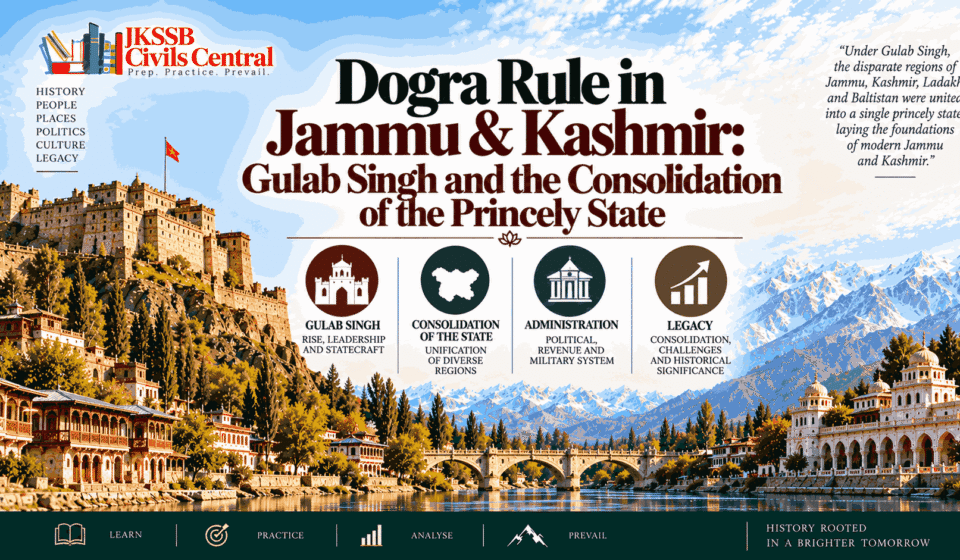
Dogra Rule in Jammu & Kashmir: Gulab Singh and the Consolidation of the Princely State

J&K History Series Navigation
| Previous Article | Current Article | Next Article |
|---|---|---|
| Article 35 — Treaty of Amritsar, 1846: Provisions, Territorial Transfer and Historical Significance | Article 36 — Dogra Rule in Jammu & Kashmir: Gulab Singh and the Consolidation of the Princely State | Article 37 — Ranbir Singh and the Administrative Development of Jammu & Kashmir |
Learning Dashboard
| Area | Key Information |
|---|---|
| Historical Period | 1846–1857, with background from the early 19th century |
| Historical Phase | Dogra State & Princely J&K |
| Main Ruler | Maharaja Gulab Singh |
| Dynasty | Dogra / Jamwal |
| Political Centre | Jammu and Srinagar, with authority extending across a geographically diverse state |
| Core Theme | Consolidation of the newly formed princely state |
| Key Turning Point | Treaty of Amritsar, 16 March 1846 |
| Major Early Challenge | Resistance of Sheikh Imam-ud-Din in Kashmir |
| Important Areas | Jammu, Kashmir Valley, Ladakh, Baltistan and frontier territories |
| Important Personalities | Gulab Singh, Sheikh Imam-ud-Din, Diwan Lakhpat Rai, Wazir Ratanu, Mian Hathu, Ranbir Singh |
| Important Source | Gulabnama of Diwan Kirpa Ram |
| JKSSB Importance | Very High |
| Likely Question Types | Direct fact, chronology, statement-based, comparative, identification, cause-consequence |
Introduction
The Treaty of Amritsar of 16 March 1846 created the legal framework within which Gulab Singh emerged as the ruler of a new princely state in the north-western Himalayas. Yet the signing of the treaty did not by itself create an administratively integrated state. Gulab Singh already possessed a substantial political base in Jammu and had, through earlier military expansion under the Sikh imperial system, acquired influence over territories such as Ladakh, but Kashmir Valley still had to be brought under his effective authority and the diverse territories of the new state had to be held together. The first decade of Dogra rule was therefore a period of consolidation, in which political authority, revenue extraction, frontier control and administrative supervision had to be established across regions with different geographical, social and political histories.
Gulab Singh’s reign is consequently important for understanding the transition from the Sikh imperial order to the Dogra princely state. His achievement was not simply the acquisition of territory; it involved constructing a durable political framework in which Jammu became the dynastic base while Kashmir Valley, Ladakh and the frontier regions were incorporated into a single ruling structure. At the same time, consolidation involved coercion and fiscal extraction, and the experience of different communities and regions was not uniform. The history of Gulab Singh’s reign must therefore be understood neither as an uncomplicated story of state-building nor merely as a story of oppression, but as a process in which territorial integration, personal monarchy, military power, revenue interests and British paramountcy interacted.
CivilsCentral Historical Insight
The significance of Gulab Singh’s reign lies in the conversion of a collection of politically distinct Himalayan territories into a single princely polity. Consolidation strengthened the state, but it did not eliminate regional differences or social tensions. The Dogra state that emerged in 1846 was therefore both an achievement of political integration and a structure whose legitimacy and administrative capacity remained uneven.
Part I — From Jammu Chiefdom to the Princely State
Gulab Singh’s Political Background
Gulab Singh’s rise began before the creation of Jammu & Kashmir in 1846. A member of the Jamwal branch of the Dogra Rajput ruling elite of Jammu, he entered the service of Maharaja Ranjit Singh of Lahore along with his brothers Dhian Singh and Suchet Singh. The brothers became important figures in the Sikh political and military system, while Gulab Singh progressively strengthened his position in Jammu and the surrounding hill regions. His appointment as Raja of Jammu in 1822 was an important stage in this process, but Jammu at this point remained within the wider political framework of Sikh paramountcy rather than constituting an independent sovereign state.
Gulab Singh subsequently used military force, political negotiation and the weakening of centralized Sikh authority after Ranjit Singh’s death in 1839 to enlarge his effective sphere of influence. The Dogra campaigns under Zorawar Singh brought Ladakh and Baltistan into Gulab Singh’s political orbit, although the precise nature of authority differed from territory to territory. Thus, by 1846, Gulab Singh possessed a political and military base considerably broader than the Jammu principality he had received in the early 1820s.
The formation of the princely state in 1846 must therefore be viewed as the culmination of a longer process. The Treaty of Lahore of 9 March 1846 recognized Gulab Singh’s independent sovereignty in territories that were to be transferred to him by a separate agreement, while the Treaty of Amritsar of 16 March formally transferred the specified territories from the British Government to Gulab Singh. The treaty framework gave legal form to a political project that had developed over several decades.
The Difference Between 1822 and 1846
For examination purposes, one of the most important chronological distinctions is between 1822 and 1846.
In 1822, Gulab Singh was recognized as Raja of Jammu under the Sikh political order. This was not the creation of the princely state of Jammu & Kashmir.
In 1846, following the First Anglo-Sikh War and the Treaty of Lahore and Treaty of Amritsar, Gulab Singh became the ruler of the newly constituted princely state encompassing territories transferred to him under the treaty settlement.
The distinction prevents a common historical error: treating Gulab Singh’s appointment as Raja of Jammu in 1822 as equivalent to the creation of Jammu & Kashmir as a princely state.
CivilsCentral Historical Insight
State formation was a process rather than a single event. Gulab Singh’s authority developed through the Sikh period, expanded through military campaigns and was legally transformed in 1846. For this reason, 1822 marks an important stage in Gulab Singh’s rise, whereas 1846 marks the formation of the princely state under British paramountcy.
Part II — 1846: From Treaty to Effective Control
The Treaty of Amritsar Did Not Immediately Establish Effective Control over Kashmir
The Treaty of Amritsar transferred the specified territories to Gulab Singh, but the implementation of the settlement in Kashmir Valley was contested. Sheikh Imam-ud-Din, the former Sikh governor of Kashmir, resisted the transfer of authority and refused to surrender the Valley to Gulab Singh’s representatives.
Gulab Singh initially attempted to establish control through his own forces. The Dogra effort met resistance, and the conflict demonstrated that treaty-based sovereignty and effective political control were not identical. Gulab Singh consequently appealed to the British under the arrangements associated with the 1846 settlement. British intervention ultimately weakened Imam-ud-Din’s position, and by late 1846 Gulab Singh was able to establish effective authority in the Valley.
This episode is particularly important because it demonstrates the role of British power in the early consolidation of the new state. Gulab Singh was the ruler of the new princely state, but his position was not one of complete independence from the British. The Treaty of Amritsar itself required Gulab Singh to acknowledge British supremacy, while the British in turn provided protection against external enemies.
The Kashmir Valley and the Transition of Authority
The transfer of Kashmir therefore involved two distinct stages:
Legal transfer in March 1846 → political struggle in the Valley → effective Dogra control by late 1846.
The distinction matters because historical writing sometimes treats the Treaty of Amritsar as though it automatically transferred actual administrative control throughout the territory on the day it was signed. In reality, the transition involved resistance, military operations and British involvement.
The defeat of Imam-ud-Din removed one of the most immediate obstacles to Gulab Singh’s authority. It also demonstrated that the new state depended during its formative stage upon a combination of Dogra military power and the wider British political order.
CivilsCentral Historical Insight
The events of 1846 reveal the difference between de jure authority and de facto control. Gulab Singh received the legal basis for sovereignty through the treaty settlement, but effective rule had to be established through political and military consolidation.
Part III — Consolidating a Geographically Diverse State
A State of Regions Rather Than a Homogeneous Territory
The new princely state was geographically exceptional. It brought together the Jammu hills and plains, the Kashmir Valley, the high-altitude region of Ladakh and frontier territories extending towards the trans-Himalayan and north-western mountain zones. These areas differed in geography, communications, political traditions, economic activity and local social structures.
The state could therefore not be governed as though it were a single homogeneous region. Jammu possessed an older Dogra political base; Kashmir had a long history of rule under successive imperial and regional powers; Ladakh had its own political traditions and had only recently come under Dogra control; while the frontier areas remained difficult to govern because of mountainous terrain and the strength of local chiefs.
Gulab Singh’s central problem was consequently not simply territorial possession. It was the establishment of a political relationship between the central authority and regions where communications were difficult and where local power structures could resist outside control.
Personal Rule and Political Centralization
Gulab Singh’s style of governance was strongly personal. The early state did not possess the highly developed bureaucratic machinery that would emerge through subsequent administrative reforms. The Maharaja retained close control over major matters of revenue, finance, foreign relations and political authority, while ministers and provincial officials implemented policy on his behalf.
This form of governance was suited to a period of rapid consolidation because decisions could be concentrated in the ruler and his immediate political circle. Its weakness was equally significant: administrative effectiveness depended heavily on the personal authority and supervision of the ruler and on the reliability of subordinate officials.
This helps explain why Gulab Singh personally travelled through and supervised different areas of his state. Consolidation required more than issuing orders from the capital; it required keeping provincial officials, revenue collectors and local elites under political supervision.
CivilsCentral Historical Insight
Gulab Singh’s early state was fundamentally a personal and centralized monarchy, not yet a fully rationalized modern bureaucracy. Its effectiveness came from concentrated authority and military-political control, while its limitations were reflected in dependence on individual officials and uneven administration across difficult frontier regions.
Part IV — Political Consolidation in Jammu and the Hill Regions
Jammu as the Dynastic Base
Jammu remained the principal political base of the Dogra ruling house. The legitimacy of Gulab Singh’s rule was closely associated with his position as the Dogra ruler of Jammu, and the creation of the larger princely state extended this existing dynastic authority over Kashmir and the other territories transferred or already controlled by him.
The integration of Jammu into the larger state did not mean that Jammu lost its political importance. Rather, it became the dynastic core from which the Dogra ruling house exercised authority over a much larger territorial system.
Rajouri and the Assertion of State Authority
The consolidation of the hill territories also involved replacing or subordinating local ruling houses. Rajouri provides a useful example. Following the 1846 settlement, Gulab Singh asserted direct authority over the principality and appointed Mian Hathu as governor. The establishment of a Dogra administrative presence and the construction of Dhannidhar Fort were part of the broader process by which strategic hill territories were brought under closer state supervision.
Such developments illustrate a recurring feature of nineteenth-century state formation in the region: the central government sought to replace fragmented local political authority with officials responsible to the Maharaja.
However, this process should not be interpreted as the instantaneous creation of a uniform administrative structure. Local rulers, chiefs and landed interests continued to matter, and the extent of direct state control varied by region.
CivilsCentral Historical Insight
Consolidation meant more than adding territory to a map. It involved reducing the autonomy of local political centres and replacing them, where possible, with officials responsible to the Maharaja. Rajouri illustrates this broader movement from localized authority towards centralized princely administration.
Part V — Frontier Consolidation
The Strategic Problem of the Northern and Western Frontiers
The newly constituted state possessed some of the most difficult frontiers in South Asia. Mountain ranges, high passes, sparse settlement and long communication routes made military and administrative control expensive. The frontier was also politically fluid, with local chiefs and neighbouring powers possessing influence that could not simply be ignored.
Gulab Singh therefore devoted considerable attention to frontier security. The military campaigns of the preceding period had brought Ladakh and Baltistan within the Dogra sphere, but consolidation required continued garrisons, local political arrangements and military expeditions.
The experience of Gilgit was particularly revealing. Dogra attempts to establish durable control in the northern frontier encountered serious resistance. The uprising in Gilgit in the early 1850s demonstrated that possession of a territory did not automatically mean secure political control. The region remained one of the most difficult areas of the state and later became a major focus of frontier policy under Ranbir Singh.
Chilas and the Frontier
Dogra forces also operated in the Chilas area during Gulab Singh’s reign. These campaigns were connected with the broader effort to secure routes and frontier positions rather than simply with territorial expansion for its own sake.
Yet the results were uneven. Gulab Singh’s state achieved greater control in some frontier areas while failing to establish equally secure authority everywhere. This is why the concept of consolidation is more accurate than describing his reign simply as uninterrupted territorial expansion.
CivilsCentral Historical Insight
The northern frontier reveals the limits of nineteenth-century state power. Mountain geography, local political autonomy and distance from the administrative centre made consolidation a continuing process. Gulab Singh strengthened the state’s position, but several frontier areas remained unsettled at his death.
Part VI — Administrative Consolidation
Early Administrative Structure
Gulab Singh inherited administrative practices from the political systems that had preceded him, but he also began reorganizing them to serve the new state. The administration remained strongly centralized, with the Maharaja exercising direct authority over important matters while ministers and provincial officers handled day-to-day governance.
Contemporary and later accounts describe a division of responsibilities among officials dealing with civil administration, revenue and related functions. The state was also organized territorially into major divisions and subordinate districts or local administrative units. However, the precise administrative structure developed over time and should not be projected backward from the more elaborate system associated with Ranbir Singh.
This distinction is important. Gulab Singh laid foundations and undertook measures of consolidation; the systematic departmental and judicial reorganization associated with the later Dogra period belongs more appropriately to the reign of Ranbir Singh and subsequent rulers.
Revenue Administration
Revenue was central to the functioning of the new state. Gulab Singh inherited a difficult fiscal environment in Kashmir in which agricultural production had long been subject to heavy demands and numerous exactions. The state depended heavily upon agricultural revenue, and improving the predictability of assessment and collection was therefore important for both political control and state income.
Accounts of Gulab Singh’s reign indicate attempts to regulate assessment and collection and to bring waste land under cultivation. Measures concerning newly cultivated land were intended to encourage reclamation, while administrative attention was directed towards strengthening the state’s control over agricultural revenue.
At the same time, the fiscal system remained burdensome. The consolidation of state authority did not mean the immediate disappearance of heavy taxation. Revenue extraction remained an important feature of the relationship between the state and cultivators.
The correct historical interpretation therefore lies between two extremes: Gulab Singh did make efforts to regularize revenue administration, but the fiscal demands of the state continued to impose substantial pressure on sections of the population.
Justice and Maintenance of Order
One of Gulab Singh’s major priorities was the restoration and maintenance of political order. Kashmir had passed through periods of political instability, competing officials and localized disorder before the Dogra takeover. Gulab Singh’s government sought to strengthen the authority of the state and reduce crime and disorder.
The judicial system of the early Dogra state, however, remained largely personal and executive in character. The highly developed codification and judicial restructuring associated with later Dogra administration should not be attributed wholesale to Gulab Singh.
This distinction is especially important for JKSSB preparation:
Gulab Singh → consolidation and foundations
Ranbir Singh → extensive administrative reorganization and codification
CivilsCentral Historical Insight
The early Dogra administration should be understood as a transitional system. Gulab Singh strengthened central authority, revenue supervision and political order, but the systematic bureaucratic and legal institutions of the later state developed further under his successors.
Part VII — Agriculture, Revenue and the Rural Economy
Agriculture as the Fiscal Foundation
Agriculture formed the principal economic base of the Kashmir Valley and other settled areas of the state. For a ruler concerned with consolidation, agricultural revenue was therefore not merely an economic matter; it was a foundation of political authority.
Gulab Singh’s administration continued earlier revenue practices while introducing some modifications. Contemporary accounts indicate attention to the reclamation of waste land and the regulation of cultivation. Such measures were consistent with the state’s interest in expanding the taxable agricultural base.
The difficulty was that state revenue requirements could conflict with the interests of cultivators. Heavy assessment, additional exactions and the activities of subordinate officials could reduce the effective benefit received by cultivators from agricultural production. The existence of reforming measures therefore does not mean that the agrarian system became equitable.
The Problem of Official Exaction
One of the persistent problems of the nineteenth-century state was the difference between official assessment and actual collection. Even when the central government established a formal revenue demand, subordinate officials could impose additional charges or extract benefits through their local authority.
This distinction is important because historical descriptions of Dogra revenue policy often move between the formal system and the actual experience of cultivators. A careful historical account must distinguish the two.
The state sought revenue because it needed to maintain its administration and military establishment. But the burden of extraction could contribute to rural hardship and undermine the stability that the government was simultaneously trying to create.
CivilsCentral Historical Insight
Revenue administration illustrates the central contradiction of early state consolidation: a stronger government required a reliable fiscal base, but excessive extraction could weaken the economic foundation on which that government depended. Administrative regularization and fiscal pressure therefore existed simultaneously.
Part VIII — The Shawl Industry and State Regulation
Kashmir’s Shawl Economy
The shawl industry was one of Kashmir’s most important commercial activities and had already developed substantially before Gulab Singh’s accession. The state inherited the established system of regulating the industry and taxing production.
The shawl industry was attractive to the state because it generated substantial revenue. Consequently, the administration maintained close supervision over artisans, workshops and the movement of shawl production. This created tension between fiscal interests and the welfare of the weavers.
The 1847 Crisis
The early Dogra period witnessed serious dissatisfaction among shawl workers. In 1847, a large number of weavers reportedly left Kashmir for Punjab in protest against taxation and working conditions. The episode demonstrated that the state’s extraction from the industry could threaten the productive base on which that extraction depended.
Gulab Singh responded by introducing changes in the organization and taxation of the shawl industry. Accounts describe the abolition of some earlier practices, the removal of certain unnecessary taxes and changes in the way taxation was assessed. Regulations also sought to reduce some of the rigid controls under which weavers worked.
These measures should not be interpreted as the complete transformation of the shawl industry into a free labour market. State regulation and taxation continued, and the basic relationship between the state and the industry remained highly extractive.
The historical significance of the 1847 episode lies precisely in this tension: the ruler recognized that excessive pressure could damage a valuable source of revenue and therefore introduced adjustments without abandoning state control.
CivilsCentral Historical Insight
The shawl industry demonstrates how state-building and economic regulation were intertwined. Gulab Singh’s government depended on the industry for revenue, yet excessive extraction produced resistance and migration. The 1847 response shows an attempt to preserve the revenue-producing capacity of the industry by modifying, rather than abolishing, state regulation.
Part IX — Social and Religious Governance
Governing a Religiously Diverse Population
The princely state brought together populations belonging to different religious, linguistic and regional communities. Kashmir Valley had a Muslim majority, while Jammu contained substantial Hindu communities alongside Muslims and other groups. Ladakh and the frontier areas possessed their own distinctive religious and cultural landscapes.
The Dogra monarchy was Hindu and derived much of its dynastic legitimacy from the Dogra Rajput political tradition. However, the state ruled over a religiously diverse population and therefore had to maintain political order across communities.
The early Dogra state cannot be understood simply through the religious identity of the ruling dynasty. Governance also depended on inherited institutions, local elites, revenue officials and political alliances. At the same time, questions of access to land, government service, taxation and official authority gradually acquired social and communal dimensions that would become much more important in later Dogra history.
It is therefore historically safer to distinguish Gulab Singh’s personal and dynastic identity from the much more developed political conceptions of a “Hindu state” that emerged in later historical contexts.
Religious Policy and Political Legitimacy
Gulab Singh’s government sought to establish itself as a legitimate ruling authority across the territories it controlled. The state maintained existing religious institutions and practices while the ruler also supported Hindu religious institutions associated with the Dogra dynasty.
However, claims about complete religious equality or systematic religious discrimination during the whole of Gulab Singh’s reign should be treated cautiously because the evidence is uneven and later historical interpretations differ.
The more important historical point for this article is that the state had to govern across religious and regional divisions, and the manner in which it did so shaped the political history of the princely state long after Gulab Singh’s death.
CivilsCentral Historical Insight
Gulab Singh’s state was simultaneously a Dogra dynastic monarchy and a multi-religious polity. Its long-term political history cannot be explained solely through either religious identity or administrative policy; the interaction of dynasty, territory, social hierarchy and state institutions became increasingly important.
Part X — British Paramountcy and the Limits of Dogra Sovereignty
An Independent Ruler Under British Supremacy
The Treaty of Amritsar gave Gulab Singh extensive internal authority, but it did not establish modern sovereign independence. Article X required him to acknowledge the supremacy of the British Government, while other treaty provisions restricted his freedom in matters involving external relations and required military cooperation under specified circumstances.
This arrangement placed Jammu & Kashmir within the system of British paramountcy. The British did not administer the state as they administered directly ruled provinces, but they retained a superior political position.
This distinction is essential:
Princely state ≠ directly ruled British province
but also:
Princely state ≠ fully sovereign independent kingdom in the modern sense.
Gulab Singh’s government therefore possessed considerable internal autonomy while operating within the larger imperial political order.
British Support and Political Dependence
The early consolidation of Kashmir also revealed the practical importance of British support. The resistance of Imam-ud-Din could not be overcome easily by Gulab Singh alone, and British intervention helped secure the transfer of effective control.
At the same time, British officials differed in their assessments of Gulab Singh. Some regarded him as capable of maintaining order and as useful to British strategic interests; others criticized aspects of his conduct and administration. This disagreement is important because it demonstrates that British policy towards Gulab Singh was pragmatic rather than based upon a single uniform assessment.
CivilsCentral Historical Insight
Gulab Singh’s state was politically autonomous in many internal matters but strategically embedded within British paramountcy. Its formation therefore reflected both Dogra state-building and British imperial calculations in the north-western Himalayas.
Part XI — Gulab Singh and the Consolidation of the State
From Territorial Acquisition to Political Integration
By the middle of the nineteenth century, the political geography of the Dogra state had changed dramatically from the limited Jammu principality of Gulab Singh’s earlier career. Jammu had become the dynastic centre of a larger state extending across the Kashmir Valley and Himalayan frontier regions.
The process of consolidation involved several interconnected elements:
Military power established or defended territorial authority.
Provincial officials extended the ruler’s presence into distant regions.
Revenue administration provided the financial resources required to maintain the state.
Frontier policy attempted to secure vulnerable northern and western territories.
Personal supervision compensated, at least partially, for the limited development of formal bureaucratic institutions.
British paramountcy provided an external political framework within which the state survived.
These elements should not be studied separately. The military required revenue; revenue required administrative control; administration required political stability; and frontier security required military resources.
Consolidation Was Uneven
The state was not equally consolidated everywhere. Jammu and the Kashmir Valley became the core regions of Dogra authority, while the northern frontier remained much more difficult. Local political structures continued to influence governance, and communication problems restricted the state’s capacity to exercise uniform control.
This explains why the history of Dogra consolidation cannot be reduced to a map showing territorial expansion. A territory could be formally included within the state while actual administrative penetration remained limited.
The northern frontier in particular remained a long-term problem that Ranbir Singh inherited. Later Dogra governments would continue military and administrative efforts in these areas.
CivilsCentral Historical Insight
Consolidation was a matter of effective state capacity, not merely territorial possession. Gulab Singh established the political framework of the princely state, but the process of making that framework administratively effective continued under his successors.
Part XII — Gulab Singh and the Succession of Ranbir Singh
Preparing for a Transfer of Power
As Gulab Singh’s health deteriorated, the question of succession became increasingly important. The experience of the Sikh Empire after Ranjit Singh’s death had demonstrated the dangers of succession disputes and political fragmentation.
Gulab Singh therefore increasingly prepared his son Ranbir Singh for the responsibilities of government. By the mid-1850s, Ranbir Singh had become deeply involved in administration and was positioned to succeed his father.
The transfer of effective power to Ranbir Singh before Gulab Singh’s death is important because it helped prevent a major succession crisis at a time when the wider political environment of northern India was becoming increasingly unstable.
1856–1857 and the End of Gulab Singh’s Reign
Ranbir Singh assumed effective authority before Gulab Singh’s death, while Gulab Singh withdrew from some of the direct burdens of government and spent his final period largely in Kashmir.
Gulab Singh died in 1857, and Ranbir Singh succeeded him. Sources differ regarding the precise date of Gulab Singh’s death, with several nineteenth-century and later sources giving dates in June or August. For examination purposes, the securely established point is that Gulab Singh died in 1857 and was succeeded by Ranbir Singh.
The transition occurred in the same year as the major uprising against British rule in northern India. The subsequent relationship between the Dogra state and the British during 1857–58 belongs primarily to the history of Ranbir Singh’s reign and will be treated in later articles.
CivilsCentral Historical Insight
Gulab Singh’s most important political achievement was not simply the acquisition of Kashmir but the creation of a dynastic state capable of surviving his own rule. The relatively orderly succession to Ranbir Singh helped ensure that the new princely state did not collapse with the death of its founder.
Part XIII — Historical Interpretation and Evidence
Gulab Singh as State Builder
One interpretation emphasizes Gulab Singh’s role as a state builder. From this perspective, he transformed the Jammu principality into a large Himalayan polity, strengthened political authority, imposed greater order and created the institutional foundations upon which his successors could build.
This interpretation is supported by evidence of territorial consolidation, the suppression of resistance, the development of provincial authority and the continuation of the state after his death.
Gulab Singh as an Extractive Ruler
A second interpretation emphasizes the fiscal and social burdens imposed by the new state. Revenue demands, artisan taxation and the dependence of government on extraction created significant hardship among sections of the population.
The shawl industry is particularly important in this respect. The 1847 crisis demonstrates that the government’s economic policies could become sufficiently burdensome to provoke collective resistance and migration.
Why Both Dimensions Matter
These interpretations are not necessarily mutually exclusive. A state could become stronger administratively and militarily while simultaneously imposing substantial economic burdens upon its subjects.
Historical analysis should therefore avoid both extremes:
“Gulab Singh created a perfectly efficient and benevolent state” — too simplistic.
“Gulab Singh’s rule was nothing more than arbitrary oppression” — also insufficient as a complete explanation.
The more defensible interpretation is that Gulab Singh was a highly capable and forceful nineteenth-century ruler whose state-building depended upon military power, personal authority and fiscal extraction, while his government also made selective efforts to regularize administration and respond to problems that threatened political or economic stability.
The Gulabnama as a Source
An important source for Gulab Singh’s life is the Persian Gulabnama, written by Diwan Kirpa Ram, who served in the ruler’s administration. The work is valuable because it preserves information and documents relating to Gulab Singh’s career and the early Dogra state.
However, Gulabnama must be used critically. It was written from within the ruling establishment and uses the conventions of Persian courtly biography. It therefore provides important evidence but cannot be treated as a completely neutral account.
Other useful sources include British political correspondence, treaties, gazetteers, administrative records, travel accounts and later historical scholarship. Each source has its own perspective and limitations.
CivilsCentral Historical Insight
Gulab Singh’s history becomes clearer when different types of evidence are compared. Courtly biography reveals the ruler from within the Dogra establishment, while British records reveal imperial perceptions and administrative concerns; neither should automatically be treated as the complete historical truth.
Part XIV — JKSSB Knowledge Matrix
| Question Area | High-Value Knowledge |
|---|---|
| Who? | Maharaja Gulab Singh |
| Dynasty? | Dogra / Jamwal |
| Raja of Jammu? | 1822 |
| Formation of princely state? | 1846 |
| Key treaty? | Treaty of Amritsar, 16 March 1846 |
| Preceding treaty? | Treaty of Lahore, 9 March 1846 |
| Major early resistance? | Sheikh Imam-ud-Din |
| Major issue after 1846? | Establishing effective control over Kashmir |
| Political base? | Jammu |
| Important frontier regions? | Ladakh, Baltistan and northern frontier |
| Major economic base? | Agriculture |
| Important commercial industry? | Kashmir shawl industry |
| Major artisan crisis? | Shawl-weavers’ resistance/migration in 1847 |
| Form of early government? | Strong personal monarchy with centralized authority |
| British relationship? | Princely-state autonomy under British paramountcy |
| Important source? | Gulabnama |
| Succeeded by? | Ranbir Singh |
| Death year? | 1857 |
Part XV — Examination Discrimination Points
1. 1822 vs 1846
1822 → Gulab Singh recognized as Raja of Jammu.
1846 → Creation of the larger princely state under Gulab Singh.
2. Treaty of Lahore vs Treaty of Amritsar
Treaty of Lahore, 9 March 1846 → ended the First Anglo-Sikh War and recognized the framework for Gulab Singh’s separate sovereignty.
Treaty of Amritsar, 16 March 1846 → transferred specified territories to Gulab Singh and defined his relationship with the British.
3. Legal transfer vs effective control
The Treaty of Amritsar provided the legal basis for Gulab Singh’s authority, but Kashmir Valley had to be brought under effective Dogra control after resistance from Sheikh Imam-ud-Din.
4. Gulab Singh vs Ranbir Singh
Gulab Singh → state formation and initial consolidation.
Ranbir Singh → major subsequent administrative, legal and institutional development.
5. State formation vs complete administrative integration
The princely state existed from 1846, but administrative consolidation continued for decades.
6. Princely state vs sovereign independence
Jammu & Kashmir possessed substantial internal autonomy but remained under British paramountcy.
Part XVI — JKSSB Question Pattern
Direct Fact
A question may ask:
Who was the first Maharaja of the princely state of Jammu & Kashmir?
Answer: Gulab Singh
Statement-Based
Consider the following statements:
- Gulab Singh became Raja of Jammu in 1822.
- The princely state of Jammu & Kashmir was created in 1822.
- The Treaty of Amritsar was signed in 1846.
- Gulab Singh was succeeded by Ranbir Singh.
Correct statements: 1, 3 and 4.
Chronology
Arrange the following chronologically:
- Gulab Singh becomes Raja of Jammu
- First Anglo-Sikh War
- Treaty of Lahore
- Treaty of Amritsar
- Death of Gulab Singh
Correct sequence:
1822 → 1845–46 → 9 March 1846 → 16 March 1846 → 1857
Match the Following
| Column A | Column B |
|---|---|
| Gulab Singh | First Maharaja of princely J&K |
| Sheikh Imam-ud-Din | Resistance during transition of Kashmir in 1846 |
| Ranbir Singh | Successor of Gulab Singh |
| Diwan Kirpa Ram | Gulabnama |
Identification by Clues
Identify the ruler:
- Raja of Jammu from the Sikh period
- Became Maharaja in 1846
- Associated with the Treaty of Amritsar
- Consolidated the newly formed Dogra princely state
- Succeeded by Ranbir Singh
Answer: Gulab Singh
Part XVII — JKSSB Practice Questions
Q1. Which of the following correctly distinguishes Gulab Singh’s position in 1822 from that in 1846?
A. In 1822 he became Maharaja of J&K, while in 1846 he became Raja of Jammu
B. In 1822 he became Raja of Jammu, while in 1846 he became Maharaja of the newly constituted princely state
C. In both years he became Maharaja of J&K
D. In 1822 he became governor of Kashmir, while in 1846 he became governor of Jammu
Correct Answer: B
Explanation: Gulab Singh’s recognition as Raja of Jammu belongs to 1822. The larger princely state emerged through the 1846 treaty settlement.
Q2. The immediate political problem faced by Gulab Singh after the Treaty of Amritsar was:
A. Mughal invasion of Kashmir
B. Resistance of Sheikh Imam-ud-Din
C. Afghan occupation of Jammu
D. British annexation of Ladakh
Correct Answer: B
Explanation: Sheikh Imam-ud-Din, the former Sikh governor of Kashmir, resisted the transfer of authority and delayed Gulab Singh’s effective control of the Valley.
Q3. Consider the following statements:
- Gulab Singh’s authority in Kashmir was immediately uncontested after the Treaty of Amritsar.
- British intervention assisted Gulab Singh in overcoming resistance in Kashmir.
- The new state remained subject to British paramountcy.
Which of the above is/are correct?
A. 1 only
B. 2 only
C. 2 and 3 only
D. 1, 2 and 3
Correct Answer: C
Explanation: Statement 1 is incorrect because Imam-ud-Din resisted the transfer. Statements 2 and 3 are correct.
Q4. Which source is particularly associated with the biography and history of Gulab Singh?
A. Rajatarangini
B. Akbarnama
C. Gulabnama
D. Ain-i-Akbari
Correct Answer: C
Explanation: Gulabnama, written in Persian by Diwan Kirpa Ram, is an important source for Gulab Singh’s career and the early Dogra state.
Q5. Which development is more appropriately associated with Gulab Singh’s reign than with the later administrative development under Ranbir Singh?
A. Initial consolidation of the princely state
B. Comprehensive codification of state law
C. Mature judicial reorganization
D. Extensive later departmental decentralization
Correct Answer: A
Explanation: Gulab Singh’s reign focused primarily on formation and consolidation. More systematic legal and administrative development occurred under Ranbir Singh.
Q6. Arrange the following events in the correct order:
- Treaty of Amritsar
- Gulab Singh becomes Raja of Jammu
- First Anglo-Sikh War
- Gulab Singh’s death
A. 2–3–1–4
B. 3–2–1–4
C. 2–1–3–4
D. 1–2–3–4
Correct Answer: A
Q7. Which statement best describes the economic significance of the shawl industry during Gulab Singh’s reign?
A. It was outside state taxation
B. It was an important revenue-producing industry subject to state regulation
C. It disappeared immediately after 1846
D. It was controlled entirely by British officials
Correct Answer: B
Q8. The 1847 shawl-weaver crisis demonstrates which broader feature of early Dogra rule?
A. Complete separation of economic and political policy
B. Conflict between state revenue interests and artisan welfare
C. Abolition of state taxation
D. British direct rule over Kashmir
Correct Answer: B
Explanation: The state’s heavy dependence on revenue from the shawl industry created tensions with the interests of the artisans. The 1847 response involved modifications to regulation rather than abandonment of state control.
Q9. Which of the following is the most accurate description of the early Dogra state?
A. A directly administered British province
B. A completely sovereign independent kingdom
C. A princely state exercising internal authority under British paramountcy
D. A continuation of direct Sikh administration
Correct Answer: C
Q10. Which succession is correct?
A. Gulab Singh → Hari Singh
B. Gulab Singh → Ranbir Singh
C. Gulab Singh → Pratap Singh
D. Gulab Singh → Amar Singh
Correct Answer: B
Part XVIII — Rapid Revision Zone
Important Dates
- 1822 — Gulab Singh recognized as Raja of Jammu.
- 1845–46 — First Anglo-Sikh War.
- 9 March 1846 — Treaty of Lahore.
- 16 March 1846 — Treaty of Amritsar.
- 1846 — Beginning of Dogra rule over the newly constituted princely state.
- 1846 — Resistance of Sheikh Imam-ud-Din during the transfer of Kashmir.
- 1847 — Major shawl-weaver crisis and administrative response.
- 1851 — Major difficulties on the northern frontier, including Gilgit.
- 1857 — Death of Gulab Singh and succession of Ranbir Singh.
Important Personalities
- Gulab Singh — First Maharaja of the princely state.
- Ranbir Singh — Successor of Gulab Singh.
- Sheikh Imam-ud-Din — Last Sikh governor of Kashmir and major opponent of the immediate Dogra takeover.
- Diwan Kirpa Ram — Author of Gulabnama.
- Mian Hathu — Associated with Dogra administration in Rajouri.
Important Treaties
Treaty of Lahore, 1846
↓
Recognized the framework for Gulab Singh’s separate sovereignty.
Treaty of Amritsar, 1846
↓
Transferred specified territories to Gulab Singh and defined his relationship with the British.
Important Economic Areas
- Agriculture
- Land revenue
- Shawl industry
- Artisanal production
- Trade routes
- Frontier commerce
Important Administrative Themes
- Centralized personal rule
- Revenue supervision
- Provincial officials
- Maintenance of law and order
- Frontier administration
- Military consolidation
Chronological Sequence
Raja of Jammu, 1822
↓
Dogra territorial expansion
↓
First Anglo-Sikh War, 1845–46
↓
Treaty of Lahore, 9 March 1846
↓
Treaty of Amritsar, 16 March 1846
↓
Resistance of Imam-ud-Din
↓
Effective Dogra control of Kashmir
↓
Consolidation and administrative adjustment
↓
Gulab Singh’s death, 1857
↓
Ranbir Singh
Part XIX — Frequently Confused Facts
| Confusion | Correct Distinction |
|---|---|
| 1822 = formation of J&K | Incorrect — 1822 marks Gulab Singh’s recognition as Raja of Jammu |
| 1846 = only a change of ruler | Incorrect — 1846 marks the creation of the larger princely state |
| Treaty of Lahore and Treaty of Amritsar are the same | Incorrect — they were separate treaties signed one week apart |
| Gulab Singh immediately controlled Kashmir on 16 March 1846 | Incorrect — resistance delayed effective control |
| Gulab Singh was completely independent of Britain | Incorrect — British paramountcy applied |
| All Dogra administrative reforms belong to Gulab Singh | Incorrect — major later institutional development occurred under Ranbir Singh |
| Shawl industry began under Gulab Singh | Incorrect — it considerably predated Dogra rule |
| Gulab Singh only expanded territory | Incomplete — he also consolidated political and fiscal authority |
| Consolidation was complete everywhere by 1846 | Incorrect — frontier areas remained difficult to control |
| Gulabnama was a completely neutral source | Incorrect — it is an important but courtly source requiring critical use |
Part XX — What Can JKSSB Ask?
From this topic, high-value question areas include:
- Gulab Singh’s rise from Raja of Jammu to Maharaja
- 1822 vs 1846
- Treaty of Lahore vs Treaty of Amritsar
- Sheikh Imam-ud-Din’s resistance
- Establishment of effective Dogra control in Kashmir
- Dogra consolidation of Jammu and hill territories
- Frontier problems during Gulab Singh’s reign
- Revenue administration
- Shawl industry and the 1847 crisis
- British paramountcy
- Gulabnama and Diwan Kirpa Ram
- Gulab Singh → Ranbir Singh succession
- Distinction between state formation and later administrative modernization
A particularly strong statement-based question can combine several of these facts because they test chronology and discrimination rather than isolated memorization.
Chapter Summary
The Dogra princely state emerged in 1846 from a longer process of political expansion rather than from a single administrative act. Gulab Singh had already established himself as Raja of Jammu and had expanded Dogra influence into several Himalayan regions before the Treaty of Amritsar provided the legal framework for the larger state.
The immediate challenge after 1846 was to convert treaty-based authority into effective political control. The resistance of Sheikh Imam-ud-Din in Kashmir demonstrated that the transfer of sovereignty was not automatically equivalent to administrative possession. With British assistance, Gulab Singh established effective control over the Valley and then concentrated on consolidating the wider state.
His methods combined personal monarchy, military power, provincial administration, revenue extraction and frontier policy. Agriculture remained the main fiscal base, while the shawl industry provided an important source of commercial revenue but also generated conflict over taxation and working conditions. The state’s northern frontier remained particularly difficult, demonstrating that territorial inclusion did not always mean complete administrative control.
Gulab Singh’s reign therefore represents the first consolidation phase of the Dogra princely state. He created the political framework that his successors would inherit, but he did not create the fully developed administrative system that later characterized the state.
JKSSB Takeaway
Remember the sequence:
1822 — Gulab Singh becomes Raja of Jammu
1846 — Treaty of Lahore + Treaty of Amritsar
1846 — Dogra state established
1846 — Resistance of Imam-ud-Din and consolidation of Kashmir
1847 — Shawl-weaver crisis
1857 — Gulab Singh dies; Ranbir Singh succeeds
The central distinction is:
Gulab Singh = Formation and Consolidation
Ranbir Singh = Major Administrative Development
Mind Map
DOGRA STATE — 1846
↓
GULAB SINGH
Raja of Jammu → Maharaja of J&K
↓
LEGAL FRAMEWORK
Treaty of Lahore
↓
Treaty of Amritsar
↓
EARLY CHALLENGE
Sheikh Imam-ud-Din’s resistance
↓
Effective Dogra control of Kashmir
↓
CONSOLIDATION
Jammu + Kashmir + Ladakh + Frontier Regions
↓
STATE CAPACITY
Central authority
Revenue administration
Provincial officials
Military power
↓
ECONOMY
Agriculture
Land revenue
Shawl industry
Trade
↓
FRONTIER PROBLEM
Gilgit
Chilas
Northern mountain regions
↓
BRITISH PARAMOUNTCY
Internal autonomy
External political supremacy
↓
SUCCESSION
Gulab Singh → Ranbir Singh
↓
HISTORICAL SIGNIFICANCE
Creation and initial consolidation of the Dogra princely state
FAQs
1. Who was the first Maharaja of Jammu & Kashmir?
Gulab Singh was the first Maharaja of the princely state created in 1846.
2. When did Gulab Singh become Raja of Jammu?
He was recognized as Raja of Jammu in 1822 under the Sikh political order.
3. Did the princely state of Jammu & Kashmir exist in 1822?
No. 1822 marks Gulab Singh’s position as Raja of Jammu; 1846 marks the creation of the larger princely state.
4. Which treaties were central to the creation of the Dogra state?
The Treaty of Lahore, 9 March 1846, and the Treaty of Amritsar, 16 March 1846, were central to the political and territorial settlement.
5. Who resisted Gulab Singh’s takeover of Kashmir in 1846?
Sheikh Imam-ud-Din, the former Sikh governor of Kashmir, resisted the transfer of authority.
6. Was Gulab Singh completely independent after 1846?
No. Jammu & Kashmir was a princely state with substantial internal autonomy but remained under British paramountcy.
7. What was the major economic base of Gulab Singh’s state?
Agriculture and land revenue formed the principal fiscal foundation, while the shawl industry was an important commercial and revenue-producing sector.
8. What happened in the shawl industry in 1847?
A major crisis involving shawl workers occurred amid dissatisfaction with taxation and working conditions. Gulab Singh’s government subsequently modified aspects of regulation and taxation.
9. Who wrote Gulabnama?
Diwan Kirpa Ram, an important official associated with Gulab Singh’s administration, wrote the Persian Gulabnama.
10. Who succeeded Gulab Singh?
His son Ranbir Singh succeeded him in 1857 and subsequently undertook much more extensive administrative and legal development of the state.
About The Author




[…] Article 36 — Dogra Rule in Jammu & Kashmir: Gulab Singh and the Consolidation of the Princely … […]
[…] ← Article 36 — Dogra Rule in Jammu & Kashmir: Gulab Singh and the Consolidation of the Princ… […]