
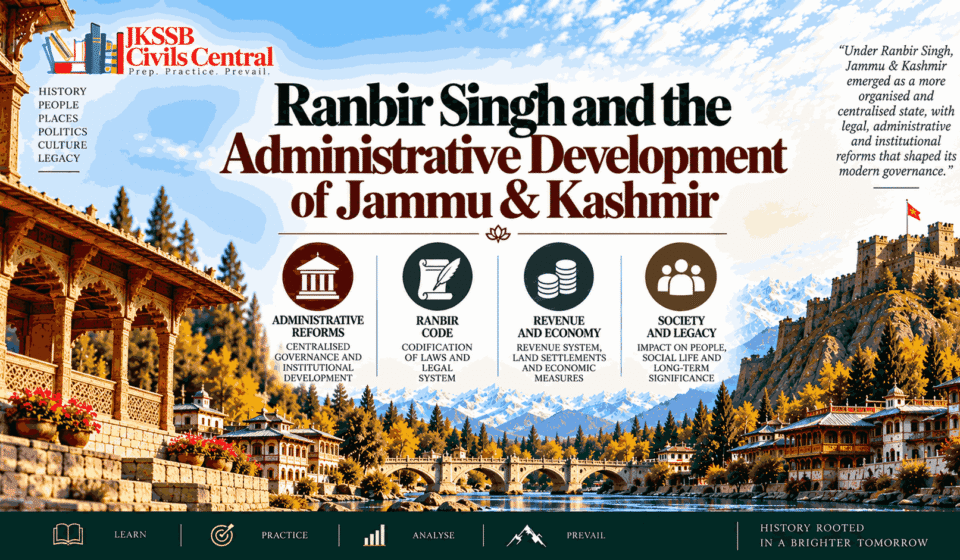
Ranbir Singh and the Administrative Development of Jammu & Kashmir

J&K History Series Navigation
| Previous Article | Current Article | Next Article |
|---|---|---|
| ← Article 36 — Dogra Rule in Jammu & Kashmir: Gulab Singh and the Consolidation of the Princely State | Article 37 — Ranbir Singh and the Administrative Development of Jammu & Kashmir | Article 38 — Dogra Administration: Institutions, Law, Revenue and Governance in Jammu & Kashmir → |
Learning Dashboard
| Area | Key Information |
|---|---|
| Historical Period | 1857–1885 |
| Historical Phase | Dogra State & Princely J&K |
| Ruler | Maharaja Ranbir Singh |
| Dynasty | Dogra / Jamwal |
| Capital / Political Centre | Jammu |
| Core Theme | Administrative, judicial, revenue, educational and institutional development |
| Major Administrative Development | Organization of civil, revenue and military functions |
| Judicial Landmark | Adalat-i-Alia / High Court, 1877 |
| Legal Development | Ranbir Dand Bidhi and related codification efforts |
| Revenue Development | Greater organization of revenue administration and land assessment |
| Education | Expansion of state-supported Pathshalas, Madrassas and learning institutions |
| Culture & Knowledge | Sanskrit, Persian, Arabic and manuscript preservation |
| Communication | Telegraphic and postal development during the later part of the reign |
| Important Source | Contemporary British accounts, state records and later scholarship |
| JKSSB Importance | Very High |
| Likely Question Types | Direct fact, statement-based, chronology, matching, comparative, conceptual-factual |
Introduction
When Maharaja Ranbir Singh succeeded Gulab Singh, he inherited a state that had been politically consolidated but was still administratively uneven. The territories brought together under Dogra rule differed considerably in geography, economic structure, political traditions and the degree to which the central government could exercise direct authority. The central problem of Ranbir Singh’s reign was therefore no longer primarily the creation of the state but the development of institutions capable of governing it with greater regularity.
Ranbir Singh’s reign from 1857 to 1885 is consequently an important stage in the evolution of Jammu & Kashmir from a recently consolidated princely state into a more structured administrative polity. His government reorganized civil, revenue and military functions, developed a hierarchy of provincial and district officials, strengthened judicial institutions, worked towards codification of laws, expanded state-supported education and promoted scholarship and manuscript preservation. These changes did not transform Jammu & Kashmir into a modern democratic or fully bureaucratic state; political authority remained concentrated in the Maharaja and the system continued to operate within the framework of British paramountcy.
The historical significance of Ranbir Singh therefore lies in administrative institutionalization. Gulab Singh had provided the territorial and dynastic foundation; Ranbir Singh strengthened the machinery through which that state could be governed. This distinction is central to the chronology of the Dogra period and is particularly important for examination purposes.
CivilsCentral Historical Insight
Ranbir Singh’s reign represents the movement from state formation to administrative consolidation. The central achievement was not the creation of a new territorial state but the development of more regular structures of administration, justice, revenue and knowledge within the state already established under Gulab Singh.
Part I — Ranbir Singh’s Accession and the Administrative Context
From Gulab Singh to Ranbir Singh
Ranbir Singh was the son and successor of Maharaja Gulab Singh. He became ruler in the context of the transition that followed Gulab Singh’s death in 1857. The succession was significant because the new ruler inherited a state whose territorial framework had been established only a decade earlier.
Gulab Singh’s principal task had been to establish and consolidate Dogra authority over the territories brought together after 1846. Ranbir Singh inherited that achievement but also its administrative problems. Governing Jammu, Kashmir and the distant frontier regions required more systematic arrangements for revenue collection, justice, military organization and provincial supervision.
The change in emphasis can therefore be summarized as:
Gulab Singh → formation and consolidation
Ranbir Singh → administrative development and institutionalization
This is not an absolute division. Gulab Singh had also undertaken administrative measures, while Ranbir Singh continued military and political consolidation. The distinction describes the dominant historical character of their respective reigns rather than an exclusive separation of functions.
The Challenge of Governing a Multi-Regional State
The state’s geographical diversity made administration particularly difficult. Jammu, Kashmir, Ladakh and the northern frontier were connected politically but not geographically or administratively uniform. Mountain barriers, seasonal communication difficulties and the presence of local elites meant that the central government needed intermediate layers of authority.
Ranbir Singh’s response involved strengthening territorial administration through governors, wazirs, tehsildars and other officials. The state thus developed a clearer relationship between the central Darbar and the local administrative units.
CivilsCentral Historical Insight
The administrative problem of Jammu & Kashmir was fundamentally geographical as well as political. A state stretching across plains, valleys, high mountains and frontier zones required intermediate institutions to connect the ruler with distant populations. Ranbir Singh’s reforms addressed this problem by strengthening the territorial hierarchy of government.
Part II — Reorganization of the State Administration
Three Major Branches of Government
One of the most important developments under Ranbir Singh was the clearer differentiation of governmental functions. His administration came to be organized around three broad branches:
- Daftar-i-Nizamat — civil administration
- Daftar-i-Diwani — revenue administration
- Daftar-i-Jungi — military administration
The significance of this arrangement was not that it created a modern separation of powers in the constitutional sense. The Maharaja remained the supreme political authority, and the branches were administrative departments rather than independent constitutional institutions. Nevertheless, differentiation of functions reduced the earlier concentration of unrelated responsibilities within the same administrative machinery and made the operation of government more structured.
A prime minister or chief ministerial authority coordinated the wider administration, while provincial and district officers carried government into the territories. This provided a framework through which civil governance, revenue collection and military affairs could be handled as distinct but interconnected areas.
Territorial Administration
The state was increasingly divided into territorial units for administrative convenience. Kashmir was administered through wazarats, with officials responsible for civil and revenue administration. Governors or Hakim-i-Alas exercised authority over major territorial divisions, while Wazirs and Tehsildars operated at subordinate levels.
The exact number and boundaries of administrative units changed over time, so the structure should not be treated as permanently fixed throughout Ranbir Singh’s reign. Some sources describe Jammu and Kashmir as having different numbers of wazarats at different stages, reflecting administrative rearrangement.
This is an important source-discipline point. The wazarat was a significant administrative unit, but its precise territorial composition changed. Therefore, examination preparation should distinguish the general institutional fact from later or changing lists of districts.
Jammu and Kashmir Under Different Administrative Arrangements
Jammu remained closely connected with the Maharaja’s direct political authority, while Kashmir was administered through a governor and subordinate officials. This arrangement reflected both geography and the political history of the two provinces.
The development of provincial administration did not eliminate the Maharaja’s personal authority. Instead, it created a chain through which that authority could be exercised over a larger territory.
CivilsCentral Historical Insight
Ranbir Singh’s administrative reorganization should be understood as centralization through delegation. The Maharaja remained the ultimate authority, but the expanding state required governors, wazirs and tehsildars to make centralized rule practically possible.
Part III — Development of the Revenue Administration
Revenue as the Foundation of the State
Revenue remained fundamental to the functioning of the princely state. The government required resources to maintain the army, officials, courts, public works and the wider machinery of administration. Consequently, improvement of revenue collection was one of the most important aspects of Ranbir Singh’s administrative policy.
The challenge was to make revenue assessment and collection more regular while maintaining the fiscal capacity of the state. Earlier systems had often relied heavily upon collection in kind and on local intermediaries. Under Ranbir Singh, efforts were made to rationalize revenue administration and improve the recording and supervision of agricultural resources.
Cash and Kind
An important development concerned the form in which revenue was collected. Evidence indicates that Jammu moved towards cash revenue collection during Ranbir Singh’s reign, while the older system of collection in kind continued for longer in Kashmir.
This distinction is highly useful for examination purposes because a generalized statement such as “Ranbir Singh abolished revenue in kind throughout Jammu & Kashmir” would be misleading. The process was regionally differentiated.
In Jammu, the movement towards cash assessment simplified the state’s fiscal relationship with cultivators and reduced some of the logistical difficulties associated with transporting agricultural produce. In Kashmir, however, older arrangements remained influential for a longer period.
Revenue Officials and Record-Keeping
The development of a more structured revenue department required officials responsible for assessment and collection at different administrative levels. Greater attention was also given to land measurement, assessment and the recording of agricultural information.
This represented an important movement toward a more documentary form of administration. Instead of depending entirely upon personal knowledge or informal arrangements, the state increasingly sought written records that could support taxation and administrative supervision.
However, the process should not be romanticized as a fully modern land-settlement system comparable to later British settlements. The state remained a princely administration, and the development of revenue records occurred gradually.
CivilsCentral Historical Insight
Revenue reform illustrates the broader administrative transition under Ranbir Singh: the state increasingly relied upon records, territorial officials and standardized procedures rather than purely personal extraction. Yet this was an incremental process, not the sudden creation of a modern revenue bureaucracy.
Part IV — Judicial Development
From Personal Justice to Institutional Courts
Judicial administration was one of the areas in which Ranbir Singh’s reign produced particularly significant institutional change. Under Gulab Singh, the Maharaja personally retained extensive judicial authority, with executive officers handling much of the routine administration of justice. Ranbir Singh sought to create a more differentiated judicial structure.
The development of courts allowed disputes to be processed through recognized institutions rather than depending exclusively upon direct intervention by the ruler. This did not eliminate the Maharaja’s ultimate judicial authority, but it created a more regular hierarchy of courts.
Sadar Adalats
Chief courts or Sadar Adalats operated at major centres, including Jammu and Srinagar. These institutions dealt with important cases and formed part of the developing judicial hierarchy.
Their significance lies in the movement towards institutional supervision of subordinate courts. Judicial authority was becoming increasingly associated with recognized courts rather than solely with the personal authority of the Maharaja.
Adalat-i-Alia: The High Court of 1877
The most important judicial landmark of Ranbir Singh’s reign was the establishment of the Adalat-i-Alia, or High Court, in 1877 under the Jammu & Kashmir State Civil Courts Regulation.
The High Court was placed above the subordinate civil courts and exercised powers of appeal and revision, subject to the judicial authority of the Maharaja. The official history of the Jammu & Kashmir High Court identifies this 1877 institution as the historical predecessor of the later High Court system.
The establishment of the Adalat-i-Alia was important because it created a more coherent hierarchy of judicial supervision. It did not mean that judicial independence in the modern constitutional sense had been established: the Maharaja retained significant powers. Nevertheless, the development represented a substantial step towards institutionalized judicial administration.
Jury Experiment
A further development occurred in 1880, when a jury system was introduced in the city courts of Jammu and Srinagar. The experiment involved appointed jurors and represented an attempt to incorporate collective participation into certain judicial proceedings.
The jury system should not be confused with modern representative democracy. It was an administrative-judicial experiment operating within an autocratic princely system.
CivilsCentral Historical Insight
The judicial reforms of Ranbir Singh reveal an important institutional transition: justice was moving from a predominantly ruler-centred arrangement towards a hierarchy of courts with defined appellate supervision. Yet the system remained ultimately subordinate to monarchical authority.
Part V — Codification and the Development of Law
Why Codification Became Necessary
As the state expanded its administrative machinery, customary practices and ruler’s orders alone became increasingly inadequate for consistent governance. Officials required written rules defining offences, procedures, penalties and administrative responsibilities.
Ranbir Singh therefore encouraged the compilation and codification of laws. This process was influenced in part by developments in British India, where codified laws were increasingly shaping colonial administration.
The important point, however, is that the Dogra state did not simply copy British Indian law wholesale. Legal rules were adapted to the institutional and social conditions of the princely state.
Ranbir Dand Bidhi
During Ranbir Singh’s reign, a criminal code known as the Ranbir Dand Bidhi was prepared and published. Contemporary scholarship describes this as an important early attempt to codify criminal law in the state, alongside civil and military legal provisions.
This requires a crucial examination clarification.
The term Ranbir Penal Code (RPC) is associated with the later formal state code, enacted in 1932 under Maharaja Hari Singh. The foundations of this later code lay in the legal codification associated with Ranbir Singh, including the Ranbir Dand Bidhi. Therefore, it is inaccurate to state that Ranbir Singh enacted the modern RPC in 1932.
The safest formulation is:
Ranbir Singh → development of the Ranbir Dand Bidhi and foundations of later state criminal codification.
1932 → formal enactment of the Jammu & Kashmir State Ranbir Penal Code under Maharaja Hari Singh.
This distinction is particularly important because the phrase “Ranbir Penal Code” is frequently used loosely in historical summaries.
Civil and Military Codes
The codification process extended beyond criminal law. A civil code known as Zabita-i-Diwani and a military code associated with the state’s forces were also developed during this broader process of legal organization.
The result was a growing body of written law that provided officials with clearer guidance in administration and adjudication.
CivilsCentral Historical Insight
Legal codification was part of the wider transformation of the state from personal rule towards rule through written administrative procedures. However, the later Ranbir Penal Code of 1932 must not be projected backward into Ranbir Singh’s reign; the historical continuity lies in the earlier Ranbir Dand Bidhi and associated legal codification.
Part VI — Regulation of Revenue Officials and Administrative Conduct
From Personal Orders to Written Procedure
Administrative development required not only institutions but also rules governing officials. Ranbir Singh’s government introduced regulations intended to guide revenue officers and other state functionaries.
The Dastur-ul-Amal has been associated with the regulation and guidance of revenue administration. Such written instructions helped standardize official practices and reduce the scope for purely discretionary decisions.
The state also took measures against corruption and unauthorized exactions. Bribery and interference in judicial proceedings were increasingly treated as administrative problems requiring formal regulation.
Administrative Discipline
This development should not be interpreted as evidence that corruption disappeared. Rather, it demonstrates that the government increasingly recognized corruption, arbitrary official behaviour and interference with courts as problems that needed institutional remedies.
This distinction is important. The existence of an anti-corruption regulation does not prove the absence of corruption; it demonstrates the state’s attempt to regulate it.
CivilsCentral Historical Insight
Administrative modernization is visible not only in the creation of new departments but also in attempts to regulate the conduct of officials. The state increasingly sought to define what officials could and could not do, although implementation remained uneven.
Part VII — Education and Intellectual Development
Education Before Modern Schooling
Education in Jammu & Kashmir before the expansion of state institutions was largely provided through indigenous Pathshalas, Madrassas and Maktabs, alongside other traditional centres of learning. Instruction was strongly connected with religious, literary and classical traditions.
Ranbir Singh took an active interest in education and scholarship. His policy did not simply replace traditional learning with a Western curriculum. Instead, much of his educational patronage strengthened classical and oriental learning while also creating some institutional structures that could support broader educational development.
This distinction matters because later Western-style educational expansion became much more prominent under subsequent Dogra rulers.
Pathshalas and Madrassas
State-supported and traditional institutions continued to operate in Jammu and Kashmir during Ranbir Singh’s reign. Sanskrit learning received substantial patronage, while Persian and Arabic learning remained important.
The state also supported instruction in subjects associated with classical scholarship, including Sanskrit grammar, logic and literary studies. Muslim educational institutions and Arabic instruction continued to have a place within the educational landscape.
Research on Dogra education indicates that the number and nature of educational institutions expanded during Ranbir Singh’s reign, while traditional educational structures remained important.
Raghunath Temple and Sanskrit Learning
The Raghunath Temple complex in Jammu became closely associated with the educational and intellectual patronage of Ranbir Singh. Sanskrit learning, manuscript preservation and scholarly activity were supported through institutions connected with the complex.
The significance of this development extends beyond religious patronage. Manuscript preservation and scholarly activity created an institutional environment in which texts from different linguistic traditions could be collected, copied, studied and translated.
Manuscript Collection and Translation
Ranbir Singh’s government encouraged the collection and preservation of manuscripts in languages including Sanskrit, Persian and Arabic. Translation activities sought to make works available across linguistic traditions.
This was particularly important in a multilingual state. Scholarship was not restricted to a single literary tradition; rather, the intellectual environment brought together Sanskritic, Persianate and Arabic traditions alongside regional languages.
The resulting collections became an important part of Jammu’s cultural and intellectual heritage.
CivilsCentral Historical Insight
Ranbir Singh’s educational policy was not simply “Westernization.” Its strongest early component was state patronage of classical and multilingual learning. The preservation, collection and translation of manuscripts helped create an intellectual infrastructure that linked different literary traditions within the princely state.
Part VIII — Language, Printing and the Growth of Administrative Communication
Persian, Dogri and Other Languages
Persian retained an important position in official and judicial administration during Ranbir Singh’s reign. At the same time, Dogri was used extensively in Jammu in administrative and educational contexts, while Sanskrit, Arabic and other languages continued to be used in scholarship and religious education.
The multilingual character of the administration reflected the diversity of the state itself. No single language could completely encompass its administrative and cultural life.
Printing and the Jammu & Kashmir Gazette
The establishment of a printing press represented an important step in the dissemination of government information and scholarly material. Sources associate Ranbir Singh’s reign with the Ranbir Printing Press, and the first issue of the Jammu and Kashmir Gazette appeared in 1882.
The development of printing had administrative significance because written regulations, notices and other official material could be reproduced more efficiently. It also had intellectual significance because printed texts reduced dependence on manuscript copying.
The emergence of print should nevertheless not be confused with the later development of a modern newspaper culture. The political press remained heavily restricted under the princely state, and the growth of printing did not automatically produce freedom of expression.
CivilsCentral Historical Insight
Printing changed the state’s information environment. It strengthened the capacity of government to circulate written material and supported scholarship, but the existence of a printing press did not mean that the princely state had adopted modern principles of press freedom.
Part IX — Postal and Telegraphic Development
Communication as an Administrative Requirement
The geographical structure of Jammu & Kashmir made communication a major administrative challenge. A government attempting to supervise distant districts and frontier regions needed faster transmission of information than traditional messengers could provide.
During Ranbir Singh’s reign, the state therefore became connected to expanding telegraphic communication. Agreements with the British enabled the development of telegraph lines connecting Jammu and Srinagar and eventually extending towards the northern frontier.
The telegraph had significance beyond convenience. Faster communication improved the government’s ability to transmit orders, receive information from distant officials and coordinate frontier administration.
Jammu–Srinagar and Frontier Communication
The first telegraph connections were developed in the later part of the reign, with arrangements made for lines linking Jammu and Srinagar and subsequently the frontier. British strategic interests were also involved, particularly because the northern frontier had become increasingly important in the context of Russian expansion in Central Asia.
The development of communication therefore reflected both state modernization and imperial geopolitics.
The British were interested in obtaining information about the frontier and improving communication with strategically important areas. Ranbir Singh, meanwhile, sought to preserve the state’s political autonomy while using communication technology that strengthened administrative capacity.
CivilsCentral Historical Insight
Telegraphic development illustrates how modernization in princely India was rarely isolated from imperial politics. Ranbir Singh could use British technology to strengthen his own administration, while the British simultaneously regarded improved communication as strategically valuable for frontier intelligence.
Part X — Frontier Administration and Military Organization
Consolidation Did Not End with Gulab Singh
Although Gulab Singh had established the broad territorial framework of the Dogra state, frontier consolidation continued under Ranbir Singh. Areas such as Gilgit and the territories towards Hunza, Nagar and Yasin remained strategically sensitive.
Ranbir Singh’s government conducted military operations and strengthened frontier positions. These activities were shaped not only by local political conditions but also by the growing strategic competition between the British and Russia in Central Asia.
The Dogra state thus occupied a position between local Himalayan politics and the wider geopolitical rivalry commonly described as the Great Game.
Gilgit and British Strategic Interests
The northern frontier became increasingly important during the 1870s. British officials were concerned about Russian movements and the possibility that frontier territories might become vulnerable to outside influence.
In this context, British pressure encouraged Ranbir Singh to strengthen his control over frontier areas while also permitting a limited British political presence at Gilgit. Captain J. Biddulph was appointed as an officer on special duty in Gilgit in 1877, reflecting the growing British interest in frontier intelligence.
This arrangement illustrates the complicated relationship between the Dogra state and British paramountcy. Ranbir Singh sought to preserve control over internal administration, while British strategic interests increasingly affected frontier policy.
Military Organization
Ranbir Singh maintained and reorganized the state forces, which remained essential both for internal security and frontier operations. Military organization was increasingly influenced by contemporary patterns of drill, discipline and equipment, although the forces remained those of a princely state rather than a modern national army.
The military therefore remained closely connected to administrative consolidation: revenue financed the state, the administration collected revenue, and military power protected the territory in which the administrative system operated.
CivilsCentral Historical Insight
Frontier policy under Ranbir Singh demonstrates that administration and geopolitics were inseparable. The Maharaja’s government was trying to consolidate its own authority while operating in a region increasingly shaped by British strategic concerns about Central Asia and Russia.
Part XI — Public Works, Trade and Economic Administration
Roads and Communication Routes
The improvement of roads and communication routes was important for both economic and administrative purposes. Roads reduced the difficulty of moving officials, troops and goods across the mountainous state.
The development of routes connecting Jammu, Kashmir and frontier areas therefore had multiple purposes. It could facilitate trade while simultaneously strengthening military mobility and government supervision.
The state did not possess the financial and technological resources of British India, so infrastructure development remained uneven. Nevertheless, the direction of policy was towards improving the physical connections necessary for effective government.
Trade and Reduction of Some Fiscal Barriers
Ranbir Singh’s government also took measures intended to facilitate trade. Certain vexatious duties and local exactions were reduced or abolished, while commercial relations with British India were encouraged.
These measures reflected a broader recognition that state revenue could not depend exclusively upon extracting from agricultural and artisanal production. Trade could increase the economic resources available to the state and strengthen connections with neighbouring markets.
The economic policy therefore contained a tension similar to that seen under Gulab Singh: the government required revenue but also needed a productive economy capable of generating that revenue.
CivilsCentral Historical Insight
Economic administration under Ranbir Singh increasingly recognized that state strength depended on more than taxation. Roads, communication and trade regulation could expand the economic base from which the state derived revenue and political capacity.
Part XII — Cultural Patronage and Religious Institutions
Patronage of Sanskrit and Hindu Institutions
Ranbir Singh was a major patron of Sanskrit learning and Hindu religious institutions. The construction and development of temples in Jammu, particularly the Raghunath complex, formed an important part of his cultural policy.
The Maharaja’s patronage was closely connected with the identity of the Dogra ruling house. Religious and cultural patronage therefore had both intellectual and political dimensions.
At the same time, the state’s intellectual environment remained more diverse than a simple description of “Hindu cultural policy” might suggest. Persian and Arabic scholarship continued, Muslim scholars participated in translation and educational activity, and the state ruled over a population with varied religious traditions.
Cultural Patronage and Political Legitimacy
Modern historical scholarship has emphasized the importance of Dogra legitimacy during Ranbir Singh’s reign and the role of Hindu identity in constructing the prestige of the ruling house. This should be understood historically rather than projected backward into modern categories of communal politics.
The ruler’s religious identity and patronage formed part of the monarchy’s political legitimacy, but governance also required managing a religiously diverse population.
This dual character is essential to understanding the period.
CivilsCentral Historical Insight
Cultural patronage under Ranbir Singh had two dimensions: it supported genuine scholarly and religious activity while also strengthening the prestige and identity of the Dogra monarchy. The historical challenge is to recognize both dimensions without reducing the entire administration to either religious patronage or religious conflict.
Part XIII — Ranbir Singh and the British Empire
A Princely Ruler Within British Paramountcy
Ranbir Singh did not rule an independent sovereign state in the modern international sense. Jammu & Kashmir remained a princely state under British paramountcy, while retaining substantial internal autonomy.
The Maharaja generally sought to protect this autonomy, particularly in relation to British attempts to expand their political presence in the state. At the same time, his government cooperated with British India in areas of mutual strategic interest.
This relationship was particularly visible in frontier policy and communications.
The 1857 Uprising
Ranbir Singh’s accession coincided with the great uprising of 1857. His government remained aligned with the British, and the state provided military assistance to the British during the crisis.
This episode strengthened the political relationship between the Dogra monarchy and the British. It also reinforced the strategic value that the British attached to the Jammu & Kashmir state.
The significance of 1857 for Ranbir Singh therefore extends beyond military cooperation. It helped shape the political environment within which his subsequent administrative development occurred.
CivilsCentral Historical Insight
The Dogra state developed its administrative institutions while operating inside the British imperial system. Ranbir Singh’s cooperation with the British in 1857 strengthened that relationship, even as he continued to defend the internal autonomy of his princely government.
Part XIV — Limits and Contradictions of Administrative Development
Administrative Modernization Without Representative Government
Ranbir Singh’s reforms should not be described as democratic modernization. The state remained a hereditary monarchy, and political authority remained concentrated in the Maharaja and his officials.
The establishment of courts, departments, written regulations and educational institutions increased administrative regularity but did not create representative institutions through which ordinary subjects could participate in government.
This distinction is essential. Administrative modernization and political democratization are not the same process.
Regional and Social Inequality
The benefits of administrative development were also uneven. Educational opportunities remained limited in comparison with the scale of the population, and access to government institutions varied across communities and regions.
The structure of the bureaucracy and the distribution of official positions would become important political questions in later decades. The administrative system created under Ranbir Singh therefore laid foundations not only for greater state capacity but also for future debates about representation, employment and social inequality.
Centralization and Local Autonomy
The creation of governors, wazirs and tehsildars strengthened central authority, but local society continued to shape how administration actually functioned. Officials depended on local intermediaries, while difficult geography limited direct supervision.
Consequently, the state was more centralized than before but not uniformly centralized in practice.
CivilsCentral Historical Insight
Ranbir Singh’s administrative development should be judged in its nineteenth-century context. It strengthened state capacity without creating representative government, and it introduced greater procedural regularity without eliminating regional and social inequalities.
Part XV — Historical Significance of Ranbir Singh’s Reign
Ranbir Singh’s reign occupies a pivotal position in the institutional history of Jammu & Kashmir. The state inherited from Gulab Singh was politically consolidated but administratively uneven; by 1885 it possessed a more recognizable governmental structure, a judicial hierarchy, written legal rules, a differentiated revenue system, educational institutions, printing facilities and improved communication.
The importance of these changes lies in their cumulative effect. A court cannot function effectively without administrative districts; districts require officials; officials require revenue; revenue requires records and assessment; frontier security requires military organization; and all these functions depend upon communication. Ranbir Singh’s reforms therefore formed an interconnected system rather than a collection of unrelated initiatives.
Yet the transformation remained incomplete. The monarchy retained extensive personal authority, the administration remained dependent upon officials appointed from above, and political participation was limited. The later Dogra state would inherit both the institutional achievements and the unresolved inequalities of this system.
This is why Ranbir Singh should be remembered historically as an important institution-builder and consolidator, rather than as the creator of a fully modern state.
CivilsCentral Historical Insight
The lasting significance of Ranbir Singh’s reign lies in the creation of an administrative infrastructure that survived the ruler himself. His reforms made the Dogra state more governable, but they also established institutions whose inequalities and limitations would become central to the political history of Jammu & Kashmir in the twentieth century.
Part XVI — Historical Interpretation and Evidence Note
Ranbir Singh as an Administrative Reformer
Older historical writing often presents Ranbir Singh as a progressive ruler, emphasizing his attention to administration, law, education and culture. There is substantial evidence for institutional development during his reign, particularly in judicial organization, revenue administration, education and communications.
However, the term “reformer” requires qualification. His reforms were designed to strengthen a hereditary princely government rather than establish representative politics. Administrative efficiency and monarchical authority developed together.
Religious Legitimacy
Modern scholarship has also examined the role of Hindu identity in the consolidation of Dogra legitimacy during Ranbir Singh’s reign. This interpretation is important because the ruler’s religious identity was not merely private; it formed part of the political culture of the monarchy. At the same time, the state remained religiously diverse and its administrative history cannot be reduced to religious identity alone.
Evidence Base
The history of Ranbir Singh’s administration can be reconstructed through several types of evidence:
- State regulations and legal texts
- Administrative records
- British political correspondence
- Contemporary travel accounts
- Gazetteers
- Educational records
- Later historical scholarship
- Institutional histories of the judiciary
The Jammu & Kashmir High Court’s own historical account is particularly useful for the judicial chronology and confirms the establishment of the Adalat-i-Alia in 1877.
The key methodological caution is that later summaries sometimes project institutions backwards. The most important example is the Ranbir Penal Code: the formal 1932 RPC should not be presented as though it was enacted by Ranbir Singh. His reign belongs to the earlier development of Ranbir Dand Bidhi and related legal codification.
Part XVII — JKSSB Knowledge Matrix
| Question Area | High-Value Knowledge |
|---|---|
| Who? | Maharaja Ranbir Singh |
| Reign? | 1857–1885 |
| Dynasty? | Dogra / Jamwal |
| Predecessor? | Gulab Singh |
| Successor? | Pratap Singh |
| Core contribution? | Administrative and institutional development |
| Three major departments? | Nizamat, Diwani, Jungi |
| Nizamat? | Civil administration |
| Diwani? | Revenue administration |
| Jungi? | Military administration |
| Major judicial institution? | Adalat-i-Alia |
| Adalat-i-Alia established? | 1877 |
| Jury experiment? | 1880 |
| Early criminal code? | Ranbir Dand Bidhi |
| Formal RPC? | 1932, under Hari Singh |
| Important revenue development? | Greater regularization and movement toward cash revenue in Jammu |
| Education? | Pathshalas, Madrassas, Sanskrit and multilingual learning |
| Printing? | Ranbir Printing Press |
| J&K Gazette? | First issue in 1882 |
| Communication? | Telegraphic development in later reign |
| Important cultural centre? | Raghunath Temple complex, Jammu |
| Frontier concern? | Gilgit and northern frontier |
| British relationship? | Princely autonomy under British paramountcy |
Part XVIII — Examination Discrimination Points
1. Gulab Singh vs Ranbir Singh
Gulab Singh → formation and initial consolidation of the princely state.
Ranbir Singh → administrative, judicial, revenue and institutional development.
2. Ranbir Dand Bidhi vs Ranbir Penal Code
Ranbir Dand Bidhi → associated with the legal codification undertaken during Ranbir Singh’s reign.
Ranbir Penal Code → formal state penal code enacted in 1932 under Maharaja Hari Singh.
3. 1877 vs 1880
1877 → Adalat-i-Alia / High Court established.
1880 → jury system introduced in Jammu and Srinagar city courts.
4. Daftar-i-Nizamat vs Daftar-i-Diwani vs Daftar-i-Jungi
- Nizamat → civil administration
- Diwani → revenue administration
- Jungi → military administration
5. Administrative modernization vs democracy
Ranbir Singh developed administrative institutions, but his state remained a hereditary monarchy.
6. Education under Ranbir Singh vs later Western education
Ranbir Singh strongly supported traditional and classical learning and institutional education. The much broader expansion of Western-style education belongs largely to the later Dogra period.
7. Revenue in Jammu vs Kashmir
The movement toward cash revenue was more advanced in Jammu; older revenue-in-kind arrangements continued longer in Kashmir.
Part XIX — JKSSB Question Pattern
Direct Fact
Which High Court was established in Jammu & Kashmir during the reign of Maharaja Ranbir Singh?
Answer: Adalat-i-Alia, 1877
Statement-Based
Consider the following statements:
- Ranbir Singh succeeded Gulab Singh.
- The Adalat-i-Alia was established in 1877.
- The formal Ranbir Penal Code was enacted during Ranbir Singh’s reign.
- Ranbir Singh encouraged classical learning and manuscript preservation.
Correct: 1, 2 and 4.
Statement 3 is incorrect because the formal state Ranbir Penal Code was enacted in 1932.
Chronology
Arrange:
- Gulab Singh’s death
- Establishment of Adalat-i-Alia
- Introduction of jury system
- First issue of Jammu & Kashmir Gazette
- Death of Ranbir Singh
Correct sequence:
1857 → 1877 → 1880 → 1882 → 1885
Match the Following
| Column A | Column B |
|---|---|
| Daftar-i-Nizamat | Civil administration |
| Daftar-i-Diwani | Revenue administration |
| Daftar-i-Jungi | Military administration |
| Adalat-i-Alia | High Court |
Identification by Clues
Identify the ruler:
- Son and successor of Gulab Singh
- Ruled from 1857 to 1885
- Developed the administrative structure of the Dogra state
- Associated with Adalat-i-Alia
- Patron of Sanskrit and manuscript learning
- Associated with early legal codification
Answer: Maharaja Ranbir Singh
Part XX — JKSSB Practice Questions
Q1. Maharaja Ranbir Singh succeeded:
A. Maharaja Pratap Singh
B. Maharaja Gulab Singh
C. Maharaja Hari Singh
D. Maharaja Ranjit Singh
Correct Answer: B
Explanation: Ranbir Singh succeeded Gulab Singh and ruled from 1857 to 1885.
Q2. Which of the following correctly matches the three major administrative branches under Ranbir Singh?
A. Nizamat—Revenue; Diwani—Military; Jungi—Civil
B. Nizamat—Civil; Diwani—Revenue; Jungi—Military
C. Nizamat—Military; Diwani—Civil; Jungi—Revenue
D. Nizamat—Judicial; Diwani—Military; Jungi—Revenue
Correct Answer: B
Q3. The Adalat-i-Alia was established in:
A. 1846
B. 1857
C. 1877
D. 1885
Correct Answer: C
Explanation: The High Court known as Adalat-i-Alia was established in 1877 under the State Civil Courts Regulation.
Q4. Consider the following statements:
- Ranbir Singh developed a more differentiated administrative structure.
- The Adalat-i-Alia was established during his reign.
- The formal Ranbir Penal Code was enacted in 1932 during his reign.
Which statement(s) is/are correct?
A. 1 only
B. 1 and 2 only
C. 2 and 3 only
D. 1, 2 and 3
Correct Answer: B
Q5. Which of the following was associated with revenue administration?
A. Daftar-i-Jungi
B. Daftar-i-Nizamat
C. Daftar-i-Diwani
D. Adalat-i-Alia
Correct Answer: C
Q6. The jury system was introduced in the city courts of Jammu and Srinagar in:
A. 1860
B. 1877
C. 1880
D. 1885
Correct Answer: C
Q7. Which statement about the Ranbir Dand Bidhi is most accurate?
A. It was enacted in 1932 by Maharaja Hari Singh
B. It was an early legal codification associated with Ranbir Singh’s reign
C. It was a Mughal revenue code
D. It was a British Act applicable directly to Jammu & Kashmir
Correct Answer: B
Q8. Which of the following best describes the educational policy of Ranbir Singh?
A. Complete abolition of traditional education
B. Exclusive emphasis on English education
C. Strong patronage of classical and multilingual learning alongside institutional educational development
D. Complete transfer of education to Christian missionaries
Correct Answer: C
Q9. The first issue of the Jammu and Kashmir Gazette is associated with:
A. 1846
B. 1857
C. 1877
D. 1882
Correct Answer: D
Q10. Which development best demonstrates the difference between administrative modernization and political democratization under Ranbir Singh?
A. Establishment of courts without representative government
B. Abolition of monarchy
C. Introduction of universal suffrage
D. Establishment of an elected legislature
Correct Answer: A
Explanation: Ranbir Singh strengthened institutions of administration and justice, but political authority remained concentrated in the hereditary monarchy.
Part XXI — Rapid Revision Zone
Important Dates
- 1857 — Ranbir Singh succeeds Gulab Singh.
- 1877 — Adalat-i-Alia / High Court established.
- 1880 — Jury system introduced in Jammu and Srinagar city courts.
- 1882 — First issue of the Jammu & Kashmir Gazette.
- 1885 — Death of Ranbir Singh; Pratap Singh succeeds him.
- 1932 — Formal Jammu & Kashmir State Ranbir Penal Code enacted under Maharaja Hari Singh.
Important Administrative Terms
| Term | Meaning |
|---|---|
| Daftar-i-Nizamat | Civil administration |
| Daftar-i-Diwani | Revenue administration |
| Daftar-i-Jungi | Military administration |
| Wazarat | Major territorial administrative unit |
| Wazir / Wazir-i-Wazarat | Senior district-level official in later administrative terminology |
| Tehsil | Subordinate territorial unit |
| Hakim-i-Ala | Governor / senior provincial authority |
| Adalat-i-Alia | High Court |
Judicial Development
Ruler-centred justice
↓
Sadar Adalats
↓
Adalat-i-Alia — 1877
↓
Jury experiment — 1880
↓
Further legal development under later Dogra rulers
Legal Development
Ranbir Singh’s reign
→ Ranbir Dand Bidhi and other codification efforts
Later Dogra period
→ Further consolidation and publication of laws
1932
→ Formal Ranbir Penal Code
Education
- Pathshalas
- Madrassas
- Maktabs
- Sanskrit learning
- Persian learning
- Arabic learning
- Manuscript collection
- Translation activities
- Raghunath Temple educational complex
Communication
- Postal development
- Telegraphic connections
- Jammu–Srinagar communication
- Frontier communication
- Increasing links with British India
Chronological Sequence
Gulab Singh
↓
Ranbir Singh, 1857
↓
Administrative reorganization
↓
Adalat-i-Alia, 1877
↓
Jury system, 1880
↓
J&K Gazette, 1882
↓
Ranbir Singh dies, 1885
↓
Pratap Singh
Part XXII — Frequently Confused Facts
| Confusion | Correct Position |
|---|---|
| Ranbir Singh founded the princely state | Incorrect — Gulab Singh established the state framework in 1846 |
| Ranbir Singh ruled before Gulab Singh | Incorrect — he succeeded Gulab Singh |
| Adalat-i-Alia was established in 1846 | Incorrect — 1877 |
| Jury system was introduced in 1877 | Incorrect — 1880 |
| Ranbir Penal Code was enacted by Ranbir Singh | Incorrect — formal RPC dates to 1932 |
| Ranbir Dand Bidhi and the 1932 RPC are completely unrelated | Incorrect — there is legal continuity, but they must not be treated as identical enactments |
| Ranbir Singh’s education policy was exclusively Western | Incorrect — classical and indigenous learning received major patronage |
| Administrative reform meant democratic government | Incorrect — the state remained a hereditary monarchy |
| Revenue modernization was identical across all regions | Incorrect — Jammu and Kashmir followed different trajectories |
| Telegraph development was purely an internal Dogra project | Incomplete — British strategic and technological interests were also involved |
Part XXIII — What Can JKSSB Ask?
From this topic, high-value examination areas include:
- Ranbir Singh’s reign: 1857–1885
- Gulab Singh → Ranbir Singh succession
- Three major administrative branches
- Nizamat–Diwani–Jungi
- Wazarat and Tehsil structure
- Adalat-i-Alia and 1877
- Jury system and 1880
- Ranbir Dand Bidhi
- Formal RPC distinction: 1932
- Revenue administration and cash/in-kind distinction
- Pathshala–Madrassa–Maktab associations
- Raghunath Temple and Sanskrit scholarship
- Ranbir Printing Press
- Jammu & Kashmir Gazette, 1882
- Telegraphic development
- Gilgit and frontier administration
- Administrative modernization vs political democratization
- Ranbir Singh vs Gulab Singh vs Pratap Singh
Chapter Summary
Ranbir Singh inherited from Gulab Singh a politically consolidated but administratively uneven princely state. His principal challenge was to make that state more governable through institutions capable of functioning beyond the direct personal intervention of the Maharaja.
He organized government into broad civil, revenue and military branches, strengthened provincial and district administration, and developed a more systematic revenue structure. The judicial system underwent particularly important change, culminating in the establishment of the Adalat-i-Alia in 1877 and the introduction of a jury experiment in 1880. Legal codification also advanced through the Ranbir Dand Bidhi and associated civil and military provisions.
Education and scholarship formed another major dimension of his reign. Ranbir Singh supported Pathshalas, Madrassas and classical learning, encouraged manuscript preservation and translation, and patronized institutions associated with Sanskrit scholarship. Printing and the publication of the Jammu & Kashmir Gazette further strengthened the circulation of official and scholarly material.
The later part of his reign also witnessed improved communications and growing British strategic involvement in the northern frontier. Telegraphic links and frontier arrangements demonstrated the interaction between Dogra administrative interests and British imperial geopolitics.
The overall result was a state with greater administrative differentiation and institutional capacity than the one inherited in 1857. Yet it remained a hereditary monarchy under British paramountcy, and administrative modernization did not mean representative government.
JKSSB Takeaway
Gulab Singh = Formation & Consolidation
Ranbir Singh = Administrative Development
Pratap Singh = Later Administrative and Political Transformation
Hari Singh = Late Dogra Reform and Constitutional Development
The highest-value Ranbir Singh facts are:
1857–1885 → reign
Nizamat → civil
Diwani → revenue
Jungi → military
1877 → Adalat-i-Alia
1880 → jury system
1882 → Jammu & Kashmir Gazette
Ranbir Dand Bidhi → early legal codification
1932 → formal Ranbir Penal Code
Mind Map
RANBIR SINGH — 1857–1885
↓
INHERITED STATE FROM GULAB SINGH
↓
ADMINISTRATIVE REORGANIZATION
Nizamat
+
Diwani
+
Jungi
↓
TERRITORIAL ADMINISTRATION
Governors / Hakim-i-Ala
↓
Wazirs
↓
Tehsildars
↓
REVENUE
Assessment
↓
Records
↓
Greater regularity
↓
Cash revenue in Jammu
↓
JUDICIARY
Sadar Adalats
↓
Adalat-i-Alia — 1877
↓
Jury system — 1880
↓
LAW
Ranbir Dand Bidhi
↓
Civil / military codification
↓
Later legal development
↓
Formal RPC — 1932
↓
EDUCATION & CULTURE
Pathshalas
+
Madrassas
+
Sanskrit
+
Persian / Arabic
↓
Manuscripts
↓
Translation
↓
Raghunath intellectual centre
↓
COMMUNICATION
Printing Press
↓
J&K Gazette — 1882
↓
Telegraph
↓
Improved administrative communication
↓
FRONTIER
Gilgit
↓
British strategic interest
↓
Dogra–British frontier cooperation
↓
HISTORICAL SIGNIFICANCE
From territorial state → more structured administrative state
FAQs
1. When did Ranbir Singh rule Jammu & Kashmir?
Ranbir Singh ruled from 1857 to 1885.
2. Who succeeded Gulab Singh?
Ranbir Singh, his son, succeeded him.
3. What were the three major branches of administration under Ranbir Singh?
They were broadly Daftar-i-Nizamat (civil), Daftar-i-Diwani (revenue) and Daftar-i-Jungi (military).
4. When was the Adalat-i-Alia established?
The Adalat-i-Alia, or High Court, was established in 1877.
5. When was the jury system introduced?
A jury system was introduced in the city courts of Jammu and Srinagar in 1880.
6. Did Ranbir Singh enact the Ranbir Penal Code of 1932?
No. The formal Jammu & Kashmir State Ranbir Penal Code was enacted in 1932, under Maharaja Hari Singh. Ranbir Singh’s reign is associated with the earlier Ranbir Dand Bidhi and the development of state legal codification.
7. What was the main character of Ranbir Singh’s educational policy?
It strongly supported classical and indigenous learning, especially Sanskrit, Persian and Arabic scholarship, while also developing state-supported educational institutions.
8. What was the importance of the Adalat-i-Alia?
It provided a superior judicial institution with appellate and supervisory authority over subordinate civil courts, subject to the Maharaja’s judicial powers.
9. What was the Jammu & Kashmir Gazette?
It was an official publication associated with the state administration. Its first issue is associated with 1882 during Ranbir Singh’s reign.
10. Was Ranbir Singh’s administration democratic?
No. His reforms strengthened administrative institutions but did not establish representative government. The state remained a hereditary princely monarchy under British paramountcy.
About The Author




[…] ← Article 37 — Ranbir Singh and the Administrative Development of Jammu & Kashmir […]
[…] Article 37 — Ranbir Singh and the Administrative Development of Jammu & Kashmir […]