
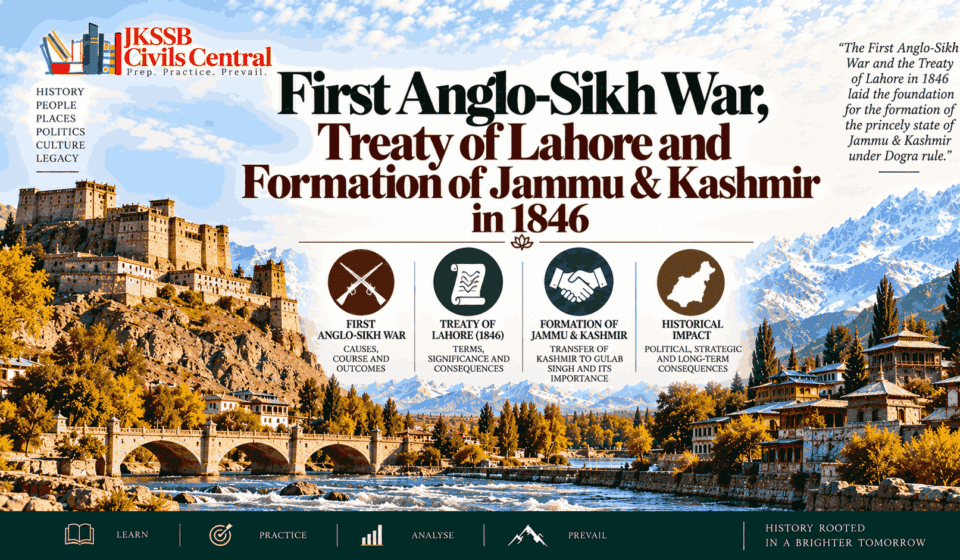
First Anglo-Sikh War, Treaty of Lahore and Formation of Jammu & Kashmir in 1846

J&K History Series Navigation
| Previous Article | Current Article | Next Article |
|---|---|---|
| Article 33 — Dogra Expansion under Zorawar Singh: Ladakh, Baltistan and Western Himalayan Campaigns | Article 34 — First Anglo-Sikh War, Treaty of Lahore and Formation of Jammu & Kashmir in 1846 | Article 35 — Treaty of Amritsar, 1846: Provisions, Territorial Transfer and Historical Significance |
Learning Dashboard
| Component | Key Information |
|---|---|
| Historical Period | 1845–1846 |
| Historical Phase | Sikh–Dogra transition / formation of the princely State |
| Main Topic | First Anglo-Sikh War, Treaty of Lahore and political settlement of 1846 |
| Principal Powers | British East India Company, Lahore Darbar, Dogra Jammu |
| Key Ruler | Maharaja Duleep Singh |
| Key Dogra Ruler | Raja Gulab Singh of Jammu |
| British Governor-General | Sir Henry Hardinge |
| Major Battles | Mudki, Ferozeshah, Aliwal, Sobraon |
| Key Treaties | Treaty of Lahore, 9 March 1846; Treaty of Amritsar, 16 March 1846 |
| Core J&K Significance | Kashmir and adjoining hill territories passed from Sikh sovereignty into the 1846 settlement through the British and were transferred to Gulab Singh under a separate treaty |
| Important Places | Lahore, Sutlej, Mudki, Ferozeshah, Aliwal, Sobraon, Jammu, Kashmir |
| Key Sources | Treaty texts, British records, Sikh historical sources, Gulabnama, modern scholarship |
| JKSSB Importance | Very High |
| Expected Question Types | Chronology, statement-based, treaty provisions, battle identification, matching, comparative questions |
Introduction
The year 1846 occupies a decisive position in the political history of Jammu and Kashmir. It was the year in which the Sikh Empire, weakened after the death of Maharaja Ranjit Singh and the subsequent political instability at Lahore, was defeated by the British East India Company in the First Anglo-Sikh War. The resulting Treaty of Lahore of 9 March 1846 transformed the territorial and political balance of the north-western subcontinent, while its provisions created the legal and diplomatic framework through which the British subsequently entered into a separate settlement with Raja Gulab Singh of Jammu.
The formation of the princely State of Jammu and Kashmir therefore cannot be understood simply as the result of a single military conquest or as an immediate consequence of the First Anglo-Sikh War. The process involved several connected stages: the rise of Dogra power under the Sikh paramountcy, the expansion of Gulab Singh’s territories into Ladakh and Baltistan, the First Anglo-Sikh War of 1845–46, the defeat of the Lahore Darbar, the Treaty of Lahore, and finally the Treaty of Amritsar of 16 March 1846. The last of these formally transferred the specified hill territories to Gulab Singh in independent possession and thereby established the new princely State under British paramountcy.
This chronology is particularly important for examination purposes. Treaty of Lahore and Treaty of Amritsar were different treaties involving different parties and different legal functions. The Treaty of Lahore ended the First Anglo-Sikh War and required the Lahore State to surrender territory and pay indemnity; the Treaty of Amritsar subsequently transferred specified territories from the British Government to Gulab Singh. Thus, the formation of Jammu and Kashmir in 1846 must be understood as a two-stage territorial and diplomatic settlement, not as something accomplished by the Treaty of Lahore alone.
CivilsCentral Historical Insight
The significance of 1846 lies not merely in the defeat of the Sikh Empire but in the restructuring of political authority across the western Himalayas. The year connected British expansion, the weakening of Lahore, and the earlier territorial rise of Gulab Singh into a new political configuration that became the princely State of Jammu and Kashmir.
Part I — The Political Background: From Sikh Paramountcy to Dogra Expansion
Jammu under the Sikh Empire
The political position of Jammu in the early nineteenth century was closely connected with the expansion of the Sikh Empire. After the weakening of the earlier Jammu ruling structure, the Lahore Darbar extended its authority over the region. The Dogra brothers Gulab Singh, Dhian Singh and Suchet Singh, sons of Kishore Singh, entered the service of Maharaja Ranjit Singh and rose rapidly within the Sikh political system.
Gulab Singh was not initially an independent sovereign in the modern sense. His rise took place within the political framework of the Sikh Empire, and his authority over Jammu developed through grants and recognition from the Lahore Darbar. By the early 1820s he had emerged as the principal Dogra ruler of Jammu, while Dhian Singh became an influential figure at Lahore.
The distinction is crucial: Dogra political power developed within Sikh paramountcy before 1846. Gulab Singh’s later emergence as an independent ruler was therefore a historical transformation rather than a condition that had existed unchanged since his first appointment in Jammu.
Expansion Beyond Jammu
During the 1820s and 1830s, Gulab Singh’s power expanded beyond the Jammu heartland. The campaigns led by his military commander Zorawar Singh brought Ladakh under Dogra control beginning in 1834, followed by expansion into Baltistan. The western Himalayan territories acquired through these campaigns greatly increased the strategic and geographical importance of the Jammu-based Dogra power.
This earlier expansion matters directly for understanding 1846. When the British later negotiated with Gulab Singh, they were not dealing with a minor Jammu chief whose authority was confined to the Jammu hills. He already possessed a substantial territorial base extending across parts of the western Himalayas. The 1846 settlement therefore converted an already expanding Dogra power into a formally recognized princely state.
The previous article in this series examines these campaigns in detail; here their importance is primarily political: Dogra expansion created the territorial and military foundation upon which the 1846 state formation became possible.
CivilsCentral Historical Insight
The State created in 1846 did not emerge from nothing. The Treaty settlement formalized and enlarged a political power that had already been built through the Dogra consolidation of Jammu and the expansion into Ladakh and Baltistan.
Part II — Why the First Anglo-Sikh War Broke Out
The Decline of Central Authority after Ranjit Singh
The death of Maharaja Ranjit Singh in 1839 weakened the political cohesion of the Sikh Empire. The period that followed was marked by rapid succession, court rivalries, factional struggles and increasing political influence of the Khalsa army. The Lahore Darbar became less capable of maintaining the centralized authority that had characterized much of Ranjit Singh’s reign.
The problem was not simply military. The Sikh state had to manage a powerful army, competing court factions and an increasingly assertive British power along the Sutlej frontier. At the same time, British territorial expansion in north-western India altered the strategic environment surrounding Lahore.
By the middle of the 1840s, therefore, the relationship between the Sikh Empire and the East India Company had become increasingly unstable.
British Expansion and Sikh Suspicion
The British had already established their position east of the Sutlej and were expanding their influence in the north-west. The Anglo-Sikh relationship had previously been regulated by the Treaty of Amritsar of 1809, concluded between the East India Company and Maharaja Ranjit Singh.
After Ranjit Singh’s death, the balance that had sustained the earlier relationship weakened. British military preparations near the Sutlej increased Sikh suspicion, while the internal instability of Lahore made a controlled response increasingly difficult.
The crisis eventually resulted in the movement of the Khalsa army across the Sutlej in December 1845. The British treated this as a breach of existing arrangements and hostilities followed.
The Immediate Trigger
On 11 December 1845, Sikh forces crossed the Sutlej. The East India Company subsequently declared war, and the conflict developed into the First Anglo-Sikh War of 1845–46.
It is important not to reduce the outbreak to a single explanation. Sikh military movement across the Sutlej was the immediate trigger, but the deeper background included the weakening of Lahore after Ranjit Singh’s death, British military expansion, mutual distrust, and the unstable political relationship between the Lahore Darbar and the Khalsa army.
CivilsCentral Historical Insight
The First Anglo-Sikh War was the product of a deteriorating regional balance of power. The immediate crossing of the Sutlej triggered the conflict, but the underlying conditions had been developing for several years through the weakening of Lahore and the expansion of British power.
Part III — The First Anglo-Sikh War, 1845–1846
The war was fought primarily along the Sutlej frontier and involved some of the strongest military forces then operating in northern India. The Khalsa army had inherited and developed a powerful military organization under Ranjit Singh, including substantial artillery and infantry forces. The British, meanwhile, possessed a disciplined military establishment supported by the resources of the East India Company.
The conflict therefore cannot accurately be portrayed as an effortless British victory. Several engagements were costly, and Sikh artillery and battlefield resistance posed serious challenges to the British forces.
Battle of Mudki — 18 December 1845
The Battle of Mudki, fought on 18 December 1845, was the first major engagement of the war. British forces under the command of Sir Hugh Gough, with Governor-General Sir Henry Hardinge present, confronted Sikh forces associated with the Lahore army.
The British obtained the battlefield advantage, but the engagement demonstrated the strength of Sikh resistance. The fighting was particularly difficult and involved significant casualties. Mudki therefore marked the beginning of a campaign in which British forces would repeatedly face a determined and well-equipped Khalsa army.
Examination Point
Mudki = first major battle of the First Anglo-Sikh War.
Battle of Ferozeshah — 21–22 December 1845
Only a few days later, the armies met at Ferozeshah. The Sikh forces had established strong defensive positions, including extensive entrenchments and artillery.
The British assault encountered fierce resistance, and the battle became one of the most difficult engagements of the war. Although the British ultimately held the field, the scale of resistance and British losses demonstrate why the conflict should not be reduced to a straightforward or easy victory.
Ferozeshah also became important in later historical interpretations of the war because questions surrounding the conduct of Sikh commanders have generated considerable debate. Such interpretations must be treated carefully: allegations of deliberate betrayal should not automatically be converted into established fact without considering the source and context.
Battle of Baddowal — January 1846
The fighting continued into January 1846. At Baddowal, Sikh forces under Ranjodh Singh Majithia achieved a notable local success against a British column under Harry Smith.
This engagement is often overshadowed by the larger battles of Mudki, Ferozeshah, Aliwal and Sobraon, but it is useful for understanding the course of the war. The British did not win every encounter, and the Sikh military retained significant operational capability even after the earlier battles.
Battle of Aliwal — 28 January 1846
The Battle of Aliwal, fought on 28 January 1846, was a major British victory. British forces under Sir Harry Smith defeated the Sikh force operating in the area.
Aliwal weakened the Sikh military position and demonstrated the effectiveness of British operational coordination. The defeat also contributed to the strategic situation that led to the final major engagement at Sobraon.
Examination Point
Aliwal = 28 January 1846.
Do not confuse it with:
- Mudki — 18 December 1845
- Ferozeshah — 21–22 December 1845
- Sobraon — 10 February 1846
Battle of Sobraon — 10 February 1846
The decisive battle of the war was fought at Sobraon on 10 February 1846. The Sikh army had established fortified positions around the Sutlej and resisted the British assault with substantial artillery and infantry forces.
The British eventually broke the Sikh defensive position. The defeat had consequences far beyond the battlefield because it removed the principal military obstacle to a British advance toward Lahore.
After Sobraon, British forces advanced into the Sikh capital. Lahore was occupied on 20 February 1846, and the political leadership of the Lahore State was compelled to negotiate terms of peace.
The defeat at Sobraon therefore transformed the war from a military contest into a question of political settlement.
CivilsCentral Historical Insight
Sobraon was important not simply because it was a British battlefield victory but because it destroyed the military position that had enabled the Lahore Darbar to resist British pressure. Once Lahore was occupied, the central issue became the terms on which Sikh sovereignty would continue.
Part IV — The Political Position of Gulab Singh during the War
A Contested Historical Question
One of the most sensitive issues surrounding the First Anglo-Sikh War concerns the role of Raja Gulab Singh. Later historical writing has offered sharply different assessments of his conduct. Some historians and regional traditions have portrayed him as having acted against Sikh interests, while others have emphasized his political calculations, his reluctance to commit himself fully to the war, and his role in the subsequent negotiations.
Modern scholarship has therefore treated Gulab Singh’s role as a historiographical question rather than a simple moral judgment. Bawa Satinder Singh’s study in Modern Asian Studies, for example, specifically highlights the disagreement between interpretations that describe Gulab Singh’s conduct as perfidious and those that emphasize his political role and the evidence surrounding his actions.
For a serious examination resource, the safest formulation is therefore:
Gulab Singh’s role in the First Anglo-Sikh War is historically contested; his political importance in the settlement of 1846 is much more firmly established.
Why Gulab Singh Became Important to the Settlement
Gulab Singh possessed several advantages from the British perspective. He controlled Jammu, had expanded his power across important Himalayan territories, and represented a political authority separate from the increasingly unstable Lahore court.
The British were also faced with a practical problem after their victory. They could impose a settlement upon Lahore, but directly administering all the hill territories acquired from the Sikh State was not necessarily the only or preferred option. Gulab Singh offered a possible political arrangement that could reduce British administrative burdens while weakening the territorial position of Lahore.
The settlement therefore emerged from the interaction of three developments:
British military victory + weakening of Lahore + established Dogra power under Gulab Singh.
Part V — The Treaty of Lahore, 9 March 1846
The Treaty That Ended the First Anglo-Sikh War
The Treaty of Lahore was signed on 9 March 1846 between the British East India Company and Maharaja Duleep Singh, the young ruler of the Lahore State. The treaty was not the document that directly created the princely State of Jammu and Kashmir. Its principal function was to establish peace after the First Anglo-Sikh War and impose a territorial, financial and military settlement upon the Lahore State.
This distinction is one of the most important examination points in the entire topic.
Treaty of Lahore
Date: 9 March 1846
Parties: British Government / East India Company and Lahore State
Purpose: End the First Anglo-Sikh War and establish terms of peace
Key J&K relevance: Lahore ceded the hill territories between the Beas and Indus, including Kashmir and Hazara, to the British as part of the war indemnity settlement.
Part VI — Major Provisions of the Treaty of Lahore
1. Peace and Friendship
The treaty established perpetual peace and friendship between the British Government and the Lahore State.
This represented the formal end of the First Anglo-Sikh War.
2. Renunciation of Territories South of the Sutlej
The Maharaja of Lahore renounced claims and connections with territories lying south of the Sutlej.
This consolidated the British position along the Sutlej and reduced the territorial reach of Lahore.
3. Cession of the Jalandhar Doab
The Lahore State ceded to the British in perpetual sovereignty its forts, territories and rights in the country between the Beas and Sutlej rivers, known as the Jalandhar Doab.
This was a major territorial loss for the Lahore State.
4. Kashmir and Hazara as Part of the War Indemnity Settlement
The British demanded a total war indemnity of one and a half crore rupees.
The Lahore Government was unable to pay the entire amount. Consequently, under Article IV, the Lahore State ceded to the British in perpetual sovereignty, as equivalent for one crore of rupees, its forts, territories, rights and interests in the hill countries situated between the Beas and Indus, including the provinces of Kashmir and Hazara.
The remaining 50 lakhs was to be paid in cash under Article V.
This provision is crucial because it explains the immediate legal position of Kashmir after the Treaty of Lahore:
Kashmir was first ceded by the Lahore State to the British in 1846.
It was only subsequently transferred by the British to Gulab Singh under the Treaty of Amritsar.
The correct sequence is:
Lahore State → British Government → Gulab Singh
not:
Lahore State → Gulab Singh directly.
5. Reduction of the Sikh Army
The treaty required the Lahore Government to reorganize and reduce its military forces. The regular army was limited to 25 infantry battalions of 800 bayonets each and 12,000 cavalry, unless the British consented to an increase.
This provision was designed to prevent the Lahore State from immediately rebuilding the military capacity that had challenged British power.
6. Surrender of Guns
The Lahore State was required to surrender 36 guns that had been positioned against British forces but had not been captured at Sobraon.
7. British Control over River Tolls and Ferries
The treaty transferred control over specified river tolls and ferries on the Beas, Sutlej and connected waterways to the British.
This had strategic and economic significance because river communications were important to movement, trade and military logistics.
8. British Passage through Lahore Territory
The treaty provided for British troops to pass through Lahore territories in specified circumstances, subject to the treaty’s conditions.
This further increased British strategic freedom in the region.
9. Article XII and Gulab Singh
For J&K history, Article XII is especially important.
The Lahore State agreed to recognize the independent sovereignty of Raja Gulab Singh of Jammu in such hill territories and districts as might subsequently be transferred to him by a separate agreement with the British Government. The British Government also agreed to recognize his independence in those territories and admit him to a separate treaty.
This provision created the legal bridge between the Treaty of Lahore and the Treaty of Amritsar.
It did not itself transfer Kashmir to Gulab Singh.
Instead, it established the principle that Gulab Singh would receive territories through a separate agreement with the British.
CivilsCentral Historical Insight
Article XII of the Treaty of Lahore is the key connecting provision for J&K history. It recognized the future possibility of Gulab Singh’s independent sovereignty in territories that the British might transfer to him, but the actual territorial transfer occurred through the separate Treaty of Amritsar.
Part VII — The Treaty of Lahore and the Territorial Transformation of Kashmir
The Treaty of Lahore fundamentally changed the political status of the Kashmir region. Under Sikh rule, Kashmir had been part of the Lahore State. After Article IV of the Treaty of Lahore, the Lahore State ceded its rights and interests in the hill territories between the Beas and Indus, including Kashmir and Hazara, to the British.
This did not mean that Kashmir immediately became part of the ordinary British-administered provinces in the same way as territories directly annexed and incorporated into the Company’s administrative structure. The British settlement that followed involved the transfer of the specified hill territories to Gulab Singh through a separate treaty.
This distinction is essential because the political history of 1846 involved successive transfers of authority rather than one uninterrupted transfer.
Territorial sequence
Sikh sovereignty over Kashmir
↓
Treaty of Lahore, 9 March 1846
↓
Lahore cedes Kashmir and Hazara as part of the indemnity settlement to the British
↓
Article XII recognizes Gulab Singh’s future independent sovereignty in territories to be transferred by separate agreement
↓
Treaty of Amritsar, 16 March 1846
↓
British transfer specified hill territories to Gulab Singh
↓
Formation of the princely State of Jammu and Kashmir
This sequence should be memorized exactly.
Part VIII — From Lahore to Amritsar: Why a Second Treaty Was Necessary
The Treaty of Lahore established the British position, but it did not by itself settle the political future of Gulab Singh’s territories. A separate treaty was therefore negotiated between the British Government and Raja Gulab Singh.
The result was the Treaty of Amritsar, signed on 16 March 1846, only one week after the Treaty of Lahore.
Under Article I of the Treaty of Amritsar, the British Government transferred to Gulab Singh and his male heirs in independent possession the specified hilly or mountainous territories lying east of the Indus and west of the Ravi, including Chamba and excluding Lahul, as part of the territories previously ceded by Lahore under Article IV of the Treaty of Lahore.
The treaty therefore transformed the territorial settlement created by the Treaty of Lahore into a new Dogra-ruled princely state.
The distinction between the two treaties is therefore:
| Treaty | Date | Main Parties | Principal Function |
|---|---|---|---|
| Treaty of Lahore | 9 March 1846 | British Government and Lahore State | Ended First Anglo-Sikh War; imposed territorial, financial and military settlement |
| Treaty of Amritsar | 16 March 1846 | British Government and Gulab Singh | Transferred specified hill territories to Gulab Singh in independent possession |
This table is one of the highest-value revision tools for JKSSB preparation.
CivilsCentral Historical Insight
The two treaties should be understood as sequential instruments of the same wider political restructuring. Lahore created the British claim over the ceded hill territories; Amritsar converted that British acquisition into Gulab Singh’s territorial sovereignty under British paramountcy.
Part IX — Formation of the Princely State of Jammu and Kashmir
Why 1846 Is the Foundational Date
The political entity generally known as the princely State of Jammu and Kashmir emerged from the 1846 settlement.
The state was not simply an enlargement of the pre-existing Jammu principality in the ordinary sense. Gulab Singh’s earlier Jammu authority formed its political base, while the 1846 settlement brought Kashmir and extensive adjoining mountainous territories into the same princely framework.
The new state therefore combined territories with different political histories, geographical environments, economic systems and social compositions. Jammu, Kashmir, Ladakh and the surrounding hill and frontier territories did not possess an identical historical trajectory before 1846.
This is an important analytical point: the State was politically unified in 1846, but its constituent regions were historically diverse.
The Territorial Logic of the New State
The formation of the state was connected to developments that had begun before 1846. Gulab Singh already controlled Jammu and had expanded Dogra power into Ladakh and Baltistan. The Treaty of Amritsar then brought Kashmir and additional hill territories into his political possession.
The result was a Himalayan polity extending across markedly different geographical zones:
- the Jammu hills and plains;
- the Kashmir Valley;
- Ladakh and high Himalayan regions;
- western and northern frontier territories.
The later history of the princely state would be shaped in large measure by the challenge of governing this geographically extensive and socially diverse territory.
Part X — Was Jammu and Kashmir “Sold” by the Treaty of Amritsar?
This is a common formulation in popular discussions and requires careful historical treatment. The Treaty of Amritsar involved a payment of 75 lakh Nanakshahi rupees by Gulab Singh to the British Government in consideration of the territorial transfer. Article III specified the payment, with 50 lakhs due at the initial stage and 25 lakhs by 1 October 1846.
Because the treaty involved territorial transfer in return for payment, later political discourse frequently described the event as the “sale of Kashmir.”
However, for a historical article, it is more precise to say:
The Treaty of Amritsar transferred the specified territories to Gulab Singh in independent possession in return for a payment of 75 lakh Nanakshahi rupees.
The phrase “sale of Kashmir” may be mentioned as a later description, but it should not replace the actual legal language and structure of the treaty.
This distinction is particularly important because the treaty transferred a specified territorial complex, not merely the Kashmir Valley in isolation.
Part XI — British Paramountcy and the Status of Gulab Singh
The Treaty of Amritsar did not create a fully sovereign independent state in the modern international sense.
Article X explicitly provided that Gulab Singh acknowledged the supremacy of the British Government. The treaty also required him to provide annual symbolic tribute consisting of a horse, twelve shawl goats and three pairs of Kashmiri shawls.
Other provisions further demonstrate the nature of the relationship. Gulab Singh’s territorial limits could not be changed without British concurrence; disputes with neighbouring states were to be referred to British arbitration; he was required to support British forces in specified circumstances; and he could not employ British, European or American subjects without British consent.
At the same time, the British formally transferred the territories to Gulab Singh in independent possession. The arrangement therefore combined substantial internal authority for the Dogra ruler with the broader framework of British paramountcy.
For examination purposes, the safest formulation is:
Gulab Singh became the hereditary ruler of a princely state under British paramountcy, not an internationally independent sovereign outside the British imperial system.
Part XII — The Role of the British in the Formation of the State
The formation of Jammu and Kashmir in 1846 reflected British strategic calculations as well as Dogra ambitions.
The British had defeated the Lahore State but did not necessarily need to administer every Himalayan territory directly. A strong allied ruler in Jammu and the western Himalayas could serve British strategic interests by creating a political buffer between British territories and the wider Himalayan and Central Asian frontier.
The arrangement also weakened the territorial position of the Lahore State. Instead of allowing the Sikh Empire to retain its former control over the northern hill regions, the settlement divided the political geography of the area.
This does not mean that British policy was motivated by a single objective. Financial compensation for the war, strategic considerations, relations with Gulab Singh, the administrative costs of direct control, and the desire to reorganize the post-war political order all formed part of the wider context.
CivilsCentral Historical Insight
The formation of Jammu and Kashmir in 1846 was simultaneously a Dogra achievement and a product of British imperial strategy. Gulab Singh gained a large territorial state, while the British gained a strategically useful political arrangement and weakened the former territorial structure of the Sikh Empire.
Part XIII — The Geographic and Political Significance of 1846
The 1846 settlement altered the political map of the western Himalayas.
Before the settlement, Kashmir was governed within the Sikh political system, while Jammu was under Gulab Singh and the eastern and northern frontier territories had been brought under Dogra control through earlier campaigns. After the settlement, these territories were brought together under a single princely authority.
The new state occupied an unusually complex geographical position. It connected the plains of Jammu with the Kashmir Valley and the high mountain regions extending toward Ladakh and the northern frontier. This geographical diversity later made communications, military defence, revenue administration and political integration major challenges for the Dogra rulers.
The significance of 1846 therefore extended far beyond the immediate treaty settlement. It created the territorial framework within which later developments under Gulab Singh, Ranbir Singh, Pratap Singh and Hari Singh would occur.
Part XIV — Consequences of the 1846 Settlement
1. End of Sikh Political Control over Kashmir
The Lahore State’s sovereignty over Kashmir ended through the Treaty of Lahore.
2. Recognition of Gulab Singh’s Independent Possession
The Treaty of Amritsar formally transferred the specified territories to Gulab Singh and his heirs in independent possession.
3. Formation of the Princely State
The settlement created the political entity that became the princely State of Jammu and Kashmir.
4. Expansion of Dogra Political Authority
The Dogras moved from regional power in Jammu to rulers of a large multi-regional Himalayan princely state.
5. British Paramountcy
The new state existed within the British imperial system and acknowledged British supremacy.
6. Strategic Transformation of the Himalayas
The British gained a powerful political arrangement in the Himalayan frontier while avoiding direct administration of all the territories transferred under the settlement.
7. Long-Term Administrative Challenge
The new state brought together territories with different languages, religions, economies, political traditions and geographical conditions. Governing them as one political unit became a central challenge of Dogra rule.
Part XV — Historical Interpretation: Was 1846 a British Creation, a Dogra Achievement, or Both?
A mature understanding of 1846 should avoid reducing the event to a single actor.
The Dogra Dimension
Gulab Singh’s rise was the result of decades of political consolidation. His authority over Jammu and the expansion achieved through the campaigns of Zorawar Singh created the material basis for a larger Dogra state.
The British Dimension
The British military victory over Lahore and their diplomatic settlement created the circumstances in which the larger Dogra state could formally emerge.
The Sikh Dimension
The decline of the Lahore State and its defeat in the First Anglo-Sikh War were essential conditions. Without the territorial cessions imposed upon Lahore, the political map of 1846 would have been different.
The Regional Dimension
Jammu, Kashmir, Ladakh, Baltistan and neighbouring hill territories had distinct political histories. The 1846 settlement brought them into a common political framework, but it did not erase their historical differences.
Thus, the most accurate interpretation is:
The State of Jammu and Kashmir emerged through the interaction of pre-existing Dogra expansion, Sikh political decline, British military victory and British-Dogra diplomacy in 1846.
Part XVI — Historical Sources and Evidence Note
The 1846 settlement is unusually well documented compared with many earlier periods of J&K history because the principal treaties survive as documentary evidence.
The Treaty of Lahore provides direct evidence for the territorial and financial settlement between the British and the Lahore State. Its Article IV specifically identifies the hill territories between the Beas and Indus, including Kashmir and Hazara, while Article XII establishes the framework for a separate treaty involving Gulab Singh.
The Treaty of Amritsar provides direct documentary evidence for the subsequent transfer to Gulab Singh. Its Article I defines the transferred territory, Article III establishes the payment of 75 lakh rupees, and Article X records Gulab Singh’s acknowledgment of British supremacy.
Modern scholarship is especially important for interpreting Gulab Singh’s conduct during the First Anglo-Sikh War. The historiographical disagreement over whether he should be regarded primarily as a reluctant participant, strategic political actor or betrayer of the Sikh cause demonstrates why moral labels should not replace documentary analysis.
The strongest approach is therefore to separate:
Documentary fact
→ what the treaties actually state
from
Historical interpretation
→ why the British and Gulab Singh adopted the settlement
from
Historiographical judgment
→ how later historians have assessed Gulab Singh’s conduct.
Part XVII — JKSSB Knowledge Matrix
| Question | High-Value Answer |
|---|---|
| Who fought the First Anglo-Sikh War? | British East India Company and Lahore State / Sikh Empire |
| When was the war? | 1845–1846 |
| Immediate trigger? | Sikh army crossed the Sutlej in December 1845 |
| First major battle? | Mudki |
| Mudki date? | 18 December 1845 |
| Ferozeshah? | 21–22 December 1845 |
| Aliwal? | 28 January 1846 |
| Final major battle? | Sobraon |
| Sobraon date? | 10 February 1846 |
| Treaty ending war? | Treaty of Lahore |
| Treaty of Lahore date? | 9 March 1846 |
| Sikh ruler at the time? | Maharaja Duleep Singh |
| British Governor-General? | Sir Henry Hardinge |
| What happened to Kashmir under Treaty of Lahore? | Lahore ceded it to the British as part of the territorial indemnity settlement |
| Which article is crucial for Kashmir? | Article IV |
| Which article concerns Gulab Singh? | Article XII |
| Did Treaty of Lahore transfer Kashmir directly to Gulab Singh? | No |
| What followed? | Treaty of Amritsar |
| Treaty of Amritsar date? | 16 March 1846 |
| Who signed it for the Dogras? | Raja Gulab Singh |
| Payment under Article III? | 75 lakh Nanakshahi rupees |
| What status did Gulab Singh acknowledge? | British supremacy |
| Historical result? | Formation of the princely State of Jammu and Kashmir |
Part XVIII — Examination Discrimination Points
Treaty of Lahore vs Treaty of Amritsar
| Feature | Treaty of Lahore | Treaty of Amritsar |
|---|---|---|
| Date | 9 March 1846 | 16 March 1846 |
| Main parties | British and Lahore State | British and Gulab Singh |
| Main purpose | End First Anglo-Sikh War | Transfer specified territories to Gulab Singh |
| Kashmir | Ceded by Lahore to British | Transferred by British to Gulab Singh |
| Gulab Singh | Article XII recognized framework for separate treaty | Became ruler of transferred territories |
| Payment | Sikh war indemnity settlement | Gulab Singh paid 75 lakh rupees |
| Historical role | Ended Sikh-British war | Formalized Dogra princely state |
The most important distinction
Lahore = Sikh → British
Amritsar = British → Gulab Singh
Part XIX — JKSSB Question Pattern
Direct Fact
Q. The Treaty of Lahore was signed in:
A. 1809
B. 1819
C. 1846
D. 1857
Answer: C. 1846
Statement-Based
Consider the following statements regarding the Treaty of Lahore of 1846:
- It ended the First Anglo-Sikh War.
- Kashmir was ceded to the British under the territorial settlement.
- It directly transferred Kashmir to Gulab Singh.
- Article XII provided for a separate treaty concerning Gulab Singh.
Which of the statements given above are correct?
A. 1 and 2 only
B. 1, 2 and 4 only
C. 2 and 3 only
D. 1, 2, 3 and 4
Answer: B
Explanation: Statements 1, 2 and 4 are correct. Statement 3 is incorrect because the Treaty of Lahore did not itself transfer Kashmir to Gulab Singh. The subsequent Treaty of Amritsar accomplished the transfer.
Chronology
Arrange the following in chronological order:
- Battle of Sobraon
- Treaty of Lahore
- Treaty of Amritsar
- Battle of Aliwal
A. 4–1–2–3
B. 1–4–2–3
C. 4–2–1–3
D. 2–4–1–3
Answer: A
Correct sequence:
Aliwal → Sobraon → Treaty of Lahore → Treaty of Amritsar
Match the Following
| Event | Date |
|---|---|
| A. Mudki | 1. 10 February 1846 |
| B. Aliwal | 2. 18 December 1845 |
| C. Sobraon | 3. 28 January 1846 |
| D. Treaty of Lahore | 4. 9 March 1846 |
Answer: A–2, B–3, C–1, D–4
Identification by Clues
Identify the treaty:
- Signed on 9 March 1846
- Ended the First Anglo-Sikh War
- Lahore ceded hill territories including Kashmir and Hazara
- Article XII recognized the framework for Gulab Singh’s separate treaty
Answer: Treaty of Lahore
Correct / Incorrect Pair
Which pair is correctly matched?
A. Treaty of Lahore — 16 March 1846
B. Treaty of Amritsar — 9 March 1846
C. Battle of Sobraon — 10 February 1846
D. Battle of Aliwal — 10 February 1846
Answer: C
Conceptual-Factual
Which statement best explains the relationship between the Treaties of Lahore and Amritsar?
A. Both were treaties between the British and Gulab Singh.
B. Lahore transferred Kashmir directly to Gulab Singh.
C. Lahore created the British territorial position, while Amritsar transferred specified territories to Gulab Singh.
D. Amritsar ended the First Anglo-Sikh War.
Answer: C
Part XX — JKSSB Practice Questions
Question 1
The First Anglo-Sikh War was fought during:
A. 1839–1840
B. 1841–1842
C. 1845–1846
D. 1848–1849
Correct Answer: C
Explanation: The First Anglo-Sikh War took place in 1845–46. The Second Anglo-Sikh War followed in 1848–49.
Question 2
Which battle was fought on 10 February 1846?
A. Mudki
B. Ferozeshah
C. Aliwal
D. Sobraon
Correct Answer: D
Explanation: Sobraon was fought on 10 February 1846 and was the decisive final major battle of the First Anglo-Sikh War.
Question 3
Which article of the Treaty of Lahore is particularly important for understanding the subsequent political settlement involving Gulab Singh?
A. Article III
B. Article IV
C. Article XII
D. Article XVI
Correct Answer: C
Explanation: Article XII recognized Gulab Singh’s independent sovereignty in territories that might be transferred to him through a separate agreement with the British.
Question 4
Under Article IV of the Treaty of Lahore, Kashmir was:
A. retained by the Lahore State
B. transferred directly to Gulab Singh
C. ceded by the Lahore State to the British as part of the indemnity settlement
D. declared an independent republic
Correct Answer: C
Explanation: Kashmir and Hazara were included among the hill territories ceded to the British in lieu of one crore rupees of the war indemnity.
Question 5
The Treaty of Amritsar of 1846 was concluded between:
A. Ranjit Singh and the British
B. Duleep Singh and Gulab Singh
C. British Government and Gulab Singh
D. Afghan Government and Gulab Singh
Correct Answer: C
Question 6
The amount specified in Article III of the Treaty of Amritsar was:
A. 25 lakh rupees
B. 50 lakh rupees
C. 75 lakh rupees
D. 1 crore rupees
Correct Answer: C
Question 7
Consider the following:
- Treaty of Lahore — 9 March 1846
- Treaty of Amritsar — 16 March 1846
- Battle of Sobraon — 10 February 1846
- Battle of Aliwal — 28 January 1846
Which of the following is the correct chronological sequence?
A. 4–3–1–2
B. 3–4–1–2
C. 4–1–3–2
D. 1–3–4–2
Correct Answer: A
Question 8
Which of the following best describes Gulab Singh’s status after the 1846 settlement?
A. Independent ruler outside British authority
B. Governor appointed directly by Lahore
C. Hereditary ruler of a princely state under British paramountcy
D. British provincial governor
Correct Answer: C
Part XXI — Rapid Revision Zone
Important Dates
- 1839 — Death of Maharaja Ranjit Singh
- 11 December 1845 — Sikh army crosses the Sutlej
- 18 December 1845 — Battle of Mudki
- 21–22 December 1845 — Battle of Ferozeshah
- 28 January 1846 — Battle of Aliwal
- 10 February 1846 — Battle of Sobraon
- 20 February 1846 — British occupation of Lahore
- 9 March 1846 — Treaty of Lahore
- 11 March 1846 — Supplementary agreement at Lahore
- 16 March 1846 — Treaty of Amritsar
Important Personalities
- Maharaja Ranjit Singh
- Maharaja Duleep Singh
- Raja Gulab Singh
- Sir Henry Hardinge
- Sir Hugh Gough
- Sir Harry Smith
- Lal Singh
- Tej Singh
- Ranjodh Singh Majithia
- Zorawar Singh
Important Battles
Mudki → Ferozeshah → Aliwal → Sobraon
Important Treaties
Treaty of Lahore, 1846
- Ended First Anglo-Sikh War
- Territorial cessions
- War indemnity
- Military restrictions
- Article XII and Gulab Singh
Treaty of Amritsar, 1846
- British–Gulab Singh settlement
- Transfer of specified hill territories
- 75 lakh Nanakshahi rupees
- British supremacy acknowledged
Part XXII — Frequently Confused Facts
1. Treaty of Lahore vs Treaty of Amritsar
Lahore: British + Lahore State
Amritsar: British + Gulab Singh
2. Kashmir’s first transfer in 1846
Kashmir was ceded by Lahore to the British under the Treaty of Lahore before being transferred by the British to Gulab Singh.
3. Treaty of Lahore did not itself create the Dogra State
The formal transfer to Gulab Singh occurred through the Treaty of Amritsar.
4. Article XII of Lahore vs Article I of Amritsar
Lahore Article XII: recognized the framework for Gulab Singh’s separate settlement.
Amritsar Article I: actually transferred the specified territories to Gulab Singh.
5. 1846 vs 1822
1822: Gulab Singh’s recognition as Raja of Jammu.
1846: formation of the larger princely State of Jammu and Kashmir.
6. Sobraon vs Aliwal
Aliwal — 28 January 1846
Sobraon — 10 February 1846
7. Gulab Singh and the First Anglo-Sikh War
His role is historically contested. Do not reduce the historiography to an unqualified statement that he was simply a “traitor.”
8. “Sale of Kashmir”
The phrase is commonly used in later discourse, but the treaty’s actual legal formulation was a territorial transfer in independent possession in return for payment.
Part XXIII — What Can JKSSB Ask?
From this topic, high-value examination areas include:
- Date of the First Anglo-Sikh War
- First major battle of the war
- Battle-date matching
- Battle of Sobraon
- Treaty of Lahore date
- Treaty of Amritsar date
- Duleep Singh’s role
- Henry Hardinge’s role
- Article IV of Treaty of Lahore
- Article XII of Treaty of Lahore
- 75 lakh payment under Treaty of Amritsar
- Kashmir’s transfer sequence
- Difference between Lahore and Amritsar treaties
- Status of Gulab Singh after 1846
- British paramountcy
- Chronological relationship between 1822 and 1846
- Relationship between Dogra expansion and the 1846 settlement
- Historiographical debate surrounding Gulab Singh’s conduct
High-value conceptual trap
Question: Did the Treaty of Lahore transfer Kashmir directly to Gulab Singh?
Answer: No.
The correct sequence is:
Lahore State → British Government → Gulab Singh
Chapter Summary
The formation of Jammu and Kashmir in 1846 was the culmination of several connected developments rather than a single event. Gulab Singh had already consolidated his authority in Jammu and expanded Dogra power into Ladakh and Baltistan, while the Sikh Empire had entered a period of political instability following the death of Ranjit Singh. The resulting tensions between Lahore and the expanding British East India Company produced the First Anglo-Sikh War of 1845–46.
The decisive stages of the war included the battles of Mudki, Ferozeshah, Aliwal and Sobraon. The British victory at Sobraon allowed them to occupy Lahore and impose the Treaty of Lahore on 9 March 1846. Under its territorial and financial provisions, the Lahore State ceded the Jalandhar Doab and, as part of the war indemnity settlement, ceded the hill territories between the Beas and Indus, including Kashmir and Hazara, to the British.
The Treaty of Lahore did not directly transfer Kashmir to Gulab Singh. Its Article XII instead recognized his independent sovereignty in territories that the British might subsequently transfer to him under a separate agreement. That separate agreement was the Treaty of Amritsar of 16 March 1846, through which the British transferred the specified hill territories to Gulab Singh in independent possession for a payment of 75 lakh Nanakshahi rupees.
The result was the emergence of the princely State of Jammu and Kashmir under Gulab Singh, within the wider framework of British paramountcy. The new state brought together territories with distinct historical, geographical and social backgrounds, creating the political framework within which subsequent Dogra rule developed.
JKSSB Takeaway
Remember the complete chain:
Dogra rise under Sikh paramountcy
↓
Dogra expansion into Ladakh and Baltistan
↓
Death of Ranjit Singh and Sikh political instability
↓
First Anglo-Sikh War, 1845–46
↓
Sobraon — 10 February 1846
↓
Treaty of Lahore — 9 March 1846
↓
Kashmir ceded by Lahore to British
↓
Article XII recognizes Gulab Singh’s separate settlement
↓
Treaty of Amritsar — 16 March 1846
↓
Specified territories transferred to Gulab Singh
↓
Princely State of Jammu and Kashmir emerges
Mind Map
FIRST ANGLO-SIKH WAR & FORMATION OF J&K
Sikh Empire after Ranjit Singh
↓
Political instability at Lahore
↓
British–Sikh tensions
↓
Sikh army crosses Sutlej
↓
First Anglo-Sikh War, 1845–46
↓
Mudki
↓
Ferozeshah
↓
Aliwal
↓
Sobraon
↓
British occupation of Lahore
↓
Treaty of Lahore — 9 March 1846
↓
Jalandhar Doab ceded
+
Kashmir & Hazara ceded to British as part of indemnity
↓
Article XII — Gulab Singh
↓
Separate British–Dogra settlement
↓
Treaty of Amritsar — 16 March 1846
↓
75 lakh rupees
↓
Specified hill territories transferred to Gulab Singh
↓
British paramountcy
↓
Princely State of Jammu & Kashmir
FAQs
1. When was the First Anglo-Sikh War fought?
The First Anglo-Sikh War was fought in 1845–1846.
2. What was the first major battle of the First Anglo-Sikh War?
The Battle of Mudki, fought on 18 December 1845, was the first major engagement.
3. Which was the decisive final battle?
The Battle of Sobraon, fought on 10 February 1846.
4. When was the Treaty of Lahore signed?
The Treaty of Lahore was signed on 9 March 1846.
5. Did the Treaty of Lahore directly transfer Kashmir to Gulab Singh?
No. Kashmir was first ceded by the Lahore State to the British. The subsequent Treaty of Amritsar transferred the specified territories to Gulab Singh.
6. What was Article XII of the Treaty of Lahore about?
It recognized the framework for the independent sovereignty of Raja Gulab Singh in territories that would be transferred to him through a separate agreement with the British.
7. When was the Treaty of Amritsar signed?
It was signed on 16 March 1846.
8. How much did Gulab Singh agree to pay under the Treaty of Amritsar?
The treaty specified 75 lakh Nanakshahi rupees.
9. Did Gulab Singh become completely independent of the British?
No. The Treaty of Amritsar explicitly recognized British supremacy, establishing the relationship within the system of British paramountcy.
10. Why is 1846 important in J&K history?
Because the 1846 settlement resulted in the emergence of the princely State of Jammu and Kashmir under Gulab Singh, creating the political framework that continued until the major constitutional and political transformations of the twentieth century.
About The Author





[…] Article 34 — First Anglo-Sikh War, Treaty of Lahore and Formation of Jammu & Kashmir in 1846 […]
[…] Article 34 — First Anglo-Sikh War, Treaty of Lahore and Formation of Jammu & Kashmir in 1846 […]