
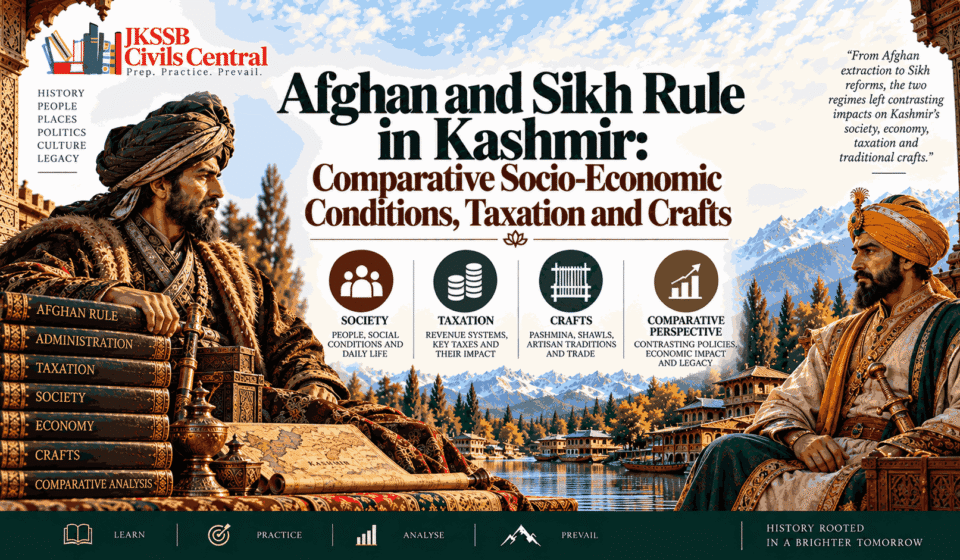
Afghan and Sikh Rule in Kashmir: Comparative Socio-Economic Conditions, Taxation and Crafts

J&K History Series Navigation
| Previous Article | Current Article | Next Article |
|---|---|---|
| Article 29 — Afghan Rule in Kashmir, 1752/53–1819: Administration, Revenue, Society and Economy | Article 30 — Afghan and Sikh Rule in Kashmir: Comparative Socio-Economic Conditions, Taxation and Crafts | Article 31 — Sikh Rule in Kashmir: Ranjit Singh, Battle of Shopian and the Administration of Kashmir |
Learning Dashboard
| Component | Key Information |
|---|---|
| Historical Period | c. 1752/53–1846 |
| Historical Phase | Afghan → Sikh transition |
| Afghan Rule | c. 1752/53–1819 |
| Sikh Rule | 1819–1846 |
| Core Theme | Comparative socio-economic history |
| Main Economic Sectors | Agriculture, shawls, carpets, paper, handicrafts and trade |
| Major Fiscal Issue | Land revenue and additional cesses |
| Important Revenue Unit | Kharwar / trak |
| Major Labour Issue | Begar / forced labour |
| Important Afghan Institution | Dagshawl |
| Important Sikh Development | Continued and modified inherited revenue system |
| Major Economic Contrast | Sikh-period trade security and some craft revival alongside heavy taxation |
| Major Social Theme | Peasant and artisan vulnerability |
| Transition | Afghan defeat in 1819 → Sikh rule → Dogra transition in 1846 |
| JKSSB Importance | Very High |
| Expected Question Types | Comparative, statements, chronology, matching, correct/incorrect pairs, cause–consequence |
Introduction
The transition from Afghan to Sikh rule in Kashmir in 1819 was a major political change, but it did not produce an immediate transformation of the region’s socio-economic structure. The Sikhs inherited an economy in which agriculture remained the principal productive base, land revenue remained the principal source of state income, and specialized handicrafts—especially shawl production—were deeply integrated into systems of taxation and commercial exchange. Many administrative practices and revenue mechanisms also survived the political transition, although their scale, implementation and consequences changed under the new regime. The comparative study of the two periods therefore reveals both continuity and change rather than a simple break between two completely different systems.
The Afghan period, conventionally dated from 1752/53 to 1819, was marked by frequent changes of governors, strong fiscal demands, political instability and recurrent environmental crises. At the same time, agriculture, trade and specialized crafts continued to function, demonstrating that economic hardship did not mean the disappearance of productive activity. The Sikh conquest of 1819 brought greater integration with the Lahore Darbar and, in some phases, improved military and commercial security, but it also retained heavy revenue demands and developed new forms of fiscal and administrative pressure. Contemporary travellers and later historians consequently describe Sikh Kashmir in contradictory ways: some evidence points to improved order and revival in particular sectors, while other evidence records severe agrarian distress and heavy taxation.
The central historical question, therefore, is not simply which regime was harsher. A more useful question is: How did the Afghan and Sikh states extract revenue, regulate production, manage trade and affect cultivators and artisans—and what changed when sovereignty shifted in 1819? This approach allows the student to understand why the same economy could experience both continuity and transformation across the political transition.
CivilsCentral Historical Insight
The Afghan–Sikh transition demonstrates that a change of ruling power does not automatically mean a complete change in economic institutions. The Sikh state inherited many fiscal practices from the Afghan period, modified some of them and introduced new administrative priorities, producing a combination of continuity, intensification and selective economic revival.
Part I — Historical Context: From Afghan Kashmir to Sikh Kashmir
1. The Afghan economic inheritance
By the early nineteenth century, Kashmir possessed an economy shaped by centuries of agrarian production, long-distance trade and specialized craftsmanship. Agriculture remained fundamental, particularly rice cultivation in the valley, while saffron, horticulture and other crops contributed to regional specialization. Srinagar functioned as the principal urban and commercial centre, connecting the valley with Punjab, Ladakh, Tibet and wider Asian markets.
Afghan administration had placed considerable pressure on this economic structure. Revenue extraction became increasingly important to provincial governors, while additional cesses and official exactions could raise the effective burden above the formal assessment. The shawl industry remained commercially valuable but became heavily regulated through state mechanisms such as the Dagshawl, while artisans faced pressure from taxation and intermediaries.
Environmental shocks compounded these problems. Floods, severe cold and crop failures repeatedly affected agricultural production during the Afghan period, while poor harvests could become more damaging when cultivators were simultaneously expected to meet revenue demands. Historical studies of Afghan Kashmir therefore describe a relationship between environmental vulnerability and fiscal pressure rather than treating famine as a purely natural phenomenon.
2. Why 1819 was an important transition
The Sikh conquest of Kashmir in 1819 occurred within the broader expansion of Maharaja Ranjit Singh’s Lahore Darbar. The defeat of Afghan authority ended approximately six and a half decades of Durrani political control and brought Kashmir into a new imperial framework.
The political change mattered economically because the valley became more closely connected with the Sikh-controlled territories of Punjab. Military routes, commercial connections and administrative communication with Lahore acquired greater importance. Yet the Sikh administration did not begin with a blank institutional slate. It inherited a revenue system, established local officials, agricultural practices, craft networks and commercial relationships that had developed under previous regimes.
This is why the correct historical framework is:
Afghan political system → Sikh political takeover → substantial administrative continuity + fiscal modification + selective economic change.
CivilsCentral Historical Insight
The year 1819 should be understood as a political turning point rather than an instant socio-economic revolution. The Sikh state inherited the productive structure and fiscal machinery of Kashmir and consequently adapted many existing practices instead of abolishing them.
Part II — Agriculture: The Foundation of Both Economies
3. Agriculture under Afghan rule
Agriculture formed the basic economic foundation of Kashmir under the Afghans. Rice was particularly important, while wheat, vegetables, fruits and saffron contributed to the diversity of agricultural production. Different localities developed particular agricultural specializations, creating a network of internal economic interdependence within the valley.
The principal problem was not the existence of agricultural taxation but the cumulative burden placed upon cultivators. Land revenue could be accompanied by additional cesses, demands from intermediaries and charges connected with agricultural and household activities. When a poor harvest occurred, the cultivator’s ability to meet these demands declined precisely when food prices and household vulnerability increased.
Some governors did attempt relief measures during periods of scarcity. The evidence concerning Sukh Jiwan Mal, for example, records measures involving grain distribution and agricultural assistance. Such episodes are important because they demonstrate that Afghan administration was not uniformly identical across all governors. Nevertheless, the broader period witnessed repeated evidence of agrarian distress.
4. Agriculture under Sikh rule
The Sikh state inherited this agrarian system and continued to depend heavily upon land revenue. The fiscal objective became closely connected with the needs of the Lahore treasury and the expenses of provincial administration and military activity.
Studies of Sikh Kashmir describe the government’s claim over a substantial share of agricultural produce. A frequently cited description of the Sikh assessment places the state’s share at approximately one-half of the paddy crop, accompanied by additional demands measured in traks. Because these figures come from later descriptions of the revenue system and must be interpreted within the terminology of the period, they should not be treated as a perfectly uniform assessment applied identically in every locality and year.
The Sikh state also employed a larger network of revenue functionaries. Officials associated with revenue collection included qanungos, shiqdars, sazawals, muqaddams, patwaris and tahvildars in the historical literature. Their salaries and expenses could themselves become part of the economic burden on cultivators.
The result was a paradox. A more organized revenue system could improve the state’s capacity to collect revenue, but improved extraction did not necessarily mean improved rural welfare.
5. Comparative agrarian condition
The agricultural comparison can therefore be summarized as follows:
| Dimension | Afghan Rule | Sikh Rule |
|---|---|---|
| Principal economic base | Agriculture | Agriculture |
| Major crop | Paddy/rice | Paddy/rice |
| Land revenue | Major state income | Major state income |
| Additional cesses | Extensive | Continued and intensified in important phases |
| Revenue intermediaries | Important | Expanded/continued |
| Environmental vulnerability | High | High |
| Peasant distress | Significant | Significant |
| Administrative continuity | Strong | Strong, with modifications |
| Major change | Increasing fiscal pressure and instability | More systematic extraction under Lahore authority |
The crucial conclusion is that Sikh rule did not eliminate the agrarian pressures inherited from Afghan rule. In several respects, it increased the state’s ability to extract revenue, even while some governors later introduced measures to encourage cultivation and trade.
CivilsCentral Historical Insight
The agricultural history of the two regimes reveals continuity more clearly than rupture. The Sikhs inherited an agrarian revenue state and made it more closely responsive to the financial requirements of the Lahore Darbar; the resulting administrative efficiency did not automatically translate into rural prosperity.
Part III — Revenue and Taxation: Continuity and Intensification
6. The Afghan revenue structure
Under Afghan rule, land revenue remained the principal source of state income, but the fiscal burden extended beyond the formal land assessment. Historical studies record various additional demands associated with orchards, houses, shops, marriages, trade, shawls and other economic activities.
Terms appearing in the literature include dastar-shumari, sar-i-darakhti, zar-i-dudi, telli-chargh, zar-i-nikah, zar-i-bayutat, zar-i-hasrat, baj, tamgha and zar-i-niaz. These should not be memorized as though they formed one standardized tax code covering every year of Afghan rule. Their importance lies in demonstrating the multiple forms through which the state and its intermediaries could obtain resources from different sections of society.
This distinction is especially important for JKSSB. A question may ask about the nature of taxation rather than requiring the candidate to memorize every obscure levy.
7. The Sikh revenue structure
The Sikhs retained the importance of land revenue but increased the scale and regularity of collection in important phases. The trak system became particularly significant. A trak functioned as a unit of measure associated with agricultural assessment, while the kharwar represented a larger measure of grain.
Later descriptions of the Sikh revenue system record a state demand of approximately half the paddy crop, together with additional traks per kharwar. One historical account describes the Sikh-period additional demand as four traks per kharwar, compared with two traks under the Afghans. Because revenue systems varied by crop and locality, these figures are best used as high-value comparative indicators rather than as universal mathematical rules.
The Sikh system therefore illustrates a significant transition:
Inherited fiscal structure → greater administrative reach → increased extraction in important phases.
8. The burden of cesses
The major difference between the formal revenue demand and the cultivator’s actual burden was the existence of additional cesses and payments to officials. In the Sikh period, descriptions of the agrarian system mention nazarana, tambol and other charges in addition to the basic agricultural assessment.
This is why the effective burden cannot be understood by looking only at the headline percentage of crop taken by the state. The cultivator could lose a much larger proportion of the economic surplus once additional charges, official demands and subsistence requirements were taken into account.
The same principle applies to the Afghan period. The existence of a nominal assessment does not capture the full economic burden when local intermediaries and officials imposed additional demands.
9. Comparative taxation
| Feature | Afghan Rule | Sikh Rule |
|---|---|---|
| Main revenue source | Land revenue | Land revenue |
| Agricultural assessment | Continued earlier traditions | Continued and modified |
| Additional cesses | Numerous | Numerous |
| Trak system | In use | Continued and increased in scale in important accounts |
| Administrative intermediaries | Extensive | Extensive |
| Revenue objective | Provincial and imperial finance | Lahore treasury and provincial administration |
| Impact on peasants | Heavy pressure | Heavy pressure |
| Overall pattern | Fragmented/extractive | More systematic extraction |
The important historical conclusion is that the Sikh revenue system was not simply invented after 1819. It developed upon an inherited fiscal foundation.
CivilsCentral Historical Insight
Comparing taxation reveals one of the strongest continuities between the two regimes: both depended on Kashmir’s agricultural surplus. The significant change lay less in the existence of taxation than in the scale, organization and political destination of the revenue extracted.
Part IV — The Peasantry and Agrarian Crisis
10. Peasant vulnerability under Afghan rule
Afghan-period cultivators faced a combination of revenue demands, intermediary extraction, debt and environmental shocks. A failed harvest could leave a household without enough produce to meet both subsistence requirements and state demands.
Historical accounts describe cases in which cultivators sold livestock, fruit trees or other productive assets to meet fiscal obligations. Such practices could have long-term consequences because the sale of productive assets reduced the ability of households to recover in subsequent agricultural seasons.
Migration was another response. When the cumulative burden became too high, some cultivators left the valley for Punjab and other neighbouring regions.
11. Peasant conditions under Sikh rule
The Sikh period did not eliminate these problems. Contemporary observers such as William Moorcroft, who visited Kashmir in the early 1820s, described severe poverty and the effects of heavy taxation. Later scholarship also identifies an agrarian crisis involving taxation, migration, begar and administrative exaction.
Yet the Sikh period should not be interpreted exclusively through its worst years. Some governors introduced measures intended to encourage cultivation, provide agricultural assistance or improve trade conditions. Mian Singh’s governorship, particularly, is associated in the literature with measures aimed at agricultural recovery after severe famine conditions.
The historical picture is therefore uneven: heavy taxation coexisted with occasional administrative efforts to stimulate production.
12. The problem of migration
Migration provides an important indicator of rural distress but must be handled carefully. Afghan-period accounts report migration from Kashmir to Punjab and other areas, while Sikh-period sources also describe movement of peasants and artisans.
Migration did not necessarily mean permanent depopulation of the entire valley. It could be temporary, occupational, seasonal or connected with particular localities. Nevertheless, repeated migration indicates that sections of the population viewed departure as an economic strategy when taxation, insecurity or scarcity became difficult to sustain.
Part V — Begar: An Important Continuity
13. Begar did not begin under the Sikhs
One of the most important examination distinctions is the history of begar, or compulsory/unpaid labour. Begar was not a Sikh invention. Historical research traces forms of compulsory labour in Kashmir to much earlier periods and records its continuation under the Mughals, Afghans, Sikhs and later Dogras.
The system could involve compelling cultivators and other people to provide labour or transport services for the state. Its precise forms varied by period and purpose, so it should not be imagined as a single standardized institution operating identically across centuries.
14. Begar under Afghan and Sikh rule
During the Afghan and Sikh periods, compulsory labour could become particularly important because Kashmir’s mountainous geography made transport difficult. Human and animal transport remained essential for moving supplies, especially toward frontier regions.
The later Gilgit-begar system became particularly notorious under Dogra rule, but its roots and earlier forms predated the Dogras. Research on the history of begar specifically identifies its presence under Afghan and Sikh rule as well.
This distinction matters because examination questions can easily create a trap by stating:
“Begar was introduced by the Dogras.”
That statement is incorrect.
A more accurate formulation is:
Begar had older roots; its scale, organization and institutionalization varied across regimes.
CivilsCentral Historical Insight
Begar illustrates why historical institutions should not be attributed mechanically to one dynasty. Practices often survived political transitions, while later regimes changed their scale, purpose and administrative organization.
Part VI — The Shawl Industry: The Best Comparative Case Study
15. The importance of shawl weaving
The shawl industry provides perhaps the clearest example of continuity and change between Afghan and Sikh Kashmir. Shawl production was already highly developed before Afghan rule, particularly under the Sultanate and Mughal regimes. Neither the Afghans nor the Sikhs therefore “created” the industry.
What changed was the relationship between the state, merchants, karkhandars and artisans.
The shawl industry was valuable because Kashmir possessed access to fine pashmina wool and highly specialized weaving skills. Shawls generated revenue and were traded beyond the valley. This made the industry attractive to governments seeking taxable commercial activity.
16. The shawl industry under Afghan rule
During the Afghan period, the state increasingly regulated shawl production through the Dagshawl or shawl department. This system enabled the government to monitor production and collect revenue from the industry.
The result was a complicated economic relationship. The state had an interest in maintaining production because shawls generated revenue, but heavy taxation and regulation could reduce the income available to artisans. The weaver was therefore economically dependent upon a production structure involving the karkhandar, merchant and state.
The industry survived because demand remained strong, but the survival of production should not be confused with artisan prosperity.
17. The shawl industry under Sikh rule
The Sikh period initially brought some improvement in the condition and scale of the shawl industry. Contemporary evidence from William Moorcroft’s visit in 1822 describes a flourishing industry, while later studies note that artisans who had migrated to the plains returned to Kashmir during the early Sikh period.
This improvement was associated with greater political stability, trade security and renewed commercial demand. The industry therefore experienced a period of revival after 1819. However, this revival was not permanent. The Sikh state also imposed substantial duties on shawls and on the movement of raw materials. As fiscal demands increased, the industry again came under pressure.
This produces one of the most important conclusions of the entire comparison:
Sikh rule initially facilitated recovery in the shawl industry but later fiscal extraction weakened the benefits of that revival.
18. Why the shawl industry is an important examination topic
The history of the shawl industry can be represented as:
Pre-Afghan development
↓
Afghan regulation and heavy taxation
↓
Artisan pressure and migration
↓
Sikh-period initial revival
↓
Expansion of external trade
↓
Renewed taxation and fiscal pressure
↓
Later decline
This is much more historically accurate than saying: Afghans destroyed the shawl industry → Sikhs revived it.
The real historical process was more complicated.
19. Comparative shawl economy
| Dimension | Afghan Rule | Sikh Rule |
|---|---|---|
| Industry existed before regime | Yes | Yes |
| State regulation | Strong | Strong |
| Major state mechanism | Dagshawl | Continued taxation/regulation |
| Artisan condition | Frequently difficult | Initial improvement, later renewed pressure |
| External demand | Strong | Strong and expanding |
| Trade | Vulnerable to instability | Greater security in important phases |
| Migration of artisans | Significant | Some return in early Sikh period; later pressures again encouraged migration |
| Long-term result | Heavy fiscal burden | Revival followed by renewed fiscal pressure |
CivilsCentral Historical Insight
The shawl industry demonstrates that economic revival and fiscal exploitation could occur simultaneously. The early Sikh period improved the industry’s operating environment, but the state’s later dependence on shawl revenue recreated many of the pressures that had affected artisans under Afghan rule.
Part VII — Other Crafts and the Urban Economy
20. Carpets
Carpet production had a long history in Kashmir and should not be attributed exclusively to either Afghan or Sikh rulers. The industry developed through earlier royal and commercial patronage and remained part of the valley’s specialized craft economy.
Some historical studies describe a decline in carpet production during Afghan rule and renewed attention to crafts during Sikh rule. However, these developments should be understood in terms of patronage, market demand, raw materials, taxation and commercial organization rather than as simple decisions of individual rulers.
21. Paper, woodwork and other crafts
Kashmir’s craft economy extended beyond shawls and carpets. Paper-making, wood carving, furniture, lacquer work and other artisanal activities formed part of the urban economy.
The survival of these crafts demonstrates the resilience of specialized production even during periods of political instability. Yet artisans remained vulnerable to taxation, shortages of raw materials, fluctuations in demand and the control exercised by merchants and intermediaries.
The urban economy therefore depended upon a delicate balance:
skilled artisans + raw materials + merchant capital + external demand + political security.
A disruption in any one component could affect production.
Part VIII — Trade and Commercial Security
22. Trade under Afghan rule
Afghan Kashmir remained connected to Punjab, Ladakh, Tibet, Central Asia and other regions. However, political instability and insecurity on surrounding routes could interfere with trade. The Afghan state’s fiscal demands also affected merchants. Taxes and duties increased the cost of moving goods, while uncertainty encouraged some outside merchants to reduce their involvement in Kashmiri markets.
This did not eliminate trade. Rather, it meant that commercial activity operated under a higher level of political and fiscal risk.
23. Trade under Sikh rule
One important change after 1819 was the closer integration of Kashmir with the Lahore Darbar’s wider political and commercial network. The Sikh state had an interest in securing routes connecting Kashmir with Punjab and other territories.
Historical accounts associate the Sikh administration, particularly under some governors, with efforts to improve trade security and suppress banditry. This was economically significant because merchants require predictable routes before they are willing to commit capital to long-distance trade.
Trade therefore benefited from an important form of state intervention:
political stability → safer routes → greater commercial confidence → stronger market connections.
24. But trade security did not eliminate taxation
The improvement in security should not be confused with a low-tax commercial environment. The Sikh state also viewed trade and handicrafts as important sources of revenue. Thus, the commercial history of Sikh Kashmir contains another major contradiction: greater security for commerce + stronger fiscal extraction from commerce.
This combination explains why trade could expand while merchants and artisans simultaneously complained about taxation.
CivilsCentral Historical Insight
The Sikh period demonstrates that state capacity could have contradictory economic effects. Greater political and military control could make trade safer and stimulate production, while the same stronger state could extract a larger share of the resulting commercial surplus.
Part IX — Society and Living Conditions: Comparative Assessment
25. Rural society
Under both regimes, cultivators occupied a vulnerable position because they were the principal producers of agricultural surplus. The state’s dependence upon agriculture meant that peasants were indispensable to government finance, but this did not protect them from high taxation.
The Afghan period combined revenue pressure with frequent political instability and environmental crises. Sikh rule brought greater political integration but retained the fundamental fiscal dependence on agricultural production.
Consequently, peasant vulnerability was a structural feature that crossed the 1819 political boundary.
26. Artisans
Artisans occupied a similarly contradictory position. Their skills generated valuable commodities for domestic and international markets, yet their economic bargaining power was often limited. The shawl weaver could produce an expensive luxury commodity while receiving only a small fraction of its final commercial value. The state, merchant and karkhandar could each claim a share of the surplus.
This explains why an internationally successful craft industry could coexist with widespread artisan poverty.
27. Merchants and intermediaries
Merchants occupied a stronger position than peasants and many artisans because they controlled capital, market access and distribution. During periods of strong trade, they could benefit from the international demand for Kashmiri products.
However, merchants were also exposed to taxation and political insecurity. The state viewed commercial wealth as an important fiscal resource, making traders potential beneficiaries of economic expansion but also targets of taxation.
28. Religious and social conditions
The socio-economic comparison should not be separated entirely from political and religious policy. The Sikh state introduced restrictions affecting sections of the Muslim population, and some religious institutions experienced periods of restriction. The closure of the Jamia Masjid in Srinagar for an extended period during Sikh rule is frequently cited in historical literature.
However, these developments belong to the broader political history of Sikh Kashmir and should not be converted into a single explanation for the entire socio-economic condition of the population. Economic distress affected cultivators and artisans through fiscal mechanisms that could operate across community boundaries.
The important distinction is therefore: religious policy ≠ revenue policy ≠ agrarian policy
although they could interact in practice.
Part X — Governance and State Capacity
29. Afghan provincial governance
Afghan Kashmir was characterized by frequent changes of governors and a considerable degree of provincial autonomy. Governors were responsible for extracting revenue, maintaining order and transmitting resources to the Durrani state.
The weakness of central Durrani control meant that provincial political interests often became important. A governor might pursue policies that reflected both imperial requirements and personal or local interests.
This instability limited administrative continuity.
30. Sikh provincial governance
The Sikh administration was more directly integrated into the Lahore Darbar. Kashmir was governed through appointed governors, and the state maintained a stronger connection between provincial administration and the central political authority at Lahore.
This did not eliminate corruption or local exploitation. Indeed, several studies emphasize that revenue officials and provincial functionaries could impose substantial burdens upon the population.
The important distinction is therefore:
Afghan rule → greater provincial instability and governor autonomy
Sikh rule → stronger integration with Lahore and greater administrative reach
Neither automatically means: Afghan = no administration or Sikh = efficient and benevolent administration.
CivilsCentral Historical Insight
The comparison between Afghan and Sikh governance is fundamentally a comparison between different forms of state capacity. Afghan Kashmir often suffered from provincial instability and weak continuity, while Sikh Kashmir experienced stronger integration and administrative reach—but stronger state capacity also enabled more systematic extraction.
Part XI — Famine, Environment and Economic Crisis
31. Environmental vulnerability across both regimes
Kashmir’s economy remained highly vulnerable to floods, severe cold, crop failure and other environmental events throughout the eighteenth and nineteenth centuries. During Afghan rule, historical records describe repeated famines and agricultural crises. These included episodes associated with untimely rain, severe cold, floods and crop failure.
Sikh Kashmir inherited this environmental vulnerability. The famous 1833 famine became one of the major economic crises of the Sikh period. The famine coincided with political and administrative pressures and caused serious distress.
The comparison demonstrates an important principle:
Natural disaster created the shock; the administrative and economic system determined how severe the social consequences became.
32. Mian Singh and economic recovery
The governorship of Mian Singh is significant because it provides evidence of state intervention aimed at economic recovery. Historical accounts associate his administration with measures designed to encourage cultivation, improve trade and restore economic activity after the severe crisis of the preceding years.
Such measures should not be interpreted as proof that Sikh administration as a whole was economically benevolent. Rather, they demonstrate variation among governors and show that states dependent on agricultural revenue sometimes had strong incentives to revive the productive capacity of the population.
Part XII — Comparative Historical Assessment
33. What changed in 1819?
The most important changes after 1819 were:
- Political sovereignty shifted from the Durrani/Afghan state to the Sikh Empire.
- Kashmir became more closely integrated with Lahore.
- Trade routes received greater attention from the new regime.
- Some crafts, particularly shawl production, experienced an initial revival.
- The inherited revenue structure continued but was modified and intensified.
- The state acquired stronger administrative reach.
- Peasant and artisan taxation remained heavy.
- Begar continued in various forms.
Therefore, 1819 represents neither complete rupture nor simple continuity.
34. What remained continuous?
Several structural features survived the political transition:
- agriculture as the economic foundation;
- land revenue as the principal fiscal resource;
- dependence on rice cultivation;
- the importance of Srinagar;
- specialized handicrafts;
- long-distance trade;
- revenue intermediaries;
- additional cesses;
- social differentiation between cultivators, artisans, merchants and officials;
- forms of compulsory labour;
- vulnerability to floods and crop failures.
This continuity is crucial for understanding why many economic problems of the Sikh period resembled those of the Afghan period.
35. What became different?
The Sikh state differed in its stronger political connection with Punjab and the Lahore Darbar. Greater political and military integration improved security along important commercial routes and allowed the government to exercise more systematic control over revenue collection.
At the same time, stronger administrative capacity enabled the state to extract a larger share of agricultural and commercial surplus. This explains the apparently contradictory evidence of the period: economic activity could revive while the population remained heavily taxed.
Part XIII — Comparative Matrix
| Dimension | Afghan Rule, c. 1752/53–1819 | Sikh Rule, 1819–1846 |
|---|---|---|
| Political centre | Durrani/Afghan Empire | Lahore Darbar |
| Provincial governance | Frequent governor changes; greater autonomy | Stronger integration with Lahore |
| Agriculture | Main economic base | Main economic base |
| Land revenue | Major state income | Major state income |
| Additional cesses | Extensive | Continued and intensified in important phases |
| Peasant condition | Heavy fiscal pressure and insecurity | Heavy fiscal pressure and agrarian crisis |
| Begar | Existing | Continued |
| Shawl industry | State regulation; severe artisan pressure | Initial revival, later heavy taxation |
| Trade | Vulnerable to political insecurity | Greater route security in important phases |
| Crafts | Continued but under fiscal pressure | Some revival followed by renewed fiscal pressure |
| Environmental crises | Repeated | Continued; 1833 famine especially important |
| State capacity | More unstable/fragmented | Greater administrative integration |
| Long-term outcome | Ended with Sikh conquest | Ended with Dogra transition in 1846 |
CivilsCentral Historical Insight
The comparative evidence rejects two simplistic conclusions: that Afghan rule destroyed Kashmir’s economy completely, and that Sikh rule immediately restored prosperity. Both regimes depended upon the same agrarian and artisanal economy, but the Sikh state exercised greater integration and administrative reach. This produced opportunities for trade and craft revival as well as stronger mechanisms of extraction.
Part XIV — Historical Significance
The Afghan–Sikh comparison is important because it provides a bridge between medieval Kashmir and the nineteenth-century formation of the Dogra state. The economic institutions, revenue practices, craft networks and social divisions inherited by the Sikh government did not disappear in 1819. Instead, they continued to influence the conditions under which the later Dogra administration took control of Kashmir in 1846.
The comparison also reveals the importance of state capacity in economic history. A weak or unstable government may struggle to regulate trade and protect routes but can still impose heavy local exactions. A stronger state may provide greater security and more predictable administration while simultaneously increasing the efficiency of taxation. The social consequences therefore depend not only on how much revenue the state demands but also on how that revenue is collected, how much is retained by intermediaries and whether the state reinvests resources in productive activity.
Finally, the comparison demonstrates why Kashmir’s craft history cannot be separated from political economy. Shawls, carpets and other crafts were not simply cultural products. They were sources of employment, exports, taxation, merchant wealth and state revenue. The history of artisans therefore provides a direct window into the relationship between political authority and economic production.
Part XV — Historical Interpretation / Evidence Note
Strongly Established
- Afghan rule preceded Sikh rule in Kashmir.
- Afghan rule ended with the Sikh conquest of 1819.
- Sikh rule continued until 1846.
- Agriculture remained the economic foundation under both regimes.
- Land revenue was central to state finance under both regimes.
- Shawl production predated both Afghan and Sikh rule.
- The state regulated and taxed shawl production under both regimes.
- Sikh rule initially brought conditions favourable to a revival of some commercial activity.
- Heavy taxation remained an important feature of Sikh Kashmir.
- Begar existed before the Dogra period and continued under Afghan and Sikh rule.
Strong Historical Tradition / Documentary Reconstruction
- Exact details of individual governors’ revenue measures.
- Particular relief measures adopted during famines.
- The precise scale of artisan migration during individual phases.
- Specific changes in the number of shawl looms.
Claims Requiring Caution
“Half of all agricultural produce was always taken by the Sikhs”
Too absolute.
Historical descriptions frequently give approximately one-half of paddy production as the Sikh state share, but the assessment varied by crop, locality and additional cesses.
“The Sikhs revived the shawl industry completely”
Too absolute.
The early Sikh period witnessed evidence of revival, but later taxation again placed heavy pressure on the industry.
“Begar was introduced by the Sikhs”
Incorrect.
Forms of begar predated Sikh rule and continued afterward.
“Afghan rule destroyed all trade”
Incorrect.
Trade continued, although insecurity and taxation affected its volume and profitability.
“Sikh rule restored prosperity”
Too broad.
Some sectors and periods experienced revival, while agrarian distress and heavy taxation remained important.
Part XVI — JKSSB Knowledge Matrix
| Question | Answer |
|---|---|
| Afghan rule ended in | 1819 |
| Sikh rule in Kashmir | 1819–1846 |
| Political centre under Afghans | Durrani Empire |
| Political centre under Sikhs | Lahore Darbar |
| Main economic base under both | Agriculture |
| Major crop | Paddy/rice |
| Important commercial craft | Shawl weaving |
| Afghan shawl department | Dagshawl |
| Important Sikh-period traveller | William Moorcroft |
| Moorcroft’s Kashmir visit | Early 1820s |
| Major Sikh-period famine | 1833 |
| Important governor associated with later economic recovery | Mian Singh |
| Begar | Older than Sikh rule; continued under Sikhs |
| Major revenue unit | Trak |
| Larger grain measure | Kharwar |
| Afghan → Sikh transition | 1819 |
| Sikh → Dogra transition | 1846 |
Part XVII — Examination Discrimination Points
1. Afghan rule vs Sikh rule
Afghan: c. 1752/53–1819
Sikh: 1819–1846
2. Political centre
Afghan → Durrani/Afghan Empire
Sikh → Lahore Darbar
3. Dagshawl
It is associated with state regulation of the shawl industry, not with the invention of Kashmiri shawls.
4. Begar
It was not introduced by the Sikhs or Dogras. Forms of compulsory labour existed earlier.
5. Agriculture
Agriculture remained the principal economic foundation under both regimes.
6. Revenue
Both regimes depended heavily on agricultural revenue.
The Sikh system is particularly associated in later descriptions with a higher agricultural share and increased trak-based cesses.
7. Shawl industry
Afghan period: regulation and heavy taxation.
Early Sikh period: evidence of revival.
Later Sikh period: substantial taxation again created pressure.
8. Trade
The Sikh period saw greater attention to route security and commercial integration, but this did not mean low taxation.
9. Famine
Afghan period: repeated environmental and agricultural crises.
Sikh period: 1833 famine is a major examination association.
10. 1819
1819 marks:
end of Afghan rule + beginning of Sikh rule
not the beginning of Dogra rule.
Part XVIII — JKSSB Question Pattern
Direct Fact
Q. Sikh rule in Kashmir lasted from:
A. 1752–1819
B. 1819–1846
C. 1846–1947
D. 1813–1846
Answer: B
Statement-Based
Consider the following statements:
- Agriculture remained an important economic foundation under both Afghan and Sikh rule.
- The shawl industry originated under Sikh rule.
- Begar existed before Sikh rule.
- Sikh rule ended in 1846.
Which are correct?
A. 1 and 2 only
B. 1, 3 and 4 only
C. 2 and 4 only
D. 1, 2, 3 and 4
Answer: B
Comparative
Which one best distinguishes Sikh rule from Afghan rule?
A. Agriculture became irrelevant under the Sikhs
B. The Sikhs abolished land revenue
C. Kashmir became more closely integrated with the Lahore Darbar
D. Shawl production disappeared under the Sikhs
Answer: C
Chronology
Arrange the following:
- Sikh conquest of Kashmir
- Afghan rule
- Dogra acquisition of Kashmir
- End of Sikh rule
Correct sequence:
2 → 1 → 4 → 3
Match the Following
| Column I | Column II |
|---|---|
| Dagshawl | Shawl regulation |
| Moorcroft | Early Sikh-period traveller |
| 1833 | Major famine during Sikh rule |
| 1819 | Sikh conquest of Kashmir |
Identification by Clues
Identify the economic institution:
- Associated with shawl production.
- Used for state regulation and taxation.
- Important during the Afghan period.
- Closely connected with shawl weavers.
Answer: Dagshawl
Part XIX — JKSSB Practice Questions
Question 1
Which of the following correctly represents the political sequence?
A. Sikh → Afghan → Dogra
B. Afghan → Sikh → Dogra
C. Mughal → Sikh → Afghan
D. Afghan → Dogra → Sikh
Correct Answer: B
Explanation: Afghan rule ended in 1819, Sikh rule continued until 1846, and Dogra rule began after the Treaty of Amritsar in 1846.
Question 2
Consider the following statements:
- The shawl industry existed before Afghan rule.
- Afghan authorities regulated shawl production.
- The early Sikh period witnessed some revival in shawl production.
- Sikh taxation had no impact on shawl artisans.
Which are correct?
A. 1 and 2 only
B. 1, 2 and 3 only
C. 2, 3 and 4 only
D. All four
Correct Answer: B
Explanation: Shawl production predated Afghan rule; Afghan authorities regulated it; early Sikh rule saw evidence of revival. Later Sikh taxation again placed substantial pressure on the industry.
Question 3
Which economic sector provides the clearest example of both continuity and change between Afghan and Sikh rule?
A. Tea plantation
B. Shawl industry
C. Modern banking
D. Railway construction
Correct Answer: B
Question 4
The principal economic foundation of Kashmir under both Afghan and Sikh rule was:
A. Mining
B. Agriculture
C. Heavy industry
D. Maritime trade
Correct Answer: B
Question 5
Which statement about begar is correct?
A. It was introduced by the Sikhs in 1819.
B. It was introduced by the Dogras in 1846.
C. It had earlier roots and continued under successive regimes.
D. It existed only under Afghan rule.
Correct Answer: C
Question 6
The 1833 famine is particularly associated with:
A. Karkota rule
B. Afghan conquest
C. Sikh rule in Kashmir
D. Dogra accession
Correct Answer: C
Question 7
Which of the following best describes the Sikh economic legacy in Kashmir?
A. Complete abolition of inherited revenue institutions
B. Greater political integration and commercial security alongside heavy taxation
C. Complete disappearance of handicrafts
D. End of agricultural taxation
Correct Answer: B
Question 8
Which pair is correctly matched?
A. Dagshawl — Agricultural irrigation
B. Moorcroft — Early Sikh-period observations
C. 1833 — Afghan conquest
D. 1819 — Treaty of Amritsar
Correct Answer: B
Question 9
Consider the following:
- Afghan rule ended in 1819.
- Sikh rule ended in 1846.
- Dogra rule began in 1819.
- Agriculture remained important under both Afghan and Sikh rule.
Which statements are correct?
A. 1 and 2 only
B. 1, 2 and 4 only
C. 2 and 3 only
D. All four
Correct Answer: B
Question 10
Which conclusion is most historically defensible?
A. Sikh rule completely transformed Kashmir’s economy immediately after 1819.
B. Afghan rule completely destroyed Kashmir’s productive economy.
C. Sikh rule combined inherited fiscal institutions with stronger political integration and selective economic revival.
D. There was no economic continuity between Afghan and Sikh Kashmir.
Correct Answer: C
Part XX — Rapid Revision Zone
Important Dates
| Date | Significance |
|---|---|
| c. 1752/53 | Beginning of Afghan rule |
| 1819 | End of Afghan rule; beginning of Sikh rule |
| 1822 | Moorcroft’s observations on Kashmir’s economy and shawl industry |
| 1833 | Major famine during Sikh rule |
| 1834–41 | Mian Singh’s important governorship |
| 1846 | End of Sikh rule; beginning of Dogra state in Kashmir |
Political Sequence
Afghan / Durrani rule
↓ 1819
Sikh / Lahore Darbar rule
↓ 1846
Dogra rule
Economic Sequence
Agriculture
Afghan → heavy revenue pressure
↓
Sikh → inherited system + stronger collection
↓
Agrarian distress continues
Shawls
Pre-Afghan development
↓
Afghan regulation / Dagshawl
↓
Artisan pressure
↓
Early Sikh revival
↓
Increased Sikh taxation
↓
Renewed artisan pressure
Important Associations
| Association | Answer |
|---|---|
| Dagshawl | Shawl regulation |
| Trak | Revenue/measurement unit |
| Kharwar | Larger grain measure |
| Moorcroft | Early Sikh-period traveller |
| 1833 | Sikh-period famine |
| Mian Singh | Later Sikh-period governor |
| 1819 | Sikh conquest |
| 1846 | End of Sikh rule |
Important Economic Sectors
- Agriculture
- Paddy cultivation
- Saffron
- Horticulture
- Shawls
- Carpets
- Paper
- Woodwork
- Trade
- Woollen textiles
Part XXI — Frequently Confused Facts
| Incorrect Assumption | Correct Understanding |
|---|---|
| Sikh rule began in 1846 | Sikh rule began in 1819 |
| Dogra rule began in 1819 | Dogra rule began in 1846 |
| Shawl industry was created by Afghans | It substantially predated Afghan rule |
| Sikh rule immediately ended shawl taxation | Taxation continued and later became substantial |
| Dagshawl was a type of shawl | It was a state regulatory mechanism/department associated with shawls |
| Begar was introduced by Sikhs | Begar had older roots |
| Afghan rule ended all trade | Trade continued despite instability |
| Sikh rule created complete prosperity | Some sectors revived, but taxation and agrarian distress persisted |
| 1833 famine was Afghan | It occurred during Sikh rule |
| 1819 was the beginning of Dogra rule | It was the beginning of Sikh rule |
| 1846 was the end of Afghan rule | Afghan rule had already ended in 1819 |
Part XXII — What Can JKSSB Ask?
High-value areas
JKSSB can test:
- Afghan vs Sikh chronology
- 1819 and 1846 as transition dates
- Lahore Darbar and Sikh Kashmir
- continuity of Mughal/Afghan revenue practices
- agriculture under both regimes
- trak and kharwar
- Dagshawl
- shawl industry
- artisan migration
- Moorcroft
- 1833 famine
- Mian Singh
- begar
- trade security
- comparative taxation
- Afghan governor instability vs Sikh administrative integration
- continuity versus change in the economy
Particularly valuable statement trap
A question may combine four apparently related claims:
Afghan rule ended in 1819.
Sikh rule began in 1819.
Begar was introduced by the Sikhs.
The shawl industry originated under the Afghans.
The first two are correct; the latter two are incorrect.
Chapter Summary
The comparison between Afghan and Sikh Kashmir begins with a crucial fact: 1819 changed the political ruler but did not erase the existing economic structure. Agriculture remained the principal economic foundation, land revenue remained the principal fiscal resource, and handicrafts—especially shawls—continued to connect Kashmir with wider markets.
Under Afghan rule, political instability, governor turnover, environmental crises and multiple forms of fiscal extraction placed heavy pressure on cultivators and artisans. The state nevertheless depended upon the productive economy and therefore occasionally adopted relief measures or policies intended to maintain production.
The Sikh state inherited this system after 1819. Its stronger integration with the Lahore Darbar improved political control and, in some phases, strengthened trade security and encouraged the revival of particular crafts. Yet the same increase in administrative reach enabled more systematic revenue extraction. Agricultural taxation remained heavy, additional cesses continued, and the shawl industry eventually faced renewed fiscal pressure.
The most important conclusion is therefore not that one regime was simply “good” and the other “bad.” The historical evidence reveals a more complicated relationship between state capacity, taxation, economic production and social welfare.
JKSSB Takeaway
Afghan rule: c. 1752/53–1819
Sikh rule: 1819–1846
Agriculture: economic foundation under both
Land revenue: major state income under both
Dagshawl: Afghan-period shawl regulation
Shawl industry: predated both regimes
Sikh period: initial craft revival + stronger trade security + continued heavy taxation
Begar: older than Sikh rule and continued under successive regimes
1833: major famine during Sikh rule
1846: end of Sikh rule and beginning of Dogra rule
Mind Map
AFGHAN KASHMIR
c.1752/53–1819
        ↓
AGRARIAN + CRAFT ECONOMY
        ↓
HEAVY REVENUE + CESS
        ↓
PEASANT / ARTISAN PRESSURE
        ↓
1819
SIKH CONQUEST
        ↓
LAHORE DARBAR
        ↓
STRONGER POLITICAL INTEGRATION
        ↓
TRADE SECURITY + ADMINISTRATIVE REACH
        ↓
AGRICULTURAL REVENUE CONTINUES
        ↓
HEAVY CESS + FISCAL EXTRACTION
        ↓
SHAWL INDUSTRY
   ↙              ↘
EARLY REVIVAL     LATER TAX PRESSURE
        ↓
AGRARIAN DISTRESS
        ↓
1833 FAMINE
        ↓
SELECTIVE RECOVERY UNDER SOME GOVERNORS
        ↓
1846
        ↓
DOGRA TRANSITION
FAQs
1. What is the main difference between Afghan and Sikh rule in Kashmir?
The Sikh state was more closely integrated with the Lahore Darbar and possessed stronger administrative reach, while Afghan Kashmir experienced greater governor turnover and provincial instability. Economically, however, both depended heavily on agriculture and revenue extraction.
2. Did the Sikh rulers introduce a completely new revenue system?
No. They inherited important elements of the existing revenue structure and modified and intensified them.
3. What was the main economic base under both regimes?
Agriculture, particularly paddy cultivation, remained fundamental.
4. Did the shawl industry begin under the Afghans?
No. Shawl production had developed well before Afghan rule.
5. What was Dagshawl?
It was an Afghan-period state mechanism associated with regulating and taxing the shawl industry.
6. Did the Sikh period improve the shawl industry?
The early Sikh period provides evidence of revival, including observations by Moorcroft in the early 1820s. However, later taxation again placed substantial pressure on the industry.
7. Was begar introduced by the Sikhs?
No. Forms of begar existed before Sikh rule and continued under later regimes.
8. What happened in 1819?
Sikh forces defeated the Afghan political authority in Kashmir, ending Afghan rule and beginning Sikh rule.
9. What happened in 1846?
Sikh rule ended following the First Anglo-Sikh War and the subsequent political settlement, opening the way for the establishment of the Dogra state in Kashmir.
10. Why is the Afghan–Sikh comparison important for JKSSB?
Because it allows candidates to distinguish chronology, revenue systems, taxation, agriculture, crafts, begar, trade and political transitions rather than memorizing the two periods separately.
About The Author




[…] Article 30 — Afghan and Sikh Rule in Kashmir: Comparative Socio-Economic Conditions, Taxation and … […]
[…] Article 30 — Afghan and Sikh Rule in Kashmir: Comparative Socio-Economic Conditions, Taxation and … […]