
J&K History Series Navigation
| Previous Article | Current Article | Next Article |
|---|---|---|
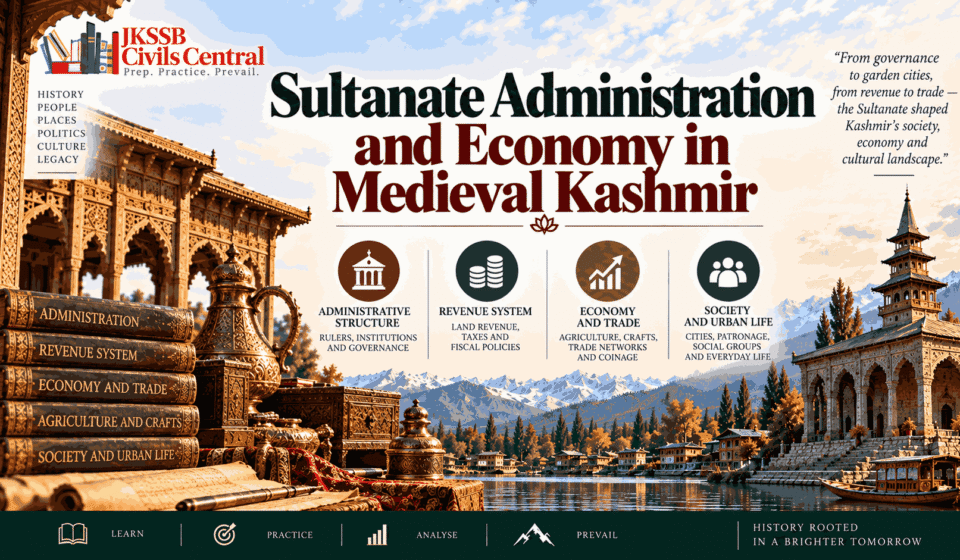
| ← Article 21 — Shah Mir Dynasty: Foundation, Major Sultans and Political Consolidation | Article 22 — Sultanate Administration and Economy in Medieval Kashmir | Article 23 — Zain-ul-Abidin: Governance, Economic Recovery, Cultural Patronage and Social Policy → Coming Soon |
Learning Dashboard
| Category | Key Information |
|---|---|
| Historical Period | 14th–16th centuries |
| Historical Phase | Kashmir Sultanate |
| Main Political House | Shah Mir dynasty; later Chak dynasty in the wider Sultanate period |
| Geographical Core | Kashmir Valley, with changing links to surrounding regions |
| Core Theme | State administration, revenue, agriculture, trade, crafts, markets and economic change |
| Political Centre | Srinagar and other royal centres at different times |
| Main Economic Base | Agriculture and land revenue |
| Major Economic Activities | Agriculture, horticulture, crafts, textiles, trade and riverine/overland exchange |
| Important Ruler for Economic Reconstruction | Zain-ul-Abidin |
| Important Language | Persian increasingly became important in court and administration |
| Important Sources | Jonaraja, Srivara, Persian chronicles, numismatic evidence and modern historical scholarship |
| JKSSB Importance | Very High |
| Expected Question Types | Statements, matching, chronology, terminology, ruler-policy association, conceptual-factual |
Introduction
The establishment of the Kashmir Sultanate in the fourteenth century did not create an entirely new administrative or economic system overnight. The Shah Mir rulers inherited a political landscape shaped by earlier Kashmiri institutions, landed groups, established village structures and long-standing patterns of agriculture and trade. At the same time, the new ruling house introduced new political and cultural influences, including a growing Persianate administrative vocabulary and stronger connections with the wider Islamic and Central Asian world.
The economy of medieval Kashmir remained fundamentally agrarian. The Kashmir Valley’s rivers, lakes, wetlands and fertile agricultural tracts provided the material base of political power, while taxation on agricultural production supplied an important part of state revenue. At the same time, Kashmir’s geographical position encouraged trade with Punjab, Ladakh, Tibet and Central Asia, while local craftsmanship—especially textiles and other artisanal production—became increasingly important during the later Sultanate.
Administration and economy were therefore closely connected. A ruler could not maintain armies, courts, public works or political authority without securing revenue, while excessive extraction could weaken agriculture, trade and the social groups on which the state depended. The history of the Sultanate consequently reveals a recurring tension between revenue extraction and economic reconstruction, particularly visible when the policies of different rulers are compared with the more interventionist economic measures associated with Zain-ul-Abidin.
Part I — Historical Background: From Lohara State to Sultanate
The Shah Mir Sultanate emerged in 1339 after a prolonged period of political instability. The preceding Lohara period had already demonstrated the importance of landed elites, regional power-holders and groups capable of challenging royal authority. The Sultanate therefore inherited not a politically empty landscape but an existing social and economic structure that had to be incorporated into the new state.
This continuity is important because the establishment of Muslim rule did not mean that all previous institutions, officials or social groups disappeared. Local elites continued to matter, and Brahman intellectuals and administrative personnel remained significant during the early Sultanate. Later historical evidence also indicates that Persian gradually became an important language of administration while local personnel participated in the functioning of the state.
The new Sultanate consequently developed through a combination of political innovation and institutional continuity. The ruling house changed, the political elite became more closely connected with the Persianate Islamic world, and new religious and administrative networks developed, but the state still depended on Kashmir’s established agricultural landscape and local social structures.
CivilsCentral Historical Insight
The Shah Mir Sultanate should not be understood as an administrative system imposed on a blank slate. Its durability depended on adapting a new ruling ideology to an older agrarian society, local political structures and inherited administrative practices.
Part II — The Sultan and the Structure of Political Authority
The Sultan as the Centre of the State
The Sultan occupied the apex of the political order. Executive authority, military command, judicial power and the appointment of important officials ultimately rested with the ruler. The Sultan’s authority was exercised through a court and a network of officials rather than through personal rule alone.
However, the practical strength of the Sultan varied considerably. Strong rulers could appoint and dismiss officials, control revenue and manage powerful elites, while weaker rulers could become dependent upon nobles, court factions and regional power-holders. This explains why the administrative history of the Sultanate cannot be separated from its political history.
The reigns of Shihab-ud-Din and Zain-ul-Abidin illustrate periods of stronger political consolidation, while the succession struggles following Zain-ul-Abidin demonstrate how quickly political authority could become fragmented.
The Wazir and High Officials
The wazir was an important senior official associated with the functioning of the government. Historical evidence for medieval Kashmir indicates that the office could carry substantial political and administrative influence.
However, caution is necessary. The administrative terminology of the Kashmir Sultanate should not automatically be equated with the much more extensively documented bureaucratic structures of the Delhi Sultanate or Mughal Empire. Similar titles could exist in different political contexts without having identical institutional functions.
This is particularly important for examination preparation: a candidate should not assume that every office found in a general textbook on the Delhi Sultanate necessarily operated in precisely the same form in Kashmir.
Part III — Persian and the Administrative Transformation
From Sanskrit to a Persianate Administrative Environment
The early Shah Mir state did not immediately eliminate older administrative practices or the use of Sanskrit. Over time, however, Persian became increasingly important to the court and state.
Encyclopaedia Iranica identifies the Shah Mir period as the phase in which New Persian spread in Kashmir and notes that it eventually became the official court language. It also records the important role of Kashmiri Pandits as scribes and administrative personnel within the emerging Persianate system.
This development had major institutional consequences. A language of administration does more than provide vocabulary: it creates channels for record-keeping, correspondence, literary production and interaction with wider political networks. Persian therefore became one of the mechanisms through which Kashmir was increasingly connected to the broader Persianate world.
At the same time, Persianization should not be confused with the disappearance of Sanskrit or local cultural traditions. Hindu scholars continued to participate in intellectual life, and Sanskrit works were translated into Persian during the reign of Zain-ul-Abidin.
Administrative Continuity
The development of Persian administration should therefore be understood as a process of layering rather than complete replacement. New Persianate forms were incorporated into an existing Kashmiri political environment.
This is one of the most important institutional themes of the Sultanate: the state became increasingly Persianate while continuing to depend on local officials, agrarian communities and inherited social structures.
CivilsCentral Historical Insight
Persianization changed the language and cultural framework of state activity, but it did not erase institutional continuity. The Sultanate was built through the interaction of a new Persianate political culture with older Kashmiri administrative and social practices.
Part IV — Local Elites, Landed Power and the State
The Importance of Landed Groups
Agriculture generated the surplus that supported the state, but control over agricultural resources was not necessarily exercised directly by the Sultan in every locality. Powerful landed groups could influence villages, collect revenue and command local resources.
The broader history of Kashmir shows the continuing importance of powerful landed groups and regional elites. In earlier centuries, the Damaras had already demonstrated how control over land and local resources could translate into political power. Their historical significance continued to influence the problem of central authority in medieval Kashmir.
The relationship between the Sultan and local elites was therefore not simply one of ruler versus subject. Powerful groups could support the Sultan, resist him, bargain with him or become involved in succession struggles. Their cooperation was particularly important when the central government lacked the capacity to enforce its authority throughout the valley.
Centralization and Local Power
The Sultanate thus faced a structural problem: the state needed local intermediaries to collect revenue and administer rural society, but those same intermediaries could accumulate independent power.
This tension was not unique to Kashmir, but its expression in the valley was shaped by Kashmir’s geography and political history. Mountain routes, dispersed settlements and strong local landed interests could make direct central control difficult.
CivilsCentral Historical Insight
The political strength of the Sultanate depended partly on the same local groups that could limit royal authority. Revenue administration was therefore simultaneously an economic mechanism and a political negotiation between the centre and regional power-holders.
Part V — Agriculture: The Foundation of the Economy
Why Agriculture Mattered
The Kashmir Valley’s economy remained fundamentally agricultural. Rice was especially important in the low-lying and irrigated areas, while wheat, barley and other crops formed part of the agricultural system. Horticulture also contributed to the economic life of the valley.
The importance of agriculture went beyond food production. Agricultural surplus supported urban populations, artisans, soldiers, religious institutions and the royal court. A decline in agricultural productivity therefore affected the entire political economy of the Sultanate.
The state had a direct interest in maintaining cultivation because agricultural production generated revenue. Irrigation, drainage, flood management and the reclamation of cultivable land could therefore strengthen both the rural economy and the fiscal capacity of the state.
Geography and Agricultural Production
Kashmir’s physical geography created both opportunities and constraints. Rivers and streams provided abundant water, while wetlands and marshes could be reclaimed for cultivation. At the same time, floods, waterlogging and uneven access to irrigation could reduce productivity.
The agricultural economy was consequently closely connected with water management. This relationship had already been visible in earlier Kashmir under Avantivarman and Suyya, and it became important again under Zain-ul-Abidin.
Part VI — Land Revenue and State Income
Agricultural Revenue
Agricultural taxation was an important source of state income. The state claimed a share of agricultural production, and the size and practical burden of that demand could vary according to period and locality.
Some later historical accounts give precise fractions for revenue demands under different rulers. These figures should be used cautiously because the surviving evidence does not justify treating one numerical rate as a uniform, empire-wide rule throughout the Sultanate.
What is historically more secure is the broader relationship:
Land → Agricultural production → Revenue demand → State income
The state required revenue to maintain political authority, armies, officials and the court. The cultivator, however, needed sufficient resources to continue cultivation. Excessive extraction could therefore undermine the very economic base on which the state depended.
Revenue and Political Stability
This relationship helps explain why economic policy became especially important under Zain-ul-Abidin. His government is associated with measures intended to expand cultivation and improve agricultural productivity rather than simply increasing extraction.
Modern scholarship on medieval Kashmir also emphasizes the relationship between state formation, landholding and the distribution of economic power. Rattan Lal Hangloo’s study of the medieval state places the relationship between political authority, landed interests and revenue at the centre of understanding the Sultanate’s development.
CivilsCentral Historical Insight
Land revenue was not merely a tax issue. It linked the Sultan, officials, landed elites and cultivators into a single political-economic structure. The long-term strength of the state depended on extracting enough surplus to govern without destroying the productive capacity of the countryside.
Part VII — Other Taxes, Cesses and Charges
Agricultural revenue was not the only form of state income. Historical accounts mention additional taxes, tolls and cesses connected with economic activity, transport and particular social groups.
However, this is an area where precision is essential. Terms recorded in later sources do not necessarily represent a single standardized tax system operating unchanged throughout the Shah Mir period. Different rulers modified fiscal practices, and some taxes were abolished or reduced.
For example, sources discussing Zain-ul-Abidin record the abolition or reduction of certain burdens associated with earlier reigns. This indicates that taxation was itself a matter of political policy rather than a fixed institution.
Jizya and Religious Policy
The question of jizya requires particular care. Historical accounts associate its imposition with Sikandar and describe changes under Zain-ul-Abidin. Some sources indicate that Zain-ul-Abidin reduced it substantially and later abolished it in practice.
The broader historical significance is that fiscal policy and religious policy could overlap. A tax imposed specifically upon a religious community was not simply a fiscal instrument; it also carried political and social meaning.
However, this should not lead to the assumption that every tax in the Sultanate was religiously differentiated. Much of the state’s economic extraction rested on agricultural and commercial activity.
Part VIII — Trade and Commercial Networks
Kashmir’s Geographic Position
Kashmir’s location gave it access to several regional trading systems. The valley was connected southwards with Punjab, north-westwards with Central Asian networks, and across the mountains with Ladakh and Tibet.
These routes were difficult because of the terrain, but the difficulty did not isolate Kashmir. Instead, it shaped the character of trade. High-value, relatively transportable goods could move through mountain corridors more easily than bulky commodities.
Trade therefore complemented rather than replaced agriculture. Agricultural production supplied food and raw materials, while commercial exchange brought luxury goods, specialised materials, techniques and cultural influences.
Central Asian Connections
The Shah Mir period witnessed increasing movement of people, scholars, merchants and artisans between Kashmir and Central Asia. Persian cultural influence grew alongside these connections.
The development of Persian and the movement of skilled craftsmen should therefore be understood partly within a broader pattern of regional exchange. Kashmir was not simply receiving political influence; it was participating in networks through which people, technologies, artistic forms and commodities moved in multiple directions.
Riverine and Local Trade
Within the valley, rivers and waterways were important for movement and economic life. Srinagar’s position along the Jhelum helped make it a major political and commercial centre.
Markets depended on the availability of agricultural produce and manufactured goods, while the state had an interest in maintaining roads, bridges and security along important routes.
CivilsCentral Historical Insight
Kashmir’s economy was neither purely local nor simply dependent on foreign trade. Agriculture formed its material base, while mountain and river networks connected that base to wider markets, technologies and cultural systems.
Part IX — Markets, Weights and Measures
A functioning market economy required some degree of regulation and standardization. Historical evidence for the Sultanate period refers to weights, measures, prices and state intervention in economic activity, particularly under rulers concerned with agricultural and commercial stability.
However, the detailed terminology of the market system is less securely documented for the entire Shah Mir period than it is for later Mughal administration. Therefore, terms such as muhtasib, kotwal, diwan-i-kul and similar offices should not be automatically projected backward as though they operated identically throughout the Sultanate.
The broader principle is nevertheless clear: rulers had an interest in maintaining order in markets, preventing excessive manipulation of essential commodities and ensuring that economic exchange generated revenue without destabilizing the population.
Zain-ul-Abidin’s economic policies are especially associated with concern for agricultural production and the availability of food. Later accounts emphasize the abundance and relatively low prices of cereals during his reign, although such descriptions should be read as historical evaluations rather than modern statistical price series.
Part X — Urban Economy and Srinagar
Srinagar as the Political and Economic Centre
Srinagar occupied a central position in the Sultanate’s political economy. Its location along the Jhelum and its concentration of royal, religious, artisanal and commercial activities made it the principal urban centre.
The city linked the countryside with the state. Agricultural produce moved toward urban markets, while artisans and merchants supplied goods to the court and wider population.
Urban prosperity therefore depended on rural productivity. A successful harvest could support markets and crafts, while agricultural disruption could reduce food availability and weaken commercial activity.
Bridges and Urban Infrastructure
The development and maintenance of bridges was important in a city divided by waterways. Zain-ul-Abidin’s reign is traditionally associated with important bridge-building activity, including the structure later known as Zaina Kadal.
Such public works had both economic and political significance. Bridges improved movement within the city, facilitated trade and connected different urban neighbourhoods. They also demonstrated the ruler’s capacity to mobilize resources for public infrastructure.
Part XI — Crafts and Manufacturing
The Growth of Artisanal Production
The Sultanate economy was not based on agriculture alone. Kashmir possessed a strong tradition of craftsmanship, and the later Sultanate period witnessed important developments in textiles, paper-related production, woodwork and other crafts.
Zain-ul-Abidin is particularly associated with encouraging craftsmen and importing or adapting techniques from Central Asia and the Persianate world. Sources and modern studies connect his reign with developments in weaving, paper-making, book production and other skilled activities.
The precise claim that Zain-ul-Abidin personally “invented” each of these crafts should be avoided. Some crafts had earlier roots, while his contribution often consisted of organizing, patronizing, improving or introducing new techniques.
Shawl Production
The shawl tradition is a good example of this distinction. Weaving existed before Zain-ul-Abidin, but studies of Kashmir’s textile history identify his reign as an important phase in the development and flourishing of shawl production. He should therefore not automatically be described as the absolute “founder” of Kashmiri shawl weaving.
The significance of the period lies in the interaction of local craftsmanship with imported techniques and artisans. This helped produce a more specialized artisanal economy and strengthened the relationship between court patronage, skilled labour and commercial production.
Paper and Book Production
Paper-making and book production also became increasingly significant within the Persianate intellectual environment. The growth of Persian scholarship required manuscripts, scribes, paper and bookbinding, creating economic demand beyond the agricultural sector.
Thus intellectual development itself had an economic dimension: scholarship required specialized materials and skilled labour, while royal patronage could sustain these activities.
CivilsCentral Historical Insight
Zain-ul-Abidin’s craft policies illustrate the difference between invention and institutional development. His historical importance lies less in creating every craft from nothing than in creating conditions in which specialized production, technical exchange and skilled labour could expand.
Part XII — Irrigation, Drainage and Agricultural Expansion under Zain-ul-Abidin
The strongest connection between administration and economic policy appears in Zain-ul-Abidin’s treatment of agriculture. Historical accounts associate his reign with canals, drainage works, dams and other interventions designed to increase cultivated land and improve water availability.
These works had several effects. They could bring previously underused land into cultivation, reduce dependence on uncertain rainfall in particular areas and increase the agricultural surplus available to both cultivators and the state.
The importance of this policy should not be reduced to the claim that Zain-ul-Abidin simply “made Kashmir prosperous.” The historical mechanism is more useful:
Public works → improved water management → expanded/reliable cultivation → increased agricultural production → stronger economic base
Studies drawing on Jonaraja and later accounts emphasize the Sultan’s irrigation projects and his concern with agricultural productivity.
Why Irrigation Was a Political Issue
Irrigation required state coordination because canals and waterworks could affect several villages and agricultural zones. The ability to construct and maintain such works therefore demonstrated administrative capacity.
The economic effect also reinforced political legitimacy. When agricultural production improved and food became more available, the state could be seen as protecting the material conditions of rural society.
This explains why irrigation occupies such an important place in the historical memory of Zain-ul-Abidin’s reign.
Part XIII — Public Works and Economic Governance
Zain-ul-Abidin’s economic policy extended beyond irrigation. Historical accounts associate his reign with bridges, urban development, support for crafts, and institutions connected with learning and public welfare.
The important analytical point is that these were not isolated acts of generosity. They could strengthen the productive capacity of the state. Better infrastructure facilitated movement; irrigation expanded agriculture; craft patronage increased specialized production; and educational and literary patronage supported the administrative and intellectual environment.
This does not mean that the Sultanate became a modern welfare state. Such a description would project a modern institutional concept backward. Rather, Zain-ul-Abidin’s government represents a medieval form of productive state intervention, in which public works and patronage could serve political, economic and social purposes simultaneously.
Part XIV — The Role of Craftsmen, Artisans and Skilled Migrants
The expansion of crafts depended on skilled labour. Kashmir’s connections with Persia and Central Asia facilitated the movement of craftsmen and techniques into the valley.
Historical traditions particularly associate Zain-ul-Abidin with inviting or employing skilled artisans and sending people to learn specialized techniques elsewhere. Such accounts should be treated carefully when they give precise numbers or claim that a particular craft was entirely foreign in origin.
What is more securely established is the broader process of technical exchange. Kashmir’s artisans adapted external techniques to local materials, markets and artistic traditions, producing a distinctive regional craft economy.
This interaction also illustrates the relationship between migration and economic development. Migration was not merely demographic; skilled migrants could transfer technologies, designs and production methods.
Part XV — Agriculture, Crafts and Trade: An Integrated Economy
The Sultanate’s economy should not be divided into completely separate sectors. Agriculture supplied food and raw materials; crafts transformed materials into higher-value products; trade connected producers with markets; and the state derived revenue from economic activity.
A simplified model is:
Agriculture
↓
Food + raw materials + surplus
↓
Craft production
↓
Textiles + paper + woodwork + other goods
↓
Markets and trade
↓
Regional exchange
↓
State revenue and urban demand
↓
Political and administrative expenditure
The system could also work in the opposite direction. Political instability could reduce security, weaken trade, discourage cultivation and damage the state’s revenue base.
This explains why periods of civil war and dynastic conflict had economic consequences even when the conflict itself was primarily political.
CivilsCentral Historical Insight
Medieval Kashmir’s economy functioned as an interconnected system rather than a collection of isolated activities. Agriculture created the surplus, crafts added value, trade redistributed goods, and the state attempted to capture enough of this economic activity to sustain political authority.
Part XVI — Economic Consequences of Political Instability
The later Shah Mir period illustrates the vulnerability of this system. When succession disputes intensified, political elites competed for control of the state and local resources. Civil conflict could interrupt cultivation, weaken trade routes and increase the burden on rural society.
This relationship explains why the long reign of Zain-ul-Abidin was economically important. Political continuity gave the government time to invest in irrigation, infrastructure and crafts. Conversely, later instability reduced the ability of rulers to maintain such policies consistently.
The economy therefore cannot be separated from the question of political legitimacy. A stable state could potentially generate more revenue through productive expansion, whereas a weak state might increasingly depend on short-term extraction.
Part XVII — Social Dimensions of the Economic System
The economic structure of the Sultanate affected different groups differently. Cultivators carried the central burden of agricultural production and taxation, while artisans depended on access to raw materials, markets and patronage.
Merchants benefited from secure routes and predictable markets, while powerful landed groups could derive wealth and political influence from control over agricultural resources.
The state itself was not economically neutral. Its taxation, regulation, public works and patronage affected the distribution of resources. Zain-ul-Abidin’s reputation partly rests on policies remembered as reducing some burdens and protecting productive activity, while the history of other reigns shows how fiscal pressure could become politically destabilizing.
This is why the medieval economy should not be described simply as either “prosperous” or “oppressive.” Its effects varied according to period, class, locality and state policy.
Part XVIII — Currency, Coinage and Exchange
Coinage provides an important source for reconstructing the monetary side of the Sultanate economy. Coins can identify rulers, titles and political authority and can sometimes help establish chronology.
However, coinage should not be confused with the entire economy. Much rural exchange could operate through produce, customary payments and localized transactions, while coin was especially important in taxation, urban markets, long-distance trade and state expenditure.
The Sultanate’s monetary history also changed over time. Coins associated with different rulers and periods provide evidence of changing political authority and monetary practices, but precise conclusions about the scale of monetization require careful numismatic study.
For examination purposes, the key distinction is: Coinage = evidence of monetary circulation and political authority
but:
Coinage ≠ proof that the entire rural economy was fully monetized.
Part XIX — Weights, Measures and the Problem of Evidence
Weights and measures were essential to taxation and commercial exchange. Historical sources preserve references to measures of land, grain and other commodities, particularly in connection with later descriptions of agricultural administration.
Yet the terminology and exact standards changed over time. It would therefore be misleading to create a single uniform table of medieval Kashmiri measurements and present it as though it operated unchanged from Shah Mir to Mughal rule.
This is a classic example of an examination trap. A term may genuinely belong to a later administrative system but be incorrectly projected backward into the Shah Mir period.
The safest historical method is to distinguish: documented Sultanate terminology
from, later Mughal or Dogra standardization.
Part XX — What Was Distinctive About Zain-ul-Abidin’s Economic Policy?
Zain-ul-Abidin’s importance does not lie simply in the number of reforms associated with him. His distinctive contribution was the attempt to connect political stability with productive economic activity.
His government encouraged:
- agricultural expansion
- irrigation and water management
- infrastructure
- crafts
- technical exchange
- learning and manuscript production
- commercial activity
- relatively stable conditions for rural production.
The relationship can be summarized as:
Political stability
→ Public works
→ Agricultural and artisanal development
→ Greater economic activity
→ Stronger revenue base
→ Greater capacity for governance
This should not be interpreted as a modern development programme. It was a medieval political economy in which the ruler’s legitimacy, fiscal needs and concern for productive resources were closely interconnected.
Part XXI — Administrative and Economic Limits of the Sultanate
The Sultanate should not be portrayed as a fully centralized bureaucratic state in the modern sense. The ruler depended upon officials, nobles, local landed groups and religious institutions, and the degree of central control varied.
The state also faced geographical constraints. Kashmir’s mountain environment made communication with surrounding regions difficult and complicated the maintenance of distant political influence.
Another limitation was succession. The absence of a stable mechanism for transferring power could produce conflict among royal relatives and elites. Such conflict could weaken administration and redirect state resources toward military and political competition.
Finally, the surviving sources themselves impose limitations. Much of what is known about administration and economy comes from literary narratives rather than systematic state accounts. Consequently, historians can reconstruct broad patterns more confidently than exact annual revenue, population or production figures.
CivilsCentral Historical Insight
The Sultanate was a functioning state, but not a modern bureaucratic machine. Its effectiveness depended upon the ruler’s personal authority, the cooperation of officials and elites, and the productive capacity of the countryside; when these relationships weakened, administrative and economic stability suffered together.
Part XXII — Historical Sources for Administration and Economy
Jonaraja
Jonaraja is particularly valuable for the political and social history surrounding Zain-ul-Abidin’s reign. His account provides information on agriculture, public works, rulers, officials and contemporary conditions, but it remains a literary chronicle and must be interpreted in context.
Srivara
Srivara continued the chronicle tradition and provides evidence for the later part of the fifteenth century. His work helps historians follow changes after Zain-ul-Abidin.
Persian Chronicles
Persian historical traditions became increasingly important as Persian became the language of the court. These sources provide information about rulers, institutions, religion, culture and economic activity, but their date and perspective must be considered.
Numismatic Evidence
Coins provide material evidence for rulers, titulature and monetary circulation. They are especially useful for checking chronology against literary narratives.
Modern Historical Scholarship
Modern historians such as Mohibbul Hasan and Rattan Lal Hangloo have reconstructed the administrative, social and economic history of the Sultanate by comparing Sanskrit, Persian and other sources. Hasan’s Kashmir Under the Sultans specifically separates the administrative system, social and economic conditions, and currency/coinage/weights and measures into distinct areas of analysis, while Hangloo emphasizes the relationship between state formation, social groups and political power.
CivilsCentral Historical Insight
The economy of medieval Kashmir is reconstructed indirectly. Unlike a modern state with annual budgets and statistical records, the Sultanate leaves a mixed source base in which chronicles, coins and later historical analysis must be read together.
Part XXIII — Historical Significance
The administration and economy of the Kashmir Sultanate are important because they reveal how the new political order became materially sustainable. The Sultanate relied on an agrarian base inherited from earlier Kashmir but increasingly connected that base with Persianate political culture, wider trade networks and specialized crafts. The growth of Persian administration and Central Asian connections changed the institutional and cultural environment without eliminating local participation.
The most significant phase of economic reconstruction came under Zain-ul-Abidin. His reign demonstrates that medieval state power could be strengthened not only through conquest and taxation but also through irrigation, infrastructure, craft patronage and the protection of productive activity.
At the same time, the Sultanate’s experience demonstrates the limits of centralized authority. Powerful local elites, succession disputes, geographical constraints and uneven administrative capacity repeatedly shaped the relationship between state and society.
Part XXIV — Evidence and Historical Interpretation
| Claim | Evidence Level | Historical Caution |
|---|---|---|
| Agriculture was a principal economic base | A/B | Strongly supported by the geography and historical record |
| Agricultural revenue was important to the state | B | Exact rates varied and should not be universalized |
| Persian became important to court and administration | A/B | Strongly supported; process developed over time |
| Kashmiri Pandits participated in Persian administration | B | Strong historical evidence for scribal/administrative participation |
| Local landed elites influenced politics | B | Strong historical pattern, though structures changed over time |
| Trade linked Kashmir with surrounding regions | A/B | Strong geographical and historical basis |
| Zain-ul-Abidin promoted irrigation | B | Strong literary-historical tradition supported by scholarship |
| Zain-ul-Abidin encouraged crafts | B | Strong historical tradition; exact individual introductions require caution |
| Zain-ul-Abidin invented every major Kashmiri craft | D | Unsupported simplification |
| Shawl weaving began entirely under Zain-ul-Abidin | D | Earlier weaving existed; his reign was a major phase of development |
| The entire Sultanate used a uniform revenue rate | D | Rates varied; numerical claims require source-specific qualification |
| Delhi Sultanate administrative offices automatically existed in identical form in Kashmir | D | Must be verified individually |
| Sultanate economy was completely monetized | D | Rural and localized forms of exchange remained important |
Part XXV — JKSSB Knowledge Matrix
| Question | High-Value Answer |
|---|---|
| Main economic base | Agriculture |
| Major source of state income | Agricultural revenue and other taxes/charges |
| Important urban centre | Srinagar |
| Important river for urban/economic life | Jhelum |
| Important external connections | Punjab, Ladakh/Tibet, Central Asia |
| Major administrative-cultural language | Persian, increasingly important during Shah Mir rule |
| Earlier major administrative/intellectual language | Sanskrit remained important in the earlier Sultanate |
| Important ruler for economic reconstruction | Zain-ul-Abidin |
| Zain-ul-Abidin’s reign | 1420–1470 |
| Popular name | Budshah |
| Major agricultural intervention | Irrigation and cultivation expansion |
| Major infrastructure association | Bridges and public works |
| Major craft development | Textiles and other specialized crafts |
| Major chronicle source | Jonaraja |
| Later chronicle continuation | Srivara |
| Material source | Coins |
| Major economic vulnerability | Political instability and succession conflict |
| Important political-economic actors | Sultan, officials, landed elites, cultivators, artisans, merchants |
Part XXVI — Examination Discrimination Points
1. Agriculture vs Trade
Agriculture = principal economic foundation.
Trade = important supplementary and connecting activity.
Do not select an answer claiming that long-distance trade replaced agriculture as the basis of the Sultanate economy.
2. Persian vs Sanskrit
Persian became increasingly important to the court and administration.
Sanskrit did not disappear immediately, and Hindu intellectuals continued to participate in cultural and administrative life.
3. Zain-ul-Abidin and Crafts
Correct:
Zain-ul-Abidin strongly promoted and developed crafts.
Avoid:
Zain-ul-Abidin invented every Kashmiri craft.
4. Irrigation and Revenue
Irrigation was not merely a welfare measure.
It could:
increase cultivated land → increase production → strengthen the revenue base.
5. Local Elites
Local landed groups were not simply state employees.
They could simultaneously be:
- revenue intermediaries,
- landholders,
- military actors,
- political allies,
- opponents of the Sultan.
6. Persianization vs Islamization
Persianization: language and cultural transformation.
Islamization: religious and social transformation.
They interacted but are not synonymous.
7. Sultanate vs Mughal Administration
Do not automatically place fully developed Mughal offices and revenue structures into fourteenth- or fifteenth-century Kashmir.
Part XXVII — JKSSB Question-Type Mapping
Direct Fact
Which sector formed the principal economic base of medieval Kashmir?
Agriculture.
Statement-Based
Consider:
- Persian became increasingly important in Shah Mir administration.
- Agriculture was an important basis of state revenue.
- Zain-ul-Abidin promoted irrigation.
- The Sultanate economy was entirely dependent upon long-distance trade.
Correct: 1, 2 and 3 only.
Chronology
Arrange:
- Zain-ul-Abidin’s irrigation expansion
- Establishment of Shah Mir dynasty
- Growth of Persian administrative culture
- Chak ascendancy
Correct broad sequence:
2 → 3 → 1 → 4
Match the Following
| Item | Association |
|---|---|
| Persian | Court/administrative language |
| Agriculture | Economic base |
| Srinagar | Major urban centre |
| Zain-ul-Abidin | Economic reconstruction |
| Jonaraja | Historical source |
Identification by Clues
A medieval Kashmiri ruler:
- ruled 1420–1470,
- encouraged irrigation,
- promoted crafts,
- supported intellectual exchange,
- became associated with the title Budshah.
Answer: Zain-ul-Abidin.
Conceptual-Factual
Why could irrigation strengthen the Sultanate?
Because improved water management could increase cultivation and agricultural surplus, thereby strengthening both rural production and state revenue.
Part XXVIII — JKSSB Practice Questions
Question 1
What formed the principal economic foundation of the Kashmir Sultanate?
A. Maritime trade
B. Agriculture
C. Mining
D. Overseas commerce
Correct Answer: B
Explanation: Agriculture and the revenue derived from agricultural production formed the principal economic base of the Sultanate.
Question 2
Consider the following statements:
- Persian became increasingly important in the administration of Kashmir during Shah Mir rule.
- Sanskrit immediately disappeared from administrative and intellectual life after 1339.
- Kashmiri Pandits participated in Persian scribal and administrative work.
- Persianization and Islamization were identical processes.
Which statements are correct?
A. 1 and 3 only
B. 1, 2 and 3
C. 2 and 4 only
D. All four
Correct Answer: A
Explanation: Persian became increasingly important, and Kashmiri Pandits participated in its administrative use. Sanskrit did not immediately disappear, and Persianization and Islamization were related but distinct.
Question 3
Which ruler is most strongly associated with agricultural reconstruction through irrigation and public works?
A. Shah Mir
B. Shihab-ud-Din
C. Sikandar
D. Zain-ul-Abidin
Correct Answer: D
Explanation: Zain-ul-Abidin’s reign is particularly associated with irrigation, cultivation expansion and public works.
Question 4
Which of the following best describes the relationship between agriculture and state revenue?
A. Agriculture had little relation to the state.
B. Agricultural production supplied an important revenue base for the state.
C. The state depended exclusively on foreign trade.
D. Agricultural production was mainly for export.
Correct Answer: B
Explanation: Agricultural surplus and land-based revenue were central to the fiscal foundation of the Sultanate.
Question 5
Which of the following is the safest historical statement about Zain-ul-Abidin and crafts?
A. He invented every major craft of Kashmir.
B. He had no role in craft development.
C. His reign was an important phase of craft promotion, technical exchange and artisanal development.
D. All Kashmiri crafts originated outside Kashmir.
Correct Answer: C
Explanation: Earlier craft traditions existed, but Zain-ul-Abidin’s reign is strongly associated with their development, organization and interaction with external techniques.
Question 6
Which source is particularly associated with the continuation of the Kashmiri chronicle tradition during Zain-ul-Abidin’s period?
A. Kalhana
B. Jonaraja
C. Megasthenes
D. Al-Biruni
Correct Answer: B
Explanation: Jonaraja continued the historical chronicle tradition established by Kalhana.
Question 7
Consider the following:
- Agriculture
- Crafts
- Trade
- Public works
Which of these could interact with one another within the Sultanate economy?
A. 1 and 2 only
B. 1, 2 and 3 only
C. 1, 2, 3 and 4
D. 2 and 4 only
Correct Answer: C
Explanation: Agriculture, crafts, trade and public works were interconnected components of the political economy.
Question 8
Which statement is most accurate regarding local landed elites?
A. They had no political influence.
B. They were always directly controlled by the Sultan.
C. They could possess economic resources and influence political affairs.
D. They disappeared after the Shah Mir dynasty was founded.
Correct Answer: C
Explanation: Landed and regional elites remained important actors in Kashmir’s political economy.
Question 9
Which of the following is a major examination trap?
A. Agriculture was important to the economy.
B. Persian became increasingly important.
C. Zain-ul-Abidin promoted irrigation.
D. Every Delhi Sultanate administrative institution automatically operated in Kashmir in identical form.
Correct Answer: D
Explanation: Administrative terminology must be established specifically for Kashmir rather than imported mechanically from another political system.
Question 10
Why could irrigation have fiscal importance for the Sultanate?
A. It eliminated taxation.
B. It increased the potential area and reliability of cultivation.
C. It ended the need for trade.
D. It replaced artisans with farmers.
Correct Answer: B
Explanation: Improved water management could expand cultivation and increase agricultural output, strengthening the economic base from which the state derived revenue.
Part XXIX — Rapid Revision Zone
Important Dates
- 1339 — Establishment of Shah Mir dynasty.
- 1354–1373 — Shihab-ud-Din.
- 1373–1389 — Qutb-ud-Din.
- 1389–1413 — Sikandar.
- 1420–1470 — Zain-ul-Abidin.
- 1561 — Chak ascendancy.
Economic Foundation
Agriculture → surplus → revenue → state expenditure
Major Economic Activities
- Agriculture
- Horticulture
- Crafts
- Textiles
- Paper and book production
- Woodwork
- Local and regional trade
- Long-distance exchange
Important Economic Actors
- Sultan
- Officials
- Landed elites
- Cultivators
- Artisans
- Merchants
- Religious institutions
Important Language
Persian — increasingly important court and administrative language.
Sanskrit — continued in intellectual and cultural life.
Zain-ul-Abidin’s Economic Associations
- Irrigation
- Canals
- Cultivation expansion
- Public works
- Bridges
- Crafts
- Technical exchange
- Trade
- Learning and manuscript culture
Important Sources
- Jonaraja
- Srivara
- Persian chronicles
- Coins
- Modern scholarship
Important Places
- Srinagar
- Jhelum River
- Zain-ul-Abidin-associated urban/public works sites
Part XXX — Frequently Confused Facts
| Confusion | Correct Distinction |
|---|---|
| Agriculture vs trade | Agriculture was the principal economic foundation; trade connected Kashmir to wider markets |
| Persian vs Sanskrit | Persian gained administrative prominence; Sanskrit continued |
| Zain-ul-Abidin vs Shah Mir | Shah Mir founded dynasty; Zain-ul-Abidin was later major economic/cultural ruler |
| Craft invention vs craft development | Zain-ul-Abidin is more safely associated with promotion/development than absolute invention |
| Sultanate vs Mughal revenue system | Do not project later Mughal institutions backward |
| Local elites vs state officials | Landed elites could have independent economic and political power |
| Revenue vs taxation generally | Revenue included agricultural income and other fiscal sources |
| Coinage vs monetization | Coins prove monetary circulation, not a completely monetized rural economy |
| Persianization vs Islamization | Related but distinct historical processes |
| Public works vs modern welfare state | Medieval public works should not be described through modern welfare-state concepts |
Part XXXI — What Can JKSSB Ask?
High-Value Areas
From this topic, JKSSB can test:
- economic base of medieval Kashmir
- agriculture and revenue
- Shah Mir administrative development
- Persian in administration
- continuity of local officials
- role of landed elites
- trade routes
- Srinagar’s economic importance
- Zain-ul-Abidin’s irrigation works
- craft development
- public works
- Jonaraja and Srivara
- coinage
- distinction between agriculture and trade
- Persianization versus Islamization
- distinction between Sultanate and Mughal administration.
Particularly Valuable Statement Traps
A candidate should question statements claiming that:
- the Sultanate economy was entirely based on trade;
- Sanskrit disappeared immediately after 1339;
- Zain-ul-Abidin invented every Kashmiri craft;
- one revenue rate applied uniformly throughout the Sultanate;
- all Delhi Sultanate administrative offices automatically existed in Kashmir;
- the rural economy was completely monetized.
Chapter Summary
The administration and economy of the Kashmir Sultanate developed through the interaction of a new Shah Mir ruling house with older Kashmiri political and agrarian structures. The Sultan stood at the centre of authority, but effective government depended upon officials, landed elites, cultivators and other social groups. Persian gradually became increasingly important to court and administrative culture, while local intellectual and administrative traditions continued.
Agriculture remained the principal economic foundation. Agricultural surplus supported the state, urban populations, artisans and political institutions, while trade connected Kashmir with Punjab, Ladakh, Tibet and Central Asian networks. Crafts became increasingly important, particularly during the later Shah Mir period, when the movement of artisans and techniques encouraged specialized production.
The reign of Zain-ul-Abidin represents the clearest example of the relationship between state policy and economic development. Irrigation, public works, craft patronage and technical exchange could increase productive capacity rather than relying exclusively on greater fiscal extraction. His reign therefore provides the most important case study of economic reconstruction in medieval Kashmir.
At the same time, the Sultanate remained constrained by local landed power, geography, succession conflicts and uneven administrative capacity. Its economy was therefore neither uniformly prosperous nor uniformly exploitative. It changed according to political stability, state policy and the interaction between the central government and the wider society.
JKSSB Takeaway
Sultanate economy = Agriculture at the core
Agriculture → surplus → revenue → state
Trade = regional and long-distance connectivity
Persian = increasingly important administrative/court language
Sanskrit = continued in intellectual and cultural life
Local landed elites = important political-economic actors
Zain-ul-Abidin = irrigation + public works + crafts + economic reconstruction
Jonaraja + Srivara = important chronicle sources
Coins = evidence for rulers, titles and monetary circulation
Do not import later Mughal administrative structures into the Shah Mir period without evidence.
Mind Map
SHAH MIR SULTANATE
↓
STATE FORMATION
↓
SULTAN + OFFICIALS + LOCAL ELITES
↓
PERSIANATE ADMINISTRATIVE CULTURE
↓
AGRARIAN ECONOMY
↓
LAND REVENUE
↓
URBAN CENTRES + MARKETS
↓
CRAFTS + ARTISANS
↓
TRADE WITH PUNJAB / LADAKH / CENTRAL ASIA
↓
ZAIN-UL-ABIDIN’S RECONSTRUCTION
→ Irrigation
→ Public works
→ Cultivation
→ Crafts
→ Technical exchange
↓
GREATER PRODUCTIVE CAPACITY
↓
STRONGER FISCAL AND POLITICAL BASE
↓
LATER SUCCESSION STRUGGLES
↓
ECONOMIC AND POLITICAL INSTABILITY
↓
CHAK ASCENDANCY
FAQs
1. What was the main economic base of the Kashmir Sultanate?
Agriculture was the principal economic foundation, with agricultural surplus and revenue supporting the state and urban economy.
2. Did trade play an important role?
Yes. Kashmir participated in regional and long-distance exchange with Punjab, Ladakh, Tibet and Central Asian networks, although trade did not replace agriculture as the economic foundation.
3. Which language became increasingly important in administration?
Persian became increasingly important in court and administration during the Shah Mir period.
4. Did Persian replace Sanskrit immediately?
No. Sanskrit continued to have an important intellectual and cultural role, and Hindu scholars continued to participate in administration and scholarship.
5. Which ruler is most strongly associated with economic reconstruction?
Zain-ul-Abidin (1420–1470).
6. Why was irrigation economically important?
Irrigation could expand cultivated land, improve the reliability of agricultural production and increase the surplus available to cultivators and the state.
7. Did Zain-ul-Abidin invent Kashmiri shawl-making?
That is too strong. Shawl and weaving traditions had earlier roots, while his reign was an important phase of their development and technical advancement.
8. Who were the Damaras?
They were powerful landed and regional groups whose economic resources could translate into political influence. Their importance demonstrates the continuing tension between central authority and local power.
9. What are the main sources for studying the Sultanate economy?
Jonaraja, Srivara, Persian chronicles, coins and modern historical scholarship are important, although none provides a complete statistical account of the economy.
10. Was the Sultanate administration identical to the Delhi Sultanate?
It should not be assumed so. Similar Persianate titles may have existed, but their specific functions in Kashmir require Kashmir-specific evidence.
About The Author