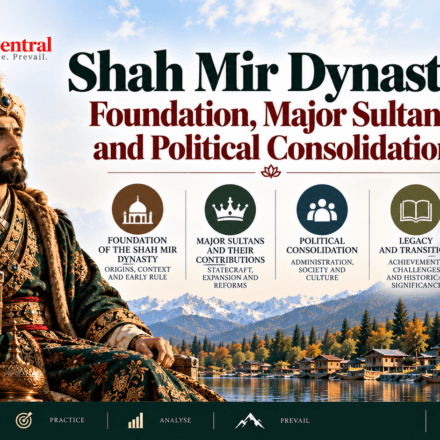
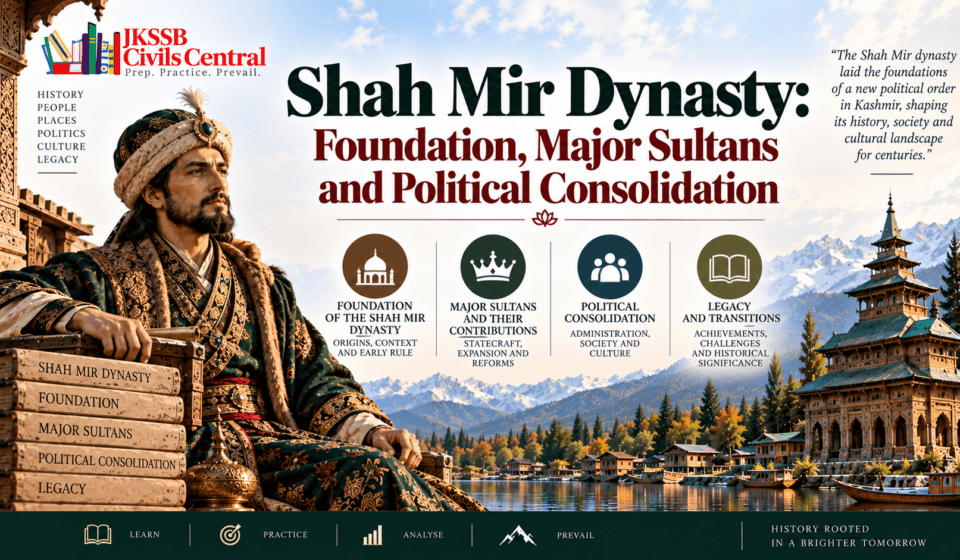
Shah Mir Dynasty: Foundation, Major Sultans and Political Consolidation

J&K History Series Navigation
| Previous Article | Current Article | Next Article |
|---|---|---|
| ← Article 20 — Rinchen, Kota Rani and the Political Transition to Muslim Rule in Kashmir | Article 21 — Shah Mir Dynasty: Foundation, Major Sultans and Political Consolidation | Article 22 — Sultanate Administration and Economy in Medieval Kashmir |
Learning Dashboard
| Category | Key Information |
|---|---|
| Historical Period | 14th–15th centuries |
| Historical Phase | Kashmir Sultanate / Shah Mir period |
| Dynasty | Shah Mir dynasty |
| Approx. Dynastic Span | 1339–1561 |
| Founder | Shah Mir / Sultan Shams-ud-Din |
| Political Centre | Kashmir Valley, especially Srinagar |
| Major Sultans | Shams-ud-Din, Ala-ud-Din, Shihab-ud-Din, Qutb-ud-Din, Sikandar, Ali Shah, Zain-ul-Abidin |
| Most Important Consolidation Phase | Shihab-ud-Din and Zain-ul-Abidin |
| Major Turning Point | Shah Mir’s accession in 1339 |
| Major Cultural Development | Growth of Persian literary and court culture |
| Key Sources | Jonaraja’s continuation of the Rajatarangini tradition, later Persian chronicles, numismatic evidence and modern scholarship |
| JKSSB Importance | Very High |
| Expected Question Types | Chronology, ruler-dynasty association, statements, matching, identification, comparative questions |
Introduction
The establishment of the Shah Mir dynasty in 1339 transformed the political history of Kashmir. The transition did not begin with a completely new religious or social order appearing suddenly in the valley; Muslim communities and political actors were already present, and Rinchana had adopted Islam several decades earlier. What changed under Shah Mir was the durability of Muslim dynastic authority: a brief episode of Muslim kingship was transformed into a succession-based political order that continued for more than two centuries.
The Shah Mir period is conventionally dated from 1339 to 1561, although the dynasty’s political strength varied greatly across this long period. Its early rulers consolidated the Sultanate, expanded Kashmir’s influence beyond the valley, and developed links with neighbouring regions. Later rulers faced succession struggles and political fragmentation, while the reign of Sultan Zain-ul-Abidin (1420–1470) represented a major phase of political reconstruction and cultural development.
The dynasty is therefore important for more than the fact that it was Kashmir’s first long-lasting Muslim ruling house. Its history illustrates how a new political elite became embedded in Kashmir, how the state developed regional ambitions, how Persian became increasingly important to elite and court culture, and how the political institutions of the Sultanate evolved before the later Chak period. Persian became an important language of court and intellectual culture under the Shah Mirs, with its influence particularly pronounced by the time of Zain-ul-Abidin.
Part I — From Political Transition to the Shah Mir Dynasty
The Background to 1339
The establishment of the Shah Mir dynasty must be placed against the political crisis of the early fourteenth century. The invasion associated with Dulcha or Zulchu around 1320 disrupted the already weakened Lohara political order, after which Rinchana emerged as ruler. His conversion to Islam was historically significant, but his reign was short and did not establish a durable Muslim dynasty.
After Rinchana’s death, the earlier ruling order was restored under Udayanadeva, while Kota Rani became the central political figure in the final phase of the pre-Sultanate state. Shah Mir, who had already acquired political influence within Kashmir, eventually overcame this political order and established himself as ruler in 1339.
This sequence is essential because it shows that the Shah Mir dynasty emerged from political restructuring inside Kashmir, not simply from the sudden arrival of an external conquering army. Shah Mir’s origins were non-local according to the historical tradition, but his political career had developed within the Kashmiri political environment.
CivilsCentral Historical Insight
The importance of 1339 lies in institutional continuity. Rinchana had already demonstrated that a Muslim ruler could occupy the Kashmiri throne, but Shah Mir converted that temporary political development into a durable dynastic order.
Part II — Shah Mir and the Foundation of the Sultanate
Shah Mir’s Rise
Shah Mir’s rise was the culmination of a political career that had begun before his accession. Traditional accounts associate him with the north-western region, particularly Swat, while some details of his ancestry remain debated. What is more important historically is that he became integrated into the Kashmiri political establishment before becoming ruler.
His success was facilitated by the continuing weakness of the old ruling structure and by his ability to establish relationships with influential political groups. His accession consequently illustrates a broader feature of medieval state formation: political authority could be transferred to a new ruling house when an established dynasty could no longer maintain control.
Shams-ud-Din
After his accession in 1339, Shah Mir assumed the title Shams-ud-Din. His reign was brief, traditionally dated to approximately 1339–1342, but its importance lies not in its duration but in its institutional consequences.
The new ruler established the dynastic framework within which subsequent sultans ruled. Later rulers were able to inherit an already established Sultanate rather than having to reconstruct political authority from the beginning. This marks the principal distinction between Shah Mir and Rinchana.
Rinchana and Shah Mir — The Essential Distinction
| Rinchana | Shah Mir |
|---|---|
| Rose around c.1320 | Established rule in 1339 |
| Converted to Islam | Founded the Shah Mir ruling house |
| Reigned briefly | Established a durable dynastic succession |
| Sadr-ud-Din | Shams-ud-Din |
| Muslim royal episode | Institutional beginning of the Sultanate |
Part III — The Early Shah Mir Sultans
Jamshid
After Shah Mir’s death, his son Jamshid succeeded him. His reign was very brief, traditionally dated to 1342, and it was followed by the accession of his brother Ala-ud-Din. Jamshid’s importance is therefore primarily chronological. His short reign demonstrates that the new dynasty had already established a hereditary succession mechanism sufficiently strong for power to pass within Shah Mir’s family rather than immediately returning to the earlier ruling house.
For examination purposes, Jamshid is particularly useful as a chronology marker: Shams-ud-Din → Jamshid → Ala-ud-Din
Ala-ud-Din
Ala-ud-Din ruled approximately from 1342 to 1354. His reign belongs to the period in which the Shah Mir state was consolidating itself rather than yet reaching its greatest territorial ambitions. The early Sultanate faced the normal problems of a newly established dynasty: maintaining control over the political elite, ensuring succession and preserving authority over the valley. The significance of Ala-ud-Din’s reign therefore lies in the continuation of the new ruling structure.
His period also demonstrates why the early Shah Mir state should not be judged solely by later achievements under Shihab-ud-Din or Zain-ul-Abidin. Dynastic consolidation was itself a historical development.
CivilsCentral Historical Insight
The first three decades after 1339 were fundamentally about making the new political order durable. The succession from Shah Mir to Jamshid and Ala-ud-Din shows that the Sultanate was becoming a dynasty rather than remaining the personal regime of its founder.
Part IV — Sultan Shihab-ud-Din and Regional Expansion
Accession and Political Consolidation
Shihab-ud-Din succeeded Ala-ud-Din around 1354 and ruled until approximately 1373. His reign marks an important change in the character of the Shah Mir state. While earlier rulers had been primarily concerned with maintaining the new dynasty, Shihab-ud-Din pursued a more assertive regional policy.
He is remembered in historical traditions for military campaigns extending beyond the Kashmir Valley. Accounts associate his campaigns with areas in the Punjab, north-western regions, Ladakh and other neighbouring territories. The exact extent and duration of political control over every region mentioned in later sources require caution, because military expedition, temporary submission and permanent incorporation were not necessarily the same thing.
Kashmir’s Regional Position
Shihab-ud-Din’s reign nevertheless demonstrates that the Kashmir Sultanate was not politically isolated. Kashmir’s geography connected the valley with Punjab, the north-western highlands, Ladakh and Central Asian routes. A ruler capable of controlling the valley could therefore seek influence beyond it, while neighbouring powers could also affect Kashmiri politics.
This geographical setting helps explain the recurring outward orientation of Kashmiri rulers. Expansion could provide political prestige, access to strategic routes and influence over neighbouring chiefs, but maintaining distant territories was more difficult than defeating them militarily.
Shihab-ud-Din Pora
Tradition associates Shihab-ud-Din with the foundation or development of a settlement called Shihab-ud-Din Pora, generally identified with Shadipur. Such foundation traditions are useful for understanding the political geography of the period, although individual claims about the exact circumstances of urban foundations should be treated according to the strength of the evidence.
The association of Shihab-ud-Din with major military expansion led later writers to compare him with earlier expansionist rulers such as Lalitaditya. Such comparisons are modern historiographical comparisons, not historical titles used by Shihab-ud-Din himself.
CivilsCentral Historical Insight
Shihab-ud-Din represents the transition from dynastic survival to regional ambition. His reign demonstrates that the Kashmir Sultanate had acquired enough political stability to project power beyond the valley, although military reach should not automatically be equated with permanent territorial administration.
Part V — Qutb-ud-Din and the Consolidation of the Sultanate
Qutb-ud-Din
Shihab-ud-Din was succeeded by Qutb-ud-Din, generally dated to 1373–1389. His reign was comparatively less expansionist than that of his predecessor and is important for the consolidation of the Sultanate.
Qutb-ud-Din’s period coincided with a growing cultural and religious transformation within Kashmir. Muslim political authority was now established, while networks connecting Kashmir with Central Asia and the wider Persianate world were becoming increasingly significant.
Sayyid Ali Hamadani and the Wider Cultural Environment
The later 14th century also witnessed the visits of Sayyid Ali Hamadani, the Kubrawi Sufi scholar whose influence on Kashmir’s religious and intellectual history became particularly important. His visits belong primarily to the reign of Qutb-ud-Din and the surrounding period.
However, Hamadani should not be presented as the person who introduced Islam to Kashmir. Muslim presence and Rinchana’s conversion preceded him. His importance lies instead in strengthening Islamic scholarly and Sufi networks and contributing to the broader Persianate cultural transformation of Kashmir.
This distinction is particularly important because the political history of the Shah Mir dynasty and the social history of Islamization are related but not identical processes.
CivilsCentral Historical Insight
The later fourteenth century shows how political change and cultural change interacted without being identical. The Shah Mir state created the political framework within which Persianate and Islamic institutions could expand, while Sufi networks, migration and local social processes contributed to cultural transformation.
Part VI — Sultan Sikandar and a Major Turning Point
Accession of Sikandar
Sikandar, son of Qutb-ud-Din, succeeded to the throne in approximately 1389 and ruled until 1413. He is one of the most controversial rulers of medieval Kashmir because later sources associate his reign with strong religious policies and the destruction or abandonment of some Hindu religious institutions.
His reign must therefore be handled with particular source discipline. Jonaraja, a Brahman court poet writing under Sikandar’s successor Zain-ul-Abidin, provides an important narrative source, while later Persian chronicles and subsequent historical traditions add further accounts. The sources differ in emphasis and chronology, and later narratives can magnify or simplify the complexity of religious change.
Religious Policy and Historical Interpretation
The traditional image of Sikandar as an iconoclast is associated with the epithet Butshikan, usually translated as “image-breaker.” However, modern historical analysis should distinguish between evidence for particular acts of religious destruction, later literary representations, and broader claims about the complete transformation of Kashmiri society.
It would be equally inaccurate to reduce the entire reign to religious policy. The Sultanate continued to function as a political state, and its institutions, elite networks and regional relationships remained important. The reign also belongs to a period when Islamic institutions and Persianate culture were becoming increasingly influential.
The period’s religious history should therefore be understood as part of a longer process involving state policy, Sufi networks, migration, conversion, social relationships and political patronage rather than through a single explanatory factor.
Sikandar and the Question of Islamization
Sikandar’s reign is sometimes presented as the moment when Kashmir became Muslim. That formulation is historically too simple. Islamization had begun before Sikandar. Muslim communities existed earlier, Rinchana had converted, Shah Mir had established the Sultanate, and Sufi networks had expanded during the later 14th century. Sikandar’s reign represents an important phase in the changing religious policies of the state, but it cannot be used to explain the entire process of Islamization.
CivilsCentral Historical Insight
Sikandar’s reign demonstrates why political and religious history must be separated analytically. State policy could accelerate or constrain religious change, but Kashmir’s Islamization was a longer process involving multiple actors and social mechanisms.
Part VII — Ali Shah and the Succession Crisis
Ali Shah
Sikandar was succeeded by his son Ali Shah, who ruled approximately from 1413 to 1420. His reign was overshadowed by a succession conflict that eventually brought his younger brother Shahi Khan to the throne.
Ali Shah’s accession continued the hereditary principle of the Shah Mir dynasty, but the subsequent conflict demonstrated that hereditary succession did not guarantee political stability. The authority of the Sultan still depended upon alliances with military groups, regional chiefs and influential political actors.
Shahi Khan’s Rise
Shahi Khan, the son of Sikandar and brother of Ali Shah, emerged as the principal rival in the succession struggle. He eventually defeated Ali Shah’s position and became ruler in 1420, adopting the title Zain-ul-Abidin.
The transition from Ali Shah to Zain-ul-Abidin is therefore both a succession event and a major political turning point. It brought one of the longest and most consequential reigns in the history of medieval Kashmir.
Part VIII — Zain-ul-Abidin: Reconstruction and Consolidation
Accession of Zain-ul-Abidin
Sultan Zain-ul-Abidin, also known as Budshah, ruled from 1420 to 1470. He was the eighth ruler in the conventional sequence of the Shah Mir dynasty and became its most celebrated sovereign.
His reign is important because it followed a period of political and religious tension. Instead of continuing the more restrictive tendencies associated with the preceding period, Zain-ul-Abidin pursued policies aimed at restoring political stability and rebuilding the kingdom’s economic and cultural institutions.
Political Reconstruction
Zain-ul-Abidin’s long reign gave him an opportunity to restore institutions that had been weakened by earlier political conflicts. His administration sought to strengthen the state, encourage productive activity and maintain relationships with neighbouring regions.
His reign also benefited from relative political continuity. Long duration itself does not prove good governance, but in a fragmented medieval political environment it provided the ruler with the time necessary to implement policies and develop institutions.
The Sultan’s reputation for administrative ability therefore rests not on a single reform but on a broader process of reconstruction.
Part IX — Zain-ul-Abidin and Religious Policy
A Change in Political Orientation
Zain-ul-Abidin’s reign is remembered for a more accommodative religious policy than that associated with the preceding period. Later sources and modern scholarship emphasize the restoration of privileges and institutions for Hindu communities and the participation of non-Muslim groups in the state’s intellectual and administrative life.
However, the modern description of Zain-ul-Abidin as simply a ruler of “complete religious equality” should be avoided unless carefully qualified. Medieval political systems did not operate according to modern constitutional concepts of equality. His significance lies in the concrete policies associated with restoration, patronage and accommodation.
Religious and Cultural Plurality
The cultural environment under Zain-ul-Abidin included Muslims, Kashmiri Pandits and other intellectual communities. Persian became increasingly important, while Sanskrit learning continued to exist. This coexistence is particularly significant because it shows that the rise of Persianate Muslim political culture did not automatically eliminate older intellectual traditions.
The later Persian literary tradition also records translations and intellectual exchanges involving Sanskrit works. Encyclopaedia Iranica notes that translations of works such as the Mahabharata and the Rajatarangini into Persian are associated with the courtly environment of Zain-ul-Abidin.
CivilsCentral Historical Insight
Zain-ul-Abidin’s significance lies in reconstruction rather than simple religious tolerance as an abstract ideal. His reign demonstrates how a Muslim-ruled state could incorporate multiple intellectual and religious communities while simultaneously strengthening a Persianate court culture.
Part X — Economic and Craft Development under Zain-ul-Abidin
Zain-ul-Abidin’s reign is also associated with the expansion of crafts, trade and cultural production. Kashmir’s geographical position connected it with Central Asia, the Punjab and the Himalayan regions, allowing ideas, techniques and artisans to move across political boundaries.
Later historical accounts associate his reign with encouragement of crafts such as paper-making, shawl-related production, woodwork and other artisanal activities. The precise chronology of individual crafts and the claim that particular crafts were entirely “introduced” by one ruler should be treated cautiously. Cultural technologies rarely emerge from a single moment; they are usually adapted through longer processes of exchange.
What can be stated more securely is that the Shah Mir period, particularly under Zain-ul-Abidin, saw a strengthening of Persianate cultural connections and the patronage of learning and craftsmanship. Persian scholarship flourished under his rule, and Kashmir increasingly participated in a wider cultural world extending into Central Asia and Iran.
Part XI — Persian and the Shah Mir State
The Growth of Persian
One of the long-term consequences of the Shah Mir period was the increasing importance of Persian in Kashmir’s political and intellectual culture. Persian did not become influential merely because the rulers were Muslim; Kashmir’s position on trade and cultural routes also connected it with Persian-speaking regions.
Under the Shah Mir sultans, Persian developed as a major language of court and elite culture. Encyclopaedia Iranica identifies the Shah Mir period as a decisive phase in the development of Persian in Kashmir and notes that its literary influence became particularly strong under Zain-ul-Abidin.
This development was historically important because it transformed the intellectual environment of Kashmir. Persian became a vehicle for administration, poetry, historical writing and scholarship, while Sanskrit and Kashmiri traditions continued alongside it.
Persianization and Islamization Are Not Identical
The two processes were closely connected but should not be treated as synonyms. Persian could be used by Hindu as well as Muslim intellectuals, and the spread of Persian learning cannot by itself demonstrate religious conversion.
This distinction is particularly important when interpreting medieval Kashmir. Cultural change involved language, literary production, administration, migration and elite patronage in addition to religious transformation.
CivilsCentral Historical Insight
The rise of Persian in Kashmir illustrates how political change can generate cultural transformation without producing cultural uniformity. Persian became an important elite language while older linguistic, literary and religious traditions continued to participate in Kashmiri society.
Part XII — The Shah Mir Dynasty as a Political System
The Shah Mir dynasty should not be understood simply as a list of sultans. Across its history, the state had to manage several recurring problems: succession, relations with powerful regional groups, control over the Kashmir Valley, relations with neighbouring states and the integration of new political elites.
The strength of the Sultanate varied from ruler to ruler. Shihab-ud-Din demonstrated considerable regional ambition, while Zain-ul-Abidin emphasized reconstruction. Sikandar’s reign illustrates the political consequences of succession and religious policy, while the accession of Zain-ul-Abidin shows that dynastic competition could produce major changes in political direction.
The dynasty therefore developed through a combination of hereditary succession, elite politics, military power, regional diplomacy and cultural patronage. These mechanisms became increasingly important as the Sultanate matured.
Part XIII — The Shah Mir Dynasty and Regional Relations
Kashmir’s geography made external relations unavoidable. The valley was connected to Punjab through routes to the south-west, to Ladakh and Tibet through the high Himalayan corridors, and to Central Asia through north-western routes.
The Shah Mir rulers consequently interacted with neighbouring political communities rather than existing in isolation. Shihab-ud-Din’s campaigns demonstrate the outward projection of Kashmiri power, while Zain-ul-Abidin’s diplomacy and relations with neighbouring rulers illustrate a different method of maintaining Kashmir’s regional position.
Military expansion and diplomacy should therefore be viewed as complementary tools of medieval statecraft. A ruler could use military force to strengthen bargaining power while also using marriage, diplomatic exchange and commercial connections to maintain political relationships.
Part XIV — Historical Sources for the Shah Mir Period
Jonaraja and the Rajatarangini Tradition
The most important indigenous literary source for the later medieval history of Kashmir is the continuation of the Rajatarangini tradition. Jonaraja, a Brahman scholar associated with the court of Zain-ul-Abidin, continued Kalhana’s historical project. His account is particularly important for the rulers leading up to Zain-ul-Abidin and provides valuable information about political events.
However, Jonaraja was not a modern detached historian. He wrote within a courtly environment, and his narrative must be read with attention to literary conventions, political context and the perspective of the author.
Srivara
The later part of Zain-ul-Abidin’s reign is associated with Srivara, who continued the chronicle tradition. This is particularly useful because Zain-ul-Abidin’s reign lasted approximately fifty years, making it difficult for a single source to cover the entire period from the same perspective.
Persian Chronicles
Later Persian historical works provide additional information about the Sultanate. However, many were written after the events and may themselves have drawn on earlier Kashmiri traditions. They should therefore be compared with Jonaraja, Srivara, coins and other evidence rather than treated as automatically superior.
Coins
Numismatic evidence is especially useful for establishing rulers, titles and aspects of chronology. Coins associated with Shah Mir rulers provide independent evidence for the existence and titulature of particular sultans, although coin evidence also has limitations and does not by itself reconstruct an entire political history.
CivilsCentral Historical Insight
The Shah Mir period is unusually valuable for historical reconstruction because literary, Persianate and numismatic evidence can be compared. The historian’s task is not to choose one source uncritically, but to examine where different kinds of evidence converge and where they diverge.
Part XV — Master Chronology of the Shah Mir Sultans
The following is a working examination chronology, using approximate dates where the succession traditions are most secure:
| No. | Sultan | Approx. Reign | Key Historical Association |
|---|---|---|---|
| 1 | Shams-ud-Din (Shah Mir) | 1339–1342 | Founder of Shah Mir dynasty |
| 2 | Jamshid | 1342 | Very brief succession |
| 3 | Ala-ud-Din | 1342–1354 | Early dynastic consolidation |
| 4 | Shihab-ud-Din | 1354–1373 | Regional expansion and political consolidation |
| 5 | Qutb-ud-Din | 1373–1389 | Later 14th-century consolidation; Hamadani’s period of activity |
| 6 | Sikandar | 1389–1413 | Major religious-policy turning point |
| 7 | Ali Shah | 1413–1420 | Succession conflict |
| 8 | Zain-ul-Abidin | 1420–1470 | Reconstruction, cultural patronage and long reign |
The exact chronology of some short reigns can vary across historical compilations. The sequence from Shams-ud-Din → Jamshid → Ala-ud-Din → Shihab-ud-Din → Qutb-ud-Din → Sikandar → Ali Shah → Zain-ul-Abidin is the key examination sequence. A published scholarly chronology also gives the same broad succession and dates.
What Happens After Zain-ul-Abidin?
The Shah Mir dynasty did not end with Zain-ul-Abidin in 1470. Later rulers included Haider Shah, Hasan Shah, Muhammad Shah and Fateh Shah, among others. The later fifteenth and early sixteenth centuries were characterized by repeated succession struggles and changing balances among competing political groups.
The dynasty eventually gave way to the Chak ruling house in 1561, bringing the main Shah Mir phase of Kashmir’s medieval political history to a close. The Chak period will be explained later in this series.
Part XVI — Decline of Shah Mir Political Consolidation
The long reign of Zain-ul-Abidin gave the Sultanate considerable stability, but this stability did not permanently resolve the problem of succession. After his death, competing claimants and powerful political groups again became important, weakening central authority.
This later history should not be described as a sudden “collapse” immediately after 1470. The Shah Mir political order survived for almost another century, but the ability of individual rulers to maintain stable central control varied. Repeated succession struggles gradually created conditions in which rival political groups could exercise greater influence.
The eventual emergence of the Chak dynasty in 1561 therefore represents a longer process of political transformation rather than the consequence of a single defeat.
CivilsCentral Historical Insight
The Shah Mir dynasty demonstrates that dynastic longevity does not automatically mean uninterrupted political stability. Its greatest periods of consolidation were followed by renewed succession struggles, and the eventual Chak transition emerged from this longer weakening of centralized dynastic authority.
Part XVII — Historical Significance of the Shah Mir Dynasty
The Shah Mir dynasty occupies a central position in the political history of medieval Kashmir for several reasons.
First, it established the first durable Muslim dynastic framework after the political transition of the early fourteenth century. Second, its rulers expanded Kashmir’s regional political connections and, at times, projected military power beyond the valley. Third, the dynasty provided the political environment in which Persian became increasingly important to court culture, scholarship and administration.
Fourth, the Shah Mir period demonstrates that religious and political transformation did not occur through a single mechanism. Muslim rule, Sufi networks, migration, conversion, Persianization and local cultural continuity interacted over generations. Finally, the dynasty’s history provides the immediate political background to the later Chak period and therefore forms a necessary bridge between the establishment of the Sultanate and the later Mughal conquest of Kashmir.
Part XVIII — Historical Interpretation and Evidence Note
| Historical Claim | Evidence Level | Caution |
|---|---|---|
| Shah Mir established the dynasty in 1339 | A/B | Strongly established historical chronology |
| Shah Mir assumed the title Shams-ud-Din | B | Supported by historical and numismatic traditions |
| Shah Mir’s origins were connected with the north-west/Swat region | B/C | Details of ancestry and origin vary |
| Shihab-ud-Din pursued major regional campaigns | B | Broad military expansion is well represented; exact territorial control varies |
| Qutb-ud-Din ruled during Hamadani’s Kashmir visits | B | Chronologically consistent |
| Sikandar pursued restrictive religious policies | B | Strongly represented in historical traditions, but precise extent requires source criticism |
| Sikandar’s reign completely converted Kashmir | D | Over-simplified and should not be presented as established fact |
| Zain-ul-Abidin ruled 1420–1470 | A/B | Strong chronological consensus |
| Zain-ul-Abidin was known as Budshah | B | Strong historical tradition |
| Zain-ul-Abidin encouraged intellectual and cultural exchange | B | Strongly represented in historical literature |
| Persian became increasingly important under the Shah Mirs | A/B | Supported by linguistic and historical scholarship |
| Every craft associated with Zain-ul-Abidin was invented by him | D | Cultural development was cumulative; avoid single-ruler attribution |
The evidence hierarchy is especially important for the religious history of Sikandar and the cultural achievements attributed to Zain-ul-Abidin. The broad developments are historically important, but individual stories and numerical or absolute claims require separate verification.
Part XIX — JKSSB Knowledge Matrix
| Question | Answer |
|---|---|
| Who founded the Shah Mir dynasty? | Shah Mir |
| When did Shah Mir establish his rule? | 1339 |
| What title did Shah Mir assume? | Shams-ud-Din |
| What dynasty did he establish? | Shah Mir dynasty |
| Approximate dynastic period? | 1339–1561 |
| Who succeeded Shah Mir? | Jamshid |
| Who followed Jamshid? | Ala-ud-Din |
| Which ruler is associated with major regional expansion? | Shihab-ud-Din |
| Which ruler followed Shihab-ud-Din? | Qutb-ud-Din |
| Which Sultan ruled during the period of Sayyid Ali Hamadani’s major Kashmir visits? | Qutb-ud-Din’s period |
| Who was Sikandar? | A major Shah Mir Sultan, r. c.1389–1413 |
| Who succeeded Sikandar? | Ali Shah |
| Who succeeded Ali Shah? | Zain-ul-Abidin |
| When did Zain-ul-Abidin rule? | 1420–1470 |
| What was Zain-ul-Abidin popularly called? | Budshah |
| Which ruler is especially associated with cultural reconstruction? | Zain-ul-Abidin |
| Which language gained major court and intellectual importance? | Persian |
| Which source continued Kalhana’s Rajatarangini tradition? | Jonaraja |
| Who continued the chronicle tradition for the later period of Zain-ul-Abidin? | Srivara |
| Which dynasty followed the Shah Mirs? | Chak dynasty |
Part XX — Examination Discrimination Points
1. Shah Mir vs Rinchana
Rinchana: early Muslim ruler, c.1320–1323.
Shah Mir: founder of durable Shah Mir dynasty, 1339.
2. Shams-ud-Din vs Zain-ul-Abidin
Shams-ud-Din: title of Shah Mir.
Zain-ul-Abidin: title adopted by Shahi Khan, ruler from 1420.
3. Shihab-ud-Din vs Sikandar
Shihab-ud-Din: associated with regional military expansion.
Sikandar: associated with a major religious-policy turning point.
4. Sikandar vs Zain-ul-Abidin
Sikandar: ruled 1389–1413.
Zain-ul-Abidin: ruled 1420–1470.
5. Qutb-ud-Din vs Qutb-ud-Din Aibak
These are entirely different historical figures.
Qutb-ud-Din of Kashmir: Shah Mir Sultan, r. c.1373–1389.
Qutb-ud-Din Aibak: founder of the Mamluk/Slave dynasty of the Delhi Sultanate, early 13th century.
6. Persianization vs Islamization
Persianization refers to the growing influence of Persian language and Persianate cultural forms.
Islamization refers to the broader spread and institutionalization of Islam.
They interacted but are not identical processes.
Part XXI — JKSSB Question-Type Mapping
Direct Fact
Who founded the Shah Mir dynasty?
Answer: Shah Mir.
Chronology
Arrange:
- Sikandar
- Shihab-ud-Din
- Zain-ul-Abidin
- Qutb-ud-Din
Correct order:
2 → 4 → 1 → 3
Statement-Based
Consider:
- Shah Mir established his rule in 1339.
- Shah Mir adopted the title Shams-ud-Din.
- Zain-ul-Abidin succeeded Shah Mir directly.
- Shihab-ud-Din ruled before Qutb-ud-Din.
Correct:
1, 2 and 4 only.
Match the Following
| Ruler | Association |
|---|---|
| Shah Mir | Foundation of dynasty |
| Shihab-ud-Din | Regional expansion |
| Sikandar | 1389–1413 |
| Zain-ul-Abidin | 1420–1470 |
Identification by Clues
A Shah Mir Sultan:
- ruled for about fifty years,
- succeeded after a succession conflict,
- was known as Budshah,
- encouraged cultural and intellectual development.
Answer: Zain-ul-Abidin.
Comparative
Which distinction is correct?
A. Shams-ud-Din was Zain-ul-Abidin’s title.
B. Shams-ud-Din was Shah Mir’s title, while Zain-ul-Abidin was the title of Shahi Khan.
Correct: B
Part XXII — JKSSB Practice Questions
Question 1
Who established the Shah Mir dynasty in Kashmir?
A. Rinchana
B. Shah Mir
C. Udayanadeva
D. Zain-ul-Abidin
Correct Answer: B
Explanation: Shah Mir established durable Muslim dynastic rule in Kashmir in 1339.
Question 2
Shah Mir assumed which title after establishing his rule?
A. Sadr-ud-Din
B. Shams-ud-Din
C. Zain-ul-Abidin
D. Sikandar
Correct Answer: B
Explanation: Shah Mir became Sultan Shams-ud-Din. Sadr-ud-Din is associated with Rinchana.
Question 3
Arrange the following Shah Mir rulers chronologically:
- Sikandar
- Ala-ud-Din
- Zain-ul-Abidin
- Shihab-ud-Din
- Qutb-ud-Din
A. 2–4–5–1–3
B. 4–2–5–1–3
C. 2–5–4–1–3
D. 5–2–4–3–1
Correct Answer: A
Explanation: Ala-ud-Din → Shihab-ud-Din → Qutb-ud-Din → Sikandar → Zain-ul-Abidin.
Question 4
Which Shah Mir ruler is particularly associated with regional military expansion?
A. Jamshid
B. Shihab-ud-Din
C. Ali Shah
D. Zain-ul-Abidin
Correct Answer: B
Explanation: Shihab-ud-Din’s reign is associated with extensive campaigns beyond the Kashmir Valley.
Question 5
Consider the following statements:
- Zain-ul-Abidin ruled from 1420 to 1470.
- He was popularly known as Budshah.
- He founded the Shah Mir dynasty.
- His reign is associated with cultural and intellectual reconstruction.
Which are correct?
A. 1 and 3 only
B. 1, 2 and 4 only
C. 2 and 3 only
D. All four
Correct Answer: B
Explanation: Shah Mir founded the dynasty in 1339. Zain-ul-Abidin ruled 1420–1470 and became known as Budshah.
Question 6
Which ruler succeeded Sikandar?
A. Qutb-ud-Din
B. Ali Shah
C. Zain-ul-Abidin
D. Shihab-ud-Din
Correct Answer: B
Explanation: Ali Shah succeeded Sikandar around 1413 and ruled until 1420.
Question 7
Which ruler succeeded Ali Shah?
A. Zain-ul-Abidin
B. Shihab-ud-Din
C. Sikandar
D. Ala-ud-Din
Correct Answer: A
Explanation: Shahi Khan succeeded Ali Shah in 1420 and assumed the title Zain-ul-Abidin.
Question 8
Which of the following correctly distinguishes Qutb-ud-Din of Kashmir from Qutb-ud-Din Aibak?
A. They were the same ruler.
B. Both ruled Kashmir.
C. Qutb-ud-Din of Kashmir belonged to the Shah Mir dynasty, whereas Qutb-ud-Din Aibak belonged to the early Delhi Sultanate.
D. Both ruled in the 15th century.
Correct Answer: C
Explanation: They were different rulers separated by chronology, geography and political context.
Question 9
Which statement about Persian in medieval Kashmir is most accurate?
A. Persian became influential only after Mughal annexation.
B. Persian had no connection with Shah Mir rule.
C. Persian became increasingly important in court and intellectual culture during the Shah Mir period.
D. Persian completely replaced all other languages under Zain-ul-Abidin.
Correct Answer: C
Explanation: Persian gained major importance during the Shah Mir period, especially under Zain-ul-Abidin, but older linguistic and intellectual traditions continued.
Question 10
Which of the following represents the most accurate interpretation of the Shah Mir dynasty?
A. It was merely a short-lived continuation of Rinchana’s rule.
B. It established a durable Muslim dynastic state that gradually developed regional, administrative and cultural institutions.
C. It immediately converted the entire population of Kashmir.
D. It existed only during the reign of Shah Mir.
Correct Answer: B
Explanation: The Shah Mir dynasty transformed the temporary political development represented by Rinchana into a durable ruling order that lasted for more than two centuries.
Part XXIII — Rapid Revision Zone
Important Dates
- 1339 — Shah Mir establishes the dynasty.
- 1339–1342 — Shams-ud-Din.
- 1342 — Jamshid’s brief reign.
- 1342–1354 — Ala-ud-Din.
- 1354–1373 — Shihab-ud-Din.
- 1373–1389 — Qutb-ud-Din.
- 1389–1413 — Sikandar.
- 1413–1420 — Ali Shah.
- 1420–1470 — Zain-ul-Abidin.
- 1561 — End of Shah Mir political rule and transition to the Chak dynasty.
Important Rulers
Shah Mir / Shams-ud-Din
Founder of dynasty.
Shihab-ud-Din
Regional expansion.
Qutb-ud-Din
Late 14th-century consolidation; Hamadani’s period of activity.
Sikandar
Major religious-policy turning point.
Ali Shah
Succession crisis before Zain-ul-Abidin.
Zain-ul-Abidin / Budshah
Long reign, reconstruction and cultural development.
Chronological Sequence
Shams-ud-Din
→ Jamshid
→ Ala-ud-Din
→ Shihab-ud-Din
→ Qutb-ud-Din
→ Sikandar
→ Ali Shah
→ Zain-ul-Abidin
Important Associations
| Association | Answer |
|---|---|
| Founder of Shah Mir dynasty | Shah Mir |
| Shams-ud-Din | Shah Mir |
| Regional expansion | Shihab-ud-Din |
| Hamadani’s major Kashmir visits | Qutb-ud-Din period |
| Sikandar | 1389–1413 |
| Ali Shah | 1413–1420 |
| Budshah | Zain-ul-Abidin |
| Zain-ul-Abidin | 1420–1470 |
| Jonaraja | Continuation of Rajatarangini tradition |
| Srivara | Later continuation |
| Persian cultural expansion | Shah Mir period, especially Zain-ul-Abidin |
| Successor ruling house | Chak dynasty |
One-Line Revision Facts
- 1339 = Shah Mir dynasty begins.
- Shah Mir = Shams-ud-Din.
- Shihab-ud-Din = major regional expansion.
- Qutb-ud-Din = later 14th-century Sultanate; Hamadani’s period.
- Sikandar = major religious-policy controversy.
- Ali Shah = predecessor of Zain-ul-Abidin.
- Zain-ul-Abidin = 1420–1470; Budshah.
- Persian culture expanded substantially during Shah Mir rule.
- Jonaraja and Srivara continued the Kashmiri chronicle tradition.
- Shah Mir dynasty eventually gave way to the Chak dynasty in 1561.
Part XXIV — Frequently Confused Facts
| Confused Pair | Correct Distinction |
|---|---|
| Rinchana / Shah Mir | Rinchana = earlier Muslim ruler; Shah Mir = dynasty founder |
| Sadr-ud-Din / Shams-ud-Din | Sadr-ud-Din = Rinchana; Shams-ud-Din = Shah Mir |
| Shihab-ud-Din / Sikandar | Shihab = expansion; Sikandar = religious-policy controversy |
| Sikandar / Zain-ul-Abidin | Sikandar = 1389–1413; Zain = 1420–1470 |
| Ali Shah / Zain-ul-Abidin | Ali preceded Zain |
| Qutb-ud-Din Kashmir / Qutb-ud-Din Aibak | Different rulers and different periods |
| Persianization / Islamization | Related but distinct processes |
| Jonaraja / Kalhana | Jonaraja continued the chronicle tradition; Kalhana authored the original Rajatarangini |
| Shah Mir / Chak | Shah Mir dynasty preceded Chak rule |
| 1339 / 1420 | 1339 = Shah Mir foundation; 1420 = Zain-ul-Abidin’s accession |
Part XXV — What Can JKSSB Ask?
High-Value Areas
From this topic, JKSSB can test:
- founder of the Shah Mir dynasty
- year of its establishment
- Shams-ud-Din and Shah Mir
- succession of early Shah Mir rulers
- Shihab-ud-Din’s regional expansion
- Qutb-ud-Din and the late 14th-century Sultanate
- Sikandar’s reign
- Ali Shah’s position in the succession
- Zain-ul-Abidin’s accession and reign
- Budshah
- Persian cultural development
- Jonaraja and Srivara
- Shah Mir vs Rinchana
- Shah Mir vs Chak dynasty
- chronology-based identification
- statement-based distinctions concerning Islamization and state policy.
Especially Important Chronology
1339 — Shah Mir
1354 — Shihab-ud-Din
1373 — Qutb-ud-Din
1389 — Sikandar
1413 — Ali Shah
1420 — Zain-ul-Abidin
1470 — Death/end of Zain-ul-Abidin’s reign
1561 — Chak transition
Chapter Summary
The Shah Mir dynasty emerged from the political crisis of early 14th-century Kashmir and converted the temporary Muslim kingship represented by Rinchana into a durable dynastic state. Shah Mir established his rule in 1339 under the title Shams-ud-Din, after which succession passed through Jamshid, Ala-ud-Din, Shihab-ud-Din and Qutb-ud-Din.
Under Shihab-ud-Din, the Sultanate demonstrated greater regional ambition, while Qutb-ud-Din’s period coincided with the expanding influence of Sufi and Persianate networks. Sikandar’s reign marked a controversial phase of religious policy, followed by the succession crisis involving Ali Shah. The accession of Zain-ul-Abidin in 1420 opened the most sustained period of political reconstruction and cultural development in the Shah Mir history.
The dynasty’s significance extends beyond its religious identity. It created institutions of Muslim dynastic rule, strengthened Kashmir’s regional connections, encouraged Persianate intellectual culture and provided the political environment in which longer-term social and cultural transformations unfolded. At the same time, its history demonstrates that dynastic rule remained vulnerable to succession disputes and elite competition, ultimately contributing to the political transition to the Chak dynasty in 1561.
JKSSB Takeaway
Shah Mir → 1339 → Shams-ud-Din → foundation of Shah Mir dynasty
Shihab-ud-Din → regional expansion
Qutb-ud-Din → later 14th-century consolidation / Hamadani period
Sikandar → 1389–1413
Ali Shah → 1413–1420
Zain-ul-Abidin → 1420–1470 → Budshah → reconstruction and cultural development
Jonaraja + Srivara → continuation of Kashmiri chronicle tradition
Shah Mir dynasty → Chak transition in 1561
Mind Map
EARLY 14TH-CENTURY POLITICAL CRISIS
↓
SHAH MIR’S RISE
↓
1339 — SHAMS-UD-DIN
↓
SHAH MIR DYNASTY ESTABLISHED
↓
JAMSHID
↓
ALA-UD-DIN
↓
SHIHAB-UD-DIN
→ Regional expansion
→ Strengthening of Sultanate
↓
QUTB-UD-DIN
→ Late 14th-century consolidation
→ Hamadani’s period of activity
↓
SIKANDAR
→ Religious-policy turning point
↓
ALI SHAH
→ Succession crisis
↓
ZAIN-UL-ABIDIN
→ 1420–1470
→ Budshah
→ Political reconstruction
→ Cultural and intellectual patronage
→ Persianate development
↓
POST-ZAIN SUCCESSION STRUGGLES
↓
POLITICAL WEAKENING
↓
1561 — CHAK DYNASTY
FAQs
1. Who founded the Shah Mir dynasty?
Shah Mir founded the dynasty in 1339 and assumed the title Shams-ud-Din.
2. Was Shah Mir the first Muslim ruler of Kashmir?
Rinchana had already ruled as a Muslim ruler in the early 14th century. Shah Mir is more accurately described as the founder of the first durable Muslim dynastic ruling house in Kashmir.
3. How long did the Shah Mir dynasty rule?
The dynasty is conventionally dated from 1339 to 1561, although the strength of central rule varied considerably over this period.
4. Who was the most important Shah Mir ruler?
Zain-ul-Abidin (1420–1470) is generally regarded as the dynasty’s most prominent ruler because of the length of his reign and his political, cultural and intellectual policies.
5. Who was Budshah?
Zain-ul-Abidin was popularly known as Budshah, meaning “Great King.”
6. Which Shah Mir ruler is associated with major territorial expansion?
Shihab-ud-Din is particularly associated with extensive military campaigns and regional expansion.
7. Which Shah Mir ruler ruled during the period of Sayyid Ali Hamadani’s major visits?
The major Kashmir visits of Sayyid Ali Hamadani occurred during the later 14th century, particularly around the reign of Qutb-ud-Din and the surrounding period.
8. What happened to Persian during Shah Mir rule?
Persian became increasingly important in Kashmir’s courtly, administrative and intellectual culture, particularly during the Shah Mir period and under Zain-ul-Abidin.
9. Who continued Kalhana’s Rajatarangini tradition during this period?
Jonaraja continued the chronicle tradition, while Srivara continued it for the later period of Zain-ul-Abidin’s reign.
10. Which dynasty succeeded the Shah Mirs?
The Chak dynasty emerged as the next major ruling house in Kashmir in 1561.
About The Author