
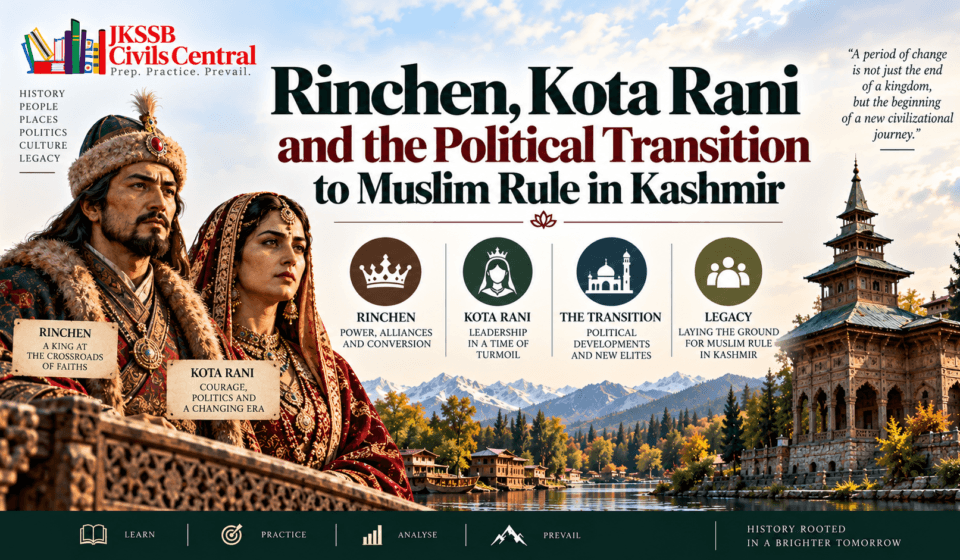
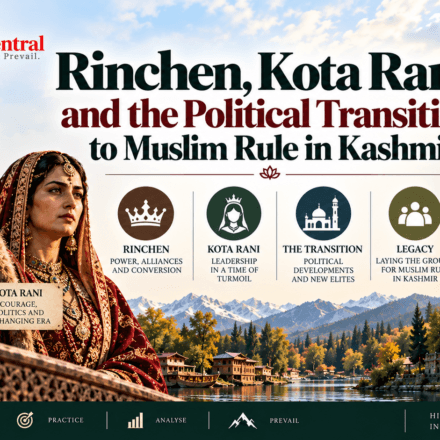
Rinchen, Kota Rani and the Political Transition to Muslim Rule in Kashmir

J&K History Series Navigation
| Previous Article | Current Article | Next Article |
|---|---|---|
| ← Article 19 — Islam in Medieval Kashmir: Early Contacts, Migration, Settlement and Islamization | Article 20 — Rinchen, Kota Rani and the Political Transition to Muslim Rule in Kashmir | Article 21 — Shah Mir Dynasty: Foundation, Major Sultans and Political Consolidation |
Learning Dashboard
| Category | Key Information |
|---|---|
| Historical Period | Early 14th century |
| Historical Phase | Transition from Lohara rule to the Kashmir Sultanate |
| Main Theme | Political transformation and the emergence of Muslim political authority |
| Principal Figures | Rinchana, Kota Rani, Udayanadeva, Shah Mir, Ramachandra, Bulbul Shah |
| Approx. Chronology | Rinchana c.1320–1323; Udayanadeva c.1323–1338; Kota Rani c.1338–1339; Shah Mir from 1339 |
| Key Places | Kashmir Valley, Ladakh, Srinagar, Inderkot |
| Key Political Development | Collapse of the old Lohara order → Rinchana’s rule → restoration under Udayanadeva → Kota Rani’s rule → Shah Mir’s establishment of the Sultanate |
| Religious Development | Rinchana’s conversion to Islam gave Islam an important political presence at the royal level |
| Key Sources | Jonaraja, later Persian chronicles, Rajatarangini tradition, modern historical scholarship |
| JKSSB Importance | Very High |
| Expected Question Types | Chronology, ruler-identification, statement-based, correct/incorrect pair, political transition, personality-association |
Introduction
The transition from the medieval Hindu ruling order of Kashmir to sustained Muslim political rule was not a single event that occurred suddenly in 1339. It developed through a period of political instability beginning with the crisis of the Lohara state, the devastating invasion traditionally associated with Dulcha or Zulchu around 1320, the rise of the Ladakhi prince Rinchana, his conversion to Islam, the restoration of the earlier ruling house under Udayanadeva, the political prominence of Kota Rani, and finally the rise of Shah Mir. Understanding this sequence is essential because it separates the arrival and political visibility of Islam from the establishment of a durable Muslim dynasty.
Rinchana is particularly important because his brief rule represents an early instance of a ruler of Kashmir adopting Islam and assuming a Muslim royal title. Yet his reign did not immediately establish a Muslim dynasty. After his death, political authority returned to the earlier ruling house for roughly another fifteen years, and Kota Rani became the central figure in the final phase of pre-Sultanate Kashmir. The decisive institutional transformation came only with Shah Mir’s accession in 1339, when Muslim political rule acquired a durable dynastic structure.
The period therefore has to be studied as a political transition, not as a simple religious replacement. Political fragmentation, elite competition, external invasions, migration, changing alliances and the presence of Muslim communities all interacted with individual conversions and dynastic struggles. This distinction is especially important for examination purposes because Rinchana’s conversion, Kota Rani’s rule and Shah Mir’s foundation of the Sultanate are related but not identical historical developments.
Part I — Kashmir Before the Political Transition
The Later Lohara Political Order
By the beginning of the 14th century, Kashmir had already experienced several centuries of dynastic change, and the Lohara political order had become increasingly vulnerable to internal conflict. The later Lohara period was marked by struggles among rulers, ministers, landed elites and other powerful groups, while the central authority of the monarchy was increasingly difficult to maintain. The situation created a political environment in which an external shock could produce consequences far beyond a temporary military defeat.
The weakness of the state should not, however, be understood as meaning that Kashmir had simply ceased to possess political institutions. The kingdom continued to function, and the ruling house retained authority, but the ability of the centre to coordinate the different political interests of the valley had weakened. This distinction matters because the events of the 1320s were not the sudden destruction of a completely stateless society; rather, they accelerated an existing process of political fragmentation.
The Invasion Associated with Dulcha
Around 1320, an invasion traditionally associated with Dulcha, Dulacha or Zulchu devastated Kashmir. Accounts of the invasion differ in details, including the identity and precise political affiliation of the invader, and some later narratives considerably dramatize the destruction. What is historically important is the political consequence: the existing ruling structure was severely disrupted, the king Suhadeva fled, and a major power vacuum emerged in the valley.
The invasion therefore acted as a catalyst. It weakened the legitimacy and practical authority of the existing monarchy and opened political space for military leaders, regional chiefs and ambitious outsiders. It was within this environment that Rinchana, a prince associated with Ladakh, emerged as a major political actor.
CivilsCentral Historical Insight
The significance of the 1320 crisis lies less in treating the invasion as an isolated military episode and more in understanding how external shock interacted with internal political weakness. The collapse of central authority created the conditions in which new elites could compete for power and in which Kashmir’s political order could be reconstructed on different foundations.
Part II — Rinchana and the First Major Political Break
Who Was Rinchana?
Rinchana, also written as Rinchan or Rinchanā in different sources, was a prince of Ladakhi/Tibetan background who entered Kashmir during a period of political turmoil. Modern historical scholarship generally places his rise to power around 1320 and his death around 1323. His background is significant because he was not simply a continuation of the established Kashmiri royal line; his accession illustrates the extent to which political instability had opened the kingdom to new ruling elites.
Rinchana was able to exploit the political vacuum created by the crisis surrounding the Dulcha invasion. Traditional accounts connect his rise with the displacement or death of Ramachandra, a powerful figure associated with the pre-existing political order. Rinchana subsequently consolidated his position and became ruler of Kashmir.
The exact details of his seizure of power vary across sources, and later narratives contain literary elements. The broad historical point, however, is relatively clear: Rinchana emerged as ruler in the political crisis following the disruption of the Lohara order and ruled for only a few years.
Rinchana’s Political Position
Rinchana’s immediate problem was not simply obtaining the throne but making his authority acceptable to a politically fragmented kingdom. He therefore had to build relationships with influential local groups and with members of the earlier political elite. His marriage to Kota, the daughter of Ramachandra in the traditional historical account, helped connect his new regime with an established Kashmiri political family.
This was an important feature of medieval state formation. Political legitimacy could be reinforced through matrimonial alliances, accommodation with local elites and incorporation of existing administrative networks. Rinchana’s rule therefore should not be understood merely as the replacement of one individual ruler by another; it was an attempt to stabilize a new political order after a period of severe disruption.
Rinchana’s Conversion to Islam
One of the most important developments of Rinchana’s reign was his conversion to Islam. Historical traditions associate this conversion with Sayyid Sharaf-ud-Din, popularly known as Bulbul Shah, a Sufi associated with the Suhrawardi tradition. Modern scholarship accepts the broad historical importance of Rinchana’s conversion while cautioning that later narratives differ regarding the circumstances that led to it.
A well-known Kashmiri tradition holds that Rinchana considered adopting the religious tradition of the established Kashmiri elite but encountered resistance from the Shaiva religious establishment. Jonaraja’s later account contains a narrative involving the Brahman Devasvami and Rinchana’s attempt to enter the Shaiva fold. This story is important as a historical tradition, but it should not automatically be treated as an independently verified account of Rinchana’s private deliberations.
What can be stated more securely is that Rinchana adopted Islam and assumed the Muslim name and title Sultan Sadr-ud-Din. His conversion gave Islam a new political visibility because the ruler himself had adopted the faith. This did not mean that the population of Kashmir immediately became Muslim, nor did it create an established Muslim dynasty.
CivilsCentral Historical Insight
Rinchana’s conversion is historically important because it connected an already existing Muslim presence in Kashmir with royal authority. The event should not be confused with the later establishment of the Shah Mir Sultanate: conversion of a ruler in c.1320 and establishment of a durable Muslim dynasty in 1339 were separate developments.
Part III — Rinchana’s Short Reign and Its Limits
A Brief Political Experiment
Rinchana’s rule lasted only about three years. His short reign demonstrates how unstable the political environment remained even after the throne had changed hands. His conversion gave Islam a position within the ruling establishment, but his regime lacked the time and institutional continuity necessary to create a durable new dynasty.
This is one of the most important distinctions in the history of medieval Kashmir. It is tempting to describe Rinchana simply as the “first Muslim ruler” and then move directly to Shah Mir. Such a presentation hides the fifteen-year political interval between Rinchana’s death and Shah Mir’s establishment of the Sultanate. In reality, political authority passed through another phase of dynastic restoration before Shah Mir finally established lasting Muslim rule.
Ramachandra and the Political Elite
The relationship between Rinchana and the surviving members of the earlier political establishment was complex. The traditional accounts connect Rinchana with Ramachandra’s family through his marriage to Kota. His acceptance of members of the earlier elite into his political structure illustrates the importance of continuity even during periods of regime change.
This also explains why the political transition cannot be described simply as an external Muslim conquest of Kashmir. Rinchana was an outsider by origin, but his rule developed through alliances and political relationships inside the valley. Later Shah Mir rule likewise emerged from a political struggle involving local elites rather than from a large-scale external army conquering Kashmir.
Part IV — Restoration under Udayanadeva
After Rinchana’s Death
Rinchana died around 1323. His death created another succession crisis because his son was still young, and the political balance that had supported his regime was fragile. The throne consequently returned to the earlier ruling house through Udayanadeva, traditionally identified as the brother of Suhadeva.
Udayanadeva’s reign is generally placed in the period c.1323–1338. The exact chronology varies somewhat among sources, but the important point is that Kashmir did not remain under a Muslim ruling dynasty after Rinchana’s death. The political restoration demonstrates why Rinchana’s conversion cannot be treated as the beginning of continuous Muslim dynastic rule.
Kota Rani’s Political Role
Kota Rani, associated with the earlier ruling family and widow of Rinchana, became an important political figure during Udayanadeva’s reign. Later accounts portray Udayanadeva as a relatively weak ruler and attribute a major share of effective political authority to Kota Rani.
The historical memory of Kota Rani is particularly strong because she occupies the final stage of the pre-Sultanate political order. She is commonly described as the last major Hindu ruler of Kashmir before Shah Mir’s establishment of the Sultanate. However, this formulation should be understood chronologically rather than as evidence of a simple religious binary. The court contained people of different backgrounds, Muslim communities were already present in Kashmir, and political alliances crossed religious boundaries.
CivilsCentral Historical Insight
The period after Rinchana is crucial because it disproves the idea of an uninterrupted transition from Rinchana’s conversion to Muslim dynastic rule. Rinchana → Udayanadeva → Kota Rani → Shah Mir represents a sequence of political transformations, not one continuous regime.
Part V — Kota Rani and the Final Phase of the Pre-Sultanate Order
Kota Rani as a Political Actor
Kota Rani’s historical importance lies in her role during the final crisis of the old political order. After Udayanadeva’s death, she emerged as the effective ruler of Kashmir, traditionally dated to around 1338–1339. Her position was difficult because the kingdom continued to face internal political competition while powerful nobles and military figures were capable of challenging the authority of the throne.
Kota Rani’s rule should therefore be studied within the broader politics of elite competition. She was not merely a symbolic queen at the end of a religious era. She exercised political authority, appointed officials and attempted to preserve the independence of the kingdom during a period when the balance of power was shifting rapidly.
Inderkot and the Strategic Geography of Power
Later traditions associate Kota Rani with Inderkot, a fortified location that became important in the final struggle with Shah Mir. The strategic significance of fortified centres in this period was considerable because control over the valley depended not only on possession of the capital but also on the ability to mobilize troops, control routes and retain the loyalty of powerful regional groups.
The final conflict between Kota Rani and Shah Mir was therefore a struggle over political authority rather than a simple confrontation between two religious communities. Both men and women from different social and religious backgrounds were embedded within the political structures of the period, and the decisive issue was control over the state.
Part VI — The Rise of Shah Mir
Shah Mir Before 1339
Shah Mir had already become an important political figure before establishing his dynasty. He is generally associated with Swat or the north-western hill region, although details of his ancestry and place of origin vary among historical traditions. He is said to have entered Kashmir during the reign of Suhadeva and gradually risen within the political establishment.
This gradual rise is important because Shah Mir did not suddenly appear in 1339 with an external army. He had spent years developing political influence within Kashmir. His career demonstrates how outsiders could become integrated into the political elite of a fragmented medieval kingdom.
The presence of Shah Mir also illustrates the broader process discussed Later in this series: Muslim political influence had been developing in Kashmir before the Sultanate was formally established. Migration, trade, military service and political patronage had already created Muslim communities and networks in the valley.
Shah Mir and the Struggle with Kota Rani
After Udayanadeva’s death, political rivalry between Kota Rani and Shah Mir became increasingly important. Later accounts differ over the precise circumstances of the final confrontation. Some narratives emphasize a political struggle at Inderkot, while others present the transition through a combination of court intrigue, elite defections and military pressure.
The safest historical interpretation is that Shah Mir succeeded in overcoming Kota Rani’s political position in 1339 and then established himself as ruler. The episode was therefore both a dynastic crisis and a struggle among competing political elites.
Part VII — 1339: The Establishment of Sustained Muslim Political Rule
Why 1339 Matters
The year 1339 is conventionally treated as the beginning of the Kashmir Sultanate because Shah Mir established his rule and assumed the title Shams-ud-Din. This date is much more significant for the political history of Kashmir than Rinchana’s earlier conversion because Shah Mir created a ruling dynasty capable of maintaining Muslim political authority beyond the lifetime of a single ruler.
The distinction can be expressed simply:
Rinchana’s conversion = early Muslim royal rule
Shah Mir’s accession = establishment of durable Muslim dynastic rule
This distinction should be retained carefully in examination preparation.
Was 1339 the “First Arrival of Islam”?
No. Islam had already entered Kashmir before 1339 through traders, migrants, religious figures and other contacts. Rinchana had also adopted Islam around two decades earlier. Therefore, 1339 should not be described as the year in which Islam first arrived in Kashmir.
Instead, 1339 marks the establishment of sustained Muslim political rule under Shah Mir.
This distinction also explains why the historical process described in Article 19 and the political transition examined in this article must be read together. Islamization was a longer social and cultural process, whereas the Shah Mir accession was a political transformation.
CivilsCentral Historical Insight
The most useful way to understand 1339 is as a change in the political structure of the state, not as the beginning of Islam itself in Kashmir. Muslim presence and conversion preceded the Sultanate; what changed in 1339 was the establishment of a durable Muslim ruling dynasty.
Part VIII — Was Shah Mir’s Rise a Foreign Conquest?
The description of Shah Mir’s accession requires historical precision. Shah Mir had non-local origins, but his political career had developed within Kashmir, where he had accumulated influence before 1339. The final transfer of power was consequently not equivalent to a large external imperial conquest in which a foreign army permanently occupied the valley.
The political transition involved local elites, rival claimants, court politics and military force. This does not mean that the transition was peaceful or purely constitutional; power was contested, and Shah Mir’s victory resulted in the displacement of Kota Rani’s political authority. But describing the event simply as an external conquest obscures the internal political dynamics that made Shah Mir’s success possible.
This distinction is particularly important when studying medieval state formation. Dynasties could have rulers of non-local origin while still emerging through the political institutions and elite networks of the region they came to govern.
Part IX — Rinchana, Kota Rani and Shah Mir: A Connected Political Sequence
The political transition becomes clearer when the three principal figures are studied together.
Rinchana
Rinchana emerged from the political crisis following the disruption of the Lohara order. He became ruler around 1320, converted to Islam and adopted the title Sultan Sadr-ud-Din. His reign was short, and his conversion did not produce continuous Muslim dynastic rule.
Kota Rani
Kota Rani belonged to the political environment of the earlier ruling order and became an important ruler after Udayanadeva. Her reign represents the final phase of the pre-Sultanate political structure. Her political struggle with Shah Mir became the immediate background to the establishment of the Shah Mir dynasty.
Shah Mir
Shah Mir had developed political influence within Kashmir before 1339. His victory over the existing political order allowed him to establish a durable Muslim dynasty. His accession therefore represents the institutional turning point from intermittent Muslim royal presence to sustained Muslim political rule.
The sequence can therefore be remembered as:
Lohara crisis
↓
Dulcha/Zulchu invasion and political disruption
↓
Rinchana’s rise, c.1320
↓
Rinchana’s conversion to Islam
↓
Rinchana’s death, c.1323
↓
Udayanadeva’s restoration
↓
Kota Rani’s political ascendancy
↓
Shah Mir’s rise
↓
1339 — establishment of Shah Mir rule
Part X — Political, Social and Religious Dimensions
Political Dimension
The most immediate change was political. The old dynastic order lost its ability to retain power, new elites entered the political establishment, and Shah Mir eventually transformed his personal influence into a dynastic state.
The transition demonstrates that medieval political legitimacy could be reconstructed through a combination of lineage, military power, elite alliances, marriage, administrative experience and religious identity. No single factor explains the transformation.
Social Dimension
The political transition occurred in a society that was already socially differentiated and religiously diverse. Brahmanical institutions remained important, while Buddhist traditions and Muslim communities also existed. The arrival of new political elites did not immediately erase earlier social structures.
The subsequent spread of Islam therefore needs to be studied over a longer period. Article 20 establishes the political turning point; it does not attempt to explain the entire social process of Islamization, which continued under later sultans.
Religious Dimension
Rinchana’s conversion was politically significant because it brought Islam directly into the ruling establishment. Nevertheless, the conversion of a ruler should not be equated with the conversion of the population.
The religious history of Kashmir after 1339 developed through multiple mechanisms, including migration, Sufi networks, elite conversion, political patronage, local religious traditions and individual choices. These developments became more pronounced during the Sultanate and are treated in greater detail in the later articles of this series.
Part XI — Bulbul Shah and the Question of Rinchana’s Conversion
Sayyid Sharaf-ud-Din Bulbul Shah
Sayyid Sharaf-ud-Din, commonly known as Bulbul Shah, occupies an important place in the traditional history of Rinchana’s conversion. Academic scholarship identifies him with the early Sufi presence in Kashmir and associates him with the Suhrawardi tradition.
His importance should nevertheless be kept within chronological limits. He did not introduce Islam to Kashmir from nothing. Muslim presence predated Rinchana, and Islam had already entered the valley through several channels.
Nor should traditional numerical claims concerning mass conversion under Bulbul Shah be treated as verified demographic data. Later historical narratives sometimes assign large numbers of converts to individual Sufis, but such figures are not equivalent to contemporary population records.
Why the Conversion Mattered
The significance of Rinchana’s conversion was primarily political and symbolic. It demonstrated that Islam could become associated with the ruling authority of Kashmir, while also showing that political elites and religious identities were not rigidly fixed.
The conversion also illustrates the interaction between political opportunity and religious choice. Rinchana was a ruler seeking legitimacy in a politically fragmented environment, and his religious decision occurred within that wider political context.
CivilsCentral Historical Insight
Rinchana’s conversion should neither be reduced to a purely personal religious episode nor explained solely as a political strategy. The evidence permits us to identify the event and its political significance more confidently than the precise private motives behind it.
Part XII — Kota Rani: Historical Figure and Later Memory
Kota Rani occupies a particularly prominent place in the historical memory of Kashmir because she represented the final phase of the pre-Sultanate political order. Later narratives emphasize her political ability, resistance to Shah Mir and efforts to preserve the kingdom’s independence.
At the same time, the sources require critical reading. Much of the detailed narrative concerning her political decisions, personal relationships and final confrontation with Shah Mir comes through later literary traditions rather than contemporary administrative records. This means that the broad chronology and political transition are more secure than every detail of her personal story.
Her importance therefore lies not simply in the label “last Hindu queen.” She is historically significant because she was a central political actor during a period when Kashmir’s political institutions were undergoing a major transformation.
Part XIII — Historical Interpretation and Evidence Note
The principal source problem for this period is that the narrative tradition is richer than the contemporary documentary record. Later Kashmiri chronicles, including the continuation of the Rajatarangini tradition, preserve valuable information about the political sequence but were written after the events they describe. Persian historical works and later chronicles add additional perspectives, but they too must be read critically.
Evidence Levels
| Claim | Evidence Assessment |
|---|---|
| Political crisis around 1320 seriously weakened the old order | A/B — strongly supported in broad outline |
| Rinchana ruled Kashmir around 1320–1323 | B — strong historical reconstruction |
| Rinchana was of Ladakhi/Tibetan background | B — widely accepted historical tradition |
| Rinchana converted to Islam | B — strong historical tradition |
| Bulbul Shah was associated with his conversion | B/C — important historical tradition, details debated |
| Rinchana adopted the title Sadr-ud-Din | B — widely transmitted historical tradition |
| Udayanadeva restored the earlier ruling house after Rinchana | B — strong historical reconstruction |
| Kota Rani became the principal ruler in the final pre-Sultanate phase | B — strong historical tradition |
| Exact details of Kota Rani’s final confrontation with Shah Mir | C/D — later narrative and contested details |
| Shah Mir established sustained Muslim political rule in 1339 | A/B — strongly established in the historical chronology |
| 1339 marks the beginning of Islam in Kashmir | Incorrect |
| Rinchana’s conversion immediately created a Muslim dynasty | Incorrect |
The distinction between these evidence levels is especially important for a premium examination resource. A traditional narrative may be historically significant without being equivalent to an independently corroborated fact.
Part XIV — Historical Significance
The political transition of the early 14th century had several long-term consequences.
First, it ended the political dominance of the old Lohara order and opened the way for a new dynastic structure. Second, it demonstrated that political authority in Kashmir could be acquired by individuals who were not members of the established royal lineage, provided they could build sufficient elite support. Third, it gave Islam an increasingly important position within the political establishment.
Yet the transformation should not be interpreted as an instantaneous social revolution. The population remained religiously diverse, older institutions survived, and the Islamization of Kashmir continued gradually over subsequent generations. The Shah Mir state created a new political framework within which these longer social and cultural processes developed.
The period also established a pattern that would recur in later Kashmir history: political change was closely connected with competition among regional elites, control of strategic territory, migration and external connections, but the resulting political order was shaped within Kashmir itself.
Part XV — JKSSB Knowledge Matrix
| Question | High-Value Answer |
|---|---|
| Who was Rinchana? | A Ladakhi/Tibetan prince who became ruler of Kashmir around 1320 |
| What happened to Rinchana? | He converted to Islam and adopted the title Sultan Sadr-ud-Din |
| Who is associated with his conversion? | Sayyid Sharaf-ud-Din, popularly Bulbul Shah |
| When did Rinchana rule? | Approximately c.1320–1323 |
| Did Rinchana establish the Shah Mir dynasty? | No |
| Who followed Rinchana? | Udayanadeva |
| Who was Kota Rani? | A major political figure and ruler in the final pre-Sultanate phase |
| When did Shah Mir establish his rule? | 1339 |
| What title did Shah Mir assume? | Shams-ud-Din |
| What is significant about 1339? | Establishment of sustained Muslim dynastic rule in Kashmir |
| Did Islam first arrive in Kashmir in 1339? | No |
| Was Rinchana’s conversion the same as establishment of the Sultanate? | No |
| Which figure connects early Muslim political presence with later Sultanate rule? | Rinchana provides the earlier link; Shah Mir establishes the durable dynasty |
Part XVI — Examination Discrimination Points
1. Rinchana vs Shah Mir
Rinchana converted to Islam and ruled briefly around c.1320–1323.
Shah Mir established the durable Shah Mir dynasty in 1339.
2. Conversion vs Sultanate
Rinchana’s conversion ≠ establishment of the Sultanate
The former occurred around two decades before the latter.
3. Muslim Presence vs Muslim Political Rule
Muslims were present in Kashmir before 1339.
Therefore: Arrival/presence of Islam ≠ establishment of Muslim dynasty.
4. Rinchana vs Kota Rani
Rinchana was a Ladakhi/Tibetan-origin ruler who converted to Islam.
Kota Rani was associated with the earlier Kashmiri ruling order and became a major ruler during the final pre-Sultanate phase.
5. Kota Rani vs Shah Mir
Kota Rani represented the final phase of the earlier political order.
Shah Mir established the new dynastic order.
6. 1320 vs 1339
c.1320 → Rinchana’s rise.
1339 → Shah Mir’s establishment of sustained Muslim rule.
Part XVII — JKSSB Question Pattern
Direct Fact
Who was the first major ruler of Kashmir to adopt Islam during the early 14th-century political crisis?
Answer: Rinchana/Sultan Sadr-ud-Din.
Statement-Based
Consider the following statements:
- Rinchana ruled Kashmir around 1320–1323.
- Rinchana established the Shah Mir dynasty.
- Rinchana’s conversion is traditionally associated with Bulbul Shah.
- Shah Mir established sustained Muslim dynastic rule in 1339.
Correct statements: 1, 3 and 4 only.
Chronology
Arrange the following:
- Shah Mir’s accession
- Rinchana’s rise
- Udayanadeva’s rule
- Kota Rani’s final rule
Correct sequence:
2 → 3 → 4 → 1
Identification by Clues
A ruler:
- emerged during the political crisis following the early 14th-century invasion,
- was associated with Ladakh,
- converted to Islam,
- adopted the title Sadr-ud-Din,
- ruled only briefly.
Identify him.
Answer: Rinchana.
Correct / Incorrect Pair
| Pair | Correct? |
|---|---|
| Rinchana — Sadr-ud-Din | Correct |
| Shah Mir — Shams-ud-Din | Correct |
| Kota Rani — Founder of Shah Mir dynasty | Incorrect |
| Bulbul Shah — Associated with Rinchana’s conversion | Correct |
Comparative Question
Which statement best distinguishes Rinchana from Shah Mir?
Rinchana’s importance lies in his conversion and brief Muslim kingship, whereas Shah Mir’s importance lies in establishing a durable Muslim dynasty in 1339.
Part XVIII — JKSSB Practice Questions
Question 1
Rinchana is historically associated with:
A. Founding the Lohara dynasty
B. Establishing the Shah Mir dynasty
C. Early 14th-century Kashmir and conversion to Islam
D. Annexing Kashmir to the Mughal Empire
Correct Answer: C
Explanation: Rinchana emerged as ruler around 1320 and converted to Islam, taking the title Sultan Sadr-ud-Din. The Shah Mir dynasty was established later by Shah Mir in 1339.
Question 2
Consider the following statements:
- Rinchana ruled Kashmir before Shah Mir.
- Rinchana’s reign lasted for several decades.
- His conversion is traditionally associated with Bulbul Shah.
- Shah Mir established sustained Muslim political rule in 1339.
Which of the above are correct?
A. 1 and 2 only
B. 1, 3 and 4 only
C. 2 and 4 only
D. 1, 2, 3 and 4
Correct Answer: B
Explanation: Rinchana ruled briefly, approximately c.1320–1323. His conversion is associated with Bulbul Shah in the historical tradition, while Shah Mir established durable Muslim dynastic rule in 1339.
Question 3
Which is the correct chronological sequence?
A. Kota Rani → Rinchana → Udayanadeva → Shah Mir
B. Rinchana → Udayanadeva → Kota Rani → Shah Mir
C. Udayanadeva → Rinchana → Shah Mir → Kota Rani
D. Rinchana → Kota Rani → Udayanadeva → Shah Mir
Correct Answer: B
Explanation: Rinchana rose around 1320, followed by Udayanadeva after Rinchana’s death, then Kota Rani’s final political ascendancy, and finally Shah Mir’s accession in 1339.
Question 4
Rinchana adopted which title after his conversion to Islam?
A. Shams-ud-Din
B. Sadr-ud-Din
C. Sikandar
D. Zain-ul-Abidin
Correct Answer: B
Explanation: Rinchana is traditionally identified as Sultan Sadr-ud-Din. Shams-ud-Din was the title adopted by Shah Mir.
Question 5
Which statement is most accurate regarding 1339?
A. Islam first arrived in Kashmir in 1339.
B. Rinchana converted to Islam in 1339.
C. Shah Mir established sustained Muslim dynastic rule in Kashmir in 1339.
D. The Mughal Empire annexed Kashmir in 1339.
Correct Answer: C
Explanation: Islam and Muslim communities predated 1339. The significance of 1339 lies in Shah Mir’s establishment of durable Muslim political rule.
Question 6
Who is traditionally associated with Rinchana’s conversion to Islam?
A. Mir Sayyid Ali Hamadani
B. Bulbul Shah
C. Nund Rishi
D. Zain-ul-Abidin
Correct Answer: B
Explanation: Sayyid Sharaf-ud-Din, popularly known as Bulbul Shah, is traditionally associated with Rinchana’s conversion. Mir Sayyid Ali Hamadani belongs to the later 14th century.
Question 7
Which of the following best describes Kota Rani’s historical position?
A. Founder of the Karkota dynasty
B. Last major ruler of the pre-Sultanate political order
C. Founder of the Shah Mir dynasty
D. First Mughal governor of Kashmir
Correct Answer: B
Explanation: Kota Rani became the principal ruler during the final phase of the pre-Sultanate order and was defeated/displaced in the political transition that brought Shah Mir to power.
Question 8
Consider the following pairs:
- Rinchana — Sultan Sadr-ud-Din
- Shah Mir — Shams-ud-Din
- Bulbul Shah — Association with Rinchana’s conversion
- Kota Rani — Founder of Shah Mir dynasty
Which pair is incorrectly matched?
A. 1 only
B. 2 only
C. 3 only
D. 4 only
Correct Answer: D
Explanation: Kota Rani did not found the Shah Mir dynasty. Shah Mir established the dynasty in 1339.
Question 9
Which development occurred first?
A. Shah Mir’s establishment of the Sultanate
B. Rinchana’s rise to power
C. Establishment of Mughal rule in Kashmir
D. Establishment of the Chak dynasty
Correct Answer: B
Explanation: Rinchana rose around 1320, well before Shah Mir’s accession in 1339 and the later Chak and Mughal periods.
Question 10
The most historically accurate interpretation of the transition from Rinchana to Shah Mir is:
A. Rinchana immediately founded a permanent Muslim dynasty.
B. Islam entered Kashmir only after Shah Mir’s accession.
C. Rinchana’s brief Muslim rule preceded a restoration of the earlier ruling order, after which Shah Mir established durable Muslim dynastic rule.
D. Shah Mir conquered Kashmir through a large external imperial army in 1320.
Correct Answer: C
Explanation: This sequence best captures the political chronology. Rinchana’s conversion was an early political development, but durable Muslim dynastic rule emerged only with Shah Mir in 1339.
Part XIX — Rapid Revision Zone
Important Dates
- c.1320 — Rinchana rises to power in Kashmir.
- c.1320–1323 — Rinchana’s short reign.
- c.1320s — Rinchana’s conversion to Islam.
- c.1323 — Death of Rinchana.
- c.1323–1338 — Udayanadeva’s rule, approximately.
- c.1338–1339 — Final political phase of Kota Rani.
- 1339 — Shah Mir establishes sustained Muslim dynastic rule.
Important Personalities
- Rinchana — Ladakhi/Tibetan-origin ruler; converted to Islam.
- Sultan Sadr-ud-Din — Muslim title/name associated with Rinchana.
- Kota Rani — Major ruler of the final pre-Sultanate phase.
- Udayanadeva — Ruler following Rinchana.
- Shah Mir — Founder of the Shah Mir dynasty.
- Shams-ud-Din — Regnal title of Shah Mir.
- Bulbul Shah — Sufi traditionally associated with Rinchana’s conversion.
Important Places
- Kashmir Valley — Main political theatre.
- Ladakh — Associated with Rinchana’s background.
- Inderkot — Associated in later traditions with Kota Rani’s final political phase.
Key Political Sequence
Lohara crisis
→ Dulcha/Zulchu invasion
→ Rinchana
→ conversion to Islam
→ Udayanadeva
→ Kota Rani
→ Shah Mir
→ 1339 Sultanate
Three Most Important Distinctions
- Rinchana ≠ Shah Mir
- Conversion of Rinchana ≠ establishment of Sultanate
- 1339 Muslim political rule ≠ first arrival of Islam
Part XX — Frequently Confused Facts
| Confusion | Correct Understanding |
|---|---|
| Rinchana founded the Shah Mir dynasty | Incorrect |
| Rinchana and Shah Mir were the same ruler | Incorrect |
| Rinchana ruled from 1339 | Incorrect |
| Shah Mir established rule in 1339 | Correct |
| Rinchana converted to Islam | Correct |
| Bulbul Shah is associated with Rinchana’s conversion | Correct |
| Kota Rani ruled after Rinchana’s death | Not immediately — Udayanadeva intervened first |
| Islam first arrived in Kashmir in 1339 | Incorrect |
| Rinchana’s conversion created continuous Muslim rule | Incorrect |
| Shah Mir’s rise was simply an external conquest | Too simplistic |
| Kota Rani founded the Shah Mir dynasty | Incorrect |
| Rinchana’s reign was long and stable | Incorrect |
Part XXI — What Can JKSSB Ask?
High-Value Question Areas
- Rinchana’s identity and background
- Rinchana’s approximate reign
- Rinchana’s conversion to Islam
- Sadr-ud-Din and Rinchana
- Bulbul Shah and Rinchana
- Udayanadeva’s position in the succession
- Kota Rani’s historical role
- Shah Mir’s rise
- Shams-ud-Din and Shah Mir
- 1339 as the beginning of sustained Muslim dynastic rule
- Difference between early Muslim political presence and the Sultanate
- Chronological sequence from Rinchana to Shah Mir
- Political rather than purely religious interpretation of the transition
- Correct identification of the final pre-Sultanate phase
Particularly Testable Statement
“Rinchana’s conversion to Islam and Shah Mir’s establishment of the Sultanate were separate developments.”
This is a high-value conceptual-factual distinction.
Chapter Summary
The political transition to Muslim rule in Kashmir developed through a prolonged crisis rather than a single event. The invasion associated with Dulcha around 1320 severely disrupted the already vulnerable Lohara political order and created conditions for the rise of Rinchana, a prince associated with Ladakh. Rinchana became ruler around 1320, converted to Islam and adopted the title Sultan Sadr-ud-Din, but his reign lasted only a few years.
After Rinchana’s death, political authority returned to the earlier ruling house through Udayanadeva. Kota Rani subsequently became the principal political figure in the final phase of the pre-Sultanate order. During this period Shah Mir gradually strengthened his position within the political establishment, eventually overcoming Kota Rani’s authority and establishing himself as ruler in 1339.
The central historical distinction is therefore between early Muslim political presence and durable Muslim dynastic rule. Rinchana represents an important early Muslim royal episode, while Shah Mir represents the institutional establishment of the Sultanate. The transition should not be reduced either to an instantaneous religious conquest or to a purely peaceful social transformation; it emerged from political fragmentation, elite competition, migration, religious change and the reorganization of state power.
JKSSB Takeaway
Rinchana → c.1320–1323 → conversion to Islam → Sadr-ud-Din
Udayanadeva → restoration of earlier ruling house
Kota Rani → final pre-Sultanate political phase
Shah Mir → 1339 → Shams-ud-Din → establishment of sustained Muslim dynastic rule
Most important distinction: 1339 marks the establishment of Muslim political rule, not the first arrival of Islam in Kashmir.
Mind Map
LOHARA POLITICAL CRISIS
↓
DULCHA/ZULCHU INVASION — c.1320
↓
POLITICAL VACUUM
↓
RINCHANA
→ Ladakhi/Tibetan background
→ rises around 1320
→ converts to Islam
→ Sadr-ud-Din
→ short reign
↓
RINCHANA DIES — c.1323
↓
UDAYANADEVA
→ restoration of earlier ruling order
↓
KOTA RANI
→ final pre-Sultanate political phase
→ struggle among competing elites
↓
SHAH MIR
→ develops political influence
→ defeats/displaces existing ruling order
↓
1339
↓
SHAH MIR DYNASTY / SUSTAINED MUSLIM POLITICAL RULE
↓
LATER SULTANATE
↓
SHAH MIR DYNASTY
FAQs
1. Who was Rinchana?
Rinchana was a prince associated with Ladakh who rose to power in Kashmir around 1320 during the political crisis following the disruption of the Lohara order.
2. Was Rinchana the first Muslim ruler of Kashmir?
He is traditionally regarded as the first major ruler of Kashmir to adopt Islam, taking the title Sultan Sadr-ud-Din. The formulation should be understood within the historical tradition because the details of his conversion and reign come largely from later sources.
3. Who converted Rinchana to Islam?
Rinchana’s conversion is traditionally associated with Sayyid Sharaf-ud-Din, popularly known as Bulbul Shah.
4. Did Rinchana establish the Muslim Sultanate?
No. His reign was brief, around c.1320–1323. After his death, Udayanadeva restored the earlier ruling order. Durable Muslim dynastic rule was established later by Shah Mir in 1339.
5. Who was Kota Rani?
Kota Rani was a major political figure and ruler during the final phase of the pre-Sultanate political order. She became the central ruler during the final struggle before Shah Mir’s accession.
6. When did Shah Mir establish Muslim rule in Kashmir?
Shah Mir established sustained Muslim dynastic rule in 1339, assuming the title Shams-ud-Din.
7. Did Islam first arrive in Kashmir in 1339?
No. Muslim communities and religious figures were present before 1339, and Rinchana had converted to Islam roughly two decades earlier.
8. Was Shah Mir’s rise simply a foreign invasion?
That description is too simplistic. Although Shah Mir had non-local origins, he had already established himself within Kashmir’s political establishment before 1339. His rise involved internal political competition and elite alliances.
9. Why is 1339 more important than Rinchana’s conversion?
Because 1339 marks the establishment of a durable Muslim ruling dynasty. Rinchana’s conversion was an important earlier development but did not create continuous Muslim dynastic rule.
10. Which article should be studied next?
Article 21 — Shah Mir Dynasty: Foundation, Major Sultans and Political Consolidation, which will examine the dynasty established by Shah Mir after the transition described here.
About The Author



[…] Article 20 — Rinchen, Kota Rani and the Political Transition to Muslim Rule in Kashmir […]
[…] ← Article 20 — Rinchen, Kota Rani and the Political Transition to Muslim Rule in Kashmir […]