
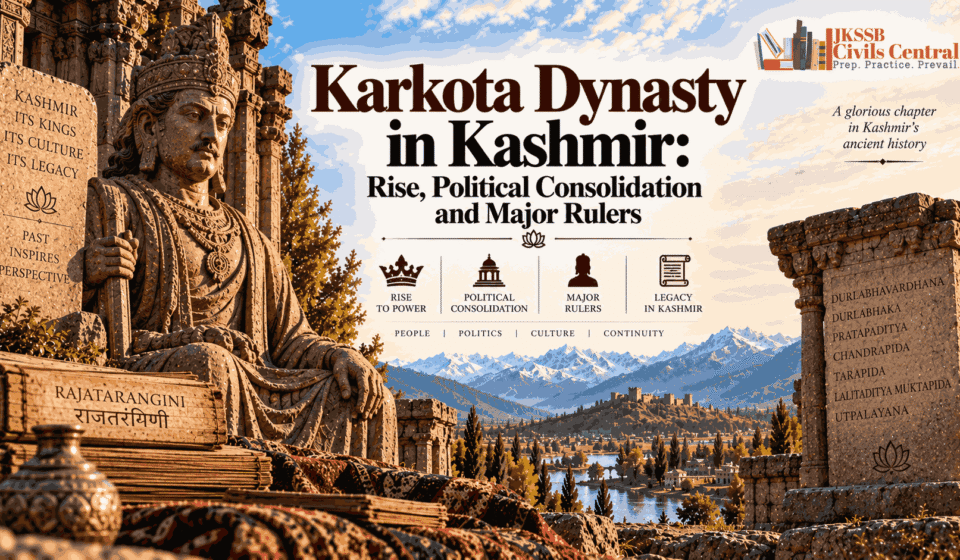
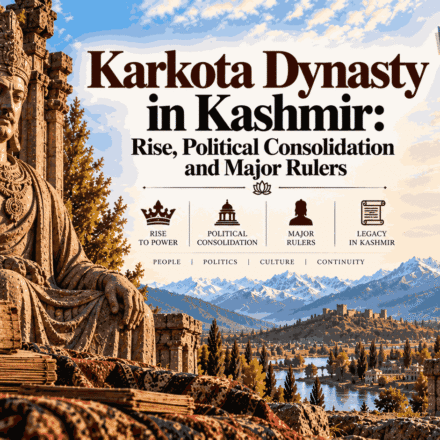
Karkota Dynasty in Kashmir: Rise, Political Consolidation and Major Rulers

J&K History Series Navigation
| Previous Article | Current Article | Next Article |
|---|---|---|
| Article 10 — Kalhana’s Rajatarangini: Structure, Sources, Historical Value and Limitations | Article 11 — Karkota Dynasty in Kashmir: Rise, Political Consolidation and Major Rulers | Article 12 — Lalitaditya Muktapida: Conquests, Kashmir’s Political Expansion and Historical Assessment |
Learning Dashboard
| Category | Key Information |
|---|---|
| Historical Period | Early Medieval Kashmir |
| Historical Phase | Karkota rule |
| Dynasty | Karkota / Kārkoṭa |
| Approximate Period | c. 7th–9th century CE; conventional chronology places the dynasty roughly from c. 625 to c. 855 CE |
| Founder | Durlabhavardhana |
| Major Rulers | Durlabhavardhana, Durlabhaka/Pratapaditya, Chandrapida, Tarapida, Lalitaditya Muktapida, Jayapida |
| Political Centre | Kashmir Valley; Parihaspura became an important royal foundation under Lalitaditya |
| Major Places | Kashmir Valley, Parihaspura, Martand, Pandrethan, Baramulla region |
| Important Sources | Rajatarangini, Chinese accounts, inscriptions, coins, archaeology, literary works |
| Major Theme | Emergence of a powerful Kashmir-based ruling house and political consolidation |
| Cultural Importance | Temple architecture, Buddhist establishments, Sanskrit literary culture and regional artistic development |
| JKSSB Importance | Very High |
| Expected Question Types | Direct fact, chronology, ruler-dynasty association, statement-based, matching, identification and comparative questions |
Introduction
The rise of the Karkota dynasty marks an important transition in the political history of Kashmir. After the complicated dynastic traditions preserved for the preceding centuries, the Karkotas emerge in the early medieval period as a ruling house whose history can be studied through a combination of literary evidence, external accounts, coins, archaeology and the later historical reconstruction of Kalhana. The dynasty is conventionally placed from about the seventh to the mid-ninth century CE, although the exact chronology of individual rulers remains a subject of historical debate.
The Karkota period is particularly important because Kashmir became more closely connected with the political world of the north-western subcontinent and the wider Himalayan region. Under the early rulers, the kingdom possessed influence beyond the immediate valley; under Lalitaditya Muktapida, the political ambitions of the dynasty expanded dramatically. Yet the history of the Karkotas should not be reduced to Lalitaditya alone. The dynasty’s development was cumulative: Durlabhavardhana established the ruling house, Durlabhaka consolidated it, Chandrapida and Tarapida governed during a period of changing regional pressures, Lalitaditya transformed its political scale, and Jayapida represents another important phase of Karkota political and cultural history.
The dynasty also left a substantial architectural and cultural legacy. Parihaspura and Martand are particularly important, while archaeological remains demonstrate that Buddhist and Brahmanical establishments existed within the same wider political environment. The Karkota period therefore provides an important case study in the interaction of political consolidation, regional power, religious patronage, architecture and literary culture in early medieval Kashmir.
CivilsCentral Historical Insight: The Karkota rise was not a single event but a process of political consolidation extending across several rulers. Lalitaditya’s later expansion was possible because the dynasty had already developed a durable political base in Kashmir.
Part I — Kashmir Before the Karkotas
The Political Background
The Karkotas emerged after a period in which Kashmir’s early dynastic history is difficult to reconstruct with precision. Kalhana’s Rajatarangini provides an extensive sequence of earlier rulers, but the chronology of its earliest books is problematic and contains substantial legendary material. By the time the narrative approaches the seventh century, however, the historical reconstruction becomes increasingly useful, particularly when literary evidence can be compared with external and archaeological material.
The Karkota emergence should therefore be understood against a background of political competition and changing regional relationships. Kashmir was not an isolated mountain kingdom disconnected from the wider subcontinent. Its geographical position connected the valley with the Punjab plains, the north-western frontier, the Himalayan regions and routes toward Central Asia and Tibet. Control of these connections gave political developments inside Kashmir significance beyond the valley itself.
The Chinese Buddhist pilgrim Xuanzang’s visit to Kashmir in the seventh century provides an important external perspective on the kingdom during the early Karkota period. His account is valuable because it does not derive from Kalhana’s later 12th-century narrative and therefore provides an independent window into seventh-century Kashmir. The use of such external evidence is particularly important when assessing the territorial and political claims preserved by later Kashmiri tradition.
Part II — Rise of the Karkota Dynasty
Durlabhavardhana and the Foundation of Karkota Rule
Durlabhavardhana is conventionally regarded as the founder of the Karkota dynasty. Kalhana places his accession in the early seventh century and associates him with the political transition that brought a new ruling house to power in Kashmir. Traditional accounts concerning his exact background and accession contain genealogical elements that should be treated cautiously; the secure historical point is his position as the first major ruler of the Karkota line in the standard dynastic reconstruction.
The chronology most commonly used places his reign approximately in the mid-seventh century, around c. 625–662 CE, although different chronological reconstructions have been proposed. The variation is important because the reign lengths preserved in Rajatarangini do not always align neatly with external chronological evidence. For examination purposes, the safest approach is to remember Durlabhavardhana as the founder of the Karkota ruling house while treating exact regnal dates as approximate.
Durlabhavardhana’s reign is particularly significant because it coincided with the visit of Xuanzang to Kashmir. The Chinese pilgrim’s account indicates that Kashmir was a substantial political entity with influence over neighbouring areas. This provides an external check on the picture of Kashmir’s regional importance during the early Karkota period.
The Karkota Name
The name of the dynasty is associated in Kalhana’s narrative with the Karkota Nāga tradition. This should be understood as part of the dynastic and sacred genealogy preserved in the literary tradition rather than as straightforward archaeological proof of the dynasty’s biological descent from a serpent deity.
The association is nevertheless historically significant because dynasties in pre-modern South Asia frequently constructed genealogical and sacred narratives to establish legitimacy. The Karkota connection with the Nāga tradition therefore illustrates the relationship between political authority, regional sacred geography and dynastic identity.
CivilsCentral Historical Insight: The foundation of Karkota rule illustrates how early medieval political legitimacy could be expressed through both political succession and sacred genealogy. For historical analysis, these two dimensions should be recognised without treating a dynastic origin legend as equivalent to independently established genealogy.
Part III — Durlabhaka / Pratapaditya and Dynastic Consolidation
Durlabhaka
Durlabhavardhana was succeeded by Durlabhaka, who is also known in the Karkota tradition as Pratapaditya. Kalhana assigns him a remarkably long reign of approximately fifty years. The exact chronology remains subject to the broader problems of reconstructing seventh- and eighth-century Kashmir, but his place in the dynastic sequence is well established within the Karkota narrative.
Durlabhaka’s importance lies less in one dramatic military episode than in the consolidation of the ruling house. A dynasty becomes politically significant not merely when it captures a throne but when succession becomes sufficiently stable for the ruling family to reproduce political authority across generations. Durlabhaka’s long reign provided such continuity and was followed by the succession of his sons.
According to Kalhana, Durlabhaka had three sons who became rulers in succession: Chandrapida, Tarapida and Lalitaditya Muktapida. This succession is one of the most important chronological chains for understanding the Karkota dynasty.
Narendraprabha and the Royal Family
Kalhana’s narrative also provides a detailed account of the royal family and its relationships. Durlabhaka’s marriage to Narendraprabha, and the succession of their sons, forms part of the dynastic story.
For examination purposes, the important connection is:
Durlabhaka / Pratapaditya → Chandrapida + Tarapida + Lalitaditya Muktapida
This relationship becomes particularly important because the three brothers represent sharply different phases of Karkota political history.
Part IV — Chandrapida and the Changing Regional Environment
Chandrapida / Vajraditya
Chandrapida, also known as Vajraditya in the dynastic tradition, succeeded Durlabhaka. His reign is generally placed in the early eighth century, although precise dates vary among chronological reconstructions.
Chandrapida is important because his reign coincided with a major transformation in the political environment of the north-western subcontinent. Arab expansion had reached Sindh in the early eighth century, following Muhammad ibn Qasim’s conquest of Sindh in 711–712 CE. The resulting changes affected the political calculations of states farther north, including Kashmir and the Himalayan frontier.
Chinese sources provide particularly important evidence for Chandrapida. The Chinese imperial court recognised the ruler of Kashmir within the diplomatic framework of the Tang period. Chandrapida’s association with Chinese diplomacy demonstrates that Kashmir was participating in a wider international political environment rather than operating solely within the politics of the Indian subcontinent.
The exact nature of the military assistance requested from China and the extent to which China actually intervened should be treated cautiously. What is secure is the existence of diplomatic contact between Kashmir and Tang China during this period.
Arab Expansion and Kashmir
The Arab conquest of Sindh created a new political reality in the north-west. It is tempting to describe this as a direct Arab invasion of the Kashmir Valley, but the evidence does not justify such a simplified account. Arab military activity reached the frontier regions connected with Kashmir, and the political developments in Sindh and the north-west influenced Kashmir’s strategic calculations.
The mountains and difficult geography of the region constrained large-scale military penetration into the Kashmir Valley. This geographical factor helps explain why the Karkota rulers could remain politically independent while simultaneously engaging in diplomacy with China and other neighbouring powers.
CivilsCentral Historical Insight: Chandrapida’s reign demonstrates that Kashmir’s early medieval history was connected to the larger geopolitical competition among the Arab Caliphate, Tang China, Tibet and north-western Indian polities. Geography did not isolate Kashmir from these developments; it shaped the form in which Kashmir responded to them.
Part V — Tarapida and the Transition to Lalitaditya
Tarapida / Udayaditya
Chandrapida was followed by his brother Tarapida, also known as Udayaditya. His reign was comparatively brief. Kalhana portrays him negatively and associates his rule with oppression and political disorder. Because this information comes principally through Kalhana’s literary narrative, the moral characterisation should not simply be reproduced as objective political fact. What is more historically important is the short duration of the reign and the transition that followed it.
Tarapida’s death opened the way for his brother Lalitaditya Muktapida, whose reign became the defining political phase of Karkota history.
The transition from Tarapida to Lalitaditya therefore represents a major turning point:
Durlabhaka’s consolidation → Chandrapida’s diplomacy → Tarapida’s short reign → Lalitaditya’s expansion
Part VI — Lalitaditya Muktapida and the Karkota Zenith
Lalitaditya Muktapida (Also Known as “SamudraGupta of Kashmir”)
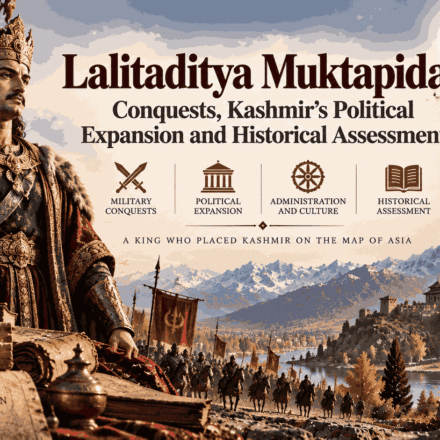
Lalitaditya Muktapida is the most famous ruler of the Karkota dynasty. His reign is conventionally placed in the eighth century, commonly around c. 724–760 CE, although the chronology of Karkota rulers has been debated by historians. Lalitaditya’s importance lies in the combination of political expansion, state-building, monumental architecture and cultural patronage associated with his reign. Kalhana describes him as an exceptionally ambitious conqueror whose campaigns extended Kashmir’s political influence across a wide geographical area.
However, the territorial claims made by Kalhana require careful historical assessment. His narrative attributes extensive conquests to Lalitaditya, reaching regions of northern India, the north-west and beyond. Some of these campaigns may preserve memories of genuine military expeditions or political interventions, but it is unsafe to translate every conquest described by Kalhana into a permanently administered empire of the geographical scale implied by the narrative.
This distinction is particularly important. Military expedition, political influence, tribute relationship and permanent territorial administration are not identical. A detailed assessment of Lalitaditya’s campaigns will be undertaken in Upcoming Article, where the evidence, chronology and historiographical debate surrounding his expansion can be examined separately.
Parihaspura
One of the most important material expressions of Lalitaditya’s rule was Parihaspura, a major royal foundation and political centre associated with him. The site lies on a plateau in the Kashmir Valley and preserves the remains of substantial religious architecture.
Archaeological work has identified a number of structures at Parihaspura, including Buddhist remains such as a stupa, monastery and chaitya. This is significant because it demonstrates that the Karkota political environment included substantial Buddhist institutions alongside Brahmanical religious foundations. The archaeological record therefore provides a more complex picture than a simple association of the dynasty with one religious tradition.
Parihaspura is consequently important not only as a royal centre but also as evidence of the scale and diversity of Karkota architectural patronage.
Martand
The Martand Sun Temple, located in the Anantnag region, is the most famous surviving architectural monument associated with Lalitaditya. The Archaeological Survey of India documentation attributes the eighth-century Sun temple to Lalitaditya Muktapida. The complex consists of a central shrine, subsidiary shrines and a large enclosed courtyard with a colonnaded peristyle.
The importance of Martand extends beyond its religious function. Its architectural scale, use of dressed stone and distinctive Kashmir setting demonstrate the development of a substantial regional architectural tradition during the Karkota period. At the same time, claims that it was simply the “oldest” or “largest” Sun temple should be avoided unless a particular authoritative comparison is being made.
The Karkota architectural tradition also reflects interaction among regional and wider artistic influences. The precise sources of individual architectural forms remain a matter for specialist study, so broad claims of direct borrowing from a particular foreign civilisation should not be presented as established fact.
CivilsCentral Historical Insight: Lalitaditya’s importance should not be measured only by the size of the territory attributed to him in Rajatarangini. Parihaspura and Martand provide material evidence that his reign was also a period of substantial royal investment in architecture, religious institutions and the visual expression of political authority.
Part VII — The Karkota State: Political Consolidation and Regional Power
From Valley Kingdom to Regional Power
The Karkota state developed in an environment where control of Kashmir’s internal resources was connected with access to surrounding regions. The valley’s agricultural base supported political institutions, while its mountain passes and river corridors connected it with the Punjab, north-western regions and trans-Himalayan routes.
The dynasty’s growing regional importance should therefore be understood through a combination of factors rather than military conquest alone. Stable succession, political authority within the valley, control of strategic routes and diplomatic relationships all contributed to the development of Karkota power.
Under Lalitaditya, these elements were combined with more ambitious military activity. Yet the evidence does not justify assuming that every region mentioned in Rajatarangini was permanently incorporated into a centrally administered Karkota state.
Relations with Neighbouring Powers
Karkota Kashmir interacted with several political centres:
- Tang China
- Tibetan powers
- north-western frontier states
- kingdoms of northern India
- Himalayan regions
- polities associated with the Punjab and Sindh frontier
These relationships were not uniform. They included diplomacy, military conflict, alliance, tribute and political competition.
The Chinese diplomatic evidence concerning Chandrapida and Lalitaditya is particularly useful because it demonstrates that Kashmir was recognised within the wider diplomatic system of the Tang world. It also provides an independent chronological framework that historians have used when assessing the dates of Karkota rulers.
Part VIII — Administration, Economy and Society
Administration: What Can Safely Be Said?
The Karkota state was a monarchy centred on the ruler and his court, but the surviving evidence does not permit a complete reconstruction of its administrative machinery in the way possible for some later states.
Rajatarangini refers to ministers, officials, military figures, landed interests and religious institutions. These references demonstrate the existence of organised political authority and a network of elite groups around the king. However, many administrative details attributed to the Karkota period in later popular accounts are derived from generalised descriptions or later terminology rather than securely documented Karkota institutions.
Therefore, it is safer to describe the Karkota state in terms of royal authority, ministers, landed elites, religious endowments and regional political relationships than to construct a detailed bureaucratic system from unsupported terminology.
Agriculture and Resources
The Kashmir Valley’s agricultural landscape provided the economic foundation for political power. Royal patronage of religious establishments and the construction of large monumental complexes necessarily depended on the mobilisation of land, labour and resources.
Land grants to Brahmins and religious institutions are part of the source tradition for the period. Such grants were not merely religious acts; they also reveal relationships between political authority, landed resources and social elites.
Society and Elite Groups
The Karkota period saw the interaction of royal authority with Brahmanical groups, Buddhist institutions, military elites and landed interests. The available evidence does not support reducing society to a single religious or ethnic category.
The coexistence of Buddhist archaeological establishments and Brahmanical temples is particularly important. It suggests a political and cultural environment in which different religious institutions could receive patronage, although the scale and nature of patronage varied across rulers and periods.
CivilsCentral Historical Insight: Karkota political power rested on more than military expansion. The dynasty required agricultural resources, elite cooperation, religious institutions and regional networks to sustain royal authority. The surviving evidence points to a politically stratified society rather than a uniform social order.
Part IX — Karkota Religion and Cultural Environment
Brahmanical Patronage
The Karkota period witnessed substantial patronage of Brahmanical religious institutions. Martand is the most prominent surviving example associated with Lalitaditya, while other foundations mentioned in literary sources demonstrate the broader importance of temple patronage.
Shaiva and Vaishnava traditions both appear in the architectural and literary record. The Karkota rulers should therefore not be treated as representing a single uniform religious policy across the entire dynasty.
Buddhist Continuity
The Karkota period also preserved important Buddhist institutions. The archaeological remains at Parihaspura include Buddhist structures, while earlier Buddhist centres in Kashmir continued to form part of the region’s religious landscape.
This is especially important because Kashmir’s Buddhist history did not end with the Mauryan or Kushan periods. Buddhism remained part of Kashmir’s intellectual and institutional environment into the early medieval period.
Cultural Development
The Karkota period is associated with the development of Kashmir’s distinctive artistic and architectural traditions. The surviving monuments demonstrate a sophisticated use of stone construction and a regional architectural vocabulary adapted to Kashmir’s geography.
The period was also significant for Sanskrit literary culture. Later accounts of Jayapida’s court connect the Karkota political environment with Sanskrit literary figures and works, although individual associations should be checked carefully rather than repeated as unquestioned court facts.
Part X — Jayapida and the Later Karkota Phase
Jayapida Vinayaditya
After Lalitaditya and a sequence of shorter reigns, Jayapida, also known as Vinayaditya, emerged as one of the most significant later Karkota rulers.
Jayapida’s reign is generally placed toward the late eighth and early ninth centuries, but exact dates differ in chronological reconstructions. His political career is described extensively by Kalhana, who presents him as an ambitious ruler involved in military campaigns and political struggles.
The historical value of Jayapida’s reign extends beyond warfare. His period is associated with an important literary environment, and the Sanskrit work Kuttanimata, attributed to Damodaragupta, is connected with his courtly milieu. Modern scholarship regards Kuttanimata as an unusually valuable source for aspects of social and urban life in Kashmir around the end of Jayapida’s reign.
Jayapida is therefore useful for demonstrating that Karkota history cannot be reduced to Lalitaditya’s military expansion. The later dynasty continued to be an important centre of political activity and Sanskrit literary culture.
The Importance of Jayapida in the Dynastic Sequence
For examination purposes, the broad sequence should be remembered:
Durlabhavardhana
↓
Durlabhaka / Pratapaditya
↓
Chandrapida
↓
Tarapida
↓
Lalitaditya Muktapida
↓
Later Karkota rulers
↓
Jayapida
The succession after Lalitaditya became increasingly unstable, and the dynasty eventually lost its political predominance. The precise sequence of the final rulers and their dates is one area where different chronological reconstructions require caution.
CivilsCentral Historical Insight: Jayapida’s reign demonstrates that the Karkota period was not simply a brief “age of conquest” centred on Lalitaditya. Its later phase remained politically and culturally significant, particularly for the development of Kashmir’s Sanskrit literary environment.
Part XI — Decline of Karkota Political Power
From Expansion to Instability
The political strength created during the earlier Karkota period did not remain constant. After Lalitaditya, a succession of relatively short reigns created greater instability, while court politics and succession disputes weakened the cohesion of the ruling house.
Jayapida’s reign temporarily restored political energy, but later Karkota rulers faced increasing instability. The dynasty’s political authority eventually gave way to the Utpala dynasty, associated with Avantivarman.
The transition should not be understood as an instantaneous collapse of every Karkota institution. Dynastic transitions generally involve overlapping elites, political factions and institutional continuities. The change from Karkota to Utpala rule therefore represents a shift in ruling house rather than a complete cultural or social break.
Approximate End of Karkota Rule
The Karkota dynasty is conventionally dated to approximately c. 625–855 CE, but the chronology of the final rulers is disputed. Some traditional regnal lists extend Karkota-associated rulers beyond dates commonly used for the dynasty’s political end because of competing chronological calculations.
For examination purposes, c. 855 CE is a useful conventional endpoint for Karkota rule and the beginning of the transition toward Utpala dominance, while exact dates for the final succession should not be overstated.
Part XII — Historical Sources for the Karkota Dynasty
1. Rajatarangini
Kalhana’s Rajatarangini is the central literary source for the dynasty. It provides the succession of rulers, political narratives, accounts of military activity, court politics and descriptions of royal foundations. Its limitations are equally important. Kalhana wrote several centuries after the earliest Karkota rulers and incorporated material from earlier traditions. Therefore, the chronology and political claims must be compared with independent evidence.
2. Chinese Sources
Chinese records are particularly important for the seventh- and eighth-century Karkota period. Xuanzang’s account provides information about Kashmir during the reign of Durlabhavardhana, while Tang diplomatic records provide evidence concerning Chandrapida and Lalitaditya. These sources are valuable precisely because they offer evidence independent of Kalhana’s 12th-century narrative.
3. Archaeology
Archaeology provides direct material evidence for Karkota-period architecture and settlement. Parihaspura is particularly important, with excavated Buddhist structures including a stupa, monastery and chaitya. Martand provides another major archaeological source for understanding Karkota monumental architecture. The ASI identifies the temple as an eighth-century construction associated with Lalitaditya Muktapida.
4. Coins and Numismatic Evidence
Coins are important for reconstructing Karkota chronology and political history, although their interpretation requires caution. A coin establishes circulation and monetary usage; it does not automatically establish the precise administrative territory of the issuing ruler.
5. Literary Works
Works associated with the Karkota period, including Kuttanimata, can provide information about social and cultural life. Such sources are not conventional political chronicles and therefore answer different historical questions.
Part XIII — Historical Interpretation: What Was the Karkota Achievement?
The Karkota period is best understood as a phase of political consolidation followed by regional expansion and cultural investment.
The first stage involved establishing and stabilising a ruling house within Kashmir. Durlabhavardhana and Durlabhaka are particularly important in this process. The second stage involved responding to a changing regional geopolitical environment, particularly during the reign of Chandrapida. The third stage, associated above all with Lalitaditya, involved a much more ambitious projection of Kashmir’s political power and the construction of monumental centres.
Yet political expansion had limits. The territories described in literary accounts cannot automatically be equated with a tightly administered empire. Early medieval political power often operated through changing combinations of direct rule, tribute, alliances, military expeditions and political influence.
The cultural legacy is more securely visible in the archaeological record. Martand and Parihaspura demonstrate the scale of Karkota architectural patronage, while the continued presence of Buddhist institutions demonstrates that the religious landscape remained plural. The dynasty’s political history and cultural history therefore need to be studied together rather than as separate narratives.
Part XIV — Karkota Dynasty: Historical Significance
The Karkota dynasty occupies a central position in the early medieval history of Kashmir for several reasons.
First, it provided a durable ruling house that consolidated political authority in Kashmir over several generations. Second, the dynasty connected Kashmir more closely with the political networks of the north-western subcontinent, the Himalayan region and Tang China. Third, Lalitaditya’s reign expanded Kashmir’s political horizons and left a substantial monumental legacy. Fourth, the Karkota period contributed to the development of Kashmir’s distinctive architectural and Sanskrit literary traditions.
The dynasty also provides an important methodological lesson. Much of what is popularly remembered about the Karkotas comes from Kalhana’s narrative, particularly his account of Lalitaditya. But archaeology and external sources allow historians to test, refine and sometimes qualify that narrative.
The Karkotas therefore matter not merely because they ruled Kashmir for roughly two centuries. They represent a formative stage in the emergence of Kashmir as a significant early medieval regional power with its own political, architectural and intellectual traditions.
CivilsCentral Historical Insight: The Karkota period demonstrates that Kashmir’s early medieval importance emerged through the interaction of geography, political consolidation, regional diplomacy, military power and cultural patronage. Its history cannot be reduced either to military conquest or to monumental architecture; both were expressions of a broader transformation in Kashmir’s regional political position.
Part XV — JKSSB Knowledge Matrix
| Question | High-Value Answer |
|---|---|
| Who founded the Karkota dynasty? | Durlabhavardhana |
| Approximate period? | c. 7th to mid-9th century CE |
| Conventional dynastic range? | c. 625–855 CE |
| Important early ruler? | Durlabhavardhana |
| Who succeeded him? | Durlabhaka / Pratapaditya |
| Durlabhaka’s sons? | Chandrapida, Tarapida and Lalitaditya |
| Who was Chandrapida? | Karkota ruler associated with Tang diplomatic contacts |
| Who followed Chandrapida? | Tarapida / Udayaditya |
| Most prominent Karkota ruler? | Lalitaditya Muktapida |
| Major monument associated with Lalitaditya? | Martand Sun Temple |
| Important royal foundation? | Parihaspura |
| Major later ruler? | Jayapida / Vinayaditya |
| Important literary source? | Rajatarangini |
| Important external source? | Chinese accounts |
| Important archaeological evidence? | Martand and Parihaspura |
| Successor dynasty? | Utpala dynasty |
| Important Utpala ruler after Karkotas? | Avantivarman |
Part XVI — Examination Discrimination Points
Durlabhavardhana vs Lalitaditya
Durlabhavardhana → founder of Karkota dynasty
Lalitaditya → most prominent expansionist ruler of the dynasty
Chandrapida vs Lalitaditya
Chandrapida → associated with Tang Chinese diplomatic recognition/contact amid regional threats
Lalitaditya → major political expansion and monumental construction
Tarapida vs Lalitaditya
Tarapida → short reign immediately preceding Lalitaditya
Lalitaditya → succeeded Tarapida
Parihaspura vs Martand
Parihaspura → royal foundation associated with Lalitaditya; important Buddhist and Brahmanical remains
Martand → major Sun temple associated with Lalitaditya
Karkota vs Utpala
Karkota → Durlabhavardhana, Lalitaditya, Jayapida
Utpala → Avantivarman, followed Karkota political dominance
Rajatarangini vs Contemporary Source
Rajatarangini → 12th-century literary chronicle
Chinese records / archaeological remains → independent evidence useful for testing aspects of Karkota history
Part XVII — JKSSB Question Pattern
Direct Fact
The Karkota dynasty is conventionally associated with which ruler as its founder?
A. Lalitaditya
B. Durlabhavardhana
C. Jayapida
D. Avantivarman
Answer: B. Durlabhavardhana
Statement-Based
Consider the following statements:
- Durlabhavardhana is regarded as the founder of the Karkota dynasty.
- Lalitaditya Muktapida succeeded Tarapida.
- Jayapida was a ruler of the Utpala dynasty.
- Martand is associated with Lalitaditya.
Which of the above are correct?
A. 1, 2 and 4 only
B. 1 and 3 only
C. 2 and 3 only
D. All four
Correct Answer: A
Explanation: Durlabhavardhana founded the Karkota line; Lalitaditya succeeded his brother Tarapida; Martand is associated with Lalitaditya. Jayapida was a later Karkota ruler, not an Utpala ruler.
Chronology
Arrange the following Karkota rulers in the correct sequence:
- Lalitaditya
- Durlabhaka
- Chandrapida
- Durlabhavardhana
- Tarapida
A. 4–2–3–5–1
B. 2–4–3–1–5
C. 4–3–2–5–1
D. 3–2–4–5–1
Correct Answer: A
Match the Following
| Ruler | Association |
|---|---|
| A. Durlabhavardhana | 1. Founder of Karkota dynasty |
| B. Chandrapida | 2. Tang diplomatic connection |
| C. Lalitaditya | 3. Martand |
| D. Jayapida | 4. Kuttanimata milieu |
Correct:
A–1, B–2, C–3, D–4
Identification by Clues
Identify the dynasty:
- Emerged in early medieval Kashmir
- Founder traditionally identified as Durlabhavardhana
- Lalitaditya was its most prominent ruler
- Associated with Martand and Parihaspura
- Eventually succeeded by the Utpala ruling house
A. Karkota
B. Lohara
C. Utpala
D. Shah Mir
Answer: A. Karkota
Conceptual-Factual
Why should Lalitaditya’s territorial expansion described by Kalhana be treated cautiously?
A. Kalhana never mentioned Lalitaditya.
B. All evidence about Lalitaditya comes from coins alone.
C. Literary descriptions of conquest do not automatically prove permanent administrative control over every region mentioned.
D. Lalitaditya was not a Karkota ruler.
Answer: C
Part XVIII — JKSSB Practice Questions
Q1. Who is conventionally regarded as the founder of the Karkota dynasty?
A. Chandrapida
B. Durlabhavardhana
C. Lalitaditya
D. Jayapida
Answer: B
Q2. Which of the following represents the correct succession?
A. Durlabhavardhana → Durlabhaka → Chandrapida → Tarapida → Lalitaditya
B. Durlabhaka → Durlabhavardhana → Tarapida → Chandrapida → Lalitaditya
C. Durlabhavardhana → Chandrapida → Durlabhaka → Lalitaditya → Tarapida
D. Chandrapida → Durlabhaka → Tarapida → Durlabhavardhana → Lalitaditya
Answer: A
Q3. Which ruler is associated with the Martand Sun Temple?
A. Durlabhavardhana
B. Chandrapida
C. Lalitaditya Muktapida
D. Jayapida
Answer: C
The ASI identifies the eighth-century Sun temple at Martand with Lalitaditya Muktapida.
Q4. Which of the following places is particularly associated with Lalitaditya’s royal foundation?
A. Parihaspura
B. Avantipura
C. Srinagar Fort
D. Akhnoor Fort
Answer: A
Q5. Which ruler was associated with diplomatic contact with Tang China?
A. Chandrapida
B. Avantivarman
C. Shankaravarman
D. Didda
Answer: A
Q6. Consider the following statements:
- Parihaspura contains archaeological remains of Buddhist establishments.
- Martand is associated with Lalitaditya.
- The Karkota period was exclusively Buddhist.
- The Karkota period saw substantial Brahmanical architectural patronage.
Which are correct?
A. 1, 2 and 4 only
B. 1 and 3 only
C. 2 and 3 only
D. All four
Answer: A
Explanation: Archaeology at Parihaspura includes Buddhist structures, while Martand represents major Brahmanical/Solar architecture. The religious environment cannot be described as exclusively Buddhist.
Q7. Jayapida is important not only politically but also in connection with:
A. Kuttanimata and Sanskrit literary culture
B. Treaty of Amritsar
C. Naya Kashmir
D. Mughal gardens
Answer: A
- Kuttanimata* is attributed to Damodaragupta and is associated with Jayapida’s courtly environment.
Q8. The Karkota dynasty was followed by:
A. Lohara dynasty
B. Utpala dynasty
C. Shah Mir dynasty
D. Dogra dynasty
Answer: B
Q9. Which source provides an external perspective on Kashmir during the early Karkota period?
A. Xuanzang’s account
B. Ain-i-Akbari
C. Tuzuk-i-Jahangiri
D. Baharistan-i-Shahi
Answer: A
Q10. Which statement best reflects the historical significance of the Karkota period?
A. It was important only because of one temple.
B. It marked a phase of political consolidation, regional expansion and cultural development in Kashmir.
C. It ended Buddhism in Kashmir.
D. It created the Dogra State.
Answer: B
Part XIX — Rapid Revision Zone
Important Rulers
Durlabhavardhana
→ Founder of Karkota dynasty
Durlabhaka / Pratapaditya
→ Successor; long reign in Kalhana’s account
Chandrapida / Vajraditya
→ Tang diplomatic connection; early eighth-century ruler
Tarapida / Udayaditya
→ Short reign before Lalitaditya
Lalitaditya Muktapida
→ Most prominent Karkota ruler; major expansion; Martand; Parihaspura
Jayapida / Vinayaditya
→ Important later ruler; political and literary significance
Important Places
| Place | Karkota Association |
|---|---|
| Parihaspura | Major royal foundation associated with Lalitaditya |
| Martand | Sun temple associated with Lalitaditya |
| Kashmir Valley | Core political territory of the dynasty |
| Pandrethan | Important wider Kashmir architectural landscape; do not confuse its later monuments with Martand |
| Baramulla region | Important geographical and archaeological context |
Important Sources
- Rajatarangini
- Chinese accounts
- Tang diplomatic records
- Archaeology
- Coins
- Inscriptions
- Sanskrit literary works
Important Associations
Durlabhavardhana → Founder
Durlabhaka → Pratapaditya
Chandrapida → Tang diplomatic contact
Tarapida → Udayaditya
Lalitaditya → Martand + Parihaspura
Jayapida → Vinayaditya + Kuttanimata milieu
Karkota → Utpala succession
Part XX — Chronological Sequence
Core Sequence
Durlabhavardhana
↓
Durlabhaka / Pratapaditya
↓
Chandrapida
↓
Tarapida
↓
Lalitaditya Muktapida
↓
Later Karkota rulers
↓
Jayapida
↓
Later Karkota instability
↓
Utpala dynasty / Avantivarman
Wider Dynastic Sequence
Earlier Kashmir dynastic traditions
↓
Karkota
↓
Utpala
↓
Lohara
This sequence is more important for JKSSB than memorising every disputed regnal year.
Part XXI — Frequently Confused Facts
| Fact 1 | Fact 2 | Correct Distinction |
|---|---|---|
| Durlabhavardhana | Lalitaditya | Founder vs most prominent expansionist ruler |
| Chandrapida | Tarapida | Brothers; Chandrapida preceded Tarapida |
| Tarapida | Lalitaditya | Tarapida preceded Lalitaditya |
| Martand | Parihaspura | Sun temple vs royal foundation with multiple religious structures |
| Karkota | Utpala | Earlier dynasty vs successor ruling house |
| Lalitaditya | Jayapida | Major expansionist ruler vs important later Karkota ruler |
| Rajatarangini | Chinese accounts | Later Kashmiri chronicle vs external near-contemporary evidence |
| Political influence | Direct administration | Influence/tribute/expedition does not necessarily equal permanent annexation |
| Karkota religion | Exclusive religious identity | Evidence shows both Brahmanical and Buddhist institutions |
| Conventional dates | Absolute dates | Karkota chronology has scholarly disputes |
Part XXII — What Can JKSSB Ask?
High-value question areas include:
- Founder of the Karkota dynasty
- Correct Karkota succession
- Durlabhaka’s alternate name
- Chandrapida and Tang China
- Tarapida’s position in the succession
- Lalitaditya’s association with Martand
- Lalitaditya and Parihaspura
- Jayapida and later Karkota history
- Karkota vs Utpala chronology
- Rajatarangini as the principal literary source
- Chinese accounts as external evidence
- Buddhist remains at Parihaspura
- Karkota religious patronage
- Difference between literary conquest claims and proven territorial administration
- Chronology-based statement questions
- Ruler–monument matching
- Dynasty–ruler matching
- Source-based questions
Chapter Summary
The Karkota dynasty emerged in early medieval Kashmir under Durlabhavardhana and developed into a major regional ruling house over the following generations. Durlabhaka strengthened dynastic continuity, while Chandrapida’s reign demonstrates Kashmir’s involvement in the wider geopolitical environment created by Arab expansion, Tang China and Himalayan politics.
The accession of Lalitaditya Muktapida marked a major turning point. His reign is associated with extensive military activity, a significant expansion of Kashmir’s political horizons and major architectural foundations, particularly Parihaspura and the Martand Sun Temple. The archaeological record at Parihaspura also demonstrates the continued importance of Buddhist establishments within the broader Karkota cultural environment.
The later Karkota period remained politically and culturally significant, particularly under Jayapida, whose reign is connected with a notable Sanskrit literary environment. Eventually, dynastic instability weakened Karkota political dominance and prepared the ground for the rise of the Utpala dynasty.
The most important historical lesson is that Karkota power developed through dynastic consolidation → regional diplomacy → political expansion → monumental patronage → later succession problems. The dynasty’s history must be reconstructed by combining Rajatarangini with Chinese records, archaeology, coins and other evidence rather than relying on any one source.
JKSSB Takeaway
Remember the core chain:
Karkota → Durlabhavardhana → Durlabhaka/Pratapaditya → Chandrapida → Tarapida → Lalitaditya Muktapida → Jayapida → Utpala transition
And remember the three highest-value associations:
Durlabhavardhana = Founder
Lalitaditya = Martand + Parihaspura + major expansion
Jayapida = Later Karkota phase + literary milieu
Mind Map
EARLY MEDIEVAL KASHMIR
↓
POLITICAL TRANSITION
↓
DURLABHAVARDHANA
→ Foundation of Karkota rule
↓
DURLABHAKA / PRATAPADITYA
→ Dynastic consolidation
↓
CHANDRAPIDA
→ Tang diplomatic connections
→ Arab frontier context
↓
TARAPIDA
→ Short transitional reign
↓
LALITADITYA MUKTAPIDA
→ Political expansion
→ Parihaspura
→ Martand
→ Cultural patronage
↓
LATER KARKOTA RULERS
↓
JAYAPIDA
→ Political activity
→ Sanskrit literary environment
↓
DYNASTIC INSTABILITY
↓
UTPALA DYNASTY
↓
AVANTIVARMAN
FAQs
1. Who founded the Karkota dynasty?
Durlabhavardhana is conventionally regarded as the founder of the Karkota dynasty.
2. When did the Karkota dynasty rule Kashmir?
The dynasty is conventionally placed from approximately the seventh century to the mid-ninth century CE, often given as c. 625–855 CE. Exact dates for individual rulers remain debated.
3. Who was the most prominent Karkota ruler?
Lalitaditya Muktapida is generally regarded as the most prominent ruler of the dynasty because of the political expansion and monumental building activity associated with his reign.
4. Which monument is associated with Lalitaditya?
The Martand Sun Temple in the Anantnag region is associated with Lalitaditya Muktapida. The ASI dates the temple to the eighth century and identifies Lalitaditya as its builder.
5. What was Parihaspura?
Parihaspura was a major royal foundation associated with Lalitaditya. Its archaeological remains include substantial Buddhist structures as well as evidence of wider religious and architectural patronage.
6. Who succeeded Durlabhavardhana?
He was succeeded by Durlabhaka, also known as Pratapaditya in the Karkota tradition.
7. Who were Durlabhaka’s sons?
The three principal sons named in the dynastic tradition are Chandrapida, Tarapida and Lalitaditya.
8. Why is Chandrapida important?
Chandrapida is important partly because Chinese/Tang records provide evidence of diplomatic interaction involving the ruler of Kashmir during the early eighth century.
9. Was Kashmir under the Karkotas exclusively Hindu?
That would be an oversimplification. The Karkota period saw substantial Brahmanical patronage, but archaeological evidence also demonstrates Buddhist establishments, including those at Parihaspura.
10. Which dynasty succeeded the Karkotas?
The Utpala dynasty, associated particularly with Avantivarman, succeeded Karkota political dominance in Kashmir.
About The Author




[…] Article 11 — Karkota Dynasty in Kashmir: Rise, Political Consolidation and Major Rulers […]