
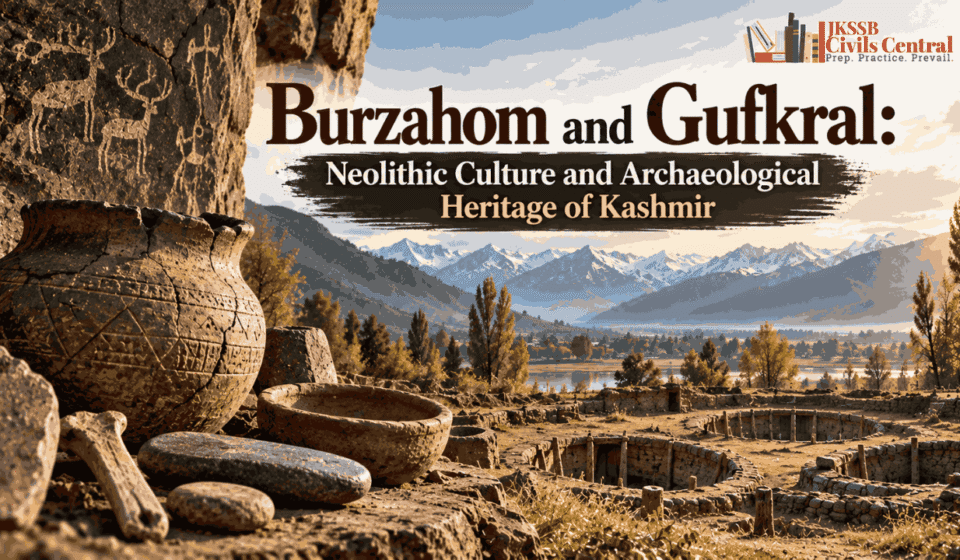
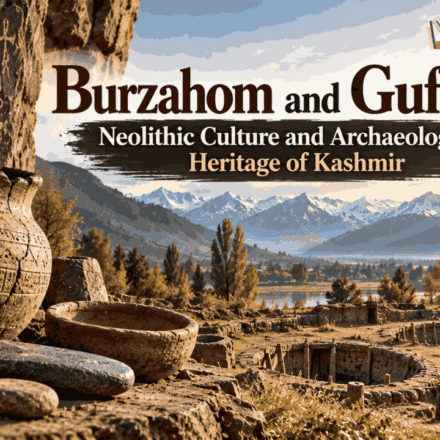
Burzahom and Gufkral: Neolithic Culture and Archaeological Heritage of Kashmir

J&K History Series Navigation
| Previous Article | Current Article | Next Article |
|---|---|---|
| Article 01 — Prehistoric Jammu & Kashmir: Archaeological Evidence, Neolithic Culture and Early Human Settlements | Article 02 — Burzahom and Gufkral: Neolithic Culture and Archaeological Heritage of Kashmir | Article 03 — Megalithic and Early Cultural Developments in Jammu & Kashmir |
Learning Dashboard
| Component | Key Information |
|---|---|
| Historical Period | Prehistoric / Neolithic to Megalithic |
| Historical Phase | Neolithic Kashmir and its subsequent cultural developments |
| Main Sites | Burzahom and Gufkral |
| Geographical Area | Kashmir Valley |
| Core Theme | Settlement, subsistence, tools, pottery, burials and cultural change |
| Major Archaeological Features | Pit dwellings, stone and bone tools, pottery, agricultural remains, burials, menhirs |
| Important Personalities | T. N. Khazanchi; K. D. Banerjee; A. K. Sharma |
| Key Evidence | Archaeological remains, stratigraphy, radiocarbon dating, plant and animal remains |
| Key Source Institutions | Archaeological Survey of India and archaeological scholarship |
| JKSSB Importance | Very High |
| High-Value Question Types | Direct fact, statement-based, matching, chronology, identification by clues, comparative |
Introduction
The Neolithic archaeology of Kashmir occupies a distinctive position in the prehistoric history of the north-western Indian subcontinent. Among the numerous archaeological sites discovered in the Kashmir Valley, Burzahom and Gufkral are particularly important because their excavations revealed substantial evidence for changing patterns of settlement, subsistence, technology and material culture. Together, they show that the emergence of food production in Kashmir was not a single uniform event but a longer process involving hunting, animal management, cultivation, technological adaptation and changes in domestic architecture.
Burzahom, situated in the Srinagar region, became the best-known archaeological site of prehistoric Kashmir because of its characteristic subterranean or pit-dwelling structures, extensive stone and bone tool assemblage, burials and later megalithic remains. The Archaeological Survey of India undertook extensive excavations there between 1960 and 1971 under T. N. Khazanchi, following earlier investigations by H. de Terra and T. T. Paterson in the 1930s.
Gufkral, in south Kashmir, provides an equally important but somewhat different archaeological sequence. Excavated by the Prehistory Branch of the Archaeological Survey of India in 1981–82, it produced evidence ranging from an Aceramic Neolithic phase through later Neolithic and Megalithic occupation to a historical phase. Its sequence is particularly valuable for understanding the transition from pit-based settlement to more surface-oriented habitation and for examining changes in tools, pottery, agriculture, animal domestication and metallurgy.
The importance of these sites therefore lies not simply in the fact that they are “old archaeological sites.” Their real value lies in the archaeological record they preserve: how communities lived, obtained food, made tools, constructed houses, buried their dead and modified their material culture over time. For JKSSB preparation, the crucial task is to understand these relationships rather than memorise isolated facts.
CivilsCentral Historical Insight
Burzahom and Gufkral demonstrate that prehistoric Kashmir cannot be understood through a simple transition from “hunter-gatherers” to “farmers.” Archaeology reveals a gradual and regionally varied process in which hunting, cultivation, animal domestication, craft production and changing settlement forms coexisted and interacted.
Part I — The Archaeological Setting of Burzahom and Gufkral
1. Kashmir Valley and the Karewa Landscape
The geographical setting of Kashmir played an important role in the development of prehistoric settlements. The Kashmir Valley contains extensive Karewa formations, elevated deposits and terraces that provided relatively stable surfaces for human occupation. These formations, together with lakes, wetlands, streams, forests and surrounding mountain zones, created a varied ecological environment in which prehistoric communities could exploit multiple resources.
Burzahom lies in the Srinagar region, approximately northeast of Srinagar and close to the Dal Lake area. Its setting included access to water bodies, wetlands and surrounding uplands, providing opportunities for hunting, fishing, gathering and eventually cultivation. The archaeological evidence must therefore be interpreted against a landscape rather than as an isolated settlement.
Gufkral is located in south Kashmir on an extensive upper Karewa terrace in the Tral area. The Archaeological Survey of India’s report records its excavation by the Prehistory Branch in 1981 and 1982, specifically to investigate the cultural sequence and suspected Aceramic Neolithic level as well as the plant and animal remains associated with different periods.
The two sites thus belong to the same broader archaeological tradition but occupy different geographical settings within the Kashmir Valley. Their comparison is useful precisely because it allows historians and archaeologists to distinguish shared regional characteristics from local variations.
CivilsCentral Historical Insight
Geography did not determine prehistoric culture in a mechanical way, but it shaped the opportunities available to human communities. The contrasting locations of Burzahom and Gufkral help explain why the Kashmir Neolithic should be viewed as a regional archaeological phenomenon rather than as a single settlement culture reproduced identically everywhere.
Part II — Burzahom: Excavation and Archaeological Sequence
Discovery and Excavation
Burzahom was first investigated archaeologically in the 1930s by the Yale-Cambridge expedition led by H. de Terra and T. T. Paterson during their work on Himalayan glaciation and early human evidence. Their trial investigations drew attention to the archaeological potential of the site. More systematic work followed after the State Department of Archaeology of Jammu and Kashmir was merged with the Archaeological Survey of India in 1959.
Extensive excavations were subsequently undertaken at Burzahom from 1960 to 1971, under the direction of T. N. Khazanchi. The ASI’s later detailed publication on the excavations describes Burzahom as the first extensively excavated habitation site of its particular kind in Jammu and Kashmir and emphasises its importance in establishing the archaeological significance of the Valley’s prehistoric food-producing communities.
The excavations revealed a sequence of occupation extending from the Neolithic through a later Megalithic phase and into an early historical phase. The exact chronological framework has been refined through subsequent research, so it is safer to treat the broad cultural sequence as more secure than any single rigid date range.
The Burzahom Pit Dwellings
The most distinctive archaeological feature associated with Burzahom is its pit-dwelling architecture.
During the earlier occupation, people excavated circular or oval pits into the compact Karewa soil. Some pits were relatively shallow, while others were considerably deeper. Their sides and floors show evidence of human modification, and post-holes around the upper edges indicate that superstructures were constructed above the pits.
The architectural arrangement suggests that the excavated depression formed part of a living space rather than simply being a refuse or storage feature. Hearths and other occupation remains occur in association with the pits, while storage features were also found around some dwelling complexes. UNESCO’s Tentative List description records pits that were circular or oval in plan, narrow near the top and wider toward the base, with post-holes suggesting a covering or superstructure.
The precise reason for the pit-dwelling form, however, should not be reduced to a single explanation. Climatic adaptation is one important interpretation because subterranean spaces can provide protection from severe seasonal conditions. At the same time, archaeological interpretation must remain cautious because a settlement form can perform several functions simultaneously, and the evidence does not justify treating the pits simply as “winter houses” without qualification.
The importance of the Burzahom pits therefore lies in what they reveal about architectural adaptation. Instead of constructing every dwelling entirely above ground, the inhabitants modified the landscape itself and combined excavated spaces with surface structures.
Why Are Burzahom Pit Dwellings Important?
They demonstrate:
- deliberate modification of the natural Karewa surface;
- circular or oval subterranean habitation spaces;
- use of post-holes for superstructures;
- association with hearths and storage facilities;
- adaptation of settlement architecture to local environmental conditions;
- a distinctive feature of the Northern Neolithic archaeological tradition.
Tools and Technology at Burzahom
The archaeological assemblage from Burzahom is notable for the variety of stone and bone implements.
Stone tools included axes, chisels, adzes, picks, points, pounders and other implements associated with hunting, woodworking, processing and agricultural activities. Bone and antler were also important raw materials, producing objects such as harpoons, needles, awls, arrowheads, spear-points and other specialised tools. UNESCO’s archaeological description specifically records the presence of harpoons, needles, awls, spear-points, arrowheads, daggers, scrapers, axes, chisels, adzes, pounders and related implements.
This material culture is significant because it demonstrates that Neolithic technology was not restricted to a single “farming tool kit.” The same community could possess implements associated with hunting, animal processing, woodworking, cultivation and craft activities.
The presence of bone and antler technology is particularly important for distinguishing Kashmir’s archaeological record from simplified descriptions of Neolithic culture that focus exclusively on polished stone tools. At Burzahom, different materials were selected for different technological purposes.
Part III — Subsistence: Hunting, Agriculture and Animal Domestication
From Food Gathering to Food Production
One of the most important questions raised by Burzahom and Gufkral is how the inhabitants obtained their food. The archaeological record indicates a combination of hunting, gathering, cultivation and animal domestication rather than an immediate replacement of one economic system by another. This is an important distinction for understanding the Neolithic transition in Kashmir.
At Burzahom, archaeological evidence points to the cultivation of crops including wheat, barley and lentil. The UNESCO Tentative List identifies agricultural evidence through tools and palaeobotanical analysis and associates the site with wheat, barley and lentil cultivation.
At Gufkral, archaeobotanical and faunal evidence similarly indicates a mixed subsistence system. The earlier phases yielded evidence of wheat, barley and lentil, while later phases show changes in the range of cultivated and domesticated resources. The published archaeological sequence records domesticated sheep and goat in the earlier phases and later evidence for cattle and other domesticated animals.
The significance of this evidence is greater than the simple statement that “Neolithic people practised agriculture.” It shows that the emergence of food production in Kashmir involved economic diversification. Hunting did not necessarily disappear when cultivation began, and domesticated animals were added to rather than immediately replacing wild resources.
Animal Domestication
Animal remains provide another important dimension of the Neolithic economy. At Gufkral, the archaeological sequence records domesticated sheep and goat in its early phase, followed by evidence for cattle and other domesticated animals. Wild species continued to be represented, demonstrating that hunting and animal management coexisted for substantial periods.
This distinction is essential. The presence of domesticated animals does not mean that the inhabitants ceased hunting. Instead, the archaeological evidence suggests a mixed subsistence economy in which domesticated and wild animals were both exploited.
At Burzahom, animal remains similarly contribute to the reconstruction of the community’s economy. The site is especially notable for unusual dog-associated burials, discussed separately below because they are more significant archaeologically than a simple statement about domestication.
CivilsCentral Historical Insight
The Neolithic transition in Kashmir was not a clean economic break between “hunting” and “farming.” Burzahom and Gufkral show a mixed economy in which cultivation, animal domestication and exploitation of wild resources interacted over time.
Part IV — Burials, Ritual Behaviour and the Human Remains
Burials at Burzahom
Burial evidence provides an unusually valuable window into the social and cultural practices of prehistoric Kashmir. At Burzahom, burials occur in pits associated with habitation areas. Human skeletons were found in different positions, including crouched or flexed arrangements, and some burials were associated with animal remains. The UNESCO description records red ochre associated with some burials and notes both human and animal skeletal remains.
One particularly striking category consists of dog burials and animal-associated burial contexts. These finds are important because they raise questions about the relationship between humans and animals within the community. However, the exact social or ritual meaning of such burials cannot be established simply from the presence of animal remains.
Archaeology can establish the physical association between human activity and animal remains; interpreting the beliefs behind that association requires greater caution.
Trepanation
Burzahom is also widely discussed because of evidence interpreted as trepanation, the surgical opening or modification of the human skull. The UNESCO Tentative List records seven complete and four incomplete examples of trepanation from the site.
This is a high-value examination fact, but it requires careful historical interpretation. The existence of cranial modification can be archaeologically investigated, whereas the precise medical, ritual or cultural motivation behind the practice is more difficult to establish.
Therefore, a statement such as “trepanation has been reported at Burzahom” is much safer than claiming that the practice definitely had a particular religious or medical purpose.
The Engraved Hunting Scene
Another important cultural find from Burzahom is an engraved stone depicting a hunting scene, associated with representations interpreted as including human figures, a dog and a solar element. UNESCO’s description identifies this as evidence of art-producing behaviour at the site.
The engraving is significant because it provides evidence that prehistoric material culture was not limited to utilitarian tools. Symbolic or representational behaviour formed another component of the archaeological record.
Its interpretation, however, should remain appropriately cautious. The existence of an engraved scene is archaeological evidence; the precise symbolic meaning intended by its maker is an interpretive question.
CivilsCentral Historical Insight
Burzahom’s burials, animal associations, trepanation evidence and engraved art show that the Neolithic community cannot be reconstructed only through its economy. Archaeology also reveals practices concerning death, the human-animal relationship and symbolic expression, although the meanings behind these practices remain partly inaccessible.
Part V — Gufkral: A Distinctive Neolithic Sequence
Location and Excavation
Gufkral is situated in south Kashmir, in the Tral area, on an extensive upper Karewa terrace. The site was excavated by the Prehistory Branch of the Archaeological Survey of India in 1981 and 1982 under K. D. Banerjee and A. K. Sharma. The excavations were designed in part to investigate a suspected Aceramic Neolithic level and to reconstruct the floral and faunal assemblages associated with successive occupation periods.
The importance of Gufkral lies particularly in its stratified cultural sequence. The archaeological record was divided into successive phases, traditionally described as:
- Period IA — Aceramic Neolithic
- Period IB — Early Neolithic
- Period IC — Late Neolithic
- Period II — Megalithic
- Period III — Historical
The chronological values attached to these phases have been refined and debated as radiocarbon calibration methods and new samples have become available. Therefore, students should remember the sequence first and treat individual date ranges as archaeological reconstructions rather than immutable numbers.
The Aceramic Neolithic at Gufkral
One of Gufkral’s most important features is the identification of an Aceramic Neolithic phase.
“Aceramic” means that the archaeological phase is characterised by an absence or very limited presence of pottery. It does not mean that the inhabitants lacked a developed material culture. Gufkral’s early phase contained stone tools, bone and horn implements, querns and other evidence of domestic and subsistence activities. Archaeological summaries of the Gufkral sequence also associate this phase with wheat, barley and lentil and with both wild and domesticated animals.
This makes Gufkral particularly useful for understanding the relationship between technological and economic change. Pottery is only one part of material culture; the emergence of agriculture and animal domestication does not necessarily occur simultaneously with pottery production.
Settlement Pattern at Gufkral
The early Gufkral settlement included dwelling pits resembling those known from Burzahom. Excavated evidence indicates dwelling pits accompanied by storage pits and hearths, with post-holes around some of the structures.
However, an important transformation occurred in the subsequent phases. The archaeological sequence indicates a gradual disappearance of dwelling pits and the emergence of surface structures constructed with compacted clay or mud. This change is particularly valuable because it provides evidence for architectural transformation within the same broader cultural sequence.
Thus, Gufkral should not be remembered simply as another “pit-dwelling site.” It is important precisely because its sequence demonstrates that settlement architecture changed over time.
Part VI — Pottery and Technological Development at Gufkral
From Aceramic to Ceramic Neolithic
The emergence of pottery represents an important technological development in the Gufkral sequence. The early Aceramic phase was followed by handmade pottery, including coarse grey ware, while later levels produced a wider ceramic repertoire including grey, burnished grey, red and black varieties.
The development of pottery should not be interpreted merely as an improvement in “technology.” Pottery could affect food preparation, storage, transport and household organisation. Changes in ceramic forms therefore form part of a wider transformation in domestic and economic life.
The archaeological record at Gufkral also contains querns, pounders and specialised harvesting implements, indicating increasing diversification of activities associated with food processing and production.
Stone, Bone and Copper
Gufkral’s tool assemblage includes polished stone celts, points, needles, harpoons, scrapers, querns and other implements. Bone technology remained important, particularly in the production of needles and other specialised objects. Later phases also yielded copper objects.
The coexistence of stone, bone and metal illustrates another important feature of prehistoric technological change: new materials did not necessarily replace older ones immediately. Communities could continue using stone and bone while experimenting with or adopting copper and, in later contexts, iron.
This is why technological “progress” should not be presented as a simple linear sequence in which one material completely replaces another.
Part VII — Gufkral and the Megalithic Phase
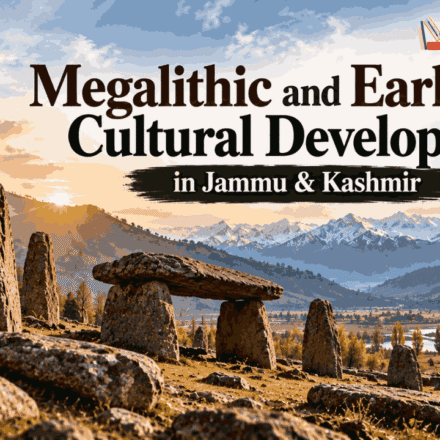
Menhirs at Gufkral
The later archaeological sequence at Gufkral is associated with large stone monuments or menhirs. An Archaeological Survey of India publication identifies Period II as the Megalithic period and associates it with the erection of menhirs, the introduction of rice and millet cultivation and the use of iron. It gives an uncalibrated radiocarbon bracket for this phase of approximately 1550–1100 BCE.
Later archaeological research has drawn attention to the need to reassess how the “Megalithic” phase of Kashmir should be defined and dated. At Gufkral, the menhirs did not have deep foundation pits, and some scholars have questioned whether their presence alone should be treated as evidence of a completely separate cultural phase.
This debate is important because it illustrates the difference between archaeological observation and historical interpretation.
The observation is: Large stone monuments or menhirs are associated with a later phase of the Gufkral archaeological sequence.
The interpretation of what this represents — a new population, a new cultural phase, an extension of Neolithic society or a more complex transition — remains open to scholarly discussion.
The Number and Condition of the Menhirs
Modern descriptions of Gufkral’s menhirs record a group of large stones, most of which are now fallen. One recent archaeological study records sixteen menhirs at the site and notes that they vary considerably in size. The same study cautions that the original arrangement is difficult to reconstruct because of their present condition.
This condition creates an important methodological problem. Archaeologists are often reconstructing a prehistoric arrangement from stones that have fallen, shifted or been disturbed over long periods. Therefore, suggestions about their original pattern should be identified as interpretations or reconstructions, not as directly observed facts.
Part VIII — Burzahom and Gufkral Compared
The greatest examination value of these two sites emerges when they are studied together.
| Feature | Burzahom | Gufkral |
|---|---|---|
| Region | Srinagar area, Kashmir Valley | South Kashmir, Tral area |
| Major Archaeological Importance | Pit dwellings, tools, burials, art and later menhirs | Stratified Neolithic–Megalithic sequence |
| Excavation | Extensive ASI excavations, 1960–1971 | ASI excavation, 1981–82 |
| Important Archaeologist(s) | T. N. Khazanchi | K. D. Banerjee and A. K. Sharma |
| Pit Dwellings | Major characteristic | Present in early phase |
| Aceramic Phase | Traditionally not separately recognised in the same way as Gufkral | Explicitly identified as Period IA |
| Pottery | Appears in later Neolithic phase | Develops through successive phases |
| Stone Tools | Extensive | Extensive |
| Bone Tools | Extensive | Extensive |
| Agriculture | Wheat, barley, lentil | Wheat, barley, lentil; later changes in crop evidence |
| Animal Economy | Hunting plus domestication | Hunting plus domestication |
| Burials | Important and distinctive | Less central to the site’s popular identification |
| Trepanation | Reported | Not the characteristic association |
| Engraved Hunting Scene | Important artistic find | Not the defining feature |
| Menhirs | Present in later sequence | Present in later sequence |
| Later Cultural Development | Megalithic and Early Historic phases | Megalithic and Historical phases |
| Major Exam Association | Pit dwellings, burials, trepanation, hunting engraving | Aceramic Neolithic, settlement sequence, menhirs |
The table should not be interpreted as suggesting that the sites were culturally unrelated. On the contrary, their similarities are evidence for broader regional connections, while their differences demonstrate local variation.
CivilsCentral Historical Insight
Burzahom and Gufkral should be studied comparatively rather than as two disconnected archaeological sites. Burzahom is especially valuable for its distinctive architecture, burials and symbolic evidence, while Gufkral is especially valuable for its stratified sequence showing changes from Aceramic Neolithic settlement through later Neolithic and Megalithic phases.
Part IX — Chronology and the Problem of Dating
Why Archaeological Dates Must Be Used Carefully
Dating prehistoric sites is not always a matter of assigning one fixed year to an entire settlement. Archaeological sites often contain multiple occupation layers, and different samples may produce different radiocarbon ranges. Older publications frequently used radiocarbon dates in forms that differ from modern calibrated chronologies. Newer research has also introduced additional dates from previously under-studied sites and exposed sections.
A 2026 study using AMS radiocarbon dating on material from Gufkral Extension, Hariparigam and Qasim Bagh produced calibrated dates ranging approximately from 2890 to 516 BCE, with a substantial part of the sampled Neolithic occupation falling between approximately 2500 and 2200 BCE. The study also notes that the new dates broadly correspond with established chronologies for excavated Kashmir Neolithic sites while refining the chronology of individual contexts.
This is important for students because it shows that prehistoric chronology remains an active area of archaeological research.
A Safe Chronological Framework
For examination preparation, the following sequence is safer than memorising one rigid set of dates:
Aceramic Neolithic
↓
Early / Ceramic Neolithic
↓
Later Neolithic developments
↓
Megalithic / Menhir-associated phase
↓
Historical occupation
Gufkral provides an especially clear example of this sequence through its traditional division into Period IA, IB, IC, II and III. At Burzahom, the conventional archaeological sequence similarly distinguishes earlier and later Neolithic occupation followed by a later megalithic and early historical sequence. UNESCO’s Tentative List describes four broad periods extending from the Neolithic through the Megalithic to the Early Historic period.
Part X — The Archaeological Interpretation of Pit Dwellings
The pit dwellings of Burzahom and Gufkral have generated considerable interest because they differ from the above-ground architecture familiar from many other prehistoric settlements. One interpretation emphasises environmental adaptation. Kashmir experiences severe winters, and partially subterranean spaces could have helped moderate temperature and provide protection from weather. The construction of superstructures over the pits would have created enclosed living spaces.
However, the evidence does not permit a single universal explanation. Some pits were shallower than others, and the archaeological association of pits with storage facilities and hearths means that different subterranean features may not necessarily have served exactly the same function. UNESCO itself notes that some shallower pits may have been used for storage or seasonal purposes.
The archaeological lesson is therefore important: a distinctive structure does not automatically have a single function.
For examination purposes, the safe association is: Burzahom → characteristic subterranean/pit dwellings
but the explanatory statement should be: The precise function and use of individual pits requires archaeological interpretation and should not be reduced to a single simplistic explanation.
Part XI — Cultural Contacts and the Wider Northern Neolithic
Burzahom and Gufkral were not isolated from the wider prehistoric world.
Comparative archaeology has identified similarities between the Kashmir Neolithic and archaeological traditions in neighbouring regions, including the Swat Valley, Potwar region and parts of the western Himalayan zone. The ASI’s Burzahom publication notes that subsequent discoveries in Kashmir and neighbouring regions helped scholars recognise a broader Northern Neolithic cultural tradition and identify shared as well as regional characteristics.
However, cultural similarity should not automatically be interpreted as evidence for mass migration or direct colonisation. Similar tools, pottery forms or subsistence practices can result from contact, exchange, parallel adaptation or movement of small groups and ideas.
The Burzahom evidence has therefore been used to investigate interaction between Kashmir and neighbouring regions, but such interaction should be described in terms of archaeological evidence and scholarly interpretation, rather than assuming a single migration narrative.
Part XII — Agriculture and the Question of Cultural Transformation
The development of agriculture in Kashmir should be viewed as a long-term process. The archaeological evidence from Burzahom and Gufkral includes wheat, barley and lentil, while Gufkral’s later sequence records changes in the crop assemblage. At the same time, hunting and the exploitation of wild animals remained important.
This indicates that food production developed within an already diverse ecological economy. Rather than imagining a sudden “Neolithic Revolution” occurring at one moment, the Kashmir evidence is better understood as a gradual restructuring of subsistence practices.
The transformation also affected settlement. As communities increasingly relied upon cultivated crops and domesticated animals, the need for storage, food processing, specialised tools and more stable habitation could increase. The archaeological transition from pit-based settlement to surface structures at Gufkral provides one example of how economic and architectural changes could occur together.
CivilsCentral Historical Insight
Agriculture was not simply the introduction of a new food source. It was part of a wider transformation involving settlement stability, storage, animal management, tools and domestic organisation. Burzahom and Gufkral allow archaeologists to observe these changes through material evidence rather than relying on later literary traditions.
Part XIII — Why Burzahom Is Especially Important
Burzahom has acquired a particularly prominent place in the archaeology of Kashmir because several distinctive categories of evidence occur together.
1. Pit Dwellings
The subterranean dwelling pits provide direct evidence for a distinctive form of prehistoric domestic architecture.
2. Stone and Bone Technology
The site contains a broad range of stone, bone and antler implements.
3. Agricultural Evidence
Wheat, barley and lentil form part of the archaeological evidence for cultivation.
4. Animal Remains
The site provides evidence relevant to hunting, domestication and human-animal relationships.
5. Burials
Human and animal-associated burials provide evidence for mortuary practices.
6. Trepanation
Evidence interpreted as trepanation makes Burzahom especially important for the study of prehistoric cranial practices.
7. Engraved Art
The engraved hunting scene provides evidence for representational behaviour.
8. Megalithic Remains
The later occupation included large stones or menhirs.
9. Long Cultural Sequence
The site preserves evidence extending beyond the earliest Neolithic occupation into later prehistoric and early historical phases.
These associations explain why Burzahom repeatedly appears in J&K-specific history and archaeology questions.
Part XIV — Why Gufkral Is Especially Important
Gufkral has a different but complementary significance.
1. Aceramic Neolithic
Its early phase provides important evidence for an Aceramic Neolithic occupation.
2. Stratified Sequence
The site’s sequence allows researchers to study cultural changes through successive archaeological phases.
3. Changing Settlement Pattern
The movement from pit-based habitation toward surface structures is particularly important.
4. Agriculture
Evidence for wheat, barley and lentil contributes to the reconstruction of the Neolithic economy.
5. Animal Domestication
Domesticated sheep, goat and cattle are represented in the archaeological sequence.
6. Pottery Development
The site documents the emergence and diversification of ceramic technology.
7. Tools
Stone and bone tools demonstrate technological continuity and innovation.
8. Menhirs
The later phase contains large stone monuments.
9. Metal Use
Copper and later iron occur in the sequence, although the chronology and interpretation of early iron at Gufkral have been debated.
Thus, if Burzahom is particularly associated with pit dwellings and distinctive burials, Gufkral is particularly useful for understanding archaeological sequence and cultural transformation.
Part XV — Historical Evidence and Interpretation
The history of prehistoric Kashmir is fundamentally different from the history of later periods because there are no contemporary written chronicles describing the people who lived at Burzahom and Gufkral.
The principal evidence is archaeological:
- settlement remains;
- stratigraphy;
- stone tools;
- bone and antler objects;
- pottery;
- human remains;
- animal remains;
- plant remains;
- radiocarbon dates;
- architectural features;
- engravings and other material traces.
This makes archaeological method especially important.
A stone tool can establish technological activity. A charred seed can provide evidence of plant use. A domesticated animal bone can contribute to the reconstruction of animal management. A burial can establish mortuary practice. But none of these objects automatically reveals the complete belief system, political organisation or social hierarchy of the community.
Part XVI — Archaeological Dating: An Ongoing Field of Research
The chronology of Kashmir’s Neolithic sites has continued to develop as new radiocarbon techniques and additional samples become available. The 2026 AMS study of Gufkral Extension, Hariparigam and Qasim Bagh is particularly relevant because it demonstrates how minimally invasive sampling of exposed archaeological sections can generate new chronological information without large-scale excavation. The study’s dates broadly correspond with established chronologies but also refine the understanding of individual contexts.
This matters for students because older textbook dates should not always be treated as immutable. Archaeological chronology is periodically revised as new evidence becomes available. For a stable examination answer, use the established cultural sequence first and provide exact dates only when the question or source context demands them.
Part XVII — UNESCO Status of Burzahom
Burzahom has another important heritage association that is frequently misunderstood. The Neolithic Settlement of Burzahom is included in India’s UNESCO World Heritage Tentative List, with its submission dated 15 April 2014. It is therefore important to distinguish between:
UNESCO Tentative List and UNESCO World Heritage List.
Burzahom should not be described as a UNESCO World Heritage Site on the basis of its Tentative List status. UNESCO’s official entry identifies it under the Tentative Lists and describes the archaeological sequence from the Neolithic through Megalithic and Early Historic phases.
This is a classic examination trap.
Remember:
Burzahom → UNESCO Tentative List
Not → UNESCO World Heritage Site
Part XVIII — JKSSB Knowledge Matrix
| Question | Burzahom | Gufkral |
|---|---|---|
| Where? | Srinagar region | South Kashmir / Tral area |
| What period? | Neolithic → Megalithic → Early Historic | Aceramic Neolithic → Neolithic → Megalithic → Historical |
| Key architectural feature? | Pit dwellings | Early pit dwellings followed by surface settlement |
| Important excavation? | 1960–71 | 1981–82 |
| Associated archaeologists? | T. N. Khazanchi | K. D. Banerjee and A. K. Sharma |
| Aceramic phase? | Not separately established in the same manner as Gufkral | Period IA |
| Agriculture? | Wheat, barley, lentil | Wheat, barley, lentil and later crop developments |
| Animal domestication? | Yes | Yes |
| Bone tools? | Yes | Yes |
| Burials? | Major archaeological feature | Present archaeological evidence but not its principal exam association |
| Trepanation? | Reported | Not the defining association |
| Engraved hunting scene? | Yes | No comparable defining association |
| Menhirs? | Later phase | Later phase |
| UNESCO? | Tentative List | No comparable UNESCO association in this context |
Part XIX — Examination Discrimination Points
Burzahom vs Gufkral
Burzahom
→ Srinagar region
→ famous pit dwellings
→ human and animal burials
→ trepanation evidence
→ engraved hunting scene
→ later menhirs
→ extensive ASI excavations, 1960–71
Gufkral
→ south Kashmir / Tral area
→ Aceramic Neolithic phase
→ successive IA–IB–IC sequence
→ changing settlement pattern
→ agriculture and domestication
→ later menhirs
→ ASI excavation, 1981–82
Aceramic vs Ceramic
Aceramic Neolithic
→ pottery absent or very limited in the archaeological phase
→ Gufkral Period IA is an important association
Ceramic Neolithic
→ pottery becomes part of the material assemblage
→ later Gufkral phases demonstrate ceramic development
Do not confuse “Aceramic” with “technologically primitive.” The term describes the ceramic component of the archaeological assemblage, not the overall sophistication of the community.
Menhir vs Pit Dwelling
Pit dwelling
→ habitation architecture
→ strongly associated with Burzahom
→ also present in early Gufkral
Menhir
→ large standing/fallen stone monument
→ associated with later archaeological phases at both sites
Archaeological Fact vs Interpretation
Fact: Burzahom has pit dwellings.
Interpretation: The pit form was partly an adaptation to severe climatic conditions.
The first is directly archaeological; the second requires qualification.
Part XX — JKSSB Question Pattern
Direct Fact
A question may ask: Which archaeological site in Kashmir is particularly associated with subterranean pit dwellings?
Answer: Burzahom
Statement-Based
Consider the following statements:
- Burzahom contains evidence of pit dwellings.
- Gufkral has an Aceramic Neolithic phase.
- Trepanation is particularly associated with the archaeological evidence from Burzahom.
- Burzahom is a UNESCO World Heritage Site.
Options:
A. 1, 2 and 3 only
B. 1 and 2 only
C. 2, 3 and 4 only
D. 1, 2, 3 and 4
✅ Correct Answer: A. 1, 2 and 3 only
Detailed Explanation
Statement 1 — Correct ✅
Burzahom Archaeological Site is one of the most important Neolithic sites of Kashmir and is especially famous for its pit dwellings. These underground or semi-subterranean habitation structures are a distinctive feature of the site and provide important evidence about the settlement pattern and lifestyle of Neolithic communities in Kashmir.
Statement 2 — Correct ✅
Gufkral, located in the Kashmir Valley, has yielded evidence of an Aceramic Neolithic phase, representing an early stage of Neolithic culture before the widespread use of pottery. The site subsequently developed through later cultural phases, making it important for tracing the transition and development of prehistoric communities in Kashmir.
Statement 3 — Correct ✅
Trepanation—a surgical procedure involving the deliberate perforation of the skull—is among the notable archaeological findings associated with Burzahom. Human skeletal remains from the site have provided evidence of this practice, making Burzahom particularly significant in discussions of prehistoric medical or surgical practices in the Indian subcontinent.
Statement 4 — Incorrect ❌
Burzahom is not a UNESCO World Heritage Site. It has been included in India’s UNESCO World Heritage Tentative List, but inclusion on the Tentative List does not mean that a site has been inscribed on the World Heritage List.
This distinction is important for examinations:
Tentative List ≠ World Heritage List
A site on the Tentative List is a candidate that may be considered for future nomination and inscription. Therefore, describing Burzahom as an existing UNESCO World Heritage Site is incorrect.
🔑 Exam Takeaway
| Site | Key Archaeological Feature |
|---|---|
| Burzahom | Pit dwellings; Neolithic culture; evidence of trepanation |
| Gufkral | Aceramic Neolithic phase |
| Burzahom’s UNESCO status | Tentative List, not World Heritage List |
Hence, Statements 1, 2 and 3 are correct, while Statement 4 is incorrect.
Answer: A. 1, 2 and 3 only
Chronology
Arrange the following in broad chronological order:
- Aceramic Neolithic
- Later Ceramic Neolithic
- Megalithic / menhir-associated phase
- Historical occupation
Correct sequence:
1 → 2 → 3 → 4
Match the Following
Match List-I with List-II:
| Site / Feature | Association |
|---|---|
| 1. Burzahom | A. Aceramic Neolithic |
| 2. Burzahom | B. Menhir-associated later phase |
| 3. Gufkral | C. Pit dwellings |
| 4. Gufkral | D. Trepanation evidence |
Options:
A. 1-C, 2-D, 3-A, 4-B
B. 1-D, 2-C, 3-B, 4-A
C. 1-A, 2-B, 3-C, 4-D
D. 1-B, 2-A, 3-D, 4-C
✅ Correct Answer: A. 1-C, 2-D, 3-A, 4-B
Detailed Solution
1. Burzahom — C. Pit dwellings
Burzahom is particularly famous for its pit dwellings, a characteristic feature of its Neolithic settlement. The inhabitants constructed deep pits, generally circular or oval in plan, which served as habitation spaces. This makes Burzahom → Pit dwellings an important examination association.
2. Burzahom — D. Trepanation evidence
Burzahom has yielded human skeletal remains showing evidence of trepanation, an ancient surgical practice involving the deliberate perforation of the skull. This is one of the distinctive archaeological findings associated with the site and is frequently tested in questions on the prehistoric archaeology of Kashmir.
3. Gufkral — A. Aceramic Neolithic
Gufkral is an important prehistoric site of Kashmir that provides evidence of an Aceramic Neolithic phase. The term Aceramic refers to a phase in which pottery was absent or had not yet become a significant part of the material culture.
4. Gufkral — B. Menhir-associated later phase
Gufkral also has evidence of a later phase associated with megalithic features, including menhirs. A menhir is a large, vertically erected stone, generally associated with Megalithic cultural practices.
🔑 Quick Revision
- Burzahom → Pit dwellings
- Burzahom → Trepanation
- Gufkral → Aceramic Neolithic
- Gufkral → Menhir-associated later phase
Therefore, the correct matching is: 1-C, 2-D, 3-A, 4-B.
Identification by Clues
Clues:
- Kashmir archaeological site
- pit dwellings
- human and animal burials
- trepanation evidence
- engraved hunting scene
- later menhirs
Answer: Burzahom
Part XXI — JKSSB Practice Questions
Question 1
Consider the following statements regarding Burzahom:
- It is located in the Kashmir Valley.
- It is particularly associated with subterranean pit dwellings.
- Evidence interpreted as trepanation has been reported from the site.
- It is presently inscribed as a UNESCO World Heritage Site.
Which of the statements given above are correct?
A. 1 and 2 only
B. 1, 2 and 3 only
C. 2, 3 and 4 only
D. 1, 2, 3 and 4
Correct Answer: B
Explanation: Burzahom is a prehistoric archaeological site in the Kashmir Valley and is particularly known for its pit dwellings. Trepanation evidence has also been reported. However, Burzahom is on UNESCO’s Tentative List, not the World Heritage List.
Question 2
Which one of the following archaeological sites is particularly associated with an Aceramic Neolithic phase in Kashmir?
A. Martand
B. Gufkral
C. Parihaspora
D. Harwan
Correct Answer: B — Gufkral
Explanation: Gufkral’s archaeological sequence traditionally identifies Period IA as an Aceramic Neolithic phase.
Question 3
Match List I with List II:
| List I | List II |
|---|---|
| A. Burzahom | 1. Pit dwellings |
| B. Gufkral | 2. Aceramic Neolithic |
| C. Burzahom | 3. Trepanation evidence |
| D. Gufkral | 4. Menhir-associated later phase |
Which of the following is correct?
A. A-1, B-2, C-3, D-4
B. A-2, B-1, C-4, D-3
C. A-3, B-4, C-1, D-2
D. A-4, B-3, C-2, D-1
Correct Answer: A
Question 4
Which of the following best distinguishes the archaeological importance of Gufkral?
A. It is primarily known for medieval Persian inscriptions.
B. It provides a stratified sequence from Aceramic Neolithic through later phases.
C. It was the capital of the Karkota dynasty.
D. It is principally a Buddhist monastic complex.
Correct Answer: B
Explanation: Gufkral’s importance lies in its prehistoric sequence, including Aceramic Neolithic, later Neolithic, Megalithic and historical phases.
Question 5
The presence of domesticated animals and cultivated crops at Burzahom and Gufkral indicates that:
A. Hunting disappeared immediately after agriculture began.
B. Neolithic communities relied exclusively on domesticated animals.
C. Food production developed alongside continued exploitation of wild resources.
D. Agriculture was absent from prehistoric Kashmir.
Correct Answer: C
Explanation: Archaeological evidence from the sites indicates a mixed subsistence economy involving cultivation, animal domestication and continued exploitation of wild resources.
Question 6
Which of the following is correctly associated with Burzahom?
A. Trepanation evidence
B. Mughal garden architecture
C. Karkota inscriptions
D. Dogra administrative reforms
Correct Answer: A
Question 7
Consider the following sequence:
- Aceramic Neolithic
- Ceramic Neolithic
- Megalithic / menhir-associated phase
- Historical occupation
This sequence is most appropriately associated with:
A. Gufkral’s broad archaeological development
B. Mughal Kashmir
C. Dogra Kashmir
D. Medieval Kashmir Sultanate
Correct Answer: A
Question 8
Which statement about Burzahom’s UNESCO status is correct?
A. It is a UNESCO World Heritage Site.
B. It is a UNESCO Biosphere Reserve.
C. It is included in India’s UNESCO Tentative List.
D. It has no UNESCO association whatsoever.
Correct Answer: C
Part XXII — Rapid Revision Zone
Important Sites
Burzahom — Srinagar region
Gufkral — South Kashmir / Tral area
Important Archaeologists
T. N. Khazanchi — major Burzahom excavations, 1960–71
K. D. Banerjee and A. K. Sharma — Gufkral excavations, 1981–82
Burzahom — Remember
- Pit dwellings
- Stone and bone tools
- Wheat
- Barley
- Lentil
- Animal remains
- Burials
- Dog-associated burials
- Trepanation evidence
- Engraved hunting scene
- Later menhirs
- Early Historic occupation
- UNESCO Tentative List
Gufkral — Remember
- South Kashmir
- Tral area
- Upper Karewa terrace
- Aceramic Neolithic
- Early Neolithic
- Later Neolithic
- Megalithic phase
- Historical phase
- Pit dwellings in early phase
- Later surface settlement
- Wheat
- Barley
- Lentil
- Domesticated sheep/goat/cattle
- Pottery development
- Menhirs
High-Value Associations
Burzahom → Pit dwellings
Burzahom → Trepanation
Burzahom → Engraved hunting scene
Burzahom → Burials
Gufkral → Aceramic Neolithic
Gufkral → Stratified sequence
Gufkral → Menhirs
Both → Kashmir Neolithic
Both → Stone and bone tools
Both → Agriculture and animal domestication
One-Line Revision Facts
- Burzahom is one of the most important prehistoric archaeological sites of Kashmir.
- Burzahom is particularly famous for its subterranean pit dwellings.
- Extensive ASI excavations at Burzahom were conducted between 1960 and 1971.
- T. N. Khazanchi was associated with the major Burzahom excavations.
- Gufkral is situated in south Kashmir in the Tral area.
- Gufkral was excavated by the ASI in 1981–82.
- Gufkral’s early sequence includes an Aceramic Neolithic phase.
- Both sites provide evidence for stone and bone technology.
- Agriculture at the sites included crops such as wheat, barley and lentil.
- Burzahom has archaeological evidence interpreted as trepanation.
- Burzahom contains an important engraved hunting scene.
- Later phases at both sites are associated with menhirs.
- Burzahom is on India’s UNESCO Tentative List, not the World Heritage List.
- The chronology of Kashmir’s Neolithic sites continues to be refined through new radiocarbon research.
Part XXIII — Frequently Confused Facts
1. Burzahom vs Gufkral
Do not treat the two sites as identical. Burzahom: especially associated with pit dwellings, burials, trepanation and engraved art. Gufkral: especially important for its Aceramic-to-later Neolithic sequence and changing settlement pattern.
2. Aceramic Does Not Mean Pre-Neolithic
“Aceramic Neolithic” is still a Neolithic archaeological phase. The term refers to the absence or limited presence of pottery, not the absence of agriculture or other Neolithic characteristics.
3. Menhir Does Not Mean Pit Dwelling
A pit dwelling is an architectural/habitation feature. A menhir is a large stone monument. They belong to different categories of archaeological evidence.
4. UNESCO Tentative List ≠ World Heritage List
Burzahom is included in the Tentative List. It should not be described as a UNESCO World Heritage Site.
5. Archaeological Evidence ≠ Interpretation
The existence of a pit is evidence. Why people constructed the pit is an interpretation. The existence of a burial is evidence. What the burial symbolised is an interpretation. This distinction is central to prehistoric archaeology.
6. Agriculture ≠ End of Hunting
Both Burzahom and Gufkral demonstrate the coexistence of cultivation, animal domestication and exploitation of wild resources.
7. New Technology ≠ Immediate Replacement of Old Technology
Stone and bone continued to be used even as copper and later iron appeared in the archaeological sequence.
Part XXIV — What Can JKSSB Ask?
From Burzahom and Gufkral, high-value examination areas include:
- location of Burzahom;
- location of Gufkral;
- excavation chronology;
- archaeologist associated with Burzahom;
- archaeologists associated with Gufkral;
- pit dwellings;
- Aceramic Neolithic;
- agriculture;
- domesticated animals;
- bone and stone tools;
- burials;
- trepanation;
- engraved hunting scene;
- menhirs;
- distinction between Burzahom and Gufkral;
- broad archaeological sequence;
- UNESCO Tentative List status of Burzahom;
- evidence versus interpretation;
- chronology of cultural phases.
Particularly Testable Associations
T. N. Khazanchi → Burzahom
K. D. Banerjee / A. K. Sharma → Gufkral
Pit dwellings → Burzahom
Aceramic Neolithic → Gufkral
Trepanation → Burzahom
Menhirs → Later phases at Burzahom and Gufkral
UNESCO Tentative List → Burzahom
Chapter Summary
The archaeology of Burzahom and Gufkral provides some of the clearest evidence for understanding the prehistoric transformation of Kashmir. Both sites demonstrate that Neolithic communities combined multiple forms of subsistence, including cultivation, animal domestication and exploitation of wild resources. Their material culture included stone, bone and antler tools, while pottery developed through successive phases.
Burzahom is particularly important for its distinctive subterranean pit dwellings, burials, animal-associated remains, evidence interpreted as trepanation and engraved hunting imagery. Its later occupation also included large stones or menhirs and an early historical phase. Extensive ASI excavations between 1960 and 1971 established its importance within the prehistoric archaeology of Kashmir.
Gufkral complements Burzahom by preserving a particularly useful stratified sequence from an Aceramic Neolithic phase through later Neolithic and Megalithic developments. Its archaeological record shows changes in settlement architecture, pottery, tools, animal domestication and agricultural practices. The sequence has also contributed to wider debates about the chronology and nature of the Kashmir Megalithic tradition.
The most important lesson is that prehistoric Kashmir was not static. Communities changed their settlement forms, technologies and economic practices while retaining elements of older traditions. The archaeological record therefore reveals continuity as well as transformation, rather than a series of abrupt cultural replacements.
JKSSB Takeaway
Remember the following chain:
Kashmir Neolithic
↓
Burzahom + Gufkral
↓
Pit Dwellings + Stone/Bone Tools
↓
Agriculture + Animal Domestication
↓
Pottery and Technological Diversification
↓
Burials / Symbolic Evidence
↓
Menhirs / Later Megalithic Phase
↓
Historical Occupation
And for direct discrimination:
Burzahom = Pit dwellings + burials + trepanation + engraved hunting scene
Gufkral = Aceramic Neolithic + stratified cultural sequence + changing settlement pattern
Burzahom = UNESCO Tentative List, not UNESCO World Heritage inscription
Mind Map
PREHISTORIC KASHMIR
↓
KAREWA LANDSCAPE
↓
NEOLITHIC SETTLEMENTS
↙ ↘
BURZAHOM GUFKRAL
↓ ↓
Pit dwellings Aceramic Neolithic
↓ ↓
Stone + bone tools Early Neolithic
↓ ↓
Agriculture Ceramic development
↓ ↓
Animal domestication Changing settlement
↓ ↓
Burials Megalithic phase
↓ ↓
Trepanation Menhirs
↓ ↓
Engraved hunting art Historical occupation
↘ ↙
REGIONAL NEOLITHIC CULTURAL DEVELOPMENT
↓
AGRICULTURE + DOMESTICATION + TECHNOLOGY + SETTLEMENT CHANGE
↓
LATER MEGALITHIC / HISTORICAL DEVELOPMENTS
↓
ARCHAEOLOGICAL HERITAGE OF KASHMIR
FAQs
1. Why is Burzahom important in the history of Kashmir?
Burzahom is important because its excavations provide extensive evidence for prehistoric settlement, especially subterranean pit dwellings, stone and bone tools, agriculture, animal remains, burials, trepanation evidence and later megalithic activity.
2. Where is Gufkral located?
Gufkral is located in south Kashmir, in the Tral area, on an extensive upper Karewa terrace.
3. Which site is particularly associated with Aceramic Neolithic culture?
Gufkral is particularly associated with an Aceramic Neolithic phase, traditionally identified as Period IA.
4. Which archaeological site is famous for pit dwellings?
Burzahom is especially famous for its subterranean pit dwellings, although pit dwellings also occur in the early phase of Gufkral.
5. Is trepanation associated with Burzahom?
Yes. Archaeological evidence interpreted as trepanation has been reported at Burzahom. UNESCO’s Tentative List description records seven complete and four incomplete examples.
6. What crops are associated with the Kashmir Neolithic?
Archaeological evidence from sites including Burzahom and Gufkral includes wheat, barley and lentil, although crop assemblages changed over time.
7. Were Neolithic Kashmiris only farmers?
No. The evidence indicates a mixed subsistence economy involving cultivation, animal domestication, hunting and exploitation of wild resources.
8. What are the menhirs of Burzahom and Gufkral?
Menhirs are large stones associated with later prehistoric phases at both sites. Their exact function and the nature of the cultural transition they represent remain subjects of archaeological interpretation.
9. Is Burzahom a UNESCO World Heritage Site?
No. Burzahom is included in India’s UNESCO World Heritage Tentative List. It should not be described as an inscribed UNESCO World Heritage Site.
10. Is the chronology of Kashmir’s Neolithic completely settled?
No. The broad cultural sequence is well established, but precise dates continue to be refined through radiocarbon research and new archaeological investigations. Recent AMS research has added new chronological information from Gufkral Extension and other Kashmir sites.
About The Author






[…] Article 02 — Burzahom and Gufkral: Neolithic Culture and Archaeological Heritage of Kashmir […]
[…] Article 02 — Burzahom and Gufkral: Neolithic Culture and Archaeological Heritage of Kashmir […]