
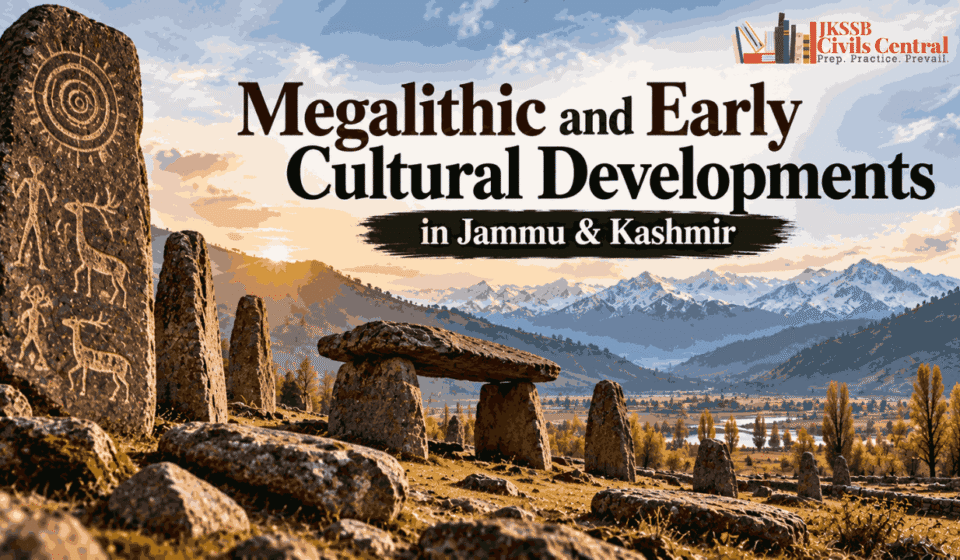
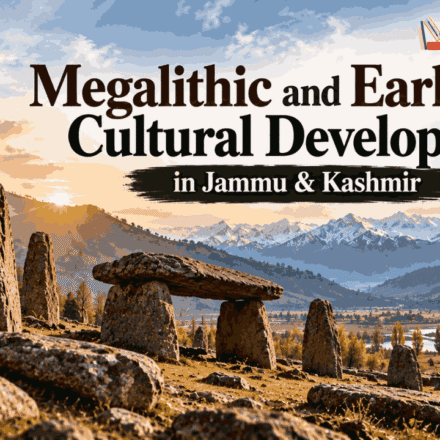
Megalithic and Early Cultural Developments in Jammu & Kashmir

J&K History Series Navigation
| Previous Article | Current Article | Next Article |
|---|---|---|
| Article 02 — Burzahom and Gufkral: Neolithic Culture and Archaeological Heritage of Kashmir | Article 03 — Megalithic and Early Cultural Developments in Jammu & Kashmir | Article 04 — Vedic Traditions and Early Historical Geography of Jammu & Kashmir |
Learning Dashboard
| Component | Key Information |
|---|---|
| Historical Period | Prehistoric |
| Historical Phase | Late Neolithic to Megalithic and Early Historic transition |
| Core Region | Kashmir Valley, with comparison to the wider J&K archaeological landscape |
| Core Theme | Megalithic monuments, technological change, subsistence and cultural transition |
| Key Monument | Menhir |
| Major Sites | Burzahom, Gufkral, Hariparigam, Dadsar and other Kashmir sites |
| Important Gufkral Association | Megalithic Period II; menhirs, rice, millet and iron in the conventional archaeological classification |
| Major Historical Issue | Whether the Neolithic–Megalithic transition was abrupt or gradual |
| Regional Interaction | Connections with the wider northwestern Himalayan and Swat archaeological sphere |
| Important Archaeological Bridge | Semthan |
| JKSSB Importance | High — site identification, chronology, associations, statements and archaeological interpretation |
Introduction
The prehistoric development of Jammu & Kashmir was not a simple succession of completely separate cultures. Archaeological evidence from the Kashmir Valley reveals a long process in which communities that had already developed agriculture, animal domestication, settlement practices and distinctive stone and bone technologies gradually adopted new forms of material culture and monumental activity. The emergence of the Megalithic tradition therefore needs to be understood within the longer history of prehistoric settlement rather than as an automatic replacement of one population by another.
The term Megalithic is generally used in archaeology for traditions involving deliberately erected or arranged large stones. In Kashmir, the most distinctive manifestation is the presence of menhirs, or large upright stones, at sites including Burzahom and Gufkral and at several other locations identified through archaeological exploration. Their presence marks an important change in the way prehistoric communities used and symbolically organized their landscapes, although the precise function of individual monuments is not always established.
The archaeological record also points to developments in agriculture, pottery and metal technology. At Gufkral, the conventional archaeological sequence identifies a Megalithic Period II associated with menhirs and with evidence for crops such as rice and millet and the use of iron. At the same time, the chronology and interpretation of these developments continue to be refined, making it important to distinguish between the established archaeological sequence and more uncertain interpretations.
CivilsCentral Historical Insight: The Megalithic phase of Kashmir is best understood through the relationship between continuity and change. Earlier Neolithic communities did not simply disappear; instead, new monumental, technological and economic characteristics developed within a changing prehistoric landscape.
Part I — Understanding the Megalithic Tradition
What Does “Megalithic” Mean?
The word Megalithic literally derives from Greek roots meaning “large stone.” In archaeological usage, it refers broadly to traditions involving the deliberate erection or arrangement of large stones. Different societies used megalithic monuments in different ways, so the term does not describe one single uniform culture across the world or even across South Asia.
The monuments associated with Megalithic traditions can include menhirs, stone circles, cairns, dolmens and various forms of stone-built funerary structures. Their chronological position and social function vary according to region. For this reason, the archaeological meaning of “Megalithic” must always be established through the evidence of the particular region being studied.
In Kashmir, the most distinctive monument is the menhir. A menhir is a large stone deliberately erected in an upright position. It is therefore useful to remember the conceptual distinction:
Megalithic = broad archaeological category
Menhir = a specific type of large upright stone monument
This distinction is particularly important for examination preparation because questions can deliberately test whether a candidate understands the relationship between an archaeological tradition and one of its characteristic monuments.
CivilsCentral Historical Insight: A menhir is not synonymous with the entire Megalithic tradition. It is one form of megalithic monument, and its function must be established through archaeological context rather than assumed from its appearance.
Part II — The Neolithic Background
The Foundations of Megalithic Development
The Megalithic developments of Kashmir emerged from an already established Neolithic cultural landscape. By the later Neolithic phases, communities at sites such as Burzahom and Gufkral had developed settled occupations, agriculture, animal domestication and specialized stone and bone tool traditions. At Burzahom, the archaeological record is particularly notable for pit dwellings, burials, tools and other evidence of Neolithic life.
Gufkral provides another important sequence because excavation revealed successive occupational phases beginning with an Aceramic Neolithic stage and continuing through Early Neolithic, Late Neolithic, Megalithic and Historical phases. This sequence is valuable precisely because it demonstrates cultural development over time rather than presenting the Megalithic phase as an isolated phenomenon.
Burzahom likewise preserves evidence extending beyond the Neolithic. The archaeological sequence includes a later Megalithic phase and an Early Historic phase, making the site important for studying long-term cultural transformation. The UNESCO Tentative List description of the site explicitly recognizes this broad archaeological sequence.
The Neolithic background is therefore essential to understanding the Megalithic phase. The communities that erected later monuments were part of a landscape in which agriculture, domestication, settlement and craft traditions were already established.
Part III — The Neolithic–Megalithic Transition
Continuity and Change
Older archaeological frameworks often presented prehistoric Kashmir through a sequence resembling:
Neolithic → Megalithic → Historical
This remains useful as a broad chronological framework, but it should not be interpreted as evidence that every aspect of society changed simultaneously. Archaeological periods are analytical categories used to organize material evidence, whereas real communities could retain older practices while adopting new technologies, crops, monuments or social practices.
The Gufkral sequence is particularly useful in demonstrating this complexity. The conventional classification identifies a Megalithic Period II, but the wider archaeological record shows that the site developed from earlier Neolithic occupation. Some elements therefore continued while others changed.
Recent scholarship has questioned whether the transition should be understood as a sharp cultural break. Research examining the relationship between Neolithic and Megalithic evidence in Kashmir has emphasized the persistence of earlier cultural characteristics and proposed a more gradual interpretation of the transition.
This does not invalidate the conventional term “Megalithic.” Rather, it means that the term should be used as an archaeological classification while recognizing that the underlying cultural transformation may have been more complex.
CivilsCentral Historical Insight: The correct historical question is not simply “When did the Neolithic end?” but also “Which Neolithic practices continued, and what new practices emerged?” This approach produces a more accurate understanding of prehistoric cultural change.
Did the Megalithic Phase Represent a New Population?
The appearance of new archaeological characteristics sometimes led earlier interpretations to associate cultural change with the arrival of new populations. Such a conclusion, however, requires evidence beyond the appearance of new material culture.
A society can adopt new technologies or cultural practices through interaction with neighbouring communities without experiencing complete population replacement. New crops, tools, pottery forms, monument traditions and ritual practices can spread through exchange, limited migration, intermarriage, technological transmission or internal innovation.
This question has become particularly important because archaeogenetic research is now contributing additional evidence. A 2025 study of mitochondrial genomes from Burzahom examined individuals associated with Neolithic, Megalithic and later periods. The study found predominantly local maternal genetic continuity in the sampled Neolithic and Megalithic individuals, alongside evidence of connections with populations associated with the wider Swat region.
These findings do not establish a simple story of either complete isolation or complete population replacement. They instead support a more cautious interpretation involving local continuity together with regional interaction. The number of ancient individuals available for study remains limited, so the genetic evidence cannot by itself reconstruct the entire population history of prehistoric Kashmir.
CivilsCentral Historical Insight: Cultural change should not automatically be equated with population replacement. Archaeological, genetic and environmental evidence must be considered together before making demographic conclusions.
Part IV — Major Megalithic Sites
Burzahom
Burzahom is one of the most important archaeological sites in the prehistoric history of Kashmir. Its earlier occupation is famous for pit dwellings, stone and bone tools, animal remains, agricultural evidence and burial practices. These features make it central to the study of Kashmir’s Neolithic culture.
Its importance, however, extends beyond the Neolithic. The later archaeological sequence contains evidence associated with a Megalithic phase, including menhirs, and is followed by an Early Historic phase. The site’s long sequence therefore allows archaeologists to examine changes within a single settlement landscape over a considerable period.
The menhirs at Burzahom are significant because they demonstrate the deliberate modification of the landscape through large stone monuments. Their exact social or ritual function, however, cannot simply be assumed from their physical form.
Burzahom should consequently be remembered not merely as a “Neolithic site” but as an archaeological sequence that demonstrates Neolithic → Megalithic → Early Historic development.
Gufkral
Gufkral, situated near Tral in south Kashmir, provides another major archaeological sequence. Excavations by the Archaeological Survey of India’s Prehistory Branch identified five broad periods:
- Period IA — Aceramic Neolithic
- Period IB — Early Neolithic
- Period IC — Late Neolithic
- Period II — Megalithic
- Period III — Historical
This sequence makes Gufkral especially important for understanding the transition from early farming communities toward later prehistoric and historical cultural contexts.
The conventional archaeological description of Period II associates it with menhirs, along with evidence of rice, millet and iron. These associations are among the most useful factual connections for examination preparation.
At the same time, exact chronological boundaries should be treated cautiously. Older publications used chronological frameworks that subsequent research has continued to refine.
JKSSB Association
Gufkral → Aceramic Neolithic → Neolithic → Megalithic → Historical
And: Gufkral Period II → Menhirs + Rice + Millet + Iron
Other Megalithic Locations in Kashmir
The Megalithic phenomenon was not restricted to Burzahom and Gufkral. Archaeological exploration has reported megalithic or menhir-related evidence at locations including:
- Hariparigam
- Dadsar
- Begagund
- Sombur
- Brah
- Waztal/Waztal-related locations
The evidence from these sites is not equally extensive. Some are known through archaeological exploration or visible monuments rather than the type of extensive stratified excavation available at Burzahom or Gufkral.
This difference in evidence is important. A site known to contain a menhir can establish the existence of monumental activity, but it may not provide the same chronological or cultural information as a deeply excavated settlement with associated pottery, tools, structures and stratigraphy.
The distribution nevertheless demonstrates that the use of large stones was a regional phenomenon within parts of the Kashmir Valley rather than a feature confined to a single archaeological site.
Part V — Menhirs and Monumental Activity
What Is a Menhir?
A menhir is a large stone deliberately erected in an upright position. The menhirs of Kashmir are significant because they represent a different form of landscape use from ordinary domestic structures. Their erection would have required planning and collective labour, suggesting that prehistoric communities could organize activities extending beyond immediate household requirements.
The monument may have carried symbolic meaning for the community that created it. It could have been connected with remembrance, ritual activity, social identity or the organization of space.
However, the exact function cannot be assumed to have been identical everywhere. Archaeological interpretation must take into account the monument’s location, association with burials or structures, arrangement and wider site context.
Were Kashmir’s Menhirs Burial Monuments?
This is one of the most important points of caution. A menhir is defined by its form, not by a universally established function.
Some megalithic traditions elsewhere in South Asia are strongly associated with funerary practices. This broader association can sometimes lead to the assumption that all megalithic monuments must have been burial structures. Such a conclusion would be too broad for Kashmir.
The archaeological context of each monument must be considered independently. Where the evidence does not conclusively establish a funerary purpose, the appropriate historical approach is to acknowledge the uncertainty.
CivilsCentral Historical Insight: In an examination statement, “All menhirs of Kashmir were burial monuments” would be an overgeneralization. The defensible statement is that menhirs are large upright monuments whose precise functions may vary and remain debated.
Part VI — Agriculture and Subsistence
Agricultural Continuity and Diversification
Agriculture had already become an important component of the economy during the Neolithic period. Archaeological evidence from Kashmir indicates the cultivation of cereals and pulses, alongside animal domestication and other forms of resource exploitation. The later prehistoric record shows continued agricultural activity but also evidence of diversification. At Gufkral, the conventional archaeological classification associates the Megalithic phase with rice and millet in addition to the crops represented in earlier phases.
This should not be interpreted as a sudden agricultural revolution. Agricultural systems develop through experimentation, environmental adaptation and interaction between communities. The appearance of a crop in a later archaeological phase does not necessarily mean that the crop suddenly appeared for the first time at exactly that moment. The important historical point is that prehistoric communities adapted their subsistence strategies over time.
Animal Husbandry
Animal domestication continued to be an important part of the prehistoric economy. The archaeological record from Kashmir’s Neolithic settlements demonstrates the presence of domesticated animals alongside wild animal remains. This indicates that communities combined different strategies for obtaining food and raw materials.
The prehistoric economy should therefore not be reduced to agriculture alone. It involved an interconnected system of:
Cultivation + Animal Husbandry + Hunting + Gathering + Local Resource Exploitation
The balance between these activities could vary according to ecological conditions and historical development.
Part VII — Material and Technological Developments
Pottery
Pottery became increasingly important during the later prehistoric sequence. Changes in ceramic technology can reveal developments in cooking, storage, food processing and household organization. Pottery can also provide evidence for contact between different communities when similar ceramic traditions occur across geographically separated sites.
At Gufkral, the Megalithic phase is associated in the conventional archaeological literature with wheel-made dull red pottery, alongside other changes in material culture. However, ceramic change should not be interpreted as a simple replacement of all earlier technologies. Archaeological assemblages frequently contain elements of continuity as well as innovation.
Stone and Bone Technology
The development of megalithic monuments did not mean that stone and bone technologies disappeared. Stone tools remained an important component of prehistoric material culture, while bone was also used for various implements. The continued presence of these technologies demonstrates that technological change was cumulative rather than necessarily replacing older practices immediately.
This is another reason why the Neolithic–Megalithic transition should not be imagined as a complete cultural rupture.
Copper and Iron
Metal technology became increasingly significant during the later prehistoric sequence. Copper objects form part of the wider archaeological record, while iron is particularly important in discussions of Gufkral Period II. The conventional archaeological classification associates iron with its Megalithic phase.
This association is important for examination purposes, but it must be interpreted carefully. Evidence for iron at one archaeological site does not establish that iron technology appeared simultaneously across all of Jammu & Kashmir. Technological adoption can be regionally uneven.
CivilsCentral Historical Insight: Gufkral’s iron evidence is site-specific evidence. It should be remembered as an important archaeological association, not converted into a universal claim about the timing of iron technology throughout J&K.
Part VIII — Settlement and Landscape
Changing Settlement Practices
The settlement history of prehistoric Kashmir reveals adaptation to the local environment. Burzahom’s famous pit dwellings are an important example of early settlement adaptation. Later phases show changes in construction practices and the organization of living spaces.
The appearance of large stone monuments introduced another dimension to landscape use. Domestic structures primarily served practical needs, whereas monuments such as menhirs appear to have had wider communal or symbolic significance. The ability to erect large stones also implies some degree of collective organization. Communities had to coordinate labour and undertake activities whose significance extended beyond the individual household.
However, the existence of monumental activity alone cannot establish the presence of a centralized state or highly stratified political system.
Part IX — Megalithic Distribution in the Kashmir Valley
A Regional Archaeological Phenomenon
The distribution of megalithic evidence across several Kashmir locations suggests that the tradition was not restricted to a single settlement. Burzahom and Gufkral provide the strongest archaeological sequences for detailed study, while locations such as Hariparigam and Dadsar demonstrate a wider distribution of menhir-related evidence.
Several other sites have also been reported in archaeological exploration, but many remain comparatively under-researched. Their precise chronology and relationship with excavated settlements therefore require further investigation. This uneven archaeological record is an important methodological point. Archaeological absence of evidence is not necessarily evidence of absence, particularly in a region where many prehistoric sites have not been excavated extensively.
Part X — Jammu and Kashmir: Regional Distinctions
Why Kashmir and Jammu Should Not Be Treated as One Archaeological Sequence
The present-day Union Territory of Jammu & Kashmir covers a geographically diverse landscape, including the Kashmir Valley, Jammu region and high mountain environments. Prehistoric communities did not necessarily experience identical cultural developments across all these zones.
The menhir-associated Megalithic tradition discussed in this article is particularly well represented in Kashmir Valley archaeology. Jammu has its own prehistoric and protohistoric record, including sites such as Malpur and Manda, but these should not automatically be described as identical manifestations of the Kashmir Valley Megalithic sequence.
This distinction is especially important in a J&K-specific history series. Modern administrative geography cannot simply be projected backward onto prehistoric cultural geography.
CivilsCentral Historical Insight: When studying prehistoric J&K, always distinguish present-day territorial unity from prehistoric archaeological diversity. The same modern region can contain several distinct archaeological trajectories.
Part XI — Regional Contacts and Cultural Interaction
Kashmir and the Northwestern Archaeological Sphere
Kashmir’s geographical position placed it within wider networks connecting the Himalayan region with areas to the northwest. Archaeological comparisons have identified similarities between prehistoric Kashmir and neighbouring regions, including the Swat area. Such similarities may indicate interaction involving technology, material culture, exchange or movement of people.
However, similarity does not automatically prove direct migration. Archaeologists distinguish among:
- exchange;
- technological transmission;
- cultural influence;
- limited migration;
- sustained settlement;
- population replacement.
These mechanisms can produce similar archaeological patterns but have very different historical implications.
Archaeogenetic evidence from Burzahom has also indicated connections with the broader northwestern region while showing substantial local maternal continuity in the sampled Neolithic and Megalithic individuals.
Part XII — The Problem of Population Replacement
Cultural Change Does Not Equal Demographic Replacement
One of the most important lessons from the archaeology of prehistoric Kashmir is that cultural change should not automatically be explained through migration. The emergence of menhirs, new pottery forms, changing agricultural practices or iron technology could have resulted from multiple interacting processes.
A population can adopt an external innovation without being replaced by the people who originally developed it. Similarly, limited movement of individuals or small communities can influence material culture without producing wholesale demographic transformation. The available evidence therefore supports caution regarding claims that the Megalithic phase represented the arrival of an entirely new population in Kashmir.
Recent genetic evidence strengthens the importance of this cautious approach, although the available ancient DNA sample remains too limited to answer every demographic question.
Part XIII — Semthan and the Transition Toward the Early Historic Period
Semthan as an Archaeological Bridge
The transition from later prehistoric societies toward the Early Historic period becomes clearer at sites that preserve long archaeological sequences. Semthan, in south Kashmir, is particularly important in this regard. Archaeological research at the site has identified successive phases associated with later prehistoric contexts followed by Northern Black Polished Ware, Indo-Greek and Kushan material.
This makes Semthan valuable for understanding the transformation of Kashmir’s archaeological landscape as it became increasingly connected to wider historical networks. The significance of Semthan lies not in treating it as a simple “Megalithic site,” but in recognizing its value as an archaeological bridge between later prehistoric and historical contexts.
The Semthan Sequence
A broad sequence reported for Semthan includes:
| Period | Broad Archaeological Association |
|---|---|
| Period I | Pre-NBPW |
| Period II | Northern Black Polished Ware |
| Period III | Indo-Greek |
| Period IV | Kushan-Huna |
| Later phases | Subsequent historical occupations |
The precise dates assigned to individual phases depend upon the archaeological framework being used. The important point for the present article is the sequence rather than excessive reliance on exact chronological boundaries.
Semthan therefore helps connect the later prehistoric landscape discussed in this article with the historical developments that will be examined in subsequent articles of the series.
CivilsCentral Historical Insight: Archaeological sites such as Semthan are valuable not merely because of individual artefacts but because stratified sequences show how one historical phase developed into another.
Part XIV — Monumentality and Social Organization
What Do Megalithic Monuments Tell Us About Society?
The erection of large stones required collective activity. Even without assuming the existence of a centralized political authority, such monuments suggest that communities could organize labour, coordinate activities and assign significance to particular landscapes.
Monumentality may therefore reflect changes in community identity and social organization. At the same time, archaeological evidence does not allow us to reconstruct the entire political system of these communities. There is insufficient evidence to describe them automatically as states, kingdoms or centralized chiefdoms simply because they constructed large monuments.
The safest interpretation is that the monuments indicate collective social organization and deliberate landscape modification.
Part XV — Historical Interpretation
The “Megalithic Culture” Problem
The term “Megalithic Culture” is useful but requires careful handling. It provides archaeologists with a convenient category for material associated with large-stone monuments and particular chronological contexts. However, archaeological categories should not be mistaken for complete descriptions of the societies that produced them.
The Kashmir evidence demonstrates that some Neolithic characteristics continued into later phases while new characteristics appeared. This has led recent scholarship to question whether the conventional Neolithic–Megalithic boundary represents a sharp historical break.
The better approach is therefore to retain the archaeological classification while recognizing that the underlying cultural process could have been prolonged and uneven.
Archaeology and the Limits of Interpretation
Archaeological evidence can establish certain facts with considerable confidence. For example, excavation can establish:
- the existence of a settlement;
- the presence of particular tools;
- the occurrence of pottery;
- the cultivation of particular crops;
- the presence of animal remains;
- the erection of monuments;
- the existence of particular archaeological layers.
But archaeology may not always establish:
- the precise identity of the population;
- the language they spoke;
- the political system they followed;
- the exact meaning of a monument;
- the complete explanation for cultural change.
This distinction is central to responsible prehistoric history.
CivilsCentral Historical Insight: The quality of historical reconstruction depends not only on knowing what evidence exists but also on knowing what that evidence cannot prove.
Part XVI — Historical Significance
Why Does the Megalithic Phase Matter?
The Megalithic phase is important because it reveals a period of increasing cultural and technological complexity in prehistoric Kashmir.
Monumental Development
The appearance of menhirs demonstrates deliberate large-scale modification of the landscape.
Economic Development
Agricultural practices continued and diversified, with rice and millet associated with the conventional Megalithic phase at Gufkral.
Technological Development
Metal use became increasingly important, with iron associated with the Gufkral Megalithic phase.
Regional Interaction
Material and genetic evidence points toward interaction between Kashmir and neighbouring northwestern regions.
Cultural Continuity
Earlier Neolithic practices continued alongside newer forms of material and monumental culture.
Transition Toward Historical Society
Sites such as Semthan help connect later prehistoric developments with archaeological contexts associated with the Early Historic period.
Part XVII — Evidence Hierarchy
What Is Established and What Remains Debated?
| Evidence Level | Historical Interpretation |
|---|---|
| A — Strongly Established | Burzahom contains Neolithic, Megalithic and Early Historic archaeological evidence |
| A — Strongly Established | Gufkral contains a conventionally identified Megalithic phase |
| A — Strongly Established | Menhir evidence occurs at Burzahom, Gufkral and several other Kashmir locations |
| A — Strongly Established | Gufkral Period II is conventionally associated with menhirs, rice, millet and iron |
| B — Strong Interpretation | The Megalithic phase reflects both continuity and cultural change |
| B — Strong Interpretation | Kashmir participated in wider northwestern cultural interaction |
| D — Debated | The precise function of individual menhirs |
| D — Debated | The extent to which new populations contributed to Megalithic cultural change |
| D — Debated | The exact nature and chronology of the Neolithic–Megalithic transition |
Part XVIII — JKSSB Knowledge Matrix
High-Value Examination Associations
| Topic | Must Remember |
|---|---|
| Megalithic | Broad archaeological category associated with large-stone monuments |
| Menhir | Deliberately erected upright large stone |
| Burzahom | Neolithic → Megalithic → Early Historic |
| Gufkral | Aceramic Neolithic → Neolithic → Megalithic → Historical |
| Gufkral Period II | Conventional Megalithic phase |
| Gufkral Period II associations | Menhirs + rice + millet + iron |
| Hariparigam | Megalithic/menhir evidence |
| Dadsar | Menhir evidence |
| Kashmir Valley | Strongest evidence for the menhir-associated tradition discussed here |
| Jammu | Distinct prehistoric archaeological record |
| Semthan | Later prehistoric to historical archaeological sequence |
| Population replacement | Not established as a simple explanation |
| Menhir function | Not conclusively established for every monument |
| Major debate | Sharp cultural break vs gradual/protracted transition |
Part XIX — Examination Discrimination Points
Burzahom vs Gufkral
Burzahom
- Famous for pit dwellings.
- Major Neolithic archaeological site.
- Contains Megalithic evidence.
- Contains Early Historic evidence.
- Important for burials and material culture.
Gufkral
- Located near Tral in south Kashmir.
- Contains an Aceramic Neolithic phase.
- Contains Early and Late Neolithic phases.
- Period II is conventionally identified as Megalithic.
- Historical phase follows the Megalithic phase.
Megalithic vs Menhir
Megalithic = broad archaeological designation.
Menhir = particular type of upright stone monument.
Menhir vs Burial
A menhir describes a monument. A burial describes a funerary practice. Therefore: Menhir ≠ automatically burial
Gufkral vs Burzahom
If the question emphasizes: Aceramic Neolithic + Period II Megalithic + Historical phase
→ Gufkral
If the question emphasizes: Pit dwellings + Neolithic + Megalithic + Early Historic
→ Burzahom
Kashmir vs Jammu
The strongest evidence for the particular menhir-associated Megalithic tradition discussed in this article comes from Kashmir Valley archaeology. This should not be generalized automatically to every prehistoric site in Jammu.
Part XX — JKSSB Question-Type Mapping
Direct Fact
A large upright stone deliberately erected by a prehistoric community is known as:
Answer: Menhir
Statement-Based
Consider the following statements:
- Burzahom contains evidence extending from the Neolithic into the Megalithic and Early Historic phases.
- Gufkral contains a conventionally identified Megalithic Period II.
- All menhirs in Kashmir have been conclusively identified as burial monuments.
Correct answer: Statements 1 and 2 only.
Chronology
Arrange the following broadly in chronological order:
- Early Historic phase
- Neolithic phase
- Megalithic phase
Answer:
Neolithic → Megalithic → Early Historic
Match the Following
| Site | Association |
|---|---|
| Burzahom | Neolithic, Megalithic and Early Historic sequence |
| Gufkral | Aceramic Neolithic through Historical sequence |
| Semthan | Later prehistoric to historical sequence |
All three associations are useful for examination preparation.
Identification Through Clues
Clues:
- Located in south Kashmir near Tral.
- Contains an Aceramic Neolithic phase.
- Period II is conventionally classified as Megalithic.
- Associated with menhirs.
- Historical phase follows.
Answer: Gufkral
Part XXI — Practice Questions
MCQ 1
Consider the following statements:
- Burzahom contains Neolithic, Megalithic and Early Historic archaeological evidence.
- A menhir is a deliberately erected upright stone.
- Every menhir in Kashmir has been conclusively established as a burial monument.
Which of the statements given above is/are correct?
A. 1 and 2 only
B. 2 and 3 only
C. 1 and 3 only
D. 1, 2 and 3
Answer: A
Explanation: Burzahom has evidence extending through Neolithic, Megalithic and Early Historic phases. A menhir is an upright large stone. The function of individual menhirs in Kashmir is not universally established as funerary.
MCQ 2
Which archaeological site is particularly associated with a sequence beginning with an Aceramic Neolithic phase and continuing through a conventional Megalithic phase to the Historical period?
A. Gufkral
B. Martand
C. Parihaspura
D. Avantipur
Answer: A
MCQ 3
Consider the following pairs:
| Site | Association |
|---|---|
| 1. Burzahom | Megalithic evidence |
| 2. Gufkral | Conventional Megalithic Period II |
| 3. Semthan | Later prehistoric and historical archaeological sequence |
Which of the pairs given above is/are correctly matched?
A. 1 only
B. 1 and 2 only
C. 2 and 3 only
D. 1, 2 and 3
Answer: D
MCQ 4
The term “menhir” refers to:
A. A type of prehistoric pottery
B. An upright large stone monument
C. A prehistoric agricultural tool
D. A burial pit
Answer: B
MCQ 5
Which statement best describes the Neolithic–Megalithic transition in Kashmir?
A. It necessarily involved complete population replacement.
B. It involved the disappearance of agriculture.
C. It involved both continuity and cultural change.
D. It occurred exclusively in Jammu.
Answer: C
MCQ 6
The conventional archaeological classification associates the Megalithic Period II at Gufkral with:
A. Menhirs, rice, millet and iron
B. Roman coins, silk and Christianity
C. Mughal gardens and Persian inscriptions
D. Northern Black Polished Ware alone
Answer: A
MCQ 7
Why should exact dates assigned to prehistoric cultural phases in Kashmir be treated cautiously?
A. No archaeological evidence exists for prehistoric Kashmir.
B. Archaeological chronologies have been refined through subsequent research and scientific dating.
C. All prehistoric sites belong to one archaeological period.
D. Radiocarbon dating cannot be applied to archaeological sites.
Answer: B
MCQ 8
Semthan is particularly important because it:
A. Was a major Dogra administrative centre.
B. Helps connect later prehistoric archaeological contexts with historical phases.
C. Was the principal Mughal garden centre of Kashmir.
D. Was the capital of the Karkota dynasty.
Answer: B
MCQ 9
Consider the following statements about Gufkral:
- It contains an Aceramic Neolithic phase.
- Its conventional Period II is identified as Megalithic.
- Its archaeological sequence ends with the Neolithic phase.
Which of the statements given above is/are correct?
A. 1 only
B. 1 and 2 only
C. 2 and 3 only
D. 1, 2 and 3
Answer: B
MCQ 10
Which one of the following statements is incorrect?
A. Burzahom contains a long archaeological sequence.
B. Gufkral provides important evidence for the Megalithic phase.
C. Every menhir in Kashmir has a conclusively established funerary function.
D. Semthan contains evidence of later historical archaeological phases.
Answer: C
Part XXII — Rapid Revision Zone
Important Associations
Megalithic → Large-stone monuments
Menhir → Upright large stone
Burzahom → Neolithic + Megalithic + Early Historic
Gufkral → Aceramic Neolithic + Neolithic + Megalithic + Historical
Gufkral Period II → Megalithic
Gufkral Period II → Menhirs + Rice + Millet + Iron
Semthan → Later prehistoric → Historical archaeological sequence
Important Chronological Sequence
Aceramic Neolithic
↓
Early Neolithic
↓
Late Neolithic
↓
Conventional Megalithic Phase
↓
Historical / Early Historic Developments
This sequence is particularly visible at Gufkral, while Burzahom provides its own long archaeological sequence.
Important Sites
Burzahom
Pit dwellings + Neolithic + Megalithic + Early Historic
Gufkral
Aceramic Neolithic + Neolithic + Megalithic + Historical
Hariparigam
Megalithic/menhir evidence
Dadsar
Menhir evidence
Begagund, Sombur, Brah and Waztal
Additional reported Megalithic/menhir locations
Semthan
Later prehistoric to historical archaeological sequence
Part XXIII — Frequently Confused Facts
Burzahom Is Not Only a Neolithic Site
Burzahom is famous for its Neolithic remains, but its archaeological sequence continues into later Megalithic and Early Historic phases.
Gufkral Is Not Only a Megalithic Site
Gufkral begins with an Aceramic Neolithic phase and contains successive Neolithic, Megalithic and Historical phases.
Megalithic Does Not Simply Mean Iron Age
Iron is associated with the conventional Megalithic phase at Gufkral, but the term Megalithic itself is broader and is not simply another name for the Iron Age.
Menhir Does Not Mean Burial
Menhir refers to an upright large stone. Its exact function must be established from archaeological context.
Megalithic Does Not Automatically Mean New Population
Cultural change can result from interaction, technological transmission and internal development without complete population replacement.
Kashmir Archaeology Should Not Automatically Be Applied to Jammu
The archaeological histories of the Kashmir Valley and Jammu region were not identical.
Part XXIV — What Can JKSSB Ask?
High-Value Question Areas
From this article, JKSSB can test:
- meaning of Megalithic;
- definition of menhir;
- Burzahom’s archaeological sequence;
- Gufkral’s archaeological sequence;
- Gufkral Period II;
- menhir-associated sites;
- rice and millet at Gufkral;
- iron association at Gufkral;
- Neolithic–Megalithic transition;
- Kashmir Valley vs Jammu archaeological distinction;
- Semthan’s archaeological significance;
- chronology;
- statement-based distinctions;
- archaeological evidence vs interpretation.
The most likely difficulty is not obscure trivia but distinguishing closely related archaeological facts.
Part XXV — Mind Map
Megalithic and Early Cultural Developments in J&K
NEOLITHIC BACKGROUND
Agriculture
↓
Animal Domestication
↓
Settlement
↓
Stone & Bone Technology
↓
CULTURAL TRANSFORMATION
Continuity
+
New Technologies
+
New Monumental Practices
↓
MEGALITHIC DEVELOPMENT
Large Stones
↓
Menhirs
↓
MAJOR SITES
Burzahom
Gufkral
Hariparigam
Dadsar
Begagund
Sombur
Brah
Waztal
↓
Gufkral Period II
Menhirs
+
Rice
+
Millet
+
Iron
↓
REGIONAL INTERACTION
Kashmir
↕
Northwestern / Swat Region
↓
INTERPRETIVE DEBATE
Abrupt Break?
OR
Continuity + Gradual Transformation?
↓
LATER DEVELOPMENT
Semthan
↓
Pre-NBPW
↓
NBPW
↓
Indo-Greek
↓
Kushan
↓
EARLY HISTORIC KASHMIR
Part XXVI — Chapter Summary
The Megalithic phase represents an important stage in the prehistoric development of Jammu & Kashmir, particularly in the Kashmir Valley. Its most distinctive feature is the deliberate erection of large stones, especially menhirs, which demonstrate a new form of monumental engagement with the landscape.
The development of this tradition must be understood against the background of the earlier Neolithic communities of Kashmir. Sites such as Burzahom and Gufkral demonstrate that agriculture, animal domestication, settlement and specialized material culture were already established before the conventional Megalithic phase emerged.
Burzahom is particularly significant because its archaeological sequence extends from the Neolithic through the Megalithic to the Early Historic period. Gufkral is equally important because its sequence begins with an Aceramic Neolithic phase and continues through Early and Late Neolithic phases, a conventional Megalithic Period II and a Historical phase.
The conventional classification of Gufkral Period II associates it with menhirs, rice, millet and iron. These associations are highly useful for examination preparation, but they should be interpreted as site-specific archaeological evidence rather than generalized across the entire region.
The major interpretive issue concerns the nature of the Neolithic–Megalithic transition. Older archaeological frameworks tended to emphasize distinct cultural periods, whereas more recent research has highlighted continuity and questioned whether the transition was as abrupt as conventional periodization suggests.
The archaeological and genetic evidence also does not justify a simple narrative of population replacement. Recent archaeogenetic research from Burzahom indicates substantial local maternal continuity in the sampled Neolithic and Megalithic individuals while also demonstrating wider regional connections.
The archaeological evidence is geographically differentiated. The menhir-associated Megalithic tradition discussed here is particularly well represented in the Kashmir Valley and should not automatically be imposed upon the prehistoric archaeology of Jammu.
Finally, Semthan provides an important archaeological bridge toward the Early Historic period. Its sequence, including later prehistoric, NBPW, Indo-Greek and Kushan-associated contexts, helps demonstrate how the archaeological landscape of Kashmir developed into increasingly connected historical networks.
The broader significance of the Megalithic phase therefore lies in the combination of continuity, technological development, agricultural diversification, monumental activity, regional interaction and gradual transformation.
JKSSB Takeaway
Remember the central chain: Neolithic background → Megalithic development → Menhirs → Gufkral Period II → Rice + Millet + Iron → Regional interaction → Transition toward Early Historic contexts
Part XXVII — FAQs
Q1. What is the main feature of the Megalithic tradition in Kashmir?
The most distinctive feature is the presence of menhirs, or deliberately erected large upright stones.
Q2. What is a menhir?
A menhir is a large stone deliberately erected in an upright position.
Q3. Which two sites are particularly important for studying prehistoric Kashmir?
Burzahom and Gufkral are especially important because they preserve extensive archaeological sequences.
Q4. What is the significance of Gufkral Period II?
It is conventionally identified as the Megalithic phase and is associated with menhirs, rice, millet and iron.
Q5. Was the Megalithic phase a complete break from the Neolithic?
Not necessarily. Archaeological interpretation increasingly emphasizes continuity alongside change.
Q6. Were all Kashmir menhirs burial monuments?
No. Their precise function is not conclusively established for every monument.
Q7. Does the Megalithic phase prove that a new population entered Kashmir?
No. Population replacement is not established as a simple explanation of the archaeological transition.
Q8. Why is Semthan important?
It provides an important archaeological sequence connecting later prehistoric contexts with historical phases.
Q9. Why should Kashmir and Jammu archaeology be distinguished?
Because prehistoric cultural development was geographically diverse and the menhir-associated Megalithic tradition discussed here is particularly well represented in the Kashmir Valley.
Q10. Why is the exact chronology of the Megalithic phase treated cautiously?
Because archaeological dating and interpretation continue to be refined through new excavations and scientific research.
About The Author




[…] Article 03 — Megalithic and Early Cultural Developments in Jammu & Kashmir […]