
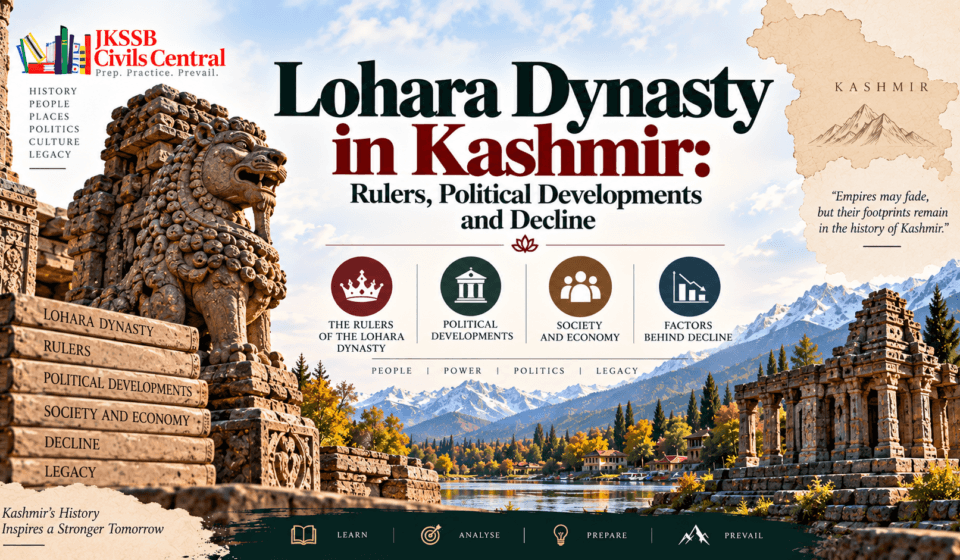
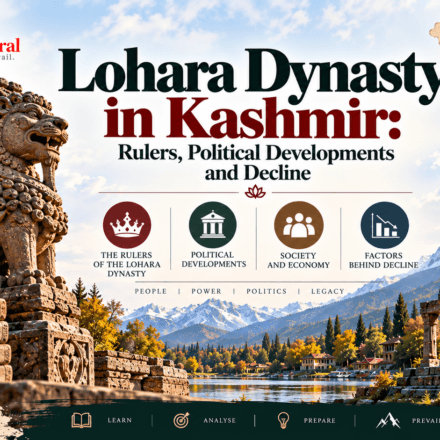
Lohara Dynasty in Kashmir: Rulers, Political Developments and Decline

J&K History Series Navigation
| Previous Article | Current Article | Next Article |
|---|---|---|
| ← Article 17 — Queen Didda and the Lohara Dynasty: Power, Politics and the Transition to Lohara Rule | Article 18 — Lohara Dynasty in Kashmir: Rulers, Political Developments and Decline | Article 19 — Islam in Medieval Kashmir: Early Contacts, Migration, Settlement and Islamization |
Learning Dashboard
| Area | Key Information |
|---|---|
| Historical Period | c. 1003–12th century CE |
| Historical Phase | Early Medieval / Medieval Kashmir |
| Main Dynasty | Lohara Dynasty |
| Political Centre | Kashmir Valley; Lohara remained an important associated power centre |
| Core Theme | Dynastic rule, court politics, Damara power, military conflict and political fragmentation |
| Key Rulers | Sangramaraja, Ananta, Kalasha, Harsha, Uchchala, Sussala, Bhikshachara, Jayasimha |
| Key Personalities | Didda, Mahmud of Ghazni, Damaras, Gargacandra, Kalhana |
| Key Places | Kashmir Valley, Lohara, Rajapuri, Srinagar, Tosa Maidan, Banihal region |
| Key Source | Kalhana’s Rajatarangini, especially Tarangas VII–VIII |
| JKSSB Importance | Very High |
| High-Value Areas | Sangramaraja–Mahmud, Ananta–Kalasha succession, Harsha, Uchchala, Sussala, Bhikshachara, Jayasimha, Damaras, chronology |
| Expected Question Types | Direct fact, chronology, statement-based, matching, identification, comparative |
Introduction
The establishment of the Lohara dynasty in Kashmir at the beginning of the eleventh century marked an important transition in the political history of the Valley. The transition was closely connected with Queen Didda, who had ruled Kashmir directly from around 980 until her death in 1003 and belonged by birth to the Lohara ruling house. She selected her nephew Sangramaraja as her successor, thereby bringing a ruler from the Lohara house to the Kashmir throne. The significance of this development was not simply dynastic: it connected the political history of Kashmir more closely with the hill region of Lohara and created a ruling house that would dominate Kashmir for much of the next two centuries.
The Lohara period, however, should not be understood as a continuous phase of strong centralized monarchy. Its history reveals a recurring tension between the authority of the king and powerful regional chiefs, particularly the Damaras, together with repeated succession disputes within the royal family. The dynasty produced rulers with very different political capacities. Sangramaraja maintained the kingdom during a period of external pressure; Ananta and Kalasha presided over a relatively long phase of dynastic continuity but experienced serious court tensions; Harsha began as an able and culturally active ruler but later faced severe fiscal and political problems; and the reigns of Uchchala and Sussala were dominated by rebellion and civil conflict. Jayasimha eventually restored a measure of political stability, but the long-term structural problems of royal succession and aristocratic power remained.
The Lohara period is particularly important for the study of Kashmir because Kalhana’s Rajatarangini provides its most detailed narrative. The seventh and eighth Tarangas devote extensive attention to the Lohara rulers and their political conflicts, making this period much more richly documented than many earlier phases. At the same time, Kalhana’s account is a literary historical work rather than a modern administrative record, so political chronology and major events can often be reconstructed with considerable confidence while individual speeches, motives, moral judgments and dramatic episodes require greater caution.
CivilsCentral Historical Insight
The central historical lesson of the Lohara period is that dynastic continuity did not necessarily mean political stability. Kashmir could retain a recognizable monarchy while real political power was repeatedly contested by royal relatives, ministers, regional chiefs and military elites. The period therefore helps explain the growing importance of elite competition and decentralized political power in the later history of Kashmir.
Part I — Historical Background: From Didda to Lohara Rule
Didda and the Lohara Connection
The political relationship between Kashmir and Lohara became especially important through Queen Didda. Didda was the daughter of Simharaja, a chief of Lohara, and had married Kshemagupta, the Kashmir ruler, in the mid-tenth century. After Kshemagupta’s death in 958, she exercised political authority first as regent and later as the direct ruler of Kashmir. Her long political dominance created a durable connection between the Kashmir throne and her natal Lohara family.
When Didda died in 1003, the succession did not return to another branch of the earlier Utpala-related ruling line. Instead, she selected Sangramaraja, her nephew from the Lohara family, as her successor. This is conventionally treated as the beginning of Lohara rule in Kashmir. The transition was therefore fundamentally a dynastic transfer through succession, rather than a conquest of Kashmir by an external power.
The distinction is important for examination purposes. Lohara was a political centre in the western Himalayan region associated with the ruling family; the establishment of the Lohara dynasty in Kashmir does not mean that Kashmir was newly conquered by a foreign empire. The dynasty’s authority emerged through the political networks created during Didda’s rule.
The Lohara Dynasty and the Two Political Phases
Historians commonly distinguish between two phases of Lohara rule.
The First Lohara phase begins with Sangramaraja in 1003 and continues through Ananta, Kalasha, Utkarsha and Harsha, whose reign ended in 1101. The Second Lohara phase begins with Uchchala in 1101 and includes the highly unstable succession involving Radda, Salhana, Sussala, Bhikshachara and ultimately Jayasimha.
This division should not be misunderstood as the complete disappearance of the Lohara family after Harsha. Rather, it reflects a change in the branch of the ruling house and the political circumstances through which the throne was occupied. Uchchala and Sussala were themselves connected to the Lohara family, and the political transition followed Harsha’s violent overthrow.
A Master Chronology of Lohara Rule
| Approx. Date | Ruler / Development | Historical Significance |
|---|---|---|
| 1003 | Sangramaraja | Beginning of Lohara rule in Kashmir |
| 1003–1028 | Sangramaraja | Consolidation; external pressure from Ghaznavid power |
| 1028 | Hariraja, followed by Ananta | Brief succession and beginning of Ananta’s long reign |
| 1028–1063 | Ananta | Dynastic continuity and court politics |
| 1063–1089 | Kalasha | Long reign marked by court tensions and succession conflict |
| 1089 | Utkarsha | Very brief reign |
| 1089–1101 | Harsha | Cultural patronage followed by fiscal and political crisis |
| 1101 | Uchchala | Overthrow of Harsha; beginning of second Lohara phase |
| 1111–1112 | Radda / Salhana phase | Rapid succession and aristocratic intervention |
| 1112–1120 | Sussala | Conflict with Damaras and Bhikshachara |
| 1120–1121 | Bhikshachara | Brief restoration of Harsha’s line |
| 1121–1128 | Sussala restored | Continued civil conflict |
| 1128 | Jayasimha | Begins a long attempt to restore political stability |
| 1128–c.1155 | Jayasimha | Relative stabilization; Kalhana writes during his reign |
| After Jayasimha | Paramanuka and later rulers | Gradual weakening of centralized authority |
| 12th century | Later Lohara rulers | Increasing political fragmentation |
| Later 12th century | Declining Lohara authority | Conditions develop for later political transformation |
The exact dates of some short reigns vary among reconstructions. The most secure examination sequence is:
Sangramaraja → Hariraja → Ananta → Kalasha → Utkarsha → Harsha → Uchchala → Sussala → Bhikshachara → Sussala (restored) → Jayasimha.
CivilsCentral Historical Insight
The chronology of the Lohara dynasty is not merely a list of kings. The succession sequence itself reveals a transformation from relatively long reigns under the early Lohara rulers to increasingly unstable transfers of power. The contrast between Ananta’s and Kalasha’s lengthy reigns and the rapid succession surrounding Utkarsha, Uchchala, Sussala and Bhikshachara is an important indicator of increasing political instability.
Part II — Sangramaraja and the Consolidation of Lohara Rule
Sangramaraja: The First Lohara Ruler of Kashmir
Sangramaraja succeeded Didda in 1003 and is conventionally regarded as the founder of the Lohara dynasty in Kashmir. His accession represented the culmination of the political relationship between Didda’s Kashmir and her Lohara family. Unlike a ruler who established authority through a new military conquest, Sangramaraja inherited a political structure that had already been maintained by Didda for decades.
His reign is especially important because Kashmir faced external pressure from the expanding Ghaznavid power under Mahmud of Ghazni. Kashmir’s geographical setting provided a formidable defensive advantage, and the routes into the Valley through the western and north-western mountain approaches were strategically significant.
Sangramaraja and Mahmud of Ghazni
Mahmud of Ghazni conducted campaigns in north-western India during the early eleventh century, and Kashmir entered the strategic calculations of the Ghaznavid state. Traditional accounts associate Mahmud with attempts to penetrate Kashmir during Sangramaraja’s reign.
The most important point for examination purposes is that Mahmud of Ghazni did not conquer Kashmir. The difficult mountain geography and Kashmir’s defensive arrangements prevented the establishment of Ghaznavid control over the Valley. The episodes associated with these campaigns are therefore significant less because of territorial conquest and more because they demonstrate Kashmir’s position within the wider political and military environment of north-western India.
The well-known association with Lohkot should be handled carefully. The narrative tradition describes defensive resistance in the region and the failure of Mahmud to establish control over Kashmir. The precise identification and details of the fortifications and campaign routes should not be inflated beyond what the sources securely establish.
Kashmir’s Strategic Position
Sangramaraja’s reign demonstrates that Kashmir was not politically isolated from developments in the north-west. The Valley was connected to a broader zone involving the Punjab, the hill states and the political formations of Afghanistan and north-western India.
At the same time, the mountains created a distinctive strategic environment. A power could exert influence in the surrounding plains without automatically acquiring effective control over the Kashmir Valley. This distinction helps explain why Kashmir could experience external military pressure without undergoing immediate political incorporation into the Ghaznavid state.
CivilsCentral Historical Insight
Sangramaraja’s reign illustrates the relationship between geography and political autonomy. Kashmir’s mountain environment did not make the Valley completely inaccessible, but it increased the military cost of sustained external occupation. The failure of Ghaznavid attempts to establish lasting control also shows why political influence in the north-west should not automatically be equated with sovereignty over Kashmir.
Part III — Ananta and the Consolidation of the Early Lohara State
Ananta’s Long Reign
After a brief succession following Sangramaraja’s death in 1028, Ananta became ruler and governed Kashmir for several decades. His reign, conventionally dated from 1028 to 1063, stands in contrast to the rapid succession that would characterize parts of the later Lohara period.
Ananta’s reign was not free from political conflict. Kalhana’s narrative places considerable emphasis on court factions, nobles and powerful individuals who influenced royal decision-making. The role of elite groups in the political system became increasingly visible, particularly as the royal court had to negotiate with influential regional chiefs and military figures.
Court Politics and the Shahis
The political environment of Ananta’s reign also illustrates the continuing interaction between Kashmir and neighbouring ruling families. Sources refer to Shahi princes and nobles at the Kashmir court, including individuals who acquired influence among sections of the ruling elite.
One such figure was Rudrapala, whose role in Ananta’s political environment is described in literary sources. Such episodes should not be interpreted as evidence that Kashmir was controlled by the Shahis. Rather, they show that members of neighbouring ruling houses could become embedded in Kashmir’s political and matrimonial networks.
This was a recurring characteristic of early medieval politics: royal legitimacy and political influence could extend through marriage, patronage, personal alliances and military relationships rather than through direct territorial administration alone.
Ananta and Dynastic Succession
Ananta’s relationship with his son Kalasha eventually became one of the major political conflicts of the period. The succession was complicated by competing court interests and the influence of royal family members and nobles.
The transition from Ananta to Kalasha is therefore important not simply as a succession fact but as a precursor to the increasingly factional politics of the later Lohara period.
CivilsCentral Historical Insight
The early Lohara state demonstrates that a long reign did not eliminate factional politics. Ananta’s period shows how royal authority operated through a network of family members, nobles, neighbouring elites and court officials. These relationships would become increasingly difficult to manage as succession disputes intensified.
Part IV — Kalasha: Dynastic Conflict and Court Politics
Kalasha’s Accession
Kalasha, the son of Ananta, ruled from approximately 1063 to 1089. His reign was lengthy, but it was marked by serious tensions within the royal family and court.
Kalasha’s relationship with his father deteriorated, and the succession became entangled in struggles between different factions. Kalhana’s narrative presents these developments in dramatic form, including the influence of Shahi-linked figures at the court and the growing importance of competing nobles.
The political importance of the period lies in the increasing difficulty of maintaining a stable succession when royal authority depended heavily on relationships among powerful court groups.
Shahi Connections at the Kashmir Court
The Lohara period also demonstrates the continued importance of the Hindu Shahi political world in Kashmir’s diplomatic and aristocratic environment. Some Shahi princes appear in Kalhana’s account as influential figures at the Kashmir court.
These connections should not be confused with direct Shahi rule over Kashmir. They demonstrate political interaction, matrimonial connections and elite integration, rather than territorial subordination.
This distinction is particularly important for examination questions because the presence of Shahi personalities in Kashmir’s political narrative can easily lead to the incorrect conclusion that Kashmir itself became part of the Shahi state.
Kalasha and the Problem of Succession
Kalasha’s reign eventually became entangled with the ambitions of his son Harsha. The father-son conflict was not simply a personal disagreement. It reflected the larger problem of succession in a political system where rival members of the royal family could mobilize supporters among the nobility.
The eventual rise of Harsha after Kalasha’s death created a new political phase. Harsha inherited not only the throne but also unresolved tensions among the royal family, Damaras and other political actors.
CivilsCentral Historical Insight
Kalasha’s reign shows that dynastic succession could become a structural source of instability. When competing royal claimants gained support from different elite groups, the monarchy itself became an arena of factional competition. This pattern would become much more severe during Harsha’s reign.
Part V — Harsha: Cultural Patronage, Fiscal Crisis and Political Collapse
Harsha’s Early Rule
Harsha, son of Kalasha, became ruler in 1089 and remained on the throne until 1101. His reign occupies an important place in Kalhana’s narrative because it combines cultural patronage, intellectual interests, political ambition and eventual administrative and fiscal crisis.
Harsha’s early reputation was considerably more favourable than the image created by the final years of his reign. He is associated with patronage of scholars, poets, artists and religious institutions. His court participated in a rich cultural environment in which Sanskrit literary traditions and royal patronage remained important.
The historical significance of Harsha therefore lies partly in the contrast between his early political and cultural activity and the severe crisis that ultimately brought his rule to an end.
Harsha and the Damaras
One of the defining political developments of Harsha’s reign was the growing conflict between the king and powerful Damaras.
The Damaras were influential landed and regional elites whose political power could become substantial enough to challenge royal authority. Their relationship with the monarchy was not permanently one of either loyalty or rebellion. They could support the king, compete with one another, or oppose royal policies depending on circumstances.
Harsha’s attempts to suppress powerful Damaras eventually contributed to a widening political conflict. The monarchy increasingly relied on coercive measures, while sections of the aristocracy became determined to resist the king.
This conflict is one of the most important structural themes of the later Lohara period.
Fiscal Pressure and the Royal Treasury
Kalhana presents Harsha’s later reign as a period of serious fiscal pressure. Military expenditure, court expenditure and political conflict placed considerable demands on the state.
The literary account associates Harsha with increased taxation and the appropriation of wealth from temples and religious institutions. These descriptions are important historical evidence for understanding contemporary perceptions of royal fiscal pressure, but individual details should be read critically because Kalhana also uses moral judgment as part of his historical narrative.
The safest historical conclusion is that Harsha faced severe fiscal and political pressures and resorted to increasingly coercive extraction, contributing to growing opposition against him. It is less appropriate to reduce his entire reign to a simple narrative of religious destruction or personal tyranny.
Harsha’s Relationship with Temples and Religious Wealth
One of the most frequently remembered aspects of Harsha’s reign is the appropriation of temple wealth. Kalhana describes the seizure and melting of images for their metal value. This evidence should be understood within the wider fiscal crisis. The episode is not sufficient by itself to establish a generalized policy of religious persecution. The broader political context indicates that Harsha was seeking resources during a period of financial and military difficulty.
The distinction is important: appropriation of temple wealth during fiscal crisis is not identical to a systematic programme of religious destruction.
Harsha’s Political Isolation
As opposition increased, Harsha became progressively isolated. His conflict with powerful nobles and Damaras weakened the political coalition required to maintain the monarchy. His relatives Uchchala and Sussala, members of the Lohara family, emerged as important political actors. The rebellion eventually developed into a broader challenge to Harsha’s rule.
The final phase of Harsha’s reign illustrates the danger of simultaneously alienating regional elites and rival members of the royal family.
The Fall and Death of Harsha
Harsha’s authority collapsed in 1101. After losing political and military support, he attempted to escape and seek refuge. Kalhana’s narrative describes his eventual capture and death.
Harsha’s fall marked the end of the first major phase of Lohara rule. His death also opened the way for Uchchala, who established the political order conventionally described as the Second Lohara phase.
CivilsCentral Historical Insight
Harsha’s reign demonstrates how fiscal pressure, military expenditure, aristocratic opposition and dynastic rivalry could reinforce one another. His decline cannot be explained simply by personal weakness or by one policy. The political crisis emerged because the monarchy progressively lost the alliances and resources necessary to sustain centralized authority.
Part VI — Uchchala and the Beginning of the Second Lohara Phase
Uchchala’s Rise
After Harsha’s death, Uchchala emerged as ruler in 1101. His accession marks the beginning of what historians often call the Second Lohara dynasty or Second Lohara phase.
Uchchala was closely related to Harsha and to Sussala. His rise was therefore not the emergence of a completely unrelated ruling house but a change in the branch and political coalition controlling the monarchy.
Uchchala inherited a state weakened by civil conflict. His immediate task was to restore royal authority while preventing the Damaras and rival royal claimants from becoming dominant.
Uchchala and the Damaras
Uchchala understood that direct confrontation with every powerful chief could destabilize the kingdom further. His political strategy therefore involved managing rival elites and balancing competing interests.
His reign nevertheless remained vulnerable to court conspiracy. The political environment was characterized by shifting alliances in which nobles and royal relatives could change sides when opportunities emerged.
The eventual assassination of Uchchala demonstrated the continuing weakness of personal monarchy in the face of elite factionalism.
The Assassination of Uchchala
Uchchala was assassinated in 1111. His death produced another succession crisis. A short political phase involving Radda and Salhana followed, before Sussala emerged as the principal ruler in 1112. The rapid succession is one of the clearest indicators of the political instability that had become characteristic of the Second Lohara phase.
CivilsCentral Historical Insight
Uchchala’s reign reveals that replacing an unpopular ruler was easier than constructing a stable political order. The Second Lohara phase therefore began with the same structural problem that had contributed to Harsha’s downfall: the monarchy remained dependent on alliances among powerful political actors.
Part VII — Sussala and the Lohara Civil Wars
Sussala’s Accession
Sussala, brother of Uchchala, became ruler in 1112. His reign was dominated by repeated conflicts with Damaras, rival claimants and members of the royal family. Sussala faced a difficult political environment because the aristocratic groups that had helped shape the succession now possessed enough power to challenge the king himself. Attempts to suppress them frequently produced new rebellions.
The political history of Sussala’s reign therefore illustrates the cycle:
Royal centralization → aristocratic resistance → rebellion → royal repression → renewed resistance.
The Rise of Bhikshachara
A major challenge to Sussala emerged through Bhikshachara, the grandson of Harsha. His claim provided the opponents of Sussala with an alternative dynastic centre around which resistance could organize.
In 1120, Bhikshachara briefly succeeded in overthrowing Sussala and occupying the throne. His restoration of Harsha’s line, however, did not last long.
Sussala reorganized his forces and returned to power. The result was not a permanent dynastic restoration but a continuation of the civil war.
Sussala’s Restoration
After regaining the throne, Sussala continued to face opposition. Kashmir’s political order had become increasingly militarized, with royal forces, Damaras and rival claimants competing for control.
The instability also affected the Valley’s economic and social conditions. Repeated fighting could disrupt agriculture, movement, trade and the normal functioning of government. Political authority became increasingly dependent on the ability of individual rulers to maintain alliances rather than on stable institutional mechanisms.
Sussala was eventually killed in 1128.
The Significance of Bhikshachara’s Rebellion
Bhikshachara’s brief reign is important for examination purposes because it demonstrates that succession in the Lohara period could be contested through competing branches of the royal family.
It should not be remembered simply as: Sussala → Bhikshachara → Sussala.
The deeper historical point is that the conflict involved:
- competing dynastic claims,
- Damaras,
- regional military support,
- shifting aristocratic alliances,
- control of Srinagar,
- and the broader struggle over royal legitimacy.
CivilsCentral Historical Insight
The Sussala–Bhikshachara conflict reveals the degree to which the Kashmir monarchy had become embedded in a competitive political marketplace of alliances. The throne could be won or lost not merely through hereditary succession but through the ability to assemble military and aristocratic support.
Part VIII — Jayasimha: Restoration of Relative Stability
Jayasimha’s Accession
After Sussala’s death in 1128, his son Jayasimha became ruler. His reign marks an important turning point in the political history of the Lohara dynasty.
Jayasimha inherited a deeply divided kingdom. Rival claimants, Damaras and members of the royal family continued to threaten the monarchy. In the early years of his reign, the political situation remained unstable and Bhikshachara continued to represent a potential alternative centre of power.
Yet Jayasimha proved more successful than his immediate predecessors in surviving these challenges.
Jayasimha and Bhikshachara
Jayasimha’s early reign involved continued confrontation with Bhikshachara and his supporters. The conflict was not resolved immediately, and the king had to rely on alliances with powerful nobles.
This demonstrates an important continuity with the previous period. Jayasimha did not suddenly eliminate aristocratic power. Instead, he managed political competition more effectively and gradually created conditions in which the monarchy could function with greater stability.
His success therefore lay less in establishing absolute centralization than in managing the existing balance of political forces.
Jayasimha and the Damaras
The Damaras continued to be important throughout Jayasimha’s reign. Some supported the king while others opposed him, and their allegiance could change according to political circumstances.
Jayasimha’s political method involved a combination of negotiation, alliance-building, coercion and selective elimination of threats. The result was a gradual reduction in the intensity of open civil conflict.
This is why Jayasimha’s reign should be understood as a period of relative stabilization, not as the creation of a fully centralized state free from regional power.
Political and Economic Recovery
With the reduction of continuous civil warfare, the kingdom could again devote greater attention to ordinary political and economic functions.
The relative stability of Jayasimha’s reign allowed agriculture, trade, religious foundations and urban life to recover from the disruptions of the preceding decades. His reign therefore provides an important contrast with the instability under Uchchala, Sussala and Bhikshachara.
The improvement should not be exaggerated into a complete political transformation. The underlying power of regional elites remained significant, and the succession after Jayasimha would again expose the weaknesses of the political structure.
Jayasimha and Kalhana
Jayasimha is particularly important because Kalhana composed the Rajatarangini during his reign.
This creates a unique source situation. The eighth Taranga deals extensively with the political events surrounding Uchchala, Sussala and Jayasimha, and the account of Jayasimha is far more detailed than many earlier sections of the chronicle.
Kalhana’s proximity to the political world of Jayasimha does not mean that every detail of his narrative should be treated as a modern eyewitness record. Nevertheless, the abundance of information makes the period especially valuable for reconstructing the political and social history of medieval Kashmir.
CivilsCentral Historical Insight
Jayasimha’s reign demonstrates that political stability in medieval Kashmir often depended on managing powerful elites rather than eliminating them. It also marks an important transition in historical documentation because Kalhana’s detailed account brings the political, social and institutional world of twelfth-century Kashmir into unusually clear view.
Part IX — Administration, Economy and Society under the Loharas
The King and Regional Elites
The Lohara political system was characterized by interaction between the king and powerful local elites. The Damaras are particularly important in this context. They possessed local resources and political influence and could support or challenge the monarchy. Their role indicates that royal authority was mediated through regional power structures rather than exercised uniformly across the kingdom.
The relationship was therefore not simply “king versus feudal lords.” Damaras could become allies, opponents, intermediaries or independent political actors depending on circumstances.
Political Fragmentation
The repeated rebellions of the Lohara period indicate that the Kashmir monarchy faced limitations in maintaining centralized authority.
Several factors contributed:
- Rival royal claimants.
- Strong regional chiefs.
- Court factions.
- Personal military followings.
- Succession disputes.
- Geographic divisions between Kashmir and neighbouring hill regions.
- Economic pressures generated by warfare.
These factors interacted rather than operating independently.
Economic Consequences of Political Conflict
Civil warfare could have direct economic consequences. Military mobilization required resources, while repeated fighting could disrupt cultivation, transport and trade.
The fiscal difficulties described during Harsha’s later reign are especially important because they illustrate how political instability could produce pressure for greater extraction from the population.
At the same time, it would be misleading to portray the entire Lohara period as one continuous economic decline. Long reigns such as those of Ananta and Kalasha and the relative stability of Jayasimha indicate that economic and administrative life could recover when political conditions were favourable.
Religious Institutions and Cultural Patronage
Religious institutions remained important throughout the Lohara period. Kings, queens and members of the aristocracy supported temples, monasteries and other religious foundations.
Harsha in particular is remembered for cultural and literary patronage, even though his later fiscal policies became controversial. The existence of political conflict therefore did not eliminate cultural activity.
This is another reason why the period should not be reduced to a narrative of decline. Political fragmentation and cultural production could coexist.
CivilsCentral Historical Insight
The Lohara period demonstrates that political instability does not automatically imply uniform social or cultural decline. Royal patronage, literary production and religious foundations continued even while the political system experienced repeated crises. The more useful historical approach is therefore to examine state capacity, elite competition and cultural continuity separately rather than treating the entire period as either “prosperous” or “declining.”
Part X — Culture, Literature and the Historical Record
The Rajatarangini
The most important source for the political history of the Lohara period is Kalhana’s Rajatarangini. Kalhana completed the chronicle in the twelfth century during the reign of Jayasimha. Its final books provide unusually detailed information about the Lohara rulers, their families, political factions and conflicts.
The chronicle is especially valuable because it does not merely list kings. It provides information about:
- royal succession,
- court politics,
- Damaras,
- military conflicts,
- taxation,
- economic difficulties,
- social conditions,
- religious institutions,
- urban life,
- political geography,
- and elite networks.
Why Kalhana Must Be Read Critically
Kalhana’s work is a major historical source, but it is not a modern political history. His narrative contains moral judgments, dramatic speeches, literary devices and traditional material. The distinction is particularly important when studying the motives of rulers. A statement that a ruler acted from greed, anger, lust or cruelty may represent Kalhana’s historical interpretation rather than independently verifiable evidence.
The strongest use of the Rajatarangini is therefore often the reconstruction of political sequence, relationships and major events, while highly dramatic personal motives require greater caution.
Other Evidence
The Lohara period can also be studied through:
- inscriptions,
- coins,
- archaeological remains,
- temple architecture,
- literary references,
- external accounts,
- and modern historical scholarship.
These sources can sometimes confirm or contextualize the literary narrative, although the documentary record is not equally strong for every ruler.
CivilsCentral Historical Insight
The Lohara period is especially valuable for teaching historical method because the quantity of literary information is large, but literary richness is not the same as complete factual certainty. The historian must separate chronology and political structure from the moralized or dramatic interpretation through which Kalhana presented them.
Part XI — Historical Significance of the Lohara Dynasty
The Lohara dynasty occupies an important position between the political world of Didda and the later transformations of Kashmir.
First, it established a ruling house that maintained political authority in Kashmir for a prolonged period after Didda’s death. Second, it illustrates the increasing importance of regional aristocratic groups, especially the Damaras, in determining the practical strength of the monarchy. Third, the repeated succession crises show the vulnerability of hereditary monarchy when rival members of the royal family could mobilize independent political support.
The Lohara period also provides important evidence for Kashmir’s interaction with the wider north-western political world. The Ghaznavid campaigns associated with Sangramaraja, Shahi connections at the Kashmir court and relations with neighbouring hill chiefs demonstrate that Kashmir was deeply connected to regional political networks.
Finally, the Lohara period is central to the transition from early medieval dynastic politics to the later political fragmentation of Kashmir. Jayasimha’s relative stabilization did not permanently resolve the structural problems of succession and aristocratic power. After the twelfth century, the political authority of the ruling house weakened further, creating a context in which new political actors would eventually emerge.
CivilsCentral Historical Insight
The long-term importance of the Lohara dynasty lies less in the achievements of any single ruler than in the political pattern it reveals. The monarchy survived, but its ability to impose stable authority over powerful regional elites became increasingly constrained. This tension between central kingship and decentralized political power is essential for understanding the later political transformation of Kashmir.
Part XII — Historical Interpretation and Evidence Note
| Historical Claim | Evidence Level | Historical Treatment |
|---|---|---|
| Didda belonged to the Lohara ruling family | B — Strong Historical Tradition | Supported by the historical tradition surrounding her lineage |
| Sangramaraja succeeded Didda in 1003 | B | Widely accepted dynastic chronology |
| Sangramaraja founded Lohara rule in Kashmir | B | Standard historical reconstruction |
| Mahmud of Ghazni failed to establish control over Kashmir | B | Strongly established in the broad historical reconstruction, though campaign details require caution |
| Ananta ruled for a long period after Sangramaraja | B | Widely accepted chronology |
| Kalasha succeeded Ananta | B | Established in the dynastic sequence |
| Harsha ruled 1089–1101 | B | Strong chronological tradition |
| Harsha patronized culture and learning | B | Literary evidence and historical reconstruction |
| Harsha appropriated temple wealth | B/C | Primarily based on Kalhana; requires contextual interpretation |
| Damaras challenged royal authority | B | Strongly reflected in the political narrative and later scholarship |
| Uchchala began the Second Lohara phase | B | Standard dynastic classification |
| Sussala and Bhikshachara fought for the throne | B | Strong literary-historical evidence |
| Jayasimha restored relative stability | B | Supported by Kalhana’s narrative and modern historical interpretation |
| Lohara political authority declined after Jayasimha | B/D | Broad trend is accepted, but the timing and mechanisms of decline require qualification |
Important Source-Critical Rule
The following distinction should be retained: Historical event ≠ every detail in the literary narrative.
For example, the broad political conflict between Harsha and the Damaras is historically important. Individual speeches, motives, dramatic conversations and moral descriptions in Kalhana should not automatically be treated as independently verified facts.
Part XIII — JKSSB Knowledge Matrix
| Question | High-Value Answer |
|---|---|
| Who founded Lohara rule in Kashmir? | Sangramaraja |
| When did Lohara rule begin in Kashmir? | c. 1003 CE |
| Who preceded Sangramaraja? | Queen Didda |
| What was Didda’s connection with Lohara? | She belonged by birth to the Lohara ruling family |
| Who succeeded Sangramaraja? | Ananta, after a brief succession phase |
| Who succeeded Ananta? | Kalasha |
| Who succeeded Kalasha? | Utkarsha briefly, followed by Harsha |
| Who was Harsha? | Son of Kalasha |
| When did Harsha rule? | c. 1089–1101 |
| What major political group challenged Harsha? | Damaras |
| Who overthrew Harsha? | Uchchala |
| Who was Uchchala’s brother? | Sussala |
| Who challenged Sussala as Harsha’s descendant? | Bhikshachara |
| Who succeeded Sussala permanently in 1128? | Jayasimha |
| Who wrote the Rajatarangini during Jayasimha’s reign? | Kalhana |
| What source gives the most detailed account of the Lohara period? | Rajatarangini |
| What is the major political theme of the period? | Tension between royal authority and powerful regional elites |
| What is the major elite group associated with political instability? | Damaras |
| What major external power pressured Kashmir during Sangramaraja’s reign? | Ghaznavid power under Mahmud of Ghazni |
Part XIV — Examination Discrimination Points
1. Didda vs Sangramaraja
- Didda ruled Kashmir directly until 1003.
- Sangramaraja succeeded her and began Lohara dynastic rule in Kashmir.
2. First Lohara vs Second Lohara Phase
- First phase: Sangramaraja → Ananta → Kalasha → Utkarsha → Harsha.
- Second phase: Uchchala → Sussala → Bhikshachara → Sussala restored → Jayasimha.
3. Harsha vs Jayasimha
- Harsha: 1089–1101; cultural patronage but later fiscal and political crisis.
- Jayasimha: from 1128; relative stabilization after prolonged civil conflict.
4. Uchchala vs Sussala
- Uchchala: overthrew Harsha in 1101.
- Sussala: Uchchala’s brother; ruled after the succession crisis of 1111–12.
5. Sussala vs Bhikshachara
- Sussala: Lohara claimant and ruler.
- Bhikshachara: grandson of Harsha who briefly displaced Sussala in 1120.
6. Mahmud of Ghazni and Kashmir
Do not state: “Mahmud of Ghazni conquered Kashmir.”
The historically safer formulation is: Ghaznavid campaigns reached the political and strategic environment of Kashmir, but Mahmud did not establish lasting control over the Kashmir Valley.
7. Damaras
Do not reduce the Damaras to a simple modern equivalent of “landlords.” Their political role included regional landed power, military influence and participation in court politics.
8. Harsha and Temple Wealth
Do not automatically convert Kalhana’s account of appropriation of temple wealth into a claim of systematic religious persecution.
9. Jayasimha and Kalhana
Kalhana wrote the Rajatarangini during Jayasimha’s reign.
Part XV — JKSSB Question Pattern
Direct Fact
Who was the first Lohara ruler of Kashmir?
Answer: Sangramaraja
Statement-Based
Consider the following statements:
- Sangramaraja succeeded Queen Didda.
- Harsha was the son of Kalasha.
- Uchchala succeeded Jayasimha.
- Kalhana wrote the Rajatarangini during Jayasimha’s reign.
Correct statements: 1, 2 and 4
Chronology
Arrange the following in chronological order:
- Jayasimha
- Ananta
- Harsha
- Sangramaraja
- Kalasha
Correct order: Sangramaraja → Ananta → Kalasha → Harsha → Jayasimha
Match the Following
| Column A | Column B |
|---|---|
| Sangramaraja | Beginning of Lohara rule in Kashmir |
| Harsha | 1089–1101 |
| Uchchala | Beginning of Second Lohara phase |
| Jayasimha | Contemporary of Kalhana |
Identification by Clues
Identify the ruler:
- Succeeded Didda.
- Belonged to the Lohara family.
- Faced the external pressure associated with Mahmud of Ghazni.
- Ruled from 1003 to 1028 approximately.
Answer: Sangramaraja
Correct / Incorrect Pair
Harsha — 1089–1101
Correct.
Jayasimha — 1089–1101
Incorrect.
Comparative Question
Which development best distinguishes Jayasimha’s reign from the immediately preceding phase?
A. Establishment of Lohara rule
B. Relative restoration of political stability after prolonged civil conflict
C. Beginning of Didda’s regency
D. Establishment of Ghaznavid rule in Kashmir
Answer: B
Part XVI — JKSSB Practice Questions
Question 1
Who succeeded Queen Didda in Kashmir in 1003 CE?
A. Ananta
B. Sangramaraja
C. Kalasha
D. Harsha
Correct Answer: B. Sangramaraja
Explanation: Sangramaraja, Didda’s Lohara nephew, succeeded her in 1003 and is conventionally regarded as the founder of Lohara rule in Kashmir.
Question 2
Arrange the following rulers in the correct chronological order:
- Harsha
- Kalasha
- Ananta
- Sangramaraja
A. 4–3–2–1
B. 3–4–2–1
C. 4–2–3–1
D. 3–2–4–1
Correct Answer: A
Explanation: Sangramaraja → Ananta → Kalasha → Harsha.
Question 3
Consider the following statements about Harsha:
- He ruled Kashmir from approximately 1089 to 1101.
- His reign was associated with cultural and literary patronage.
- He faced serious opposition from powerful Damaras.
- He founded the Lohara dynasty.
Which of the above are correct?
A. 1 and 2 only
B. 1, 2 and 3 only
C. 2, 3 and 4 only
D. 1, 2, 3 and 4
Correct Answer: B
Explanation: Harsha ruled c. 1089–1101, was associated with cultural patronage and faced serious political opposition. The Lohara dynasty had begun under Sangramaraja.
Question 4
The beginning of the Second Lohara phase is conventionally associated with:
A. Ananta
B. Kalasha
C. Uchchala
D. Jayasimha
Correct Answer: C. Uchchala
Explanation: Uchchala overthrew Harsha in 1101 and is conventionally treated as the beginning of the Second Lohara phase.
Question 5
Bhikshachara was primarily associated with:
A. The Karkota dynasty
B. A brief restoration of Harsha’s dynastic line
C. The foundation of the Lohara dynasty
D. The conquest of Kashmir by Mahmud of Ghazni
Correct Answer: B
Explanation: Bhikshachara, Harsha’s grandson, briefly displaced Sussala in 1120 before Sussala regained the throne.
Question 6
Who was the father of Jayasimha?
A. Harsha
B. Uchchala
C. Sussala
D. Ananta
Correct Answer: C. Sussala
Explanation: Jayasimha succeeded his father Sussala in 1128.
Question 7
Which source provides the most detailed narrative of the political struggles of the later Lohara period?
A. Nilamata Purana
B. Rajatarangini
C. Arthashastra
D. Akbarnama
Correct Answer: B. Rajatarangini
Explanation: Kalhana’s Rajatarangini, especially Tarangas VII and VIII, is the principal literary source for the Lohara period.
Question 8
Which of the following is the most appropriate description of the Damaras in Lohara-period Kashmir?
A. A foreign invading dynasty
B. A Buddhist monastic order
C. Powerful regional landed and political elites
D. A Mughal administrative department
Correct Answer: C
Explanation: Damaras were influential regional elites whose military and political power could support or challenge the Kashmir monarchy.
Question 9
Which ruler’s reign is particularly associated with the combination of cultural patronage and later fiscal-political crisis?
A. Sangramaraja
B. Harsha
C. Uchchala
D. Jayasimha
Correct Answer: B. Harsha
Question 10
Which of the following sequences is correct?
A. Sangramaraja → Ananta → Kalasha → Harsha → Uchchala
B. Ananta → Sangramaraja → Harsha → Kalasha → Uchchala
C. Sangramaraja → Kalasha → Ananta → Harsha → Sussala
D. Didda → Harsha → Sangramaraja → Kalasha → Jayasimha
Correct Answer: A
Part XVII — Rapid Revision Zone
Important Dates
| Date | Event |
|---|---|
| 1003 | Sangramaraja succeeds Didda |
| 1003–1028 | Sangramaraja |
| 1028–1063 | Ananta |
| 1063–1089 | Kalasha |
| 1089 | Utkarsha briefly rules |
| 1089–1101 | Harsha |
| 1101 | Uchchala overthrows Harsha |
| 1111–1112 | Uchchala’s death and succession crisis |
| 1112–1120 | Sussala |
| 1120–1121 | Bhikshachara briefly rules |
| 1121–1128 | Sussala restored |
| 1128 | Jayasimha succeeds Sussala |
| c.1155 | End of Jayasimha’s reign in commonly used chronology |
Dynasties and Rulers
Didda → Sangramaraja → Ananta → Kalasha → Utkarsha → Harsha → Uchchala → Sussala → Bhikshachara → Sussala restored → Jayasimha
Important Associations
- Didda → Lohara family connection
- Sangramaraja → beginning of Lohara rule in Kashmir
- Mahmud of Ghazni → unsuccessful attempts associated with Kashmir during Sangramaraja’s reign
- Ananta → long early Lohara reign
- Kalasha → dynastic/court conflict
- Harsha → cultural patronage + later fiscal crisis
- Damaras → regional political power
- Uchchala → overthrow of Harsha
- Sussala → civil conflict
- Bhikshachara → brief restoration of Harsha’s line
- Jayasimha → relative stabilization
- Kalhana → Rajatarangini
Chronological Sequence
Didda
↓
Sangramaraja
↓
Ananta
↓
Kalasha
↓
Utkarsha
↓
Harsha
↓
Uchchala
↓
Sussala
↓
Bhikshachara
↓
Sussala restored
↓
Jayasimha
One-Line Revision Facts
- Lohara rule in Kashmir conventionally begins with Sangramaraja in 1003 CE.
- Sangramaraja was the nephew of Queen Didda.
- Ananta followed Sangramaraja after a brief succession phase.
- Kalasha succeeded Ananta.
- Harsha ruled approximately from 1089 to 1101.
- Harsha’s later reign was marked by fiscal pressure and conflict with powerful elites.
- Uchchala overthrew Harsha in 1101.
- Sussala was Uchchala’s brother.
- Bhikshachara was Harsha’s grandson.
- Bhikshachara briefly displaced Sussala in 1120.
- Jayasimha succeeded Sussala in 1128.
- Kalhana wrote the Rajatarangini during Jayasimha’s reign.
- The Damaras were powerful regional political elites.
- The Lohara period demonstrates recurring tension between royal authority and aristocratic power.
Part XVIII — Frequently Confused Facts
| Confusion | Correct Distinction |
|---|---|
| Didda / Sangramaraja | Didda ruled before 1003; Sangramaraja succeeded her |
| Lohara family / Lohara rule in Kashmir | The family connection existed before 1003; dynastic rule in Kashmir conventionally begins with Sangramaraja |
| Sangramaraja / Ananta | Sangramaraja first Lohara ruler; Ananta followed him |
| Ananta / Kalasha | Kalasha was Ananta’s son and successor |
| Kalasha / Harsha | Harsha succeeded Kalasha after Utkarsha’s brief reign |
| Harsha / Uchchala | Uchchala overthrew Harsha |
| Uchchala / Sussala | Brothers; Uchchala ruled first |
| Sussala / Bhikshachara | Sussala was displaced briefly by Harsha’s grandson Bhikshachara |
| Bhikshachara / Jayasimha | Bhikshachara was a claimant and brief ruler; Jayasimha succeeded Sussala in 1128 |
| Damaras / Lohara dynasty | Damaras were powerful regional elites, not the ruling dynasty |
| Mahmud of Ghazni / Kashmir conquest | Mahmud did not establish lasting control over Kashmir |
| Harsha / religious persecution | Temple-wealth appropriation is recorded; avoid reducing his reign to a generalized persecution narrative |
| Jayasimha / Kalhana | Kalhana wrote during Jayasimha’s reign |
| First / Second Lohara | The distinction concerns different political phases/branches, not the arrival of an entirely unrelated foreign dynasty |
Part XIX — What Can JKSSB Ask?
High-Value Question Areas
JKSSB can test:
- Sangramaraja’s relationship with Didda
- beginning of Lohara rule
- chronology of Sangramaraja, Ananta, Kalasha and Harsha
- Harsha’s political crisis
- role of the Damaras
- Uchchala’s overthrow of Harsha
- Sussala–Bhikshachara conflict
- Jayasimha’s accession
- Kalhana and Jayasimha
- First vs Second Lohara phase
- Mahmud of Ghazni and Kashmir
- ruler-dynasty associations
- chronology-based elimination
- source-based identification
- correct/incorrect statements about the Lohara rulers
Particularly Useful Statement Traps
A question may deliberately combine:
- Sangramaraja with Didda,
- Harsha with Uchchala,
- Sussala with Bhikshachara,
- Jayasimha with Kalhana,
- Damaras with the royal dynasty,
- Mahmud of Ghazni with a supposed conquest of Kashmir.
These are high-value distinctions because they require connection rather than isolated memorization.
Chapter Summary
The Lohara dynasty emerged in Kashmir through the succession of Sangramaraja, Didda’s nephew, in 1003. Its early phase included the long reigns of Ananta and Kalasha, but succession disputes and court factionalism gradually weakened political cohesion. Harsha’s reign brought together cultural patronage and political ambition with increasing fiscal pressure and conflict with powerful Damaras, eventually leading to his overthrow and death in 1101.
The Second Lohara phase began with Uchchala, followed by the unstable reigns of Sussala and the brief restoration of Bhikshachara. The repeated struggles demonstrated the growing ability of regional elites and rival royal claimants to challenge the monarchy. Jayasimha, who succeeded Sussala in 1128, managed to restore relative stability and ruled during the period in which Kalhana composed the Rajatarangini.
The Lohara period therefore represents more than a succession of kings. It reveals a political system in which monarchy remained important but was increasingly constrained by regional aristocratic power, dynastic rivalry, military factionalism and succession disputes. These developments form an essential bridge between the earlier dynastic history of Kashmir and the political transformations that followed in the later medieval period.
JKSSB Takeaway
Remember the core sequence: Didda → Sangramaraja → Ananta → Kalasha → Utkarsha → Harsha → Uchchala → Sussala → Bhikshachara → Sussala restored → Jayasimha
And remember the central political theme: Lohara rule = royal authority + dynastic rivalry + Damara power + recurring political instability + eventual relative stabilization under Jayasimha.
Mind Map
LOHARA DYNASTY IN KASHMIR
↓
Didda’s Lohara Connection
↓
Sangramaraja — 1003
↓
First Lohara Phase
↓
Ananta → Kalasha → Utkarsha → Harsha
↓
Growing Court Conflict + Damara Power
↓
Harsha’s Fiscal & Political Crisis
↓
Uchchala — 1101
↓
Second Lohara Phase
↓
Sussala ↔ Bhikshachara Conflict
↓
Sussala Restored
↓
Jayasimha — 1128
↓
Relative Political Stabilization
↓
Kalhana’s Rajatarangini
↓
Later Weakening of Lohara Authority
↓
Political Transformation of Medieval Kashmir
FAQs
1. Who founded the Lohara dynasty in Kashmir?
Sangramaraja is conventionally regarded as the founder of Lohara rule in Kashmir after succeeding Queen Didda in 1003 CE.
2. What was Queen Didda’s connection with the Loharas?
Didda belonged by birth to the Lohara ruling family and was the daughter of Simharaja. Her political career created the dynastic connection through which Sangramaraja later succeeded her.
3. Who was the first Lohara ruler of Kashmir?
Sangramaraja.
4. Who succeeded Sangramaraja?
After a brief succession phase in 1028, Ananta became ruler.
5. Who was Harsha?
Harsha was the son of Kalasha and ruled Kashmir approximately from 1089 to 1101. His reign combined cultural patronage with severe political and fiscal difficulties in its later phase.
6. Who were the Damaras?
The Damaras were powerful regional landed and political elites who could support or challenge the Kashmir monarchy. Their growing political influence was a major feature of the later Lohara period.
7. Who overthrew Harsha?
Uchchala emerged victorious in the political struggle that ended Harsha’s rule in 1101.
8. Who was Bhikshachara?
Bhikshachara was the grandson of Harsha. He briefly displaced Sussala in 1120 before Sussala regained power.
9. Who was Jayasimha?
Jayasimha was the son of Sussala and became ruler in 1128. His reign brought relative stability after years of civil conflict and was contemporary with Kalhana’s composition of the Rajatarangini.
10. What is the main source for the Lohara dynasty?
Kalhana’s Rajatarangini is the principal literary source and provides especially detailed accounts of the Lohara rulers in its seventh and eighth Tarangas.
About The Author



[…] Article 18 — Lohara Dynasty in Kashmir: Rulers, Political Developments and Decline […]
[…] ← Article 18 — Lohara Dynasty in Kashmir: Rulers, Political Developments and Decline […]