
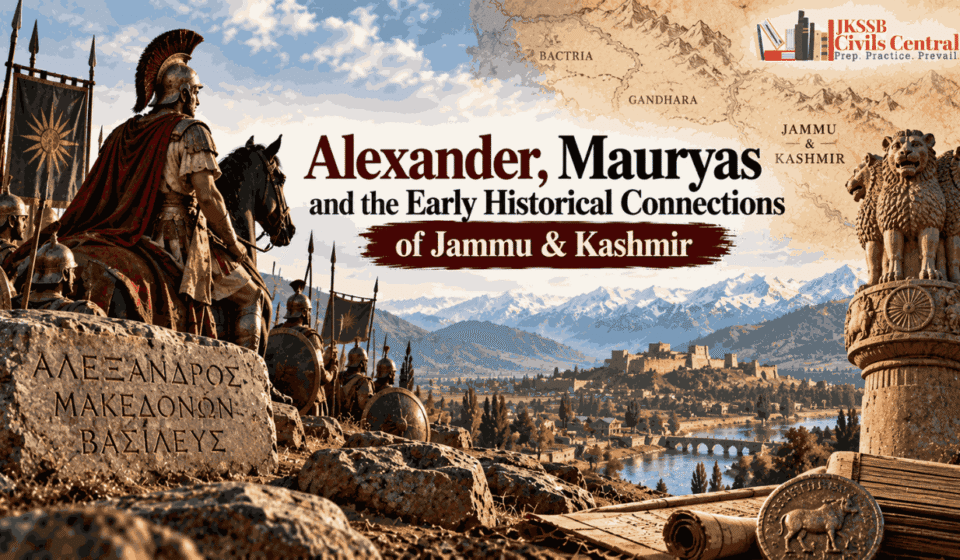
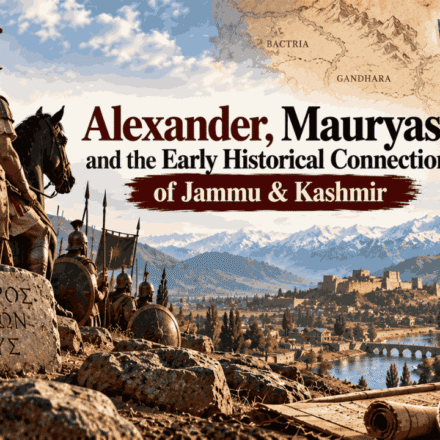
Alexander, Mauryas and the Early Historical Connections of Jammu & Kashmir

J&K History Series Navigation
| Previous Article | Current Article | Next Article |
|---|---|---|
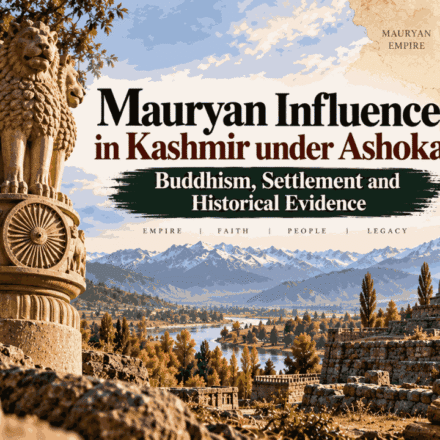
| Article 04 — Vedic Traditions and Early Historical Geography of Jammu & Kashmir | Article 05 — Alexander, Mauryas and the Early Historical Connections of Jammu & Kashmir | Article 06 — Mauryan Influence in Kashmir under Ashoka: Buddhism, Settlement and Historical Evidence |
Learning Dashboard
| Component | Key Information |
|---|---|
| Historical Period | Late 4th–3rd century BCE |
| Historical Phase | Early Historical J&K |
| Main Topic | Alexander, north-western contacts and Mauryan integration |
| Major Power | Mauryan Empire |
| Key Ruler | Ashoka |
| Important Greek Figure | Alexander III of Macedon |
| Important Local Figure | Abisares/Abhisara |
| Key Event | Battle of Hydaspes, 326 BCE |
| Key River | Hydaspes = Jhelum = Vitasta |
| Key Archaeological Site | Semthan, Anantnag |
| Important Evidence | Northern Black Polished Ware, punch-marked coins, stratigraphy |
| Important Literary Source | Arrian; Kalhana’s Rajatarangini for the later literary memory of Ashoka |
| Core Theme | Transition from early geographical connections to historically visible political and cultural integration |
| JKSSB Importance | Very High |
| Likely Question Types | Direct fact, statement-based, chronology, source identification, matching, conceptual-factual |
Introduction
The late fourth and third centuries BCE mark an important transition in the history of Jammu & Kashmir. Earlier evidence discussed in this series—archaeological remains, Vedic geographical references and later textual traditions—helps reconstruct the region’s broad cultural and geographical setting, but the period of Alexander and the Mauryas brings Jammu & Kashmir into a much more clearly documented network of north-western Indian politics. The importance of this transition does not lie in the simplistic claim that Alexander “conquered Kashmir”; rather, it lies in the fact that his campaign reached the Jhelum frontier and brought the political communities of the north-west into direct interaction with the Macedonian world. Within a few decades, the rise of the Mauryan Empire transformed that north-western political landscape and created the conditions for a stronger connection between Kashmir and the wider political and economic systems of northern India.
The geographical position of Kashmir is central to understanding this development. The Jhelum, known in Sanskrit as Vitasta and to the Greeks as the Hydaspes, connects the Kashmir Valley with the north-western plains. Alexander’s army fought the famous Battle of the Hydaspes in 326 BCE on the Jhelum, but the battlefield was in the Punjab region (Present day: Pakistan), not in the Kashmir Valley. At the same time, Greek accounts refer to Abisares, a ruler of the “mountaineer Indians,” whose territory has commonly been associated with the hill country to the north-east of the Punjab and has sometimes been connected with Kashmir; the exact extent of his territory remains a matter requiring caution.
The Mauryan period provides a more direct connection. Kashmir’s inclusion within the Mauryan political sphere is supported by a combination of later literary tradition and archaeological evidence. Kalhana’s Rajatarangini associates Ashoka with Kashmir and the foundation of Srinagari, while excavations at Semthan have revealed a pre-Mauryan and Mauryan cultural sequence containing Northern Black Polished Ware and punch-marked coins. The significance of the period, therefore, lies not merely in the presence of a powerful empire but in the emergence of stronger political, economic and cultural connections between Kashmir and the wider north Indian world.
Part I — From Early Historical Geography to the North-Western Frontier
1. Why the North-West Mattered
The north-western subcontinent was historically a zone of movement rather than an isolated frontier. Routes linking the Indus basin, Gandhara, the Punjab, the western Himalayan valleys and Central Asia allowed people, armies, merchants, technologies and cultural practices to move across difficult but strategically important terrain. Kashmir was not simply a remote mountain valley; its river systems, especially the Jhelum corridor, connected it with neighbouring regions to the south and west.
This geographical reality helps explain why the political changes occurring in Gandhara and the Punjab could affect Kashmir even when armies did not directly occupy the Valley. Taxila was particularly important because it functioned as a major political and commercial centre on the route between the Indus and the Jhelum. Arrian describes Taxila as a large and prosperous city and records that envoys from Abisares, ruler of the mountaineer Indians, came to Alexander there before the Macedonian advance towards the Hydaspes.
The historical connection should therefore be understood as a corridor of interaction. The Jhelum linked the Kashmir Valley to the Punjab, while the routes through Gandhara connected the region with the wider north-western world. This geography later helped the Mauryan political and cultural system extend its influence towards Kashmir.
CivilsCentral Historical Insight
The early historical importance of Kashmir cannot be understood through political boundaries alone. Its position within the Jhelum–Gandhara–Punjab network meant that political changes outside the Valley could have consequences within it. Geography therefore functioned as a mechanism connecting Kashmir to wider historical processes.
Part II — Alexander and the Jhelum Frontier
2. Alexander’s Indian Campaign
Alexander III of Macedon entered the north-western subcontinent during his campaign of 327–325 BCE, after consolidating his conquests in Central Asia. His advance into the Indian subcontinent brought him through the territories of Gandhara and Taxila before he moved towards the Jhelum.
By this stage Alexander’s expansion was not simply a military march through an undefined geographical space. He encountered a mosaic of rulers and communities, some of whom negotiated with him while others resisted. Taxiles of Taxila cooperated with Alexander, whereas several mountain communities opposed Macedonian expansion. This pattern of negotiation, resistance and incorporation became characteristic of Alexander’s campaign in the north-west.
The geographical relationship with Kashmir becomes particularly important at this point. Alexander did not conquer the Kashmir Valley in the manner sometimes suggested in popular accounts. His best-documented military engagement connected with the region was the Battle of the Hydaspes, fought on the Jhelum in 326 BCE in the Punjab. The identification of Hydaspes with the Jhelum is firmly established in the classical geographical tradition.
3. Abisares and the Mountain Kingdoms
One of the most important figures for understanding Kashmir’s early historical connections with Alexander is Abisares, also rendered Abhisara or Abisaris in different traditions.
Arrian describes Abisares as a ruler of the mountaineer Indians. His envoys came to Alexander at Taxila before the Macedonian army reached the Hydaspes. After Alexander defeated Porus, Abisares did not engage Alexander in a decisive military confrontation; later, through his representatives, he submitted and was allowed to retain authority over his territory under Alexander’s wider political arrangement.
The important examination point is the identification of Abisares. Later geographical scholarship has associated Abisares with the mountainous region adjoining Kashmir, and some historical works refer to him as a “king of Kashmir.” However, Arrian himself does not use that formulation; he describes Abisares as ruler of the mountaineer Indians. The exact territorial extent of Abisares’ kingdom is therefore better treated as a historical-geographical identification rather than as an absolutely established boundary of ancient Kashmir.
This distinction matters because the modern territorial concept of Jammu & Kashmir cannot simply be projected backward onto the fourth century BCE. Ancient political units did not necessarily correspond to today’s districts, divisions or international boundaries.
A crucial distinction
Correct: Alexander’s campaign brought him to the Jhelum and into political contact with rulers of the north-western mountain region.
Correct with qualification: Abisares has been associated with the Kashmir/hill-country region.
Incorrect: Alexander conquered the Kashmir Valley in 326 BCE.
Incorrect: The Battle of Hydaspes was fought in present-day Kashmir Valley.
Part III — The Battle of Hydaspes, 326 BCE
4. Alexander and Porus
The Battle of Hydaspes was fought in 326 BCE between Alexander and Porus, the ruler of the Paurava territory. The Hydaspes was the Greek name for the Jhelum, which flows through the Kashmir Valley before entering the Punjab. Alexander’s crossing of the river and his subsequent victory over Porus represented one of the major military episodes of his Indian campaign.
Arrian’s account provides a detailed description of the campaign. Alexander used deception and a carefully timed crossing to overcome Porus’s attempt to prevent the Macedonian army from crossing the river. The battle was difficult, particularly because Porus employed war elephants, but Alexander eventually defeated the Paurava army. Rather than removing Porus completely, Alexander restored him to power and expanded his authority over additional territory.
The Battle of Hydaspes is therefore significant for J&K history primarily because of geographical connectivity, not because it constituted the conquest of Kashmir. The river that the Greeks encountered as the Hydaspes was the same Jhelum that formed the principal river of the Kashmir Valley. The event demonstrates how the Valley was connected to the political and military geography of the north-western subcontinent.
5. Alexander’s Advance and Its Limits
Following his victory over Porus, Alexander continued his advance eastwards. His army eventually reached the Hyphasis, generally identified with the Beas, where his soldiers refused to continue farther into India. Alexander consequently began his return journey.
The significance of this episode for Kashmir lies in what Alexander did not accomplish. There is no sound basis for describing the Macedonian campaign as the conquest and occupation of the Kashmir Valley. Instead, the campaign brought the north-western political system—including mountain rulers connected with the region—into a new relationship with Macedonian power.
This distinction is especially important because popular accounts sometimes compress the entire north-western campaign into the statement “Alexander came to Kashmir.” A historically responsible reconstruction is more precise: Alexander reached the Jhelum frontier, fought Porus on the Hydaspes, received the submission of Abisares and interacted with political communities connected with the mountain zone north-east of the Punjab.
CivilsCentral Historical Insight
Alexander’s importance to J&K history is best understood through contact rather than conquest. The campaign demonstrates the strategic connectivity of the Jhelum–Punjab–Gandhara region and provides one of the earliest externally recorded contexts in which the political geography surrounding Kashmir becomes visible.
Part IV — The Political Transformation After Alexander
6. Alexander’s Withdrawal and the North-Western Power Vacuum
Alexander’s death in 323 BCE created a major political transformation. His empire fragmented among competing successors, while the territories he had conquered in the north-west experienced changing political control. The Macedonian presence did not produce a permanent Greek empire in the Indian subcontinent.
This instability created an opportunity for the rise of the Mauryan Empire. Chandragupta Maurya emerged in northern India during this period and established the Mauryan dynasty at Pataliputra. The Mauryan expansion subsequently brought large parts of northern India and the north-west under a single imperial framework.
The transformation is important for Kashmir because the Valley was situated near the north-western political zone affected by these developments. The incorporation of Gandhara and adjacent territories into the Mauryan political system strengthened the connections between Kashmir and the plains. However, the exact process and date by which Kashmir came under Mauryan authority cannot be reconstructed from a single contemporary inscription and therefore requires a combination of archaeological and literary evidence.
Part V — Kashmir and the Mauryan Empire
7. Was Kashmir Part of the Mauryan Empire?
The broad historical conclusion that Kashmir entered the Mauryan political sphere during the reign of Ashoka is well established in the historical literature, but the evidentiary basis needs to be explained carefully.
Unlike regions containing numerous Ashokan edicts, Kashmir does not provide a comparable corpus of directly datable Ashokan inscriptions establishing the emperor’s presence in the Valley. Much of the specific narrative concerning Ashoka in Kashmir comes from later sources, particularly Kalhana’s Rajatarangini. At the same time, archaeological discoveries at Semthan provide material evidence for strong connections between Kashmir and the wider Mauryan-era cultural world. The evidence is therefore cumulative rather than dependent upon one inscription.
The Government of Jammu & Kashmir’s historical overview also places Kashmir within the Mauryan Empire under Ashoka and associates the foundation of Srinagar with his reign. The Archaeological Survey of India documentation for Semthan is particularly important because it records a cultural sequence extending from the pre-Mauryan and Mauryan periods into later Indo-Greek, Kushana-Huna and medieval phases.
Kashmir is generally understood to have formed part of the Mauryan political sphere under Ashoka, supported by literary tradition and archaeological evidence, although the precise mechanism and extent of Mauryan administration in the Valley remain less directly documented than in regions containing Ashokan inscriptions.
Part VI — Ashoka and Kashmir
8. Ashoka in the Kashmir Tradition
Ashoka occupies a distinctive place in the historical tradition of Kashmir. Kalhana’s Rajatarangini, describes an Ashoka who ruled Kashmir and associates him with the foundation of Srinagari and the construction or patronage of religious establishments.
According to this tradition, Ashoka established a city called Srinagari, which later historical and archaeological discussions have associated with Pandrethan, south-east of the present city of Srinagar. The old settlement was subsequently known as Puranadhisthana, meaning roughly “old city” or “old foundation,” after a later capital developed farther down the Jhelum.
The identification, however, should be expressed carefully. Kalhana’s literary account is not itself an archaeological excavation report. The identification of ancient Srinagari with Pandrethan is a historical reconstruction based on textual, topographical and archaeological evidence.
9. Srinagari and the Development of Early Urban Centres
The Ashokan association with Srinagari is important because it reflects a broader historical transition: Kashmir was increasingly connected to the urban and political networks of early historic northern India.
Pandrethan lies close to the Jhelum and south-east of modern Srinagar. Its location illustrates why the Jhelum corridor was so important for the development of settlements. The river was simultaneously a geographical route, a source of water and an organising feature of the Valley’s settlement pattern.
It is therefore useful to distinguish Ashoka’s Srinagari from modern Srinagar. The traditional historical sequence associates an earlier Srinagari with the Pandrethan area, while a later capital known as Pravarapura or Pravarasenapura came to occupy the site associated with the modern city. The two should not automatically be treated as the same foundation separated only by a change of name.
This distinction is highly relevant to JKSSB because a question may deliberately place Ashoka, Srinagari, Pandrethan and Pravarasena in the same set of options.
Part VII — Archaeology and the Mauryan Connection
10. Semthan: The Archaeological Bridge
If Kalhana provides a later literary memory of Mauryan Kashmir, Semthan provides some of the most important archaeological evidence for the early historic transition.
Semthan, located in the Anantnag district near Bijbehara, occupies a significant position on a Karewa tableland close to the Jhelum. According to the Archaeological Survey of India’s documentation, excavations at the site produced a cultural sequence extending through the pre-Mauryan, Mauryan, Indo-Greek, Kushana-Huna and medieval periods. The site therefore helps bridge the archaeological gap between prehistoric Kashmir and the better-documented historical periods.
The archaeological sequence at Semthan is particularly important because it demonstrates that Kashmir was participating in cultural developments occurring beyond the Valley. Excavations recorded Northern Black Polished Ware (NBPW) and associated wares, together with punch-marked coins and other material remains. The 1978–79 Indian Archaeology: A Review records a pre-Mauryan and Mauryan phase at Semthan characterised by NBPW and associated material, including punch-marked coins.
11. Northern Black Polished Ware and What It Tells Us
Northern Black Polished Ware was a distinctive fine ceramic tradition associated with the early historic period of northern India. Its occurrence at Semthan is significant not because NBPW was itself a uniquely Mauryan object, but because it demonstrates Kashmir’s participation in wider networks of technology, consumption and exchange during a period associated with the Mauryan political expansion.
This distinction is important. NBPW does not by itself prove that a particular settlement was directly administered by the Mauryan state. Archaeological material can demonstrate interaction, cultural connection and chronological association; political control must be established through a broader body of evidence.
At Semthan, the significance becomes stronger because NBPW occurs alongside punch-marked coins and a stratified cultural sequence corresponding broadly to the period of Mauryan expansion. The archaeological evidence therefore complements, rather than simply repeats, the literary tradition concerning Mauryan Kashmir.
12. Punch-Marked Coins
Punch-marked coins are another important feature of the early historic material from Semthan. Their presence demonstrates that Kashmir participated in monetary and exchange systems connected with the wider northern Indian economy.
Again, the correct historical interpretation is more nuanced than saying “the Mauryans introduced coins to Kashmir.” The existence of punch-marked coins indicates participation in a broader monetary environment, but the exact mechanisms through which the coins circulated—state administration, trade, taxation or local exchange—cannot always be reconstructed from the archaeological find alone.
For examination purposes, however, the association is extremely useful:
Semthan → NBPW + punch-marked coins → early historic/Mauryan-period connections.
Part VIII — Economic and Cultural Connections
13. Kashmir Was Not Isolated
The archaeological record suggests that early historic Kashmir was increasingly integrated into networks extending beyond the Valley. The appearance of ceramic traditions and coins associated with wider northern Indian developments indicates interaction involving commodities, technologies and cultural practices.
This does not mean that Kashmir simply became culturally identical to the Gangetic plains. The archaeological record instead points to selective integration. Local traditions continued while new forms of pottery, technology, settlement and exchange entered the Valley.
The importance of Mauryan-era connections therefore lies in the creation of a more intensive relationship between Kashmir and the wider north Indian world. This relationship would become even more pronounced in subsequent centuries, when Indo-Greek and Kushan political and cultural influences became visible in the archaeological record.
14. The Jhelum as a Historical Corridor
The Jhelum deserves special attention because it connects several stages of this history.
In the Vedic geographical tradition it appears as Vitasta. In the Greek accounts of Alexander it appears as the Hydaspes. In the historical geography of Kashmir it becomes the central river around which major settlements and political centres developed.
This continuity demonstrates why rivers should be treated not simply as physical features but as historical corridors. The same river connected different political worlds at different moments: early north-western communities, the Paurava kingdom, Macedonian forces, Mauryan networks and later historical Kashmir.
The Jhelum’s significance therefore extends beyond the Battle of Hydaspes. It provides a geographical framework for understanding the long-term integration of Kashmir with the north-western subcontinent.
CivilsCentral Historical Insight
The Mauryan connection was not simply a political annexation visible on a map. Archaeological evidence such as NBPW and punch-marked coins indicates that Kashmir was becoming embedded in wider systems of exchange and material culture. The Jhelum corridor helped make this integration geographically possible.
Part IX — Ashoka and the Spread of Buddhism
15. Buddhism and Kashmir
Ashoka’s association with Kashmir is also important because the Mauryan period forms part of the early history of Buddhism in the Valley. Later Kashmiri traditions associate Ashoka with the construction of stupas and religious establishments and with the promotion of Buddhism. However, the precise chronology and extent of early Buddhist institutional development in Kashmir cannot be reconstructed solely from Kalhana’s account. Archaeological and literary evidence becomes progressively stronger for later centuries.
Part X — What Happened to the Mauryan Connection After Ashoka?
16. The End of Mauryan Political Dominance
The Mauryan Empire weakened after Ashoka’s death, and by the middle of the second century BCE the dynasty had lost its dominant position across much of northern India. The north-west again became an arena of political competition involving Indo-Greek and other Central Asian-linked powers.
Kashmir did not remain outside these transformations. Archaeological evidence from Semthan shows a sequence moving from the NBPW phase into an Indo-Greek phase, generally dated by archaeological scholarship to around the second century BCE and continuing into the early centuries CE.
The transition is historically significant because it demonstrates that Mauryan incorporation was not the endpoint of Kashmir’s early historical development. Rather, it created or intensified connections that continued through successive political formations. The archaeological sequence at Semthan is particularly valuable here because the site preserves multiple phases rather than an isolated Mauryan layer: pre-NBPW, NBPW, Indo-Greek, Kushana-Huna and later occupations.
Part XI — Alexander to Mauryas: The Larger Historical Transition
The period from Alexander to Ashoka can be understood as a sequence of connected transformations:
Early north-western political geography
↓
Alexander’s campaign, 327–325 BCE
↓
Battle of Hydaspes, 326 BCE
↓
Contact with Abisares and mountain polities
↓
Macedonian withdrawal and post-Alexander political fragmentation
↓
Rise of Chandragupta Maurya
↓
Mauryan expansion into the north-west
↓
Kashmir’s incorporation into the Mauryan political sphere
↓
Ashokan association with Kashmir
↓
Srinagari/Pandrethan tradition
↓
NBPW + punch-marked coins at Semthan
↓
Increasing integration with wider early historic networks
↓
Post-Mauryan Indo-Greek connections
This sequence is more historically useful than treating Alexander and Ashoka as isolated personalities. The important development was the transformation of the north-western political environment in which Kashmir was situated.
CivilsCentral Historical Insight
The period from Alexander to the Mauryas represents a transition from frontier interaction to stronger imperial integration. Alexander demonstrated the strategic importance of the Jhelum frontier; the Mauryans subsequently incorporated the north-west into a much larger political system in which Kashmir became increasingly connected to wider economic and cultural networks.
Part XII — Jammu and the Limits of the Evidence
17. What About the Jammu Region?
The early historical evidence is considerably richer for the Kashmir Valley than for many parts of the Jammu region. This difference should not be interpreted as evidence that Jammu was historically disconnected from the wider north-western world. Rather, the surviving archaeological and textual record is uneven.
The Chenab, Ravi and associated routes connected the Jammu hills with the Punjab and the north-west. These geographical connections created opportunities for interaction with the same wider political systems that affected Kashmir. However, direct evidence for a Mauryan administrative structure in particular parts of present-day Jammu is insufficient to justify assigning modern districts to Mauryan administrative units without qualification.
Part XIII — Historical Sources and Evidence
18. Arrian and the Greek Accounts
For Alexander’s campaign, Greek and Roman literary sources are indispensable. Arrian’s Anabasis of Alexander is especially important because it preserves detailed material about Alexander’s campaign, including Taxila, Abisares, the Hydaspes and the subsequent movement of the Macedonian army.
However, Arrian wrote centuries after Alexander and relied on earlier accounts, especially those associated with Alexander’s companions. His work therefore has to be treated as a later literary compilation based partly on earlier sources rather than as a contemporary battlefield diary.
19. Kalhana’s Rajatarangini
For Kashmir, Kalhana’s Rajatarangini is indispensable for understanding the later historical memory of ancient rulers. It places an Ashoka in the history of Kashmir and associates him with Srinagari and Buddhist establishments.
But Kalhana’s chronology of the earliest centuries cannot simply be accepted in the same manner as a contemporary inscription. The Rajatarangini was composed in the twelfth century CE, long after the Mauryan period. Its value is therefore strongest when combined with archaeology and other historical evidence.
This distinction is particularly important for Ashoka. The existence of a Kashmiri tradition connecting Ashoka with the Valley is strong; reconstructing every detail of his activities requires additional evidence.
20. Archaeology at Semthan
Semthan provides a different type of evidence because it is based on material remains and stratigraphy. The Archaeological Survey of India identifies a cultural sequence at the site extending from pre-Mauryan and Mauryan levels through Indo-Greek, Kushana-Huna and medieval phases.
The 1978–79 Indian Archaeology: A Review records NBPW and associated wares in the early historic sequence, together with punch-marked coins and other objects. This makes Semthan particularly valuable for the historical reconstruction of early Kashmir because it provides material evidence for the Valley’s participation in wider early historic processes.
Part XIV — Evidence Note: What Is Established and What Requires Caution?
| Claim | Evidence Level | Historical Treatment |
|---|---|---|
| Alexander fought Porus on the Hydaspes/Jhelum in 326 BCE | A | Strongly established |
| Hydaspes = Jhelum | A/B | Established conventional identification |
| Alexander conquered the Kashmir Valley | D / Unsupported | Should not be stated |
| Abisares was a ruler of mountain peoples | A | Explicitly recorded by Arrian |
| Abisares was definitely “king of Kashmir” | D | Later identification; qualify |
| Kashmir entered Mauryan political sphere under Ashoka | A/B | Strong historical conclusion from combined evidence |
| Ashoka founded Srinagari | B | Based principally on Kalhana and later reconstruction |
| Srinagari is identified with Pandrethan | B | Historical/archaeological identification |
| Semthan had Mauryan-period cultural material | A | Archaeologically established |
| NBPW occurs at Semthan | A | Archaeologically established |
| Punch-marked coins occur at Semthan | A | Archaeologically established |
| Ashokan edicts directly document rule in Kashmir | Not established | Do not claim |
| Mauryan administration was identical in Kashmir to the Gangetic core | D | Requires evidence; do not assume |
| Mauryan period strengthened Kashmir’s wider connections | A/B | Strongly supported by archaeological context |
The distinction between these levels is fundamental. Historical writing becomes unreliable when a later literary tradition is presented as though it were a contemporary inscription or archaeological fact.
Part XV — JKSSB Knowledge Matrix
| Question | High-Value Answer |
|---|---|
| Who invaded north-western India in 326 BCE? | Alexander III of Macedon |
| Which major battle is associated with the Jhelum? | Battle of Hydaspes |
| When was the Battle of Hydaspes fought? | 326 BCE |
| Hydaspes is the ancient name of which river? | Jhelum |
| Who fought Alexander at Hydaspes? | Porus |
| Who was Abisares? | Ruler of the mountaineer Indians mentioned in Greek accounts |
| Is Abisares certainly identical with the ruler of the entire Kashmir Valley? | No; the identification requires qualification |
| Did Alexander conquer Kashmir Valley? | No established evidence supports this |
| Which dynasty followed the post-Alexander political transformation in northern India? | Mauryan dynasty |
| Which Mauryan ruler is especially associated with Kashmir? | Ashoka |
| Which Kashmiri chronicle associates Ashoka with Srinagari? | Rajatarangini |
| Which site is traditionally identified with ancient Srinagari/Puranadhisthana? | Pandrethan |
| Which archaeological site provides important Mauryan-period evidence? | Semthan |
| What important pottery occurs at Semthan? | Northern Black Polished Ware |
| What important monetary evidence occurs at Semthan? | Punch-marked coins |
| What does Semthan demonstrate? | Kashmir’s participation in wider early historic cultural and economic networks |
| Which site bridges pre-Mauryan, Mauryan and later historical phases? | Semthan |
Part XVI — Examination Discrimination Points
1. Hydaspes vs Kashmir Valley
Hydaspes = Jhelum, but the Battle of Hydaspes was fought in the Punjab region, not in the Kashmir Valley.
2. Alexander vs Ashoka
- Alexander: 4th century BCE; north-western campaign; Hydaspes, 326 BCE.
- Ashoka: 3rd century BCE; Mauryan ruler; associated with Mauryan incorporation of Kashmir and Srinagari tradition.
3. Abisares vs Porus
- Abisares: ruler of the mountaineer Indians; associated with the north-western mountain zone.
- Porus: ruler defeated by Alexander at the Hydaspes.
4. Srinagari vs Modern Srinagar
The Srinagari attributed to Ashoka is traditionally associated with Pandrethan, whereas the later Pravarapura/Pravarasenapura is associated with the site of modern Srinagar.
5. Literary vs Archaeological Evidence
- Rajatarangini → later literary source.
- Semthan excavation → archaeological evidence.
- Arrian → classical literary source for Alexander’s campaign.
6. NBPW vs Mauryan Administration
NBPW is evidence of cultural and economic connection and chronology. It does not, by itself, prove the exact administrative structure of Mauryan Kashmir.
Part XVII — JKSSB Question Pattern
Direct Fact
Q. The ancient Greek name Hydaspes refers to which river?
A. Chenab
B. Jhelum
C. Ravi
D. Beas
Answer: B. Jhelum
Statement-Based
Q. Consider the following statements:
- The Battle of Hydaspes was fought between Alexander and Porus.
- Hydaspes is identified with the Jhelum.
- The battle was fought in the Kashmir Valley.
- Abisares was described by Arrian as ruler of the mountaineer Indians.
Which of the above are correct?
A. 1 and 2 only
B. 1, 2 and 4 only
C. 2 and 3 only
D. 1, 2, 3 and 4
Correct Answer: B
Explanation: Statements 1, 2 and 4 are correct. The Battle of Hydaspes occurred in the Punjab region, not in the Kashmir Valley.
Chronology
Q. Arrange the following in chronological order:
- Battle of Hydaspes
- Rise of Chandragupta Maurya
- Reign of Ashoka
- Decline of Mauryan power
A. 1 → 2 → 3 → 4
B. 2 → 1 → 3 → 4
C. 1 → 3 → 2 → 4
D. 2 → 3 → 1 → 4
Correct Answer: A
Match the Following
| Column I | Column II |
|---|---|
| A. Hydaspes | 1. Ashoka |
| B. Srinagari | 2. Jhelum |
| C. Semthan | 3. Mauryan/early historic archaeological sequence |
| D. Abisares | 4. Mountaineer Indians |
Correct Answer: A–2, B–1, C–3, D–4.
Identification by Clues
Q. Identify the archaeological site from the following clues:
- Located in Anantnag district
- Situated near the Jhelum
- Excavations revealed NBPW
- Punch-marked coins were found
- Cultural sequence extends from pre-Mauryan/Mauryan to later periods
A. Burzahom
B. Gufkral
C. Semthan
D. Martand
Correct Answer: C. Semthan
Conceptual-Factual
Q. Why is Alexander’s campaign important for the early history of Kashmir even though Alexander did not conquer the Kashmir Valley?
A. Because he established a permanent capital in Kashmir
B. Because his campaign demonstrated the strategic connectivity of the Jhelum and north-western mountain regions
C. Because he introduced Buddhism into Kashmir
D. Because he founded Srinagari
Correct Answer: B
Part XVIII — JKSSB Practice Questions
Question 1
The Battle of Hydaspes was fought in:
A. 327 BCE
B. 326 BCE
C. 322 BCE
D. 305 BCE
Correct Answer: B. 326 BCE
The battle between Alexander and Porus took place on the Hydaspes, identified with the Jhelum.
Question 2
Which of the following is the most accurate statement about Abisares?
A. He was the Mauryan governor of Kashmir.
B. He was the ruler of Magadha.
C. He was described by Arrian as ruler of the mountaineer Indians.
D. He was the successor of Ashoka.
Correct Answer: C
Arrian records envoys from Abisares, described as ruler of the mountaineer Indians, before Alexander’s advance to the Hydaspes.
Question 3
Which archaeological site is particularly important for understanding the Mauryan and early historic phases of Kashmir?
A. Burzahom
B. Semthan
C. Parihaspora
D. Martand
Correct Answer: B. Semthan
The ASI records a cultural sequence at Semthan extending through pre-Mauryan, Mauryan, Indo-Greek, Kushana-Huna and medieval phases.
Question 4
Which combination is correctly matched?
A. Hydaspes — Ravi
B. Porus — Battle of Hydaspes
C. Semthan — Karkota capital
D. Abisares — Mauryan emperor
Correct Answer: B
Question 5
Which archaeological evidence from Semthan is especially relevant to the Mauryan-period connection?
A. NBPW and punch-marked coins
B. Pit dwellings and dog burials
C. Mughal glazed tiles
D. Persian inscriptions of Akbar
Correct Answer: A
The early historic levels at Semthan yielded NBPW, associated wares and punch-marked coins. (NMMA)
Question 6
Consider the following statements:
- Rajatarangini associates Ashoka with Srinagari.
- Pandrethan has been identified with the ancient Srinagari/Puranadhisthana tradition.
- The present city of Srinagar must be identical with Ashoka’s original Srinagari.
Which is correct?
A. 1 only
B. 1 and 2 only
C. 2 and 3 only
D. 1, 2 and 3
Correct Answer: B
The first two statements reflect the established literary and historical reconstruction. The third oversimplifies the distinction between the earlier Srinagari/Pandrethan complex and the later capital associated with modern Srinagar.
Question 7
Which sequence is chronologically correct?
A. Ashoka → Alexander → Chandragupta Maurya
B. Alexander → Chandragupta Maurya → Ashoka
C. Chandragupta Maurya → Alexander → Ashoka
D. Ashoka → Chandragupta Maurya → Alexander
Correct Answer: B
Question 8
Which statement is NOT historically safe?
A. Hydaspes is identified with the Jhelum.
B. Alexander fought Porus in 326 BCE.
C. Alexander established permanent Mauryan-style administration in Kashmir.
D. Abisares was associated with the north-western mountain region.
Correct Answer: C
There is no basis for attributing Mauryan-style administration to Alexander in Kashmir.
Part XIX — Rapid Revision Zone
Important Dates
| Date | Event |
|---|---|
| 327–325 BCE | Alexander’s Indian campaign |
| 326 BCE | Battle of Hydaspes/Jhelum |
| Late 4th century BCE | Rise and expansion of Mauryan power |
| c. 268–232 BCE | Reign of Ashoka |
| 3rd century BCE | Mauryan political and cultural connections with Kashmir |
| c. 2nd century BCE onward | Increasing Indo-Greek connections in Kashmir |
Important Personalities
- Alexander III of Macedon — led the north-western Indian campaign.
- Porus/Paurava ruler — fought Alexander at Hydaspes.
- Abisares/Abhisara — ruler of the mountaineer Indians in Greek accounts.
- Chandragupta Maurya — founder of Mauryan imperial power.
- Ashoka — Mauryan ruler strongly associated with Kashmir in literary tradition.
Important Places
- Hydaspes/Jhelum — site of Alexander’s battle with Porus.
- Taxila — major north-western political and commercial centre.
- Pandrethan — traditionally identified with ancient Srinagari/Puranadhisthana.
- Semthan — major archaeological site for the early historic period.
- Kashmir Valley — central geographical area of Mauryan-era historical reconstruction.
Important Sources
| Source | Importance |
|---|---|
| Arrian’s Anabasis | Alexander’s campaign |
| Rajatarangini | Later Kashmir tradition concerning Ashoka and Srinagari |
| Archaeological evidence from Semthan | Mauryan/early historic material culture |
| Indian Archaeology: A Review | Excavation evidence from Semthan |
| Later Chinese Buddhist accounts | Important for the wider Buddhist history of Kashmir, especially later periods |
Important Associations
Alexander → Hydaspes → Jhelum → Porus
Abisares → Mountaineer Indians → North-western hill region
Ashoka → Mauryas → Kashmir → Srinagari tradition
Pandrethan → Puranadhisthana → Old Capital
Semthan → NBPW → Punch-marked coins → Early Historic Kashmir
Chronological Sequence
Vedic geographical connections
↓
Alexander’s campaign — 327–325 BCE
↓
Battle of Hydaspes — 326 BCE
↓
Rise of Mauryas
↓
Ashoka — 3rd century BCE
↓
Mauryan connection with Kashmir
↓
Semthan early historic sequence
↓
Indo-Greek phase
Part XX — Frequently Confused Facts
Alexander did not conquer Kashmir Valley
His campaign reached the Jhelum and brought him into contact with mountain rulers associated with the north-west, but there is no reliable basis for describing the Valley itself as conquered and occupied by Alexander.
Hydaspes is not a different river from the Jhelum
Hydaspes = Jhelum = Vitasta in the respective Greek/Sanskrit geographical traditions.
Porus was not the king of Kashmir
Porus was the Paurava ruler who fought Alexander at the Hydaspes.
Abisares was not Ashoka
Abisares belonged to the north-western political landscape of Alexander’s campaign; Ashoka was the Mauryan emperor of the third century BCE.
Srinagari should not automatically be equated with modern Srinagar
The traditional Ashokan Srinagari is associated with the Pandrethan/Puranadhisthana area, while the later Pravarapura/Pravarasenapura is associated with modern Srinagar.
Semthan is not a Neolithic site like Burzahom
Semthan is especially important for the early historic sequence, including pre-Mauryan, Mauryan and Indo-Greek phases.
NBPW is not synonymous with the Mauryan Empire
NBPW is an archaeological cultural marker with a broader chronological and geographical distribution. At Semthan it forms part of the evidence for Kashmir’s participation in wider early historic networks.
Part XXI — What Can JKSSB Ask?
High-value question areas
- Battle of Hydaspes and its date
- Hydaspes–Jhelum identification
- Alexander and Porus
- Abisares and the north-western mountain region
- Difference between Alexander’s campaign and Mauryan expansion
- Chandragupta Maurya and Ashoka chronology
- Ashoka’s association with Kashmir
- Srinagari and Pandrethan
- Puranadhisthana
- Semthan archaeological evidence
- NBPW
- punch-marked coins
- literary vs archaeological evidence
- distinction between Kashmir Valley and the wider Jhelum/Punjab frontier
- chronology of Alexander → Mauryas → Indo-Greeks
- limitations of using Rajatarangini for the Mauryan period.
Chapter Summary
The history of Jammu & Kashmir in the late fourth and third centuries BCE cannot be understood as a simple sequence of foreign conquest followed by Mauryan rule. Alexander’s campaign brought the north-western political landscape into direct contact with Macedonian power, and the Battle of Hydaspes in 326 BCE established the Jhelum as one of the major geographical markers of Alexander’s Indian campaign. The presence of Abisares, described by Arrian as a ruler of the mountaineer Indians, further demonstrates the political importance of the mountainous region adjoining the north-west, although his precise territorial identification with Kashmir requires caution.
The rise of the Mauryas produced a more substantial political transformation. Kashmir became connected with the Mauryan imperial sphere, particularly under Ashoka, although the evidence for this connection is drawn from a combination of later literary tradition and archaeological material rather than from a surviving Ashokan inscription in the Valley. Kalhana’s Rajatarangini associates Ashoka with Srinagari, traditionally connected with Pandrethan, while the excavations at Semthan provide material evidence for Kashmir’s participation in the wider early historic world through NBPW, punch-marked coins and a stratified sequence extending from the pre-Mauryan and Mauryan phases into the Indo-Greek and later periods.
The broader historical significance lies in the transformation of Kashmir from a region known primarily through geographical and cultural connections into a region increasingly visible within the political and economic networks of early historic South Asia. The Jhelum acted as a major connecting corridor, linking Kashmir with Gandhara and the Punjab, while archaeological evidence demonstrates that the Valley was participating in wider systems of material exchange and cultural interaction.
Mind Map
EARLY HISTORICAL J&K
        │
        ├── NORTH-WESTERN GEOGRAPHY
        │       ├── Gandhara
        │       ├── Taxila
        │       ├── Punjab
        │       └── Jhelum / Vitasta
        │
        ├── ALEXANDER
        │       ├── Indian Campaign
        │       ├── Hydaspes — 326 BCE
        │       ├── Porus
        │       └── Abisares / Mountain Polities
        │
        ├── POST-ALEXANDER TRANSFORMATION
        │       └── Rise of Mauryas
        │
        ├── MAURYAN CONNECTION
        │       └── Ashoka
        │
        ├── KASHMIR
        │       ├── Srinagari Tradition
        │       ├── Pandrethan
        │       └── Puranadhisthana
        │
        ├── ARCHAEOLOGY
        │       └── Semthan
        │             ├── Pre-Mauryan
        │             ├── Mauryan
        │             ├── NBPW
        │             ├── Punch-marked Coins
        │             └── Indo-Greek
        │
        └── HISTORICAL SIGNIFICANCE
                ├── Political Integration
                ├── Economic Connections
                ├── Cultural Interaction
                └── Transition to Early Historic Kashmir
FAQs
1. Did Alexander conquer Kashmir?
No. There is no reliable evidence that Alexander conquered and occupied the Kashmir Valley. His campaign reached the Jhelum and brought him into contact with political communities of the north-western mountain region.
2. What was the Hydaspes?
Hydaspes was the Greek name for the Jhelum, the principal river of the Kashmir Valley.
3. When was the Battle of Hydaspes fought?
The Battle of Hydaspes was fought in 326 BCE between Alexander and Porus.
4. Who was Abisares?
Abisares, or Abhisara, was described by Arrian as a ruler of the mountaineer Indians. His territory is commonly associated with the north-western mountain region adjoining Kashmir, but the exact territorial identification requires qualification.
5. When did Kashmir become associated with the Mauryan Empire?
Kashmir is generally understood to have entered the Mauryan political sphere during the third century BCE, particularly under Ashoka. The conclusion rests on combined literary and archaeological evidence.
6. Which Mauryan ruler is most closely associated with Kashmir?
Ashoka is the Mauryan ruler most strongly associated with Kashmir in the historical and literary tradition.
7. What was Srinagari?
Srinagari was a city attributed to Ashoka in Kalhana’s Rajatarangini. It is traditionally associated with the Pandrethan/Puranadhisthana area rather than being treated as identical in every respect with modern Srinagar.
8. Why is Semthan important?
Semthan is one of the most important archaeological sites for reconstructing early historic Kashmir. Its excavations revealed pre-Mauryan and Mauryan cultural levels, NBPW, punch-marked coins and later Indo-Greek and other phases.
9. Does NBPW prove direct Mauryan administration in Kashmir?
Not by itself. NBPW demonstrates participation in wider early historic cultural and economic networks. Political control requires a broader evidentiary basis.
10. Why is this period important for the later history of Kashmir?
It marks the transition from an early historical geography dominated by regional networks into a period of stronger imperial, economic and cultural integration. These connections created the background for the subsequent development of Buddhism and the Indo-Greek and Kushan phases of Kashmir’s history.
About The Author




[…] Article 05 — Alexander, Mauryas and the Early Historical Connections of Jammu & Kashmir […]
[…] Article 05 — Alexander, Mauryas and the Early Historical Connections of Jammu & Kashmir […]