
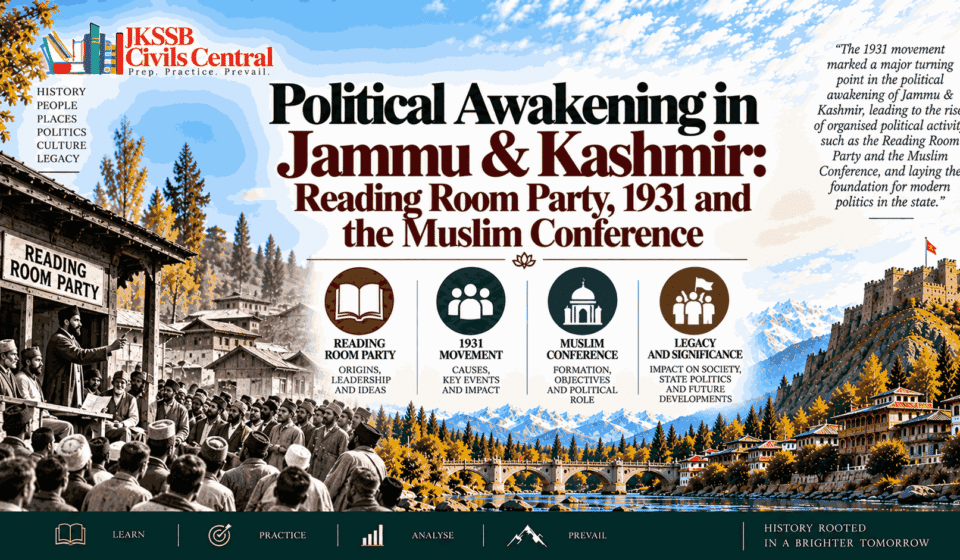
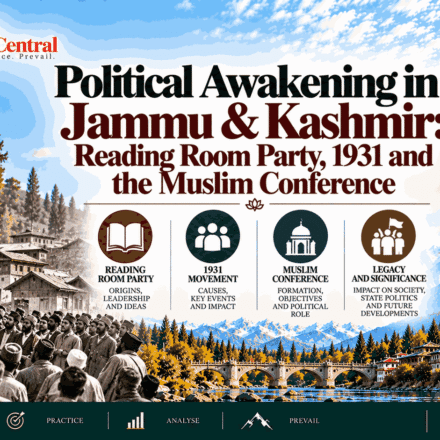
Political Awakening in Jammu & Kashmir: Reading Room Party, 1931 and the Muslim Conference

J&K History Series Navigation
| Previous Article | Current Article | Next Article |
|---|---|---|
| Article 41 — Maharaja Hari Singh: Social Reforms, Constitutional Developments and Modernization | Article 42 — Political Awakening in Jammu & Kashmir: Reading Room Party, 1931 and the Muslim Conference | Article 43 — National Conference and Naya Kashmir Manifesto: Political and Socio-Economic Vision |
Learning Dashboard
| Area | Key Information |
|---|---|
| Historical Period | c. 1920s–1934 |
| Historical Phase | Political Awakening & Modern J&K |
| Core Theme | Emergence of organised political consciousness under Dogra rule |
| Main Organisations | Reading Room Party; Young Men’s Muslim Association; All Jammu & Kashmir Muslim Conference |
| Major Turning Point | 1931 agitation |
| Major Date | 13 July 1931 |
| Major Commission | Glancy Commission, 1931–32 |
| Major Political Organisation | All Jammu & Kashmir Muslim Conference, October 1932 |
| Key Personalities | Sheikh Mohammad Abdullah, Chaudhry Ghulam Abbas, Mirwaiz Mohammad Yusuf Shah, Ghulam Ahmad Ashai and other political activists |
| Important Places | Fateh Kadal, Srinagar; Khanqah-i-Moula; Srinagar Central Jail; Pathar Masjid |
| Key Consequence | Transition from scattered grievances to organised political mobilisation |
| JKSSB Importance | Very High |
| Likely Question Types | Chronology, statement-based, matching, direct fact, identification, cause–consequence |
Introduction
The political awakening of Jammu & Kashmir in the late 1920s and early 1930s marked a major transition in the modern history of the princely state. Earlier expressions of discontent had appeared through economic protests, local associations, religious organisations and grievances regarding government employment and administration, but these did not yet amount to a sustained, organised political movement across the state. The emergence of educated political activists, especially among the younger generation, created a new kind of public discourse in which questions of education, employment, representation, civil rights and political participation increasingly became subjects of collective discussion.
The Reading Room Party was an important early expression of this new political consciousness in Kashmir Valley. It provided an informal platform through which educated young men could discuss the condition of society and the grievances of Muslims, particularly their limited representation in state services and public institutions. The movement acquired a much wider mass character during the upheavals of 1931, when a series of religious, administrative and political grievances converged with growing dissatisfaction with the structure of Dogra rule.
The events of 13 July 1931, when state forces opened fire outside Srinagar Central Jail during the proceedings against Abdul Qadeer, became a defining moment in this political awakening. The immediate episode was followed by wider disturbances, arrests, political mobilisation and the appointment of the Glancy Commission to investigate grievances. Out of this rapidly changing political environment emerged the All Jammu & Kashmir Muslim Conference in October 1932, providing the movement with a formal organisational structure.
This transformation is important because it changed the character of politics in Jammu & Kashmir. Political dissatisfaction was no longer confined to petitions and elite representations. It increasingly involved public meetings, organised associations, political programmes, mass mobilisation and demands for representation. At the same time, the movement’s early political language was strongly connected with Muslim grievances, making the relationship between community-based mobilisation and broader political representation one of the central questions in the subsequent history of Jammu & Kashmir.
Part I — Historical Background: Conditions Before Political Awakening
The political awakening of the 1930s did not emerge suddenly. It developed against the background of the institutional and socio-economic structure of the Dogra princely state, in which political authority ultimately rested with the Maharaja and organised representative politics remained extremely limited. The administrative reforms discussed in the preceding article had produced new institutions, educational opportunities and a small educated class, but political participation had not developed at a comparable pace. This created a gap between increasing social awareness and limited opportunities for organised political expression.
Education was particularly important. During the early twentieth century, a small but increasingly influential group of educated Kashmiris came into contact with political ideas circulating in British India. Some had studied at institutions outside the state, including Aligarh and universities in Punjab. They encountered debates concerning representative government, communal representation, civil liberties, employment, constitutional reform and anti-colonial politics. On returning to Jammu & Kashmir, these educated men increasingly viewed local grievances not simply as isolated administrative problems but as symptoms of a wider political structure.
Employment was one of the most important issues. Educated Muslims in particular complained about inadequate opportunities in state services and about educational qualifications and recruitment practices that they regarded as disadvantageous. These grievances acquired a political dimension because government employment was closely connected with social status, economic security and access to state institutions. Thus, the demand for greater representation in government services gradually became connected with a broader demand for political and administrative reform.
At the same time, the state did not yet possess a developed system of representative politics through which such grievances could be debated institutionally. Political associations faced restrictions, while public political activity remained tightly controlled. The result was that educated youth increasingly relied on informal discussion groups, religious platforms, petitions and public meetings.
CivilsCentral Historical Insight
Political awakening in Jammu & Kashmir was not simply the result of one dramatic event. It emerged from the interaction of education, employment grievances, restricted political participation and the growth of a new educated public sphere. The significance of the late 1920s lies precisely in this transition from individual grievance to collective political consciousness.
Part II — Emergence of the Reading Room Party
The Reading Room as a Political Space
The Reading Room Party emerged in Srinagar around 1929–30, although sources differ somewhat over the precise date and terminology used for the organisation. It was associated with a group of educated young Muslims who gathered at a reading room in the Fateh Kadal area of Srinagar. Rather than beginning as a fully developed political party in the modern sense, it functioned primarily as a forum for discussion, political awareness and articulation of grievances.
The importance of the Reading Room lay less in its formal organisational structure than in the new political culture it represented. Newspapers, books and political discussions allowed educated youth to exchange ideas about conditions within Jammu & Kashmir and developments in British India. The group became a meeting point where questions concerning education, government employment, Muslim representation and the political condition of the state could be discussed collectively.
Among the personalities associated with this emerging political milieu was Sheikh Mohammad Abdullah, who had received modern education and subsequently became one of the most prominent political leaders of Jammu & Kashmir. Other educated activists also participated in the growing political discussion. The Reading Room therefore represented the emergence of a new educated political leadership rather than an already established mass party.
The term “Reading Room Party” should consequently not be misunderstood as meaning that it was equivalent to the later Muslim Conference or National Conference. It was an early organisational and intellectual platform that helped create the political networks and public consciousness from which more formal political organisation subsequently developed.
From Discussion to Political Mobilisation
The early activities of the Reading Room group were connected with concrete grievances. Young educated Muslims were concerned about their representation in government employment, educational opportunities and the wider administration of the state. The political significance of these concerns grew because they were increasingly discussed collectively rather than privately.
The movement also began establishing connections with political activists outside Srinagar. In Jammu, organisations such as the Young Men’s Muslim Association, associated particularly with Chaudhry Ghulam Abbas, had already created a political platform among sections of the Muslim population. The interaction between political activists in Jammu and Srinagar was important because it helped move political mobilisation beyond the confines of a single city or region.
This connection would become particularly important after 1931. The subsequent Muslim Conference would bring together leadership from Jammu and Kashmir Valley, although political differences within the Muslim community and between regions would remain important throughout the decade.
CivilsCentral Historical Insight
The Reading Room movement was significant because it transformed the political role of the educated youth. Its importance was not that it immediately possessed mass organisational power, but that it helped create the political vocabulary, networks and leadership that later made organised mobilisation possible.
Part III — Immediate Preconditions of the 1931 Agitation
The upheaval of 1931 had multiple causes and should not be reduced to a single incident. Religious grievances, concerns regarding employment and representation, restrictions on political activity, dissatisfaction with administrative practices and the growing influence of educated political activists interacted with one another. The political atmosphere became increasingly tense during the first half of 1931.
Several incidents involving religious sensitivities contributed to this atmosphere. Among them were disputes concerning religious observances and allegations of disrespect towards the Quran. Such incidents acquired political importance because they were interpreted within an already existing environment of distrust between sections of the population and the state administration.
The mobilisation also involved religious leaders and public figures. The involvement of the Mirwaizs and other religious personalities helped extend political discussion beyond the educated elite. This was an important transformation: grievances that had initially been articulated by educated groups increasingly acquired a mass social and religious dimension.
At the same time, it is important not to portray the 1931 movement as having a single universally agreed programme from its beginning. Different actors entered the movement with different priorities. Some emphasised Muslim representation and religious grievances; others increasingly articulated broader political and civil rights; still others were concerned with socio-economic conditions and administrative reform.
This diversity became one of the defining characteristics of the political awakening of the 1930s.
Part IV — The Abdul Qadeer Episode
One of the immediate catalysts of the July 1931 crisis was the case of Abdul Qadeer Khan, a visitor to Kashmir who delivered a strongly worded speech in which he criticised the ruling authority. His speech attracted the attention of the state authorities, and he was arrested and charged under the state’s penal provisions.
The trial attracted considerable public attention. Large numbers of people gathered around the proceedings, demonstrating that the case had become more than an ordinary judicial matter. As tensions increased, the authorities shifted the proceedings to the Srinagar Central Jail, where security could be more tightly controlled.
The movement surrounding Abdul Qadeer illustrates an important feature of the 1931 crisis: an individual legal case became a focal point for wider political dissatisfaction. The issue was no longer simply whether one person should be tried. His case became connected to questions of public authority, political expression and the right of people to participate in matters affecting the community.
The case therefore helped convert accumulated grievances into a visible mass mobilisation.
CivilsCentral Historical Insight
Political crises often develop when a specific incident becomes a symbol for accumulated grievances. The Abdul Qadeer case acquired significance because it connected an individual prosecution with broader questions about political expression, administrative authority and popular participation.
Part V — 13 July 1931: The Central Jail Firing
The Events of 13 July
On 13 July 1931, large numbers of people gathered near Srinagar Central Jail in connection with Abdul Qadeer’s trial. During the proceedings, the crowd became increasingly tense. At approximately midday, the call to prayer was being given when firing by the state forces took place.
The most widely cited historical figure is 22 persons killed during the firing and its immediate aftermath. Some contemporary reports and later accounts give slightly different figures, which is why the precise numerical formulation requires caution. For examination purposes, 22 is the figure most commonly associated with the 13 July 1931 Central Jail firing.
The episode had an enormous political impact. The deaths transformed the gathering from a protest surrounding a particular trial into a powerful symbol of resistance to state authority. The bodies of those killed were carried through Srinagar, and the event generated widespread anger and mobilisation.
The day subsequently acquired a permanent place in the political memory of Kashmir as 13 July 1931, commonly remembered as Martyrs’ Day in the political tradition that developed around the event. The terminology and interpretation of the day have themselves become politically contested in later periods, but its significance as a turning point in the history of mass political mobilisation is firmly established.
Beyond the Firing
The consequences of the firing extended beyond Srinagar. Protests and disturbances occurred in other parts of the state, and the situation took on a communal dimension in some places. This is an important part of the historical record that should not be omitted simply because later political narratives have often concentrated on the Central Jail firing itself.
The disturbances affected relations between communities, property and commercial activity, and the general functioning of administration. The crisis therefore had both a political and a social dimension.
The state responded through arrests and measures intended to restore order. Sheikh Abdullah and other political activists were among those arrested during the subsequent unrest. Rather than ending political mobilisation, however, repression and arrests contributed to further political consciousness.
CivilsCentral Historical Insight
The importance of 13 July 1931 lies not merely in the number of people killed. The event transformed political grievance into mass political memory and accelerated the transition from informal mobilisation to organised politics. At the same time, the communal violence that accompanied the wider agitation reminds us that the political awakening was neither ideologically uniform nor socially uncomplicated.
Part VI — The State Response and the Glancy Commission
The 1931 crisis forced the state authorities to confront grievances that could no longer be treated merely as isolated complaints. Maharaja Hari Singh’s government appointed a commission under Sir B. J. Glancy to investigate grievances and recommend measures for reform.
The Glancy Commission became one of the most important institutional consequences of the 1931 agitation. Its significance extended beyond religious grievances because it examined questions concerning education, government employment, representation, political rights and constitutional reform.
The Commission’s recommendations addressed, among other matters, greater attention to Muslim educational advancement, representation in government services, religious concerns, and political and constitutional reform. The recommendations also became connected with the question of greater public participation in government.
The British parliamentary record confirms that the Maharaja’s government had taken action on the Commission’s recommendations by April 1932 and that the subsequent constitutional reform process led to the appointment of a Franchise Committee in May 1932.
This sequence is particularly important:
1931 agitation → Glancy Commission → constitutional reform process → Franchise Committee → Praja Sabha (1934).
The Commission therefore represented an important transition from protest politics to institutional reform.
The Importance of Political Rights
One of the most significant consequences of the reform process was the gradual relaxation of restrictions on political expression. The government’s acceptance of measures concerning freedom of press and public platform helped create greater space for political associations.
This change was crucial because political organisation requires more than grievances. It requires opportunities to meet, communicate, publish, mobilise supporters and formulate demands. The relaxation of restrictions therefore helped create the institutional environment in which the Muslim Conference could develop.
However, these reforms did not establish responsible government in the modern democratic sense. The Maharaja continued to retain ultimate authority, and representative institutions introduced during the following years possessed significant limitations.
CivilsCentral Historical Insight
The Glancy process illustrates how political movements can alter state institutions even without immediately overthrowing the existing political order. The 1931 agitation did not end Dogra rule; instead, it forced the regime toward a new phase of constitutional and administrative reform.
Part VII — From Agitation to Organisation
The events of 1931 revealed both the strength and weakness of spontaneous mobilisation. The movement could mobilise large crowds, but sustained political action required an organisation capable of coordinating activists, formulating demands and representing different regions.
The political leadership therefore increasingly moved towards creating a formal organisation. The experience of 1931 had also brought together activists from different parts of the state, especially from Jammu and Kashmir Valley. Sheikh Abdullah and Chaudhry Ghulam Abbas became particularly important figures in this process.
The proposed organisation was shaped by the political circumstances of the time. Its immediate social base was predominantly Muslim, and its name explicitly reflected that fact. Its initial programme therefore placed considerable emphasis on the political, educational, economic and social rights of Muslims.
At the same time, its leaders did not initially present the movement simply as a religious campaign. Sheikh Abdullah and other leaders frequently argued that the political struggle should address wider grievances and that non-Muslims should not be excluded from the benefits of reform.
This distinction is important. The name and social base of the organisation were Muslim, but its political programme cannot be understood solely through a narrow religious lens. The organisation represented an early stage in the evolution of a political movement that would later undergo major ideological transformation.
Part VIII — Formation of the All Jammu & Kashmir Muslim Conference
Formation in October 1932
The All Jammu & Kashmir Muslim Conference was established in October 1932. The inaugural convention/session was held at Pathar Masjid, Srinagar, in mid-October. University of Kashmir research and historical documentary material place the convention in the 14–16 October 1932 period, while some secondary accounts give 15–17 October; the safest exam formulation is therefore October 1932, Pathar Masjid, Srinagar.
Sheikh Mohammad Abdullah was chosen as president, while Chaudhry Ghulam Abbas emerged as an important organisational leader and general secretary. Other prominent activists and religious figures also participated in the formation of the organisation.
The formation of the Muslim Conference represented a major organisational breakthrough. For the first time, the political energy generated by the 1931 movement acquired a formal political platform capable of coordinating activity across the state.
Main Objectives
The organisation’s early constitutional objectives included:
- organisation and unity of the Muslims of Jammu & Kashmir;
- protection of the political rights of Muslims;
- improvement of educational conditions;
- social and economic advancement;
- protection of religious interests;
- greater representation in government services;
- political and constitutional reform.
These objectives reflected the political environment from which the organisation emerged. The Muslim Conference was therefore not merely a religious body. It was a political organisation formed in response to grievances concerning state power, representation and socio-economic conditions.
University of Kashmir research on the organisation’s original constitution emphasises its explicit Muslim organisational identity and its objectives concerning political, educational, social, cultural and economic rights.
Jammu and Kashmir Connection
One of the organisation’s important features was its attempt to connect political activists from Jammu and Kashmir Valley. This was historically significant because political mobilisation had previously developed through somewhat separate regional and organisational channels.
The Young Men’s Muslim Association in Jammu and the Reading Room movement in Srinagar represented different regional political networks. The Muslim Conference created a common organisational framework through which these networks could interact.
This did not eliminate regional differences. Jammu, Kashmir Valley and other parts of the state possessed different political, social and economic conditions. Nevertheless, the creation of a state-wide political organisation was itself a major development.
CivilsCentral Historical Insight
The Muslim Conference transformed political awakening into organised state-wide politics. Its importance lies not simply in its religious identity but in the fact that it created a durable political organisation capable of articulating demands, coordinating leadership and participating in the constitutional politics that followed.
Part IX — Sheikh Mohammad Abdullah and the New Political Leadership
Sheikh Mohammad Abdullah emerged from the educated Muslim milieu of the late 1920s and became one of the central political figures of the 1930s. His importance arose from his ability to connect educated political activism with wider public mobilisation.
He was not the sole leader of the political awakening. Chaudhry Ghulam Abbas, the Mirwaizs, Ghulam Ahmad Ashai and numerous other activists played important roles. The movement was therefore collective in origin even though Sheikh Abdullah eventually became its most prominent public leader.
Abdullah’s political language evolved over time. In the early 1930s, Muslim political representation was central to the movement’s programme. However, the political experience of the following years increasingly encouraged debate about whether the movement should remain organised around Muslim identity or develop into a broader political organisation representing all communities.
That debate would eventually contribute to the transformation of the Muslim Conference into the National Conference in 1939, which belongs to the next stage of the series and should not be retroactively imposed on the organisation’s original 1932 identity.
This chronological distinction is essential:
Reading Room Party → 1931 agitation → Muslim Conference (1932) → political and ideological debate → National Conference (1939).
Part X — Muslim Conference and the Constitutional Reform Process
The Muslim Conference did not operate in isolation from constitutional developments. The reforms initiated after 1931 created new political questions: how should representatives be selected? Who should have the right to vote? What powers should an assembly possess? How should different communities and regions be represented?
The Kashmir Constitutional Reforms Conference, presided over by B. J. Glancy, examined these questions in 1932. The process subsequently led to the appointment of the Franchise Committee on 31 May 1932. The British Library catalogue preserves the official record of the 1932 Kashmir Constitutional Reforms Conference and the 1934 Franchise Committee report.
The constitutional process eventually contributed to the establishment of the Praja Sabha in 1934. The Sabha contained elected, nominated and official members, but the Maharaja retained substantial authority. Consequently, the introduction of a legislative assembly represented an important institutional development without amounting to full responsible government.
This distinction matters for examination purposes. A question stating that the 1931 agitation immediately established democracy in Jammu & Kashmir would be incorrect. The historical process was gradual:
Mass agitation → inquiry → reforms → constitutional discussion → franchise arrangements → limited representative institution.
Part XI — Political Awakening Beyond 1931
The political awakening of the early 1930s continued after the immediate crisis of July 1931. The Muslim Conference used the political space created by the reforms to press for implementation of recommendations and further political rights.
The movement also increasingly engaged with questions of land, employment, education, taxation and the condition of different social groups. This broadened political mobilisation beyond purely religious questions.
At the same time, the movement faced internal divisions. Differences existed between political leaders, religious authorities, regional interests and competing visions of the future political organisation of the state. The early Muslim Conference therefore should not be portrayed as a perfectly unified organisation.
These internal debates were historically significant because they foreshadowed the ideological transformation that occurred later in the decade. The question increasingly became whether political rights should be organised around the interests of one religious community or around a broader conception of popular representation.
That question would become central to the emergence of the National Conference.
CivilsCentral Historical Insight
Political awakening is not the same as political unity. The 1930s created a common political arena in Jammu & Kashmir, but they also exposed disagreements over identity, representation, region and political strategy. These tensions shaped the subsequent evolution of the Muslim Conference and National Conference.
Part XII — Political Awakening: Major Dimensions
1. Educational Dimension
Modern education created a small educated class capable of articulating political grievances in new forms. Institutions outside the state exposed students to wider political debates, while educated youth returning to Jammu & Kashmir became intermediaries between these ideas and local society.
2. Employment and Representation
Government employment was a major source of political grievance, especially among educated Muslims who believed that their community was inadequately represented. Recruitment therefore became a political issue rather than merely an administrative one.
3. Religious Dimension
Religious identity played a major role in the early mobilisation of Kashmir’s Muslim population. Religious leaders and institutions helped convert political grievances into mass mobilisation. However, reducing the entire movement to religion alone obscures the simultaneous demands for political representation, education, employment and civil rights.
4. Political Dimension
The absence of representative institutions created a structural problem. Grievances could be expressed through petitions and public meetings, but there was no developed legislature through which organised political parties could exercise meaningful influence.
5. Regional Dimension
The political awakening involved both Jammu and Kashmir Valley. The emergence of the Muslim Conference created a common organisational framework, although regional political differences remained significant.
6. Social Dimension
The movement gradually extended beyond educated elites to wider sections of the population. This transition from elite political discussion to mass mobilisation was one of the most important features of the period.
Part XIII — Historical Interpretation and Evidence Note
The political awakening of the early 1930s has been interpreted differently by different political and historical traditions.
One interpretation places primary emphasis on Muslim grievances under Dogra rule, particularly under-representation in government services, educational backwardness, religious grievances and socio-economic inequalities. This interpretation sees the 1931 movement as a major assertion of political rights by Kashmir’s Muslim majority.
Another interpretation places greater emphasis on the emergence of a broader anti-autocratic and representative political movement, arguing that the grievances of the period increasingly extended beyond community-specific concerns. This interpretation highlights the later development of the National Conference and the evolution of political demands from communal representation towards wider popular rights.
A balanced historical approach recognises elements of both. The early movement was unquestionably shaped by Muslim political mobilisation, and the Muslim Conference explicitly organised around Muslim identity. At the same time, the movement generated wider debates about representation, civil liberties and the structure of princely rule.
The historiography of 1931 is therefore itself important. Later political developments have influenced how the events of 1931 are remembered and interpreted. The historian must distinguish between the events of 1931, the political meanings attached to those events at the time, and the later narratives constructed around them.
The number of deaths on 13 July is a useful example of why source criticism matters. The figure most commonly used in historical and political literature is 22, while some contemporary reports and later accounts give different figures. For a general JKSSB article, 22 is the safest conventional answer, but a serious historical treatment should acknowledge the existence of source variation rather than presenting numerical certainty where the record is not completely uniform.
Part XIV — JKSSB Knowledge Matrix
| Question Area | High-Value Knowledge |
|---|---|
| What was the Reading Room Party? | An early political discussion/mobilisation platform of educated Muslim youth in Srinagar |
| Approximate period of emergence | Around 1929–30 |
| Important location | Fateh Kadal, Srinagar |
| Major personality associated | Sheikh Mohammad Abdullah |
| Major turning point | 1931 agitation |
| Important date | 13 July 1931 |
| Location of firing | Srinagar Central Jail |
| Immediate background | Abdul Qadeer’s trial and growing public mobilisation |
| Commonly cited deaths | 22 |
| Major commission after agitation | Glancy Commission |
| Commission associated with | B. J. Glancy |
| Major subject | Grievances and constitutional/administrative reforms |
| Political organisation formed afterward | All Jammu & Kashmir Muslim Conference |
| Year | 1932 |
| Venue of inaugural session | Pathar Masjid, Srinagar |
| President | Sheikh Mohammad Abdullah |
| Important organisational leader | Chaudhry Ghulam Abbas |
| Later transformation | National Conference, 1939 |
Part XV — Examination Discrimination Points
1. Reading Room Party ≠ Muslim Conference
The Reading Room Party was an earlier political discussion and mobilisation platform. The Muslim Conference was formally established in 1932.
2. 1931 ≠ Formation of Muslim Conference
The 1931 agitation preceded the Muslim Conference. The organisation was established in October 1932.
3. 13 July 1931 ≠ Glancy Commission
13 July was the date of the Central Jail firing. The Glancy Commission was appointed subsequently to investigate grievances.
4. Glancy Commission ≠ Praja Sabha
The Glancy inquiry and constitutional reform process preceded the establishment of the Praja Sabha in 1934.
5. Muslim Conference ≠ National Conference
The Muslim Conference was formed in 1932. It was renamed/transformed into the National Conference in 1939.
6. Sheikh Abdullah ≠ Sole Founder of the Entire Political Awakening
He became the most prominent leader, but the political awakening involved numerous activists, organisations and religious and regional leaders.
7. Political Awakening ≠ Immediate Democracy
The 1930s reforms created limited representative institutions but did not immediately establish responsible government.
Part XVI — JKSSB Question Pattern
Direct Fact
Q. The All Jammu & Kashmir Muslim Conference was established in which year?
Answer: 1932.
Chronology
Arrange the following chronologically:
- Formation of Muslim Conference
- 13 July 1931 agitation
- Glancy Commission
- Praja Sabha
Correct sequence:
2 → 3 → 1 → 4
Statement-Based
Consider the following statements:
- The Reading Room Party emerged before the Muslim Conference.
- The 1931 agitation preceded the establishment of the Muslim Conference.
- The Muslim Conference was formed in 1932.
- The Praja Sabha was established immediately in 1931.
Correct answer: 1, 2 and 3 only.
Identification by Clues
Identify the organisation:
- Emerged among educated Muslim youth in Srinagar.
- Associated with political discussion.
- Predated the formal Muslim Conference.
- Became associated with Sheikh Mohammad Abdullah.
Answer: Reading Room Party.
Match the Following
| Column A | Column B |
|---|---|
| Reading Room Party | Early political mobilisation |
| 13 July 1931 | Central Jail firing |
| B. J. Glancy | Commission/reform process |
| Muslim Conference | October 1932 |
Part XVII — JKSSB Practice Questions
Q1. The Reading Room Party is primarily associated with which development in Jammu & Kashmir?
A. Formation of the Praja Sabha
B. Early political mobilisation among educated youth
C. Treaty of Amritsar
D. Formation of the National Conference
Correct Answer: B
Explanation: The Reading Room Party represented an early phase of organised political discussion and mobilisation among educated Muslim youth in Srinagar.
Q2. Which of the following occurred first?
A. Formation of Muslim Conference
B. 13 July 1931 agitation
C. Establishment of Praja Sabha
D. Formation of National Conference
Correct Answer: B
Explanation: The sequence is broadly 1931 agitation → Muslim Conference in 1932 → Praja Sabha in 1934 → National Conference in 1939.
Q3. The events of 13 July 1931 occurred in connection with the proceedings involving:
A. Chaudhry Ghulam Abbas
B. Sheikh Mohammad Abdullah
C. Abdul Qadeer Khan
D. B. J. Glancy
Correct Answer: C
Explanation: The gathering outside Srinagar Central Jail was connected with the trial of Abdul Qadeer.
Q4. The Glancy Commission is primarily associated with:
A. The Treaty of Amritsar
B. Investigation of grievances and constitutional reform
C. The abolition of the Dogra monarchy
D. The formation of the National Conference
Correct Answer: B
Q5. The All Jammu & Kashmir Muslim Conference was formed in:
A. 1929
B. 1931
C. 1932
D. 1939
Correct Answer: C
Q6. The inaugural session of the Muslim Conference was associated with:
A. Jamia Masjid, Srinagar
B. Pathar Masjid, Srinagar
C. Hari Parbat
D. Mubarak Mandi
Correct Answer: B
Q7. Consider the following statements:
- Sheikh Mohammad Abdullah became the president of the Muslim Conference.
- Chaudhry Ghulam Abbas was an important organisational leader of the organisation.
- The Muslim Conference was formed before the 1931 agitation.
Which of the statements is/are correct?
A. 1 only
B. 1 and 2 only
C. 2 and 3 only
D. 1, 2 and 3
Correct Answer: B
Explanation: Statements 1 and 2 are correct. The Muslim Conference was formed in 1932, after the 1931 agitation.
Q8. Which sequence best represents the development of political mobilisation?
A. Muslim Conference → Reading Room Party → 1931 agitation → Praja Sabha
B. Reading Room Party → 1931 agitation → Muslim Conference → Praja Sabha
C. 1931 agitation → Reading Room Party → Praja Sabha → Muslim Conference
D. Praja Sabha → Reading Room Party → Muslim Conference → 1931 agitation
Correct Answer: B
Q9. Which of the following is the most historically accurate description of the Reading Room Party?
A. A fully developed legislative political party
B. An early platform of educated political discussion and mobilisation
C. A branch of the National Conference
D. A Dogra government institution
Correct Answer: B
Q10. Which statement best describes the significance of 1931?
A. It immediately ended Dogra rule.
B. It created the modern Constitution of Jammu & Kashmir.
C. It transformed accumulated grievances into a major episode of mass political mobilisation.
D. It directly resulted in the accession of Jammu & Kashmir to India.
Correct Answer: C
Q11. Consider the following chronological sequence:
- Glancy Commission
- Muslim Conference
- Praja Sabha
- National Conference
Which is correct?
A. 1–2–3–4
B. 2–1–3–4
C. 1–3–2–4
D. 3–1–2–4
Correct Answer: A
Q12. Which distinction is correct?
A. Reading Room Party — 1939; Muslim Conference — 1929
B. Reading Room Party — early political platform; Muslim Conference — formal organisation in 1932
C. Reading Room Party — legislative assembly; Muslim Conference — judicial institution
D. Reading Room Party — Dogra government body; Muslim Conference — British commission
Correct Answer: B
Part XVIII — Rapid Revision Zone
Important Dates
| Date/Year | Event |
|---|---|
| c. 1929–30 | Emergence of Reading Room political activity |
| 1931 | Major political agitation |
| 13 July 1931 | Central Jail firing in Srinagar |
| 1931–32 | Glancy Commission/reform process |
| 1932 | Constitutional reform and franchise discussions |
| October 1932 | All Jammu & Kashmir Muslim Conference formed |
| 1934 | Praja Sabha established |
| 1939 | Muslim Conference transformed into National Conference |
Important Personalities
- Sheikh Mohammad Abdullah — major leader of the political movement
- Chaudhry Ghulam Abbas — major Jammu-based political leader
- B. J. Glancy — associated with the post-1931 commission and constitutional reform process
- Mirwaiz Mohammad Yusuf Shah — important religious and political figure
- Ghulam Ahmad Ashai — associated with the political mobilisation of 1931
Important Places
- Fateh Kadal — associated with Reading Room activity
- Khanqah-i-Moula — important political gathering in 1931
- Srinagar Central Jail — site of the 13 July 1931 episode
- Pathar Masjid — associated with the formation/inaugural session of Muslim Conference
Key Organisations
Reading Room Party
↓
1931 Mass Agitation
↓
All Jammu & Kashmir Muslim Conference, 1932
↓
National Conference, 1939
Part XIX — Frequently Confused Facts
| Confusion | Correct Distinction |
|---|---|
| Reading Room Party vs Muslim Conference | Reading Room activity came earlier; Muslim Conference was formally organised in 1932 |
| 1931 vs 1932 | 1931 = major agitation; 1932 = Muslim Conference |
| 13 July vs Glancy Commission | 13 July = Central Jail firing; Glancy = subsequent inquiry/reform process |
| Glancy Commission vs Constitutional Reforms Conference | Related but distinct stages of the reform process |
| Muslim Conference vs National Conference | Muslim Conference = 1932; National Conference = 1939 |
| Sheikh Abdullah vs Ghulam Abbas | Abdullah became president; Abbas was a major organisational leader/general secretary |
| Political awakening vs democracy | Awakening produced pressure for reform; it did not immediately establish full democracy |
| Religious mobilisation vs entire movement | Religion was important, but employment, education, representation and political rights were also major issues |
Part XX — What Can JKSSB Ask?
From this topic, high-value examination areas include:
- approximate emergence of the Reading Room Party;
- its association with educated Muslim youth;
- Fateh Kadal and Srinagar;
- the chronology of the 1931 agitation;
- 13 July 1931 and Srinagar Central Jail;
- Abdul Qadeer and the context of his trial;
- commonly cited figure of 22 deaths;
- Glancy Commission;
- constitutional reform following the agitation;
- formation of the Muslim Conference in 1932;
- Pathar Masjid;
- Sheikh Mohammad Abdullah;
- Chaudhry Ghulam Abbas;
- Muslim Conference versus National Conference;
- chronology from 1931 agitation to Praja Sabha;
- distinction between political awakening and responsible government.
The most useful examination strategy is to remember the sequence, not merely individual facts:
Educated political youth → Reading Room activity → 1931 agitation → Central Jail firing → Glancy Commission → constitutional reforms → Muslim Conference → Praja Sabha → National Conference.
Chapter Summary
Political awakening in Jammu & Kashmir developed gradually during the late 1920s and early 1930s as modern education, employment grievances, limited political participation and dissatisfaction with aspects of Dogra administration created a new political consciousness among sections of the population. The Reading Room Party represented an early stage in this process, providing educated Muslim youth in Srinagar with a platform for political discussion and mobilisation.
The year 1931 transformed this limited political consciousness into mass mobilisation. The trial of Abdul Qadeer, growing religious and political grievances, and the 13 July 1931 Central Jail firing created a major political crisis. The event accelerated political organisation and compelled the state to respond through the Glancy Commission and subsequent constitutional reform measures.
The All Jammu & Kashmir Muslim Conference, established in October 1932, gave this political awakening a formal organisational structure. Led initially by Sheikh Mohammad Abdullah, with Chaudhry Ghulam Abbas as a major organisational figure, it became an important political platform for articulating Muslim political, educational, social and economic demands. Its later transformation into the National Conference in 1939 would mark a new stage in J&K’s political history.
The central historical significance of the period is therefore the transition from scattered grievance to organised political mobilisation. Yet the movement was not ideologically uniform: religious identity, regional interests, constitutional reform, social grievances and wider questions of popular representation interacted throughout the decade.
JKSSB Takeaway
Remember this chain:
Reading Room Party — c. 1929–30
→ 13 July 1931 Agitation
→ Glancy Commission — 1931–32
→ Muslim Conference — October 1932
→ Praja Sabha — 1934
→ National Conference — 1939
Mind Map
POLITICAL AWAKENING IN J&K
│
├── BACKGROUND
│   ├── Dogra princely rule
│   ├── Limited political participation
│   ├── Educated youth
│   ├── Employment grievances
│   └── Educational and social concerns
│
├── EARLY POLITICAL PLATFORM
│   └── Reading Room Party
│       ├── Srinagar
│       ├── Fateh Kadal
│       ├── Educated Muslim youth
│       └── Political discussion
│
├── 1931 AGITATION
│   ├── Religious grievances
│   ├── Political restrictions
│   ├── Abdul Qadeer case
│   ├── Central Jail
│   └── 13 July firing
│
├── STATE RESPONSE
│   └── Glancy Commission
│       ├── Education
│       ├── Employment
│       ├── Religious grievances
│       ├── Political rights
│       └── Constitutional reform
│
├── FORMAL POLITICAL ORGANISATION
│   └── Muslim Conference, 1932
│       ├── Sheikh Abdullah
│       ├── Chaudhry Ghulam Abbas
│       ├── Pathar Masjid
│       └── Muslim political mobilisation
│
├── CONSTITUTIONAL DEVELOPMENT
│   ├── Reform process
│   ├── Franchise Committee
│   └── Praja Sabha, 1934
│
└── LATER TRANSFORMATION
    └── National Conference, 1939
FAQs
1. What was the Reading Room Party in Jammu & Kashmir?
The Reading Room Party was an early political discussion and mobilisation platform associated with educated Muslim youth in Srinagar around 1929–30. It helped transform social and administrative grievances into organised political discussion.
2. Who was associated with the Reading Room Party?
Sheikh Mohammad Abdullah was among the most important personalities associated with the political milieu of the Reading Room movement. The movement, however, involved a wider group of educated activists.
3. What happened on 13 July 1931?
Large numbers of people gathered outside Srinagar Central Jail in connection with the trial of Abdul Qadeer. During the gathering, state forces opened fire, resulting in deaths that are conventionally recorded as 22.
4. Why is 13 July 1931 important in J&K history?
It became a major turning point in the political awakening of Kashmir. It transformed accumulated grievances into mass political mobilisation and accelerated subsequent constitutional and organisational developments.
5. What was the Glancy Commission?
The Glancy Commission was appointed after the 1931 disturbances to investigate grievances and recommend reforms concerning matters including education, government employment, religious issues and political/constitutional reform.
6. When was the All Jammu & Kashmir Muslim Conference formed?
It was formed in October 1932, with its inaugural political session/convention associated with Pathar Masjid, Srinagar.
7. Who became the president of the Muslim Conference?
Sheikh Mohammad Abdullah became its president, while Chaudhry Ghulam Abbas became a major organisational leader and general secretary.
8. Was the Muslim Conference the same as the National Conference?
No. The Muslim Conference was established in 1932. It was later transformed into the National Conference in 1939.
9. Did the 1931 agitation immediately establish democracy in Jammu & Kashmir?
No. The agitation contributed to constitutional reforms and eventually to the establishment of the Praja Sabha in 1934, but the Maharaja continued to retain substantial political authority.
10. Why is this topic important for JKSSB?
Because it combines several highly testable areas—Reading Room Party, 13 July 1931, Glancy Commission, Muslim Conference, Sheikh Abdullah, Chaudhry Ghulam Abbas and the chronology leading to Praja Sabha and National Conference.
About The Author




[…] Article 42 — Political Awakening in Jammu & Kashmir: Reading Room Party, 1931 and the Muslim C… […]
[…] Article 42 — Political Awakening in Jammu & Kashmir: Reading Room Party, 1931 and the Muslim C… […]