
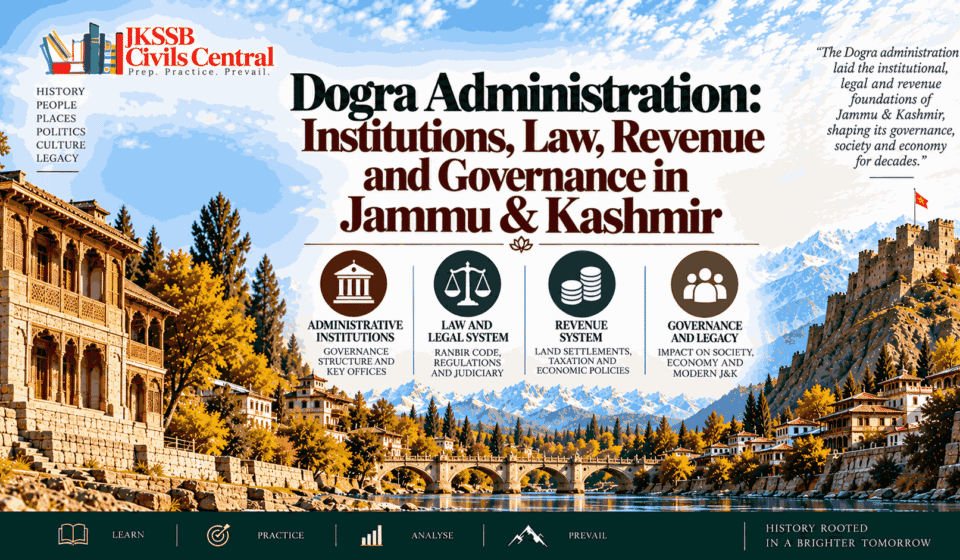
Dogra Administration: Institutions, Law, Revenue and Governance in Jammu & Kashmir

J&K History Series Navigation
| Previous Article | Current Article | Next Article |
|---|---|---|
| ← Article 37 — Ranbir Singh and the Administrative Development of Jammu & Kashmir | Article 38 — Dogra Administration: Institutions, Law, Revenue and Governance in Jammu & Kashmir | Article 39 — Socio-Economic Conditions under Dogra Rule: Land, Taxation, Begar, Agriculture and Crafts → |
Learning Dashboard
| Area | Key Information |
|---|---|
| Historical Period | 1846–1947 |
| Historical Phase | Dogra State & Princely J&K |
| Ruling House | Dogra / Jamwal |
| Core Theme | Evolution of institutions, law, revenue and governance |
| Initial Ruler | Maharaja Gulab Singh |
| Major Institutional Development | From personal Darbar to differentiated departments, councils and constitutional institutions |
| Judicial Development | Chief Courts → Adalat-i-Alia → later High Court of Judicature |
| Revenue Development | Territorial assessment, land records, settlements and revenue administration |
| Important Administrative Turning Point | State Council, 1889 |
| Important Legal Development | Codification and consolidation of state laws |
| State Subject System | 1927 |
| Representative Institution | Praja Sabha, 1934 |
| Constitutional Landmark | J&K Constitution Act, 1939 |
| Political Character | Hereditary princely rule under British paramountcy |
| JKSSB Importance | Very High |
| Likely Question Types | Chronology, statement-based, matching, direct fact, comparative, conceptual-factual |
Introduction
The establishment of the princely state of Jammu & Kashmir in 1846 created a political framework, but a territorial state could not function effectively without institutions capable of collecting revenue, administering justice, maintaining security, regulating land and trade, and communicating the ruler’s decisions across a geographically difficult region. The history of Dogra administration is therefore not simply the history of individual Maharajas. It is the history of how the machinery of government evolved from a largely ruler-centred Darbar into a progressively differentiated administrative and, eventually, constitutional system.
The first phase was associated with Maharaja Gulab Singh, whose government concentrated on consolidating the newly formed state. Under Maharaja Ranbir Singh (1857–1885), the administrative structure became more differentiated, judicial institutions were strengthened, laws were codified and educational and communication institutions expanded. Under Maharaja Pratap Singh (1885–1925), the state experienced a major interruption in monarchical authority when, in 1889, administration was transferred to a State Council under British supervision; later, after the restoration of the Maharaja’s powers, further administrative and judicial reorganization followed. Under Maharaja Hari Singh (1925–1952), the state moved further towards constitutional government, including the definition of State Subjects, the establishment of the Praja Sabha and the Constitution Act of 1939.
The result was not a linear march toward modern democracy. Dogra administration combined centralized monarchy, bureaucratic development, customary authority, codified law, British paramountcy and limited representative institutions. Its institutions became increasingly complex, but political power remained concentrated in the ruling house for most of the period.
CivilsCentral Historical Insight
Dogra administrative history is best understood as a process of institutionalization under monarchical rule. The state gradually moved from personal government toward departments, courts, councils, written laws and representative bodies, but administrative modernization did not automatically produce political equality or democratic government.
Part I — The Administrative Foundations of the Princely State
The State Created in 1846
The Treaty of Amritsar of 16 March 1846 transferred to Gulab Singh the specified territories that had been ceded to the British by the Lahore State, creating the territorial basis of the princely state ruled by the Dogra dynasty. The Treaty also placed Gulab Singh in a relationship of British supremacy, meaning that the new state possessed substantial internal autonomy but did not enjoy unrestricted external sovereignty.
This constitutional position shaped the entire subsequent history of Dogra administration. The Maharaja controlled internal administration, revenue, justice and much of the military establishment, while foreign relations and the broader political relationship with British India were constrained by British paramountcy.
The state’s geography made administration particularly demanding. Jammu, Kashmir, Ladakh and the northern frontier differed in terrain, economy, social organization and historical political traditions. A single uniform administrative system could therefore not simply be imposed without adaptation.
The Early Darbar
During the early Dogra period, government remained strongly centred on the Maharaja and his Darbar. A Prime Minister and senior officials assisted the ruler, while provincial and local officials carried out administrative functions in different parts of the state.
The distinction between departments was less developed than it would become later. The Maharaja exercised extensive personal authority over appointments, justice, revenue and major political decisions. This was typical of many princely states of nineteenth-century India, but Jammu & Kashmir’s geographical scale made the problem of administrative delegation especially significant.
Gulab Singh’s government therefore concentrated on establishing political authority and maintaining control over the territories brought together in 1846. The more systematic differentiation of administrative functions became particularly visible during Ranbir Singh’s reign.
CivilsCentral Historical Insight
The early Dogra administration should not be judged by the standards of a later bureaucratic state. Its central problem was first to make a recently assembled and geographically diverse territory governable. Institutional differentiation followed territorial consolidation rather than preceding it.
Part II — From Personal Rule to Differentiated Administration
Ranbir Singh and Administrative Organization
Under Maharaja Ranbir Singh, the state developed a more clearly differentiated administrative structure. Civil, revenue and military functions increasingly operated through identifiable branches of government, commonly associated with Daftar-i-Nizamat, Daftar-i-Diwani and Daftar-i-Jungi.
This differentiation did not constitute a modern separation of powers. The Maharaja remained the supreme authority, and the various departments functioned within a centralized monarchical system. Its importance lay instead in making government more predictable and administratively manageable.
The development of territorial administration was equally important. Provincial and district officials, including governors, wazirs and tehsildars, connected the Darbar with local administration. The exact organization of territorial units changed over time, so later lists of wazarats and tehsils should not be projected backward as though they remained fixed throughout the entire Dogra period.
Administrative Hierarchy
The administrative hierarchy gradually developed multiple levels between the Maharaja and the local population. Senior officials supervised provinces and major districts, while subordinate officers dealt with revenue collection, policing, judicial matters and routine administration.
This hierarchy allowed the state to exercise authority over areas that could not be directly supervised from Jammu or Srinagar. At the same time, geographical constraints meant that local intermediaries continued to matter greatly.
The resulting system was therefore centralized in principle but uneven in practice. The state could issue orders from the Darbar, but implementation depended upon officials, local structures and the physical accessibility of different regions.
CivilsCentral Historical Insight
Dogra centralization depended on delegation. The more extensive the territory under the Maharaja, the more the state required governors, district officers and local functionaries to convert central authority into practical administration.
Part III — The Revenue Administration
Revenue as the Administrative Foundation
Land revenue was one of the principal financial foundations of the Dogra state. The government required regular income to maintain the army, bureaucracy, courts, public works and the ruling establishment. Consequently, the development of revenue administration was inseparable from the broader development of state capacity.
Revenue practices differed across regions and changed over time. The state inherited older systems of assessment and collection, while attempting to improve measurement, record-keeping and supervision. This was especially important in Kashmir, where agricultural production, landholding arrangements and the relationship between cultivators and intermediaries had a complex history.
Land Records and Settlement
During the later nineteenth century, the state increasingly relied upon formal land records and settlement operations. The Lawrence Settlement of the 1880s became particularly important in Kashmir because it sought to record land rights, assess revenue and clarify the relationship between cultivators and the state.
The systematic settlement of land records is associated with Sir Walter Lawrence’s work beginning in 1889 under Maharaja Pratap Singh. The J&K Registration Department itself identifies Lawrence’s settlement as the first systematic settlement of land records and notes that registration of documents was later entrusted to the judiciary from 1920.
The significance of settlement was administrative as much as fiscal. A government that possessed written information about land, cultivation and rights could assess revenue more systematically and intervene more effectively in disputes.
However, settlement should not be confused with later twentieth-century land reform. The detailed transformation of agrarian relations and the later land reforms belong to a separate stage of J&K history and are treated in Article 40.
Revenue Officials
The revenue administration depended on a hierarchy of officials who assessed and collected revenue and maintained records. The precise organization changed across periods, but the general trend was toward greater documentary regulation.
This development also increased the state’s ability to monitor local officials. Written records created an administrative trail through which assessments, payments and disputes could be examined.
Yet stronger records did not necessarily mean lighter taxation. Administrative efficiency could increase the state’s capacity to extract revenue as well as its capacity to regulate it.
CivilsCentral Historical Insight
Revenue administration had a dual character. It created greater predictability and documentation, but it also strengthened the fiscal reach of the state. Administrative rationalization did not automatically mean reduced extraction.
Part IV — Judicial Institutions and the Development of Law
Early Judicial Administration
Under the early Dogra rulers, the Maharaja remained the ultimate judicial authority. The High Court of Jammu & Kashmir records that under Gulab Singh, the administration of justice was entrusted largely to the executive and that the Maharaja functioned as the chief judicial authority.
This arrangement reflected the personal nature of early princely government. The same political authority that made executive decisions also possessed extensive judicial powers.
Ranbir Singh introduced important institutional changes. Chief Courts or Adalat-ul-Saddar were established at Jammu and Srinagar, and in 1877 the Adalat-ul-Alia was established as a superior judicial institution. The official history of the J&K High Court records this development and notes that there were 25 courts in the state at that stage, including 14 Wazarat Courts.
Do Not Confuse 1877 with 1928
This distinction is extremely important.
The Adalat-ul-Alia of 1877 was a high judicial institution in the evolving Dogra system, but the full-fledged High Court of Judicature was established only in 1928. The present High Court’s official history explicitly identifies 1928 as the year in which the full-fledged High Court of Judicature was established.
Thus:
1877 → Adalat-ul-Alia / superior High Court institution
1928 → full-fledged High Court of Judicature
This is a classic chronology trap.
Legal Codification
The development of courts was accompanied by the increasing use of written law and regulations. During Ranbir Singh’s reign, criminal and civil legal provisions were codified in works including the Ranbir Dand Bidhi and associated legal compilations.
Later rulers continued this process. Under Pratap Singh, laws and regulations were consolidated and judicial procedure became more systematically defined. The High Court’s official history records the Jammu & Kashmir State Civil Courts Regulation of 1921, which regularized judicial procedure and maintained the High Court as the highest court of appeal and revision subject to the Maharaja’s judicial authority.
The legal system therefore developed incrementally rather than through a single comprehensive reform.
CivilsCentral Historical Insight
The evolution of Dogra justice illustrates the broader transition from personal judicial authority to institutional courts governed increasingly by written law. Yet even when courts became more organized, ultimate monarchical authority remained an important feature of the system until later constitutional developments.
Part V — The State Council and the Transformation of Governance, 1889
Why 1889 Was a Turning Point
The year 1889 represents one of the most important administrative turning points in Dogra history. Maharaja Pratap Singh’s relations with the British Government had deteriorated, and the British Government intervened directly in the administration of the state.
Pratap Singh was required to relinquish his administrative powers through an Irshad in March 1889. A State Council was established to conduct the administration, functioning under the influence and supervision of the British Resident.
This did not mean that the Dogra monarchy formally disappeared. Pratap Singh remained Maharaja, but his effective control over administration was sharply curtailed.
The State Council
The State Council became the central instrument through which the administration was conducted. The British Resident possessed considerable influence and, according to the arrangements governing the Council, acted as the final referee in important matters.
The intervention is historically significant because it demonstrates that the evolution of Dogra administration was shaped not only by internal reform but also by British paramountcy and imperial strategic interests.
The official history of the J&K judiciary records that in 1889 the British Government required Pratap Singh to appoint a Council and that its Judicial Member exercised appellate powers on the civil and criminal sides.
Administrative Reorganization Under British Supervision
The Council introduced or strengthened several bureaucratic practices. Departments became more clearly differentiated, written procedures expanded, and British officials became more influential in areas of administration and frontier policy.
The intervention also affected language and recruitment patterns. The administrative system increasingly required officials trained in the procedures and languages used by the reorganized government.
The result was a more bureaucratic state, but it came at the cost of a significant reduction in the Maharaja’s direct administrative authority.
CivilsCentral Historical Insight
The 1889 State Council reveals a central contradiction of Dogra administrative development: institutional modernization could occur alongside a temporary reduction in indigenous monarchical autonomy. Administrative reform and imperial intervention were therefore intertwined.
Part VI — Restoration of the Maharaja’s Authority and Later Reorganization
Restoration of Powers
The State Council period was not permanent. Over time, Pratap Singh’s authority was restored, and by 1905 the Maharaja had regained control over the administration.
This restoration did not simply return the state to the pre-1889 system. The administrative experience of the Council period had introduced stronger bureaucratic procedures and departmental organization. Subsequent governments therefore operated within a more developed institutional environment.
The state increasingly resembled other administratively organized princely states, with specialized departments responsible for revenue, justice, public works, education, forests, agriculture and other functions.
Departments and Specialized Governance
The growth of specialized departments was a defining feature of late nineteenth- and early twentieth-century Dogra administration. Government increasingly operated through officials with defined responsibilities rather than through a small circle of personal advisers.
This did not eliminate patronage or personal influence. Nor did it create a modern civil service insulated from politics. But it did create a more complex administrative apparatus capable of handling a growing range of governmental functions.
The development of specialized departments also enabled the state to undertake public works, education, communications and economic initiatives on a scale that would have been difficult under the earlier Darbar-centred system.
CivilsCentral Historical Insight
The significance of the post-1889 period lies not simply in the restoration of Pratap Singh’s authority but in the institutional continuity created by bureaucratic expansion. Once specialized departments and procedures developed, the state could not simply return to the administrative simplicity of the 1840s.
Part VII — Registration, Documentation and the Administrative State
Registration of Property and Documents
As administration became increasingly documentary, registration became an important component of governance. The J&K Government’s Registration Department records that registration of documents and properties began under the judiciary in 1920, under the Jammu & Kashmir Registration Act of 1977 Bikrami.
This development had practical consequences. Property transfers, legal instruments and other documents could be formally recorded rather than relying entirely upon informal or locally maintained records.
Registration therefore complemented the revenue and judicial systems. A documented property transaction could become relevant to revenue assessment, inheritance disputes and judicial proceedings.
The Importance of Written Records
The growth of documentation was one of the less visible but most important aspects of Dogra state formation. Government increasingly depended upon registers, orders, regulations, settlement records, judicial decisions and official publications.
This documentary culture made the state more capable of supervising territory and population. It also created historical records through which later scholars can reconstruct aspects of nineteenth- and twentieth-century governance.
CivilsCentral Historical Insight
A modernizing administration is not defined only by new departments. It is also defined by its records. Land registers, court records, registration documents and official regulations transformed governance into a more documentary process.
Part VIII — Law, Regulation and the Limits of Legal Modernization
Expansion of Written Law
The Dogra state increasingly governed through regulations, codes and formal orders. Criminal, civil, revenue and judicial matters were progressively brought under written rules.
This process created greater uniformity, but the legal system remained embedded in the authority of the Maharaja. Courts were not independent in the modern constitutional sense, and the ruler retained important prerogatives.
The development of written law should therefore be interpreted as legal institutionalization within a princely monarchy, not as the immediate creation of the rule of law in the modern constitutional sense.
Continuity and Change
Legal development occurred cumulatively:
Personal judicial authority
↓
Chief Courts
↓
Adalat-ul-Alia, 1877
↓
Civil Courts Regulation, 1921
↓
High Court of Judicature, 1928
↓
Constitutional judicial framework, 1939
This sequence demonstrates the long-term direction of institutional change while preserving the distinctions between individual stages.
CivilsCentral Historical Insight
The Dogra legal system became increasingly formalized over roughly a century. Its development is best understood as a continuum of institutionalization, not as a single legal reform attributed to one Maharaja.
Part IX — State Subjects and the Regulation of Government Employment and Property
The Problem of State Subjecthood
By the early twentieth century, access to government employment and land ownership had become politically sensitive. Concerns about the employment of outsiders and the protection of opportunities for people regarded as belonging to the state contributed to demands for a formal definition of State Subject.
Under Maharaja Hari Singh, the State Subject Definition Notification of 20 April 1927 established categories of State Subjects. The notification divided them into classes and established different criteria based upon birth, residence and settlement. The legal record confirms the three principal classes and their relationship to residence and property.
The issue was not merely administrative. It connected questions of employment, land ownership, political identity and access to state resources.
Why the State Subject System Matters
The State Subject system represented an important development in the relationship between the princely state and its population. It created a legal distinction between people recognized as belonging to the state and others who might reside within it.
The policy also illustrates the changing meaning of “subjects” in a princely state. The government increasingly needed legal categories to regulate access to state employment and property.
The later political history of Jammu & Kashmir would give the State Subject system much greater significance, but its institutional origins belong to the late Dogra period.
CivilsCentral Historical Insight
The State Subject system shows that late Dogra administration was moving beyond simple territorial governance toward the legal classification of political belonging. Administrative categories were becoming instruments for regulating access to land, employment and state resources.
Part X — Representative Institutions and the Praja Sabha
From Monarchical Administration to Limited Representation
The growth of representative institutions was one of the most important late developments in Dogra governance. Under Maharaja Hari Singh, the Praja Sabha was established in 1934.
The Praja Sabha introduced an element of representation into the state administration, but it did not replace monarchical government. Its powers were limited, and the Maharaja and his executive remained central to the political system.
The composition of the body also reflected the controlled nature of representation. Membership included elected, nominated and official elements rather than being based entirely on universal democratic elections.
Why the Praja Sabha Was Important
Despite its limitations, the Praja Sabha represented a significant institutional departure from earlier Dogra government. It created a formal arena in which representatives could raise questions and participate in legislative discussion.
Its emergence must be understood alongside the growth of political mobilization in Jammu & Kashmir. Political organizations increasingly demanded greater participation, responsible government and reforms in administration.
The Praja Sabha therefore formed a bridge between princely administrative government and the constitutional politics that would dominate the final years of Dogra rule.
CivilsCentral Historical Insight
The Praja Sabha did not democratize the Dogra state completely. Its deeper significance was that representation entered the institutional structure of government, creating a new political space that later movements could contest and expand.
Part XI — The Jammu & Kashmir Constitution Act, 1939
Constitutionalization of Government
The most advanced constitutional development under Dogra rule came with the Jammu & Kashmir Constitution Act of 1939. The Act sought to consolidate and amend the law relating to the government of the state and provided a formal framework for the functioning of the executive and other institutions.
The Act defined institutions including the Council of Ministers and provided a more systematic constitutional structure. The surviving text begins by describing the need to consolidate and amend the law relating to the government of Jammu & Kashmir and defines the Council in relation to the Maharaja.
This was a significant institutional development because government was increasingly described through written constitutional provisions rather than solely through royal orders and administrative practice.
Limits of the 1939 Constitution
The Constitution Act did not establish parliamentary democracy in the modern sense. The Maharaja remained the central constitutional authority, and executive power remained closely connected to the ruler.
Nevertheless, the Act represented an important transition from a primarily administrative conception of government toward a more explicitly constitutional one.
The judicial system was also given a more developed constitutional framework. The official High Court history notes that the 1939 Constitution Act conferred a substantial measure of independence on the High Court and provided for a Board of Judicial Advisers to advise the ruler on appeals from the High Court.
CivilsCentral Historical Insight
The 1939 Constitution Act marks the culmination of a long institutional trajectory that began with the early Dogra Darbar. The state had moved from personal rule → departmental administration → councils and courts → limited representation → written constitutional government, although monarchical authority remained fundamental.
Part XII — The Judicial System by the Late Dogra Period
The High Court of Judicature
The full-fledged High Court of Judicature was established in 1928. The official High Court history records that the Court initially consisted of a Chief Justice and two judges and sat at Jammu and Srinagar.
The establishment of the High Court represented a major institutional advance over the early nineteenth-century system in which the Maharaja personally remained the final judicial authority.
Its development should be understood as part of the gradual differentiation of the judiciary from the executive administration.
Judicial Administration Under the 1939 Constitution
The 1939 constitutional framework strengthened the institutional position of the judiciary. The High Court received a more defined constitutional status and powers of superintendence over subordinate courts.
The Board of Judicial Advisers provided an additional appellate mechanism in relation to the ruler. This arrangement illustrates the transitional character of the constitutional system: judicial institutions were becoming more independent, but the Maharaja continued to occupy a central constitutional position.
CivilsCentral Historical Insight
By the late Dogra period, the judiciary had become one of the most institutionalized branches of the state. Yet its development remained gradual, and the final constitutional authority of the Maharaja distinguished it from the fully independent constitutional judiciary of a modern democratic state.
Part XIII — Governance Across a Geographically Diverse State
Jammu
Jammu remained the dynastic and political heartland of the Dogra ruling house. The administration there operated relatively close to the central Darbar, although the mountainous districts also required delegated administration.
The region was important not only politically but also as the base from which the Dogra state projected authority into Kashmir and the frontier.
Kashmir
Kashmir required a distinct administrative approach because of its geography, agrarian structure and large settled population. Srinagar functioned as the major administrative centre of the Valley, while governors and district officials connected the province with the Darbar.
The evolution of revenue settlement, courts, registration and education had particularly significant consequences in Kashmir.
Ladakh and Frontier Regions
Ladakh and the northern frontier posed a different administrative challenge. Distance, terrain and political relations with neighbouring regions made direct supervision difficult.
Frontier administration therefore depended more heavily on military posts, local authorities, governors and political agents. British strategic interests became increasingly important in the northern frontier during the late nineteenth century.
This unevenness is essential to understanding Dogra governance: the state was politically unified but administratively differentiated by region.
CivilsCentral Historical Insight
Dogra administration was never a perfectly uniform system imposed identically across all regions. Its institutions had to operate through regional adaptation, reflecting differences in geography, economy, historical institutions and proximity to the central government.
Part XIV — Bureaucracy, Officials and the Nature of Governance
Officials as the Link Between State and Society
The expansion of administration increased the importance of government officials. Revenue officers, judicial officers, provincial administrators, police officials, military officers and departmental heads became essential to the functioning of the state.
This created a more recognizable bureaucracy, but it did not create a fully professional, politically neutral civil service in the modern sense. Appointment, patronage, social networks and political influence remained important.
The bureaucracy therefore had two characteristics: increasing institutional specialization and continuing dependence upon the ruling establishment.
Administrative Centralization
The Dogra state progressively increased the number of functions exercised through central departments. This included revenue, justice, public works, education, forests, agriculture, communications and other areas.
Centralization strengthened the state’s ability to collect revenue and implement policy. It also increased the state’s capacity to regulate everyday life.
But centralization could generate resentment when administrative practices were perceived as unequal, extractive or unrepresentative. The political movements that emerged in the twentieth century were partly shaped by this contradiction.
CivilsCentral Historical Insight
A stronger bureaucracy gives a state greater capacity, but it also makes government more visible in everyday life. As Dogra administration expanded, both the benefits and grievances of state power became more politically significant.
Part XV — The Overall Character of Dogra Governance
Dogra administration cannot be described accurately either as completely traditional or as fully modern. It contained elements of both. Traditional monarchical authority, hereditary rule and local intermediaries coexisted with codified laws, departmental government, courts, land records, registration, telegraphy, printing and constitutional legislation.
Nor did administrative development proceed at a uniform pace. The reigns of Gulab Singh, Ranbir Singh, Pratap Singh and Hari Singh produced different institutional emphases. The British intervention after 1889 created another major layer, because some administrative reforms were implemented in a context of reduced monarchical autonomy.
The system also contained contradictions. Centralization improved the state’s ability to govern a large territory but could reduce local autonomy. Revenue records could clarify rights but could also strengthen extraction. Courts could make justice more regular while remaining subject to monarchical authority. State Subject rules protected access to state resources for defined categories of residents but also created legal distinctions in rights and opportunities.
These contradictions became increasingly important as political consciousness expanded during the twentieth century.
CivilsCentral Historical Insight
The central paradox of Dogra governance was that institutional strengthening increased both state capacity and political expectations. As government became more organized, subjects increasingly demanded that this stronger state also become more accountable and representative.
Part XVI — Historical Significance
The administrative history of the Dogra state is significant because it explains how Jammu & Kashmir acquired institutions that later shaped its political and constitutional development. The state that entered the twentieth century was no longer governed solely through the personal Darbar of the 1840s. It possessed courts, departments, revenue records, registration procedures, administrative regulations, councils and eventually representative and constitutional institutions.
The evolution can be summarized as a long institutional sequence:
1846 — Princely State established
↓
Gulab Singh — territorial consolidation and personal Darbar
↓
Ranbir Singh — departmental differentiation, judicial development and codification
↓
1889 — State Council and intensified British administrative influence
↓
1905 — Restoration of Pratap Singh’s administrative authority
↓
1921–1928 — further judicial and institutional reorganization
↓
1927 — State Subject definition
↓
1934 — Praja Sabha
↓
1939 — Constitution Act
↓
1947 — end of the Dogra princely order in the context of accession and political transformation
This sequence is more historically useful than simply memorizing the names of departments. It demonstrates how the political structure of Jammu & Kashmir gradually changed over a century.
CivilsCentral Historical Insight
The most important legacy of Dogra administration was the creation of an institutional state whose structures outlived individual Maharajas. The courts, revenue records, administrative departments, legal categories and constitutional institutions developed during this period became part of the institutional inheritance with which post-1947 Jammu & Kashmir had to work.
Part XVII — Historical Interpretation and Evidence Note
Was Dogra Administration “Modern”?
The answer depends upon what is meant by modernization. If modernization means increasing bureaucratic specialization, written law, courts, records, communications and formal institutions, then Dogra administration clearly underwent substantial institutional development.
If modernization means representative democracy, equality before independent courts, universal political participation and accountable government, the description becomes much less appropriate.
The most accurate interpretation is therefore administrative modernization within a princely-monarchical framework.
British Influence
British influence must also be treated carefully. The British did not simply create the Dogra administrative system. Major institutional developments began before 1889, particularly under Ranbir Singh. However, British intervention after 1889 significantly altered the balance between the Maharaja and administrative institutions and introduced a period of direct British supervision.
Thus: Dogra initiative + internal institutional development + British paramountcy
together shaped the mature administrative system.
Evidence
The reconstruction of Dogra administration relies on:
- treaties and official agreements
- state regulations
- court records
- revenue and settlement records
- government gazettes
- constitutional documents
- British political correspondence
- administrative reports
- judicial histories
- modern academic scholarship.
The official J&K High Court history is especially valuable for reconstructing the institutional development of the judiciary, including the 1877 Adalat-ul-Alia, 1921 Civil Courts Regulation and 1928 High Court of Judicature.
The J&K Government’s Registration Department provides institutional evidence for the 1889 Lawrence Settlement and the beginning of formal registration work in 1920.
The 1927 State Subject notification survives as a legal document and provides the strongest basis for reconstructing the formal categories of State Subjects.
Part XVIII — JKSSB Knowledge Matrix
| Question Area | High-Value Knowledge |
|---|---|
| State established | 1846 |
| Founder / first Maharaja | Gulab Singh |
| Successor | Ranbir Singh |
| Ranbir Singh’s reign | 1857–1885 |
| Pratap Singh’s reign | 1885–1925 |
| Hari Singh’s reign | 1925–1952 |
| Early administrative character | Ruler-centred Darbar |
| Civil administration | Nizamat |
| Revenue administration | Diwani |
| Military administration | Jungi |
| Chief Courts | Jammu and Srinagar under Ranbir Singh |
| Adalat-ul-Alia | 1877 |
| Full-fledged High Court | 1928 |
| State Council | 1889 |
| Restoration of Pratap Singh’s authority | 1905 |
| Civil Courts Regulation | 1921 |
| Land settlement | Lawrence Settlement, late 1880s/1889 onward |
| Registration of documents | 1920 under judiciary |
| State Subject notification | 20 April 1927 |
| Praja Sabha | 1934 |
| Constitution Act | 1939 |
| Political character | Princely monarchy under British paramountcy |
Part XIX — Examination Discrimination Points
1. 1846 vs 1889
1846 → formation of the Dogra princely state.
1889 → British-supervised State Council and major reduction of Pratap Singh’s administrative authority.
2. Ranbir Singh vs Pratap Singh
Ranbir Singh → institutional development, courts, codification, administrative differentiation.
Pratap Singh → State Council period, later restoration of authority, further administrative and judicial reorganization.
3. 1877 vs 1928
1877 → Adalat-ul-Alia.
1928 → full-fledged High Court of Judicature.
4. 1921 vs 1928
1921 → Jammu & Kashmir State Civil Courts Regulation.
1928 → High Court of Judicature established.
5. 1927 vs 1934 vs 1939
1927 → State Subject definition.
1934 → Praja Sabha.
1939 → Constitution Act.
6. State Council vs Praja Sabha
State Council → executive/administrative institution associated particularly with the 1889 British-supervised administration.
Praja Sabha → representative legislative institution established in 1934.
7. Revenue settlement vs land reform
Land settlement → assessment, recording and determination of land rights/revenue.
Land reform → later transformation of agrarian ownership and tenancy relations.
These should not be treated as synonymous.
8. Administrative modernization vs democracy
The Dogra state developed modernizing administrative institutions without becoming a fully democratic state.
Part XX — JKSSB Question Pattern
Direct Fact
The State Subject Definition Notification was issued in:
A. 1905
B. 1921
C. 1927
D. 1939
Answer: C
Statement-Based
Consider the following statements:
- The Adalat-ul-Alia was established in 1877.
- The full-fledged High Court of Judicature was established in 1928.
- The Praja Sabha was established in 1934.
- The Constitution Act of Jammu & Kashmir was enacted in 1939.
Correct: All four.
Chronology
Arrange the following:
- Adalat-ul-Alia
- State Council
- Civil Courts Regulation
- State Subject Definition
- Praja Sabha
- Constitution Act
Correct sequence:
1877 → 1889 → 1921 → 1927 → 1934 → 1939
Match the Following
| Institution / Development | Date |
|---|---|
| Adalat-ul-Alia | 1877 |
| State Council | 1889 |
| Civil Courts Regulation | 1921 |
| State Subject Definition | 1927 |
| Praja Sabha | 1934 |
| Constitution Act | 1939 |
Identification by Clues
Identify the institution:
- Established during Pratap Singh’s reign
- Associated with British supervision of state administration
- Exercised major governmental functions after the Maharaja relinquished administrative authority
- Its formation dates to 1889
Answer: State Council
Comparative
Which development most clearly represents the transition from administrative government toward representative politics?
Answer: Establishment of the Praja Sabha in 1934.
Part XXI — JKSSB Practice Questions
Q1. The Dogra princely state of Jammu & Kashmir was established in its 1846 form under:
A. Ranbir Singh
B. Gulab Singh
C. Pratap Singh
D. Hari Singh
Correct Answer: B
Explanation: Gulab Singh became Maharaja under the settlement of 1846.
Q2. Which of the following pairs is correctly matched?
A. Adalat-ul-Alia — 1928
B. Praja Sabha — 1927
C. State Subject Definition — 1927
D. Constitution Act — 1934
Correct Answer: C
Q3. Consider the following statements:
- The early Dogra administration was strongly centred on the Maharaja.
- Ranbir Singh strengthened departmental differentiation.
- The State Council of 1889 increased the Maharaja’s direct administrative control.
Which is correct?
A. 1 only
B. 1 and 2 only
C. 2 and 3 only
D. 1, 2 and 3
Correct Answer: B
Explanation: Statement 3 is incorrect. The 1889 arrangements substantially curtailed Pratap Singh’s direct administrative authority.
Q4. Which institution is associated with the year 1934?
A. Adalat-ul-Alia
B. State Council
C. Praja Sabha
D. High Court of Judicature
Correct Answer: C
Q5. Arrange the following in chronological order:
- High Court of Judicature
- State Council
- Praja Sabha
- State Subject Definition
A. 2–1–4–3
B. 1–2–3–4
C. 2–4–1–3
D. 4–2–1–3
Correct Answer: A
Explanation: State Council—1889; High Court—1928; State Subject Definition—1927; therefore the correct complete sequence is 1889 → 1927 → 1928 → 1934. Thus none of the listed options exactly represents the complete chronological order if all four are interpreted literally.
Correction for examination use: The question as drafted is therefore not publication-safe and should not be used. The correct sequence is:
State Council (1889) → State Subject Definition (1927) → High Court (1928) → Praja Sabha (1934).
This is an intentional quality-control flag rather than a forced answer.
Q6. The systematic settlement of land records in Kashmir during the Dogra period is particularly associated with:
A. Henry Lawrence
B. Walter Lawrence
C. Alexander Cunningham
D. John Nicholson
Correct Answer: B
Q7. Which statement best describes the State Subject system introduced in 1927?
A. It created universal citizenship throughout British India.
B. It classified persons according to specified criteria of birth, residence and settlement in relation to the state.
C. It abolished all restrictions on land ownership.
D. It established the Praja Sabha.
Correct Answer: B
Q8. Which of the following best distinguishes the 1877 Adalat-ul-Alia from the 1928 High Court?
A. The former was a judicial institution under the evolving Dogra system; the latter was the full-fledged High Court of Judicature.
B. Both were identical institutions created by the same regulation.
C. The 1877 institution was a legislative body.
D. The 1928 institution was a revenue court.
Correct Answer: A
Q9. The Constitution Act of Jammu & Kashmir was enacted in:
A. 1921
B. 1927
C. 1934
D. 1939
Correct Answer: D
Q10. Which development best demonstrates the gradual constitutionalization of Dogra rule?
A. Treaty of Amritsar, 1846
B. Establishment of the Praja Sabha and Constitution Act
C. Creation of the first Dogra army
D. Establishment of the Lawrence Settlement
Correct Answer: B
Part XXII — Rapid Revision Zone
Important Dates
| Year | Development |
|---|---|
| 1846 | Formation of Dogra princely state under Gulab Singh |
| 1857 | Ranbir Singh succeeds Gulab Singh |
| 1877 | Adalat-ul-Alia established |
| 1885 | Pratap Singh succeeds Ranbir Singh |
| 1889 | State Council established under British supervision |
| 1905 | Pratap Singh’s administrative authority restored |
| 1920 | Registration of documents entrusted to judiciary |
| 1921 | State Civil Courts Regulation |
| 1927 | State Subject Definition |
| 1928 | Full-fledged High Court of Judicature |
| 1934 | Praja Sabha |
| 1939 | Jammu & Kashmir Constitution Act |
| 1947 | End of Dogra princely rule in the context of accession and political transformation |
Administrative Evolution
1846
Personal Darbar
↓
Ranbir Singh
Differentiated departments + courts + codification
↓
1889
State Council + British supervision
↓
1905
Restoration of Maharaja’s authority
↓
1920s
Judicial and administrative consolidation
↓
1927
State Subject system
↓
1934
Praja Sabha
↓
1939
Constitution Act
↓
1947
Political transition
Important Institutions
- Darbar
- Prime Minister / Chief Ministerial authority
- Nizamat
- Diwani
- Jungi
- Wazarat administration
- Chief Courts / Adalat-ul-Saddar
- Adalat-ul-Alia
- State Council
- High Court of Judicature
- Praja Sabha
- Council of Ministers under the constitutional framework
Important Legal Developments
- Ranbir Dand Bidhi
- State Civil Courts Regulation, 1921
- State Subject Definition, 1927
- Constitution Act, 1939
Important Administrative Developments
- Departmental differentiation
- Land settlement
- Land records
- Registration
- Judicial hierarchy
- Specialized departments
- State Subject regulation
- Representative institutions
- Constitutional government
Part XXIII — Frequently Confused Facts
| Fact A | Fact B |
|---|---|
| Adalat-ul-Alia — 1877 | High Court of Judicature — 1928 |
| State Council — 1889 | Praja Sabha — 1934 |
| Civil Courts Regulation — 1921 | Constitution Act — 1939 |
| Lawrence Settlement — land/revenue administration | Later land reforms — agrarian restructuring |
| State Subject Definition — 1927 | Article 35A — much later constitutional development |
| Gulab Singh — state formation | Ranbir Singh — administrative institutionalization |
| Pratap Singh — State Council crisis and later reorganization | Hari Singh — late constitutional and social reforms |
| Administrative modernization | Political democratization |
Part XXIV — What Can JKSSB Ask?
From this topic, high-value areas for examination include:
- 1846 and formation of the princely state
- Gulab Singh and early administration
- Ranbir Singh’s departmental organization
- Nizamat, Diwani and Jungi
- Adalat-ul-Alia — 1877
- State Council — 1889
- Restoration of Pratap Singh’s authority — 1905
- Registration — 1920
- Civil Courts Regulation — 1921
- State Subject Definition — 1927
- High Court of Judicature — 1928
- Praja Sabha — 1934
- Constitution Act — 1939
- Administrative modernization versus representative government
- Revenue settlement versus land reform
- Dogra autonomy versus British paramountcy
- Regional variation within the state
- Chronology of Dogra institutions
Chapter Summary
Dogra administration evolved over approximately a century from a ruler-centred Darbar into a complex institutional and partially constitutional system. The initial task under Gulab Singh was to consolidate the territorial state created in 1846. Under Ranbir Singh, departments became more differentiated, courts were organized, laws were codified and administrative records and procedures expanded.
Pratap Singh’s reign introduced a major interruption in this development when the British-supervised State Council took over the administration in 1889. Although the Maharaja later regained authority, the state emerged from this period with a more developed bureaucratic structure. Judicial and administrative institutions continued to evolve, including the Civil Courts Regulation of 1921 and the full-fledged High Court of Judicature in 1928.
The late Dogra period under Hari Singh witnessed a further transformation. The State Subject system of 1927 introduced legal categories of political belonging; the Praja Sabha of 1934 introduced limited representation; and the Constitution Act of 1939 placed government on a more explicit constitutional footing.
The historical trajectory can therefore be remembered as:
Personal monarchy → departmental administration → judicial institutionalization → British-supervised administration → restored bureaucratic government → limited representation → constitutional government.
JKSSB Takeaway
1846 — Dogra State formed
1877 — Adalat-ul-Alia
1889 — State Council
1921 — Civil Courts Regulation
1927 — State Subject Definition
1928 — High Court of Judicature
1934 — Praja Sabha
1939 — Constitution Act
The most important conceptual distinction is:
Administrative modernization ≠ democratic government.
Mind Map
DOGRA ADMINISTRATION — 1846–1947
↓
1846 — STATE FORMATION
Gulab Singh
↓
Treaty of Amritsar
↓
Princely State
↓
EARLY DARBAR
Maharaja
↓
Prime Minister / Advisers
↓
Provincial & Local Officials
↓
RANBIR SINGH
Nizamat
+
Diwani
+
Jungi
↓
Courts
↓
Codification
↓
Revenue records
↓
Education & communication
↓
JUDICIARY
Chief Courts
↓
Adalat-ul-Alia — 1877
↓
Civil Courts Regulation — 1921
↓
High Court — 1928
↓
1889 TURNING POINT
Pratap Singh
↓
State Council
↓
British supervision
↓
LATER ADMINISTRATION
Specialized departments
↓
Registration
↓
Revenue / land records
↓
Public works
↓
HARI SINGH
State Subject — 1927
↓
Praja Sabha — 1934
↓
Constitution Act — 1939
↓
HISTORICAL TRANSFORMATION
Personal Rule
→
Institutional Government
→
Limited Representation
→
Constitutional Administration
↓
1947
End of Dogra princely order in the context of accession and political transformation
FAQs
1. Who founded the Dogra princely state of Jammu & Kashmir?
Maharaja Gulab Singh, following the political settlement of 1846, is regarded as the founder of the Dogra princely state.
2. What was the main administrative contribution of Ranbir Singh?
Ranbir Singh significantly developed the state’s departmental, judicial, legal and administrative institutions, moving governance beyond the earlier highly personal Darbar system.
3. When was the Adalat-ul-Alia established?
The Adalat-ul-Alia was established in 1877 during Ranbir Singh’s reign.
4. When was the full-fledged High Court of Judicature established?
The full-fledged High Court of Judicature was established in 1928.
5. What happened to Dogra administration in 1889?
Maharaja Pratap Singh was deprived of his administrative powers, and a State Council under British supervision took over the administration.
6. When were Pratap Singh’s administrative powers restored?
His administrative authority was restored in 1905.
7. What was the purpose of the State Subject system?
The State Subject regulations legally classified persons connected with the state according to specified criteria and became important in regulating access to state employment and property.
8. When was the State Subject Definition issued?
The principal State Subject Definition Notification was issued on 20 April 1927.
9. What was the Praja Sabha?
The Praja Sabha, established in 1934, was a limited representative institution introduced during the reign of Maharaja Hari Singh. It did not replace monarchical government.
10. What was the significance of the Constitution Act of 1939?
It provided a more formal constitutional framework for the government of Jammu & Kashmir and represented an important late-stage development in the institutionalization of Dogra rule.
About The Author





[…] Article 38 — Dogra Administration: Institutions, Law, Revenue and Governance in Jammu & Kashmi… […]