
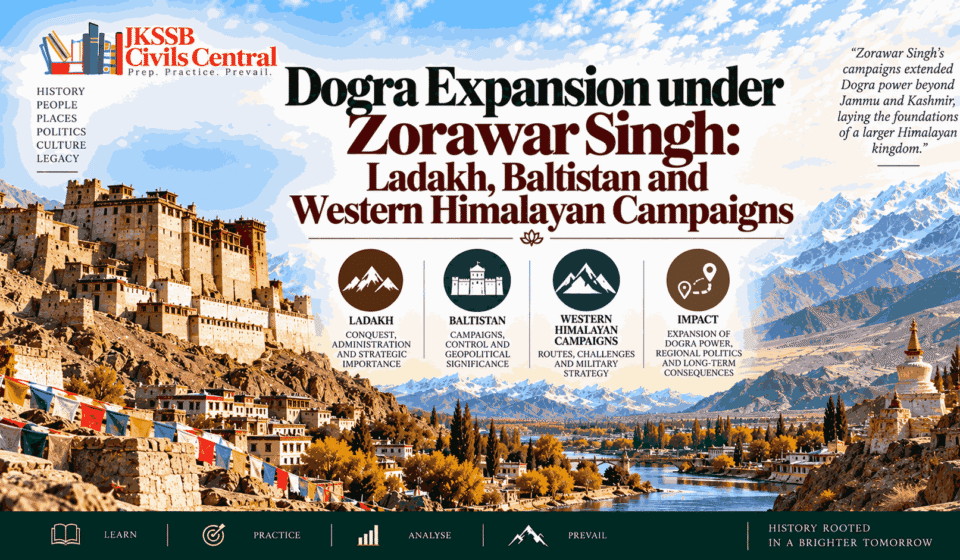
Dogra Expansion under Zorawar Singh: Ladakh, Baltistan and Western Himalayan Campaigns

J&K History Series Navigation
| Previous Article | Current Article | Next Article |
|---|---|---|
| Article 32 — Gulab Singh and the Rise of Dogra Power: From Jammu Chiefdom to Regional Power | Article 33 — Dogra Expansion under Zorawar Singh: Ladakh, Baltistan and Western Himalayan Campaigns | Article 34 — First Anglo-Sikh War, Treaty of Lahore and Formation of Jammu & Kashmir in 1846 |
Learning Dashboard
| Category | Key Information |
|---|---|
| Historical Period | 1834–1842 |
| Historical Phase | Dogra territorial expansion |
| Main Personality | Zorawar Singh |
| Political Authority | Gulab Singh of Jammu under Sikh paramountcy |
| Core Theme | Dogra expansion across the western Himalayas |
| Major Campaigns | Ladakh, Baltistan and Western Tibet |
| Beginning of Ladakh Campaign | 1834 |
| Baltistan Campaign | 1839–1840 |
| Western Tibet Campaign | 1841 |
| Zorawar Singh’s Death | December 1841 |
| Post-war Settlement | Treaty of Chushul, 1842 |
| Important Places | Kishtwar, Zanskar, Leh, Suru, Purig, Skardu, Baltistan, Rudok, Gartok, Taklakot/Purang, Chushul |
| Important Personalities | Gulab Singh, Zorawar Singh, Ladakhi rulers, Ahmad Shah, Muhammad Shah, Diwan Hari Chand |
| Strategic Themes | Trade routes, pashmina, frontier security, territorial expansion, mountain warfare |
| JKSSB Importance | Very High |
| Expected Question Types | Direct fact, chronology, statement-based, matching, battle/campaign identification, comparative |
Introduction
The rise of Dogra power in the nineteenth century cannot be understood solely through the political career of Gulab Singh. The territorial expansion that transformed Jammu from a regional hill power into the nucleus of a much larger Himalayan state depended heavily upon the military leadership of Zorawar Singh, one of Gulab Singh’s principal commanders. Between 1834 and 1841, Zorawar Singh led a series of campaigns that brought Ladakh and Baltistan under Dogra control and then attempted an ambitious extension into western Tibet.
These campaigns occurred within a complicated political framework. Gulab Singh was still the Raja of Jammu and operated under the wider supremacy of the Sikh Empire, while the Himalayan regions beyond Jammu were divided among several political authorities. Ladakh had its own ruling house, Baltistan consisted of several local political centres, and western Tibet was connected to the Tibetan political order under the broader Qing imperial framework. Dogra expansion therefore involved not simply military conquest but also negotiations, local rivalries, changes in tributary relationships and the establishment of garrisons and administrative authority.
The campaigns were also connected with the economic geography of the western Himalayas. Ladakh occupied a strategic position between Kashmir, the Tibetan plateau and Central Asian trade networks, while the movement of pashmina wool was particularly important to the Kashmir shawl economy. Control of routes through Ladakh and the adjoining mountain regions consequently had both strategic and commercial value. At the same time, the scale of the campaigns imposed severe logistical demands, especially when Dogra forces moved beyond Ladakh into the much harsher environment of western Tibet.
The result was mixed. The campaigns in Ladakh and Baltistan were successful and greatly enlarged Dogra territorial power, whereas the 1841 Tibetan expedition ended in military disaster and the death of Zorawar Singh. Yet the subsequent 1842 settlement helped stabilize the Ladakh–Tibet frontier and became an important episode in the diplomatic history of the western Himalayas.
CivilsCentral Historical Insight
Zorawar Singh’s campaigns demonstrate that Dogra expansion was simultaneously a military, economic and geographical project. The conquest of Ladakh and Baltistan succeeded because the Dogras could combine military force with local political divisions and strategic control of mountain routes. The Tibetan expedition exposed the limits of the same expansionist strategy when supply lines became excessively long and the environment increasingly hostile.
Part I — The Strategic Background
Jammu, Kishtwar and the Western Himalayas
The campaigns of Zorawar Singh were a direct continuation of the territorial consolidation described in Article 32. Gulab Singh had established Jammu as the core of his power and had extended his authority into Kishtwar, a mountainous territory east of Jammu.
Kishtwar was strategically important because it opened routes towards the high Himalayan regions. The difficult geography that had previously protected the mountain principalities could also become an advantage for a power that possessed experienced troops, local guides and fortified positions. Zorawar Singh increasingly used Kishtwar as a base from which to project military power towards Ladakh.
The objective was not simply to occupy empty mountain territory. The western Himalayas contained settled valleys, fortified centres, political authorities and commercial routes linking Kashmir with Tibet and Central Asia. Control of these routes could strengthen the economic and strategic position of Jammu.
The Sikh Imperial Context
At this stage, Gulab Singh was not an independent sovereign in the later sense. He was the Raja of Jammu within the political structure dominated by Maharaja Ranjit Singh and the Lahore Darbar.
This distinction matters because the Dogra campaigns have sometimes been described too simply as either independent Jammu expansion or direct Sikh conquest. The reality was more complicated. Dogra forces operated under Gulab Singh’s authority, but Gulab Singh’s position itself existed within the larger Sikh political order.
The British also watched the expansion of political power in the high Himalayas with increasing interest because the region was connected with trade routes and the frontier of Tibet and Central Asia.
CivilsCentral Historical Insight
Dogra expansion took place at the intersection of three political scales: the local Himalayan kingdoms, the expanding Dogra power centred on Jammu, and the wider Sikh Empire. Understanding this layered political structure prevents the common mistake of treating the campaigns as either purely local wars or straightforward Sikh imperial conquests.
Part II — Zorawar Singh: Commander of Dogra Expansion
Background and Rise
Zorawar Singh belonged to a Rajput family traditionally associated with the Kahlur/Bilaspur region. His early career was shaped by military service, and he eventually entered Gulab Singh’s service.
His rise was closely connected with the consolidation of Kishtwar. Gulab Singh required an effective commander capable of administering difficult mountain territory, maintaining communications and conducting campaigns beyond Jammu. Zorawar Singh proved particularly suited to this environment.
His military importance rested not simply on battlefield courage but on his ability to operate across some of the most difficult terrain in South Asia. Mountain passes, extreme seasonal variations, limited agricultural resources and long supply lines required a different military approach from warfare in the Punjab plains.
Military and Administrative Role
Zorawar Singh combined military command with territorial administration. After Dogra expansion, control could not be maintained merely by leaving troops in a conquered settlement. Local rulers had to be managed, tribute arrangements maintained and communications protected.
This explains why the campaigns repeatedly involved a combination of:
military action → political settlement → garrisoning → renewed resistance → further military intervention.
The history of Ladakh therefore cannot be reduced to a single battle in 1834. Dogra control developed through repeated campaigns and the gradual weakening of Ladakhi political independence.
Part III — The Ladakh Campaign of 1834
Why Ladakh?
Ladakh was the first major target of Dogra expansion beyond the Jammu–Kishtwar core. Its importance came from geography. Ladakh connected the western Himalayan world with the Tibetan plateau and routes leading towards Central Asia. Leh was an important commercial centre, while the region was also connected with the movement of pashmina and other goods.
The commercial significance of pashmina was particularly important because Kashmir’s shawl industry depended upon high-quality wool from the Himalayan and trans-Himalayan region. Control over the routes through which this wool moved could therefore strengthen the economic position of the Jammu–Kashmir political system.
Strategic considerations were equally important. A Dogra presence in Ladakh would extend the eastern frontier of Gulab Singh’s power and create a buffer between Jammu-controlled territories and competing Himalayan political centres.
The 1834 Expedition
In 1834, Zorawar Singh led Dogra forces into Ladakh from the direction of Kishtwar and the high mountain routes. The expedition required the army to cross difficult terrain and operate far from its original base. The Dogras benefited from their experience in mountain warfare and from the political fragmentation of the region.
The Ladakhi forces were defeated, and Dogra authority was established over important parts of Ladakh. However, the initial military success did not immediately produce completely stable control.
The Ladakhi political establishment remained capable of resistance, and subsequent revolts required additional Dogra interventions.
Part IV — Consolidating Ladakh
Conquest Was Not the Same as Consolidation
One of the most important distinctions for examination purposes is:
1834 = beginning of the Dogra conquest of Ladakh
not necessarily:
1834 = complete and permanently uncontested Dogra control of every part of Ladakh.
Following the initial conquest, resistance and political instability continued. Zorawar Singh had to return to the region more than once to suppress revolts and reorganize the political structure.
This pattern illustrates a broader principle of nineteenth-century Himalayan state formation: military occupation and political consolidation were separate processes.
Ladakhi Political Authority
The Dogras did not simply abolish all existing political structures immediately. They worked through local rulers and officials where useful, while ensuring that ultimate authority and military power remained with the Dogra state.
The precise sequence of appointments and political arrangements is reconstructed differently in different sources, and some later accounts simplify the process. The secure historical point is that Dogra authority increasingly displaced the independent political position of the Ladakhi ruling house.
Repeated Resistance
Ladakh experienced several episodes of resistance after the initial conquest. Zorawar Singh returned with additional forces and reasserted Dogra authority.
The repeated campaigns had an important consequence: they converted an initial military victory into a more durable political relationship.
By the end of the 1830s, Ladakh had effectively become a major component of Gulab Singh’s expanding territorial system.
CivilsCentral Historical Insight
The Ladakh campaign illustrates the difference between conquest and state formation. The first military victory opened the region to Dogra control, but repeated campaigns, political restructuring and garrisoning were necessary to make that control durable.
Part V — Why Mountain Warfare Favoured the Dogras
Zorawar Singh’s success in Ladakh was partly a consequence of adapting military operations to Himalayan geography.
The Dogra forces had to cross high passes, negotiate narrow valleys and maintain communications over long distances. Their effectiveness depended on mobility, local knowledge, pack animals, fortified positions and the ability to operate in environments where conventional large-scale armies faced serious difficulties.
The military problem was therefore not simply defeating an opponent. It was maintaining an army after victory.
This made forts and garrisons particularly important. A fort could serve as a military post, supply centre and symbol of political authority. The network of fortified positions allowed Dogra commanders to maintain control over strategic routes even when the main army had moved elsewhere.
The geography of the western Himalayas consequently became part of the military system itself.
CivilsCentral Historical Insight
Zorawar Singh’s campaigns reveal that Himalayan warfare was fundamentally a logistical problem. The ability to move troops, maintain supplies and hold strategic posts was often more important than winning a single engagement. This explains why Dogra expansion developed through a chain of campaigns and fortified positions rather than one decisive conquest.
Part VI — From Ladakh to Baltistan
The Strategic Logic of Further Expansion
Once Ladakh had been brought substantially under Dogra control, the political geography of the region encouraged further expansion towards Baltistan. Baltistan lay to the northwest of Ladakh and occupied important routes through the upper Indus region. Control of the area would strengthen the western flank of Ladakh and reduce the possibility of hostile intervention from that direction.
The political situation within Baltistan also created an opportunity. Rivalries within the ruling family of Skardu became connected with Dogra interests, allowing Zorawar Singh to intervene in local politics.
This is important because Dogra expansion did not always take the form of a straightforward invasion of a unified state. Internal political divisions frequently provided openings for external intervention.
Part VII — The Baltistan Campaign, 1839–1840
Entry into Baltistan
After dealing with renewed disturbances in Ladakh, Zorawar Singh turned towards Baltistan. The campaign is generally dated to 1839–1840, with the decisive operations taking place in 1840. Dogra forces moved through difficult winter terrain and crossed the Indus system in an operation that placed enormous demands on the army.
The political objective was to bring the Skardu region under Dogra authority and thereby secure the western approaches to Ladakh.
Skardu
The principal political centre of Baltistan was Skardu. Zorawar Singh’s forces defeated the opposing forces and invested the fort of Skardu. The capture of the fort became the decisive moment of the campaign.
Rather than simply destroying the existing political order, the Dogras installed Muhammad Shah, son of Ahmad Shah, as ruler under Dogra supremacy. This arrangement allowed the Dogras to exercise political influence while retaining a local ruling structure.
The settlement illustrates the flexible character of Dogra expansion: military victory could be followed by indirect political control rather than immediate bureaucratic annexation.
Strategic Consequences
The conquest of Skardu significantly strengthened Dogra control over the western Himalayan region. Ladakh was now connected with territories extending westward into the upper Indus region. The Dogras had therefore moved from controlling a single high-altitude kingdom to creating a much broader territorial system.
This also placed Dogra power closer to the political centres of Gilgit, Hunza and Nagar, although those areas were not simply incorporated into Gulab Singh’s state through Zorawar Singh’s 1840 campaign.
That distinction is important. The later history of Dogra expansion into the Gilgit region belongs to a different phase and should not be attributed entirely to Zorawar Singh’s Baltistan campaign.
CivilsCentral Historical Insight
The conquest of Baltistan transformed the strategic geography of Dogra power. Ladakh was no longer an isolated eastern acquisition; the Dogras now possessed a chain of territories extending across the upper Indus. Yet the campaign also brought them into a much more complex frontier environment in which local rulers and neighbouring polities remained important.
Part VIII — Economic and Commercial Dimensions
Military expansion had important economic implications. The western Himalayas were not economically isolated. Trade routes connected Ladakh with Kashmir, Tibet and Central Asian markets, while pashmina wool moved through the region towards Kashmir’s important shawl-manufacturing centres.
Control of these routes could therefore affect customs, taxation, supply and access to commercial goods. For Gulab Singh, territorial expansion also created new revenue opportunities. However, it would be misleading to reduce the campaigns entirely to a search for revenue. Security, strategic depth, political prestige and frontier control were also significant.
The relationship between pashmina and Dogra expansion should therefore be understood carefully:
Pashmina trade → commercial value of Ladakh → strategic importance of routes → incentive for political control
rather than:
Pashmina alone → conquest of Ladakh.
British officials also followed these developments because the movement of wool and other goods through Himalayan routes had implications for British commercial interests.
Part IX — The Western Tibet Campaign of 1841
From Consolidation to Overextension
After Ladakh and Baltistan had been brought under Dogra control, Zorawar Singh turned his attention towards western Tibet. This represented a major change in the scale of the military project.
The earlier campaigns had established Dogra control over neighbouring Himalayan territories. The Tibetan expedition attempted to extend that frontier beyond Ladakh and into areas historically connected with Ladakh’s political and commercial sphere.
The principal areas involved included Rudok, Gartok and Taklakot (Purang).
The campaign also reflected the strategic importance of trade routes and the older political claims associated with the Ladakh–Tibet frontier.
The Advance into Western Tibet
In 1841, Dogra forces crossed from Ladakh into western Tibet. The campaign initially achieved substantial success. Dogra troops captured or occupied several strategic positions, and the advance reached deep into the Tibetan plateau.
The success, however, created a serious logistical problem. The farther the army advanced, the longer its supply lines became. The high-altitude environment was already difficult; winter transformed the problem into an existential threat.
The expedition therefore faced the classic problem of Himalayan warfare:
territorial success → extended supply line → winter isolation → declining military capacity.
Part X — The Logistical Crisis
The western Tibetan campaign demonstrated the limits of the military system that had worked in Ladakh and Baltistan. The Dogra army was operating far from Jammu, far from Kishtwar and even far from Leh. The route through which supplies had to move was enormous, while the Tibetan winter severely restricted movement.
Cold, snow, shortage of supplies and exhaustion weakened the troops. The army could not maintain its earlier operational strength. The problem was not simply that the Tibetans were stronger in a conventional sense. The environment itself became a major opponent.
This is one of the most important lessons of the campaign:
Mountain warfare is not only about defeating the enemy; it is about sustaining the army.
Part XI — The Battle of Taklakot / To-Yo and the Death of Zorawar Singh
The Final Phase
As Tibetan and Qing-associated forces regrouped and advanced, the Dogra army found itself increasingly vulnerable. The decisive confrontation occurred near Taklakot/Purang, with the final battle conventionally dated to 12 December 1841. Some source traditions use different local names for the battlefield, including To-Yo, but the broad historical sequence is clear.
Zorawar Singh was killed during the fighting.
His death was a major turning point. The Dogra army was unable to sustain its position in western Tibet and withdrew or was forced back towards Ladakh.
Why the Campaign Failed
The defeat cannot be explained simply by saying that Zorawar Singh was militarily defeated by a superior enemy.
Several factors interacted:
- extreme winter conditions;
- inadequate supply over a very long distance;
- exhaustion of troops;
- difficulties in maintaining communications;
- Tibetan resistance;
- the intervention of Qing-associated forces;
- the inability to sustain advanced positions through winter.
The campaign therefore illustrates the limits of territorial expansion when political ambition exceeds logistical capacity.
CivilsCentral Historical Insight
Zorawar Singh’s death did not erase the achievements of his earlier campaigns, but it exposed a fundamental limit of Dogra expansion. Ladakh and Baltistan were geographically connected to the Dogra sphere and could be supplied through established routes; western Tibet required an extended military presence beyond the limits of the existing logistical system.
Part XII — The Tibetan Counter-Offensive
Following the collapse of the Dogra position in western Tibet, Tibetan forces advanced towards Ladakh. The danger was now no longer merely the loss of the newly acquired Tibetan positions. There was a possibility that the Dogras could lose Ladakh itself, which had been the foundation of the entire eastern expansion.
Gulab Singh therefore had to respond quickly. Dogra reinforcements were sent towards Ladakh under commanders including Diwan Hari Chand. The subsequent fighting checked the Tibetan advance and restored the Dogra position in Ladakh.
This phase is often overshadowed by the dramatic death of Zorawar Singh, but it is essential for understanding the final outcome. The western Tibet expedition failed, yet the Dogras succeeded in retaining Ladakh.
That distinction is central:
Tibetan expedition — failed
Dogra control of Ladakh — retained
Part XIII — The Treaty of Chushul, 1842
The Need for Settlement
After the fighting in Ladakh, neither side had a compelling reason to continue an indefinitely expensive mountain war. Negotiations followed, resulting in the settlement commonly known as the Treaty of Chushul of 1842.
The agreement was concluded in Ladakh through an exchange of formal notes between representatives of the Dogra/Sikh side and Tibetan authorities. The precise dating is given as 16 or 17 September 1842 in different documentary traditions.
Major Principles
The settlement established peace and reaffirmed the importance of the old established frontier between Ladakh and Tibet. It also provided for continued commercial relations, including the movement of tea, wool and shawls through established routes.
The agreement effectively ended the attempt to extend Dogra rule into western Tibet while preserving Dogra control over Ladakh.
Thus the settlement can be understood as a return to a stable frontier arrangement rather than a Dogra annexation of western Tibet.
Treaty of Chushul and the Ladakh–Tibet Frontier
The treaty is particularly important because it demonstrates that the military frontier was also a commercial frontier.
The agreement was not simply about stopping warfare. It addressed:
- territorial boundaries;
- peace;
- trade;
- movement of merchants;
- established commercial routes.
This combination of security and commerce was characteristic of Himalayan frontier politics.
CivilsCentral Historical Insight
The Treaty of Chushul reveals the limits and achievements of Dogra expansion simultaneously. The Dogras failed to retain their western Tibetan conquests, but they preserved control over Ladakh and secured a negotiated frontier. The settlement therefore converted a military failure in Tibet into a more stable political and commercial relationship along the Ladakh–Tibet frontier.
Part XIV — Zorawar Singh’s Military System
The campaigns reveal several recurring features of Zorawar Singh’s military method.
1. Use of Mountain Routes
Rather than relying exclusively on major established roads, Dogra forces used difficult mountain routes through Kishtwar, Zanskar and Ladakh.
2. Fortified Posts
Forts and garrisons allowed the Dogras to maintain control over strategic points after the main army had moved.
3. Local Political Divisions
Zorawar Singh frequently exploited rivalries among local rulers and factions.
4. Integration of Local Troops
The Dogra army did not consist solely of troops recruited from the Jammu core. Local Ladakhi forces were incorporated into later campaigns, increasing the army’s ability to operate in the region.
5. Long-Distance Operations
The campaigns required movement over extraordinary distances. This increased Dogra strategic reach but also exposed the army to severe logistical risks.
6. Political Settlement after Military Victory
The Dogras often installed or retained local rulers under their supremacy instead of attempting immediate uniform administrative integration. These features help explain both the successes in Ladakh and Baltistan and the eventual failure in Tibet.
Part XV — Administrative Consequences of the Conquests
The conquest of new territories created a new administrative problem. Military victory was only the first step. Gulab Singh needed to transform conquest into continuing political authority.
In Ladakh, the Dogras retained elements of the existing political order while placing ultimate authority in Dogra hands. Garrisons were established at strategic points, revenue and tribute relationships were reorganized, and political appointments were made to secure the new regime.
The precise administrative structure evolved over time rather than appearing fully formed immediately after the 1834 campaign. This is important because later Dogra administrative arrangements should not automatically be projected backwards onto the first years of conquest.
Baltistan similarly required a combination of local rulers, tribute arrangements and military supervision.
The result was therefore not a uniform bureaucratic state but a frontier political system in which direct military authority, local rulers and tributary relationships operated together.
CivilsCentral Historical Insight
Dogra expansion created a frontier state before it created a uniform administrative state. Control depended upon garrisons, local political arrangements, tribute and military mobility. This explains why the early Dogra territories should not be imagined as being administered identically to the later centralized princely state.
Part XVI — The Human and Environmental Cost
The military successes of the Dogra campaigns should not obscure their human cost. Mountain warfare involved high mortality from combat, cold, disease, exhaustion and supply shortages. The 1841 Tibetan expedition was especially destructive because troops were exposed to extreme winter conditions far from secure supply bases.
Civilian populations also experienced the consequences of repeated warfare, changes in political authority, taxation, military requisitioning and the movement of troops.
The campaigns therefore produced both territorial transformation and social disruption.
It is historically inappropriate to describe the expansion only in terms of military brilliance or territorial achievement. The same campaigns that expanded Dogra power also imposed considerable costs on soldiers and local populations.
Part XVII — Historical Significance of the Ladakh and Baltistan Campaigns
Territorial Transformation
The campaigns dramatically enlarged the geographical reach of Dogra power. The political centre remained Jammu, but the territorial system now extended across the high mountains into Ladakh and the upper Indus region.
Strategic Transformation
The Dogras gained control over approaches linking Jammu with the trans-Himalayan world. This altered the strategic position of Jammu and later became fundamental to the geography of the princely state created in 1846.
Economic Transformation
Control over Ladakh and its routes strengthened the Dogras’ position in relation to pashmina and trans-Himalayan commerce.
Frontier Transformation
The campaigns created a new relationship between Jammu, Ladakh, Baltistan and Tibet. The frontier was no longer merely a distant geographical boundary; it became an active zone of military and commercial policy.
Political Transformation
Zorawar Singh’s campaigns strengthened Gulab Singh’s bargaining position. By the time the Sikh Empire entered its final crisis, the Dogra ruler possessed a substantial territorial and military base.
CivilsCentral Historical Insight
The long-term importance of Zorawar Singh’s campaigns lies not only in individual victories but in the geographical transformation they produced. By 1840, Dogra power extended far beyond its original Jammu base, creating the territorial foundations from which the later princely state of Jammu and Kashmir would emerge in 1846.
Part XVIII — Zorawar Singh in Historical Memory
Zorawar Singh occupies a prominent place in the historical memory of Jammu and Ladakh because of the scale and difficulty of his campaigns. However, historical assessment should distinguish military achievement from later heroic memory.
His campaigns were undeniably ambitious and operationally difficult. The successful expansion into Ladakh and Baltistan demonstrates substantial military capability in high-altitude environments. At the same time, the Tibetan expedition ended in defeat and his death, showing that his strategy had limits.
Modern epithets comparing Zorawar Singh with famous conquerors should not be treated as historical titles. Such comparisons are later commemorative or historiographical constructions rather than contemporary official designations.
The most balanced assessment is therefore that Zorawar Singh was a highly capable nineteenth-century Himalayan commander whose campaigns significantly expanded Dogra power, but whose final expedition also demonstrates the dangers of overextension.
Part XIX — Historical Interpretation and Evidence Note
The history of Zorawar Singh’s campaigns has been reconstructed from a mixture of Sikh court chronicles, Dogra historical traditions, Ladakhi chronicles, Tibetan materials, British political correspondence and later academic scholarship.
This diversity of sources is important because different political communities recorded the campaigns from different perspectives. Dogra and Sikh traditions naturally emphasize military achievement, while Tibetan and Ladakhi materials provide perspectives on resistance, local political structures and the consequences of the campaigns.
The chronology of the broad sequence is substantially secure:
1834 Ladakh campaign → repeated campaigns to consolidate Ladakh → 1839–40 Baltistan campaign → 1841 western Tibet expedition → death of Zorawar Singh in December 1841 → Tibetan advance into Ladakh → Dogra counter-offensive → 1842 settlement.
Some details require caution. Exact troop numbers are particularly unreliable because military sources often provide differing estimates, and later narratives sometimes reproduce large figures without adequate corroboration. The same caution applies to claims about the precise territorial extent of Dogra occupation at particular moments.
The 1842 settlement is especially important because its surviving documentary traditions preserve the emphasis on peace, established frontiers and trade. The agreement should not be described as a simple Dogra annexation of Tibet. Rather, it ended the western Tibetan campaign while preserving Dogra control over Ladakh.
Part XX — JKSSB Knowledge Matrix
| Question | High-Value Answer |
|---|---|
| Who led Dogra expansion into Ladakh? | Zorawar Singh |
| Under whose authority? | Gulab Singh of Jammu |
| When did the major Ladakh campaign begin? | 1834 |
| What was the base for eastern expansion? | Kishtwar |
| Why was Ladakh strategically important? | High-Himalayan routes, frontier position and trade |
| What important commodity was associated with the region? | Pashmina wool |
| Was Ladakh fully and permanently consolidated in 1834? | No; further resistance and campaigns followed |
| Which region was conquered after Ladakh? | Baltistan |
| Baltistan campaign | 1839–1840 |
| Principal political centre of Baltistan | Skardu |
| Who was installed after Ahmad Shah was defeated? | Muhammad Shah, under Dogra supremacy |
| Where did Zorawar expand after Baltistan? | Western Tibet |
| Tibetan campaign | 1841 |
| What happened to Zorawar Singh? | He was killed in December 1841 |
| Where did the decisive final battle occur? | Near Taklakot/Purang, with the battlefield also referred to in sources as To-Yo |
| What happened after his death? | Tibetan forces advanced into Ladakh |
| Who led important Dogra reinforcements? | Diwan Hari Chand and other commanders |
| What ended the conflict? | Treaty of Chushul, 1842 |
| What did the settlement emphasize? | Peace, established frontiers and continuation of trade |
| Did Dogra forces permanently annex western Tibet? | No |
Part XXI — Examination Discrimination Points
1834 vs 1840 vs 1841 vs 1842
1834 → beginning of Dogra conquest of Ladakh.
1839–1840 → major Baltistan campaign.
1841 → western Tibet campaign and death of Zorawar Singh.
1842 → Treaty of Chushul and stabilization of the Ladakh–Tibet frontier.
Ladakh vs Baltistan
Ladakh → first major target; campaign began in 1834.
Baltistan → campaign followed after consolidation of Ladakh; major operations in 1839–40.
Successful vs Failed Expansion
Ladakh → Dogra control established and retained.
Baltistan → Dogra expansion successful.
Western Tibet → initial advance successful but ultimately unsustainable and abandoned after defeat.
Zorawar Singh vs Gulab Singh
Gulab Singh → political ruler and authority behind Dogra expansion.
Zorawar Singh → principal military commander who led the campaigns.
1841 vs 1842
1841 → death of Zorawar Singh during the western Tibet campaign.
1842 → Dogra counter-offensive in Ladakh and negotiated settlement with Tibet.
Treaty of Chushul vs Treaty of Amritsar
Treaty of Chushul, 1842 → Dogra–Tibetan frontier settlement.
Treaty of Amritsar, 1846 → British–Gulab Singh treaty associated with the formation of the Dogra princely state.
Part XXII — JKSSB Question Pattern
Direct Fact
High-value areas include:
- Zorawar Singh;
- Gulab Singh;
- 1834;
- Ladakh;
- Kishtwar;
- Baltistan;
- Skardu;
- 1841 Tibetan campaign;
- December 1841;
- Treaty of Chushul;
Statement-Based
A likely examination construction could distinguish:
- Zorawar Singh led the major Dogra campaign into Ladakh.
- The Ladakh campaign began in 1834.
- The Dogras permanently annexed western Tibet.
- The Treaty of Chushul was concluded in 1842.
The correct answer requires distinguishing successful Ladakh expansion from unsuccessful Tibetan expansion.
Chronology
Kishtwar consolidation → Ladakh campaign, 1834 → Ladakh consolidation → Baltistan campaign, 1839–40 → Western Tibet campaign, 1841 → Death of Zorawar Singh → Tibetan advance into Ladakh → Dogra counter-offensive → Treaty of Chushul, 1842
Match the Following
| Personality / Event | Association |
|---|---|
| Zorawar Singh | Dogra military commander |
| Gulab Singh | Raja of Jammu |
| Ladakh | Major campaign from 1834 |
| Skardu | Baltistan |
| Taklakot/Purang | Western Tibet campaign |
| Treaty of Chushul | 1842 |
Identification by Clues
Clue: Dogra commander who led the 1834 Ladakh campaign and died during the 1841 western Tibet expedition.
Answer: Zorawar Singh.
Clue: 1842 agreement that ended the Dogra–Tibetan conflict and reaffirmed established frontier arrangements.
Answer: Treaty of Chushul.
Clue: Political centre whose capture was a decisive phase of the Dogra conquest of Baltistan.
Answer: Skardu.
Part XXIII — JKSSB Practice Questions
Question 1
The major Dogra campaign into Ladakh under Zorawar Singh began in:
A. 1819
B. 1822
C. 1834
D. 1841
Correct Answer: C
Explanation: Zorawar Singh began the major Dogra expansion into Ladakh in 1834.
Question 2
Consider the following statements:
- Zorawar Singh operated under Gulab Singh’s authority.
- The Dogra campaign in Ladakh began in 1834.
- The conquest of Ladakh was followed by Dogra expansion into Baltistan.
- The Dogras permanently conquered western Tibet in 1841.
Which of the statements is/are correct?
A. 1 and 2 only
B. 1, 2 and 3 only
C. 2, 3 and 4 only
D. 1, 2, 3 and 4
Correct Answer: B
Explanation: The first three statements are correct. The western Tibet campaign initially achieved successes but ultimately failed, and the Dogras did not permanently annex western Tibet.
Question 3
Arrange the following in chronological order:
- Baltistan campaign
- Ladakh campaign
- Treaty of Chushul
- Western Tibet campaign
A. 2–1–4–3
B. 1–2–3–4
C. 2–4–1–3
D. 4–2–1–3
Correct Answer: A
Explanation: Ladakh campaign began in 1834; major Baltistan operations occurred in 1839–40; the western Tibet campaign occurred in 1841; Treaty of Chushul followed in 1842.
Question 4
Which of the following was the principal political centre of Baltistan involved in Zorawar Singh’s campaign?
A. Leh
B. Skardu
C. Kargil
D. Kishtwar
Correct Answer: B
Question 5
Which of the following best explains the importance of Ladakh to Dogra expansion?
A. It was the administrative capital of the Sikh Empire
B. It provided access to important trans-Himalayan routes and commercial networks
C. It was the seat of the British Resident
D. It controlled the Punjab plains
Correct Answer: B
Question 6
Zorawar Singh was killed during:
A. The conquest of Jammu
B. The conquest of Kashmir
C. The western Tibet campaign
D. The First Anglo-Sikh War
Correct Answer: C
Explanation: Zorawar Singh was killed during the 1841 western Tibet campaign.
Question 7
The Treaty of Chushul is associated with:
A. The end of Sikh rule in Kashmir
B. The end of the Afghan period
C. The settlement following the Dogra–Tibetan conflict
D. The creation of the princely state of Jammu and Kashmir
Correct Answer: C
Question 8
Which one of the following sequences is correct?
A. Tibet → Ladakh → Baltistan → Kishtwar
B. Kishtwar → Ladakh → Baltistan → Western Tibet
C. Baltistan → Jammu → Ladakh → Tibet
D. Ladakh → Jammu → Kishtwar → Baltistan
Correct Answer: B
Question 9
Which statement best distinguishes the western Tibet campaign from the Ladakh campaign?
A. The Tibet campaign was entirely peaceful
B. The Ladakh campaign failed while the Tibet campaign succeeded
C. The Tibet campaign initially succeeded but could not be sustained, whereas Dogra control of Ladakh was retained
D. Both campaigns ended with immediate British intervention
Correct Answer: C
Question 10
The most important strategic weakness exposed by the 1841 Tibetan campaign was:
A. Lack of cavalry
B. Excessive dependence on naval transport
C. Extended supply lines combined with severe winter conditions
D. Lack of access to the Punjab plains
Correct Answer: C
Part XXIV — Rapid Revision Zone
Important Dates
- 1834 — Major Dogra campaign into Ladakh begins.
- 1839–1840 — Major Dogra campaign in Baltistan.
- 1840 — Skardu brought under Dogra control.
- 1841 — Western Tibet campaign.
- December 1841 — Death of Zorawar Singh.
- 1842 — Dogra–Tibetan conflict concluded through the Chushul settlement.
- 1846 — Ladakh becomes part of the larger Dogra princely state through the political settlement following the First Anglo-Sikh War.
Important Personalities
- Gulab Singh — Raja of Jammu and political authority behind Dogra expansion.
- Zorawar Singh — Principal military commander.
- Ahmad Shah — Ruler associated with Skardu/Baltistan.
- Muhammad Shah — Installed as ruler under Dogra supremacy after the Baltistan campaign.
- Diwan Hari Chand — Important Dogra commander in the post-1841 Ladakh phase.
Important Places
- Kishtwar — base for eastern mountain expansion.
- Zanskar — important mountain route.
- Leh — political and commercial centre of Ladakh.
- Suru — western Ladakh/Kargil-region route.
- Skardu — principal centre of Baltistan.
- Rudok — western Tibet.
- Gartok — important western Tibetan centre.
- Taklakot/Purang — western Tibet; associated with final phase of Zorawar Singh’s campaign.
- Chushul — associated with the final military phase and the 1842 settlement.
Important Campaigns
Ladakh → 1834
Baltistan → 1839–40
Western Tibet → 1841
Post-war Ladakh operations → 1842
Important Associations
Zorawar Singh → Ladakh
Zorawar Singh → Baltistan
Zorawar Singh → Western Tibet
Gulab Singh → Dogra political authority
Skardu → Baltistan
Taklakot/Purang → 1841 campaign
Chushul → 1842 settlement
Pashmina → Trans-Himalayan trade
Part XXV — Frequently Confused Facts
| Confusion | Correct Distinction |
|---|---|
| Gulab Singh vs Zorawar Singh | Gulab Singh = ruler; Zorawar = principal military commander |
| 1834 vs 1841 | 1834 = Ladakh campaign; 1841 = western Tibet campaign |
| Ladakh vs Baltistan | Ladakh was the first major target; Baltistan followed |
| Ladakh conquest vs Tibet campaign | Ladakh was successfully retained; Tibet campaign ultimately failed |
| Skardu vs Leh | Skardu = Baltistan; Leh = Ladakh |
| Taklakot vs Skardu | Taklakot/Purang = western Tibet; Skardu = Baltistan |
| Zorawar’s death vs Treaty of Chushul | Death = December 1841; treaty = 1842 |
| Treaty of Chushul vs Treaty of Amritsar | Chushul = Ladakh–Tibet settlement; Amritsar = 1846 Dogra state settlement |
| Pashmina vs Dogra conquest | Pashmina trade was an important economic factor, but conquest had multiple strategic and political causes |
| Military conquest vs administrative consolidation | Initial victory did not mean immediate stable administration |
Part XXVI — One-Line Revision Facts
- Zorawar Singh was the principal military commander of Gulab Singh’s early Himalayan expansion.
- The major Dogra campaign into Ladakh began in 1834.
- Kishtwar provided an important base for Dogra expansion towards Ladakh.
- Ladakh was strategically important because of its trans-Himalayan location and trade routes.
- Pashmina wool was an important commercial connection between the trans-Himalayan region and Kashmir’s shawl industry.
- The initial Ladakh conquest did not immediately eliminate all resistance.
- Dogra expansion into Baltistan occurred mainly in 1839–40.
- Skardu was a major political centre of Baltistan.
- Dogra forces installed Muhammad Shah under their supremacy after defeating Ahmad Shah.
- The western Tibet expedition took place in 1841.
- Zorawar Singh died in December 1841.
- The failure of the Tibetan campaign was strongly connected with logistical and environmental difficulties.
- Tibetan forces subsequently advanced towards Ladakh.
- Dogra reinforcements succeeded in retaining Ladakh.
- The conflict ended through the 1842 Treaty of Chushul.
- The settlement emphasized peace, established frontiers and continuation of trade.
- Dogra forces did not permanently annex western Tibet.
- The campaigns greatly strengthened the territorial position of Dogra power before 1846.
Part XXVII — What Can JKSSB Ask?
From this topic, high-value question areas include:
- Zorawar Singh’s identity and role;
- Gulab Singh–Zorawar Singh relationship;
- 1834 Ladakh campaign;
- Kishtwar as the eastern base;
- repeated Ladakh campaigns;
- 1839–40 Baltistan campaign;
- Skardu;
- Muhammad Shah;
- pashmina and trans-Himalayan trade;
- 1841 western Tibet expedition;
- Zorawar Singh’s death;
- Taklakot/Purang;
- logistical difficulties;
- Tibetan counter-offensive;
- Diwan Hari Chand;
- 1842 Treaty of Chushul;
- distinction between successful Ladakh expansion and failed Tibetan expansion;
- chronology of Dogra territorial expansion.
The highest-value conceptual distinction
The complete sequence should be remembered as:
Gulab Singh’s Jammu consolidation
↓
Kishtwar as eastern base
↓
Ladakh — 1834
↓
Repeated campaigns to consolidate Ladakh
↓
Baltistan — 1839–40
↓
Western Tibet — 1841
↓
Zorawar Singh killed
↓
Tibetan counter-offensive
↓
Dogra recovery of Ladakh
↓
Treaty of Chushul — 1842
↓
Dogra territorial position strengthened before 1846
Chapter Summary
The expansion of Dogra power under Zorawar Singh represented the military extension of the political consolidation achieved by Gulab Singh in Jammu and Kishtwar. Beginning in 1834, Zorawar Singh led Dogra forces into Ladakh, a region whose geographical position gave it importance for high-Himalayan communications and trans-Himalayan trade. Although the initial conquest was successful, repeated resistance demonstrated that military occupation had to be followed by political consolidation.
After strengthening Dogra authority in Ladakh, Zorawar Singh expanded westward into Baltistan in 1839–40. The capture of Skardu and the installation of Muhammad Shah under Dogra supremacy strengthened the western flank of Ladakh and created a much larger Dogra-controlled Himalayan zone.
The greatest test came in 1841, when Zorawar Singh attempted to extend Dogra power into western Tibet. The initial advance achieved considerable success, but the army’s extended supply lines, severe winter conditions and Tibetan and Qing-associated resistance eventually produced a military crisis. Zorawar Singh was killed in December 1841, and the Dogra position in western Tibet collapsed.
The subsequent Tibetan advance into Ladakh was checked by Dogra reinforcements, allowing Gulab Singh to retain Ladakh. The Treaty of Chushul in 1842 then restored peace and reaffirmed established frontier arrangements while preserving commercial relations. Thus, the final outcome was neither complete Dogra victory nor complete defeat: Ladakh and Baltistan remained within the expanding Dogra sphere, while western Tibet was not permanently annexed.
JKSSB Takeaway
1834 — Ladakh
→ 1839–40 — Baltistan
→ 1841 — Western Tibet
→ December 1841 — Death of Zorawar Singh
→ 1842 — Treaty of Chushul
The key distinction is:
Dogra expansion succeeded in Ladakh and Baltistan but failed to permanently extend into western Tibet.
Mind Map
GULAB SINGH’S JAMMU POWER
↓
KISHTWAR
↓
ZORAWAR SINGH
↓
LADAKH — 1834
Leh + Trans-Himalayan Routes + Pashmina
↓
Repeated Consolidation Campaigns
↓
BALTISTAN — 1839–40
Skardu
↓
Dogra Control of Upper Indus Region
↓
WESTERN TIBET — 1841
Rudok → Gartok → Taklakot/Purang
↓
Extended Supply Lines + Winter
↓
ZORAWAR SINGH KILLED
↓
TIBETAN COUNTER-OFFENSIVE
↓
DOGRA RECOVERY OF LADAKH
↓
TREATY OF CHUSHUL — 1842
Peace + Established Frontier + Trade
↓
DOGRA TERRITORIAL POSITION BEFORE 1846
↓
FORMATION OF LARGER DOGRA STATE — 1846
FAQs
1. Who led the Dogra conquest of Ladakh?
The campaign was led by Zorawar Singh, operating under the authority of Gulab Singh of Jammu.
2. When did the Dogra conquest of Ladakh begin?
The major Dogra campaign began in 1834.
3. Why was Ladakh important to Gulab Singh?
Ladakh was strategically positioned between Jammu-Kashmir, Tibet and Central Asian routes. It was also connected with the commercially important movement of pashmina wool.
4. When did Dogra forces expand into Baltistan?
The major Baltistan campaign occurred in 1839–1840, culminating in the capture of Skardu.
5. Who was Zorawar Singh?
Zorawar Singh was Gulab Singh’s leading military commander during the expansion of Dogra power into Ladakh, Baltistan and western Tibet.
6. Did Zorawar Singh conquer Tibet?
No. His forces initially advanced successfully into western Tibet in 1841, but the campaign ultimately failed because of military, logistical and environmental difficulties.
7. When did Zorawar Singh die?
He was killed in December 1841 during the final phase of the western Tibet campaign.
8. What was the Treaty of Chushul?
The 1842 Treaty of Chushul was the settlement that ended the Dogra–Tibetan conflict and reaffirmed established frontier arrangements while maintaining traditional trade relations.
9. Did Dogra forces lose Ladakh after Zorawar Singh’s death?
They were temporarily threatened by the Tibetan advance, but Dogra reinforcements restored their position and Ladakh remained under Dogra control.
About The Author






[…] Article 33 — Dogra Expansion under Zorawar Singh: Ladakh, Baltistan and Western Himalayan Campaign… […]
[…] Article 33 — Dogra Expansion under Zorawar Singh: Ladakh, Baltistan and Western Himalayan Campaign… […]