
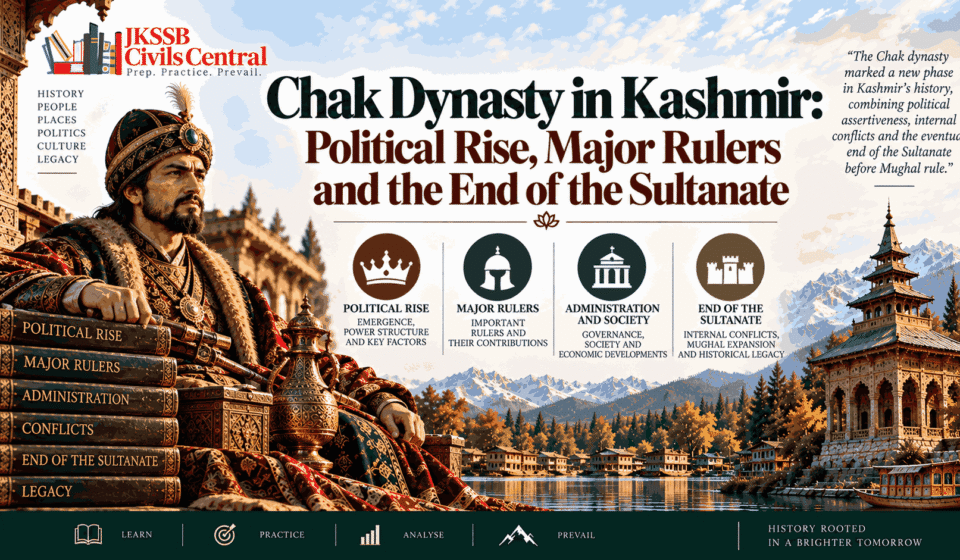
Chak Dynasty in Kashmir: Political Rise, Major Rulers and the End of the Sultanate

J&K History Series Navigation
| Previous Article | Current Article | Next Article |
|---|---|---|
| Article 24 — Medieval Kashmir: Sufism, Rishi Tradition, Persian Culture, Art and Literature | Article 25 — Chak Dynasty in Kashmir: Political Rise, Major Rulers and the End of the Sultanate | Article 26 — Mughal Annexation of Kashmir: Akbar, Yusuf Shah Chak and the Events of 1586 |
Learning Dashboard
| Category | Key Information |
|---|---|
| Historical Period | 16th century |
| Historical Phase | Late Medieval Kashmir / Late Kashmir Sultanate |
| Dynasty | Chak Dynasty |
| Broad Period | c. 1550s/1560s–1586 as independent rule; resistance continued to 1589 |
| Political Centre | Kashmir Valley, with Srinagar as the principal political centre |
| Core Theme | Rise of Chak political power, dynastic consolidation, factional politics and Mughal intervention |
| Major Rulers | Ghazi Shah Chak, Husain Shah Chak, Ali Shah Chak, Yusuf Shah Chak, Yaqub Shah Chak |
| Other Short-Reign Figures | Sayyid Mubarak Khan Baihaqi, Lohur Shah Chak |
| Major External Power | Mughal Empire under Akbar |
| Key Turning Point | Mughal intervention and annexation of Kashmir in 1586 |
| Final Resistance | Yaqub Shah Chak’s struggle after the loss of effective independence |
| Religious Context | Increasing importance of Shi’i traditions alongside Sunni institutions and factional divisions |
| Cultural Context | Persian court culture, Sufi traditions and Kashmiri literary expression |
| Important Personality | Yusuf Shah Chak |
| Important Literary Association | Habba Khatoon tradition |
| Important Sources | Baharistan-i-Shahi, Akbarnama, Ain-i-Akbari, later Persian chronicles and modern scholarship |
| JKSSB Importance | Very High |
| Expected Question Types | Direct fact, chronology, statement-based, matching, identification, comparative |
Introduction
The rise of the Chak Dynasty marked the final major indigenous political phase of the medieval Kashmir Sultanate before the valley was incorporated into the Mughal Empire. The Chaks emerged from the military and political elite of Kashmir and gradually displaced the weakened Shah Mir ruling house during a period of factional competition, succession disputes and increasing intervention by powerful nobles. Their rise did not represent a complete break with the political and cultural structures of the preceding Sultanate; rather, the Chak rulers inherited the institutions, Persianate court culture and political problems of late Shah Mir Kashmir.
The Chak period is generally associated with the mid-sixteenth century to the Mughal annexation of Kashmir in 1586, although historical works differ in assigning the exact starting date. Older chronological traditions place Ghazi Shah Chak’s accession in 1555, while other modern reference works use 1561 for the beginning of the Chak dynasty. The safest approach is therefore to describe the Chaks as the ruling house that emerged from the crisis of the later Shah Mir Sultanate in the 1550s–1560s, rather than manufacture a false precision around the transition.
The dynasty produced several capable rulers, but its political history was marked by repeated struggles among members of the Chak aristocracy. The short reigns of some rulers, factional conflicts and competing claims to the throne weakened political cohesion. At the same time, Kashmir’s strategic importance attracted Mughal attention, particularly as Akbar consolidated his empire in north India and the north-west.
The reign of Yusuf Shah Chak, the best-known Chak ruler, brought these tensions into sharp focus. His attempts to maintain political independence occurred alongside internal opposition and growing Mughal pressure. His eventual submission to Akbar in 1586 did not immediately end Chak resistance, because Yaqub Shah Chak continued the struggle. The Mughal annexation of Kashmir therefore needs to be understood not simply as the defeat of one ruler but as the culmination of a longer process of dynastic fragmentation and imperial expansion.
CivilsCentral Historical Insight
The significance of the Chak period lies in its position at the intersection of two historical processes: the internal transformation of the Kashmir Sultanate and the external expansion of the Mughal Empire. The fall of the Chaks was therefore not caused by one battle alone; it resulted from the interaction of dynastic factionalism, military pressures, political alliances and Mughal imperial strategy.
Part I — Historical Background: From Shah Mir Decline to Chak Ascendancy
The Chak rise occurred during the weakening phase of the Shah Mir dynasty. By the sixteenth century, the political authority of the Sultanate had become increasingly vulnerable to court factions, rival nobles and succession disputes. The authority of the Sultan was often dependent upon the ability to balance competing political groups rather than simply command an unchallenged centralized administration.
This political environment gave military aristocratic groups greater opportunities to influence succession. The Chaks, who had become prominent in the political and military affairs of Kashmir, were particularly successful in exploiting this environment. Their rise should therefore be understood as part of the transformation of the Sultanate’s ruling elite rather than as an isolated military coup.
The final Shah Mir rulers faced repeated instability, and the political order became increasingly fragmented. In the traditional chronology, Habib Shah is generally treated as the last Shah Mir ruler, after which Ghazi Shah Chak emerged as the dominant political figure. The exact transition date varies among historical chronologies.
CivilsCentral Historical Insight
Dynasties often end before their formal replacement becomes obvious. In late Shah Mir Kashmir, the weakening of central authority allowed military and aristocratic factions to become kingmakers, creating the conditions from which Chak rule emerged.
Part II — Origin and Political Rise of the Chaks
The origin of the Chaks has been described differently in historical literature, and claims about their precise ethnic or geographical origin require caution. They became an important military group in Kashmir before establishing themselves as the ruling dynasty. Their political rise was closely connected with their role in warfare, court politics and factional struggles.
The Chaks should not simply be described as an entirely foreign ruling house that suddenly conquered Kashmir. Their political power developed within the political environment of Kashmir itself. By the time Ghazi Shah Chak emerged as ruler, Chak leaders were already deeply involved in the internal politics of the Sultanate.
Their military background was particularly important because late Sultanate politics depended heavily on armed retainers and the ability of nobles to mobilize military support. This gave the Chaks a structural advantage during periods of succession crisis.
Ghazi Shah Chak and the Fall of the Shah Mir Dynasty
Ghazi Shah Chak emerged as the principal Chak leader and displaced the last Shah Mir ruler. Older historical chronologies place his accession around 1555, while several modern references use 1561 as the beginning of Chak rule.
This difference is not merely a trivial dating issue. It reflects broader problems in reconstructing the final decades of Shah Mir rule, where rival claimants and short reigns complicate the chronology.
For examination purposes, the safest formulation is:
Chak political ascendancy → mid-16th century
Ghazi Shah Chak → first major Chak ruler
Mughal annexation → 1586
The Chak dynasty therefore belongs to the final phase of the Kashmir Sultanate immediately before Mughal incorporation.
Part III — Ghazi Shah Chak: Establishing Chak Rule
Ghazi Shah Chak’s accession represented a major change in the political leadership of Kashmir. He assumed the throne after the decline of the Shah Mir house and attempted to consolidate the authority of the new ruling family.
His reign was shaped by two immediate challenges: maintaining control over competing Kashmiri factions and responding to the growing power of the Mughal Empire. The latter problem was particularly important because Kashmir’s geographical position made it strategically relevant to Mughal interests in the north-west.
Ghazi Shah’s military background was therefore an important political asset. However, the Chak state inherited the same structural problem that had weakened the later Shah Mir rulers: the political elite was powerful enough to influence succession and constrain the ruler.
This meant that Chak political consolidation remained incomplete.
CivilsCentral Historical Insight
Ghazi Shah’s achievement was not simply that he became Sultan. His more important historical role was to convert Chak military influence into dynastic authority. Yet the continuing strength of aristocratic factions meant that the new dynasty inherited rather than eliminated the structural instability of the late Sultanate.
Part IV — Husain Shah Chak
After Ghazi Shah, Husain Shah Chak succeeded to the throne. His reign belongs to the period in which Chak authority was still being consolidated and rival political groups remained powerful.
The ruler’s relationship with the nobility was crucial because the Sultanate did not possess an entirely centralized political structure in which the ruler could operate independently of military elites. Political survival required alliances, appointments and the management of rival factions.
Husain Shah’s reign therefore continued the process of Chak consolidation but did not remove the underlying factional character of the political system.
The older Kashir chronology places Husain Shah’s reign approximately in 1563–1570, although the precise chronology of the early Chak period differs among sources.
Part V — Ali Shah Chak
Ali Shah Chak succeeded Husain Shah and ruled during another important stage of Chak consolidation.
His reign demonstrates the continuing importance of dynastic succession and factional politics. The Chak political order had not developed into a completely stable hereditary system in which succession was automatically accepted by all major political groups. Rival claimants could mobilize support from different sections of the nobility.
Ali Shah’s period is particularly important because it leads directly to the turbulent succession crisis surrounding Yusuf Shah Chak. The traditional chronology generally places Ali Shah’s reign around 1570–1579.
Part VI — The Succession Crisis of 1579–1580
The transition after Ali Shah illustrates the political fragility of the Chak state more clearly than almost any other episode. Following Ali Shah’s death, Yusuf Shah Chak initially became ruler, but his position was challenged. A sequence of short-lived rulers and claimants followed, including Sayyid Mubarak Khan Baihaqi and Lohur Shah Chak.
Older chronological tables therefore show a sequence broadly resembling:
Ali Shah Chak
↓
Yusuf Shah Chak — first reign
↓
Sayyid Mubarak Khan Baihaqi
↓
Lohur Shah Chak
↓
Yusuf Shah Chak — restored
The exact duration of these short reigns varies across sources. For examination purposes, the important point is not to memorize artificially precise dates but to recognize that 1579–1580 was a period of acute succession instability.
Yusuf Shah eventually regained the throne and began the second and most historically significant phase of his rule.
CivilsCentral Historical Insight
The 1579–1580 crisis demonstrates that dynastic succession alone could not guarantee political stability. Chak rule depended heavily upon the support of competing nobles and military factions, and this instability later weakened Kashmir’s capacity to respond collectively to Mughal pressure.
Part VII — Yusuf Shah Chak: The Most Important Chak Ruler
Background
Yusuf Shah Chak is the most famous ruler of the dynasty because his reign coincided with the final confrontation between an independent Kashmir Sultanate and the expanding Mughal Empire.
He ruled in two phases, separated by a brief political crisis. The older Kashir chronology places his first reign in 1579, followed by the brief rule of other claimants, and his second reign in 1580–1586.
His importance therefore extends beyond his personal biography. Yusuf Shah’s reign represents the final attempt by the Chak state to maintain political independence in the face of Akbar’s imperial expansion.
Internal Political Problems
Yusuf Shah faced opposition from powerful members of the Chak aristocracy. Rival factions repeatedly challenged his authority, forcing him to devote significant attention to internal political struggles.
This was strategically damaging because a state facing an external imperial power benefits from political cohesion. In Kashmir, however, the Sultan had to divide attention between domestic rivals and the growing Mughal threat.
The political problem was therefore structural rather than simply personal.
Part VIII — Yusuf Shah and the Mughal Threat
By the early 1580s, Mughal interest in Kashmir had become increasingly direct.
Akbar had consolidated substantial territories in north India and had established a strong political base in the Punjab. Kashmir’s location beyond the north-western frontier made it strategically significant, while its political divisions created opportunities for Mughal intervention.
Akbar initially used diplomacy rather than immediate large-scale conquest. Mughal envoys communicated imperial demands to Yusuf Shah, including recognition of Mughal authority. Yusuf Shah’s response reflected the difficult position of the Chak ruler. Open resistance against the Mughals carried enormous military risks, but accepting Mughal supremacy threatened Kashmir’s political independence.
The crisis eventually moved from diplomacy to military confrontation.
Part IX — The Mughal Campaign of 1586
The Mughal conquest of Kashmir occurred in 1586, after earlier attempts and diplomatic pressure. Akbar’s north-western strategy was strengthened by his movement of attention toward the Punjab and Kabul frontier. Cambridge scholarship notes that Akbar’s stay in Lahore in the 1580s coincided with the Mughal annexation of Kashmir in 1586.
The geography of Kashmir also shaped the campaign. Access to the valley required difficult mountain routes, passes and logistical preparation. Mughal forces therefore had to operate under conditions very different from those of the plains.
The campaign was not simply a straightforward confrontation between two large conventional armies. Negotiations, local political divisions, military movements and changing alliances played important roles.
Part X — Yusuf Shah’s Submission and the Treaty
As the Mughal campaign developed, Yusuf Shah eventually entered negotiations with Raja Bhagwan Das, one of the Mughal commanders.
A settlement was negotiated under which Yusuf Shah would acknowledge Mughal authority in important respects. The precise terms are preserved through later historical accounts and should be treated as part of the documentary and literary reconstruction of the episode.
The agreement involved important matters concerning:
- recognition of Akbar’s authority;
- the khutba and coinage;
- imperial supervision of important economic interests;
- political relations between Yusuf Shah and Akbar;
- Yusuf’s appearance at the Mughal court.
However, the political settlement did not produce a stable compromise.
Akbar ultimately rejected the arrangement in its existing form, and Yusuf Shah was taken to the Mughal court. The subsequent imprisonment of Yusuf became one of the most important elements of the traditional narrative of the fall of independent Chak rule.
This episode requires careful distinction between: negotiated submission and complete voluntary incorporation into the Mughal Empire.
The latter would be misleading.
CivilsCentral Historical Insight
The 1586 crisis illustrates the difference between diplomacy under military pressure and genuine political equality. Yusuf Shah’s negotiations were an attempt to preserve as much autonomy as possible, but Mughal imperial power ultimately transformed the relationship from negotiation into incorporation.
Part XI — Was Yusuf Shah Defeated in a Single Decisive Battle?
The answer requires caution. Popular accounts sometimes reduce the Mughal conquest of Kashmir to a single military defeat. The historical process was more complicated.
The Mughal advance involved:
- military pressure;
- difficult mountain logistics;
- internal Chak divisions;
- negotiations;
- competing political interests;
- the eventual detention of Yusuf Shah;
- continued resistance under Yaqub Shah.
Thus, 1586 should be understood as a process of Mughal annexation rather than merely the date of one isolated battlefield victory. This distinction is particularly useful for statement-based examination questions.
Part XII — Yaqub Shah Chak and the Final Resistance
After Yusuf Shah was removed from effective power, Yaqub Shah Chak emerged as the principal Chak claimant. His rule is generally placed in 1586, although the exact sequence of his authority and the continuing resistance requires careful chronology.
Yaqub did not simply accept Mughal authority. He continued resistance against Mughal forces and attempted to preserve Chak independence. The resistance demonstrates that the annexation of Kashmir was not politically uncontested. The Mughal Empire had to consolidate its control rather than merely announce it.
Traditional chronologies distinguish: 1586 → Mughal conquest/annexation and Yaqub Shah’s resistance, from
1589 → final surrender/end of Chak resistance.
This is one of the most important chronological distinctions in the entire article.
Part XIII — 1586 vs 1589: The Critical Examination Distinction
1586
The Mughal Empire successfully conquered and incorporated Kashmir into its imperial system.
1589
Yaqub Shah Chak’s final resistance ended with surrender to the Mughal authorities.
Therefore:
Mughal annexation / effective conquest → 1586
End of remaining Chak resistance → 1589
A question asking: “When did Kashmir come under Mughal rule?” should ordinarily be answered: 1586.
A question asking: “When did the last Chak resistance finally end?” may require: 1589.
CivilsCentral Historical Insight
Political conquest and the disappearance of resistance are not necessarily the same event. The distinction between 1586 and 1589 is a model example of why chronology must identify both the beginning of a new political order and the end of the preceding regime’s resistance.
Part XIV — The Religious Context of Chak Rule
The Chak period also had an important religious dimension.
The Chaks are frequently associated with Shi’i Islam, particularly Twelver Shi’ism, although the religious composition of the political elite and the wider population was more complex. Encyclopaedia Iranica identifies the Chaks as a sixteenth-century Twelver dynasty and notes that the Nurbakhshiya, which had developed a strong presence in Kashmir, formally embraced Shi’ism under Chak rule.
This religious development occurred within a society in which Sunni Muslims, Shi’is, Hindus and followers of different Sufi traditions continued to exist.
The political significance of sectarian affiliation should therefore be understood within the broader context of elite competition. Religious divisions could overlap with political factions, but political conflict cannot automatically be reduced to sectarian conflict.
This distinction is especially important because later historical narratives sometimes explain the Chak period almost entirely through Sunni-Shi’i confrontation.
The more defensible interpretation is that religious affiliation interacted with political competition.
Part XV — The Nurbakhshiya Connection
The Nurbakhshiya had entered Kashmir before the Chak dynasty became dominant. The tradition developed connections with the Shi’i intellectual environment and later became associated with the Chak ruling elite.
Its importance demonstrates that the religious transformation of Kashmir was not a simple shift from one uniform religious system to another. Instead, multiple Islamic intellectual and devotional traditions competed and interacted.
The Chak period therefore belongs to the wider history of Kashmir’s Islamic diversity.
For examination purposes:
Nurbakhshiya → late medieval Kashmir
Chaks → Shi’i/Twelver political association
But: Chak rule ≠ complete Shi’ization of Kashmir.
The wider population and political elite remained religiously diverse.
Part XVI — Administration and Political Structure under the Chaks
The Chak state inherited the political framework of the Sultanate rather than creating an entirely new administrative system.
The Sultan remained the central political authority, but his practical power depended heavily upon relationships with nobles and military commanders. The political elite could support, challenge or even replace rulers, making factional management a central component of governance. This political structure explains the repeated succession crises of the Chak period.
The state also continued the broader Persianate administrative culture established under the Shah Mirs. Persian had become an important language of court and administration by the preceding period, and this cultural framework continued under the Chaks. Encyclopaedia Iranica identifies 1561–1589 as a distinct phase of Persian court and Sufi poetry under Chak rule.
Thus Chak political change did not mean cultural discontinuity.
Part XVII — Economy and Strategic Resources
The Chak state inherited an economy based primarily on agriculture, supplemented by crafts, trade and specialized products.
Kashmir’s location also gave it connections with surrounding mountain regions and the wider north-western commercial world. Saffron, textiles and other products were economically significant.
During the final Mughal negotiations, economic interests became part of the political settlement. Later accounts specifically associate the negotiated arrangements with imperial control over matters including the mint, saffron cultivation and shawl manufacture.
This is important because it demonstrates that Mughal interest in Kashmir was not purely symbolic or military. Control over its economic resources formed part of the larger process of imperial incorporation.
Part XVIII — Persian Culture under the Chaks
The Chak period was not culturally isolated. Persian literary culture continued to develop, and Encyclopaedia Iranica identifies the Chak period as a distinct phase of court and Sufi Persian poetry from 1561 to 1589.
This continuation demonstrates the importance of cultural continuity between the Shah Mir and Chak periods. The Chak court operated within an established Persianate cultural environment while also participating in Kashmir’s vernacular literary traditions.
This is especially significant because the end of the Sultanate did not mean the end of Persian culture in Kashmir. Instead, Persian literary and administrative traditions continued and were subsequently incorporated into Mughal Kashmir.
Part XIX — Yusuf Shah Chak and Habba Khatoon: History and Cultural Memory
The name Yusuf Shah Chak is closely associated in Kashmiri cultural memory with Habba Khatoon, one of Kashmir’s best-known women poets. Habba Khatoon is remembered primarily for her Kashmiri lyrical poetry, particularly poems associated with themes of love, separation and longing. Her cultural association with Yusuf Shah has become one of the most enduring narratives surrounding the Chak period.
However, the historian must distinguish between: literary and oral tradition and contemporary documentary evidence.
Modern scholarship has pointed out that the early chronicles do not provide the detailed romantic narrative that later popular tradition associates with Habba Khatoon and Yusuf Shah. The historical association is therefore culturally important, but individual details of their relationship should not be presented as unquestionable documentary fact.
This does not reduce Habba Khatoon’s historical importance. Rather, it illustrates how later cultural memory transformed political history into literary and emotional memory.
CivilsCentral Historical Insight
Habba Khatoon’s association with Yusuf Shah demonstrates how historical figures can acquire significance through literary memory as well as political documentation. For historians and examination candidates alike, the correct approach is to preserve the cultural tradition while distinguishing it from securely documented political history.
Part XX — The Mughal Strategic Context
The Mughal conquest of Kashmir cannot be separated from Akbar’s broader imperial expansion. By the 1580s, Akbar had built a powerful state extending across much of northern India. His strategic focus increasingly shifted toward the north-west, including Lahore, Kabul and frontier territories. Cambridge research notes that Akbar moved to Lahore in 1585 and used the city as a base for managing the north-western frontier, including the conquest of Kashmir in 1586.
Kashmir therefore became part of a larger frontier strategy.
Its significance included:
- geographical position;
- mountain routes;
- proximity to Kabul and Central Asian connections;
- political fragmentation;
- control over a strategically important Himalayan valley.
The Mughal conquest was consequently both a regional political intervention and part of imperial frontier consolidation.
Part XXI — Why Did the Chaks Fall?
The fall of the Chak dynasty cannot be explained by a single cause.
1. Dynastic Factionalism
Repeated succession disputes weakened political unity.
2. Powerful Nobility
Military and aristocratic factions possessed enough influence to challenge rulers.
3. Short Reigns
Frequent political changes undermined continuity of policy.
4. Internal Rivalries
Competing Chak factions weakened the ability of the state to respond collectively to external threats.
5. Mughal Military Superiority
Akbar possessed a much larger and increasingly sophisticated imperial military and administrative system.
6. Mughal Diplomatic Pressure
Akbar combined military power with negotiation, demands for recognition and political inducements.
7. Strategic Frontier Position
Kashmir’s geographical position increased its importance to the Mughal Empire.
The decline therefore resulted from the interaction of internal political fragmentation and external imperial expansion.
Part XXII — Why Kashmir Was Difficult for the Mughals to Conquer
Kashmir’s mountainous geography presented a serious logistical challenge. The valley was protected by difficult passes and narrow approaches. An invading army had to deal with:
- steep terrain;
- seasonal weather;
- difficult supply lines;
- mountain passes;
- limited routes for large armies.
Cambridge scholarship emphasizes that reaching Kashmir required negotiating difficult mountain roads and passes. This explains why Mughal control, once established, required more than military victory. The empire had to develop administrative and logistical mechanisms capable of governing a mountainous frontier.
The geography therefore affected both the conquest and the subsequent administration of Kashmir.
Part XXIII — The End of the Independent Kashmir Sultanate
The Mughal annexation of Kashmir in 1586 ended the independent political order of the Kashmir Sultanate. This was a major historical transition.
The sequence can be understood as:
Shah Mir Dynasty
↓
Chak Ascendancy
↓
Chak Sultanate
↓
Internal factional crisis
↓
Mughal intervention
↓
Yusuf Shah Chak’s submission
↓
Mughal annexation — 1586
↓
Yaqub Shah’s resistance
↓
Final Chak resistance — 1589
↓
Mughal consolidation
This transition introduced a new political framework in which Kashmir became part of a much larger imperial system.
The Mughal period would subsequently transform Kashmir’s political administration, economy, architecture and relationship with the wider Indo-Persian world.
These developments belong to the next phase of the series.
Part XXIV — Historical Significance of the Chak Dynasty
The Chak Dynasty occupies a crucial place in J&K history because it represents the final indigenous ruling house of the medieval Kashmir Sultanate before Mughal incorporation.
Its significance can be understood through several dimensions.
Political
The Chaks inherited and attempted to stabilize the late Sultanate but remained vulnerable to factional politics.
Military
Their military elite successfully established a dynasty but eventually confronted the much larger Mughal military system.
Religious
The period witnessed a strong association between the ruling elite and Shi’i traditions, particularly the Nurbakhshiya–Shi’i environment.
Cultural
Persian court culture and Sufi literary traditions continued to develop.
Literary
The period remains important for Kashmiri cultural memory through figures such as Habba Khatoon and the literary world surrounding the late Sultanate.
Imperial
The fall of the Chaks brought Kashmir into the Mughal Empire and ended its independent Sultanate political order.
CivilsCentral Historical Insight
The Chak dynasty was simultaneously a period of political instability and cultural continuity. Its greatest historical significance lies in the fact that its fall transferred Kashmir from a regionally rooted Sultanate into the imperial framework of the Mughals.
Part XXV — Evidence Note and Historiographical Caution
The history of the Chaks depends heavily on later Persian chronicles and Mughal-era historical writing. Important sources include the Baharistan-i-Shahi, Mughal works such as the Akbarnama and Ain-i-Akbari, and later historical compilations.
These sources are indispensable but must be read critically.
The Akbarnama was produced within the Mughal imperial context and naturally presents events from the perspective of the Mughal court. Kashmiri chronicles preserve local political memory but also contain literary and moralized elements.
The chronology itself varies. One older Kashir chronology lists:
- Ghazi Shah Chak — 1555–1563
- Husain Shah Chak — 1563–1570
- Ali Shah Chak — 1570–1579
- Yusuf Shah Chak — 1579
- Sayyid Mubarak Khan Baihaqi — 1579
- Lohur Shah Chak — 1579–1580
- Yusuf Shah Chak — 1580–1586
- Yaqub Shah Chak — 1586
Other reference works use 1561 as the beginning of Chak rule and 1589 as the end of the dynastic period. The safest historical presentation is therefore to use the mid-16th century–1586 for the period of effective independent Chak rule, while separately noting the final resistance through 1589.
This distinction prevents false chronological certainty.
Part XXVI — Evidence Classification
| Historical Claim | Evidence Level | Caution |
|---|---|---|
| Chaks replaced the declining Shah Mir ruling house | A/B | Strong historical reconstruction |
| Ghazi Shah Chak was the principal founder of Chak rule | B | Chronology of transition varies |
| Chak independent rule belongs to the mid-16th century–1586 | A/B | Exact beginning differs by chronology |
| Chak rulers had strong Shi’i associations | A/B | Does not imply uniform Shi’ization |
| Nurbakhshiya had an important role in late medieval Kashmir | B | Religious development was complex |
| Yusuf Shah was the last major independent Chak ruler | A/B | Yaqub continued resistance |
| Mughal annexation occurred in 1586 | A/B | Strongly established in standard chronology |
| Yaqub continued resistance after 1586 | B | Chronology of final resistance varies |
| Final Chak resistance ended in 1589 | B | Common historical chronology |
| Yusuf Shah was imprisoned by Akbar after going to the Mughal court | B | Based mainly on historical chronicles |
| Habba Khatoon was Yusuf Shah’s queen | C/D | Strong popular tradition but documentary evidence is limited |
| Habba Khatoon–Yusuf Shah romance exactly as later tradition narrates it | C/D | Should not be presented as established fact |
| Persian literary culture continued under Chaks | A/B | Strong literary evidence |
| Chak rule ended all earlier cultural traditions | D | Historically incorrect |
Part XXVII — JKSSB Knowledge Matrix
| Question | High-Value Answer |
|---|---|
| Dynasty after Shah Mir | Chak |
| Major founder of Chak political rule | Ghazi Shah Chak |
| First major Chak ruler | Ghazi Shah Chak |
| Important later Chak ruler | Yusuf Shah Chak |
| Last Chak ruler | Yaqub Shah Chak |
| Major Mughal emperor involved | Akbar |
| Mughal annexation of Kashmir | 1586 |
| Final Chak resistance | 1589 |
| Religious association of Chak ruling house | Shi’i / Twelver |
| Important Sufi context | Nurbakhshiya |
| Famous literary personality associated with Yusuf Shah | Habba Khatoon |
| Major language of court culture | Persian |
| Previous ruling dynasty | Shah Mir |
| Successor political power | Mughal Empire |
| Critical chronology distinction | 1586 annexation vs 1589 end of resistance |
Part XXVIII — Examination Discrimination Points
1. Shah Mir vs Chak
Shah Mir
→ Earlier Muslim ruling dynasty
→ Established durable Muslim political rule in 1339
→ Ended in the mid-16th century
Chak
→ Successor ruling house
→ Rose from military/political elite
→ Ruled during the final phase of the independent Sultanate
→ Overthrown through Mughal annexation
2. Ghazi Shah vs Yusuf Shah
Ghazi Shah Chak
→ Established Chak dynastic authority
Yusuf Shah Chak
→ Most prominent final Chak ruler
→ Faced Akbar
→ Negotiated with Mughal forces
→ Lost effective independence in 1586
3. Yusuf Shah vs Yaqub Shah
Yusuf Shah
→ Major ruler during Mughal confrontation
→ Taken to Mughal court
Yaqub Shah
→ Continued Chak resistance after 1586
→ Last Chak ruler in the conventional sequence
4. 1586 vs 1589
1586 → Mughal annexation / effective conquest
1589 → final Chak resistance ends
5. Habba Khatoon vs Yusuf Shah
Yusuf Shah → Chak Sultan
Habba Khatoon → Kashmiri poet
Their association is culturally important, but later romantic narratives should not be treated as fully documented political history.
6. Chak Religion vs Entire Kashmir
The Chak ruling house had strong Shi’i associations.
This does not mean: all Kashmiris became Shi’a or the entire Sultanate became uniformly Shi’i.
Part XXIX — JKSSB Question-Type Mapping
Direct Fact
Who was the last Chak ruler?
→ Yaqub Shah Chak.
Statement-Based
Consider the following:
- The Chaks succeeded the Shah Mir dynasty.
- Yusuf Shah Chak faced Mughal pressure under Akbar.
- Mughal annexation of Kashmir occurred in 1586.
- Yaqub Shah Chak immediately ended all resistance after 1586.
Correct answer:
1, 2 and 3 only.
Chronology
Arrange:
- Ghazi Shah Chak
- Husain Shah Chak
- Ali Shah Chak
- Yusuf Shah Chak
- Yaqub Shah Chak
Correct sequence:
1 → 2 → 3 → 4 → 5
Match the Following
| Personality | Association |
|---|---|
| Ghazi Shah Chak | Establishment of Chak rule |
| Ali Shah Chak | Chak ruler before Yusuf |
| Yusuf Shah Chak | Final major independent ruler |
| Yaqub Shah Chak | Final Chak resistance |
| Akbar | Mughal annexation of Kashmir |
Identification by Clues
A Chak ruler who negotiated with Mughal forces and whose political career became closely associated with the end of independent Kashmir:
→ Yusuf Shah Chak
A ruler who continued resistance after the Mughal conquest of 1586:
→ Yaqub Shah Chak
Comparative
Which best explains the fall of the Chak dynasty?
A. Only religious conflict
B. Only Mughal military strength
C. Internal political fragmentation combined with Mughal imperial expansion
D. Complete economic collapse caused by famine
Correct: C
Part XXX — JKSSB Practice Questions
Question 1
Which dynasty succeeded the Shah Mir dynasty in Kashmir?
A. Karkota
B. Utpala
C. Chak
D. Lohara
Correct Answer: C
Explanation: The Chak dynasty emerged from the political and military elite of late Shah Mir Kashmir.
Question 2
Who is generally regarded as the principal founder of Chak dynastic rule?
A. Yusuf Shah Chak
B. Ghazi Shah Chak
C. Yaqub Shah Chak
D. Ali Shah Chak
Correct Answer: B
Explanation: Ghazi Shah Chak emerged as the dominant Chak leader and established the dynasty’s political authority.
Question 3
Consider the following statements:
- Yusuf Shah Chak was a major ruler of the Chak dynasty.
- He faced Mughal pressure under Akbar.
- He was succeeded in the final phase by Yaqub Shah Chak.
- He defeated Akbar and permanently preserved Kashmir’s independence.
Which are correct?
A. 1, 2 and 3 only
B. 1 and 4 only
C. 2 and 4 only
D. All four
Correct Answer: A
Explanation: Yusuf Shah faced Akbar and ultimately lost effective independence. Yaqub continued resistance afterward.
Question 4
The Mughal annexation of Kashmir is generally dated to:
A. 1526
B. 1556
C. 1586
D. 1605
Correct Answer: C
Explanation: Akbar’s Mughal Empire incorporated Kashmir in 1586.
Question 5
Which Chak ruler continued resistance after the Mughal annexation?
A. Ghazi Shah Chak
B. Husain Shah Chak
C. Yusuf Shah Chak
D. Yaqub Shah Chak
Correct Answer: D
Explanation: Yaqub Shah Chak continued resistance after the Mughal conquest.
Question 6
Arrange the following Chak rulers chronologically:
- Ali Shah Chak
- Ghazi Shah Chak
- Yusuf Shah Chak
- Husain Shah Chak
A. 2–4–1–3
B. 4–2–1–3
C. 2–1–4–3
D. 1–2–4–3
Correct Answer: A
Explanation: Ghazi Shah was followed by Husain Shah, then Ali Shah, followed by Yusuf Shah.
Question 7
Which Mughal ruler was directly involved in the annexation of Kashmir?
A. Babur
B. Humayun
C. Akbar
D. Jahangir
Correct Answer: C
Explanation: Kashmir was annexed to the Mughal Empire during Akbar’s reign in 1586.
Question 8
Which statement about the Chak period is most accurate?
A. The Chak dynasty completely rejected Persian culture.
B. The Chak period witnessed the continuation of Persian court and Sufi literary culture.
C. Persian disappeared from Kashmir during Chak rule.
D. Sanskrit became the exclusive court language.
Correct Answer: B
Explanation: Persian literary and court culture continued during Chak rule.
Question 9
The Chak ruling house is particularly associated with which religious tradition?
A. Twelver Shi’ism
B. Theravada Buddhism
C. Jainism
D. Zoroastrianism
Correct Answer: A
Explanation: The Chak ruling house developed a strong association with Shi’i Islam, although Kashmir’s wider religious population remained diverse.
Question 10
Which distinction is historically most accurate?
A. 1586 marked the beginning of Chak rule.
B. 1589 marked the Mughal annexation.
C. 1586 marked Mughal annexation, while 1589 is associated with the end of remaining Chak resistance.
D. Both dates refer to the accession of Yusuf Shah.
Correct Answer: C
Explanation: The Mughal conquest/annexation occurred in 1586; Yaqub Shah’s remaining resistance ended later, conventionally dated to 1589.
Part XXXI — Rapid Revision Zone
Important Dates
| Date | Event |
|---|---|
| Mid-16th century | Chak political ascendancy |
| c.1555 / 1561 | Alternative chronologies for beginning of Chak rule |
| c.1555/61–1563 | Ghazi Shah Chak in alternative chronologies |
| 1563–1570 | Husain Shah Chak |
| 1570–1579 | Ali Shah Chak |
| 1579 | Yusuf Shah’s first brief reign |
| 1579 | Sayyid Mubarak Khan Baihaqi |
| 1579–1580 | Lohur Shah Chak |
| 1580–1586 | Yusuf Shah’s restored reign |
| 1586 | Mughal annexation of Kashmir |
| 1586 | Yaqub Shah’s resistance |
| 1589 | End of remaining Chak resistance in conventional chronology |
Important Rulers
Ghazi Shah Chak
→ Founder/principal establisher of Chak rule
Husain Shah Chak
→ Second major Chak ruler
Ali Shah Chak
→ Ruler preceding Yusuf’s rise
Yusuf Shah Chak
→ Most important late Chak ruler
Yaqub Shah Chak
→ Last Chak ruler / final resistance
Important Personalities
- Akbar
- Raja Bhagwan Das
- Yusuf Shah Chak
- Yaqub Shah Chak
- Habba Khatoon
- Sayyid Ali Hamadani — earlier cultural context, not a Chak ruler
Important Associations
Chak Dynasty → Late Kashmir Sultanate
Yusuf Shah → Akbar / Mughal confrontation
Yaqub Shah → Final Chak resistance
Habba Khatoon → Kashmiri poetry
Chaks → Shi’i/Twelver association
Persian → Court and literary culture
1586 → Mughal annexation
1589 → End of remaining Chak resistance
Part XXXII — Chronological Sequence
Decline of late Shah Mir dynasty
↓
Chak political ascendancy
↓
Ghazi Shah Chak
↓
Husain Shah Chak
↓
Ali Shah Chak
↓
Yusuf Shah — first reign
↓
Brief succession crisis, 1579–1580
↓
Yusuf Shah restored — 1580
↓
Increasing Mughal pressure
↓
Mughal campaign — 1586
↓
Yusuf Shah’s submission/removal
↓
Yaqub Shah Chak
↓
Continued resistance
↓
Final surrender — 1589
↓
Mughal Kashmir
Part XXXIII — One-Line Revision Facts
- The Chak dynasty succeeded the Shah Mir ruling house in late medieval Kashmir.
- Ghazi Shah Chak was the principal founder/establisher of Chak rule.
- Chak rule belongs to the mid-sixteenth century.
- Chronologies differ on the exact beginning of Chak rule.
- Husain Shah Chak followed Ghazi Shah.
- Ali Shah Chak preceded Yusuf Shah’s major reign.
- Yusuf Shah Chak was the most important late Chak ruler.
- Yusuf Shah faced Akbar’s Mughal Empire.
- 1586 marks the Mughal annexation of Kashmir.
- Yaqub Shah Chak continued resistance after 1586.
- 1589 is conventionally associated with the end of remaining Chak resistance.
- The Chaks had a strong Shi’i/Twelver association.
- The Nurbakhshiya had an important place in the religious environment of Chak Kashmir.
- Persian court culture continued under the Chaks.
- Persian poetry entered a distinct Chak-period phase.
- Habba Khatoon is a major literary figure associated with the Yusuf Shah tradition.
- Her detailed romantic association with Yusuf Shah belongs partly to later cultural tradition.
- The fall of the Chaks resulted from internal factionalism combined with Mughal expansion.
- The Mughal conquest was not simply one isolated battlefield event.
- 1586 and 1589 must not be treated as interchangeable dates.
Part XXXIV — Frequently Confused Facts
| Confusion | Correct Distinction |
|---|---|
| Shah Mir vs Chak | Shah Mir preceded Chak |
| Ghazi Shah vs Yusuf Shah | Ghazi established Chak rule; Yusuf faced final Mughal confrontation |
| Yusuf Shah vs Yaqub Shah | Yusuf was the major ruler; Yaqub continued resistance |
| 1586 vs 1589 | 1586 = Mughal annexation; 1589 = end of remaining Chak resistance |
| Chak origin vs Mughal origin | Chaks emerged from Kashmir’s political-military environment; Mughals were an expanding imperial power |
| Chak rule vs Mughal rule | Chak = independent Sultanate phase; Mughal = imperial incorporation |
| Yusuf Shah vs Habba Khatoon | Yusuf = ruler; Habba Khatoon = poet |
| Habba Khatoon history vs legend | Core literary personality is established; detailed romantic narratives require caution |
| Shi’i Chak elite vs entire population | Chak ruling house had strong Shi’i associations; Kashmir remained religiously diverse |
| Persian culture vs Mughal culture | Persian culture was already established before Mughal annexation |
| Annexation vs final resistance | Political incorporation began in 1586; resistance lasted longer |
| Short reigns | Do not memorize false precision where chronologies differ |
Part XXXV — What Can JKSSB Ask?
High-Value Question Areas
JKSSB can test:
- successor dynasty of Shah Mir
- founder/establisher of Chak rule
- sequence of Chak rulers
- Yusuf Shah Chak
- Yaqub Shah Chak
- Mughal annexation of Kashmir
- Akbar’s role
- 1586 vs 1589
- Chak religious affiliation
- Nurbakhshiya
- Habba Khatoon
- Persian culture under the Chaks
- succession crisis of 1579–1580
- causes of Chak decline
- relationship between internal factionalism and Mughal expansion.
High-Value Statement Traps
Statement: The Chaks succeeded the Shah Mir dynasty.
→ Correct
Statement: Yusuf Shah Chak was the first Chak ruler.
→ Incorrect
Statement: Akbar annexed Kashmir in 1586.
→ Correct
Statement: Yaqub Shah ended all Chak resistance immediately in 1586.
→ Incorrect
Statement: Chak rule was associated with Shi’i Islam.
→ Correct, with qualification
Statement: All Kashmiris became Shi’a under the Chaks.
→ Incorrect
Statement: Persian culture disappeared under the Chaks.
→ Incorrect
Statement: Habba Khatoon was a Chak Sultan.
→ Incorrect
Chapter Summary
The Chak dynasty emerged from the military and political elite of late Shah Mir Kashmir during a period of weakening dynastic authority and factional competition. Ghazi Shah Chak established the new ruling house, but the political system remained dependent upon alliances among powerful nobles and military groups.
The subsequent rulers—Husain Shah, Ali Shah and especially Yusuf Shah—attempted to maintain Chak authority while managing internal rivalry. The succession crisis of 1579–1580 exposed the fragility of the political order, after which Yusuf Shah regained the throne and faced the much greater challenge of Mughal imperial expansion.
Akbar’s growing power in north India and the north-west brought Kashmir increasingly within Mughal strategic calculations. Diplomatic pressure eventually gave way to military intervention, and in 1586 the Mughal Empire successfully annexed Kashmir. Yusuf Shah was removed from effective power, while Yaqub Shah Chak continued resistance.
The remaining Chak resistance ended conventionally in 1589, completing the political transition from the independent Kashmir Sultanate to Mughal rule.
The Chak period was also culturally significant. Persian court culture continued to develop, Shi’i traditions gained greater prominence within the ruling elite, and the literary world associated with figures such as Habba Khatoon became part of Kashmir’s enduring cultural memory.
The fall of the Chaks therefore represents both the end of an independent Sultanate political order and the beginning of Kashmir’s integration into a larger Mughal imperial system.
JKSSB Takeaway
Shah Mir → Chak → Mughal
Ghazi Shah → establishment of Chak rule
Yusuf Shah → final major Chak ruler / Mughal confrontation
Yaqub Shah → final Chak resistance
Akbar → Mughal annexation
1586 → Kashmir annexed
1589 → remaining Chak resistance ends
Chaks → strong Shi’i/Twelver association
Habba Khatoon → Kashmiri literary tradition
Core cause of Chak decline → internal factionalism + Mughal expansion
Mind Map
LATE SHAH MIR DECLINE
↓
POLITICAL & MILITARY FACTIONALISM
↓
CHAK ASCENDANCY
↓
GHAZI SHAH CHAK
↓
CHAK DYNASTY
↓
HUSAIN SHAH
↓
ALI SHAH
↓
YUSUF SHAH
↓
SUCCESSION CRISIS
↓
YUSUF RESTORED — 1580
↓
MUGHAL PRESSURE
→ Akbar
→ Diplomacy
→ Military campaign
↓
1586 ANNEXATION
↓
YAQUB SHAH
↓
CONTINUED RESISTANCE
↓
1589 END OF RESISTANCE
↓
MUGHAL KASHMIR
Parallel Cultural Development
CHAK PERIOD
↓
PERSIAN COURT CULTURE
+
SUFI TRADITIONS
+
SHI’I/NURBAKHSHIYA CONTEXT
+
KASHMIRI LITERATURE
↓
HABBA KHATOON & LITERARY MEMORY
FAQs
1. Who founded the Chak dynasty in Kashmir?
Ghazi Shah Chak is generally regarded as the principal founder or establisher of Chak dynastic rule.
2. When did the Chak dynasty rule Kashmir?
The chronology varies. Chak political ascendancy belongs to the mid-sixteenth century, while the standard independent-rule period ends with the Mughal conquest of 1586. Some references extend the dynastic period to 1589 because of continued Chak resistance.
3. Who was the last Chak ruler?
Yaqub Shah Chak is conventionally regarded as the last Chak ruler.
4. Who was the most important Chak ruler?
Yusuf Shah Chak is the most historically prominent because his reign coincided with the final confrontation with Akbar’s Mughal Empire.
5. When did Kashmir come under Mughal rule?
Kashmir was annexed by the Mughal Empire in 1586 under Akbar.
6. Why is 1589 also important?
1589 is conventionally associated with the end of remaining Chak resistance, following the earlier Mughal conquest of 1586.
7. Were the Chaks Shi’a?
The Chak ruling house developed a strong association with Twelver Shi’ism, and the Nurbakhshiya became connected with this religious environment. This does not mean that the entire population of Kashmir became Shi’a.
8. Who was Yusuf Shah Chak’s famous literary associate?
Habba Khatoon is strongly associated with Yusuf Shah in Kashmiri cultural memory. However, detailed romantic narratives about their relationship should be treated as later literary/folk tradition rather than entirely established contemporary documentation.
9. Did Persian culture begin with the Chaks?
No. Persian culture and its administrative/literary role had already developed substantially under the Shah Mir rulers and particularly under Zain-ul-Abidin. The Chaks continued this Persianate cultural environment.
10. Why did the Chak dynasty fall?
The fall resulted from a combination of internal dynastic and factional instability, powerful nobles, succession conflicts and expanding Mughal imperial power.
About The Author




[…] Article 25 — Chak Dynasty in Kashmir: Political Rise, Major Rulers and the End of the Sultanate […]
[…] Article 25 — Chak Dynasty in Kashmir: Political Rise, Major Rulers and the End of the Sultanate […]