
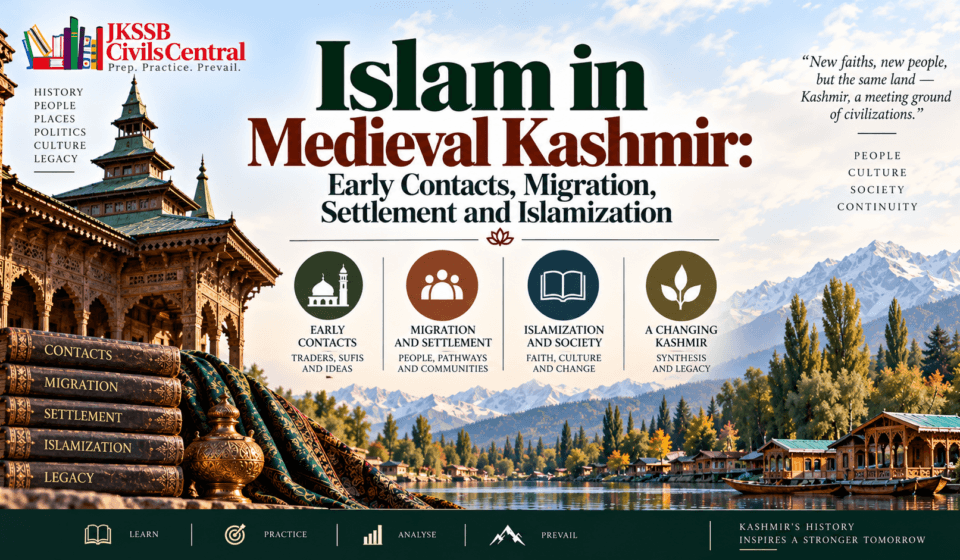
Islam in Medieval Kashmir: Early Contacts, Migration, Settlement and Islamization

J&K History Series Navigation
| Previous Article | Current Article | Next Article |
|---|---|---|
| ← Article 18 — Lohara Dynasty in Kashmir: Rulers, Political Developments and Decline | Article 19 — Islam in Medieval Kashmir: Early Contacts, Migration, Settlement and Islamization | Article 20 — Rinchen, Kota Rani and the Political Transition to Muslim Rule in Kashmir |
Learning Dashboard
| Area | Key Information |
|---|---|
| Historical Period | Early contacts from the early medieval period; major transformation from the 13th–15th centuries |
| Historical Phase | Medieval Kashmir — transition from Lohara rule to Muslim political rule |
| Main Topic | Arrival, settlement and gradual spread of Islam in Kashmir |
| Geographical Area | Kashmir Valley and its connections with Central Asia, Afghanistan, Punjab and the western Himalayas |
| Core Theme | Migration + trade + settlement + political change + Sufi networks + local conversion + institutional transformation |
| Key Personalities | Bulbul Shah, Rinchen, Shah Mir, Mir Sayyid Ali Hamadani, later Rishi/Sufi figures |
| Key Places | Srinagar, Kashmir Valley, western Himalayan routes, Central Asian and north-western corridors |
| Key Sources | Rajatarangini, later Kashmir chronicles, Persian sources, travel accounts, inscriptions, archaeological evidence and modern scholarship |
| JKSSB Importance | Very High |
| Expected Question Types | Chronology, statement-based, identification, cause–consequence, matching, comparative and source-based questions |
Introduction
The spread of Islam in Kashmir was not a single event and cannot be adequately explained through the simple formula of “Muslim conquest followed by mass conversion.” Islam was present in or connected to Kashmir before the establishment of the Kashmir Sultanate in 1339, while the transformation of the Valley’s religious and social landscape continued over several generations after Muslim political authority was established. Traders, soldiers, artisans, travellers, migrants, scholars and religious figures contributed to contacts between Kashmir and the wider Muslim world, while political changes within Kashmir created new opportunities for settlement and conversion.
This distinction between arrival, settlement, political establishment and Islamization is fundamental. The establishment of Muslim rule under Shah Mir in 1339 was a major political turning point, but it did not mean that the population of Kashmir suddenly became Muslim. Likewise, the presence of Muslims before 1339 does not mean that Kashmir had already undergone large-scale Islamization. The historical process unfolded gradually and involved different regions, social groups and institutions at different speeds.
The transformation also involved interaction between incoming Muslim communities and Kashmir’s existing religious and social traditions. Sufis and other religious specialists established networks of teaching and devotion; rulers provided varying degrees of patronage; migrants introduced new intellectual and economic connections; and local converts participated in reshaping Islamic institutions within the Valley. Later traditions associated figures such as Mir Sayyid Ali Hamadani and Shaykh Nuruddin Nurani with this transformation, but their roles must be placed within a much longer process rather than treated as the sole cause of Kashmir’s Islamization.
The history is therefore best understood as a multi-generational process of religious and social change in which political authority, migration, economic interaction, religious networks and local social conditions intersected.
CivilsCentral Historical Insight
The most important distinction in this topic is between Islam’s presence in Kashmir and the Islamization of Kashmir. The first predates Muslim political rule; the second developed over a much longer period through interacting political, social, economic and religious processes.
Part I — Kashmir Before the Establishment of Muslim Rule
A Hindu-Buddhist Religious Landscape
Before the major expansion of Islam, Kashmir possessed a complex religious landscape shaped principally by Brahmanical traditions and Buddhism. Shaivism and Vaishnavism became particularly influential during the early medieval period, while Buddhist institutions continued to exist alongside Brahmanical religious centres.
The political history described in the preceding articles therefore provides an essential background. The Karkota, Utpala and Lohara periods were not religiously uniform, and rulers could patronize different religious institutions. Buddhist establishments survived into the medieval period, while Brahmanical institutions remained important in political and cultural life.
This existing plural environment matters because Islam entered a society that already possessed developed religious institutions, intellectual traditions and social hierarchies. Conversion therefore involved interaction with an established cultural order rather than the replacement of an institutionally empty religious landscape.
Kashmir’s Geographic Position
Kashmir’s geography both protected the Valley and connected it to wider regions. Mountain passes linked Kashmir with the Punjab plains, western Himalayan kingdoms, Central Asian routes and regions toward Afghanistan and Tibet. The same geographical environment that made military conquest difficult did not prevent commercial and cultural movement. Traders, horse dealers, artisans, soldiers, religious specialists and travellers could enter the Valley through established routes.
This distinction is important: mountains restricted armies more effectively than they restricted all forms of human mobility.
CivilsCentral Historical Insight
Kashmir’s geography should not be understood simply as a barrier. It functioned simultaneously as a defensive environment and a corridor of selective connectivity. This helps explain why political conquest could be difficult while migration, trade and cultural exchange continued.
Part II — Early Muslim Contacts with Kashmir
Islam Arrived Before Muslim Rule
The establishment of the Sultanate in 1339 should not be treated as the first moment when Muslims appeared in Kashmir. Historical research indicates that Muslims were present in or connected to Kashmir before the fourteenth-century establishment of Muslim political authority.
The evidence for the earliest phase is uneven. Local sources are comparatively sparse, and later writers sometimes projected the significance of early Muslim contacts backward. For this reason, claims about a large or fully organized Muslim community in very early Kashmir should be treated cautiously.
The strongest conclusion is that Muslim individuals and communities reached Kashmir through wider networks of trade, travel and political interaction before the establishment of the Sultanate.
Trade and Commercial Contacts
Trade was an important mechanism through which Kashmir interacted with Muslim-ruled regions. The demand for horses was particularly significant because high-quality horses were imported into Kashmir from regions to its west and north-west.
Kalhana’s account of the Lohara period contains references to foreign horse dealers and artisans benefiting from royal demand. Such references do not prove that every foreign trader was Muslim, but they demonstrate the existence of sustained commercial interaction with regions in which Muslim communities were already well established.
The wider development of Muslim political powers in Punjab, Sindh, Afghanistan and Central Asia increased the possibilities for commercial movement. Over time, traders could become temporary visitors, long-term residents or members of permanent settlements.
Soldiers and Military Service
Military service was another possible channel of Muslim presence. Medieval rulers frequently recruited soldiers and military specialists from outside their immediate political territories. The presence of Muslims in military or courtly environments does not necessarily imply religious conversion among the local population. However, repeated settlement of soldiers and their families could create small Muslim communities and establish personal and economic relationships with local society.
Such processes are historically important because religious communities often expand through ordinary social settlement as well as formal missionary activity.
Artisans, Specialists and Migrants
Migration was not restricted to merchants and soldiers. Artisans, craftsmen, scholars and religious specialists also moved across political boundaries. Kashmir’s position within the wider Himalayan and Central Asian world meant that cultural movement could take place even when political relations were unstable. Migrants could settle, marry into local communities, establish occupational networks and participate in urban economic life.
The result was not an immediate demographic transformation but the gradual creation of a Muslim social presence within an overwhelmingly non-Muslim society.
CivilsCentral Historical Insight
Early Islam in Kashmir spread initially through mobility and networks, not through a single political act. Trade, military service, migration and religious travel created the social infrastructure within which later conversion and institutional expansion became possible.
Part III — Muslim Settlement Before the Sultanate
From Presence to Settlement
A crucial historical transition occurred when temporary visitors became permanent residents. The distinction between a trader passing through Kashmir and a Muslim community established in the Valley is therefore important.
By the later medieval period, evidence points to Muslim residents living within Kashmir’s urban and commercial environment. Later sources refer to communities associated with Muslim settlers and foreign merchants. These settlements provided a social base for mosques, religious teaching, occupational networks and family formation.
The precise size of these early communities cannot be established with confidence. It is therefore unsafe to assign large population figures to the pre-Sultanate Muslim population without strong demographic evidence.
Srinagar as a Centre of Contact
The developing urban environment of Srinagar became particularly important. Urban centres provided opportunities for merchants, craftsmen, administrators and religious figures to interact with the local population.
The presence of Muslim residents did not necessarily produce immediate large-scale conversion. Communities could retain their own religious institutions while participating in the economic life of a predominantly Hindu-Buddhist society.
Over time, however, permanent settlement created conditions for greater social interaction. Conversion could then occur through personal relationships, patronage, marriage, intellectual exchange and religious teaching.
Marriage and Social Integration
Intermarriage was another possible mechanism of social integration. Members of immigrant communities could marry locally, while local elites could establish relationships with newcomers through political or matrimonial alliances. Such relationships complicate any simplistic division between “foreign Muslims” and “local Kashmiris.” Over generations, communities became socially interconnected.
This does not mean that all migrants assimilated or that conversion was automatic. Rather, migration created new social networks through which religious identities could change.
CivilsCentral Historical Insight
Settlement transformed Islam from an external presence into a social reality within Kashmir. Once Muslim communities became permanent, religious change could operate through family, occupation, neighbourhood, patronage and everyday interaction rather than through preaching alone.
Part IV — Political Crisis and the Opening of the Fourteenth Century
The Weakening of the Lohara Political Order
By the beginning of the fourteenth century, the political system of Kashmir was facing serious internal difficulties. Rival elites, court factions and regional political groups had weakened the ability of the monarchy to maintain stable authority.
The situation became more severe during the reign of Suhadeva, whose rule was disrupted by the invasion associated with the Central Asian/Mongol military leader commonly identified in Kashmir sources as Dulacha or Zulju. The invasion caused major political and social disruption.
The crisis did not by itself “convert Kashmir to Islam.” Its significance was political: it weakened the existing ruling structure and created conditions in which new political actors could acquire influence.
Rinchen and Shah Mir
Two figures became particularly important during this transition: Rinchen, a Buddhist prince associated with Ladakh, and Shah Mir, an immigrant who had entered Kashmir before the political crisis.
Both acquired positions within Kashmir’s political environment, and both benefited from the weakening of the earlier order. Rinchen eventually became ruler, while Shah Mir developed a powerful political base within the court.
Their careers demonstrate that the emergence of Muslim political authority in Kashmir was connected to political restructuring within Kashmir itself, not simply to an external military conquest.
The detailed story of Rinchen’s accession, marriage with Kota Rani and conversion to Islam belongs to the next article in this series and is therefore treated here only as the bridge between early Muslim presence and the establishment of Muslim political authority.
CivilsCentral Historical Insight
The political crisis of the early fourteenth century created an opening for new elites. The eventual establishment of Muslim rule was therefore connected to the breakdown and reconfiguration of the existing political order, not simply to the arrival of religious missionaries.
Part V — Rinchen and the First Political Break
Conversion and Political Legitimacy
Rinchen’s conversion to Islam is traditionally associated with Sayyid Sharafuddin Abdul Rahman, popularly known as Bulbul Shah. After accepting Islam, Rinchen is associated with the Muslim name Sadr al-Din.
The precise circumstances of the conversion are transmitted mainly through later historical traditions, and the dramatic narratives surrounding it should not be treated as contemporary documentary records. The broad historical significance, however, is much clearer: the ruler’s conversion gave Islam a new position within the political structure of Kashmir.
This was different from the earlier presence of individual Muslims. A ruler’s adoption of Islam could provide patronage for Muslim institutions and increase the visibility of the religion within the state.
Bulbul Shah and Early Muslim Institutions
Bulbul Shah is traditionally associated with the establishment of an early khanqah in Srinagar and with the conversion of Rinchen.
A khanqah was not simply a place of worship. In the wider Islamic world, Sufi hospices could function as centres of teaching, residence, charity and spiritual practice. In Kashmir, such institutions later became important nodes in the spread and localization of Islamic religious culture.
The early institutional presence should nevertheless not be confused with the later extensive network of Sufi establishments associated with the Shah Miri period.
Why Rinchen’s Conversion Matters
Rinchen’s conversion was historically important because it linked Islam to political sovereignty for the first time at the highest level in Kashmir. But it would be incorrect to conclude that Kashmir became an Islamic society immediately after his conversion. His rule was brief, and political authority remained unstable. Large-scale social transformation required institutions, communities and networks that developed over subsequent decades.
CivilsCentral Historical Insight
Rinchen’s conversion represents a political breakthrough for Islam, not the completion of Islamization. The distinction between the conversion of a ruler and the religious transformation of a society is one of the most important conceptual points in this entire topic.
Part VI — Establishment of Muslim Political Rule
Shah Mir and 1339
After the short political phase following Rinchen, the Kashmir monarchy continued to experience instability. Shah Mir gradually strengthened his political position and eventually became ruler in 1339, taking the title Sultan Shams al-Din. This event marks the conventional beginning of the Kashmir Sultanate and the establishment of sustained Muslim political rule in the Valley.
The significance of 1339 is therefore political rather than demographic. Islam already had a presence in Kashmir, but from this point onward the ruling dynasty itself was Muslim.
Political Rule and Religious Change
The establishment of the Sultanate altered the institutional environment in which Islam could develop. Muslim rulers could appoint Muslim officials, support religious scholars, establish mosques and hospices, and connect Kashmir more closely to Muslim political and intellectual networks.
Yet the early Shah Miri rulers did not instantly eliminate the existing religious order. Kashmir remained religiously plural, and Brahmanical institutions continued to possess social and intellectual influence.
The pace and character of Islamization therefore varied according to ruler, region, social group and period.
The Difference Between Muslim Rule and Islamization
This distinction can be summarized:
Muslim presence
↓
Muslim settlement
↓
Ruler’s conversion
↓
Muslim political rule
↓
Expansion of Islamic institutions
↓
Growth of Muslim communities
↓
Local conversion over generations
↓
Broader Islamization of society
These stages overlap rather than occurring in a perfectly linear sequence.
CivilsCentral Historical Insight
The year 1339 marks a decisive political transition, but Islamization remained a longer social and cultural process. This distinction prevents two common historical errors: claiming that Islam first arrived in 1339, or claiming that the entire population converted immediately after Muslim rule was established.
Part VII — Migration from Persia and Central Asia
A New Phase of Migration
The establishment of Muslim political authority increased Kashmir’s links with the wider Islamic world. Scholars, sayyids, Sufis, administrators, artisans and other migrants arrived from regions including Persia and Central Asia.
The migration became especially important during the fourteenth and fifteenth centuries. These migrants contributed to religious learning, Persian literary culture, administrative practice, crafts and urban institutions.
Migration should therefore be understood as more than a religious phenomenon. It was simultaneously an intellectual, cultural and economic process.
Why Migrants Came to Kashmir
Several factors encouraged migration. Political instability in Central Asia and Persia could displace scholars and religious figures. Kashmir’s rulers could also provide patronage, while the Valley offered opportunities for religious teaching, scholarship and commercial activity.
The development of political links with Central Asian regions further facilitated movement. Kashmir increasingly became part of a wider Persianate cultural world.
The Sayyids and Religious Networks
Sayyids and Sufi teachers became particularly visible among the migrants. They established religious networks that connected Kashmir to broader Sufi traditions.
Their influence should not be understood as a simple process in which foreign preachers converted an otherwise passive population. Local communities interacted with these figures selectively, and the resulting religious culture developed through adaptation as well as transmission.
CivilsCentral Historical Insight
Migration accelerated the transformation of Kashmir because it brought not only new religious ideas but also institutions, languages, scholarly traditions, crafts and transregional networks. Islamization and Persianization therefore developed together, although neither process was instantaneous.
Part VIII — Mir Sayyid Ali Hamadani and the Expansion of Islamic Networks
The Historical Figure
One of the most influential migrant religious figures associated with fourteenth-century Kashmir was Mir Sayyid Ali Hamadani, a major scholar and Sufi of the Kubrawiya tradition. He was born in Hamadan in 1314 and travelled extensively before establishing himself in the region of Khuttalan. His visits to Kashmir are generally placed in the 1370s, with a later visit in the early 1380s.
His significance lies in the scale of his intellectual and religious networks and the influence of his followers, rather than in the claim that he personally converted the entire population of Kashmir.
Hamadani’s Visits to Kashmir
Traditions associate Hamadani with several visits to Kashmir and with a large group of companions and followers. The often-repeated figure of 700 Sayyids belongs to the historical tradition surrounding his later visit and should be treated as a traditional numerical claim rather than as a precisely verified census.
Hamadani’s presence strengthened links between Kashmir and the Persianate Islamic world. His religious teaching, networks and followers contributed to the development of Islamic institutions and helped establish Kashmir within a wider transregional intellectual environment.
Khanqahs and Institutional Expansion
The khanqah became an important institution in this process. It could function simultaneously as a religious, educational, charitable and social centre. Hamadani’s followers established or strengthened networks of khanqahs in Kashmir. These institutions provided spaces for religious instruction and devotional activity while also creating enduring local communities.
The significance of this development was institutional: Islam was no longer represented only by individual migrants or court figures. It was increasingly embedded in the social and urban landscape.
Crafts and Economic Influence
Traditions surrounding Hamadani also associate his followers with the introduction or development of particular crafts and technical skills. Such claims have sometimes been presented too categorically.
A safer historical interpretation is that the arrival of Persian and Central Asian migrants contributed to the development and refinement of crafts, commercial practices and artisanal networks in Kashmir. These migrants became part of the economic transformation of the Valley alongside their religious role.
CivilsCentral Historical Insight
Hamadani’s importance lies not in a simplistic “single missionary converted Kashmir” narrative. His historical significance is better understood through networks: scholars, disciples, khanqahs, migrants, craftspeople, rulers and local communities collectively strengthened the institutional foundations of Islam in Kashmir.
Part IX — Local Conversion and the Social Process of Islamization
Conversion Was Multi-Causal
The question of why Kashmiris converted to Islam has generated extensive historical debate. No single explanation is sufficient for the entire population or for every period.
Possible factors included:
- attraction to Sufi teachings,
- personal relationships,
- integration into new religious communities,
- political patronage,
- social mobility,
- interaction with migrant communities,
- economic relationships,
- changing patterns of landholding and authority,
- dissatisfaction with particular social structures,
- and the gradual normalization of Muslim institutions.
The relative importance of these factors probably differed between individuals and regions.
The Role of Sufis
Sufi teachers were important because they provided a form of religious engagement that could operate outside the formal court. Their hospices, teaching networks and charitable activities brought them into contact with ordinary communities. Conversion could therefore occur through long-term social interaction rather than through a single formal event.
However, it would be equally misleading to portray all conversion as spontaneous or entirely peaceful. Political authority, economic incentives, social pressures and episodes of coercion also formed part of Kashmir’s complex medieval history.
The Role of Local Religious Traditions
Islam did not develop in a cultural vacuum. It encountered Kashmir’s established traditions of Shaivism, Vaishnavism, Buddhism and ascetic practice. The later development of the Rishi tradition, especially associated with Shaykh Nuruddin Nurani, demonstrates the importance of local religious idioms in the formation of Kashmiri Islamic culture.
The Rishi tradition deserves separate detailed treatment because it belongs to the broader history of Sufism, Rishi traditions, Persian culture, art and literature in medieval Kashmir. It is therefore important here primarily as evidence that Islamization involved local cultural adaptation.
Social Hierarchy and Conversion
Some historical interpretations emphasize the possibility that sections of society viewed Islam as an alternative to existing social hierarchies. This may have contributed to conversion among particular groups. However, this should not be converted into a universal explanation such as “the lower castes converted because of oppression.” Kashmir’s social structure was complex, and individual conversion decisions cannot be reduced to a single class-based formula.
A strong historical explanation must therefore combine social structure with agency, religious belief, political circumstances and local experience.
CivilsCentral Historical Insight
Islamization was neither a purely political process nor a purely spiritual one. It involved individual choices within changing social structures, and those choices were shaped by religious teaching, community formation, political power, economic circumstances and local cultural interaction.
Part X — The Role of the State
Patronage and Institutional Support
Once Muslim rulers controlled the state, they could provide institutional support for Islamic religious life. Mosques, khanqahs, madrasas and scholarly networks could receive royal or elite patronage. This did not mean that the state controlled every aspect of conversion. Religious change remained dependent on local communities and networks. Nevertheless, political patronage could significantly increase the visibility and institutional capacity of Islam.
Different Rulers, Different Policies
The Shah Miri rulers did not all follow identical religious policies. Early rulers could cooperate with Brahmanical elites and accommodate existing religious institutions, while later rulers adopted different approaches.
The reign of Sikandar in the late fourteenth and early fifteenth century is especially controversial because later sources describe temple destruction, confiscation and pressure on non-Muslim institutions. At the same time, the details and scale of these policies are debated, and the later image of Sikandar must be read alongside the policies of his successor Zain-ul-Abidin, whose reign is associated with greater accommodation and cultural pluralism.
This variation is historically important because it demonstrates that “Muslim rule” was not a single uniform policy lasting unchanged for centuries.
Coexistence and Conflict
Medieval Kashmir contained both coexistence and conflict. Muslim institutions expanded while Hindu and Buddhist traditions continued to exist. Political rulers could patronize different communities, while episodes of destruction or coercion could occur under particular rulers.
A balanced history must therefore avoid two equally simplistic narratives: “Islam spread entirely through peaceful Sufi preaching.”
and “Islam spread entirely through forced conversion.”
Neither explains the full historical process.
CivilsCentral Historical Insight
State policy influenced the speed and institutional direction of Islamization, but it did not determine the entire process. The history of medieval Kashmir demonstrates considerable variation between rulers and periods, making it necessary to distinguish dynastic policy from long-term social transformation.
Part XI — Persianization and the Transformation of Kashmir
Persian as a New Cultural Medium
The expansion of Islam was closely connected with the growing importance of Persian. Persian became increasingly important in administration, scholarship, literature and elite culture under Muslim rule. This did not mean that Kashmiri languages or Sanskrit disappeared. Instead, Kashmir became increasingly integrated into a Persianate intellectual and political world.
The development was particularly important because Persian served as a bridge connecting Kashmir with Central Asia, Iran and other Muslim-ruled regions.
Migration and Cultural Exchange
Migrants from Persia and Central Asia brought literary traditions, religious texts, artistic practices, craft knowledge and scholarly connections. Local Kashmiris also participated actively in this new cultural environment. Persian was not simply imposed from outside; it was learned, adapted and used by local intellectuals and officials.
This interaction eventually produced a distinctive Kashmiri Persianate culture.
Islamization Was Not Cultural Replacement
It is historically misleading to describe Islamization as the complete replacement of pre-Islamic culture. Older geographical names, social practices, artistic traditions and local religious memories continued in modified forms. New Islamic institutions interacted with established cultural patterns.
The result was therefore cultural transformation through adaptation and recombination, rather than simple replacement.
CivilsCentral Historical Insight
The emergence of a Persianate Islamic culture in Kashmir demonstrates that religious change and cultural change were interconnected but not identical. Islamization changed institutions and identities, while local society simultaneously reshaped the forms through which Islam was expressed.
Part XII — Islamization: A Historical Model
The process can be represented as a long historical sequence:
Stage 1 — External Contact
Trade + Travel + Political Links
↓
Stage 2 — Muslim Presence
Traders + Soldiers + Artisans + Travellers + Religious Figures
↓
Stage 3 — Permanent Settlement
Families + Occupations + Urban Communities + Mosques
↓
Stage 4 — Political Opening
Lohara Crisis + Early Fourteenth-Century Political Transformation
↓
Stage 5 — Ruler Conversion
Rinchen / Sadr al-Din
↓
Stage 6 — Muslim Political Rule
Shah Mir — 1339
↓
Stage 7 — Institutional Expansion
Mosques + Khanqahs + Madrasas + Scholarly Networks
↓
Stage 8 — Migration
Persia + Central Asia + Sayyids + Scholars + Artisans
↓
Stage 9 — Local Conversion
Religious + Social + Political + Economic + Personal Factors
↓
Stage 10 — Cultural Transformation
Persianate Culture + Islamic Institutions + Local Adaptation
This sequence is analytical rather than a rigid timetable. Different stages overlapped, and the pace differed across Kashmir.
Part XIII — Historiographical Debate: How Did Kashmir Islamize?
The “Conquest” Explanation
One interpretation places primary emphasis on political change and the establishment of Muslim rule. This explanation correctly recognizes that political authority mattered. Muslim rulers controlled patronage, appointments and institutions, and political changes created conditions for Islamic expansion.
However, political rule alone cannot explain why Islam continued to expand across society over generations.
The “Sufi Mission” Explanation
Another interpretation gives primary importance to Sufis and religious teachers. This approach highlights the importance of figures such as Bulbul Shah and Mir Sayyid Ali Hamadani, as well as later Sufi and Rishi networks.
Its limitation is that it can turn a complex social process into a story of missionary activity alone. Religious networks operated within political, economic and social structures.
The Social-Structural Explanation
A third approach emphasizes social and economic conditions, including the organization of society, political patronage, occupational mobility and relationships between elites and ordinary communities. This perspective helps explain why individuals and groups could find Islam attractive or useful under particular historical circumstances.
But social explanations also require caution. There is no single documented motive that can be applied to every convert.
The Best Historical Approach
The strongest interpretation combines these approaches. Islamization in Kashmir should be understood as the interaction of:
**Migration
- Trade
- Settlement
- Political change
- State patronage
- Sufi networks
- Local religious traditions
- Social mobility
- Economic relationships
- Individual conversion
- Cultural adaptation**
This model avoids both a purely political and a purely devotional explanation.
CivilsCentral Historical Insight
The most defensible historical interpretation is multi-causal. Islamization was a process produced through interaction between political structures and social networks, not a single event attributable to one ruler, one missionary or one explanation.
Part XIV — Evidence Note and Source Criticism
1. Kalhana’s Rajatarangini
Kalhana is indispensable for reconstructing Kashmir’s political history up to the twelfth century. His chronicle provides information about rulers, foreign merchants, political elites and the wider social environment. However, it ends before the major fourteenth-century transformation. It therefore provides essential background, but it cannot by itself document the later process of Islamization.
2. Later Kashmir Chronicles
Later Persian and Sanskrit chronicles provide important information about Rinchen, Shah Mir, the Sultanate and subsequent rulers. Their chronological distance from some events requires caution. Narratives written after the events may incorporate political memory, religious interpretation and retrospective explanation.
3. Travel Accounts
Travelers such as Marco Polo are important for understanding the existence of Muslim communities in Kashmir before the Sultanate. Travel accounts can provide valuable external evidence, but they also need contextual reading because travelers may describe limited areas or rely on information obtained from local informants.
4. Persian Sources
Persian became increasingly important after the establishment of Muslim rule. Persian chronicles, biographies and administrative records provide evidence for the Sultanate period and its connections with the wider Islamic world.
However, Persian sources should not be assumed to be neutral simply because they are written in a different language. Court historians could also shape narratives according to political and religious perspectives.
5. Archaeology and Material Evidence
Mosques, khanqahs, inscriptions, graves, coins and urban remains can provide material evidence for the establishment and expansion of Muslim communities. Archaeological evidence is particularly useful because it can sometimes confirm the existence of institutions independently of later literary narratives.
Evidence Hierarchy for This Topic
| Claim | Evidence Level | Treatment |
|---|---|---|
| Muslims were present in Kashmir before 1339 | B | Supported by historical and external evidence, though earliest chronology is uneven |
| Trade linked Kashmir with Muslim regions | A/B | Strong geographical and textual basis |
| Muslim merchants and horse dealers visited Kashmir | B | Supported by textual evidence |
| Permanent Muslim settlement existed before the Sultanate | B | Supported by later historical reconstruction and external accounts |
| Rinchen converted to Islam | B | Strong historical tradition, but details of conversion are literary |
| Bulbul Shah converted Rinchen | B/C | Widely transmitted tradition; precise narrative details require caution |
| Shah Mir established Muslim rule in 1339 | B | Strong historical chronology |
| Hamadani influenced the spread of Islam | B | Strong historical tradition and institutional evidence |
| Hamadani alone converted Kashmir | C/D | Not historically defensible |
| Islamization occurred through forced conversion alone | D | Oversimplified interpretation |
| Islamization occurred entirely peacefully | D | Oversimplified interpretation |
| Islamization was multi-causal | B/D | Strong modern historical interpretation |
Part XV — Historical Significance
The spread of Islam transformed Kashmir’s political and cultural history, but the transformation occurred over centuries rather than through one event. Early Muslim contacts established connections between the Valley and the wider Muslim world; settlement created permanent communities; political instability opened new opportunities for Muslim elites; Rinchen’s conversion connected Islam with kingship; Shah Mir established sustained Muslim political authority; and subsequent migration and religious networks expanded the institutional presence of Islam.
The process also changed Kashmir’s position within the wider Persianate world. Persian language and literature gained increasing importance, while scholars and artisans from Central Asia and Persia interacted with local communities. At the same time, local traditions continued to shape the form that Islam took in Kashmir.
The emergence of Islam therefore represents not simply a change of religion but a broader transformation of politics, society, language, institutions, migration patterns and cultural connections.
Yet continuity remained equally important. Existing communities, sacred landscapes, local customs and intellectual traditions did not disappear overnight. Medieval Kashmir became a society in which Islamic, Brahmanical, Buddhist and locally rooted cultural elements interacted in changing ways.
CivilsCentral Historical Insight
Islamization was one of the major transformations in Kashmir’s history, but transformation did not mean complete discontinuity. The medieval Valley emerged through the interaction of new Islamic institutions and migrants with older local traditions, producing a distinctive historical society rather than a simple replacement of one civilization by another.
Part XVI — JKSSB Knowledge Matrix
| Question | High-Value Answer |
|---|---|
| Did Islam first arrive in Kashmir in 1339? | No. Muslim presence predates the establishment of Muslim rule |
| What happened in 1339? | Shah Mir established sustained Muslim political rule |
| Who is associated with Rinchen’s conversion? | Bulbul Shah |
| What was Rinchen’s original religious background? | Buddhist |
| What Muslim name is associated with Rinchen? | Sadr al-Din |
| Who founded the Shah Miri Sultanate? | Shah Mir / Sultan Shams al-Din |
| What was an important early institution? | Khanqah |
| Who was Mir Sayyid Ali Hamadani? | A major fourteenth-century Kubrawi Sufi scholar associated with the expansion of Islamic networks in Kashmir |
| When did Hamadani visit Kashmir? | His major visits are generally placed in the 1370s and early 1380s |
| What encouraged early Muslim presence? | Trade, migration, military service, travel and religious networks |
| Did Muslim rule automatically mean mass conversion? | No |
| Was Islamization caused by one factor? | No; it was multi-causal |
| What language gained major importance under Muslim rule? | Persian |
| Did local traditions disappear immediately? | No |
| What later indigenous religious tradition became important? | Rishi tradition |
| Which source is crucial for pre-14th-century Kashmir? | Rajatarangini |
| Which traveler provides evidence for Muslim communities in late medieval Kashmir? | Marco Polo |
Part XVII — Examination Discrimination Points
1. Islam’s Arrival vs Muslim Rule
Islamic presence: before 1339. Muslim political rule: established under Shah Mir in 1339. This is one of the most important distinctions.
2. Rinchen vs Shah Mir
Rinchen
- Buddhist ruler
- converted to Islam
- associated with Sadr al-Din
- ruled briefly
Shah Mir
- established the Shah Miri Sultanate
- became Sultan Shams al-Din
- 1339 marks the beginning of sustained Muslim political rule
3. Bulbul Shah vs Mir Sayyid Ali Hamadani
Bulbul Shah
- associated with the early fourteenth century
- linked to Rinchen’s conversion
- important in the early institutional phase of Islam in Kashmir
Mir Sayyid Ali Hamadani
- fourteenth-century Kubrawi Sufi
- visited Kashmir later, in the 1370s and early 1380s
- associated with wider religious and cultural networks
4. Muslim Presence vs Islamization
Muslim merchants and settlers could exist in Kashmir without the majority population being Muslim.
Therefore: Presence ≠ Islamization
5. Political Rule vs Religious Conversion
The establishment of a Muslim dynasty did not mean: “The entire population converted.”
Instead: Political change → institutional expansion → gradual social transformation
6. Sufi Influence vs Sole Causation
Sufis were important, but it is historically unsafe to state: “One Sufi converted all Kashmir.”
Islamization involved multiple agents and processes.
7. Migration vs Foreign Conquest
The arrival of Persian and Central Asian migrants should not automatically be described as a foreign conquest.
Migration involved:
- scholars,
- Sufis,
- sayyids,
- artisans,
- merchants,
- administrators,
- soldiers.
Part XVIII — JKSSB Question Pattern
Direct Fact
Who established Muslim political rule in Kashmir in 1339?
Answer: Shah Mir.
Statement-Based
Consider the following statements:
- Muslims were present in Kashmir before the establishment of the Sultanate.
- Shah Mir established Muslim political rule in 1339.
- Rinchen converted to Islam before Shah Mir established the Sultanate.
- Mir Sayyid Ali Hamadani introduced Islam to Kashmir for the first time.
Which statements are correct?
A. 1 and 2 only
B. 1, 2 and 3 only
C. 2 and 4 only
D. 1, 2, 3 and 4
Correct Answer: B
Why?
- Statement 1 — Correct.
- Statement 2 — Correct.
- Statement 3 — Correct.
- Statement 4 — Incorrect. Muslim presence predates Hamadani.
Chronology
Arrange the following:
- Shah Mir’s establishment of Muslim rule
- Early Muslim settlement
- Rinchen’s conversion
- Hamadani’s major visits
Correct broad sequence:
Early Muslim presence → Rinchen’s conversion → Shah Mir’s rule → Hamadani’s major visits
Match the Following
| Column A | Column B |
|---|---|
| Bulbul Shah | Rinchen’s conversion |
| Shah Mir | 1339 |
| Mir Sayyid Ali Hamadani | Kubrawi Sufi |
| Kalhana | Rajatarangini |
Identification by Clues
Identify the personality:
- Fourteenth-century Sufi scholar
- Born in Hamadan
- Associated with the Kubrawiya tradition
- Visited Kashmir in the 1370s and early 1380s
- Influenced Islamic religious and cultural networks in Kashmir
Answer: Mir Sayyid Ali Hamadani
Comparative
Which statement best distinguishes Muslim presence from Islamization?
A. Both began only after 1339
B. Muslim presence preceded Muslim political rule, while Islamization was a longer social process
C. Islamization occurred immediately after Shah Mir’s accession
D. Muslim presence existed only among rulers
Correct Answer: B
Part XIX — JKSSB Practice Questions
Question 1
Which statement best describes the beginning of Muslim political rule in Kashmir?
A. Islam first entered Kashmir in 1339
B. Shah Mir established sustained Muslim political rule in 1339
C. Mir Sayyid Ali Hamadani founded the Kashmir Sultanate
D. Rinchen established the Shah Miri dynasty
Correct Answer: B
Explanation: Muslim presence predated 1339, but Shah Mir’s accession marks the conventional beginning of sustained Muslim political rule.
Question 2
Consider the following statements:
- Muslim traders and other migrants reached Kashmir before the establishment of the Sultanate.
- Rinchen’s conversion preceded Shah Mir’s accession.
- Hamadani’s major Kashmir visits occurred before Rinchen’s conversion.
Which are correct?
A. 1 only
B. 1 and 2 only
C. 2 and 3 only
D. 1, 2 and 3
Correct Answer: B
Explanation: Hamadani’s major visits belong to the later fourteenth century, after Rinchen and Shah Mir.
Question 3
Who is traditionally associated with the conversion of Rinchen?
A. Shah Mir
B. Bulbul Shah
C. Nuruddin Nurani
D. Zain-ul-Abidin
Correct Answer: B
Question 4
Rinchen is important in the history of Islam in Kashmir because:
A. he founded the Shah Miri dynasty
B. he was the first Mughal governor
C. his conversion connected Islam with Kashmir’s political sovereignty
D. he introduced Persian as the court language
Correct Answer: C
Question 5
Which of the following is the most historically defensible explanation of Islamization in Kashmir?
A. It resulted entirely from military conquest
B. It occurred entirely through peaceful Sufi preaching
C. It resulted from a combination of political, social, economic, migratory and religious processes
D. It occurred immediately after Shah Mir became Sultan
Correct Answer: C
Question 6
Mir Sayyid Ali Hamadani belonged to which Sufi tradition?
A. Chishti
B. Suhrawardi
C. Kubrawi
D. Naqshbandi
Correct Answer: C
Question 7
Which language gained major importance in Kashmir following the establishment of Muslim rule?
A. Greek
B. Persian
C. Pali
D. Prakrit
Correct Answer: B
Explanation: Persian became increasingly important in administration, scholarship and elite culture, particularly from the fourteenth century onward.
Question 8
Which of the following should NOT be treated as equivalent?
A. Muslim presence and Muslim rule
B. Muslim rule and complete Islamization
C. Migration and conquest
D. All of the above
Correct Answer: D
Explanation: Each pair involves an important historical distinction.
Question 9
Which source is particularly important for reconstructing Kashmir’s political history before the fourteenth century?
A. Akbarnama
B. Rajatarangini
C. Tuzuk-i-Jahangiri
D. Ain-i-Akbari
Correct Answer: B
Question 10
Which sequence is historically most appropriate?
A. Hamadani → Rinchen → Shah Mir
B. Rinchen → Shah Mir → Hamadani’s major visits
C. Shah Mir → Rinchen → Hamadani
D. Shah Mir → Hamadani → Rinchen
Correct Answer: B
Part XX — Rapid Revision Zone
Important Dates
| Approx. Date | Development |
|---|---|
| Early medieval period | Muslim contacts with Kashmir develop through wider regional networks |
| 11th–13th centuries | Increasing commercial and migratory interaction |
| Early 14th century | Political crisis in Kashmir creates new opportunities for Muslim elites |
| c. 1320s | Rinchen’s conversion to Islam traditionally associated with Bulbul Shah |
| 1339 | Shah Mir establishes sustained Muslim political rule |
| 1370s | Major phase of Mir Sayyid Ali Hamadani’s association with Kashmir begins |
| Early 1380s | Hamadani makes another major visit according to historical tradition |
| Late 14th–15th centuries | Expansion of Islamic institutions, migration and local Islamization |
Key Personalities
| Personality | Association |
|---|---|
| Bulbul Shah | Rinchen’s conversion; early Islamic institution-building |
| Rinchen / Sadr al-Din | Early Muslim ruler |
| Shah Mir / Shams al-Din | Establishment of Muslim political rule in 1339 |
| Mir Sayyid Ali Hamadani | Kubrawi Sufi; major religious-cultural influence |
| Nuruddin Nurani | Indigenous Rishi tradition; later phase |
| Kalhana | Rajatarangini; essential pre-Sultanate source |
Important Concepts
Muslim Presence
Muslims living, travelling or working in Kashmir before the establishment of Muslim rule.
Muslim Settlement
Permanent communities established through migration, occupation and family formation.
Muslim Political Rule
The establishment of the Shah Miri Sultanate under Shah Mir in 1339.
Islamization
The longer social, religious and cultural process through which Islam became increasingly established among the population.
Persianization
The growing influence of Persian language, literature, administrative culture and intellectual networks.
Key Causal Chain
Trade
↓
Migration
↓
Settlement
↓
Community Formation
↓
Political Change
↓
Institutional Expansion
↓
Local Conversion
↓
Cultural Transformation
One-Line Revision Facts
- Islam was present in Kashmir before 1339.
- 1339 marks the establishment of sustained Muslim political rule under Shah Mir.
- Rinchen is associated with an early ruler-level conversion to Islam.
- Bulbul Shah is traditionally associated with Rinchen’s conversion.
- Shah Mir founded the Shah Miri political order.
- Mir Sayyid Ali Hamadani was a major Kubrawi Sufi figure of the later fourteenth century.
- Islamization was gradual and multi-causal.
- Trade and migration helped create early Muslim communities.
- Persian gained increasing importance under Muslim rule.
- Muslim presence ≠ Muslim rule ≠ complete Islamization.
- Sufis were important but were not the sole cause of conversion.
- Local traditions continued to shape medieval Kashmiri Islam.
Part XXI — Frequently Confused Facts
| Common Confusion | Correct Distinction |
|---|---|
| Islam arrived in 1339 | Muslims were present before 1339 |
| Rinchen founded the Shah Miri dynasty | Shah Mir established the Shah Miri political order |
| Rinchen and Shah Mir were the same ruler | They were different political figures |
| Bulbul Shah and Hamadani were contemporaries | They belonged to different phases of the fourteenth century |
| Hamadani introduced Islam for the first time | Islam predates his major Kashmir visits |
| Muslim rule = mass conversion | Political rule and social Islamization were separate processes |
| Sufis alone converted Kashmir | Islamization involved multiple social and political factors |
| Islamization = foreign conquest | Migration, settlement and local conversion were also important |
| Persian replaced all local traditions | Persian became influential while local traditions continued |
| Rishi tradition was simply imported from Central Asia | It developed as an important indigenous Kashmiri religious tradition |
Part XXII — What Can JKSSB Ask?
From this topic, high-value question areas include:
- whether Islam was present before 1339
- Shah Mir and 1339
- Rinchen and Bulbul Shah
- distinction between Rinchen and Shah Mir
- Mir Sayyid Ali Hamadani
- Kubrawiya
- chronology of Muslim presence and Muslim rule
- migration and settlement
- Persianization
- role of trade and horse commerce
- Sufi networks
- political vs social Islamization
- Muslim rule vs mass conversion
- Rajatarangini as a pre-Sultanate source
- identification through personality clues
- multi-statement questions on causes of Islamization
High-Value Conceptual Trap
If a question says: “Islam was introduced into Kashmir only after the establishment of the Shah Miri Sultanate.”
The statement is incorrect.
The correct distinction is: Islamic presence preceded Muslim political rule; the Sultanate accelerated institutional and political consolidation of Islam but did not mark its first arrival.
Chapter Summary
Islam entered Kashmir through a process of contact, movement and settlement that preceded the establishment of Muslim political rule. Trade routes connected Kashmir with Muslim-ruled regions, while merchants, horse dealers, soldiers, artisans, travellers and religious specialists contributed to an expanding Muslim presence. Over time, some of these contacts developed into permanent communities.
The political crisis of the early fourteenth century created a new environment. Rinchen’s conversion, traditionally associated with Bulbul Shah, connected Islam with the political authority of the Kashmir throne. In 1339, Shah Mir established sustained Muslim political rule, creating a new institutional framework for the development of Islamic society.
The process did not end there. Migration from Persia and Central Asia, the establishment of khanqahs and other institutions, Sufi networks, political patronage, local conversion and social interaction gradually strengthened Islam’s position. Mir Sayyid Ali Hamadani became an important figure in this later phase, but his role should be understood as part of an already developing process.
The resulting Islamization of Kashmir was therefore gradual, multi-causal and historically uneven. Political authority, migration, trade, religious teaching, social relationships, economic factors and local cultural adaptation all contributed to the transformation.
JKSSB Takeaway
Remember the central sequence:
Early Muslim Contacts
→ Migration & Trade
→ Permanent Settlement
→ Early 14th-Century Political Crisis
→ Rinchen’s Conversion
→ Shah Mir’s Rule in 1339
→ Expansion of Islamic Institutions
→ Persian & Central Asian Migration
→ Sufi Networks
→ Local Conversion
→ Long-Term Islamization
The most important distinction: Islam’s presence in Kashmir began before Muslim rule; Islamization continued long after Muslim rule began.
Mind Map
PRE-ISLAMIC KASHMIR
↓
Hindu + Buddhist religious landscape
↓
REGIONAL CONNECTIVITY
↓
Trade + Horse Trade + Travel + Political Links
↓
EARLY MUSLIM PRESENCE
↓
Merchants + Soldiers + Artisans + Religious Figures
↓
PERMANENT SETTLEMENT
↓
Families + Mosques + Urban Communities
↓
LOHARA POLITICAL CRISIS
↓
Rinchen + Shah Mir
↓
RINCHEN’S CONVERSION
↓
Political visibility of Islam
↓
SHAH MIR — 1339
↓
Muslim Political Rule
↓
MIGRATION FROM PERSIA & CENTRAL ASIA
↓
Sayyids + Scholars + Sufis + Artisans
↓
KHANQAHS + RELIGIOUS NETWORKS
↓
LOCAL CONVERSION
↓
Social + Political + Economic + Religious Factors
↓
PERSIANATE CULTURAL TRANSFORMATION
↓
LONG-TERM ISLAMIZATION OF KASHMIR
FAQs
1. Did Islam first arrive in Kashmir in 1339?
No. Historical evidence indicates Muslim presence before 1339. The year 1339 is important because it marks the establishment of sustained Muslim political rule under Shah Mir.
2. Who was the first Muslim ruler associated with Kashmir?
Rinchen, also known as Sadr al-Din, is traditionally regarded as the first ruler of Kashmir to embrace Islam. His rule was brief.
3. Who established the Muslim Sultanate in Kashmir?
Shah Mir, who became Sultan Shams al-Din in 1339.
4. Who was Bulbul Shah?
Bulbul Shah, traditionally identified as Sayyid Sharafuddin Abdul Rahman, was an early Muslim religious figure associated particularly with Rinchen’s conversion and the establishment of early Muslim institutions in Kashmir.
5. Who was Mir Sayyid Ali Hamadani?
He was a fourteenth-century scholar and Kubrawi Sufi from Hamadan who visited Kashmir and played an important role in expanding Islamic intellectual and religious networks.
6. Did Hamadani introduce Islam to Kashmir for the first time?
No. Muslim presence and Islamic influence existed before his major visits. His importance lies in strengthening an already developing process.
7. What role did migration play in Islamization?
Migration brought scholars, Sufis, sayyids, artisans, merchants and other groups from Persia and Central Asia. Their settlement strengthened religious, intellectual and economic links between Kashmir and the wider Islamic world.
8. Was Islamization of Kashmir caused only by forced conversion?
No. Such a claim is an oversimplification. Political power and episodes of coercion mattered in particular periods, but conversion also involved Sufi networks, migration, settlement, social interaction, patronage and individual choice.
9. Was Islamization entirely peaceful?
No. The historical record contains both accommodation and conflict. Different rulers followed different policies, and the social process varied across time and place.
10. What is the most important distinction for examinations?
Muslim presence, Muslim political rule and Islamization are three different historical processes.
About The Author



[…] Article 19 — Islam in Medieval Kashmir: Early Contacts, Migration, Settlement and Islamization […]