
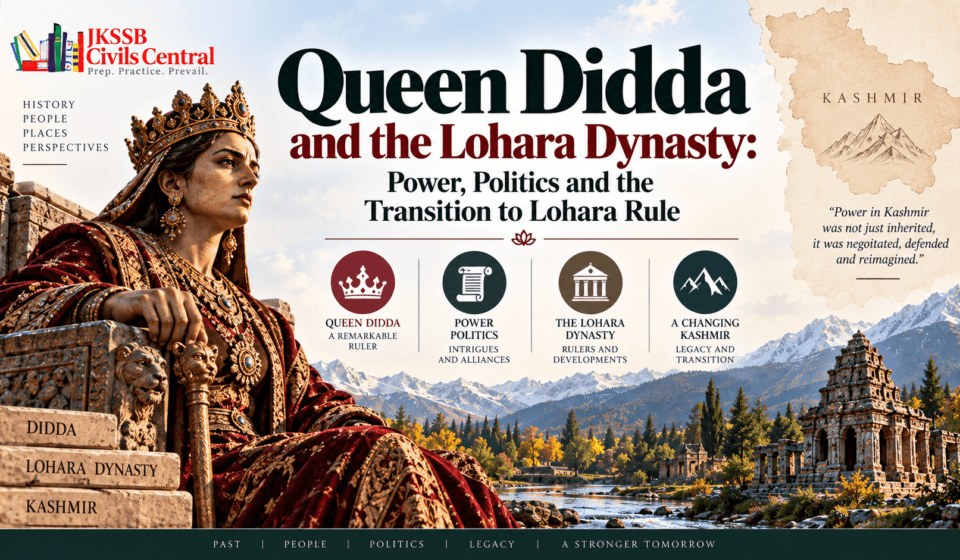
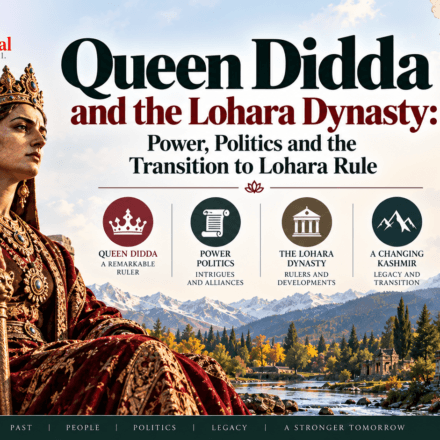
Queen Didda and the Lohara Dynasty: Power, Politics and the Transition to Lohara Rule

J&K History Series Navigation
| Previous Article | Current Article | Next Article |
|---|---|---|
| Article 16 — Post-Utpala Kashmir: Political Fragmentation, Yashaskara, Parvagupta and Kshemagupta | Article 17 — Queen Didda and the Lohara Dynasty: Power, Politics and the Transition to Lohara Rule | Article 18 — Lohara Dynasty in Kashmir: Rulers, Political Developments and Decline |
Learning Dashboard
| Category | Details |
|---|---|
| Historical Period | Late 10th–early 11th century CE |
| Historical Phase | Late Utpala/Parvagupta political order → Lohara transition |
| Main Personality | Queen Didda |
| Political Houses | Parvagupta line → Didda’s rule → Lohara |
| Didda’s political dominance | c. 958–1003 CE |
| Regency | From 958 CE |
| Direct rule | c. 980–1003 CE |
| Lohara succession | Sangramaraja, 1003 CE |
| Key Family Connection | Didda was daughter of Lohara chief Simharaja |
| Important Political Figure | Tunga |
| Important Places | Kashmir Valley, Lohara, Parnotsa, Rajapuri |
| Important Source | Kalhana’s Rajatarangini |
| Core Theme | Queenship, court politics, succession and dynastic transition |
| JKSSB Importance | Very High |
| Expected Question Types | Direct fact, chronology, statement-based, matching, identification, comparative |
Introduction
The political history of Kashmir in the second half of the 10th century was shaped by repeated succession crises, powerful court officials and competition among royal and landed elites. The political order inherited from the Utpala and Parvagupta phases had become increasingly dependent on the ability of individual rulers to control competing factions. It was within this unstable environment that Queen Didda emerged as the dominant political figure of Kashmir and eventually played the decisive role in transferring the succession to her natal Lohara family.
Didda’s importance lies not merely in the fact that she was a woman who ruled Kashmir. Her career demonstrates how political authority could operate through several overlapping channels: marriage into the ruling family, regency for a minor king, control of court appointments, management of rival factions, direct sovereignty and ultimately the designation of a successor from the queen’s natal family. Her career therefore forms an important bridge between the late 10th-century political order and the establishment of Lohara rule in Kashmir.
At the same time, Didda is one of the most difficult personalities of early medieval Kashmir to interpret. The principal narrative account comes from Kalhana’s Rajatarangini, composed in the 12th century, more than a century after Didda’s death. Kalhana presents her through a strongly moralized narrative containing allegations of cruelty, manipulation and sexual impropriety. Such descriptions are historically important as part of the chronicler’s representation of political power, but they should not automatically be treated as independently verified facts. What is much clearer is the political outcome: Didda survived successive succession crises, maintained power for decades and ensured that the Kashmir throne passed to her nephew Sangramaraja.
CivilsCentral Historical Insight
Didda’s significance lies in the relationship between personal political authority and dynastic transformation. Her career shows how a ruler operating within an unstable succession system could use kinship, court politics and political patronage to redirect the future ruling house of Kashmir.
Part I — Historical Background
Kashmir after the Utpala Political Crisis
The political background to Didda’s rise was created by the instability that followed the death of Shankaravarman in 902 CE. The later Utpala period witnessed rapid changes of ruler, factional struggles and the increasing importance of powerful officials and elite groups. By the middle of the 10th century, the old political order had weakened considerably, and the stability of the throne depended increasingly upon the ruler’s ability to manage competing political interests.
Yashaskara’s reign, conventionally dated to approximately 939–948 CE, temporarily restored a measure of political order. His successors, however, again became involved in struggles among ministers and competing factions. Parvagupta’s assumption of power represented another stage in the weakening of the earlier Utpala succession structure. When Kshemagupta came to the throne around 950 CE, his marriage to Didda brought the Lohara ruling family directly into the Kashmir royal household.
Kshemagupta ruled approximately from 950 to 958 CE. His death created the immediate political circumstances in which Didda moved from the position of queen-consort to regent and eventually to sovereign.
Didda’s Family and Political Background
Didda belonged by birth to the ruling family of Lohara, a political centre in the hill region adjoining Kashmir. Kalhana identifies her father as Simharaja, the chief or ruler of Lohara. Her maternal ancestry also connected her with the Shahi political world; historical traditions identify her maternal grandfather with Bhima Shahi.
This background placed Didda at the intersection of several regional political networks. Through marriage she became part of the Kashmir royal household, through birth she belonged to the Lohara ruling family, and through her maternal ancestry she was connected with the north-western Shahi political sphere. These relationships later became important when the succession of Kashmir was transferred to her nephew from Lohara.
The Lohara connection should not be understood as though Lohara had already conquered Kashmir before 1003 CE. Its importance was initially dynastic and political. Didda’s marriage and subsequent political authority created the conditions under which her natal family could eventually become the ruling house of Kashmir.
CivilsCentral Historical Insight
Didda’s family background illustrates why dynastic history cannot be understood only through kings and battles. Marriage, kinship and regional ruling families could create political connections that eventually transformed the succession of an entire kingdom.
Part II — Didda as Queen-Consort and Regent
Marriage to Kshemagupta
Didda married Kshemagupta, who ruled Kashmir approximately from 950 to 958 CE. The marriage connected the Lohara ruling family with the Kashmir royal household and gave Didda a position at court from which she could later exercise substantial political authority.
Kshemagupta’s death in 958 CE transformed Didda’s political position. Their son Abhimanyu succeeded to the throne, but he was still young. Didda therefore became regent and guardian of the young king.
This distinction is essential. Didda’s political dominance began in 958 CE, but her direct sovereign rule began only around 980 CE. Between these dates, formal kingship remained in the hands of successive rulers, while Didda increasingly became the decisive political authority behind the throne.
The Regency of Abhimanyu
Abhimanyu ruled approximately from 958 to 972 CE. During his reign, Didda exercised regency and became one of the central political actors in Kashmir. The Rajatarangini portrays this period as one in which court officials and rival political interests competed for influence around the young ruler.
One important figure associated with this period was Phalguna, who appears in the political struggles surrounding Didda’s regency. The sources describe a prolonged conflict between Didda and powerful officials at court. This illustrates the broader political problem of the period: the formal presence of a king did not necessarily mean that effective authority was concentrated in the person of the king.
Didda’s regency therefore became more than a temporary guardianship. It provided her with political experience, access to appointments and the opportunity to build alliances. When Abhimanyu died in 972 CE, the succession crisis that followed placed her in an even stronger position.
Abhimanyu’s Death and the Succession Crisis
After Abhimanyu’s death in 972 CE, his son Nandigupta succeeded to the throne. He was followed by Tribhuvana, and then by Bhimagupta. These short reigns form an important part of Didda’s political career because the throne remained occupied by her descendants while she continued to exercise major political influence.
The conventional chronology places Nandigupta immediately after Abhimanyu, Tribhuvana approximately around 975 CE, and Bhimagupta thereafter. The exact dating of these very short reigns should not be presented with the same precision as the longer reigns of Abhimanyu, Didda or Kshemagupta.
According to Kalhana’s narrative, Didda was responsible for the removal or deaths of her grandsons. These accusations are among the most dramatic elements of the Rajatarangini, but they should be identified as part of the literary-historical account rather than treated as independently corroborated evidence for each individual death.
The politically significant outcome is clearer: by approximately 980 CE, the succession through Didda’s son and grandsons had failed, and Didda assumed direct control of Kashmir.
CivilsCentral Historical Insight
The succession crisis demonstrates that early medieval kingship depended not only on hereditary descent but also on control over the court and the succession process. Didda’s political position strengthened as successive nominal rulers failed to provide a stable succession.
Part III — Didda as Direct Ruler of Kashmir
Direct Rule from c. 980 to 1003 CE
Around 980 CE, Didda moved from regency to direct sovereign rule. Her direct reign continued until her death in 1003 CE, making her one of the longest-lasting political authorities of the late 10th-century Kashmir court.
Her rule unfolded within a politically competitive environment. Powerful landed groups, Brahmanical elites, ministers and regional interests could all influence the balance of power. The Rajatarangini presents Didda as a ruler who relied heavily on political calculation, appointments and the suppression of opposition.
Whatever the accuracy of Kalhana’s moral judgments, the political outcome is significant. Didda remained in effective control for more than two decades. Her longevity indicates that she was able to overcome the factional instability that had weakened several earlier rulers.
Tunga and the Politics of Court Power
The most prominent political figure associated with Didda’s later reign was Tunga. Kalhana describes him as a Khasa from the Parnotsa region who rose from relatively humble origins to become one of the most influential officials in Kashmir.
Tunga’s rise is important because it illustrates the political flexibility of the royal court. Access to royal patronage could enable individuals outside the established aristocratic elite to acquire substantial political influence. His elevation, however, generated resentment among sections of the established political class.
Tunga eventually became a principal minister and a major supporter of Didda. His political importance also demonstrates that Didda’s rule was not simply personal or individualistic. Her government depended upon alliances with powerful officials who helped her maintain authority.
The precise nature of Didda’s personal relationship with Tunga belongs more securely to Kalhana’s literary narrative than to independently corroborated history. The historically useful point is his political role and influence under Didda.
Opposition from Lohara
Didda’s political struggles also involved members of her own natal family. Her brother Udayaraja had two sons, Vigraharaja and Sangramaraja, both of whom were connected with Lohara.
According to the traditional narrative, Vigraharaja became associated with opposition to Didda and was brought into Kashmir by groups hostile to Tunga. This episode demonstrates that Didda’s Lohara connection did not automatically eliminate political conflict within her natal family.
Didda ultimately retained control. Her later choice of Sangramaraja, rather than Vigraharaja, as her successor was therefore politically significant. It shows that kinship alone did not determine succession; Didda made a political choice within her own family.
CivilsCentral Historical Insight
Didda’s relationship with Lohara demonstrates that dynastic kinship could simultaneously create political opportunity and political rivalry. Her eventual choice of Sangramaraja was therefore a succession decision with wider dynastic consequences.
Part IV — Didda’s Political Strategy and Exercise of Power
Managing Powerful Elites
Early medieval Kashmir was not governed through an uncontested royal centre. The Rajatarangini refers to powerful groups such as the Damaras, while Brahmanical elites, ministers and regional chiefs could also exercise significant influence.
Didda’s political career unfolded within this competitive environment. Her ability to remain in power suggests that she was able to manage or neutralize competing groups more effectively than many of her predecessors. Her reign should therefore be understood as a period of political consolidation under a strong personal ruler, rather than as the disappearance of factional politics.
The sources also show the importance of patronage. Political appointments created networks of loyalty, while the suppression of opponents prevented competing factions from controlling the throne. Didda’s government thus depended on the interaction between royal authority and elite politics.
Central Authority and Political Survival
Didda did not establish an entirely new administrative system. Rather, she strengthened her command over the political institutions and personnel already available to the Kashmir monarchy.
Her political methods, as reconstructed from the narrative tradition, included strategic appointments, patronage, management of rival factions and suppression of opposition. The longevity of her rule suggests that these methods were politically effective, even though Kalhana presents many of them through a strongly moralized lens.
Didda should therefore neither be reduced to Kalhana’s image of a cruel queen nor transformed into a modern symbol of progressive female rule. Her political career was rooted in the institutional and dynastic realities of early medieval Kashmir.
Part V — Religious Patronage and Public Foundations
Religious Foundations
Didda’s political career was accompanied by religious patronage and foundation activity. Kalhana associates her with institutions including Diddasvamin, as well as foundations connected with members of her family.
She is also associated in the historical tradition with settlements such as Diddapura, while establishments associated with Abhimanyu and Simharaja formed part of the broader commemorative landscape of the period.
These foundations are significant because royal patronage could serve several purposes simultaneously. It could express religious devotion, commemorate members of the ruling family, establish a visible royal presence and contribute to the legitimacy of the ruling household.
Because much of the evidence comes through the Rajatarangini, these associations should be treated primarily as literary-historical evidence rather than automatically as independently archaeologically established facts.
Religious Patronage in Context
Didda’s religious patronage should not be interpreted as evidence of a narrowly sectarian political programme. The religious landscape of Kashmir remained diverse, and royal patronage operated within a broader environment of Brahmanical and Buddhist institutions.
The significance of Didda’s foundations therefore lies less in proving a particular religious policy and more in demonstrating how religious institutions, royal memory and political legitimacy were interconnected.
This also provides a useful counterbalance to the negative aspects of Kalhana’s portrayal. The same ruler described through accusations of political ruthlessness is also associated with religious and public foundations.
CivilsCentral Historical Insight
Royal patronage was not merely a religious act. In early medieval Kashmir, temples, viharas and settlements could also function as institutions of memory, legitimacy and political presence.
Part VI — Didda and the Transition to Lohara Rule
The Succession Problem
By the final phase of her reign, Didda faced a fundamental succession problem. The direct line descending through her son Abhimanyu had failed to provide a stable succession, while Didda herself was ageing and had no surviving son who could continue her direct line.
She therefore turned to her natal Lohara family. Her chosen successor was Sangramaraja, son of her brother Udayaraja and brother of Vigraharaja. This decision was historically decisive. Didda did not merely designate an individual successor; she redirected the succession of Kashmir toward the ruling family into which she had been born.
Sangramaraja and the Dynastic Transition
Sangramaraja’s accession in 1003 CE marks the formal establishment of Lohara rule in Kashmir. This should not be described as a sudden foreign conquest of Kashmir. The Lohara family had already been connected to the Kashmir court for decades through Didda’s birth and marriage.
The transition was therefore fundamentally dynastic rather than military. Didda’s political career created the bridge between the Kashmir ruling house and Lohara, and Sangramaraja’s accession converted that connection into formal dynastic rule.
1003 CE — The Beginning of Lohara Rule
Didda died in 1003 CE and was succeeded by Sangramaraja. With his accession, the Lohara family became the ruling house of Kashmir.
The importance of 1003 CE therefore lies in the completion of a process that had developed over several decades. Didda’s marriage had brought Lohara into the Kashmir royal family; her regency and direct rule gave her control over the succession; and her final decision transferred that succession to her nephew.
CivilsCentral Historical Insight
The transition of 1003 CE was not simply a change of monarch. It represented the conversion of a marital and kinship connection into a formal dynastic succession, making Lohara the ruling house of Kashmir.
Part VII — Didda’s Historical Image and the Problem of Sources
Kalhana’s Didda
The principal narrative source for Didda is Kalhana’s Rajatarangini. Kalhana describes her regency, her political conflicts, her relationship with ministers, the succession crises involving her descendants and the eventual accession of Sangramaraja.
However, Kalhana’s portrayal is strongly moralized. He presents Didda’s political conduct through the ethical standards and literary conventions of his own period. His allegations regarding Didda’s motives, personal relationships and responsibility for individual deaths therefore require careful source criticism.
This does not make Kalhana useless. On the contrary, his account is indispensable for reconstructing the political sequence. The historian’s task is to distinguish between the chronological-political information contained in the narrative and the moral or personal judgments through which Kalhana presents it.
Literary Narrative versus Historical Reconstruction
The broader chronology of Didda’s political career is relatively secure within the traditional historical reconstruction: Kshemagupta ruled approximately 950–958 CE; Didda became regent after his death; Abhimanyu ruled until 972; Didda remained politically dominant through the subsequent short successions; she assumed direct rule around 980; and Sangramaraja succeeded her in 1003.
By contrast, the precise circumstances surrounding the deaths of Nandigupta, Tribhuvana and Bhimagupta, Didda’s personal motivations and aspects of her relationship with Tunga depend heavily on Kalhana’s narrative.
This distinction is particularly important for examination preparation. Candidates should know the established chronology while recognizing that literary descriptions of political conduct do not automatically possess the same evidentiary status as chronology supported by multiple historical reconstructions.
Evidence Note
| Claim / Topic | Evidence Level | Historical Treatment |
|---|---|---|
| Didda was daughter of Simharaja of Lohara | B — Strong historical tradition | Widely accepted in the Kashmir historical tradition |
| Didda was connected maternally with the Shahi family | B | Traditional genealogy supported in historical accounts |
| Didda married Kshemagupta | B | Strong historical tradition |
| Kshemagupta ruled c. 950–958 CE | B | Standard chronological reconstruction |
| Didda became regent after 958 CE | B | Strong dynastic tradition |
| Abhimanyu ruled c. 958–972 CE | B | Standard chronology |
| Didda became direct ruler around 980 CE | B | Standard chronology |
| Didda ruled until 1003 CE | B | Strong historical tradition |
| Tunga became a major minister under Didda | B | Primarily based on Kalhana |
| Didda caused the deaths of her grandsons | C | Literary account requiring qualification |
| Didda’s exact relationship with Tunga | C | Literary narrative; avoid treating conjecture as established fact |
| Sangramaraja succeeded Didda in 1003 CE | B | Strong dynastic tradition |
| Sangramaraja’s accession established Lohara rule | B | Standard historical interpretation |
Part VIII — Historical Significance
1. Didda and Female Political Authority
Didda represents one of the most important examples of female political authority in early medieval Kashmir. Her career demonstrates that a royal woman could exercise authority through regency and ultimately direct sovereignty.
Her case should nevertheless be interpreted within the institutions of her time. Her authority emerged from dynastic position, marriage, motherhood, kinship, political alliances and control of the court. It should not be projected backward as a modern concept of gender equality.
2. Consolidation of Political Authority
Didda’s long political dominance followed decades of succession crises. Her ability to remain in power indicates a considerable degree of political effectiveness. Her reign therefore illustrates the difference between institutional stability and personal political stability. The underlying political system remained factional, but a strong ruler could temporarily impose coherence upon it.
3. Dynastic Transformation
The most enduring political consequence of Didda’s reign was the transfer of succession to Sangramaraja. The Lohara family, already connected to Kashmir through Didda, thereby became the ruling dynasty of Kashmir.
4. Kashmir and the Surrounding Hill Polities
Didda’s career demonstrates the close political relationship between Kashmir and neighbouring hill regions. Lohara and other surrounding political centres were not isolated from Kashmir’s political system.
The movement of rulers, officials and political families between the Valley and surrounding hill regions shows that Kashmir’s history must be understood within a wider north-western Himalayan political environment.
5. A Structural Transition
Didda’s reign represents more than the biography of a powerful queen. It exposes several features of early medieval Kashmir:
- unstable succession;
- strong ministerial influence;
- competition among landed and court elites;
- importance of dynastic marriage;
- political significance of regional ruling families;
- royal patronage of religious institutions;
- and the ability of succession decisions to transform the ruling dynasty.
The transition to Lohara rule was therefore the cumulative result of political developments rather than a single isolated event.
Part IX — JKSSB Knowledge Matrix
| Question Area | High-Value Knowledge |
|---|---|
| Who was Didda? | Queen and later direct ruler of Kashmir; daughter of Lohara chief Simharaja |
| Whom did she marry? | Kshemagupta |
| Kshemagupta’s reign | c. 950–958 CE |
| What happened in 958? | Kshemagupta died; Abhimanyu succeeded; Didda became regent |
| Abhimanyu’s reign | c. 958–972 CE |
| Who followed Abhimanyu? | Nandigupta → Tribhuvana → Bhimagupta |
| When did Didda become direct ruler? | c. 980 CE |
| When did Didda die? | 1003 CE |
| Important minister | Tunga |
| Natal dynasty | Lohara |
| Who succeeded Didda? | Sangramaraja |
| Sangramaraja’s relationship to Didda | Nephew |
| Sangramaraja’s accession | 1003 CE |
| Dynasty established | Lohara dynasty in Kashmir |
| Principal narrative source | Kalhana’s Rajatarangini |
| Major historical theme | Transition from late Utpala/Parvagupta political order to Lohara rule |
Part X — Examination Discrimination Points
Didda was not the daughter of Kshemagupta
She was the wife of Kshemagupta and daughter of Simharaja of Lohara.
958 CE does not mean Didda immediately became sovereign
In 958 CE, Kshemagupta died and Abhimanyu succeeded. Didda became regent.
Didda’s direct rule began around 980 CE
Her broader political dominance began earlier, but her direct sovereign rule is conventionally dated from approximately 980 CE.
Sangramaraja was not Didda’s son
He was her nephew, the son of her brother Udayaraja.
1003 CE is the key Lohara transition date
Didda died in 1003 CE and Sangramaraja succeeded her, establishing Lohara rule in Kashmir.
Tunga was not a king
He was a powerful minister and political associate of Didda.
Kalhana’s narrative must be read critically
The chronology is important, but allegations concerning Didda’s motives, personal conduct and responsibility for individual deaths should not be treated as independently verified facts.
Part XI — JKSSB Question Pattern
Direct Fact
Question: Didda was the daughter of which ruler?
Answer: Simharaja of Lohara.
Statement-Based
Consider the following statements:
- Didda was the wife of Kshemagupta.
- She became regent after the death of Kshemagupta.
- She directly ruled Kashmir from 958 CE.
- Sangramaraja succeeded her in 1003 CE.
Correct Answer: 1, 2 and 4 only.
Statement 3 is incorrect because Didda initially ruled as regent; her direct rule began around 980 CE.
Chronology
Arrange the following in chronological order:
- Kshemagupta
- Abhimanyu
- Nandigupta
- Tribhuvana
- Bhimagupta
- Didda
- Sangramaraja
Correct sequence:
Kshemagupta → Abhimanyu → Nandigupta → Tribhuvana → Bhimagupta → Didda → Sangramaraja
The short reigns of Nandigupta, Tribhuvana and Bhimagupta should be remembered as a succession sequence rather than through falsely precise dates.
Match the Following
| Person | Association |
|---|---|
| Didda | Lohara |
| Kshemagupta | Husband of Didda |
| Tunga | Powerful minister under Didda |
| Sangramaraja | Nephew and successor of Didda |
Identification by Clues
A ruler:
- belonged by birth to Lohara;
- married Kshemagupta;
- became regent after his death;
- later assumed direct rule;
- and ensured that her nephew succeeded her in 1003 CE.
Answer: Queen Didda
Part XII — JKSSB Practice Questions
Question 1
Consider the following statements regarding Queen Didda:
- She was the daughter of Simharaja of Lohara.
- She married Kshemagupta.
- She directly ruled Kashmir from 958 CE.
- She was succeeded by her nephew Sangramaraja.
Which of the above statements are correct?
A. 1 and 2 only
B. 1, 2 and 4 only
C. 2, 3 and 4 only
D. 1, 2, 3 and 4
Correct Answer: B
Explanation: Didda was the daughter of Simharaja and wife of Kshemagupta. After Kshemagupta’s death in 958 CE, she initially exercised authority as regent. Her direct rule began around 980 CE. Sangramaraja succeeded her in 1003 CE.
Question 2
Who succeeded Didda as ruler of Kashmir?
A. Kshemagupta
B. Abhimanyu
C. Sangramaraja
D. Vigraharaja
Correct Answer: C
Explanation: Sangramaraja was Didda’s nephew and succeeded her in 1003 CE.
Question 3
Which of the following is correctly matched?
A. Didda — Daughter of Avantivarman
B. Didda — Wife of Kshemagupta
C. Didda — Wife of Lalitaditya
D. Didda — Daughter of Shankaravarman
Correct Answer: B
Explanation: Didda was the daughter of Simharaja of Lohara and wife of Kshemagupta.
Question 4
Arrange the following in chronological order:
- Abhimanyu
- Kshemagupta
- Didda
- Sangramaraja
A. 1–2–3–4
B. 2–1–3–4
C. 2–3–1–4
D. 3–2–1–4
Correct Answer: B
Explanation: Kshemagupta preceded Abhimanyu; Didda later assumed direct rule around 980 CE; Sangramaraja succeeded her in 1003 CE.
Question 5
Tunga is primarily associated with:
A. Lalitaditya
B. Avantivarman
C. Didda
D. Zain-ul-Abidin
Correct Answer: C
Explanation: Tunga became a major political figure and minister under Didda.
Question 6
Which development most directly marks the formal transition to Lohara rule in Kashmir?
A. Marriage of Didda with Kshemagupta
B. Death of Abhimanyu
C. Didda’s direct accession around 980 CE
D. Accession of Sangramaraja in 1003 CE
Correct Answer: D
Explanation: Didda created the political bridge, but Sangramaraja’s accession in 1003 CE established Lohara rule as the ruling dynasty of Kashmir.
Question 7
Which source is the principal narrative source for the political career of Didda?
A. Rajatarangini
B. Arthashastra
C. Akbarnama
D. Ain-i-Akbari
Correct Answer: A
Explanation: Kalhana’s Rajatarangini provides the principal narrative account of Didda’s political career.
Question 8
Which of the following is associated with Didda’s religious patronage?
A. Diddasvamin
B. Martand Sun Temple
C. Avantisvamin
D. Parihaspura
Correct Answer: A
Explanation: Diddasvamin is associated with Didda. Martand and Parihaspura belong primarily to the Karkota period, while Avantisvamin is associated with Avantivarman.
Question 9
Consider the following statements:
- Didda belonged to the Lohara family by birth.
- Her political career was connected to Kashmir through her marriage to Kshemagupta.
- Sangramaraja was her nephew.
- Sangramaraja succeeded Didda in 1003 CE.
Which statements are correct?
A. 1 and 2 only
B. 1, 2 and 3 only
C. 2, 3 and 4 only
D. 1, 2, 3 and 4
Correct Answer: D
Explanation: All four statements correctly describe Didda’s family connections and the dynastic transition.
Question 10
Which statement best explains Didda’s historical significance?
A. She founded the Karkota dynasty.
B. She introduced Buddhism into Kashmir.
C. She transferred the Kashmir succession to her natal Lohara family.
D. She ended Mughal rule in Kashmir.
Correct Answer: C
Explanation: Didda’s most important long-term political consequence was the succession of her nephew Sangramaraja from Lohara in 1003 CE.
Part XIII — Rapid Revision Zone
Important Dates
| Approx. Date | Event |
|---|---|
| c. 950–958 CE | Kshemagupta rules Kashmir |
| 958 CE | Kshemagupta dies; Abhimanyu succeeds; Didda becomes regent |
| 958–972 CE | Abhimanyu’s reign |
| 972 CE | Abhimanyu dies; Nandigupta succeeds |
| c. 975 CE | Tribhuvana succeeds Nandigupta |
| c. 975 onward | Bhimagupta succeeds Tribhuvana |
| c. 980 CE | Didda assumes direct rule |
| c. 980–1003 CE | Didda’s direct rule |
| 1003 CE | Didda dies; Sangramaraja succeeds |
| 1003 CE onward | Lohara rule established in Kashmir |
Chronology note: The short reigns between Abhimanyu and Didda’s direct accession are best remembered as a succession sequence. The exact year-by-year chronology is less secure than the broad sequence.
Dynasties and Rulers
Late Utpala/Parvagupta political order
↓
Kshemagupta
↓
Abhimanyu
↓
Nandigupta
↓
Tribhuvana
↓
Bhimagupta
↓
Didda
↓
Sangramaraja
↓
Lohara Dynasty
Important Personalities
- Didda — Queen and later direct ruler of Kashmir
- Simharaja — Didda’s father and Lohara chief
- Kshemagupta — Didda’s husband
- Abhimanyu — Didda’s son
- Nandigupta — Didda’s grandson
- Tribhuvana — Didda’s grandson
- Bhimagupta — Didda’s grandson
- Tunga — Powerful minister associated with Didda
- Udayaraja — Didda’s brother
- Vigraharaja — Didda’s nephew and political rival
- Sangramaraja — Didda’s nephew and successor
Important Places
- Lohara — Didda’s natal political base
- Kashmir Valley — Centre of Didda’s rule
- Parnotsa — Associated with Tunga
- Rajapuri — Neighbouring hill polity associated with Tunga’s military activity
- Diddapura — Associated with Didda’s foundation tradition
- Abhimanyupura — Associated with Abhimanyu
- Kankanapura — Associated with the period’s foundation tradition
Important Associations
Didda → Simharaja → Lohara
Didda → Kshemagupta → Marriage
Didda → Abhimanyu → Regency
Didda → Tunga → Minister
Didda → Sangramaraja → Succession
Sangramaraja → 1003 CE → Lohara Rule
Part XIV — Frequently Confused Facts
| Confusion | Correct Distinction |
|---|---|
| Didda vs Kshemagupta | Didda was wife of Kshemagupta |
| Didda vs Simharaja | Didda was daughter of Simharaja |
| Didda vs Sangramaraja | Sangramaraja was her nephew |
| Didda vs Tunga | Tunga was a powerful minister, not king |
| 958 vs c. 980 | 958 = beginning of Didda’s regency; c. 980 = beginning of direct rule |
| c. 980 vs 1003 | c. 980 = Didda’s direct rule; 1003 = her death and Lohara succession |
| Lohara vs Kashmir monarchy | Didda was born into Lohara but ruled Kashmir before transferring succession to Lohara |
| Didda vs Vigraharaja | Vigraharaja was her nephew and associated with opposition to her |
| Diddasvamin vs Avantisvamin | Diddasvamin = Didda; Avantisvamin = Avantivarman |
| Sangramaraja vs Kshemagupta | Sangramaraja succeeded Didda; Kshemagupta was her husband |
Part XV — What Can JKSSB Ask?
High-value question areas include:
- Didda’s parentage
- Didda–Kshemagupta relationship
- Didda’s role after 958 CE
- distinction between regency and direct rule
- Abhimanyu’s reign
- sequence of Nandigupta → Tribhuvana → Bhimagupta
- Tunga’s association with Didda
- Didda’s Lohara connection
- Sangramaraja’s relationship with Didda
- Sangramaraja’s accession in 1003 CE
- beginning of Lohara rule
- Diddasvamin and Didda’s foundation activity
- Rajatarangini as the principal narrative source
- chronology versus literary narrative
- transition from the late Utpala/Parvagupta political order to Lohara rule
Chapter Summary
The political career of Queen Didda emerged from the instability of late 10th-century Kashmir. Born into the Lohara ruling family, she entered the Kashmir royal household through her marriage to Kshemagupta. After his death in 958 CE, she became regent for her son Abhimanyu and remained the dominant political figure through the successive short reigns of Nandigupta, Tribhuvana and Bhimagupta.
Around 980 CE, Didda assumed direct sovereignty. Her rule was marked by court competition, the influence of powerful officials such as Tunga, opposition from sections of the political elite and continued efforts to preserve royal authority. At the same time, she was associated with religious and public foundations that connected royal patronage with political legitimacy and dynastic memory.
The decisive development came at the end of her reign. Didda selected her nephew Sangramaraja, son of her brother Udayaraja, as successor. When Didda died in 1003 CE, Sangramaraja succeeded her and the Lohara dynasty became the ruling house of Kashmir.
Didda’s historical importance therefore lies in the combination of regency, direct queenship, political consolidation, court management and dynastic succession. Her career also demonstrates the importance of source criticism: Kalhana is indispensable for reconstructing the political sequence, but his moralized portrayal of Didda must be distinguished from independently established historical fact.
JKSSB Takeaway
Didda = daughter of Simharaja of Lohara + wife of Kshemagupta + regent from 958 CE + direct ruler from c. 980 CE + associated with Tunga + selected nephew Sangramaraja + died in 1003 CE → Lohara rule in Kashmir.
Mind Map
LATE UTPALA / PARVAGUPTA POLITICAL INSTABILITY
↓
Kshemagupta — c. 950–958
↓
Marriage with Didda
↓
958 CE — Kshemagupta dies
↓
Abhimanyu — c. 958–972
↓
Didda as Regent
↓
Nandigupta → Tribhuvana → Bhimagupta
↓
c. 980 CE — Didda assumes direct rule
↓
Tunga + Court Politics + Elite Opposition
↓
Political Consolidation
↓
Religious / Public Foundations
↓
Succession Decision
↓
Sangramaraja Chosen
↓
1003 CE — Didda Dies
↓
Sangramaraja Succeeds
↓
LOHARA RULE IN KASHMIR
FAQs
1. Who was Queen Didda?
Didda was a powerful ruler of Kashmir in the late 10th century. She was the daughter of Lohara chief Simharaja, the wife of Kshemagupta and the aunt of Sangramaraja.
2. When did Didda rule Kashmir?
Didda exercised political authority from approximately 958 to 1003 CE, initially as regent and later as direct ruler. Her direct rule is conventionally dated from around 980 CE.
3. Who was Didda’s husband?
Didda was married to Kshemagupta, who ruled Kashmir approximately from 950 to 958 CE.
4. Who was Sangramaraja?
Sangramaraja was Didda’s nephew, the son of her brother Udayaraja. He succeeded her in 1003 CE and became the ruler who established Lohara rule in Kashmir.
5. What was Didda’s connection with Lohara?
Didda was born into the Lohara ruling family. Her father was Simharaja. Her political career eventually enabled her natal family to succeed to the Kashmir throne.
6. Who was Tunga?
Tunga was a powerful political figure and minister associated with Didda. Kalhana identifies him as a Khasa from the Parnotsa region who rose to high office under her patronage.
7. Which source provides the main account of Didda?
The principal narrative source is Kalhana’s Rajatarangini. Because Kalhana wrote in the 12th century, his account must be read critically.
8. Did Didda directly rule Kashmir from 958 CE?
No. After Kshemagupta’s death in 958 CE, Didda initially acted as regent. Her direct rule began around 980 CE.
9. What is the historical importance of Didda?
Her importance lies in her ability to maintain political authority through decades of succession crises and in her role in transferring the Kashmir succession to the Lohara family.
10. Why is 1003 CE important?
Didda died in 1003 CE and was succeeded by Sangramaraja. His accession marks the formal establishment of Lohara rule in Kashmir.
About The Author




[…] Article 17 — Queen Didda and the Lohara Dynasty: Power, Politics and the Transition to Lohara Rule […]
[…] ← Article 17 — Queen Didda and the Lohara Dynasty: Power, Politics and the Transition to Lohara … […]