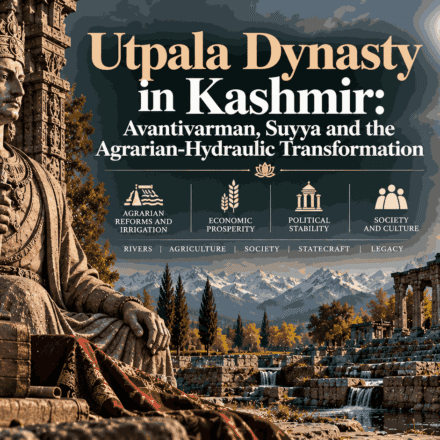
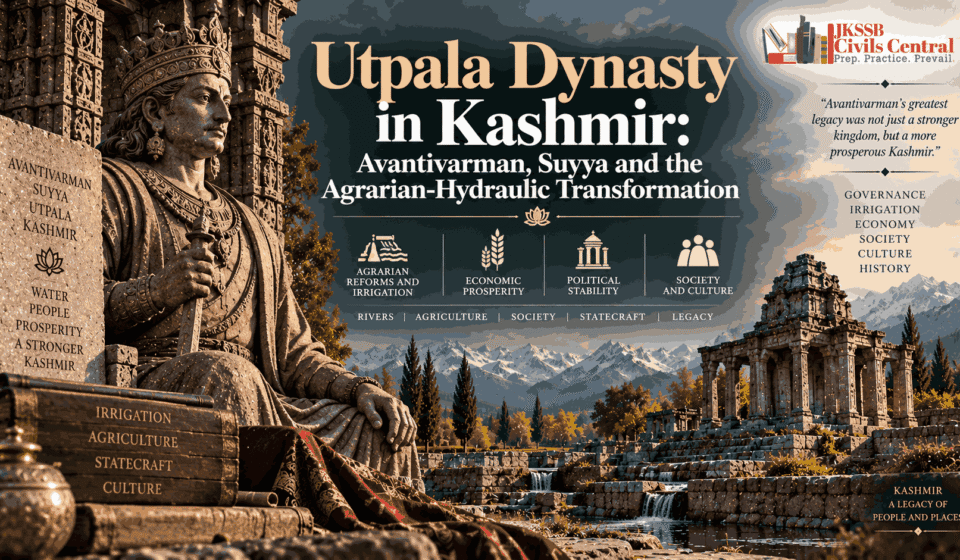
Utpala Dynasty in Kashmir: Avantivarman, Suyya and the Agrarian-Hydraulic Transformation

J&K History Series Navigation
| Previous Article | Current Article | Next Article |
|---|---|---|
| Karkota Architecture and Cultural Development: Martand, Parihaspura and Early Medieval Kashmir | Article 14 — Utpala Dynasty in Kashmir: Avantivarman, Suyya and the Agrarian-Hydraulic Transformation | Article 15 — Shankaravarman and the Later Utpala Period: Expansion, Fiscal Pressure and Political Instability |
Learning Dashboard
| Category | Key Information |
|---|---|
| Historical Period | 9th century CE, beginning c. 855 CE |
| Historical Phase | Early Medieval Kashmir |
| Dynasty | Utpala |
| Founder | Avantivarman |
| Major Ruler | Avantivarman |
| Major Engineer/Administrator | Suyya |
| Political Centre | Kashmir Valley; Avantipura became an important royal centre |
| Core Theme | Political consolidation, hydraulic engineering, drainage, irrigation and agrarian recovery |
| Major River | Vitasta (Jhelum) |
| Major Lake/Water System | Wular / Mahapadma in historical terminology |
| Important Urban Foundation | Avantipura; Suyyapur is traditionally identified with modern Sopore |
| Major Temples | Avantisvamin and Avantishvara |
| Major Source | Kalhana’s Rajatarangini, especially Book V |
| Other Evidence | Archaeological remains, environmental/geo-historical research and later historical scholarship |
| JKSSB Importance | Very High |
| Expected Question Types | Direct fact, statement-based, chronology, matching, identification and conceptual-factual |
Introduction
The transition from the Karkota dynasty to the Utpala dynasty in the ninth century was more than a simple change of ruling house. It followed a prolonged period of political instability after the decline of the later Karkota line, and the accession of Avantivarman around 855 CE created the conditions for a different kind of royal consolidation. Instead of being remembered primarily for territorial expansion, Avantivarman’s reign is closely associated with internal stabilisation, restoration of productive capacity, temple construction and, above all, the hydraulic works attributed to his engineer and minister Suyya.
The importance of Suyya’s work lies in the relationship between water management and agriculture. Kashmir’s fertile valley depended heavily on the controlled use of water, but the same river system that sustained cultivation could also produce destructive flooding and waterlogging. The account preserved by Kalhana describes a series of interventions involving the Vitasta (Jhelum), drainage, channel clearance, embankments and irrigation. Modern geological research has also examined the flood and drainage narrative preserved in Rajatarangini, finding that the broad environmental problem described by Kalhana is plausible even though some details of the traditional chronology remain uncertain.
Avantivarman’s reign therefore provides an important case study in J&K history: political stability created the conditions for hydraulic intervention, hydraulic intervention expanded productive land and improved agricultural conditions, and agricultural recovery strengthened the material basis of the state. The relationship should not be reduced to a simplistic claim that one engineer “created an agricultural revolution”; rather, the evidence points to a combination of state action, environmental management, agricultural labour and institutional patronage.
CivilsCentral Historical Insight: The significance of the Utpala period lies in the connection between political authority and the physical environment. In Kashmir, controlling water was not merely an engineering problem; it affected cultivation, food supply, settlement and state revenue. Avantivarman’s reign is therefore especially important because it shows how environmental management could become a central component of early medieval statecraft.
Part I — From Karkota Decline to Utpala Rule
The Political Background
The Karkota dynasty, which had produced powerful rulers such as Lalitaditya, gradually weakened in the later eighth and early ninth centuries. After the death of the stronger Karkota rulers, succession disputes and factional struggles increasingly weakened the monarchy. A sequence of short-lived rulers and competing political groups created an unstable environment in which effective central authority became difficult to maintain.
The transition to the Utpala dynasty should therefore be understood against this background of political fragmentation. Avantivarman did not inherit the same political circumstances that had characterised Lalitaditya’s reign. His principal challenge was not to reproduce Karkota territorial expansion but to establish a functioning political order within Kashmir.
The conventional chronology places Avantivarman’s accession around 855 CE, following the final phase of Karkota rule. He ruled until 883 CE and is conventionally regarded as the founder of the Utpala dynasty.
The Role of Sura
Avantivarman’s accession was closely connected with the political influence of Sura, an important minister who helped establish the new ruling order. Kalhana’s narrative gives considerable attention to the political networks surrounding the accession, demonstrating that early medieval kingship depended not only on dynastic descent but also on the support of powerful ministers and political groups.
This is an important distinction for examination purposes. Avantivarman was the founder of the Utpala ruling line, but the transition was not simply an automatic hereditary succession from Karkota to Utpala. It emerged from a period of political competition in which ministers and elite groups played an important role.
CivilsCentral Historical Insight: Dynastic change in early medieval Kashmir was often a political process rather than a clean genealogical succession. The rise of Avantivarman demonstrates how ministerial influence, elite alliances and dynastic legitimacy could combine to produce a new ruling house after a period of instability.
Part II — Avantivarman: Consolidation Rather Than Conquest
A Different Model of Kingship
Avantivarman’s reign is distinctive because the surviving historical narrative does not emphasise a major programme of external conquest comparable to the campaigns traditionally attributed to Lalitaditya. Instead, the focus falls on internal reconstruction and economic recovery.
This does not mean that Avantivarman’s kingdom was politically insignificant or that military concerns disappeared. It means that the central historical importance of his reign lies elsewhere: in the strengthening of the productive and institutional foundations of the Kashmir Valley.
The distinction is important because historical greatness should not be measured only through territorial expansion. A ruler who improves agricultural production, stabilises administration and strengthens the economic base of a state may produce consequences that are less dramatic in military narratives but more significant for everyday society.
Political Stability and Economic Recovery
Kalhana presents Avantivarman’s reign as a period of prosperity following severe difficulties. His narrative associates the earlier condition of the valley with floods, high grain prices and agricultural distress, while the reign of Avantivarman is associated with improved cultivation and lower food prices.
The precise numerical claims in Rajatarangini should not be treated as modern economic statistics. They are valuable primarily because they indicate the historical memory of a major improvement in agricultural conditions.
This distinction is particularly important:
Kalhana’s numerical figures → historical literary evidence
Modern economic statistics → not available for the ninth-century valley
The historian can therefore use the figures to understand the scale of change as perceived by Kalhana, but not to calculate a precise ninth-century inflation or price index.
Part III — Why Water Management Was Central to Kashmir
The Geography of the Kashmir Valley
The Kashmir Valley is an enclosed basin dominated by the Vitasta/Jhelum system and surrounded by mountains. Its fertile soils supported intensive agriculture, particularly rice cultivation, but the same hydrological environment created serious flood and drainage problems.
The problem was structural. Water entering the valley through rainfall, snowmelt and tributary systems ultimately had to leave through the Jhelum’s relatively narrow outlet toward the lower valley. Any obstruction or unusual hydrological event could therefore create extensive inundation.
The historical sources preserve repeated references to floods and famines. Modern research has examined these descriptions in relation to the geomorphology of the Jhelum Valley and has found that the broad environmental setting described by Kalhana is credible.
Floods and Agriculture
Flooding had consequences beyond the immediate destruction of crops. Prolonged waterlogging could reduce cultivable land, delay agricultural cycles and make settlement more vulnerable. When floods destroyed rice crops, the consequences could extend to food prices and famine.
Thus the relationship can be expressed as:
Flooding
↓
Waterlogging / crop destruction
↓
Reduced agricultural output
↓
Higher grain prices
↓
Food insecurity
↓
Pressure on population and state resources
Conversely:
Drainage + controlled irrigation
↓
Expansion/protection of cultivable land
↓
Higher agricultural productivity
↓
Greater food availability
↓
Improved economic conditions
CivilsCentral Historical Insight: In Kashmir’s environmental history, water was simultaneously a productive resource and a source of risk. The significance of Suyya’s work therefore lies not simply in “irrigation” but in the attempt to convert an unstable hydrological environment into a more predictable agricultural system.
Part IV — Suyya: Engineer, Administrator and Historical Figure
Who Was Suyya?
Suyya is one of the most prominent individuals associated with hydraulic engineering in the historical tradition of Kashmir. He served during the reign of Avantivarman and is credited by Kalhana with major interventions in the Vitasta and the wider water system of the valley.
His background is presented unusually in Kalhana’s narrative. Rather than emerging from a prominent aristocratic family, Suyya is portrayed as a person whose social origins were obscure. The story emphasises his technical ability and confidence rather than hereditary status.
This aspect of the narrative should be treated cautiously. Kalhana’s account has a literary structure, and the details of Suyya’s social background cannot all be independently verified. Nevertheless, the prominence given to a technically skilled official is historically significant.
The Suyya Narrative
According to Kalhana, the valley was suffering from severe flooding and agricultural distress when Suyya proposed a solution. He obtained royal support and undertook major works to improve the river system.
The narrative attributes to him:
- clearing obstructions from the Vitasta
- improving river flow
- regulating channels
- constructing embankments
- improving drainage
- expanding irrigation
- organising the distribution of water
- improving the agricultural potential of the valley.
Modern scholarship has treated the story seriously enough to investigate whether the physical geography of the valley supports the broad account. Geological research has reconstructed possible flood and drainage conditions associated with the Jhelum system, while also cautioning that the chronology and technical details of the literary account cannot all be independently demonstrated.
Part V — The Famous Coin-Pot Episode
One of the best-known parts of the Suyya narrative concerns his method of obtaining labour for the removal of obstructions from the river. According to Kalhana, Suyya threw pots containing coins into the floodwaters and announced that people could recover them. This encouraged people to enter the water and remove the obstacles that were preventing effective drainage.
The story has often been presented as evidence of Suyya’s extraordinary ingenuity. Historically, however, its significance is broader: it illustrates how incentives, labour mobilisation and state-directed infrastructure could be connected. The exact historicity of every detail cannot be independently established, but the episode belongs to the central narrative through which Kalhana explains Suyya’s hydraulic intervention.
This is an excellent example of evidence classification:
Suyya’s hydraulic activity → strong literary tradition with environmental plausibility
Every detail of the coin-pot episode → cannot be independently verified
Exact engineering dimensions → should not be invented
CivilsCentral Historical Insight: The coin-pot episode is valuable not because every detail should be treated as literal documentary evidence, but because it illustrates a larger historical principle: infrastructure required organised labour, incentives and political authority. Hydraulic engineering was therefore simultaneously a technical and social process.
Part VI — Regulation of the Vitasta
Clearing the River
The central element of Suyya’s hydraulic programme was the Vitasta, the ancient name of the Jhelum. Kalhana describes the removal of obstructions and the regulation of its flow. The purpose was not simply to make the river “smaller.” The objective was to improve the movement of water through the valley, reduce destructive inundation and make water available for cultivation in a more controlled manner.
The river should therefore be understood as part of an interconnected system:
Vitasta
↕
tributary channels
↕
wetlands and lake systems
↕
agricultural fields
↕
settlements
Changing one part of the system could affect the others.
Drainage and Irrigation Together
A major analytical point is that Suyya’s work involved both drainage and irrigation.
These are not identical:
Drainage = removing excess water from flooded or waterlogged land.
Irrigation = directing water to cultivated land when needed.
The achievement attributed to Suyya was therefore not simply “building canals.” It involved attempts to create a more controlled hydrological environment in which excess water could be removed while useful water could be directed toward agriculture.
This distinction is highly relevant for statement-based examination questions.
Part VII — Embankments and Water Control
The literary tradition also attributes the construction of embankments and other protective measures to Suyya. Such works would have helped regulate water movement and protect cultivated areas from uncontrolled inundation.
The broader environmental principle is straightforward:
Uncontrolled river flow → flood risk
Controlled channels + embankments → greater predictability
Predictability → improved agricultural planning
However, it would be incorrect to imagine a modern canal-and-dam system. Ninth-century hydraulic works operated with technologies and environmental constraints very different from those of modern engineering.
The appropriate historical formulation is therefore:
Suyya’s works represent sophisticated early medieval attempts to regulate Kashmir’s water system; they should not be projected backward as a modern hydraulic network.
Part VIII — The Agricultural Transformation
Expansion of Cultivable Land
The most important consequence attributed to Suyya’s hydraulic works was an increase in the area suitable for cultivation. Where waterlogging had previously restricted agriculture, drainage could make land usable. Where water supply was uncertain, controlled irrigation could improve agricultural reliability.
This potentially expanded the productive capacity of the valley in two directions:
- recovering or protecting land from excessive water, and
- improving the availability of water for cultivation.
The distinction matters because “irrigation” alone cannot explain the agricultural changes described for Avantivarman’s reign.
Rice and Food Supply
Rice was especially important in Kashmir’s agrarian economy. The hydraulic management of the valley therefore had direct implications for food availability. Kalhana’s narrative associates the reign of Avantivarman with a dramatic fall in the price of rice. Modern historians use this as an indicator of increased agricultural supply, although the precise numerical figures should not be interpreted as statistically exact.
The historical relationship is more important than the exact number:
Improved water management
→ better cultivation conditions
→ greater agricultural output
→ greater food availability
→ lower pressure on grain prices
Part IX — Agriculture, Villages and Settlement
New Settlement Possibilities
Improved agricultural conditions could also affect settlement geography. Land that had previously been too wet or vulnerable to flooding could become more usable. Kalhana attributes a large number of new settlements to the prosperity associated with Avantivarman. The claim of “thousands” should be treated cautiously because literary chronicles frequently use large numbers rhetorically.
Nevertheless, the underlying historical point is important: hydraulic improvement could contribute to changes in settlement and cultivation patterns.
The process can be understood as:
Water control
→ reclamation/protection of land
→ cultivation
→ settlement expansion
→ increased production
→ stronger fiscal base
This represents a structural connection between environmental management and state formation.
Part X — Food Prices and the Economy
Kalhana’s account gives a striking comparison in the price of rice before and during Avantivarman’s reign. In his narrative, a khari of rice that had previously commanded an extremely high price became much cheaper after Suyya’s works. The exact figures are best treated as literary evidence rather than as modern quantitative economic data. What matters historically is the direction of change that Kalhana emphasises: food became more abundant and therefore cheaper.
This suggests that the Utpala state benefited from increased agricultural productivity in at least three ways:
1. Food Security
A more productive agricultural system could reduce the vulnerability of the population to shortage.
2. Commercial Activity
Agricultural surplus could support exchange and market activity.
3. State Resources
Higher agricultural productivity could enlarge the material base from which the state obtained resources.
The relationship between agricultural surplus and state revenue should nevertheless be treated as a reasoned inference unless a specific revenue mechanism is documented.
CivilsCentral Historical Insight: Suyya’s hydraulic programme was economically important because water management changed the productive capacity of land. The key historical transformation was therefore not merely technological; it was the conversion of environmental control into greater agricultural surplus and social stability.
Part XI — Avantipura: Urban and Political Development
Foundation of Avantipura
Avantivarman is associated with the foundation and development of Avantipura, an important royal centre in the southern Kashmir Valley. The town was named after the ruler and became associated with major religious monuments. Its development illustrates a broader feature of early medieval kingship: rulers could use urban and religious foundations to mark political authority and reorganise the landscape around royal centres.
Avantipura should therefore be studied not simply as an archaeological site but as part of the relationship among:
Kingship + settlement + religious patronage + architecture
The Avantisvamin Temple
The Avantisvamin temple was dedicated to Vishnu and is traditionally associated with Avantivarman’s period before his accession to the throne. Its surviving remains demonstrate the continuity of the architectural vocabulary discussed in the previous article. The complex includes a large rectangular courtyard and architectural elements characteristic of Kashmir’s early medieval temple tradition.
The Avantishvara Temple
After becoming king, Avantivarman is associated with the construction of the Avantishvara temple dedicated to Shiva. The two temples are especially important for understanding the religious and political culture of his reign because they demonstrate patronage of both Vishnu and Shiva.
The evidence does not justify reducing Avantivarman to a simplistic single-sectarian identity. Kalhana’s narrative itself contains a more complicated picture of royal religious affiliation and patronage.
Part XII — Religious Patronage Under Avantivarman
The religious culture of the Utpala period developed from the broader Brahmanical and Buddhist environment inherited from earlier Kashmir. Avantivarman’s monuments show strong Brahmanical patronage, while Buddhist institutions continued to exist in Kashmir.
This should not be interpreted as an abrupt religious rupture with the Karkota period. Rather, the Utpala period continued the broader pattern of royal and elite patronage of religious institutions while introducing new centres and monuments.
The Avantisvamin and Avantishvara temples also demonstrate that Vishnu and Shiva worship could coexist within royal patronage.
This is a useful examination distinction:
Avantivarman → Avantisvamin + Avantishvara
not:
Avantivarman → only Shiva or Avantivarman → only Vishnu
Part XIII — Patronage of Learning and Intellectual Culture
The reign of Avantivarman is also associated with a vibrant intellectual environment. Kashmir’s early medieval period produced important developments in Sanskrit literary culture, poetics, philosophy and religious thought.
The name Anandavardhana, associated with the theory of Dhvani in Sanskrit poetics, is traditionally connected with this broader intellectual milieu. The philosopher and Shaiva thinker Bhatta Kallata is also associated with the Kashmir intellectual environment of this period.
However, the precise nature of their relationship with the royal court should be stated carefully. Literary traditions and later scholarship connect major intellectual figures with the cultural environment of ninth-century Kashmir, but the surviving evidence does not justify constructing a detailed court roster without qualification.
The broader historical significance is nevertheless clear: the Utpala period formed part of Kashmir’s important early medieval intellectual history, alongside its political and economic developments.
Part XIV — Suyyapur and the Development of Sopore
From Suyya to Suyyapur
The historical tradition associates Suyyapur with Suyya and identifies the settlement with modern Sopore in the Baramulla region. The location is historically significant because it lies near the point where the Jhelum leaves the Wular basin. This made it particularly relevant to the hydrological system that Suyya was attempting to regulate.
The association should be expressed carefully:
Suyyapur is traditionally identified with modern Sopore and is associated in the historical tradition with Suyya.
This is safer than presenting the modern identification as though it were established through a surviving ninth-century inscription naming the town.
Why Sopore Matters
The association illustrates the relationship between hydraulic management and urban development. A settlement located near a strategically important point in the river system could become economically significant because of its position in relation to water transport, agriculture and regional exchange.
Thus the Suyya story extends beyond irrigation:
Hydraulic intervention → settlement development → commercial significance
Part XV — The Wular/Mahapadma System
The historical geography of Kashmir frequently uses the name Mahapadma for the great lake system identified with the modern Wular Lake. The lake and the Jhelum were not separate historical subjects. They formed part of an interconnected hydrological environment.
Suyya’s works are traditionally associated with improving the relationship between the river and this wider water system. Modern studies have examined the possibility of natural obstructions and landslide-generated dams in the Jhelum gorge and their relationship to historical flood narratives.
The evidence, however, requires caution. Geological research supports the plausibility of major flood events and hydraulic intervention but also points out inconsistencies in the traditional chronology.
Therefore:
Broad environmental problem → plausible and historically well supported
Exact sequence and dating of every hydraulic event → debated
This distinction is central to responsible historical writing.
CivilsCentral Historical Insight: The Suyya narrative is strongest when understood as environmental history rather than as a simple biography of an “ancient engineer.” The real subject is the interaction between river morphology, floods, agricultural land, human labour and political authority.
Part XVI — State, Economy and Hydraulic Infrastructure
Infrastructure and Political Authority
Large-scale water management could not be undertaken by individual farmers alone. River clearance, embankment construction and coordinated irrigation required collective labour and some form of political organisation. The Utpala state therefore played an important role in mobilising resources for hydraulic works. The exact administrative structure through which this occurred is less securely documented, and it would be inappropriate to invent a modern-style irrigation department.
The historically defensible conclusion is:
The monarchy provided political authority and resources for large-scale hydraulic intervention, while the actual work necessarily depended on organised human labour and local participation.
Agriculture as the Economic Foundation
The importance of agriculture was particularly high in a valley where rice cultivation depended heavily on water conditions.
Improving agricultural productivity therefore strengthened more than food supply. It could support:
- population
- settlement
- local exchange
- artisanal activity
- religious institutions
- royal expenditure
- state resources.
The chain from hydraulic infrastructure to broader economic development is therefore one of the central themes of Avantivarman’s reign.
Part XVII — Avantivarman’s Administration and Governance
Avantivarman’s achievement cannot be explained only through Suyya. The king’s political role was to create the stability within which technical and economic measures could be implemented. The historical narrative presents him as a ruler who restored order after the political instability of the preceding period. His government appears to have relied heavily on ministers and elite officials, including Sura and Suyya.
However, the evidence does not permit reconstruction of a detailed bureaucratic hierarchy comparable to much later states. Terms from later administrative systems should therefore not be projected backward.
The safest interpretation is that Avantivarman strengthened central authority sufficiently to mobilise resources, support construction and intervene in major environmental problems.
Part XVIII — From Avantivarman to Shankaravarman
Avantivarman died in 883 CE. His son Shankaravarman succeeded him, although the succession involved political complications. This transition is important because it marks a shift in the character of Utpala rule. Avantivarman is remembered principally for consolidation, agricultural recovery and cultural patronage, whereas Shankaravarman is associated with a more expansionist and fiscally demanding phase.
The contrast is central to the next article:
Avantivarman
Stability → hydraulic works → agricultural recovery → prosperity
Shankaravarman
Expansion → fiscal demands → heavier extraction → political pressure
This does not mean that Avantivarman’s reign was completely peaceful or that Shankaravarman’s administration had no achievements. It means that their historical profiles are significantly different.
Part XIX — Why the Utpala Transformation Matters
The Utpala period is historically important because it demonstrates how early medieval Kashmir’s political history was connected to its environmental and economic history.
The transformation can be summarised as:
Karkota decline
↓
Political instability
↓
Avantivarman’s accession c. 855 CE
↓
Political consolidation
↓
Suyya’s hydraulic intervention
↓
Drainage + irrigation + river regulation
↓
Improved agricultural conditions
↓
Settlement and economic recovery
↓
Architectural and cultural patronage
↓
Utpala consolidation
The process should not be interpreted as a perfectly linear “agrarian revolution.” Historical change was more complicated, and the evidence is largely literary for the details of the hydraulic programme. But the relationship between water management and agricultural prosperity is sufficiently central to make it the defining theme of Avantivarman’s reign.
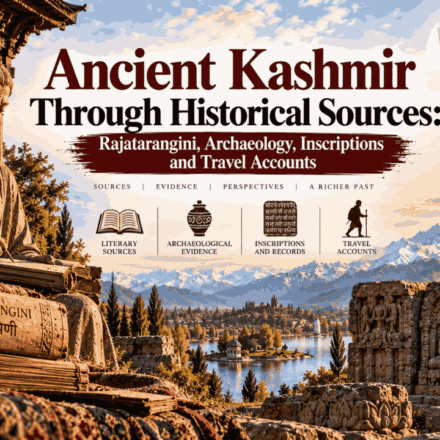
Part XX — Historical Evidence and Interpretation
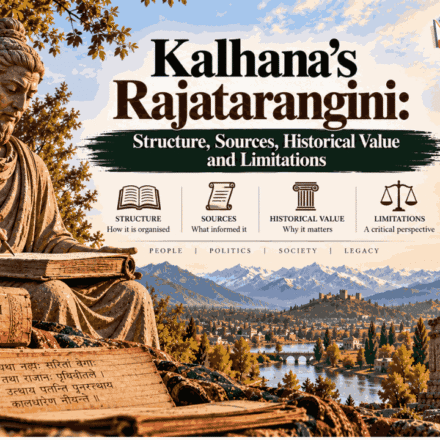
Kalhana’s Rajatarangini
The principal narrative source for Avantivarman and Suyya is Kalhana’s Rajatarangini, particularly the fifth book. This source is invaluable because it preserves detailed descriptions of the Utpala period, including political developments, construction, agriculture, floods and Suyya’s works.
But Kalhana wrote in the twelfth century, several centuries after Avantivarman. His account must therefore be read as a later historical narrative rather than as a contemporary engineering report.
Archaeological Evidence
Archaeology provides physical evidence for Utpala-period construction, particularly at Avantipura. The surviving Avantisvamin and Avantishvara temple complexes demonstrate the scale and sophistication of Utpala architectural patronage.
Archaeology is less capable of independently confirming the full sequence of Suyya’s hydraulic works. It can help historians understand the physical environment and settlement geography, but many details remain dependent on textual evidence.
Environmental and Geological Research
Modern geological research has revisited the flood narratives in Rajatarangini. Studies of the Jhelum Valley have found that a major flood and landslide scenario is physically plausible and have used the historical narrative to investigate the valley’s changing hydrology.
At the same time, such studies have identified inconsistencies in the chronology of the traditional accounts. This is a valuable example of how modern environmental science can test, refine and sometimes challenge historical narratives.
CivilsCentral Historical Insight: The Suyya episode demonstrates the value of interdisciplinary history. A literary chronicle provides the narrative, archaeology provides material evidence, and geological research helps test the environmental plausibility of the account. No single source is sufficient by itself.
Part XXI — Historical Significance
1. Establishment of the Utpala Dynasty
Avantivarman ended the period of Karkota political dominance and established the Utpala ruling house around 855 CE.
2. Political Stabilisation
His reign is associated with consolidation after prolonged instability.
3. Hydraulic Engineering
The works attributed to Suyya represent one of the most important examples of early medieval water management in Kashmir.
4. Agricultural Recovery
Drainage and irrigation contributed to improved cultivation and the expansion or protection of agricultural land.
5. Food-Supply Improvement
Kalhana’s narrative associates the period with a substantial decline in rice prices, indicating increased availability.
6. Urban Development
Avantipura emerged as an important royal and religious centre, while Suyyapur is traditionally associated with modern Sopore.
7. Architectural Development
The Avantisvamin and Avantishvara temples continued the architectural traditions of early medieval Kashmir while developing them under Utpala patronage.
8. Intellectual and Cultural Development
The period formed part of Kashmir’s important Sanskrit literary, philosophical and religious intellectual environment.
9. Environmental Statecraft
The reign demonstrates how management of rivers, wetlands and agricultural land could become a central concern of political authority.
Part XXII — JKSSB Knowledge Matrix
| Question | High-Value Answer |
|---|---|
| Which dynasty was founded by Avantivarman? | Utpala dynasty |
| Approximate accession? | c. 855 CE |
| Reign? | c. 855–883 CE |
| Who succeeded Avantivarman? | Shankaravarman |
| Who was Suyya? | Engineer/official associated with Avantivarman’s hydraulic works |
| Main river? | Vitasta/Jhelum |
| Main environmental problem? | Flooding and waterlogging |
| Main solutions attributed to Suyya? | Drainage, river clearance, embankments and irrigation |
| Main economic effect? | Improved agricultural conditions and food supply |
| Important town of Avantivarman? | Avantipura |
| Avantisvamin dedicated to? | Vishnu |
| Avantishvara dedicated to? | Shiva |
| Suyyapur traditionally identified with? | Sopore |
| Major source for Suyya? | Kalhana’s Rajatarangini |
| Major source limitation? | It was composed centuries after Avantivarman |
| Historical significance? | Link between political consolidation, hydraulic management and agrarian recovery |
Part XXIII — Examination Discrimination Points
Avantivarman vs Lalitaditya
Lalitaditya
→ Karkota
→ military expansion
→ Martand
→ Parihaspura
→ eighth century
Avantivarman
→ Utpala
→ political consolidation
→ Suyya’s hydraulic works
→ Avantipura
→ ninth century
Avantivarman vs Shankaravarman
Avantivarman
→ 855–883 CE
→ founder of Utpala dynasty
→ Suyya
→ irrigation/drainage
→ agricultural recovery
→ Avantisvamin/Avantishvara
Shankaravarman
→ successor
→ 883–902 CE
→ expansion and fiscal pressure
→ later Utpala phase
Drainage vs Irrigation
Drainage
→ removes excess water
→ reduces waterlogging/flood impact
Irrigation
→ supplies water to agricultural land
Suyya’s programme
→ associated with both
Avantisvamin vs Avantishvara
| Temple | Deity | Association |
|---|---|---|
| Avantisvamin | Vishnu | Avantivarman, associated with pre-accession foundation |
| Avantishvara | Shiva | Avantivarman, after accession |
Part XXIV — JKSSB Question-Type Mapping
Direct Fact
Who founded the Utpala dynasty in Kashmir?
Answer: Avantivarman
Statement-Based
Consider the following statements:
- Avantivarman founded the Utpala dynasty.
- Suyya is associated with hydraulic works in Kashmir.
- The Vitasta is the ancient name of the Jhelum.
- Avantivarman succeeded Lalitaditya directly.
Which are correct?
A. 1 and 2 only
B. 1, 2 and 3 only
C. 2, 3 and 4 only
D. 1, 2, 3 and 4
Answer: B
Statement 4 is incorrect because several rulers and a period of political instability separated Lalitaditya from Avantivarman.
Chronology
Arrange the following in chronological order:
- Avantivarman
- Lalitaditya
- Shankaravarman
- Karkota decline
Correct broad sequence:
Lalitaditya → later Karkota rulers → Karkota decline → Avantivarman → Shankaravarman
Match the Following
| Person | Association |
|---|---|
| A. Avantivarman | 1. Utpala dynasty |
| B. Suyya | 2. Hydraulic works |
| C. Lalitaditya | 3. Karkota dynasty |
| D. Shankaravarman | 4. Later Utpala phase |
Correct: A–1, B–2, C–3, D–4
Identification by Clues
Identify the historical figure:
- ninth century Kashmir
- associated with Avantivarman
- worked on the Vitasta/Jhelum
- associated with drainage and irrigation
- traditionally linked with Suyyapur
Answer: Suyya
Conceptual-Factual
Why were hydraulic works particularly important in Kashmir?
A. Because agriculture depended exclusively on rainfall
B. Because the valley’s river and flood system could simultaneously provide water and cause destructive inundation
C. Because the Jhelum did not flow through Kashmir
D. Because irrigation had no relationship with agriculture
Answer: B
Part XXV — JKSSB Practice Questions
Q1. Who is regarded as the founder of the Utpala dynasty of Kashmir?
A. Lalitaditya
B. Avantivarman
C. Shankaravarman
D. Jayapida
Correct Answer: B
Explanation: Avantivarman established the Utpala ruling house around 855 CE after the decline of the Karkota line.
Q2. Suyya is primarily associated with which development?
A. Construction of Martand
B. Mughal garden construction
C. Hydraulic engineering and agricultural improvement
D. Introduction of Persian administration
Correct Answer: C
Q3. Consider the following statements:
- Suyya’s works are associated with the Vitasta.
- His works included both drainage and irrigation.
- The historical account attributes agricultural benefits to these works.
- All technical details of the works have been independently confirmed archaeologically.
Which statement is incorrect?
A. 1
B. 2
C. 3
D. 4
Correct Answer: D
Explanation: The broad hydraulic narrative is preserved in literary sources and has been examined through environmental research, but all technical details cannot be treated as independently archaeologically established.
Q4. Which temple is associated with Vishnu?
A. Martand
B. Avantisvamin
C. Avantishvara
D. Shankaragaurishvara
Correct Answer: B
Q5. Avantishvara was associated with:
A. Shiva
B. Vishnu
C. Surya
D. Buddha
Correct Answer: A
Q6. Which river is known as Vitasta in ancient Kashmir?
A. Chenab
B. Ravi
C. Jhelum
D. Indus
Correct Answer: C
Q7. Which sequence is correct?
A. Utpala → Karkota → Lohara
B. Karkota → Utpala → Lohara
C. Lohara → Karkota → Utpala
D. Utpala → Lohara → Karkota
Correct Answer: B
Q8. Which of the following best explains the economic importance of Suyya’s works?
A. They eliminated all taxation.
B. They connected Kashmir directly with the Mughal Empire.
C. They helped regulate water and improve agricultural conditions.
D. They ended all political conflicts in Kashmir.
Correct Answer: C
Q9. The principal literary source for the account of Suyya’s hydraulic works is:
A. Nilamata Purana
B. Rajatarangini
C. Ain-i-Akbari
D. Akbarnama
Correct Answer: B
Q10. Which statement best distinguishes Avantivarman’s reign from that of Lalitaditya?
A. Avantivarman is chiefly associated with hydraulic and agrarian development, while Lalitaditya is more strongly associated with Karkota political expansion and monumental architecture.
B. Avantivarman ruled before the Karkotas.
C. Lalitaditya founded the Utpala dynasty.
D. Avantivarman ruled during the Mughal period.
Correct Answer: A
Part XXVI — Rapid Revision Zone
Important Dates
- c. 855 CE → accession of Avantivarman
- c. 855–883 CE → reign of Avantivarman
- 883 CE → death of Avantivarman / succession crisis
- 883–902 CE → reign of Shankaravarman
Dynasty Sequence
Karkota → Utpala → later Utpala rulers → Lohara
Key Personalities
Avantivarman
Founder of Utpala dynasty; associated with political consolidation, economic recovery and temple construction.
Suyya
Engineer/official associated with hydraulic works, drainage, irrigation and regulation of the Vitasta.
Sura
Important minister associated with Avantivarman’s accession and government.
Shankaravarman
Son and successor of Avantivarman; belongs to the next major phase of Utpala history.
Important Places
Avantipura
Royal centre associated with Avantivarman.
Sopore
Traditionally identified with Suyyapur.
Vitasta/Jhelum
Principal river in the hydraulic narrative.
Wular/Mahapadma
Major water body within the valley’s hydrological system.
Important Temples
Avantisvamin → Vishnu
Avantishvara → Shiva
Suyya’s Hydraulic Works
Remember:
RIVER CLEARANCE
↓
DRAINAGE
↓
EMBANKMENTS / CHANNEL CONTROL
↓
IRRIGATION
↓
AGRICULTURAL IMPROVEMENT
Major Source
Kalhana → Rajatarangini → Book V → Utpala period
Key Concept
Water management = environmental management + agricultural policy + economic recovery
Part XXVII — Frequently Confused Facts
| Confusion | Correct Distinction |
|---|---|
| Avantivarman = Karkota | No; Avantivarman founded the Utpala dynasty |
| Lalitaditya = Utpala | No; Lalitaditya was Karkota |
| Avantivarman = Suyya | No; Avantivarman was king, Suyya was the official/engineer associated with hydraulic works |
| Suyya = ruler | No |
| Vitasta = Jhelum | Yes |
| Avantisvamin = Shiva temple | No; associated with Vishnu |
| Avantishvara = Vishnu temple | No; associated with Shiva |
| Suyya = only irrigation | His works are associated with both drainage and irrigation |
| Suyyapur = unquestionably proven by inscription as Sopore | The identification is traditional/historical rather than something to state as direct inscriptional proof |
| Suyya’s works = modern dam system | No; they were early medieval hydraulic interventions |
| Rice-price figures = modern statistics | No; they come from Kalhana’s literary account |
| Utpala period begins with Shankaravarman | No; Avantivarman is the founder |
| Avantivarman = major conqueror like Lalitaditya | His historical profile is principally associated with consolidation and internal development |
Part XXVIII — What Can JKSSB Ask?
High-value areas from this article include:
- Avantivarman → founder of Utpala dynasty
- c. 855 CE → accession
- Avantivarman → c. 855–883 CE
- Suyya → hydraulic engineering
- Suyya → Vitasta/Jhelum
- Suyya → drainage + irrigation
- Suyyapur → traditionally identified with Sopore
- Avantipura → Avantivarman
- Avantisvamin → Vishnu
- Avantishvara → Shiva
- Avantivarman → political consolidation
- Suyya → agricultural improvement
- Rajatarangini → principal narrative source
- Utpala → follows Karkota
- Shankaravarman → successor of Avantivarman
High-Value Conceptual Question
A question may test whether the candidate understands why Suyya’s works mattered.
The correct chain is: Hydraulic control → agricultural productivity → food availability → economic recovery
rather than simply: Suyya → irrigation
Chapter Summary
The Utpala dynasty emerged from the political instability that followed the decline of the Karkotas. Around 855 CE, Avantivarman established the new ruling house, and his reign until 883 CE became associated with internal consolidation rather than the kind of large-scale military expansion traditionally attributed to Lalitaditya.
The central achievement associated with Avantivarman’s reign was the attempt to address Kashmir’s environmental and agricultural problems. The valley’s water system was both an economic asset and a recurring source of danger, particularly through flooding and waterlogging. Suyya, the official and engineer associated with Avantivarman, is credited by Kalhana with clearing obstructions, regulating the Vitasta, improving drainage, constructing protective works and expanding irrigation.
The economic significance of these measures was substantial in the historical narrative. Better control of water could protect or expand cultivable land, improve rice production, reduce food shortages and facilitate settlement. Kalhana’s account of sharply reduced rice prices should be understood as literary evidence for perceived prosperity rather than as precise modern economic statistics.
Avantivarman’s reign also produced important cultural and architectural developments. Avantipura became a major royal centre, while the Avantisvamin and Avantishvara temples represent patronage of Vishnu and Shiva respectively. These monuments continued the architectural traditions of early medieval Kashmir while giving them a new Utpala political setting.
The historical importance of the Utpala period therefore lies in the connection between political consolidation, environmental management, agriculture, urban development and cultural patronage.
JKSSB Takeaway
Remember the core chain:
Karkota decline
→ Avantivarman, c. 855 CE
→ Utpala dynasty
→ Suyya
→ Vitasta/Jhelum regulation
→ Drainage + irrigation
→ Agricultural recovery
→ Avantipura
→ Avantisvamin + Avantishvara
→ Shankaravarman
The single most important conceptual distinction is:
Suyya’s achievement was not merely irrigation; the historical tradition associates him with the broader management of Kashmir’s water system, combining drainage, river regulation and irrigation.
Mind Map
KARKOTA DECLINE
↓
POLITICAL INSTABILITY
↓
AVANTIVARMAN — c. 855 CE
↓
FOUNDATION OF UTPALA DYNASTY
↓
POLITICAL CONSOLIDATION
→ Internal stability
→ Ministerial support
→ Restoration of state capacity
↓
ENVIRONMENTAL PROBLEM
→ Flooding
→ Waterlogging
→ Crop damage
→ Food-price pressure
↓
SUYYA
→ Vitasta/Jhelum
→ River clearance
→ Drainage
→ Embankments
→ Irrigation
↓
AGRARIAN EFFECT
→ More usable agricultural land
→ Better water control
→ Improved rice cultivation
→ Greater food availability
↓
ECONOMIC EFFECT
→ Lower food-price pressure
→ Settlement expansion
→ Stronger productive base
↓
CULTURAL DEVELOPMENT
→ Avantipura
→ Avantisvamin
→ Avantishvara
→ Intellectual culture
↓
NEXT PHASE
SHANKARAVARMAN
↓
EXPANSION + FISCAL PRESSURE + POLITICAL INSTABILITY
FAQs
1. Who founded the Utpala dynasty?
Avantivarman, who came to power around 855 CE, is conventionally regarded as the founder of the Utpala dynasty.
2. Who was Suyya?
Suyya was an official/engineer associated with Avantivarman and is credited in Rajatarangini with major hydraulic works in Kashmir.
3. What river did Suyya regulate?
The principal river associated with his works is the Vitasta, or Jhelum.
4. What was the main purpose of Suyya’s hydraulic works?
They are associated with controlling excess water, improving drainage, regulating river channels and expanding irrigation for agriculture.
5. Why were hydraulic works important in Kashmir?
Because the valley’s agriculture depended heavily on water, while floods and waterlogging could severely damage crops and settlements.
6. What is the relationship between Suyyapur and Sopore?
Suyyapur is traditionally identified with modern Sopore and is associated with Suyya in the historical tradition.
7. Which temples did Avantivarman build at Avantipura?
The two principal temples associated with him are Avantisvamin, dedicated to Vishnu, and Avantishvara, dedicated to Shiva.
8. Which source provides the main narrative of Suyya’s works?
The principal literary source is Kalhana’s Rajatarangini.
9. Can every detail of Suyya’s hydraulic works be treated as archaeologically proven?
No. The broad environmental and hydraulic problem is historically plausible and has been investigated by modern researchers, but many technical details come primarily from Kalhana’s later literary account.
10. How is Avantivarman different from Lalitaditya?
Lalitaditya belongs to the Karkota dynasty and is principally associated with political expansion and monumental construction, while Avantivarman founded the Utpala dynasty and is particularly associated with political consolidation, hydraulic works and agrarian recovery.
About The Author