
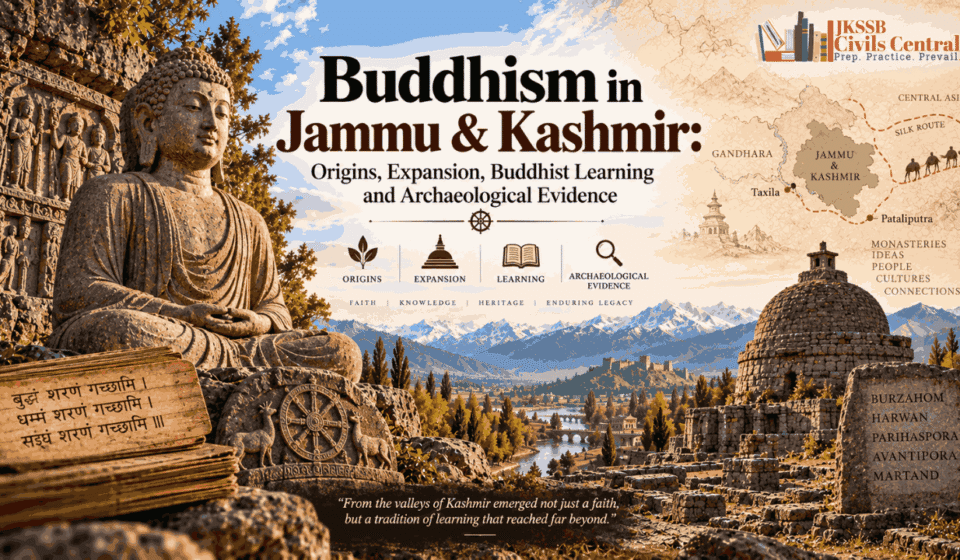
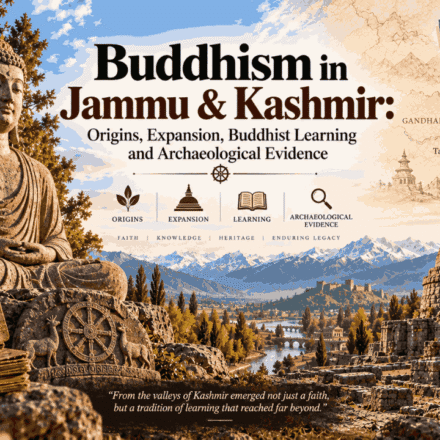
Buddhism in Jammu & Kashmir: Origins, Expansion, Buddhist Learning and Archaeological Evidence

J&K History Series Navigation
| Previous Article | Current Article | Next Article |
|---|---|---|
| Article 07 — Kushan Kashmir: Kanishka, Buddhism, Trade and Cultural Exchange | Article 08 — Buddhism in Jammu & Kashmir: Origins, Expansion, Buddhist Learning and Archaeological Evidence | Article 09 — Ancient Kashmir Through Historical Sources: Rajatarangini, Archaeology, Inscriptions and Travel Accounts |
Learning Dashboard
| Category | Key Information |
|---|---|
| Historical Period | Ancient to Early Medieval J&K |
| Historical Phase | Expansion and institutional development of Buddhism |
| Core Theme | Origins, Buddhist institutions, learning, archaeology and transmission |
| Principal Region | Kashmir Valley, with important evidence from Jammu |
| Major Political Contexts | Mauryan, Kushan and later Kashmir |
| Important Personalities | Ashoka, Madhyantika, Kanishka, Vasumitra, Xuanzang, O-kong |
| Important Places | Harwan, Ushkur, Pandrethan, Parihaspora, Ambaran, Semthan |
| Important School | Sarvāstivāda, especially its Abhidharma tradition |
| Major Sources | Archaeology, Chinese pilgrim accounts, Rajatarangini, Buddhist traditions |
| JKSSB Importance | Very High |
| High-Value Question Areas | Sites, schools, pilgrims, chronology, archaeological features, Buddhist learning, Jammu–Kashmir distinction |
Introduction
Buddhism occupies an important place in the ancient history of Jammu & Kashmir, but its historical development cannot be reduced to a single ruler, a single council or a single moment of conversion. Buddhist traditions connect the early spread of the religion in Kashmir with the Mauryan age, while archaeological evidence demonstrates the subsequent development of monasteries, stupas, settlements and artistic traditions. By the Kushan period, Kashmir had become closely connected with the wider Buddhist intellectual world, and the region’s importance continued to be visible in the accounts of Chinese pilgrims centuries later. The evidence therefore points to a long process of establishment, institutionalisation, intellectual development and regional transmission rather than a one-time introduction of Buddhism.
The geographical position of Kashmir was particularly significant. The Valley was connected westward with Gandhara through the Jhelum corridor and Baramulla, while routes across the northern mountains connected it with areas leading toward Central Asia. Jammu, meanwhile, occupied an important position on routes connecting the north-western plains with the Himalayan region. Archaeological discoveries at Ambaran near Akhnoor demonstrate that Buddhist activity was not confined to the Kashmir Valley, although the archaeological record of Buddhism is considerably richer in Kashmir.
The history of Buddhism in J&K must also be reconstructed through different kinds of evidence. Literary traditions provide accounts of Ashoka, Madhyantika, Kanishka and Buddhist councils; archaeology provides monasteries, stupas, sculptures, terracotta objects, architectural remains and inscriptions or coins; and Chinese pilgrims provide unusually valuable observations on the condition of Buddhist institutions in particular periods. These sources do not always agree, and they should therefore be used together rather than treated as interchangeable evidence.
CivilsCentral Historical Insight
The significance of Buddhism in J&K lies not merely in the presence of Buddhist monuments but in the transformation of Kashmir into a zone of religious learning and transregional exchange. The region became important because geography, political connections, monastic institutions and intellectual networks reinforced one another over several centuries.
Part I — Historical Background: Before Buddhism Became an Institutional Tradition
1. Kashmir Before the Expansion of Buddhism
Buddhism entered a region that already possessed complex religious and cultural traditions. The archaeological record discussed in the earlier articles of this series demonstrates that prehistoric and early historic Kashmir had developed settled communities, agricultural practices and regional connections long before the emergence of organised Buddhist institutions. Later Buddhist and Brahmanical literary traditions also preserved memories of an ancient sacred landscape associated with nāgas, lakes, mountains and rivers.
This background is important because the arrival and expansion of Buddhism should not be understood as the replacement of an otherwise culturally empty landscape. Buddhist institutions developed within an existing society and interacted with earlier religious practices, local sacred traditions and political structures. The later archaeological record similarly shows that Buddhist, Brahmanical and other religious traditions could coexist within the same broad historical environment.
The early historical development of Kashmir is therefore better understood as a process of religious layering and institutional transformation rather than a simple succession in which one religion completely displaced another.
2. The Mauryan Connection
The strongest traditional association between the early institutional expansion of Buddhism in Kashmir and the Mauryan period is the reign of Ashoka. Later Buddhist traditions and Kalhana’s Rajatarangini associate Ashoka with Kashmir and with the construction of Buddhist establishments. However, these accounts were written or transmitted considerably later than the Mauryan period and must therefore be distinguished from direct contemporary evidence.
There is no known Ashokan rock or pillar edict from the Kashmir Valley comparable to the famous imperial inscriptions found elsewhere in the subcontinent. Consequently, the reconstruction of Ashoka’s role in Kashmir depends on a combination of later literary traditions and archaeological evidence rather than on a surviving Ashokan inscription from the Valley.
This distinction is particularly important for examination purposes. Ashoka’s association with the spread of Buddhism in Kashmir is a major historical tradition, but the precise scale and administrative mechanism of Mauryan control or Buddhist institutionalisation in Kashmir cannot be reconstructed simply from the existence of Ashoka’s empire.
3. Madhyantika and the Buddhist Mission Tradition
Buddhist traditions associate the monk Madhyantika with the early propagation of Buddhism in Kashmir. In later accounts, he is connected with the conversion of the region and with the establishment of Buddhist communities.
The story is preserved in a religious and literary framework and contains legendary elements. It is therefore unsafe to interpret the narrative literally as a contemporary administrative account of a missionary expedition. Its historical importance lies instead in the fact that Buddhist traditions themselves remembered Kashmir as one of the important regions reached during the early expansion of the religion.
The Madhyantika tradition also illustrates a broader feature of Kashmir’s Buddhist history: later Buddhist communities constructed a historical memory that connected the Valley with the earliest missionary expansion of Buddhism. This memory strengthened Kashmir’s status as a sacred and intellectual landscape within Buddhist traditions.
CivilsCentral Historical Insight
The Mauryan period provides the traditional starting point for the institutional history of Buddhism in Kashmir, but the evidence must be separated into literary tradition and archaeological demonstration. This distinction prevents the common mistake of treating every detail in later Buddhist narratives as contemporary Mauryan documentation.
Part II — From Religious Presence to Institutional Expansion
4. The Importance of Monasteries and Stupas
The development of Buddhism in J&K became historically significant when religious belief was translated into durable institutions. Monasteries, stupas, chaityas, shrines and associated settlements created physical centres for teaching, ritual activity, residence and patronage.
A Buddhist monastery was not simply a place where monks lived. In an established Buddhist landscape it could function as a centre of education, textual transmission, religious practice and interaction with travellers and patrons. Stupas and relic structures similarly transformed particular places into sites of pilgrimage and ritual memory.
Archaeological remains from Kashmir demonstrate that Buddhist architecture developed regional characteristics while also retaining connections with wider north-western Buddhist traditions. Harwan, for example, displays architectural and decorative elements connected with the broader Gandharan artistic environment, while its terracotta tile tradition also demonstrates local development and adaptation.
5. The Kushan Period and Institutional Consolidation
The Kushan period was especially important for the expansion and institutional consolidation of Buddhism in Kashmir. As discussed in previous articles, the Kushan political world connected Kashmir with Gandhara, Central Asia and other regions of northern India. Kanishka became associated with Buddhist patronage, while the Valley acquired greater importance within Buddhist intellectual networks.
It is important, however, not to describe Kanishka as the person who introduced Buddhism to Kashmir. Buddhist traditions already associated Kashmir with Buddhism before the Kushan period. The Kushan contribution was more closely related to the scale of political connectivity, patronage, monastic development and intellectual circulation that characterised the period.
The Kushan environment was also religiously plural. Kanishka’s coinage, for example, represents a wide range of religious figures rather than a narrowly exclusive Buddhist religious policy. This makes it more historically accurate to describe Kushan patronage as supporting Buddhist institutions within a plural religious environment.
6. Sarvāstivāda and the Intellectual Identity of Kashmir
One of the most important developments in the history of Buddhist Kashmir was the growth of Sarvāstivāda, particularly its sophisticated tradition of Abhidharma scholarship.
Sarvāstivāda was one of the major Buddhist schools of ancient India. Its philosophical and scholastic traditions became particularly influential in north-western India and Kashmir. Kashmir consequently developed a reputation as a centre where Buddhist doctrine was studied, debated, systematised and transmitted.
This intellectual tradition is important because it changes the way Kashmir’s Buddhist history should be understood. Kashmir was not merely a geographical location containing monasteries; it became a place where Buddhist intellectual traditions were preserved and developed through teachers, texts, commentaries and debates.
The importance of this scholastic tradition can be seen in the later accounts of Chinese pilgrims, who travelled to Kashmir specifically to study Buddhist doctrine and Sanskrit texts with learned teachers.
7. Abhidharma Learning
The Abhidharma tradition represented a highly developed form of Buddhist scholastic thought. It involved systematic analysis of phenomena, consciousness, doctrine and the structure of Buddhist teaching.
Kashmir’s importance in this field was closely associated with the Sarvāstivāda tradition. The region became known for learned teachers and commentarial scholarship, and its intellectual influence extended beyond the Valley.
This explains why later Buddhist scholars and pilgrims did not regard Kashmir merely as a pilgrimage destination. They also approached it as a centre of advanced Buddhist learning. The distinction between pilgrimage and scholarship is central to understanding Kashmir’s place in the wider Buddhist world.
CivilsCentral Historical Insight
The major transformation during the ancient period was the movement from the presence of Buddhism to the creation of a durable intellectual and institutional system. Kashmir’s significance grew because monasteries provided not only religious spaces but also environments for advanced doctrinal study and transmission.
Part III — Buddhist Learning and the Intellectual Networks of Kashmir
8. Kashmir as a Centre of Buddhist Scholarship
By the early centuries of the Common Era, Kashmir had acquired an intellectual reputation that extended beyond its immediate geographical boundaries. The combination of monasteries, learned teachers, Sanskrit scholarship and connections with north-western Buddhist centres created conditions for sustained intellectual exchange.
This development was closely linked to the geography of the region. Kashmir stood between the Indian subcontinent and the routes leading through Gandhara toward Central Asia. Monks, merchants, pilgrims and scholars could therefore move through the same broad geographical networks, although the precise routes and intensity of movement varied across periods.
The intellectual importance of Kashmir should nevertheless not be exaggerated into the claim that every major Buddhist thinker of northern India studied in the Valley. Individual associations require separate evidence. What can be established more securely is that Kashmir became a recognised centre of Buddhist scholastic activity and attracted learned visitors.
9. Buddhist Teachers and Scholars
The Chinese pilgrim tradition is especially valuable because it preserves the names of teachers with whom Xuanzang studied in Kashmir. Xuanzang’s account indicates that he spent an extended period in the Valley studying Buddhist doctrine and Sanskrit with learned teachers.
Among the teachers associated with his Kashmiri studies are Saṅghayaśas (Samghayasas), Vinītaprabha, Candravarman and Jayagupta. The importance of these names is not that they represent a single organised school of thought, but that they demonstrate the existence of a sophisticated scholarly environment capable of attracting an advanced Buddhist student from China.
The intellectual history of Kashmir should therefore be understood as a network rather than as a list of isolated personalities. Teachers transmitted texts; students travelled to study them; monasteries preserved manuscripts and doctrinal traditions; and pilgrims carried knowledge beyond the Valley.
10. Sanskrit and Buddhist Transmission
The history of Buddhist Kashmir is also connected with the increasing importance of Sanskrit in northern Buddhist intellectual traditions. This was particularly significant for Sarvāstivāda scholastic literature and later Buddhist philosophical transmission.
The movement of Buddhist texts between Kashmir, Gandhara, Central Asia and China was not simply a one-way process. Chinese pilgrims came to India to obtain texts and learn from Indian teachers, while Indian and Central Asian scholars participated in translation and transmission networks. Kashmir was one node within this broader intellectual system.
This is why the history of Buddhism in Kashmir should not be isolated from the history of Buddhism in Gandhara, Central Asia and China. The Valley’s historical importance emerged partly from its position within a much larger transregional Buddhist world.
Part IV — The Buddhist Council Tradition and Its Historical Limits
11. The So-Called Fourth Buddhist Council
Kashmir is traditionally associated with what later Buddhist traditions call the Fourth Buddhist Council, convened under Kanishka. According to the northern Buddhist tradition, the gathering was connected with disputes concerning Buddhist doctrine and with the preparation of authoritative commentaries.
The tradition associates Vasumitra with the intellectual leadership of the council and links it particularly with the Sarvāstivāda school. The council tradition therefore has considerable significance for understanding the later reputation of Kashmir as a centre of Buddhist scholasticism.
However, the expression “Fourth Buddhist Council” must be used carefully. Buddhist traditions differ regarding the number, location and historical character of major councils, and the Kashmiri council is not uniformly recognised in the same way across all Buddhist traditions. Some traditions associate the event with Kashmir, while other scholarly reconstructions have proposed different locations.
12. The Location of the Council
The council is often associated with Kundalavana in Kashmir, and later tradition has connected it with the broader Harwan area. However, the exact archaeological identification of the council site remains uncertain.
Recent scholarship on Harwan itself emphasises this distinction. Archaeological investigation shows that the surviving structural complex at Harwan developed over several phases, with major remains associated with later centuries. The famous decorated terracotta pavement cannot simply be treated as the physical remains of a council held during Kanishka’s reign.
Other locations have also been proposed in historical discussions. The safest examination formulation is therefore:
Kanishka — traditional Buddhist council — Kashmir — Sarvāstivāda/Vasumitra; exact location and historical details remain debated.
13. Why the Council Tradition Matters
Even where the precise historicity or location of an event remains debated, the tradition itself is historically significant. It demonstrates that later Buddhist intellectual memory regarded Kashmir as a place capable of hosting major doctrinal deliberation.
The council tradition also explains why Kashmir became strongly associated with the Sarvāstivāda intellectual tradition in later Buddhist literature. It therefore has two levels of significance: the historical question of whether and exactly where such a council occurred, and the much clearer historical fact that Kashmir acquired a major reputation for Buddhist scholasticism.
CivilsCentral Historical Insight
The “Fourth Buddhist Council” is a classic example of why historical evidence must be graded. The association of Kanishka, Kashmir and Sarvāstivāda scholarship is important, but the exact venue and historical details of the council should not be presented with greater certainty than the evidence allows.
Part V — Archaeological Evidence of Buddhist Kashmir
14. Harwan
Harwan, north-east of Srinagar, is one of the most important archaeological sites for understanding Buddhist Kashmir. The site has been identified with the ancient Shad-arhat-vana mentioned in the Rajatarangini tradition. Archaeological remains include a substantial structural complex, pebble masonry, a stupa and a remarkable courtyard paved with decorated terracotta tiles.
The terracotta tiles are particularly significant. Their decoration includes geometric patterns, animals, human figures and motifs displaying both local and wider artistic influences. Kharoshthi numerals occur on some tiles, while the architectural technique has parallels with the north-western artistic environment associated with Gandhara. These features demonstrate that Buddhist Kashmir was culturally connected with regions beyond the Valley while simultaneously developing its own architectural and decorative vocabulary.
Harwan therefore provides archaeological evidence for a Buddhist institutional landscape rather than merely a literary claim about Buddhism in Kashmir.
Harwan — Examination Association
Harwan → Buddhist archaeological complex → Srinagar → terracotta tile pavement → diaper-pebble masonry → Buddhist Kashmir
But: Harwan ≠ conclusively proven site of the Fourth Buddhist Council.
That distinction is extremely important.
15. Ushkur
Ushkur, near Baramulla and close to the western entrance of the Kashmir Valley, is another major Buddhist archaeological site. It has traditionally been identified with Huṣkapura, associated with Huvishka of the Kushan dynasty. Its geographical position is significant. Baramulla formed an important western gateway of the Valley, and the Jhelum corridor connected Kashmir with Gandhara and the wider north-western world.
Archaeological evidence from Ushkur includes stupa remains and terracotta material associated with the later Gandharan artistic tradition. An ASI account also records that Xuanzang encountered a flourishing Buddhist establishment at Hushkapura when entering Kashmir. The site therefore illustrates the connection between Kushan political networks, Buddhist institutions, the Jhelum corridor and Gandharan artistic traditions.
16. Pandrethan
Pandrethan is associated in historical discussions with the ancient settlement of Puranadhisthana and the early urban history of Kashmir. The site has archaeological importance extending beyond Buddhism, but Buddhist remains form an important component of its historical record.
Its importance lies partly in demonstrating that Buddhist establishments were integrated into broader settlement landscapes. Buddhist religious architecture did not exist separately from urban and political developments; monasteries and religious structures formed part of the changing settlement geography of Kashmir.
Pandrethan should therefore not be reduced simply to a “Buddhist site.” It represents the interaction of urban history, political centres and religious institutions.
17. Parihaspora
Parihaspora, associated with the Karkota ruler Lalitaditya, provides evidence for the continued importance of Buddhism in Kashmir into the early medieval period. The site is particularly valuable because it demonstrates that Buddhist institutional life continued after the Kushan period. The presence of Buddhist remains in a major political and architectural centre associated with Lalitaditya also cautions against simplistic assumptions that Kashmir’s Buddhist tradition disappeared immediately after the Kushans.
The archaeological evidence indicates that Buddhist institutions remained part of Kashmir’s religious landscape even as political dynasties and religious patronage patterns changed.
18. Hoinar and Hutamer
Hoinar and Hutamer are among the other sites associated with Buddhist archaeological remains in Kashmir. Earlier archaeological literature records terracotta decorative material and structural remains from these locations. Their significance is less about assigning them a single monumental identity and more about the cumulative archaeological picture they provide. When considered together with Harwan, Ushkur, Pandrethan and Parihaspora, these sites demonstrate that Buddhist activity was geographically distributed across the Valley.
The uneven state of preservation, however, means that the archaeological record is incomplete. Many Buddhist structures were damaged, reused, buried or otherwise transformed over subsequent centuries. Consequently, the surviving archaeological remains probably represent only a portion of the original Buddhist landscape.
19. Ambaran: Buddhism in the Jammu Region
The history of Buddhism in Jammu must be treated separately from that of the Kashmir Valley because the archaeological record is different. Ambaran, near Akhnoor in the Jammu region, is the most important excavated Buddhist site currently identified in the region. The District Jammu administration records a Buddhist stupa at Ambaran and archaeological remains dating broadly from the early historic period through later phases.
Excavations have revealed structural remains, terracotta objects, sculptures and stupa-related material. The University of Jammu describes the site as an ancient monastic complex that remained active over a substantial period, with the site situated on an important route connecting Jammu with Kashmir and regions farther north.
The archaeological record therefore demonstrates that Buddhism was not confined to Kashmir. At the same time, the evidence should not be used to suggest that Buddhist archaeological remains are equally distributed across the modern Union Territory. The surviving and excavated record is much denser in Kashmir than in Jammu.
20. Archaeological Site Comparison
| Site | Region | Major Association | Key Archaeological Features |
|---|---|---|---|
| Harwan | Srinagar/Kashmir | Buddhist monastic complex | Terracotta tiles, pebble masonry, stupa |
| Ushkur | Baramulla/Kashmir | Hushkapura tradition | Stupa, terracotta, Gandharan artistic connections |
| Pandrethan | Srinagar/Kashmir | Early settlement and religious landscape | Structural remains and Buddhist evidence |
| Parihaspora | Kashmir | Karkota-period political centre | Buddhist and other monumental remains |
| Hoinar | Kashmir | Buddhist archaeology | Terracotta/decorative remains |
| Hutamer | Kashmir | Buddhist archaeology | Terracotta/decorative remains |
| Ambaran | Jammu/Akhnoor | Early Buddhist complex | Stupas, terracotta and structural remains |
CivilsCentral Historical Insight
Archaeology changes the way Buddhism in J&K is understood. Instead of relying exclusively on literary traditions, sites such as Harwan, Ushkur and Ambaran demonstrate the physical existence of Buddhist institutions and reveal regional differences within J&K itself.
Part VI — Chinese Pilgrims and the Documentary Window into Buddhist Kashmir
21. Why Chinese Pilgrim Accounts Matter
Chinese Buddhist pilgrims provide some of the most valuable documentary evidence for the later history of Buddhism in Kashmir. Their journeys were motivated primarily by religious and intellectual objectives, but their records also contain observations on geography, monasteries, teachers, rulers, social conditions and religious practices.
Two figures are particularly important for the history of Kashmir:
- Xuanzang in the 7th century CE
- O-kong / Wukong in the 8th century CE
Their accounts are especially valuable because they provide external testimony to the existence and scale of Buddhist institutions in Kashmir.
22. Xuanzang in Kashmir
Xuanzang reached Kashmir in the 7th century CE and spent an extended period studying in the region. Accounts of his journey indicate that he encountered a large Buddhist institutional network and studied with learned teachers. He also recorded the existence of numerous monasteries and monks.
The commonly cited figures in summaries of Xuanzang’s account are approximately 100 monasteries and more than 5,000 monks in the kingdom. These numbers are valuable for understanding the scale of Buddhist institutional life in his time, but they should be treated as a traveller’s reported figures rather than as a modern census.
Xuanzang’s account is particularly important because it demonstrates that Kashmir remained a significant centre of Buddhist learning centuries after the Kushan period. His own prolonged study in the Valley indicates that the region’s reputation was intellectual as well as religious.
23. Xuanzang as a Student, Not Merely a Traveller
One of the most important points for understanding Xuanzang’s significance is that he did not simply pass through Kashmir. He studied Buddhist doctrine and Sanskrit with learned teachers over an extended period. Accounts associate his studies with teachers including Saṅghayaśas, Vinītaprabha, Candravarman and Jayagupta.
This makes Xuanzang an important source for reconstructing the intellectual history of Kashmir. His account suggests that the Valley possessed teachers whose knowledge was sufficiently developed to attract an advanced foreign scholar seeking access to Buddhist learning unavailable to him elsewhere.
24. The Religious Landscape Recorded by Xuanzang
Xuanzang’s account should not be interpreted as evidence that every inhabitant of Kashmir was Buddhist. His purpose as a Buddhist pilgrim naturally led him to focus on monasteries, stupas, relics and Buddhist teachers.
At the same time, the account indicates the presence of both Buddhist and non-Buddhist religious traditions. This is historically important because it demonstrates that Buddhist prominence did not necessarily mean complete religious uniformity.
Xuanzang’s testimony therefore provides evidence of Buddhist institutional strength within a plural religious society, rather than evidence of exclusive Buddhist domination.
25. O-kong / Wukong and the 8th Century
Another important Chinese Buddhist visitor was O-kong, also known as Wukong, who reached Kashmir in the 8th century. A study published through the University of Kashmir records his arrival in Kashmir in 759 CE and his extended study of Sanskrit and Buddhist Vinaya texts.
His account is particularly important because it extends the documentary evidence for Buddhist institutions beyond Xuanzang’s 7th-century visit. O-kong reportedly encountered hundreds of Buddhist monasteries and studied the Mūlasarvāstivāda Vinaya in Kashmir. This evidence is crucial for chronology. It demonstrates that Buddhist institutional and scholastic traditions remained significant in Kashmir into the 8th century.
CivilsCentral Historical Insight
Xuanzang and O-kong provide a chronological bridge between archaeological evidence and literary traditions. Their accounts show that Kashmir’s Buddhist institutions were not merely remembered as an ancient past; they were still functioning as places of learning and religious practice centuries after the Kushan age.
Part VII — Buddhism, Trade and Transregional Cultural Exchange
26. Kashmir’s Geographical Position
Kashmir’s Buddhist history cannot be separated from its geography. The Valley was connected to Gandhara through the western gateway at Baramulla and to northern routes leading toward Central Asia. The Jhelum provided a natural geographical corridor through the Valley, while mountain routes linked Kashmir with neighbouring highland regions. These connections facilitated the movement of people, goods, ideas and religious traditions.
It is therefore more accurate to say that Kashmir participated in wider transregional networks connected with the Silk Road world than to claim that a single “Silk Road” physically passed through the Valley in a uniform manner throughout antiquity.
27. Buddhism as a Medium of Cultural Exchange
Buddhist monasteries formed part of networks that connected distant communities. Monks travelling between India, Kashmir, Central Asia and China carried texts, doctrinal ideas, artistic motifs and ritual traditions. Kashmir’s importance in this process was strengthened by its reputation for scholastic learning. A monk travelling to Kashmir could study Sanskrit texts and Buddhist doctrine before transmitting that knowledge elsewhere.
The process was not one-directional. Foreign influences also entered Kashmir through artistic and intellectual contacts. The terracotta art of Harwan, for example, demonstrates connections with wider north-western artistic traditions while retaining regional characteristics.
28. Kashmir and Central Asia
The cultural relationship between Kashmir and Central Asia should therefore not be understood simply as a process in which Buddhism “spread out” from the Valley. Instead, Kashmir formed part of a network in which ideas moved in multiple directions.
Central Asian and Gandharan connections influenced artistic and intellectual developments in Kashmir, while Kashmiri teachers and texts contributed to Buddhist learning beyond the region. The movement of manuscripts and scholars made Kashmir part of a much wider intellectual geography.
Part VIII — Buddhist Art and Architecture in Kashmir
29. The Stupa Tradition
The stupa became one of the most recognisable architectural forms of Buddhist Kashmir. It served as a structure associated with relics, commemoration, pilgrimage and Buddhist ritual.
Archaeological evidence indicates that Kashmiri stupas developed distinctive regional characteristics while remaining connected with broader north-western Buddhist architecture. The surviving remains at Harwan and Ushkur illustrate different aspects of this tradition.
The stupa should therefore be understood not simply as an architectural object but as an institutionally and ritually significant structure within the Buddhist landscape.
30. Terracotta Art at Harwan
Harwan’s terracotta tiles are among the most distinctive archaeological evidence associated with Buddhist Kashmir.
The tiles contain a mixture of geometric patterns, human figures, animals and decorative motifs. Their stylistic diversity suggests interaction between local artistic traditions and wider cultural influences. The presence of Kharoshthi numerals on the tiles provides additional evidence of their organised production.
The site therefore demonstrates that Buddhist architecture in Kashmir was not culturally isolated. Artistic forms could travel along the same networks as merchants, monks and political contacts.
31. Gandharan Connections
The relationship between Kashmiri Buddhist art and the broader Gandharan artistic world is particularly visible at sites such as Harwan and Ushkur. Archaeological publications have noted Gandharan and Central Asian characteristics in the material from these sites.
However, “Gandharan influence” should not be interpreted as proof that Kashmiri Buddhist art was simply imported from Gandhara. Local craftsmen adapted motifs and architectural techniques to the environmental and cultural conditions of Kashmir.
The resulting tradition was therefore both connected and distinctive.
Part IX — The Relationship Between Buddhism and Other Religious Traditions
32. Buddhism Did Not Develop in Isolation
The religious history of ancient Kashmir was characterised by interaction among multiple traditions. Buddhist institutions existed alongside Brahmanical traditions, local cults and other forms of religious practice.
This becomes especially important when interpreting royal patronage. A ruler could support Buddhist institutions without abandoning other religious affiliations. The religious landscape of the period therefore cannot be reconstructed using modern assumptions of mutually exclusive religious identities.
33. From Buddhist Prominence to Religious Transformation
Buddhism remained influential for centuries, but its institutional position changed over time. The archaeological and literary evidence indicates that Buddhist institutions continued well beyond the Kushan period, including during the Karkota age and into the period recorded by Chinese pilgrims.
The later history was more complex. Buddhist institutions gradually lost their earlier prominence as political, social and religious conditions changed. The decline should therefore not be assigned to one ruler or one event without qualification.
This is particularly important because some Buddhist literary traditions preserve evidence of continuing intellectual and literary engagement with Buddhism even after its institutional presence had diminished.
34. The Transition Should Not Be Oversimplified
It would be historically misleading to describe the later history as a simple sequence:
Buddhism → Hinduism → Islam.
Such a model treats religious change as if entire populations changed identity simultaneously. The historical evidence instead suggests a much longer process involving changes in patronage, institutions, intellectual traditions, political authority and social practice.
The later transformation of Kashmir’s religious landscape belongs to the broader medieval history of the region and will be treated in greater detail in the subsequent articles of this series.
For Article 08, the key point is that Buddhism remained historically significant long after its initial introduction and cannot be confined to the Mauryan or Kushan periods alone.
CivilsCentral Historical Insight
The long history of Buddhism in Kashmir demonstrates that religious traditions survive through institutions, intellectual networks and social patronage rather than through political power alone. Its later decline was therefore a historical process, not a single event.
Part X — Historical Sources for the Study of Buddhism in J&K
35. Archaeology
Archaeology is one of the strongest forms of evidence for reconstructing Buddhist institutional history. Sites such as Harwan, Ushkur and Ambaran provide material evidence for:
- monasteries
- stupas
- structural complexes
- terracotta art
- sculptures
- pottery
- architectural techniques
- settlement continuity
- regional cultural contacts.
Archaeology is particularly valuable because it can independently establish the physical existence of Buddhist institutions even when literary accounts are later or contain legendary material.
36. Rajatarangini
Kalhana’s Rajatarangini, composed in the 12th century, is an important source for Kashmir’s historical memory and contains references relevant to Buddhist institutions and rulers. However, it was written many centuries after the Mauryan and Kushan periods. It must therefore be used critically when reconstructing ancient Buddhism.
The correct approach is: Rajatarangini = important historical source for Kashmir, but not a contemporary Mauryan or Kushan record.
This distinction will become central to Article 09 and Article 10 of the series.
37. Chinese Pilgrim Accounts
The accounts of Xuanzang and O-kong are especially important because they provide external testimony to Buddhist institutions in Kashmir during the 7th and 8th centuries. They provide information on:
- monasteries
- monks
- teachers
- Buddhist schools
- religious sites
- political geography
- routes
- local conditions.
But they too have limitations. They were Buddhist pilgrims whose primary interests were religious and scholarly. Their descriptions should therefore be compared with archaeological and other historical evidence.
38. Buddhist Literary Traditions
Buddhist traditions preserve important memories concerning:
- Ashoka
- Madhyantika
- Kanishka
- Vasumitra
- Buddhist councils
- Sarvāstivāda scholarship.
These traditions are essential for understanding Buddhist historical memory but vary in chronology and detail. They should therefore be classified according to evidentiary strength rather than automatically treated as contemporary documentation.
Part XI — Evidence Hierarchy: What Is Established and What Remains Debated?
| Historical Claim | Evidence Assessment |
|---|---|
| Buddhism existed in ancient Kashmir | Strongly established through archaeological and literary evidence |
| Buddhist institutions flourished in Kashmir | Strongly established |
| Ashoka is traditionally associated with Buddhist expansion in Kashmir | Strong historical tradition |
| Madhyantika is associated with early Buddhist propagation in Kashmir | Strong Buddhist tradition; historical details require caution |
| Kushan-period Buddhism was important in Kashmir | Strongly supported |
| Sarvāstivāda was important in Kashmir | Strongly supported by literary tradition and later scholarship |
| Kanishka is associated with a Buddhist council in Kashmir | Strong historical tradition, but details debated |
| Vasumitra is associated with that council | Traditional/literary association |
| Harwan was a Buddhist centre | Strong archaeological evidence |
| Harwan was definitely the site of Kanishka’s council | Not established |
| Ushkur is associated with Hushkapura | Strong archaeological/historical identification, but attribution should be phrased cautiously |
| Xuanzang studied in Kashmir | Strongly established |
| Xuanzang reported numerous monasteries and monks | Strong documentary evidence from his account |
| O-kong studied Buddhist texts in Kashmir in the 8th century | Strong documentary tradition |
| Buddhism was present in Jammu | Strongly supported by Ambaran archaeology |
| Buddhism remained the sole or exclusive religion of Kashmir | Not supported |
| Buddhism disappeared immediately after the Kushans | Incorrect |
| Buddhist decline resulted from one single event | Not supported by the evidence |
Part XII — Jammu and Kashmir: A Necessary Regional Distinction
One of the most important examination distinctions is that Buddhist archaeology in Jammu and Buddhist archaeology in Kashmir should not be treated as identical evidence.
The Kashmir Valley contains a relatively rich archaeological record of Buddhist institutions, including Harwan, Ushkur, Pandrethan and Parihaspora. Jammu’s archaeological evidence is more limited, but Ambaran near Akhnoor provides important evidence of an early Buddhist complex.
This distinction is not merely geographical. It demonstrates that Buddhism reached different parts of the region through different historical and communication contexts. Kashmir’s position within the north-western Buddhist intellectual world gave it an especially strong institutional role, while Jammu’s position along routes connecting the plains and the Himalayan region created another channel of interaction.
For JKSSB, the association is straightforward:
Ambaran → Jammu region
Harwan/Ushkur/Pandrethan/Parihaspora → Kashmir Buddhist archaeology
Part XIII — Historical Significance
39. Kashmir as a Buddhist Intellectual Centre
The greatest historical significance of Buddhism in Kashmir lies in the transformation of the Valley into a centre of Buddhist scholarship. Its importance cannot be measured only by the number of stupas or monasteries. Kashmir’s learned teachers, doctrinal traditions and connections with travelling monks gave it a wider intellectual role.
40. Kashmir and the Wider Buddhist World
Kashmir was connected to Gandhara, Central Asia and China through networks of movement and learning. Buddhist monks travelled into and out of the Valley, while texts and artistic traditions circulated through wider routes.
This made Kashmir part of the history of Asian cultural exchange rather than an isolated regional religious centre.
41. Archaeology and Historical Memory
The archaeological remains are particularly valuable because many of the literary accounts describing ancient Buddhism were composed much later than the events they describe. Harwan, Ushkur and Ambaran therefore provide a material counterpoint to literary tradition. They allow historians to ask not simply what later texts remembered, but what physical institutions actually existed.
This is one of the central methodological lessons of ancient J&K history:
Literary tradition and archaeology should be read together, but neither should automatically replace the other.
Part XIV — JKSSB Knowledge Matrix
| Question | High-Value Answer |
|---|---|
| What religion became highly influential in ancient Kashmir? | Buddhism |
| Which Mauryan ruler is traditionally associated with Buddhism in Kashmir? | Ashoka |
| Who is associated with early Buddhist missionary traditions in Kashmir? | Madhyantika |
| Which Kushan ruler is associated with the major Buddhist council tradition in Kashmir? | Kanishka |
| Which Buddhist school became particularly important in Kashmir? | Sarvāstivāda |
| Which field of Buddhist scholarship became especially important? | Abhidharma |
| Who is traditionally associated with leadership of Kanishka’s council? | Vasumitra |
| What is Harwan famous for? | Buddhist archaeological remains and decorated terracotta tiles |
| Where is Harwan? | Srinagar region |
| What site is associated with Hushkapura? | Ushkur |
| Where is Ushkur? | Baramulla region |
| Which site is important for Buddhism in Jammu? | Ambaran |
| Where is Ambaran? | Near Akhnoor, Jammu |
| Which Chinese pilgrim studied in Kashmir in the 7th century? | Xuanzang |
| Which 8th-century Chinese pilgrim studied Buddhist texts in Kashmir? | O-kong/Wukong |
| What did Xuanzang’s account demonstrate? | The continued importance of Buddhist institutions and learning in 7th-century Kashmir |
| Was Harwan conclusively the site of the Fourth Buddhist Council? | No; the traditional association is debated |
| Did Kanishka introduce Buddhism to Kashmir? | No; Buddhist traditions in Kashmir predate him |
| Was Kashmir religiously uniform under Buddhism? | No |
| Did Buddhism disappear immediately after the Kushan period? | No |
Part XV — Examination Discrimination Points
1. Ashoka vs Kanishka
Ashoka → Mauryan period → early Buddhist expansion tradition.
Kanishka → Kushan period → Buddhist patronage and council tradition.
2. Harwan vs Ushkur
Harwan → Srinagar → terracotta tiles → Buddhist complex.
Ushkur → Baramulla → Hushkapura tradition → stupa/Buddhist remains.
3. Harwan vs Kundalavana
Harwan is an archaeological Buddhist site traditionally associated with the wider council tradition.
Kundalavana is the traditional literary location associated with Kanishka’s council.
They should not automatically be treated as proven identical locations.
4. Kashmir vs Jammu Buddhist Archaeology
Kashmir: Harwan, Ushkur, Pandrethan, Parihaspora and other sites.
Jammu: Ambaran is the key excavated Buddhist archaeological site.
5. Buddhism vs Buddhist Scholarship
The question may not simply ask where Buddhism existed. It may ask where Buddhism became an important centre of learning.
For that distinction, Kashmir’s Sarvāstivāda and Abhidharma traditions are especially important.
6. Xuanzang vs O-kong
Xuanzang → 7th century → prolonged study in Kashmir.
O-kong → 8th century → study of Sanskrit and Buddhist Vinaya traditions.
7. Archaeology vs Tradition
Archaeology: Harwan, Ushkur, Ambaran and other physical remains.
Tradition: Madhyantika mission, Kanishka’s council, Vasumitra and related narratives.
Part XVI — JKSSB Question Pattern
Direct Fact
Which archaeological site near Akhnoor is associated with ancient Buddhism?
Answer: Ambaran
Statement-Based
Consider the following statements:
- Harwan is associated with Buddhist archaeological remains.
- Ushkur is associated with the Hushkapura tradition.
- Ambaran is located in the Kashmir Valley.
Correct answer: Statements 1 and 2 only.
Chronology
Arrange the following broadly from earlier to later:
- Ashoka
- Kanishka
- Xuanzang
- O-kong
Correct sequence:
Ashoka → Kanishka → Xuanzang → O-kong
Match the Following
| Site | Association |
|---|---|
| Harwan | Terracotta tile pavement |
| Ushkur | Hushkapura tradition |
| Ambaran | Jammu Buddhist archaeology |
| Parihaspora | Karkota-period Buddhist remains |
Identification by Clues
Identify the site:
- Located near Srinagar
- Buddhist archaeological complex
- Decorated terracotta tiles
- Kharoshthi numerals on tiles
- Pebble masonry
Answer: Harwan
Correct / Incorrect Pair
Harwan — Buddhist archaeological site
Correct.
Ambaran — Kashmir Valley
Incorrect. Ambaran is in the Jammu region near Akhnoor.
Part XVII — JKSSB Practice Questions
Question 1
Which one of the following sites is particularly associated with Buddhist archaeological remains near Akhnoor?
A. Harwan
B. Ambaran
C. Parihaspora
D. Ushkur
Correct Answer: B. Ambaran
Explanation: Ambaran near Akhnoor is the principal excavated Buddhist archaeological site associated with the Jammu region.
Question 2
Which Buddhist school became particularly important in ancient Kashmir?
A. Ajivika
B. Sarvāstivāda
C. Charvaka
D. Lokayata
Correct Answer: B. Sarvāstivāda
Explanation: Kashmir became particularly associated with the Sarvāstivāda scholastic tradition, especially Abhidharma learning.
Question 3
Consider the following statements:
- Harwan is associated with Buddhist archaeological remains.
- Harwan’s decorated terracotta tiles are an important archaeological feature.
- Harwan is conclusively proven to be the exact site of Kanishka’s Buddhist council.
Which of the above is/are correct?
A. 1 only
B. 1 and 2 only
C. 2 and 3 only
D. 1, 2 and 3
Correct Answer: B. 1 and 2 only
Explanation: Harwan is an important Buddhist archaeological site and its terracotta tiles are distinctive. The identification of Harwan as the exact location of Kanishka’s council is not conclusively established.
Question 4
Which Chinese Buddhist pilgrim spent an extended period studying in Kashmir during the 7th century CE?
A. Faxian
B. Xuanzang
C. Yijing
D. O-kong
Correct Answer: B. Xuanzang
Explanation: Xuanzang studied in Kashmir with learned Buddhist teachers and provides important information about the Valley’s Buddhist institutions.
Question 5
Arrange the following in chronological order:
- Kanishka
- Ashoka
- Xuanzang
- O-kong
A. 2–1–3–4
B. 1–2–4–3
C. 2–3–1–4
D. 3–2–1–4
Correct Answer: A. 2–1–3–4
Explanation: Ashoka belonged to the Mauryan period; Kanishka to the Kushan period; Xuanzang visited Kashmir in the 7th century; O-kong visited in the 8th century.
Question 6
Which archaeological feature is especially associated with Harwan?
A. Neolithic pit dwellings
B. Decorated terracotta tile pavement
C. Megalithic menhirs
D. Rock edicts of Ashoka
Correct Answer: B. Decorated terracotta tile pavement
Question 7
Which site is traditionally associated with Hushkapura?
A. Ushkur
B. Harwan
C. Ambaran
D. Semthan
Correct Answer: A. Ushkur
Explanation: Ushkur near Baramulla has traditionally been identified with Huṣkapura, associated with Huvishka.
Question 8
Consider the following statements:
- Buddhism was present in Kashmir before the Kushan period.
- Kanishka is associated with Buddhist patronage in Kashmir.
- Kanishka is generally regarded as the person who first introduced Buddhism into Kashmir.
Which is correct?
A. 1 only
B. 1 and 2 only
C. 2 and 3 only
D. 1, 2 and 3
Correct Answer: B. 1 and 2 only
Explanation: Buddhist traditions connect Kashmir with the Mauryan period, while Kanishka is associated with later Buddhist patronage and institutional development. He should not be described as the original introducer of Buddhism into Kashmir.
Question 9
O-kong’s visit to Kashmir is particularly important because it provides evidence for:
A. The first introduction of Buddhism into Kashmir
B. Continued Buddhist learning and monastic activity in the 8th century
C. The beginning of Mughal rule
D. The foundation of the Karkota dynasty
Correct Answer: B. Continued Buddhist learning and monastic activity in the 8th century
Explanation: O-kong reached Kashmir in the 8th century and studied Sanskrit and Buddhist Vinaya traditions there.
Question 10
Which one of the following pairs is correctly matched?
A. Ambaran — Jammu Buddhist archaeology
B. Harwan — Dogra administration
C. Ushkur — Neolithic pit dwellings
D. Parihaspora — Treaty of Amritsar
Correct Answer: A. Ambaran — Jammu Buddhist archaeology
Part XVIII — Rapid Revision Zone
Important Chronology
Mauryan period
↓
Traditional association of Ashoka with Buddhism in Kashmir
Early centuries BCE/CE
↓
Development and expansion of Buddhist institutions
Kushan period
↓
Kanishka, Buddhist patronage, Sarvāstivāda scholarship
Later ancient period
↓
Growth of monasteries, stupas and Buddhist learning
7th century CE
↓
Xuanzang studies in Kashmir
8th century CE
↓
O-kong records continued Buddhist learning
Early Medieval period
↓
Continued Buddhist institutions alongside other religious traditions
Later medieval period
↓
Long-term transformation and decline of institutional Buddhism
Important Associations
| Association | Remember |
|---|---|
| Ashoka | Mauryan Buddhist expansion tradition |
| Madhyantika | Early Buddhist missionary tradition |
| Kanishka | Kushan Buddhist patronage |
| Vasumitra | Council tradition |
| Sarvāstivāda | Major Buddhist school in Kashmir |
| Abhidharma | Major scholastic tradition |
| Harwan | Terracotta tiles |
| Ushkur | Hushkapura tradition |
| Ambaran | Jammu Buddhist archaeology |
| Xuanzang | 7th-century Buddhist scholar-pilgrim |
| O-kong | 8th-century Buddhist visitor |
| Jhelum/Baramulla | Western route connecting Kashmir with Gandhara |
Important Sites
Harwan — Srinagar region
Ushkur — Baramulla region
Pandrethan — Srinagar region
Parihaspora — Kashmir
Ambaran — Akhnoor/Jammu
Semthan — important early historic archaeological site with wider relevance to the transition into historical periods
One-Line Revision Facts
- Buddhism became an important religious and intellectual tradition in ancient Kashmir.
- Ashoka is traditionally associated with its early expansion in Kashmir.
- Madhyantika is associated with early Buddhist missionary traditions.
- Kanishka is associated with major Buddhist patronage and a council tradition in Kashmir.
- Sarvāstivāda became particularly important in Kashmiri Buddhist scholasticism.
- Abhidharma studies were a major component of Kashmir’s Buddhist intellectual tradition.
- Harwan is famous for its Buddhist remains and decorated terracotta tiles.
- Ushkur is traditionally associated with Hushkapura.
- Ambaran is the key excavated Buddhist archaeological site in the Jammu region.
- Xuanzang studied in Kashmir in the 7th century.
- O-kong visited Kashmir in the 8th century.
- Harwan should not be stated as the conclusively proven site of Kanishka’s council.
- Buddhism did not disappear from Kashmir immediately after the Kushan period.
- Buddhist institutions existed alongside other religious traditions.
Part XIX — Frequently Confused Facts
Was Ashoka or Kanishka responsible for introducing Buddhism to Kashmir?
Neither formulation is sufficiently precise. Buddhist traditions associate Ashoka/Mauryan Kashmir with early institutional expansion, while Kanishka is associated with a later phase of Buddhist patronage and scholastic development.
Is Harwan definitely the site of the Fourth Buddhist Council?
No. Harwan is a major Buddhist archaeological site traditionally associated with the council landscape, but the exact location of the council remains debated.
Is Harwan the same as Kundalavana?
Not conclusively established. Kundalavana is the traditional literary location associated with the council; its precise archaeological identification remains uncertain.
Is Ambaran in Kashmir?
No. Ambaran is in the Jammu region, near Akhnoor.
Was Buddhism the only religion in ancient Kashmir?
No. Buddhist and non-Buddhist religious traditions coexisted.
Did Buddhism end after the Kushan period?
No. Archaeological and documentary evidence demonstrates continued Buddhist activity for centuries afterward.
Was Xuanzang merely passing through Kashmir?
No. He stayed for an extended period and studied Buddhist doctrine and Sanskrit with teachers in the Valley.
Did O-kong visit Kashmir before Xuanzang?
No. Xuanzang’s visit belongs to the 7th century; O-kong’s visit belongs to the 8th century.
Is every Buddhist site in J&K a Kushan site?
No. The Buddhist archaeological record extends across multiple periods.
Is Buddhism in Jammu represented by the same archaeological record as Kashmir?
No. The evidence differs significantly. Ambaran is especially important for the Jammu region.
Part XX — What Can JKSSB Ask?
From this topic, high-value examination areas include:
- Ashoka and the early Buddhist tradition in Kashmir
- Madhyantika and Buddhist missionary traditions
- Kanishka and Buddhist patronage
- Sarvāstivāda and Kashmir
- Abhidharma scholarship
- Vasumitra and the council tradition
- Harwan and its terracotta tiles
- Ushkur and Hushkapura
- Ambaran and Jammu Buddhist archaeology
- Xuanzang’s visit and studies in Kashmir
- O-kong’s 8th-century visit
- Buddhist monasteries and stupas
- Kashmir’s connection with Gandhara and Central Asia
- archaeology versus literary tradition
- exact location of the Buddhist council
- chronological sequence of Ashoka → Kanishka → Xuanzang → O-kong
- distinctions between Jammu and Kashmir archaeological evidence.
The strongest questions are likely to test association and distinction, rather than obscure Buddhist doctrine.
Chapter Summary
The history of Buddhism in Jammu & Kashmir was a long process extending from the early historical period into the early medieval age. Buddhist traditions associate the Mauryan period and Ashoka with the early institutional expansion of Buddhism in Kashmir, while the Kushan period gave the religion a particularly strong institutional and intellectual setting. Kashmir subsequently became closely associated with Sarvāstivāda and Abhidharma scholarship, attracting teachers and students from beyond the region.
Archaeology provides an independent and indispensable dimension to this history. Harwan, Ushkur, Pandrethan and Parihaspora demonstrate the existence of Buddhist institutions in Kashmir, while Ambaran provides important evidence from the Jammu region. These sites also reveal that Buddhist architecture and art developed through interaction between local traditions and wider north-western cultural networks.
Chinese pilgrims provide another major source. Xuanzang’s extended stay in Kashmir in the 7th century demonstrates the continuing importance of the Valley as a centre of Buddhist learning, while O-kong’s 8th-century visit shows that this intellectual tradition survived beyond Xuanzang’s time. Their accounts, combined with archaeology and literary traditions, allow historians to reconstruct a Buddhist Kashmir that was not isolated but connected to Gandhara, Central Asia and China.
At the same time, the evidence demands caution. Ashoka’s precise role, the historical details of Madhyantika’s mission, the exact location and nature of Kanishka’s council, and the chronology of particular monuments cannot all be treated with the same level of certainty. The history of Buddhism in Kashmir is therefore best understood through a combination of archaeological evidence, literary tradition, external testimony and critical historical interpretation.
Mind Map
                 BUDDHISM IN JAMMU & KASHMIR
                              │
          ┌───────────────────┼───────────────────┐
          │                   │                   │
       ORIGINS             INSTITUTIONS       INTELLECTUAL LIFE
          │                   │                   │
       Ashoka             Monasteries         Sarvāstivāda
          │               Stupas              Abhidharma
     Madhyantika          Viharas             Sanskrit
          │                   │                   │
          └───────────────┬───┴───────────────┬───┘
                          │                   │
                     KUSHAN PERIOD       BUDDHIST SCHOOLS
                          │                   │
                       Kanishka          Council Tradition
                          │                Vasumitra
                          │
             ┌────────────┴────────────┐
             │                         │
        ARCHAEOLOGY               PILGRIM ACCOUNTS
             │                         │
     Harwan — Tiles             Xuanzang — 7th c.
     Ushkur — Stupa             O-kong — 8th c.
     Pandrethan
     Parihaspora
     Ambaran — Jammu
             │
             └──────────────┬──────────────┘
                            │
                    TRANSREGIONAL NETWORKS
                            │
                Gandhara → Kashmir → Central Asia
                            │
                         China
                            │
                            ↓
                   HISTORICAL SIGNIFICANCE
                            │
             Religion + Learning + Exchange
                            │
                            ↓
                 Long-Term Transformation
FAQs
1. Who is traditionally associated with the early spread of Buddhism in Kashmir?
Ashoka is traditionally associated with the early institutional expansion of Buddhism in Kashmir, while Buddhist missionary traditions also associate the monk Madhyantika with the region.
2. Which Buddhist school became especially important in Kashmir?
The Sarvāstivāda school became particularly important, especially through its Abhidharma scholastic tradition.
3. Which Kushan ruler is associated with the Buddhist council tradition in Kashmir?
Kanishka is traditionally associated with a major Buddhist council in Kashmir, particularly within northern Buddhist and Sarvāstivāda traditions.
4. What is Harwan famous for?
Harwan is famous for its Buddhist archaeological complex, including decorated terracotta tiles, pebble masonry and stupa remains.
5. What is Ushkur associated with?
Ushkur near Baramulla is traditionally identified with Hushkapura, associated with Huvishka, and contains important Buddhist archaeological remains.
6. Which is the important Buddhist archaeological site in Jammu?
Ambaran, near Akhnoor, is the principal excavated Buddhist archaeological site associated with the Jammu region.
7. Who was Xuanzang?
Xuanzang was a Chinese Buddhist monk and scholar who visited Kashmir in the 7th century and studied Buddhist doctrine and Sanskrit with learned teachers.
8. Who was O-kong?
O-kong/Wukong was an 8th-century Chinese Buddhist pilgrim who visited Kashmir and studied Buddhist texts, providing evidence for the continued importance of Buddhist learning in the region.
9. Was Harwan definitely the location of Kanishka’s Buddhist council?
No. Harwan is traditionally associated with the council tradition, but the exact location remains debated.
10. Why is Buddhism important in J&K history?
Buddhism is important not only because it left monasteries, stupas and artistic remains but because Kashmir became a significant centre of Buddhist learning and participated in intellectual and cultural networks connecting the Indian subcontinent with Gandhara, Central Asia and China.
About The Author




[…] Article 08 — Buddhism in Jammu & Kashmir: Origins, Expansion, Buddhist Learning and Archaeolog… […]
[…] Article 08 — Buddhism in Jammu & Kashmir: Origins, Expansion, Buddhist Learning and Archaeolog… […]