


Updated 2025 | Perfect for JKSSB JE Civil, SSC JE, RRB JE Exam Preparation
What is Dimension Analysis?
Dimension Analysis is a fundamental mathematical approach used extensively in physics and engineering, including civil engineering applications such as fluid mechanics. It focuses on understanding and establishing the interrelationship between various physical quantities by expressing them in terms of basic dimensions like Mass (M), Length (L), and Time (T). By doing so, engineers can derive equations, check their validity, and even predict the behavior of physical systems under different conditions. This technique eliminates the need for detailed experimentation in early stages and provides clarity and simplicity when dealing with complex engineering problems involving units, scaling, and similarity analysis. It is especially powerful in situations where empirical data is scarce, and theoretical deduction is required. This method helps to:
- Understand the nature of physical quantities.
- Verify the correctness of physical equations.
- Reduce the complexity of engineering problems by lowering the number of variables.
- Develop scaling laws and model testing rules.
In Fluid Mechanics, dimension analysis is especially important because it allows engineers to predict fluid behavior and forces without extensive experiments.
Fundamental and Derived Dimensions
Fundamental Dimensions
These are the basic building blocks of all physical quantities. The most common are:
| Quantity | Symbol | Dimension Symbol |
|---|---|---|
| Mass | M | [M] |
| Length | L | [L] |
| Time | T | [T] |
| Temperature | Θ | [Θ] |
| Electric Current | I | [I] |
Derived Dimensions
Derived dimensions are combinations of fundamental dimensions. For example:
| Quantity | Dimension |
|---|---|
| Velocity (V) | [LT⁻¹] |
| Acceleration (a) | [LT⁻²] |
| Force (F) | [MLT⁻²] |
| Pressure (P) | [ML⁻¹T⁻²] |
| Density (ρ) | [ML⁻³] |
| Viscosity (μ) | [ML⁻¹T⁻¹] |
Principle of Dimensional Homogeneity
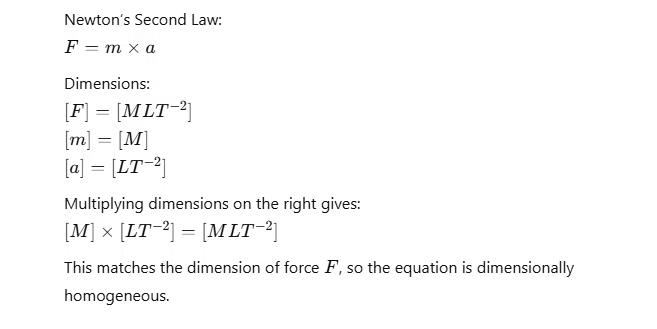
Any physically meaningful equation must be dimensionally homogeneous, meaning all terms in the equation have the same dimensional formula.
Example:
Methods of Dimension Analysis
1. Rayleigh’s Method
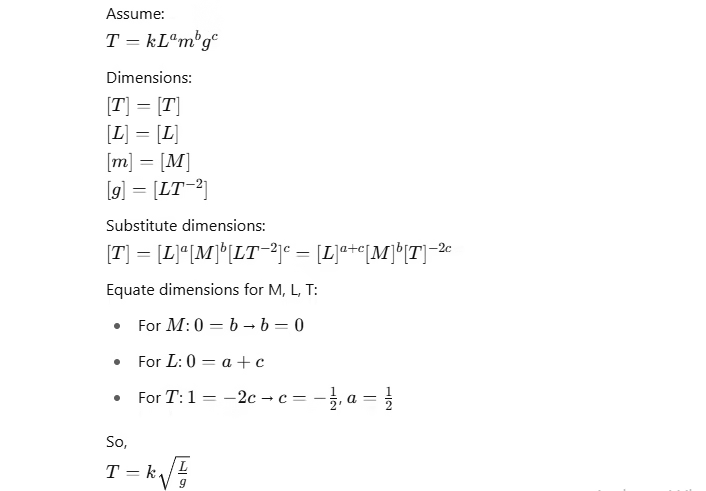
- Used to find the relationship between physical quantities when the exact relation is unknown.
- Assumes that the quantity depends on variables raised to unknown powers.
- Forms equations based on dimensional homogeneity and solves for powers.
Example:
Find the period T of a simple pendulum, assuming it depends on length L, mass M, and acceleration due to gravity g.
2. Buckingham π Theorem
- Reduces number of variables in a problem by forming dimensionless groups (ππ groups).
- For a problem with nn variables and kk fundamental dimensions, number of dimensionless groups = n−kn – k.
- Used in hydraulic model studies and fluid flow problems.
Steps to Apply Buckingham π Theorem:
- List all the variables involved in the problem.
- Determine the number of fundamental dimensions (M, L, T, etc.).
- Calculate the number of π terms using π=n−kπ = n – k.
- Select repeating variables that include all dimensions.
- Form π groups using these variables and the remaining ones.
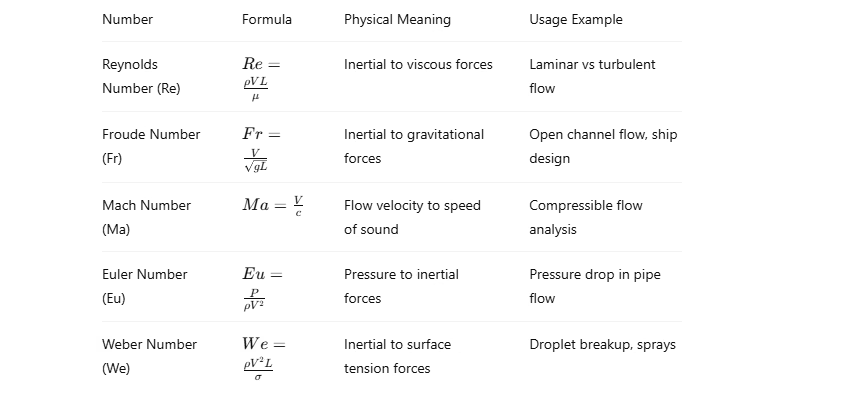
Important Dimensionless Numbers
Applications in Civil Engineering
- Hydraulic Model Testing
Dimension analysis helps relate model and prototype parameters using dimensionless numbers to ensure flow similarity. - Pump and Turbine Design
Scaling laws derived from dimensionless numbers predict performance from model tests. - Open Channel Flow
Froude number helps classify flows (subcritical, critical, supercritical) in irrigation, canals, rivers. - Pipe and Sewer Design
Reynolds number helps decide whether flow is laminar or turbulent. - Environmental Engineering
Used to model pollutant dispersion in rivers and atmosphere using similarity criteria. - Structural Engineering
Applies dimensional analysis in dynamic analysis of structures under fluid-induced loads (e.g., wind or water waves).
Step-by-Step Example
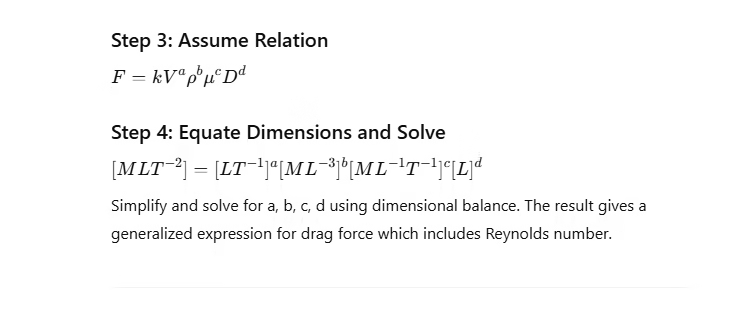
Find relation for Drag Force (F) on a sphere in a viscous fluid
Step 1: List Variables
- F, V, ρ, μ, D
Step 2: Dimensions
| Quantity | Symbol | Dimensions |
|---|---|---|
| Drag Force | FF | [MLT⁻²] |
| Velocity | VV | [LT⁻¹] |
| Density | ρ\rho | [ML⁻³] |
| Viscosity | μ\mu | [ML⁻¹T⁻¹] |
| Diameter | DD | [L] |
Summary for JKSSB Aspirants
- Master fundamental and derived dimensions.
- Use dimensional homogeneity to verify equations.
- Memorize and understand dimensionless numbers.
- Practice Rayleigh and Buckingham methods.
- Use dimension analysis to simplify complex fluid mechanics problems.
- Frequently appears in JKSSB, SSC JE, and RRB NTPC exams.
🧾 Conclusion: Mastering Dimension Analysis for Fluid Mechanics and JKSSB Exams
Dimension Analysis is not just a theoretical concept—it’s a powerful practical tool in the hands of civil engineers. By breaking down physical quantities into their fundamental dimensions and ensuring dimensional homogeneity, engineers can validate equations, derive relationships between variables, and create dimensionless parameters that simplify real-world problems. This becomes especially valuable in fluid mechanics, where experimentation is costly and complex.
The Rayleigh Method helps derive functional relationships using dimensional logic when empirical data is not available, while the Buckingham π Theorem reduces complex multi-variable problems into manageable dimensionless groups. Dimensionless numbers like Reynolds Number, Froude Number, and Weber Number are essential in predicting and analyzing fluid behavior in various engineering applications—from pipe flows and open channels to model testing of hydraulic structures.
For JKSSB, SSC JE, and RRB JE aspirants, mastering Dimension Analysis offers several benefits:
- It helps you solve numerical problems with logic and less memorization.
- It prepares you for real-world engineering decision-making.
- It enhances your understanding of scaling, modeling, and fluid behavior in civil systems.
In short, Dimension Analysis is the language through which fluid mechanics becomes universal and scalable, allowing civil engineers to innovate, simplify, and optimize complex systems with confidence.
📌 Join our Telegram Channel JKSSB CivilsCentral for regular updates, quizzes, PDF notes, and practice sets curated specifically for JKSSB aspirants.
About The Author