
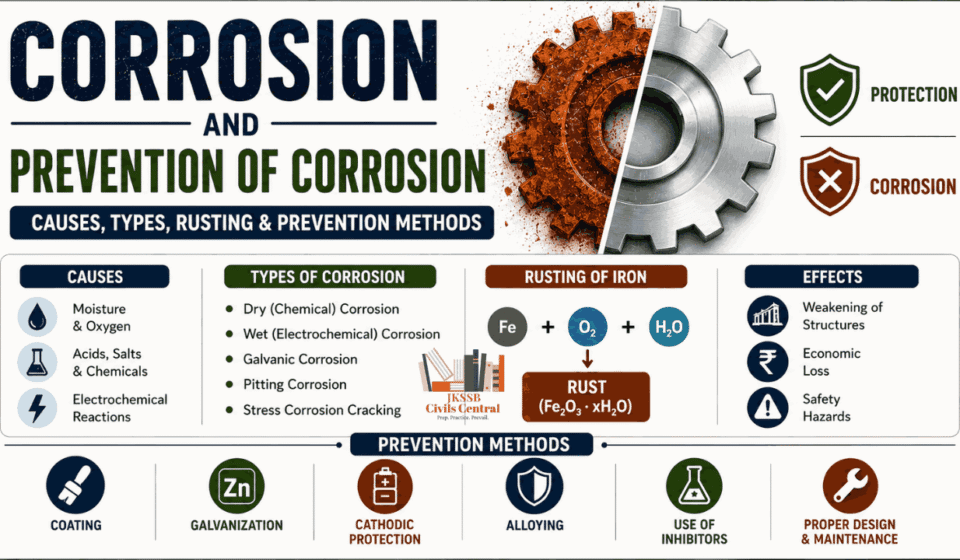
Corrosion and Prevention of Corrosion | Causes, Types, Rusting & Prevention Methods

Understand the process of corrosion, causes of rusting, factors affecting corrosion, methods of prevention, galvanization, alloying, electroplating, cathodic protection, and the economic impact of corrosion for JKSSB, JKPSC, SSC, UPSC & State PSC examinations.
Learning Dashboard
| Chapter Information | Details |
|---|---|
| Subject | General Science – Chemistry |
| Series | Metals and Non-Metals |
| Lesson Number | Lesson 6 |
| Previous Lesson | Reactivity Series of Metals & Displacement Reactions | Reactivity, Metal Displacement & Redox Explained |
| Current Lesson | Corrosion and Prevention of Corrosion | Causes, Types, Rusting & Prevention Methods |
| Next Lesson | Alloys and Their Uses | Types, Composition, Properties & Applications |
| Core Theme | Corrosion is the gradual deterioration of metals due to chemical reactions with the environment. Various methods are used to prevent corrosion and increase the life of metallic objects. |
| Major Topics Covered | Corrosion, Rusting, Conditions Required for Rusting, Factors Affecting Corrosion, Prevention of Corrosion, Galvanization, Painting, Electroplating, Alloying, Cathodic Protection, Economic Impact |
| Important Metals Studied | Iron, Zinc, Aluminium, Copper, Silver, Gold, Stainless Steel |
| Key Concepts | Corrosion, Rust, Hydrated Iron(III) Oxide, Oxidation, Moisture, Oxygen, Galvanization, Electroplating, Sacrificial Protection |
| Real-Life Applications | Bridges, Buildings, Vehicles, Pipelines, Ships, Household Appliances, Industrial Machinery |
| Exam Focus | Frequently Asked in JKSSB FAA, JKPSC, JKAS, SSC, CDS, UPSC & State PSC Examinations |
Chapter Overview
In the previous lesson, we studied the Reactivity Series of Metals and learned that different metals possess different levels of chemical reactivity. We also understood that highly reactive metals lose electrons more readily than less reactive metals and therefore participate more easily in chemical reactions. This concept helps explain not only displacement reactions and metal extraction but also another important phenomenon observed in everyday life—corrosion.
Have you ever noticed an old iron gate turning reddish-brown, a bicycle chain becoming rusty after the rainy season, or a steel bridge requiring regular maintenance? These are all examples of corrosion, a natural process in which metals gradually deteriorate due to their reaction with substances present in the environment, such as oxygen, moisture, acids, and salts.
Among all forms of corrosion, rusting of iron is the most common and widely studied example. Rusting weakens iron objects, reduces their strength, spoils their appearance, and causes enormous economic losses every year. However, iron is not the only metal affected by corrosion. Metals such as copper, silver, and aluminium also undergo corrosion, although the products formed are different. For example, copper develops a green patina, while silver gradually becomes black due to tarnishing.
Fortunately, corrosion can be controlled and prevented. Scientists and engineers have developed several methods to protect metals from environmental attack. These include painting, oiling, greasing, galvanization, electroplating, alloying, and cathodic protection. Choosing the appropriate method depends on the type of metal, its intended use, and the environmental conditions to which it is exposed.
Throughout this lesson, we will study the concept of corrosion, understand how rusting occurs, examine the conditions and factors responsible for corrosion, explore different methods used to prevent it, and discuss its practical and economic importance. We will also learn why corrosion is considered one of the most significant challenges in engineering, construction, transportation, and manufacturing.
Since questions related to rusting, galvanization, corrosion prevention, and alloying are frequently asked in JKSSB FAA, JKPSC, JKAS, SSC, CDS, UPSC, and other State PSC examinations, mastering this lesson will not only strengthen your understanding of chemistry but also help you answer a wide variety of examination questions with confidence.
What is Corrosion?
Corrosion is one of the most common chemical processes observed in everyday life. It is responsible for the gradual deterioration of metallic objects such as iron gates, bridges, pipelines, vehicles, ships, and household appliances. Although metals are generally strong and durable, continuous exposure to the environment causes many of them to undergo slow chemical changes that weaken their structure over time.
Corrosion is essentially a natural process through which metals tend to return to the stable compounds from which they were originally extracted. Most metals are obtained from ores by supplying a large amount of energy during extraction. When these metals are exposed to air, moisture, and other environmental substances, they slowly react and revert to more stable forms such as oxides, hydroxides, sulphides, or carbonates.
Among all metals, iron is the most familiar example because it undergoes rusting, a type of corrosion that produces a reddish-brown coating called rust. However, corrosion is not limited to iron alone. Different metals undergo different types of corrosion depending on their chemical properties and the surrounding environment.
Definition of Corrosion
Corrosion is the slow deterioration of a metal due to its chemical or electrochemical reaction with substances present in the surrounding environment, such as oxygen, moisture, acids, salts, or pollutants.
During corrosion, the metal gradually loses its original properties, including its strength, lustre, and durability.
Why Does Corrosion Occur?
Corrosion occurs because most metals are chemically unstable in their pure metallic state. During metallurgy, metals are extracted from their ores by removing oxygen or other non-metals. This requires a large amount of energy. Once exposed to the environment, these metals naturally tend to regain their stable state by reacting with substances such as oxygen and water.
Thus, corrosion is essentially a reverse process of metal extraction.
For example:
- Iron is extracted from iron oxide.
- During rusting, iron gradually changes back into hydrated iron(III) oxide.
This explains why corrosion is a natural and spontaneous process.
Common Examples of Corrosion
Corrosion can be observed in many everyday situations.
Some common examples include:
- Iron develops a reddish-brown layer of rust.
- Copper develops a green coating (patina) after prolonged exposure to moist air.
- Silver develops a black coating (tarnish) due to the formation of silver sulphide.
- Aluminium develops a thin protective oxide layer that prevents further corrosion.
These examples show that corrosion affects different metals in different ways.
Characteristics of Corrosion
Corrosion generally possesses the following characteristics:
- It is a slow process.
- It occurs naturally.
- It requires interaction between the metal and its environment.
- It gradually weakens the metal.
- It causes loss of metallic lustre.
- It reduces the useful life of metallic objects.
- It results in significant economic losses.
Corrosion is an Oxidation Process
Chemically, corrosion is an oxidation reaction. During corrosion, metal atoms lose electrons and are converted into positive metal ions.
For example, during rusting: Fe → Fe²⁺ + 2e⁻
The released electrons are accepted by oxygen in the presence of water, resulting in the formation of rust through a series of reactions. Thus, corrosion is closely associated with oxidation, which is why rusting is often described as the oxidation of iron.
Metals Commonly Affected by Corrosion
Different metals undergo corrosion in different forms.
| Metal | Type of Corrosion | Product Formed |
|---|---|---|
| Iron | Rusting | Hydrated Iron(III) Oxide (Rust) |
| Copper | Patination | Basic Copper Carbonate (Green Patina) |
| Silver | Tarnishing | Silver Sulphide (Black Coating) |
| Aluminium | Oxidation | Protective Aluminium Oxide Layer |
Unlike iron, aluminium forms a thin oxide layer that protects it from further corrosion, making it naturally corrosion-resistant.
Importance of Studying Corrosion
Understanding corrosion is important because it helps us:
- Protect metallic structures from damage.
- Increase the lifespan of machines and buildings.
- Reduce maintenance and replacement costs.
- Improve industrial safety.
- Develop better methods of corrosion prevention.
Engineers and scientists continuously study corrosion to design stronger materials and more effective protective coatings.
Exam Tip
Remember these important facts:
- Corrosion is the gradual deterioration of metals due to chemical reactions with the environment.
- Rusting is the corrosion of iron.
- Corrosion is mainly an oxidation process.
- Most metals tend to return to their stable compound forms.
- Different metals undergo different types of corrosion.
- Aluminium forms a protective oxide layer, whereas iron forms porous rust, allowing corrosion to continue.
Understanding the concept of corrosion is the first step toward learning why rusting occurs, the conditions necessary for rust formation, and the various methods used to prevent corrosion, which will be discussed in the following sections.
Rusting of Iron
Among all forms of corrosion, rusting of iron is the most common and economically significant. Since iron and steel are extensively used in the construction of buildings, bridges, vehicles, railway tracks, machinery, pipelines, and household appliances, understanding the process of rusting is essential for both scientific knowledge and practical applications.
Rusting is a specific type of corrosion that affects only iron and its alloys, such as steel. Unlike many other metals, iron forms a porous and flaky coating during corrosion. This coating does not protect the underlying metal, allowing corrosion to continue until a large portion of the iron is damaged.
What is Rusting?
Rusting is the slow oxidation of iron in the presence of oxygen and moisture, resulting in the formation of a reddish-brown substance called rust. Rust is chemically known as hydrated iron(III) oxide.
Its approximate chemical formula is: Fe₂O₃·xH₂O, where x represents a variable amount of water present in the rust.
How Does Rusting Occur?
Rusting begins when an iron surface is exposed to moist air. In the presence of water, oxygen reacts with iron through a series of oxidation and reduction reactions. Initially, iron atoms lose electrons and form iron ions.
Fe → Fe²⁺ + 2e⁻
The released electrons are accepted by oxygen dissolved in water. These reactions ultimately produce hydrated iron(III) oxide, which appears as a reddish-brown coating on the surface of the iron.
Unlike the protective oxide layer formed on aluminium, rust is porous and loosely attached. Therefore, air and moisture continue to reach the underlying metal, causing rusting to proceed further.
Chemical Equation of Rusting
The overall reaction can be represented as: 4Fe + 3O₂ + xH₂O → 2Fe₂O₃·xH₂O
This equation shows that iron, oxygen, and water are all essential for the formation of rust.
Appearance of Rust
Rust has several characteristic features.
- It is reddish-brown in colour.
- It is soft and flaky.
- It is porous.
- It does not adhere firmly to the metal surface.
- It allows corrosion to continue beneath the rust layer.
Because rust is porous, it cannot protect iron from further attack by oxygen and moisture.
Why is Rust Harmful?
Rusting gradually destroys the strength and usefulness of iron objects.
As rust spreads:
- The thickness of the metal decreases.
- Mechanical strength is reduced.
- Cracks and holes may develop.
- The object becomes weak and unsafe.
- The appearance of the metal deteriorates.
In severe cases, rusting may lead to the complete failure of structures such as bridges, pipelines, storage tanks, and machinery.
Everyday Examples of Rusting
Rusting can be observed in many common situations.
Examples include:
- Iron gates exposed to rain.
- Bicycle chains left uncovered.
- Railway tracks exposed to moisture.
- Iron nails kept in damp places.
- Water pipes made of iron.
- Agricultural tools stored in humid conditions.
- Steel bridges exposed to coastal environments.
These examples demonstrate that rusting is a common environmental problem affecting both household objects and large engineering structures.
Difference Between Rust and Iron
Students often confuse iron with rust. The two are completely different substances.
| Iron | Rust |
|---|---|
| Pure metallic element | Hydrated iron(III) oxide |
| Grey, shiny surface | Reddish-brown coating |
| Strong and hard | Soft and flaky |
| Good conductor of heat and electricity | Poor conductor |
| Useful construction material | Product of corrosion |
Understanding this distinction is important because many examination questions ask students to identify the chemical nature of rust.
Importance of Studying Rusting
The study of rusting helps us:
- Understand the process of corrosion.
- Protect iron structures from damage.
- Improve the lifespan of machines and buildings.
- Reduce maintenance costs.
- Develop effective methods of corrosion prevention.
Because iron is one of the most widely used engineering materials, preventing rusting has enormous practical and economic importance.
Exam Tip
Remember these high-scoring facts:
- Rusting is the corrosion of iron.
- Rust is hydrated iron(III) oxide (Fe₂O₃·xH₂O).
- Rusting requires both oxygen and moisture.
- Rust is reddish-brown, porous, and flaky.
- Rust does not protect the underlying iron.
- Rusting is an oxidation process.
- Iron structures gradually weaken due to continuous rust formation.
Understanding the process of rusting prepares us to study the essential conditions required for rusting, where we will learn why iron does not rust in the absence of either oxygen or water and how simple experiments demonstrate these conditions.
Conditions Necessary for Rusting
One of the most important questions in the study of corrosion is: What conditions are required for iron to rust? Although iron objects are continuously exposed to the environment, rusting does not occur under all circumstances. Scientific experiments have shown that both oxygen and water (moisture) are essential for the rusting of iron. If either of these is absent, rusting does not take place.
Understanding these conditions not only explains why rust forms but also provides the scientific basis for the various methods used to prevent corrosion.
Essential Conditions for Rusting
Two conditions are absolutely necessary for the rusting of iron:
- Presence of oxygen (air)
- Presence of water or moisture
When both oxygen and moisture are available simultaneously, iron gradually reacts to form hydrated iron(III) oxide (rust). If either oxygen or moisture is absent, rusting is prevented.
Condition 1: Presence of Oxygen
Oxygen is one of the reactants required for the formation of rust. During rusting, oxygen accepts electrons released by iron and participates in a series of oxidation-reduction reactions that ultimately produce hydrated iron(III) oxide.
If iron is kept in an environment completely free from oxygen, rusting does not occur, even if moisture is present. This demonstrates that oxygen is indispensable for the rusting process.
Condition 2: Presence of Water (Moisture)
Water is equally important for rusting. Moisture acts as a medium that allows the movement of ions and facilitates the electrochemical reactions occurring on the surface of iron. Dry air alone does not cause rusting because there is insufficient moisture for these reactions to proceed.
Similarly, iron immersed in pure, oxygen-free water also does not rust. Thus, water is another essential requirement for rust formation.
Why Both Oxygen and Water Are Necessary
Neither oxygen alone nor water alone is sufficient to produce rust. The rusting process begins only when oxygen and water are present together.
In moist air:
- Iron loses electrons.
- Oxygen gains these electrons.
- Water facilitates the movement of ions.
- Hydrated iron(III) oxide is gradually formed.
Therefore, rusting is an electrochemical process that requires the combined action of oxygen and moisture.
Experimental Demonstration
The necessity of oxygen and water for rusting can be demonstrated using three simple test tubes.
Test Tube A – Iron Nail in Dry Air
An iron nail is placed in a test tube containing dry air. Calcium chloride or another drying agent is used to absorb all moisture.
Observation
No rust is formed.
Reason
Oxygen is present, but water is absent.
Test Tube B – Iron Nail in Boiled Water
An iron nail is immersed in boiled water, and a thin layer of oil is poured over the surface.
Boiling removes dissolved oxygen, while the oil prevents oxygen from re-entering the water.
Observation
No rust is formed.
Reason
Water is present, but oxygen is absent.
Test Tube C – Iron Nail in Ordinary Water
An iron nail is placed in ordinary water exposed to air.
Observation
A reddish-brown layer of rust gradually appears on the nail.
Reason
Both oxygen and water are present.
Therefore, rusting occurs.
Summary of the Experiment
| Test Tube | Conditions | Rust Formation |
|---|---|---|
| A | Oxygen present, Water absent | No Rust |
| B | Water present, Oxygen absent | No Rust |
| C | Oxygen present, Water present | Rust Forms |
This experiment conclusively proves that both oxygen and moisture are essential for rusting.
Importance of Knowing These Conditions
Understanding the conditions necessary for rusting helps explain why corrosion occurs more rapidly in certain environments.
For example:
- Iron objects exposed to rain rust quickly because both oxygen and moisture are present.
- Iron stored in dry rooms rusts much more slowly due to the lack of moisture.
- Metals coated with paint or oil are protected because these coatings prevent oxygen and water from reaching the metal surface.
Thus, all methods of corrosion prevention are based on eliminating one or both of the conditions required for rusting.
Exam Tip
Remember these high-yield facts:
- Rusting requires both oxygen and water.
- Oxygen alone cannot produce rust.
- Water alone cannot produce rust.
- Dry air does not cause rusting.
- Boiled water covered with oil does not cause rusting because oxygen is absent.
- Ordinary moist air causes rusting because both oxygen and water are present.
- The classic three-test-tube experiment is frequently asked in JKSSB, JKPSC, SSC, UPSC, CDS, and other competitive examinations.
Understanding the essential conditions for rusting forms the basis for the next topic, Factors Affecting Corrosion, where we will study why some iron objects rust faster than others and how environmental conditions influence the rate of corrosion.
Factors Affecting Corrosion
Although oxygen and moisture are essential for corrosion, they are not the only factors that determine how rapidly a metal corrodes. In everyday life, some iron objects remain in good condition for many years, while others rust within a short period. This difference arises because the rate of corrosion depends upon several environmental and material-related factors.
Understanding these factors is important because it helps engineers design more durable structures and select suitable methods for corrosion prevention.
Presence of Moisture
Moisture is one of the most important factors affecting corrosion. When the amount of moisture in the air increases, the rate of corrosion also increases because water acts as a medium for electrochemical reactions. Consequently, iron objects rust much faster during the rainy season or in regions with high humidity than in dry climates.
Examples
- Iron tools left outdoors during the monsoon rust quickly.
- Iron furniture kept in damp basements corrodes faster than furniture stored in dry rooms.
Availability of Oxygen
Oxygen is another essential factor influencing corrosion. A continuous supply of oxygen allows oxidation reactions to proceed, leading to the gradual formation of corrosion products. Environments where both oxygen and moisture are continuously available favour rapid corrosion.
Presence of Salts
Salt greatly accelerates the process of corrosion. Salt dissolved in water increases the electrical conductivity of the solution, allowing electrochemical reactions to occur more rapidly. For this reason, metals exposed to seawater corrode much faster than those exposed to freshwater.
Examples
- Ships require regular anti-corrosion treatment.
- Coastal bridges rust more rapidly than inland bridges.
- Vehicles driven near coastal regions often experience faster corrosion.
Presence of Acids and Pollutants
Acidic substances present in the atmosphere also increase the rate of corrosion.
Industrial gases such as:
- Sulphur dioxide (SO₂)
- Nitrogen oxides (NOₓ)
- Carbon dioxide (CO₂)
can dissolve in rainwater to form weak acids. These acidic solutions attack metal surfaces more aggressively than pure water. As a result, industrial areas often experience faster corrosion than rural regions.
Nature of the Metal
Different metals possess different corrosion resistance because of their chemical properties. Highly reactive metals corrode readily unless protected. Some metals, however, develop protective oxide layers that prevent further corrosion.
Examples
- Aluminium forms a thin aluminium oxide layer that protects the underlying metal.
- Iron forms porous rust that allows corrosion to continue.
- Gold and platinum are highly resistant to corrosion because they are very unreactive.
Thus, the intrinsic properties of the metal play an important role in determining its corrosion behaviour.
Surface Condition of the Metal
The condition of the metal surface also affects corrosion. Scratches, cracks, rough surfaces, and damaged protective coatings expose fresh metal to oxygen and moisture, increasing the rate of corrosion. In contrast, smooth and well-coated surfaces remain protected for longer periods.
Regular maintenance therefore helps reduce corrosion.
Temperature
Temperature influences the speed of chemical reactions, including corrosion. In general, an increase in temperature increases the rate of corrosion because chemical reactions proceed more rapidly.
However, the exact effect depends on the type of metal and the surrounding environment.
Impurities Present in the Metal
Pure metals generally corrode more slowly than impure metals. The presence of impurities creates tiny electrochemical cells within the metal, accelerating corrosion.
For this reason, high-purity metals often exhibit better corrosion resistance than impure metals.
Comparison of Factors Affecting Corrosion
| Factor | Effect on Corrosion |
|---|---|
| Moisture | Increases corrosion |
| Oxygen | Essential for corrosion |
| Salts | Accelerate corrosion significantly |
| Acids and pollutants | Increase corrosion rate |
| High temperature | Generally increases corrosion |
| Rough or damaged surface | Promotes corrosion |
| Impurities | Increase corrosion |
| Protective oxide layer | Reduces corrosion |
Importance of Understanding These Factors
Knowledge of the factors affecting corrosion helps in:
- Designing corrosion-resistant structures.
- Selecting suitable construction materials.
- Developing effective protective coatings.
- Reducing maintenance costs.
- Improving the lifespan of industrial equipment.
- Ensuring the safety of bridges, pipelines, ships, and buildings.
Engineers use this knowledge to choose the most appropriate corrosion-prevention techniques for different environmental conditions.
Exam Tip
Remember these important examination facts:
- Moisture and oxygen are essential for corrosion.
- Salt water accelerates corrosion much faster than fresh water.
- Acid rain increases the rate of corrosion.
- Coastal areas experience faster corrosion due to dissolved salts.
- Iron forms porous rust, whereas aluminium forms a protective oxide layer.
- Scratches and damaged coatings increase corrosion.
- Higher humidity generally leads to faster rusting.
A clear understanding of these factors explains why corrosion occurs at different rates under different environmental conditions. It also provides the scientific basis for the next topic—Methods of Prevention of Corrosion, where we will study how painting, oiling, greasing, galvanization, electroplating, alloying, and cathodic protection are used to protect metals from deterioration.
Methods of Prevention of Corrosion
Corrosion causes enormous losses every year by damaging buildings, bridges, vehicles, ships, pipelines, machinery, and household appliances. Since corrosion weakens metals and shortens their useful life, scientists and engineers have developed several methods to protect metals from environmental attack.
The basic principle behind every method of corrosion prevention is to prevent the metal from coming into contact with oxygen, moisture, or other corrosive substances, or to make the metal itself more resistant to corrosion.
The most commonly used methods are painting, oiling and greasing, galvanization, electroplating, alloying, and cathodic protection.
Painting
Painting is one of the simplest and most widely used methods of preventing corrosion. A layer of paint forms a protective barrier over the metal surface, preventing oxygen and moisture from coming into direct contact with the metal. As long as the paint remains intact, corrosion does not occur.
However, if the painted surface develops cracks or scratches, oxygen and water can reach the exposed metal, and corrosion begins at those points.
Applications
Painting is commonly used for:
- Iron gates
- Steel bridges
- Railway coaches
- Electric poles
- Household furniture
- Machinery
Advantages
- Simple and inexpensive.
- Provides an attractive appearance.
- Easy to apply and maintain.
Oiling and Greasing
Moving metal parts are often protected by applying oil or grease. Oil and grease form a thin protective film over the metal surface that prevents contact with air and moisture. They also reduce friction between moving parts, thereby increasing the efficiency and lifespan of machines.
Since oil and grease can be easily removed during use, they require regular reapplication.
Applications
Oiling and greasing are commonly used for:
- Bicycle chains
- Machine parts
- Door hinges
- Engine components
- Agricultural tools
Advantages
- Prevents corrosion.
- Reduces wear and tear.
- Improves lubrication.
- Easy to apply.
Galvanization
Galvanization is one of the most effective methods of protecting iron and steel from corrosion. In this process, the iron or steel surface is coated with a thin layer of zinc.
Even if the zinc coating is scratched, zinc continues to protect the underlying iron because zinc is more reactive than iron. It corrodes preferentially and acts as a sacrificial metal, preventing iron from rusting.
This makes galvanization much more effective than ordinary painting.
Applications
Galvanization is widely used for:
- Water pipes
- Roofing sheets
- Iron buckets
- Barbed wire
- Electric transmission towers
- Steel fences
Advantages
- Provides long-lasting protection.
- Zinc protects even when the coating is slightly damaged.
- Increases the service life of iron and steel.
Electroplating
Electroplating involves depositing a thin layer of one metal over another using an electric current. The coating metal protects the underlying metal from corrosion while also improving its appearance.
Common coating metals include:
- Chromium
- Nickel
- Silver
- Gold
Applications
Electroplating is used for:
- Bathroom fittings
- Automobile parts
- Jewellery
- Kitchen utensils
- Bicycle components
Advantages
- Prevents corrosion.
- Improves appearance.
- Increases wear resistance.
- Enhances durability.
Alloying
Another effective method of preventing corrosion is the preparation of alloys. An alloy is a homogeneous mixture of two or more elements, at least one of which is a metal. Many alloys possess better corrosion resistance than pure metals.
For example, stainless steel contains iron along with chromium and nickel. Chromium forms a thin protective oxide layer that prevents further corrosion.
Applications
Corrosion-resistant alloys are widely used in:
- Surgical instruments
- Kitchen utensils
- Chemical industries
- Aircraft
- Buildings
- Food processing equipment
Advantages
- Excellent corrosion resistance.
- High strength.
- Long service life.
- Low maintenance.
Cathodic Protection
Cathodic protection is an advanced method used mainly for protecting large metallic structures. In this method, the iron structure is connected to a more reactive metal, such as magnesium or zinc. The more reactive metal corrodes instead of iron and is therefore called the sacrificial anode.
As long as the sacrificial metal remains available, the iron structure remains protected.
Applications
Cathodic protection is used for:
- Underground pipelines
- Oil and gas pipelines
- Water storage tanks
- Ship hulls
- Offshore drilling platforms
Advantages
- Highly effective.
- Suitable for large structures.
- Provides long-term protection.
- Reduces maintenance costs.
Comparison of Methods of Corrosion Prevention
| Method | Principle | Common Applications |
|---|---|---|
| Painting | Prevents contact with air and moisture | Bridges, gates, furniture |
| Oiling & Greasing | Forms a protective film | Machine parts, bicycle chains |
| Galvanization | Zinc coating protects iron | Pipes, roofing sheets, fences |
| Electroplating | Coating with another metal | Jewellery, automobile parts |
| Alloying | Produces corrosion-resistant alloys | Stainless steel utensils, surgical instruments |
| Cathodic Protection | Uses a sacrificial metal | Pipelines, ships, storage tanks |
Importance of Corrosion Prevention
Preventing corrosion is essential because it:
- Increases the lifespan of metallic objects.
- Reduces repair and replacement costs.
- Improves safety in buildings and transportation.
- Conserves valuable natural resources.
- Minimizes industrial losses.
- Ensures the reliable functioning of machinery and infrastructure.
Today, corrosion prevention is considered one of the most important aspects of engineering, construction, transportation, and manufacturing.
Exam Tip
Remember these high-scoring facts:
- Painting prevents oxygen and moisture from reaching the metal.
- Oiling and greasing are used for moving machine parts.
- Galvanization is the coating of iron with zinc.
- Zinc acts as a sacrificial metal because it is more reactive than iron.
- Electroplating deposits a thin layer of another metal using electricity.
- Stainless steel is a corrosion-resistant alloy containing chromium.
- Cathodic protection uses magnesium or zinc as sacrificial anodes to protect iron structures.
These methods form the foundation of modern corrosion control and are extensively applied in industries, transportation, construction, and everyday life. Understanding their principles and applications is essential for JKSSB, JKPSC, SSC, UPSC, CDS, and other competitive examinations, where questions on galvanization, electroplating, alloying, and cathodic protection are frequently asked.
Economic and Environmental Impact of Corrosion
Corrosion is not merely a chemical process; it is also a major economic, industrial, environmental, and safety concern. Every year, governments, industries, and individuals spend enormous amounts of money repairing or replacing corroded metal structures. In addition to financial losses, corrosion can weaken important infrastructure, cause accidents, interrupt industrial production, and pollute the environment.
Understanding the impact of corrosion highlights why effective corrosion prevention is essential in modern engineering and everyday life.
Economic Losses Due to Corrosion
Corrosion causes huge financial losses because damaged metal structures require frequent maintenance, repair, or complete replacement. Bridges, railway tracks, pipelines, ships, vehicles, machinery, and industrial equipment must be regularly inspected and protected against corrosion. If corrosion is ignored, repair costs increase significantly, and valuable resources are wasted. Many countries spend billions of rupees every year on corrosion control and maintenance.
Reduction in the Life of Metal Structures
Continuous corrosion gradually reduces the strength and durability of metallic objects.
As corrosion progresses:
- Metal becomes thinner.
- Mechanical strength decreases.
- Cracks and holes may develop.
- Structures become unsafe for use.
Without proper protection, even well-designed engineering structures may fail long before their expected service life.
Safety Hazards
One of the most serious consequences of corrosion is the danger it poses to human life. Corroded structures may suddenly fail, leading to accidents and property damage.
Examples include:
- Collapse of bridges.
- Leakage of gas pipelines.
- Failure of water storage tanks.
- Breakage of industrial machinery.
- Damage to railway tracks.
- Weakening of building structures.
Regular inspection and corrosion prevention are therefore essential for public safety.
Industrial Losses
Industries depend heavily on metallic equipment for manufacturing and transportation. Corrosion of machinery and equipment results in:
- Production delays.
- Frequent shutdowns.
- Increased maintenance costs.
- Reduced efficiency.
- Loss of industrial productivity.
Many industries therefore invest heavily in protective coatings, galvanization, cathodic protection, and corrosion-resistant alloys.
Environmental Impact
Corrosion can also affect the environment. Leakage from corroded pipelines or storage tanks may release harmful substances into the surrounding environment. Examples include:
- Oil spills from corroded pipelines.
- Leakage of industrial chemicals.
- Contamination of groundwater.
- Pollution of rivers and lakes.
- Soil contamination near industrial sites.
Preventing corrosion therefore contributes to environmental protection as well as industrial safety.
Waste of Natural Resources
The extraction of metals requires:
- Mining.
- Energy.
- Water.
- Labour.
- Transportation.
When metals are lost due to corrosion, valuable natural resources are wasted. Preventing corrosion reduces the demand for new metal extraction and helps conserve mineral resources for future generations.
Increased Energy Consumption
Producing new metals requires a large amount of energy. If corroded metals must be replaced frequently, additional energy is consumed for:
- Mining ores.
- Extracting metals.
- Manufacturing new products.
- Transportation.
By increasing the lifespan of metal structures, corrosion prevention also contributes to energy conservation.
Importance of Recycling
Corroded metal objects are often recycled to recover useful metals. Recycling offers several advantages:
- Conserves natural resources.
- Reduces mining activities.
- Saves energy.
- Decreases environmental pollution.
- Lowers manufacturing costs.
Thus, recycling and corrosion prevention together promote sustainable development.
Real-Life Examples
The effects of corrosion can be observed in many sectors.
- Steel bridges require regular painting and maintenance.
- Ships undergo periodic anti-corrosion treatment.
- Underground pipelines are protected using cathodic protection.
- Automobiles receive protective coatings to prevent rusting.
- Railway tracks are regularly inspected for corrosion damage.
- Industrial plants use corrosion-resistant alloys in chemical processing equipment.
These examples illustrate how corrosion prevention is an essential part of modern engineering.
Summary Table
| Impact | Effect |
|---|---|
| Economic | High repair and replacement costs |
| Structural | Weakening of buildings, bridges, and machinery |
| Safety | Risk of accidents and structural failure |
| Industrial | Reduced efficiency and production losses |
| Environmental | Pollution due to leakage of harmful substances |
| Natural Resources | Increased consumption of metals and minerals |
| Energy | Greater energy required for metal production |
| Sustainability | Recycling helps conserve resources and reduce waste |
Exam Tip
Remember these important examination facts:
- Corrosion causes enormous economic losses every year.
- It reduces the strength and lifespan of metal structures.
- Corroded bridges, pipelines, and machinery can create serious safety hazards.
- Leakage from corroded pipelines can pollute soil and water.
- Preventing corrosion conserves natural resources and saves energy.
- Recycling corroded metals reduces mining and promotes sustainable development.
Understanding the economic and environmental consequences of corrosion explains why governments and industries invest heavily in corrosion prevention technologies. It also emphasizes that preventing corrosion is not only a scientific necessity but also an economic, environmental, and social responsibility.
JKSSB CivilsCentral Insight
Corrosion is a natural but undesirable process in which metals gradually deteriorate due to their reaction with the surrounding environment. Although corrosion cannot be completely eliminated, it can be significantly reduced by understanding the conditions that cause it and by adopting suitable preventive measures. The most familiar example of corrosion is the rusting of iron. Rusting occurs only when both oxygen and moisture are present. Neither oxygen alone nor water alone can produce rust. This principle is demonstrated by the classic three-test-tube experiment, which is one of the most frequently asked concepts in competitive examinations.
Students should also remember that rust is chemically different from iron. Iron is a strong metallic element, whereas rust is hydrated iron(III) oxide (Fe₂O₃·xH₂O), a soft, reddish-brown, porous substance. Since rust is porous, it does not protect the underlying iron. Instead, it allows oxygen and moisture to penetrate deeper, causing corrosion to continue. Corrosion is influenced by several environmental factors. High humidity, the presence of dissolved salts, acidic pollutants, higher temperatures, and damaged protective coatings all accelerate the process. This explains why coastal regions, industrial areas, and humid climates experience much faster corrosion than dry inland regions.
One of the most important aspects of this lesson is the study of methods of corrosion prevention. Although these methods differ in technique, their objective remains the same—to prevent the metal from coming into contact with oxygen and moisture or to protect it using a more reactive metal.
Among these methods, galvanization is especially important from an examination perspective. In galvanization, iron is coated with zinc, which acts as a sacrificial metal. Even if the coating is scratched, zinc corrodes in preference to iron because it is more reactive. This provides better protection than ordinary painting.
Students should also distinguish between the commonly used protection methods:
- Painting creates a physical barrier between the metal and the environment.
- Oiling and greasing protect moving machine parts while also reducing friction.
- Electroplating deposits a thin layer of another metal to improve both appearance and corrosion resistance.
- Alloying increases corrosion resistance by combining metals with suitable elements, as in stainless steel.
- Cathodic protection safeguards large structures by attaching a more reactive sacrificial metal such as zinc or magnesium.
Corrosion has enormous practical significance because it causes economic losses, structural damage, industrial downtime, environmental pollution, and safety hazards. Preventing corrosion therefore not only increases the lifespan of metallic structures but also conserves natural resources, reduces energy consumption, and supports sustainable development.
High-Yield Facts for Competitive Examinations
Remember the following examination-oriented points:
- Corrosion is the gradual deterioration of metals due to chemical or electrochemical reactions with the environment.
- Rusting is the corrosion of iron.
- Rust = Hydrated Iron(III) Oxide (Fe₂O₃·xH₂O).
- Both oxygen and moisture are essential for rusting.
- Dry air does not cause rusting.
- Boiled water covered with oil does not cause rusting because oxygen is absent.
- Rust is porous and does not protect iron.
- Aluminium forms a protective oxide layer that prevents further corrosion.
- High humidity, salts, acids, and pollutants accelerate corrosion.
- Painting prevents corrosion by blocking air and moisture.
- Oiling and greasing are used for moving machine parts.
- Galvanization is the coating of iron with zinc.
- Zinc acts as a sacrificial metal and protects iron even if the coating is scratched.
- Electroplating deposits a protective metal layer using electricity.
- Stainless steel is a corrosion-resistant alloy containing chromium.
- Cathodic protection uses zinc or magnesium as sacrificial anodes.
- Corrosion leads to economic losses, structural failure, environmental pollution, and increased maintenance costs.
- Recycling corroded metals conserves natural resources and saves energy.
Rather than memorizing individual facts, remember the central principle: corrosion occurs when metals react with their surroundings, and every prevention method either isolates the metal from the environment or provides a more reactive material to protect it. This concept links chemistry with engineering, environmental science, and industrial applications, making it one of the most important topics for JKSSB, JKPSC, SSC, UPSC, CDS, and other competitive examinations.
Quick Revision
Before completing this lesson, revise the following key concepts. These points summarize the entire chapter and are useful for quick revision before JKSSB, JKPSC, SSC, UPSC, CDS, and other competitive examinations.
- Corrosion is the gradual deterioration of metals due to chemical or electrochemical reactions with the environment.
- Rusting is the corrosion of iron.
- Rust is chemically known as hydrated iron(III) oxide.Formula: Fe₂O₃·xH₂O
- Corrosion is an oxidation process in which metals lose electrons and gradually convert into more stable compounds.
- Rusting requires both oxygen and moisture.
- Oxygen alone cannot cause rusting.
- Water alone cannot cause rusting.
- The overall reaction of rusting is:4Fe + 3O₂ + xH₂O → 2Fe₂O₃·xH₂O
- Rust is reddish-brown, porous, soft, and flaky.
- Rust does not protect the underlying iron because it is porous.
- Aluminium forms a thin protective oxide layer, which prevents further corrosion.
- The classic three-test-tube experiment proves that both oxygen and water are essential for rusting.
- Corrosion occurs more rapidly in the presence of:
- Moisture
- Oxygen
- Dissolved salts
- Acids
- Industrial pollutants
- High humidity
- High temperature
- Corrosion can be prevented by:
- Painting
- Oiling and greasing
- Galvanization
- Electroplating
- Alloying
- Cathodic protection
- Galvanization is the coating of iron with zinc.
- Zinc protects iron because it is more reactive and acts as a sacrificial metal.
- Electroplating deposits a thin layer of another metal using electricity.
- Stainless steel is a corrosion-resistant alloy because chromium forms a protective oxide layer.
- Cathodic protection uses zinc or magnesium as sacrificial anodes to protect large iron structures.
- Corrosion leads to:
- Economic losses
- Structural damage
- Industrial losses
- Safety hazards
- Environmental pollution
- Waste of natural resources
- Recycling corroded metals conserves resources and reduces energy consumption.
Frequently Asked Questions (FAQs)
The following frequently asked questions address the most common doubts related to Corrosion and Prevention of Corrosion. These questions reinforce the important concepts discussed in this lesson and are highly relevant for JKSSB FAA, JKPSC, JKAS, SSC, CDS, UPSC, and other State PSC examinations.
1. What is corrosion?
Corrosion is the gradual deterioration of a metal due to its chemical or electrochemical reaction with the surrounding environment, such as oxygen, moisture, acids, or salts. It weakens the metal and reduces its useful life.
2. What is rusting?
Rusting is the corrosion of iron. It occurs when iron reacts with oxygen and moisture, producing a reddish-brown substance called rust.
3. What is the chemical formula of rust?
Rust is chemically known as hydrated iron(III) oxide. Its approximate formula is: Fe₂O₃·xH₂O
4. What conditions are necessary for rusting?
Two conditions are essential:
- Presence of oxygen
- Presence of water (moisture)
If either oxygen or moisture is absent, rusting does not occur.
5. Why does dry air not cause rusting?
Dry air contains oxygen but lacks moisture. Since water is essential for rust formation, iron does not rust in dry air.
6. Why does iron not rust in boiled water covered with oil?
Boiling removes dissolved oxygen from the water. The oil layer prevents oxygen from re-entering the water. Since oxygen is absent, rusting does not occur.
7. Why is rust harmful?
Rust is porous and flaky. Unlike the protective oxide layer formed on aluminium, rust does not adhere firmly to iron. It allows oxygen and moisture to reach the underlying metal, causing continuous corrosion and weakening the structure.
8. Why does aluminium resist corrosion better than iron?
Aluminium forms a thin, compact, and protective oxide layer on its surface. This oxide coating prevents further contact between the metal and the environment. Iron, however, forms porous rust that cannot stop further corrosion.
9. What factors increase the rate of corrosion?
Corrosion occurs more rapidly in the presence of:
- Moisture
- Oxygen
- Dissolved salts
- Acids
- Industrial pollutants
- High humidity
- High temperature
- Scratched or damaged metal surfaces
10. What is galvanization?
Galvanization is the process of coating iron or steel with a thin layer of zinc. The zinc coating protects iron from corrosion.
11. Why is zinc used in galvanization?
Zinc is more reactive than iron. It corrodes first and acts as a sacrificial metal, protecting the underlying iron even if the coating is scratched.
12. What is electroplating?
Electroplating is the process of depositing a thin layer of one metal over another using electric current. It improves both the appearance and corrosion resistance of the metal.
13. What is cathodic protection?
Cathodic protection is a method in which a metal structure is connected to a more reactive metal, such as zinc or magnesium. The more reactive metal corrodes instead of the protected structure and is therefore called a sacrificial anode.
14. Why is stainless steel resistant to corrosion?
Stainless steel contains chromium, which forms a thin protective oxide layer on the surface. This layer prevents oxygen and moisture from reaching the underlying metal, making stainless steel highly resistant to corrosion.
15. What are the effects of corrosion?
Corrosion causes:
- Weakening of metal structures.
- Economic losses.
- Frequent repairs and replacements.
- Industrial production losses.
- Environmental pollution due to leakage.
- Safety hazards such as bridge or pipeline failures.
- Waste of natural resources.
16. Why is corrosion prevention important?
Preventing corrosion:
- Increases the lifespan of metallic structures.
- Reduces maintenance costs.
- Improves public safety.
- Conserves metals and natural resources.
- Saves energy.
- Protects the environment.
- Improves industrial efficiency.
17. Which facts from this lesson are most important for competitive examinations?
Students should remember these high-yield facts:
- Corrosion = Gradual deterioration of metals.
- Rusting = Corrosion of iron.
- Rust = Fe₂O₃·xH₂O (Hydrated Iron(III) Oxide).
- Rusting requires both oxygen and moisture.
- Rust is porous and does not protect iron.
- Aluminium forms a protective oxide layer.
- Galvanization = Zinc coating on iron.
- Zinc acts as a sacrificial metal.
- Electroplating uses electric current to deposit a metal coating.
- Stainless steel resists corrosion because of chromium.
- Cathodic protection uses zinc or magnesium as sacrificial anodes.
- Corrosion causes economic losses, structural damage, and environmental pollution.
- Recycling corroded metals conserves resources and saves energy.
18. Why is corrosion considered an important topic in chemistry?
Corrosion is one of the most practical applications of chemistry because it connects oxidation reactions, metal reactivity, environmental science, engineering, metallurgy, and industrial technology. Understanding corrosion helps explain why metals deteriorate, how they can be protected, and why prevention methods such as galvanization, alloying, electroplating, and cathodic protection are essential in modern infrastructure and manufacturing.
For competitive examinations, corrosion is a high-scoring topic because questions are frequently asked on rusting, essential conditions for corrosion, galvanization, sacrificial protection, stainless steel, and corrosion-prevention methods. A clear understanding of these concepts enables students to solve both objective and descriptive questions with confidence.
Mind Maps
Mind Map 1: Corrosion
                  CORROSION
                      │
                      ▼
      Gradual Deterioration of Metals
                      │
      ┌───────────────┼───────────────┐
      │               │               │
      ▼               ▼               ▼

 Oxygen         Moisture        Environment

      │               │

      └───────┬───────┘
              │
              ▼

      Chemical Reaction

              │
              ▼

     Metal Weakens Gradually
Mind Map 2: Rusting of Iron
                 RUSTING OF IRON
                       │
                       ▼

          Iron + Oxygen + Moisture

                       │

                       ▼

         Hydrated Iron(III) Oxide

             Fe₂O₃·xH₂O

                       │

                       ▼

          Reddish-Brown Rust

                       │

       Soft • Porous • Flaky

                       │

      Corrosion Continues
Mind Map 3: Conditions for Rusting
            CONDITIONS FOR RUSTING
                    │
        ┌───────────┴───────────┐
        │                       │
        ▼                       ▼

     Oxygen                 Moisture

        │                       │
        └───────────┬───────────┘
                    │
                    ▼

              Rust Formation

──────────────────────────────────

Only Oxygen → No Rust

Only Water → No Rust

Oxygen + Water → Rust
Mind Map 4: Prevention of Corrosion
          PREVENTION OF CORROSION
                     │
 ┌─────────┬─────────┬─────────┬─────────┐
 │         │         │         │
 ▼         ▼         ▼         ▼

Painting  Oiling   Galvanization Electroplating

 │         │         │            │

Barrier  Barrier   Zinc Coat   Metal Coating

──────────────────────────────────────

         Alloying

             │

     Stainless Steel

──────────────────────────────────────

   Cathodic Protection

             │

   Zinc / Magnesium

 Sacrificial Metal
Mind Map 5: Complete Chapter Summary
        CORROSION & PREVENTION
                  │
                  ▼

Corrosion

↓

Gradual Deterioration

↓

Rusting of Iron

↓

Rust = Fe₂O₃·xH₂O

────────────────────────────

Needs

✓ Oxygen

✓ Moisture

────────────────────────────

Rust

✓ Reddish Brown

✓ Porous

✓ Flaky

────────────────────────────

Factors

✓ Moisture

✓ Salts

✓ Acids

✓ Humidity

✓ Temperature

────────────────────────────

Prevention

✓ Painting

✓ Oiling

✓ Galvanization

✓ Electroplating

✓ Alloying

✓ Cathodic Protection

────────────────────────────

Effects

✓ Economic Loss

✓ Structural Damage

✓ Pollution

✓ Safety Hazards
About The Author




[…] Corrosion and Prevention of Corrosion | Causes, Types, Rusting & Prevention Methods […]