
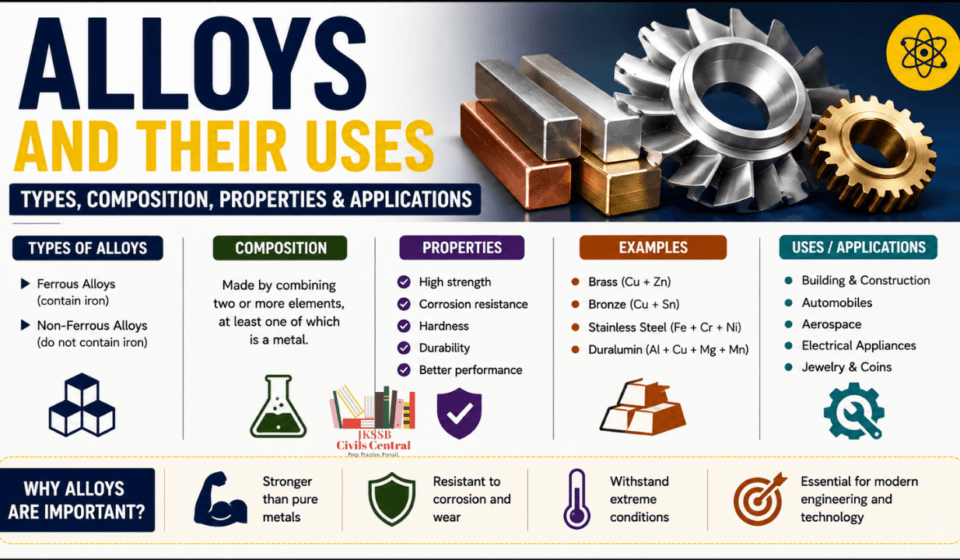
Alloys and Their Uses | Types, Composition, Properties & Applications

Understand the concept of alloys, their composition, manufacture, properties, advantages over pure metals, important examples such as steel, stainless steel, brass, bronze, solder, duralumin, amalgam, and their applications in engineering, medicine, transportation, and daily life for JKSSB, JKPSC, SSC, UPSC & State PSC examinations.
Learning Dashboard
| Chapter Information | Details |
|---|---|
| Subject | General Science – Chemistry |
| Series | Metals and Non-Metals |
| Lesson Number | Lesson 7 |
| Previous Lesson | Corrosion and Prevention of Corrosion | Causes, Types, Rusting & Prevention Methods |
| Current Lesson | Alloys and Their Uses | Types, Composition, Properties & Applications |
| Next Lesson | Extraction of Metals (Metallurgy) | Ores, Reduction, Smelting & Refining |
| Core Theme | Alloys are mixtures of metals or a metal with a non-metal, designed to improve properties such as strength, hardness, corrosion resistance, durability, and workability. |
| Major Topics Covered | Definition of Alloys, Composition, Manufacture, Properties, Advantages of Alloys, Important Alloys, Stainless Steel, Brass, Bronze, Solder, Duralumin, Amalgam, Applications of Alloys |
| Important Alloys Studied | Steel, Stainless Steel, Brass, Bronze, Solder, Duralumin, Nichrome, Amalgam |
| Key Concepts | Alloy, Homogeneous Mixture, Corrosion Resistance, Hardness, Strength, Ductility, Electrical Resistance |
| Real-Life Applications | Buildings, Aircraft, Automobiles, Electrical Appliances, Coins, Jewellery, Medical Instruments, Cooking Utensils |
| Exam Focus | Frequently Asked in JKSSB FAA, JKPSC, JKAS, SSC, CDS, UPSC & State PSC Examinations |
Chapter Overview
In the previous lesson, we studied corrosion and its prevention and learned that pure metals often deteriorate when exposed to the environment. We also discovered that one of the most effective methods of preventing corrosion is alloying, where a metal is combined with one or more other elements to improve its properties. This naturally leads to an important question: Why are pure metals rarely used in their original form?
Although pure metals possess many useful properties, they also have certain limitations. Some are too soft, some corrode easily, some cannot withstand high temperatures, while others lack the strength required for engineering applications. To overcome these limitations, scientists and engineers produce alloys, which combine the desirable properties of different elements into a single material.
An alloy is a homogeneous mixture of two or more elements, at least one of which is a metal. By carefully selecting the constituent elements and their proportions, alloys can be made stronger, harder, lighter, more corrosion-resistant, more wear-resistant, or more heat-resistant than the pure metals from which they are prepared.
Today, alloys are indispensable in modern life. Steel is the backbone of construction and engineering, stainless steel is used in kitchens, hospitals, and industries because of its corrosion resistance, brass is widely used in musical instruments and plumbing fittings, bronze is used for statues, medals, and bearings, duralumin is used in aircraft manufacturing because of its light weight and strength, while nichrome is used in heating elements due to its high electrical resistance.
Throughout this lesson, we will study the concept of alloys, understand how they are manufactured, examine their properties and advantages over pure metals, explore the composition and uses of important alloys, and learn why alloying is one of the most important techniques in modern metallurgy and materials science.
Since questions related to steel, stainless steel, brass, bronze, solder, duralumin, nichrome, amalgam, and the advantages of alloys are frequently asked in JKSSB FAA, JKPSC, JKAS, SSC, CDS, UPSC, and other State PSC examinations, mastering this lesson will provide a strong foundation for understanding both chemistry and engineering applications.
What are Alloys?
Metals such as iron, copper, aluminium, and gold are available in their pure form, but they are rarely used directly in engineering, construction, transportation, or household applications. This is because pure metals often do not possess all the properties required for practical use. Some are too soft, some corrode easily, while others lack sufficient strength or hardness.
To overcome these limitations, scientists developed the concept of alloying, in which two or more elements are combined to produce a material with improved properties. The resulting material is called an alloy.
Alloys have become indispensable in modern civilization. From skyscrapers and aircraft to surgical instruments and kitchen utensils, alloys are used almost everywhere because they combine the best properties of their constituent elements.
Definition of an Alloy
An alloy is a homogeneous mixture of two or more elements, at least one of which is a metal, prepared to obtain improved physical or chemical properties. The constituent elements are mixed in definite proportions, usually in the molten state, and then allowed to cool and solidify.
Unlike pure metals, alloys are specifically designed to possess desirable characteristics such as greater strength, higher hardness, improved corrosion resistance, better wear resistance, or increased heat resistance.
Composition of Alloys
An alloy may consist of:
- Two or more metals.
- A metal and a non-metal.
The metal forms the major component, while the other element or elements are added in smaller quantities to modify the properties of the metal.
Examples
- Brass = Copper + Zinc
- Bronze = Copper + Tin
- Steel = Iron + Carbon
- Stainless Steel = Iron + Chromium + Nickel + Carbon
These combinations produce materials that perform much better than the individual metals alone.
Why Are Alloys Made?
Pure metals often have certain disadvantages that limit their practical applications.
For example:
- Pure iron rusts easily.
- Pure gold is very soft.
- Pure aluminium has comparatively low strength.
- Pure copper wears out quickly under heavy mechanical stress.
By alloying these metals with suitable elements, these limitations can be overcome.
As a result, alloys are generally:
- Stronger.
- Harder.
- More durable.
- More resistant to corrosion.
- Better suited for industrial applications.
Nature of Alloys
Most alloys are homogeneous mixtures, meaning their constituent elements are uniformly distributed throughout the material. Although alloys are mixtures rather than chemical compounds, they often behave like a single material because their components are thoroughly mixed at the atomic level. This uniform composition gives alloys consistent physical and mechanical properties throughout the material.
Characteristics of Alloys
Compared with pure metals, alloys generally possess several improved characteristics.
These include:
- Greater strength.
- Higher hardness.
- Better corrosion resistance.
- Improved durability.
- Greater wear resistance.
- Better heat resistance.
- Improved mechanical properties.
However, the exact properties depend upon the elements used to prepare the alloy.
Everyday Examples of Alloys
Alloys are found almost everywhere in daily life.
Some common examples include:
- Stainless steel kitchen utensils.
- Steel used in buildings and bridges.
- Brass door handles and taps.
- Bronze statues and medals.
- Duralumin used in aircraft.
- Nichrome heating coils in electric irons and heaters.
- Solder used in electrical circuits.
These examples illustrate the immense practical importance of alloys in modern technology.
Importance of Studying Alloys
The study of alloys is important because it helps us understand:
- Why pure metals are modified.
- How engineering materials are improved.
- Why different industries use different metals.
- The relationship between composition and properties.
- The applications of materials in everyday life.
Alloys form the foundation of modern metallurgy, mechanical engineering, aerospace engineering, electrical engineering, and materials science.
Exam Tip
Remember these high-scoring facts:
- An alloy is a homogeneous mixture of two or more elements, at least one of which is a metal.
- Alloys are prepared to improve the properties of pure metals.
- An alloy may consist of two metals or a metal and a non-metal.
- Steel = Iron + Carbon
- Brass = Copper + Zinc
- Bronze = Copper + Tin
- Stainless Steel = Iron + Chromium + Nickel + Carbon
- Most engineering materials are alloys rather than pure metals because alloys possess superior strength, hardness, durability, and corrosion resistance.
Understanding the concept of alloys provides the foundation for the next topic, Manufacture of Alloys, where we will learn how alloys are prepared and why different elements are combined in specific proportions to obtain desired properties.
Manufacture of Alloys
After understanding what alloys are and why they are preferred over pure metals, the next important question is: How are alloys manufactured? The preparation of alloys is a carefully controlled process in which different elements are combined in suitable proportions to obtain the desired physical and chemical properties.
The manufacturing process depends on the nature of the constituent elements, their melting points, and the intended application of the alloy. Although different industrial methods are available, the basic principle remains the same—the constituent elements are melted, mixed uniformly, and then allowed to solidify.
Basic Principle of Alloy Manufacture
The manufacture of an alloy involves combining two or more elements in fixed proportions to produce a material with improved properties. Usually, the metal having the higher melting point is melted first. The other metal or non-metal is then added in the required quantity and mixed thoroughly until a uniform molten mixture is obtained.
The molten alloy is then cooled under controlled conditions to produce a solid alloy with a homogeneous composition.
Step 1: Selection of Raw Materials
The first step in alloy manufacture is the selection of suitable constituent elements. The choice of metals depends on the properties required in the final alloy.
For example:
- Chromium is added to improve corrosion resistance.
- Nickel increases toughness and strength.
- Carbon increases hardness.
- Zinc improves the strength of copper.
- Tin enhances wear resistance.
Thus, every alloy is designed for a specific purpose.
Step 2: Melting of the Base Metal
The principal metal, known as the base metal, is heated until it melts. Industrial furnaces such as electric arc furnaces, induction furnaces, or blast furnaces are commonly used depending on the type of alloy being manufactured. The temperature is carefully controlled to prevent oxidation and contamination.
Step 3: Addition of Other Elements
After the base metal melts, the remaining constituent elements are added in predetermined proportions. These elements dissolve in the molten metal and are thoroughly mixed to ensure a uniform composition throughout the alloy. Proper mixing is essential because uneven distribution of elements may lead to defects and non-uniform properties.
Step 4: Cooling and Solidification
Once a homogeneous molten mixture has been obtained, it is poured into moulds or casting machines. The alloy is then cooled gradually under controlled conditions. During cooling, the atoms arrange themselves into a solid structure, producing the finished alloy. The cooling rate influences the hardness, strength, and grain structure of the alloy.
Step 5: Further Processing
After solidification, the alloy may undergo additional processes to improve its quality and shape.
These include:
- Rolling
- Forging
- Extrusion
- Heat treatment
- Machining
These processes enhance the mechanical properties and prepare the alloy for industrial use.
Example: Manufacture of Brass
Brass is produced by melting copper and adding the required quantity of zinc. The molten mixture is stirred thoroughly to obtain a uniform composition. After cooling, the alloy becomes stronger and more corrosion-resistant than pure copper.
Example: Manufacture of Steel
Steel is prepared by adding a controlled amount of carbon to molten iron. Depending on the percentage of carbon and other alloying elements added, different types of steel with varying hardness and strength are produced.
Importance of Controlled Composition
The properties of an alloy depend greatly on the proportion of its constituent elements. Even a small change in composition can significantly alter:
- Strength
- Hardness
- Corrosion resistance
- Electrical conductivity
- Heat resistance
- Ductility
Therefore, industries maintain strict control over the composition of alloys during manufacturing.
Advantages of the Manufacturing Process
The controlled manufacture of alloys enables industries to produce materials that are:
- Stronger than pure metals.
- More resistant to corrosion.
- Better able to withstand high temperatures.
- More durable.
- Suitable for specific engineering applications.
This flexibility makes alloy manufacturing one of the most important processes in modern metallurgy.
Exam Tip
Remember these important points:
- Alloys are generally prepared by melting and mixing the constituent elements.
- The base metal is melted first, followed by the addition of other elements.
- Uniform mixing is necessary to obtain a homogeneous alloy.
- Controlled cooling determines the final properties of the alloy.
- Brass is prepared from copper and zinc.
- Steel is prepared by adding carbon to iron.
- The composition of an alloy determines its strength, hardness, corrosion resistance, and other properties.
Understanding the manufacture of alloys helps explain why different alloys possess different characteristics and prepares us for the next topic, Properties of Alloys, where we will compare alloys with pure metals and study how alloying improves their physical, mechanical, and chemical properties.
Properties of Alloys
One of the primary reasons for preparing alloys is that they possess better properties than pure metals. Although pure metals such as iron, copper, aluminium, and gold are useful, they often fail to meet the demands of modern engineering and industry. By combining metals with other metals or non-metals, scientists can significantly improve their physical, mechanical, and chemical properties.
The exact properties of an alloy depend upon its composition. Some alloys are designed to be stronger, while others are made lighter, harder, more corrosion-resistant, or capable of withstanding high temperatures. This ability to tailor properties makes alloys indispensable in construction, transportation, electrical engineering, medicine, and manufacturing.
Greater Strength
One of the most important properties of alloys is their greater strength. Pure metals are often soft and cannot withstand heavy mechanical loads. Alloying increases the strength of the metal by modifying its internal structure, enabling it to bear greater stress without deformation. For example, steel is much stronger than pure iron and is therefore widely used in the construction of buildings, bridges, railway tracks, and machinery.
Higher Hardness
Most alloys are harder than their constituent pure metals. The atoms of different elements interfere with the regular arrangement of metal atoms, making it more difficult for the layers of atoms to slide over one another. As a result, alloys become harder and more resistant to wear.
For example:
- Steel is harder than iron.
- Bronze is harder than copper.
- Brass is harder than pure copper.
This increased hardness makes alloys suitable for manufacturing tools, machine parts, and engineering components.
Better Corrosion Resistance
Many alloys exhibit excellent resistance to corrosion. The addition of certain elements, such as chromium and nickel, enables alloys to form protective oxide layers that prevent further chemical attack.
For example, stainless steel contains chromium, which forms a thin protective chromium oxide film on the surface. This film prevents rusting and makes stainless steel ideal for kitchen utensils, surgical instruments, and chemical industries.
Improved Durability
Alloys generally have a longer service life than pure metals. Their increased strength, hardness, and corrosion resistance enable them to withstand harsh environmental conditions for extended periods. Consequently, alloys are preferred for structures and equipment that are expected to function reliably for many years.
Better Wear Resistance
Wear resistance refers to the ability of a material to resist damage caused by friction or repeated mechanical contact. Many alloys possess excellent wear resistance because of their increased hardness.
For this reason, alloys are widely used in:
- Bearings
- Gears
- Machine components
- Railway wheels
- Cutting tools
Heat Resistance
Some alloys can withstand very high temperatures without losing their strength. Such heat-resistant alloys are extensively used in:
- Aircraft engines
- Gas turbines
- Electric heating elements
- Industrial furnaces
For example, nichrome retains its strength even at high temperatures and is therefore used in electric heaters, irons, and toasters.
Modified Electrical Conductivity
The electrical conductivity of alloys is generally lower than that of pure metals. This property is useful in situations where electrical resistance is required. For example, nichrome has high electrical resistance and produces heat when electric current passes through it, making it suitable for heating elements.
Attractive Appearance
Some alloys possess an attractive colour and excellent polishing properties. These alloys are widely used in decorative articles, jewellery, coins, and ornamental objects.
For example:
- Brass has a golden appearance.
- Bronze has an attractive brownish colour.
- White gold is widely used in jewellery.
Comparison Between Pure Metals and Alloys
| Property | Pure Metals | Alloys |
|---|---|---|
| Strength | Generally lower | Generally higher |
| Hardness | Usually softer | Usually harder |
| Corrosion Resistance | Often lower | Usually higher |
| Durability | Lower | Higher |
| Wear Resistance | Lower | Higher |
| Heat Resistance | Moderate | Often higher |
| Electrical Conductivity | Generally higher | Usually lower |
| Industrial Applications | Limited | Extensive |
Importance of Improved Properties
The improved properties of alloys make them suitable for a wide range of applications. They are used in:
- Construction of buildings and bridges.
- Manufacturing of vehicles and aircraft.
- Medical instruments.
- Electrical appliances.
- Household utensils.
- Industrial machinery.
- Defence equipment.
- Space technology.
Without alloys, many modern engineering achievements would not have been possible.
Exam Tip
Remember these high-scoring facts:
- Alloys are generally stronger than pure metals.
- Most alloys are harder and more durable than pure metals.
- Alloys usually possess better corrosion resistance.
- Stainless steel resists corrosion because of chromium.
- Nichrome has high electrical resistance and heat resistance.
- Steel is stronger and harder than iron.
- Brass and bronze are harder than copper.
- The improved properties of alloys make them indispensable in engineering, medicine, transportation, and industry.
Understanding these properties explains why alloys have largely replaced pure metals in modern applications. The next section will introduce the Advantages of Alloys over Pure Metals, where we will systematically compare alloys with pure metals and understand why alloying has become one of the most important developments in materials science.
Advantages of Alloys over Pure Metals
After studying the properties of alloys, it becomes clear why they are preferred over pure metals in almost every field of engineering and technology. Although pure metals possess useful characteristics, they often fail to satisfy the demands of modern industries. Alloys are specifically designed to overcome these limitations by combining the desirable properties of two or more elements.
Today, almost every major engineering structure, vehicle, aircraft, machine, electrical appliance, and medical instrument is manufactured using alloys rather than pure metals. Their superior performance has made them one of the most important materials in modern civilization.
Greater Mechanical Strength
One of the greatest advantages of alloys is their higher mechanical strength. Pure metals are often too soft to withstand heavy loads and mechanical stress. Alloying modifies the internal arrangement of atoms, making the material much stronger.
For example, steel is considerably stronger than pure iron and is therefore used in constructing buildings, bridges, railway tracks, and heavy machinery. The increased strength of alloys enables them to perform reliably under demanding conditions.
Increased Hardness
Alloys are generally harder than pure metals. The presence of atoms of different sizes disrupts the regular arrangement of metal atoms, making it difficult for them to slide over one another. As a result, alloys resist scratching, deformation, and wear much better than pure metals.
This property makes alloys suitable for manufacturing:
- Cutting tools
- Machine components
- Industrial equipment
- Engineering parts
Better Corrosion Resistance
Many pure metals corrode easily when exposed to air and moisture. Alloying with suitable elements significantly improves corrosion resistance. For example, stainless steel contains chromium, which forms a thin protective oxide layer that prevents rusting.
Because of this property, stainless steel is widely used in:
- Kitchen utensils
- Surgical instruments
- Food processing industries
- Chemical plants
Higher Durability
Alloys generally possess a much longer service life than pure metals. Their greater strength, hardness, and corrosion resistance enable them to withstand continuous use for many years without significant deterioration. This reduces maintenance requirements and replacement costs.
Better Heat Resistance
Certain alloys retain their strength even at very high temperatures. This property makes them suitable for applications involving intense heat.
Examples include:
- Aircraft engines
- Gas turbines
- Industrial furnaces
- Electric heating elements
Nichrome is an excellent example of a heat-resistant alloy.
Improved Wear Resistance
Repeated friction gradually damages pure metals. Many alloys exhibit excellent wear resistance because of their increased hardness.
Consequently, alloys are extensively used for:
- Bearings
- Gears
- Railway wheels
- Machine shafts
- Automobile components
Better Electrical Properties
Some alloys possess electrical properties that are superior to those of pure metals for specific applications. For example, nichrome has high electrical resistance and produces heat efficiently when electric current passes through it.
This makes it suitable for:
- Electric irons
- Heaters
- Toasters
- Electric kettles
Attractive Appearance
Certain alloys possess attractive colours and excellent polishing characteristics. Examples include:
- Brass with its golden appearance.
- Bronze with its attractive brownish colour.
- White gold used in jewellery.
These alloys are widely used for decorative and ornamental purposes.
Greater Design Flexibility
By changing the composition of an alloy, scientists can produce materials with specific combinations of properties. For example, an alloy can be designed to be:
- Strong but lightweight.
- Hard yet corrosion-resistant.
- Heat-resistant and electrically conductive.
- Tough and wear-resistant.
This flexibility allows engineers to select materials according to the exact requirements of different applications.
Cost-Effectiveness
Many alloys are more economical than using expensive pure metals. For example, replacing pure copper or gold with suitable alloys reduces manufacturing costs while maintaining satisfactory performance. The longer service life of alloys also reduces repair and replacement expenses.
Comparison Between Pure Metals and Alloys
| Feature | Pure Metals | Alloys |
|---|---|---|
| Strength | Lower | Higher |
| Hardness | Softer | Harder |
| Corrosion Resistance | Lower | Higher |
| Durability | Lower | Higher |
| Wear Resistance | Lower | Higher |
| Heat Resistance | Moderate | Better |
| Mechanical Performance | Limited | Superior |
| Industrial Use | Limited | Extensive |
Why Are Alloys Preferred?
Industries prefer alloys because they provide an ideal balance of properties. They offer:
- Better performance.
- Longer lifespan.
- Greater safety.
- Lower maintenance.
- Improved efficiency.
- Wider industrial applications.
As a result, alloys have largely replaced pure metals in modern engineering, transportation, medicine, electronics, defence, and construction.
Exam Tip
Remember these important examination facts:
- Alloys are generally stronger than pure metals.
- Most alloys are harder and more durable.
- Alloys possess better corrosion resistance.
- Stainless steel resists corrosion because of chromium.
- Nichrome is used in heating elements due to its high electrical resistance.
- Steel is stronger than iron.
- Brass and bronze are harder than copper.
- Most engineering materials are alloys because they combine multiple desirable properties.
Understanding the advantages of alloys explains why they have become the preferred materials in almost every branch of science, engineering, industry, and daily life. In the next section, we will study the Important Alloys, Their Composition, Properties, and Uses, which is one of the most frequently asked topics in JKSSB, JKPSC, SSC, UPSC, CDS, and other competitive examinations.
Important Alloys: Composition, Properties and Uses
After understanding why alloys are preferred over pure metals, it is important to study the most commonly used alloys. Each alloy is prepared by combining specific elements in definite proportions to obtain particular properties required for different applications.
Some alloys are designed for high strength, others for corrosion resistance, light weight, heat resistance, or good electrical properties. Because of these unique characteristics, different alloys are used in different fields of engineering, medicine, construction, transportation, electronics, and daily life.
The following alloys are among the most important from the examination point of view.
Steel
Steel is the most widely used alloy in the world. It is prepared by adding a small percentage of carbon to iron.
Composition
- Iron (Fe)
- Carbon (C)
Properties
Steel possesses:
- High strength
- High hardness
- Good toughness
- Better wear resistance than iron
- Good mechanical properties
Uses
Steel is extensively used in:
- Buildings
- Bridges
- Railway tracks
- Machinery
- Automobiles
- Ships
- Construction equipment
Because of its excellent strength and durability, steel is considered the backbone of modern infrastructure.
Stainless Steel
Stainless steel is a corrosion-resistant alloy of iron. It is produced by adding chromium, nickel, and a small amount of carbon to iron.
Composition
- Iron (Fe)
- Chromium (Cr)
- Nickel (Ni)
- Carbon (C)
Properties
Stainless steel has:
- Excellent corrosion resistance
- High strength
- Attractive shiny appearance
- Good heat resistance
- Hygienic surface
Chromium forms a thin protective oxide layer that prevents rusting.
Uses
Stainless steel is widely used for:
- Kitchen utensils
- Surgical instruments
- Medical equipment
- Food processing industries
- Chemical plants
- Water tanks
Brass
Brass is one of the oldest and most useful copper alloys. It is prepared by mixing copper and zinc.
Composition
- Copper (Cu)
- Zinc (Zn)
Properties
Brass possesses:
- Good strength
- Attractive golden colour
- High corrosion resistance
- Good machinability
- Good electrical conductivity
Uses
Brass is commonly used in:
- Door handles
- Water taps
- Decorative articles
- Musical instruments
- Electrical fittings
- Screws and nuts
Bronze
Bronze is another important copper alloy. It is prepared by combining copper and tin.
Composition
- Copper (Cu)
- Tin (Sn)
Properties
Bronze has:
- Greater hardness than copper
- High strength
- Excellent wear resistance
- Good corrosion resistance
Uses
Bronze is used for:
- Statues
- Medals
- Coins
- Bearings
- Ship propellers
- Decorative articles
Solder
Solder is a low-melting alloy used for joining metal parts. It is prepared by mixing lead and tin.
Composition
- Lead (Pb)
- Tin (Sn)
Properties
Solder has:
- Low melting point
- Good electrical conductivity
- Easy flow when molten
Uses
Solder is widely used in:
- Electrical circuits
- Electronic components
- Joining metal wires
- Printed circuit boards (PCBs)
Duralumin
Duralumin is a lightweight but strong aluminium alloy. It contains aluminium along with copper, magnesium, and manganese.
Composition
- Aluminium (Al)
- Copper (Cu)
- Magnesium (Mg)
- Manganese (Mn)
Properties
Duralumin possesses:
- High strength
- Low weight
- Good corrosion resistance
- Excellent machinability
Uses
Duralumin is extensively used in:
- Aircraft construction
- Spacecraft
- Automobiles
- Railway coaches
Its high strength-to-weight ratio makes it ideal for the aerospace industry.
Nichrome
Nichrome is a heat-resistant alloy. It is prepared by combining nickel and chromium, sometimes with a small amount of iron.
Composition
- Nickel (Ni)
- Chromium (Cr)
Properties
Nichrome has:
- High electrical resistance
- High melting point
- Excellent heat resistance
- Good corrosion resistance
Uses
Nichrome is used in:
- Electric irons
- Water heaters
- Electric kettles
- Toasters
- Room heaters
- Heating coils
Amalgam
An amalgam is an alloy containing mercury. Mercury combines with several metals to form amalgams.
Composition
- Mercury (Hg)
- Another metal (such as silver, tin, or gold)
Properties
Amalgams possess:
- Good binding properties
- Easy moulding
- Good durability
Uses
Amalgams are used in:
- Dental fillings (traditional use)
- Scientific instruments
- Laboratory applications
Summary Table of Important Alloys
| Alloy | Composition | Major Property | Common Uses |
|---|---|---|---|
| Steel | Iron + Carbon | Strong and hard | Buildings, bridges, machinery |
| Stainless Steel | Iron + Chromium + Nickel + Carbon | Corrosion resistant | Kitchen utensils, surgical instruments |
| Brass | Copper + Zinc | Strong, corrosion resistant | Taps, musical instruments, fittings |
| Bronze | Copper + Tin | Hard and wear resistant | Statues, medals, bearings |
| Solder | Lead + Tin | Low melting point | Electrical and electronic joining |
| Duralumin | Aluminium + Copper + Magnesium + Manganese | Light and strong | Aircraft, automobiles |
| Nichrome | Nickel + Chromium | High electrical resistance | Heating elements |
| Amalgam | Mercury + Another Metal | Easily moulded | Dental fillings, laboratory use |
Exam Tip
Remember these high-yield facts:
- Steel = Iron + Carbon
- Stainless Steel = Iron + Chromium + Nickel + Carbon
- Brass = Copper + Zinc
- Bronze = Copper + Tin
- Solder = Lead + Tin
- Duralumin = Aluminium + Copper + Magnesium + Manganese
- Nichrome = Nickel + Chromium
- Amalgam = Mercury + Another Metal
- Stainless steel resists corrosion because of chromium.
- Nichrome is used in heating elements because of its high electrical resistance and high melting point.
- Duralumin is used in aircraft because it is light yet strong.
- Brass has a golden appearance and is widely used for decorative and plumbing applications.
These important alloys, their composition, properties, and uses are among the most frequently asked topics in JKSSB, JKPSC, SSC, UPSC, CDS, and other competitive examinations, making them essential for both conceptual understanding and objective-type questions. cite
Applications of Important Alloys
The various alloys studied in the previous section are not merely laboratory materials; they form the backbone of modern civilization. Every alloy is designed for a specific purpose based on its unique combination of properties. Some alloys provide exceptional strength, some resist corrosion, some withstand high temperatures, while others possess excellent electrical or mechanical properties.
From the construction of skyscrapers and aircraft to the manufacture of electrical appliances, medical instruments, coins, and household utensils, alloys have become indispensable in almost every field of science, engineering, medicine, and industry.
Steel in Construction and Engineering
Steel is the most widely used engineering alloy because of its high strength, toughness, and durability. Its ability to withstand heavy loads makes it the preferred material for large structures.
Major Applications
Steel is extensively used in:
- Buildings
- Bridges
- Railway tracks
- Flyovers
- Industrial machinery
- Automobiles
- Ships
- Cranes
Modern infrastructure would not be possible without steel.
Stainless Steel in Daily Life and Medicine
Stainless steel is valued for its excellent corrosion resistance and hygienic surface. Since it does not rust easily and is easy to clean, it is widely used where cleanliness and durability are essential.
Major Applications
Stainless steel is used in:
- Kitchen utensils
- Surgical instruments
- Hospital equipment
- Water storage tanks
- Food processing industries
- Chemical industries
- Pharmaceutical equipment
Its resistance to corrosion makes it one of the most versatile engineering materials.
Brass in Decorative and Plumbing Applications
Brass possesses an attractive golden appearance along with good strength and corrosion resistance. It is also easy to machine and shape.
Major Applications
Brass is commonly used for:
- Water taps
- Door handles
- Locks
- Musical instruments
- Decorative articles
- Electrical fittings
- Plumbing accessories
Its attractive appearance makes it suitable for ornamental purposes.
Bronze in Heavy-Duty Applications
Bronze is harder than copper and exhibits excellent wear resistance. It also resists corrosion in marine environments.
Major Applications
Bronze is used for:
- Statues
- Medals
- Coins
- Bearings
- Ship propellers
- Industrial machine parts
Its strength and wear resistance make it suitable for components subjected to continuous friction.
Solder in Electrical and Electronic Industries
Solder has a low melting point, allowing it to join metals without damaging electronic components. It forms strong electrical connections.
Major Applications
Solder is widely used in:
- Printed circuit boards (PCBs)
- Electronic devices
- Electrical wiring
- Electrical repair work
- Communication equipment
Without solder, modern electronic assembly would be extremely difficult.
Duralumin in Aerospace and Transport
Duralumin combines low weight with high strength. This unique combination makes it one of the most important alloys used in transportation.
Major Applications
Duralumin is used in:
- Aircraft bodies
- Spacecraft
- Railway coaches
- Automobiles
- Defence equipment
Its excellent strength-to-weight ratio improves fuel efficiency and performance.
Nichrome in Heating Appliances
Nichrome possesses high electrical resistance and can withstand very high temperatures without melting. When electric current passes through it, electrical energy is converted into heat.
Major Applications
Nichrome is used in:
- Electric irons
- Water heaters
- Room heaters
- Electric kettles
- Toasters
- Hair dryers
- Electric ovens
Its heat resistance makes it the ideal material for heating elements.
Amalgam in Dentistry
Amalgams are alloys containing mercury and another metal. Traditionally, dental amalgam has been used because it is easy to shape and becomes hard after placement.
Major Applications
Amalgams have been used for:
- Dental fillings
- Laboratory applications
- Certain scientific instruments
Although newer materials are increasingly used in dentistry, amalgam remains an important alloy from a chemistry perspective.
Importance of Alloys in Modern Life
Alloys have transformed modern technology by providing materials with properties that pure metals cannot offer. Their importance can be seen in almost every sector.
Engineering
- Buildings
- Bridges
- Heavy machinery
- Railway infrastructure
Transportation
- Aircraft
- Automobiles
- Ships
- Railway coaches
Medical Field
- Surgical instruments
- Hospital equipment
- Dental materials
Electrical Industry
- Heating elements
- Electrical fittings
- Electronic circuits
Household Applications
- Kitchen utensils
- Furniture fittings
- Decorative items
- Water storage tanks
Thus, alloys are indispensable in both everyday life and advanced technological applications.
Summary Table
| Alloy | Major Application |
|---|---|
| Steel | Buildings, bridges, railway tracks, machinery |
| Stainless Steel | Kitchen utensils, hospitals, chemical industries |
| Brass | Taps, locks, musical instruments, decorative items |
| Bronze | Statues, medals, bearings, ship propellers |
| Solder | Electronic circuits, electrical wiring |
| Duralumin | Aircraft, spacecraft, automobiles |
| Nichrome | Heating elements, electric irons, heaters |
| Amalgam | Dental fillings, laboratory applications |
Exam Tip
Remember these high-yield applications:
- Steel → Construction and heavy engineering
- Stainless Steel → Kitchen utensils and surgical instruments
- Brass → Taps, fittings, musical instruments
- Bronze → Statues, medals, bearings
- Solder → Electrical and electronic joining
- Duralumin → Aircraft and aerospace industry
- Nichrome → Heating coils and electric appliances
- Amalgam → Dental fillings
These applications are frequently tested in JKSSB, JKPSC, SSC, UPSC, CDS, and other competitive examinations. Questions often ask students to match an alloy with its composition or its principal use, making this one of the highest-scoring sections of the chapter.
JKSSB CivilsCentral Insight
Alloys are among the most important materials developed by humans because they combine the desirable properties of different elements into a single material. While pure metals often possess useful characteristics, they also have certain limitations such as low strength, poor hardness, or susceptibility to corrosion. By alloying metals with suitable elements, scientists are able to overcome these limitations and produce materials with superior performance.
The most important point to remember is that an alloy is a homogeneous mixture of two or more elements, at least one of which is a metal. Depending on the composition, an alloy may consist of two metals (such as brass and bronze) or a metal and a non-metal (such as steel, where carbon is mixed with iron). One of the major advantages of alloying is the improvement of physical and mechanical properties. Most alloys are stronger, harder, more durable, and more resistant to corrosion than the corresponding pure metals. This is why alloys have almost completely replaced pure metals in modern engineering, construction, transportation, and manufacturing.
Among all alloys, steel is the most widely used because of its high strength and toughness. It is prepared by adding carbon to iron and serves as the foundation of modern infrastructure. Stainless steel is another important alloy that contains chromium and nickel. Chromium forms a thin protective oxide layer, making stainless steel highly resistant to corrosion. This explains its widespread use in kitchen utensils, hospitals, and chemical industries.
Copper also forms two important alloys frequently asked in examinations. Brass, prepared from copper and zinc, possesses good strength, corrosion resistance, and an attractive golden appearance. It is commonly used in taps, locks, musical instruments, and decorative articles. Bronze, an alloy of copper and tin, is harder than copper and is widely used for statues, medals, bearings, and marine applications.
Certain alloys are designed for very specific purposes. Nichrome, an alloy of nickel and chromium, has high electrical resistance and heat resistance, making it ideal for heating elements in electric irons, heaters, and toasters. Duralumin, an aluminium alloy containing copper, magnesium, and manganese, combines high strength with low weight and is therefore extensively used in aircraft and spacecraft. Solder, an alloy of lead and tin, has a low melting point and is used for joining electrical and electronic components. Amalgam, which contains mercury, has traditionally been used in dental fillings and laboratory applications.
Thus, alloys demonstrate how a small change in composition can produce a remarkable improvement in properties. Their development has revolutionized engineering, medicine, electronics, aerospace, and countless other fields, making them one of the most significant achievements in materials science.
High-Yield Facts for Competitive Examinations
Remember the following examination-oriented points:
- An alloy is a homogeneous mixture of two or more elements, at least one of which is a metal.
- Alloys may consist of two metals or a metal and a non-metal.
- Alloys are generally stronger, harder, and more corrosion-resistant than pure metals.
- Steel = Iron + Carbon
- Stainless Steel = Iron + Chromium + Nickel + Carbon
- Brass = Copper + Zinc
- Bronze = Copper + Tin
- Solder = Lead + Tin
- Duralumin = Aluminium + Copper + Magnesium + Manganese
- Nichrome = Nickel + Chromium
- Amalgam = Mercury + Another Metal
- Steel is widely used in construction and heavy engineering.
- Stainless steel is used in kitchen utensils and surgical instruments because of its corrosion resistance.
- Brass is used in taps, locks, plumbing fittings, and musical instruments.
- Bronze is used for statues, medals, bearings, and ship propellers.
- Nichrome is used in heating elements because of its high electrical resistance and high melting point.
- Duralumin is preferred in the aerospace industry because it is lightweight yet strong.
- Solder is used for joining electrical and electronic components due to its low melting point.
- Amalgam has traditionally been used in dental fillings.
- Chromium improves corrosion resistance, while carbon increases the hardness and strength of steel.
Instead of memorizing only the names of alloys, always connect their composition with their properties and applications. This approach makes it much easier to solve matching, assertion-reason, and multiple-choice questions commonly asked in JKSSB, JKPSC, SSC, UPSC, CDS, and other competitive examinations.
Quick Revision
Before completing this lesson, revise the following key concepts. These points summarize the entire chapter and are useful for last-minute revision before JKSSB, JKPSC, SSC, UPSC, CDS, and other State PSC examinations.
- An alloy is a homogeneous mixture of two or more elements, at least one of which is a metal.
- Alloys may consist of:
- Two metals.
- A metal and a non-metal.
- Alloys are prepared to improve the properties of pure metals.
- The constituent elements are generally melted, mixed uniformly, and then cooled to form the alloy.
- Alloys are generally:
- Stronger
- Harder
- More durable
- More corrosion-resistant
- More wear-resistant
- Better suited for industrial applications
- The properties of an alloy depend upon:
- Its composition.
- The proportion of constituent elements.
- The manufacturing process.
- Steel is an alloy of iron and carbon.
- Stainless steel contains iron, chromium, nickel, and carbon.
- Chromium forms a protective oxide layer that prevents corrosion.
- Brass is an alloy of copper and zinc.
- Bronze is an alloy of copper and tin.
- Solder is an alloy of lead and tin and has a low melting point.
- Duralumin is an alloy of aluminium, copper, magnesium, and manganese.
- Nichrome is an alloy of nickel and chromium.
- Amalgam is an alloy containing mercury.
- Important applications of alloys include:
- Construction
- Aircraft manufacturing
- Automobiles
- Surgical instruments
- Kitchen utensils
- Electrical appliances
- Electronic circuits
- Decorative articles
- Stainless steel is widely used because of its:
- Corrosion resistance
- Hygienic surface
- Attractive appearance
- Nichrome is used in heating elements because of its:
- High electrical resistance
- High melting point
- Duralumin is used in aircraft because it is:
- Lightweight
- Strong
- Corrosion-resistant
- Steel forms the backbone of modern engineering and infrastructure.
- Alloys have largely replaced pure metals because they provide better overall performance.
Frequently Asked Questions (FAQs)
The following frequently asked questions address the most common doubts related to Alloys and Their Uses. These questions reinforce the important concepts discussed in this lesson and are highly relevant for JKSSB FAA, JKPSC, JKAS, SSC, CDS, UPSC, and other State PSC examinations.
1. What is an alloy?
An alloy is a homogeneous mixture of two or more elements, at least one of which is a metal. Alloys are prepared to improve the physical, mechanical, and chemical properties of pure metals.
2. Why are alloys prepared?
Alloys are prepared because pure metals often lack the properties required for practical applications. Alloying improves:
- Strength
- Hardness
- Corrosion resistance
- Durability
- Wear resistance
- Heat resistance
3. Can an alloy contain a non-metal?
Yes. An alloy may consist of:
- Two or more metals, or
- A metal and a non-metal.
For example, steel is an alloy of iron and carbon, where carbon is a non-metal.
4. How are alloys manufactured?
Most alloys are manufactured by:
- Melting the base metal.
- Adding the other constituent elements in the required proportions.
- Mixing thoroughly to obtain a uniform molten mixture.
- Cooling and solidifying the mixture.
Controlled cooling ensures uniform properties throughout the alloy.
5. Why are alloys generally stronger than pure metals?
The atoms of different elements present in an alloy interfere with the regular arrangement of metal atoms. This prevents the layers of atoms from sliding easily, making the alloy stronger and harder than the pure metal.
6. What is steel?
Steel is an alloy of:
- Iron
- Carbon
It is widely used in buildings, bridges, railway tracks, automobiles, and machinery because of its high strength and toughness.
7. Why is stainless steel resistant to corrosion?
Stainless steel contains chromium, which forms a thin protective oxide layer on the surface. This oxide layer prevents oxygen and moisture from reaching the underlying metal, making stainless steel highly resistant to corrosion.
8. What is brass?
Brass is an alloy of:
- Copper
- Zinc
It is commonly used in taps, locks, decorative articles, plumbing fittings, and musical instruments because of its strength, corrosion resistance, and attractive appearance.
9. What is bronze?
Bronze is an alloy of:
- Copper
- Tin
It is harder than copper and is widely used for statues, medals, bearings, coins, and ship propellers.
10. What is solder?
Solder is an alloy of:
- Lead
- Tin
Because of its low melting point, it is used for joining electrical wires, electronic components, and printed circuit boards.
11. Why is duralumin used in aircraft?
Duralumin is an aluminium alloy containing copper, magnesium, and manganese. It is preferred in aircraft because it is:
- Lightweight
- Strong
- Corrosion-resistant
Its excellent strength-to-weight ratio improves aircraft performance.
12. Why is nichrome used in heating elements?
Nichrome is an alloy of nickel and chromium. It has:
- High electrical resistance
- High melting point
- Excellent heat resistance
Therefore, it is widely used in electric irons, heaters, toasters, and electric kettles.
13. What is an amalgam?
An amalgam is an alloy that contains mercury along with another metal. Traditionally, amalgams have been used in dental fillings and certain laboratory applications.
14. What are the advantages of alloys over pure metals?
Compared with pure metals, alloys generally have:
- Greater strength
- Higher hardness
- Better corrosion resistance
- Greater durability
- Better wear resistance
- Improved heat resistance
- Longer service life
These advantages make alloys more suitable for industrial applications.
15. What are the major applications of alloys?
Alloys are widely used in:
- Construction
- Transportation
- Aerospace
- Electrical engineering
- Medical equipment
- Household utensils
- Electronics
- Defence industries
- Decorative articles
Almost every modern engineering industry depends on alloys.
16. Which facts from this lesson are most important for competitive examinations?
Students should always remember these high-yield facts:
- Steel = Iron + Carbon
- Stainless Steel = Iron + Chromium + Nickel + Carbon
- Brass = Copper + Zinc
- Bronze = Copper + Tin
- Solder = Lead + Tin
- Duralumin = Aluminium + Copper + Magnesium + Manganese
- Nichrome = Nickel + Chromium
- Amalgam = Mercury + Another Metal
- Stainless steel resists corrosion because of chromium.
- Nichrome is used in heating elements because of its high electrical resistance.
- Duralumin is used in aircraft because it is lightweight and strong.
- Steel is widely used in construction and engineering.
17. Why are alloys considered important in modern science and technology?
Alloys have transformed modern engineering by providing materials with combinations of properties that pure metals cannot offer. They make stronger buildings, lighter aircraft, safer vehicles, durable medical instruments, efficient electrical appliances, and corrosion-resistant industrial equipment possible.
Their versatility, reliability, and improved performance make alloys one of the most important classes of engineering materials used today.
18. Why is the study of alloys important for competitive examinations?
Questions related to the composition, properties, and uses of alloys are regularly asked in JKSSB, JKPSC, SSC, CDS, UPSC, and State PSC examinations. Students are often required to identify an alloy from its composition, match an alloy with its applications, or explain why a particular alloy is preferred over a pure metal. A thorough understanding of these concepts helps in solving both objective and descriptive questions accurately and efficiently.
Mind Maps
Mind Map 1: What is an Alloy?
                    ALLOYS
                      │
                      ▼
      Homogeneous Mixture of Elements
                      │
          At Least One is a Metal
                      │
        ┌─────────────┴─────────────┐
        │                           │
        ▼                           ▼

 Metal + Metal              Metal + Non-metal

 (Brass, Bronze)           (Steel: Iron + Carbon)

                      │
                      ▼

      Improved Properties
Mind Map 2: Properties of Alloys
                    PROPERTIES OF ALLOYS
                            │
        ┌───────────────────┼───────────────────┐
        │                   │                   │
        ▼                   ▼                   ▼
     STRONGER             HARDER       CORROSION RESISTANT
        │                   │                   │
        ▼                   ▼                   ▼
      STEEL            CUTTING TOOLS       STAINLESS STEEL


        ┌───────────────────┼───────────────────┐
        │                   │                   │
        ▼                   ▼                   ▼
      DURABLE       HIGH HEAT RESISTANCE    LIGHTWEIGHT
        │                   │                   │
        ▼                   ▼                   ▼
 LONG SERVICE LIFE        NICHROME          DURALUMIN
Mind Map 3: Important Alloys
                         IMPORTANT ALLOYS
                                │
        ┌───────────────────────┼────────────────────────┐
        │                       │                        │
        ▼                       ▼                        ▼
       BRASS                  BRONZE                   STEEL
        │                       │                        │
        ▼                       ▼                        ▼
 Copper + Zinc            Copper + Tin            Iron + Carbon
        │                       │                        │
        ▼                       ▼                        ▼
  Electrical fittings,     Statues, medals,       Construction,
  utensils & hardware      bells & bearings       tools & machinery


        ┌───────────────────────┼────────────────────────┐
        │                       │                        │
        ▼                       ▼                        ▼
 STAINLESS STEEL            NICHROME                DURALUMIN
        │                       │                        │
        ▼                       ▼                        ▼
 Iron + Chromium +        Nickel + Chromium       Aluminium + Copper
      Nickel                    │                  + Magnesium + Manganese
        │                       ▼                        │
        ▼                  Heating elements              ▼
 Utensils, surgical       & resistance wires       Aircraft bodies
 instruments & equipment
Mind Map 4: Uses of Important Alloys
BRASS
→ Taps, fittings, screws, musical instruments

BRONZE
→ Statues, medals, bells, bearings

STEEL
→ Construction, machinery, tools

STAINLESS STEEL
→ Utensils, surgical instruments, medical equipment

NICHROME
→ Heating elements, electric heaters

DURALUMIN
→ Aircraft bodies and lightweight structures

SOLDER
→ Joining electrical wires and metal parts

ALNICO
→ Permanent magnets, loudspeakers
Mind Map 5: Complete Chapter Summary
           ALLOYS & THEIR USES
                  │
                  ▼

Alloy

↓

Homogeneous Mixture

↓

Improved Properties

────────────────────────────

Advantages

✓ Stronger

✓ Harder

✓ Durable

✓ Corrosion Resistant

────────────────────────────

Important Alloys

Steel → Fe + C

Stainless Steel → Fe + Cr + Ni

Brass → Cu + Zn

Bronze → Cu + Sn

Solder → Pb + Sn

Nichrome → Ni + Cr

Duralumin → Al + Cu + Mg + Mn

Amalgam → Hg + Metal

────────────────────────────

Applications

✓ Construction

✓ Aircraft

✓ Utensils

✓ Heating Elements

✓ Electronics

✓ Medical Equipment
About The Author












[…] Alloys and Their Uses | Types, Composition, Properties & Applications […]