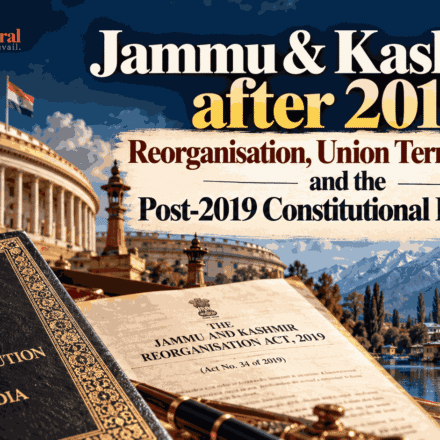
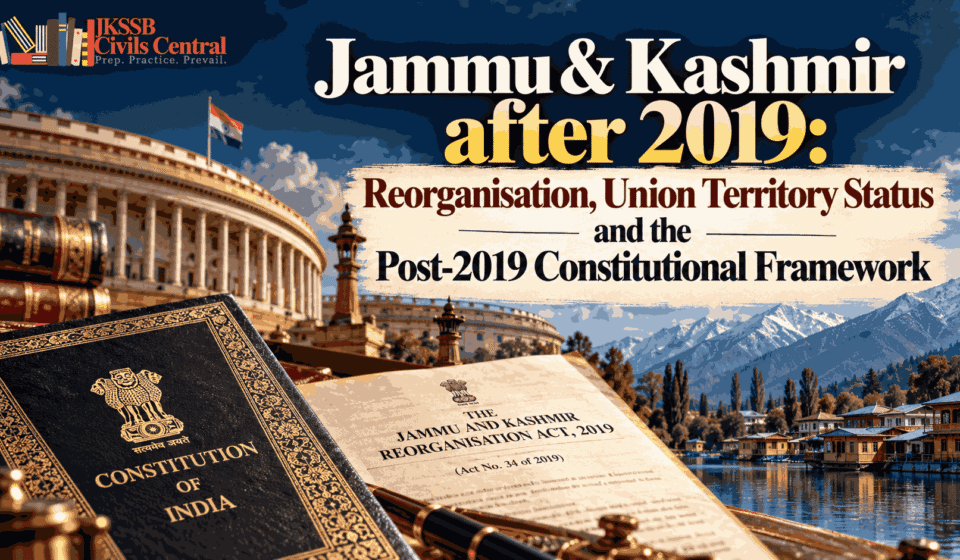
Jammu & Kashmir after 2019: Reorganisation, Union Territory Status and the Post-2019 Constitutional Framework

J&K History Series Navigation
| Previous Article | Current Article | Next Article |
|---|---|---|
| ← Article 49: Jammu & Kashmir after 1947: Political and Constitutional Developments up to 2019 | Article 50: Jammu & Kashmir after 2019: Reorganisation, Union Territory Status and the Post-2019 Constitutional Framework | End of Series — Article 50 |
Learning Dashboard
| Category | Key Information |
|---|---|
| Historical Period | 2019 onwards |
| Historical Phase | Post-2019 Constitutional & Administrative Reorganisation |
| Core Theme | Constitutional transformation, Union Territory status and new governance structure |
| Major Constitutional Development | Constitutional Orders C.O. 272 and C.O. 273 |
| Major Statute | Jammu and Kashmir Reorganisation Act, 2019 |
| Date of Reorganisation | 31 October 2019 |
| Successor Units | Union Territory of Jammu & Kashmir and Union Territory of Ladakh |
| J&K UT Status | Union Territory with a Legislative Assembly |
| Ladakh UT Status | Union Territory without a Legislative Assembly |
| Key Institution | Lieutenant Governor |
| Key Constitutional Provision | Article 239A, as applied to J&K through the Reorganisation Act |
| Important Judicial Development | Supreme Court judgment in In Re: Article 370, 11 December 2023 |
| Common High Court | High Court of Jammu & Kashmir and Ladakh |
| JKSSB Importance | Extremely High |
| Expected Question Types | Chronology, statement-based, constitutional provisions, matching, correct/incorrect pairs, conceptual-factual |
Introduction
The year 2019 marks a fundamental constitutional and administrative transition in the history of Jammu and Kashmir. The change was not simply a change of government or an alteration of one constitutional provision. It involved two connected developments: the transformation of the constitutional position of Jammu and Kashmir through Presidential Orders issued in August 2019, and the reorganisation of the former State of Jammu and Kashmir into two Union Territories under the Jammu and Kashmir Reorganisation Act, 2019.
The first major step occurred on 5 August 2019, when the President issued the Constitution (Application to Jammu and Kashmir) Order, 2019, C.O. 272. The Order superseded the earlier 1954 Presidential Order and provided for the application of the provisions of the Constitution of India to Jammu and Kashmir, subject to the modifications specified in the Order. Among other things, it inserted a new clause into Article 367 for purposes of interpreting the Constitution as it applied to J&K. The following day, C.O. 273 declared that all clauses of Article 370 would cease to operate except a modified form of Article 370(1), under which the provisions of the Constitution of India would apply to Jammu and Kashmir without the earlier modifications and exceptions.
The second major development was legislative. Parliament enacted the Jammu and Kashmir Reorganisation Act, 2019, which received Presidential assent on 9 August 2019. The Act reorganised the existing State into two Union Territories: Jammu and Kashmir, with a Legislative Assembly, and Ladakh, without a Legislative Assembly. The appointed day for the reorganisation was 31 October 2019.
The post-2019 framework therefore represents a change from a State with its own Constitution and distinctive constitutional arrangements to a Union Territory framework operating primarily under the Constitution of India and Parliamentary legislation. Understanding this transformation requires careful distinction between Article 370, Article 35A, the Constitution of Jammu and Kashmir, the Reorganisation Act, the role of the Lieutenant Governor, the powers of the Legislative Assembly and the continuing constitutional authority of Parliament.
CivilsCentral Historical Insight
The importance of 2019 lies in the interaction of constitutional transformation and territorial reorganisation. Article 370 concerned the constitutional relationship between J&K and India, while the Reorganisation Act altered the territorial and institutional structure of governance. These were connected developments, but they were not legally identical measures.
Part I — The Political and Constitutional Background to 2019
The constitutional transformation of 2019 did not occur in isolation. By the middle of 2018, Jammu and Kashmir had entered another period of direct central administration. The PDP–BJP coalition had collapsed in June 2018, the Legislative Assembly was subsequently dissolved, and President’s Rule was imposed in December 2018. Thus, when the constitutional measures of August 2019 were introduced, the state did not have an elected government functioning through its Legislative Assembly.
The pre-2019 constitutional structure was also the product of a long historical evolution. Article 370 had provided the original constitutional mechanism through which provisions of the Indian Constitution were applied to Jammu and Kashmir with specified exceptions and modifications. Over the decades, successive Presidential Orders extended many provisions of the Indian Constitution to the state. The Constitution of Jammu and Kashmir, adopted in 1956 and brought into force in 1957, operated alongside this framework.
By 2019, therefore, J&K possessed a constitutional structure substantially different from that of other Indian States. It had its own Constitution, its own constitutional terminology and a distinctive relationship with the Union. The events of August 2019 fundamentally altered that arrangement.
CivilsCentral Historical Insight
The 2019 changes should be understood against the long constitutional evolution described in Articles 47–49. The transformation was therefore a culmination of a decades-long constitutional history, not an isolated administrative event.
Part II — Constitutional Order of 5 August 2019: C.O. 272
The Constitution (Application to Jammu and Kashmir) Order, 2019
On 5 August 2019, the President issued C.O. 272, formally titled the Constitution (Application to Jammu and Kashmir) Order, 2019.
The Order was issued under Article 370(1) of the Constitution of India. It superseded the Constitution (Application to Jammu and Kashmir) Order, 1954, as amended from time to time.
Its central effect was to provide that all provisions of the Constitution of India, as amended from time to time, would apply in relation to Jammu and Kashmir, subject to the modifications specified in the Order.
This was constitutionally significant because the earlier system had involved selective application of constitutional provisions through Presidential Orders.
Modification of Article 367
One of the most important features of C.O. 272 was the insertion of a new clause into Article 367, the constitutional provision dealing with interpretation.
For purposes of the Constitution as it applied to Jammu and Kashmir, references to:
- the Constitution of India;
- the Government of Jammu and Kashmir;
- the Sadar-i-Riyasat;
- and the Constituent Assembly of Jammu and Kashmir
were given modified meanings under the Order.
In particular, the reference in Article 370 to the “Constituent Assembly of the State” was directed to be read as “Legislative Assembly of the State”.
This modification became central to the subsequent constitutional process because the original J&K Constituent Assembly had ceased to exist in 1957.
CivilsCentral Historical Insight
C.O. 272 was important not merely because it extended constitutional provisions. Its modification of Article 367 became part of the legal mechanism through which the Government of India proceeded toward the subsequent declaration concerning Article 370.
Part III — Constitutional Order of 6 August 2019: C.O. 273
Declaration under Article 370(3)
On 6 August 2019, the President issued C.O. 273, formally giving effect to the declaration under Article 370(3).
The declaration stated that, from 6 August 2019, all clauses of Article 370 would cease to be operative except clause (1), which itself was substituted by a new formulation providing for the application of all provisions of the Constitution of India to Jammu and Kashmir without modifications or exceptions.
This had a fundamental constitutional consequence. The earlier special constitutional mechanism through which the Constitution of India was applied to J&K ceased to operate in its previous form.
The effect was not simply that one provision disappeared from the constitutional text. The entire architecture of constitutional exceptions and modifications that had developed through Article 370 was transformed.
Article 35A
Article 35A had been introduced through the 1954 Presidential Order and had provided constitutional protection for certain laws relating to permanent residents and associated rights.
With the 2019 constitutional changes and the replacement of the earlier constitutional application framework, Article 35A ceased to operate as part of the previous constitutional arrangement.
This distinction is important:
Article 370
→ constitutional mechanism governing the application of the Indian Constitution to J&K.
Article 35A
→ provision introduced through the 1954 Presidential Order concerning special rights and privileges of permanent residents.
They were therefore related but not identical constitutional provisions.
Part IV — The Jammu and Kashmir Reorganisation Act, 2019
Enactment
The Jammu and Kashmir Reorganisation Act, 2019 was enacted by Parliament as Act No. 34 of 2019. It received Presidential assent on 9 August 2019.
Its long title stated that it was an Act to provide for the reorganisation of the existing State of Jammu and Kashmir and for matters connected with or incidental to that reorganisation.
The Act created two successor Union Territories:
Union Territory of Jammu and Kashmir
With a Legislative Assembly
Union Territory of Ladakh
Without a Legislative Assembly
The Act came into operation on the appointed day, 31 October 2019.
Part V — Creation of the Union Territory of Ladakh
Section 3 of the Reorganisation Act provided for the creation of the Union Territory of Ladakh without a Legislature. The new Union Territory comprised the Leh and Kargil districts of the former State. The creation of Ladakh as a separate Union Territory responded to a longstanding demand for a distinct administrative arrangement for the region.
The important examination distinction is therefore:
Ladakh
→ Union Territory
→ No Legislative Assembly
whereas:
Jammu and Kashmir
→ Union Territory
→ Legislative Assembly provided by law
The two territories therefore did not receive identical institutional structures.
CivilsCentral Historical Insight
The 2019 reorganisation did not simply divide the old state into two administratively equal units. It created two different constitutional-administrative models: J&K as a Union Territory with a legislature and Ladakh as a Union Territory without one.
Part VI — Creation of the Union Territory of Jammu and Kashmir
Section 4 of the Reorganisation Act created the Union Territory of Jammu and Kashmir with a Legislative Assembly. Its territory consisted of the former State of Jammu and Kashmir other than the territories forming the new Union Territory of Ladakh.
The transformation therefore altered both the political status and territorial structure of the former state. The former State was no longer represented in the First Schedule of the Constitution as a State. Instead, the Reorganisation Act provided for Jammu and Kashmir and Ladakh to be listed among the Union Territories.
This represented one of the most significant territorial changes in the constitutional history of J&K.
Part VII — 31 October 2019: The New Constitutional Order Comes into Operation
Although the major constitutional announcements occurred in August 2019, the territorial reorganisation itself took effect on 31 October 2019, the appointed day specified under the Reorganisation Act.
The date is therefore particularly important for examination purposes.
5 August 2019
→ C.O. 272
6 August 2019
→ C.O. 273
9 August 2019
→ Presidential assent to Reorganisation Act
31 October 2019
→ Reorganisation Act comes into effect
→ State becomes two Union Territories
→ J&K becomes UT with Legislature
→ Ladakh becomes UT without Legislature
The first Lieutenant Governors of the two new Union Territories also assumed office on 31 October 2019. Girish Chandra Murmu became the first Lieutenant Governor of J&K, while Radha Krishna Mathur became the first Lieutenant Governor of Ladakh.
CivilsCentral Historical Insight
A common examination error is to treat 5 August 2019 and 31 October 2019 as the same event. They were not. August marked the major constitutional orders; 31 October marked the commencement of the territorial reorganisation and the new Union Territory structure.
Part VIII — The Constitutional Structure of the Union Territory of Jammu and Kashmir
Article 239A
The Reorganisation Act applied Article 239A of the Constitution of India to Jammu and Kashmir.
Article 239A provides the constitutional basis for Parliament to create a legislature and Council of Ministers for certain Union Territories.
Section 13 of the Reorganisation Act extended the provisions of Article 239A applicable to Puducherry to the Union Territory of Jammu and Kashmir.
This is an important distinction from the earlier State framework.
Before 2019:
J&K State
→ governed through Part VI arrangements applicable to States
→ own Constitution
→ distinctive Article 370 framework.
After 2019:
J&K Union Territory
→ governed under Part VIII of the Constitution
→ Legislature created through Parliamentary legislation
→ Article 239A applied through the Reorganisation Act.
The Legislative Assembly of the new Union Territory therefore derives its constitutional and statutory basis from the Union Territory framework, rather than from the former Constitution of Jammu and Kashmir.
Part IX — Legislative Assembly of the Union Territory
The Reorganisation Act created a Legislative Assembly for Jammu and Kashmir. The Assembly is therefore not equivalent in constitutional position to the Legislature of an ordinary Indian State. Its existence and powers are determined through the Constitution of India and the Jammu and Kashmir Reorganisation Act.
This distinction is particularly important because the word “Assembly” appears in both the earlier State system and the post-2019 Union Territory system, but the constitutional foundations are different.
Legislative Powers
Section 32 of the Reorganisation Act provides that the Legislative Assembly may legislate on matters in the State List, except:
- Entry 1 — Public Order
- Entry 2 — Police
It may also legislate on applicable matters in the Concurrent List.
At the same time, Parliament retains the power to legislate for the Union Territory.
This creates a major institutional distinction from the pre-2019 State system.
High-Value Examination Point
J&K Legislative Assembly
→ can legislate on State List subjects except Public Order and Police
→ can legislate on applicable Concurrent List subjects
→ Parliament retains legislative power for the Union Territory.
CivilsCentral Historical Insight
The post-2019 Assembly represents representative government within a Union Territory framework, not the legislature of a State. The distinction is essential for understanding the relative constitutional positions of the Assembly, Parliament and the Lieutenant Governor.
Part X — The Lieutenant Governor
The Lieutenant Governor became the central constitutional office in the post-2019 administrative structure.
Under the Reorganisation Act, the Union Territory is administered by the President through a Lieutenant Governor appointed under Article 239.
The Lieutenant Governor therefore occupies a constitutionally different position from the Governor of a State.
This distinction is fundamental:
Governor of a State
→ constitutional head of a State government operating within the federal structure.
Lieutenant Governor of a Union Territory
→ administrator appointed by the President under the Union Territory framework.
In J&K, the presence of an elected Legislative Assembly and Council of Ministers creates a mixed institutional arrangement: representative government exists, but the Union retains a stronger constitutional role than it does in an ordinary State.
Part XI — Council of Ministers and Chief Minister
The Reorganisation Act provides for a Council of Ministers headed by the Chief Minister.
The Council is intended to aid and advise the Lieutenant Governor in matters within the legislative competence of the Assembly, subject to areas in which the Lieutenant Governor is required to exercise discretion.
Section 53 provides that the Council of Ministers shall consist of not more than 10 per cent of the total number of members of the Legislative Assembly. It also identifies circumstances in which the Lieutenant Governor acts in discretion, including matters outside the Assembly’s legislative competence and matters specifically assigned to the Lieutenant Governor’s discretion.
The Act also specifically refers to matters concerning:
- All India Services;
- Anti-Corruption Bureau;
- areas outside the Assembly’s competence;
- judicial or quasi-judicial functions.
The constitutional relationship between the elected Council of Ministers and the Lieutenant Governor is therefore an important feature of the post-2019 system.
Part XII — Financial Powers and the Legislative Assembly
The Reorganisation Act contains special provisions concerning financial legislation.
Under Section 36, certain financial Bills or amendments cannot be introduced or moved in the Assembly without the recommendation of the Lieutenant Governor.
These include matters relating to:
- taxation;
- financial obligations of the Union Territory;
- appropriation from the Consolidated Fund;
- expenditure charged on the Consolidated Fund;
- receipt, custody and issue of public funds.
A Bill involving expenditure from the Consolidated Fund of the Union Territory also requires the Lieutenant Governor’s recommendation before it can be passed.
This illustrates that the post-2019 Legislative Assembly operates within a constitutional framework in which the Lieutenant Governor has significant financial and administrative authority.
Part XIII — Parliament and the J&K Legislature
One of the most important features of the new constitutional framework is the continuing legislative authority of Parliament. Unlike an ordinary State, where Parliament’s power is constitutionally distributed through the Union, State and Concurrent Lists, a Union Territory remains more directly connected to Parliament.
For J&K, Section 32 expressly preserves Parliament’s power to legislate for the Union Territory. Consequently, the existence of a Legislative Assembly does not eliminate Parliament’s legislative authority over J&K.
This is one of the clearest distinctions between: Statehood and Union Territory with Legislature.
CivilsCentral Historical Insight
The post-2019 arrangement is best understood as legislative representation within a Union-controlled constitutional framework. The Assembly has substantial legislative functions, but Parliament’s authority over the Union Territory remains constitutionally significant.
Part XIV — What Happened to the Constitution of Jammu and Kashmir?
The Constitution of Jammu and Kashmir had served as the state’s internal constitutional framework since 1957.
After the 2019 constitutional changes, however, the entire Constitution of India became applicable to Jammu and Kashmir without the earlier constitutional exceptions and modifications.
The Supreme Court in its 2023 judgment explained that the Constitution of Jammu and Kashmir no longer served a constitutional function after the application of the Constitution of India in its entirety and therefore became inoperative.
This is an important terminology point.
It is safer to say: The Constitution of Jammu and Kashmir became inoperative
rather than casually stating that it was simply “repealed by the Reorganisation Act.”
The legal consequence arose from the transformation of the constitutional framework, while the Supreme Court’s judgment provides the authoritative judicial explanation of its resulting status.
Part XV — What Happened to the Earlier Permanent Resident Framework?
The earlier J&K constitutional system contained special provisions concerning permanent residents and associated rights. Article 35A, introduced through the 1954 Presidential Order, had provided constitutional protection for laws concerning permanent residents.
After the 2019 constitutional transformation, this special constitutional framework ceased to operate.
The significance was broader than terminology. The post-2019 constitutional order no longer preserved the earlier constitutional distinction between permanent residents of J&K and other citizens in the manner associated with Article 35A.
The precise statutory consequences for land, employment and other matters were subsequently addressed through legislative and administrative changes. These later developments belong to the broader post-2019 legal transition and should not be confused with the August 2019 constitutional orders themselves.
CivilsCentral Historical Insight
Article 35A should be remembered as part of the earlier constitutional framework, not as an independent constitutional arrangement created in 2019. Its cessation was a consequence of the transformation of the earlier Article 370-based constitutional structure.
Part XVI — The Legislative Council
The former State of Jammu and Kashmir had possessed a bicameral legislature, consisting of:
- Legislative Assembly
- Legislative Council.
The Reorganisation Act abolished the Legislative Council.
Section 57 provided that, from the appointed day, the Legislative Council of the existing State would stand abolished and its members would cease to hold membership. Bills pending before the Council would also lapse.
The post-2019 J&K legislative structure therefore became unicameral.
Before 2019
Legislative Assembly
↓
Legislative Council
After 2019
Legislative Assembly only
This is a straightforward but important JKSSB distinction.
Part XVII — The Common High Court
The reorganisation did not create two separate High Courts.
Section 75 of the Reorganisation Act provided that the existing High Court of Jammu and Kashmir would become the common High Court for the Union Territories of Jammu and Kashmir and Ladakh. The judges serving in the existing High Court continued as judges of the common High Court.
This created another distinctive institutional arrangement.
J&K
Union Territory with Legislature
Ladakh
Union Territory without Legislature
Judiciary
Common High Court of Jammu and Kashmir and Ladakh
The common High Court therefore serves both successor Union Territories.
CivilsCentral Historical Insight
Territorial reorganisation did not automatically mean complete institutional separation. The common High Court demonstrates that some institutions were retained and adapted for both successor Union Territories.
Part XVIII — Representation in Parliament
The Reorganisation Act also altered parliamentary representation. The former State’s representation had to be redistributed between the successor Union Territories. The Act provided for the allocation of parliamentary seats and consequential amendments to the relevant constitutional schedules.
This was necessary because the constitutional identity of the territory had changed from one State to two Union Territories. The change therefore affected not only local administration but also representation in the national legislature.
For examination purposes, candidates should distinguish:
State reorganisation
→ affects territorial status
Legislative reorganisation
→ affects Assembly structure
Parliamentary representation
→ requires corresponding adjustment in Lok Sabha and Rajya Sabha representation.
Part XIX — Delimitation and the New Electoral Framework
The Reorganisation Act also provided for changes concerning electoral constituencies and made the Delimitation Act, 2002 applicable to the new Union Territory framework. The Act contained provisions concerning the readjustment of parliamentary and Assembly constituencies and the role of the Delimitation Commission.
This represented another institutional transition because the electoral map had to be reconstructed for the new constitutional arrangement.
The important distinction is:
2019
→ legal framework for reorganisation and delimitation established.
Subsequent delimitation process
→ later implementation under the statutory framework.
The two should not be treated as one event.
Part XX — Administrative Continuity and Legal Transition
A constitutional transformation of this scale could not immediately replace every existing law and administrative institution. The Reorganisation Act therefore contained extensive transitional provisions. Existing laws, institutions, officers, courts, authorities, liabilities and administrative arrangements had to be adapted to the new Union Territory framework.
The Central Government was also given powers to make necessary adaptations and modifications to laws in order to facilitate their application to the successor Union Territories.
This created a continuity-and-transition model:
Old State institutions and laws
↓
Adaptation / continuation / modification
↓
New Union Territory framework
This prevented an immediate legal vacuum.
CivilsCentral Historical Insight
Constitutional reorganisation does not mean that every existing law disappears overnight. Large-scale constitutional transitions depend upon legal continuity, adaptation and transitional provisions to preserve governance while the new institutional structure is established.
Part XXI — President’s Rule and the Transition to Union Territory Administration
An important constitutional transition occurred concerning direct central administration. President’s Rule under Article 356 had been imposed in the former State in December 2018. With the commencement of the Reorganisation Act on 31 October 2019, the former State ceased to exist as a State. Consequently, the previous Article 356 framework relating to the State ceased to operate.
A separate statutory mechanism under Section 73 of the Reorganisation Act was used for the new Union Territory of Jammu and Kashmir because its Legislative Assembly was not then functioning.
This distinction is important:
Article 356 President’s Rule in the former State ≠ post-reorganisation administration under the Union Territory framework.
The Union Government itself explained that Article 356 was revoked on 31 October 2019 and a separate order under Section 73 was issued for the Union Territory to avoid a constitutional vacuum while no Legislative Assembly was in existence.
Part XXII — The First Lieutenant Governors
The creation of the Union Territories required a new administrative hierarchy.
On 31 October 2019:
Girish Chandra Murmu
→ first Lieutenant Governor of Jammu and Kashmir.
Radha Krishna Mathur
→ first Lieutenant Governor of Ladakh.
Their assumption of office symbolised the transition from the Governor-led State administration to the new Lieutenant Governor-led Union Territory structure.
This provides a useful examination distinction:
Governor
→ former State of Jammu and Kashmir
Lieutenant Governor
→ post-2019 Union Territories.
Part XXIII — Supreme Court and the Constitutional Interpretation of 2019
The constitutional changes of 2019 were challenged before the Supreme Court of India.
A Constitution Bench delivered its judgment in December 2023 in In Re: Article 370 of the Constitution.
The judgment upheld the constitutional validity of the 2019 process concerning the inoperability of Article 370. It also held that the Constitution of Jammu and Kashmir had become inoperative once the Constitution of India applied to the state in its entirety.
The Court also addressed the Reorganisation Act.
It upheld the creation of the Union Territory of Ladakh. With regard to the conversion of the former State of Jammu and Kashmir into Union Territories, the Court did not finally adjudicate the substantive question in the same manner because the Union had stated that J&K’s statehood would be restored, except for the carving out of Ladakh. The Court directed that steps be taken for Assembly elections by 30 September 2024 and stated that restoration of statehood should take place at the earliest and as soon as possible.
This judgment therefore forms an important part of the post-2019 constitutional interpretation.
CivilsCentral Historical Insight
The 2023 Supreme Court judgment is important because it separates two questions that are often mixed together: the constitutional validity of the 2019 Article 370 changes and the more specific constitutional question concerning the conversion of a State into Union Territories. The Court upheld Ladakh’s creation as a Union Territory while leaving the broader question of extinguishing statehood open in the context of the Union’s assurance of restoration.
Part XXIV — Statehood and Union Territory Status: An Important Distinction
The constitutional status of Jammu and Kashmir after 2019 should be understood precisely.
Before 31 October 2019
State of Jammu and Kashmir
→ State legislature
→ Governor
→ State constitutional framework
→ distinctive Article 370-based constitutional arrangements.
From 31 October 2019
Union Territory of Jammu and Kashmir
→ Legislative Assembly provided by Parliament
→ Lieutenant Governor
→ Constitution of India as the governing constitutional framework
→ Article 239A framework
→ no separate State Constitution.
At the same time:
Union Territory of Ladakh
→ no Legislative Assembly
→ Lieutenant Governor
→ direct Union Territory administration.
This distinction is central to understanding the post-2019 order.
Part XXV — Federalism and the Post-2019 Structure
The 2019 transformation also altered the federal position of Jammu and Kashmir. The former state had been a constituent State of the Indian Union, although with distinctive constitutional arrangements. After reorganisation, Jammu and Kashmir became a Union Territory. This changed the distribution of political authority.
The post-2019 system gives the Union a stronger institutional role through:
- the Lieutenant Governor;
- Parliament’s continuing legislative authority;
- the Union Territory framework under Part VIII;
- exclusion of Public Order and Police from the Assembly’s legislative competence;
- special provisions concerning financial legislation;
- Union control over areas outside the Assembly’s legislative competence.
The system nevertheless retains an elected legislature and Council of Ministers.
Therefore, it would be inaccurate to describe the post-2019 J&K simply as either:
“direct central rule with no representative institutions” or “equivalent to a full-fledged State.”
It is constitutionally a Union Territory with a legislature.
CivilsCentral Historical Insight
The post-2019 constitutional structure occupies an intermediate institutional position: it retains representative political institutions, but those institutions operate within a Union Territory framework in which the Union exercises greater constitutional authority than in a State.
Part XXVI — Jammu and Kashmir and Ladakh: The Institutional Comparison
| Feature | Former State of J&K | UT of Jammu & Kashmir | UT of Ladakh |
|---|---|---|---|
| Constitutional status | State | Union Territory | Union Territory |
| Legislature | Legislative Assembly + Council | Legislative Assembly | No Legislative Assembly |
| Executive head | Governor | Lieutenant Governor | Lieutenant Governor |
| Council of Ministers | State Council | Provided by Reorganisation Act | No elected Council of Ministers |
| Separate Constitution | J&K Constitution | No separate State Constitution | No separate Constitution |
| Article 370 framework | Applicable before 2019 | Earlier framework no longer operative | Earlier framework no longer operative |
| Legislative basis | State constitutional structure | Article 239A + Reorganisation Act | Union Territory framework |
| Public Order | State legislative competence | Outside Assembly’s competence | Union-administered |
| Police | State legislative competence | Outside Assembly’s competence | Union-administered |
| High Court | J&K High Court | Common High Court | Common High Court |
| Reorganisation date | — | 31 October 2019 | 31 October 2019 |
Part XXVII — What Changed Institutionally?
The transformation can be understood through a simple institutional comparison.
Constitutional Framework
Before
Constitution of India
+
Article 370
+
Constitution of J&K
After
Constitution of India
+
Union Territory framework
+
J&K Reorganisation Act
Executive
Before
Governor
↓
Chief Minister
↓
Council of Ministers
After
Lieutenant Governor
↕
Chief Minister + Council of Ministers
within the statutory Union Territory framework.
Legislature
Before
Legislative Assembly
+
Legislative Council
After
Legislative Assembly only.
Judiciary
Before
High Court of J&K
After
Common High Court for J&K and Ladakh.
Territorial Structure
Before
One State of Jammu and Kashmir
After
Two Union Territories:
Jammu and Kashmir
Ladakh
Part XXVIII — Political and Historical Significance
The first significance of the 2019 transformation is constitutional. It ended the earlier constitutional arrangement under which Jammu and Kashmir possessed a distinctive mechanism for the application of the Constitution of India.
The second significance is territorial. The former State was reorganised into two Union Territories, separating Ladakh from the remainder of the territory administered by India as the former State.
The third significance is institutional. J&K ceased to have the constitutional status of a State and instead received a Legislative Assembly under the Union Territory framework. Ladakh, by contrast, was established without a legislature.
The fourth significance is administrative. The Lieutenant Governor became the central executive authority, while the elected Council of Ministers operates within powers defined by Parliamentary legislation.
The fifth significance is constitutional jurisprudential. The Supreme Court’s 2023 judgment became an important authoritative interpretation of the 2019 measures, including the status of Article 370 and the Constitution of Jammu and Kashmir.
The sixth significance is historical. The 2019 transformation marked the endpoint of the constitutional trajectory that had begun with accession, evolved through Article 370, the J&K Constitution and decades of Centre–State negotiations, and culminated in a new Union Territory structure.
CivilsCentral Historical Insight
The historical significance of 2019 cannot be reduced to the phrase “Article 370 was removed.” The transformation simultaneously involved constitutional application, territorial reorganisation, institutional restructuring, administrative transition and a new relationship between representative institutions and Union authority.
Part XXIX — Historical Interpretation and Evidence Note
The events of 2019 are politically contested and have generated sharply different interpretations.
Some interpretations emphasise:
- constitutional integration;
- uniform application of the Indian Constitution;
- administrative restructuring;
- development and security considerations;
- removal of constitutional distinctions.
Other interpretations emphasise:
- loss of statehood;
- reduction of the earlier autonomy framework;
- centralisation of political authority;
- concerns regarding federalism;
- the political and social consequences of the transition.
For historical study, these interpretations should be distinguished from the underlying legal chronology.
Established Constitutional Sequence
The following are documentary facts:
5 August 2019
→ C.O. 272.
6 August 2019
→ C.O. 273.
9 August 2019
→ Reorganisation Act receives Presidential assent.
31 October 2019
→ Reorganisation comes into effect.
31 October 2019
→ J&K becomes a Union Territory with Legislature.
31 October 2019
→ Ladakh becomes a Union Territory without Legislature.
December 2023
→ Supreme Court delivers judgment concerning the constitutional challenges to the 2019 measures.
Interpretation
Whether the transformation should be understood primarily as integration, centralisation, federal restructuring, administrative reorganisation or a combination of these is a matter of political and constitutional interpretation.
A history article should therefore distinguish:
What the legal instruments did from How different political traditions interpret their significance.
Part XXX — Important Constitutional Distinctions
Article 370 vs Article 35A
Article 370
→ constitutional mechanism for the application of the Indian Constitution to J&K.
Article 35A
→ provision introduced through the 1954 Presidential Order concerning special rights and privileges associated with permanent residents.
They are related but not interchangeable.
C.O. 272 vs C.O. 273
C.O. 272 — 5 August 2019
→ Constitution (Application to Jammu and Kashmir) Order, 2019.
C.O. 273 — 6 August 2019
→ declaration making Article 370 inoperative except for the modified Article 370(1).
5 August vs 31 October
5 August 2019
→ major constitutional order.
31 October 2019
→ Reorganisation Act comes into effect.
State vs Union Territory
State
→ constitutional status under Part VI.
Union Territory
→ constitutional framework primarily under Part VIII.
Governor vs Lieutenant Governor
Governor
→ constitutional head of a State.
Lieutenant Governor
→ administrator appointed by the President for a Union Territory.
State Legislature vs UT Legislature
The J&K Legislative Assembly after 2019 is not the legislature of a State. Its powers derive from the Union Territory framework established through Parliamentary legislation.
Part XXXI — JKSSB Knowledge Matrix
| Question Component | High-Value Knowledge |
|---|---|
| C.O. 272 | 5 August 2019 |
| C.O. 273 | 6 August 2019 |
| Reorganisation Act | Act No. 34 of 2019 |
| Presidential assent to Act | 9 August 2019 |
| Appointed day | 31 October 2019 |
| J&K status after 2019 | UT with Legislature |
| Ladakh status after 2019 | UT without Legislature |
| Article applied to J&K through Section 13 | Article 239A |
| Assembly cannot legislate on | Public Order and Police |
| Former Legislative Council | Abolished |
| Separate J&K Constitution | Became inoperative |
| Common High Court | J&K and Ladakh |
| First J&K LG | Girish Chandra Murmu |
| First Ladakh LG | Radha Krishna Mathur |
| Supreme Court Article 370 judgment | 11 December 2023 |
| SC direction on Assembly elections | By 30 September 2024 |
| SC statement on statehood | Restore at earliest and as soon as possible |
Part XXXII — Examination Discrimination Points
1. 5 August vs 6 August 2019
5 August
→ C.O. 272.
6 August
→ C.O. 273.
2. August vs October 2019
The constitutional orders were issued in August. The territorial reorganisation took effect on 31 October 2019.
3. J&K vs Ladakh
J&K
→ UT with Legislature.
Ladakh
→ UT without Legislature.
4. Article 239A vs Article 239AA
Article 239A
→ relevant to the legislative framework of J&K UT through the Reorganisation Act.
Article 239AA
→ special constitutional provision for the National Capital Territory of Delhi.
Do not confuse them.
5. Public Order vs Police
Both are excluded from the legislative competence of the J&K Legislative Assembly under Section 32.
Entry 1 — Public Order
Entry 2 — Police
6. Former Council vs New Assembly
The former State had: Legislative Assembly + Legislative Council
The post-2019 J&K framework provides: Legislative Assembly only
7. Governor vs Lieutenant Governor
The former State had a Governor. The Union Territory is administered through a Lieutenant Governor.
8. J&K Constitution vs Constitution of India
The former J&K Constitution became inoperative after the 2019 constitutional transformation. The governing constitutional framework is now the Constitution of India together with the Parliamentary statutory framework applicable to the Union Territory.
Part XXXIII — JKSSB Question-Type Mapping
Direct Fact
- When was C.O. 272 issued?
- When did the Reorganisation Act come into force?
- Which Union Territory was created without a legislature?
- Which article was applied to J&K through Section 13 of the Reorganisation Act?
Statement-Based
Candidates can be tested on:
- C.O. 272 and C.O. 273;
- J&K versus Ladakh;
- Article 239A;
- Assembly powers;
- Lieutenant Governor;
- common High Court.
Chronology
A high-value sequence is:
C.O. 272 → C.O. 273 → Reorganisation Act → 31 October 2019
Match the Following
| Item | Association |
|---|---|
| C.O. 272 | 5 August 2019 |
| C.O. 273 | 6 August 2019 |
| Reorganisation Act | Act 34 of 2019 |
| Appointed Day | 31 October 2019 |
| Article 239A | J&K UT Legislature |
| Section 32 | Legislative powers |
| Section 57 | Abolition of Legislative Council |
| Section 75 | Common High Court |
Identification by Clues
Identify the constitutional development:
- issued on 5 August 2019;
- superseded the 1954 Presidential Order;
- applied the Constitution of India to J&K with specified modifications.
→ C.O. 272
Part XXXIV — JKSSB Practice Questions
Q1. The Constitution (Application to Jammu and Kashmir) Order, 2019 was issued on:
A. 5 August 2019
B. 6 August 2019
C. 9 August 2019
D. 31 October 2019
Correct Answer: A
Explanation: C.O. 272 was issued on 5 August 2019.
Q2. C.O. 273 is associated with:
A. Creation of Ladakh as a Union Territory
B. Application of the J&K Reorganisation Act
C. Declaration concerning the operation of Article 370
D. Establishment of the common High Court
Correct Answer: C
Explanation: C.O. 273, issued on 6 August 2019, declared that the clauses of Article 370 would cease to operate except the modified Article 370(1).
Q3. The Jammu and Kashmir Reorganisation Act, 2019 received Presidential assent on:
A. 5 August 2019
B. 6 August 2019
C. 9 August 2019
D. 31 October 2019
Correct Answer: C
Explanation: The Act received Presidential assent on 9 August 2019.
Q4. The appointed day under the Jammu and Kashmir Reorganisation Act, 2019 was:
A. 5 August 2019
B. 9 August 2019
C. 26 October 2019
D. 31 October 2019
Correct Answer: D
Explanation: The reorganisation came into effect on 31 October 2019.
Q5. Which of the following correctly describes the two Union Territories created in 2019?
A. J&K without Legislature; Ladakh with Legislature
B. J&K with Legislature; Ladakh without Legislature
C. Both with Legislatures
D. Both without Legislatures
Correct Answer: B
Explanation: The Reorganisation Act created J&K as a Union Territory with a Legislative Assembly and Ladakh as a Union Territory without a Legislative Assembly.
Q6. Article 239A became applicable to the Union Territory of Jammu and Kashmir through:
A. Article 370
B. Section 13 of the Reorganisation Act
C. Section 57 of the Reorganisation Act
D. Article 356
Correct Answer: B
Explanation: Section 13 of the Reorganisation Act applied Article 239A to the Union Territory of Jammu and Kashmir.
Q7. Consider the following statements:
- The J&K Legislative Assembly can legislate on Public Order.
- The J&K Legislative Assembly can legislate on Police.
- The J&K Legislative Assembly can legislate on applicable Concurrent List subjects.
- Parliament retains legislative power for the Union Territory.
Which of the above are correct?
A. 1 and 2 only
B. 3 and 4 only
C. 1, 3 and 4 only
D. All four
Correct Answer: B
Explanation: Public Order and Police are excluded from the Assembly’s legislative competence under Section 32. The Assembly can legislate on applicable Concurrent List matters, while Parliament retains legislative power.
Q8. Which institution became the common High Court for Jammu and Kashmir and Ladakh after reorganisation?
A. Delhi High Court
B. Punjab and Haryana High Court
C. High Court of Jammu and Kashmir
D. Supreme Court of India
Correct Answer: C
Explanation: Section 75 made the existing High Court of Jammu and Kashmir the common High Court for both Union Territories.
Q9. Arrange the following chronologically:
- C.O. 273
- Presidential assent to Reorganisation Act
- C.O. 272
- Commencement of reorganisation
A. 3–1–2–4
B. 1–3–2–4
C. 3–2–1–4
D. 2–3–1–4
Correct Answer: A
Explanation: C.O. 272 — 5 August; C.O. 273 — 6 August; assent — 9 August; reorganisation — 31 October 2019.
Q10. Which of the following was abolished by the Jammu and Kashmir Reorganisation Act?
A. Legislative Assembly
B. Legislative Council
C. High Court
D. Lok Sabha representation
Correct Answer: B
Explanation: The former State Legislative Council was abolished under Section 57.
Q11. Which pair is correctly matched?
A. C.O. 272 — 31 October 2019
B. C.O. 273 — 5 August 2019
C. Section 32 — Legislative powers of J&K Assembly
D. Section 75 — Creation of Ladakh
Correct Answer: C
Explanation: Section 32 concerns the legislative competence of the J&K Legislative Assembly.
Q12. Consider the following statements:
- Jammu and Kashmir became a Union Territory with a Legislative Assembly.
- Ladakh became a Union Territory without a Legislative Assembly.
- The Constitution of Jammu and Kashmir continued as the governing constitution after 2019.
- The former State Legislative Council was abolished.
Which are correct?
A. 1, 2 and 4 only
B. 1 and 3 only
C. 2 and 3 only
D. All four
Correct Answer: A
Explanation: Statements 1, 2 and 4 are correct. The Constitution of Jammu and Kashmir became inoperative following the 2019 constitutional transformation.
Part XXXV — Rapid Revision Zone
Important Dates
| Date | Development |
|---|---|
| 5 August 2019 | C.O. 272 issued |
| 6 August 2019 | C.O. 273 issued |
| 9 August 2019 | Reorganisation Act received Presidential assent |
| 31 October 2019 | Reorganisation came into effect |
| 31 October 2019 | J&K became UT with Legislature |
| 31 October 2019 | Ladakh became UT without Legislature |
| 11 December 2023 | Supreme Court judgment on Article 370 |
Important Constitutional Provisions
| Provision | Significance |
|---|---|
| Article 239 | Administration of Union Territories |
| Article 239A | Legislative framework applied to J&K UT |
| Article 370 | Earlier special constitutional framework; transformed in 2019 |
| Article 367 | Interpretation; modified through C.O. 272 |
| Article 3 | Parliamentary power concerning formation/reorganisation of States and Union Territories |
| Section 13, Reorganisation Act | Applies Article 239A to J&K |
| Section 32 | Legislative competence |
| Section 36 | Financial Bills |
| Section 53 | Council of Ministers |
| Section 57 | Abolition of Legislative Council |
| Section 73 | Failure of constitutional machinery |
| Section 75 | Common High Court |
Important Associations
C.O. 272
→ 5 August 2019
C.O. 273
→ 6 August 2019
Act 34 of 2019
→ Jammu and Kashmir Reorganisation Act
31 October 2019
→ appointed day
J&K
→ UT with Legislature
Ladakh
→ UT without Legislature
Section 13
→ Article 239A
Section 32
→ Legislative powers
Section 57
→ Legislative Council abolished
Section 75
→ Common High Court
Girish Chandra Murmu
→ first LG of J&K UT
R. K. Mathur
→ first LG of Ladakh UT
Part XXXVI — Frequently Confused Facts
| Confusion | Correct Understanding |
|---|---|
| Article 370 was removed on 31 October | Constitutional orders were issued in August; reorganisation took effect on 31 October |
| C.O. 272 and C.O. 273 were the same order | They were separate orders |
| C.O. 272 was issued on 6 August | C.O. 272 was issued on 5 August |
| C.O. 273 was the Reorganisation Act | No; C.O. 273 concerned Article 370 |
| Reorganisation Act was enacted on 31 October | Presidential assent was on 9 August; it commenced on 31 October |
| Ladakh received a Legislature | No; Ladakh became UT without Legislature |
| J&K became UT without Legislature | No; J&K became UT with Legislature |
| Both UTs have separate High Courts | No; they share the common High Court |
| Legislative Council continued after 2019 | It was abolished |
| J&K retained its own Constitution | The J&K Constitution became inoperative |
| Article 239A applies only to Puducherry | After the Reorganisation Act, it also applies to J&K |
| J&K Assembly controls Police | Police is outside its legislative competence |
| J&K Assembly controls Public Order | Public Order is outside its legislative competence |
| Governor remained the constitutional head | The post-2019 office is Lieutenant Governor |
| Statehood and UT status are identical | They are constitutionally distinct arrangements |
Part XXXVII — One-Line Revision Facts
- C.O. 272 — 5 August 2019.
- C.O. 273 — 6 August 2019.
- Reorganisation Act — Act No. 34 of 2019.
- Presidential assent — 9 August 2019.
- Appointed day — 31 October 2019.
- J&K — UT with Legislature.
- Ladakh — UT without Legislature.
- Article 239A — applied to J&K UT.
- Public Order — outside J&K Assembly’s legislative competence.
- Police — outside J&K Assembly’s legislative competence.
- Legislative Council — abolished.
- J&K Constitution — became inoperative.
- Common High Court — serves J&K and Ladakh.
- First J&K LG — Girish Chandra Murmu.
- First Ladakh LG — R. K. Mathur.
- Supreme Court Article 370 judgment — 11 December 2023.
Part XXXVIII — What Can JKSSB Ask?
From this topic, high-value questions can be framed around:
Constitutional Chronology
- 5 August vs 6 August 2019.
- August 2019 vs October 2019.
- Presidential assent vs appointed day.
Constitutional Provisions
- Article 239A.
- Article 239.
- Article 370.
- Article 367.
- Section 32 of the Reorganisation Act.
- Section 57.
- Section 75.
Institutional Distinctions
- Governor vs Lieutenant Governor.
- State Legislature vs UT Legislature.
- Legislative Assembly vs Legislative Council.
- J&K UT vs Ladakh UT.
Territorial Reorganisation
- Which territory became Ladakh?
- Which districts form Ladakh?
- Which UT received a legislature?
Constitutional Interpretation
- C.O. 272 vs C.O. 273.
- Article 370 vs Article 35A.
- Constitution of J&K vs Constitution of India after 2019.
Part XXXIX — Chapter Summary
The post-2019 history of Jammu and Kashmir begins with a fundamental constitutional transformation. On 5 August 2019, C.O. 272 superseded the earlier constitutional application order and provided for the application of the Constitution of India to Jammu and Kashmir with the modifications specified in the Order. On 6 August, C.O. 273 made the earlier Article 370 framework inoperative except for a modified Article 370(1).
Parliament then enacted the Jammu and Kashmir Reorganisation Act, 2019, which received Presidential assent on 9 August. The Act reorganised the former State into two Union Territories: Jammu and Kashmir with a Legislative Assembly and Ladakh without a Legislative Assembly. The appointed day was 31 October 2019, when the new territorial and administrative structure came into operation.
The post-2019 J&K framework is based on the Constitution of India and Parliamentary legislation, particularly the Reorganisation Act. Article 239A was applied to the Union Territory, while the Legislative Assembly was given legislative competence over applicable State and Concurrent List matters subject to important exclusions, particularly Public Order and Police. The Lieutenant Governor occupies a central constitutional position, while an elected Council of Ministers is provided within the statutory framework.
The reorganisation also abolished the former Legislative Council and established a common High Court for Jammu and Kashmir and Ladakh. The former Constitution of Jammu and Kashmir became inoperative as the Constitution of India became applicable in its entirety.
The Supreme Court’s 2023 judgment subsequently provided authoritative judicial interpretation of the 2019 constitutional changes. It upheld the constitutional validity of the measures concerning Article 370 and held the J&K Constitution to be inoperative, while also upholding the creation of Ladakh as a Union Territory and directing steps toward Assembly elections and restoration of statehood.
The post-2019 constitutional order therefore represents a transition:
Former State of Jammu & Kashmir
↓
C.O. 272 + C.O. 273
↓
Jammu and Kashmir Reorganisation Act, 2019
↓
31 October 2019
↓
UT of Jammu & Kashmir + UT of Ladakh
↓
New Union Territory constitutional framework
JKSSB Takeaway
Remember the core sequence:
5 Aug 2019 — C.O. 272 → 6 Aug 2019 — C.O. 273 → 9 Aug 2019 — Reorganisation Act receives assent → 31 Oct 2019 — two UTs come into existence → J&K with Legislature → Ladakh without Legislature → Article 239A framework → Legislative Council abolished → common High Court → Constitution of J&K becomes inoperative
Mind Map
2019 CONSTITUTIONAL TRANSFORMATION
↓
C.O. 272 — 5 AUGUST
↓
Application of Constitution of India
↓
C.O. 273 — 6 AUGUST
↓
Article 370 made inoperative in its earlier form
↓
REORGANISATION ACT — 9 AUGUST
↓
31 OCTOBER 2019
↓
┌───────────────────────────────┐
│ │
J&K UT LADAKH UT
│ │
With Legislature Without Legislature
│ │
Lieutenant Governor Lieutenant Governor
│
Article 239A framework
│
Assembly — limited legislative competence
│
Public Order + Police excluded
│
Legislative Council abolished
│
Common High Court
↓
POST-2019 CONSTITUTIONAL FRAMEWORK
↓
SUPREME COURT INTERPRETATION — 2023
FAQs
1. What happened to Jammu and Kashmir on 31 October 2019?
The former State of Jammu and Kashmir was reorganised into two Union Territories: Jammu and Kashmir with a Legislative Assembly and Ladakh without a Legislative Assembly.
2. What was C.O. 272?
C.O. 272 was the Constitution (Application to Jammu and Kashmir) Order, 2019, issued on 5 August 2019.
3. What was C.O. 273?
C.O. 273 was the Presidential declaration issued on 6 August 2019 under Article 370(3), making the earlier Article 370 framework inoperative except for the modified Article 370(1).
4. When did the Jammu and Kashmir Reorganisation Act come into force?
The Act came into force on 31 October 2019, the appointed day.
5. Does Jammu and Kashmir have a Legislative Assembly under the post-2019 framework?
Yes. The Reorganisation Act created Jammu and Kashmir as a Union Territory with a Legislative Assembly.
6. Does Ladakh have a Legislative Assembly?
No. Ladakh was created as a Union Territory without a Legislative Assembly.
7. Can the J&K Legislative Assembly make laws on Police and Public Order?
No. Under Section 32 of the Reorganisation Act, Public Order and Police are excluded from its legislative competence.
8. What happened to the Constitution of Jammu and Kashmir?
Following the application of the Constitution of India in its entirety, the Constitution of Jammu and Kashmir became inoperative. The Supreme Court expressly recognised this consequence in its 2023 judgment.
9. Did the Reorganisation Act create separate High Courts for J&K and Ladakh?
No. The existing High Court became the common High Court for Jammu and Kashmir and Ladakh.
10. Why is 2019 a major turning point in J&K history?
Because it simultaneously transformed the constitutional framework, altered the territorial status of the former State, created two Union Territories and established a new administrative and legislative structure.
SEO & Publishing Package
SEO Title
Jammu & Kashmir After 2019: Reorganisation, UT Status & Constitution
Meta Description
Understand J&K after 2019: Article 370 changes, Reorganisation Act, UT status, J&K Assembly, Ladakh, LG framework and constitutional developments.
Excerpt
The 2019 transformation fundamentally changed Jammu and Kashmir’s constitutional and administrative structure. This article explains C.O. 272, C.O. 273, the J&K Reorganisation Act, Union Territory status, the Legislative Assembly, Lieutenant Governor framework and the post-2019 constitutional order.
Focus Keyword
Jammu and Kashmir after 2019
Secondary Keywords
Jammu Kashmir Reorganisation Act 2019, J&K Union Territory, Jammu Kashmir Article 370 2019, C.O. 272, C.O. 273, Jammu Kashmir Legislative Assembly, Ladakh Union Territory, Article 239A J&K, J&K constitutional framework, JKSSB J&K History
AISEO Tags
AISEO Tags: Jammu Kashmir after 2019, J&K Reorganisation Act 2019, Article 370, C.O. 272, C.O. 273, Jammu Kashmir Union Territory, Ladakh Union Territory, J&K Legislative Assembly, Article 239A, Lieutenant Governor J&K, J&K Constitutional History, Jammu Kashmir Reorganisation, Post 2019 J&K, JKSSB J&K History, J&K History
Suggested URL Slug
jammu-kashmir-after-2019-reorganisation-ut-status
Suggested Internal Links
- Previous: Article 49 — Jammu & Kashmir after 1947: Political and Constitutional Developments up to 2019
- Article 48: Constitutional Development of Jammu & Kashmir: Article 370, Article 35A and the J&K Constitution
- Article 47: Accession of Jammu & Kashmir to India: Instrument of Accession, October 1947 and Constitutional Context
- Article 46: Jammu & Kashmir in 1947: Partition, Conflict, Standstill Agreement and the Crisis of Accession
- Series Hub: Premium J&K History — Complete Series
Featured Image Suggestion
Featured Image Concept:
A clean constitutional-history timeline showing the former State of Jammu and Kashmir transitioning in 2019 into the Union Territories of Jammu & Kashmir and Ladakh, with restrained visual references to the Constitution of India, the Reorganisation Act and the new administrative structure. Avoid partisan political imagery.
Featured Image Title:
Jammu & Kashmir After 2019: Constitutional Reorganisation
Featured Image Alt Text:
Timeline showing the 2019 constitutional and territorial reorganisation of Jammu and Kashmir into the Union Territories of Jammu and Kashmir and Ladakh.
Related Articles
Premium J&K History Series
- Article 41 — Maharaja Hari Singh: Social Reforms, Constitutional Developments and Modernization
- Article 42 — Political Awakening in Jammu & Kashmir: Reading Room Party, 1931 and the Muslim Conference
- Article 43 — National Conference and Naya Kashmir Manifesto: Political and Socio-Economic Vision
- Article 44 — Quit Kashmir Movement, 1946: Causes, Course, Leadership and Political Significance
- Article 45 — Sheikh Abdullah: Political Career, Naya Kashmir and Constitutional Politics
- Article 46 — Jammu & Kashmir in 1947: Partition, Conflict, Standstill Agreement and the Crisis of Accession
- Article 47 — Accession of Jammu & Kashmir to India: Instrument of Accession, October 1947 and Constitutional Context
- Article 48 — Constitutional Development of Jammu & Kashmir: Article 370, Article 35A and the J&K Constitution
- Article 49 — Jammu & Kashmir after 1947: Political and Constitutional Developments up to 2019
Category
Parent Category: Premium J&K History Series
Subcategory: Post-1947 J&K
Article Series Information
Article Number: 50
Module: Module IX — 1947, Accession & Constitutional History
Previous Article: Article 49 — Jammu & Kashmir after 1947: Political and Constitutional Developments up to 2019
Current Article: Article 50 — Jammu & Kashmir after 2019: Reorganisation, Union Territory Status and the Post-2019 Constitutional Framework
Next Article: End of Core Series — Article 50
About The Author