
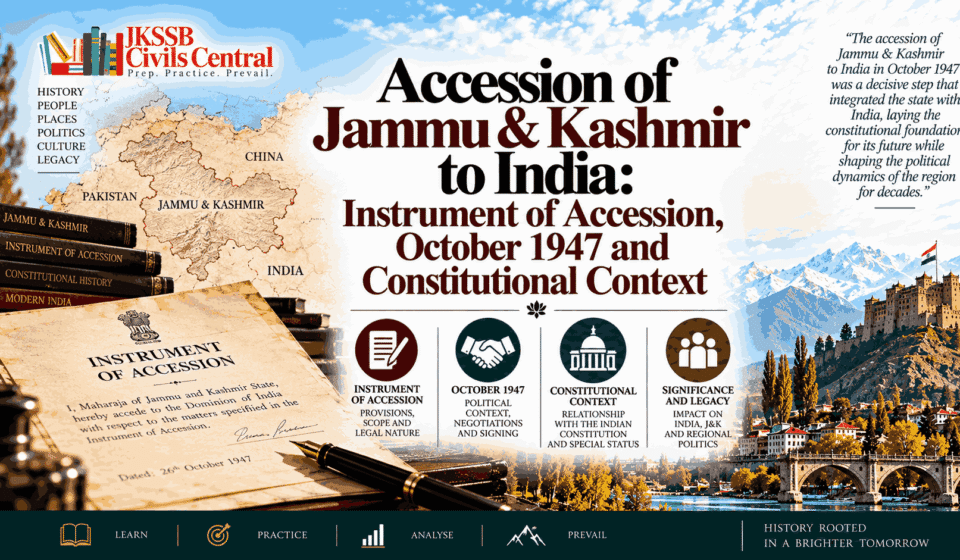
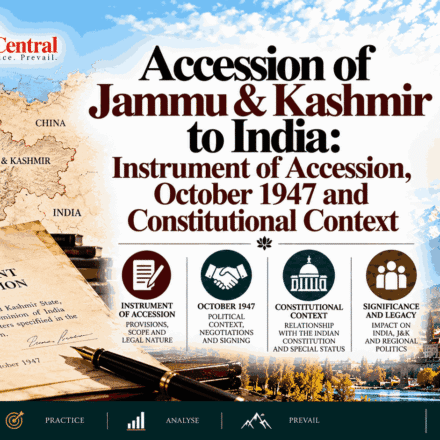
Accession of Jammu & Kashmir to India: Instrument of Accession, October 1947 and Constitutional Context

J&K History Series Navigation
| Previous Article | Current Article | Next Article |
|---|---|---|
| ← Article 46: Jammu & Kashmir in 1947: Partition, Conflict, Standstill Agreement and the Crisis of Accession | Article 47: Accession of Jammu & Kashmir to India: Instrument of Accession, October 1947 and Constitutional Context | Article 48: Constitutional Development of Jammu & Kashmir: Article 370, Article 35A and the J&K Constitution |
Learning Dashboard
| Category | Key Information |
|---|---|
| Historical Period | October 1947 onward |
| Historical Phase | Accession & Constitutional Transition |
| Principal Topic | Instrument of Accession and its constitutional consequences |
| Ruler | Maharaja Hari Singh |
| Acceding State | Jammu & Kashmir |
| Dominion | Dominion of India |
| Date of execution | 26 October 1947 |
| Acceptance | 27 October 1947 |
| Main subjects | Defence, External Affairs, Communications and specified ancillary matters |
| Key legal framework | Indian Independence Act, 1947; Government of India Act, 1935 as adapted for the Dominion |
| Key personalities | Hari Singh, Lord Mountbatten, V. P. Menon, Jawaharlal Nehru, Sheikh Abdullah |
| Key documents | Instrument of Accession, Maharaja’s letter, Mountbatten’s acceptance, Standstill Agreement |
| JKSSB Importance | Extremely High |
| Expected Question Types | Direct fact, statement-based, chronology, document identification, comparative and conceptual-factual |
Introduction
The accession of Jammu and Kashmir to India in October 1947 was one of the most consequential constitutional decisions in the modern history of the region. It occurred in the midst of the political and military crisis described in the previous article: the end of British paramountcy, uncertainty over the state’s future, internal disturbances, Partition-related violence and the armed invasion of October 1947. The accession therefore needs to be understood both as a legal act and as a decision taken under extraordinary political and military circumstances.
The central legal document was the Instrument of Accession, executed by Maharaja Hari Singh on 26 October 1947. Through it, the ruler declared that Jammu and Kashmir acceded to the Dominion of India and accepted the authority of Dominion institutions in relation to the matters specified in the Instrument. The Governor-General of India, Lord Mountbatten, accepted the Instrument on 27 October 1947, the same day Indian troops were airlifted to Srinagar. The original Instrument was framed under the constitutional mechanism created by the Indian Independence Act, 1947 and the adapted Government of India Act, 1935.
The Instrument did not simply reproduce the later constitutional relationship between Jammu and Kashmir and India. Its schedule specified the subjects over which the Dominion Legislature could legislate for the state, principally Defence, External Affairs and Communications, together with certain ancillary matters. The document also contained provisions concerning the ruler’s sovereignty, future constitutional arrangements, amendment of the Instrument and compulsory acquisition of land. These provisions are crucial for understanding why the later constitutional development of Jammu and Kashmir acquired a distinctive form.
The historical importance of the Instrument therefore lies in three connected developments: first, the legal accession of the princely state to India; second, the limited and specifically defined field of Dominion legislative authority under the original Instrument; and third, the subsequent constitutional process through which the relationship between Jammu and Kashmir and India evolved.
CivilsCentral Historical Insight
The accession of Jammu and Kashmir was neither merely a military arrangement nor simply a political declaration. It was a formal constitutional act executed by the ruler under the legal framework governing accession of princely states in 1947. Its distinctive terms subsequently became the starting point for the special constitutional arrangements through which the relationship between J&K and India was developed.
Part I — Constitutional Background to Accession
The End of British Paramountcy
The constitutional setting of accession was created by the Indian Independence Act, 1947. With the establishment of the Dominions of India and Pakistan on 15 August 1947, British paramountcy over the princely states ended. Jammu and Kashmir consequently had to determine its future relationship with the new political order.
The state did not automatically become part of India or Pakistan merely because British India had been partitioned. The ruler of the princely state possessed the authority to execute an Instrument of Accession under the constitutional framework inherited from the British Indian system. The Instrument executed by Hari Singh itself begins by referring to the Indian Independence Act and the adapted Government of India Act, 1935.
This legal background is important because the accession should not be described simply as a modern constitutional amendment or as an informal political agreement. In October 1947, the operative constitutional language was that of Dominions, accession and the Government of India Act, 1935.
The Government of India Act, 1935 as the Constitutional Mechanism
The Instrument states that the Government of India Act, 1935, as adapted for the Dominion of India, provided that an Indian State could accede to the Dominion through an Instrument executed by its ruler. Hari Singh expressly invoked this mechanism when executing the document.
This explains why the original document repeatedly uses expressions such as “Dominion Legislature,” “Governor-General,” and “Federal Court.” These were not references to the later constitutional institutions of the Republic of India. They belonged to the transitional constitutional framework of 1947.
The distinction is particularly important for examination purposes. The Instrument was executed in October 1947, while the Constitution of India came into force on 26 January 1950. The constitutional relationship therefore passed through a transitional phase between accession and the commencement of the republican Constitution.
CivilsCentral Historical Insight
The legal language of the Instrument reflects the constitutional world of 1947, not the constitutional vocabulary of post-1950 India. Understanding this distinction prevents anachronistic descriptions of the accession.
Part II — The Instrument of Accession
Who Executed the Instrument?
The Instrument was executed by Maharaja Hari Singh, the ruler of Jammu and Kashmir. The document states that he executed it in the exercise of his sovereignty over the state. It is dated 26 October 1947 and bears his signature.
This is one of the most important facts for J&K history examinations: Hari Singh signed the Instrument.
It was not signed by Sheikh Abdullah, Jawaharlal Nehru, Lord Mountbatten or V. P. Menon.
The role of these other figures was different. V. P. Menon was a senior official associated with the Government of India’s States Department and was involved in the negotiations and transmission of the documents. Lord Mountbatten, as Governor-General of India, accepted the Instrument. Sheikh Abdullah became important in the political administration and popular legitimacy of the state after accession.
The Date of Execution
The Instrument bears the date 26 October 1947. This is the date that should be used when asking when Hari Singh executed or signed the Instrument.
The following day, 27 October 1947, Mountbatten accepted it. Jawaharlal Nehru’s contemporary correspondence confirms that V. P. Menon returned from Jammu with the accession document and the Standstill Agreement, and that Indian troops were sent by air to Srinagar on 27 October.
Thus, two dates must be kept separate:
26 October 1947 → execution by Maharaja Hari Singh
27 October 1947 → acceptance by Lord Mountbatten
This distinction is one of the highest-value chronology points in the entire 1947–48 section.
Part III — What Did the Instrument Actually Do?
Accession to the Dominion of India
The first substantive clause declared that the ruler acceded to the Dominion of India. It provided that the Governor-General, Dominion Legislature, Federal Court and other Dominion authorities would exercise, in relation to Jammu and Kashmir, the functions vested in them by or under the Government of India Act, 1935, subject to the terms of the Instrument and for the purposes of the Dominion.
This is the central legal effect of the document. The Instrument was therefore not merely an agreement to receive military assistance. It was the constitutional instrument through which the ruler formally acceded the state to India.
At the same time, the Instrument did not grant unrestricted legislative authority over every aspect of the state’s internal administration. Clause 3 expressly identified the matters specified in the Schedule as the subjects on which the Dominion Legislature could make laws for the state.
That distinction became fundamental to the subsequent constitutional history of Jammu and Kashmir.
Part IV — The Subjects Covered by the Instrument
The Three Principal Heads
The Schedule to the Instrument organised the main legislative subjects under three principal heads:
- Defence
- External Affairs
- Communications
It also included a fourth category of ancillary matters necessary for the functioning of the first three.
The common examination shorthand is therefore: Defence + External Affairs + Communications
with specified ancillary matters.
However, the Schedule was more detailed than this three-subject formula suggests.
A. Defence
The Defence section included matters relating to the Dominion’s armed forces. It covered the naval, military and air forces of the Dominion and other armed forces maintained by the Dominion, including certain forces of an acceding state attached to or operating with Dominion forces.
It also covered:
- naval, military and air-force works;
- administration of cantonment areas;
- arms;
- firearms;
- ammunition;
- explosives.
The practical importance of this provision was immediate because Indian military assistance became necessary in October 1947. The accession therefore provided the constitutional basis for the Union’s responsibility in the field of defence.
B. External Affairs
The External Affairs category covered:
- external affairs;
- implementation of treaties and agreements with other countries;
- extradition;
- certain matters relating to admission into, emigration from and expulsion from India;
- regulation of movements of specified categories of persons;
- pilgrimages to places outside India;
- naturalisation.
This meant that the Dominion acquired legislative competence in relation to the state’s external relations within the scope defined by the Instrument.
The category is especially important because external relations were among the core areas that a princely state could not practically conduct independently once it had acceded to a Dominion.
C. Communications
The Communications section was extensive. It covered:
- posts and telegraphs;
- telephones;
- wireless;
- broadcasting;
- federal railways;
- regulation of railways in specified respects;
- maritime shipping and navigation;
- major ports;
- aircraft and air navigation;
- aerodromes;
- lighthouses and related navigational matters;
- carriage of passengers and goods by sea or air;
- certain police jurisdictional matters connected with railways.
This breadth reflects the importance of communications to the functioning of a modern state. In 1947, communications were not merely commercial conveniences; they were closely connected with defence, administration, trade and political integration.
D. Ancillary Matters
The Schedule also contained matters necessary for giving effect to the principal subjects. These included:
- elections to the Dominion Legislature, subject to the Act;
- offences relating to the specified subjects;
- inquiries and statistics;
- jurisdiction and powers of courts in relation to those subjects.
Therefore, the frequently memorised formula of “three subjects” is useful for examinations, but the more precise formulation is:
The Instrument primarily covered Defence, External Affairs and Communications, together with specified ancillary matters contained in the Schedule.
This distinction is important because a question may be designed to test whether a candidate knows the simplified formulation or the actual structure of the Schedule.
CivilsCentral Historical Insight
The original Instrument did not function as a blank constitutional transfer of every governmental subject to the Dominion. Its Schedule defined a specific field of Dominion legislative competence. The later constitutional relationship developed around this original framework rather than simply replacing it overnight.
Part V — Important Clauses Beyond the Schedule
The Instrument is particularly important because several of its clauses dealt with issues beyond the list of subjects.
Clause 5 — Amendment of the Instrument
The Instrument provided that its terms could not be varied through amendments to the Government of India Act or the Indian Independence Act unless the ruler accepted such a change through a supplementary Instrument.
This provision is significant because it demonstrates that the accession document itself contained safeguards concerning modification of its terms.
For examination purposes: Clause 5 → protection against unilateral alteration through amendments to the underlying Acts.
Clause 6 — Compulsory Acquisition of Land
The Instrument stated that nothing in it empowered the Dominion Legislature to make a law authorising compulsory acquisition of land for any purpose within the state.
It nevertheless provided a mechanism under which, where acquisition was necessary for a Dominion law applicable in the state, the ruler could acquire the land at the Dominion’s expense or transfer his own land on agreed terms, with arbitration in case of disagreement.
This clause is important because it illustrates the detailed nature of the original constitutional arrangement. The Instrument was not limited to a simple declaration of accession; it also addressed specific consequences of Dominion legislation.
Clause 7 — Future Constitution of India
One of the most frequently discussed provisions stated that nothing in the Instrument committed the ruler to acceptance of any future Constitution of India or fettered his discretion to enter into arrangements with the Government of India under such a future Constitution.
This clause must be read in its historical context. In October 1947, India did not yet have the Constitution that came into force in 1950. The constitutional future of both India and Jammu and Kashmir was still developing.
Therefore, Clause 7 should not be used to claim that accession was temporary or legally incomplete. Rather, it shows that the future constitutional relationship had not yet been fully defined in October 1947.
Clause 8 — Continuance of the Ruler’s Sovereignty
Clause 8 stated that nothing in the Instrument affected the continuance of the ruler’s sovereignty over the state except as provided by or under the Instrument, nor the validity of laws then in force in the state.
This provision is especially important for understanding the transition from the princely-state system to the later constitutional order.
The accession did not instantly transform Jammu and Kashmir into a state governed by the Constitution of India as it existed after 1950. The ruler continued to exercise authority within the framework that existed at the time, while the Dominion acquired specified powers through the Instrument.
Clause 9 — Heirs and Successors
The final clause provided that the Instrument was executed by the ruler on behalf of the state and that references to the ruler included his heirs and successors.
This reflects the constitutional structure of the princely state in 1947, where the ruler’s authority was connected to the dynastic institution.
Part VI — Accession and the Military Emergency
Why Accession Happened When It Did
The Instrument cannot be separated from the military crisis of October 1947. The Maharaja had previously attempted to delay the accession decision, but the tribal invasion fundamentally changed the situation.
The advancing forces threatened Srinagar and placed the state administration under severe pressure. The Maharaja requested military assistance from India, and the Government of India considered accession the constitutional basis for sending Indian forces into the state.
The contemporary record shows that the decision to send troops was taken on 26 October and that troops were flown to Srinagar on 27 October. Nehru’s correspondence of 27 October explicitly records both the accession documents and the dispatch of Indian Army troops.
Thus: Military emergency → request for assistance → accession → Indian military intervention
was the immediate sequence.
Accession Was Not Simply a Military Treaty
The military context should not obscure the legal character of the Instrument. It was a formal constitutional act executed under the legal mechanism for accession of princely states. The Indian military intervention followed the accession process, but the Instrument itself dealt with the broader constitutional relationship between the state and the Dominion.
This distinction matters because reducing the document to a military bargain incorrectly narrows its legal significance.
CivilsCentral Historical Insight
The military crisis explains the timing of accession, but it does not define the entire legal character of accession. The October decision simultaneously addressed an immediate security emergency and established a formal constitutional relationship with the Dominion of India.
Part VII — Acceptance by Lord Mountbatten
The Governor-General’s Role
Lord Mountbatten, as Governor-General of India, accepted the Instrument on 27 October 1947. The acceptance followed the Maharaja’s execution of the document and enabled the constitutional process of accession to take effect within the Dominion framework.
Jawaharlal Nehru’s contemporary correspondence records that V. P. Menon returned from Jammu with the signed accession documents and that Indian troops were sent to Srinagar the same day.
This gives the basic chronology:
| Date | Development |
|---|---|
| 26 October 1947 | Hari Singh executed the Instrument |
| 27 October 1947 | Mountbatten accepted the Instrument |
| 27 October 1947 | Indian troops were airlifted to Srinagar |
Part VIII — Mountbatten’s Letter and the Question of the People’s Will
The Acceptance Letter
Mountbatten’s acceptance of the accession was accompanied by a letter addressing the circumstances in which the accession had occurred. The Government of India had also expressed a political commitment that, once law and order had been restored and the territory cleared of the invader, the question of the state’s accession could be settled by reference to the wishes of the people.
This commitment subsequently became central to political debates over Kashmir.
However, a crucial distinction must be maintained:
The Instrument of Accession
= the formal constitutional instrument executed by the ruler.
Mountbatten’s accompanying letter
= a separate communication associated with the acceptance and the political circumstances surrounding accession.
They should not be treated as if they were a single document.
Legal Accession and Political Commitment
The historical record therefore contains two related but analytically distinct dimensions.
First, there was the legal act of accession. The 1950 Government of India’s White Paper on Indian States explicitly described the accession as a legal fact and stated that Jammu and Kashmir had acceded to India on 26 October 1947. It simultaneously acknowledged the Government of India’s political commitment concerning confirmation by the people.
Second, there was the political commitment concerning the people’s wishes under the extraordinary circumstances of the conflict.
This distinction is essential. The existence of a political commitment regarding the future political determination of the state should not be presented as though it erased the legal act of accession itself.
CivilsCentral Historical Insight
The 1947 settlement contained both a legal and a political dimension. The accession established the constitutional relationship, while the Indian leadership’s public commitments concerning the people’s wishes became an additional political element that shaped subsequent debates.
Part IX — Was the Accession Complete or Conditional?
This is one of the most important conceptual questions in J&K history.
The Legal Position
The Instrument was an accession instrument. It declared that the ruler acceded to the Dominion of India and specified the matters in relation to which Dominion authorities would exercise functions.
The Government of India’s White Paper on Indian States (1950) explicitly described the accession as a legal fact. It also stated that the form of the Instrument used for Jammu and Kashmir was the same as that used by other acceding states.
Therefore, it is historically inaccurate to describe the Instrument itself as merely an “offer” that was never legally accepted.
The Political Qualification
At the same time, the Government of India had publicly committed itself to allowing the people of Jammu and Kashmir to determine their political future once conditions permitted.
This created a distinction between: legal accession and political commitment concerning the people’s wishes.
Both dimensions must be understood together.
Why the Distinction Matters
A statement such as “Jammu and Kashmir had not legally acceded to India in October 1947” is inconsistent with the formal Instrument and the contemporary Indian constitutional record.
At the same time, a statement such as “the accession ended all political controversy over the state’s future” is equally misleading.
The accession settled the constitutional basis for India’s intervention and relationship with the state, but the political and international dispute continued.
Part X — Accession and the Future Constitution of Jammu & Kashmir
The Constitution Had Not Yet Been Written
In October 1947, the Constitution of India was still under preparation. The Instrument therefore operated within the transitional constitutional framework of the Dominion.
This explains why Clause 7 referred to any future Constitution of India. The constitutional relationship had to evolve after accession.
The later Constitution of India therefore did not simply reproduce the 1947 Instrument word-for-word. Instead, the Constitution created a special constitutional mechanism through which the relationship between India and Jammu and Kashmir would be developed.
From Instrument of Accession to Article 370
When the Constitution of India came into force on 26 January 1950, Jammu and Kashmir occupied a distinctive constitutional position.
The original Article 370 provided that Parliament’s legislative power for Jammu and Kashmir was initially limited to matters in the Union and Concurrent Lists corresponding to matters specified in the Instrument of Accession, with provision for additional matters subject to the constitutional procedures specified in Article 370.
This is the key constitutional connection:
Instrument of Accession, 1947
↓
Constitutional arrangements during 1947–50
↓
Article 370 in the Constitution of India, 1950
↓
Subsequent Presidential Orders and constitutional developments
Part XI — Why the Instrument Became the Foundation of J&K’s Special Constitutional Position
The original Instrument was important for later constitutional development for several reasons.
1. Defined Legislative Competence
The Instrument specified the matters in which Dominion legislative authority initially operated.
2. Preserved a Distinct Internal Constitutional Position
The ruler retained sovereignty and existing laws except to the extent altered through the accession framework.
3. Anticipated Future Constitutional Arrangements
Clause 7 expressly recognised that India’s future Constitution had not yet been settled.
4. Created a Documentary Constitutional Foundation
The later constitutional relationship repeatedly referred back to the matters contained in the Instrument.
5. Distinguished Accession from Complete Constitutional Integration
Accession established the relationship with India, but the precise internal constitutional relationship developed subsequently.
CivilsCentral Historical Insight
The importance of the Instrument extends far beyond 26–27 October 1947. It became the constitutional reference point from which the later special arrangements governing Jammu and Kashmir were constructed.
Part XII — The Standstill Agreement and the Instrument of Accession: Do Not Confuse Them
The two documents belong to the same extraordinary transition but served different purposes.
Standstill Agreement
Its purpose was to continue existing agreements and administrative arrangements between the state and the Dominion until new arrangements could be made.
The surviving document between Jammu and Kashmir and the Dominion of India records continuation of existing arrangements in matters of common concern and expressly states that nothing in the agreement included the exercise of paramountcy functions.
Instrument of Accession
Its purpose was fundamentally different. It established accession to the Dominion of India and specified the matters over which Dominion authorities would exercise functions.
The contemporary record is especially important here. Nehru wrote on 27 October 1947 that V. P. Menon had returned from Jammu with both the accession agreement and the Standstill Agreement signed by the Maharaja.
Therefore, for the Premium Series, the correct distinction is:
| Instrument | Main Purpose |
|---|---|
| Standstill Agreement | Continuity of existing administrative arrangements |
| Instrument of Accession | Constitutional accession to the Dominion of India |
This also corrects an important oversimplification sometimes found in secondary accounts.
Part XIII — Accession and the Role of Sheikh Abdullah
Sheikh Abdullah did not sign the Instrument of Accession. The formal act was performed by Maharaja Hari Singh as ruler of the state. However, Abdullah’s political position was extremely important to the political context surrounding accession. The National Conference had become the most powerful mass political organisation in the Kashmir Valley and had developed close political relations with the Indian National Congress.
On 27 October, Nehru wrote to Abdullah that Kashmir had formally acceded to India and that the Maharaja intended to invite him to form an interim government.
This indicates that the post-accession political arrangement was already being reshaped. The Maharaja’s constitutional authority and the National Conference’s popular political influence were becoming intertwined within the emergency administration.
The role of Sheikh Abdullah therefore belongs to the political legitimacy and subsequent governance of the accession, rather than to the formal execution of the Instrument itself.
Part XIV — Historical Significance of the Accession
1. Constitutional Significance
The accession established the formal constitutional relationship between Jammu and Kashmir and the Dominion of India.
2. Military Significance
It provided the constitutional basis for India’s military intervention at a moment when Srinagar was under immediate threat.
3. Political Significance
It changed the political framework within which the Maharaja, National Conference and other political forces operated.
4. Regional Significance
The accession became central to the subsequent division and conflict over the territory of Jammu and Kashmir.
5. International Significance
The continuing conflict eventually brought the Kashmir issue before the United Nations.
6. Constitutional Legacy
The Instrument became the reference point for the special constitutional relationship subsequently reflected in Article 370 and later arrangements.
Part XV — What the Instrument Did Not Do
For examination purposes, it is just as important to understand what the Instrument did not do.
It did not itself create Article 370.
Article 370 was a provision of the Constitution of India that came into force later.
It did not itself create the Constitution of Jammu and Kashmir.
The J&K Constitution was a later development.
It did not itself define the entire post-1950 constitutional relationship.
That relationship developed through subsequent constitutional measures.
It did not transfer every possible legislative subject to the Dominion in October 1947.
The Schedule defined the subjects within the original accession framework.
It did not end the armed conflict.
Fighting continued after accession.
It did not mean that all political questions surrounding Kashmir disappeared.
The political and international dispute continued.
CivilsCentral Historical Insight
The most common historical error is to treat accession as if it were simultaneously the beginning and the completion of all subsequent constitutional integration. In reality, accession was the foundational constitutional act; the detailed relationship evolved over the following years.
Part XVI — Historical Interpretation and Evidence Note
Primary Documentary Evidence
The Instrument itself is the most important source for determining what the accession legally declared. Its clauses establish:
- the identity of the acceding ruler;
- the Dominion to which the state acceded;
- the role of Dominion authorities;
- the legislative subjects;
- limitations concerning amendment;
- provisions concerning land acquisition;
- the ruler’s future constitutional position;
- the continuance of sovereignty and existing laws.
Contemporary correspondence is particularly useful for reconstructing the chronology surrounding the document. Nehru’s 27 October correspondence records the return of V. P. Menon with the signed accession and Standstill documents and the dispatch of Indian troops to Srinagar.
The Government of India’s White Paper on Indian States, published in 1950, provides another important constitutional interpretation. It expressly treated the accession of Jammu and Kashmir as a legal fact while also recording the Government’s political commitment concerning the people’s future determination.
Why Later Political Claims Need Caution
The accession subsequently became central to competing political narratives. Assertions about whether accession was “temporary,” “conditional,” “complete,” or “subject to a plebiscite” often combine different categories of evidence.
A historically disciplined approach therefore separates:
the text of the Instrument
from
Mountbatten’s accompanying communication
from
Indian political statements
from
later constitutional developments
from
subsequent Indian and Pakistani interpretations.
This distinction prevents later political arguments from being projected backward as though they were all contained in the original Instrument.
Part XVII — JKSSB Knowledge Matrix
| Question | High-Value Answer |
|---|---|
| Who signed the Instrument? | Maharaja Hari Singh |
| Date of execution | 26 October 1947 |
| Who accepted it? | Lord Mountbatten |
| Date of acceptance | 27 October 1947 |
| Acceding Dominion | Dominion of India |
| Constitutional framework | Indian Independence Act + adapted Government of India Act, 1935 |
| Main subjects | Defence, External Affairs, Communications |
| Additional category | Ancillary matters |
| Clause 5 | Amendment of Instrument |
| Clause 6 | Compulsory acquisition of land |
| Clause 7 | Future Constitution of India |
| Clause 8 | Continuance of ruler’s sovereignty/existing laws, subject to Instrument |
| Clause 9 | Ruler’s execution on behalf of state; heirs/successors |
| Article 370 | Later constitutional provision, not part of the 1947 Instrument |
| J&K Constitution | Later development |
| Indian troops in Srinagar | 27 October 1947 |
| Sheikh Abdullah’s role | Major political leader; did not sign Instrument |
| V. P. Menon’s role | Government of India official involved in accession process |
| Legal vs political question | Accession was legally effected; political questions concerning the people’s future remained significant |
Part XVIII — Examination Discrimination Points
1. Signing vs Acceptance
Hari Singh → signed
Mountbatten → accepted
This is one of the most important traps.
2. 26 October vs 27 October
26 October 1947
→ Instrument executed by Hari Singh.
27 October 1947
→ accepted by Mountbatten.
→ Indian troops airlifted to Srinagar.
3. Instrument vs Standstill Agreement
Instrument of Accession
→ constitutional accession.
Standstill Agreement
→ continuation of existing administrative arrangements.
4. Three Subjects vs Complete Schedule
It is correct to memorise:
Defence + External Affairs + Communications
But the actual Schedule also contained ancillary matters.
5. Instrument vs Article 370
Instrument of Accession
→ 1947.
Article 370
→ Constitution of India, 1950.
Article 370 was not itself the instrument through which J&K acceded to India.
6. Hari Singh vs Sheikh Abdullah
Hari Singh
→ signed Instrument.
Sheikh Abdullah
→ major popular political leader; subsequently associated with interim administration.
7. Legal Accession vs Political Commitment
Legal accession
→ established through the Instrument and its acceptance.
Political commitment concerning people’s wishes
→ expressed separately in the political context of accession.
These should not be treated as identical concepts.
Part XIX — JKSSB Question Pattern
Direct Fact
Who executed the Instrument of Accession of Jammu and Kashmir?
→ Maharaja Hari Singh.
Statement-Based
Consider the following statements:
- The Instrument of Accession was executed on 26 October 1947.
- It was accepted by Lord Mountbatten on 27 October 1947.
- It transferred every legislative subject to the Dominion Legislature.
- Its Schedule primarily dealt with Defence, External Affairs and Communications.
Correct answer:
1, 2 and 4 only
Chronology
Arrange:
- Indian troops arrive in Srinagar
- Hari Singh executes Instrument
- Mountbatten accepts Instrument
- India approaches UN Security Council
Correct sequence:
2 → 3 → 1 → 4
Identification by Clues
Identify the document:
- executed by Hari Singh;
- dated 26 October 1947;
- acceded J&K to the Dominion of India;
- specified Defence, External Affairs and Communications.
Answer:
Instrument of Accession
Comparative
Which is correctly matched?
| Document | Function |
|---|---|
| Instrument of Accession | Constitutional accession |
| Standstill Agreement | Continuation of existing administrative arrangements |
| Article 370 | Constitutional provision adopted in 1950 |
| J&K Constitution | Later state constitutional development |
Part XX — JKSSB Practice Questions
Q1. The Instrument of Accession of Jammu and Kashmir was executed by:
A. Sheikh Abdullah
B. Lord Mountbatten
C. Maharaja Hari Singh
D. Jawaharlal Nehru
Correct Answer: C
Explanation: Maharaja Hari Singh executed the Instrument in his capacity as ruler of Jammu and Kashmir.
Q2. The Instrument of Accession was executed on:
A. 15 August 1947
B. 22 October 1947
C. 26 October 1947
D. 27 October 1947
Correct Answer: C
Explanation: The Instrument bears the date 26 October 1947.
Q3. Who accepted the Instrument of Accession on behalf of India?
A. Jawaharlal Nehru
B. Sardar Patel
C. V. P. Menon
D. Lord Mountbatten
Correct Answer: D
Explanation: Lord Mountbatten, Governor-General of India, accepted the Instrument on 27 October 1947.
Q4. Which of the following was NOT one of the principal heads in the Schedule to the Instrument of Accession?
A. Defence
B. External Affairs
C. Communications
D. Agriculture
Correct Answer: D
Explanation: The principal heads were Defence, External Affairs and Communications, along with ancillary matters.
Q5. Consider the following statements:
- The Instrument provided for Dominion legislative authority over specified subjects.
- Defence was included in the Schedule.
- External Affairs was included in the Schedule.
- The Instrument itself created Article 370.
Which statements are correct?
A. 1, 2 and 3 only
B. 1 and 4 only
C. 2, 3 and 4 only
D. All four
Correct Answer: A
Explanation: Article 370 was a later constitutional provision that came into force with the Constitution of India in 1950.
Q6. Which clause of the Instrument dealt with acceptance of a future Constitution of India?
A. Clause 3
B. Clause 5
C. Clause 7
D. Clause 9
Correct Answer: C
Explanation: Clause 7 stated that the Instrument did not commit the ruler to acceptance of any future Constitution of India.
Q7. Which clause dealt with the continuance of the ruler’s sovereignty and existing laws?
A. Clause 4
B. Clause 6
C. Clause 8
D. Clause 9
Correct Answer: C
Explanation: Clause 8 addressed continuance of the ruler’s sovereignty and existing laws, subject to the provisions of the Instrument.
Q8. Arrange the following in chronological order:
- Mountbatten accepts accession
- Hari Singh executes Instrument
- Indian troops arrive in Srinagar
- India approaches UN Security Council
A. 2–1–3–4
B. 1–2–3–4
C. 2–3–1–4
D. 3–2–1–4
Correct Answer: A
Explanation: Instrument executed on 26 October → accepted on 27 October → troops arrived on 27 October → UN approach on 1 January 1948.
Q9. Which statement best describes the relationship between the Instrument of Accession and Article 370?
A. They were the same document.
B. Article 370 was included in the Instrument.
C. Article 370 was a later constitutional provision connected to the constitutional relationship established after accession.
D. Article 370 preceded the Instrument.
Correct Answer: C
Explanation: The Instrument dates from 1947; Article 370 formed part of the Constitution of India that came into force in 1950.
Q10. Which of the following is the most accurate statement?
A. The Instrument transferred all legislative powers to the Dominion Legislature.
B. The Instrument primarily specified Defence, External Affairs and Communications, together with ancillary matters.
C. The Instrument created the Constitution of Jammu and Kashmir.
D. The Instrument ended the India–Pakistan conflict.
Correct Answer: B
Explanation: The Instrument defined the subjects over which Dominion legislative authority would operate; it did not itself create the later J&K Constitution or end the conflict.
Q11. The Standstill Agreement differed from the Instrument of Accession because the former primarily concerned:
A. Constitutional accession to India
B. Continuation of existing administrative arrangements
C. Creation of Article 370
D. Formation of the J&K Constituent Assembly
Correct Answer: B
Explanation: The Standstill Agreement was designed to continue existing agreements and administrative arrangements pending new agreements.
Q12. Which pair is correctly matched?
A. Hari Singh — accepted accession
B. Mountbatten — executed accession
C. Hari Singh — executed accession
D. Sheikh Abdullah — executed accession
Correct Answer: C
Explanation: Hari Singh executed the Instrument; Mountbatten accepted it.
Part XXI — Rapid Revision Zone
Important Dates
| Date | Event |
|---|---|
| 15 August 1947 | Indian and Pakistani Dominions established |
| 26 October 1947 | Hari Singh executed Instrument of Accession |
| 27 October 1947 | Mountbatten accepted accession |
| 27 October 1947 | Indian troops airlifted to Srinagar |
| 26 January 1950 | Constitution of India came into force |
| 1950 | Article 370 formed part of the constitutional framework |
Important Personalities
Maharaja Hari Singh
→ Ruler
→ executed Instrument
Lord Mountbatten
→ Governor-General of India
→ accepted Instrument
V. P. Menon
→ Government of India official
→ involved in accession negotiations/document transmission
Jawaharlal Nehru
→ Prime Minister of India
→ closely involved in Kashmir policy
Sheikh Abdullah
→ National Conference leader
→ major political figure in post-accession administration
Instrument: Core Structure
Preamble
→ Indian Independence Act + Government of India Act framework
Clause 1
→ Accession to Dominion of India
Clause 2
→ Obligation concerning applicable provisions of the Act
Clause 3
→ Acceptance of specified Schedule matters
Clause 4
→ Possible agreement concerning administration of Dominion laws
Clause 5
→ Amendment safeguards
Clause 6
→ Land acquisition
Clause 7
→ Future Constitution of India
Clause 8
→ Sovereignty and existing laws
Clause 9
→ Heirs and successors
Schedule
Defence
- Armed forces
- Military works
- Cantonments
- Arms
- Ammunition
- Explosives
External Affairs
- External affairs
- Treaties
- Extradition
- Admission/emigration/expulsion
- Pilgrimages outside India
- Naturalisation
Communications
- Posts
- Telegraphs
- Telephones
- Wireless
- Broadcasting
- Railways
- Shipping/navigation
- Aircraft
- Aerodromes
- Lighthouses
Ancillary
- Elections to Dominion Legislature
- Offences
- Inquiries/statistics
- Judicial jurisdiction relating to specified matters
Part XXII — Frequently Confused Facts
| Confusion | Correct Fact |
|---|---|
| Hari Singh accepted the Instrument | Hari Singh executed it |
| Mountbatten signed it for J&K | Mountbatten accepted it for India |
| Instrument dated 27 October | Dated 26 October 1947 |
| Acceptance dated 26 October | Acceptance was 27 October |
| Instrument = Standstill Agreement | Different documents |
| Standstill = accession | Incorrect |
| Three subjects = only three entries in the entire Schedule | Oversimplified; ancillary matters also existed |
| Article 370 was in the Instrument | Incorrect |
| Article 370 was created in October 1947 | Incorrect; it formed part of the Constitution in 1950 |
| Sheikh Abdullah signed accession | Incorrect |
| V. P. Menon signed accession | Incorrect |
| Accession immediately ended the war | Incorrect |
| Accession had no legal effect until a later plebiscite | Not supported by the legal character of the Instrument |
| Political commitment regarding people’s wishes = Instrument itself | Incorrect distinction |
Part XXIII — What Can JKSSB Ask?
From this topic, high-value question areas include:
Direct Fact
- Who signed the Instrument?
- Who accepted it?
- What were the dates?
- Which Dominion did J&K join?
Statement-Based
- Subjects covered by the Schedule
- Meaning of Clause 7
- Meaning of Clause 8
- Legal versus political aspects of accession
Chronology
- 26 October
- 27 October
- 1 January 1948
- 26 January 1950
Match the Following
- Hari Singh ↔ execution
- Mountbatten ↔ acceptance
- Article 370 ↔ Constitution of India
- Standstill Agreement ↔ continuation of arrangements
Identification by Clues
- Document containing Defence, External Affairs and Communications
- Document executed by Hari Singh in October 1947
Comparative
- Instrument vs Standstill Agreement
- Accession vs Article 370
- Legal accession vs political commitment
Chapter Summary
The accession of Jammu and Kashmir to India must be understood against the constitutional transformation created by the end of British paramountcy in 1947. The princely state initially attempted to preserve its freedom of action, but the October armed invasion and threat to Srinagar created an emergency that made the accession question immediate.
Maharaja Hari Singh executed the Instrument of Accession on 26 October 1947. The Instrument declared accession to the Dominion of India and established the constitutional basis for Dominion authority in relation to the matters specified in its Schedule. Lord Mountbatten accepted the Instrument on 27 October 1947, and Indian troops were simultaneously airlifted to Srinagar.
The Schedule primarily covered Defence, External Affairs and Communications, together with specified ancillary matters. The Instrument also contained important provisions relating to amendment, land acquisition, the future Constitution of India and the continuance of the ruler’s sovereignty and existing laws.
The accession was legally significant but did not by itself settle every subsequent political or constitutional question. The Government of India simultaneously expressed political commitments concerning the people’s wishes under conditions of restored peace. The later constitutional relationship therefore developed through additional arrangements, culminating initially in the special constitutional framework represented by Article 370 in the Constitution of India.
The essential historical sequence is:
End of British paramountcy
↓
J&K’s unresolved constitutional position
↓
October 1947 armed crisis
↓
Hari Singh executes Instrument — 26 October
↓
Mountbatten accepts — 27 October
↓
Indian troops arrive in Srinagar
↓
Constitutional relationship develops
↓
Article 370 — Constitution of India, 1950
↓
Further constitutional development
JKSSB Takeaway
Remember the core distinction:
26 October 1947 → Hari Singh signed/executed the Instrument.
27 October 1947 → Mountbatten accepted it and Indian troops arrived.
And the core constitutional formula: Instrument of Accession → Defence + External Affairs + Communications + specified ancillary matters.
Finally: Instrument of Accession ≠ Standstill Agreement ≠ Article 370 ≠ J&K Constitution.
These are four distinct stages/documents in the constitutional history of Jammu and Kashmir.
Mind Map
1947 CONSTITUTIONAL CRISIS
↓
End of British Paramountcy
↓
Princely State’s Future Relationship
↓
October Military Crisis
↓
Maharaja Hari Singh
↓
Instrument of Accession
↓
26 Oct — Execution
↓
27 Oct — Acceptance
↓
Dominion of India
↙︎ ↘︎
Defence External Affairs
↘︎
Communications
↓
Ancillary Matters
↓
Post-1947 Constitutional Development
↓
Constitution of India, 1950
↓
Article 370
↓
J&K Constitutional Development
FAQs
1. Who signed the Instrument of Accession of Jammu and Kashmir?
Maharaja Hari Singh, the ruler of Jammu and Kashmir, executed the Instrument on 26 October 1947.
2. Who accepted the accession?
Lord Mountbatten, Governor-General of India, accepted the Instrument on 27 October 1947.
3. What were the main subjects covered by the Instrument?
The principal subjects were Defence, External Affairs and Communications, together with specified ancillary matters.
4. Did the Instrument transfer all legislative powers to India?
No. The original Instrument specified the matters in relation to which the Dominion Legislature could make laws for Jammu and Kashmir.
5. Was Article 370 part of the Instrument of Accession?
No. Article 370 was a later constitutional provision incorporated into the Constitution of India in 1950.
6. Did Sheikh Abdullah sign the Instrument?
No. Hari Singh signed it. Sheikh Abdullah was an important political leader and subsequently became central to the post-accession administration.
7. What is the difference between the Instrument and the Standstill Agreement?
The Instrument established accession to India; the Standstill Agreement concerned continuation of existing administrative arrangements pending new agreements.
8. Was the accession legally effected in October 1947?
Yes. The Instrument was executed by the ruler and accepted by the Governor-General. The Government of India’s 1950 White Paper expressly treated the accession as a legal fact.
9. Why is 26 October important?
It is the date borne by the Instrument executed by Maharaja Hari Singh.
10. Why is 27 October important?
It was the date on which Mountbatten accepted the accession, and Indian troops were airlifted to Srinagar.
About The Author




[…] ← Article 47: Accession of Jammu & Kashmir to India: Instrument of Accession, October 1947 and… […]