
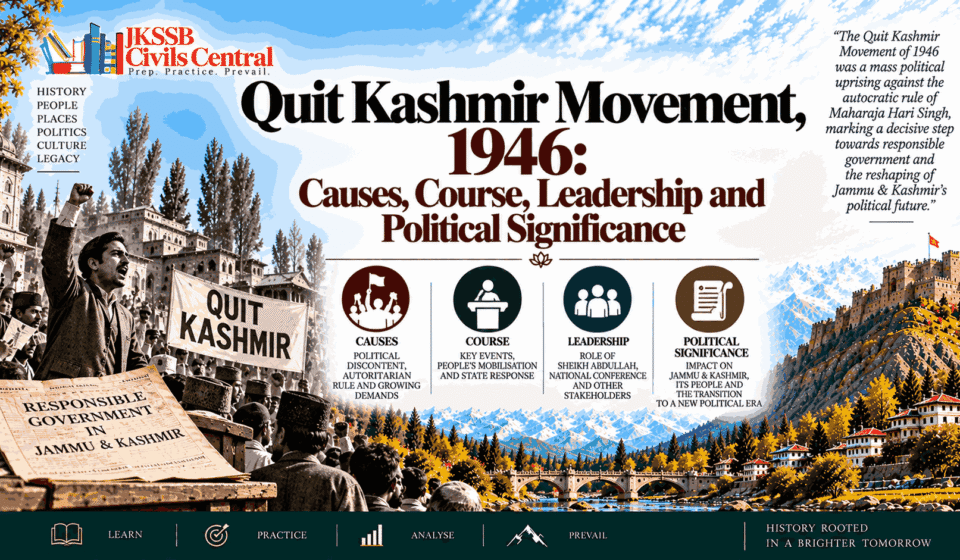
Quit Kashmir Movement, 1946: Causes, Course, Leadership and Political Significance

J&K History Series Navigation
| Previous Article | Current Article | Next Article |
|---|---|---|
| Article 43 — National Conference and Naya Kashmir Manifesto: Political and Socio-Economic Vision | Article 44 — Quit Kashmir Movement, 1946: Causes, Course, Leadership and Political Significance | Article 45 — Sheikh Abdullah: Political Career, Naya Kashmir and Constitutional Politics |
Learning Dashboard
| Area | Key Information |
|---|---|
| Historical Period | 1946 |
| Historical Phase | Political Awakening & Modern J&K |
| Main Organisation | Jammu & Kashmir National Conference |
| Principal Leader | Sheikh Mohammad Abdullah |
| Ruling Authority Challenged | Maharaja Hari Singh / Dogra monarchy |
| Immediate Political Context | Cabinet Mission, end of British paramountcy debate and constitutional future of princely states |
| Central Demand | Transfer of political sovereignty from autocratic rule to the people |
| Major Political Issue | Validity and future of the Dogra-British political relationship represented by the Treaty of Amritsar |
| Major Slogan | “Quit Kashmir” |
| Major Arrest | Sheikh Abdullah, 20 May 1946 |
| Major Supporting Personality from Indian National Movement | Jawaharlal Nehru |
| Important State Official | Prime Minister Ram Chandra Kak |
| Major Legal Development | Abdullah convicted of sedition in September 1946 |
| Sentence recorded in Nehru Archive | Three years’ simple imprisonment |
| Release | 29 September 1947 |
| JKSSB Importance | Very High |
| Likely Question Types | Chronology, statement-based, direct fact, cause–consequence, identification, comparative |
Introduction
The Quit Kashmir Movement of 1946 was the most direct pre-1947 political challenge mounted by the National Conference against the Dogra monarchy. It emerged from a political situation in which the earlier demand for responsible government had increasingly come to be seen by Sheikh Mohammad Abdullah and his associates as inadequate so long as ultimate authority remained concentrated in the Maharaja. The movement therefore represented a significant escalation: instead of asking merely for constitutional reform under the ruler, it questioned the political basis of the ruler’s authority and asserted that sovereignty should ultimately rest with the people of Jammu & Kashmir.
The immediate background was the rapidly changing constitutional situation in British India. The Cabinet Mission of 1946 had brought the future of British India and the princely states into sharp focus. The National Conference objected to the idea that the political future of the princely states could be determined principally through negotiations with hereditary rulers while the people themselves remained excluded from constitution-making. In a memorandum and related communication to the Cabinet Mission, the National Conference attacked the existing relationship between the Dogra ruler and the British Crown and specifically questioned the continuing political significance of the Treaty of Amritsar of 1846.
The movement culminated in mass agitation in May 1946, the arrest of Sheikh Abdullah on 20 May, widespread arrests and repression, and an increasingly bitter confrontation between the National Conference and the State administration headed by Prime Minister Ram Chandra Kak. Jawaharlal Nehru intervened directly, first through public statements and correspondence and later by attempting to enter Jammu & Kashmir to assist Abdullah’s defence. Nehru himself was detained at Domel after defying the State’s restriction on his entry.
The Quit Kashmir Movement was ultimately suppressed and did not achieve its immediate objective of ending Dogra rule. Nevertheless, its historical importance was substantial. It sharpened the question of popular sovereignty, exposed the limits of the constitutional reforms introduced under Maharaja Hari Singh, deepened the confrontation between the National Conference and the State, and placed Jammu & Kashmir’s internal political struggle directly within the wider crisis of the princely states as British paramountcy approached its end.
CivilsCentral Historical Insight
Quit Kashmir marked a transition from constitutional agitation to a direct challenge to the political legitimacy of hereditary rule. Its importance therefore lies not simply in the slogan or the repression that followed, but in the way it brought the question of who possessed sovereignty in Jammu & Kashmir to the centre of political debate immediately before the end of British paramountcy.
Part I — Historical Background
From the 1931 Agitation to the National Conference
The Quit Kashmir Movement cannot be understood in isolation from the political developments that began with the 1931 agitation, the formation of the Muslim Conference in 1932, and its transformation into the National Conference in 1939. During these years, the political movement evolved from demands concerning representation and community grievances toward a broader demand for responsible government and political rights.
The National Conference’s Naya Kashmir programme of 1944 represented an important stage in this development. It proposed representative government, civil liberties, economic planning, agrarian reform and social rights. Yet the programme still envisaged a constitutional role for the Maharaja. The political situation of 1945–46 increasingly convinced National Conference leaders that the existing ruling structure was unwilling to permit meaningful transfer of political authority.
Thus, the central question changed from: How can the monarchy be constitutionally limited?
to: Can the existing basis of monarchical authority continue when British paramountcy itself is about to disappear?
This was the political setting in which Quit Kashmir emerged.
Part II — The Constitutional Crisis of 1944–46
The Experiment with Popular Ministers
An important immediate background was the limited constitutional experiment introduced during Maharaja Hari Singh’s later reign. In 1944, ministers associated with popular support were brought into the government. The National Conference participated in this arrangement, and Mirza Mohammad Afzal Beg became one of the ministers.
The experiment was intended to create a greater connection between the ruler’s administration and representative politics. However, serious differences soon developed concerning the actual authority of the popular ministers. The National Conference increasingly argued that the arrangement provided the appearance of participation without transferring meaningful executive power.
Afzal Beg eventually resigned in March 1946, marking a major breakdown in the earlier period of cooperation between the National Conference and the State authorities. Contemporary accounts by Nehru describe this resignation as an important part of the growing crisis between the National Conference and the government.
Ram Chandra Kak and the Breakdown of Cooperation
The political atmosphere also changed after Ram Chandra Kak became Prime Minister. The National Conference had initially viewed Kak more favourably, partly because he was a Kashmiri, but relations deteriorated rapidly as his administration adopted a more restrictive attitude toward the National Conference.
The State administration increasingly regarded the National Conference as a powerful political organisation whose mobilisation could threaten the authority of the government. The National Conference, meanwhile, believed that the government was encouraging factional and communal organisations in order to weaken its influence.
Nehru’s later account explicitly described a deterioration in relations between Kak’s administration and the National Conference, stating that the resignation of the National Conference minister in early 1946 brought the period of cooperation to an end.
This breakdown is important because Quit Kashmir was not an isolated emotional reaction to one event. It followed a longer deterioration in relations between the popular movement and the State administration.
CivilsCentral Historical Insight
The constitutional crisis of 1945–46 shows why Quit Kashmir cannot be reduced to a single speech by Sheikh Abdullah. The movement emerged after an earlier experiment in limited political participation failed to resolve the fundamental question of where effective executive authority should lie.
Part III — The Cabinet Mission and the Question of Popular Sovereignty
The Cabinet Mission of 1946
The arrival of the Cabinet Mission in India created a new constitutional context. The Mission—comprising Lord Pethick-Lawrence, Sir Stafford Cripps and A. V. Alexander—was examining the transfer of power and the future constitutional structure of India. For political organisations in princely states, the crucial issue was whether the rulers or the people would speak for those states in the emerging constitutional order.
The National Conference objected to the principle that hereditary rulers could determine the constitutional future of their states without the participation of their populations. When the Mission’s members were expected to engage primarily with recognised constitutional authorities and rulers, the National Conference viewed this as a serious limitation on popular representation.
The National Conference Memorandum
The National Conference submitted a memorandum/communication to the Cabinet Mission challenging the political relationship created by the British and the Dogra dynasty. It argued that the people of Jammu & Kashmir should have the right to determine their own political future.
The document specifically attacked the Treaty of Amritsar of 1846, describing it in highly critical language as a “sale deed” and arguing that a historical treaty could not permanently determine the political status of millions of people without their consent. This language became central to the ideological justification of Quit Kashmir.
This should be understood as a political argument made by the National Conference, not as an established legal ruling that the Treaty of Amritsar had automatically become void. The treaty had created the British-recognised position of Gulab Singh and his successors in 1846; the National Conference’s claim was that the approaching end of British paramountcy fundamentally changed the constitutional context and that the future authority of the state should rest on the will of its people.
This distinction is especially important for examination purposes.
Historical distinction
Treaty of Amritsar, 1846:
Established the political relationship between the British and Gulab Singh’s rule.
Quit Kashmir, 1946:
Political movement challenging the continued legitimacy of hereditary rule and asserting popular sovereignty.
The latter was a political interpretation and demand, not a judicial annulment of the former.
CivilsCentral Historical Insight
The Treaty of Amritsar became politically important in 1946 not because the treaty suddenly disappeared, but because the National Conference used it to challenge the historical basis of hereditary sovereignty. Quit Kashmir therefore converted a nineteenth-century treaty into a twentieth-century question of political legitimacy and popular consent.
Part IV — Causes of the Quit Kashmir Movement
1. Demand for Popular Sovereignty
The fundamental cause was the National Conference’s growing conviction that political authority should rest with the people. Responsible government under the Maharaja had been the earlier constitutional demand, but the leadership increasingly believed that the existing political system could not adequately satisfy the popular demand for self-government.
Sheikh Abdullah’s later court statement explained the movement as a demand that the authority of the future state should derive from the people rather than from the old treaty relationship. This was the conceptual core of Quit Kashmir.
2. Failure of Limited Constitutional Reform
The limited constitutional arrangements of the 1940s failed to resolve the central problem of executive accountability. The participation of popular ministers did not produce the degree of responsible government expected by the National Conference.
The resignation of Mirza Afzal Beg in March 1946 became an important symbol of this failure.
3. Breakdown with the State Administration
Relations between the National Conference and Ram Chandra Kak’s administration deteriorated sharply. The National Conference believed that its political activities were being deliberately obstructed and that the administration was encouraging rival communal organisations.
The government, from its own perspective, increasingly viewed the National Conference’s mobilisation as a threat to public order and the authority of the State.
The confrontation was therefore reciprocal: the National Conference regarded the State as suppressing political reform, while the State regarded the movement as increasingly confrontational and destabilising.
4. End of British Paramountcy
The impending withdrawal of British power fundamentally altered the political calculations of all actors. If British paramountcy was ending, what would happen to the political authority of princely rulers?
The National Conference argued that the end of the British relationship should open the way for popular sovereignty. This became one of the most important intellectual foundations of Quit Kashmir.
5. Opposition to the Treaty-Based Political Order
The National Conference argued that the political authority of the Dogra dynasty could not be justified indefinitely by the Treaty of Amritsar. The phrase “sale deed” became politically powerful because it linked the nineteenth-century transfer of territory with the twentieth-century demand for popular rights.
The phrase was therefore part of a political critique, not a neutral description of treaty law.
6. Socio-Economic Grievances
The movement also drew upon long-standing economic and social grievances. The National Conference’s Naya Kashmir programme had already connected political freedom with agrarian reform, economic planning, education and social welfare.
In his later court statement, Sheikh Abdullah linked the demand for political transformation with poverty, low literacy, economic inequality and the concentration of privileges in the hands of a small section of society.
Thus, Quit Kashmir was not simply a constitutional dispute. It was also connected to the broader socio-economic programme of the National Conference.
CivilsCentral Historical Insight
The causes of Quit Kashmir were layered. Constitutional frustration created the immediate political crisis, the end of British paramountcy supplied the wider historical opportunity, and long-standing socio-economic grievances gave the movement a broader social vocabulary.
Part V — The Course of the Movement
Sheikh Abdullah Returns to Kashmir
Sheikh Abdullah returned to Kashmir in early May 1946 after political consultations outside the State. The atmosphere he encountered was already tense.
The National Conference had been frustrated by the Cabinet Mission’s handling of the princely-state question, while the State government was preparing to deal with what it regarded as a serious political challenge.
Abdullah delivered a series of speeches in May in which he sharpened the demand that the hereditary ruling house should relinquish political authority.
Secondary accounts differ over the exact date on which the Quit Kashmir slogan was formally launched, with 10, 14 and 15 May appearing in different narratives. For a chronology-first examination article, the safest formulation is that the movement was launched in May 1946, with the decisive public campaign developing during the middle of the month.
The Quit Kashmir Slogan
The slogan represented a deliberate escalation from the earlier demand for responsible government. The National Conference now argued that the Dogra ruling house should “quit” the political authority it had exercised over the state. The slogan drew an obvious parallel with the Quit India Movement of 1942, although the target was different.
Quit India: demanded the withdrawal of British colonial rule from India.
Quit Kashmir: demanded the end of the existing Dogra political order in Jammu & Kashmir and asserted that sovereignty should belong to the people.
The analogy was politically useful because the National Conference presented the movement as part of the broader anti-autocratic and anti-imperial struggle of the Indian subcontinent.
The Arrest of Sheikh Abdullah
The crisis intensified when Sheikh Abdullah decided to travel toward Delhi for consultations with Jawaharlal Nehru. On 20 May 1946, he was arrested at Ghari on the Srinagar–Rawalpindi route.
The arrest became the immediate catalyst for a wider public reaction. Nehru’s contemporary statement of 21 May records that Abdullah, President of the National Conference and Vice-President of the All India States Peoples Conference, had been arrested by the State authorities while travelling to Delhi.
The State authorities also arrested large numbers of National Conference workers and used police and State troops to control the situation. Nehru’s contemporary correspondence refers to hundreds of arrests and the deployment of soldiers in the Valley.
Public Agitation and Repression
The arrest transformed the movement from a campaign led by speeches and political mobilisation into a wider confrontation between the National Conference and the State administration.
Demonstrations took place in Srinagar and other parts of the Valley. Police and military forces were deployed, and the authorities attempted to prevent further escalation.
Accounts of casualties vary, and the political literature surrounding the movement contains competing descriptions of the violence. It is therefore safer to state that the repression resulted in deaths, injuries and large-scale arrests, rather than relying on a single unqualified casualty figure.
The State’s use of force became one of the central reasons why the movement attracted attention beyond Jammu & Kashmir.
CivilsCentral Historical Insight
The arrest of Sheikh Abdullah transformed Quit Kashmir from a political slogan into a mass confrontation. The State’s response weakened the possibility of a negotiated constitutional settlement in the immediate term and instead intensified the symbolic importance of the movement and its imprisoned leadership.
Part VI — Leadership of the Movement
Sheikh Mohammad Abdullah
Sheikh Mohammad Abdullah was the principal leader of Quit Kashmir. His political trajectory explains why the movement represented such a sharp change from earlier demands. He had moved from the political mobilisation of the early 1930s to the Muslim Conference, then to the National Conference and the Naya Kashmir programme. By 1946, he was arguing that the political authority of the Dogra dynasty itself should be transferred to the people.
His leadership was therefore simultaneously:
- constitutional;
- nationalist;
- anti-autocratic;
- socio-economic;
- mass-based.
However, his leadership should not be presented without political controversy. Some contemporaries criticised the movement as a unilateral departure from the National Conference’s earlier policy of responsible government under the Maharaja. Nehru himself acknowledged in May 1946 that the new orientation had not yet been formally endorsed by the National Conference executive and differed from the established policy of the All India States Peoples Conference.
This is a crucial historical nuance.
Mirza Mohammad Afzal Beg
Mirza Mohammad Afzal Beg was an important National Conference leader and had served as a popular minister. His resignation in March 1946 symbolised the breakdown of the constitutional experiment and helped create the political environment in which Quit Kashmir developed.
His role demonstrates that the movement had a constitutional background rather than appearing suddenly from nowhere.
Bakshi Ghulam Mohammad
Bakshi Ghulam Mohammad was one of the important National Conference organisers during the crisis. After Abdullah’s arrest, he became associated with the continuation of the movement’s organisational work.
Nehru’s August 1946 account indicates that Bakshi was functioning as acting president of the Kashmir National Conference during Abdullah’s imprisonment and was involved in decisions concerning the continuation and eventual modification of civil disobedience.
G. M. Sadiq and Other National Conference Workers
G. M. Sadiq, along with other National Conference leaders and organisers, played an important role in sustaining political activity after the arrest of the principal leadership.
The movement therefore should not be reduced to a single-person mobilisation. Abdullah provided the central political leadership, but the movement depended upon a wider organisational network.
Ram Chandra Kak
Ram Chandra Kak, the Prime Minister of Jammu & Kashmir, represented the State administration during the crisis.
From the government’s perspective, the Quit Kashmir campaign threatened public order and the political authority of the State. From the National Conference’s perspective, Kak’s administration represented the increasingly coercive character of the existing political system.
Kak therefore became a central figure in the confrontation even though the movement was directed politically against the Maharaja’s ruling system rather than simply against one individual.
Jawaharlal Nehru
Nehru’s role was significant but should be described carefully.
He was closely associated with Sheikh Abdullah and was President of the All India States Peoples Conference, of which Abdullah was Vice-President. Nehru supported the principle of responsible government and criticised the State’s repression.
After Abdullah’s arrest, Nehru attempted to enter Jammu & Kashmir to assist with the defence of Abdullah. On 19 June 1946, he defied the State’s order restricting his entry and was detained at Domel. He later returned to Delhi after discussions with Congress leadership and subsequently visited again in connection with Abdullah’s trial.
Nehru’s involvement gave the Kashmir agitation a much wider Indian political dimension.
CivilsCentral Historical Insight
Quit Kashmir was a mass movement, but its leadership was distributed across several political layers: Abdullah provided its central political direction, National Conference organisers sustained mobilisation, Kak represented the State response, and Nehru connected the confrontation with the wider politics of the Indian princely states.
Part VII — Nehru’s Intervention
The June 1946 Crisis
Nehru regarded Abdullah’s arrest as a serious matter not only for Kashmir but for the broader States Peoples movement. In a statement of 21 May 1946, he described Abdullah’s arrest as a major issue and objected to the State authorities’ treatment of the popular movement.
On 19 June, Nehru attempted to enter the State despite the prohibition imposed upon him. The confrontation occurred at the State border near Domel. Nehru refused to obey the order restricting his movement and was detained.
His own contemporary record makes clear that he saw the issue as a question of popular government and the rights of people in the princely states.
Political Significance of Nehru’s Arrest
Nehru’s detention had consequences beyond the immediate legal dispute. It demonstrated that the Kashmir question could no longer be treated purely as an internal matter of the princely state.
The involvement of the President of the All India States Peoples Conference and a major leader of the Indian National Congress brought the issue into the wider Indian political arena.
At the same time, it is important not to state that the Indian National Congress as a whole simply endorsed every aspect of the Quit Kashmir demand. Nehru’s contemporary statements themselves reveal that the established States Peoples Conference policy had favoured responsible government under the aegis of the ruler as constitutional head, while the Quit Kashmir campaign had introduced a sharper challenge to dynastic authority.
This distinction is frequently lost in simplified accounts.
Part VIII — Muslim Conference and Other Political Responses
The Muslim Conference
The Muslim Conference, revived in 1941 under leaders such as Chaudhry Ghulam Abbas, did not support the Quit Kashmir movement in the same political form as the National Conference.
Its leadership criticised the National Conference’s close relationship with the Indian National Congress and argued that Quit Kashmir could strengthen the National Conference at the expense of Muslim political representation.
This was an important consequence of the political division discussed in Article 43. The National Conference and Muslim Conference were now pursuing increasingly different political strategies.
The Muslim Conference’s Own Political Programme
The Muslim Conference continued to demand an end to autocratic rule but did not accept the National Conference’s Quit Kashmir formulation as the appropriate political strategy. During 1946, it developed its own programme of political mobilisation, including calls for representative government and, later in the year, direct action.
This demonstrates that opposition to Dogra autocracy was not the exclusive property of one organisation. The major political disagreement concerned who should represent the people, what political identity should define the movement, and what constitutional future should follow the end of British rule.
Other Political Groups
The movement also faced criticism from sections of Kashmiri Pandit political opinion and other groups. Some feared that the removal of the monarchy without adequate constitutional safeguards could produce political domination by one community.
This opposition should not be interpreted simply as support for autocratic rule. It reflected competing ideas about representation, minority safeguards and the political future of the state.
CivilsCentral Historical Insight
The political landscape of 1946 was not a simple contest between “the people” and “the Maharaja.” Different organisations claimed to represent the people while disagreeing over communal identity, constitutional structure, relations with India, and the future of the monarchy. Quit Kashmir must therefore be studied within this competitive political environment.
Part IX — The Trial of Sheikh Abdullah
Sedition Proceedings
Following his arrest, Sheikh Abdullah faced prosecution by the State authorities. The trial became an important political platform because Abdullah used his defence to explain the constitutional and political basis of Quit Kashmir.
On 10 September 1946, according to the contemporary record preserved in the Nehru Archive, Abdullah was sentenced to three years’ simple imprisonment on a charge of sedition arising from speeches delivered during the May agitation.
Important source discrepancy
Some later accounts state that Abdullah received a nine-year sentence. The discrepancy appears in later historical and political literature, including some international diplomatic records. For publication and examination purposes, the safest formulation is:
The Nehru Archive records that Abdullah was sentenced on 10 September 1946 to three years’ simple imprisonment for sedition. Some later sources give a nine-year figure.
The article therefore does not treat the disputed nine-year figure as an uncontested fact.
Abdullah’s Court Statement
Abdullah’s statement in court provides one of the most important primary sources for understanding the movement from the National Conference leadership’s own perspective.
He argued that the end of British paramountcy would also undermine the old treaty relationships between the British and the princely states. He presented the political future of Jammu & Kashmir as something that should derive from the will of its people rather than solely from the inherited authority of the ruling dynasty.
He also connected Quit Kashmir with the broader programme of Naya Kashmir, responsible government and socio-economic transformation.
This source is valuable but must be used critically. It represents the argument of an accused political leader defending his movement, not a neutral administrative report.
CivilsCentral Historical Insight
Abdullah’s court statement is historically valuable precisely because it reveals the movement’s political reasoning from the leadership’s perspective. It should be read as a primary political document—important evidence of what the National Conference claimed and believed, but not automatically as an impartial description of every event.
Part X — The Relationship Between Naya Kashmir and Quit Kashmir
At first sight, Naya Kashmir and Quit Kashmir may appear contradictory. In 1944, the National Conference had proposed a constitutional system in which the Maharaja would retain a constitutional role. In 1946, the National Conference was demanding that the Dogra ruling house “quit” Kashmir.
The apparent contradiction becomes clearer when the political context is considered.
Naya Kashmir was a programme for transforming the existing state into a representative and socially progressive political order. Quit Kashmir emerged when the National Conference increasingly concluded that the existing ruling structure was obstructing that transformation.
The change therefore reflected a movement from: constitutional reform under the ruler
toward: popular sovereignty and the transfer of political authority to the people.
However, this transformation was neither universally accepted nor fully endorsed by every National Conference institution at the moment it began. Nehru’s May 1946 statement explicitly observed that the new orientation had not yet been formally endorsed by the National Conference executive.
This makes the relationship historically more complex than the simple formula: Naya Kashmir → Quit Kashmir
The former supplied the broader socio-economic and constitutional vision; the latter represented a more confrontational political response to the crisis of the existing ruling structure.
Part XI — Political and Socio-Economic Dimensions
Political Dimension
The central political demand was that sovereignty should ultimately rest with the people.
This challenged the traditional structure of princely government in which the Maharaja exercised extensive executive authority. The movement therefore formed part of the wider crisis of princely rule across India as British paramountcy approached its end.
Constitutional Dimension
The movement raised a fundamental constitutional question: Who would speak for Jammu & Kashmir when British paramountcy ended—the ruler or the people?
The National Conference’s answer was that the people must participate directly in determining the political future of the state. This issue would become even more important in 1947 when the question of accession arose.
Economic Dimension
Quit Kashmir also drew upon the socio-economic programme of Naya Kashmir. Abdullah’s political arguments linked autocratic government with poverty, unequal privilege, inadequate development and limited educational opportunities.
The movement therefore presented political emancipation and social transformation as interconnected.
Social Dimension
The National Conference sought to mobilise different communities under a common political platform. Its earlier transformation from Muslim Conference to National Conference remained relevant to Quit Kashmir because the movement was presented as a struggle against autocratic rule rather than as a specifically Muslim constitutional demand.
Yet the existence of competing Muslim Conference politics and regional differences demonstrates that this civic-national model did not command universal acceptance.
Part XII — The State Response
The State administration treated the movement as a serious challenge to political authority and public order. Police and State troops were deployed in the Valley. Leaders and workers were arrested, meetings were restricted and the National Conference’s organisational capacity was weakened.
Nehru’s contemporary correspondence repeatedly criticised the severity of the State’s response. In his May 1946 statements, he described the extensive deployment of troops and arrests and argued that the government was attempting to crush the popular movement.
However, historical analysis should distinguish between the existence of repression and the precise description of every alleged incident. Contemporary political statements from both sides were highly partisan, and later accounts sometimes repeated claims without independent verification.
The most secure historical conclusion is that the State used substantial police and military measures, arrested large numbers of political workers, imprisoned Sheikh Abdullah and restricted the National Conference’s political activity.
Part XIII — The Movement’s Suppression
By the second half of 1946, the State had succeeded in imprisoning much of the National Conference’s leadership and restricting its organisational capacity. The movement therefore did not achieve its immediate objective of forcing the Maharaja to relinquish political authority.
However, suppression did not mean that the political question had disappeared.
The National Conference remained an important political force, and the imprisonment of its leadership became an important part of the political memory of the period. The movement also altered the relationship between the National Conference and the Maharaja’s government in a way that could not easily be reversed. The earlier phase of cooperation had ended decisively.
Part XIV — Release of Sheikh Abdullah
Sheikh Abdullah remained imprisoned until 29 September 1947, when Maharaja Hari Singh ordered his release. The timing was critical. By then, British rule had ended, India and Pakistan had become independent dominions, and Jammu & Kashmir was facing a rapidly deteriorating security and political environment.
Abdullah’s release therefore occurred in a completely different political context from his arrest in May 1946. His release would soon become directly relevant to the political crisis surrounding accession and the formation of an emergency administration in late October 1947.
That subject belongs to the subsequent articles in this series and should not be anticipated in detail here.
Part XV — Historical Significance
1. Direct Challenge to Autocratic Rule
Quit Kashmir represented the strongest pre-1947 National Conference challenge to the political authority of the Dogra monarchy.
2. Assertion of Popular Sovereignty
The movement placed the concept of popular sovereignty at the centre of political debate in Jammu & Kashmir.
3. Crisis of the Princely-State System
The movement demonstrated how the approaching end of British paramountcy was destabilising the political foundations of princely rule.
4. Political Use of the Treaty of Amritsar
The National Conference transformed the Treaty of Amritsar from a historical constitutional instrument into a major symbol in its political critique of hereditary rule.
5. End of Earlier Cooperation
The movement marked the decisive collapse of the earlier attempt at cooperation between the National Conference and the Maharaja’s government.
6. Wider Indian Political Involvement
Nehru’s intervention and detention demonstrated that the Kashmir political struggle had become connected with the wider movement for political reform in the princely states.
7. Deepening Political Polarisation
The movement also sharpened divisions between the National Conference and Muslim Conference and contributed to competing political visions for the future of the state.
8. Link Between Political and Socio-Economic Reform
The movement retained the socio-economic concerns expressed in Naya Kashmir and presented political authority as connected with questions of land, poverty, education and social welfare.
9. Preparation for the 1947 Crisis
Although Quit Kashmir did not directly determine accession, it shaped the political relationships among the Maharaja, National Conference, Congress-linked leaders and rival political organisations immediately before the crisis of 1947.
CivilsCentral Historical Insight
Quit Kashmir failed as an immediate attempt to remove the Dogra ruling structure, but it succeeded in changing the political vocabulary of Jammu & Kashmir. By 1946, the question was no longer merely whether the Maharaja should introduce reforms; it was increasingly whether inherited dynastic authority could survive the end of British paramountcy without the consent of the people.
Part XVI — Historical Interpretation and Evidence Note
Quit Kashmir has been interpreted differently by different political traditions.
The National Conference interpretation presented it as a democratic and anti-autocratic movement for popular sovereignty. Sheikh Abdullah’s court statement explicitly framed the movement in terms of the people’s right to determine their political future.
The Muslim Conference interpretation was much more critical. Its leadership viewed the movement as politically connected to the Indian National Congress and argued that the National Conference was attempting to claim representative authority over Muslims in the state.
Some contemporary critics also argued that the movement was politically premature because the established policy of the All India States Peoples Conference was responsible government under the aegis of the ruler. Nehru himself acknowledged that the Quit Kashmir orientation represented a departure from that established position.
Modern scholarship similarly differs over whether the movement should be interpreted primarily as:
- a democratic anti-autocratic struggle;
- a nationalist movement;
- a radicalisation of the Naya Kashmir programme;
- a response to the approaching end of British paramountcy;
- an attempt by the National Conference to strengthen its political position;
- or a combination of these factors.
A balanced interpretation should therefore avoid reducing Quit Kashmir either to a purely democratic liberation movement or to a purely partisan political manoeuvre.
The evidence demonstrates that political idealism, constitutional conflict, socio-economic grievances, organisational competition and the rapidly changing Indian political environment all interacted in producing the movement.
Part XVII — JKSSB Knowledge Matrix
| Question Area | High-Value Knowledge |
|---|---|
| Movement | Quit Kashmir Movement |
| Year | 1946 |
| Main Organisation | National Conference |
| Principal Leader | Sheikh Mohammad Abdullah |
| Ruler | Maharaja Hari Singh |
| Prime Minister during crisis | Ram Chandra Kak |
| Immediate constitutional context | Cabinet Mission and impending end of British paramountcy |
| Major historical treaty invoked | Treaty of Amritsar, 1846 |
| Central political concept | Popular sovereignty |
| Main demand | End of dynastic political authority and transfer of political power to the people |
| Major arrest | Sheikh Abdullah, 20 May 1946 |
| Place of arrest | Ghari, on Srinagar–Rawalpindi route |
| Nehru’s intervention | Attempted to enter J&K in June 1946 |
| Nehru detained | Domel |
| Abdullah’s conviction | 10 September 1946 |
| Sentence in Nehru Archive | Three years’ simple imprisonment |
| Release | 29 September 1947 |
| Major rival organisation | Muslim Conference |
| Key earlier programme | Naya Kashmir, 1944 |
Part XVIII — Examination Discrimination Points
Quit Kashmir vs Quit India
Quit India — 1942
British rule in India was the target.
Quit Kashmir — 1946
Dogra dynastic political authority in Jammu & Kashmir was the immediate target.
Naya Kashmir vs Quit Kashmir
Naya Kashmir — 1944
Comprehensive political, constitutional and socio-economic programme.
Quit Kashmir — 1946
Mass political movement challenging the existing political authority.
Treaty of Amritsar vs Quit Kashmir
Treaty of Amritsar — 1846
Agreement between the British Government and Gulab Singh establishing the transfer of specified territories to him.
Quit Kashmir — 1946
National Conference political movement questioning the continuing legitimacy of hereditary rule and invoking the treaty as part of its argument.
Responsible Government vs Popular Sovereignty
Responsible Government:
Earlier National Conference demand involving a constitutional role for the Maharaja.
Popular Sovereignty:
The stronger claim that political authority ultimately belonged to the people.
The movement of 1946 increasingly emphasised the latter.
Sheikh Abdullah vs Ram Chandra Kak
Sheikh Abdullah:
Principal National Conference leader of Quit Kashmir.
Ram Chandra Kak:
Prime Minister heading the State administration during the confrontation.
Arrest vs Conviction
20 May 1946:
Sheikh Abdullah arrested.
10 September 1946:
Nehru Archive records his conviction and sentence of three years’ simple imprisonment.
These should not be treated as the same event.
Part XIX — JKSSB Question Pattern
Direct Fact
- Year of Quit Kashmir
- Principal leader
- Maharaja during the movement
- Prime Minister during the crisis
- Place of Abdullah’s arrest
- Date of arrest
- Date of conviction
- Nehru’s role
Statement-Based
Questions can distinguish:
- Quit Kashmir from Quit India;
- Naya Kashmir from Quit Kashmir;
- Treaty of Amritsar from the movement;
- arrest from conviction;
- National Conference from Muslim Conference.
Chronology
A particularly useful sequence is: Naya Kashmir → Afzal Beg’s resignation → Cabinet Mission → Quit Kashmir → Abdullah’s arrest → Nehru’s intervention → Abdullah’s conviction → Abdullah’s release
Identification by Clues
A question may describe:
- a 1946 movement;
- National Conference leadership;
- challenge to Dogra authority;
- Treaty of Amritsar;
- popular sovereignty.
Answer: Quit Kashmir Movement
Comparative
Candidates may be asked to distinguish: National Conference vs Muslim Conference, during the 1946 political crisis.
Conceptual-Factual
Questions can test why the Treaty of Amritsar became politically significant in 1946 without confusing the National Conference’s political interpretation with the treaty’s actual provisions.
Part XX — JKSSB Practice Questions
Q1. The Quit Kashmir Movement of 1946 was primarily associated with:
A. Muslim Conference
B. National Conference
C. Praja Sabha
D. Jammu Rajya Hindu Sabha
Correct Answer: B. National Conference
Explanation: The movement was launched by the National Conference under Sheikh Mohammad Abdullah against the political authority of Maharaja Hari Singh.
Q2. Who was the principal leader of the Quit Kashmir Movement?
A. Chaudhry Ghulam Abbas
B. Mirza Afzal Beg
C. Sheikh Mohammad Abdullah
D. Ram Chandra Kak
Correct Answer: C. Sheikh Mohammad Abdullah
Q3. The Quit Kashmir Movement took place in:
A. 1931
B. 1939
C. 1944
D. 1946
Correct Answer: D. 1946
Q4. Consider the following statements:
- Quit Kashmir was launched by the National Conference.
- It challenged the political authority of the Dogra ruling house.
- It was identical to the Quit India Movement of 1942.
- The Treaty of Amritsar became an important part of its political argument.
Which statements are correct?
A. 1 and 2 only
B. 1, 2 and 4 only
C. 2, 3 and 4 only
D. 1, 2, 3 and 4
Correct Answer: B. 1, 2 and 4 only
Explanation: Quit Kashmir drew a political analogy with Quit India but had a different target and context.
Q5. Sheikh Abdullah was arrested during the Quit Kashmir Movement at:
A. Jammu
B. Srinagar
C. Ghari
D. Delhi
Correct Answer: C. Ghari
Explanation: Abdullah was arrested on 20 May 1946 while travelling toward Delhi on the Srinagar–Rawalpindi route.
Q6. Which political development immediately preceded the Quit Kashmir crisis?
A. Treaty of Amritsar
B. Resignation of Mirza Afzal Beg
C. Formation of Muslim Conference
D. Accession to India
Correct Answer: B. Resignation of Mirza Afzal Beg
Explanation: Beg’s resignation in March 1946 marked the breakdown of the National Conference’s earlier cooperation with the State administration and formed an important part of the immediate background.
Q7. Which of the following was a major constitutional issue behind Quit Kashmir?
A. Appointment of the first Governor-General of India
B. Whether hereditary rulers or the people would determine the political future of the princely states
C. Division of British India into provinces
D. Creation of the Planning Commission
Correct Answer: B
Q8. Jawaharlal Nehru attempted to enter Jammu & Kashmir in June 1946 primarily in connection with:
A. The accession negotiations
B. The defence and political crisis surrounding Sheikh Abdullah
C. The Treaty of Amritsar
D. The election campaign of the Muslim Conference
Correct Answer: B
Q9. Nehru was detained at:
A. Uri
B. Domel
C. Baramulla
D. Poonch
Correct Answer: B. Domel
Q10. According to the contemporary record preserved in the Nehru Archive, Sheikh Abdullah was sentenced on 10 September 1946 to:
A. One year
B. Three years
C. Seven years
D. Nine years
Correct Answer: B. Three years
Explanation: The Nehru Archive records a sentence of three years’ simple imprisonment for sedition. Some later sources give a nine-year figure; the discrepancy should be recognised rather than silently converted into a single uncontested fact.
Q11. Which earlier programme provided an important ideological background to Quit Kashmir?
A. Glancy Report
B. Naya Kashmir
C. Treaty of Lahore
D. State Subject Notification
Correct Answer: B. Naya Kashmir
Q12. Consider the following chronological sequence:
- Naya Kashmir Manifesto
- Resignation of Mirza Afzal Beg
- Cabinet Mission’s Kashmir-related intervention
- Arrest of Sheikh Abdullah
Which is the most appropriate sequence?
A. 1 → 2 → 3 → 4
B. 2 → 1 → 3 → 4
C. 1 → 3 → 2 → 4
D. 3 → 1 → 2 → 4
Correct Answer: A
Q13. Which statement best describes the relationship between the Treaty of Amritsar and Quit Kashmir?
A. Quit Kashmir was a treaty replacing the Treaty of Amritsar.
B. The National Conference used the Treaty of Amritsar as part of its political argument against hereditary rule.
C. The Treaty of Amritsar was legally annulled by the Cabinet Mission.
D. Quit Kashmir was launched by Gulab Singh.
Correct Answer: B
Q14. The Muslim Conference’s position during Quit Kashmir was:
A. It became the main organisation leading the movement.
B. It fully merged with the National Conference.
C. It did not support the National Conference’s Quit Kashmir campaign and pursued its own political strategy.
D. It was dissolved by the Maharaja.
Correct Answer: C
Q15. Which of the following most accurately explains the historical significance of Quit Kashmir?
A. It immediately ended Dogra rule.
B. It established the Constitution of Jammu & Kashmir.
C. It placed popular sovereignty and the future of princely rule at the centre of political debate.
D. It directly determined accession to India.
Correct Answer: C
Part XXI — Rapid Revision Zone
Important Dates
| Date / Year | Event |
|---|---|
| 1944 | Naya Kashmir Manifesto |
| March 1946 | Mirza Afzal Beg resigned from ministerial office |
| April 1946 | Cabinet Mission’s visit to Kashmir context |
| May 1946 | Quit Kashmir campaign intensified/launched |
| 20 May 1946 | Sheikh Abdullah arrested at Ghari |
| 19 June 1946 | Nehru attempted to enter J&K and was detained at Domel |
| 10 September 1946 | Abdullah sentenced, according to Nehru Archive |
| 29 September 1947 | Abdullah released |
Important Personalities
- Sheikh Mohammad Abdullah — principal leader
- Mirza Mohammad Afzal Beg — popular minister; resigned in March 1946
- Bakshi Ghulam Mohammad — important National Conference organiser
- G. M. Sadiq — National Conference leader
- Jawaharlal Nehru — intervened in support of Abdullah
- Ram Chandra Kak — Prime Minister during the crisis
- Maharaja Hari Singh — ruler whose authority was challenged
Important Organisations
National Conference
→ Led Quit Kashmir
Muslim Conference
→ Did not support Quit Kashmir in the National Conference’s form
All India States Peoples Conference
→ Wider political framework in which Abdullah and Nehru were involved
Important Places
- Srinagar — principal centre of mobilisation
- Ghari — place of Abdullah’s arrest
- Domel — place of Nehru’s detention
- Delhi — destination of Abdullah’s intended political consultation
Important Documents
- Treaty of Amritsar, 1846
- Naya Kashmir Manifesto, 1944
- National Conference memorandum/communication to Cabinet Mission, 1946
- Sheikh Abdullah’s court statement, 1946
Part XXII — Chronological Sequence
Long-Term Political Development
1931
Political awakening and mass agitation
↓
1932
Muslim Conference
↓
1939
National Conference
↓
1944
Naya Kashmir
↓
1946
Constitutional crisis
↓
March 1946
Afzal Beg resigns
↓
April–May 1946
Cabinet Mission and constitutional dispute
↓
May 1946
Quit Kashmir
↓
20 May 1946
Abdullah arrested
↓
June 1946
Nehru detained at Domel
↓
10 September 1946
Abdullah convicted and sentenced
↓
29 September 1947
Abdullah released
↓
October 1947
Accession crisis
Part XXIII — Frequently Confused Facts
| Confusion | Correct Distinction |
|---|---|
| Quit India vs Quit Kashmir | Quit India = British rule; Quit Kashmir = Dogra political authority |
| Naya Kashmir vs Quit Kashmir | Naya Kashmir = 1944 programme; Quit Kashmir = 1946 movement |
| Treaty of Amritsar vs Quit Kashmir | Treaty = 1846 agreement; Quit Kashmir = 1946 political challenge |
| Arrest vs conviction | Arrest = 20 May 1946; conviction/sentence = 10 Sept 1946 |
| Sheikh Abdullah vs Ram Chandra Kak | Abdullah = movement leader; Kak = State Prime Minister |
| National Conference vs Muslim Conference | NC led Quit Kashmir; Muslim Conference did not support it in the same form |
| Nehru’s role | Supported Abdullah and popular government; he did not himself launch Quit Kashmir |
| Popular sovereignty vs accession | Quit Kashmir concerned internal political authority; accession was a separate 1947 constitutional question |
| Naya Kashmir vs Constitution of J&K | Naya Kashmir was a political programme; it was not an enacted constitution |
Part XXIV — One-Line Revision Facts
- Quit Kashmir Movement — 1946.
- Principal organisation — National Conference.
- Principal leader — Sheikh Mohammad Abdullah.
- Ruler challenged — Maharaja Hari Singh.
- Prime Minister during crisis — Ram Chandra Kak.
- Major historical treaty invoked — Treaty of Amritsar, 1846.
- Core concept — popular sovereignty.
- Abdullah arrested — 20 May 1946.
- Place of arrest — Ghari.
- Nehru detained — Domel, June 1946.
- Abdullah sentenced — 10 September 1946, according to the Nehru Archive.
- Abdullah released — 29 September 1947.
- Naya Kashmir preceded Quit Kashmir — 1944 → 1946.
- Muslim Conference did not support the National Conference’s Quit Kashmir campaign.
- Quit Kashmir did not itself determine accession to India or Pakistan.
What Can JKSSB Ask?
High-Value Areas
JKSSB can test:
- year of Quit Kashmir;
- principal leader;
- organisation behind the movement;
- Maharaja during the movement;
- Ram Chandra Kak’s role;
- Mirza Afzal Beg’s resignation;
- Cabinet Mission connection;
- Treaty of Amritsar connection;
- popular sovereignty;
- date and place of Abdullah’s arrest;
- Nehru’s role;
- place of Nehru’s detention;
- date of Abdullah’s conviction;
- relationship between Naya Kashmir and Quit Kashmir;
- Muslim Conference’s response;
- distinction between Quit Kashmir and Quit India;
- consequences of the movement.
Particularly Useful Statement Trap
Statement 1: Quit Kashmir was launched by the National Conference.
Statement 2: It demanded that British India immediately grant accession of J&K to India.
Statement 3: It challenged the existing dynastic political authority.
Statement 4: The Treaty of Amritsar became an important part of its political argument.
Correct: Statements 1, 3 and 4.
Chapter Summary
The Quit Kashmir Movement of 1946 emerged from the growing failure of constitutional cooperation between the National Conference and the Maharaja’s government. The resignation of Mirza Afzal Beg, the deterioration of relations with Prime Minister Ram Chandra Kak, and the approaching end of British paramountcy created an increasingly unstable political environment.
The Cabinet Mission provided the immediate constitutional context. The National Conference argued that the people of Jammu & Kashmir could not be excluded from determining their own political future and challenged the continuing political significance of the treaty relationship established in 1846. The Treaty of Amritsar became a powerful political symbol in this argument, although the National Conference’s description of it as a “sale deed” should be understood as a political interpretation rather than as a neutral legal characterization.
In May 1946, Sheikh Abdullah escalated the political struggle through the Quit Kashmir campaign. His arrest on 20 May triggered widespread agitation, arrests and repression. The State administration deployed police and troops, while National Conference leaders attempted to sustain the movement despite the imprisonment of much of their leadership.
Jawaharlal Nehru intervened because of his close political relationship with Abdullah and his position within the All India States Peoples Conference. His attempt to enter Jammu & Kashmir in June led to his detention at Domel, making the internal political conflict a wider Indian political issue.
The movement did not achieve its immediate objective. Dogra rule was not ended in 1946, and the Maharaja remained the ruler until the events of 1947. Nevertheless, Quit Kashmir was historically important because it transformed the political question from one of constitutional reform under the ruler into one increasingly centred on popular sovereignty.
JKSSB Takeaway
Remember the core sequence:
Naya Kashmir (1944)
→ Afzal Beg resigns (March 1946)
→ Cabinet Mission / constitutional crisis (1946)
→ Quit Kashmir (May 1946)
→ Abdullah arrested (20 May 1946)
→ Nehru detained at Domel (June 1946)
→ Abdullah sentenced (10 Sept 1946)
→ Abdullah released (29 Sept 1947)
And the core distinction:
Quit Kashmir was a movement for political transformation and popular sovereignty; it was not the accession movement of 1947.
Mind Map
QUIT KASHMIR MOVEMENT — 1946
│
├── BACKGROUND
│   ├── 1931 political awakening
│   ├── Muslim Conference
│   ├── National Conference
│   └── Naya Kashmir — 1944
│
├── IMMEDIATE CRISIS
│   ├── Limited constitutional reform
│   ├── Mirza Afzal Beg resigns
│   ├── Ram Chandra Kak
│   └── Breakdown of cooperation
│
├── CABINET MISSION
│   ├── End of British paramountcy
│   ├── Future of princely states
│   ├── Popular representation
│   └── Treaty of Amritsar questioned
│
├── QUIT KASHMIR
│   ├── May 1946
│   ├── Sheikh Abdullah
│   ├── National Conference
│   └── Popular sovereignty
│
├── STATE RESPONSE
│   ├── Abdullah arrested
│   ├── Mass arrests
│   ├── Police / troops deployed
│   └── Movement suppressed
│
├── NEHRU'S ROLE
│   ├── Support for Abdullah
│   ├── Entry attempt — June 1946
│   └── Detention at Domel
│
├── TRIAL
│   ├── Sedition
│   ├── 10 Sept 1946
│   └── Three-year sentence in Nehru Archive
│
└── HISTORICAL SIGNIFICANCE
    ├── Popular sovereignty
    ├── Crisis of princely rule
    ├── Political polarisation
    ├── End of NC-State cooperation
    └── Prelude to 1947 political crisis
FAQs
1. What was the Quit Kashmir Movement?
It was a 1946 political movement led by the National Conference under Sheikh Mohammad Abdullah that challenged the existing Dogra political authority and asserted that sovereignty should ultimately belong to the people of Jammu & Kashmir.
2. Who led the Quit Kashmir Movement?
Sheikh Mohammad Abdullah was its principal leader.
3. Against whom was Quit Kashmir directed?
It was directed politically against the Dogra ruling authority headed by Maharaja Hari Singh.
4. Why was the Treaty of Amritsar important to Quit Kashmir?
The National Conference used the treaty as a historical basis for arguing that hereditary political authority could not permanently override the political will of the people. The treaty was therefore central to the movement’s political rhetoric.
5. When was Sheikh Abdullah arrested?
He was arrested on 20 May 1946 at Ghari, while travelling toward Delhi.
6. What role did Jawaharlal Nehru play?
Nehru supported Abdullah and the broader demand for political reform in the princely states. He attempted to enter Jammu & Kashmir in June 1946 to assist Abdullah’s defence and was detained at Domel.
7. Was Quit Kashmir the same as Quit India?
No. Quit India, launched in 1942, demanded the end of British rule in India. Quit Kashmir, launched in 1946, challenged the Dogra political order in Jammu & Kashmir.
8. Did the Muslim Conference support Quit Kashmir?
No. The revived Muslim Conference did not support the National Conference’s Quit Kashmir strategy and pursued its own political programme.
9. How was Naya Kashmir related to Quit Kashmir?
Naya Kashmir of 1944 provided a broader political and socio-economic vision. Quit Kashmir of 1946 represented a more direct challenge to the existing political authority when constitutional cooperation had broken down.
10. When was Sheikh Abdullah released?
He was released on 29 September 1947, shortly before the accession crisis of October 1947.
About The Author





[…] Article 44 — Quit Kashmir Movement, 1946: Causes, Course, Leadership and Political Significance […]
[…] ← Article 44: Quit Kashmir Movement, 1946: Causes, Course, Leadership and Political Significance […]