
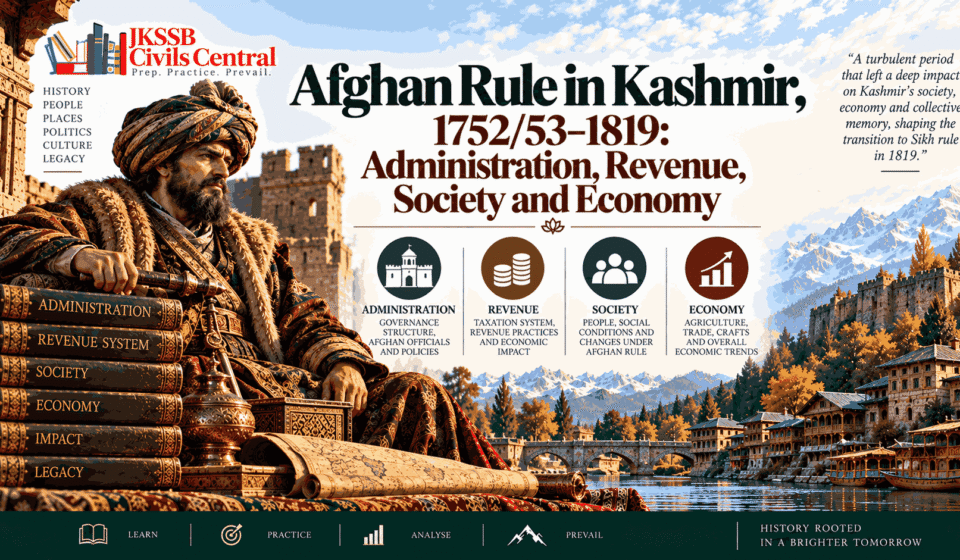
Afghan Rule in Kashmir, 1752/53–1819: Administration, Revenue, Society and Economy

J&K History Series Navigation
| Previous Article | Current Article | Next Article |
|---|---|---|
| Article 28 — Mughal Kashmir: Jahangir, Shah Jahan, Aurangzeb and the Development of Gardens and Architecture | Article 29 — Afghan Rule in Kashmir, 1752/53–1819: Administration, Revenue, Society and Economy | Article 30 — Afghan and Sikh Rule in Kashmir: Comparative Socio-Economic Conditions, Taxation and Crafts |
Learning Dashboard
| Component | Key Information |
|---|---|
| Historical Period | Mid-18th to early 19th century |
| Historical Phase | Afghan / Durrani rule in Kashmir |
| Approximate Period | 1752/53–1819 |
| Main Political Power | Durrani/Afghan Empire |
| Important Early Governor | Abdullah Khan Ishaq Aqsai |
| Major Local Figure | Raja Sukh Jiwan Mal |
| Important Afghan Governors | Noor-ud-din Bamzai, Haji Karim Dad Khan, Atta Muhammad Khan, Muhammad Azim Khan, Jabbar Khan |
| Administrative Core | Subadar, sahibkar, diwan, peshkar and revenue officials |
| Economic Core | Agriculture, land revenue, shawl industry, handicrafts and trade |
| Major Social Issue | Fiscal pressure, elite competition, migration and rural distress |
| Important Craft | Kashmiri shawl/pashmina weaving |
| Major Transition | Mughal decline → Afghan rule → Sikh conquest in 1819 |
| Key Sources | Persian chronicles, travel accounts, administrative/literary evidence and modern scholarship |
| JKSSB Importance | Very High |
| Expected Question Types | Direct fact, statements, chronology, matching, comparison, cause–consequence |
Introduction
The Afghan period occupies a distinctive position in the history of Kashmir because it emerged from the weakening of Mughal authority but did not represent a complete institutional break with the Mughal past. When Afghan power entered Kashmir in the early 1750s, it encountered an administrative system, revenue practices and local political networks that had already developed under the Mughals. The Afghan rulers therefore relied substantially on inherited institutions while modifying the functioning of important provincial offices, particularly those connected with the governor and revenue administration. The result was a political system in which imperial authority from the Durrani court coexisted uneasily with powerful provincial governors and indigenous elites.
The period is conventionally dated 1752/53 to 1819, although the exact starting point requires explanation. Afghan intervention and the first Afghan conquest belong to 1752–53, while some historians distinguish this initial intervention from the more effective consolidation of Afghan authority in 1762. The safest examination formulation is therefore 1752/53–1819, with the qualification that effective and durable Afghan control developed in stages. The period ended when Sikh forces under Maharaja Ranjit Singh defeated the Afghan forces in 1819 and incorporated Kashmir into the Lahore Darbar.
The traditional description of Afghan rule often emphasizes oppression, heavy taxation and economic decline. These themes are important, but a premium historical treatment must go further. The Afghan period also reveals the resilience of Kashmiri administrative institutions, the growing political importance of local elites, the continued importance of agriculture and handicrafts, the transformation of the shawl industry, the increasing participation of Kashmiri Pandits in higher administrative positions, and the vulnerability of the economy to both fiscal extraction and environmental disasters. Afghan rule was therefore not simply a story of external domination; it was also a period of institutional adaptation and changing relationships between the provincial state, local elites, cultivators and artisans.
CivilsCentral Historical Insight
The significance of the Afghan period lies not merely in the replacement of Mughal authority by Afghan authority. It demonstrates how political power in Kashmir could change at the imperial level while older administrative structures, local elites and economic institutions continued to shape governance from within.
Part I — Historical Background: From Mughal Decline to Afghan Intervention
1. The weakening of Mughal authority
By the first half of the eighteenth century, the Mughal Empire was experiencing a sustained decline in central authority. Kashmir, geographically distant from the imperial heartland and dependent on political connections through Punjab, became increasingly vulnerable to changes occurring outside the valley. The weakening of effective Mughal control encouraged provincial officials and local elites to pursue their own political interests, while developments in Punjab and the wider north-western region increasingly influenced Kashmir’s political trajectory.
The Afghan rise under Ahmad Shah Durrani (Ahmad Shah Abdali) transformed this regional balance. The Durrani Empire emerged in the aftermath of Nadir Shah’s death in 1747 and rapidly became a major power in Afghanistan, Punjab and the north-western subcontinent. Kashmir’s political future increasingly became connected to this changing geopolitical environment rather than being determined exclusively by the Mughal court.
The Afghan intervention was also facilitated by internal divisions among Kashmir’s political elites. Some influential local groups were dissatisfied with the existing provincial administration and saw Afghan intervention as a means of altering the balance of power. Thus, Afghan conquest should not be understood simply as an external military operation imposed upon a politically unified Kashmir; internal factional politics played an important role in creating the conditions for intervention.
2. The Afghan conquest and the problem of chronology
The Afghan conquest of Kashmir is generally associated with 1752/53. Abdullah Khan Ishaq Aqsai was appointed as the first Afghan governor associated with the new political order, and the early years were marked by rapid changes in provincial authority. The first phase did not immediately produce a completely stable or uniformly administered Afghan province. Instead, authority shifted among Afghan officials and powerful local figures, creating a transitional political environment.
One important figure in this early phase was Raja Sukh Jiwan Mal, who rose from a position within the Afghan administrative structure to become the dominant political authority in Kashmir. His long tenure illustrates an important feature of Afghan rule: the distinction between imperial sovereignty and effective provincial power could be considerable. Contemporary and later accounts indicate that Sukh Jiwan Mal exercised substantial autonomy while maintaining nominal allegiance to Ahmad Shah Durrani.
A further consolidation of Afghan control followed the defeat of Sukh Jiwan Mal in 1762. For this reason, historians sometimes distinguish between the initial Afghan conquest of 1752/53 and the later establishment of more effective Afghan political control. This distinction is particularly useful for avoiding the simplistic assumption that one military event instantly created a stable Afghan administration throughout Kashmir.
Examination distinction
1752/53 → Afghan conquest/intervention begins
1762 → defeat of Sukh Jiwan Mal and stronger Afghan consolidation
1819 → Sikh conquest and end of Afghan rule
The three dates should not be treated as interchangeable.
CivilsCentral Historical Insight
The transition from Mughal to Afghan rule was a process rather than a single administrative switch. The early prominence of Sukh Jiwan Mal demonstrates that local political agency remained important even after sovereignty had formally shifted to the Durrani Empire.
Part II — Afghan Political Structure and Administration
3. Continuity with the Mughal administrative framework
The Afghan rulers did not completely dismantle the administrative machinery inherited from the Mughals. Instead, they adapted it to the requirements of a more unstable imperial relationship. The broad framework of provincial governance continued, but the actual authority exercised by individual officials changed substantially. The subadar, or provincial governor, became particularly important because the governor represented the Afghan sovereign in Kashmir and exercised considerable control over provincial administration.
This continuity is historically important. Afghan rule should not be described as an entirely new administrative system. Rather, it was an Afghan political authority operating through an adapted version of institutions inherited from the Mughal period. The changes were especially visible in the personnel, tenure and functioning of provincial offices.
4. The Subadar: The central provincial authority
The subadar was the most important provincial official under Afghan rule. In theory, he represented the authority of the Afghan ruler and was responsible for maintaining order, supervising administration and ensuring the transfer of revenue to the central government. In practice, however, the distance between Kashmir and the Durrani political centre allowed some governors to acquire considerable autonomy.
Unlike a modern bureaucratic system with a predictable tenure, the tenure of Afghan governors in Kashmir varied sharply. Some remained in office for only a few months, while others governed for several years. This instability reflected the wider political instability of the Durrani Empire and the importance of personal relationships between provincial governors and the imperial court.
This frequent turnover had consequences beyond the personalities of individual governors. A governor who expected a short tenure had a strong incentive to maximize revenue quickly, while a longer-serving governor could develop a more independent political base. Consequently, the stability of provincial administration varied considerably across the period.
5. Sahibkar and the changing provincial administration
One notable institutional change involved the office known under the Mughals as karguzar, which was associated with the deputy provincial administration. Under Afghan rule, the designation sahibkar became important. The sahibkar assisted the governor in provincial administration and could acquire substantial influence depending upon the political circumstances of the governor.
The importance of the office illustrates a broader feature of Afghan governance: formal institutional structures mattered, but personal networks were equally significant. Governors frequently relied upon trusted officials and local elites, and some individuals accumulated multiple responsibilities within the provincial administration. This overlapping of offices demonstrates why Afghan Kashmir cannot be understood simply through a rigid hierarchy of departments.
6. Diwan, Peshkar and revenue administration
The diwan remained associated with fiscal administration, while the peshkar performed important economic and administrative functions. In practice, the responsibilities of officials could overlap, and particular individuals could hold more than one office at different times.
The peshkar’s significance was especially connected with revenue and economic affairs. The functioning of these offices reflected the central concern of the Afghan state: the extraction and transmission of revenue from Kashmir. Revenue was not merely an economic matter; it was one of the principal mechanisms through which the distant Durrani state attempted to maintain political authority over the valley.
7. Shiqdar, sazawal and the supervision of cultivation
The Afghan period also witnessed the increasing importance of officials involved directly in revenue collection from agriculture. Shiqdars and sazawals are associated in the historical literature with supervision of standing crops and the revenue-assessment process.
The basic logic was straightforward. Since agricultural revenue depended upon the produce of the land, the state needed officials capable of monitoring cultivation before the crop was harvested and assessed. Such officials could therefore become instruments of both administration and coercive extraction.
This is an important distinction for examination purposes: revenue administration was not confined to a single official. It involved a chain of provincial and local functionaries whose responsibilities could overlap.
8. The autonomy of Afghan governors
The most striking political feature of Afghan provincial administration was the substantial autonomy that some governors acquired. Several governors attempted to distance themselves from Kabul or pursued independent political ambitions. Sukh Jiwan Mal represents the clearest early example, but he was not the only provincial figure to challenge central authority.
This autonomy was partly structural. Communication between Kashmir and the Afghan political centre was difficult, and the Durrani Empire itself experienced repeated succession struggles and political fragmentation. A governor who controlled revenue, military resources and provincial appointments could therefore become a powerful regional actor.
The result was a recurring tension:
Afghan sovereignty → provincial governor → local elite → village and economic institutions
Each level had its own interests, and the resulting political structure was neither completely centralized nor fully autonomous.
CivilsCentral Historical Insight
Afghan administration in Kashmir demonstrates the difference between formal sovereignty and effective governance. Kabul possessed the ultimate political claim, but the actual operation of the state depended heavily on governors and local intermediaries who could acquire considerable autonomy.
Part III — Local Elites and Political Society
9. The importance of indigenous elites
The Afghan conquest did not eliminate Kashmir’s existing political elite. Instead, local families and officials continued to influence provincial administration, particularly during the early decades. Families such as the Kants and Bandays played important roles in the political struggles surrounding the transition from Mughal to Afghan authority.
Their significance reveals a central feature of eighteenth-century Kashmir: political power was negotiated through networks of officials, landed interests and court factions rather than simply imposed by an external ruler.
The relationship between Afghan governors and indigenous elites, however, was unstable. Local officials could assist a governor in acquiring power and later become threats to the same governor. Governors therefore alternated between incorporating local elites into government and suppressing them when their influence became excessive.
10. The changing composition of the ruling elite
As Afghan rule continued, the composition of the provincial elite changed. Some older families lost influence, while individuals and families favoured by successive governors gained prominence. The result was not a fixed administrative aristocracy but a shifting political class whose fortunes depended heavily upon proximity to the governor and control of administrative offices.
This process also affected the participation of Kashmiri Pandits in higher administration. Historical scholarship on Afghan administration records the appointment of Kashmiri Pandits to positions such as sahibkar, peshkar and diwan under different governors. Their increasing administrative prominence became particularly significant toward the end of Afghan rule and continued into the Sikh and later Dogra periods.
This should not be interpreted as a simple linear story of one community replacing another. Afghan Kashmir remained politically heterogeneous, and appointments depended on the interests and calculations of individual governors. The important historical development is the growing role of educated local officials in maintaining the machinery of government.
Part IV — Revenue System and Fiscal Pressure
11. Agriculture as the foundation of state revenue
Agriculture remained the principal economic foundation of Kashmir. Rice cultivation was particularly important in the valley, while horticulture and other forms of cultivation supplemented agricultural production. Consequently, the state’s fiscal health depended heavily upon the ability to assess and collect agricultural revenue.
The basic problem of the Afghan period was not the existence of agricultural taxation itself. Agricultural states necessarily depended upon land revenue. The deeper problem was the combination of revenue demand, intermediary exactions, political instability and repeated natural calamities. Where the official demand was supplemented by unauthorized or additional cesses, the effective burden upon cultivators could become considerably higher than the nominal assessment.
12. Multiple layers of extraction
Historical accounts of the period refer to a range of taxes and cesses affecting cultivators, traders and artisans. These included charges associated with agricultural produce, orchards, houses, shops, marriages and various economic activities. The terminology and incidence of individual levies varied, and the surviving evidence does not justify presenting every reported tax as a uniformly imposed province-wide tax throughout the entire Afghan period.
The important structural point is that taxation was multi-layered. Revenue could pass through several levels of officials and intermediaries, and the distinction between officially sanctioned revenue and additional exactions was not always clear in practice.
For the cultivator, therefore, the burden could include:
State assessment → local collection → intermediary demands → additional cesses
This helps explain why the effective fiscal burden could be much heavier than a simple statement of the nominal land-revenue rate would suggest.
13. The position of the peasantry
The peasantry was particularly vulnerable because agriculture was tied directly to climatic conditions. A bad harvest could reduce the cultivator’s capacity to pay revenue precisely when the state’s fiscal demands remained high.
Debt further complicated the situation. When cultivators borrowed to survive periods of scarcity, repayment could increase their economic vulnerability. In some accounts, excessive exactions contributed to the abandonment of land and migration from the valley.
However, it is important not to treat every report of agricultural distress as evidence of continuous economic collapse throughout the entire 67-year period. Conditions varied significantly by governor, locality, harvest and environmental circumstances.
14. Revenue officials and coercive collection
The administrative machinery developed mechanisms for monitoring crops and collecting revenue. Officials responsible for assessing standing crops could exercise considerable power over cultivators because the timing and method of assessment directly affected the amount payable.
The institutional objective was to secure the state’s revenue. Yet weak supervision and the personal interests of officials created opportunities for abuse. This produced one of the recurring tensions of Afghan administration: the state sought predictable revenue, while officials could use their positions to extract additional resources.
The distinction between fiscal administration and fiscal exploitation is therefore essential. The existence of a revenue system does not itself prove oppression, but evidence of unauthorized cesses, excessive collection and local corruption helps explain why contemporary and later accounts portray the period as economically burdensome.
CivilsCentral Historical Insight
The central economic problem of Afghan Kashmir was not taxation in isolation. It was the interaction of state revenue demands, intermediary extraction, administrative instability and environmental shocks. This combination could turn a formally organized fiscal system into a highly unequal burden at the local level.
Part V — Agriculture, Famines and Environmental Vulnerability
15. Natural calamities and economic stress
Kashmir’s agricultural economy was highly sensitive to floods, excessive cold, crop failures and other environmental disturbances. During the Afghan period, several episodes of scarcity and famine are recorded in historical literature. Reports mention severe agricultural difficulties in the 1750s and 1760s and further episodes associated with floods and climatic shocks in later decades.
These events should not automatically be classified as purely “natural” disasters. The severity of a famine depended not only upon weather but also upon storage, transportation, taxation, market conditions and the state’s capacity to provide relief.
The distinction is particularly important because agricultural distress could become much more severe when a weak harvest coincided with continued revenue demands.
16. Sukh Jiwan Mal and relief measures
The early rule of Sukh Jiwan Mal provides an important counterpoint to the generalized image of Afghan administration. Historical accounts describe measures intended to provide grain and seed assistance during periods of scarcity. One study based on literary evidence records the distribution of grain and agricultural assistance during the famine conditions of the 1750s.
Such evidence is significant because it shows that the Afghan-period state was not uniformly indifferent to agricultural crisis. Governors could adopt relief measures when political or administrative conditions permitted.
This does not erase the broader evidence of fiscal pressure. Rather, it demonstrates that the quality of governance differed substantially from one governor to another.
Part VI — The Shawl Industry and the Afghan Economy
17. Kashmir’s shawl economy
The shawl industry was one of the most important sectors of Kashmir’s urban economy. Kashmiri artisans transformed fine pashmina wool into highly valued textiles that circulated through Indian and wider Asian markets. The industry had developed before Afghan rule, particularly under the Sultanate and Mughal periods, and therefore it is incorrect to attribute its origin to the Afghans.
What changed under Afghan rule was the relationship between the state and the industry. As the shawl became an important source of revenue, the government increasingly sought to regulate production, sale and taxation. This produced a contradiction that became characteristic of the period: the industry could remain commercially important while the artisans themselves experienced severe fiscal and occupational pressure.
18. Dagh-shawl and state regulation
The dagh-shawl system is associated with Afghan attempts to regulate and tax the shawl industry. Government control over the stamping or authorization of shawls enabled the state to derive revenue from production and trade.
Historical studies report that heavy taxation and regulation contributed to difficulties for shawl weavers. George Forster, who travelled through Kashmir in the eighteenth century, famously recorded a much lower number of shawl looms than figures associated with the Mughal period. The comparison is useful, but it should not be treated as a precise statistical measurement of the entire industry because the earlier and later figures derive from different sources and observational contexts.
A particularly important point is that commercial success did not necessarily mean artisan prosperity. Merchants, intermediaries and the state could capture a substantial portion of the value generated by the industry, while weavers remained economically vulnerable.
19. Haji Karim Dad Khan and the shawl industry
Haji Karim Dad Khan, who governed Kashmir in the late eighteenth century, is particularly associated in the historical literature with tighter regulation of the shawl industry. The creation or strengthening of a dedicated administrative mechanism for shawls reflected the state’s recognition of the sector as an important source of revenue.
The resulting relationship was paradoxical. The government had an incentive to preserve production because shawls generated revenue and external demand, but excessive taxation could undermine the economic condition of the very artisans on whom the industry depended.
This is one of the clearest examples of the contradiction between short-term fiscal extraction and long-term economic sustainability.
20. The European market
By the late eighteenth and early nineteenth centuries, Kashmiri shawls had acquired substantial demand outside the immediate South Asian market. European demand eventually became an important factor in the industry’s expansion, although it is necessary to distinguish the growth of external demand from the living conditions of artisans.
The industry therefore cannot be described simply as “declining” throughout Afghan rule. A more accurate interpretation is that commercial demand and artisan welfare could move in opposite directions. Demand could rise while taxation, regulation and intermediary control simultaneously increased the pressure on producers.
CivilsCentral Historical Insight
The shawl industry illustrates a broader economic contradiction of Afghan Kashmir: an industry could remain internationally desirable and fiscally valuable while the producers themselves faced increasing pressure. Economic growth in a particular sector should therefore never be equated automatically with improvement in the living standards of its workers.
Part VII — Trade, Crafts and Urban Economy
21. Kashmir’s trading connections
Kashmir remained connected to several commercial regions during Afghan rule. Trade routes linked the valley with Punjab, Ladakh, Tibet, Central Asia and other parts of northern India. Shawls, woollen products, paper, agricultural commodities and other crafts formed part of the commercial economy.
The valley’s geographical position created both opportunity and vulnerability. Kashmir could participate in long-distance trade because of its specialized products, but mountain routes also made transport expensive and politically sensitive. Instability along surrounding routes could therefore affect trade even when production inside the valley remained active.
22. Trade taxation
The state derived revenue from commercial activity through customs and related duties. Taxes on imports and exports could provide substantial income to the government, but excessive charges could also discourage merchants and raise the cost of trade.
Historical accounts describe taxation of commodities moving through Kashmir and the importance of trading points around Srinagar and other commercial centres. Such evidence suggests that the Afghan state viewed commerce not simply as an economic activity but as a fiscal resource.
The same structural problem therefore appeared in both agriculture and handicrafts:
Commercial activity → state revenue → higher fiscal pressure → potential reduction in private economic incentives.
23. Other crafts
Kashmir’s economy was never dependent exclusively on shawls. Other crafts, including carpet production, paper-making, woollen textiles, woodwork and related handicrafts, contributed to urban economic life.
The Afghan period should therefore be understood as part of a longer history of specialized Kashmiri craft production rather than as the beginning or end of the craft economy. Some industries continued to function because they possessed strong regional demand, while others were affected by taxation, changing markets and political instability.
Part VIII — Society Under Afghan Rule
24. Social differentiation
Afghan Kashmir was characterized by significant social and economic differentiation. At the top stood Afghan governors, military and administrative officials, powerful local elites and wealthy merchants. Below them were cultivators, artisans, labourers, boatmen and other occupational groups whose economic security depended more directly upon production and wages.
The expansion of revenue extraction affected these groups differently. Officials and intermediaries could sometimes benefit from access to state resources, whereas cultivators and artisans had fewer opportunities to transfer the fiscal burden to others.
This produced an important divide between those who administered and collected revenue and those whose productive activities generated it.
25. Migration and economic distress
Migration appears repeatedly in historical accounts of eighteenth-century Kashmir. Heavy taxation, insecurity, economic hardship and periodic scarcity could encourage sections of the population to leave the valley.
However, migration should not be represented as a single continuous demographic collapse. The scale and direction of migration varied over time and among occupational groups. Some artisans moved in search of better opportunities, while others remained because their specialized skills were closely connected with Kashmiri production networks.
The safest historical conclusion is that economic pressure contributed to episodes of migration, rather than that the entire population was permanently displaced.
26. Religious and sectarian tensions
The Afghan period also witnessed episodes of religious and sectarian tension, including conflicts involving Sunni and Shia communities. Some governors were associated in historical accounts with sectarian policies, while other governors appear to have adopted more pragmatic administrative approaches.
It would be misleading, however, to reduce the entire Afghan period to a single uniform religious policy. Afghan governors differed considerably in temperament, political priorities and relations with local groups. Moreover, fiscal extraction often affected people across religious boundaries.
This is an important examination distinction: political oppression, fiscal exploitation and sectarian discrimination are related historical phenomena but should not be treated as identical processes.
27. The position of Kashmiri Pandits
The administrative history of the period is particularly important for understanding the changing role of Kashmiri Pandits. Historical studies record Pandits serving in senior administrative positions under different Afghan governors, including offices connected with revenue and provincial administration.
This development is significant because it demonstrates that political participation under Afghan rule was not determined solely by religious identity. Education, administrative skill, political connections and the requirements of the governor also influenced appointments.
At the same time, episodes of discrimination and conflict are recorded in the historical literature. These should be studied individually rather than converted into a single generalized policy covering the entire 67-year period.
CivilsCentral Historical Insight
Afghan Kashmir was socially hierarchical and politically unequal, but it was not socially static. The period witnessed changes in the composition of the administrative elite, increasing participation of local officials and shifting relations among Afghan governors, Kashmiri elites, cultivators, artisans and religious communities.
Part IX — Important Afghan Governors and Their Historical Context
28. Raja Sukh Jiwan Mal
Sukh Jiwan Mal is one of the most important figures for understanding the early Afghan period. He began within the Afghan administrative structure but subsequently acquired substantial autonomous power in Kashmir. His long tenure contrasts sharply with the short and unstable terms of several later governors.
His rule is remembered for both political independence and administrative measures, including relief during periods of agricultural distress. His eventual defeat in 1762 enabled the Afghans to strengthen their direct political control over Kashmir.
For examination purposes:
Sukh Jiwan Mal → early Afghan period → long provincial rule → substantial autonomy → defeated in 1762.
29. Haji Karim Dad Khan
Haji Karim Dad Khan governed Kashmir during the later eighteenth century and is particularly associated with strong fiscal extraction and regulation of economic activity. Historical literature connects his administration with increased pressure on artisans and with measures affecting the shawl industry.
His tenure illustrates the relationship between provincial governance and revenue maximization. The state increasingly treated productive sectors such as shawl weaving as taxable economic resources.
30. Atta Muhammad Khan
Atta Muhammad Khan was one of the more significant governors of the early nineteenth century. His period is important for understanding the continued economic importance of Kashmir’s crafts and the increasing political instability of the Durrani Empire.
He is also associated in the historical literature with administrative and infrastructural activity, while his period witnessed the continued significance of the shawl industry.
His career also demonstrates the increasing autonomy of provincial governors during the weakening phase of Durrani political authority.
31. Muhammad Azim Khan
Muhammad Azim Khan Barakzai became governor of Kashmir in 1813. His tenure occurred during the final phase of Afghan rule, when the political position of the Durrani Empire had weakened considerably and Sikh power under Ranjit Singh was expanding. He also faced the consequences of wider Barakzai–Durrani political struggles.
The significance of Azim Khan lies less in administrative innovation than in the geopolitical circumstances of his governorship. Kashmir was increasingly exposed to the expansion of the Sikh Empire, while Afghan political authority in the region was becoming fragile.
32. Jabbar Khan and the final phase
Jabbar Khan was the last major Afghan governor associated with Kashmir before the Sikh conquest of 1819. His forces confronted the Sikh army during the final campaign.
The Afghan defeat in 1819 ended the Durrani political order in Kashmir and opened the Sikh phase of the region’s history. The details of the military campaign and the Battle of Shopian belong more fully to the next stage of the series, but the political significance is clear: the end of Afghan rule was part of the larger decline of Durrani authority and expansion of the Sikh Empire.
Part X — Political Instability and the Weakening of Afghan Rule
33. Why did Afghan rule become unstable?
Several factors contributed to the weakening of Afghan authority in Kashmir.
First, the Durrani Empire itself suffered from succession disputes and political fragmentation. Kashmir was a distant province, and changes at the centre frequently affected provincial appointments and military support.
Second, frequent changes of governors reduced administrative continuity. Some governors remained in power for only short periods, while others became sufficiently powerful to challenge the central authority.
Third, local elites continued to pursue their own political interests. Their cooperation could strengthen a governor, but their rivalries could also destabilize the administration.
Fourth, fiscal pressure created resentment among cultivators, artisans and other sections of society. Excessive extraction could generate revenue in the short term but weaken the productive base over time.
Finally, the rise of Sikh power in Punjab created a new strategic environment. By the early nineteenth century, Kashmir was no longer simply a distant Durrani possession; it had become an important objective in the expansion of the Lahore Darbar.
34. The 1812–13 political transformation
The political environment changed significantly when Afghan and Sikh forces cooperated temporarily in the early 1810s in campaigns connected with the wider struggle for control in the north-west. In 1813, Muhammad Azim Khan became governor of Kashmir, while Sikh power continued to expand.
The significance of this phase is that Afghan rule increasingly depended upon a political environment that the Durrani Empire could no longer control effectively. Punjab had become a major independent centre of military power under Ranjit Singh.
35. The end of Afghan rule in 1819
The final collapse came in 1819, when the Sikh Empire launched a successful campaign against Kashmir. Afghan resistance was defeated, and Kashmir was incorporated into the Lahore Darbar.
The transition should not be interpreted as a simple consequence of popular dissatisfaction alone. Local political opposition, weakening Afghan authority, the military rise of the Sikh Empire and the strategic importance of Kashmir all interacted in producing the final change.
Thus:
Durrani decline + provincial instability + local political opposition + Sikh military expansion → end of Afghan rule in 1819.
The next article will examine how Afghan and Sikh rule compared in terms of taxation, society, crafts and economic conditions.
CivilsCentral Historical Insight
The end of Afghan rule was not caused by one factor. The decisive transformation resulted from the interaction of internal provincial instability with the broader collapse of Durrani power and the rise of the Sikh Empire as the dominant military power in the Punjab and north-west.
Part XI — Economy Under Afghan Rule: A Balanced Assessment
The economic history of Afghan Kashmir cannot be reduced to either “complete destruction” or “continued prosperity.” The evidence points to a more complicated picture. Agriculture remained the foundation of the economy, trade continued across regional networks, and specialized crafts such as shawl weaving retained strong demand. At the same time, fiscal pressure, administrative instability, natural disasters and intermediary extraction could seriously damage producers.
The shawl industry is perhaps the clearest example. External demand could remain strong while the condition of artisans deteriorated. Similarly, agricultural production could remain substantial while cultivators faced increasing difficulty in retaining the surplus necessary for household security.
This distinction between economic production and distribution of economic surplus is essential. A society may continue producing valuable commodities while the producers themselves become poorer because an increasing share of the surplus is captured by the state, intermediaries or commercial elites.
Part XII — Historical Sources and Evidence
36. Persian and local literary sources
Much of the history of eighteenth-century Kashmir is reconstructed through Persian historical writings, later chronicles, administrative traditions and literary accounts. These sources are indispensable for reconstructing the succession of governors, political conflicts and administrative practices.
At the same time, they must be used critically. Chronicles frequently emphasize the personal character of rulers and governors, sometimes describing them as exceptionally cruel, generous or capable. Such descriptions may contain valuable evidence, but they should not automatically be treated as neutral statistical assessments of society.
37. European travellers
European travellers provide another important category of evidence. George Forster, who travelled through Kashmir in the late eighteenth century, recorded observations on agriculture, trade, shawl production, wages and taxation.
Travel accounts are especially valuable because they can provide observations on material conditions, but they also have limitations. A traveller observed a particular period and locality and could not necessarily measure the whole economy. Therefore, statements such as the number of shawl looms should be used as contemporary observations, not as perfectly comparable census figures.
38. Modern scholarship
Modern historians have increasingly examined Afghan Kashmir through administrative, economic and social perspectives rather than relying exclusively on narratives of dynastic succession. Recent scholarship emphasizes the interaction between inherited Mughal institutions, Afghan political authority, indigenous elites and the economic structure of the valley.
This approach is particularly useful because it prevents the Afghan period from becoming a simplistic story of “foreign rule.” It allows historians to ask how institutions actually operated and how different groups experienced the same political system differently.
Part XIII — Historical Interpretation / Evidence Note
Strongly established
- Afghan political control replaced Mughal authority in Kashmir in the early 1750s.
- The period conventionally ends with Sikh conquest in 1819.
- Afghan governors exercised substantial provincial authority.
- Mughal administrative structures continued in modified form.
- Agriculture remained a major economic foundation.
- Shawl production and trade remained important.
- Provincial instability and frequent changes of governors characterized much of the period.
- Durrani political decline contributed to the eventual loss of Kashmir.
Strong historical tradition
- The political career and autonomy of Sukh Jiwan Mal.
- Particular details concerning the political intrigues of local elite families.
- Specific administrative actions attributed to individual governors.
- Particular relief measures during famines.
Literary / traveller evidence requiring caution
- Exact numbers of shawl looms.
- Exact numbers of people migrating from Kashmir.
- Exact amounts of revenue collected annually.
- Exact scale of particular famines.
- Dramatic descriptions of individual governors.
Contested or requiring qualification
- The precise beginning of Afghan rule: 1752, 1753 or the later consolidation of 1762 depending upon the definition used.
- Exact number of Afghan governors because different lists count repeated appointments and deputy-governors differently.
- The precise incidence and geographical extent of individual taxes.
- Claims that the entire economy uniformly collapsed during Afghan rule.
- Claims that a single community was uniformly persecuted throughout the entire period.
Part XIV — JKSSB Knowledge Matrix
| Question | High-Value Answer |
|---|---|
| Who established Afghan rule in Kashmir? | Ahmad Shah Durrani/Abdali |
| When did Afghan rule begin? | Conventionally 1752/53 |
| When did Afghan rule end? | 1819 |
| Who was an important early Afghan-period ruler of Kashmir? | Raja Sukh Jiwan Mal |
| When was Sukh Jiwan Mal defeated? | 1762 |
| Who represented Durrani authority in the province? | Subadar/governor |
| What major administrative system continued? | Adapted Mughal provincial framework |
| Important Afghan-period administrative title | Sahibkar |
| Major source of state revenue | Agriculture/land revenue |
| Important craft industry | Shawl/pashmina weaving |
| What system regulated shawls? | Dagh-shawl system |
| Important late-18th-century governor | Haji Karim Dad Khan |
| Important early-19th-century governor | Muhammad Azim Khan |
| Last Afghan governor before Sikh conquest | Jabbar Khan |
| Who conquered Kashmir in 1819? | Sikh forces under Ranjit Singh |
| What happened after 1819? | Kashmir came under Lahore Darbar/Sikh rule |
Part XV — Examination Discrimination Points
1. 1752/53 vs 1819
1752/53 = beginning of Afghan political intervention/rule
1819 = end of Afghan rule
2. Sukh Jiwan Mal vs Afghan emperor
Sukh Jiwan Mal was a powerful provincial ruler in Kashmir, not an Afghan emperor.
3. Mughal administrative continuity vs Afghan political control
Afghan rule did not mean complete abandonment of Mughal administrative institutions.
4. Agriculture vs shawl industry
Agriculture remained the fundamental economic base, while the shawl industry was one of Kashmir’s most important specialized commercial industries.
5. Shawl industry vs Dagh-shawl
The shawl industry existed before Afghan rule.
The Dagh-shawl regulatory system is associated with Afghan-period state regulation and taxation.
6. Economic importance vs artisan welfare
Strong demand for Kashmiri shawls does not automatically mean that shawl weavers enjoyed prosperity.
7. Afghan governors vs central Durrani authority
The governor represented the Durrani state, but several governors exercised considerable autonomy.
8. Afghan rule vs uniform religious policy
Different governors followed different policies. The entire 1752/53–1819 period should not be reduced to one uniform religious policy.
9. Natural calamity vs famine
A flood, cold spell or crop failure could contribute to famine, but the severity of famine was also affected by taxation, administration, food availability and economic conditions.
10. 1819 transition
The end of Afghan rule was part of the broader decline of Durrani power and rise of the Sikh Empire.
Part XVI — JKSSB Question Pattern
Direct Fact
Q. Afghan rule in Kashmir ended in:
A. 1752
B. 1762
C. 1819
D. 1846
Answer: C. 1819
Statement-Based
Consider the following statements:
- Afghan administration completely replaced the Mughal administrative framework in Kashmir.
- The subadar was an important provincial authority under Afghan rule.
- Agriculture remained an important source of state revenue.
- The shawl industry originated during Afghan rule.
Which of the above statements are correct?
Answer: 2 and 3 only.
Explanation: Afghan administrators substantially retained and modified inherited Mughal institutions. Agriculture remained central to the economy, while shawl production clearly predated Afghan rule.
Chronology
Arrange the following in chronological order:
- Sikh conquest of Kashmir
- Afghan conquest/intervention in Kashmir
- Defeat of Sukh Jiwan Mal
- Appointment of Muhammad Azim Khan as governor
Correct sequence:
2 → 3 → 4 → 1
Match the Following
| Person | Association |
|---|---|
| Sukh Jiwan Mal | Early Afghan period |
| Haji Karim Dad Khan | Late eighteenth-century governorship |
| Muhammad Azim Khan | Final phase of Afghan rule |
| Jabbar Khan | Final Afghan governor / 1819 transition |
Identification by Clues
Who am I?
- I rose within the Afghan administrative system.
- I became the dominant political authority in Kashmir.
- I exercised considerable autonomy.
- My rule ended after Afghan forces defeated me in 1762.
Answer: Raja Sukh Jiwan Mal
Correct / Incorrect Pair
Which pair is incorrectly matched?
A. Sukh Jiwan Mal — Early Afghan period
B. Haji Karim Dad Khan — Shawl regulation
C. Muhammad Azim Khan — Final phase of Afghan rule
D. Sukh Jiwan Mal — Sikh conquest of Kashmir in 1819
Answer: D
Part XVII — JKSSB Practice Questions
Question 1
The Afghan period in Kashmir is conventionally placed between:
A. 1586–1752
B. 1752/53–1819
C. 1819–1846
D. 1707–1761
Correct Answer: B
Explanation: Afghan political control emerged in Kashmir in the early 1750s and ended with the Sikh conquest in 1819.
Question 2
Which of the following best describes Afghan administration in Kashmir?
A. Complete replacement of Mughal institutions
B. Complete decentralization with no provincial authority
C. Adaptation of inherited Mughal structures under Afghan political control
D. Direct administration from Kabul without provincial governors
Correct Answer: C
Explanation: Afghan rulers retained substantial elements of the Mughal administrative framework but modified important offices and strengthened the authority of provincial governors.
Question 3
Raja Sukh Jiwan Mal is primarily associated with:
A. The Mughal annexation of Kashmir
B. The early Afghan period
C. The Sikh conquest of Kashmir
D. Dogra expansion into Ladakh
Correct Answer: B
Question 4
Which sector was particularly important for the commercial economy of Afghan Kashmir?
A. Cotton plantations
B. Shawl production
C. Tea plantations
D. Indigo cultivation
Correct Answer: B
Question 5
Consider the following statements:
- Shawl production originated under Afghan rule.
- Afghan authorities sought to regulate and tax the shawl industry.
- External demand for Kashmiri shawls remained important during the later eighteenth century.
Which statements are correct?
A. 1 only
B. 2 only
C. 2 and 3 only
D. 1, 2 and 3
Correct Answer: C
Explanation: Shawl production predated Afghan rule. The Afghan state increasingly regulated and taxed the industry, while external demand remained important.
Question 6
Which factor contributed to the weakening of Afghan authority in Kashmir?
A. Complete disappearance of agriculture
B. Strengthening of the Durrani Empire
C. Political instability within the Durrani Empire and rise of Sikh power
D. Mughal reconquest of Kashmir
Correct Answer: C
Question 7
Which of the following was an important characteristic of Afghan provincial administration?
A. Fixed and uniform tenure for every governor
B. Complete independence of all local elites
C. Considerable variation in the tenure and authority of governors
D. Absence of revenue officials
Correct Answer: C
Question 8
Muhammad Azim Khan is associated with:
A. The beginning of Karkota rule
B. The final phase of Afghan rule in Kashmir
C. Mughal annexation in 1586
D. Treaty of Amritsar
Correct Answer: B
Question 9
The Afghan rule in Kashmir ended following:
A. Battle of Hastivanj
B. Battle of Shopian
C. Battle of Plassey
D. Battle of Panipat III
Correct Answer: B
Question 10
Which sequence is correct?
A. Afghan rule → Mughal rule → Sikh rule
B. Mughal rule → Afghan rule → Sikh rule
C. Sikh rule → Afghan rule → Mughal rule
D. Mughal rule → Sikh rule → Afghan rule
Correct Answer: B
Part XVIII — Rapid Revision Zone
Important Dates
| Date | Event |
|---|---|
| 1752/53 | Beginning of Afghan political control/intervention in Kashmir |
| 1762 | Defeat of Sukh Jiwan Mal and stronger Afghan consolidation |
| Late 18th century | Intensification of revenue and shawl regulation |
| 1813 | Muhammad Azim Khan becomes governor |
| 1819 | Sikh conquest; Afghan rule ends |
Important Personalities
- Ahmad Shah Durrani → Afghan/Durrani sovereign
- Sukh Jiwan Mal → powerful early Afghan-period ruler
- Haji Karim Dad Khan → important late-18th-century governor
- Atta Muhammad Khan → important early-19th-century governor
- Muhammad Azim Khan → final phase of Afghan administration
- Jabbar Khan → final Afghan governor associated with 1819
Administrative Terms
- Subadar → principal provincial governor
- Sahibkar → important provincial official under Afghan rule
- Diwan → fiscal/financial administration
- Peshkar → economic/administrative functions
- Shiqdar → crop/revenue supervision
- Sazawal → supervision associated with revenue assessment
- Kardar → local revenue/administrative functionary in the revenue structure
Economic Associations
Agriculture → principal economic foundation
Rice → major agricultural crop
Shawl industry → major commercial craft
Dagh-shawl → state regulation/taxation of shawls
Trade → Punjab, Ladakh, Tibet, Central Asia and northern India
Political Sequence
Declining Mughal authority
↓
Afghan intervention, 1752/53
↓
Early provincial instability
↓
Sukh Jiwan Mal
↓
Afghan consolidation after 1762
↓
Frequent governors + local elite competition
↓
Durrani political decline
↓
Rise of Sikh power
↓
Sikh conquest, 1819
Part XIX — Frequently Confused Facts
| Confusion | Correct Distinction |
|---|---|
| Afghan rule began in 1819 | 1819 ended Afghan rule |
| Sukh Jiwan Mal was an Afghan emperor | He was a powerful ruler/governor in Kashmir under nominal Durrani sovereignty |
| Afghans abolished Mughal administration | They substantially adapted inherited institutions |
| Shawl industry began under Afghans | It predated Afghan rule |
| Dagh-shawl = type of shawl | It refers to a regulatory/stamping and taxation mechanism |
| Every Afghan governor ruled for a fixed period | Governor tenures varied considerably |
| Afghan rule always had one uniform policy | Policies varied by governor and political circumstances |
| Economic distress means no trade existed | Trade and craft production continued despite fiscal pressure |
| 1762 = end of Afghan rule | 1762 marks stronger consolidation after Sukh Jiwan Mal’s defeat |
| 1819 = beginning of Sikh rule only | It also marks the end of Afghan political authority in Kashmir |
Part XX — What Can JKSSB Ask?
High-value question areas
- Beginning and end of Afghan rule
- 1752/53 versus 1819
- Sukh Jiwan Mal and 1762
- Ahmad Shah Durrani
- Afghan governors
- Subadar and provincial administration
- Sahibkar and other administrative offices
- Continuity of Mughal institutions
- Role of local elites
- Revenue administration
- Agriculture as economic base
- Shawl industry
- Dagh-shawl regulation
- Economic impact of taxation
- Natural calamities and famine
- Position of artisans
- Role of Kashmiri Pandits in administration
- Muhammad Azim Khan
- Jabbar Khan
- Sikh conquest in 1819
- Causes of Afghan decline
Particularly useful statement-question distinction
A strong question can combine: Afghan rule + Sukh Jiwan Mal + revenue + shawl industry + 1819, rather than testing each fact independently.
Chapter Summary
Afghan rule in Kashmir emerged in the context of Mughal decline and the rise of the Durrani Empire. The transition began in 1752/53, although the consolidation of effective Afghan authority occurred over several stages, particularly after the defeat of Sukh Jiwan Mal in 1762. Afghan rulers did not completely replace the Mughal administrative structure; instead, they adapted inherited institutions while provincial governors acquired considerable authority.
The subadar became the key provincial representative of Afghan authority, supported by offices such as the sahibkar, diwan and peshkar. Yet frequent changes of governors and the considerable autonomy of provincial officials produced political instability. Local elites remained important, while Kashmiri Pandits increasingly entered significant administrative positions.
Economically, agriculture remained the principal foundation of state revenue. Heavy fiscal demands, intermediary exactions and environmental disasters placed considerable pressure on cultivators. At the same time, Kashmir continued to participate in regional and long-distance trade, and the shawl industry remained commercially significant. The Afghan state’s increasing regulation and taxation of shawl production created a major contradiction: the industry could remain valuable and externally demanded while its artisans faced severe economic pressure.
The weakening of Durrani authority, provincial instability and the rise of Sikh military power ultimately transformed the political balance. In 1819, Sikh forces conquered Kashmir, ending the Afghan period and beginning the Sikh phase of the region’s history.
JKSSB Takeaway
1752/53 → Afghan rule begins
Sukh Jiwan Mal → important early Afghan-period ruler
1762 → Sukh Jiwan Mal defeated; stronger Afghan consolidation
Subadar → principal provincial authority
Agriculture → major revenue base
Shawl industry → major commercial craft
Dagh-shawl → Afghan-period regulation/taxation of shawls
Muhammad Azim Khan → final phase of Afghan rule
1819 → Sikh conquest and end of Afghan rule
Mind Map
DECLINE OF MUGHAL AUTHORITY
          ↓
AFGHAN / DURRANI EXPANSION
          ↓
AFGHAN INTERVENTION IN KASHMIR
          ↓
1752/53
          ↓
EARLY POLITICAL INSTABILITY
          ↓
SUKH JIWAN MAL
          ↓
DEFEAT IN 1762
          ↓
STRONGER AFGHAN CONSOLIDATION
          ↓
PROVINCIAL GOVERNORS / SUBADARS
          ↓
LOCAL ELITES + ADMINISTRATIVE OFFICIALS
          ↓
REVENUE EXTRACTION
          ↓
AGRICULTURE ─── SHAWL INDUSTRY ─── TRADE
          ↓
FISCAL PRESSURE + ENVIRONMENTAL SHOCKS
          ↓
SOCIAL / ECONOMIC DISTRESS
          ↓
WEAKENING DURRANI AUTHORITY
          ↓
RISE OF SIKH POWER
          ↓
1819
          ↓
SIKH CONQUEST OF KASHMIR
FAQs
1. When did Afghan rule begin in Kashmir?
Afghan political control is conventionally dated to 1752/53, following the intervention of Ahmad Shah Durrani. The exact starting point varies according to whether historians emphasize the initial conquest or subsequent consolidation.
2. When did Afghan rule end in Kashmir?
Afghan rule ended in 1819, when Sikh forces conquered Kashmir.
3. Who was Sukh Jiwan Mal?
Sukh Jiwan Mal was a powerful political figure of the early Afghan period who rose within the Afghan administrative structure and subsequently exercised considerable autonomy in Kashmir. He was defeated in 1762.
4. Did the Afghans completely replace Mughal administration?
No. Afghan rulers retained substantial elements of the Mughal administrative framework but modified offices, personnel and their functioning.
5. What was the principal source of state revenue?
Agriculture and land revenue remained fundamental to the state’s finances.
6. What was the importance of the shawl industry?
The shawl industry was one of Kashmir’s most important specialized commercial industries. Afghan rulers increasingly regulated and taxed it because of its economic value.
7. What was Dagh-shawl?
Dagh-shawl refers to the Afghan-period system of regulating and taxing shawl production through state control and stamping/authorization.
8. Was Afghan rule uniformly oppressive throughout the entire period?
Historical evidence indicates substantial fiscal and political hardship, but conditions varied considerably among governors and periods. A single uniform description of all 67 years would oversimplify the evidence.
9. Who was Muhammad Azim Khan?
Muhammad Azim Khan was an Afghan governor of Kashmir from 1813 until the final phase of Afghan rule. His tenure coincided with the growing challenge posed by Sikh power.
10. What ended Afghan rule in Kashmir?
The Sikh conquest of Kashmir in 1819 ended Afghan political authority and brought Kashmir under the Lahore Darbar.
About The Author




[…] Article 29 — Afghan Rule in Kashmir, 1752/53–1819: Administration, Revenue, Society and Economy […]
[…] Article 29 — Afghan Rule in Kashmir, 1752/53–1819: Administration, Revenue, Society and Economy […]