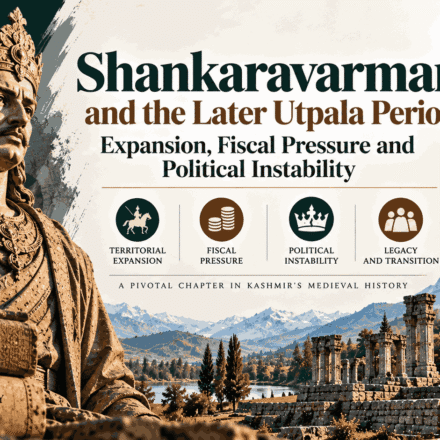
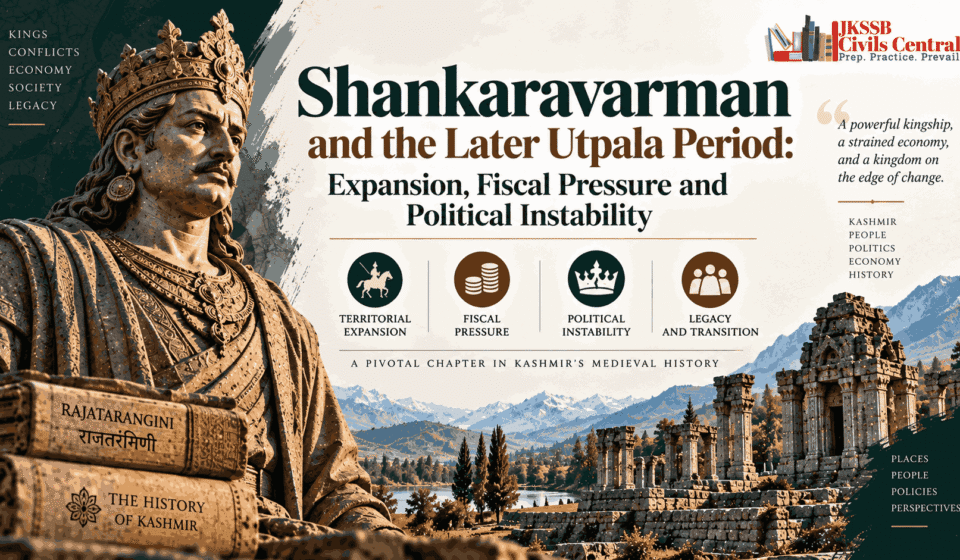
Shankaravarman and the Later Utpala Period: Expansion, Fiscal Pressure and Political Instability

J&K History Series Navigation
| Previous Article | Current Article | Next Article |
|---|---|---|
| Article 14 — Utpala Dynasty in Kashmir: Avantivarman, Suyya and the Agrarian-Hydraulic Transformation | Article 15 — Shankaravarman and the Later Utpala Period: Expansion, Fiscal Pressure and Political Instability | Article 16 — Post-Utpala Kashmir: Political Fragmentation, Yashaskara, Parvagupta and Kshemagupta |
Learning Dashboard
| Category | Key Information |
|---|---|
| Historical Period | Late 9th–early 10th century CE |
| Historical Phase | Early Medieval Kashmir |
| Dynasty | Utpala |
| Ruler | Shankaravarman |
| Reign | Commonly c. 883–902 CE; exact accession chronology is sometimes presented differently |
| Father / Predecessor | Avantivarman |
| Successor | Gopalavarman |
| Core Theme | Military expansion, fiscal extraction and political strain |
| Major Regions | Kashmir, Darvabhisara, Trigarta, Gurjara/Takka country, north-western frontier |
| Important Place | Shankarapura, traditionally identified with modern Pattan |
| Major Source | Kalhana’s Rajatarangini, Book V |
| Important External Context | Gurjara-Pratihara and Hindu Shahi political networks of the north-west |
| End of Reign | Shankaravarman died during a northern expedition in 902 CE, traditionally at Urasa |
| JKSSB Importance | Very High |
| Expected Question Types | Direct fact, chronology, statement-based, matching, identification, comparative and conceptual-factual |
Introduction
The reign of Shankaravarman marks a significant change in the political direction of the Utpala dynasty. His father, Avantivarman, had concentrated much of his political energy on internal consolidation, hydraulic works, agricultural recovery and the development of royal centres. Shankaravarman inherited a more stable and productive kingdom, but he used that strengthened base to pursue a more assertive military policy beyond the Kashmir Valley.
This expansion had important consequences. Shankaravarman recovered or extended Kashmir’s influence in areas lying beyond the valley, including Darvabhisara and territories associated with the Gurjara and north-western political world. Yet military activity was expensive. The literary tradition represented by Kalhana connects the king’s campaigns with growing pressure on the treasury and, subsequently, with heavier taxation, extraction from religious establishments and financial burdens on society.
The central historical problem of Shankaravarman’s reign is therefore not simply whether he was a successful conqueror. It is the relationship between military ambition and fiscal capacity. A state could expand its political reach only if it could finance armies, officials and campaigns; when military expenditure exceeded available resources, the pressure could be transferred to cultivators, institutions and other sections of society. In Kalhana’s account, this process contributed to social distress and weakened the cultural environment of the kingdom.
CivilsCentral Historical Insight: Shankaravarman’s reign illustrates the tension between state expansion and fiscal sustainability. The same political consolidation that had strengthened Kashmir under Avantivarman created a stronger platform for military action, but expansion generated costs that the state increasingly attempted to recover through taxation and extraction. The historical significance of the reign therefore lies as much in this contradiction as in its military successes.
Part I — The Succession after Avantivarman
Avantivarman’s Death
Avantivarman died in 883 CE, bringing to an end one of the most important phases of early Utpala rule. His death did not produce an entirely smooth succession. Competing claims and political factions emerged around the throne before his son Shankaravarman secured power.
Some modern summaries date Shankaravarman’s reign from 885 CE, while the broader dynastic chronology commonly places his reign around 883–902 CE. The difference reflects the complicated succession process following Avantivarman’s death rather than a fundamentally different historical sequence.
For examination purposes, the safest formulation is:
Avantivarman died in 883 CE; Shankaravarman succeeded him after a succession struggle and ruled until 902 CE.
The Succession Struggle
The succession demonstrates that dynastic continuity did not automatically guarantee political stability. Even though Shankaravarman was Avantivarman’s son, competing political interests could influence the process through which a claimant actually secured the throne.
The role of ministers and court elites remained important, continuing a feature already visible in the establishment of the Utpala dynasty. Kingship depended not simply upon lineage but upon the ability to secure political support and control the machinery of government.
CivilsCentral Historical Insight: The succession after Avantivarman reminds us that medieval dynasties were political systems, not merely family trees. Hereditary legitimacy mattered, but access to the throne also depended upon court alliances, military support and the balance of power among elite groups.
Part II — A New Political Direction
From Internal Consolidation to External Expansion
The contrast between Avantivarman and Shankaravarman is one of the most useful ways to understand the development of the Utpala state.
Avantivarman
Political consolidation
→ hydraulic works
→ agricultural recovery
→ economic stability
→ architectural patronage
Shankaravarman
Military expansion
→ recovery of territories and frontier influence
→ increased military expenditure
→ fiscal pressure
→ growing social and political discontent
This should not be reduced to the claim that Avantivarman was simply peaceful while Shankaravarman was simply aggressive. Avantivarman also ruled a politically contested kingdom, and Shankaravarman’s campaigns had strategic objectives. The important difference is the dominant direction of state policy.
Why Expansion Mattered
Kashmir’s geographical position made its relationship with the surrounding hill regions and Punjab plains strategically important. Control or influence over routes across the Pir Panjal and neighbouring territories could affect trade, political security and access to the plains.
The recovery of territories lost during the weakened phase of Karkota rule could therefore be understood as both a military and strategic objective.
Part III — Shankaravarman’s Military Expansion
Darvabhisara
One of the first major areas associated with Shankaravarman’s expansion was Darvabhisara, a region south-west of Kashmir extending toward the hill and Punjab frontier. The precise geographical boundaries of historical Darvabhisara varied according to period and source, but it broadly encompassed territories connected with the hill country south and west of Kashmir, including areas associated with the Rajauri–Bhimbhar region.
The recovery of influence in this region was strategically important because the routes across the Pir Panjal connected Kashmir with the plains.
Historical accounts indicate that Naravahana, associated with Darvabhisara, came into conflict with Shankaravarman. The subsequent relationship between the Kashmir ruler and the local ruler became hostile, and the episode illustrates the difficulty of maintaining stable relations between the valley kingdom and its frontier chiefs.
Trigarta
Shankaravarman’s campaigns also brought him into the political sphere of Trigarta, generally associated with the Kangra region. Kalhana’s account describes Prithivichandra, ruler of Trigarta, as approaching the Kashmir king and subsequently withdrawing. The narrative should not automatically be interpreted as proof that Kashmir permanently annexed the whole of Trigarta.
This is an important distinction: Military superiority or submission ≠ permanent territorial administration
The evidence is stronger for Shankaravarman’s projection of military power into the region than for a comprehensive and lasting incorporation of all Trigarta territory into the Kashmir state.
Part IV — The Gurjara Campaign
Alakhana and the Gurjara Country
One of the most significant military episodes of Shankaravarman’s reign involved the Gurjara ruler Alakhana.
The historical geography of the term “Gurjara” in this context requires care. It does not refer to the modern Indian state of Gujarat. The territory described in connection with Shankaravarman lay in the Punjab region, around the area associated with the historical Gurjara country between the Jhelum and Chenab.
Historical Gurjara in this Context
North-western Punjab region not modern Gujarat state
The Defeat of Alakhana
According to Kalhana’s account, Shankaravarman defeated Alakhana and obtained territory known as Takka-land. Modern historical scholarship has connected this episode with the wider political struggles of the north-west, where Kashmir, Gurjara-Pratihara interests and the Hindu Shahi political world interacted.
The campaign therefore had significance beyond a single battlefield. It brought Kashmir into closer interaction with the political structures of the Punjab and north-western frontier.
CivilsCentral Historical Insight: Shankaravarman’s military activity should be understood geographically, not simply as a list of conquests. Darvabhisara, Trigarta and the Gurjara country were part of the interconnected political and communication zone between Kashmir and the north Indian plains. Control of these spaces affected security, routes and regional influence.
Part V — The Takka-Land Settlement
The Takka-land episode is particularly important because Kalhana presents it as part of the settlement following the defeat of Alakhana. The precise geographical extent of Takka-land remains a matter of historical interpretation, but it is generally connected with territory adjoining the lower hills east of the Chenab and the north-western Punjab zone.
The important historical point is that Shankaravarman did not necessarily need to annex the entire Gurjara kingdom directly in order to strengthen Kashmir’s position. A territorial transfer or political settlement could produce strategic benefits without requiring full administrative incorporation.
This distinction is essential:
Victory
→ political settlement
→ territorial acquisition / influence
does not necessarily equal:
Victory
→ complete permanent annexation
This is a recurring problem in reconstructing early medieval political geography.
Part VI — Kashmir and the North-Western Political World
Shankaravarman’s campaigns brought Kashmir into closer contact with several important political formations of the north-west.
One of these was the Hindu Shahi political sphere, whose rulers controlled territories around the Kabul–Gandhara–Punjab frontier. The Shahi political network was important because it occupied a strategic position between Kashmir, the Indus region and Central Asian approaches.
Kalhana’s narrative also connects Shankaravarman’s campaigns with Lalliya, an important Shahi ruler. Later historical scholarship has attempted to correlate Kalhana’s account with the political history of the Hindu Shahis known from other sources.
These connections should nevertheless be treated as part of a broader regional political system rather than as evidence that Kashmir permanently controlled the entire north-west.
Part VII — The Strategic Logic of Expansion
Frontier Security
One reason for Shankaravarman’s campaigns was likely the strategic need to secure Kashmir’s approaches. The valley is naturally protected by mountain ranges, but its major routes pass through strategically important gateways.
Control of the southern and western approaches could:
- reduce the vulnerability of the valley to hostile powers,
- improve access to the plains,
- strengthen control over mountain routes,
- protect economic connections,
- enhance royal prestige.
Economic Considerations
Military expansion could also produce economic benefits through access to territory, tribute or commercial routes. However, the economic gains were not necessarily sufficient to cover the continuing costs of military activity.
This creates a central contradiction: Expansion → increased resources and prestige
but also: Expansion → military expenditure → fiscal pressure
The second relationship becomes increasingly important in the later part of Shankaravarman’s reign.
CivilsCentral Historical Insight: Early medieval expansion was not simply about acquiring land. Frontier warfare could secure routes and political influence, but campaigns were expensive to maintain. Shankaravarman’s reign illustrates how military success could coexist with growing internal economic pressure.
Part VIII — The Fiscal Cost of Military Expansion
Pressure on the Treasury
Kalhana’s account explicitly connects Shankaravarman’s military activities with the depletion of the royal treasury.
The campaigns required expenditure on:
- soldiers,
- transport,
- supplies,
- fortifications and frontier arrangements,
- administration of acquired territory,
- continued military mobilisation.
The precise size of Shankaravarman’s army cannot be accepted merely from exaggerated numerical descriptions in the chronicle. Medieval literary works often employ very large numbers to convey scale and power.
The historically meaningful point is simpler:
Military expansion imposed substantial financial demands on the Utpala state.
The Search for Revenue
As the treasury came under pressure, the state increasingly sought additional revenue. Kalhana’s account becomes sharply critical at this stage. He describes new taxes, stricter extraction and the appropriation of income associated with religious establishments.
The fiscal policy of the reign must therefore be understood as a response to a structural problem:
Military expenditure
↓
Treasury pressure
↓
Revenue extraction
↓
Higher burden on society
↓
Social discontent
Part IX — Taxation and Fiscal Extraction
Heavy Taxation
The sources associate Shankaravarman’s reign with increased taxation and extraordinary fiscal exactions. Kalhana describes taxes being imposed with unusual severity and reports that even religious activities were not spared from financial demands.
It is important not to transform these statements into a detailed modern tax code. The evidence does not permit a complete reconstruction of the fiscal system. What it does demonstrate is the perception of a markedly heavier fiscal burden during the later part of Shankaravarman’s reign.
Taxes on Religious Activities
One particularly important element in Kalhana’s account is the levy of fees connected with religious ceremonies and activities. This matters because temples and other religious institutions were not merely places of worship. They could possess land, wealth and sources of income, making them significant economic institutions.
State intervention in their resources therefore had both:
religious consequences and fiscal consequences.
Part X — Temple Wealth and State Extraction
Kalhana’s narrative goes further and describes the appropriation or exploitation of temple property. This has sometimes been simplified into the statement that Shankaravarman “destroyed temples.” That formulation is too crude. The more historically precise interpretation is that the sources associate him with the seizure or diversion of temple wealth and income, including the use of temple resources for state purposes.
The distinction matters: Temple plunder / appropriation of temple wealth
is not identical to: systematic destruction of all temples
The surviving archaeological record and the literary narrative do not justify such a sweeping claim.
Why Temple Wealth Mattered
Religious institutions could control:
- land,
- donations,
- stored wealth,
- agricultural income,
- patronage networks.
In a period of fiscal stress, such resources could become targets for royal extraction.
The episode therefore illustrates the tension between state finance and institutional autonomy.
CivilsCentral Historical Insight: Shankaravarman’s fiscal policy reveals an important feature of early medieval political economy: religious institutions could also function as economic institutions. When royal finances became strained, their land and wealth could become targets of state extraction, creating tensions between political authority and established institutional interests.
Part XI — Officials and the Problem of Administrative Extraction
The later narrative also criticises officials involved in revenue collection. In particular, Kayastha officials are portrayed in the traditional account as participating in excessive extraction and misuse of public resources. The term “Kayastha” must not be projected into a later, standardised bureaucratic system. In the context of Kalhana’s account, it is safer to understand the reference as relating to officials involved in administrative and fiscal functions.
The larger historical point is that the burden on the population did not arise only from royal decisions. Administrative intermediaries mattered. When officials collected more than was authorised, diverted resources or used their position for personal gain, the actual burden experienced by cultivators and other groups could become greater than the formal royal demand.
This creates another important chain:
Royal fiscal demand
↓
Administrative collection
↓
Official extraction / misuse
↓
Greater local burden
Part XII — Changes in Weights, Measures and Economic Control
The later Utpala narrative also refers to interventions affecting weights and measures. Such measures are significant because control over standards can influence taxation and market exchange. If the state altered the basis on which goods were measured, the economic consequences could be substantial.
However, the exact operation and scope of these changes are dependent on the interpretation of the chronicle. They should therefore be presented as part of Kalhana’s account of increasing fiscal intervention rather than as a fully reconstructed economic policy.
For examination purposes, the broader point is more important:
Shankaravarman’s fiscal policy extended beyond ordinary taxation into more intrusive forms of economic extraction.
Part XIII — Social Consequences
Burden on the Population
The literary tradition portrays the population as increasingly burdened under Shankaravarman. Heavy taxation could affect cultivators most directly because agricultural production formed the principal material basis of the state economy. Excessive extraction could reduce the surplus available to households and undermine the economic recovery achieved during Avantivarman’s reign.
This is why the transition between the two reigns is historically important.
Avantivarman
Agricultural recovery → prosperity
Shankaravarman
Military expansion → fiscal extraction → social pressure
The second process did not necessarily erase the achievements of the first, but it placed increasing pressure upon them.
Economic Recovery Under Strain
It would be inaccurate to suggest that Kashmir’s economy simply collapsed immediately after Avantivarman. States do not usually move from prosperity to collapse in a single step. The more defensible interpretation is that the productive base created during Avantivarman’s reign was increasingly subjected to fiscal demands under Shankaravarman.
This distinction avoids both exaggeration and simplification.
Part XIV — Cultural and Intellectual Consequences
Kalhana’s assessment of Shankaravarman’s reign is also negative in relation to learning and literary patronage. The source tradition suggests that the king was less interested in rewarding scholars and that intellectual life suffered from declining royal support.
One figure associated with this intellectual environment is Bhaṭṭa Jayanta, the author of the Nyāyamañjarī, who was connected with Shankaravarman’s court. This reminds us that the reign cannot be described as a complete cultural vacuum.
The better interpretation is therefore:
Reduced royal patronage and fiscal pressure
did not mean: complete disappearance of intellectual activity.
Kashmir’s Sanskrit intellectual tradition continued despite changes in court patronage.
Part XV — Shankarapura: Royal Construction in a Period of Expansion
Foundation of Shankarapura
Shankaravarman is associated with the foundation of Shankarapura, traditionally identified with modern Pattan in the Kashmir Valley. The foundation of a royal settlement served several purposes. It could commemorate the ruler, establish a new political centre and provide a location for temples and other institutions.
The settlement therefore belongs to the broader pattern of early medieval rulers using urban and religious foundations to express royal authority.
Shankaragaurisha and Sugandhesha
Shankaravarman and his queen Sugandha are associated in Kalhana’s account with the construction of two Shiva temples at Shankarapura:
- Shankaragaurisha
- Sugandhesha
These monuments are important because they demonstrate that architectural patronage continued even during a reign increasingly characterised by military expenditure and fiscal pressure.
This is another useful corrective to simplistic historical narratives:
Fiscal pressure did not eliminate royal construction.
Instead, the same ruler who imposed heavy extraction could continue to use religious architecture as an instrument of royal representation.
CivilsCentral Historical Insight: Architecture under Shankaravarman should not be read simply as evidence of prosperity. Monumental construction could coexist with fiscal stress because royal building itself was part of political representation, religious patronage and the projection of kingship.
Part XVI — The Frontier Campaigns and Death of Shankaravarman
The Northern Expedition
Toward the end of his reign, Shankaravarman undertook another expedition toward the north-western frontier. Kalhana describes the king moving into Uttarapatha, encountering local chiefs and eventually reaching Urasa, generally associated with the Hazara region.
The precise details of the campaign should be treated cautiously because the account is literary and was written later. Nevertheless, the association of Shankaravarman’s final expedition with the north-western frontier is well established in the traditional historical narrative.
Death at Urasa
Shankaravarman died in 902 CE during this northern expedition. Kalhana’s account states that he was struck by an arrow while in the region of Urasa. His death ended a reign that had begun with the consolidation of Utpala authority but ended amid continuing military activity and fiscal strain.
His son Gopalavarman succeeded him.
Part XVII — From Shankaravarman to the Later Utpala Crisis
Shankaravarman’s death did not end the Utpala dynasty immediately. His son Gopalavarman succeeded him, and the political history of Kashmir entered a new phase involving court factions, ministers and increasingly powerful military groups.
The later Utpala rulers were generally weaker than the dynasty’s early rulers. The political authority of the monarchy gradually became entangled with competing groups at court and in the military establishment.
This development is crucial because the problems visible under Shankaravarman became more severe in the following decades:
Fiscal pressure
↓
Political factionalism
↓
Weak succession
↓
Military groups gain influence
↓
Kingship becomes increasingly unstable
The rise of the Tantrins and their competition with the Ekangas belongs primarily to the later Utpala period and will be treated more fully in the subsequent chronology. Their emergence should not be projected backward as though they had already completely dominated the state during Shankaravarman’s reign.
CivilsCentral Historical Insight: Shankaravarman did not single-handedly cause the collapse of the Utpala dynasty. His reign is better understood as an important stage in a longer process. Military expenditure, fiscal extraction and political factionalism created pressures that became more severe under weaker successors.
Part XVIII — Historical Interpretation: Conqueror or Fiscal Extractor?
Shankaravarman’s historical assessment requires balance.
One interpretation emphasises his military achievements. He recovered territory in the southern and western approaches, projected Kashmir’s power into the Punjab frontier and defeated important regional rulers. From this perspective, he represented a revival of Kashmir’s external political ambitions after the more internally focused reign of Avantivarman.
Another interpretation, strongly influenced by Kalhana’s critical narrative, emphasises his fiscal policies and their social consequences. The heavy taxation, appropriation of temple resources and pressure on officials and subjects created a negative image of the ruler.
Both dimensions belong to the historical record.
The most useful interpretation is therefore:
Shankaravarman was a ruler of significant military ambition whose expansion placed heavy demands on the state’s fiscal resources, contributing to policies that imposed increasing pressure on society.
This avoids both heroisation and condemnation.
Part XIX — The Limits of the Military Narrative
Medieval chronicles often describe rulers through the language of conquest. A king who defeats a regional ruler may be described as having conquered an entire country.
Historians must therefore distinguish:
Military Expedition
A campaign conducted against a neighbouring power.
Political Submission
A ruler accepts the temporary or nominal superiority of another king.
Tribute
A payment or political acknowledgement without complete annexation.
Territorial Transfer
Specific territory changes political control.
Permanent Annexation
A region becomes an enduring part of the state’s administrative territory.
These are not interchangeable. For Shankaravarman, the evidence supports substantial military intervention beyond Kashmir, but the exact degree of permanent administrative control over every territory mentioned in Rajatarangini cannot be reconstructed with certainty.
Part XX — Evidence and Sources
Kalhana’s Rajatarangini
The main narrative source for Shankaravarman is Kalhana’s Rajatarangini. Book V is particularly important because it covers the Utpala rulers and provides extensive material on Shankaravarman’s campaigns, taxation, officials, construction and death.
Its strengths include:
- detailed narrative,
- geographical references,
- names of rulers and officials,
- descriptions of political events,
- information on economic and social conditions.
Its limitations include:
- composition several centuries after the events,
- literary and moralising style,
- possible exaggeration,
- dependence on earlier traditions,
- difficulty in independently verifying every numerical and administrative detail.
Archaeology
Archaeological evidence helps establish the existence and character of Utpala-period settlements and monuments, particularly around Pattan/Shankarapura and other early medieval sites.
However, archaeology cannot independently verify every episode described in Kalhana’s political narrative.
External Evidence
The political environment involving the Hindu Shahis, Gurjara rulers and north-western polities can be compared with evidence from other historical traditions and later Islamic geographical and historical writing.
This external context is useful because it prevents Kashmir’s history from being reconstructed solely from the perspective of the Kashmir court.
CivilsCentral Historical Insight: Shankaravarman’s history is strongest when literary evidence is placed within a wider regional framework. Kalhana gives the richest narrative, but the political geography of the Punjab, Hindu Shahi world and north-western frontier provides the context needed to assess the scale and meaning of Kashmir’s expansion.
Part XXI — Historical Significance
1. Revival of External Political Ambition
Shankaravarman shifted the emphasis of Utpala rule toward military activity beyond the Kashmir Valley.
2. Recovery of Frontier Influence
His campaigns strengthened Kashmir’s position in areas associated with Darvabhisara and the north-western approaches.
3. Engagement with the Punjab Political World
His conflict with Alakhana and the wider Shahi/Gurjara political environment connected Kashmir to broader north-western politics.
4. Fiscal Consequences of Expansion
Military activity placed substantial pressure on royal finances.
5. Increasing Taxation
The sources associate the reign with heavier taxation and extraordinary fiscal exactions.
6. Pressure on Religious Institutions
Temple wealth and income became subject to state extraction according to Kalhana’s account.
7. Social Distress
The literary narrative presents increasing impoverishment and hardship among the population.
8. Continuing Architectural Patronage
Shankarapura and its associated temples demonstrate continued royal investment in architecture and religious representation.
9. Prelude to Later Utpala Instability
The political and fiscal pressures of the reign formed part of the broader background to the instability of the later Utpala period.
Part XXII — JKSSB Knowledge Matrix
| Question | High-Value Answer |
|---|---|
| Dynasty? | Utpala |
| Father? | Avantivarman |
| Predecessor? | Avantivarman |
| Approximate reign? | c. 883–902 CE |
| Exact accession issue? | Some accounts use 885 CE because of succession complications |
| Successor? | Gopalavarman |
| Main political characteristic? | Military expansion |
| Important frontier region? | Darvabhisara |
| Important regional power defeated? | Gurjara ruler Alakhana, according to Kalhana |
| Territory associated with settlement after Gurjara conflict? | Takka-land |
| Important neighbouring political sphere? | Hindu Shahi / north-western Punjab |
| Important town founded? | Shankarapura |
| Modern identification of Shankarapura? | Traditionally Pattan |
| Queen associated with Shankaravarman? | Sugandha |
| Temples associated with the royal couple? | Shankaragaurisha and Sugandhesha |
| Major fiscal problem? | Heavy extraction and pressure on the treasury |
| Religious institutions affected? | Temples and their income/property, according to Kalhana |
| Major source? | Kalhana’s Rajatarangini, Book V |
| Death? | 902 CE |
| Place associated with death? | Urasa, traditionally linked with the Hazara region |
| Cause of death in the chronicle? | Arrow wound during northern expedition |
| Main historical tension? | Military expansion vs fiscal sustainability |
Part XXIII — Examination Discrimination Points
Shankaravarman vs Avantivarman
| Avantivarman | Shankaravarman |
|---|---|
| Founder of Utpala dynasty | Son and successor |
| c. 855–883 CE | c. 883–902 CE |
| Internal consolidation | External military expansion |
| Suyya | Military campaigns |
| Hydraulic works | Fiscal extraction |
| Agrarian recovery | Increasing taxation |
| Avantipura | Shankarapura |
Karkota vs Utpala
Lalitaditya
→ Karkota
→ c. 8th century
→ expansion
→ Martand
→ Parihaspura
Avantivarman
→ Utpala
→ c. 855–883
→ consolidation
→ Suyya
→ hydraulic works
Shankaravarman
→ Utpala
→ c. 883–902
→ military expansion
→ fiscal pressure
Gurjara vs Gujarat
This is a particularly important examination trap.
Gurjara country in Shankaravarman’s campaign
→ historical north-western Punjab region
Modern Gujarat
→ western Indian state
Do not treat the two as identical.
Military Victory vs Annexation
A campaign against a neighbouring ruler does not automatically prove:
- permanent annexation,
- complete administrative integration,
- long-term direct rule.
This distinction is essential when interpreting early medieval territorial claims.
Temple Plunder vs Temple Destruction
The sources associate Shankaravarman with appropriation/extraction from temple wealth and property. This should not automatically be converted into the broader claim that he systematically destroyed all temples.
Part XXIV — JKSSB Question-Type Mapping
Direct Fact
Who succeeded Avantivarman?
Shankaravarman
Statement-Based
Consider the following statements:
- Shankaravarman belonged to the Utpala dynasty.
- He succeeded Avantivarman.
- His reign is associated with military expansion.
- His reign is remembered primarily for Suyya’s hydraulic works.
Which statements are correct?
A. 1 and 2 only
B. 1, 2 and 3 only
C. 2, 3 and 4 only
D. All four
Correct Answer: B
Statement 4 belongs primarily to Avantivarman’s reign and Suyya’s activities.
Chronology
Arrange the following:
- Lalitaditya
- Avantivarman
- Shankaravarman
- Gopalavarman
Correct sequence:
Lalitaditya → Avantivarman → Shankaravarman → Gopalavarman
Match the Following
| Person | Association |
|---|---|
| A. Avantivarman | 1. Suyya |
| B. Shankaravarman | 2. Alakhana campaign |
| C. Gopalavarman | 3. Prabhakaradeva |
| D. Lalitaditya | 4. Martand |
Correct: A–1, B–2, C–3, D–4
Identification by Clues
Identify the ruler:
- Utpala dynasty
- son of Avantivarman
- campaigns in Darvabhisara and north-western regions
- conflict with Alakhana
- associated with Shankarapura
- died in 902 CE during a northern expedition
Answer: Shankaravarman
Conceptual-Factual
Why did military expansion create fiscal pressure during Shankaravarman’s reign?
A. Military campaigns required resources while territorial gains did not necessarily produce immediate or sufficient revenue.
B. Agriculture had completely disappeared from Kashmir.
C. Kashmir had no taxation system.
D. Religious institutions controlled the entire state treasury.
Correct Answer: A
Part XXV — JKSSB Practice Questions
Q1. Shankaravarman belonged to which dynasty?
A. Karkota
B. Utpala
C. Lohara
D. Shah Mir
Correct Answer: B
Explanation: Shankaravarman was the son and successor of Utpala ruler Avantivarman.
Q2. Which ruler is most closely associated with hydraulic works and agrarian recovery?
A. Lalitaditya
B. Avantivarman
C. Shankaravarman
D. Gopalavarman
Correct Answer: B
Q3. Which of the following best describes Shankaravarman’s reign?
A. Complete political isolation of Kashmir
B. Military expansion accompanied by increasing fiscal pressure
C. Establishment of Muslim rule
D. Mughal annexation
Correct Answer: B
Q4. Alakhana, in the context of Shankaravarman’s reign, was associated with:
A. The Gurjara political sphere
B. The Mughal Empire
C. The Delhi Sultanate
D. The Mauryan Empire
Correct Answer: A
Q5. What is the historical significance of Takka-land in Shankaravarman’s reign?
A. It was the original capital of Kashmir.
B. It is associated with the territorial settlement following the conflict with Alakhana.
C. It was a Mughal province.
D. It was the name of a Buddhist monastery.
Correct Answer: B
Q6. Which of the following is associated with Shankaravarman?
A. Shankarapura
B. Martand
C. Burzahom
D. Parihasapura
Correct Answer: A
Q7. Shankaravarman died in:
A. 855 CE
B. 883 CE
C. 902 CE
D. 939 CE
Correct Answer: C
Q8. According to the traditional account, Shankaravarman died:
A. in a battle against the Mughals
B. during a northern expedition after receiving an arrow wound
C. after a temple collapsed
D. during a rebellion in Srinagar
Correct Answer: B
Q9. Consider the following statements:
- Shankaravarman succeeded Avantivarman.
- His reign is associated with increased fiscal extraction.
- He founded Shankarapura.
- He founded the Utpala dynasty.
Which are correct?
A. 1, 2 and 3 only
B. 1 and 4 only
C. 2 and 4 only
D. All four
Correct Answer: A
Explanation: Avantivarman, not Shankaravarman, founded the Utpala dynasty.
Q10. Which statement best explains the historical significance of Shankaravarman’s reign?
A. It demonstrates that political expansion could create fiscal pressures within an early medieval state.
B. It marks the beginning of Mughal rule.
C. It marks the end of Sanskrit intellectual activity in Kashmir.
D. It resulted in the immediate collapse of the Utpala dynasty.
Correct Answer: A
Part XXVI — Rapid Revision Zone
Important Dates
- 883 CE → death of Avantivarman
- c. 883–902 CE → conventional broad dating of Shankaravarman’s reign
- c. 885 CE → sometimes used for effective accession after succession complications
- 902 CE → death of Shankaravarman
- 902 CE onward → Gopalavarman
Dynasty Sequence
Karkota
↓
Utpala
↓
Avantivarman
↓
Shankaravarman
↓
Gopalavarman
↓
Later Utpala rulers
Important Associations
Avantivarman → Utpala dynasty
Suyya → Hydraulic works
Shankaravarman → Military expansion
Alakhana → Gurjara political sphere
Takka-land → territorial settlement
Darvabhisara → Kashmir’s southern/western frontier
Shankarapura → Shankaravarman
Sugandha → Queen associated with Shankaravarman
Urasa → Shankaravarman’s death
Kalhana → Rajatarangini
Military Geography
Kashmir
→ Darvabhisara
→ Trigarta
→ Gurjara country
→ Takka-land
→ north-western frontier
→ Urasa
Fiscal Chain
Military campaigns
↓
Treasury pressure
↓
Heavier taxation
↓
Extraction from religious institutions
↓
Administrative pressure
↓
Social distress
Most Important Distinction
Avantivarman = agrarian-hydraulic consolidation
Shankaravarman = military expansion + fiscal pressure
Part XXVII — Frequently Confused Facts
| Confusion | Correct Distinction |
|---|---|
| Shankaravarman founded Utpala dynasty | No; Avantivarman founded it |
| Shankaravarman = Lalitaditya | No; Shankaravarman was Utpala, Lalitaditya was Karkota |
| Suyya = minister of Shankaravarman | No; Suyya is associated with Avantivarman |
| Shankarapura = Avantipura | No; Shankarapura is associated with Shankaravarman |
| Gurjara = modern Gujarat | Not in this context |
| Shankaravarman permanently annexed all Trigarta | Not established |
| Military victory = permanent annexation | Not necessarily |
| Temple extraction = complete temple destruction | Not necessarily |
| Shankaravarman died in Kashmir Valley | Traditional account places his death at Urasa during a northern expedition |
| Utpala dynasty ended immediately after Shankaravarman | No; it continued for several decades |
| Shankaravarman = last Utpala ruler | No |
| 883 and 885 CE | Both appear in historical chronologies; 883 marks Avantivarman’s death, while some accounts use 885 for Shankaravarman’s effective accession after succession conflict |
Part XXVIII — What Can JKSSB Ask?
High-value areas
- Shankaravarman → Utpala dynasty
- Avantivarman → father and predecessor
- c. 883–902 CE → broad reign
- 902 CE → death
- Darvabhisara → frontier region
- Alakhana → Gurjara ruler
- Takka-land → territorial settlement
- Shankarapura → Shankaravarman
- Sugandha → queen
- Urasa → final expedition and death
- Military expansion → fiscal pressure
- Temple wealth → state extraction
- Rajatarangini Book V → principal narrative source
Likely statement traps
A question may deliberately combine:
- Avantivarman with Shankaravarman,
- Suyya with Shankaravarman,
- Martand with Shankarapura,
- Gurjara with modern Gujarat,
- military victory with permanent annexation,
- temple appropriation with systematic religious destruction.
Understanding the relationships is more useful than memorising isolated names.
Chapter Summary
The death of Avantivarman in 883 CE opened a new phase in Utpala history. His son Shankaravarman eventually secured the throne after a succession struggle and ruled until 902 CE. The political orientation of the state changed significantly: where Avantivarman had concentrated on consolidation, hydraulic management and agricultural recovery, Shankaravarman pursued a more assertive military policy beyond the Kashmir Valley.
His campaigns extended Kashmir’s political reach into Darvabhisara, brought him into contact with Trigarta, and led to conflict with the Gurjara ruler Alakhana. The associated settlement over Takka-land demonstrates that early medieval expansion could involve territorial transfer or political submission without necessarily implying permanent direct administration over an entire conquered kingdom.
Military expansion, however, had a cost. Kalhana’s account associates Shankaravarman’s campaigns with pressure on the royal treasury, after which the state increasingly relied on taxation and other forms of extraction. Religious institutions were also affected, with temple wealth and income becoming subject to royal appropriation according to the chronicle. The result, in Kalhana’s portrayal, was increasing economic hardship and weakening support for learning.
Shankaravarman nevertheless continued to use architecture to express royal authority. Shankarapura, traditionally identified with modern Pattan, and the temples associated with Shankaravarman and Queen Sugandha demonstrate that monumental patronage continued alongside fiscal stress.
The final phase of the reign returned to military activity in the north-west. Shankaravarman died in 902 CE during an expedition associated with Urasa, traditionally identified with the Hazara region. His death did not immediately end Utpala rule, but the later dynasty increasingly suffered from weak rulers, court factionalism and the growing influence of military groups.
JKSSB Takeaway
Remember the central transition:
Avantivarman
→ Utpala consolidation
→ Suyya
→ hydraulic and agrarian recovery
↓
Shankaravarman
→ military expansion
→ Darvabhisara / Gurjara / Takka-land
→ treasury pressure
→ heavy fiscal extraction
→ social and institutional strain
→ death in 902 CE
The most important analytical point is:
Shankaravarman’s reign demonstrates the tension between territorial ambition and fiscal sustainability in an early medieval state.
Mind Map
AVANTIVARMAN’S DEATH — 883 CE
↓
SUCCESSION STRUGGLE
↓
SHANKARAVARMAN
↓
POLITICAL SHIFT
Internal consolidation
↓
External expansion
↓
MILITARY CAMPAIGNS
Darvabhisara
↓
Trigarta
↓
Gurjara / Alakhana
↓
Takka-land
↓
North-western frontier
↓
ECONOMIC CONSEQUENCE
Military expenditure
↓
Treasury pressure
↓
FISCAL RESPONSE
Heavy taxation
↓
Temple/property extraction
↓
Official exactions
↓
SOCIAL EFFECT
Economic hardship
↓
Reduced patronage
↓
Political discontent
↓
ROYAL PATRONAGE
Shankarapura
↓
Shankaragaurisha + Sugandhesha
↓
END OF REIGN
Northern expedition
↓
Urasa
↓
902 CE — DEATH
↓
Gopalavarman
↓
Later Utpala instability
FAQs
1. Who was Shankaravarman?
Shankaravarman was the son and successor of Avantivarman and one of the most important rulers of the Utpala dynasty of Kashmir.
2. When did Shankaravarman rule Kashmir?
His reign is broadly dated to c. 883–902 CE. Some accounts use 885 CE for his effective accession because of the succession struggle following Avantivarman’s death.
3. What was the main characteristic of his reign?
His reign is particularly associated with military expansion beyond the Kashmir Valley and increasing fiscal pressure within the kingdom.
4. Who was Alakhana?
Alakhana was a ruler associated with the Gurjara political sphere of the north-western Punjab region and is associated with Shankaravarman’s military campaigns.
5. What was Darvabhisara?
Darvabhisara was a historical frontier region south-west of Kashmir, broadly associated with the Rajauri–Bhimbhar and adjoining hill territories in different historical contexts.
6. What was Shankarapura?
Shankarapura was a settlement associated with Shankaravarman and is traditionally identified with modern Pattan in Kashmir.
7. What happened to temple institutions under Shankaravarman?
According to Kalhana’s account, temple property and income were subject to royal extraction, and fees were imposed on religious activities. This should not automatically be equated with systematic destruction of temples.
8. Why did taxation increase during Shankaravarman’s reign?
The historical narrative connects increasing fiscal pressure with the costs of military expansion and the depletion of the royal treasury.
9. Where did Shankaravarman die?
According to Kalhana’s account, he died in 902 CE at or near Urasa during a northern expedition, after being struck by an arrow.
10. Did the Utpala dynasty end with Shankaravarman?
No. Shankaravarman was succeeded by Gopalavarman, and Utpala rule continued for several decades before the dynasty’s eventual decline.
About The Author