
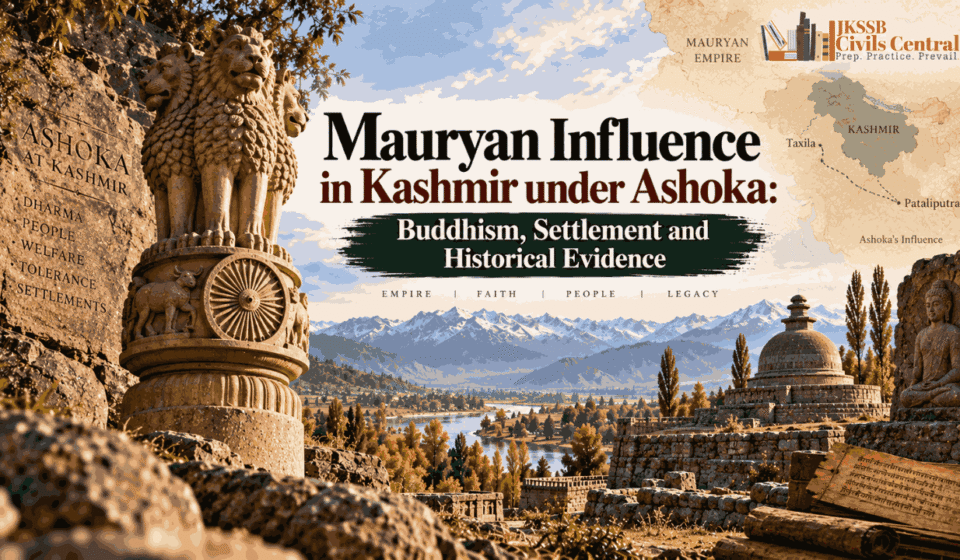
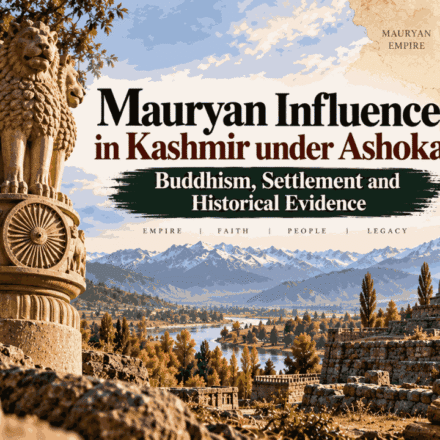
Mauryan Influence in Kashmir under Ashoka: Buddhism, Settlement and Historical Evidence

J&K History Series Navigation
| Previous Article | Current Article | Next Article |
|---|---|---|
| Article 05 — Alexander, Mauryas and the Early Historical Connections of Jammu & Kashmir | Article 06 — Mauryan Influence in Kashmir under Ashoka: Buddhism, Settlement and Historical Evidence | Article 07 — Kushan Kashmir: Kanishka, Buddhism, Trade and Cultural Exchange |
Learning Dashboard
| Component | Key Information |
|---|---|
| Historical Period | 3rd century BCE |
| Historical Phase | Ancient / Early Historical J&K |
| Main Ruler | Ashoka |
| Dynasty | Mauryan |
| Geographical Area | Kashmir Valley, especially Jhelum/Vitasta corridor |
| Core Theme | Mauryan political connection, Buddhist expansion, settlement and archaeological evidence |
| Key Buddhist Figure | Madhyāntika / Majjhantika |
| Important Settlement | Srinagari / Pandrethan tradition |
| Important Archaeological Site | Semthan |
| Important Material Evidence | NBPW, punch-marked coins and early historic settlement remains |
| Major Literary Source | Kalhana’s Rajatarangini |
| Buddhist Literary Tradition | Mahavamsa and related Buddhist traditions |
| Important Limitation | No known Ashokan edict from the Kashmir Valley |
| JKSSB Importance | Very High |
| Likely Question Types | Statement-based, chronology, source identification, matching, evidence-based, conceptual-factual |
Introduction
The Mauryan period marks one of the most important transitions in the early history of Kashmir. Earlier Article established the wider historical setting: Alexander’s campaign brought the north-western subcontinent into closer interaction with the Macedonian world, while the rise of the Mauryan Empire subsequently created a much larger political framework extending across northern India. This Article moves from that broad political connection to a more specific question: what evidence do we actually have for Mauryan influence in Kashmir under Ashoka, and how should the traditional accounts of Buddhism and settlement be evaluated?
Ashoka, who ruled the Mauryan Empire in the third century BCE, occupies a particularly important place in Kashmir’s historical memory. Later Kashmiri tradition associates him with the foundation of Srinagari, while Buddhist traditions connect his reign with the expansion of Buddhism into Kashmir through the missionary activities of Madhyāntika. Archaeological evidence, particularly from Semthan, provides an independent material context for the increasing integration of Kashmir into the early historic networks of northern India. At the same time, the absence of a known Ashokan inscription from the Kashmir Valley means that the historian cannot simply reconstruct Mauryan rule in Kashmir from the emperor’s own inscriptions in the way that is possible for several other parts of the subcontinent.
This makes Mauryan Kashmir a particularly useful case study in historical method. The evidence comes from different categories—archaeology, coins, later Kashmiri historiography, Buddhist literary traditions and comparative geography—and these sources do not all have the same evidentiary value. The strongest reconstruction therefore does not treat every traditional account as literal fact, nor does it dismiss literary traditions simply because they are later. Instead, it asks what each source can legitimately tell us and then places the pieces together.
CivilsCentral Historical Insight
The importance of Ashoka in Kashmir lies not simply in the traditional claim that he “introduced Buddhism” or “founded Srinagar.” The deeper historical significance is that the Mauryan age represents a phase of increasing political, economic and cultural integration between Kashmir and the wider early historic world, while the evidence itself teaches us how to distinguish archaeological fact from later historical memory.
Part I — Historical Background
1. Kashmir Before the Mauryan Age
The Kashmir Valley had a long cultural history before the Mauryas. The preceding articles in this series have established archaeological evidence for Neolithic settlement at sites such as Burzahom and Gufkral, followed by Megalithic and other prehistoric developments. By the early first millennium BCE, the Valley was no longer simply a prehistoric landscape; archaeological evidence points towards changing settlement patterns, metallurgy, agriculture and increasing interaction with neighbouring regions.
The emergence of early historic networks changed the nature of this interaction. Routes through the Jhelum Valley connected Kashmir with the Punjab and the north-west, while the wider network through Gandhara connected the region with Central Asia and the Indian plains. This geographical position became increasingly important as larger political formations emerged in the north-west.
The archaeological sequence at Semthan is particularly valuable in this context. Research on the site identifies a pre-NBPW phase followed by an NBPW phase, an Indo-Greek phase and later occupations, demonstrating that Kashmir participated in the broader early historic transformation rather than remaining culturally isolated.
2. From Alexander to the Mauryas
Alexander’s campaign of 327–325 BCE created a major political transformation in the north-west, but his empire did not permanently dominate the region. Following Alexander’s death in 323 BCE, the political order established by the Macedonian conquest fragmented. The Mauryan rise under Chandragupta Maurya subsequently transformed the political geography of northern India.
The Mauryan expansion brought the north-west into a much larger imperial framework. Kashmir’s location near the Jhelum corridor made its interaction with this expanding political system geographically plausible, and later evidence indicates that the Valley became increasingly connected to the Mauryan-era world.
The distinction between political incorporation and cultural interaction, however, is important. Archaeological material such as NBPW and punch-marked coins can demonstrate connections with wider early historic networks, but such material does not automatically prove the exact form of Mauryan administrative control. The political conclusion becomes stronger when archaeological evidence is considered together with literary traditions concerning Ashoka and Kashmir.
CivilsCentral Historical Insight
Mauryan influence should be understood as part of a longer process rather than as an isolated event. Alexander’s campaign altered the north-western political environment, Mauryan expansion consolidated a larger imperial framework, and Kashmir’s geographical position allowed the Valley to participate increasingly in these wider networks.
Part II — Ashoka and Kashmir
3. Ashoka: The Mauryan Ruler
Ashoka was the most important Mauryan ruler for the historical memory of Kashmir. His reign is generally placed in the third century BCE, conventionally around 268/269–232 BCE, although the chronology of his accession is expressed somewhat differently in different historical reconstructions. His significance extends beyond territorial expansion because his reign produced an unusually rich body of inscriptions concerning royal policy, ethical conduct and relations with religious communities.
Ashoka’s own inscriptions are among the most important primary sources for Mauryan history. They document his policy of Dhamma, concern for welfare and ethical conduct, and interactions with religious communities. The geographical distribution of these inscriptions is also important for reconstructing Mauryan political geography.
However, an important limitation must be emphasized for Kashmir: the Kashmir Valley has not yielded a known Ashokan rock or pillar edict comparable to the famous inscriptions at places such as Shahbazgarhi, Mansehra, Girnar, Dhauli or Sanchi. Consequently, the history of Ashoka in Kashmir cannot be reconstructed directly from a local Ashokan inscription.
This absence does not prove that Kashmir was outside the Mauryan Empire. It simply means that the evidence for Kashmir has to be assembled differently.
Part III — Literary Traditions of Ashoka in Kashmir
4. Ashoka in Kalhana’s Rajatarangini
The most important indigenous literary source connecting Ashoka with Kashmir is Kalhana’s Rajatarangini, composed in the twelfth century CE. Kalhana places an Ashoka in the early history of Kashmir and attributes significant building activity to him.
According to Kalhana’s account, Ashoka founded a city called Srinagari and associated several religious and architectural activities with his reign. The tradition also connects him with Buddhist establishments while simultaneously preserving references to Shaiva religious sites. This is significant because it does not support a simplistic picture in which Buddhism simply replaced every earlier religious tradition.
Modern scholarship must nevertheless treat Kalhana carefully. The Rajatarangini was written approximately fifteen centuries after the Mauryan period. Its account is therefore extremely valuable for understanding Kashmir’s historical memory and literary tradition, but individual details require comparison with archaeology and other sources.
5. Srinagari and Pandrethan
One of the most important traditions concerns Srinagari, the city attributed to Ashoka.
The archaeological and historical identification of Srinagari with Pandrethan, south-east of modern Srinagar, is a longstanding scholarly reconstruction. A University of Kashmir study notes that Pandrethan was identified in the historical tradition with the city founded by Ashoka under the name Srinagari and that the later settlement came to be associated with the name Puranadhisthana, or “old city.”
This distinction is essential because Ashoka’s Srinagari should not simply be equated with the entire modern city of Srinagar. The later capital associated with Pravarapura/Pravarasenapura developed in a different location, while the earlier settlement tradition became associated with Puranadhisthana/Pandrethan.
The historical importance of Pandrethan lies therefore in more than the name “Srinagari.” It provides a geographical context for understanding the emergence of urban centres along the Jhelum corridor and the gradual development of Kashmir’s early historic political landscape.
Examination distinction
Ashoka → Srinagari tradition → Pandrethan/Puranadhisthana
should not be converted into:
Ashoka → founded modern Srinagar exactly as it exists today.
The latter is an oversimplification.
Part IV — Ashoka and Buddhism in Kashmir
6. Buddhism Before and During Ashoka
The Buddhist literary tradition places Kashmir among the regions reached by Buddhist missionary activity associated with Ashoka’s reign. The Mahavamsa and related traditions associate Madhyāntika/Majjhantika with the propagation of Buddhism in Kashmir and Gandhara. An IGNCA-hosted historical study likewise records the tradition that Buddhism was introduced into Kashmir under Mauryan Ashoka through Madhyāntika.
The term “introduced”, however, needs historical qualification. Buddhist traditions naturally present missionary activity as a major turning point, but the precise process by which Buddhism became established in Kashmir cannot be reconstructed as a single conversion event. Religious traditions normally spread through repeated movement of monks, patronage, monasteries, local communities and interaction with pre-existing religious practices.
This is especially important because later Kashmiri evidence shows interaction between Buddhist and Brahmanical traditions rather than a simple sequence of one replacing the other. Kalhana’s account itself associates Ashoka with Buddhist establishments while also mentioning Shaiva temples and their repair. The historical process was therefore one of religious interaction and institutional development rather than an instantaneous religious transformation.
7. Madhyāntika/Majjhantika and the Buddhist Mission
Madhyāntika, also rendered Majjhantika in Pali tradition, occupies a central position in accounts of the early spread of Buddhism in Kashmir.
According to Buddhist traditions, he was sent towards Kashmir and Gandhara as part of the missionary activity associated with Ashoka. Later Buddhist traditions also preserve stories of his encounter with the Naga ruler of Kashmir. These accounts are religious narratives and contain miraculous elements; they should therefore not be treated as literal administrative or political records.
The historical importance of the Madhyāntika tradition lies elsewhere. It indicates that Kashmir was remembered within Buddhist intellectual traditions as an important destination for early missionary activity. The tradition also helps explain why Kashmir later became one of the significant centres of Buddhist learning in northern South Asia.
The precise historical career of Madhyāntika is difficult to establish independently. Different Buddhist traditions give different accounts of the transmission of the Buddhist teaching and of the chronology of the early missionary period. Consequently, the safest formulation is:
Buddhist traditions associate Madhyāntika/Majjhantika with the early propagation of Buddhism in Kashmir and Gandhara during the Mauryan age; the precise historical details of his mission remain difficult to establish independently.
8. The Naga Tradition and Historical Memory
The story of Madhyāntika’s encounter with the Naga ruler is particularly important in understanding Kashmir’s historical memory. In Buddhist accounts, the Naga ruler is associated with the pre-Buddhist sacred landscape of the Valley, while Madhyāntika represents the arrival and establishment of Buddhist teaching.
Such accounts should not be interpreted literally as evidence that a historical king named Aravala ruled Kashmir and was physically converted by a monk through supernatural powers. Their historical value is instead cultural and religious: they preserve a Buddhist interpretation of how a new religious order entered a landscape already populated by older sacred traditions.
This is a useful example of the evidence hierarchy used throughout the Premium J&K History Series.
Historical tradition: Buddhist missionaries associated with Madhyāntika reached Kashmir.
Traditional narrative: Madhyāntika subdued the Naga ruler and converted the region.
Archaeological question: When and how did Buddhist institutions actually develop in Kashmir?
These are related but not identical questions.
CivilsCentral Historical Insight
The Madhyāntika tradition should not be dismissed simply because it contains legendary elements. Its historical value lies in what it reveals about Buddhist memory and the perceived importance of Kashmir as a missionary destination. At the same time, legend cannot substitute for archaeological evidence concerning the actual chronology of Buddhist settlement.
Part V — Buddhist Institutions and Settlement
9. From Missionary Activity to Institutions
The spread of a religion across a large region requires more than individual preaching. Long-term religious establishment generally depends on settlements, monasteries, patronage, economic resources and networks of teachers and students. The Buddhist tradition concerning Kashmir therefore becomes historically more significant when considered alongside the later archaeological evidence for Buddhist establishments.
Kalhana’s account attributes several Buddhist constructions to Ashoka. A historical study hosted by IGNCA records the tradition that Ashoka built stupas at places identified with Sushkaletra and Vitastata, and that he established religious structures associated with Buddhist communities.
The exact identification and dating of every structure mentioned in later texts should not, however, be assumed to be archaeologically demonstrated. Some sites associated with Buddhist activity in Kashmir have substantial remains, but their surviving structures generally belong to later periods, especially the Kushan and post-Kushan phases.
This distinction is critical: a later Buddhist monument can demonstrate the strength of Buddhism at a later date without proving that the surviving structure itself was built by Ashoka.
10. Ashoka, Stupas and the Problem of Archaeological Attribution
Ashoka’s association with stupa construction is widespread in Buddhist historical traditions. He is remembered as a major patron who distributed Buddhist relics and supported religious establishments across the Mauryan realm.
In Kashmir, later tradition similarly attributes stupas and monasteries to him. But archaeology requires more precise evidence. A structure cannot be dated to Ashoka merely because a later literary source attributes it to him; archaeological stratigraphy, architectural analysis, inscriptions, associated material and secure dating are required.
This principle is particularly important in J&K history because many monuments have accumulated layers of construction, reconstruction and religious reuse over centuries. A monument associated with a famous ruler in later tradition may preserve an earlier memory while the surviving structure itself belongs to a substantially later period.
For examination purposes:
“Ashoka is traditionally associated with Buddhist construction in Kashmir” is defensible.
“Every surviving Buddhist structure attributed to Ashoka was physically built by him” is not.
Part VI — Semthan and the Material Evidence
11. Why Semthan Matters
If Kalhana and Buddhist literature provide textual traditions, Semthan provides some of the most important archaeological evidence for understanding the early historic transformation of Kashmir.
Semthan is located in the Anantnag region and occupies a strategic position in the Kashmir Valley. Excavations revealed a sequence extending from the pre-NBPW phase through the NBPW phase, Indo-Greek occupation and later periods. One scholarly reconstruction gives the following broad sequence:
- Period I — Pre-NBPW: c. 700–500 BCE
- Period II — NBPW: c. 500–200 BCE
- Period III — Indo-Greek: c. 200 BCE–1st century CE
- Period IV — Kushana-Huna: c. 1st–5th century CE
- later historical phases.
These dates should be understood as the conventional archaeological sequence rather than as absolute chronological boundaries. The larger significance is the continuity of occupation and the evidence for cultural transformation.
12. Northern Black Polished Ware at Semthan
The discovery of Northern Black Polished Ware (NBPW) at Semthan is one of the most important pieces of evidence for Kashmir’s early historic connections with northern India. NBPW is a fine ceramic tradition associated with early historic settlements in large parts of northern South Asia. Its occurrence at Semthan places Kashmir within a wider network of material culture extending far beyond the Valley.
The evidence must nevertheless be interpreted correctly. NBPW is not an exclusive Mauryan marker, nor does its presence by itself prove direct Mauryan administrative control. Its importance lies in the combination of chronology, stratigraphy, associated material and the broader historical context.
At Semthan, the NBPW phase is associated with other ceramics and material remains, demonstrating that the Valley was participating in wider patterns of production, consumption and exchange. The site is particularly important because it provides stratified evidence rather than isolated surface finds.
13. Punch-Marked Coins
Semthan also yielded punch-marked coins, including silver and copper examples associated with the early historic sequence. These coins provide evidence for Kashmir’s participation in the monetary environment of early historic northern India.
The presence of such coins is particularly useful when considered together with NBPW. Coins indicate participation in systems of exchange, while pottery can reveal cultural and economic connections. Together, these finds strengthen the argument that Kashmir was increasingly integrated into wider networks during the period associated with Mauryan expansion.
But again, a methodological caution is necessary. A coin found at an archaeological site does not automatically prove that the imperial government directly administered the settlement. Coins circulate through trade, taxation, payment, redistribution and other mechanisms. The historical interpretation therefore comes from the combination of evidence, not from one artefact in isolation.
14. Semthan as a Bridge Between Prehistory and Early History
Semthan is particularly valuable because it helps bridge a major chronological transition in Kashmir archaeology.
The site begins with an early phase before NBPW and continues through NBPW, Indo-Greek and later cultural horizons. This makes it possible to study change without imagining that Kashmir’s prehistoric world suddenly disappeared and a completely new civilization arrived overnight.
The archaeological sequence instead suggests continuity alongside transformation. Local settlement traditions interacted with new ceramic forms, monetary practices, technologies and external cultural influences.
CivilsCentral Historical Insight
Semthan demonstrates why archaeological evidence is indispensable for reconstructing Mauryan Kashmir. Literary sources tell us that Kashmir was remembered as part of Ashoka’s world; stratified archaeological material shows that the Valley was simultaneously participating in wider early historic systems of pottery, exchange and settlement.
Part VII — Settlement and Urban Development
15. Srinagari and the Emergence of Early Urban Centres
The tradition of Ashoka’s Srinagari is significant because it places urban development within the political history of Mauryan Kashmir. The Jhelum corridor provided access to water, transport routes and fertile areas, while elevated sites offered advantages for settlement in a Valley periodically affected by flooding.
The location associated with Pandrethan illustrates the importance of the riverine landscape. Later historical traditions remember it as an earlier capital before the political centre shifted towards the site of modern Srinagar.
However, urbanization should not be understood as a single event caused entirely by Ashoka. The emergence of urban centres usually reflects several interacting processes: political consolidation, trade, agricultural surplus, craft production, religious institutions and control of strategic routes.
Thus, even if the tradition of Ashoka’s foundation of Srinagari is accepted within the literary framework, its historical significance lies in the broader development of organized early historic settlement rather than merely in the act of founding a city.
16. The Jhelum as a Settlement Corridor
The Jhelum continued to be the principal geographical axis connecting different parts of Kashmir. Its significance stretches from the Vitasta of earlier geographical traditions to the Hydaspes of Greek accounts and the riverine landscape around the later capitals of Kashmir.
This continuity helps explain why political centres and archaeological sites developed along or near the river system. The river facilitated movement within the Valley and linked Kashmir with the Punjab and north-western routes.
The historical geography also explains why Kashmir’s political integration did not require the Valley to become culturally identical with the plains. Mountain geography created regional particularities, while river corridors created channels through which people, goods, ideas and institutions could move.
Part VIII — Political and Administrative Influence
17. What Can We Say About Mauryan Administration in Kashmir?
This is one of the areas where historical writing requires the greatest caution. The Mauryan Empire possessed an elaborate administrative system, known from sources such as Ashokan inscriptions and the Arthashastra, although the relationship between these sources and actual administrative practice is itself debated. It would therefore be tempting to list terms such as Rajuka, Pradeshika, Yukta and Mahamatra and assume that the same officials and institutions operated in Kashmir in exactly the same form.
That would exceed the evidence.
Ashokan inscriptions demonstrate that such officials and administrative concepts existed within the Mauryan imperial system. But the surviving evidence does not allow us to reconstruct a complete administrative hierarchy specifically for Kashmir in the third century BCE. The correct historical position is therefore that Kashmir was connected to the Mauryan political sphere, but the precise local structure of Mauryan administration in the Valley remains insufficiently documented.
This is an essential Premium CivilsCentral distinction between: Mauryan imperial administration in general and documented Mauryan administration in Kashmir.
18. Political Integration and Local Continuity
Political incorporation into a large empire did not necessarily eliminate local communities, cultural practices or regional institutions. The archaeological record at Semthan suggests continuity of settlement across changing cultural phases.
This is important because imperial integration should not be imagined as a complete replacement of local society by an external administrative apparatus. Empires generally operated through combinations of central authority, local elites, existing settlements, taxation, exchange networks and regional institutions.
For Kashmir, the evidence supports increasing integration but does not justify a detailed reconstruction of every administrative mechanism. The archaeological record tells us more securely about material and economic connectivity than about the exact organization of Mauryan officials inside the Valley.
CivilsCentral Historical Insight
The strongest historical claim is not that every Mauryan institution is known in Kashmir. It is that Kashmir entered a wider imperial and economic network during the Mauryan age. The limits of the evidence are themselves historically important because they prevent us from projecting the better-documented Mauryan administration of other regions directly onto Kashmir.
Part IX — Economy, Trade and Cultural Exchange
19. Kashmir’s Economic Integration
The appearance of NBPW and punch-marked coins at Semthan suggests that Kashmir was participating in wider systems of exchange during the early historic period. This participation would have involved movement through established geographical corridors connecting the Valley with the Punjab, Gandhara and other regions.
The economic implications should not be overstated. Archaeology does not permit us to calculate the volume of trade or reconstruct a complete Mauryan fiscal system for Kashmir. What it does demonstrate is that the Valley was not economically isolated and that material forms associated with broader northern Indian networks reached Kashmir.
The location of Semthan is particularly significant because later archaeological research has interpreted it as an important settlement in the internal geography of Kashmir, potentially functioning as a node connecting northern and southern parts of the Valley.
20. Agriculture and Settlement
Agricultural production remained the material foundation of settled society. The increasing development of organized settlements provided the economic base for political institutions, craft production and religious establishments.
However, the archaeological evidence should not be converted into an unsupported claim that Ashoka personally introduced a particular crop or agricultural technology into Kashmir. Agriculture in the Valley had much deeper roots, extending back to the Neolithic period.
The Mauryan-era transformation instead concerns the scale and connectivity of settlement, with new forms of pottery, metal objects, coins and external cultural influences appearing within an already established agricultural society.
Part X — Buddhism, Religious Plurality and Cultural Change
21. Buddhism Did Not Simply Replace Earlier Traditions
The religious history of Mauryan Kashmir should not be described as a simple transition from “Hinduism” to “Buddhism.” Such a formulation imposes modern religious categories on a much more complex ancient landscape.
Kashmir possessed older sacred traditions, including traditions associated with local deities and Naga worship. Buddhist traditions interpreted their expansion into the Valley through the story of Madhyāntika and the Naga ruler. Kalhana, meanwhile, preserves traditions in which Ashoka is associated with both Buddhist and Shaiva religious establishments.
The historical significance therefore lies in religious interaction and institutional development. Buddhism gained a foothold in Kashmir while older religious practices continued, and later centuries witnessed further interaction among Buddhist, Shaiva and other intellectual traditions.
22. Ashoka’s Dhamma and Buddhism: An Important Distinction
Another important distinction concerns Ashoka’s Dhamma. Ashoka’s inscriptions describe an ethical policy emphasizing such themes as respect, restraint, compassion and religious tolerance. These inscriptions are not simply statements of Buddhist doctrine. They represent a broader imperial ethical policy, although Ashoka’s personal commitment to Buddhism is also documented in some inscriptions and later traditions.
Therefore: Ashoka’s Dhamma ≠ simply Buddhism and Ashoka’s support for Buddhism ≠ establishment of Buddhism as an exclusive state religion.
This distinction matters particularly when interpreting Kashmir. Buddhist literary traditions emphasize missionary activity and patronage, while Ashoka’s own inscriptions present a broader ethical and political framework.
Part XI — Historical Sources
23. Ashokan Inscriptions
Ashoka’s inscriptions are the most direct primary evidence for his reign. They provide information about his political ideology, Dhamma, welfare measures, religious policy and relations with different parts of his empire. Their geographical distribution is also important for reconstructing Mauryan political geography.
But because a known Ashokan edict has not been found in the Kashmir Valley, these inscriptions cannot directly tell us the details of Mauryan administration inside Kashmir. Their value for Article 06 is therefore comparative and contextual.
24. Rajatarangini
Kalhana’s Rajatarangini is the most important indigenous narrative source for Kashmir’s political history. For the Mauryan period, however, it is a later source. Its account of Ashoka, Srinagari and Buddhist establishments is extremely important for reconstructing Kashmir’s historical memory. Yet its chronology and individual details must be compared with archaeology and other textual traditions.
For examination purposes:
Kalhana → Rajatarangini → later historical source
not:
Kalhana → contemporary Mauryan inscription
25. Buddhist Sources
Buddhist traditions, including the Mahavamsa and related literature, preserve accounts of missionary activity associated with Ashoka. These traditions are particularly important for the story of Madhyāntika and the spread of Buddhism in Kashmir and Gandhara.
Their limitation is that they were composed or transmitted in later periods and were shaped by religious purposes and traditions of Buddhist lineage. Miraculous elements must therefore be distinguished from the historical core.
The historical value of these sources is greatest when they are used to reconstruct the memory and institutional history of Buddhism, and when their claims are compared with archaeology.
Part XII — Evidence Hierarchy for Mauryan Kashmir
| Evidence / Claim | Evidence Level | Correct Historical Treatment |
|---|---|---|
| Ashoka was a Mauryan emperor of the 3rd century BCE | A | Strongly established |
| Ashokan edicts are primary sources for his reign | A | Strongly established |
| Kashmir is associated with Ashoka in later historical traditions | B | Strong historical tradition |
| Ashoka founded Srinagari | B | Based principally on Kalhana’s account |
| Srinagari is associated with Pandrethan | B | Established historical/archaeological identification, with qualifications |
| Ashoka built Buddhist establishments in Kashmir | B/C | Literary and Buddhist tradition; individual structures require archaeological verification |
| Madhyāntika was associated with the spread of Buddhism in Kashmir | B/C | Strong Buddhist tradition; exact historical chronology is difficult |
| Naga king was literally converted through miraculous events | C | Traditional Buddhist narrative |
| Semthan contains NBPW | A | Archaeologically established |
| Semthan contains punch-marked coins | A | Archaeologically established |
| Semthan demonstrates wider early historic connections | A/B | Strong archaeological interpretation |
| Every NBPW find proves direct Mauryan administration | D / Incorrect inference | Not justified |
| A known Ashokan edict exists in Kashmir Valley | Not established | Should not be claimed |
| Mauryan administration in Kashmir can be reconstructed in full detail | D | Evidence insufficient |
Part XIII — Historical Interpretation
26. The “Ashokan Kashmir” Question
The historical debate over Ashoka in Kashmir has partly arisen because different sources preserve different versions of the past. Kalhana’s Ashoka is embedded in the chronology of Kashmir’s own royal tradition, while Buddhist sources remember Ashoka primarily as a major patron of the Buddhist Sangha and missionary activity.
Archaeology adds another dimension. Semthan provides material evidence for early historic integration, but it does not carry an inscription saying “Ashoka ruled this site.” The historian therefore has to construct the larger picture from several different kinds of evidence.
The strongest interpretation is that Kashmir became part of the Mauryan political world and experienced increased cultural and economic integration during the Mauryan period, while the exact details of Ashoka’s personal activities in the Valley remain partly dependent on later literary traditions.
27. Was Ashoka the “Founder of Srinagar”?
The phrase “Ashoka founded Srinagar” is common in popular historical writing, but it requires precision.
Kalhana’s Rajatarangini attributes the foundation of Srinagari to Ashoka. The site has traditionally been associated with Pandrethan, while the later city associated with modern Srinagar developed under a subsequent ruler traditionally identified as Pravarasena.
According to Kalhana’s tradition, Ashoka founded Srinagari, which is generally associated with the early capital site at Pandrethan; this should not be treated as identical in every respect with the later urban foundation of modern Srinagar.
Part XIV — Historical Significance
28. Political Significance
The Mauryan period represents a major stage in the integration of Kashmir into the political networks of the north-western subcontinent. The Valley’s geographical position made it relevant to the Mauryan political system extending through the Punjab and Gandhara.
The evidence does not allow a detailed reconstruction of provincial administration, but the combination of literary tradition and archaeological evidence makes the broader Mauryan connection historically significant.
29. Economic Significance
The presence of NBPW and punch-marked coins at Semthan indicates that Kashmir was participating in wider systems of exchange and material culture. This suggests stronger economic interaction with northern India and the north-west.
The development should be understood as integration rather than replacement. Local economic practices continued while new goods, technologies, ceramic traditions and monetary forms entered the Valley.
30. Religious Significance
The Mauryan age occupies an important place in the early history of Buddhism in Kashmir. Buddhist traditions associate Ashoka and Madhyāntika with the establishment and propagation of Buddhism in the region.
However, Buddhism developed alongside older religious traditions rather than immediately eliminating them. This interaction laid part of the foundation for Kashmir’s later importance as a centre of Buddhist learning and intellectual exchange.
31. Settlement Significance
The Srinagari/Pandrethan tradition and archaeological evidence from Semthan point towards the growing importance of organized early historic settlements.
The significance lies not simply in the construction of one city but in the emergence of a more connected settlement system supported by agriculture, trade, craft production, political organization and religious institutions.
CivilsCentral Historical Insight
Mauryan influence transformed Kashmir’s position within the wider north-western world by strengthening political, economic and cultural connections. Yet the transformation was not a clean break with the past: archaeological continuity, local religious traditions and regional settlement patterns continued alongside new imperial and Buddhist influences.
Part XV — JKSSB Knowledge Matrix
| Question | Answer |
|---|---|
| Who? | Ashoka, Mauryan emperor |
| When? | 3rd century BCE |
| Where? | Kashmir Valley and wider north-western network |
| Which dynasty? | Mauryan |
| What happened? | Kashmir became connected with the Mauryan political and cultural sphere |
| Why important? | Political integration, early historic exchange and Buddhist development |
| Key Buddhist figure? | Madhyāntika/Majjhantika |
| Key city tradition? | Srinagari |
| Srinagari associated with? | Pandrethan/Puranadhisthana |
| Key archaeological site? | Semthan |
| Important pottery? | Northern Black Polished Ware |
| Important numismatic evidence? | Punch-marked coins |
| Important literary source? | Rajatarangini |
| Important Buddhist source tradition? | Mahavamsa and related Buddhist literature |
| What is not available? | A known Ashokan edict from the Kashmir Valley |
| Main archaeological significance? | Evidence of early historic integration |
| Main religious significance? | Early Buddhist missionary and institutional traditions |
| Main examination trap? | Treating later literary traditions as contemporary inscriptions |
Part XVI — Examination Discrimination Points
1. Ashoka vs Kanishka
Ashoka
- Mauryan
- 3rd century BCE
- early Buddhist missionary traditions in Kashmir
Kanishka
- Kushan
- 1st/2nd century CE
- later major phase of Buddhist development in Kashmir
The two should never be conflated.
2. Srinagari vs Srinagar
Srinagari — associated in Kalhana’s tradition with Ashoka.
Pandrethan/Puranadhisthana — associated with the old capital tradition.
Pravarapura/Pravarasenapura — associated with the later city at the site of modern Srinagar.
3. Madhyāntika vs Kanishka
Madhyāntika → early Buddhist missionary tradition.
Kanishka → later Kushan patronage and major Buddhist development.
4. NBPW vs Buddhism
NBPW is an archaeological ceramic tradition, not a Buddhist artefact.
Its presence indicates early historic cultural and economic connections.
5. Literary vs Archaeological Evidence
| Literary | Archaeological |
|---|---|
| Rajatarangini | Semthan excavation |
| Buddhist traditions | NBPW |
| Mahavamsa | Punch-marked coins |
| Later accounts | Stratified settlement remains |
6. Ashoka’s Dhamma vs Buddhism
Ashoka supported Buddhism, but his Dhamma was a broader ethical and social policy, not simply a synonym for Buddhist doctrine.
Part XVII — JKSSB Question-Type Mapping
Direct Fact
Which Mauryan ruler is traditionally associated with the foundation of Srinagari in Kashmir?
Answer: Ashoka.
Statement-Based
Consider the following statements:
- Kalhana’s Rajatarangini associates Ashoka with Srinagari.
- Srinagari is traditionally associated with Pandrethan.
- A known Ashokan pillar edict has been discovered in the Kashmir Valley.
- Semthan provides early historic archaeological evidence.
Correct: 1, 2 and 4 only.
Chronology
Arrange in chronological order:
- Ashoka
- Kanishka
- Lalitaditya
- Avantivarman
Answer: Ashoka → Kanishka → Lalitaditya → Avantivarman.
Match the Following
| Column I | Column II |
|---|---|
| Ashoka | Mauryan |
| Kanishka | Kushan |
| Srinagari | Ashoka tradition |
| Semthan | NBPW |
| Madhyāntika | Buddhist missionary tradition |
Identification by Clues
Identify the archaeological site:
- Early historic Kashmir
- NBPW
- Punch-marked coins
- Indo-Greek phase
- Anantnag region
Answer: Semthan
Conceptual-Factual
Why should NBPW at Semthan not automatically be treated as proof of direct Mauryan administration?
Because archaeological material demonstrates cultural and economic connections but does not, by itself, establish the exact political-administrative mechanism through which those connections operated.
Part XVIII — JKSSB Practice Questions
Question 1
Which Mauryan ruler is most strongly associated with the early Buddhist and urban traditions of Kashmir?
A. Chandragupta Maurya
B. Bindusara
C. Ashoka
D. Brihadratha
Correct Answer: C. Ashoka
Ashoka is the Mauryan ruler associated with Srinagari and early Buddhist traditions concerning Kashmir.
Question 2
According to Kashmiri historical tradition, Ashoka founded:
A. Parihasapura
B. Srinagari
C. Pravarapura
D. Lalitapura
Correct Answer: B. Srinagari
Kalhana’s Rajatarangini associates Srinagari with Ashoka. The identification of the site with Pandrethan belongs to later historical reconstruction.
Question 3
Which archaeological site is particularly important for evidence of NBPW and punch-marked coins in Kashmir?
A. Burzahom
B. Gufkral
C. Semthan
D. Harwan
Correct Answer: C. Semthan
Semthan’s stratified early historic deposits include NBPW and punch-marked coins.
Question 4
Consider the following statements:
- Madhyāntika is associated with the early spread of Buddhism in Kashmir.
- His activities are known entirely from contemporary Ashokan inscriptions.
- Buddhist traditions associate him with Kashmir and Gandhara.
Which of the above is/are correct?
A. 1 only
B. 1 and 3 only
C. 2 and 3 only
D. 1, 2 and 3
Correct Answer: B
Madhyāntika belongs primarily to Buddhist literary traditions; his activities are not documented by a surviving contemporary Ashokan inscription from Kashmir.
Question 5
Which of the following best describes the historical value of NBPW at Semthan?
A. It proves that Ashoka personally founded Semthan.
B. It proves that Buddhism was the only religion in Kashmir.
C. It provides evidence of Kashmir’s participation in wider early historic cultural and economic networks.
D. It proves that Semthan was the Mauryan capital of Kashmir.
Correct Answer: C
Question 6
Which source is most directly associated with the tradition of Ashoka founding Srinagari?
A. Rajatarangini
B. Arthashastra
C. Indica of Megasthenes
D. Harshacharita
Correct Answer: A. Rajatarangini
Question 7
Which of the following pairs is correctly matched?
A. Ashoka — Kushan
B. Kanishka — Mauryan
C. Madhyāntika — Buddhist missionary tradition
D. Semthan — Mughal-period capital
Correct Answer: C
Question 8
The absence of a known Ashokan edict from Kashmir means:
A. Kashmir definitely lay outside the Mauryan Empire.
B. Ashoka had no connection with Kashmir.
C. The evidence for Mauryan Kashmir must rely more heavily on literary and archaeological sources.
D. Semthan cannot be dated to the early historic period.
Correct Answer: C
Question 9
Which one of the following statements is the most historically cautious?
A. Ashoka converted every Kashmiri to Buddhism.
B. Ashoka introduced Buddhism into Kashmir through a single event.
C. Buddhist traditions associate the Mauryan age with missionary activity and the expansion of Buddhism in Kashmir.
D. Buddhism began in Kashmir only during the Kushan period.
Correct Answer: C
Question 10
The term Puranadhisthana is associated in the historical tradition with:
A. An ancient/old city associated with the Pandrethan area
B. A Kushan military fort
C. A Mauryan coin
D. A Buddhist council
Correct Answer: A
Part XIX — Rapid Revision Zone
Important Dates
| Date/Period | Development |
|---|---|
| c. 4th century BCE | Mauryan rise begins |
| 3rd century BCE | Ashokan period |
| c. 268/269–232 BCE | Conventional chronology for Ashoka’s reign |
| c. 700–500 BCE | Semthan pre-NBPW phase |
| c. 500–200 BCE | Semthan NBPW phase |
| c. 200 BCE–1st century CE | Indo-Greek phase at Semthan |
Important Personalities
Ashoka
Mauryan emperor associated with Kashmir’s early Buddhist and Srinagari traditions.
Madhyāntika / Majjhantika
Buddhist missionary figure associated by Buddhist traditions with the propagation of Buddhism in Kashmir and Gandhara.
Kalhana
Twelfth-century author of Rajatarangini, the major indigenous literary source preserving the Ashoka-Srinagari tradition.
Important Places
- Pandrethan
- Srinagari
- Puranadhisthana
- Semthan
- Jhelum/Vitasta
- Bijbehara/Anantnag region
Important Sources
Ashokan inscriptions → primary evidence for Ashoka’s wider reign and Dhamma
Rajatarangini → Kashmir’s later historical tradition
Mahavamsa and Buddhist traditions → missionary tradition involving Madhyāntika
Semthan archaeology → NBPW, coins, settlement and early historic cultural connections
Important Associations
Ashoka → Mauryan → 3rd century BCE
Ashoka → Srinagari → Pandrethan tradition
Madhyāntika → Buddhism → Kashmir/Gandhara
Semthan → NBPW → punch-marked coins
Semthan → early historic → Indo-Greek sequence
Chronological Sequence
Neolithic Kashmir
↓
Megalithic developments
↓
Early historic transition
↓
Mauryan connection
↓
Ashoka
↓
Buddhist missionary traditions
↓
Semthan NBPW phase
↓
Indo-Greek phase
↓
Kushan period
One-Line Revision Facts
- Ashoka was a Mauryan ruler of the 3rd century BCE.
- Kashmir is associated with Ashoka primarily through literary tradition and archaeological context.
- Srinagari is traditionally associated with Ashoka.
- Srinagari is generally associated with the Pandrethan area.
- Puranadhisthana means the old city in the relevant historical tradition.
- Madhyāntika/Majjhantika is associated with the early spread of Buddhism in Kashmir.
- Semthan is a major early historic archaeological site of Kashmir.
- NBPW occurs at Semthan.
- Punch-marked coins occur at Semthan.
- NBPW alone does not prove direct Mauryan administration.
- A known Ashokan edict has not been found in the Kashmir Valley.
- Kalhana’s Rajatarangini is a later source, not a contemporary Mauryan inscription.
- Ashoka’s Dhamma should not be equated mechanically with Buddhist doctrine.
- Kanishka belongs to the later Kushan period, not the Mauryan period.
Part XX — Frequently Confused Facts
| Confusion | Correct Distinction |
|---|---|
| Ashoka vs Kanishka | Ashoka = Mauryan; Kanishka = Kushan |
| Srinagari vs modern Srinagar | Srinagari belongs to Ashokan literary tradition; later urban development produced modern Srinagar |
| Pandrethan vs modern Srinagar | Pandrethan is associated with the old capital/Srinagari tradition |
| Madhyāntika vs Kanishka | Madhyāntika = early Buddhist missionary tradition; Kanishka = later Buddhist patron |
| NBPW vs Buddhism | NBPW = ceramic tradition; not a Buddhist artefact |
| NBPW vs Mauryan administration | NBPW indicates cultural connection; does not alone prove political administration |
| Rajatarangini vs Ashokan edicts | Rajatarangini = 12th-century literary source; edicts = 3rd-century BCE primary inscriptions |
| Ashoka’s Dhamma vs Buddhism | Dhamma was a broader ethical policy |
| Buddhist tradition vs archaeology | Buddhist texts preserve religious/historical memory; archaeology independently tests settlement and material claims |
Part XXI — What Can JKSSB Ask?
High-Value Areas
From this article, questions can be framed around:
- Ashoka’s dynasty and chronology
- Mauryan period in Kashmir
- Srinagari
- Pandrethan
- Puranadhisthana
- Madhyāntika/Majjhantika
- early Buddhist traditions
- Semthan
- NBPW
- punch-marked coins
- Ashokan inscriptions
- absence/presence of direct epigraphic evidence
- literary versus archaeological evidence
- Ashoka vs Kanishka
- chronology of Mauryan and Kushan Kashmir
- distinction between Dhamma and Buddhism
- cause-and-consequence questions on Kashmir’s integration into wider networks.
Particularly Useful Statement Traps
“An Ashokan pillar inscription has been found at Srinagar.” – Incorrect.
“Kalhana associates Ashoka with Srinagari.” – Correct.
“Pandrethan is associated with the old capital/Srinagari tradition.” – Correct.
“Madhyāntika is associated with the spread of Buddhism in Kashmir.” – Correct as a Buddhist historical tradition.
“NBPW at Semthan proves that Ashoka personally administered the site.” – Incorrect.
“Semthan provides evidence for Kashmir’s participation in early historic networks.” – Correct.
Chapter Summary
The Mauryan period represents a decisive stage in the early historical development of Kashmir. Following the north-western transformations associated with Alexander, Mauryan expansion brought the region into a larger political and economic environment. Ashoka became the most important Mauryan ruler in Kashmir’s historical memory, with later traditions associating him with the foundation of Srinagari, Buddhist establishments and the wider development of the Valley.
The religious history of this period is preserved particularly strongly in Buddhist traditions. Madhyāntika/Majjhantika is associated with the early propagation of Buddhism in Kashmir and Gandhara, while Kalhana’s Rajatarangini also preserves an Ashoka who patronized Buddhist establishments. These accounts are historically valuable but cannot all be treated as contemporary documentary evidence. The Naga conversion story, for example, belongs to religious tradition rather than independently verifiable political history.
Archaeology provides an essential second line of evidence. Semthan contains a stratified early historic sequence, including an NBPW phase and punch-marked coins, followed by an Indo-Greek phase. This material demonstrates that Kashmir was participating in wider systems of exchange and cultural interaction during the period in which Mauryan power dominated northern India.
The central historical conclusion is therefore more nuanced than the simple statement “Ashoka brought Buddhism to Kashmir.” The Mauryan age strengthened Kashmir’s political, economic and cultural connections with the wider subcontinent; Buddhist traditions associated this transformation with Ashoka and Madhyāntika; and archaeological evidence independently demonstrates the emergence of a more connected early historic cultural landscape.
Mind Map
                 MAURYAN KASHMIR
                       │
                       ▼
                    ASHOKA
                       │
          ┌────────────┼─────────────┐
          ▼            ▼             ▼
      POLITICAL     RELIGIOUS     SETTLEMENT
      CONNECTION    CHANGE        DEVELOPMENT
          │            │             │
          │            ▼             ▼
          │       MADHYĀNTIKA     SRINAGARI
          │            │          / PANDRETHAN
          │            ▼             │
          │       BUDDHISM           ▼
          │                           │
          └────────────┬──────────────┘
                       ▼
                   SEMTHAN
                       │
          ┌────────────┼─────────────┐
          ▼            ▼             ▼
        NBPW     PUNCH-MARKED    EARLY HISTORIC
                   COINS           SETTLEMENT
          │            │             │
          └────────────┼─────────────┘
                       ▼
              WIDER NETWORKS
             OF NORTH INDIA
                       │
                       ▼
                INDO-GREEKS
                       │
                       ▼
                  KUSHANS
FAQs
1. Who was Ashoka?
Ashoka was a major ruler of the Mauryan Empire in the 3rd century BCE and one of the best-documented rulers of ancient South Asia because of his extensive inscriptions.
2. What is Ashoka’s connection with Kashmir?
Later Kashmir tradition associates Ashoka with the foundation of Srinagari and Buddhist establishments, while archaeological evidence from sites such as Semthan demonstrates Kashmir’s participation in the early historic world of the Mauryan period.
3. Did Ashoka found modern Srinagar?
The cautious formulation is that Kalhana attributes the foundation of Srinagari to Ashoka, and Srinagari is traditionally associated with the Pandrethan area. This should not be equated uncritically with the entire later history of modern Srinagar.
4. Who was Madhyāntika?
Madhyāntika, or Majjhantika, is a Buddhist missionary figure associated by Buddhist traditions with the early propagation of Buddhism in Kashmir and Gandhara.
5. Is the story of Madhyāntika and the Naga king historically proven?
No. The story belongs to Buddhist religious tradition and contains legendary elements. Its historical value lies in preserving the memory of early Buddhist missionary activity in Kashmir.
6. What is the importance of Semthan?
Semthan provides important archaeological evidence for early historic Kashmir, including NBPW, punch-marked coins and an archaeological sequence continuing into the Indo-Greek period.
7. Was an Ashokan inscription found in Kashmir?
A known Ashokan rock or pillar edict has not been identified in the Kashmir Valley. This is why literary and archaeological evidence becomes particularly important for reconstructing Ashoka’s connection with Kashmir.
8. Does NBPW prove that Kashmir was directly administered by Ashoka?
No. NBPW demonstrates participation in wider early historic cultural networks. Direct political administration requires a broader evidentiary basis.
9. Was Buddhism the only religion in Kashmir under Ashoka?
There is no basis for such a claim. Later Kashmir traditions preserve both Buddhist and Shaiva religious associations, indicating a more complex religious environment.
10. What is the main difference between Ashoka and Kanishka in Kashmir history?
Ashoka belongs to the Mauryan period of the 3rd century BCE, while Kanishka belongs to the Kushan period, several centuries later. Both are associated with Buddhism, but they belong to different dynasties and historical phases.
About The Author




[…] Article 06 — Mauryan Influence in Kashmir under Ashoka: Buddhism, Settlement and Historical Eviden… […]
[…] Article 06 — Mauryan Influence in Kashmir under Ashoka: Buddhism, Settlement and Historical Eviden… […]